
Skip to main content Accessibility help
×
  • Cited by 9
    • Show more authors
    • You may already have access via personal or institutional login
    • Select format
    • Publisher:
      Cambridge University Press
      Publication date:
      25 May 2021
      03 June 2021
      ISBN:
      9781108872416
      9781108836784
      9781108819190
      Dimensions:
      (229 x 152 mm)
      Weight & Pages:
      0.58kg, 316 Pages
      Dimensions:
      (229 x 152 mm)
      Weight & Pages:
      0.463kg, 316 Pages
    You may already have access via personal or institutional login
  • Selected: Digital
    Add to cart View cart Buy from Cambridge.org

    Book description

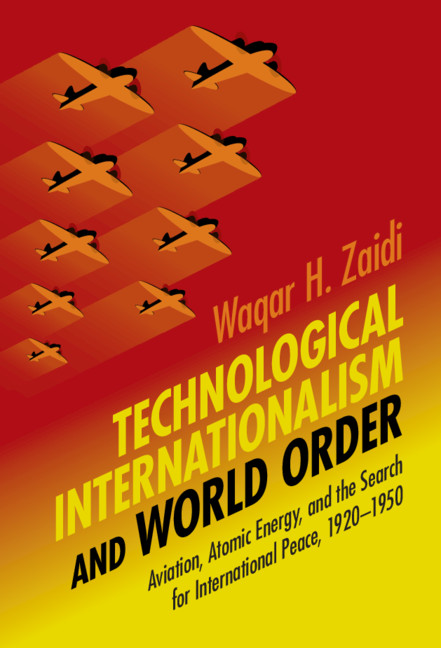
    Between 1920 and 1950, British and US internationalists called for aviation and atomic energy to be taken out of the hands of nation-states, and instead used by international organizations such as the League of Nations and the United Nations. An international air force was to enforce collective security and internationalized civil aviation was to bind the world together through trade and communication. The bomber and the atomic bomb, now associated with death and devastation, were to be instruments of world peace. Drawing on rich archival research and focusing on public and private discourse relating to the control of aviation and atomic energy, Waqar H. Zaidi highlights neglected technological and militaristic strands in twentieth-century liberal internationalism, and transforms our understanding of the place of science and technology in twentieth-century international relations.

    Awards

    2022 Turriano ICOHTEC Prize, Fundación Juanelo Turriano

    Reviews

    ‘In his profound and thoroughly researched study of how the coming of aeroplanes and the atomic bomb inspired new thinking about global peace through the international control of these inventions, S. Waqar H. Zaidi offers a masterclass in how the history of internationalism should be written.'

    Joseph Maiolo - author of Cry Havoc: How the Arms Race Drove the World to War, 1931-194

    ‘The bomber and the bomb changed the world, but how did they change thinking about international society? Zaidi's brilliantly original study, places military technologies at the heart of the history of 20th-century internationalism. Connecting the interwar period with the Cold War, it will be essential reading for anyone interested in understanding both the ambition and the frustrations of the internationalist project.'

    Adam Tooze - author of Crashed: How a Decade of Financial Crises Changed the World

    ‘Weaving together the histories of aviation and atomic energy, Zaidi makes innovative contributions to scholarship on technology and internationalism. He deftly analyzes how policymakers and intellectuals, on both sides of the Atlantic, sought to transform the airplane and the atomic bomb into catalysts of global order rather than global catastrophe.'

    Jenifer Van Vleck - author of Empire of the Air: Aviation and the American Ascendancy

    Refine List

    Actions for selected content:

    Select all | Deselect all
    • View selected items
    • Export citations
    • Download PDF (zip)
    • Save to Kindle
    • Save to Dropbox
    • Save to Google Drive

    Save Search

    You can save your searches here and later view and run them again in "My saved searches".

    Please provide a title, maximum of 40 characters.
    ×

    Contents

    Metrics

    Altmetric attention score

    Full text views

    Total number of HTML views: 0
    Total number of PDF views: 0 *
    Loading metrics...

    Book summary page views

    Total views: 0 *
    Loading metrics...

    * Views captured on Cambridge Core between #date#. This data will be updated every 24 hours.

    Usage data cannot currently be displayed.

    Accessibility standard: Unknown

    Why this information is here

    This section outlines the accessibility features of this content - including support for screen readers, full keyboard navigation and high-contrast display options. This may not be relevant for you.

    Accessibility Information

    Accessibility compliance for the HTML of this book is currently unknown and may be updated in the future.
