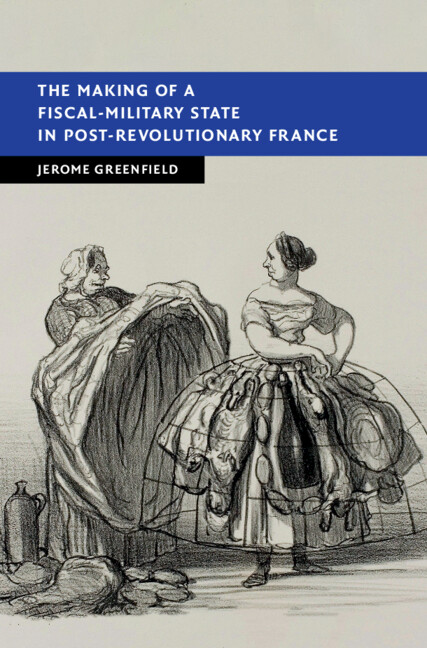

Drawing on a wide range of archival and published documents, this book explains how the French Revolution of 1789 transformed the French state and its fiscal system, and how further reforms in the nineteenth century created a durable, post-revolutionary state. Instead of presenting the nineteenth-century French state as primarily the creation of the Revolutionary and Napoleonic era, as most scholars have done, Jerome Greenfield emphasises the importance of counter-revolution after 1815 in establishing a stable, durable state, capable of surviving revolutions in 1830 and 1848 intact. The years 1815–1870 thus marked a crucial period in the development of the French state, not least in stimulating the economic interventionism for which it become notorious and facilitating the resurgence of France as a great power after Napoleon's defeat at Waterloo.
‘Jerome Greenfield’s study provides a lucid account of the ways in which France created a resilient modern fiscal state, while successive regimes struggled in their attempts to establish a stable political system in the aftermath of French Revolution.’
Joel Felix - University of Reading
‘This is an important book, one that needs to be read by all those working on the evolution of the European state. It is a thoroughly researched study, a genuine work of history.’
Samuel Clark Source: European Review of History: Revue européenne d'histoire
‘A standard work on the history of public finance in France.’
Friedemann Pestel Source: H-Soz-Kult
‘… offers a different but compelling reinterpretation of the period, focusing on the fiscal policies of the different regimes that governed France from Waterloo to Sedan. This approach is particularly relevant not only for specialists in French history but also for those studying the construction of fiscal-military states across Europe and the interaction between fiscal policies and the creation of global empires. Greenfield leads his reader to a deeper understanding of the complex financial and fiscal system that transformed post-Napoleonic France from a defeated and weakened power into an imperial power engaged in military and economic activities that stretched from Asia to Africa and Central America. Through a meticulous examination of state and private archival sources, he sheds new light on the political dimensions of the fiscal choices made by the different post-Revolutionary regimes. At the same time, he successfully manages to illustrate the local and the international dimensions of the fiscal-military state in France across the nineteenth century.‘
Niccolò Valmori Source: Journal of Modern History
Loading metrics...
* Views captured on Cambridge Core between #date#. This data will be updated every 24 hours.
Usage data cannot currently be displayed.
This section outlines the accessibility features of this content - including support for screen readers, full keyboard navigation and high-contrast display options. This may not be relevant for you.
Accessibility compliance for the HTML of this book is currently unknown and may be updated in the future.
