
Skip to main content Accessibility help
×
  • Cited by 3
    • Show more authors
    • You may already have access via personal or institutional login
    • Select format
    • Publisher:
      Cambridge University Press
      Publication date:
      21 November 2020
      17 December 2020
      ISBN:
      9781108906975
      9781108842211
      9781108820387
      Dimensions:
      (229 x 152 mm)
      Weight & Pages:
      0.53kg, 264 Pages
      Dimensions:
      (229 x 152 mm)
      Weight & Pages:
      0.392kg, 264 Pages
    You may already have access via personal or institutional login
  • Selected: Digital
    Add to cart View cart Buy from Cambridge.org

    Book description

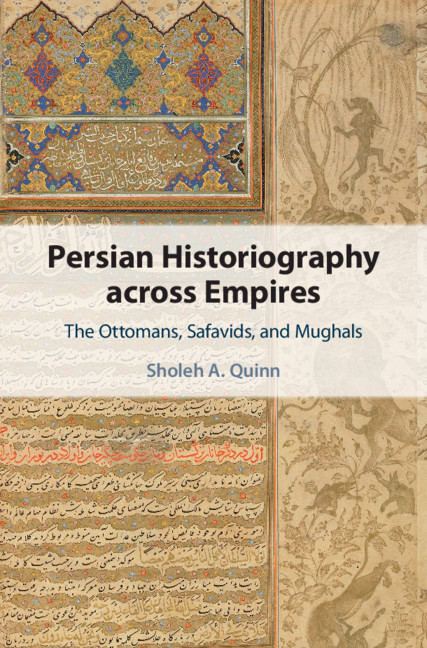
    Persian served as one of the primary languages of historical writing over the period of the early modern Islamic empires of the Ottomans, Safavids and Mughals. Historians writing under these empires read and cited each other's work, some moving from one empire to another, writing under different rival dynasties at various points in time. Emphasising the importance of looking beyond the confines of political boundaries in studying this phenomenon, Sholeh A. Quinn employs a variety of historiographical approaches to draw attention to the importance of placing these histories not only within their historical context, but also historiographical context. This comparative study of Persian historiography from the 16th-17th centuries presents in-depth case analyses alongside a wide array of primary sources written under the Ottomans, Safavids and Mughals to illustrate that Persian historiography during this era was part of an extensive universe of literary-historical writing.

    Reviews

    ‘Sholeh Quinn has written a must-read book for anyone considering the historiographical connections within the early modern Persianate world and the texts circulating across the Ottoman, Safavid, and Mughal empires. She delineates a rich tradition of shared accounts about the benefits of history, bibliographies, dream narratives, and genealogies.’

    Rula Jurdi Abisaab - McGill University

    ‘In this indispensable book, Sholeh Quinn teaches us to read a tradition of history writing central to our knowledge of early modern Persianate Asia. She illuminates common features, borrowings, innovations, and methods linking these texts. Persian Historiography across Empires redefines our vision of empires and dynasties and opens new pathways through history itself.’

    Mana Kia - Columbia University

    ‘A superb study of the 16th and 17th century histories produced across the Ottoman, Safavid, Shaybanid and Mughal realms. Quinn deftly shows the period’s chroniclers, writing in Persian, the region’s lingua franca, navigating between the Timurid ‘historiographical inheritance’, each other’s contributions and local politico-cultural discourses. After Historical Writing, another stunning contribution!’

    Andrew J Newman - University of Edinburgh

    Refine List

    Actions for selected content:

    Select all | Deselect all
    • View selected items
    • Export citations
    • Download PDF (zip)
    • Save to Kindle
    • Save to Dropbox
    • Save to Google Drive

    Save Search

    You can save your searches here and later view and run them again in "My saved searches".

    Please provide a title, maximum of 40 characters.
    ×

    Contents

    Metrics

    Altmetric attention score

    Full text views

    Total number of HTML views: 0
    Total number of PDF views: 0 *
    Loading metrics...

    Book summary page views

    Total views: 0 *
    Loading metrics...

    * Views captured on Cambridge Core between #date#. This data will be updated every 24 hours.

    Usage data cannot currently be displayed.

    Accessibility standard: Unknown

    Why this information is here

    This section outlines the accessibility features of this content - including support for screen readers, full keyboard navigation and high-contrast display options. This may not be relevant for you.

    Accessibility Information

    Accessibility compliance for the HTML of this book is currently unknown and may be updated in the future.
