
Skip to main content Accessibility help
×
  • Cited by 2
    • Show more authors
    • You may already have access via personal or institutional login
    • Select format
    • Publisher:
      Cambridge University Press
      Publication date:
      25 February 2021
      11 March 2021
      ISBN:
      9781108917216
      9781108831413
      9781108932912
      Dimensions:
      (229 x 152 mm)
      Weight & Pages:
      0.59kg, 302 Pages
      Dimensions:
      (229 x 152 mm)
      Weight & Pages:
      0.44kg, 302 Pages
    You may already have access via personal or institutional login
  • Selected: Digital
    Add to cart View cart Buy from Cambridge.org

    Book description

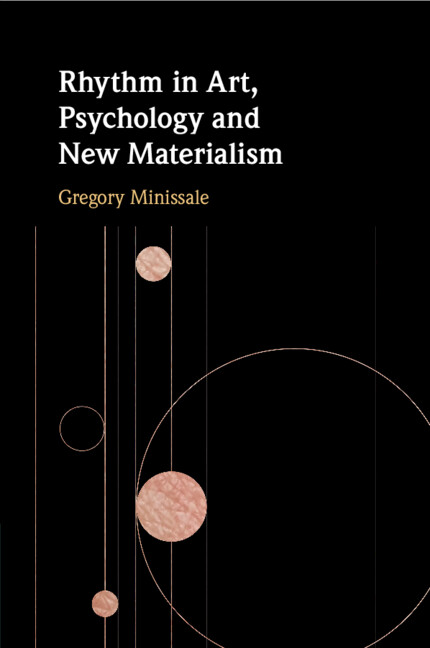
    This book examines the psychology involved in handling, and responding to, materials in artistic practice, such as oils, charcoal, brushes, canvas, earth, and sand. Artists often work with intuitive, tactile sensations and rhythms that connect them to these materials. Rhythm connects the brain and body to the world, and the world of abstract art. The book features new readings of artworks by Matisse, Pollock, Dubuffet, Tápies, Benglis, Len Lye, Star Gossage, Shannon Novak, Simon Ingram, Lee Mingwei, L. N. Tallur and many others. Such art challenges centuries of philosophical and aesthetic order that has elevated the substance of mind over the substance of matter. This is a multidisciplinary study of different metastable patterns and rhythms: in art, the body, and the brain. This focus on the propagation of rhythm across domains represents a fresh art historical approach and provides important opportunities for art and science to cooperate.

    Reviews

    ‘This is a wonderful book, giving us new ways of understanding art and illustrated with well-chosen artwork. It is a story of the interplay between mind and matter, revealing the rhythmic textures of artistic creation and taking us beyond art itself into perceptual psychology, evolution and neuroscience.’

    Michael Corballis - Professor Emeritus of Psychology, University of Auckland, New Zealand, and author of The Truth about Language

    ‘The author has an astonishing knowledge of great thinkers, artists, art criticism and neuroaesthetics. It is a remarkably easy read, considering its subject, and it is no-where self-indulgent or pretentious. If I were to teach any course on twentieth-century art or abstraction, I would adopt it as a textbook or required reading.’

    John Onians - Professor Emeritus of Art History, University of East Anglia, UK, and author of Neuroarthistory: From Aristotle and Pliny to Baxandall and Zeki

    ‘Gregory Minissale offers an enthralling analysis of the vibrant materiality of abstract art. He brilliantly shows that to be truly open to the encounter with art one needs to embrace perceptual ambiguity and let go of rigorous cognitive control. Masterfully intertwining theories of art reception with phenomenology and recent findings in cognitive sciences, he casts light on the complexity of aesthetic relations unfolding beneath the surface of the conscious mind.’

    Cristina Albu - Associate Professor of Contemporary Art History and Theory, University of Missouri-Kansas City, USA, and author of Mirror Affect: Seeing Self, Observing Others in Contemporary Art

    Refine List

    Actions for selected content:

    Select all | Deselect all
    • View selected items
    • Export citations
    • Download PDF (zip)
    • Save to Kindle
    • Save to Dropbox
    • Save to Google Drive

    Save Search

    You can save your searches here and later view and run them again in "My saved searches".

    Please provide a title, maximum of 40 characters.
    ×

    Contents

    Metrics

    Altmetric attention score

    Full text views

    Total number of HTML views: 0
    Total number of PDF views: 0 *
    Loading metrics...

    Book summary page views

    Total views: 0 *
    Loading metrics...

    * Views captured on Cambridge Core between #date#. This data will be updated every 24 hours.

    Usage data cannot currently be displayed.

    Accessibility standard: Unknown

    Why this information is here

    This section outlines the accessibility features of this content - including support for screen readers, full keyboard navigation and high-contrast display options. This may not be relevant for you.

    Accessibility Information

    Accessibility compliance for the HTML of this book is currently unknown and may be updated in the future.
