

Introduction
We began thinking about this case study chapter in the midst of a global pandemic. COVID-19 still has much of the world in various degrees of lock-down and presents unprecedented challenges, anxieties and concerns. In April 2020, as the global numbers of infections and the death count climbed exponentially, Uganda also began registering and reporting its first cases, responded to with drastic political measures carrying far-reaching socio-political and economic consequences for vast parts of the country’s population. Yet, whereas various politicians and commentators around the world consider this epidemic to be one of the biggest challenges since World War II, in the north of Uganda the pandemic in many ways constitutes yet another episode in a series of crises and disasters. In addition to an Ebola outbreak in the early 2000s, and an influx of over one million Southern Sudanese refugees during the years prior to this crisis (bringing with it a set of socio-economic and political difficulties for refugee and host populations alike), the populace in northern Uganda also specifically suffered from the more than two-decade-long civil war between the Lord’s Resistance Army (LRA) rebel group and the Government of Uganda. In the words of one of our research participants, shared via social media: ‘Things are tough with Corona, but we will manage. We managed to live through the LRA-led violence, and so we will even overcome this. We have become resilient enough.’ In this chapter, we are interested in examining what aspects, processes and capacities may play a role in fostering such resilience.
In response to the LRA war in particular, and in its immediate aftermath, for the past twelve years a wealth of instruments and processes – including criminal prosecutions, an amnesty policy, proposals for a reparations framework and traditional justice mechanisms – have been put in place, aiming to sustainably build peace and development, deliver justice and facilitate healing and reconciliation (Reference Okello, Dolan, Wande, Mncwabe, Onegi and OolaOkello et al., 2012) – and ultimately to foster resilience among war-affected communities (Reference Vindevogel, Ager, Schiltz, Broekaert and DerluynVindevogel et al., 2015). This multitude of processes makes northern Uganda a particularly interesting case for thinking about the interconnectivities between transitional justice, adaptive peacebuilding and resilience, and how these concepts and their linkages can be conceptualised, understood and utilised.
Although transitional justice and peacebuilding measures have been explicitly linked to resilience (Reference ClarkClark, 2020, 2021; Reference Juncos and JosephJuncos and Joseph, 2020; Reference KastnerKastner, 2020), what remains under-explored is whether and how these mechanisms are equipped (or even intended) to foster conflict-affected societies’ resilience, in Uganda and globally. In recent years in particular, the concept of resilience – emphasising how some individuals, communities or societies do well despite enduring adversity – has gained significant traction within conflict transformation and peacebuilding discourses globally (Reference van Metrevan Metre, 2014). Throughout the growing body of literature on these intersections, there has been a (slow) shift from thinking about resilience in neoliberal and individualistic terms towards more complex ecological, contextual and process-oriented conceptions of resilience (Reference UngarUngar, 2013) that centre on interactions and relationalities and that facilitate sustainability (Reference Kirmayer, Dandeneau, Marshall, Phillips and WilliamsonKirmayer et al., 2011: 85).
Against this backdrop, in this chapter we examine what role transitional justice measures have played, directly or indirectly, in fostering resilience in post-conflict northern Uganda. For this, we specifically focus on one under-utilised element of transitional justice and peacebuilding at the micro level, namely survivors’ groups. Situated within a vacuum of post-conflict services and mechanisms for conflict-affected communities at large, groups of survivorsFootnote 1 in northern Uganda began crafting their own spaces and forums at the micro level, in the form of survivors’ support groups. These groups – which cultivate local ownership and enable affected communities to exercise agency (Reference SchulzTouquet and Schulz, 2020: 12–14) – contribute towards building survivors’ adaptive and transformative capacities, and therefore constitute an effective and sustainable resource that conflict-affected communities in AcholilandFootnote 2 have utilised to positively adapt to various shocks and stressors caused by the armed conflict.
In particular, most existing survivors’ groups in northern Uganda are involved in forms of peer-to-peer support and collective income-generating activities, which enable survivors to engage with and recover from experiences of the war as well as to adapt to the hardships of its aftermath by facilitating social (re-)integration, communal belonging and economic stability. Survivors’ groups thus combine multiple systemic factors – including gender relations, sociality, communality and a shared lived reality, as well as financial stability – which facilitate local communities’ resilient capacities. This, in turn, can create what we think of as a local ‘ecology of resilience’ (Reference Kirmayer, Dandeneau, Marshall, Phillips, Williamson and UngarKirmayer et al., 2012; Reference UngarUngar, 2011) among members of these groups on an individual and communal level (see Reference WilliamsWilliams, 2021).
In this reading, resilience within the context of the groups is understood as ‘a dynamic process of social and psychological adaptation and transformation’ (Reference Kirmayer, Dandeneau, Marshall, Phillips and WilliamsonKirmayer et al., 2011: 85), composed of multiple systemic factors, offering new ways to think about resilience in communal terms and beyond neoliberal individualism (Reference ChandlerChandler, 2014: 48). Whereas previous debates about resilience in the context of peacebuilding have primarily focused on how international, external actors can foster resilience (Reference ChandlerChandler, 2015: 25), relatively little attention has been paid to ‘how local resilience is understood, mobilized and transformed within local communities’ (Reference LeeLee, 2020: 349–350). Through our focus on a local ecological understanding of resilience within the context of survivors’ groups, we thereby seek to uncover what resources and processes are required by local actors for fostering resilience, in part emphasising the importance of local communities’ internal capacities to deal with hardships ensuing from armed conflicts or human rights violations.
Following some methodological reflections, we commence by offering a brief recap of the conflict in northern Uganda and its manifold socio-political consequences, before describing the diverse post-conflict peacebuilding and transitional justice landscape in this context. We then concentrate on processes situated at the micro level that foster survivors’ agency, and specifically on the manifold roles played by survivor support groups. To that end, the analytical core of the chapter focuses on different survivors’ groups and the assistance they can offer to survivors of the war, as well as how this relates to transitional justice, adaptive peacebuilding and resilience more broadly. We close this chapter by thinking about what these insights can teach us about the communal and relational components of these interrelated concepts.
Methodology and Fieldwork
The reflections and arguments offered in this chapter are based upon prior experiences of working and conducting research in Acholiland since 2011 on questions of post-conflict reconstruction and transitional justice processes through a gender lens (Reference SchulzSchulz, 2020), as well as sustained work experience with different non-governmental organisations (NGOs) in the region, including the Refugee Law Project (RLP) since 2009 (Ngomokwe). In particular, both of us have worked extensively with different survivors’ groups, while one of us (Ngomokwe) continues to provide assistance to and regularly engages with different support groups across northern Uganda.
The findings and insights that we draw on in this chapter are primarily based upon research conducted jointly by the two of us over a period of seven months between January and July 2016, focused primarily on questions of transitional justice in northern Uganda. The data specifically derive from focus group discussions (FGDs) with seven different survivors’ associations, comprising a total of sixty-eight group members of survivors’ groups, as well as in-depth key-informant interviews with eleven individual members of such groups across the conflict-affected north of Uganda. Complementing these data are corroborative insights from ethnographic participant observation of different meetings and activities of the seven survivors’ associations, including regular meetings and trainings that the groups were involved in, and conferences and workshops on the topics of peacebuilding and transitional justice. In addition, we draw on supplementary material from two separate studies – that we were both involved with respectively – that examine the roles and functioning of survivors’ groups in the northern Ugandan context, with a focus on quests for justice and reparations (Reference Akullo Otwili and SchulzAkullo Otwili and Schulz, 2012) and an evaluation study of groups in relation to community healing and activism (RLP, 2016).
The Northern Ugandan Conflict
Once referred to by Jan Egeland – the former United Nations (UN) Under-Secretary for Humanitarian Affairs and emergency relief coordinator – as ‘the biggest forgotten, neglected humanitarian emergency in the world’, the conflict between the LRA rebel group and the Government of Uganda has more recently received substantial international attention. For over two decades, between 1986 and 2006, violence by and between the rebel group and government troops resulted in large-scale human rights violations with immense civilian casualties (Reference FinnströmFinnström, 2008: 22). Tens of thousands of civilians were killed, mutilated, tortured, displaced, raped and otherwise sexually abused by both the LRA and government forces (Reference DolanDolan, 2009: 39; Reference PorterPorter, 2016: 3). An African proverb quite adequately describes this situation of civilians being affected by and trapped in-between the two warring parties as: ‘When two elephants fight, it is the grass that suffers’.
As of the early 1990s, the LRA grew largely dependent upon forcefully abducting civilians, particularly youth, to generate a larger armed force to fight its cause. According to the United Nations Children’s Fund (UNICEF), approximately 35,000–66,000 children and youths were abducted by the LRA, forced to fight as child soldiers and/or serve as sex slaves (Reference Allen and VlassenrootAllen and Vlassenroot, 2010: 14). At the same time, at the height of the military conflict in the early 2000s, more than one and a half million people, or up to 95 per cent of the civilian population, were forced from their villages and homesteads into camps for internally displaced persons (IDPs) across the entire northern region. Here, civilians suffered continuous human rights violations, often at the hands of the soldiers there to protect them (Reference Okello and HovilOkello and Hovil, 2007: 440), and were vulnerable to constant rebel attacks – leading Reference DolanDolan (2009: 1) to describe the camps as a form of ‘social torture’. As a result of these intersecting dynamics and consequences, individuals within conflict-affected communities in the current post-conflict context suffer from various physical injuries and psychosocial harms, while mental health challenges and spiritual problems connected to the war are common (Reference WilliamsWilliams, 2019: 22). Much of the region’s basic infrastructure was destroyed during the war, and social relations largely broke down.
In many ways, the ‘Ugandan government’s response to the LRA has shifted back and forth between negotiation and military offensives’ (Reference Allen and VlassenrootAllen and Vlassenroot, 2010: 11). In addition to various military operations during the two-decade-long conflict and several (failed) attempts at talks and negotiations, the Ugandan government in 2000 issued a blanket amnesty, aimed at encouraging rebels in the bush to renounce rebellion, lay down arms and return to civilian life without fear of punishment. In addition to these efforts and developments, religious leaders and civil society representatives have long been involved in finding a mutual, peaceful end to the conflict and – often with the support of the international community and regional stakeholders – initiated various rounds of peace talks and negotiations. Out of a whole variety of non-violent means of conflict resolution and different attempts at negotiation, the 2006–2008 Juba peace talks were seemingly the most promising initiative. The talks led to the signing of various separate agenda items of a peace deal, although the final peace agreement was never signed by Joseph Kony and the LRA. Following the Juba peace talks, it appears that ‘an unfamiliar degree of stability and order has been sustained in northern Uganda’ (Reference Allen and VlassenrootAllen and Vlassenroot, 2010: 279).
Post-Conflict Peacebuilding and Transitional Justice in Northern Uganda
Even though the final peace agreement was never officially signed by the LRA, the separately signed agenda items provided a framework for a ceasefire deal, an Agreement on Accountability and Reconciliation (AAR) and an accord on Demobilization, Demilitarization and Reintegration. Shortly after the signing of the AAR in February 2008, the Ugandan government set up a Transitional Justice Working Group (TJWG) with the aim of drafting the framework for Uganda’s process of dealing with the legacies of the violent conflict, in the form of a national transitional justice policy.Footnote 3 Under the auspice of the Justice Law and Order Sector (JLOS) of the Ugandan Ministry of Justice, the transitional justice policy sets out to provide ‘an overreaching framework of the Government of Uganda, designed to address justice, accountability and reconciliation needs of post conflict Uganda’ (JLOS, 2019: 3) – and thus serves as an essential tool in facilitating peacebuilding and transitional justice in this context.
Aiming ‘to ensure accountability, serve justice and achieve reconciliation’ (JLOS, 2019: 3), the policy proposes the implementation and utilisation of: formal justice processes at the national and domestic level (the International Crimes Division [ICD] of the High Court of Uganda) and at the international level (the International Criminal Court [ICC]); traditional justice processes; a truth-telling process; a reparations programme and amnesty. The policy was passed by the Ugandan Parliament in 2019. However, it is yet to be legislated and implemented – a process that has been further delayed by the ongoing COVID-19 pandemic and resultant political developments.
Earlier, in late 2003, the Government of Uganda announced the referral of the northern Ugandan situation to the ICC in The Hague. The Court in 2005 issued five arrest warrants against top LRA cadre, including Joseph Kony and Dominic Ongwen. The latter surrendered in early 2015, and his trial commenced in December 2016. Trial Chamber IX of the ICC delivered its judgment on 4 February 2021 (Prosecutor v. Ongwen, 2021).Footnote 4
Uganda, therefore, constitutes a poignant example of a relatively diverse transitional justice landscape, including international criminal proceedings by the ICC, national prosecutions by the ICD (see Reference PorterMacDonald and Porter, 2016), traditional justice processes (see Reference BainesBaines, 2007) and proposals for a state-driven and government-led national transitional justice policy. Yet, whether and to what extent these (and other) measures can be deemed successful in helping communities in northern Uganda transition from war to peace, as well as in facilitating justice, healing and reconciliation, remains a subject of continuing debate and indeed criticism (Reference MacDonaldMacDonald, 2019: 226). Ultimately, most of these processes (perhaps with the general exception of some traditional processes) are top-down, elite-driven and often externally funded or supported, situated at the macro level, with little participation and ownership of local stakeholders or communities. Even more locally owned traditional mechanisms are often mediated or facilitated through external NGOs or actors and thus do not necessarily accommodate victims’ and survivors’ agency (Reference BainesBaines, 2007: 91; also see Reference KentKent, 2014: 290). These multi-systemic factors – that is, the lack of local ownership and participation and the externally driven character of most processes – in many ways hindered a successful transition from war to sustainable peace and the facilitation and delivery of justice at a societal, macro level.
Indeed, the result of these (and other) dilemmas is a vacuum of post-conflict assistance, justice and redress for large parts of the conflict-affected populaces across northern Uganda, particularly at the community level and in rural areas (Reference SchulzSchulz, 2021: 55). Situated in this vacuum, groups of survivors inevitably need to turn to alternative and often more creative processes at the micro level as a means to address their experiences of harm and suffering. This turn to the local and the micro level in the absence of effective measures at the state or macro level has previously been documented by scholars across post-conflict terrains (Reference Shaw and WaldorfShaw and Waldorf, 2010: 3), including in northern Uganda (Reference BainesBaines, 2007: 91). In the Ugandan case, such micro-level measures include, for instance, civil society-led truth-seeking initiatives (Reference Anyeko, Baines, Komakech, Ojok, Ogora and VictorAnyeko et al., 2012: 108) or localised memorials (Reference HopwoodHopwood, 2011: 19). All of these constitute avenues and measures by which communities in northern Uganda seek to engage with their war-related experiences and harms in creative and participatory ways outside the purview of the state and official, formalised institutions. Another such example of processes at the micro level is survivors’ support groups, in which diverse groups of survivors organise themselves to collectively address different harms and experiences as a result of conflict-related experiences. These groups and organisations have a relatively rich tradition in Acholiland but take on new roles and prominence in the contemporary post-war context, including with regards to peacebuilding, transitional justice and resilience.
Survivors’ Support Groups
We begin this section by setting out the roles of survivors’ groups in relation to peacebuilding and transitional justice on a more general level, before focusing specifically on different roles and constellations of support groups that exist in post-war northern Uganda. We then examine different activities by these groups, focusing on peer-to-peer support and income-generating activities, to then explore how these aspects link to adapting to peace, facilitating a sense of justice and fostering resilience.
Even though the fields of peacebuilding and transitional justice are increasingly becoming more victim-centric (Reference RobinsRobins, 2009: 322), thus far ‘not much research has been conducted on organized victims-survivors of human rights violations’ (Reference de Waardtde Waardt, 2016: 434) and specifically on survivors’ groups (Reference RudlingRudling, 2019: 460). Nevertheless, some analyses exist, often focused on the more prominent and larger groups, such as the Khulumani Victim Support Group in South Africa, or the Madres de Plaza de Mayo in Argentina (Reference HamberHamber, 2009). In particular, previous studies began to analyse how survivors in groups engage with wider, macro-level peacebuilding and transitional justice processes. For instance, Reference Humphrey and ValverdeHumphrey and Valverde (2008: 84–85) show that groups in Argentina and South Africa aid survivors in demanding recognition from the state. Utilising post-genocide Rwanda as a case study, Reference RomboutsRombouts (2004: 7) similarly unveils the manifold roles of survivors’ organisations in advocating for reparations. Together, these studies demonstrate that by uniting individual survivors under the umbrella of an association, groups facilitate an environment that enables survivors to collectively participate in and engage with external processes of dealing with the past (Reference Strassner, Bonacker and SafferlingStrassner, 2013: 331). Fewer studies have examined more closely how groups can offer active coping strategies and may facilitate healing and contribute to recovery. For instance, work by Reference RobinsRobins (2009: 320) shows how, in Nepal and East Timor, groups of families of the disappeared aid victims in reconstructing their identities that have been impacted by conflict-related disappearances.
Despite these positive aspects of survivors’ groups with regards to facilitating agency and contributing to peacebuilding and transitional justice, survivors’ groups also face different sets of challenges and are characterised by certain limitations. For instance, victim-survivor associations are frequently shaped by hierarchies between survivors (Reference de Waardtde Waardt, 2016: 434). Membership in survivors’ groups is often characterised by stark power discrepancies between different members who exercise diverging levels of influence. Yet another commonplace challenge is that survivors’ groups are often established or supported by external actors, and hence an inherent danger of dependency on outside bodies can result from these relations. As argued by Reference KentKent (2011: 447–448) in the context of East Timor, ‘the agency, autonomy and “home grown” nature of victims’ groups should not be overstated […]. Victims’ groups have been intensively cultivated by national and international NGOs. Without this support, it is likely that many of their activities would not be sustainable’. This absolutely applies to the context of northern Uganda, where many groups at the community level are established through, or supported by, NGOs.
Yet, despite these emerging engagements with survivors’ associations in relation to post-conflict reconstruction efforts, existing studies thus far have largely neglected survivors’ groups as constituting pathways to and forms of justice-making and peacebuilding at the micro level, with only a few noteworthy exceptions (see, e.g., Reference Edström and DolanEdström and Dolan, 2018; Reference SchulzSchulz, 2019). Specifically, insufficient attention has been paid to how these survivor support groups can contribute towards fostering communities’ resilience.Footnote 5
Survivors’ Groups in Northern Uganda
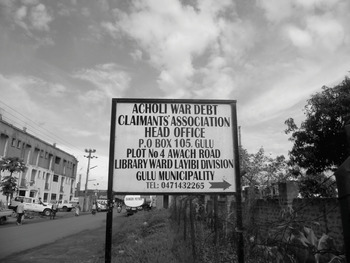
As in other post-war contexts globally, in northern Uganda a variety of survivors’ groups exist in different forms and with diverging mandates, objectives and foci, as well as variations in size, activities and levels of organisation. Most of these groups unite survivors of the LRA conflict and assist victims in advocating for their demands and pursuing their quests for justice, but they also provide more practical assistance – including peer support, income-generating activities or shared finance schemes, such as Village Savings and Loan Associations (VSLA). While smaller groups at the community level primarily engage in these forms of immediate practical support for survivors, quests for justice and reparations have mostly been taken up by larger claimants’ associations, such as the Acholi War Debt Claimants’ Association (AWDCA) (see Figure 5.1), thereby creating hierarchies between different types of groups.
Signpost of Acholi War Debt Claimants’ Association in Gulu town.
By uniting larger numbers of conflict-affected populaces, such groups enable survivors to more widely disseminate their demands and needs. As articulated by a member of one survivors’ group, ‘[w]hen we organise ourselves we can raise our voices and make them be heard by the government in order to receive help’ (Reference Akullo Otwili and SchulzAkullo Otwili and Schulz, 2012: 2). As shown above, the post-conflict context in northern Uganda continues to be characterised by restrained access to services for most conflict-affected communities. Many survivors often do not benefit from any of the developmental programmes implemented by either the Ugandan government (such as the Peace and Recovery Development Plan [PRDP]) or by the countless non-governmental agencies, mainly due to a lack of practical measures or their inaccessibility for rural communities in particular. This creates a lack of provisions and assistance for the majority of survivors of the conflict, as attested above.
In light of this, and in attempts to respond to their war-related challenges, survivors across the sub-region began to construct their own forums to articulate their voices and advocate for their needs and demands. As a recent evaluation of different survivor support groups conducted by the RLP points out, one of the key motivations for forming such groups is this potential for survivors to collectively mobilise within groups in order to jointly deal with war-related challenges, as well as to access services and assistance (RLP, 2016: 5). To further illustrate this, and as summarised in a similar evaluation study on survivors’ groups’ quest for reparations conducted by the Justice and Reconciliation Project (JRP; Reference Akullo Otwili and SchulzAkullo Otwili and Schulz, 2012), one member of a survivors’ association explained that ‘as a group, you can easily access people who have an interest in you. Some people come and say they want to give support but in most cases they just give it to established groups’ (Reference Akullo Otwili and SchulzAkullo Otwili and Schulz, 2012: 13).
Varying in their composition, some groups bring together different categories of survivors within one association, while other groups primarily unite specific (sub-)categories of survivors. As a result, a variety of associations exist, including groups of families of the disappeared,Footnote 6 groups of disabled war victims and survivors, of formerly abducted persons (FAPs) or of torture survivors. Focusing on gender, some groups – such as the Women’s Advocacy Network (WAN) or Watye ki Gen – provide a platform for conflict-affected women who have returned from LRA captivity with children born as a result of rape (Reference AmonyAmony, 2015; Reference StewartStewart, 2015), in addition to several groups of female and male survivors of conflict-related sexual violence (Reference Apiyo and McClain OpiyoApiyo and McClain Opiyo, 2015: 9; Reference Edström and DolanEdström and Dolan, 2018: 178). These survivors’ support groups exist alongside numerous small Christian churches in rural northern Uganda that similarly offer ‘a variety of social practices’ (Reference WilliamsWilliams, 2021).
All of these groups engage in a variety of different activities, including psychosocial peer support, collective income-generating activities and joint financial schemes, in the form of VLSAs. Locally referred to as bol cup, various forms of savings and farmers groups existed historically in Acholiland and took on similar roles and activities, albeit in a different context (Reference AllenAllen, 1987). The current post-conflict groups thereby qualify as a ‘continuation of local methods of self-help and income generation’, although their function ‘now extends to providing some form of non-material comfort too’ (Reference MacDonaldMacDonald, 2014: 256). In many ways, groups therefore constitute key avenues ‘in which communities [are] coping with the legacy of the conflict’ (Reference MacDonaldMacDonald, 2014: 255).
Social Belonging and Financial Stability: Nurturing a Local Ecology of Resilience in Survivors’ Groups
It is primarily the aforementioned types of activities and social practices – offering mutual support and counselling, as well as collective economic activities – and their ensuing effects that fundamentally assist survivors in their contemporary post-conflict situations. In this way, they constitute an effective resource for survivors to engage with conflict-related harms, thereby contributing towards facilitating a local ecology of resilience (Reference UngarUngar, 2011; Reference WilliamsWilliams, 2021). Elsewhere, one of us has previously examined how groups facilitate spaces for survivors to exercise agency (Reference SchulzTouquet and Schulz, 2020: 12–14) and thereby serve as a conduit for these individuals to attain a sense of justice on their own terms (Reference SchulzSchulz, 2019: 178).Footnote 7 Here, we want to extend that line of argument and focus on how, through these different social practices and their agentive capacities (Reference SchulzSchulz, 2021: 118–128), groups can also contribute towards fostering resilient capacities of conflict-affected communities.
In essence, we argue that through these activities (of peer support and income-generation) and their respective impacts on survivors and their communities, groups facilitate spaces and processes for survivors to support each other, to recover from violence and to adapt to the effects of violence – including trauma, psychosocial effects and socio-economic impacts – in sustainable and locally owned ways. Groups thereby enable survivors to interact with their wider socio-ecological environments on their own terms and ‘in ways that facilitate positive psychological, physical and social development’ (Ungar, Chapter 1), as well as aid recovery, adaptation and transformation. The groups thereby comprise multiple systemic factors – including, most importantly, communality and a sense of social belonging, re-negotiated gender identities as key markers of identity and economic support – which facilitate resilience among members of the groups. These aspects, in turn, form a necessary part of transitional justice work and adaptive peacebuilding and contribute towards fostering resilience (Reference ChandlerChandler, 2012).
In line with the approach adopted in this edited volume, we conceive of adaptive peacebuilding and resilience as multi-faceted and multi-factoral processes that require relationality and local ownership and which embrace the complexities and diversities of post-conflict and post-disaster lived realities (Reference ChandlerChandler, 2012; Reference de Coningde Coning, 2018; Ungar, Chapter 1). Our understanding of resilience specifically emphasises a communal and group perspective, following Reference Kirmayer, Dandeneau, Marshall, Phillips, Williamson and UngarKirmayer et al. (2012: 400), who suggest that:
[R]esilience may reside in the durability, flexibility and responsiveness of relationships that constitute extended families or wider social networks […]. The individualistic models [of resilience], therefore, need to be enlarged to take into account the dynamic systems that may offer resilience of individuals, communities and whole people. Indigenous concepts can provide ways to approach a more dynamic, systemic, ecological view of resilience.
As Reference de Coningde Coning (2018: 307) further elaborates, ‘in the adaptive peacebuilding approach, the core activity […] is one of process facilitation. Peacebuilding in the sustaining peace context is about stimulating those processes in a society that enable self-organization and that will lead to strengthening the resilience of the social institutions that manage internal and external stressors and shocks’. By setting in place processes for survivors to engage with their experiences on their own terms – structured around self-organisation, local ownership and internal capacities as well as relationality and social networks – survivor groups contribute towards adaptively building peace and fostering resilience at the local level and among their members, facilitating their capacities for recovery from violence and transformation of post-conflict circumstances.
Peer-to-Peer Support
Most of the extant groups in northern Uganda engage in various forms of individual and collective psychosocial peer-to-peer support. During their (semi-)regular meetings, members in the groups frequently share their experiences and stories with one another, mostly in small group-based settings, and thereby offer mutual support, counselling and solace. ‘When we meet and sit together, we can talk freely about what happened to us, because everyone understands and has the same experience’, one member of a male sexual violence survivors’ support group explained (Reference SchulzSchulz, 2021: 148). These forms of peer support and psychosocial assistance – of sharing stories and an open ear – help survivors to engage with their prior experiences of violence and armed conflict, and to deal with many of the after-effects ensuing from these experiences, such as mental health problems or stigmatisation.
As Reference Edström, Dolan, Shahrokh and DavidEdström et al. (2016: 17) underline:
The concept and methodology of “peer support” focuses on groups of people with shared challenges, who support each other and collectively develop a critical awareness (or shared critical consciousness) about their situation. This can be achieved through mutual support and training in groups. In developing a critical awareness through peer support, people explore their experiences (such as stigma […]) and they can unpack the causes and impacts of these experiences. In turn, this promotes individual and collective development of new skills, which contributes to changes at personal, interpersonal and – potentially – societal levels […].
This mode of peer support is based on and reflects a theoretical-conceptual model of positive psychology (see Reference Joseph, Linley, Joseph and LinleyJoseph and Linley, 2008) that seeks to facilitate collective healing and ‘takes into account the role of social interactions and support in how people process traumatic events’ (Reference Edström, Dolan, Shahrokh and DavidEdström et al., 2016: 17, emphasis added). This approach ‘enables us to perceive a person’s struggles in relation to their environment, and to conceptualise support in socially contextualised terms using educational, relational, social and political strategies’ (Reference Edström, Dolan, Shahrokh and DavidEdström et al., 2016: 17). The emphasis thereby primarily rests on personal psychological recovery, ‘as linked to supportive and enabling social environments’ (Reference Edström, Dolan, Shahrokh and DavidEdström et al., 2016: 17), which implies a clear ecological dimension. As Reference Edström, Dolan, Shahrokh and DavidEdström et al. (2016: 18) further argue, ‘collective healing is often cast as a linear journey from “vulnerability” to “resilience” and “coping”, rather than a dynamic evolution of agency towards changing norms and establishing new communities’. This focus thereby implies numerous crossovers with resilience discourses, which focus on the inherent strengths and resources of people and the intent to shift attention away from vulnerability and pathology (Reference Kirmayer, Dandeneau, Marshall, Phillips, Williamson and UngarKirmayer et al., 2012: 402) towards agency, recovery, adaptation and transformation.
By focusing on psychosocial dynamics, interactions with environments as well as agency and collective healing, the groups’ peer-to-peer support and collective sharing of stories and experiences thus carry numerous conceptual and analytical commonalities with adaptive peacebuilding and resilience, while at the same time offering new and creative ways to think about resilience beyond neoliberal and individualistic paradigms (Reference Brassett, Croft and Vaughan-WilliamsBrassett et al., 2013: 222). In particular, the understanding of peer support as a process that is embedded in relation to wider socio-political environments speaks to the conceptual and analytical foundations of adaptive peacebuilding and resilience as measures that require interaction between individuals and communities with their immediate environments (Reference de Coningde Coning, 2018: 305; Ungar, Chapter 1).
This raises the important question of how some of these dynamics actually play out in practice. Through the collective sharing of experiences and related peer-to-peer support, survivors in groups develop ‘a critical awareness about their situation’ which, in turn, can facilitate a mutual, collective process of ‘unpack[ing] the causes and impacts of these experiences’ (Reference Edström, Dolan, Shahrokh and DavidEdström et al., 2016: 28). Engaging with these effects ‘has a deep and liberating influence on [their] individual sense of personhood and self-worth’ (Reference Edström, Dolan, Shahrokh and DavidEdström et al., 2016: 28). As one member of a support group shared with us, ‘when we come together in a group, it is easy to share experiences and memories and we can try to at least better accept it together as a group’ (joint author interview, northern Uganda, 13 May 2016). Reference Kirmayer, Dandeneau, Marshall, Phillips, Williamson and UngarKirmayer et al. (2012: 408) similarly emphasise this narrative dimension of resilience at a group and community level, by arguing that sharing stories within small group settings ‘amplifie[s] our capacity for social cognition, communal cooperation and creative imagination’. Building on this, Reference WilliamsWilliams (2021) thus concludes that ‘upholding specific narratives together’ – as survivors in groups certainly do – ‘enables people to co-create a social landscape in which they can establish and uphold identities together’. In a similar line of argument, Reference ClarkClark (2020) likewise draws out linkages between storytelling and resilience, implying the potential to move ‘transitional justice in a new ecological direction’.
In the context of male sexual violence specifically, members of survivors’ groups create a new ‘critical awareness’ about their experiences, as Reference Edström, Dolan, Shahrokh and DavidEdström et al. (2016: 28) frame it, which can contribute towards re-negotiating their masculine identities that were previously impacted through the sexual violations (Reference SchulzSchulz, 2018: 1102). Across time and space, as well as context – specifically in northern Uganda – sexual violence strikes at multiple levels of what it means to be a man within society, thereby displacing male survivors from their gendered identities. These experiences, however, are potentially variable, fluid and malleable through different socio-political measures or interventions, and survivors can re-negotiate their gender identities, and even form new understandings of masculinities in the aftermath of their violent experiences (Reference SchulzSchulz, 2021: 4). One way for survivors to engage with their experiences and re-negotiate their gendered identities unfolds through the groups, including through the collective unpacking of their lived realities. Indeed, and further aided through other aspects and activities of the groups – such as, for instance, joint agricultural activities, as examined below – collectively coming to terms with their experiences and creating that critical awareness about their violations allowed survivors to re-establish a sense of social identity and belonging. Statements by male survivors who are members of survivors’ groups attest to these dynamics. As articulated by one survivor, ‘before we came together in the group, we had a lot of feelings of being less of a man but since being in a group, the feelings […] have reduced’ (author interview, northern Uganda, 22 June 2016). Dr Chris Dolan, the director of RLP who closely collaborates with these groups of male survivors, similarly attests that the group-based peer-support activities ‘help to give back a sense of being recognized as an adult and as a man’ (Select Committee on Sexual Violence in Conflict, 2016: 3).
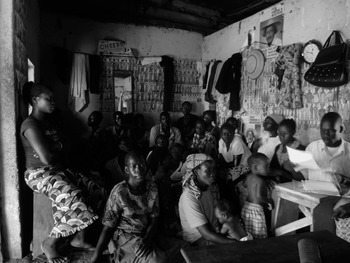
Across other survivors’ groups in northern Uganda, the peer-support activities registered similar effects with regards to rehabilitating and supporting individual members, thereby aiding processes of recovery and transformation (see Figure 5.2). Members across a variety of sub-groups repeatedly emphasised the rehabilitative and transformative effects of these activities and the sense of social belonging and community that is being nurtured through these groups. As one member of a torture survivor group explained, ‘being in a group psychologically rehabilitated us and really empowered us’ (author interview, northern Uganda, 22 March 2016). By doing so, the groups not only contribute towards rebuilding survivors’ selves, personhood and subjectivities, but also their relationships with families and communities, which, in turn, carries important implications for survivors’ capacities to participate in post-conflict communal life and subsequent recovery from the effects of violence.
Meeting of survivor group of formerly abducted women in Awach sub-county, northern Uganda.
Collective Income-Generating Activities
In addition to peer support, survivors’ groups across northern Uganda also engage in different types of collective income-generating activities (Reference Akullo Otwili and SchulzAkullo Otwili and Schulz, 2012: 2). These primarily include communal agricultural work – such as mutual farming on shared pieces of land, cultivating small animal farms or harvesting honey from bee-hives – as well as joint saving schemes, such as VSLAs (see above). The profits that derive from these agricultural activities are used in a variety of ways and for different purposes. For instance, the profits may be used to invest in new food crops for future harvests; to buy animals and livestock for the groups for additional agricultural profits; invested into joint saving schemes; or distributed among members of the group to meet their respective day-to-day survival needs.
According to survivors, such activities have helped them to respond to their everyday post-conflict challenges, including poverty and dependency. The chairperson of one survivor group explained that ‘the members of the group have decided that they should not be spoon-fed but that they can stay on their own and fend for themselves without living in poverty like before’ (author field notes, northern Uganda, 2 June 2016). In many ways, this sentiment highlights the socio-political and economic context in which these groups, their immediacy and their primary activities arise. As indicated above, because of a lack of both governmental and non-governmental assistance for mostly rural-based communities, groups of survivors get together and form associations to collectively address their needs on their own terms. As one member of a survivor organisation explained: ‘we still need that support from the government, but you never know what will happen. That is why we (the groups) do (our own) small income-generating activities’ (Reference Anyeko, Baines, Komakech, Ojok, Ogora and VictorAkullo Otwilli and Schulz, 2012: 4). The groups thus envisage and push for (social) change to be led by social actors themselves, rather than focusing on external structures and institutions to create that change, which Reference ChandlerChandler (2014: 62) conceptualises as a key characteristic of resilience.
The joint income-generating and agricultural activities thus assist survivors in numerous ways and on different levels. For some survivors who were physically impacted by the war – including landmine survivors, people with disabilities or survivors with long-lasting physical impairments as a result of different types of violations – these collective activities constitute unique avenues for them to conduct manual, agricultural labour and to generate an income, which they cannot sufficiently do on their own.
Here, we once again refer to the example of male sexual violence survivors’ groups in northern Uganda. As one of us has previously explored, most male survivors of sexual violence in the current post-war context are unable to carry out agricultural and manual labour, mostly caused by the after-effects and physical injuries of the violations committed against them (Reference SchulzSchulz, 2018: 1115). This is further compounded by the fact that most male survivors, who were victimised in the late 1980s and early 1990s, are now elderly and thus unable to carry out heavy work. As a result of these consequences, and exacerbated by various intersecting factors, male survivors are often unable to provide for their families and communities, which carries implications for their abilities to live up to normative hegemonic expectations of masculinities. In this context, these groups of male survivors carry out income-generating activities such as cultivating beehives and operating saving schemes, which enable them to generate a small income. Male survivors are thereby given new opportunities to contribute to the provision of their families, as they are socially expected to do according to hegemonic masculinities constructions. The groups’ income-generating activities thus aid a longer and multi-faceted process of re-configuring male survivors’ previously impacted gender identities (Reference SchulzSchulz, 2021: 118).
The numerous positive aspects and influences of these types of activities also carry certain wider societal and ecological implications. For instance, by being able to provide for their families, survivors are able to rebuild not only their selves and subjectivities but also their relations with their families and communities. This, in many ways, facilitates processes of re-creating and transforming social bonds and interactions between and among conflict-affected communities, as well as with their wider socio-political environments – which constitute key aspects of both adaptive peacebuilding and resilience processes. Discussing how conflict-affected communities in Sierra Leone ‘were able to find peace by regaining a sense of normality […] through everyday practices’, Reference MartinMartin (2016: 401) likewise shows how ‘groups can provide a space for rebuilding relationships and re-establishing social connections’; and how these ‘seemingly mundane interactions aided people in moving away from feelings of isolation […] towards feeling a greater sense of community’ (Reference MartinMartin, 2016: 409–410). This constitutes an often unrecognised element of transitional justice and peacebuilding work. Facilitating and creating these environmental, communal and social interactions and relationships and a sense of community, of belonging, in the midst of war-related hardships and suffering in many ways constitutes a crucial pre-condition and component of adaptive peacebuilding and resilience.
Building a Local Ecology of Resilience at the Micro Level
As we have shown, survivors’ groups in northern Uganda constitute effective resources for survivors to deal with conflict-related experiences and shocks, and to recover from and transform the struggles and effects of war and its aftermath. In particular, through peer-to-peer counselling and joint income-generating activities, groups enable survivors to make sense of their experiences, to renegotiate their own identities and to recognise a shared lived reality as well as to socially reintegrate within their families and communities. Furthermore, groups enable conflict-affected communities to develop new skills – of counselling, adaptation and income-generation – that are geared towards recovery and transformation.
In their existence and activities, groups thereby embody a sense of local ownership, of crafting social relationships and networks and of nurturing adaptive and transformative capacities – all of which are key requisites for adaptive peacebuilding, transitional justice and resilience. In this reading, the groups combine multiple systemic factors – including gender identities, and in particular masculinities constructions, social relationalities and socio-economic components – which contribute towards facilitating survivors’ resilient capacities within group settings and at the micro level. Hence, the type of resilience that can be fostered through survivors’ groups should not be understood as a set of static character traits that are inherent in individuals or in groups, but, rather, as ‘an adaptive process inculcated through specific practices’ (Reference WilliamsWilliams, 2021).
By teasing out these participatory capacities of survivors’ groups and their ensuing linkages to peacebuilding, transitional justice and resilience, it is not our intention to paint an idealised or romanticised picture of these groups, their activities and effects. Instead, we recognise the challenges and limitations of these groups, including inherent hierarchies within them as well as dependencies and restrictions in scope and reach. Concerning the groups’ potential to foster a local ecology of resilience, it is important to differentiate between resilience at different levels of social organisation (Reference Brassett, Croft and Vaughan-WilliamsBrassett et al., 2013: 223), and to emphasise that the dynamics we have analysed here primarily apply at the micro level, among individuals and smaller groups and communities of survivors.
Groups can thus contribute towards facilitating resilience at an individual and communal level, but not necessarily at a wider regional or societal level. For this, additional transitional justice and peacebuilding measures and processes at other levels of social organisation – and with wider reach in an inclusive and participatory manner – are necessary to ultimately compose a multi-systemic framework for fostering resilience at a societal and regional level.
Conclusion
In this chapter, we have sought to demonstrate how, within a vacuum of transitional justice and peacebuilding measures at the macro level in northern Uganda, survivors began crafting their own spaces in the form of survivors’ support groups. These groups have enabled survivors to exercise different forms of agency by way of engaging with their war-related experiences and harms. This, in turn, positions survivors’ groups as important vehicles of post-conflict peacebuilding and justice-making at the local level. Here, we have specifically focused on examining how, through these dynamics, survivor groups can contribute towards processes of fostering conflict-affected communities’ resilient capacities and creating a local ecology of resilience.
Our discussion shows how these groups – in particular through psychosocial peer-to-peer support and collective income-generating activities – facilitate survivors’ adaptive and transformative capacities, which enable them to positively respond to shocks and stressors resulting from mass violence and its after-effects. Taken together, these groups help survivors to relationally engage with their experiences of harms as well as with their socio-economic environments in new and creative ways, which are fundamental pre-conditions for adaptive peacebuilding, transitional justice and resilience. In the context of support groups, survivors thus develop new capacities that ultimately offer pathways to a resilient system at the communal level. This local ecology of resilience is focused on recovery and transformation and is centred around individuals’ and communities’ self-organisation, agency and self-empowerment (Reference ChandlerChandler, 2015: 28; Reference ZebrowskiZebrowski, 2013: 161).
Our case study analysis thereby illuminates what a local ecology of resilience can look like in practice in northern Uganda, and how locally owned processes can foster resilient capacities. This focus on processes and dynamics at the communal and group level enables us to divorce the concept of resilience from its often neoliberal and individualistic focus, and instead to utilise its relational and communal elements. It is particularly through the locally owned nature of these groups, and the collectivism and communality that underpin their activities, that a local ecology of resilience can be nurtured.


 Open access