
Skip to main content Accessibility help
×
  • Cited by 2
    • Show more authors
    • You may already have access via personal or institutional login
    • Select format
    • Publisher:
      Cambridge University Press
      Publication date:
      05 February 2021
      18 February 2021
      ISBN:
      9781108938167
      9781108837071
      9781108940078
      Dimensions:
      (229 x 152 mm)
      Weight & Pages:
      0.51kg, 242 Pages
      Dimensions:
      (229 x 152 mm)
      Weight & Pages:
      0.378kg, 242 Pages
    You may already have access via personal or institutional login
  • Selected: Digital
    Add to cart View cart Buy from Cambridge.org

    Book description

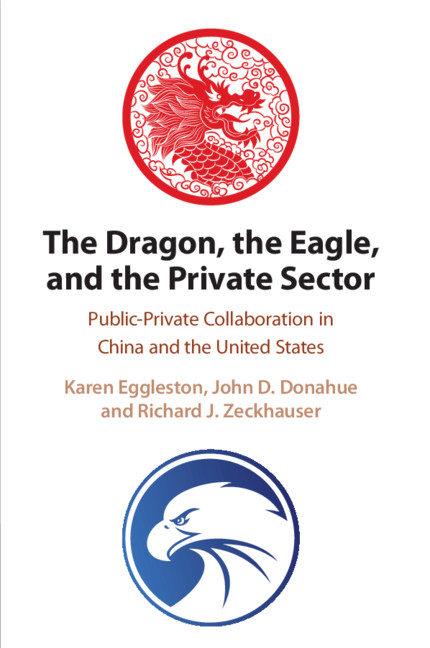
    The governments of China and the United States - despite profound differences in history, culture, economic structure, and political ideology - both engage the private sector in the pursuit of public value. This book employs the term collaborative governance to describe relationships where neither the public nor private party is fully in control, arguing that such shared discretion is needed to deliver value to citizens. This concept is exemplified across a wide range of policy arenas, such as constructing high speed rail, hosting the Olympics, building human capital, and managing the healthcare system. This book will help decision-makers apply the principles of collaborative governance to effectively serve the public, and will enable China and the United States to learn from each other's experiences. It will empower public decision-makers to more wisely engage the private sector. The book's overarching conclusion is that transparency is the key to the legitimate growth of collaborative governance.

    Reviews

    'It has become increasingly clear over the last few years that in tackling a country’s problems, what matters most is the quality of government rather than the quantity. This book provides a key to understanding how to achieve that quality-public-private collaboration, done right. Delving deep into two very different societies, the US and China, the authors provide lessons that illuminate and should inform scholars and policymakers alike.'Fareed Zakaria

    'This important book addresses how the two most important countries, the U.S. and China, address what may be their most important question: How can their public and private sectors cooperate most effectively with each other to create value. This is the rare book that is both analytic and a pleasure to read. It makes a lasting impression. It deserves a very wide readership among all those concerned about the future of the global economy.'Lawrence H Summers, President Emeritus, Harvard University

    'Eggleston, Donahue, and Zeckhauser offer an authoritative and intriguing account of why and how collaborative governance, a key modern instrument that engages public and private actors for comparative advantages in coping with complex public affairs, has been widely and deeply practiced in two vastly different countries, China and the US. An essential reading with profound academic inspirations and rich empirical inquiries.'Yijia Jing, Fudan University

    'In an age obsessed with the governance differences between China and America, this rich volume reveals the common challenges and choices they confront. U.S. and Chinese leaders are driven to 'collaborative governance' strategies to meet growing demands for public services – housing, health care, transportation, and education. Both systems seek an optimal mix of public and private sector discretion that generates more productivity, information, resources, and legitimacy. Rigorously comparative, the authors suggest the conditions under which various mixes of public-private discretion are preferable, emphasizing the critical roles of transparency and experimentation. This volume will have a long shelf life.'David M Lampton, Johns Hopkins University

    'The authors provide a refreshing lens to compare governance and the provision of public goods in the U.S. and China. Despite differences in political structures, economic organization and ideologies, privately delivered services account for around 30 percent of all government service spending. Surprisingly similar, yet profoundly different in ways, both countries rely heavily on the private sector to pursue public goals. This book provides the reader with a refreshing way of comparing government’s role and performance in delivering public goods and offers a clear, concise framework for thinking about collaborative governance.'Tony Saich, Harvard Kennedy School

    Refine List

    Actions for selected content:

    Select all | Deselect all
    • View selected items
    • Export citations
    • Download PDF (zip)
    • Save to Kindle
    • Save to Dropbox
    • Save to Google Drive

    Save Search

    You can save your searches here and later view and run them again in "My saved searches".

    Please provide a title, maximum of 40 characters.
    ×

    Contents

    Metrics

    Altmetric attention score

    Full text views

    Total number of HTML views: 0
    Total number of PDF views: 0 *
    Loading metrics...

    Book summary page views

    Total views: 0 *
    Loading metrics...

    * Views captured on Cambridge Core between #date#. This data will be updated every 24 hours.

    Usage data cannot currently be displayed.

    Accessibility standard: Unknown

    Why this information is here

    This section outlines the accessibility features of this content - including support for screen readers, full keyboard navigation and high-contrast display options. This may not be relevant for you.

    Accessibility Information

    Accessibility compliance for the HTML of this book is currently unknown and may be updated in the future.
