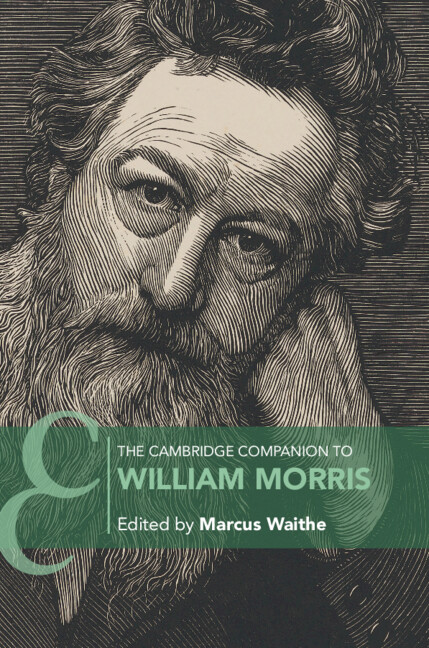
The Cambridge Companion to William Morris

-
Select format
-
- Publisher:
- Cambridge University Press
- Publication date:
- 03 May 2024
- 23 May 2024
- ISBN:
- 9781108939942
- 9781108832175
- 9781108940634
- Dimensions:
- (229 x 152 mm)
- Weight & Pages:
- 0.7kg, 358 Pages
- Dimensions:
- (229 x 152 mm)
- Weight & Pages:
- 0.57kg, 358 Pages
You may already have access via personal or institutional login
Show more authors 
You may already have access via personal or institutional login
Book description
In his short life, William Morris (1834-96) combined the roles of poet, author, painter, designer, translator, lecturer, political activist, journalist, weaver, bookmaker, and businessman. This volume draws together influential voices from different disciplines who have participated in the recent critical, political, and curatorial revival of his work, with essays exploring the contemporary resonance of his exceptional legacy. As a critic of capitalism, his thinking has thrived in these years of financial crisis; as a theorist of work and craftsmanship, his legacy interacts with a more recent ethics of making that questions the values of 'off-shored' production; and as a protector of landscape and buildings Morris's concern with what is precious strikes a chord in our age of environmental crisis. At the same time, a careful and scholarly approach observes the particularity of Morris's context, in a way that confounds the 'false friends' of hasty historical reception and reveals unexpected connections.
Reviews
‘[A] comprehensive collection of essays that explores the full extent of Morris’s multiplicity.’
Dinah Birch Source: The Times Literary Supplement
Contents
Contents
References
Metrics
Altmetric attention score
Full text views
Full text views helpTotal number of HTML views: 0
Total number of PDF views: 0 *
 Loading metrics...
* Views captured on Cambridge Core between #date#. This data will be updated every 24 hours.
Usage data cannot currently be displayed.
Accessibility standard: Unknown
Why this information is here
This section outlines the accessibility features of this content - including support for screen readers, full keyboard navigation and high-contrast display options. This may not be relevant for you.
Accessibility Information
Accessibility compliance for the HTML of this book is currently unknown and may be updated in the future.