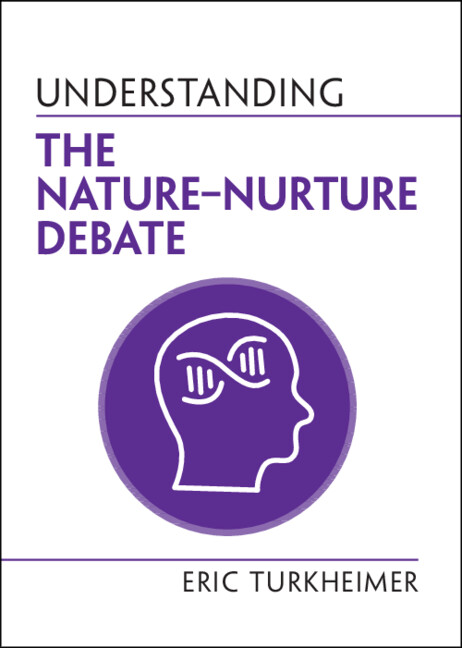

There are arguably few areas of science more fiercely contested than the question of what makes us who we are. Are we products of our environments or our genes? Is nature the governing force behind our behaviour or is it nurture? While it is now widely agreed that it is a mixture of both, discussions continue as to which is the dominant influence. This unique volume presents a clear explanation of heritability, the ongoing nature versus nurture debate and the evidence that is currently available. Starting at the beginning of the modern nature-nurture debate, with Darwin and Galton, this book describes how evolution posed a challenge to humanity by demonstrating that humans are animals, and how modern social science was necessitated when humans became an object of natural science. It clearly sets out the most common misconceptions such as the idea that heritability means that a trait is 'genetic' or that it is a justification for eugenics.
‘Eric Turkheimer has long been a Socratic figure in the field of behavioral genetics – asking incisive and often uncomfortable questions. He continues this tradition in the present volume which, in particular, challenges the common triumphalist zeitgeist about the degree of progress observed with the ‘molecular genetic revolution.’ After pondering this volume, which should serve as an antidote to the excessive exuberance of some investigators, readers should have a healthy skepticism, appreciating both the strengths and some important limitations of this challenging field.’
Kenneth S. Kendler - M.D., Virginia Commonwealth University
‘In this must-read book, Eric Turkheimer provides invaluable insights into the workings of a wide range of the social sciences. The book contains lucid explanations of key statistical concepts underlying work on differentiating nature and nurture, clear introductions to and explanations of contemporary genetics of human behavior, and very helpful historical accounts of the origins and development of this work. Look no further if you want to understand debates over IQ and race, how genomics is used by social scientists, the concept of heritability, and the power and limitations of statistical inference. This book is a history and philosophy of social science tour de force.’
Stephen M. Downes - University of Utah
‘A lively summation of a lifetime of scholarship by an internationally acclaimed expert in behavioral genetics … Understanding the Nature–Nurture Debate is wide-ranging, accessible, spirited, and nuanced. Novices and experts alike will learn from Turkheimer’s inimitable voice.’
Kathryn Paige Harden - University of Texas at Austin, and author of The Genetic Lottery: Why DNA Matters for Social Equality
‘Eric Turkheimer predicted the daunting genetic complexity of human behavior before the Human Genome Project had even been completed, a challenge the field is still grappling with two decades later. In this cogent book, he shares an insider’s perspective on the history of behavioral genetics, from analyses of twins to cutting-edge association studies of millions of genomes. Along the way, he offers insights into the universal desire to understand our own humanity and the fundamental inability of genetic variation to provide us with easy answers.’
Alexander Gusev - Harvard Medical School and The Dana–Farber Cancer Institute
‘Eric Turkheimer was an excellent choice for writing ‘Understanding the Nature-Nurture Debate’. Not only does he make his long-standing experience and personal perspective on behavioral genetics available to a wider audience, but he also manages to explain complex issues (including mathematical means of calculating heritability) in an uncomplicated fashion. … I highly recommend ‘Understanding the Nature-Nurture Debate’ as it will inform and engage both experts and people outside of biology and cognitive science.’
Ingo Brigandt Source: The Quarterly Review of Biology
Loading metrics...
* Views captured on Cambridge Core between #date#. This data will be updated every 24 hours.
Usage data cannot currently be displayed.
This section outlines the accessibility features of this content - including support for screen readers, full keyboard navigation and high-contrast display options. This may not be relevant for you.
Accessibility compliance for the HTML of this book is currently unknown and may be updated in the future.
