
Skip to main content Accessibility help
×
  • Cited by 41
    • Show more authors
    • You may already have access via personal or institutional login
    • Select format
    • Publisher:
      Cambridge University Press
      Publication date:
      05 October 2012
      17 September 2012
      ISBN:
      9781139016285
      9780521839426
      9781107460034
      Dimensions:
      (228 x 152 mm)
      Weight & Pages:
      0.78kg, 418 Pages
      Dimensions:
      (229 x 152 mm)
      Weight & Pages:
      0.62kg, 418 Pages
    You may already have access via personal or institutional login
  • Selected: Digital
    Add to cart View cart Buy from Cambridge.org

    Book description

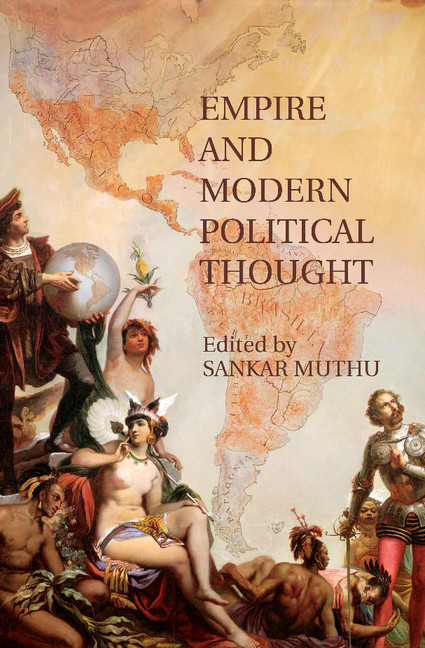
    This collection of original essays by leading historians of political thought examines modern European thinkers' writings about conquest, colonization and empire. The creation of vast transcontinental empires and imperial trading networks played a key role in the development of modern European political thought. The rise of modern empires raised fundamental questions about virtually the entire contested set of concepts that lay at the heart of modern political philosophy, such as property, sovereignty, international justice, war, trade, rights, transnational duties, civilization and progress. From Renaissance republican writings about conquest and liberty to sixteenth-century writings about the Spanish conquest of the Americas through Enlightenment perspectives about conquest and global commerce and nineteenth-century writings about imperial activities both within and outside of Europe, these essays survey the central moral and political questions occasioned by the development of overseas empires and European encounters with the non-European world among theologians, historians, philosophers, diplomats and merchants.

    Reviews

    '… this book consists of twelve carefully written and tightly argued essays that add up to more than the sum of their parts … the study of modern imperialism will oblige political scientists (and historians) to move outside our comfort zones, and to embrace approaches that are expedient, eclectic and trans-disciplinary. This fine volume should work as a catalyst, stimulating and facilitating further work as the enterprise it surveys moves ahead.'

    Theodore Koditschek Source: Canadian Journal of History

    Refine List

    Actions for selected content:

    Select all | Deselect all
    • View selected items
    • Export citations
    • Download PDF (zip)
    • Save to Kindle
    • Save to Dropbox
    • Save to Google Drive

    Save Search

    You can save your searches here and later view and run them again in "My saved searches".

    Please provide a title, maximum of 40 characters.
    ×

    Contents

    • 7 - Adam Smith in the British Empire
      pp 184-198
    • View abstract

      Summary

      Florentine republican imperialism was premised on the idea that the republic had two ends: to preserve its liberty at home and to pursue empire abroad. This chapter builds on this research by inquiring into the role of liberty, empire, and justice in the Florentine tradition in general and in the political theory of Niccolò Machiavelli in particular. Inspired by the example of the ancient Roman republic, most Florentine humanists of the early fifteenth century refused to view liberty and empire as contradictory values or pursuits. The connection between Roman and Florentine justice is also prominent in the writings produced in the aftermath of the city's conquest of Pisa in 1406. In Machiavelli's theory it is the virtue of prudence, and not that of justice, that takes on the role of binding liberty and empire together.
    • 8 - Conquest, Commerce, and Cosmopolitanism in Enlightenment Political Thought
      pp 199-231
    • View abstract

      Summary

      The debate that lasted on and off from 1511 until the early seventeenth century was initially, as Francisco de Vitoria phrased it, an attempt to explore the right (ius) of the barbarians subjected to Spanish rule. Vitoria pointed to issues that have still not been resolved about the right of any people to impose upon others what it believes to be the natural rights of all humankind. Rome demonstrated that a conquest could only be justified if it were the outcome of a just war. Vitoria employed two more natural law arguments in favor of the conquests, both of which make broad general assertions that were to have a lasting impact on all subsequent thinking about the legitimation of the intervention of one state in the affairs of another. The Roman law of vicinage, to which Vitoria alludes, required that neighbors support each other in times of crisis.
    • 9 - Liberalism, Nation, and Empire
      pp 232-260
    • The Case of J. S. Mill
    • View abstract

      Summary

      Most discussions of the political theories that accompanied the European imperial expansion have accordingly concentrated on ideas either of just war or of legitimate settlement on uncultivated territory, and this material has now become a familiar part of the standard history of imperialism. The principal stumbling block for European treaties with non-European people was very clear: the Old Testament contained a number of passages that seemed to preclude any substantial agreements between the faithful and infidels. By the beginning of the seventeenth century, Protestant Europe was united in denying legitimacy to any military alliance contracted with an infidel ruler, and this view was to be found at the very heart of the English government. In the negotiations between the English and the Dutch between 1613 and 1618 about collaboration in the East Indies, the English consistently opposed any involvement in the kinds of military alliances that the Dutch had constructed.
    • 10 - Republicanism, Liberalism, and Empire in Postrevolutionary France
      pp 261-291
    • View abstract

      Summary

      A generation of recent scholarship has fundamentally revised understandings of liberalism's relation to empire and in particular of John Locke's relationship to settler colonialism in North America and beyond. What it might mean to be a theorist of empire was profoundly shaped by the experience and practices of imperialism in the two centuries between roughly 1757 and 1960: that is, from the beginning of European military dominance in South Asia to the first great wave of formal decolonization outside Europe. There can be no doubt that Locke was a specifically colonial thinker, if by that we mean simply someone who devoted much thought and attention to the settlement and governance of colonies. Locke's imperial vision was comparatively less wide-ranging than that of many contemporary English political economists. Locke can only be described as a theorist of empire in a narrowly restricted definition of that term.
    • 11 - Colonies and Empire in the Political Thought of Hegel and Marx
      pp 292-323
    • View abstract

      Summary

      This chapter discusses whether empire for Montesquieu was potentially a way of containing the particularities of human life and giving expression to its normative unity. Montesquieu's epistolary novel Persian Letters already exhibits the territorial logic of despotic empire made explicit in the Laws. Montesquieu never excludes any region of the world from despotism. Asia's geography is more favorable to despotic rule. The continent possesses larger and wider plains unbroken by mountains or broad rivers. Anti-imperial sentiments are a feature of all of Montesquieu's writings. Persian Letters summarizes the indictment. In the guise of a fantasy about Descartes in Mexico, Montesquieu gives the reader a picture of a European spiritual civil war between faith and enlightenment. For Montesquieu, women are the natural agents of change. For Montesquieu, Gelon, the king of ancient Syracuse, made "the finest peace treaty mentioned in history".
    • 12 - Social Theory in the Age of Empire
      pp 324-350
    • View abstract

      Summary

      When viewed from Britain in the eighteenth century, the empire was still a distant matter, notwithstanding the numerous ways in which it already laced domestic life. As with his other writings, the depth and reach of Edmund Burke's insight into the turgid functioning of the empire had everything to do with the deployment of a moral imagination, which alloyed self-understanding and sympathy. Burke not only reflected on the complexity of the empire, he also expressed a sustained and deep reluctance toward it. Burke's involvement with British-Indian affairs began in 1767, the year he first entered Parliament, and concluded in his public role in 1795, two years before his death. The other issue on which Burke focused his attention involved the British practices through which the social and political coherence of India was being dismembered. The term "nation" and its cognates are scarce in Burke's writings.
    • 13 - Political Theory of Empire and Imperialism
      pp 351-388
    • An Appendix
    • View abstract

      Summary

      Approximately one-third of the Wealth of Nations is about empire, or at least about the long-distance commerce that was so intricately entangled, in Adam Smith's description, with the eighteenth-century empires. There is something idiosyncratically disagreeable, Smith suggested, in the circumstances whereby companies come to be the sovereigns of the countries which they have conquered. Smith has been celebrated or execrated, during most of the period since his death in 1790, as the inspiration of one or more great abstractions: free trade, the national economy, self-interest, sympathy, the essentially utilitarian framework, in Akeel Bilgrami's expression, of a desacralized world, or a world without enchantment. The politics of empire was central, too, to the other great influence on Smith's political and economic thought, the French economic theories with which he was so preoccupied in the 1760s. Smith was, in his own terms, an effective critic of empire.

    Metrics

    Altmetric attention score

    Full text views

    Total number of HTML views: 0
    Total number of PDF views: 0 *
    Loading metrics...

    Book summary page views

    Total views: 0 *
    Loading metrics...

    * Views captured on Cambridge Core between #date#. This data will be updated every 24 hours.

    Usage data cannot currently be displayed.

    Accessibility standard: Unknown

    Why this information is here

    This section outlines the accessibility features of this content - including support for screen readers, full keyboard navigation and high-contrast display options. This may not be relevant for you.

    Accessibility Information

    Accessibility compliance for the HTML of this book is currently unknown and may be updated in the future.
