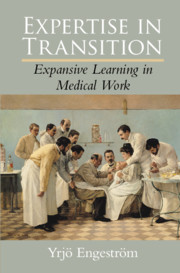


This book condenses the lessons and insights I have gained over a period of 30 years of research and formative interventions in medical work and expertise. My argument is that our predominant notions of expertise are foundationally insufficient in the face of the present challenges of an interconnected and unpredictable world. This book builds a perspective of transition toward collaborative and transformative expertise. Such a possibility is made real when practitioners and their clients take actions informed by this perspective.
Medical expertise has a long history of steadfast individualism on the one hand and intense collaboration on the other hand. The intense collaboration is vividly manifest in surgical operations, such as the one depicted on the cover of this book. Yet this intense collaboration seldom extends beyond the walls of the operating theater into today’s fragmented multi-organizational fields of medical care. In these broader arenas, individualism and compartmentalization prevail.
Medical expertise is also deeply dilemmatic in its relation to change. Medicine embraces rapid development of new treatments, medications, and technologies on the one hand. On the other hand, it stubbornly resists major shifts in the organization of work and reallocation of resources. The stubborn resistance is vividly manifest in the poor performance of medicine in handling chronic illnesses and health problems of populations living in poverty.
These two dilemmas are so persistent that our very concept of medical expertise needs to be rebuilt. Cosmetic improvements will not do the job.
The analyses, findings, and ideas presented in this book have emerged in multiple successive research projects, in collaboration with a good number of colleagues. I am grateful to Paul Adler, Eeva Ahonen, Tuula Arvonen, Frank Blackler, Aaron Cicourel, Michael Cole, Ritva Engeström, Jouni Helenius, Rick Iedema, Anu Kajamaa, Hannele Kerosuo, Kirsi Koistinen, Päivikki Lahtinen, Päivi Laurila, Kirsti Launis, Kimmo Leppo, Philippe Lorino, David Middleton, Anna-Liisa Niemelä, Jaana Nummijoki, Kaija Saarelma, Osmo Saarelma, Tarja Saaren-Seppälä, Annalisa Sannino, Riitta Simoila, Toomas Timpka, and Hanna Toiviainen. The contributions of these colleagues range from critical commentaries to collaborative data collection and joint analyses.
This book reports on the experiences of a number of patients. Collaborative and transformative medical expertise is continuous negotiation and hybridization of the insights of medical professionals and their patients. Without patients’ insights, accounts, and actions, medical expertise would at best be merely top-down engineering. I am grateful to the patients who gave their time and efforts to the research and intervention projects that form the basis of this book.
This book is dedicated to Annalisa and Jurij Enzo. Our collaboration and love keep us in transition.
