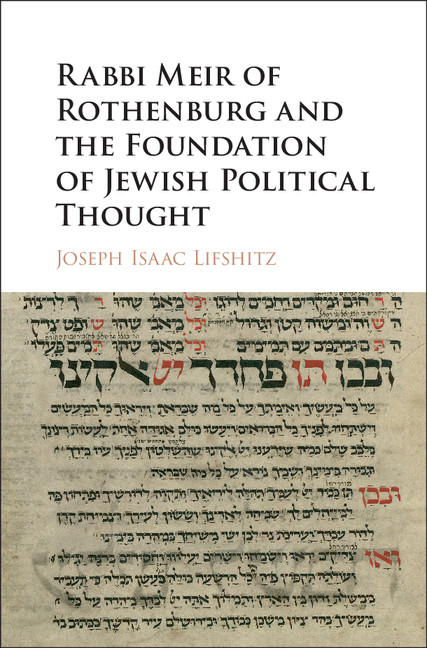

This book is a scholarly examination of the political thought of Rabbi Meir (Maharam) of Rothenburg, the most important thirteenth century German Rabbi who was associated with the Pietist movement of the period. From the Maharam's responsa on community matters, a coherent political thought emerges that exercised nearly unprecedented influence on European Jewish communities up to the Jewish Emancipation. Rabbi Meir's extremely sophisticated attempt to balance the demands of the community against those of the individual was facilitated by a characteristic three-tiered structure to his political thought: concrete legal rules supported by value-laden legal principles built upon his general religious ideology. Through a systematic analysis of the Maharam's political thought, Isaac Lifshitz offers an original contribution to Jewish studies, political theory, and the study of legal philosophy. By considering the legal and theological underpinnings of one of Medieval Jewry's most influential figures, it also makes a contribution to the history of ideas in the Medieval period.
‘This splendid, erudite book will serve many audiences, including historians of Judaism and students of comparative law and of comparative political thought.'
Menachem Kellner - Shalem College, Jerusalem
‘It is often assumed that medieval Jewish thinkers only formulated political theory in a Platonic or Aristotelian mold. But, in this extraordinary and original study, Isaac Lifshitz clearly and persuasively shows that the thirteenth-century German rabbi, Meir of Rothenburg, formulated a political theory out of classical Jewish sources alone, using rabbinic conceptions alone. Only a scholar of Isaac Lifshitz's vast learning and theoretical perspicacity could have reconstructed Rabbi Meir's political theory in a way that nonspecialists can readily understand. This book is an original contribution to Jewish studies specifically, and to political theory in general.'
David Novak - University of Toronto
‘This investigation into the political theory of Rabbi Meir Rothenburg is a major contribution to both the theory of halachic dispute and the emergence of a Jewish political discourse in the Middle Ages. Retracing the sources of Rabbi Rothenburg back to Torah, Talmud, the Geonim, and the Sephardic thinkers, this brilliant research demonstrates his unique concept of a Jewish political theology.'
Christoph Schmidt - Hebrew University of Jerusalem
Loading metrics...
* Views captured on Cambridge Core between #date#. This data will be updated every 24 hours.
Usage data cannot currently be displayed.
This section outlines the accessibility features of this content - including support for screen readers, full keyboard navigation and high-contrast display options. This may not be relevant for you.
Accessibility compliance for the HTML of this book is currently unknown and may be updated in the future.
