


Dynamic pressures generated experimentally have ranged from ~10–2 to ~105 GPa (100 GPa = 106 bar = 10–1 TPa) starting in the 1940s. Their purpose has been to measure material properties at extreme conditions. Dynamic-compression facilities generate pulsed high pressures by rapid energy deposition. From the 1940s to 1960s dynamic compression was obtained with shock waves generated by chemical explosives in contact with specimens. Beginning in the 1950s, shock drivers have used rapid deposition of kinetic energy generated with chemical explosives and guns that accelerate projectiles to high velocities prior to impact. These shock drivers include single-stage gas guns, two-stage light-gas guns and mass accelerators driven by pulsed magnetic pressures. Shock waves generated with planar or hemispherical chemical-explosive systems accelerate metal impactors to velocities up to ~5 km/s and ~15 km/s, respectively (Rice et al., Reference Rice, McQueen and Walsh1958; McQueen et al., Reference McQueen, Marsh, Taylor, Fritz, Carter and Kinslow1970; Marsh, Reference 149Marsh1980; Altshuler, Reference Altshuler1965, Reference Altshuler2001; Zhernokhletov, Reference Zhernokhletov2005).
From the 1960s to ~1990 dynamic pressures up to ~105 GPa range were generated in proximity to underground nuclear explosions (Trunin, Reference Trunin1998 and Reference 155Trunin2001; Ragan, Reference Ragan1984; Mitchell et al., Reference Mitchell, Nellis, Moriarty, Heinle, Tipton and Repp1991). In recent years dynamic pressures in excess of 10 TPa have been generated with high-power pulsed lasers, such as the NIF at LLNL (Bradley et al., Reference Bradley, Eggert, Hicks, Celliers and Moon2004). Pressures and densities achieved in all the above dynamic experiments were calculated with the R-H equations; associated temperatures must be calculated for the vast majority of those cases.
Sample dimensions and experimental lifetimes depend on the areal-energy density of the impactor or of the radiation beam used to generate dynamic pressure. Sample size and experimental lifetime are limited by radial and longitudinal pressure release and/ or re-shock edge effects. In the cases discussed herein, samples generally have sufficiently large dimensions, and experimental lifetimes are sufficiently long to measure material properties with available time resolution with accuracies of a few percent.
In the 1960s dynamic high pressures began to be generated with gas dynamics in a two-stage light-gas gun (2SG) in which compressed H2 gas accelerates a 20 g metal impactor plate to velocities as high as ~8 km/s (Charters et al., Reference Charters, Denardo and Rossow1957; Jones et al., Reference Jones, Isbell and Maiden1966; Mitchell and Nellis, Reference Mitchell and Nellis1981a; Nellis, Reference Nellis2000, Reference Nellis2007a). The 20 m long 2SG was developed for materials research on a laboratory scale. Impact velocity uI is measured in free flight, and shock velocity is measured in the target. This method has the advantage that Hugoniots of solids can be measured purely by the experimental methods illustrated in Figs. 2.6 and 2.7. Hugoniots of Al, Cu, Ta and Pt have been qualified in 2SG experiments as EOS standards up to shock pressures of a few 100 GPa (Marsh, Reference 149Marsh1980; Mitchell and Nellis, Reference Mitchell and Nellis1981b; Holmes et al., Reference Holmes, Moriarty, Gathers and Nellis1989; Trunin, Reference 155Trunin2001). Measured shock pressures typically range from 10 to 500 GPa for liquid H2 and Ta, respectively.
Impact velocities uI up to ~15 km/s and shock pressures greater than ~TPa have been achieved with hemispherically convergent, chemical-explosive systems (Altshuler et al., Reference Altshuler, Trunin, Krupnikov and Panov.1996; Trunin, Reference Trunin1998). H2 gas in a linear 2SG and gaseous reaction products of chemical explosives in a hemispherically convergent system achieve maximum impactor velocities limited by the speed of sound in the dense molecular gas pushing the impactor. To obtain still higher impact velocities, a driving gas is needed that is limited by a speed much greater than the speed of sound in a molecular gas.
More recently impact velocities as large as ~45 km/s have been achieved with the Z Accelerator at Sandia National Laboratories Albuquerque (SNLA) (Schwarzschild, Reference Schwarzschild2003). Those velocities are driven by magnetic pressure generated by fast, magnetic-flux compression (Hall et al., Reference Hall, Asay, Knudson, Stygar, Spielman and Pointon2001; Lemke et al., Reference Lemke, Knudson and Davis2011; Knudson and Desjarlais, Reference Knudson and Desjarlais2013). The Z Accelerator is an analogue of a 2SG in the sense that the compressed gas is a “gas” of magnetic flux rather than H2 molecules. Magnetic flux moves at the speed of light. The history of dynamic compression at SNLA is documented (Asay et al., Reference Asay, Chhabildas, Lawrence and Sweeney2017).
The goal that motivated construction of the large NIF facility at LLNL (Bradley et al., Reference Bradley, Eggert, Hicks, Celliers and Moon2004) and the Z facility at SNLA is achievement of ICF, a potential practical source of commercial power. Development of those two techniques has resulted in a substantial facility size. To achieve shock pressures above ~TPa, it is essential to deposit sufficient energy over a sufficiently large sample over a sufficiently long pulse duration to make accurate measurements. For this reason giant pulsed lasers and pulsed-power sources that achieve TPa pressures at U.S. national laboratories are enormous compared to, say a 20 m long 2SG that generates pressures up to a few 0.1 TPa for materials research purposes. The NIF pulsed laser facility occupies a volume comparable to that approximately of a cubic football field.
To achieve ICF, it is essential to know properties of materials at relevant extreme conditions. Thus, it is important to perform scientific experiments to measure properties of materials needed to design experiments to achieve ICF. Historically, extensive dynamic compression experiments have been performed up to ~100 GPa using shock pressures generated with plane-wave chemical explosives and single-stage gas and gunpowder guns. In this chapter we describe experiments that drive dynamic compression experiments well above 100 GPa pressures.
To put kinetic energies of shock-wave drivers into perspective, kinetic energy of a 20 g impactor accelerated to 7 km/s with a 2SG is ~0.5 MJ, which is comparable to total kinetic energy of the 1012 protons and antiprotons in colliding beams at the Tevatron at the Fermi National Accelerator Laboratory (Fermilab). Kinetic energy of impactors generated by fast planar magnetic-flux compression at the Z Accelerator is substantially greater, comparable to energies in the particle beams in the Large Hadron Collider (LHC) at CERN. Energies of the NIF Laser and Z mass Accelerator are used to study novel states of atomic matter (ultracondensed matter, warm dense matter and dense plasmas) analogous to the way high-energy particle beams at the LHC are used to probe novel states of sub-nuclear matter.
3.1 Two-Stage Light-Gas Gun
The 2SG was developed in the 1950s and 1960s to perform research on Earth that would enable manned space flight to the moon by the end of 1960s, as called for by U. S. President John F. Kennedy. The primary concern was the safety of the crew in spacecraft on their voyage through space. The threat is impact of micro-meteorite particles travelling at impact velocities greater than 15 km/s. Half that velocity was readily obtainable on Earth to assess the likely magnitude of damage that would be caused by such impacts. LLNL obtained a 2SG to perform experiments on materials at extreme conditions of P and T.
The 2SG at LLNL, illustrated in Fig. 3.1, accelerates an impactor to velocities as high as 8 km/s using compressed H2 gas. The gun breech contains up to 3.5 kg of gunpowder and the pump tube is filled with ~60 g of H2 gas initially at ~0.1 MPa pressures. Depending on impactor material, target material and impact velocity, dynamic pressures in a target can be tuned from ~GPa to as much as ~650 GPa for Ta impacting Pt at 7.8 km/s (Holmes et al., Reference Holmes, Moriarty, Gathers and Nellis1989). This range of pressure enables investigations of equations of state (EOS), dynamic strength, solid-solid phase transitions and crossovers, melting, electrical conductivity and so forth.
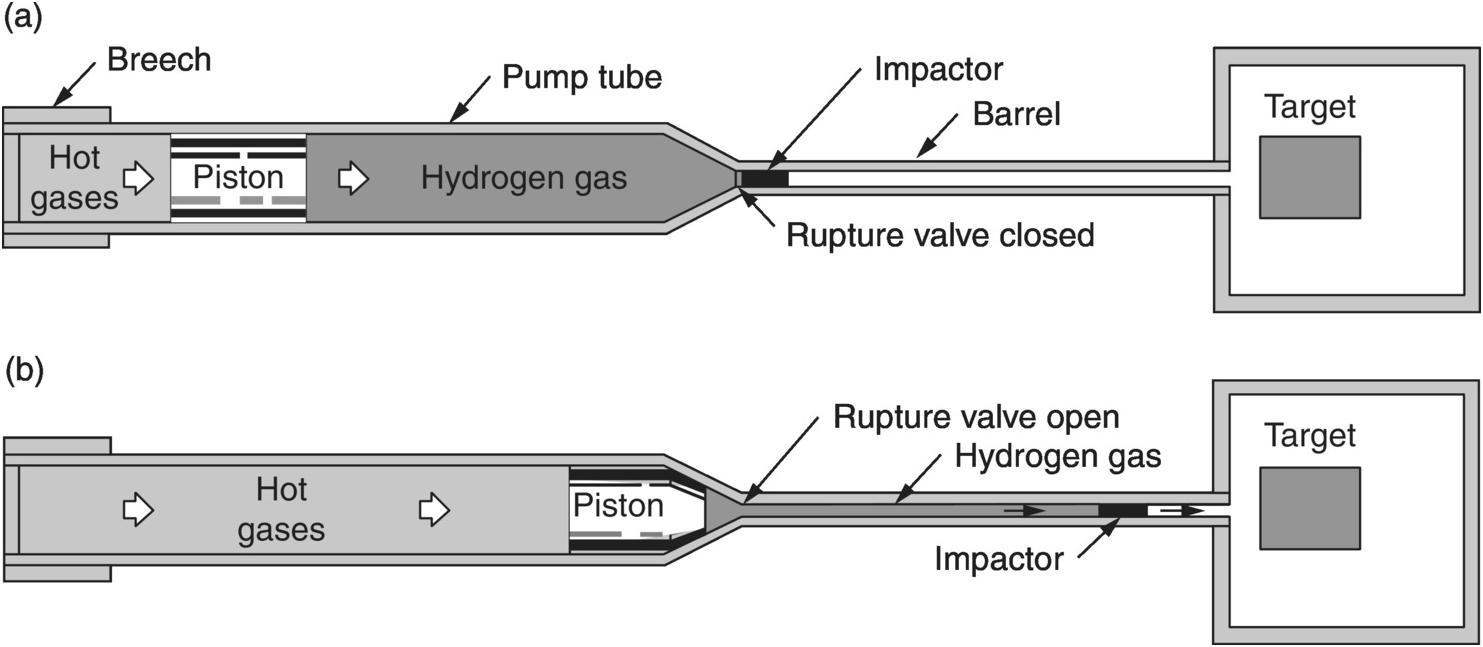
Fig. 3.1. Two-stage light-gas gun (2SG) at LLNL. First stage is hot gases from burned gunpowder plus piston; second stage is compressed H2 gas plus impactor. Piston compresses H2 gas in pump tube. When H2 pressure reaches ~0.1 GPa, the rupture valve opens and isentropically compressed H2 gas flows at ~constant rate through tapered section, which amplifies H2 velocity as inner diameter of tapered section decreases, which accelerates impactor along 9 m barrel. Maximum impactor velocity is 8 km/s. Impact generates extreme conditions in target, which are recorded with electronic, optical and X-ray diagnostics
The piston in Fig. 3.1 has a mass as large as ~5 kg, which is large compared to 60 g of the H2 gas plus ~25 g of a typical impactor, of which ~18 g is usually an Al, Cu, Ta or Pt plate hot-pressed into a Lexan polycarbonate sabot. Hot gases from burned gunpowder drive the 90 mm diameter ~5 kg piston down the 10 m long pump tube, compressing the H2 gas. At a gas pressure of ~0.1 GPa, the compressed H2 gas breaks the rupture valve and flows into the narrower, evacuated barrel, 28 mm in diameter and 9 m long. The mass flow rate of the gas through the taper is ~constant because the weight of the piston is large compared to the weight of H2 gas plus impactor. Reduction in diameter in the taper from pump tube to barrel causes gas velocity to increase to as much as 8 km/s.
Highest impactor velocity is achieved with the driving gas having the highest sound velocity c for the gas to flow as fast as possible through the taper to transmit gas pressure to the impactor at the fastest possible rate. Since the driving gas behaves essentially as an ideal gas, sound speed c = (γkBT/M)0.5, where γ is the ratio of specific heat at constant pressure to that at constant volume, kB is Boltzmann’s constant, T is temperature of the compressed gas and M is its molecular weight. Since H2 has the smallest M of any molecular gas, it has the highest sound velocity and, thus, achieves the highest impactor velocity and impact-shock pressure relative to any other potential driving gas. Velocity of the impactor in free-flight is determined by measuring the time between two fast X-ray pulses a measured distance apart (Mitchell and Nellis, Reference Mitchell and Nellis1981a). Photographs of the LLNL two-stage gun facility are published (Nellis, Reference Nellis2007a).
General Motors, Delco Electronics Division provided the 19 m long 2SG to LLNL in 1972. General Motors had used that 2SG as a test bed for their substantially larger 2SG, which was used to test thermal shielding for re-entry vehicles returning from exo-atmospheric space and for Hugoniot experiments on liquid D2 (van Thiel et al., Reference van Thiel, Hord, Gust, Mitchell and D’Addario1974). The larger gun enables use of substantially higher mass projectiles but little increase in velocity relative to that of the smaller 2SG. After the U.S. National Aeronautics and Space Administration (NASA) reached the moon in 1969, Delco provided one of those 19 m long guns to LLNL for scientific materials investigations at a nominal cost.
3.2 Mass Acceleration by Pulsed Power: Z Accelerator
Impact velocities as large as ~45 km/s have been achieved with the Z Accelerator at SNLA driven by magnetic pressure generated by fast, magnetic-flux compression (Hall et al., Reference Hall, Asay, Knudson, Stygar, Spielman and Pointon2001; Schwarzschild, Reference Schwarzschild2003; Lemke et al., Reference Lemke, Knudson and Davis2011; Knudson and Desjarlais, Reference Knudson and Desjarlais2013; Davis et al., Reference Davis, Brown, Knudson and Lemke2014). Magnetic pressure P(B) ∝ B2, accelerates a metal impactor to ultrahigh velocities with magnetic field B generated by an enormous electrical current pulse I(t). Maximum current produced by Z is ~25 MA, which generates a magnetic field of ~10 MG and a magnetic pressure of several 100 GPa applied to an impactor. Impactors contain a metallic layer so that magnetic flux diffusion times through them are long compared to acceleration time of the impactor. In this way high magnetic drive pressures are maintained and eddy current heating of the impact region is minimized.
Electrical current of Z is generated with a Marx bank and several associated pairs of gas switches charged to more than 20 MJ. This source produces a current pulse with a rise time of 100 to 500 ns, which is dumped into an electrical load at the center of the Z Accelerator, which is 34 m in diameter and 7 m high. The resulting B field accelerates two metal plates in opposite directions over 3–4 mm vacuum gaps. Useful thicknesses of the Al and quartz drive plates and samples are typically a few 100 microns. A photograph of the facility on firing shows sparking, which is caused by power leakage from fast switches submerged in water (Schwarzschild, Reference Schwarzschild2003).
The electrical load of Z that generates ultrahigh velocities is illustrated in Fig. 3.2. The time-dependent current-density pulse J(t) from Z flows upward in the layer on the far left, which generates an azimuthal magnetic field B into the plane of the figure. Magnetic pressure P(B), the cross product of J and B, is in the direction to the right in Fig. 3.2. Thermodynamic conditions induced in a material are tuned by tuning the shape of J(t). A flyer for Hugoniot experiments is made of a high-conductivity metal, which slows substantially magnetic-flux diffusion into the flyer, which is also the anode of Z. The large J x B force accelerates a flyer to very high velocity. After a flight distance of ~3 mm, the flyer impacts the target. Velocity history of the flyer and the dynamic wave induced in the target are measured with velocity interferometers (VISAR).

Fig. 3.2. Schematic of flyer acceleration by magnetic pressure generated by time-dependent current density J from Z Accelerator upward in layer on far left, which generates B field into plane of figure. Flyer frame is anode of Z with which flyer (impactor) is in contact and thus accelerated to right. Width of flight gap is ~3–4 mm
Veloce is a system similar to the Z Accelerator but much smaller in scale. Because of its smaller operating voltage, peak pressures and stresses are correspondingly reduced relative to Z. Veloce is useful for isentropic and shock compression experiments on research-size scales: dynamic strength, pressure-shear measurements and a variety of other materials investigations (Ao et al., Reference Ao, Asay, Chantrenne, Baer and Hall2008; Alexander et al., Reference Alexander, Asay and Haill2010).
3.3 Giant Pulsed Lasers
Dynamic compression is generated by high-intensity pulsed laser irradiation at the NIF, a giant pulsed laser at Lawrence Livermore National Laboratory. Giant pulsed lasers also exist at the Omega laser at the University of Rochester and at the Linac Coherent Light Source at SLAC National Accelerator Laboratory. Many shock experiments are performed with few ns laser pulses with diagnosis of the resulting decaying shock wave (Fig. 2.11). A wide variety of physical properties have been measured (Bradley et al., Reference Bradley, Eggert, Hicks, Celliers and Moon2004; Eggert et al., Reference Eggert, Brygoo, Loubeyre, McWilliams and Celliers2008, Reference Eggert, Hicks, Celliers, Bradley and McWilliams2009; Smith et al., Reference Hurricane, Callahan, Casey and Celliers2014; Gorman et al., Reference Gorman, Briggs, McBride, Higginbotham and Arnold2015). Ramp-compression research includes measuring quasi-isentropes up to pressures of several 100 GPa for comparison with 0-K isotherms calculated theoretically.
At the University of Illinois, a small-scale laser-driven mass accelerator has been developed with diagnostics that combine fast optical spectroscopy/microscopy with photon Doppler velocimetry. A laser accelerates 0.5 mm diameter Al or Cu flyer plates to velocities as high as 6 km/s. High shock pressure is generated on impact with a glass slide. Fast optical spectroscopies and chemical reactions are investigated (Banishev et al., Reference Banishev, Shaw, Bassett and Dlott2016).
3.4 Quasi-Isentropic Cylindrical and Spherical Compressions
Since the 1960s quasi-isentropic and shock compression experiments on hydrogen isotopes have been performed with cylindrical and spherical implosion systems driven by high explosives (HE). Radial convergence is utilized in both single- and two-stage implosion systems. In a two-stage implosion a seed magnetic field is injected from an external source. Convergence compresses magnetic flux, which increases magnetic drive pressure. That is, two-stage implosions use HE to dynamically compress an interior metallic shell, which in turn compresses interior magnetic flux against a second innermost metallic shell. Magnetic pressure generated by increasing magnetic field in the first stage then compresses an interior sample of a gaseous, liquid or solid hydrogen isotopes in the second stage (Zhernokhletov et al., Reference 156Zhernokhletov, Simakov, Sutulov and Trunin1995).
The purpose of the magnetic-flux compression stage is to essentially isolate the hydrogen sample at the center from shock dissipation generated by HE in the outermost region. With the two-stage system, magnetic pressure is gradually applied to the innermost metallic shell, which means pressure is also applied gradually to the sample in the central region. In this case, shock dissipation is virtually eliminated from the compression, which is then virtually isentropic.
In the single-stage implosion, HE is in contact with a single metallic shell, which means the sample in the central region experiences an initial shock wave from the HE, which shock-heats the sample to some extent prior to subsequent quasi-isentropic compression as the shell coasts radially inward after the initial shock.
These experiments are based on the assumptions that (1) sample density can be determined with flash X-radiography to measure radial positions of dense solid shells containing a hydrogen isotope and (2) pressure history can be calculated with hydrodynamic simulations of the process. Hawke et al. (Reference Hawke, Burgess, Duerre, Huebel and Keeler1978) performed pioneering experiments on isentropic compression of hydrogen and neon. Trunin et al. (Reference Trunin, Urlin and Medvedev2010) have published an extensive review of a variety of experiments on hydrogen isotopes.
3.5 Static Compression: Diamond Anvil Cell
Static compression produces states at high pressures with lifetimes that are long compared to time required to apply pressure and long for heat produced by static compression to diffuse out of a sample at the speed of sound. For this reason static compression is slow, isothermal and generates relatively little entropy, although static-compression-induced disorder is commonly observed at high static pressures by broadening of X-ray diffraction and optical spectroscopic lines measured in diamond-anvil cells (DAC)s. Hugoniot curves are used to derive pressure calibrations, called shock-wave reduced isotherms, to determine pressure up to ~200 GPa at 300 K achieved in static compression experiments (Chijioke et al., Reference Chijioke, Nellis, Soldatov and Silvera2005b).
3.5.1 Diamond anvil cell (DAC)
Highest static pressures are achieved with a diamond anvil cell (DAC), illustrated in Fig. 3.3. An extensive body of research is conducted under static pressures extending from ~10 GPa to pressures up to ~600 GPa (Piermarini and Block, Reference Piermarini and Block1958; Jayaraman, Reference Jayaraman1983, Reference Jayaraman1984; Ruoff et al., Reference Ruoff, Xia, Luo and Vohra1990; Bassett, Reference Bassett2009; Dubrovinsky et al., Reference 143Dubrovinsky, Dubrovinskaia, Prakapenka and Abakumov2012). The intrinsic difference between static and dynamic compression is the rate at which pressure is applied. Static pressure is typically applied in ~s and experimental lifetimes usually range from seconds to months, depending on sample material, P, T, chemical diffusion, chemical corrosion/reactions, etc.
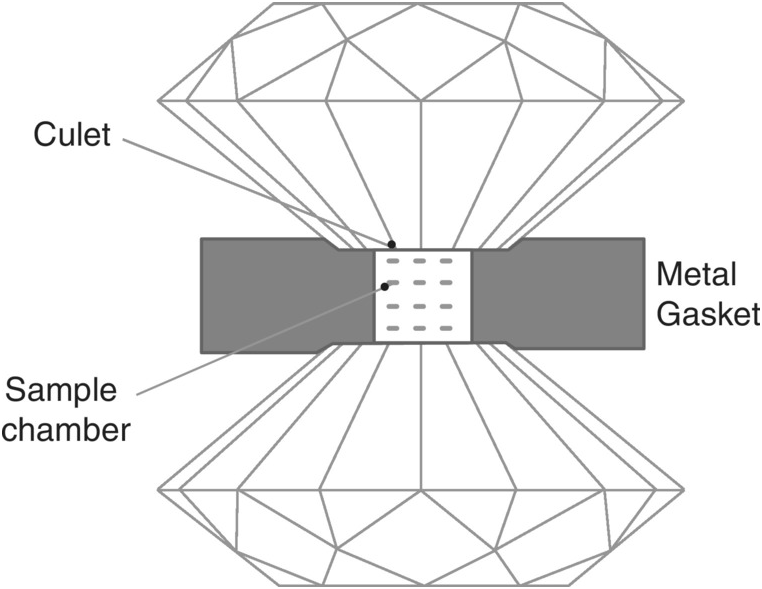
Fig. 3.3. Diamond anvil cell (DAC). Sample is contained in cylindrical chamber at center of metal gasket, which is compressed between two gem-quality diamonds to pressures as high as 300–500 GPa. To achieve highest pressures sample is initially ~20 μm in diameter and ~5 μm high or so. Mechanical assembly to constrain and maintain alignment on compression is not shown. Because diamond is optically transparent, lasers with tiny spot sizes are common spectroscopic probes, as well as X-ray beams. Insertion of electrical leads to measure electrical conductivity is common at lower pressures
Sample heating in a DAC is typically done by laser-heating, by passing an electrical current through a conductor in the sample volume or by heating the entire DAC. Sample heating and cooling in a DAC is independent of the compression process, unlike dynamic compression in which heating and entropy are produced as part of the fast, adiabatic dynamic compression process itself. Static compression techniques and experimental results have been reviewed (Mao and Hemley, Reference Mao and Hemley1994; Eremets, Reference Eremets1996; Hemley et al., Reference Hemley, Chiarotti, Bernasconi and Ulivi2002).
3.5.2 Static Pressure Calibration
A key problem is the determination of pressure achieved in a DAC. As of yet there is no known primary static-pressure standard above ~5 GPa (Bean et al., Reference Bean, Akimoto, Bell, Block, Holzapfel, Backman, Johannisson and Tegner1982, Reference Bean, Akimoto, Bell, Block and Holzapfel1986). Calibration of pressure achieved under static compression has been a major issue ever since Bancroft et al. (Reference Bancroft, Peterson and Minshall1956) reported a phase transition in Fe at a shock pressure of 13 GPa and estimated temperature of 40°C. In 1961 a phase transition was detected in Fe at around 13 GPa static pressures by electrical resistance measurements (Drickamer and Balchan, Reference Drickhamer and Balchan1961). In 1962 a phase transition was observed in Fe by X-ray diffraction up to ~15 GPa (Jamieson and Lawson, Reference Jamieson and Lawson1962). The phase above 13 GPa was deduced to be ε-hcp, which is described by two lattice parameters. The hcp phase determination was based on observation of only one xrd line, which was atypical of the initial bcc Fe α phase, plus the constraint that the higher-pressure phase above 13 GPa under static compression should have the volume of the high-pressure phase measured by Bancroft et al. under shock compression. Thus, Hugoniot measurements determined the pressure and density of that Fe ε-hcp phase transition and the single measured xrd line together with measured shock density constrained the observed xrd line to be indexed to that of the ε-hcp phase. The pressure of the α−ε Fe phase transition is discussed in more detail in Chapter 4.
There are many secondary static-pressure standards. The commonly used Ruby scale is calibrated versus pressures derived from shock-wave reduced isotherms (Mao et al., Reference Mao, Bell, Shaner and Steinberg1978; Wang et al., Reference Wang, Ahuja and Johansson2002; Chijioke et al., Reference Chijioke, Nellis and Silvera2005a, Reference Chijioke, Nellis, Soldatov and Silvera2005b). In addition, isotherms calculated theoretically are often assumed to be correct absolutely and used as pressure standards (Kunc et al., Reference Kunc, Loa and Syassen2003; Holzapfel, Reference Holzapfel2005, Reference Holzapfel2010; Dorogokupets et al., Reference Dorogokupets, Sokolova, Daniliov and Litasov2012). However, calculated “theoretical” pressure standards have intrinsic systematic uncertainties and provide reasonable estimates of pressure.
Shock-wave reduced isotherms are derived from measured Hugoniots obtained with absolutely accurate Eqs. (2.1) to (2.3). Hugoniots are then corrected to pressures and volumes at, say 300 K, by assuming thermal pressures calculated with a density-dependent Gruneisen model and estimating shock-induced stress contributions to shock pressures caused by strength (Chijioke et al., Reference Chijioke, Nellis and Silvera2005a, Reference Chijioke, Nellis, Soldatov and Silvera2005b). Use of a Gruneisen model and strength contributions introduce systematic uncertainty into the calculations of a pressure standard. To minimize effects of these corrections, the sum of such corrections of a given material is often restricted to values that are small compared to shock pressure at a given density, say 30% of PH at given VH.
Correcting Hugoniot data, which are functions of density and temperature, to obtain a 300 K isotherm becomes increasingly more uncertain as shock pressure increases above ~200 GPa, depending on material. Shock temperatures increase more rapidly with shock pressure for lower Z materials, such as Al, than for higher Z materials, such as W. As shock pressure increases, the Gruneisen parameter becomes a function of temperature as well as density, though the relationship is not known. As shock pressure increases strength contributions to Hugoniot pressure decrease, though the relationship is not known. As shock pressure increases, shock compression approaches a limiting value of approximately fourfold but the 300 K isotherm has no limiting compression. For all these reasons, the use of the Gruneisen model to obtain 300 K isotherms from Hugoniots becomes systematically less reliable with increasing pressure. Because more accurate calibrations might become available in the future, it is important to state exactly how static pressures are determined in given static-pressure experiments so that corrections can be made in the future, as appropriate.
A likely direction in which to proceed to develop isothermal static-pressure standards above ~200 GPa is to correct measured dynamic quasi-isentropes or ramp waves (Nellis, Reference Nellis2007b; Smith et al., Reference Hurricane, Callahan, Casey and Celliers2014) to obtain static isotherms to pressures above ~600 GPa as estimated, which is achieved in a two-stage diamond-anvil cell (Dubrovinsky et al., Reference 143Dubrovinsky, Dubrovinskaia, Prakapenka and Abakumov2012). Such corrections to dynamic quasi-isentropes or ramp waves are analogous to corrections to Hugoniots to achieve static-pressure isotherms up to ~200 GPa. However, temperatures achieved by ramp-wave and QI compressions are substantially lower than achieved by shock compression. In contrast, stresses induced by strength under QI compression above 200 GPa might be substantial and larger than those on the Hugoniot. Determination of static pressures in the 500 GPa regime is an important issue because static pressures in this regime are starting to be accessed experimentally.


