A Geographical and Commercial View of Northern Central Africa

-
Select format
-
- Publisher:
- Cambridge University Press
- Publication date:
- 07 October 2011
- 19 May 2011
- ISBN:
- 9781139034579
- 9781108031271
- Dimensions:
- Weight & Pages:
- Dimensions:
- (216 x 140 mm)
- Weight & Pages:
- 0.42kg, 330 Pages
You may already have access via personal or institutional login
Show more authors 
You may already have access via personal or institutional login
Book description
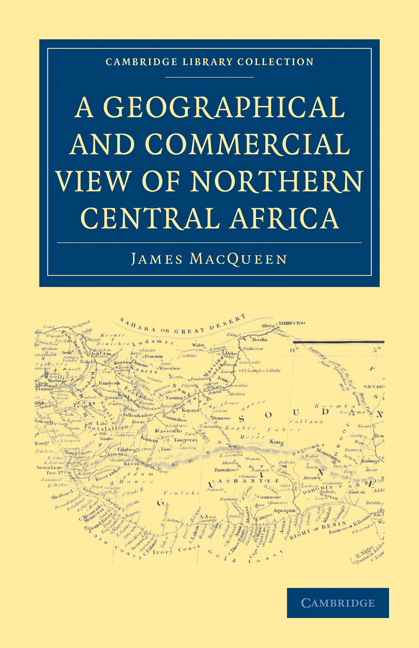
James MacQueen (1778–1870) was a British geographer fascinated by the problem of the River Niger. He set out to try to establish (on the basis of accounts by explorers, traders and missionaries), that one and the same river flowed continuously through Africa and into the Atlantic Ocean, thus challenging long-established beliefs that African rivers either disappeared into the sand or terminated in lakes. MacQueen documents his findings in this pioneering work, first published in 1821. Drawing on evidence from a range of authorities, he argues that previous misconceptions about the Niger had left Africa isolated from the civilised world, and shows how his discovery could open up trading opportunities between Africa and other countries, suggesting that contact with Europeans would lead to the eventual abolishment of the slave trade in the interior. This important study remains relevant to scholars of both geography and African history today.
Contents
Contents
Metrics
Full text views
Full text views helpTotal number of HTML views: 0
Total number of PDF views: 0 *
 Loading metrics...
* Views captured on Cambridge Core between #date#. This data will be updated every 24 hours.
Usage data cannot currently be displayed.
Accessibility standard: Unknown
Why this information is here
This section outlines the accessibility features of this content - including support for screen readers, full keyboard navigation and high-contrast display options. This may not be relevant for you.
Accessibility Information
Accessibility compliance for the PDF of this book is currently unknown and may be updated in the future.