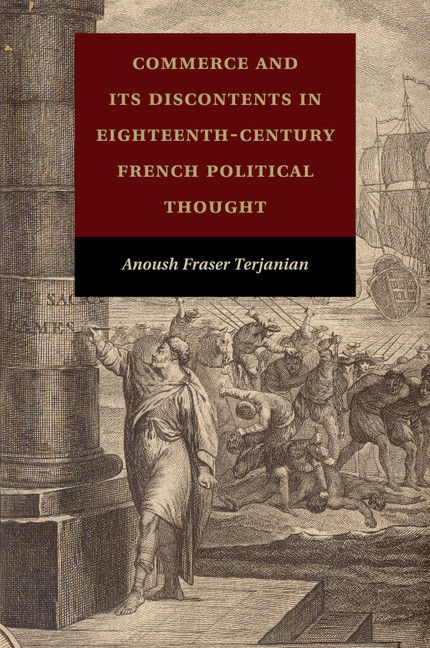

Histories of economics tend to portray attitudes towards commerce in the era of Adam Smith as celebrating what is termed doux commerce, that is, sweet or gentle commerce. Commerce and Its Discontents in Eighteenth-Century French Political Thought proposes that reliance on this doux commerce thesis has obscured our comprehension of the theory and experience of commerce in Enlightenment Europe. Instead, it uncovers ambivalence towards commerce in eighteenth-century France, distinguished by an awareness of its limits - slavery, piracy and monopoly. Through a careful analysis of the Histoire des deux Indes (1780), the Enlightenment's best-selling history of comparative empires, Anoush Fraser Terjanian offers a new perspective on the connections between political economy, imperialism and the Enlightenment. In discussing how a 'politics of definition' governed the early debates about global commerce and its impact, this book enriches our understanding of the prehistory of globalisation.
‘… [this book] enhances our understanding of late eighteenth-century debates over the place of commerce in state and society. In an erudite and theoretically sophisticated account, Anoush Terjanian breaks with a long historiographic tradition that has emphasized the Enlightenment’s favorable attitude to ‘sweet commerce’. Focusing on Abbé Raynal’s best-selling, multivolume History of the Two Indies - a work that is shown to have been every bit as important as The Wealth of Nations - Terjanian uncovers the deep ambivalence attached to practices such as monopoly, slavery and piracy … Thoughtful and elegantly written … a major reference for scholars of Enlightenment, empire and political economy.’
Madeleine Dobie - Columbia University
‘Terjanian’s argument proceeds from a brilliant insight - namely, that ambivalence actually defined the eighteenth century’s attitude toward commerce and all that it brought in its wake … [This] is a smart, engagingly written and indisputably important book.’
Jay M. Smith - University of North Carolina, Chapel Hill
'Terjanian’s main argument - that eighteenth century writers had complex and nuanced views about commerce - is certainly compelling. Her research is meticulous, her argument well stated, and the scholarship she cites the very best.'
Helena Rosenblatt Source: The Journal of Modern History
Loading metrics...
* Views captured on Cambridge Core between #date#. This data will be updated every 24 hours.
Usage data cannot currently be displayed.
This section outlines the accessibility features of this content - including support for screen readers, full keyboard navigation and high-contrast display options. This may not be relevant for you.
Accessibility compliance for the HTML of this book is currently unknown and may be updated in the future.
