
Skip to main content Accessibility help
×
  • Cited by 9
    • Show more authors
    • You may already have access via personal or institutional login
    • Select format
    • Publisher:
      Cambridge University Press
      Publication date:
      30 November 2017
      14 December 2017
      ISBN:
      9781139051613
      9781107003620
      9780521177122
      Dimensions:
      (228 x 152 mm)
      Weight & Pages:
      0.75kg, 450 Pages
      Dimensions:
      (229 x 152 mm)
      Weight & Pages:
      0.55kg, 456 Pages
    You may already have access via personal or institutional login
  • Selected: Digital
    Add to cart View cart Buy from Cambridge.org

    Book description

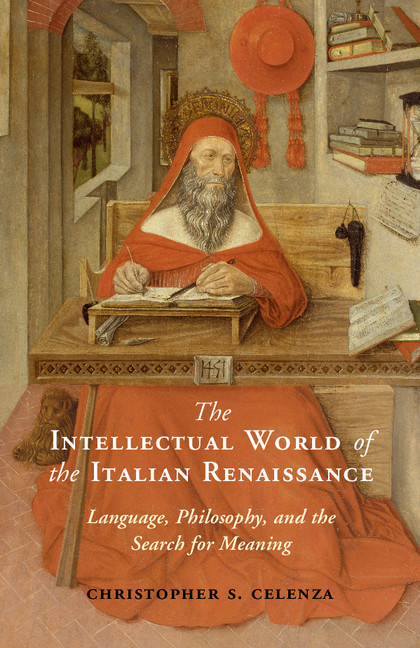
    In this book, Christopher Celenza provides an intellectual history of the Italian Renaissance during the long fifteenth century, from c.1350–1525. His book fills a bibliographic gap between Petrarch and Machiavelli and offers clear case studies of contemporary luminaries, including Leonardo Bruni, Poggio Bracciolini, Lorenzo Valla, Marsilio Ficino, Angelo Poliziano, and Pietro Bembo. Integrating sources in Italian and Latin, Celenza focuses on the linked issues of language and philosophy. He also examines the conditions in which Renaissance intellectuals operated in an era before the invention of printing, analyzing reading strategies and showing how texts were consulted, and how new ideas were generated as a result of conversations, both oral and epistolary. The result is a volume that offers a new view on both the history of philosophy and Italian Renaissance intellectual life. It will serve as a key resource for students and scholars of early modern Italian humanism and culture.

    Reviews

    'In The Intellectual World of the Italian Renaissance, Christopher Celenza provides a priceless vademecum for the study of Italian humanism. It rolls up in a delectable ball all that has come before: Garin and Kristeller; Burckhardt, Baron, and Martines; Fubini and Vasoli; Hankins, Allen, and the others. It presents in depth and with exquisite clarity the major works of nine leading humanists from Petrarch to Poliziano (plus many others introduced in discursive 'parentheses'), culminating with the writer and critic Pietro Bembo, who translates the humanist heritage into a new language of art, a Latinized Tuscan. The lucidity of the explication de textes is matched by the precision with which Celenza profiles his cast of characters, who are presented with full dimensionality in their psychological, social, and cultural contexts: the careerist Poggio, the brawler Valla, the self-made man and Medici servitor Poliziano.'

    Margaret L. King Source: The Catholic Historical Review

    'This is an immensely learned book, written in a clear, accessible style and rich in insight and understanding. Celenza has followed the currents of language and philosophy - which he defines, as do his sources, as the love of wisdom rather than a defined discipline - as elements in the search for meaning and hence self-knowledge and shared values. It is the ideal place to begin a journey into the ideas and debates that informed the intellectual world of the Italian Renaissance.'

    Kenneth Bartlett Source: American Historical Review

    '… Celenza presents a rich analysis and narrative of what it meant to participate in Renaissance Italian intellectual life. I recommend his book - either as a whole, or individual chapters as essays - to undergraduates studying intellectual life during the Florentine Renaissance, or to graduate students and early researchers, as a robust and very clear introduction to Renaissance intellectual life and Renaissance humanism.'

    Barry Torch Source: Renaissance and Reformation / Renaissance et Réforme

    'The Intellectual World of the Italian Renaissance offers an accessible synthesis of intellectual history in Italy from Petrarch to Pietro Bembo … This book will become the standard introductory text to the subject for students, while specialists will also find here a well-written and thoughtful account of a topic that so often defies synthetic treatment … Historians and students of thought, culture and society, as well as literary scholars and students will all find much to ponder here.'

    Brian J. Maxson Source: H-Net reviews

    'This is an immensely learned book, written in a clear, accessible style and rich in insight and understanding.'

    Kenneth Bartlett Source: The American Historical Review

    'This is a rich and engaging study. Not a history of Renaissance philosophy as such, it is, rather, an examination of the intellectual worlds of the fifteenth century and in particular of the dominant role of Latin.'

    Michael J. B. Allen Source: Renaissance Quarterly

    Refine List

    Actions for selected content:

    Select all | Deselect all
    • View selected items
    • Export citations
    • Download PDF (zip)
    • Save to Kindle
    • Save to Dropbox
    • Save to Google Drive

    Save Search

    You can save your searches here and later view and run them again in "My saved searches".

    Please provide a title, maximum of 40 characters.
    ×

    Contents

    Metrics

    Altmetric attention score

    Full text views

    Total number of HTML views: 0
    Total number of PDF views: 0 *
    Loading metrics...

    Book summary page views

    Total views: 0 *
    Loading metrics...

    * Views captured on Cambridge Core between #date#. This data will be updated every 24 hours.

    Usage data cannot currently be displayed.

    Accessibility standard: Unknown

    Why this information is here

    This section outlines the accessibility features of this content - including support for screen readers, full keyboard navigation and high-contrast display options. This may not be relevant for you.

    Accessibility Information

    Accessibility compliance for the HTML of this book is currently unknown and may be updated in the future.
