

5 The Role of Ukrainian and Russian Courts in the Provision of Press Freedom : Judicial Independence in Defamation Lawsuits, 1998–2003
February 2002 was a bad month for Russia’s oppositionist newspaper Novaya Gazeta. First, a Moscow court ruled that an article about the lavish lifestyle of a provincial court chair contained false information and ordered the newspaper to pay the slandered judge US$1 million (Abdullaev, Reference Abdullaev2002a). Within a week, Novaya Gazeta’s luck went from bad to worse. A bank the paper had linked to a money-laundering scandal won its defamation lawsuit, and the paper was slapped with a US$500,000 punitive damage fine. Since Novaya Gazeta’s annual turnover barely approached the total sum of the awarded damages, domestic and foreign observers started writing the paper’s obituary. The dominant interpretation of the events centered on a Kremlin-backed campaign to muzzle the independent media (Abdullaev, Reference Abdullaev2002a). Yabloko’s deputy chair, Sergei Mitrokhin, was probably speaking for most Russian liberals when he lamented that the defamation suits against Novaya Gazeta represented the “direct use of the judicial authorities for political goals, rather than in compliance with the law” (Yabloko Press Release, 2003). Eventually, though, Novaya Gazeta survived because both victorious plaintiffs decided not to collect their awards (“Novaya Gazeta Could Get a Reduced Fine,” 2002).
Ukrainian opposition newspaper Vseukrainskie Vedomosti was not so fortunate. In December 1997, it wrote about rumors that Dynamo football club owner Grigorii Surkis had talked about the possibility of selling Dynamo’s star player, Andriy Shevchenko, to an Italian club. Surkis claimed the rumors were slanderous and demanded US$1.75 million in compensation for the moral damages he sustained as a result of the article. In January 1998, a Chernivtsy court ruled in favor of the plaintiff. A month later the court froze the newspaper’s assets to ensure payment. In March, right before the parliamentary elections, Vseukrainskie Vedomosti officially closed down because they could not pay their bills (Fond Zashchity Glasnosti, 1998). In 1999, Shevchenko was indeed sold to Milan for US$26 million (ESPN SoccerNet, 2009). The newspaper had not lied after all. Few believed, though, that the dispute had ever been over Shevchenko. Rather it seemed to be all about politics. As one of the leaders of the Social Democratic Party of Ukraine (united) (SDPU(o)), Surkis was a main figure in the propresidential Kuchmist camp. Vseukrainskie Vedomosti, on the other hand, had obvious financial links to Kuchma’s arch-rival in 1998 – Hromada leader, Pavlo Lazarenko (European Institute for the Media, 1998).
These high-profile cases are just the tip of the iceberg. Between 1999 and 2003, the Russian courts of general jurisdiction heard between 4,235 and 5,499 defamation cases per year.1 In 1999, Ukrainian courts reportedly heard 2,258 defamation cases against media outlets (Razumkov Centre, 2001, p. 33). In comparative context, these figures are huge. In 2003, Australians initiated 150 defamation lawsuits, Americans filed 110 suits, and the British, known for their supposed litigiousness when it comes to defamation, filed a total of 206 cases. If we calculate the per capita incidence of defamation lawsuits, the contrast is even more striking. In the United States, there is one lawsuit per 2.3 million people. In Delaware, the defamation law capital of the United States, there were 166,000 people. England is indeed more litigious than the United States, as its data show that there is one lawsuit per 121,000 people. Australians also turn out to be quite litigious, as there is one lawsuit per 131,000 people (Caslon Analytics, 2005). By contrast, in Russia, in 2003, there was one defamation lawsuit per 26,000 people. In Ukraine in 1999, there was one defamation lawsuit per 22,000 people. In other words, Russians and Ukrainians were about five times more likely to file a defamation suit than Australians and the English, and about ten times more likely than Americans.
While litigation rates are vastly different, win-rates in defamation trials are similar in Russia and Ukraine and in the United States. In Russia, the courts ruled in favor of the plaintiff in about 65 percent of cases (Sudebnyi Departament data, 2004)2. In Ukraine, the plaintiff won approximately 70 percent of the time (Razumkov Centre, 2001, p. 33). In the United States during the 1990s, lawsuits against media outlets specifically were successful about 63% percent of the time (Logan, Reference Logan2001, p. 513).
The high defamation litigation rates in Russia and Ukraine add detail to the picture of a highly litigious society that is already emerging in other research on Russian courts. Hendley (Reference Hendley1997; Reference Hendley1999; Reference Hendley2001; Reference Hendley2004) has shown that Russians use the courts extensively to collect debts and settle business disputes. Cashu and Orenstein (2001) have described the 200,000 case strong litigation campaign that Russian pensioners pursued against a government-mandated inflation-indexing coefficient. Solomon (2004) has shown that Russians have used administrative litigation extensively to press many grievances against state institutions. In short, defamation (and electoral registration) litigation rates are part of a broader phenomenon – post-Soviet citizens’ eagerness to use the courts to resolve disputes.
The high volume of defamation cases has serious implications for media development and freedom of the press and whether the impact is positive or negative hinges squarely on the independence of the courts. Independent and impartial judicial output in defamation cases probably discourages journalists from becoming information hit men out to kill anybody’s reputation for the right sum of money. If the courts are likely to punish the willful dissemination of false and damaging information about people, journalists are going to think twice before doing it. The earnest and impartial enforcement of defamation legislation by the courts should boost the quality of investigative journalism. Journalists wary of running afoul of defamation legislation rules would use a high reliability threshold before they put anything in print. Eventually, the information that the media disseminates will be more reliable.
By contrast, judicial output that systematically reflects the preferences of politicians or other powerful and rich plaintiffs significantly curtails freedom of speech. Under the guise of fighting for their good name, politicians could effectively use the courts to punish media outlets, which report damaging (but true) information about them. The more cases politicians win, the more afraid journalists will be. Eventually, investigative reporting will suffocate under the blanket of defamation litigation. If the courts participate in this politicization of the judicial process, they would effectively become state censors.
Thus, it is essential to find out whether the Russian and Ukrainian courts were independent from politicians and other plaintiffs in adjudicating defamation disputes. The analysis presented in this chapter estimates whether a plaintiffs’ political affiliation and administrative resources have a significant effect (both statistically and substantively speaking) on their chances of victory, as well as on the size of the moral compensation award that usually accompanies a successful defamation claim. When politically powerful plaintiffs win much more often and receive larger compensation awards than other plaintiffs, that is an indication that the courts are biased, rather than impartial adjudicators.
The comparison between Russian and Ukrainian judicial output in defamation cases provides a second test of the predictions of the political competition theories of judicial independence. To remind the reader, the strategic pressure theory proposed in this book predicts that Ukrainian courts are going to be more politicized than Russian courts, because Ukraine’s electorally insecure incumbents would be much more interested in securing favorable outcomes in each case than Russia’s stronger incumbents. The traditional political competition theories make the opposite prediction – Ukraine’s higher level of political competition should serve as an incentive for the incumbents to provide independent courts.
The Statutory Framework for Defamation Lawsuits
The defamation cases analyzed in this chapter are civil suits brought by individuals and organizations under civil code provisions rather than criminal offenses pursued by the prosecution office under the criminal code. The Civil Code of the Russian Federation and the Civil Code of Ukraine both stipulate that citizens can use the courts to seek redress for the public denigration of his or her “honor, dignity and business reputation.”3 In both countries, the person disseminating the allegedly slanderous piece of information has to prove its veracity to the court’s satisfaction. If the court establishes that the defendant has not met the burden of proof, the judge can order the defendant to publish an official retraction and/or compensate the plaintiff for the moral damage that he or she has incurred. The civil codes define “moral damage” as “physical or emotional suffering” that results from the violation of a citizen’s personal nonmaterial rights, such as the right to protect his or her honor, dignity, and business reputation from denigration and defamation (Grazhdanskii Kodeks Rossiiskoi Federatsii, 1996; Grazhdanskii Kodeks Ukrainy, 1992).
Since the size of the compensation award can be exorbitant and reach several million dollars, it is important to explain how moral damage is quantified. Article 152 of the Civil Code of the Russian Federation stipulates that the plaintiff can propose an estimate of the moral damage in his or her complaint. However, as article 151 stipulates, the court is the ultimate arbiter on the matter and determines, first, whether the plaintiff is entitled to any monetary compensation, and, second, whether the plaintiff should receive the full compensation that he or she has indicated in the complaint or some fraction of it. To arrive at a precise figure, the court takes into account a variety of factors such as (1) the degree to which the defendant is responsible for the inflicted damages; (2) the intensity of the physical and emotional suffering endured by the plaintiff; (3) the characteristics and circumstances of the plaintiff. In addition, article 1101 provides that the size of the award has to be “reasonable and just” (Grazhdanskii Kodeks Rossiiskoi Federatsii, 1996).
Resolution No. 4 of the Plenum of the Supreme Court of Ukraine from March 31, 1995, which interprets Article 4401 of the Civil Code of Ukraine and is entitled “About Court Practice in Cases Involving the Adjudication of Moral (non-material) Damages,” stipulates a virtually identical mechanism to the Russian one. The court determines the size of the award by considering the defendant’s culpability, the type and seriousness of the injury, the degree to which his or her reputation and prestige have been damaged, and the efforts that would be needed to the restore them. This list of factors is not exhaustive and court practice has shown that judges also consider how widely the slanderous information has been disseminated (Civil Chamber of the Supreme Court of Ukraine).
This chapter focuses on a subgroup of the whole universe of defamation cases, namely lawsuits in which the defendant is a print or broadcast media outlet. In those cases, the Russian Law on the Mass Media applies in conjunction with the civil code. Article 51 of the media law stipulates that journalists are prohibited from disseminating false and discrediting information about a physical or a juridical person (Law of the Russian Federation on Mass Media, 1991). In addition, the Plenum of the Supreme Court of the Russian Federation has issued a binding resolution, which defines discrediting information as “information that does not correspond to reality, denigrates a citizen’s honor and dignity, contains statements which accuse a citizen or an organization of violating the law or moral principles (such as dishonest act, improper behavior at work, at home, and other information discrediting business or public activity, reputation, etc.)” (Council of Europe/Directorate General of Human Rights/Media Division, 2003).
Ukrainian practice also envisions a victory for the plaintiff if the court finds simply that the disseminated information is false. While the law provided for a distinction between inadvertent and deliberate defamation, in reality judges did not consider this factor, because “malicious intent” was not clearly defined anywhere (Shevchenko, Reference Shevchenko2003). Moreover, even the new amended Law on Guarantees for Freedom of Speech, adopted in the spring of 2003, does not say who needs to prove the presence of malicious intent. The laws on the books and Supreme Court rulings and resolutions on the matter also fail to determine whether the media outlet or the author of the article found to be defamatory carry the bulk of the responsibility for the false information’s dissemination (Civil Chamber of the Supreme Court of Ukraine).
In other words, all the legislation discussed so far gives enormous leeway to the judge to determine the outcome and impact of each case. Since there are no objective guidelines the court could use in determining either the appropriateness or the size of the moral damage award, the judge can easily act upon his or her own biases and predispositions. Alternatively or in conjunction, the judge could hand down a ruling that is more in line with a powerful actor’s agenda, than with any abstract notion of justice or reasonableness. Because of this built-in legal flexibility, defamation cases are a particularly useful tool for examining judicial behavior.
The Datasets
Each one of the 695 defamation cases that make up the Russian dataset analyzed in this chapter is described in considerable detail in the Glasnost Defense Foundation Monitor, which tracks media-related disputes and journalist rights violations in Russia and the other CIS states.4 The Glasnost Defense Foundation (GDF) is a Moscow-based human rights watchdog with ten regional centers, which serve as hubs for collecting and sorting information about media disputes. The foundation also provides legal advice and representation to media outlets who cannot afford to retain a lawyer to defend them in a defamation suit. Table 5.1 summarizes how the data break down by federation unit.
Table 5.1. Regions represented in the sample (number of cases; percent of total)
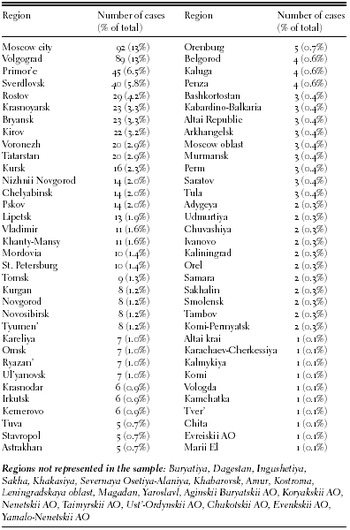
GDF researchers did not follow scientific random sampling techniques but rather recorded the entire yield from three information-gathering channels: (1) references to defamation cases in the regional press; (2) direct accounts of trials provided to a GDF center by trial participants (usually the defendant); and (3) accounts of trials provided by lawyers involved in defamation disputes. While not all federal units are equally represented in the dataset, the data contain information from a politically and geographically diverse group of regions. As Table 5.1 shows, all major geographic areas of Russia are represented. More importantly, however, the represented regions cover the entire political spectrum – from reformist regions, through moderate and Red Belt communist regions, to authoritarian ethnic republics. The last group is the only regional type that seems underrepresented in the sample. It is possible that since most ethnic republics are under the tight control of the governor, there are hardly any oppositionist media outlets. Consequently, where there would be few controversial articles, there would be fewer offended parties and hence we should expect to observe fewer defamation cases. This logic suggests that any conclusions reached on the basis of this dataset are less applicable to the most authoritarian Russian regions.
The Ukrainian dataset contains 105 cases, which were adjudicated between 1998 and 2003. About one-fifth of the cases (n = 19) are described in GDF’s CIS Monitor. The rest of the data come from GDF’s Ukrainian counterpart – IREX Promedia and lawyers who have represented media outlets in defamation cases. Like GDF, IREX Promedia is an NGO, which monitors press freedom and provides legal advice and representation free of charge to media outlets that cannot afford to hire a lawyer.
Although the Ukrainian sample is significantly smaller than the Russian one, it accurately represents Ukraine’s regional diversity. All of Ukraine’s administrative regions, with the exception of Vinnitsya, Rivne, and Sumy, are represented in the sample. Moreover, the sample reflects Ukraine’s regional East-West division. Thirty-seven cases (36% percent) were adjudicated by courts in Eastern and Southern Ukraine, thirty-five cases (or 34 percent) were adjudicated in Western and Central Ukraine, and the remaining third of the cases (n = 31 or 30 percent) were litigated in the capital, Kyiv. The overrepresentation of Kyiv in the sample reflects the fact that most media outlets with nationwide coverage have address registrations in Kyiv and therefore defamation complaints against them fall within the jurisdiction of Kyiv city courts.
Ideally, the sample of cases analyzed would be a scientifically drawn random sample of all defamation cases decided in Russia and Ukraine every year. However, official court statistics track aggregate rather than case-by-case data. Law reviews (sudebnaya praktika), which track and analyze judicial output, represent the best source for court statistics. They publish success rates for different courts and some aggregate socioeconomic data about the plaintiffs, but not on a case-by-case basis. Therefore, their data cannot be used to analyze judicial behavior.
Some may raise a concern that the GDF and IREX-Promedia data could be problematic because they were collected by pravozashchitniki, or human rights activists, who are almost by definition in opposition to the incumbent regime. As a result the dataset might not represent a random sample of all cases. Rather, it may contain a disproportionately large number of cases, in which an opposition media outlet has to defend itself against lawsuits filed by politically powerful plaintiffs. Moreover, pravozashchitniki might tend to record mainly cases in which politically powerful plaintiffs win in order to attract the public’s and the international donors’ attention to the plight of opposition journalists. In interviews with the author, experts from both GDF and IREX-Promedia stated that they recorded the outcome of every single defamation case, on which they could gather information (Timoshenko, Reference Timoshenko2002; Reference Timoshenko2004; Mycio, Reference Mycio2003). More importantly, even if the data collection were biased, it would be biased in the same direction, because GDF and IREX-Promedia have the same mission and potential biases. In other words, although the absolute level of judicial independence may be underestimated due to the partial data, any difference in the relative level of judicial independence in Russia and Ukraine should reflect a real difference, rather than a contextual one. Therefore, GDF and IREX-Promedia appear to be the best available data sources for a comparative analysis of judicial behavior in defamation cases in Russia and Ukraine.
For each case in both samples, I coded the following variables: (1) the administrative unit where the trial took place, (2) the identity of the defendant, (3) the identity of the plaintiff, (4) the month and year the complaint was filed, (5) the plaintiff’s estimate of the moral damage inflicted by the slanderous media output, (6) the court where the case was tried, (7) the court’s decision, (8) the size of the compensation award as determined by the court, and (9) the month and year the court delivered its ruling.
The GDF/IREX-Promedia case descriptions often provide some context about the political leanings of the litigants, which I used as a starting point for a broader data collection effort. I did an individual Google search on each litigant, which was aimed at collecting as much information about them as possible – their occupation, their ties to any political parties, their relationship (if any) to the regional authorities or to the Kremlin. As in the electoral registration cases, I went mostly through reports from the regional press, but I also used other information sources such as candidate lists for regional and municipal elections, NGO organizers’ lists, and employee lists for hospitals and schools. In the end, I had a fairly detailed picture of the professional background and sociopolitical affiliation of each litigant in the database.
I then created several dummy variables. I coded as central politician every incumbent Duma/Rada deputy, member of the cabinet, or member of the presidential administration. In the Russian sample, I also created a regional politician dummy, which I coded as 1 for all incumbent regional legislature deputies, regional governors, deputy governors, and mayors of the region’s capital city. The rationale behind including the mayors in the regional politician category, rather than the municipal politician category is that in many Russian regions, the mayor of the capital city was a high-profile politician with regionwide name recognition. In many politically competitive regions, the governor and the mayor were bitter rivals (e.g., Primorskii Krai governor Evgeny Nazdratenko and Vladivostok mayor Viktor Cherepkov) (Ross, Reference Ross2000). The municipal politician category includes mayors of smaller cities and city council deputies in Russia and all mayors and city council deputies in Ukraine. One exception – Kyiv mayor, Oleksandr Omelchenko – is classified as a central politician because he was the leader of a viable national party, Ednist, and clearly an important player on the national political scene. I also created a siloviki dummy, which includes employees of the militsiya (i.e., police), tax police, the security services (FSB in Russia, SBU in Ukraine), prosecutors, and judges.
Following the same data collection methodology and coding scheme as in the electoral registration cases (which is described at length in Chapter 4), I also created political affiliation plaintiff groups – opposition-affiliated and government-affiliated plaintiffs. In the Russian case, I additionally distinguished between being a protégée or an oppositionist vis-à-vis the central government (i.e., the Kremlin) or vis-à-vis the regional government (i.e., the incumbent governor in your region).
I included a regional dimension in the Russian data because during the period that the data covers (1998–2003), the degree of electoral competition varied significantly across Russia’s eighty-nine constituent regions (Golosov, Reference Golosov1999; McMann and Petrov, Reference McMann and Petrov2000; Marsh Reference Marsh2000; Moraski and Reisinger, Reference Moraski and Reisinger2003; Sharafutdinova, Reference Sharafutdinova2006, etc.). Some (mainly ethnic republics) had evolved into personal fiefdoms of powerful governors/presidents where the incumbent’s electoral position was unassailable. For example, during Murtaza Rakhimov’s or Kirsan Ilyumzhinov’s tenure, the level of electoral competition in Bashkortostan and Kalmykiya (respectively) was probably closer to that in Uzbekistan, than to that in Moscow. Others were about as competitive as the center – meaningful opposition existed and provided some challenge to the incumbent, but was not strong enough to unseat the incumbent (as mentioned in Chapter 3, the incumbent president has never lost an election in Russia). In at least a fifth of Russian regions, however, electoral competition was vigorous during the 1990s and early 2000s. In nineteen out of Russia’s eighty-nine regions, the incumbent lost in each gubernatorial election held between 1994 and 2001 (Moraski and Reisinger, Reference Moraski and Reisinger2003, p. 284).
It is important to note that while some dummy variables are mutually exclusive, not all are. For example, a plaintiff cannot be both a regional and a central politician by definition. However, politicians at all levels can have either a progovernment or an opposition affiliation, or in some cases can be neutral vis-à-vis the incumbents. Finally, I created an ordinary citizens dummy, which is not a residual category that includes all plaintiffs who are not known to have financial or formal administrative resources. Rather, this dummy seeks to capture a group of plaintiffs who are known to be cashed-strapped and vulnerable to administrative resource pressure. Therefore the dummy lumps teachers, doctors, unemployed and pensioners together. Certainly, some individuals who fall in this category may, in fact, have informal ties to politically powerful actors or may simply be proxies for powerful interests, which may introduce some noise in the statistical analysis. In the worst-case scenario, such exceptions would introduce bias and as a result the model might underestimate the difference between the win-rates of powerful and nonpowerful actors in court. Such bias is arguably preferable to bias in the opposite direction, which would lead us to find a difference where none exists in reality. Table 5.2 summarizes how the data break down according to plaintiff group.
Table 5.2. Sociopolitical groups of defamation suit plaintiffs

As mentioned in the discussion of the applicable legal provisions, the court could deliver one of three rulings at the end of each trial. If the defendant meets the burden of proof and shows that the published information is in fact truthful or if the court decides that the information is false, yet does not denigrate the plaintiff’s honor, dignity, or business reputation, the judge rules in favor of the defendant. In the dataset, these trial outcomes are coded as 0, since the focus of the analysis is the success rate of the plaintiff. If the media outlet does not manage to prove the veracity of the published information and the judge agrees that the plaintiff’s honor, dignity, and business reputation have been denigrated, the plaintiff’s complaint is granted. I coded these outcomes as 1.
Table 5.3 shows the overall plaintiff win-rate for both samples. The breakdown does suggest that the samples reflect the sensitivities of human rights activists (pravozashchitniki), as the loss-rate for media outlet is higher than the averages reported in official statistics – 75 percent win-rate in the Russian sample vs. 65 percent reported by the Supreme Court and 82 percent in the Ukrainian sample vs. 70 percent reported by the Supreme Court. Notably, however, the bias seems to be equal in size in both samples, which facilitates a reliable comparison of the level of judicial independence in Russia and Ukraine.
Table 5.3. Plaintiff win-rates in Russia and Ukraine

Loss, Victory, and “Moral Damage” Awards: Multistage Win-Rate Analysis of Judicial Independence from Politicians in Defamation Disputes
The first step in testing the hypothesis that politically powerful actors use the courts to carry out political goals is to examine the win-rate of various types of plaintiffs. To estimate the probability of success in court for different groups of plaintiffs, I use a logit estimator with the court decision as the outcome variable and the plaintiff group dummies as the explanatory variables. In addition, dummy variables for each year represented in the sample are used as control variables.5 Finally, the model includes dummies for Moscow and Kyiv. Not only are the capital cities overrepresented in both samples, but it is possible that judges in the capital behave differently than provincial judges.6 The results of the following model specifications for the two samples are listed in Table 5.4.
- Russian Sample:
CourtDecision = β0 + β1Judiciary&Siloviki + β2OrdinaryCitizen + β3Municipal Politician + β4RegionalPolitician + β5CentralPolitician + β6Regional Oppositionist + β7RegionalAdminProtege + β8CentGovtOppositionist + β9CentGovtProtege + β10CapitalDummy + β11−14YearDummies + ε
- Ukrainian Sample:
CourtDecision = β0 + β1Judiciary&Siloviki + β2OrdinaryCitizen + β3RegionalPolitician + β4CentralPolitician + β5CentGovtOppositionist + β6CentGovtProtege + β7CapitalDummy+ β8−11YearDummies + ε
Table 5.4. Logit coefficients for success rates in court for different plaintiffs

Note: Numbers in parentheses are the standard errors.
*p < .1 ** p < .05 *** p < .01
The models present several interesting results. The Russian model shows that there are three statistically significant predictors of plaintiff’s success in a defamation trial. First, protégés of the regional administration are more likely than other plaintiffs to win a defamation trial. Second, judges and siloviki are also more likely than other plaintiffs to win a defamation trial. Third, plaintiffs bringing defamation trials in Moscow are less likely to succeed than anyone else. The Ukrainian model also identifies three statistically significant predictors of plaintiff’s success in a defamation trial. First, central politicians (both incumbent and opposition) have a much higher probability of winning the defamation cases that they bring to court. Second, oppositionist plaintiffs won much less often than anybody else. Third, defamation cases decided in 1999 resulted in victory for the plaintiff less often than cases filed in other years.
Each of these results is important, and I will discuss it later on, but for now let us focus on the main comparison of interest. Did the Russian or the Ukrainian courts appear to cater more to the interests of incumbent politicians? Was the politicization of justice higher in Russia or in Ukraine? The evidence suggests a higher level of politicization in Ukraine than in Russia. Oppositionist plaintiffs in Ukraine had a significantly lower probability of winning a defamation case. By contrast, oppositionist (vis-à-vis the Kremlin) plaintiffs in Russia did not appear to be at a disadvantage. Because the magnitude of the observed relationships cannot be easily gleaned from the coefficients, I simulated the predicted probabilities of success or failure in court for various types of plaintiffs and calculated the first difference between the probability of a court victory for various types of plaintiffs and the probability for the average (the modal) plaintiff. This technique allows us to estimate how much exactly opposition status and political clout affect a plaintiff’s likelihood of success in court.
Figure 5.1 shows the predicted probabilities of victory for four different types of Russian and Ukrainian plaintiffs according to their political affiliation and political clout. The model predicts that in Russia opposition-affiliated and government-affiliated plaintiffs could expect to have roughly the same win-rate in a defamation lawsuit. Kremlin protégés might have roughly a 5 percent advantage in court over Kremlin oppositionists, but the difference is not statistically significant as the two estimates’ confidence intervals overlap significantly. By contrast, all Ukrainian opposition-affiliated plaintiffs appeared to have a lower win-rate than government-affiliated plaintiffs. Among central politicians, the difference is statistically significant, but not very big substantively. Opposition MPs have a 93 percent probability of winning, which, of course, is very high. Government ministers, MPs from the pro-Kuchma parliamentary factions, and members of the Presidential Administration, however, cannot lose a defamation case, as their expected win-rate is 99 percent! Among plaintiffs who are not central politicians, political affiliation makes a very dramatic difference. Affiliation with the opposition cuts plaintiffs’ probability of winning their defamation suit in half.

Figure 5.1. Predicted win-rates for different types of plaintiffs.
These results point to more politicized justice and less independent judicial output in Ukraine than in Russia. First, note that the probabilities for all four types of Russian plaintiffs are pretty similar (in fact they are statistically indistinguishable from each other). In other words, whether you are a Duma member or a federal minister or an average Ivan, you have about a fifty-fifty chance of winning a defamation case against a media outlet. Moreover, whether you are a communist sympathizer or a United Russia Duma MP does not appear to significantly affect your chances of success. In short, defamation cases do not appear to be particularly politicized in Russia – the political affiliation and political clout of the plaintiff do not have a significant effect on the outcome of the case.
By contrast, in Ukraine, the outcomes of defamation cases were thoroughly affected both by the political affiliation and by the administrative resources of the plaintiff. Central politicians, regardless of political affiliation, are roughly twice as likely as ordinary plaintiffs to win their defamation cases against media outlets. This suggests that both representatives of the Kuchma regimes and major opposition politicians interfered in judicial decision making in order to obtain favorable rulings. Politicians close to the regime, however, were more successful than oppositionists in maximizing their preferences. The 99 percent likelihood of victory in a defamation trial suggests that they almost never lost a case. Both results suggest that defamation trials were highly politicized, and politicians of all stripes in Ukraine used them as a tool in their competition for power.
The win-rate model results suggest that Russian and Ukrainian courts differ significantly when it comes to independence from politicians in defamation lawsuits. However, since the analysis does not include the selection stage of the litigation process, it is vulnerable to selection bias. Without information on the whole universe of potential defamation disputes, we do not know whether Ukrainian politicians win more often because judges are biased in their favor or because they consistently bring stronger cases to court. Collecting information on the whole universe of potential plaintiffs in defamation cases is quite challenging. It is not clear how researchers could identify all people who might have been offended by a newspaper article or a TV exposé, so that we could check who decided to go to court and who did not.
The finding that central politicians of all political stripes in Ukraine enjoy a significant advantage in court over other plaintiffs is consistent with an often-expressed hypothesis that the media outlets themselves are responsible for the explosion of defamation lawsuits. The theory goes something like this. People who hold elected office are exposed to much more intense media scrutiny than ordinary citizens. Given the lack of experience by the post-Soviet media with the responsibilities of free speech and self-regulation, investigative journalism often degenerates into slanderous speculation and innuendo and politicians at all levels and of all political stripes bear the brunt of it. This is the version of the story that gives the benefit of the doubt to the media and attributes their shortcomings to inexperience.
In addition, there is a more cynical view of both the Russian and the Ukrainian press. It posits that zakazukha (or “pre-paid” articles) have become standard practice and the main source of income for the major newspapers. The term refers to journalists getting large sums of money either to produce virulent and usually libelous attacks on the ordering party’s opponents and mask the article as objective reporting or sincere editorializing or to act as de facto publicists for individual politicians, again using gossip, innuendo, and manipulation, rather than facts to build up a politician’s image. (see, e.g., Zassoursky, Reference Zassoursky2004; Koltsova, Reference Koltsova2006; Tsetsura, Reference Tsetsura2009, etc.) In the fall of 2003, I had the opportunity to sit on a business dinner between a leading Ukrainian journalist and the press secretary of freshly appointed prime minister, Viktor Yanukovych. The conversation illustrated how the line between journalist and publicist was seriously blurred. The journalist and the press secretary were meeting to plan the “coming out” interview of the new prime minister on the journalist’s talk show. The journalist started the conversation by sketching out a list of “tasks” for the press secretary. He was to find some footage, in which Yanukovych looks relaxed and which shows him as an ordinary person. The journalist then suggested some scenarios: Yanukovych visiting his grandmother’s grave in Belarus, Yanukovych with his krepkaya sem’ya (tight-knit family), Yanukovych playing tennis, meeting with Olympic committee chairman, Juan Antonio Samaranch and Soviet Olympic legend Sergei Bubka, meeting with some military officers, maybe, hunting, strolling with Russian Prime Minister Kasyanov like dva krasavtsa in Crimea. Then the journalist outlined for the press secretary the topics that he wanted to cover in the conversation: (a) the budget– emphasize how this is a deficit budget, which will stimulate the economy, but talk about stuff only in principle, nothing specific; (b) how his government has lowered taxes to a record low (i.e., very promarket); (c) what Ukraine’s entry in the World Trade Organization (WTO) means for specific industries; (d) present himself as a gosudarstvennoi patriot (state patriot) and not an etnicheskii patriot (ethnic patriot); (e) Ukraine’s relationship to Russia, the United States, and Europe – let’s talk about diversification in foreign policy like in the economic realm – diversification is good, monopoly is bad. The press secretary took notes and did not say much, except to ask some clarifying questions. The conversation ended with the journalist saying that he would need to meet with the prime minister at least twice before the interview, so that they can prepare well; the journalist’s goal is for the premier to have a nice time and be relaxed during the interview in order to achieve maximum impact with the viewers. The journalist and the press secretary agreed on a time for the journalist and the premier to meet and the press secretary left, thanking.
Given the low professional standards of objectivity in both the Russian and the Ukrainian press, the argument goes, politicians were probably more often victims of defamation. As a result, it should not be surprising that they all win more often because they have strong cases more often. Another plausible hypothesis is that public figures cannot afford to be as opportunistic as ordinary citizens in bringing a lawsuit against a media outlet, so they sue only when they are certain that they have an airtight case. A loss in court for an ordinary citizen is not particularly costly. Apart from wasting money on court fees and failing to secure a retraction of the slanderous allegation, the plaintiff does not suffer any additional injury. A politician, however, would clearly prefer to abstain from suing altogether, rather than lose in court. In the absence of a trial, the politician can openly challenge the media’s allegations and hope to convince people that malicious political opponents have paid for the nefarious attacks on his or her honor and dignity. However, a loss in court lends additional credence to the published allegations. Certainly, no politician wishes to be officially “certified” a crook (or a lecher, or a dimwit, or whatever the allegation might be) by a court of law.
A final alternative hypothesis that would also produce a higher win-rate for politicians posits that since public figures have higher stakes in the outcome of the trial, they commit more resources to securing a victory. Thus, their lower failure rate could be attributed to their superior legal representation rather than to any court bias in their favor. Unfortunately, we cannot test this alternative hypothesis without survey data on plaintiffs’ legal representation.
Defamation lawsuits, however, have an additional litigation stage beyond the decision of the court to side with the plaintiff or with the defendant. The variation in the size of the compensation that judges award to all winning plaintiffs carries information about whether judges are favorably predisposed toward politically powerful plaintiffs or whether the latter simply go to court only when they have a fail-safe case and a good lawyer to argue it. A strong case implies only that the defendant would be clearly hard-pressed to prove the veracity of the published facts. While a strong case would maximize the chance of success in court, it should not have any bearing on the size of the moral damage award.
As mentioned earlier, the size of the compensation award should reflect above all the gravity of the injury to the plaintiff’s “honor, dignity and business reputation.” The vast majority of the plaintiffs, regardless of whether they are ministers, governors, or village school teachers, go to court over the same allegations of corruption, incompetence, or abuse of office. This similarity suggests that all victorious plaintiffs have suffered comparable injury and should be entitled to comparable compensation packages.
Some may argue that even independent courts would award significantly higher compensation to politicians than to other plaintiffs because politicians’ honor, dignity, and reputation are more important to them by virtue of their profession than to other plaintiffs. Interviews both in Ukraine and in Russia, however, suggest that judges are not entirely convinced by such logic. Judge Mykola Zamkovenko, former chair of Kyiv’s Pecherskii District Court, succinctly expressed an opinion echoed by many judges I interviewed – politicians are involved in a “dirty” profession, and they are used to being insulted. Therefore, they probably suffer less than anybody else, and, as a result, the law stipulates that they should receive less. A politician should be prepared to take criticism “like a man” (Zamkovenko, Reference Zamkovenko2004). An internal memo of the analytical department of the Supreme Court, which draws general conclusions and offers loose instructions on compensation award determination, makes a related point (Grinenko, Reference Grinenko2003). The author of the report urges district court judges not to feel pressured by the exorbitant sums of money that plaintiffs with significant administrative and financial resources usually demand as compensation. Even though he acknowledges that such plaintiffs’ reputation is often more important to them, he points out that a mere victory in court and the public promulgation of such victory provides moral compensation for the damages these plaintiffs have suffered (Grinenko, Reference Grinenko2003, p. 20).
Another reason why we might expect to find that public officials receive higher compensation awards than ordinary citizens, even if judicial independence is high, is that judges are supposed to consider journalistic intent in determining the award. If journalists deliberately defame anyone, they should be slapped with a heftier fine; if they inadvertently misrepresent the facts or have been misled by a source, the ruling against them should be more lenient. It is likely that public officials are subjected to slanderous and deliberate character assassination more often than ordinary citizens. Ordinary citizens, on the other hand, are more often than not defamed by overzealous journalists or sloppy investigation reporters. The practice of black-PR and kompromat during election campaigns in both Russia and Ukraine created fertile grounds for a large crop of defamation lawsuits.
For example, the 1999–2000 parliamentary presidential campaign in Russia was characterized by a massive media war between the incumbent prime minister and Yeltsin’s chosen successor, Vladimir Putin, and his closest rivals, former prime minister Evgenii Primakov and Moscow mayor Yurii Luzhkov (see, e.g., Eremin, Reference Eremin2000; Oates, Reference Oates2006; Burrett, Reference Burrett2011, etc.). The main weapon in this war was kompromat. Especially noteworthy was a Sunday show on ORT, hosted by Sergei Dorenko. ORT was a state-owned channel, but 49 percent of it was privately owned and the biggest private shareholder was Boris Berezovsky, an oil oligarch then part of Yeltsin’s closest inner circle and thus supportive of Yeltsin’s chosen successor, Vladimir Putin. Over the course of the parliamentary campaign, Dorenko released a number of kompromat stories that aimed to portray both Luzhkov and Primakov as unsuitable presidential candidates. Luzhkov was painted as corrupt and inefficient at governing Moscow and Primakov was alleged to be in poor health and thus unfit to govern. Most of the stories presented by Dorenko contained very little factual proof or backing and were mostly innuendo and gossip. Moreover, the victims of the mudslinging were effectively denied an opportunity to present a response to the allegations. Dorenko was reportedly paid millions to present these stories (White, Oates, and McAllister, Reference White, Oates and McAllister2005, p. 198; Stromback and Kaid, Reference Stromback and Kaid2008, p. 362). Luzhkov eventually won a defamation lawsuit against Dorenko for the 1999 parliamentary campaign stories, but it was perhaps too little, too late.
In the Ukrainian context, all major TV stations (both state-owned and privately held by major oligarchs) engaged routinely in black PR against particular candidates. For an illustrative example, in the run-up to the 2004 presidential election, proregime channel 1+1 had a daily “commentary” show called “Prote” that followed the evening’s most watched newscast. “Prote”’s hosts, Dmytro Korchinsky and Dmytro Dzhangirov, did nothing else but editorialize against Yushchenko and his allies every single day. Another daily show on ICTV (a channel owned by Kuchma’s son-in-law, Viktor Pinchuk), “Details with Dmitrii Kiselev” also methodically undermined the image of opposition candidate, Viktor Yushchenko (Dyczok, Reference Dyczok2005).
In sum, there is good reason to believe that politicians (incumbent or opposition) have a greater likelihood of being genuine victims of defamation and hence even independent courts should rule in favor of plaintiffs against media. Political affiliation, however, should not be correlated with the size of the compensation if the courts are immune to political influence. It seems that plaintiffs with progovernment leanings and oppositionists are roughly equally likely to be the target of malicious journalists. Incumbents’ record can be slammed unfairly by opposition-leaning media. But oppositionists are often attacked by media outlets close to the incumbent regime in an attempt to prevent them from gaining popularity. If we control for the plaintiff’s administrative and financial resources, his or her political affiliation should have no effect on the size of the moral damage award.
With these hypotheses in mind, I examine the variation in compensation size in Russia and Ukraine for different plaintiff groups according to their relationship with the incumbent regime. As in all previous comparisons, the same contrast emerges – Ukrainian judicial output seems to be systematically affected by the political affiliation of the plaintiff and Russian judicial output does not. Figure 5.2 shows the median compensation award for opposition-affiliated and government-affiliated plaintiffs in both countries. Russian oppositionists receive basically the same compensation as Kremlin protégés. Plaintiffs close to the Kuchma administration, on the other hand, receive awards that are more than three times bigger than those going to opposition-affiliated plaintiffs. To check whether the last difference is statistically significant, I conducted a comparison of means test using the natural log of the compensation. The rationale for using the natural log of the award, rather than the nominal value is that this reparametrization helps us avoid the problem of huge outliers, such as the million-dollar rulings against Novaya Gazeta, Kyivskie Vedomosti, and Stolichnye Novosti, driving the results. The reparametrization is standard practice when dealing with monetary variables. The test suggests that the difference between the size of the average award in Russia and the average award in Ukraine indeed statistically significant (t = 1.80, p < .10).

Figure 5.2. Median compensation for oppositionist and pro-government winners of defamation cases (in converted US dollars).
Another difference that jumps out is that Ukrainian awards are much larger on average than Russian awards. This divergence could be an indication that defamation lawsuits in Ukraine are much more politicized than similar cases in Russia. Large compensation awards are an effective tool for influencing editorial policy or outright bankrupting media outlets, and it appears that Ukrainian plaintiffs more often strive precisely for such effects.
Judicial Independence from other Principals
The inclusion of other sociopolitical variables besides a plaintiff’s relationship with the incumbent regime permits an investigation of other potential principals who may impose their preferences on judicial output. The Russian model shows that regional politicians, as well as judges and siloviki (i.e., prosecutors, police, and, perhaps most importantly, President Putin’s former colleagues at the FSB) enjoy a systematic advantage in defamation cases. As Figure 5.3 indicates, judges and siloviki have the highest win-rate of any sociopolitical group of plaintiffs in Russia. At 80 percent their expected success-rate in court is 25 percent higher than the success that the modal plaintiff achieves in defamation lawsuits.

Figure 5.3. Predicted win-rates for different sociopolitical groups of Russian plaintiffs.
Actually, we cannot be sure that there are real statistical differences between the probability of winning between each of the different plaintiff groups. The only group whose predicted win-rate is significantly bigger than the average win-rate are the judges and siloviki. To illustrate this point, Figure 5.4 plots the mean predicted probabilities for each plaintiff group and the 95 percent confidence intervals of the estimates.

Figure 5.4. Predicted win-rates for different sociopolitical groups of Russian plaintiffs (with 95 percent confidence intervals).
The large advantage that judges and siloviki appear to enjoy in court suggests that judicial unaccountability and judicial dependence on the other “law and order” institutions (pravookhranitel’nye organy) were bigger threats to the rule of law in Russia, than interference by federal politicians. The finding seems to back up claims that served as the justification of Putin’s judicial reform package of 2001, namely that the Russian judiciary had become “a closed club of judges, closed off from public criticism, public supervision” (Solomon, Reference Solomon2002). The finding also confirms reports that both the Procuracy and the FSB wield significant influence over judicial output. The Procuracy’s influence stems from its long-standing mandate of “general supervision” (or obshchii nadzor) of legality in the state, which imbues procurators with a sense of superiority over all other jurists. The FSB’s influence, besides being a strong historical legacy, is currently perpetuated by the continuing practice of informal FSB vetting of candidates for judicial posts.7 Finally, Genri Reznik, the head of a leading Moscow law firm with a sizable defamation practice, estimated that the only instances, in which he felt that judges were subject to significant pressure and interference were cases, in which the FSB had a strong and direct interest (Reznik, Reference Reznik2004).
Politicians at different levels of the federal hierarchy also seem to have a slightly higher chance of court victory than the average plaintiff, but none of these differences are either substantively or statistically significant. Regional politicians have the highest win-rate among politicians. This result may not be surprising given that until 2002 regional legislatures controlled the process of granting life tenure to judges and regional executives provided extrabudgetary financing to the cash-strapped courts, which sometimes could not even afford to buy pens and paper with their federal appropriations (Solomon & Foglesong, Reference Solomon and Foglesong2000, pp. 36–42).
The data on plaintiffs’ relationship with the regional incumbents allow additional exploration of the link between political competition and judicial independence. Political competition has been much more intense in Russia’s regions than in the federal center. Russian governors have had a tough time getting reelected. In the 202 gubernatorial elections that took place in Russia between May 1991 and June 2002, the incumbent governor received a second term at the polls only 67 percent of the time (Akhmedov, Ravichev, & Zhuravskaya, Reference Akhmedov, Ravichev and Zhuravskaya2002).8 Traditional political competition theories of judicial independence would predict that regional incumbents will have an interest in providing independent courts to minimize the risks associated with electoral uncertainty. The strategic pressure theory, on the other hand, predicts that while Russian judicial output would be independent from the electorally secure federal center, it would systematically reflect the preferences of electorally insecure regional authorities.
The data again offer evidence in favor of the strategic pressure theory. As the logit model presented earlier indicates and Figure 5.5 illustrates, an association with the regional administration has a significant and substantial effect on defamation trial outcomes. Protégés of the regional administration have a significantly higher probability of court victory than all other plaintiffs. The data also suggest that regional oppositionists might have a slightly higher win-rate than neutral plaintiffs. While the opposition advantage is not statistically significant, it might exist, because often times regional oppositionists have the federal center behind them. In the Red Belt regions and some of the authoritarian ethnic republics, the oppositionists are associated with the incumbent regime in Moscow. For example, in Kursk and in Voronezh, the main opposition to the communist governors were former FSB generals who had strong support from the Kremlin.

Figure 5.5. Predicted win-rates for different types of Russian plaintiffs according to relationship with the regional administration.
To report the uncertainty associated with these estimates, I simulated the first differences between the predicted probability of court victory for each plaintiff group and the modal plaintiff. Protégés of the regional administration, regardless of whether they hold elected office or not, have a significantly higher probability of winning a defamation lawsuit. Both regional incumbents and other plaintiffs close to the regional administration have a 20 percent higher probability of winning in court than other plaintiffs. The 95 percent confidence interval for this estimate is between 2 and 39 percent (in the case of regional incumbents) and 3 and 37 percent (in the case of other plaintiffs close to the regional government), so the difference is statistically significant.
Conclusion
This systematic analysis of defamation trial outcomes and moral damage awards in Russia and Ukraine goes beyond the examination of suggestive high-profile cases. It also challenges the prediction of traditional political competition theories of judicial independence, which posit that intense competition between incumbents and opposition creates a strong incentive for the regime to provide and respect judicial independence. Certainly Russia’s politics in the late 1990s through early 2000s were already less competitive than Ukraine’s, yet Russian judicial output appeared to be less dependent on the preferences of politically powerful actors. Incumbent Russian politicians won the defamation lawsuits that they filed much less often than their Ukrainian colleagues did. In addition, in Russia victorious progovernment plaintiffs did not receive larger-than-average moral damage awards, whereas in Ukraine they enjoyed a huge advantage over opposition-affiliated plaintiffs.
These seemingly paradoxical results provide additional empirical support for the strategic pressure theory. In Ukraine where the Kuchma regime was quite vulnerable for the entire period, 1998–2003, winning a defamation lawsuit against an opposition-leaning media outlet became a high-stake affair. The regime sought victory in every case not just to muzzle its critics but also to signal its strength to its opponents in the Rada. By contrast, in Russia, where the Putin regime was feeling increasingly secure after 1999, defamation lawsuits gradually became mundane and routine and the Kremlin did not deem it necessary to interfere in each and every case. Since regional politics remained competitive longer, incumbent governors and their entourage took more interest in defamation cases and exerted pressure on judges in order to rein in critical media.
1 Data provided to the author by the Court Department of the Supreme Court of the Russian Federation on April 5, 2004.
2 Data provided to the author by the Court Department of the Supreme Court of the Russian Federation on April 5, 2004.
3 The Russian phrase is chest’, dostoinstvo i delovaya reputatsiya. Coverage of defamation cases in the Russian-language sources refers to a defamation lawsuit as isk o zashchite chesti, dostoinstva i delovoi reputatsii. For more on defamation law in Russia, see Peter Krug, “Civil Defamation Law and the Press in Russia: Private and Public Interests, the 1995 Civil Code, and the Constitution (Part One), Cardozo Arts and Entertainment Law Journal, 13 (Reference Krug1995), pp. 847–79 and Peter Krug, “Civil Defamation Law and the Press in Russia: Private and Public Interests, the 1995 Civil Code, and the Constitution (Part Two), Cardozo Arts and Entertainment Law Journal, 14 (Reference Krug1996), pp. 297–342.
4 Sluzhba Monitoringa, Fond Zashchity Glasnosti, information accessed at http://www.gdf.ru/monitor/index.html
5 The rationale for using year controls is that even in civil law countries precedent plays some role and there might be trends in court rulings over time.
6 There are many reasons why the dynamics of judicial decision making may be different in the capital and in the provinces. Both the type of defamation cases and the degree of judicial independence may well vary. First, because the press in the capital is probably feistier than the provincial press, it may provoke a greater number of defamation lawsuits. In addition, one hypothesis is that judges in the capital are subject to more direct pressure from the political establishment not only because they are physically closer but also because the cases they hear are more salient. As a result, judges in the capital should be more dependent than provincial judges. An alternative hypothesis is that judicial proceedings in the capital are more visible, so the incumbents may be more cautious in exerting pressure in violation of constitutional guarantees for judicial independence.
7 Whereas no law provides a formal role for the FSB in the selection or appointment of judges, Putin’s former colleagues are involved in the process at the presidential approval stage. Since the president signs all decrees for judicial appointments, the FSB reportedly runs a check on all candidates before the decree goes to the president for signing (Skuratov, Reference Skuratov2004; Solov’ev, 2006).
8 By contrast, U.S. governors had a 76 percent reelection rate and U.S. senators had an 85 percent reelection rate between 1980 and 1992 (Squire & Fastnow, Reference Squire and Fastnow1994, p. 707).


