
7 Myths and Fallacies about the Crisis Stories about the International Economy
Another factor that is widely viewed as contributing to the financial crisis is the U.S. trade deficit and matching global financial imbalances. Chapters 4 and 5 have already shown how the trade deficit played a critical role in the structural Keynesian explanation by hollowing out of the U.S. economy, draining spending, and transmitting the crisis globally.
Mainstream accounts of the crisis also attribute an important role to global financial imbalances, but one that is very different from the structural Keynesian story. This chapter examines these accounts and shows how they are logically and empirically flawed. They survive because they serve political interests.
Changing Neoliberal Explanations of the Trade Deficit
As shown in Chapter 4, for the almost three decades between 1980 and 2007, the United States ran steadily increasing trade deficits. In 1980, the deficit was 0.9 percent of GDP; in 2007, it was 5.7 percent.
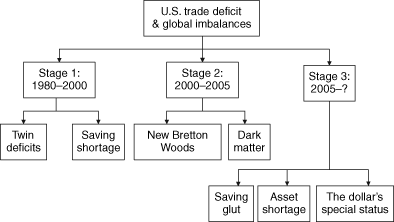
Figure 7.1 shows how the rising trade deficit has spawned three different stages of thinking among mainstream economists about the causes of the U.S. trade deficit. Stage 1 thinking (1980–2000) argued the trade deficit was due to a shortage of U.S. saving and it also argued that the deficit was cause for grave concern. Stage 2 thinking (2000–2005) argued the trade deficit was nothing to worry about and was even good for the economy. Stage 3 thinking (2005–present) argues that the U.S. trade deficit is due to excess saving among fast-growing emerging-market economies, combined with the desire to accumulate dollar assets because of the dollar’s special status. It too views deficits as essentially beneficial to the U.S. economy, providing U.S. financial markets are appropriately regulated. Each stage of thinking reflects the political preoccupations of the moment, which once again illustrates how economic theory is politically infused.
Stage 1: The Twin Deficits and Saving Shortage Hypotheses, 1980–2000
The first explanation of the trade deficit, which became popular in the early 1980s, is the twin deficits hypothesis that argues that the trade deficit is due to government’s budget deficit. The twin deficits hypothesis is a form of saving shortage argument in which the budget deficit is the source of the shortage of saving. According to its logic, trade deficits result when government spends more than it takes in as taxes.
The twin deficit hypothesis emerged in the 1980s and is particularly associated with Harvard economist Martin Feldstein, who headed President Reagan’s Council of Economic advisers. It is popular with conservatives as it provides yet another way of blaming the government, and it also makes the case for cutting government spending and shrinking government.
The twin deficit hypothesis has also been used to deflect criticism about China’s mercantilist trade policies. Here is Stephen Roach (2004a), Morgan Stanley Asia’s managing director, on the subject:
Yes, China accounted for the largest portion of America’s $540 billion trade deficit in 2003. But this deficit was not made in Beijing – it was made in Washington, That’s right – courtesy of a runaway federal budget deficit.
Moreover, despite being a pet theory of conservatives, it has become so woven into public discourse that even the liberal news media fall for it. Here is liberal columnist Nicholas Kristof (2006) writing in defense of China in the New York Times:
It’s hypocritical of us to scream at President Hu Jintao, as we did during his visit last weekend about China’s undervalued currency. Sure, that’s a problem for the world economy – but not nearly as much as our own budget deficits, caused by tax cuts we could not afford.
The twin deficits hypothesis lacks plausibility and is woefully lacking in evidence. The reality is the trade deficit is the result of the international economic policies of the United States and its trading partners, combined with the state of the business cycle (spending on imports rises with income in booms and falls with income in slumps).
Despite this, the twin deficits hypothesis is difficult to refute in a cut-and-dried manner because there is a small fragment of truth in it, specifically that higher budget deficits tend to raise national income, and higher income generates some increase in imports. However, that induced effect is small and cannot begin to explain the scale of the trade deficit. At most, one could say the twin deficits are distant cousins, which is completely different from claims they are twin siblings.
As for evidence, both Germany and Japan have run persistent large trade surpluses while simultaneously running persistent large budget deficits. In the United States, the budget moved toward surplus in the late 1990s at the same time as the trade deficit was setting new record highs.
Despite its weak theoretical foundations and lack of supporting evidence, the twin deficits hypothesis refuses to die because it serves a clear political purpose. Thus, it was somewhat in abeyance at the outset of the Great Recession when fiscal stimulus was clearly needed. However, it is now making a comeback and being enlisted to push fiscal austerity, including cutting Social Security. For instance, Martin Feldstein (2010), one of the hypothesis originators, is back to making twin deficit-styled arguments for fiscal austerity:
So, despite the rise in the household saving rate, unless federal government policies change to shrink future budget deficits, the U.S. will continue to be dependent on capital inflows from the rest of the world. If that happens, global imbalances will continue to add risk to the global economy.
He is joined in this by Fred Bergsten (2009) of the Peterson Institute for International economics, who writes:
Such massive budget deficits would almost certainly produce massive trade and current account deficits as well. The enormous government spending, along with private consumption and investment after recovery from the current crisis, would far exceed potential domestic production and drive up imports of goods and services. Financing the fiscal and external red ink would require huge capital inflows that would sharply expand our foreign debt.
The United States may or may not have a budget problem depending on the assessment of future economic growth, future tax policy, and future health care policy. However, the attempt to frame the trade deficit as a budget deficit problem is pure political polemic. The trade deficit is widely disliked by the American public for good reason as it is part of the nexus of channels that has undermined manufacturing and blue-collar prosperity. For conservatives, therefore, linking the trade deficit to the budget deficit does double duty. First, it distracts from the real cause of the trade deficit, which is corporate globalization and the United States’ flawed international economic policies. Second, it promotes an antigovernment agenda. It is this politics that explains the longevity of the twin deficit hypothesis.
The Saving Shortage Hypothesis
The twin deficits hypothesis dominated the 1980s. In the mid-1990s, as the U.S. trade deficit continued growing and the budget deficit started falling, it was increasingly replaced by the saving shortage (or excess consumption) hypothesis. This latter explanation became especially popular during the stock market bubble of the late 1990s.
The leading proponent of the saving shortage hypothesis has been Wall Street economist Stephen Roach.1 The basic claim is that the economy operates at full employment with finite capacity, and any demand in excess of this is satisfied through the trade deficit. Ergo, when Americans consume too much and save too little, it shows up through the trade deficit. The solution is simple: cut consumption and increase saving.
The saving shortage hypothesis has had much appeal. First, the rising trade deficit was accompanied by an increase in consumption as a share of GDP. Second, the saving shortage argument appeals to the puritanical streak in the American public as it blames the trade deficit on individual households and an excess of good times. Third, the argument is politically popular with conservatives as it justifies a plutocratic tax agenda aimed at increasing saving by privileging dividends, interest income, capital gains, and aimed at exempting from taxation income directed into saving accounts. Fourth, the saving shortage hypothesis has been popular with conservatives and corporations because it blames the trade deficit on households rather than U.S. policy makers’ embrace of globalization.
The saving shortage hypothesis suffers from faulty logic and is inconsistent with the evidence. According to its logic, the United States has suffered from a combination of inadequate productive capacity combined with excess demand that together drove the trade deficit. That makes no sense. Over the past two decades, the United States has been systematically losing manufacturing as trade agreements such as NAFTA and China-PNTR have encouraged U.S. corporations to offshore production and investment. The problem has not been excess demand and inadequate capacity. Rather, the problem has been lack of incentives to produce in the United States. As capacity has been closed, the goods that were once produced in the United States had to be imported.
In the most recent business cycle (2000–2007), the economy was characterized for much of the time by jobless recovery, elevated unemployment, low capacity utilization, and demand shortage, all of which prompted the Federal Reserve to lower interest rates. These weak conditions are the opposite of those implied by the saving shortage hypothesis. Rather than being short of capacity, consuming too much and saving too little, the problem is the United States is not producing or exporting enough.
The saving shortage hypothesis also ignores the role of exchange rates in causing trade deficits. This disregard of exchange rates is equivalent to doing economics without regard to prices. The trade deficit begins with shoppers at Wal-Mart who decide to buy foreign goods rather than American-produced goods. They do so because foreign goods are cheaper than American goods, and that is where the exchange rate enters because it affects the relative price of foreign and American goods. Appreciation of the dollar makes foreign goods relatively cheaper, whereas depreciation of the dollar makes them relatively more expensive. The strong-dollar policy and China’s undervalued exchange rate have together contributed to making American goods more expensive, which has increased imports, reduced exports, and also contributed to offshoring of production and investment. The saving shortage hypothesis makes no mention of this basic economics. Instead, it simply blames consumers for spending too much.
The United States could eventually find itself in a situation (and may even already be there) in which it lacks sufficient productive capacity to meet ordinary consumption needs. However, that would be due to closure of manufacturing capacity, not excess consumption and lack of saving.
In sum, the saving shortage hypothesis displays both the incoherence of mainstream economics and its trickiness. With regard to incoherence, on one hand, Americans have been repeatedly told there is a shortage of saving. On the other hand, they are repeatedly encouraged to go out and spend to avoid recession. Little surprise the public is confused. As for trickiness, sufficient downsizing of manufacturing will eventually create a situation in which the United States cannot support its normal consumption needs. This, however, has nothing to do with a saving shortage and is instead due to flawed international economic policy.
Stage 2: The New Bretton Woods and Dark Matter Hypotheses, 2000–2005
The economic triumphalism that marked the Clinton boom (1996–2000) spawned a second stage of thinking about the trade deficit. The Clinton administration vigorously promoted corporate globalization through NAFTA, proliferation of free-trade agreements, the establishment of the WTO, the strong-dollar policy, and the establishment of permanent normal trading relations (PNTR) with China, which gave China the most-favored-nation (MFN) status regarding U.S. market access. These policies increased the trade deficit and undermined U.S. manufacturing, thereby creating the need for more benign explanations of the trade deficit that could rationalize policy makers’ indifference to the deficit. This generated a second stage in thinking about the trade deficit.
The dominant stage 2 explanation was the New Bretton woods hypothesis, which argued the trade deficit posed no threat and was even to be welcomed (Dooley et al., 2003, 2004). According to the hypothesis, globalization had created a brave new world of opportunity in which emerging markets were industrializing. That industrialization was supposed to increase U.S. incomes via free trade organized around the principle of comparative advantage. However, as part of this process, emerging-market countries needed to acquire hard currency assets that supposedly provided collateral for U.S. foreign direct investment in those economies.
This situation supposedly created a parallel with the old Bretton Woods arrangement that ruled from 1945 to 1971. Back then, the United States was the dominant global economy and in the late 1950s, it started running trade deficits as the rest of the world accumulated dollar assets that were needed to finance growing global trade. Now, the United States was again running large systematic trade deficits, this time to provide collateral that could assist the industrialization of emerging-market economies. In this fashion, the new Bretton Woods hypothesis claimed to explain why the United States was running trade deficits and why the trade deficit was not bad. In effect, the United States was simply trading U.S.-produced financial assets for foreign-produced goods.
The new Bretton Woods hypothesis also purported to explain why emerging-market (EM) economies were running trade surpluses, contrary to conventional theory that predicted the reverse. According to conventional trade theory, capital should flow from capital-abundant rich countries (i.e., from the United States) to capital-scarce poor countries (i.e., to emerging markets), because rates of return are higher in capital-scarce economies. That was not happening. The new Bretton Woods hypothesis explained this by claiming that developing countries needed to acquire collateral as surety for FDI; argued it was a good thing; and asserted it could go on for a long time.
The Dark Matter Hypothesis
A second new explanation of the trade deficit was the “dark matter” hypothesis of Hausmann and Sturzenegger (2005). Their claim was that the United States earned supernormal rates of return on its foreign investments (i.e., dark matter) and these supernormal returns meant it had nothing to worry about from running up large debts to the rest of the world via the trade deficit. As with the new Bretton Woods hypothesis, that meant the trade deficit was nothing to worry about; was of no consequence to the real economy; and could be safely ignored by policy makers.
A Partial Assessment
The twin deficits and saving shortage hypotheses represent stage 1 in mainstream thinking about the trade deficit, and became popular in the 1980s and 1990s. The new Bretton Woods and the dark matter hypotheses represent stage 2 in mainstream thinking, and became popular in the 2000s.
Both stage 1 and stage 2 thinking reflect the political economy of the period. Stage 1 corresponds to the inauguration of the neoliberal era characterized by an antigovernment tilt (hence the popularity of the twin deficits hypothesis) and the desire to shift the tax code in favor of the well-to-do (hence the popularity of the saving shortage hypothesis). Stage 2 corresponds to the era of the triumph of corporate globalization embodied in NAFTA, the WTO, and China-PNTR. Hence the popularity of the new Bretton Woods and dark matter hypotheses, which both brushed aside concerns with the trade deficit and even welcomed it.
A feature of both stage 1 and stage 2 thinking (and stage 3 too) is that neither criticize globalization, which is a touchstone of the neoliberal project. According to both stage 1 and stage 2, free trade and corporate globalization are beneficial and increase U.S. income by increasing global productive efficiency via application of the principle of comparative advantage. From a stage 1 perspective, the only problem is U.S. saving behavior. From a stage 2 perspective, there is no problem. In this fashion, both aim to inoculate corporate globalization against arguments that corporate globalization is the source of the trade deficit problem and that it is undermining the U.S. economy.
The problem with the new Bretton Woods and dark matter hypotheses is they represent the trade deficit as benign. However, now that the trade deficit and global financial imbalances are widely viewed as having contributed importantly to the crisis, the appeal of these theories has dimmed.
The problem with the saving shortage and twin deficits hypotheses is they do not fit the facts in any way, shape, or form. These are theories of excess demand, which means the U.S. economy should have seen full employment, high capacity utilization, inflationary pressures, and rising interest rates. But none of this was present. Instead, the period between 2001 and 2007 was characterized by extended jobless recovery, fear of slipping back into recession, and weak investment and employment growth – which is why the Fed kept the lid on interest rates.
Furthermore, the saving shortage and twin deficit hypotheses also argued that the trade deficit was ultimately a threat because of the danger of a dollar collapse. Their reasoning was that as foreign wealth holders accumulated ever more U.S. debt, their portfolios would eventually get saturated. At that stage, once foreigners became unwilling to acquire more U.S. debt, this was supposed to trigger a spike interest rates and the collapse of the dollar, which was how the crisis was supposed to happen. However, none of this happened.
These failings suggest that the saving shortage and twin deficit hypotheses must be discarded. Instead, they have been placed in abeyance, waiting for a political opportunity to resurface. Moreover, that opportunity is now at hand, with the conservative push for fiscal austerity.
This shows how such thinking about the trade deficit is never rejected because it supports neoliberal economic policy. Consequently, as long as the neoliberal project remains politically dominant, explanations of the trade deficit such as the twin deficits hypothesis, the saving shortage hypothesis, and the new Bretton Woods hypothesis are needed politically and will continue to resurface periodically.
Stage 3: The Saving Glut, Asset Shortage, and the Dollar’s Special Status Hypotheses
Stage 2 thinking asserts that the trade deficit is of no concern. That is now viewed as wrong, necessitating another convolution of thought among mainstream economists about the U.S. trade deficit. This has produced a stage 3 thinking that centers on the saving glut hypothesis introduced by Federal Reserve Chairman Ben Bernanke (2005), which has now become doctrine and a critical part of neoliberal attempts to explain the crisis.
One country’s trade deficit is, by definition, another country’s trade surplus. Thus, instead of framing the global imbalance problem in terms of insufficient U.S. saving, the saving glut hypothesis reframes it as the product of excessive saving by EM economies.
With regard to the housing price bubble and the financial crisis, the argument is that EM economies (particularly China) increased their exports through export-led growth, ran large trade surpluses (saving), and then used those surpluses to buy U.S. bonds, thereby lowering U.S. interest rates and giving rise to the bubble.
The saving glut hypothesis is a brilliant piece of bait-and-switch political economy. It occupies the same space as the Keynesian critique by identifying the trade deficit as a problem, but it does so with an entirely different logic. However, close inspection reveals that its economic logic is faulty and it does not fit the facts.
Regarding its bait-and-switch aspect, to untrained eyes, framing the debate as a “saving glut” makes it looks as if the trade deficit problem is one of demand shortage, which causes unemployment. However, the saving glut hypothesis says nothing of the sort. Instead, it claims the trade deficit lowers interest rates, creating excess demand and asset bubbles. As regards globalization, the saving glut hypothesis sees it as good for efficiency (once again via the channel of trade), raising income, and causing no demand problem. As with stage 1 and stage 2 explanations of the trade deficit, the saving glut hypothesis therefore continues to defend corporate globalization against charges that it has undermined the U.S. economy and is a principal cause of the trade deficit.
The saving glut hypothesis is essentially a purely “financial” theory. Even though couched in the language of trade and export-led growth, its focus is on interest rates, not on offshoring and factory closures. In principle, the saving glut (i.e., foreign trade surplus and U.S. trade deficit) is even a good thing for the U.S. economy as foreigners are supplying saving on the cheap. Problems only arise if the U.S. uses those savings badly, so that according to the saving glut story, the real problem was U.S. financial markets and not the trade deficit.
Compare this with the Keynesian critique (see Chapter 4), which views globalization as hollowing out the productive structure of the economy, undermining income distribution, and creating a global shortage of demand. This is an entirely different logic that reveals how the saving glut hypothesis masquerades as Keynesian economics.
Analytically, the saving glut hypothesis is an updated global version of 1930s’ pre-Keynesian loanable funds interest rate theory that Keynes discredited in his General Theory. Loanable funds theory claims interest rates are determined by demand and supply of saving. Because trade surpluses are accounted for as saving, they affect interest rates in an integrated global economy: hence, the claim that China’s trade surplus significantly determines U.S. interest rates.
How does that happen? Whereas it is easy to see how a decision to export by a Chinese firm may lower goods prices and cause unemployment by displacing U.S. jobs (the Keynesian channel), it is difficult to see how the only effect of Chinese exports is to lower U.S. real interest rates and cause a boom (the saving glut channel). At its core, the saving glut hypothesis is based on the fiction that there is such a thing as a “loanable funds” market. According to this fiction, China hands its exports over to U.S. consumers in return for bonds, and because China wants to export a lot, it has to accept a low interest rate on the bonds.
The reality is the trade deficit involves a sequence of transactions beginning with an exchange of money for exports, followed by a second exchange of money for bonds. When one follows that sequence, it becomes clear that China is not the determining force behind U.S. interest rates. There is a very simple reason for this. China can only influence U.S. interest rates by first acquiring dollars to buy bonds. But China cannot create dollars. That is something which only happens within the U.S. economy with the cooperation of the Federal Reserve.
The first step is, therefore, the creation of dollar balances within the U.S. economy via the lending activities of U.S. banks to U.S. consumers. The second step is the spending of those dollar balances by U.S. consumers on Chinese goods, which puts the dollars in China’s hands. This is why the undervalued exchange rate is so important because it makes Chinese goods cheap compared to U.S. goods, thereby diverting spending to Chinese goods. The third step is, after the trade surplus has been created by the undervalued exchange rate, China enters the bond market and reinvests its trade surplus.
This is a very different story from the saving glut hypothesis. The initial lending by U.S. banks and the exchange rate are the critical factors, not Chinese saving. By conflating saving with the exchange rate, Chairman Bernanke sounds like Humpty Dumpty in Lewis Caroll’s Through the Looking Glass: “When I use a word it means just what I choose it to mean.”
One difficulty in overcoming the saving glut hypothesis is unwillingness of economists to carefully think through the process of trade deficit creation. A second difficulty is that China has affected U.S. interests, but not in the way the saving glut hypothesis claims. However, this creates a confusing similarity that provides the saving glut hypothesis with cover.
The main channel of influence on U.S. interest rates has been the flood of Chinese exports, which weakened U.S. manufacturing and the domestic economy. That caused the Federal Reserve to lower rates to ward off a double-dip recession in 2001–04. This is the Keynesian channel (the trade deficit caused economic weakness to which monetary policy responded) and it is completely different from Chairman Bernanke’s saving glut story (China and other emerging-market economies pumped up the bond market).
A subsidiary channel is that China may have affected the structure of relative interest rates. This is because China predominantly bought safer government bonds. That shifted money toward these safer assets, lowering their interest rate relative to other rates. In this fashion, China has helped finance the U.S. budget deficit via its portfolio choices. However, balanced against this, China also helped cause the budget deficit by undermining jobs, wages, and tax receipts, so that the net effect is a wash.
Lastly, now that China has accumulated almost a trillion dollars of U.S. bonds, it can also affect U.S. interest rates by dumping those bonds. However, this power has been accumulated because U.S. policy makers permitted China to run persistent large trade surpluses, and it has nothing to do with Bernanke’s (2005) saving glut hypothesis.
The saving glut hypothesis misunderstands the macroeconomics of the trade deficit, emphasizing “after the fact” saving (China’s trade surplus) rather than the undervalued exchange rate that causes the surplus in the first place. It also misunderstands the microeconomics by misrepresenting the nature of Chinese exports, which are misleadingly labeled “Chinese savings.” Table 7.1 shows the vast bulk of Chinese exports are produced by foreign multinationals. Fifty percent of Chinese exports are produced by fully owned foreign subsidiaries, and another 26 percent of exports are produced by joint ventures involving foreign corporations. When viewed in this microeconomic light, it becomes clear that the issue is not about saving (as normally understood) but about globalization and international economic policy.
Table 7.1. Decomposition by Firm Ownership Structure of Chinese Exports in 2005

The U.S. trade deficit and China’s trade surplus are joint products of neoliberal globalization. China’s massive exports and trade surplus reflect the fact that multinational corporations have set up shop in China to create export production platforms that take advantage of China’s cheap labor and lax standards. The true drivers of China’s trade surplus and the U.S. trade deficit are a combination of forces consisting of U.S. international economic policy, offshoring by multinational corporations, and China’s undervalued exchange rate policy.
Not only does the saving glut hypothesis neglect exchange rates and corporate globalization; it also suffers from a number of smaller inconsistencies. First, according to its logic, countries (like Germany and Japan) are saving because they have aging populations that are preparing for retirement. However, the United States also matches that demographic pattern, so it too should have run the surpluses. Furthermore, EM economies (including China) should have run deficits because of their younger demographic. Yet, the opposite occurred: the United States ran massive deficits and the EM economies ran massive surpluses.
Second, the saving glut hypothesis fails to explain why the United States was singled out. Just suppose for a moment that the hypothesis were true. In that case, all industrialized economies ought to have run huge trade deficits and had huge bubbles, yet that did not happen in the rest of the world (e.g., Germany and Japan).2
Third, the low interest rates supposedly induced by the saving glut should have spurred an investment boom in the United States, but that too did not happen, as shown in Chapter 4 (see Table 4.15). Instead, there was only a housing bubble.
Fourth and finally, not only has the saving glut hypothesis contributed to misunderstanding China’s role in the crisis; it has also hampered dealing with China. By claiming that China sets U.S. interest rates, the saving glut hypothesis has encouraged the fiction that the United States needs China. That fiction has been very costly in the public policy debate over the past decade as it was used to justify inaction against China’s exchange rate manipulation on grounds that the United States could not afford to antagonize China. Quantitative easing (the massive program of bond buying) by the Federal Reserve has now revealed the lie by showing the United States can finance its deficit by having the Fed by bonds, but a lot of damage has already been done because of this lie.
In terms of economics, proof is difficult, but the signature of events fits the Keynesian story. The saving glut hypothesis is built on incoherent macroeconomics, incoherent microeconomics, and does not fit the facts. Contrast it with the simple clear logic of the structural Keynesian argument. Export-led growth based on corporate globalization and undervalued exchange rates in EM economies poached demand from U.S. producers and contributed to massive trade deficits, factory closures, reduced investment spending, unemployment, and generally weak economic conditions. These conditions caused the Federal Reserve to lower its policy interest rate, thereby lowering market interest rates. These conditions also caused lower inflation expectations and expectations of future economic weakness, which further lowered long-term interest rates in bond markets.
The structural Keynesian hypothesis also explains why interest rates were low globally. Neoliberalism has been a global economic policy supported by a global consensus in the mainstream economics profession. Its policies have been adopted in the United States and Europe, while the World Bank and the IMF have pushed it on developing countries. This explains why income inequality widened globally (Milanovic, 2007). The combination of domestic application of neoliberal policies, corporate globalization, and export-led growth by EM economies created global demand shortage. That prompted central banks around the world to lower interest rates in various degrees in an attempt to head off depression conditions created by their own economic ideology.3
Why is the saving glut hypothesis so popular if it is so clearly wrong? There is a simple reason. The stage 1 saving shortage hypothesis is implausible at a time of massive unemployment, whereas stage 2 hypotheses, which claim the trade deficit and global imbalances are benign and inconsequential, are also implausible. That has created the need for another explanation, and the saving glut hypothesis fills the gap. It identifies the deficit as a problem and cleverly confuses debate by using the language of Keynesian economics, but avoids fingering the role of neoliberal globalization and multinational corporations in creating the deficit.
The use of the language of “saving gluts” is a case of bait and switch. It conjures up Keynesian arguments of demand shortage but in fact has nothing to with Keynesian arguments and policy recommendations. Indeed, rather than suffering from China’s predatory exchange rate policies, the saving glut story would say that the U.S. economy benefitted from it. That is because when foreign countries subsidize their exports, via undervalued exchange rates or other means, those countries are effectively giving a gift (a “free lunch”) by selling below cost.
The ability to confuse the debate makes the saving glut hypothesis brilliant political economy propaganda, but it is lousy economics. That it is so widely believed by economists is a statement about the state of modern economics.
The Asset Shortage Hypothesis
The saving glut theory has become the backbone of stage 3 accounts about the role of global imbalances in the crisis. The argument is that the housing price bubble and subsequent bust were caused by low U.S. interest rates, which were in turn caused by foreign countries’ trade surpluses. In this fashion, the saving glut theory implicitly relieves the Federal Reserve and U.S. policy makers of any responsibility, which helps explain why former Federal Reserve Chairman Alan Greenspan has also endorsed the argument.
The saving glut hypothesis has now been further elaborated with an eye to explaining the asset price bubble. MIT economist Ricardo Caballero (2006, 2007) introduces the idea that the world economy has been suffering from a financial asset shortage. Consequently, the increase in demand for assets from EM economies, combined with a shortage of quality assets, has driven up asset prices and contributed to repeated asset bubbles.
To explain why the EM economies wanted to accumulate assets, Caballero’s invokes the new Bretton Woods Hypothesis and argues that they wanted “hard currency” assets as collateral for their development. Additionally, to explain why the asset price bubble was largely restricted to the United States, he argues that EM economies are good at growing production and real saving but they lack high-quality financial institutions and financial markets that can supply financial assets. Consequently, their saving flowed disproportionately to the United States, driving up U.S. asset prices. Columbia University economist Guillermo Calvo (2009) has sought to further elaborate the asset shortage story by arguing that demand for assets combined with lax regulation led to the creation of poor-quality financial assets to satisfy this demand.
Putting the pieces together yields a compound hypothesis that is a mix of the regulatory deficiency, new Bretton Woods, saving glut, and asset shortage hypotheses. Not only does this compound hypothesis suffer from all the flaws and failings already identified; the asset shortage hypothesis introduces a host of additional problems.
First, despite the claim that assets are accumulated as collateral, there is no evidence of countries like China pledging their billions of dollars as collateral. Second, the asset shortage hypothesis does not fit the evidence of the past thirty years. As shown in Table 7.2, a cursory look at the data shows there is no evidence of a financial asset shortage as the supply of financial assets has grown far faster than GDP. During this period, U.S. financial assets, measured by the Dow Jones index and nonfinancial sector debt, were growing far faster than GDP.
Table 7.2. Growth of Supply of U.S. Financial Assets

Moreover, Table 7.2 table shows the supply of financial assets was surging long before EM economies started running huge trade surpluses. The 1980s witnessed a stock market boom and leverage buyout bubble. The 1990s saw another stock market boom, the Internet bubble, and the beginning of the housing bubble. These were domestically driven events unconnected to the global financial imbalances that emerged later.
Indeed, during the 1990s, many EM countries were actually running trade deficits, which contributed to the raft of financial crises that hit EM economies between 1997 and 2001. During this period, EM economies were therefore suppliers of financial assets via their borrowing to finance their trade deficits, and through the wave of privatizations pushed by the IMF and World Bank.
Most importantly, there are far simpler explanations of the asset price bubble than the convoluted asset shortage story.4 It is trivially obvious that asset prices went up because of changes in demand and supply, but the factors behind this change were not those identified in the asset shortage hypothesis. Here is a list of alternative factors:
1. Increased income inequality increased asset prices because the rich save more and buy more financial assets.
2. The increase in the profit share increased the fundamental value of assets.
3. Lower taxes on profits and the incomes of the rich increased both the fundamental value of assets and increased the asset-purchasing power of the rich.
4. Lower central bank interest rates to combat the weak state of global demand increased the discounted value of future profits, justifying higher asset prices.
5. Credit market innovations increased the supply of debt and allowable leverage, thereby increasing the supply of money chasing the existing pool of assets.
6. Aging baby boom populations in the industrialized countries increased retirement saving, thereby increasing demand for assets.
7. Finally, good old-fashioned investor mania contributed to higher asset prices, and nowhere is that more evident than the U.S. housing bubble.
These arguments provide a simple commonsense explanation of both credit and asset price developments over the past twenty years. If the principle of Occam’s razor (simpler theories are better than complicated ones) applied, the asset shortage theory would never have seen the light of day.
Why the popularity of the outlandish asset shortage hypothesis? The answer is that it too defends neoliberalism. Like the saving glut hypothesis, it maintains that globalization is a good thing; the U.S. trade deficits are a natural outcome of asset shortages and is not troublesome; and asset bubbles are not only no cause for concern; they are a good thing that should be left alone because they increase the supply of assets and promote development.
The Dollar’s Special Status Hypothesis
A final hypothesis is that the special status of the dollar caused the crisis. The argument begins with the observation that the dollar is the world’s number one reserve currency. It then argues that the 1997 East Asian financial crisis showed countries the cost of being exposed to sudden capital flight and shortage of foreign currency reserves. Countries therefore embarked on a process of reserve acquisition by running large trade surpluses fueled by undervalued exchange rates. In effect, they built up large dollar holdings to provide insurance against future capital flight. The flip side of this dollar accumulation was large trade deficits with the United States.
This hypothesis has been advanced by Jorg Bibow (2008) of the Levy Institute, who writes:
The hypothesis put forward here is that systematic deficiencies in the international monetary and financial order have been the root cause behind today’s situation. Furthermore, it is argued that the United States’ position as issuer of the world’s premiere reserve currency and supremacy in global finance explain the related conundrum of a positive income balance despite a negative international investment position.
It is also supported by IMF economists Lago, Duttagupta, and Goyal (2009):
The global crisis resurrected deep-rooted concerns about the functioning of the international monetary system. Despite its relative stability, the current “non-system” has the inherent weakness of a set-up with a dominant country-issued reserve currency, wherein the reserve issuer runs fiscal and external deficits to meet growing world demand for reserve assets and where there is no ready mechanism forcing surplus or reserve-issuing countries to adjust. The problem has amplified in recent years in line with a sharp rise in the demand for reserves, reflecting in part emerging markets’ tendency to self-insure against costly capital account crises.
This line of argument ties back to the work of Robert Triffin (1961, 1968) who argued that the United States ran trade deficit in the 1960s for the same reason, namely to supply net dollar assets to the rest of the world.
The dollar reserve shortage hypothesis has a grain of truth but it is also very misleading. The East Asian economies were victimized by capital flight in 1997, which likely increased the demand among their central banks for international reserves to protect against future capital flight. However, over the last decade, they have accumulated foreign reserves far in excess of what can be justified in terms of financial precaution.
The sequence of developments is better understood as follows. The 1997 East Asian financial crisis produced massive exchange rate depreciations that were explicitly endorsed by the Clinton administration’s strong-dollar policy. These depreciations spurred East Asian export growth, helping those economies recover from the crisis, and they occurred just as the United States was beginning its ten-year consumption spending boom fueled by domestic debt and the housing price bubble.
In effect, the East Asian economies stumbled onto a growth model that was highly effective given the U.S. consumption boom and U.S. international economic policy. They therefore stuck with the model because it worked so well, and not because they needed additional foreign reserves. In fact, for years their reserve holdings have far exceeded anything that can be economically rationalized.
It is also noteworthy that China, which has been the single largest contributor to the global imbalances, has also followed this growth strategy even though it was unaffected by the financial crisis of 1997 because of its capital controls.5 This clearly shows that it is the desire for export-led growth via undervalued exchange rates that is the real cause of the imbalance problem rather than the dollar’s special status and the need for international reserves.
Finally, the preference for dollar accumulation rather than accumulation of euro or yen also confirms that the intentional pursuit of export-led growth is the real issue. The reason the dollar is so special is because the United States is the world’s largest consumer market and the U.S. consumer has played the role of “buyer of first and last resort.” Countries have therefore acquired dollar assets because they want trade surpluses with the United States. That requires them to buy and hold dollars to maintain their undervalued exchange rates vis-à-vis the dollar.
This explanation of dollar reserve accumulation can be labeled the “buyer of last resort” theory of reserve currencies (Palley, 2006d). Put bluntly, the tribute other countries pay the United States through their trade surpluses is the result of their failure to generate adequate consumption spending in their own markets, be it due to poor income distribution or bad domestic economic policies. This forces them to rely on the American consumer.
Ironically, America’s dispensation from trade deficit discipline stems from other countries’ failure to develop an equivalent of the American consumer. Countries want to industrialize with full employment, but they lack adequate internal demand. Consequently, they must rely on the U.S. market. That is why Germany supplies BMWs and Mercedes-Benzes in return for paper dollar IOUs.
Seen in this light, it becomes clear that arguments about the dollar’s special status are a fig leaf that gives countries cover for pursuing export-led growth. Arguments about reserve shortages and the dollar’s special status are a major distraction. In today’s world, there is no shortage of dollar reserves. The world is awash with dollars, and countries have easy access to dollar credits (both short and long term) via international capital markets.
Focusing on the dollar and precautionary reserve accumulation by EM economies (so-called self-insurance) misdirects attention away from the fundamental problem of intentional export-led growth strategies based on undervalued exchange rates that are the real source of global imbalances (Palley, 2006c). What is needed is global exchange rate management that prevents excessive trade imbalances, combined with sensible capital controls that protect against capital flight. That is a very different story from one that focuses on the special reserve status of the dollar as the source of the problem.
The New Neoliberal Consensus: Gato Pardo Economics
The collection of hypotheses described in Chapter 6 and this chapter are now being collated into a new neoliberal consensus about the crisis. This new consensus is described by Raghuram Rajan (2010), former IMF chief economist, in his book Fault Lines. The new consensus explanation of the crisis is illustrated in Figure 7.2 and involves three principal channels of causation.
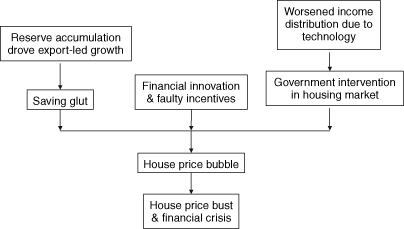
Figure 7.2. The new neoliberal consensus on the causes of the crisis.
The first channel is via global imbalances. These imbalances are attributed to East Asian governments looking to accumulate reserves after the crisis of 1997, which shifted their export-oriented economies into export overdrive. That created a global saving glut, which in turn impacted the United States by lowering interest rates.
The second channel of causation is via financial innovation and faulty incentives in financial markets. Financial innovation has increased the supply of risky financial assets that carry high returns. Faulty incentives then encouraged bankers, brokers, and dealers to take on massive amounts of risk as they were paid up front via commissions and bonuses that were unconnected to ultimate outcomes. The result was that they took on excessive risk, knowing they had nothing on the line as they would be paid before the true worth of their investment decisions was revealed.
The third channel of causation, which is the main innovation in Rajan’s (2010) story, is to add income distribution. The story is that technological innovation caused a worsening of income distribution by increasing pay of higher-educated persons and lowering pay of less-educated blue-collar workers such as union members. The deterioration in income distribution prompted political intervention in the housing market aimed at making housing more affordable – a “let them eat credit” strategy. This argument has also been made earlier by Milanovic (2009).
The three channels together then produced the housing bubble, and the rest is history. The solution is threefold: (1) try and persuade China and other EM economies to desist from export-led growth and shift to more domestic demand-led growth; (2) discourage excessive risk taking in financial markets by removing government guarantees, reforming incentive arrangements that encourage excessive risk taking, and monitoring for excessive risk buildup and risk concentration; (3) invest in education to improve the quality of “human capital” and get rid of government intervention in the housing market.
What is wrong with the new neoliberal consensus? With regard to the reserve accumulation and the saving glut piece of the story, this chapter has already described the theoretical and empirical failings. The claim that the only effects of globalization and the trade deficit are to lower U.S. interest rates is bad theory, implausible, and inconsistent with the evidence. U.S. interest rates are not set in Beijing. Had the Federal Reserve imposed higher interest rates, it would only have avoided the housing price bubble at the cost of an earlier onset of stagnation that was the inevitable outcome of the neoliberal economic model (as described in Chapter 4).
Compare the reserve accumulation – saving glut hypothesis with the structural Keynesian hypothesis that argues that flawed U.S. international economic policy encouraged offshoring by U.S. corporations and export-led growth by foreign countries. Together, that created a triple hemorrhage of leakage of spending out of the economy via imports, offshoring of production and employment, and diversion of investment offshore. This lowered employment, undermined wages, and widened income inequality, thereby creating weak demand conditions that needed low interest rates as an offset.
With regard to the financial innovation–faulty incentives component, the story is broadly sensible, but it is also an inadequate description of the problem for several reasons. Neoliberal economists retain an “efficient markets” conception of the financial system, so that any problem must be due to a “market failure” (e.g., faulty incentives) or wrong-headed government intervention (e.g., guarantees or too-big-to-fail rules). The new neoliberal consensus aims to maintain this ideology, which has prevailed for thirty years. That is the fundamental difference from the Minskyian account of the financial dimension of the crisis described in Chapter 5.
According to Minsky’s theory, financial markets are genetically prone to instability that accumulates gradually over time (Palley, 2009b, 2011). This Minskyian logic connects with Alan Greenspan’s problem of having discovered a “flaw” in his theory. The fact that market discipline by lenders and shareholders failed so comprehensively is powerful evidence exposing the fiction of efficient markets. Addressing financial markets’ inherent proclivity to instability requires systematic ongoing regulation, accompanied by permanent skepticism about finance. That is what the new consensus seeks to avoid, hence its continuous attempts to blame government for the crisis.
The third component of the new consensus is income distribution that spurred disastrous housing market intervention. According to the new consensus, there is nothing wrong with labor markets, which are working exactly as they should. It is just unfortunate that technological developments mean labor markets have produced inequality. As far as the new neoliberal consensus is concerned, there was no economic problem with labor markets and income distribution, only a political one. The economic problem only arose when government intervened in the housing market to try and ameliorate worsened income distribution.
This argument is totally unpersuasive. The claim that technology and lack of education caused worsened income distribution is a favorite neoliberal argument as it removes responsibility from policy makers and blames the victims. It says nothing about the changed bargaining power between workers and corporations; the decline of unions; globalization and the threat of job offshoring; and erosion of the minimum wage, the social safety net, and worker rights and protections.
Moreover, according to Rajan, the only effect of worsened income distribution was to provoke populist meddling. There were no effects regarding creating a shortage of demand, which is part of the Keynesian account of income distribution.
The claim that politicians’ intervention in the housing market caused the crisis is also implausible. Chapter 6 showed the evidence does not support this argument. The Community Reinvestment Act was passed in 1977; Fannie Mae was established in 1938; Freddie Mac was established in 1968; and the mortgage interest deduction has been part of the tax code for more than fifty years. There may be good reasons to reform these features, but it is impossible to argue they caused the crisis.
Indeed, all the significant political interventions in financial markets in the decade preceding the crisis were on behalf of rich powerful financial interests – including the repeal of the Glass-Steagall Act in 1999, the obstruction of derivatives market reform in 1998, the Enron loophole in the Commodities Futures Modernization Act, which enabled commodity speculation, and the SEC’s net capital rule of 2004, which permitted massively increased leverage for Wall Street’s investment banks. That is the exact opposite of the political story told by Rajan in his new consensus fable.
The new neoliberal consensus story is brilliant political polemic that captures the language of Keynesianism while having zero Keynesian content. Thus, it talks of export-led growth and a saving glut, but this has nothing to do with globalization producing global demand shortage, wage erosion, and job loss. Instead, it is about globalization producing lower interest rates that should spur demand and investment.
It talks of financial excess, but this has nothing to do with financial markets’ fundamental proclivity to speculation and instability. Instead, it is about technical incentive design failures and government interventions that supposedly promoted excessive risk taking.
Lastly, it talks about deteriorated income distribution, but this has nothing to do with the changed bargaining power and the creation of a demand gap that was filled by borrowing. Instead, it is about prompting political intervention in the housing market that causes the crisis.
Rajan’s account of the crisis is “Gato Pardo” economics. Il Gato Pardo is a sweeping movie about social tumult in Sicily in the 1860s. The wily Prince of Salina and his nephew Tancredi are intent on preserving the existing class order, and as the crisis grows, Tancredi declares “Things must change if they are to remain the same.” And they do, so that after the revolution, the old aristocracy remains in charge, allied by marriage to the new urban elite. The new neoliberal consensus aims to do exactly the same: offer the pretense of change while keeping things exactly as before.
Globalization remains unambiguously good, and policy should continue full steam ahead with the current model. Financial markets operate in accordance with the efficient markets hypothesis, and the challenge is to prevent government-induced distortions. Labor markets produce economically efficient distributions of income, and there are no concerns about bargaining power that need remedy. All that is needed is more education for the masses – but of course even that cannot be funded because of the adverse supply-side incentive effects of higher taxes, the threat of a government debt crisis, and the threat of trade deficits due to twin deficits.
Conclusion: Theory on the Fly
Chapters 6 and 7 have been long and difficult chapters that explore the plethora of hypotheses invented to explain the crisis. Crisis explanation has become a cottage industry among neoliberal economists because how the crisis is explained is of critical importance as it will influence what happens next. If neoliberalism is to remain the dominant frame for economic theory and policy, there is a need for an explanation that exculpates it.
Chapters 6 and 7 showed that neoliberal explanations do not add up in terms of theoretical coherence or consistency with the evidence. However, the sheer number of hypotheses makes the task of exposing this failing difficult.
The plethora of hypotheses also illustrates a feature of neoliberal economics that can be termed “theory on the fly.” Every time there is a new observation requiring explanation, up pops a new theory that is accepted without regard to whether it fits the larger body of evidence.
This process of theory on the fly has parallels with Ptolemaic astronomy. Every time an observation appeared that was inconsistent with the Ptolemaic geocentric universe, another planetary epicycle was added to explain away the anomaly. Metaphorically speaking, neoliberal economists are now adding new epicycles to defend their Ptolemaic model of the economy. This process is reminiscent of Keynes’s (1931) remarks about Hayek’s book, Prices and Production, in which Hayek sought to explain the Great Depression:
This book, as it stands, seems to me to be one of the most frightful muddles I ever read…. And yet it remains a book of some interest, which is likely to leave its mark on the mind of the reader. It is an extraordinary example of how, starting with a mistake, a remorseless logician can end up in bedlam.
The same can be said of the new neoliberal consensus about the crisis.
The great challenge is how to get other theories on the table. The problem is not that there are no other theories; it is that they are excluded from the room. That leads to concerns about the sociology of the economics profession – a subject that is taken up in Chapter 11.
1 See, for example, Roach, S. [2004b], “Twin Deficits at the Flashpoint?’ Morgan Stanley Global Economic Forum, August 16; and Roach, S. [Reference Roach2010], “Blaming China Will Not Solve America’s Problem,” Financial Times, March 29.
2 Only Ireland and Spain had similar bubbles and that was due to the special circumstance of their joining the euro, which enormously lowered their interest rates to levels close to that of Germany.
3 Former Federal Reserve Chairman Alan Greenspan has tried to use this global pattern of low interest rates to defend himself. The reality is that it is further evidence condemning the economic theory and policies he peddled as Federal Reserve chairman. See Greenspan, A. [Reference Greenspan2008], “Alan Greenspan: A Response to My Critics,” ft.com/economists forum, April 6, http://blogs.ft.com/economistsforum/2008/04/alan-greenspan-a-response-to-my-critics/
4 See Palley, T.I. [Reference Palley2007b], “World Asset Prices: What’s Really Going On?” January 1, http://www.thomaspalley.com/?p=61
5 Moreover, China’s undervalued exchange rate has amplified the imbalance problem by compelling other East Asian economies to undervalue their exchange rates so as to remain internationally competitive vis-à-vis China.


