
Skip to main content Accessibility help
×
  • Cited by 33
    • Show more authors
    • You may already have access via personal or institutional login
    • Select format
    • Publisher:
      Cambridge University Press
      Publication date:
      05 November 2012
      11 October 2012
      ISBN:
      9781139093538
      9781107018891
      9781107448971
      Dimensions:
      (228 x 152 mm)
      Weight & Pages:
      0.56kg, 292 Pages
      Dimensions:
      (229 x 152 mm)
      Weight & Pages:
      0.5kg, 292 Pages
    You may already have access via personal or institutional login
  • Selected: Digital
    Add to cart View cart Buy from Cambridge.org

    Book description

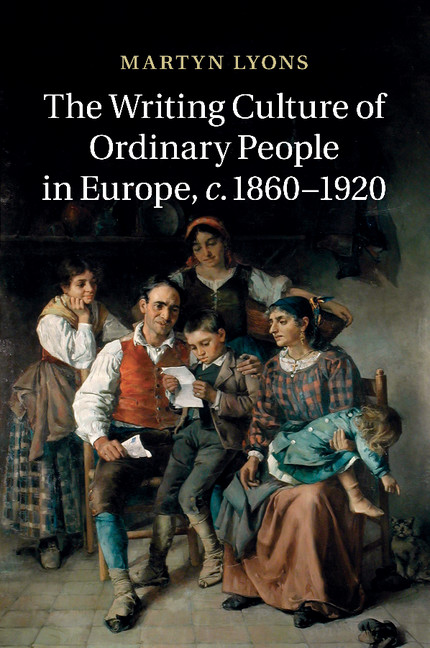
    As war and mass emigration across oceans increased the distances between ordinary people in the late nineteenth and early twentieth centuries, many of them, previously barely literate and unaccustomed to writing, began to communicate on paper. This fascinating account explores this surge of ordinary writing, how people met the new challenges of literacy and the importance of scribal culture to the history of individual experience in modern Europe. Focusing on correspondence and other writing genres produced by French and Italian soldiers in the trenches in the First World War, as well as Spanish emigrants to the Americas, the book reveals how these writings were influenced by dialect and oral speech and were oblivious to the rules of grammar, spelling and punctuation. Through their sometimes moving stories, we gain an insight into the importance to ordinary peasants of family, village and nation at a time of rapid social and cultural change.

    Reviews

    ‘All historians, regardless of their specialization, will find enthralling material in this pioneering study of the ‘common writer’. For here we find people at the bottom of the social pyramid writing their own history, as they experienced it and described it.’

    Jonathan Rose - William R. Kenan Professor of History, Drew University

    ‘Martyn Lyons’ new book is a rigorous, wide-ranging and deeply moving account of how ordinary people used correspondence to deal with the extraordinary events of emigration and war. It combines an authoritative grasp of comparative popular culture with a keen eye for the difficulties of expressing the most profound experiences of separation, loss and suffering.’

    D. M. Vincent - The Open University

    '[Lyons] has a humane and sensitive approach to his subject matter.'

    Source: The Times Literary Supplement

    'Lyons' work participates in a new 'history from below': a history that takes seriously such documents as survive from the lives of the (mainly) rural poor, and, rather than subjecting them to an alien agenda, or deploring them as banal, values them as painstaking contributions to a complex 'family strategy' through which the priorities of home (household, farm, extended family, village, region and only rarely nation) compete with the pressures of self-individuation, self-invention, adaptation … a richly nuanced map of changing patterns of literacy.'

    Source: Archives

    'Lyons’ take on history from below succeeds first and foremost in restoring individuality to the writers and texts he studies. His careful readings of specific passages show that even the weakest and least educated of these writers wrote with purpose and care … a work that does future researchers a tremendous service in calling attention to these underexplored archives and that lays the groundwork for reading alternative sources alongside and in opposition to official narratives.'

    Source: Nineteenth-Century French Studies

    'Throughout the book, Lyons successfully challenges two persistent notions: first, that few people were able to write about complex matters; and second, that there is little evidence of ordinary writing to be found. This immediately opens up a remarkable field of enquiry - a history from below - which is well worth investigating.'

    Arnold Lubbers Source: SHARP News

    'Anyone working with the written sources of ordinary people will learn from this book.'

    William A. Christian Source: Continuity and Change

    'Martyn Lyons concentrates his attention on the letters and family account books known generically as 'memory books' of French, Italian, and Spanish peasants to determine how writing allowed them to maintain disrupted family networks and to embrace or ignore the larger national agendas of their homelands. He has effectively mined Spanish and Italian archives, thus providing us with a much deeper understanding of the mental lives and scribal practices of peasant soldiers in Italy and emigrant families in Spain.'

    Martha Hanna Source: The Journal of Modern History

    '[This book] offers a strong corrective to those who would read letters, postcards, diaries, memory books and other forms of communication penned by the poor and undereducated of rural Europe in the late nineteenth and early twentieth centuries for content alone.'

    Kate Flint Source: European History Quarterly

    Refine List

    Actions for selected content:

    Select all | Deselect all
    • View selected items
    • Export citations
    • Download PDF (zip)
    • Save to Kindle
    • Save to Dropbox
    • Save to Google Drive

    Save Search

    You can save your searches here and later view and run them again in "My saved searches".

    Please provide a title, maximum of 40 characters.
    ×

    Contents


    Page 1 of 2


    Page 1 of 2


    Metrics

    Altmetric attention score

    Full text views

    Total number of HTML views: 0
    Total number of PDF views: 0 *
    Loading metrics...

    Book summary page views

    Total views: 0 *
    Loading metrics...

    * Views captured on Cambridge Core between #date#. This data will be updated every 24 hours.

    Usage data cannot currently be displayed.

    Accessibility standard: Unknown

    Why this information is here

    This section outlines the accessibility features of this content - including support for screen readers, full keyboard navigation and high-contrast display options. This may not be relevant for you.

    Accessibility Information

    Accessibility compliance for the HTML of this book is currently unknown and may be updated in the future.
