

Part II Change in Private Property Institutions
5 The Distributive Politics of Squatters’ Rights
Why do property institutions change? Claim clubs often pushed the state aside in the rush to specify private property institutions on their own. However, their members eventually had to harness the state's power to receive legal title. This chapter presents the first of several empirical studies of change in property institutions, focusing on one of the fundamental policies governing property rights to agricultural land in the nineteenth century: preemption laws, which were popularly known as “squatters’ rights” because they awarded legal titles – typically in the amount of 160 acres – to individuals who prospectively occupied government land. To help sort through the process of institutional change, the first part of the chapter provides a theoretical framework that will guide the empirical inquiry in the rest of the book.
The goal of this chapter (and Part II of this book more generally) is to understand the extent to which change in major land laws affecting participants in each of the sectors under consideration reflected efficiency or distributive considerations, as well as to better understand the consequences of claim clubs in the process of institutional change. Economic studies of institutional development during this period provide a preliminary answer to these questions, outlined in Chapter 1: federal land laws were poorly designed, with claim clubs pushing for more effective land laws. Eventually, the federal government realized that the clubs were the source of innovation in the economy, reversing course and recognizing their property rights. Overall, economic accounts tend to look favorably on squatters’ rights as well as the role of claim clubs in the process of institutional change, saving their criticism for what they viewed as a slow-moving federal government.
This findings presented in this chapter (as well as the ones that follow) call into question economic perspectives of the sort outlined above. My argument is that economic studies praising claim clubs overlook distributive features of claim clubs. To assess this economic hypothesis as well as my alternative perspective on claim clubs, it is necessary to first step back and identify the outcomes of interest.
As a general matter, my concern is with the alternative mechanisms of allocating state-owned land, namely the extent to which the government allocated land through competitive land auctions, as well as the extent to which auctions produced a price that reflected demand and supply conditions, as opposed to bargaining power of key groups. For reasons explained later, the efficiency perspective will be represented by the extent the federal government and state governments allocated land competitively through auctions. Competitive land auctions were socially desirable because they put land into the hands of those who valued it most while at the same time providing the state with revenue to provide public goods.
Consistent with an efficiency rationale for institutional change, the government created markets for public land as early as 1785, while the Articles of Confederation still remained in effect. Competitive auctions allowed individuals to acquire private property rights while also providing the state with an important potential source of nontax revenue it could use to provide public goods, including national defense.
Once we understand the status quo of competitive land auctions, the political economy of claim clubs comes into clearer focus. Claim clubs, rather than a socially desirable response to poorly designed land laws, were a source of social costs precisely because of their effort to dismantle, evade, or otherwise undermine competitive land auctions. Besides providing a source of nontax revenue to fund an army and infrastructure necessary for capitalist development, revenue from public land was to be used for education expenditures. Despite these desirable uses of revenue from land, clubs worked to undermine auctions at every turn. These remarkable self-governing organizations also undermined institutional innovations seeking to balance the state's interest in revenue with individual thirst for land. They were rent-seeking organizations by design.
At a more fundamental level, claim clubs undermined the fabric of the young American federal system during a time in which the power of the federal government was by no means institutionalized. As Bednar (2008) explains, federations must satisfy several conditions in order to be considered “robust,” in particular that there are overlapping constraints on leaders. The political economy of early land policy complements Bednar's framework by illustrating the importance of overlapping sources of revenue as an additional explanation for federal stability.1 Securing a fraction of the scarcity rent associated with state-owned land took on greater significance because collecting taxes presented logistical and bureaucratic challenges throughout the early nineteenth century (Grubb 2010; Pollack 2009). Each mechanism for generating revenue was imperfect, and overreliance on any single source of revenue threatened the robustness of the American federal system. For example, Shay's Rebellion and others like it demonstrated the costs of implementing direct taxes, and indirect taxes, such as a tax on imported goods, threatened an outbreak of protectionism. In an environment of institutional weakness, nontax revenue from the nation's vast stock of land had special significance. By systematically undermining nontax revenue opportunities in a context with little slack as far as revenue is concerned, claim clubs undercut an important leg of a weak federal state.
Besides providing insight into the political economy of federalism, a distributive perspective on claim clubs complements existing perspectives on property institutions utilizing the framework of “new institutional economics” by considering explicitly conflict over the price of land.2 For example, North and Rutten (Reference North, Rutten, Klingaman and Vedder1987), in analyzing the Northwest Ordinance of 1787, were more concerned with emergence of private property institutions during this period than distributive conflict over the price of legal title that followed. Sened (Reference Sened1997) also used the Northwest Ordinance as an example of emergence of private property institutions, yet did not consider the prolonged conflict over the price for the next century. Likewise, Libecap (1989), in his remarkably insightful study of emergence of property institutions in American economic history, clearly articulated how distributive fights could prevent emergence of private property institutions without giving much attention to the price at which land changed hands. Accordingly, each of the aforementioned perspectives, which are among the most compelling studies of origin and change in property institutions, are nevertheless incomplete, mainly because they underestimate distributive conflict over the price of land.
There are, however, a few important studies that consider land auctions from a political economy perspective. For example, Grubb (Reference Grubb, Irwin and Sylla2010, 2007) offers many insights into the distributive dimensions of land policy from 1781 to 1802, as well as precise data regarding the relationship between public land and government debt. In addition, Dougherty (2001) articulates precisely the revenue challenges confronting the Articles of Confederation from 1781 to 1787. The main problem in terms of revenue was that the Articles funded the federal government almost entirely by voluntary contributions from the states, and so the constitutional structure institutionalized a collective action problem.
The analysis in this chapter complements these earlier studies of revenue generation in the early republic by considering protracted conflict over auctions after their initial creation, one that would continue long into the nineteenth century. The aforementioned studies focus mainly on the period shortly before, during, and shortly after the Articles of Confederation. However, distributive conflict over land was a much more general feature of American land laws. In addition, neither of these earlier studies considers explicitly land auctions from the process of institutional change, focusing instead on a static economic assessment of different institutions during the late eighteenth century.
This chapter, as well as subsequent ones, also provides insight into the organizational foundation of political advantages of first possession. Economists interested in evolution of property rights have shown that those who first claim land often have advantages keeping it (Alston et al. Reference Alston, Harris, Mueller, Kenneth and Smith2011; Libecap 2007a, 2007b, 1989; Alston et al. Reference Alston, Libecap and Mueller1999). Claim clubs are an excellent example of how first-in-time possessors can translate a first-mover advantage into formal representation. These first-move advantages also validate Knight's (1992) theory of bargaining power in the process of institutional change, which stressed how de facto influence generally translates into de jure representation.3 It is hard to imagine a group that was more successful in translating informal norms into formal representation and legal rights than American squatters, an outcome anticipated by Knight's theory of institutional change. At the same time, my empirical studies alert us to organizational strength, not simply first possession, in the struggle for legal title. Economic studies tend to emphasize that those who first acquire land have advantages without considering the extent to which those possessors are organized. First possession was not a source of political advantage in and of itself but rather it was advantageous because those who were first in time to claim land had the strongest groups.
One of the central lessons of the empirical studies of land laws in Part II of this book is that changes in institutions governing agricultural land were full of contradictions. On one hand, a formal system of private property institutions emerged seemingly wherever land was valuable, a finding that lends evidence to an efficiency perspective on institutional change: the fact that private property institutions emerged in response to substantial opportunities for Pareto improvement can certainly be interpreted as socially desirable institutional change. Yet we do not necessarily want to cast aside institutional conflict simply because private property rights eventually emerged. This period witnessed one of the most thorough subversions of competitive markets in American economic history. From the moment land markets were created, illegal occupation undermined federal institutions designed to facilitate decentralization of ownership. To be sure, the government did not stand idly by as squatters disregarded formal law – for example, Congress responded to illegal occupation with an intrusion bill in 1807 that sought to protect legal owners from squatters. However, the federal government repeatedly chose, or was coerced into making, concessions to illegal occupants. Formal private property institutions emerged during this period, but the underlying mechanism governing institutional development was distributive conflict.
This chapter is organized into two parts. The first part considers implications of alternative theories of institutional change. The thrust of the discussion is that an efficiency perspective suggests land will be allocated competitively through markets, while a distributive perspective, which introduces claim clubs as mechanisms of institutional change, predicts that the state will allocate land based on bureaucratic priorities. The second part of the chapter is a case study of the origins of preemption laws. To foreshadow the conclusions, proliferation of agricultural preemption laws is a remarkable example of successful rent seeking, one that has been overlooked in existing studies of change in private property institutions. Throughout the period under consideration, public policies rewarding frontier farmers and speculators with cheap land were far more common than laws strengthening markets for public land, affirming implications of distributive theories of institutional change. As such, the findings of this chapter are a prelude to a more general theme uncovered in Part II of this book: claim clubs were distributive-minded organizations that were typically successful in their efforts to extract scarcity rent from the state.
Efficiency and Distributive Perspectives on Institutional Change
Before considering alternative perspectives on institutional change, it is necessary to consider briefly the efficiency properties of alternative land-allocation mechanisms. Libecap (Reference Libecap2007a,b), drawing upon and extending Coase's (1966, 1959) insights regarding the virtues of markets as a mechanism to allocate property rights, explained why competitive auctions of state-owned land are generally considered an efficient land-allocation mechanism. The reason is straightforward: when property is allocated through competitive markets, individuals whose marginal benefit is highest receive land and the state receives, at a minimum, its reservation price. Although economic perspectives tend to focus on the efficiency of allocation from the perspective of individuals who themselves secure the property rights, it is also important to remember that competitive auctions provide the state with revenue to provide public goods.
Alternatively, land may be allocated based on “bureaucratic priorities,” which can be defined generally to include any nonmarket pricing system. In contrast to competitive allocation of land, allocation based on bureaucratic priorities is unlikely to produce an efficient allocation of resources because doing so would require the government to acquire information regarding people whose marginal value of land ownership is highest even though they are allocating land through nonmarket institutions. Because markets provide important information regarding marginal valuation through the price mechanism – information that governments cannot generally obtain regarding marginal benefits – an allocation based on bureaucratic priorities is unlikely to be economically efficient. Of course, though it may not be efficient, bureaucratic allocation may be politically expedient.
For these reasons, competitive land auctions – both institutions creating them and their successful implementation – are a reasonable choice as an efficient land-allocation mechanism, while institutions that allocate land based on bureaucratic priorities, or successful efforts to collude at auctions, will generally reflect distributional concerns. Yet my primary interest is not in a static assessment of the welfare properties of alternative land-allocation mechanisms. Rather, it is in the process of institutional change. As Riker and Weimer (1995) observed, once efficient institutional outcomes are identified, a theory of institutional change helps to limit the range of possible choices. In order to facilitate such narrowing of choices, two hypotheses are proposed: the first is that political actors will choose competitive markets to allocate land (an efficiency hypothesis); the second predicts that the state will allocate land based on bureaucratic priorities (a distributive hypothesis). Each of these hypotheses will be empirically evaluated using key developments in nineteenth-century land laws, beginning with preemption laws in this chapter before assessing these theories more broadly in subsequent chapters.
An Efficiency Hypothesis
In the most general sense, an efficiency perspective on institutional change suggests that institutions will change in response to opportunities for Pareto improvement (see, e.g., Barzel Reference Barzel2002, Reference Barzel1989; North Reference North1981; as well as the discussion of efficiency perspectives in Chapter 1). Despite the fairly clear implications of a generalized efficiency perspective, it is still necessary to fill in some details in order to understand why governments are hypothesized to choose competitive auctions to allocate their land. To do this, I make use of the theoretical perspectives of Levi (1988) and Olson (Reference Olson2000, 1993), which help sort out the hypothesized interrelationship between political interests, revenue, and private property institutions. In addition, the discussion below draws on insights from evolutionary perspectives on property institutions. Taken together, these various perspectives can be used to construct an efficiency hypothesis for change in nineteenth-century land laws.
Levi's fundamental contribution to understanding of the “state” – defined conventionally as the organization that enjoys a monopoly on coercion in society – was to articulate clearly that the state's main goal is to maximize its revenue. Olson's theory of the origins of property institutions complements Levi's generalized theory of the state in arguing that property protection is a source of long-run revenue for the state, in particular that private property institutions encourage production, which in turn increases the state's revenue basis. A virtuous outcome in which the state provides private property protection and individuals invest in land contrasts to the situation under roving banditry, the latter involving unrestrained expropriation of wealth, mainly because nobody is powerful enough to establish property rights, and so the optimal action is to extract as much as possible before someone else does the same.4 Olson recognized that establishing private property institutions is perhaps the fundamental means by which the state increases its long-run revenue prospects. Whereas Levi understood the ends the state seeks, Olson clearly articulated the means to attain that end.
In contrast to Olson's static theory, evolutionary perspectives on institutions also provide a rationale for emergence of private property. Evolutionary theories specify competitive pressure as a mechanism of change in institutions, including property institutions.5
The logic of evolutionary change in property rights can be stated simply. First, private property institutions are assumed to be a source of productivity. Second, the state is viewed as a residual claimant in production. However, to make this an evolutionary account, we require a few additional assumptions about political and economic competition. For example, suppose we assume that as revenue declines, a state that fails to provide for property protection will weaken relative to its competitors, and its security declines along with revenue. The hypothesized relationship between revenue and war creates competitive pressure for leaders to create or adopt private property institutions. In particular, a state that fails to provide property protection can expect less revenue to provide public goods, including security, and in the face of declining capacity vis-à-vis its adversaries, a state will be compelled to adopt private property institutions (I say “adopt” rather than “choose” private property because the notion of “compelled choice” is conceptually incoherent). In the long run – perhaps over centuries – revenue incentives may force states to adopt private property institutions in order to survive because it is private property protection that ultimately provides the revenue base that fuels the state's military might and hence its security.
The perspectives offered by Levi and Olson can be interpreted as an efficiency rationale for institutional change. The Olsonian state maximizes revenue, as Levi suggested, with private property institutions posited as a fundamental means to increase revenue. An implication, one that is echoed by the evolutionary rationale outlined above, is that the process of institutional change will culminate with emergence of private property institutions, which are generally considered efficiency-enhancing institutions. Each of these perspectives also has implications for the choice of land-allocation mechanisms. Because competitive land auctions maximize a state's short-run revenue prospects, these theories suggest that a state will choose competitive auctions as a means of decentralizing property ownership. More generally, these theoretical perspectives suggest the following efficiency hypothesis: a revenue-maximizing state will privatize state-owned land through competitive auctions.
Of course, the introduction to this chapter hinted that the defining feature of conflict over land in U.S. economic history was a weakening of land auctions. To understand these dynamics, it is useful to consider the implications of generalized distributive theories of institutional change, which are tailored in the following to the context of early American land policies.
A Distributive Hypothesis
The primary hypothesis of generalized distributive theories of institutional change is that institutional change reflects conflict over division of wealth rather than creation of wealth (Acemoglu and Robinson Reference Acemoglu and Robinson2008, Reference Acemoglu and Robinson2006; Knight and Sened Reference Knight and Sened1995; Knight Reference Knight1992). Organizations are perhaps the primary source of distributive policies. For example, North (Reference North1990) viewed “organizational maximization” as the main obstacle to efficiency-enhancing institutional change. North (Reference North2005) and Denzau and North (Reference Denzau and North1994) also articulated how cognitive constraints could contribute to inefficient policies, in particular how ideology can lead to socially costly mistakes in choosing institutions.6
One might conclude from these studies that things would be better as far as efficiency is concerned if there were no organizations or if the subjective models of decision makers were more precise. However, fundamental features of political institutions suggest that we cannot escape distributive conflict. Most notably, Arrow (1951) proved the inherent inability of democracy to coherently represents society's preferences. Strategic manipulation of voting agendas and majoritarian instability call into question the possibility of democracies ever producing efficient public policies. Caplan (Reference Caplan2007) comes to a similar conclusion, albeit for different reasons, arguing that democracies produce inefficient policies, not because voters are rationally ignorant in the sense that they do not want to expend resources acquiring costly information, but because democratic procedures discourage rationality on the part of voters. In particular, democracies create few incentives for people to abandon their irrational beliefs. By recognizing that voters derive utility from their irrational beliefs, Caplan provides a rational route to irrationality in democratic policymaking. Organizational conflict and ideology, along with inherent features of political institutions, provide a powerful rational for distributive conflict as a general feature of institutional change.
Weimer (1997) and Riker and Weimer (1995) specified several sources of distributive policies, including political interests, bureaucratic interests, and interest groups.7 Among these mechanisms, group conflict is perhaps most relevant to understanding the course of land laws during the nineteenth century, in particular claim clubs, which as we shall see were among the most important organizations in many regions during various periods throughout the late eighteenth and nineteenth centuries. Before specifying a distributive hypothesis, it is useful to consider the various ways claim clubs exerted pressure on formal land institutions, mainly because clubs were not “lobbying” in the modern sense of the term. Rather, their lobbying consisted of tactics appropriate and feasible for the period in question, which did not involve vote buying in the conventional sense, but were effective nonetheless.
Is This Land Worth the Trouble?
The first way claim clubs contributed to distributive outcomes was by increasing the cost of policing state-owned land. A state, if it hopes to profit from the land it formally owns, has to make capacity investments necessary to keep unauthorized users off the land. In terms of the dimensions of a property regime, the state's problem is attaining security from trespass because both private property and state ownership regimes vary in terms of security. Security from trespass on state-owned land, in turn, requires a bureaucracy capable of demarcating and policing state-owned land – monitoring land use, removing unauthorized users, creating disincentives to occupy land illegally, and so on.
Claim clubs contributed to distributive policies by increasing the state's costs of policing the state ownership regime, and in the process increased the return to bureaucratic allocation of land. Over time, increases in illegal occupation can alter the benefit–cost matrix such that the state no longer finds competitive auctions – or state ownership more generally – worth the trouble. As clubs fanned across the country, the return to allocation through bureaucratic priorities became more politically attractive.
Are You Sure You Want to Throw Your Hat In?
A second way claim club sfacilitated distributive outcomes was by creating disincentives for people who disagreed with them to enter elections. In nineteenth-century American democracies at the local level, anyone could enter elections provided they met basic constitutional requirements. Of course, reality dictated that practical considerations came into play when deciding whether or not to enter politics. These practical considerations include anticipated costs of political participation. More generally, economic and political theories suggest that reputations will come into play in politics (Wiseman 2005; Dharmapala 2002). These perspectives suggest that the decision to enter politics will depend on the ability of groups to credibly signal punishment for entry, which in turn depends on the ability of a group to make investments in capacity necessary to deter entry.
More formally, political entry can be conceptualized of as a game with two stages. In the first stage, associations such as claim clubs choose a level of investment in political capacity. In the second stage, candidates decide to enter an election or stay out. One expects that, in a subgame Nash equilibrium of such a game, incentives to enter elections will depend on investments in the first stage. Specifically, these models suggest that political entry by candidates who oppose interests of a club's members will be less likely when an organization is perceived as “strong.” In other words, political entry can be analyzed in essentially the same way that Kreps et al. (1982) analyzed entry deterrence in markets: a firm's initial investments in capacity can increase its long-run profit by deterring incentives for competitors to enter markets.8
A full-fledged analysis of a game of this sort is beyond the scope of this section. However, the logic is straightforward, and it appears to fit well one of the aspects of the political economy of institutional choice on the American frontier. In particular, findings from studies of reputations suggest that claim clubs, because they were large and transparent investments in organizational capacity, contributed to electoral monopolies.
For example, stockmen's associations convened by ranchers throughout the Far West were capacity investments that increased ranchers’ ability to secure political monopolies. Candidates seeking to run against incumbents who were sympathetic to ranchers were in effect running against a claim club and the resources it commanded. A club's resources included political ones, in particular a typically intimate relationship between local politicians and businessmen. Indeed, historical studies have shown how cattle ranching interests dominated the Montana and Wyoming state legislatures in the 1880s (Jackson Reference Jackson1947). Reputational effects of cattlemen's associations help explain this outcome, in particular why few would venture to challenge them politically.
You're Not Welcome Here
Third, clubs contributed to distributive outcomes by ensuring only like-minded settlers located in a region. It stands to reason that members of claim clubs preferred that others in the club shared their political preferences. Rather than influencing the decision of candidates to enter a race, they could influence who settled in their region. The logic is similar to deterrence in elections, except in this case, the primary objective is to deter settlement rather than political entry in order to increase long-run political interests. In essence, this is a much stronger sort of entry deterrence because it involves altering patterns of settlement rather than political entry.
An extreme example of an effort to cleanse the population of competing ideologies was “Bleeding Kansas,” which is perhaps the best-known conflict over slavery in the history of the United States, besides the Civil War.9 The trigger for violence in Kansas was the Kansas-Nebraska Act, which in 1854 declared “squatter sovereignty” in Kansas. Squatter sovereignty was essentially the idea that slavery would be determined by popular vote in new states without restriction, so called because these struggles were waged by those who often had no title to the land they occupied. The conflict in Kansas broke out when “Border Ruffians” from Missouri entered Kansas in large numbers with the hope of increasing support for a pro-slavery constitution. One of the most infamous of the many instances of violence occurred in 1856 when pro-slavery men tarred, feathered, and kidnapped a number of “Free State Men.” In response, John Brown and his sons murdered five pro-slavery men, to which the Border Ruffians responded by killing five Free State Men in response. Conflict continued until Kansas became a state in 1861 by a vote of the wartime Congress.
Although the basic facts of Bleeding Kansas are well known, the role of claim clubs is not at the forefront of popular discourse about the struggle for Kansas. Slavery was a new dimension added to the already contentious political economy of claim clubs. Bleeding Kansas, in other words, was a political struggle between rival claim clubs in which these private-order associations served a dual purpose of establishing property institutions along with coordinating members on their political preferences regarding slavery. Indeed, the organizational “technology” utilized in the conflict over slavery in Kansas Territory – claim clubs – had existed for over eight decades before it was wielded by free- and slave-state men alike.
The conflict in Kansas also illustrates the importance of organizations in the emergence of segregated territory. Economic studies of geographic segregation have shown how small differences in preferences can lead to large differences in outcomes, such as a weak preference for living next to someone with similar racial characteristics can lead to segregated neighborhoods.10 These models are remarkable in their ability to explain important outcomes through a highly decentralized, largely unconscious process. However, the strength of these models – their ability to explain aggregate behavior without organizations – is also a drawback for situations such as Bleeding Kansas, where segregation dynamics depended not only on beliefs and preferences, but on emergence of organizations that harnessed coercive authority.
This Land Is My Land
A fourth way clubs contributed to distributive outcomes was by colluding at government auctions. Squatters, either because they tried and failed to influence formal policy or because they believed collusion was a less costly way to acquire legal title, often focused their activities on manipulating government auctions. Indeed, collusion was one of the most important dimensions of the political economy of land relations in the nineteenth century, one that was common across each of the major economic sectors.
Clubs mattered in terms of collusion because they helped members overcome collective-action problems inherent in a bidding cartel. Successful collusion required members not to bid against one another, but more importantly, to deter any outsiders from bidding. To succeed, a club had to make clear that those who dared to bid against a club were risking physical harm, if not death. Indeed, it was precisely a club's capacity to visit pain upon those who crossed them that made them effective.
Of course, participating in a bidding cartel is itself collective action and subject to the usual problem, namely, free riding on “contributions” of other members. Contributions, in this case, meant showing up ready to administer punishment against anyone who elected to bid against the interests of the cartel. When a group of men proceeded to remove someone from land claimed by a club's members or to convince someone not to bid on land occupied by members of an association, those who ventured to participate took on substantial risk – they may not have known if outsiders were armed, or if the interlopers had confederates nearby. These costs created incentives to free ride in the sense that squatters would rather have their neighbors go out and have words with their enemies or, if need arose, to fight them. Clubs were important because they could, by virtue of their powerful organizational structure, overcome these free rider problems.
Collective action also involves coordination, and by writing down rules, clubs may have also enhanced the ability of members to collude. As Weingast (1997) has shown, writing down rights is one of the reasons why constitutions limit transgressions of property rights. Although Weingast was primarily concerned with formal constitutions, it seems clear that informal constitutions also perform an important coordination function. Claim club constitutions coordinated members in opposition to any outsiders who threatened their claims, including speculators, thus providing a focal point in what can be thought of as a prisoner's dilemma game with coordination. The demand for coordination arises because collective action typically involves a large number of individuals, all of whom must participate for success.11 Because there was a potentially large number of squatters in a region, the act of writing down rights in a constitution likely increased the ability of members to police bidding cartels by overcoming the coordination problem inherent in collective action situations with a large number of people. All told, clubs were the glue holding collusive agreements together, not simply by facilitating cooperation, but also by serving as a focal point for coordination.
Give Them an Inch and They Take a Mile
Yet a fifth way clubs weakened land auctions was by undermining credibility of commitment to state-owned land. Unlike the mechanisms just described, declining credibility of commitment reflected claim clubs as well as political mistakes. In particular, political decisions to reward squatters’ entrepreneurship with a legal title undermined the government's credibility of commitment to state ownership, encouraged new waves of settlers to convene their own clubs, and ultimately increased incentives for the government to forgo competitive auctions of state-owned land.
One of the lessons to take from nineteenth-century land laws is that the government, besides committing credibly to private property, also has to commit credibly to state ownership.12 Drawing on the insights from the credibility approach, we must conceptualize of the relationship between squatters and the government as a dynamic one in which squatters take into account the state's previous responses to trespass in calculating the benefits and costs of illegal occupation of land. If the state has removed squatters in the past, then potential migrants are less likely to break the law. Conversely, concessions to squatters, by undermining credibility of commitment to state ownership, can make additional land transfers a foregone conclusion as more groups occupy land in anticipation of a government handout.
As the empirical studies will show, the government appeared to make mistakes in terms of its credibility of commitment to state ownership throughout the nineteenth century. Political considerations, which included ideological rationales such as fairness, often led to what were viewed at the time as one-time or temporary policies awarding squatters a legal title. The recurring theme of temporary preemption bills suggests that many in the government believed it was possible to reward squatters without setting a precedent. If the government truly believed they could make one-time concessions, then they were surely mistaken. Indeed, these concessions – which increased the cost of policing state-owned land by encouraging new waves of squatters – made free land on a grand scale a self-fulfilling prophecy.
Despite a fairly clear case to be made that political mistakes undermined the state's commitment to its landholding, it is important to remember that clubs put the government in a position to make these mistakes. Organized squatters set a trap, one that the federal government repeatedly walked into. More generally, existing studies of credibility of commitment focus on constitutional and political features governing commitment to private property rights without considering explicitly that organizational demands are often the underlying source of conflict over property institutions. As major developments in nineteenth-century land laws illustrate, even problems in the dimension of credibility of commitment can be traced to bottom-up processes of organizational conflict rather than top-down features of political struggle.
The foregoing discussion suggests several ways in which claim clubs influenced policy choice: by increasing the cost of policing state-owned land, intimidating candidates and settlers, and enforcing bidding cartel. Clubs also played a part in the emergence of a credibility problem for the government. These theoretical observations suggest the following distributive hypothesis: Claim clubs, while sharing a common interest in private property rights with a revenue-maximizing state, create incentives to substitute from competitive allocation of land to allocation based on bureaucratic priorities. Did the state create competitive auctions for land, consistent with an efficiency hypothesis? Or, did the state choose to forgo revenue, as hypothesized by distributive perspectives? The remainder of this chapter considers these questions in the context of squatters’ rights, the first of several empirical studies of institutional change.
Squatters’ Rights and the Process of Institutional Change
Squatters’ rights did not emerge with a single law but rather unfolded over a half-century. To facilitate analysis, I divided the complicated process of change in land laws into three fundamental stages. The first stage was expansion of state ownership of land. Although economists sometimes characterize development of private property rights on western lands as arising from a status quo of open access, or no property institutions at all (e.g., Libecap Reference Libecap1989; Umbeck Reference Umbeck1981), the status quo was actually widespread state ownership of land. The second stage was creation and adjustment of institutions to competitively allocate public land. An efficiency perspective seems to best explain key institutional developments during this second stage. The third stage, which unfolded over decades, was a shift away from competitive auctions to nearly uniform support of squatters’ rights.
Distributive conflict comes into clear focus during this third stage of the development of land laws. The first major example of this conflict concerned squatters’ rights, which would award a legal title to people who occupied land prospectively for a nominal price. In terms of our understanding of why property institutions change, this case study illustrates a fairly complete reversal from efficiency to distributive considerations as the driving force of institutional change, as well as the role of claim clubs in the process of institutional transformation.
The Status Quo: State Ownership
Before assessing squatters’ rights from the perspective of institutional change, it is useful to first consider the rather stunning expansion of state-owned land during the late eighteenth and nineteenth centuries. The federal government acquired around 1.4 billion acres of land for an average price of less than six cents an acre through cession from the states (1781 to 1802), the Louisiana Purchase (1803), the purchase of Florida (1819), annexation of Texas and the Texas Purchase (1845 and 1850), acquisition of Oregon Territory (1846), acquisition of territory from Mexico (1848), and the Gadsden Purchase (1853) (Hibbard Reference Hibbard1924; see also Table 1.1 in Chapter 1). As Map 5.1 shows, these purchases represented huge sections of territory. Much of the federal government's land came through cession, which referred to the decision of states to transfer their land to the federal government to avoid confusion over ownership of public land. In this way, the federal government dramatically increased its potential wealth through expansion of land ownership (Grubb 2010, 2007).

Map 5.1. Territorial expansion of the United States.
The low price the federal government paid to acquire land, which is perhaps as stunning as the extent of state ownership, reflected bargaining power rather than the workings of a market. The U.S. government had the upper hand in negotiations with many of its competitors, most notably Indian tribes and vanquished foreign adversaries, an advantage that translated into a remarkably low price of land. As noted in Chapter 1, the government paid a mere $77 million for what would ultimately account for 65 percent of the entire land mass of the United States.
Through these activities of the federal government, state ownership of land expanded dramatically. Such expansive state ownership, as well as plans to maintain it until it can be allocated competitively, raises questions about the desirability of centralized ownership. Economic historians have shown that private property institutions are the key to understanding economic growth and development (North Reference North1990, 1981; North and Rutten 1987; North and Thomas Reference North and Paul Thomas1973). Why not simply give land away? Although land privatization typically enhances efficiency, there are at least four reasons why ongoing centralization of landholding was desirable from a political economy perspective, in particular during early stages of political and economic development of the United States.
First, cession from the states to the federal government addressed a coordination problem. When the colonies broke from Great Britain, there were numerous, overlapping claims to land (see Map 5.2). This “giant jigsaw puzzle” of land ownership was a perfect example of a coordination problem for a property regime.13 New York, Virginia, North Carolina, South Carolina, Georgia, Massachusetts, and Connecticut each laid claim to vaguely defined western areas. Convinced that competing claims to large areas of the frontier could be more easily settled by turning disputed lands over to a new government that promised to represent all of the states, the states ceded millions of various “western” lands from 1781 to 1802, including Georgia's transfer of nearly 57 million acres, in exchange for a payment of $1.2 million, to the federal government.
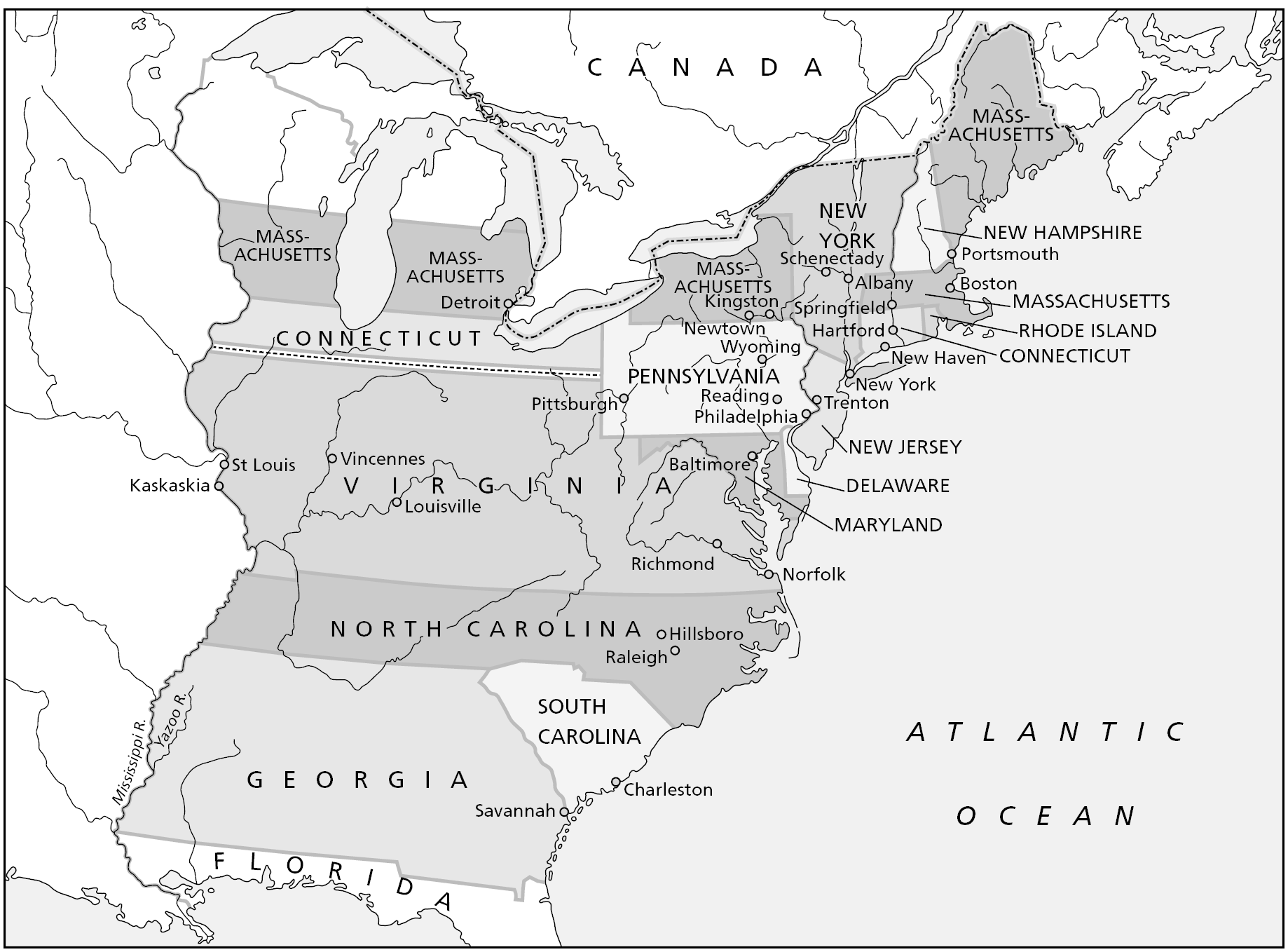
Map 5.2. Land claims of the original thirteen states, 1783.
Second, economic development depended to an extent on maintaining federal landholding for the purposes of later development of railroads. As economic historians have shown, railroads facilitated impersonal market exchange while permitting attainment of economies of scale in business (Fogel 1964). Although there is some debate about whether or not the transcontinental railroad actually contributed a great deal in terms of development – White (Reference White2011), for example, argues that it was built mainly because of pressure from railroad interests rather than actual demand – it is clear that state-owned land was an important aspect of the railroad subsidies. As Engerman (Reference Engerman1972) explained, development of railroads benefited from the state's ability to acquire large amounts of land as well as to secure it from various threats. For example, the Gadsden Purchase secured 19 million acres of Mexican territory to build railroads.14 Although we can debate whether railroads were an important engine of national integration, it is undeniable that territorial expansion and land subsidies liberated and encouraged railroad companies in their effort to bridge the nation.15 A land free for all may have reduced the government's ability to contribute to this process.
Third, federal acquisition of land had direct consequences for security. Control of land was intimately tied to geopolitical considerations. For example, prior to the United States acquiring land surrounding the mouth of the Mississippi, it was in the hands of foreign powers, first Spain and then France. In 1803, Thomas Jefferson negotiated with France to surrender 500 million acres of unsettled land for a total price of $27 million. Spain relinquished Florida to the United States in 1819 for a price of $6 million for nearly 43 million acres of land. In 1848, Mexico transferred the Pacific Southwest (California, Nevada, Utah, and parts of New Mexico, Arizona, Colorado, and Wyoming) to the federal government for $16 million. In 1850, Texas ceded 79 million acres to the United States for $15 million, reducing the potential for conflict between Texas and the federal government. France, Spain, and Mexico were serious adversaries, and Texas had to be a full partner in the new American federation. Each acquisition was relevant for economic development but each also had fairly obvious consequences for national security, for at least two reasons: the government was acquiring land previously controlled by adversaries, reducing an international threat, and centralization removed an important potential dimension of conflict between American states and the national government, thereby enhancing stability of the new American federation. Had the government simply given land for taking, many isolated settlers would have no doubt drawn on the government's military resources to help them defend themselves.
Finally, and most importantly for the account of land laws in this book, federal landholding was a potentially vast source of nontax revenue for the federal government. Nontax revenue was particularly important because it reduced reliance on direct and indirect taxes to fund public goods during a period in which tax revenue was highly uncertain. Provision of public goods, in turn, has obvious consequences for economic development because markets depend to an extent on infrastructure.16 Some economists may raise an objection here, suggesting that markets often provide “public” goods privately. Toll roads are a well-known example of private provision of goods that are traditionally considered public goods (Klein Reference Klein1992), and private armies suggest that even security – the provision of which is perhaps the main rationale for a nation-state – can be provided privately (Avant 2005; Singer 2003). Toll roads and private armies notwithstanding, markets generally depend for their effectiveness on provision of public goods, such as roads and security. Government defense of borderlands is an example: claim clubs benefited from the activities of the army in securing borderlands from various threats. The ability to provide public goods such as defense of a nation's borderlands, in turn, depended in part on the state's ability to profit from its landholding.
Nothing in the foregoing account suggests that the federal government would maintain state ownership perpetually. If anything, my argument suggests the virtue of strengthening markets; indeed, claim clubs are viewed as a source of social costs because they undermined land markets. Yet a defense of private property institutions that excludes from consideration the opportunity costs of land giveaways is incomplete, to say the least. Land acquisition and consequent state ownership were an expedient stage in the tapestry of American land laws, and American political development more generally.
Of course, realizing revenue from land required the government to create markets for public land. The initial efforts to establish land markets occurred under the Articles of Confederation (1781–9). Although the government created competitive markets shortly after the Revolutionary War, a reversal of fortune was on the horizon as far as the government's revenue aspirations were concerned.
Before considering creation of land markets in greater depth, a few observations regarding the price quoted above are in order. Obviously, $77 million – or $2 billion in today's dollars – is a small price to pay for the nation's lands. The federal government's acquisition of land could be described as first-order rent-seeking (federal government versus its international competitors, including Indian tribes), while the effort to undermine competitive auctions as second-order rent-seeking (claim clubs vs. the state). Through coercion, conquest, and purchase, the federal government was able to acquire formal authority over a vast empire of land. However, formal authority did not always translate into ability to control the land. Despite the success of the federal government in acquiring massive amounts of land vis-à-vis its adversaries, the state eventually became a victim of rent-seeking, in particular as claim clubs began cutting off opportunities for the state to profit from its landholding. My emphasis is on the second sort of rent-seeking, namely, clubs versus the state. As we shall see, rent seeking of the second sort emerged almost immediately after land markets were created.
The Creation of Land Markets in the Post-Revolutionary Period
As the colonial and later federal and state governments systematically acquired land, politicians were continually confronted with a choice between competitive and bureaucratic allocation of land. The colonial governments rejected competitive markets for land, electing instead to give land away in hope of erecting a barrier of settlers between established towns and Indians. Many of the colonial government followed a “headright system,” one in which free land was made available to all eligible citizens, in order to encourage settlement. Under the headright system, settlers were expected to claim borderlands that surrounded established towns, with the expectation that such settlement would improve security in the more established towns (Hibbard Reference Hibbard1924).
From an economic perspective, free land promised to reduce the cost of policing the borderlands by increasing density of settlement in regions surrounding towns. As such, the colonial policy supports the economic justification for free land introduced in Chapter 3. Using the Homestead Act of 1862 as an illustrative case, economic proponents of free land argue that packing less-settled regions of the frontier with settlers reduced the army's cost of clearing Indian tribes from the land. There was, however, a much earlier example that supports the economic logic of free land as a security source. Colonial governments viewed settlers as a buffer between unregulated territory and established towns. Giving land away in these chaotic times may have been expedient, perhaps even efficient. At the very least, the colonial government subscribed to a theory that border packing through free land would enhance security.
A cost-saving rationale for free land is compelling for the aforementioned cases. However, it is less appropriate for other cases. As a general matter, it is more challenging to justify free land as the opportunity costs of revenue forgone increase, or as threats from outsiders, such as Indian tribes, wane. For example, free land arguably made less sense under the Articles of Confederation, as opposed to the colonial period, because of increasing revenue demands.
Consistent with my hypothesis that there was a stronger case to be made for free land during the colonial period compared to subsequent periods, free land was rejected as a policy under the Articles of Confederation, and there was vocal opposition to free land throughout the 1850s even amid a growing chorus supporting it. Persistent opposition to free land suggests a cost-saving rationale was not particularly persuasive, at least in terms of winning support of large majorities in government.
Nor should rejecting free land be surprising from a political economy perspective, mainly because revenue shortfalls under the Articles of Confederation created a strong incentive to allocate land competitively. Under the Articles’ system of voluntary contributions from the states to fund public projects, compliance rates with the states’ levied contributions were generally low, a situation that called into question the effectiveness of the Articles as a fiscal mechanism.17 Spending projects also required unanimous approval, which implies each state had a de facto veto over federal spending. Routine funding shortfalls raised the specter of defaults on foreign loans. Declining access to international credit markets is important for various reasons, for example, because of its implications for national security: weakness in debt markets, by reducing a state's ability to finance war, can reduce a nation's ability to wage a war, in the process undermining its security.18
For these reasons, land began to take on greater importance as a source of stability for the new American state, mainly because it provided an additional revenue resource in a time when revenue was tight. Evidently, members of the Confederate Congress recognized that a robust federation also depended on overlapping, redundant revenue resources in order to improve prospects for the survival of America's first constitutional system.
Translating land into revenue required organizing the vast lands that the government won from various colonial competitors. One of the first challenges confronting the government under the Articles of Confederation was to organize the territory of northwest of the Ohio River, known as the Northwest Territory, which had no formal constitution in place after the Revolutionary War. To get an idea of the importance of this region, it would eventually become the present states of Ohio, Indiana, Illinois, Michigan, and Wisconsin (see Map 5.3).

Map 5.3. The Northwest Territory, 1787.
In 1784, Jefferson made one of the first attempts to organize the territory with a bill, which would have eliminated slavery in the region as well as provided an institutional framework for economic development had it been successful.19 Members of the Continental Congress eventually agreed on the Land Ordinance of 1785, which enacted many of the features of Jefferson's bill.20 However, the Northwest Ordinances of 1787 and 1789 would become the best known of these bills (the 1789 bill carried over, in more or less direct fashion, the earlier bill from the Articles of the Confederation, which disbanded in 1787). The importance of these bills is hard to overstate because they arguably provided the institutional matrix that permitted economic and political development of the United States. Hughes (1987) eloquently captures the profound, though underappreciated, significance of these land laws:
The land ordinances became the great American colonizing machine: they left the intellectual mark of the Americans on the nation's geography as indelibly as did the Roman roads on physical England, cutting straight across the undulating English countryside. The Northwest Ordinances were the colonial American's institutional thumbprint on the American continent all the way from the Ohio River to the Pacific…Uncelebrated in history books, unknown to the average citizen, the land ordinances of the “old Congress” achieved an almost ubiquitous domination beyond the Appalachians. The objects of those acts were achieved in a century of unparalleled economic development.
One of the defining features of these ordinances, in addition to the profoundly important prohibition on slavery in the new territories, was creating the basis for the Public Land Survey System (PLSS), which created square townships of 36 square miles each, six miles across. Each township was divided into 36 rectangular sections of 640 acres each, with 16 sections reserved to support public schools, with the remaining 20 sections available at public auction (Hibbard Reference Hibbard1924; see also Table 1.2 in Chapter 1). The PLSS contrasted with the older “metes and bounds” configuration used in England and much of colonial and postrevolutionary America, in which land boundaries followed natural contours and breaks such as creeks and ridge lines. The rectangular patterns characteristic of the PLSS reduced survey costs, reduced boundary disputes, and reduced odd lot sizes that were harder to sell (Grubb 2010).
As mentioned earlier, scholars have upheld these ordinances as fundamental to understanding emergence of private property institutions (Sened 1997; North Reference North1990; North and Rutten 1987). These studies also recognize that the effectiveness of private property institutions depends on the structure of political institutions. In this regard, changes in political institutions increased the chances that these private property institutions would be effective by providing what was essentially a bill of rights for the Northwest Territory.
The method of allocating land receives less attention than the private property and political features of the Northwest Ordinance. However, the Confederation government also established a market-based method of allocating land. The Northwest Ordinance of 1789, which was agreed on during the first Congress, established rules for allocating land that were similar to the Land Ordinance, except that the minimum price increased to $2.00 an acre with a minimum tract size was 640 acres.21 Although the government's preferred landholding size was far above the average landholding during this period – as Grubb (Reference Grubb, Irwin and Sylla2010) notes, most farms were around a hundred acres – the government appeared committed to using land as a revenue resource.
The decision to use land for the public good was one of the most important “founding choices” for the early United States, to use Irwin and Sylla's (2011) characterization of American economic policies during the 1790s. States differed substantially in their preferences for how the government lands would be allocated. States with larger landholding, for example, preferred an orderly process of land distribution that kept land prices high; in contrast, states with less land were more inclined to support a more rapid system of allocating land (Grubb 2010). Despite these conflicts, the states agreed that land revenue should be used for the common good.
Implementing this vision, however, proved problematic. The government was inexperienced with land sales, and the fiscal provisions of the Northwest Ordinance required modification almost immediately. For example, Congress did not initially include a credit system to finance land purchases. Lack of markets for credit implies some farmers who valued land would be unable to acquire it. Indeed, Coase's (1960) well-known theorem that property rights will be efficiently allocated subject to the cost of transacting says nothing about credit market imperfections, which typically undermine the ability of competitive auctions to allocate land efficiently because high-value users of land would not be able to acquire a legal title in the presence of credit constraints.
Despite these challenges in terms of design of the auction system, institutional adaptation occurred fairly quickly through a series of changes aimed at increasing revenue prospects. An act of 1796 increased land available for competitive allocation, but only about 49,000 acres, primarily in Pittsburgh and Philadelphia, were sold under it. In 1800 and again in 1804, minimum lot size was reduced, from 640 to 320 acres and then from 320 to 160 acres. The Harrison Land Act of 1800 increased the period of repayment and reduced the price of land to $1.64 an acre (Hibbard Reference Hibbard1924).
Despite modifying the credit system, defaults on government loans were common. According to a report compiled in 1806 by Albert Gallatin, for example, delinquent payments for land sold in the state of Ohio increased from nearly $1.1 million in 1803 to over $2 million in 1805. Gallatin, a Democratic-Republican from Pennsylvania who helped organize the House Finance Committee (the predecessor to the Ways and Means Committee) and also served as Thomas Jefferson's Secretary of the Treasury (an appointment that reflected his belief in limiting national debt and opposition to direct taxes), urged replacement of the credit system with exclusive cash sales because of high default rates under the credit system (Hibbard Reference Hibbard1924).
Gallatin's recommendation, and incremental changes to competitive auctions that followed, indicate institutional learning, although these marginal adjustments did not resolve the fundamental conflict of interest between settlers and the federal government over the price of land. Under competitive auctions, the federal government secured the scarcity rent associated with land, while settlers received these rents under free-land programs. Distributive conflict over the price of land was one of the defining features of land laws in this period, a conflict that emerged as soon as the government established a framework to allocate land competitively.
Recognizing the problems posed by squatting, Congress early on attempted to stem the rising tide of squatting. By 1800, private claimants who had purchased legal title with cash petitioned the federal government to enforce their claims after squatters began to occupy their land, forcing Congress to choose between enforcing legal ownership and policies rewarding squatters. With the Intrusion Act of 1807, which authorized the president to use force to prevent settlement of state-owned land unless individuals had a legal title, as well as imposing fines on violators of $100 for illegal occupation, Congress sided with formal owners. Unfortunately for owners, the Intrusion Act, which was designed to give force to the state-ownership regime, as well as to ensure the state profited from its landholding, proved difficult to enforce. There were also appeals to go easy on squatters, with opponents of intrusion legislation arguing that squatters did not have much money, as well as pragmatic appeals that there were not even enough prisons to incarcerate the illegal occupants. Despite a few efforts to enforce these provisions, including the use of troops to remove squatters in Alabama in 1827, in Missouri in 1834, and in Iowa in the 1830s and 1840s, evictions appear to have been the exception rather than the norm (Dick Reference Dick1970).
Lack of enforcement reflected a more general challenge, which was little investment in the land-administration bureaucracy in this period. Local land offices were established in 1800, yet the General Land Office was not created until 1812. Even when the offices were established, they had few resources. Consequently, there was almost no revenue collected from government lands prior to 1800, and defaults on loans from those who agreed to pay were common (Rohrbough 1968).
Investment in bureaucratic capacity was perhaps the key to policing state ownership. However, few resources were devoted to enforcing the state ownership regime. Consequently, the state's commitment to holding onto its own land was somewhat shaky. More fundamentally, concessions to squatters undermined Congress’ commitment to competitive land auctions. Congress continually rewarded squatters in each sector with bills that reduced the price of land with preemption bills over the next sixty years, thereby inviting a credibility problem. Squatters’ rights, considered in the following section, were the first major policies giving away the state's land, yet as subsequent chapters show, laws recognizing squatters’ rights on agricultural land were only the beginning of a great land giveaway, one in which the free land would be extended in one form or another to squatters occupying mineral land, rangeland, and timberland.
The Decline of Competitive Markets for Agricultural Land
The idea behind preemption was simple: squatters could acquire a legal title to government-owned land, provided the land was not owned by another citizen. The usual amount was 160 acres of land at the federal level, although state-land states often recognized squatters’ rights as well, allocating land in different amounts (such as 100- or 200-acre sections). The discussion below focuses on squatters’ rights on land in public-land states, which are the ones where land policy is controlled by Congress.
Of the many preepmtion bills enacted by Congress, the one that receives perhaps the most attention is a temporary preemption bill enacted in 1830. For example, Kanazawa (1996) suggested the 1830 bill was a watershed moment because it allowed anyone on government land by the time the bill took effect to acquire a legal title to 160 acres of land. Even though it was temporary, Kanazawa characterized subsequent legislation as a fait accompli.
Despite Kanazawa's compelling insights into the political economy of preemption is compelling, the notion of a watershed moment presents a somewhat misleading picture of squatters’ rights. As Table 5.1 shows, agricultural preemption laws represented an institutional transformation that unfolded from 1799 (the first preemption bill) to 1863 (the year the homestead bill took effect). Emphasis on the 1830 bill detracts from distributive conflict over land throughout the first half of the nineteenth century, as Congress continually responded to demands posed by claim clubs with preemption bills. Distributive bills rewarding squatters on agricultural land were the norm rather than the exception, and the steady flow of bills rewarding squatters suggests that there may not have been a “watershed moment.” Rather, preemption was a steady flow throughout this period.
Table 5.1. Major Preemption Acts, 1799–1862

The pattern of preemption bills is revealing. On one hand, public policies weakening land auctions were common prior to 1830. For example, in 1808, Congress allowed all settlers who had prospectively occupied state-owned land in Michigan Territory to register their claims. On the other hand, many important preemption bills were enacted after the preemption act of 1830. An 1832 law allowed squatters to make claims in amounts of forty acres. In 1834, Congress allowed anyone occupying land (subject to minimal qualifications) in 1833 to make preemption claims. In 1838 and 1840, the preemption bill was again renewed, but by this time, preemption had been used for decades. The government also recognized squatters’ rights with separate bills that covered territory in Kansas, Nebraska, and Colorado in the 1850s in response to widespread squatting on government land (Robbins 1942, 1931).
The design of the 1830 bill also suggests that Congress had not given up on the idea of competitive land auctions. By making the 1830 bill retrospective and available for only a single year, members of Congress seem to have believed that it was truly a temporary bill. A more plausible interpretation of the temporary bill is that members of Congress believed they could have their cake and eat it too, rewarding squatters without giving up on competitive land auctions. In reality, temporary and small-scale preemption laws ensured more squatters would occupy land, increasing the cost of policing state-owned land and ultimately forcing Congress’ hand to enact new preemption laws.
Leaving aside issues of credibility of commitment for now, it is clear that substantial amounts of land changed hands as a result of these preemption laws. To understand just how much land was changing hands, it is useful to consider land entries made around the time of the 1830 preemption bill. Rohrbough's (1968) unrivaled study of land offices during this period provides data on land sales for the period from 1828 to 1837, which are reproduced in Table 5.2. Fueled by the preemption acts of 1830, 1832, 1834, and 1836, the government transferred over two million acres of land to squatters in the ten-year period from 1828 to 1838. To get an idea how much land was given away, consider that the township under the PLSS consisted of 23,040 acres (thirty-six square miles). By this measure, squatters claimed land equivalent to nearly 90 towns, a fairly large amount of land during an early stage of economic development.
Table 5.2. Preemption Claims Entered, 1828–1836

How do we interpret these developments? Because the status quo was competitive allocation of land, which is perhaps as close as we come to an efficient mechanism to allocate state-owned land, the flood of preemption laws during the first half of the nineteenth century supports a distributive perspective on institutional change. After all, each of these land laws represented a substantial transfer in scarcity rent from the state to squatters. However, it is important to keep in mind that there were two ways in which squatters undermined markets for public land. One way, discussed up to this point, was agitating for legislation formally weakening auctions. In terms of formal legislation, preemption laws are some of the most important examples of successful rent-seeking in the nineteenth century.
Despite their seeming importance, as well as the long struggle to secure them, preemption laws never fulfilled their promise. For many of the preemption laws, few patents to land were actually entered.22 Does this mean that rent seeking to attain agricultural land bore little fruit?
In short, the answer is no. To understand the consequences of rent-seeking, it is essential to take account of the second, arguably much more pervasive, method for acquiring land: collusion at federal land auctions. Any study of nineteenth-century land laws that focuses exclusively on squatters’ rights – legislation formally awarding title to illegal occupants – dramatically understates the political consequences of agricultural claim clubs. Successful collusion reduced the need for formal legislation because members of clubs received a legal title for a minimum price without changing laws regulating land distribution. In order to assess the full social cost of claim clubs, it is necessary to take into account their activities at land auctions, in particular collusion during auctions.
Once we account for collusion, the consequences of claim clubs come into clearer focus. Profit from land sales was far less than its potential because much of the land, if not most of it, changed hands under the watchful eyes of a claim club, which typically ensured that the price paid for agricultural land was a minimal one, if not the federally mandated legal minimum. The federal minimum price of preemption was, in most cases, $1.25 an acre. Despite formally conducting auctions, land purchased on “competitive” markets was almost never exchanged at market price, but rather at prices preordained by a club. The price the club chose was often the federal minimum, which happened to be the preemption price. In this regard, most land auctions were de facto preemption programs.
An important piece of evidence of the distributive consequence of collusion comes from Rohrbough's data on land sales from the 1830s, which are presented in Table 5.3. The most remarkable feature of these data on land is the average price of land. Of 50 million acres sold from 1828 to 1838, land was sold, on average, at the federally mandated minimum price of $1.25 an acre. In other words, the going price of land on “competitive” markets was the nominal price of land the squatters paid for preemption claims, a price that reflected the bargaining power of claim clubs.
Table 5.3. Land Office Revenue, 1828–1837

For example, 20 million acres in land sales brought $25 million in revenue in 1836, which translates into an average price of $1.25 an acre. The difference between the average market price and the average price squatters paid at a “competitive” auction is the value of the transfer of scarcity rent. To illustrate the potential transfer in rent, if we assume the market value of land was $5 an acre, then squatters extracted over $300 million in scarcity rent through “competitive” land auctions in the ten-year period from 1828 to 1838. In today's dollars, that sum translates into about $7 billion in scarcity rent.23 Although the government was bringing in some revenue through land sales, it seems clear that squatters and speculators, each group adept at collusion, secured most of the scarcity rent associated with the state's vast land resources.
Collusion was a good option for clubs because it required less work to get what they desired than did political change. Manipulating an auction only required a club's members to intimidate outsiders, and as we have seen, clubs were good at putting a scare into their foes. Even federal agents were generally too weak to challenge seriously a club's will.
Once we take into account de jure transfers through preemption legislation and de facto transfers through collusion, the social costs of claim clubs seem obvious. For example, suppose we assume that most of these acres changing hands through “competitive” auctions from 1828 to 1838 were influenced by clubs. The amount of land that changed hands through potentially rigged auctions is up to 50 million acres, which is over 25 times the amount of land patented through preemption. A precise quantitative estimate of the value of the de facto transfers is elusive (after all, these were illegal activities, and so they are challenging to measure precisely). However, it is reasonable to conclude based on the evidence that has been presented that the agricultural land grab was one of the most important examples of distributive politics in American political economic history.
Squatters’ Rights as a Test of Competing Theories
What do squatters’ rights tell us about efficiency and distributive perspectives on institutional change? On one hand, there is some support for an efficiency perspective in the first decades after the Revolutionary War. The great ordinances of the 1780s created a framework for private property rights as well as competitive land auctions. One of the most important contributions of the land ordinances was to establish private property institutions and a political framework to lend credibility to private property rights. Yet these ordinances also had important implications for the fiscal strength of the nation by creating competitive markets for land. That these ordinances considered carefully the fiscal consequences of land laws speaks to their profound importance, beyond surveying the land and provisions for self-government. Besides these fiscal provisions of the ordinances, there were also a few attempts to enforce as well as to improve the design of federal auctions, as well as marginal changes to the auction system in response to challenges to it, such as credit provisions.
Several bills during this period were arguably a response to opportunities for Pareto improvement, which is the definition of efficiency in the process of institutional change. Nonetheless, the vast majority of legislation was distributive, transferring scarcity rent from the state to organized claimants. For example, a few laws strengthened the state's capacity to remove squatters, and others adjusted credit provisions and the size of land. Overall, however, policies removing land from competitive markets were much more common; laws strengthening markets were far and few between. All told, distributive conflict seems to be the overwhelming dynamic governing agricultural land laws in the first half of the nineteenth century.
If one accepts that preemption was a source of social costs and competitive markets a source of social benefits, then the next question to ask is why the federal government ended up giving away much of its vast landholding. One reason is formation of powerful economic organizations on the nation's agricultural land. As Chapter 3 showed, these claim clubs were common in each of the Midwestern states as well as public-domain states more generally. These economic organizations increased the cost of policing state ownership and the government responded with laws rewarding members of these organizations. In the absence of claim clubs, legislators would have had few reasons to give away the scarcity rent associated with public land.
There is, of course, the all-important question of whether claim clubs actually caused these changes in the prices of land. There are several reasons why a causal account stressing the role of claim clubs makes sense. First, the theory of distributive conflict linked claim clubs to policy choice. Second, clubs preceded changes in preemption laws. Third, there are few examples of the government providing land to unorganized squatters, and so it seems it was their organizations, not simply first possession, driving the process of institutional change. Finally, because preemption undermined government revenue, we can rule out revenue maximization as an explanation for changes in land laws. Because they satisfy most of the criteria for a causal relationship (theoretical relationship, temporal antecedence, correlation, ruling out alternative explanations), clubs are certainly plausible as a mechanism of change in land laws.
Although clubs are an important explanation for land giveaways, political mistakes also played a role. Some of the blame lies with Congress, which is clear when squatters’ rights are considered dynamically, in terms of credibility of commitment. Although studies of credibility of commitment typically emphasize effectiveness of private property institutions, maintaining state ownership also involves a credibility problem. The initial preemption grants to squatters in Michigan and Illinois in the 1810s and 1820s – legislation that could very well have reduced the state's costs of policing borderlands by strengthening the property rights of those who might defend the nation's borderlands – also had a collateral consequence of increasing incentives to occupy state-owned land prospectively, as did the temporary preemption law of 1830. Each of these laws undermined credibility of commitment to state ownership, encouraged squatting, and ultimately undermined the ability of future governments to profit from state-owned land. Even after the permanent preemption act of 1841, claim clubs continued to divide land informally prior to government authorization in order to compel the government to extend to new territories yet another preemption bill. The mechanism that made preemption a self-fulfilling prophecy is declining credibility of commitment to state ownership.
During this time period, various political majorities seemed unaware of the consequences of their actions for credibility of commitment to state ownership. Nonetheless, there were some members of the federal bureaucracy who recognized that Congress was falling prey to a credibility problem (even if they did not describe it as such). For example, in 1829, Samuel Foot, a member of Andrew Jackson's administration, proposed inquiring into the possibility of limiting public-land sales in response to widespread corruption, as well as the possibility of eliminating the office of Surveyor General of the General Land Office (Robbins 1942). In addition, several of the key administrators in the General Land Office (GLO) were kindred spirits as far as support of competitive allocation of land was concerned. In 1830, the Senate Committee on Public Lands approved a preemption bill, and the House Committee on Public Lands asked the Commissioner of the GLO to review the Senate bill. Commissioner George Graham responded that the bill would threaten orderly sale of public land and encourage squatting. Jackson's appointment to head the GLO, Elijah Hayward, recommended rapidly surveying and selling public lands, leaving intruders and trespassers to local tribunals of justice (Rohrbough 1968).
These federal administrators recognized the importance of committing credibly to state ownership of land. Unfortunately, their wisdom met little political support. Despite these admonitions, Jackson's belief in smallholder farming as a development strategy led him to reject proposals to reform the preemption system (Feller 1984; Stephenson 1917). More generally, various majorities in Congress believed in the possibility of temporary preemption bills – bills that were meant to apply only to a particular group of squatters, and not to others. Taking the lessons of the credibility perspective seriously, there is no such thing as a temporary preemption bill when we take into account the consequences of such laws on incentives to occupy land. Beginning in 1799, the federal government, by repeatedly adopting temporary bills that were meant to be limited in scope, sowed the seeds of destruction of competitive markets to allocate land.
Thus, in seeking to understand policy choices during this period, policy mistakes and unanticipated consequences should take each factor into our account. Members of Congress seem to have underestimated problems of how piecemeal bills rewarding squatters would constrain their future choices. After all, legislators repeatedly adopted preemption bills that were limited in scope even though each bill undermined the government's credibility of commitment to state ownership.
The twin logics of rent seeking by claim clubs and declining credibility of commitment resolve a puzzle of the efficiency perspective on state-owned land articulated earlier in this chapter. Although Levi's and Olson's perspectives suggest that the government will allocate land through competitive auctions to increase revenue, the federal government did nothing of the sort. The structure of economic organizations – the proliferation of claim clubs – helps us understand why the government elected to forgo a substantial revenue opportunity. Yet it is also necessary to conceptualize of institutional change from a dynamic perspective in which past decisions involving land laws shape and constrain subsequent institutional choices. Claim clubs, by increasing costs of maintaining state ownership of land, created incentives for legislators to forgo land auctions, an effect that was amplified by declining credibility of commitment to state ownership. Ultimately, explaining institutional change thus requires us to consider insights from bottom-up mechanisms, such as claim clubs, and top-down mechanisms, such as declining credibility of commitment. Once we do this, it seems clear that economic organizations and political mistakes explain why the state realized so little revenue from its vast agrarian landholding.
Were Squatters’ Rights “Efficient?”
The evidence just presented supports a distributive perspective on institutional change, provided one accepts the proposition that competitive auctions are economically efficient mechanisms to allocate land. There are, however, several counterarguments that can be raised in defense of squatters’ rights, each suggesting that laws reducing substantially the price of land may have been expedient, if not efficiency enhancing. There are at least five arguments that suggest squatters’ rights may have been socially desirable.
First, squatters rights may be justified as social welfare policies because they benefitted poor squatters with few opportunities elsewhere. Indeed, what we can call a public-good perspective on state ownership suggests that the state may often have incentives to give land away to vulnerable groups, and that such giveaways are socially desirable. According to a public-good perspective, which has its roots in the work of Commons (Reference Commons1924) and has been articulated more recently by Bromley (Reference Bromley2006, 1991, 1989), the state has an interest in maintaining state-owned land as a resource to benefit its citizens. Indeed, in many societies, state-owned land continues to substitute for a system of social insurance (see, e.g., Cai 2012; Ho 2005a, 2005b; Liu et al. 1998). Maintaining state-owned land promises to limit vulnerability by providing people with land for subsistence agriculture.
Applied to the American frontier, a public-good perspective on state-owned land suggests that land transfers to squatters may have enhanced social welfare to the extent that these policies alleviated risks facing vulnerable groups. After all, if squatters were a vulnerable group that would have been dependent upon the state without the land they occupied, then it might enhance efficiency to provide them with land to the extent that such expenditures reduce the burden of the government to provide social welfare.
Although a public-good perspective on state-owned land is compelling in the abstract, it is important to keep in mind an important fact: much of the land on the frontier went to speculators and other people of means (see, e.g., Gates 1979, 1942; Bogue 1958). Realistically, there are few reasons to believe the land typically benefitted “poor squatters” on the agricultural frontier. And as Chapter 8 shows, the idea that land giveaways benefited poor people on the frontier makes even less sense in light of land grants to miners, ranchers, and loggers – the booming sectors of the America's western lands. In later-developing sectors, preemption laws are best described as corporate rather than social welfare, casting doubt upon any argument that land giveaways were socially desirable pro-poor policies.
A second line of argument suggests that preemption laws were desirable because land was idle or because it had limited value. De Soto (Reference de Soto2000), for example, assumes that squatters did the federal and state governments a service by improving land that had little value.
There is much to be said for giving land away when the state overreaches in terms of land ownership. However, the idea that land was idle, or that the government was unwilling to assign legal title, flies in the face of increasing land office business in this period. Using the 1820s and 1830s as an example, it is clear that there was substantial demand for land in this period (see Table 5.3). The thirty months from the fall of 1834 to the spring of 1837 brought some of the largest land-office business in the history of the United States. According to these data on land sales, citizens purchased lands for the sum of $52 million between 1833 and 1836. Although land auctions brought in far less than its potential revenue (most of these sales were far from competitive because of collusion by clubs), it is clear that land was neither idle nor lacking in value.
Because land was increasing in value and often benefited speculators (or small-scale businessmen) as clubs proliferated, it stands to reason that preemption laws reflected distributive rather than efficiency considerations. In particular, these laws rewarded enterprising settlers rather than poor settlers. Preemption laws were like “manna from heaven” (to use a phrase squatters often used in their constitutions) to men who realized they could profit by occupying the government's land rather than playing by the legal rules. In fact, it was manna from Congress, and it was like manna precisely because it was valuable, not idle. An even more precise conclusion to draw is that these laws benefited organized squatters. Club members did quite well in this period, though it is not as clear they were doing good, in particular from a social-welfare perspective.
A third argument that can be raised in defense of squatters’ rights is the economic case for free land, outlined earlier. One of the keys to the argument is assuming packing the borderlands would reduce the government's cost of policing them. If we assume that policing the borderlands is costly and that settlers can provide security at lower cost than armies, then it may be efficient to “rush” settlers into areas where the federal government faced a substantial threat from Indian tribes. It is useful to consider whether their argument also applies to preemption, which is a plausible additional case for the theory to explain (Allen 1991; Barzel Reference Barzel1989).
How does the economic case for free land stack up? As discussed earlier, the efficiency criteria set forth in the economic case for free land is a plausible rationalization for policies benefiting squatters in some periods. For example, in the 1810s, the American government was fearful of Spanish aggression (Adelman and Aron 1999). Frustrating foreign adversaries provides a compelling rationale for recognizing legal titles of settlers who initially had titles issued by the French or Spanish. In such situations, improvements on the security dimension – by forging common interests with settlers who may have in the past had loyalties to France or Spain – may have outweighed any social costs of giving land away to squatters in terms of revenue forgone.
For reasons mentioned earlier, the case for free land has a persuasive logic. However, it is essential to remember that clubs generally formed after the government cleared the land of Indian tribes. An efficiency rationale for preemption based on cost saving has some merit, but it does not explain why legislators would provide settlers with land after the government had already done the hard work of clearing the land of Indian tribes. Clubs were typically convened in the wake of the army's activities, which implies they were not saving the government much in terms of defending the borderlands after the early 1800s, contrary to the implications of the economic case for free land.
Fourth, occupation of land may have altered the transaction cost matrix in such a way that preemption is an efficient institutional choice. Once land was illegally occupied, the costs of removing people from it may have been so substantial as to make squatters’ rights an efficient policy given transaction costs. This line of reasoning follows from Barzel's (2002, 1989) perspective on institutional change, which I introduced in Chapter 1: all institutional change is efficient, subject to transaction costs. As transaction costs of changing public policies increase, a seemingly inefficient policy can become an efficient one because the transaction costs of institutional change are prohibitive.
One of the weaknesses of transaction cost analysis is that it can rationalize any policy as efficient. For example, consider sugar quotas, which have rather large and obvious social costs to the extent that they raise substantially the domestic price of sugar. Despite their social costs, dismantling systems of quotas is difficult because beneficiaries have incentives to invest substantial resources to keep price supports in place (Krueger 1996). Applying transaction costs analysis to this example, because the costs of removing sugar subsidies to sugar producers are substantial, should we conclude that protectionist policies are somehow efficient policies because the transaction costs of institutional change are substantial? This is exactly what transaction cost economics asks us to do. Transaction costs analysis, used this way, rationalizes even policies that have obvious social costs, and so it is not particularly useful.24
Finally, productivity gains from rapid privatization and associated gains in tax revenue may have exceeded the loss in nontax revenue from free land programs and collusion. Because the state is a residual claimant from improvements in productivity through its taxation authority, it is possible that land giveaways may have increased tax revenue to the extent that rapid privatization increased production more quickly than it would have increased otherwise.
There seems to be little debate that private property institutions are likely to increase productivity as well as government revenue in the long run. However, in the political and bureaucratic environment of the nineteenth-century United States, it is a stretch to assume that politicians believed that legal title would translate into increased revenue for the state. For one reason, the state lacked capacity to tax its citizens in any meaningful way during this period. More importantly, I did not find evidence of politicians who argued that land should be given away because it would increase government revenue as a residual claimant as productivity increased. Rather, supporters of free land typically emphasized fairness over the state's interests in revenue. For these reasons, it is more plausible that the state was simply losing out on revenue by forgoing competitive land auctions rather than decentralizing land as quickly as possible to increase its long-run revenue.
We can conjure up various ways in which squatters’ rights may have been efficiency enhancing. However, each of the arguments presented earlier has important flaws. Ultimately, my interpretation of land laws in the first half of the nineteenth century suggests that there are few compelling reasons to believe claim clubs contributed to efficient institutional change. Rather, they are more accurately described as rent-seeking organizations, perhaps the quintessential ones of the nineteenth century.
Conclusion: The Distributive Politcs of Squatters’ Rights
The main contributions of this chapter have been to show the tradeoffs inherent in early land policy, as well as to remind us of the importance of early land laws in economic development. As the quote from Hughes earlier in this chapter reminds us, these laws are often forgotten, yet they laid the framework for a prosperous nation. At the same time, Hughes understates the distributive politics of squatters’ rights. In reflecting on the ordinances, Hughes remarks
The distribution of the public land seemed to offer temptation beyond the capacity of common humanity to resist, decade after decade. The corruption and fraud, however, “made a market,” and the lands went quickly enough into private hands, which was, after all, the object of it all. That the federal government hoped for a profit was a secondary consideration. What was important in the long run was that the land be distributed into private hands in the standard American land tenure, and that the titles be perfectly secure, and that the American political democracy be expanded in its pure form from east to west as the continental nation was formed, piece by piece, township by township. The people and wagons moved ever westward and a stable institutional framework of settlement went with them until the nation extended from ocean to ocean…It is true that the machinery of the land distribution was oiled by fraudulence. But no amount of wisdom and virtue could have distributed without sin a legacy taken “from others of the Sons of Adam” by military force, or the threat of it, from the beginning. From the Ohio River to the Pacific Ocean, the American thumbprint covered it all.
Hughes understands these ordinances as well as anyone and rightly acknowledges an important aspect of distributive conflict inherent in land acquisition – the great theft of land from native inhabitants. Yet to consider the ordinances without reflecting more carefully on their opportunity costs all but ensures historians and economic historians will look back on them as efficient. Glossing over the profound conflict over the price of land neglects one of the most important aspects of the ordinances, which was the effort to dismantle, weaken, or otherwise evade the provisions governing land allocation.
Squatters’ rights were nevertheless only a beginning rather than an end to the run on state-owned land. The remaining empirical studies of formal institutional change consider homesteads (Chapter 6); the struggle over mineral land, pasture, and timberland (Chapter 7); and state-level contestation over land in each of the major frontier sectors (Chapter 8). These empirical studies demonstrate the pervasiveness of distributive conflict as a mechanism of institutional change in economic sectors besides agriculture.
1 Specifically, Bednar's design problems that destabilize federations include incomplete coverage of opportunism, ineffective safeguards, unreliable safeguard response, overly frequent sanctions, adapting the distribution of authority, and identification of socially beneficial adjustments. To this list, we could add lack of reliable revenue sources, with overlapping sources of revenue as an additional design principle for robust federations.
2 The main difference between the “old” and “new” institutional economics is mainly a concern with rational choice and institutions as the product of strategic interactions between rational individuals in the latter. The old institutionalists, such as Thorsten Veblen and John Commons, were more concerned with providing the reasons for institutional emergence and change rather than using history to assess different mechanisms of institutional change. My approach tends to draw on insights from each perspective. An excellent explanation of the differences between alternative perspectives in institutional economics is Bromley (Reference Bromley2006).
3 Acemoglu and Robinson (Reference Acemoglu and Robinson2008, Reference Acemoglu and Robinson2006) also emphasize the relationship between de facto and de jure authority, although many of their conclusions are anticipated by Knight.
4 Olson is perhaps most closely associated with the argument that the state provides property protection in exchange for tax revenue. However, North and Thomas also recognized that a state is more likely to be successful in the long run if it provides private property rights. Olson's contribution was to more explicitly relate property protection, revenue, and state formation. North and Thomas's neoclassical theory of the state also anticipates much of Levi's theory of the state and Sened's theory of the origins of property institutions.
5 North (Reference North1981), North and Thomas (Reference North and Paul Thomas1973), and Alchian and Demsetz (1973) provide insight into competitive pressure as a source of emergence of private property institutions. One of the foundational theoretical studies of evolution and economics is Alchian (1950), who explained that firms survive not if they maximize profit, but if they realize positive profit.
6 Acemoglu (Reference Acemoglu2003) also considers how ideology influences the process of institutional change, explaining how ideological mistakes all but ensure political bargaining will produce inefficient public policies.
7 Bromley (1989) provides a similar framework, identifying various mechanisms of institutional change including rent-seeking by concentrated interest groups and changes in the “full social consumption set,” which is essentially society's preference over social welfare. It should be noted that Bromley (Reference Bromley2006) argues that his earlier characterization was too restrictive, proposing instead that only way to actually explain why institutions change is to understand the process by which people fix beliefs on the meaning of economic institutions. Although the later work by Bromley is compelling, the earlier version seems to be more useful to understanding change in property institutions on the American frontier.
8 As one expects, scholars have spilled a lot of ink trying to work out the details of applying the reputational model to politics, although in the end, the implications are similar: capacity investments can have beneficial effects for those who make them, under certain conditions. For an excellent example of how such models and systematic evidence enlighten our understanding of politics, see especially Dal Bo, Dal Bo, and Snyder (2009), whose cases include political dynasties in Congress.
9 Excellent historical studies of conflict over slavery in Kansas territory include Oates (1970), Monaghan (1955), Nichols (1954), and Gates (1954).
10 For a review of economic models of segregation, see Young (2001) and Schelling (1969). Schelling's study is the classic one; Young provides a modern game-theoretic treatment of dynamics of segregation.
11 Calvert and Johnson (1999) explain precisely why constitutional politics generally can be modeled as a prisoner's dilemma game with coordination.
12 Representative works in the credibility approach are cited earlier. The implications of my perspective on credibility, as well as the key features of the credibility approach, are discussed more fully later on in this chapter and the following one.
13 Credit for this phrase goes to Shepsle (1978), who famously described Congressional committee assignments as a “giant jigsaw puzzle.” The metaphor is perhaps an even better fit for the situation involving competing land claims in the early republic, which literally looked like a giant jigsaw puzzle.
14 On territorial expansion, including the Gadsen Purchase, see Kluger (2007).
15 Economic development also required a favorable legal environment. On the legal political economy of early expansion, in particular with respect to railroad development, see Schweber (2004).
16 Grubb (Reference Grubb, Irwin and Sylla2010) is an excellent source on the value of land during the Articles and founding of the Constitution.
17 Dougherty (2001), Dougherty and Cain (1997), and Cain and Dougherty (1999) consider the fiscal consequences of the Articles’ contribution mechanism, arguing that the voluntary system ensured the demise of the Articles as a fiscal instrument. In contrast, Sobel (2002, 1999) explains why voluntary contributions promised to impose fiscal discipline on the states. Sobel makes the case by observing that the nascent government more or less provided all the public goods it needed to, while keeping expenditures down.
18 On the relationship between credibility in debt markets and security, see Schultz and Weingast (2003), who argue that credibility in debt markets is a driving force behind success in war.
19 Journals of the Continental Congress (JCC), 24 and 25.
20 JCC 29.
21 Statutes at Large, 1st Congress, Session I, 1789: 50–51.
22 The definitive study of the political economy of preemption is Gates’ (1960) The Farmers’ Age: Agriculture, 1815–1860. Gates provides remarkable insight into institutional foundations of agricultural development as well as the promise and limitations of preemption.
23 Calculation made using a 1835 as base year and 2010 as desired year.
24 For a compelling argument why transaction costs analysis is appropriate, see Zerbe (2000) and Zerbe and McCurdy (1999), who argue that the concept of market failure is more appropriately considered failure of economic models to adequately account for transaction costs. As they explain, many market failures do not justify government intervention once we account for transaction costs, which is an exceptionally important point that reminds us that we have to know something about the context of institutional choice in order to make policy recommendations. Their argument, although compelling and important, still has the undesirable effect of rationalizing even policies with obvious social costs as “efficient” whenever the costs of institutional change are prohibitively costly. Yet as a critique of government intervention based on assumptions about the existence of market failure for a general class of economic situations, their argument is a quite convincing and useful corrective to the standard economic theory of market failure.
6 The Political Economy of Free Land
If preemption was a crack in the dam holding back settlers seeking cheap agricultural land, then homestead legislation was the dam breaking. Unlike preemption laws, which retrospectively allowed those already on the land acquire a legal title, homestead laws prospectively encouraged settlement while also reducing the nominal fee under preemption to zero price. As such, homesteads were the first true “free land” policies. Of course, economics instructs us that nothing is free in the sense that opportunity costs are inescapable. This chapter considers free land from a political economy perspective, analyzing its origins and consequences, as well as the economic tradeoffs with free land.
The first two sections of this chapter analyze roll-call votes on four failed homestead bills, using econometric methods to estimate which factors influenced probability of supporting free land. These votes, which occurred between 1852 and 1860, were selected because they were hotly contested, and so they present a good opportunity to assess competing hypotheses for institutional change. Because the successful Homestead Act of 1862 was overwhelmingly supported by the wartime Congress, there is not much to learn from it using econometric techniques. In addition, I selected the unsuccessful bills for the simple fact that scholars tend to focus on the successful bill rather than its various failures, and so the analysis contributes something new. In terms of method, the main benefit of an econometric approach is that it nicely sorts out the influence of political party, economic interests, and sectionalism on support and opposition to free land.
To foreshadow the empirical findings, legislators from public-land states – states where the federal government controlled land allocation, including the Midwestern and Western states – were the strongest source of support for homesteads across various bills, holding constant economic interests and political party. The significance of sectional variables provides additional evidence of the distributive consequences of claim clubs because they were most active in precisely those states. At the same time, quantitative assessment of homestead votes illuminates our understanding of the relationship between group conflict and free land more generally, including the influence of political parties and agricultural, manufacturing, and slavery interests, in the struggle for free land.
The findings regarding these other variables of interest are surprising. For example, the evidence reveals that political party did strongly influence votes on homestead legislation. Although Foner's (1970) definitive study of this period articulated the importance of free land in Republican ideology, these ideological differences did not translate into statistical differences in voting behavior.
In contrast to partisanship, slavery interests fare much better as an explanation for voting behavior. The hypothesized link between slavery and homesteads arises because of the relationship between free land and the balance of free and slave states. As Weingast (1998) explains, the balance between free and slave states ensured that the Southern states could veto any legislation that seriously undermined slavery institutions. Homestead legislation threatened the balance of free and slave states by removing a constraint on migration. For this reason, legislators from districts or states in which slavery interests were stronger are expected to be more likely to oppose free land. Indeed, legislators from cotton-producing regions and the South were more likely, statistically speaking, to oppose free land, which lends support to my hypothesis that free land threatened the political bargain holding slavery together.
Econometric analysis of roll-call votes is supplemented by an exegesis of President James Buchanan's message accompanying his veto of the 1860 homestead bill. The veto message offers a compelling analysis of the social costs of free land, including reducing the government's ability to provide public goods, such as revenue to fund an army or to pay down debt. Besides providing insight into the more general argument against class-based legislation that was common during the nineteenth century, the veto message stands out for its recognition of the opportunity costs of free land, as well as a compelling counterargument to modern economic defenses of free land.
The veto message also provides an opportunity to evaluate distributive theories of lawmaking. According to distributive perspectives, when districts are small and legislators have opportunities to bargain over policies, elected officials are hypothesized to have stronger incentives to support policies providing particularistic benefits to their district, as opposed to legislation benefiting society more generally.1 In contrast, incentives to engage in distributive politics are hypothesized to decline as the size of the constituency increases relative to the national electorate.
In the context of American political institutions and nineteenth-century land laws, these theories suggest that presidents will have stronger incentives to internalize social costs of free land by virtue of having a national constituency. Buchanan's careful consideration of the full set of benefits and costs of free land was arguably a consequence of institutional incentives, in particular the structural incentives for presidents to support policies promising revenue for the government – revenue that, by its very nature, benefits the United States rather than a particular section. Similarly, overwhelming support of homesteads in the House, alongside more vocal opposition in the Senate, reflects stronger incentives of members of the Senate to internalize the social costs of free land.
This chapter is organized as follows. The first part derives hypotheses from relevant theories regarding support and opposition to homestead legislation. Second, each of these hypotheses is evaluated econometrically to better understand various sources of support and opposition to homestead legislation. Third, the veto message accompanying the 1860 homestead bill is assessed from a political economy perspective to gain additional insight into distributive dimensions of free land. The fourth section considers explicitly homesteads from a static welfare perspective, in particular the economic argument for free land, introduced in earlier chapters, that suggests homesteads were socially desirable because they reduced the federal government's costs of policing the nation's borderlands. Finally, the chapter concludes by considering whether homesteads are better thought of as a component of social policy, or as a corporate welfare policy.
To foreshadow my findings, the fiscal consequences of homestead legislation during a period of mushrooming government debt make them less an efficient response to security considerations (as the economic defense of free land would have us believe) than a socially costly land giveaway. In terms of institutional change, claim clubs were a driving force behind free land, although the more generalized force for change was sectional interests, which included, but was not limited to, the influence of clubs. Overall, then, homestead laws are most accurately described as the fruits of rent seeking, with claim clubs and sectional interests as the most important mechanisms behind emergence of free land.
Who Wants Free Land? Hypotheses for Institutional Change
The basic features of homestead laws, and the significance of homesteaders in settling the Western frontier, are well known in popular culture. Nor is there any shortage of attention to homesteads among historians. However, less is known about homesteads from the perspective of alternative theories of institutional change. To facilitate such understanding, this section derives alternative hypotheses for support for free land from various political and economic theories that will subsequently be evaluated by analyzing votes on four failed homestead bills.
The first hypothesis is that legislators from public-land states will support homesteads.2 There were several reasons why legislators from public-land states had incentives to support homesteads. First, claim clubs remained in several of the public-land states in the 1850s and 1860s. Squatters continued to occupy public land because Congress had yet to formally extend preemption legislation to new territories that would eventually be covered by homesteads. Although homesteads were designed to encourage settlement, any homestead law would certainly have been used by anyone who had occupied land prospectively, even though such use would have violated the letter as well as the spirit of the law. Thus, a club's members would have been content with preemption laws or homestead legislation because the government would have had a hard time figuring out who was making a homestead entry as a squatter and who settled land after homestead legislation.
Second, legislators from public-land states had incentives to support homesteads as part of a strategy for economic development. Homesteads would certainly have increased the number of people in less populous Western states. Economic theory suggests that at low levels of development, increasing the population will increase economic growth.3 To the extent that legislators from public-land states believed population growth would lead to economic development, they had incentives to support free land.
Third, homesteads may have been appealing to legislators from public-land states because of the perceived relationship between free land and security from Indian tribes. According to the economic defense of free land alluded to earlier, packing the borderlands with settlers may have increased security in Western states. To the extent legislators from the public-land states were convinced that homesteads would increase security, they had stronger incentives to support a homestead bill. A security rationale also suggests homesteads may have been efficient, a possibility I consider explicitly toward the end of this chapter.
These three factors suggest that legislators from public-land states had stronger incentives to support homesteads than legislators from state-land states in the Eastern states. In contrast to their counterparts from the public-land states, legislators from state-land states would only realize benefits from homesteads indirectly, at best – for example, packing the land with settlers benefited Easterners to the extent that such policies reduced the cost of providing security in the nation as a whole, assuming such costs are financed from a national pool of revenue. However, any security benefits for those in the East were quite indirect. In addition, Easterners would have benefited from revenue-generating use of public land to pay down debt, which would have created incentives for legislators from state-land states to oppose homesteads. For these reasons, legislators from state-land states are hypothesized to have opposed homesteads.
A drawback to a public-land hypothesis conceptualized along these lines is that it includes several complementary rationales as to why legislators from public-land states would be more likely to support homesteads. Claim clubs are a plausible reason why legislators from public-land states supported homesteads, but so too are the goals of economic development or a belief that homesteads would improve security in Western states. Consequently, a public-land variable does not permit a precise test of my hypothesis that claim clubs were the fundamental mechanism of institutional change in the nineteenth century. Isolating the impact of claim clubs would require district-level data on presence of a claim club. Unfortunately, such a data set does not exist, and its collection is beyond the scope of this book. Nonetheless, a public-land hypothesis is a reasonable way to evaluate my theoretical argument that claim clubs increased incentives for legislators to support distributive policies, with the caveat that statistical significance of this variable reflects political interests as well as organizational influence.
Political party provides additional hypotheses regarding support and opposition to homesteads. There were four major parties during this period: Republicans, Free Soil Republicans, Democrats, and Whigs, each with preferences over land (there were a few other minor parties that will also be discussed). Republicans and Free Soil Republicans tended to argue that land should be used to encourage Western migration. Republican support of free land was based on the theory that a flood of settlers would undermine political support for slavery. Democrats, in contrast, generally had a stronger preference to use public land as a revenue resource.4 Democrats also had reasons to oppose institutional changes that undermined slavery (see my hypothesis, explained later, relating free land to slavery institutions). Members of the Whig party, which convened in opposition to Andrew Jackson's Democratic Party, were less concerned with using public land as a revenue resource than Democrats. A few members were part of the Opposition Party, which had as one of its defining features opposition to the spread of slavery in Kansas, along with a dislike of the Democratic Party. Because the Opposition Party opposed slavery and democrats, its members had incentives to support free land.
For reasons outlined earlier, Democrats are hypothesized to have opposed homesteads, not only because free land reduced revenue but also because migration to the western states threatened slavery institutions. Whigs, Free Soil Republicans, Republicans, and members of the Opposition Party are hypothesized to have supported homesteads for various reasons. Although these parties had their differences, each of them had at least one of the following ideological reasons to oppose homestead legislation: a desire to increase the number of free states, growing belief among party members that all people who so desired were entitled to a small section of land, and a conviction that free land would alleviate economic duress in the East. For this reason, members of these four parties are all expected to have opposed free land.
Economic interests are also expected to translate into legislative influence. There are at least four groups that had preferences over homestead legislation: farmers with legal title, ranchers, manufacturers, and slaveholders. Because homestead legislation was designed to benefit farmers prospectively, it may have been viewed by farmers with legal title as a subsidy to new entrants into agricultural markets. Of course, measuring presence of legal title in the 1850s presents a challenge. However, Clay's (2006) finding that farmers with legal title were more productive than squatters without formal documentation suggests a reasonable solution to this problem: agricultural productivity in a state (in analysis of Senate votes) or district (for House votes) as a proxy for the number of farmers with legal title. This is an acceptable measure under the assumption that greater productivity reflected more extensive formalization of land claims.
Similarly, legislators in districts with higher levels of livestock production are hypothesized to oppose homesteads. As the “range wars” would later demonstrate, farmers and ranchers often had serious conflicts of interest. In essence, both sides often viewed the other as a nuisance (Kantor 1998, 1994, 1991). For this reason, legislators from districts and states with greater livestock production are hypothesized to be less likely to support free land.
In contrast to the reasonable clear reasons for farmers with legal title and ranchers to oppose free land, the relationship between manufacturing interests and free land is somewhat more complicated. On one hand, economic theory suggests manufacturers had reason to oppose free land because it encouraged labor outmigration. As the supply of labor decreases, manufacturers have to pay higher wages, creating economic incentives to oppose homesteads. Manufacturers had incentives to oppose homesteads because free land increased wages in the relevant labor-market equilibrium. On the other hand, alliance politics during the 1850s may have led manufacturers to support homesteads for strategic purposes. According to Feller (1984), who authored the authoritative account of partisan politics of land from the 1830s through the 1850s, manufacturers and Westerners formed an alliance in hope of securing tariffs desired by manufacturers and free land benefiting Western interests. Benefits from tariffs may have exceeded costs of free land to manufacturers, leading them to support homesteads.
Because of these competing possibilities, I do not offer a hypothesis one way or the other how manufacturing interests will influence support for free land. Certainly, the variable for manufacturing interests should be included in the model, although without a clear sign on the hypothesized direction. Rather, the statistical test can be used to sort out competing theoretical and historical perspectives on the relationship between manufacturing interests and support for free land.
Finally, legislators in cotton-producing districts or states are hypothesized to oppose homesteads. Fogel and Engerman (1974), in their unrivaled economic history of slavery in the United States, showed that abolition would devastate cotton-producing districts given their central finding that slaves were as valuable on the eve of the Civil War as they had ever been. Weingast's (1998) analysis of slavery complements the earlier study by Fogel and Engerman by offering a political theory of the American Civil War, one in which the balance rule of admitting free states with slave states – an informal norm – was one of the factors that held the Union together.5 Weingast hypothesized that the balance rule was a source of federal stability because Southern interests could veto any legislation that weakened slavery institutions, a finding that makes sense only to the extent that slaves were valuable, which Fogel and Engerman demonstrated conclusively.
The analysis that follows complements these studies by considering explicitly the relationship between free land and the political institution of slavery. Fogel and Engerman's evidence that slaves were valuable, Weingast's theoretical and empirical take on the causes of the American Civil War, and the perceived relationship between free land and free states can be combined into the following hypothesis: legislators from cotton-producing districts will oppose homestead legislation because it threatened the political institution of slavery.
Econometric Analysis of Homestead Votes, 1852–60
An econometric approach to homesteads provides a convenient way to estimate the influence of variables of interest on legislative votes holding constant other relevant variables. At the same time, the econometric analysis presented in this section should be viewed as complementing historical and archival studies of homestead legislation because many of the hypotheses considered are derived from historians’ studies of the politics of free land. To say that econometric analysis provides precise estimates of relationships between variables does suggest the work of historians is imprecise. Indeed, anyone who has read the wonderful histories of American land laws will recognize and appreciate the remarkable precision of their craft. As such, we can think of econometric estimation as offering a different, complementary kind of clarity.
In the quantitative models, outcomes are House votes on homestead bills of 1852, 1854, 1859, and 1860, as well as the Senate vote on the 1852 bill.6 The smaller number of votes in the Senate, my reliance on several dichotomous independent variables, and a high degree of uniformity in partisan and sectional voting prevented econometrically analyzing all but the 1852 vote. Nonetheless, each Senate vote is considered descriptively even though not all could be assessed econometrically, as the votes are often informative and relevant to assessing the hypotheses that have been presented. A logit specification is used to estimate the relationship between variables on each bill because votes are dichotomous.
Legislators from public-land states are hypothesized to support homesteads. A variable for public-land state is included in all models (1 if a legislator is from Ohio, Louisiana, Indiana, Mississippi, Illinois, Alabama, Missouri, Arkansas, Michigan, Florida, Iowa, Wisconsin, California, Minnesota, or Oregon and 0 otherwise). Support for homesteads among public-land legislators can be interpreted as evidence that claim clubs influenced support for free land for reasons mentioned earlier.
All models of House votes include a variable for political party (1 if a legislator is a member of the Whig, Free Soil, Republican, or Opposition Party and 0 if a legislator is a member of the Democratic Party or a faction of the Democratic Party). Members of the Whigs, Free Soil Republicans, Republicans, and Opposition Party are hypothesized to support homesteads, while Democrats are hypothesized to oppose them.7
Four measures of economic interests are included in various models of House votes. District agriculture is measured by the number of bushels of corn and wheat (measured in thousands of bushels) produced in a district divided by total free population. The livestock variable is the value of livestock (in thousands of dollars) produced in a district divided by total free population. The variable district manufacturing is manufacturing product (in thousands of dollars) in a district divided by total free population. Data on agricultural production, manufacturing value, and livestock value for the House are district-level measures that are taken from the 1843 to 1883 data on Congressional districts (Parsons et al. 1986). Ultimately, these data are constructed from census data, which provide a great deal of information regarding economic activities during this period. Data for each variable used in the analysis of House votes are taken from the year closest to the particular vote in which data are available.
Finally, in each econometric specification used to model House votes, cotton production is used as a proxy for slavery interests. Cotton production is a district-level measure taken from Parsons et al. (1986). A variable for cotton production is included in each model (1 if a district produced at least 100,000 bales of cotton in a year during the period 1843--55 and 0 otherwise).
The variables in the model of Senate votes on the 1852 bill are similar to those of the House votes. Partisan and sectional variables are defined identically. State-level measures of agricultural and manufacturing share are taken from the 1860 census.8 Unfortunately, measures of livestock value and cotton production could not be included in the model of Senate votes because those variables were highly correlated with other variables in the model, and so they had to be dropped from the analysis.
House and Senate Votes, 1852
It may come as a surprise that the House approved four times a homestead bill prior to the successful bill, first in 1852. However, the fact that several bills were successful, although interesting, does not tell us much about why a particular legislator was more or less likely to vote for free land. Indeed, there was nontrivial dissent on each of the homestead votes. Econometric analysis of House votes on the 1852 bill, the results of which are presented in Table 6.1, provides additional insight into the political economy of homesteads by considering quantitatively the micro-level sources of support and opposition to free land.
Table 6.1. Roll-Call Analysis of House Votes on the 1852 Homestead Bill

* Statistically significant at the 5 percent level
Logit Model: 1 for yea; 0 for nay
Dependent variable is House vote on the 1852 homestead bill
As the statistical results for the 1852 roll-call vote reveals, legislators from public-land states were more likely to support land transfers to smallholder farmers, holding constant other theoretically relevant factors. Indeed, the public-land variable was the only statistically significant variable, as well as the only factor that would remain statistically significant across each of the bills considered. Sectional interests appear to have been a driving force behind free land, consistent with my theoretical argument outlined earlier.
Other hypotheses did not fare as well, at least on this particular vote. Contrary to expectations, political party, economic composition, and cotton production did not influence votes on homesteads in the House in 1852. The nonsignificance of political party is perhaps most surprising because all of the major political parties had preferences over land. As importantly, partisan preferences over land have had no shortage of attention from historians, in particular in Foner's (1970) work on Republican ideology. Although Foner's history is first rate by any standard, the ideological convictions of Republicans did not translate into observed differences in voting behavior on the first bill that successfully made it out of the House.
The 1852 version of the bill, failed in the Senate by a margin of 38 to 16 after it was approved in the House. More generally, the Senate typically opposed, voting free land down 1852, 1854, and 1859, in contrast with the House, which typically supported these bills. As Table 6.2 indicates, Senators from public-land states were more likely to support homestead legislation, as expected. Similar to the finding in the House, political party did not influence votes in the Senate, which is again informative because there were clear theoretical expectations relating political party to votes on the major land law of the 1850s. Agricultural share and manufacturing share also had no effect, statistically speaking, in the Senate.
Table 6.2. Roll-Call Analysis of Senate Votes on the 1852 Homestead Bill

* Statistically significant at the 5 percent level
Logit Model: 1 for yea; 0 for nay
Dependent variable is Senate vote on the 1852 homestead bill
In this model, I could not include a variable for state-level cotton production because all Senators from cotton-producing states supported the bill. An alternative is to include a measure for the South, which also captures proslavery interests (coded 1 if a Senator was from a state in the South, 0 otherwise). Although cotton production is the preferred measure, one expects legislators in the South to also oppose free land because it potentially undermined the balance of power that made slavery a self-enforcing political equilibrium. This regional variable turned out to be statistically significant, lending additional evidence to the hypothesis that free land threatened slavery. If free land posed a threat to slavery institutions, then we would expect legislators in the South to be more likely to oppose it, which is what the evidence tells us on this particular vote in the Senate.
Additional insights into dynamics of support and opposition to homestead legislation can be gleaned by considering how senators from the Midwestern states voted. Nine of eleven senators from Midwestern states supported this bill. Overall, nine of sixteen senators supporting this version of a homestead law were from Midwestern public-land states. Strong support among Midwestern senators reflects the influence of claim clubs, which were particularly active in those states.
House and Senate Votes, 1854
The defeat of the homestead bill failed in 1852 was only the beginning of the story of free land rather than its end. By 1854, another homestead bill was ready for consideration. Legislators in the House again approved the bill, this time by a margin of 107 to 72 after a motion to table it was defeated. Similar to the 1852 bill, House members from public-land states were more likely to support the bill (see Table 6.3). Once again, slavery interests appear to have influenced voting on homesteads, with legislators from cotton-producing districts less likely to support homesteads. The cotton variable also turns out to be statistically significant on the 1859 and 1860 votes on homestead bills. Political party and economic interests did not have much of an effect on this bill, either. Political party did not have a statistically significant impact on votes in 1854, while economic composition – measured by agricultural, manufacturing, and livestock values – did not influence House votes.
Table 6.3. Roll-Call Analysis of House Votes on the 1854 Homestead Bill

* Statistically significant at the 5 percent level
Logit Model: 1 for yea; 0 for nay
Dependent variable is House vote on the 1854 homestead bill
As mentioned, lack of influence of political parties on the 1852 and 1854 votes is somewhat surprising. However, modern theories of party competition provide some insight into these outcomes. According to the parties-as-cartels theory devised by Cox and McCubbins (2005, 1993), political parties have the potential to influence public policies because they are organizations capable of providing selective incentives to members to choose a party's preferred policies.
One of the conditions for the cartel theory to work is that parties are sufficiently strong. On this measure, political parties were fairly weak during this period. Party switching and creation of new political parties, each common during the 1850s, undermined the ability of political parties to act as cartels by increasing competition between parties, dissipating partisan differences, and contributing to fragmentation; each of these features reduces political parties’ ability to provide selective incentive necessary to compel compliance with partisan platforms. For example, the Opposition Party, Whigs, and Republicans, although sharing certain ideological perspectives, had not yet coordinated their interests. For this reason, it should not be especially surprising that political parties did not translate ideological interests into voting behavior.
More generally, there are few reasons to expect political parties to influence policy choice in a separated system in which the electoral connection between voters and candidates is strong. Krehbiel (1998), one of the architects of a separation-of-powers approach to the modern study of Congress, argued that veto players, not majority party control, govern the process of institutional change. From a separation of powers perspective, it should not be surprising that political party exerted little impact on House and Senate votes in the early 1850s despite the importance of land in party platforms. The reason is simple: candidates in a system in which districts select candidates without relying on things such as party lists have stronger incentives to respond to the demands of their constituents rather than their parties.
Returning to the votes, the Senate approved this bill by a margin of 36 to 11. Although unified support Democratic senators and senators from public-land states prevented me from analyzing the bill econometrically, the voting patterns are revealing. As expected, there was strong support among senators from public-land states, with each of the 22 senators from public-land states who voted on this bill supporting it. In addition, each of the 32 Democratic senators supported the bill, while Whigs opposed it by a margin of 10 to 1. On this vote in the Senate, members of the Democratic Party did not appear to view free land as a threat to slavery even through it promised to ease migration to the Western states. Perhaps slavery was viewed as a more stable institution in 1854 than it would be within a few years. The bill, however, was never signed, and there would be two more votes before the successful bill of 1862.
House and Senate Votes, 1859 and 1860
The 1859 and 1860 votes in the House were not even close, with homesteads winning by large margins. There remained, however, obstruction in the Senate, as well as opposition from the White House. There was nevertheless nontrivial opposition, and so information can be gained by analyzing the votes. Besides sectionalism, which continued to influence House votes on the homestead bills, partisan and economic interests also influenced legislative behavior. In the 1859 House vote, political party had the expected effect, with members of the Republican and Free Soil Parties more likely to support homesteads. Agricultural production correlated with opposition to homesteads in the House in both 1859 and 1860, consistent with my hypothesis that farmers had incentives to oppose free land because it subsidized competitors. Farmers who may have taken preemption claims may also have viewed free land as unfair: preemptioners had to pay a nominal price for land, while homesteads would have given it away. However, manufacturing composition and livestock production did not influence House votes in 1859 or 1860. As with votes on previous bills, legislators from cotton-producing districts were more likely to oppose homesteads. The results are summarized in Table 6.4.
Table 6.4. Roll-Call Analysis of House Votes on the 1859 Homestead Bill

* Statistically significant at the 5 percent level
Logit Model: 1 for yea; 0 for nay
Dependent variable is House vote on the 1859 homestead bill
In contrast to overwhelming support in the House, the Senate declined to consider the 1859 bill by a margin of 27 to 20. Political party and section continued to influence votes, and a Midwestern section was a bulwark of support for homesteads. Republicans supported the bill by a margin of 16 to 0 with Democrats opposing by a margin of 29 to 9. In contrast with their colleagues in the House, senators from public-land states were not as strongly supportive of homesteads, with thirteen legislators from public-land states voting for, and twelve against, this bill. However, Senators from Midwestern states were quite unified in support of the bill, with eleven voting in support and two against it – lending additional support to my hypothesis introduced earlier that the legislators from the Midwest were the fundamental driving force behind homestead legislation. In addition, although Democrats opposed the bill by a margin of twenty-nine to nine, eight of the nine Democratic Party legislators who defected from the preferences of their political party were from public-land states. The persistence and legacy of claim clubs in the Midwest appear to have created a divide in Democratic Party voting on both the 1852 and 1859 bills. Finally, consistent with my hypothesis regarding land and slavery institutions, legislators in the South opposed the bill, with twenty-five of twenty-six senators voting against it.
The statistical relationships between variables and votes on the 1860 bill are nearly identical to the 1859 vote (see Table 6.5). Sectional factors and political party had essentially the same consequences in 1859 and 1860: legislators from public-land states remained an important force in support of homesteads, and political parties continued to influence votes in the hypothesized direction. Similar to the finding from the 1859 vote, legislators from more productive agricultural districts were more likely to oppose homesteads. Cotton measures had to be dropped from the model because all of the cotton-producing districts opposed the homestead bill in 1860, although unanimous support from cotton-producing districts is evidence that slavery interests conflicted with free land.
Table 6.5. Roll-Call Analysis of House Votes on the 1860 Homestead Bill

* Statistically significant at the 5 percent level
Logit Model: 1 for yea; 0 for nay
Dependent variable is House vote on the 1860 homestead bill
In 1860, manufacturing share again had no effect on votes, statistically speaking. Although economic theory suggests that manufacturers had incentives to oppose labor outmigration, the desire for a cheap labor supply did not translate into legislative influence on any of the votes. In addition, although manufacturers may have formed a coalition with Western interests, there is no statistical evidence of this effect in roll-call votes on homestead legislation.
The Senate supported the bill by a vote of 44 to 8 on May 10, 1860. Republicans supported it by a margin of 18 to 1, and Democrats supported it by a margin of 15 to 7. Southern senators supported the bill by a margin of 15 to 5. Senators from public-land states were the strongest source of support for the bill (all twenty-three senators from public-land states supported this version of the homestead bill), followed by Republicans. In this last-gasp attempt to block free land, a handful of senators from the Democratic Party and the South, consistent with partisan and slavery-based hypotheses regarding homesteads, opposed it. Thus, by 1860, political parties appear to have coordinated members in support of free land while legislators from public-land states continued to support homesteads. Whatever opposition remained was from the Democratic Party and legislators from the South, which we would expect given partisan and slavery-based interests.
Several conclusions may be drawn from the econometric analysis of roll-call votes on various versions of the homestead bill. Sectionalism exhibited the most consistent influence on homestead legislation, consistent with the hypothesis that claim clubs were a source of distributive policies. Greater legislative support for free land in the sections of the United States in which claim clubs were active suggests they influenced policy making beyond squatters’ rights.
Political party had some effects on a few of the bills but it was by no means consistent, influencing votes only on homestead bills as the Civil War was imminent. Democrats were more likely to oppose free land by the late 1850s than they were in the early 1850s, perhaps because it became clear that the balance rule was in peril. However, the overall influence of political party seems at best inconclusive.
In contrast, there is consistent and strong support for my hypothesis relating free land to slavery institutions. Although Weingast's balance rule theory did not consider land in his analysis of the Civil War, free land challenged the political balance of free and slave states that made slavery a self-enforcing equilibrium. Evidence from votes on homestead bills is consistent with my hypothesis regarding the balance rule: legislators from pro-slavery regions were less likely to support homesteads, presumably because free land threatened slavery through its effect on the balance of free and slave states.
One of the limits of analysis of roll-call votes is that it cannot tell us about the desirability of homesteads as a public policy. The veto message accompanying the homestead bill of 1860 offers a clear assessment of homestead legislation from a public policy perspective that anticipates distributive perspectives on institutional change.
National Security and the Veto of the Homestead Bill
The 1860 version came closer than the rest to succeeding, succumbing after President James Buchanan returned the homestead bill with a veto on June 22, 1860.9 The veto message is worth briefly considering because Buchanan clearly articulated the social costs of homestead legislation. It is also an excellent example of the argument against class-based legislation that would become famous in a series of Supreme Court decisions at the dawn of the twentieth century – the so-called Lochner era of Supreme Court jurisprudence, which was made famous by the willingness of the nation's highest court to strike down government legislation benefiting a particular groups of citizens because of its perceived conflict with individual liberty and autonomy.
The veto concerned both issues of fairness and public policy. One of the most salient fairness considerations was a fear that the “old class” of settlers – those who took preemption claims – would be “alienated” by a new bill giving land away. Although preemption was also a land giveaway, it nonetheless retained a positive price. Homesteads, by removing the price of land entirely, could be perceived as unfair by those who actually paid for their land by decreasing land prices in private markets. In particular, the president was concerned the homestead bill would potentially harm soldiers who received land as payment for fighting battles for the country.
More fundamentally, the veto message articulated ideological opposition to class-based legislation, which today we might simply refer to as distributive politics. During the nineteenth century, class-based legislation referred to any law benefiting a specific class of individuals, as opposed to legislation that served the public interest more generally (Gillman 1992). Buchanan objected to public policies benefiting a specific class of citizens, a sentiment foreshadowing the famous Lochner decision of 1905, which invalidated legislation benefiting a particular class of citizens as a violation of the equal protection clause of the Constitution.10 The case involved a New York state law restricting the hours bakers could work, presumably to improve work conditions. The Lochner majority struck down legislation, arguing that it was not in the public interest. According to the Court, “public interest” required that a law benefits all people rather than a particular class. In this case, the hours law only regulated bakers, which were in the Court's mind no different from any other occupation, and hence the regulation affected a particular class. Substantively, the court argued that the law violated “liberty of contract,” which was derived from various principles in the Constitution, although the phrase itself is found nowhere in the document. The defining feature of Lochner jurisprudence to define the police powers of the states – which are a source of authority to regulate and prohibit various economic activities for the purposes of protecting health, safety, and welfare – was narrow, overruling legislation unless it had features of a pure public good.
It seems obvious that the Supreme Court was pursuing its own policy preferences in the Lochner cases (especially considering the court invented the concept of liberty of contract). However, the Court was actually applying long-standing principles in those cases. As Gillman (1992) explained in The Constitution Besieged, a masterful work articulating the constitutional political economy of Supreme Court decision making during the late nineteenth and early twentieth centuries, Lochner-era judges were engaged in a herculean effort to balance an institutional need to adhere to long-standing jurisprudential principles with demands ignited by unprecedented economic and class-based conflict at the dawn of the twentieth century.
Buchanan's veto message foreshadowed the Lochner principle of substantive due process in constitutional jurisprudence in arguing that homesteads were indefensible because they were transfers to a specific class of citizens. Indeed, it is one of the more important examples of the arguments against class-based legislation, invoked in this case to strike down a homestead bill – arguably, legislation as important in the 1850s and 1860s as a health and safety regulation in the early 1900s.
Philosophical opposition to class legislation aside, Buchanan offers several additional policy-relevant critiques of homestead legislation. First, free land could harm manufacturers. Reminiscent of Henry Clay, one of the most famous nationalists and mercantilists the country knew during the first half of the nineteenth century, Buchanan believed that free land threatened manufacturing interests because it created incentives for western migration. Buchanan, echoing the earlier arguments espoused by Clay, believed that government policies that encouraged migration should be avoided because they threatened business interests. Second, homesteads promised to encourage speculation. Speculators, according to Buchanan's calculus, would collude to accumulate homestead entries. This hypothesis seems entirely reasonable once the nation's experience with preemption laws is taken into account, because preemption typically benefited speculators as well as the “poor farmer.” Third, free land threatened a run on American land by foreign citizens. The mining boom in California led to massive immigration of foreigners to the United States, and the California state legislature even voted to ban Chinese immigration to their state in the 1850s (Kanazawa Reference Kanazawa2005). The gold rush experience certainly seems to have influenced the veto message. However, it was not immigration per se that vexed Buchanan but rather public policies that encouraged migration simply to take advantage of free land. The President's argument was not anti-immigrant, but rather was that it was not in the country's interest to encourage people to come to American shores because they wanted free land. And as we will see in Chapter 8, legislation seeking to regulate access to the gold fields was clearly anti-immigrant legislation – compared with legislation coming out of the California legislature, there was nothing particularly offensive about the ideas expressed in the veto message.
Finally, homestead legislation had important fiscal implications. Buchanan recognized that free land undermined government revenue, backing his theory up with numbers. The Secretary of the Interior estimated that public revenue from sale of public land would be $4,000,000 without homesteads, while less than $1,000,000 would be brought in from that same source if the homestead bill passed. Buchanan himself estimated that the current system generated revenue of $10,000,000 per year while recognizing that free land threatened this important nontax revenue source ($10 million per year translates into about $270 million in today's dollars, which may not seem like much, except the size of government was much smaller back then, and so $10 million was by no means trivial). Although Buchanan did not use language of opportunity costs, the veto message clearly articulated the tradeoffs associated with free land. In addition, these numbers only include revenue from agricultural land. The fiscal implications of free mineral land, considered carefully in Chapter 7, are even more staggering.
Along with ideological opposition to distributive policies provides insight into Buchanan's decision to veto the bill, institutional incentives contributed to Buchanan's rejection of homesteads. Government debt was historically a threat to national sovereignty. The fears of inability to pay down debt, which contributed to the demise of the Articles of Confederation, remained in 1860, in part because the federal government continued to have few reliable revenue resources.
As president, Buchanan had stronger incentives to consider the welfare of the country, as opposed to members of the House and Senate, who had incentives to support public policies that were locally popular even if they undermined national security. The substantive content of the veto message – in particular, concern with the social costs of homesteads – reflected a president's institutional incentives to internalize the external costs of free land, in this case a fiscal externality imposed on the average voter.
Members of the Senate, evidently unconvinced by these reasonable objections, attempted to override the veto, although proponents of the homestead bill came up a vote short of the necessary two-thirds, 28 to 18. Senators from public-land states remained supportive of homesteads, with 15 of the 22 members of the Senate from public-domain states voting to override the veto. The Midwestern states remained the bulwark of support for free land, with all of the senators from the Midwestern states voting to support the override. The only senators from public-land states who supported the veto were from Southern states.
Unsurprisingly, Buchanan's veto infuriated proponents of free land. Horace Greeley, one of the most influential journalists of the time, wrote an acerbic editorial criticizing him for rejecting the tens of thousands in Iowa, Kansas, Minnesota, and similar states facing a harsh existence who were praying for a homestead bill (Robbins Reference Robbins1933). Nonetheless, the veto message suggests the president clearly understood the social costs of free land – costs that should be taken into account when assessing the desirability of public policies, in particular public policies as important as homesteads.
Economic Analysis of Homesteads
The previous chapter suggested various reasons why squatters’ rights were a source of social costs. If squatters’ rights, which had a positive price of land, were a source of social costs, then homestead legislation seems like an even more obvious example of distributive politics. Yet a distributive interpretation of homestead legislation is also contingent on a welfare analysis of free land, one that considers the net benefits of these laws from society's perspective. Indeed, economic studies of homesteads, rather than seeking to understand homesteads from the perspective of institutional change, are largely confined to welfare analysis of the consequences of free land. This section considers the categories of benefits and costs of homesteads explicitly.
Welfare analyses of homesteads can be divided into two perspectives. The first perspective rationalizes free land by articulating its social benefits. The most compelling argument for benefits is the idea that free land reduces the state's costs of defending the borderlands by packing the frontier with settlers. As introduced in earlier chapters, Barzel (Reference Barzel1989) defended homestead legislation from an economic perspective because free land potentially flooded the dangerous regions of the West with settlers, reducing the state's cost of defending that region from Indian tribes. Similarly, Allen (Reference Allen1991) argued that one of the virtues of homesteads was packing the Western lands with settlers who could defend the land at lower cost than the army. Each perspective suggests that the benefits from free land may have outweighed its costs.
A second general perspective on free land, which offers a less optimistic economic assessment, emphasizes its costs. According to this second perspective, free land created incentives to make socially wasteful expenditures to capture natural resources before land had sufficient value (Anderson and Hill Reference Anderson and Hill2002; Bohanan and Coelho Reference Bohanan and Coelho1998). Homesteads also encouraged smallholder farming when other economic activities were more appropriate, discouraged internalization of risk by reducing the price of land, and undermined incentives to invest in conservation (Hansen and Libecap Reference Hansen and Libecap2004a,Reference Hansen and Libecapb). Free land was socially costly because it exacerbated costly conflict to establish property rights, encouraged inappropriate economic activities in Western lands, and discouraged incentives to internalize risk.
On one hand, neither of these perspectives explains why the government chose homesteads, which is what the first parts of this chapter provided. Rather, each of the aforementioned economic studies debates whether or not homesteads were efficient, rather than explaining why such policies were chosen. Congress may have had an interest in increasing density of settlement in the West. However, the economic defense of free land has a hard time explaining why there was often substantial opposition to homestead legislation (or why the bill failed four times). In other words, if packing the frontier with settlers was a low-cost way of defending the nation's borderlands, then it is puzzling why homesteads failed four times. More generally, economic arguments for free land do not address the following question: Why did some legislators support free land and others oppose it? The empirical study of homesteads presented in this chapter provides additional insight into these questions of institutional change.
On the other hand, existing economic studies have not provided a compelling benefit–cost analysis of homesteads. Existing studies suggest that the primary category of benefits of free land is providing security on the borderlands, while the main cost categories include undermining incentives to conserve land and farm failures. None of the economic studies above consider the benefits and costs of free land.
Nor have the studies that actually consider costs taken all of the relevant ones into account. For example, studies articulating the conservation costs of free land have not given much thought to the fiscal consequences of homestead legislation, focusing instead on the costs of racing to establish property rights. Indeed, none of the aforementioned studies critical of homesteads devotes much attention to the fact that land giveaways after the Civil War threatened government revenue – and perhaps even long-run security – in a period of unprecedented debt. As such, an important category of costs has been excluded from existing welfare analyses.
As a final point of contention, defenders of homesteads make a strong assumption about the security benefits of homestead legislation. Barzel and Allen each assume that settlers in borderlands were able to provide security at lower cost than the military. However, security is probably provided more effectively by a military than by pushing large numbers of settlers into harsh lands when few understood how to farm in inhospitable terrain. Settlers were not private armies, nor were they necessarily trained in security matters. Public policies that encouraged homesteaders to flock to the frontier, many with no experience in security matters or even agriculture, were unlikely to reduce substantially the federal government's need to use the army to defend borderlands, and may even have put the army in a position of having to defend inexperienced settlers from their enemies.
Once we account for settlers’ inexperience with military affairs, as well as declining threat, security benefits of homesteads appear less substantial. In addition, studies articulating the costs of homesteads emphasize diminished incentives to conserve land under free land policies at the expense of the fiscal consequences of such policies, and so they understate the social costs of free land. Revenue forgone, and the potential that the army would have to defend settlers who put themselves in danger, suggest that homesteads were another example of the fruits of rent seeking rather than an example of efficient institutional change. At a minimum, a full-fledged economic analysis of homesteads should take into account all major categories of benefits and costs. The observations here merely suggest that to this point, existing studies have not done so.
Land and the Welfare State
The analysis of homestead legislation presented in this chapter has taken a political economy perspective, which is to say it has emphasized origins and consequences of institutions. Besides providing an example of distributive conflict over property rights, homestead legislation is important in terms of development of the American welfare state.
This interrelationship between land and welfare in the early United States has been touched on in a few previous studies. For example, small-scale grants to soldiers have been recognized as a component of social policy in the United States (Jensen Reference Jensen2003; Skocpol Reference Skocpol1992). Beginning in the Revolutionary War, soldiers received land scrip for service when the government lacked a pension system for war veterans.
Land grants to veterans are an important example of the initial social policies in the United States, although one could consider these grants payment for service rather than a “social policy,” which typically are determined by income status rather than in exchange for service. Regardless of what we call them, land grants to soldiers are a link between welfare policies and land policies.
Similarly, homesteads link land policy to development of the welfare state, although the link is much stronger with homesteads than with land scrip for war veteran, for two reasons: homesteads were a more extensive policy (many more people claimed homesteads than the early scrip-for-soldiers programs), as well as universalistic policies that were not tied to service. Homesteads were sufficiently extensive that they compete with pensions as a beachhead for development of social policies. As Skocpol (Reference Skocpol1992) has shown, pensions became a critical federal social-welfare program during the period from the 1890s to 1910s, with spending reaching $100 million annually after the Arrears Act of 1879 and the Dependent Pensions Act of 1890 increased eligibility. Using universalism as our criterion, which is one of the most important dimensions for assessing the extent of welfare benefits (Swank Reference Swank2002; Pierson Reference Pierson1994; Esping-Andersen Reference Esping-Andersen1990), homesteads may have been much more of a pure welfare policy than land scrip for soldiers; after all, land scrip for soldiers is more like payment for a service than a social policy for reasons outlined above. Thus, homesteads were not only universal, but they also predated pensions stressed by Skocpol as the first large-scale policies seeking to benefit the poor.
These observations suggest the potential importance of considering homesteads as the first major social policies in the United States. The argument that has been presented sketches out how we might interpret homesteads as a social policy if we wanted to go in that direction. Indeed, homesteads seem like a better example of emergence of welfare policies than the actual examples used in studies of the “land welfare state,” namely, land grants to war veterans.
Nonetheless, before we take this bait, it is important to reflect on such an interpretation in light of the actual operation of the homestead law. Homesteads were certainly a spending program. However, interpreting them as social policies requires that they actually benefited poor settlers. Social policies are generally considered policies that benefit poor people in the literature on the American welfare state. On paper, homesteads were a social policy sine qua non for poor people seeking opportunities. In practice, they were more akin to a corporate welfare policy, or at least forerunners to modern corporate policies. Despite possessing elements of universalistic policies benefiting the poor, homesteads were manipulated so thoroughly that it is not clear the poor settler was the beneficiary of this act. Homestead laws were de jure social policies but de facto corporate welfare programs often benefiting powerful interests and speculators. Land laws were often manipulated, and they often benefited men of means thirsting for additional land. It is certainly a stretch to interpret homesteads as social policies when they were used by ranchers, miners, and loggers to extract natural resources throughout the Midwest and Far West during the early stages of capitalist development (this corruption of the homestead principle is discussed at greater length in Chapter 7).
More generally, it is important to distinguish between the myth and reality of homesteads when interpreting these policies from the perspective of social welfare. The myth of homesteads was that they created a nation of smallholder farmers, while the reality of homesteads was that they benefited corporate interests – miners, ranchers, and loggers. There were few legitimate economic reasons to give land away in order to encourage farming in the United States during the period in which opposing sides struggled over homesteads because most of the action with respect to laying an institutional framework for agrarian development had already occurred before the debates over homesteads. Geography and effective political institutions essentially ensured agricultural development in the United States (Sokoloff and Engerman Reference Sokoloff and Engerman2000). Homesteads were not necessary for agriculture to take hold; rather, the institutional matrix took shape from 1780 to 1850, rather than in the 1850s and beyond. These earlier institutional transformations, along with geography, ensured the nation would develop its agriculture without a homestead bill. Free land, rather than causing and promoting agrarian development, only exacerbated to an ever-increasing run on government land.
If one finds this interpretation of homesteads believable, then it seems reasonable to conclude that homesteads were an important component of the origins of what Anderson and Hill (Reference Anderson and Hill1980) refer to as “the transfer society,” the birth of which they located in declining protection of property rights and removal of barriers to legislative transfers during the New Deal. Yet the political economy of early land laws suggests that its origins lie much earlier. Changes of the early twentieth century documented by Anderson and Hill exacerbated a process of expansion of social and corporate welfare that was set in motion by rent-seeking squatters. Perhaps economic studies of the welfare state, as well as political ones, neglect homesteads as a welfare policy because they created private property rights. After all, private property and the welfare state are often considered in opposition to one another, as redistribution tends to involve a weakening of private property rights. In a seeming paradox, public policies creating private property institutions were also welfare policies. The paradox can be resolved once we take into account that emergence of private property institutions is a separate question from how these private property rights are allocated.
My aim in this chapter and the previous one was to articulate distributive conflict over land prices as a fundamental dimension of conflict on agricultural land during the nineteenth century. Who received land, and for what price, hung in the balance of these struggles. However, conflict over agricultural property rights was by no means the end of the story when it came to the run on government land. What remains is to consider the major resource sectors: minerals, timber, and the nation's vast pasture lands. These resource-rich lands, much like the agricultural lands, provided the government with a potentially vast revenue resource. How would the government allocate property rights to these vast riches? As we will see, the period after the Civil War witnessed a complete and unmistakable extension of rent seeking, with members of claim clubs again demonstrating their ability to take the nation's land without paying for it.
1 There is a large literature on the political economy of legislative decision making, in particular from a distributive perspective. Some of the most important early contributions to distributive theories of legislative politics are Weingast et al. (Reference Weingast, Shepsle and Johnsen1981) and Shepsle and Weingast (Reference Weingast, Shepsle and Johnsen1981).
2 See Chapter 1 for the distinction between public-land and state-land states as well as Map 1.1 for their location.
3 Technically, population growth leads to extensive growth, which is growth that occurs by increasing land, labor, capital, and entrepreneur skill, holding constant technology. Intensive growth refers to growth attained holding constant inputs. At early stages of development, it is often desirable to increase the overall size of an economy by increasing population, although at later stages, intensive growth is critical to understanding long-run economic development. Larger populations may also contribute to technology by increasing diversity of ideas.
4 These hypotheses for partisan preferences over land are derived from Feller (Reference Feller1984), Stewart (Reference Stewart1976), and Foner (Reference Foner1970). Feller provides the most thorough discussion regarding partisan preferences over land, as well as insight into roll call votes on various land bills.
5 Weingast's (Reference Weingast, Bates, Greif, Levi, Rosenthal and Weingast1998) study of the American Civil War is an “analytic narrative,” which uses game theory to better understand pivotal historical decisions and conflict. Analytic narratives provide insight into history by clarifying the underlying strategic situations giving rise to important outcomes, as well as by specifying precisely the important players, their preferences, and their choices, as well as providing insight into the institutional foundations of economic growth and development (Katznelson and Weingast Reference Katznelson and Weingast2005; Rodrik Reference Rodrik2003; Bates et al. Reference Bates, Greif, Levi, Rosenthal and Weingast1998).
6 Information on roll-call votes is found in the Congressional Globe, various years.
7 Measures of ideology were not used in the econometric models because free land does not have a clear theoretical interpretation on the conventional spectrum of spatial models of politics, which is size of government. Political party has a much stronger theoretical and substantive rationale regarding support and opposition to homestead legislation.
8 Secretary of State, 8th Census, 1861.
9 Journal of the Senate, June 22, 1860: 747–53. The details that follow are drawn from Buchanan's veto message unless otherwise noted.
10 Lochner v. New York 198 U.S. 45 (1905).
7 The Open Floodgate in the Far West
A tremendous amount of land changed hands prior to the Civil War, and the wartime Congress provided a framework for additional settlement in the midst of the nation's bloodiest conflict with the Homestead Act. Did the antebellum land rush leave the nation with any land to give away?
As it turns out, despite extensive decentralization of state ownership, the federal government still formally owned over a billion acres of land in 1865, valued in the 1870 census at $5 billion (Dunham Reference Dunham1941; Donaldson Reference Donaldson1884). Nor had the government given up on competitive land auctions, as the great land giveaway to that point only technically applied to agricultural land. Thus, the federal government continued to hold on to its vast mineral, timber, and rangeland resources, a vast stock of land that continued to promise potentially vast revenues.
Despite its great potential as a revenue resource, formal federal ownership of land was in many ways chimeric as legal and illegal settlement increased in response to economic opportunities in the Western states, both real and imagined. A combination of formal federal ownership, rapid expansion of illegal and extralegal settlement, and incongruence between local norms and national laws meant that something had to give in terms of institutions. Feeling the weight of highly organized settlers, competitive auctions typically gave way to demands presented by organized interests.
This chapter considers conflict over key natural resources in the Far West: minerals, timberland, and rangeland. Dynamics of distributive politics, which surfaced during the struggle for agricultural land, continued without losing a step. Miners, loggers, and ranchers, as well as desert farmers, collectively acquired hundreds of millions of acres of land for a nominal fee or for free. Several groups on the Western frontier – in particular, miners and loggers – petitioned for, and ultimately received, bills that formally reduced the price of lands they set in their sights. By now, we should also expect that legislative change was not the only path to legal title to the nation's bountiful natural resources. Indeed, as we found in the agricultural sector, attaining legal title through coercion at government auctions was common in each of the major resource sectors. And although ranchers never secured a free-land bill allowing them to formally privatize the open range (which was probably undesirable in any event given its large geographic reach), they were able to manipulate federal land laws seemingly at will to ensure they had free access to rangeland.
Once we take account of formal legislation reducing the price of land, manipulation of land laws, and the low price paid for access to vast and valuable land, rent seeking emerges as a central theme in the process of institutional change in the Far West. After describing key developments in land laws in each of the major Western economic sectors, I conclude the discussion of federal legislation by considering why speculation persisted despite federal efforts to limit it.
The Mining Act of 1866: Efficient Instituitonal Change or the Fruit of Rent Seeking?
During the 1850s, informal private property institutions in California and Nevada rivaled a state-enforced system of private property institutions. Even with some limitations in terms of enforcement and clarity of allocation (disorder was not unheard of in the mining districts), these informal private property regimes permitted emergence of booming sectors. Once claim clubs transformed anarchy into a situation in which production increased dramatically, all the federal government had to do was recognize these informal claims to land. However, the state was slow to change formal institutions governing mineral land despite emergence of a mining sector under its nose, waiting to reform fundamentally the property regime only in 1866, nearly two decades after gold was discovered in California. Yet when it finally came up with a legislative solution, the bill Congress produced seemed to have a number of desirable properties.
This section considers the Mining Act of 1866, which was the major piece of federal legislation regulating mineral lands to emerge after the gold rush.1 The discussion that follows is meant to clarify certain important features of the act, features praised by economists interested in the economic history of mining in the Far West, as well as to recall some of the social costs that tend to be left out of economic defenses of this particular piece of legislation. Similar to the discussion of the homestead bill in the previous chapter, the purpose of this brief exegesis is not to offer a full-fledged economic analysis of the law, but rather to articulate important categories of social costs that have received too little attention in previous studies.
There are several reasons to consider (and reconsider) the Mining Act. For one, Libecap (Reference Libecap2007b, 1989) upholds this bill as an example of efficient institutional change. Several substantive features of the bill make it easy to see why it can be viewed favorably from an economic perspective. Sections 1 and 2 of the Mining Act opened mineral lands to exploration and occupation, as well as formally recognized local customs and rules of mining districts. Under federal law, an individual could acquire a legal title whenever land was claimed according to local rules. Provisions recognizing local custom are perhaps the most important evidence that the Mining Act was a Pareto-improving institutional change. Because local institutions were arguably expedient (perhaps even economically efficient), one can make the case that recognition of local institutions on the various mining frontiers enhanced efficiency.
The mining bill also formalized local institutions that emerged to regulate use of and access to water. Western water laws were typically adapted to local conditions, branching away from the Eastern water laws on which they were initially based (Kanazawa Reference Kanazawa1998). This was certainly the case in mining districts, which specified norms governing water use that were appropriate to the mining sector. In another example in favor of an efficiency perspective, the Mining Act formalized water rights recognized by local customs, laws, and decisions of miners’ courts. Apparently, the federal government recognized that a centralized solution would be inappropriate to regulate access to water. From an economic perspective, it seems clear that federal procedures strengthening locally tailored institutions regulating water rights facilitated economic development of the mineral sector by reducing risk associated with new occupations.
One of the most important lessons gleaned from Libecap's various studies of contracting for property rights in American economic history is the importance of taking into account local conditions in devising formal property institutions. The Mining Act comes close to Libecap's ideal. In terms of incentive compatibility, the federal government increased chances that its rules would be self-enforcing by recognizing rules as they evolved “on the ground.” Recognition of local institutions also provided the federal government with information regarding which rules were appropriate to the context at hand: rather than struggling to figure out which institutions are “efficient” for the miners, federal officials only needed to agree to enforce tried and true norms that had arisen as both a by-product of human interaction and by conscious design.
Libecap's thesis about institutional change is compelling in its own right, and it also resonates with Hayek's (Reference Hayek1945) insights regarding utilization of knowledge in society. Hayek stressed the importance of the price mechanism and markets as providing information about what and how to produce, although the logic applies equally to institutional design: governments can improve institutional design by recognizing what institutions work locally.
In terms of taking advantage of information, the willingness of government officials in Washington, DC, to accept social norms that evolved in the West ought to be praised. In particular, these provisions in the Mining Act can be compared with legislation presiding over agricultural development in the Far West. Under federal land laws, desert farmers could claim 160 acres, a size that may have been appropriate in the Midwest but was entirely too small for the Far West (Hansen and Libecap Reference Hansen and Libecap2004a,Reference Hansen and Libecapb). To get an idea of the challenges facing claimants seeking to till lands in the arid West, many farmers believed that “rain follows the plow” in the sense that plowing the land made it rain (Libecap and Hansen Reference Libecap and Hansen2002). In comparison to, say, the Desert Land Act of 1877 – a bill that encouraged agricultural development in hostile and inappropriate geography by those who knew little of the demands and requirements of successful desert farming – the mining act was exceptionally well designed.
The wisdom of the Mining Act seems obvious in an era in which land laws left so much to be desired. However, there were some drawbacks to the Mining Act. Most importantly, it was a substantial land giveaway. By setting the price of land at a nominal price of $5.00 per acre, the bill represented substatial revenue forgone in an era of increasing government debt and potential fiscal insecurity. To be sure, some of the features of the bill recognize the inability of the federal government to take advantage of Hayek's “knowledge of the man on the spot.” Yet the bill also had distributive features that undermined the nation's ability to pay down its unprecedented Civil War debt. Once fiscal considerations are taken into account, even a paragon of efficient institutional change during the nineteenth century had important social costs.
The distributional implications of the Mining Act come into clearer focus once we consider the context of the bill more carefully. The Mining Act preempted the possibility of nationalizing mines, which was a compelling possibility because federal debt mushroomed to an unprecedented sum of $3 billion in the wake of the Civil War. Nationalization was attractive as a revenue strategy because ore from mines was valued at over $100 million per year, which is around $2.7 billion on an annual basis in today's dollars.2 Nationalization also had influential supporters, including President Abraham Lincoln, who at the height of the Civil War believed that California mines could be used to reduce substantially the nation's debt. Nationalization was also desirable because it raised fewer security concerns than collateralization of debt with government land, which several European banking interests proposed (Shutes Reference Shutes1943).
In this regard, the political economy of mineral laws was a classic example of conflict between concentrated and diffuse interests. Paying down debt is a public good that benefits the nation – the outcome preferred by the “average voter” in the United States. In contrast, Westerners preferred to acquire scarcity rent for themselves. In situations such as this, organized interests usually shape the course of institutional change, which is the logic of collective action (Olson Reference Olson1965). In response to these rumblings about state control of the destiny of mineral lands, Nevada's legislature formally rejected nationalization plans in 1865, although the California legislature, which had already been actively regulating mining activities through taxation policy, denounced nationalization in a series of bills, also in 1865.3
Congress also debated conflicting proposals for free mining to promote development versus revenue-generating proposals. Nevada's Senator William Stewart, a member of the Committee on Mines and Mining, staunchly defended free mining; his leading opponent, Representative George Julian of Indiana, introduced a bill in the House to subdivide and sell mineral land to facilitate investment by large corporations (Elliott Reference Elliott1983). Julian's bill may have been a boon to business, but it would also have provided the government with revenue. However, the arguments presented by the proponents of free mining would eventually carry the day.
Nevada's Stewart was a key player on the side of Western interests. Yet it was Representative Cornelius Cole of California who made perhaps the most eloquent defense of free mining in the House on February 7, 1865.4 Cole's impassioned defense began by articulating the importance of mines to the nation's economy and to society itself:
The scope of their usefulness is absolutely unlimited. They build your houses and ships, and their agency is indispensable in all public works. They marshal armies and put fleets afloat. Cities and empires grow with their abundance and decline without them. Religion, civilization, liberty – all that men live and die for – lean upon them as upon a staff. Their withdrawal from any community operates as a dire calamity, producing distress and death. In their absence the farmer ceases his labors, the merchant closes his doors, the arms of the artisan and mechanic are unnerved, the hum of the factory is hushed, commerce folds her wings and her messengers chafe their chains in stagnant ports…It is somewhat remarkable, in view of these considerations, that the production of the precious metals has not been encouraged with the same fostering care and patronage which has been extended toward other pursuits.
Tellingly, Cole described this bill as patronage, which suggests he recognized distributive features of the bill. Nonetheless, he did not seem particularly concerned with them. Nor was he naive enough to believe his eloquent words were sufficient to convince others. Rather, one of California's greatest defenders of gold diggers backed up his words by conjuring up an image of war:
Though we may seem secure at this time, no one can promise for any subsequent generation on that far-distant shore. If a pretense for separation was found in States interlocked as were the North and the South, how much greater would seem to be the danger when the separation is by thousands of miles, by mountain ranges and broad deserts?…Truly is our anxiety for the passage of this bill stimulated by our desire for a perpetual Union. The mixed population that is to inhabit these desert wilds will be instructed to look upon the Federal Government not only as the center of power, but also of light and beneficence.
Cole's implicit threat was credible because his words came on the heels of the Civil War. If the value of slaves gave the South a reason to secede, as Fogel and Engerman (Reference Fogel and Engerman1974) convincingly argued, then it is certainly within the realm of imagination that federal policies that fell too far out of step with Westerners’ demands would fracture the nation. Indeed, it was precisely the specter of renewed sectional conflict that gave force to Cole's demand for a bill rightly referred to as patronage.
Ultimately, proponents of free land eventually secured their preferred bill, with Stewart drafting the final bill (Elliott Reference Elliott1983). Even though features of the Mining Act may have been efficiency enhancing, the bill was at its core special-interest legislation. Yet we are still left with the problem of explaining why a bill with distributive features was chosen over one that might have better balanced the nation's interest in paying down debt with miners’ interest in private property rights to mineral land. There are several plausible reasons why the government elected to forgo a plan that would have benefited the state more than miners.
One is the coordinating effect of nationalization plans on opposition to them. Fear of nationalization made a common enemy out of the federal government among Western mining interests, helping them to close their ranks. Successful collective action typically requires that people cooperate, although they also have to coordinate their activities (Calvert and Johnson Reference Calvert, Johnson, Hauser and Wasilewski1999; Weingast Reference Weingast1997), and nothing coordinates a group like a common enemy. In this sense, the federal government's plan, by providing Westerners with a common enemy – or, in the jargon of game theory, a focal point – improved the miners’ ability to overcome their collective action problem.
Another factor that cleared the path for the Mining Act was the decline in historical sources of opposition to cheap and free land. Manufacturers, who may have in an earlier period had incentives to oppose land laws that reduced constraints on migration because they benefited from a large supply of cheap labor, had less to fear from outmigration because of a large, stable population in the East. The Civil War also rendered irrelevant slavery-based opposition to free land.
Finally, and perhaps most importantly, widespread presence of claim clubs provides insight into Congressional support for a bill clothed in patronage rather than the public interest. In assessing institutional change, we must always ask: Cui bono? Distributive features of the bill certainly fit the demands issued by organized miners that they typically wrote down in their constitutions. Once mining districts occupied mineral land (perhaps colonized is a better word), the federal government had few options but to concede to their demands. Legislative support for a bill so heavily skewed toward the interests of miners as far as distribution of rents is concerned is certainly consistent with my argument that clubs were a source of such policies.
Any remaining opposition to cheap mineral land seemed to reside in the executive office. For reasons introduced in Chapter 6, a president has stronger incentives than legislators, institutionally speaking, to support land policies that contribute to national security. President Lincoln's support for nationalization to pay down debt is consistent with my hypothesis that presidents have stronger incentives to consider more carefully the full social costs of free land. A veto message by Lincoln's successor, Andrew Johnson, which was directed at a different mining bill, provides additional insight into the incentives of presidents to protect revenue-generating use of land. A brief discussion of the bill is sufficient to illustrate the social costs of mining bills that reduced substantially the price of mineral land.
In 1866, the House and Senate approved a law that allowed the New York and Montana Iron Mining and Manufacturing Company to take twenty sections of land, three of them containing iron ore and coal, provided they permanently marked boundaries and published their claim in a newspaper.5 This bill, much smaller in scale than the mining bill, was nonetheless a substantial transfer to the mining company. Recalling that a section is 640 acres, this would have given the mining company 12,800 acres of land, to be precise.
President Johnson's veto message, presented to Congress on June 15, 1866, was motivated by a theory similar to the one espoused by President Buchanan in his veto of the homestead bill discussed in the previous chapter.6 Johnson, like Buchanan, believed class-based legislation was inappropriate under the presumption that the public land was set apart for the welfare of all citizens. This bill benefited one mining company, which in the president's mind closely fit a model of particularistic rather than general-interest politics. Johnson, who viewed revenue as the first objective of public land, was more sympathetic to homesteads than Buchanan, positing that homesteads reasonably moved society closer to the worthy goals of agricultural expansion and population growth in the Western states. Nevertheless, Johnson believed land giveaways to mining, trading land, or any pursuit besides cultivation were a perversion of a preemption principle. Although the findings from earlier chapters cast some doubt on Johnson's notion that preemption and homesteads were the foundation for agrarian development, his opposition to the mineral bill at hand espoused a similar logic to Buchanan's veto of the homestead bill, as well as recognized the social costs of policies dramatically reducing the price of land.
A simple calculation demonstrates the social cost of this particular mining bill. The going price of three sections of coal land was at least $38,400 because laws of 1864 and 1865 established a minimum price of $20 an acre for mineral lands. However, under the proposed bill, the mining company would have received the land for $1.25 an acre, or a price of $2,400. The transfer was therefore $36,000 – or about $500,000 in today's dollars.7 Johnson recognized that there was no legitimate economic reason to reduce the price of land, including the fact that Congress had recently enacted legislation that set a minimum price for these lands of $20 an acre. In addition, this law would have granted an additional seventeen sections (10,880 acres) of nonmineral land to the mining company for a minimum price, adding tens of thousands of dollars to the transfer in scarcity rent (much more than that in present value terms) because nothing would have prevented the company from selling land in private markets.
Although this particular bill died after the Senate failed in an attempt to override the veto, successful campaigns against free land in its various guises were few and far between. The Mining Act was a bill with nearly identical distributive features as the defeated bill, except for the fact that the Mining Act covered thousands of times more land than the bill that Johnson so accurately criticized as the (forbidden) fruit of rent seeking. However, the Mining Act, which was a much more massive transfer program, faced little opposition. Like squatters on agricultural land decades earlier, miners were able to acquire legal title on terms they demanded.
Property Rights to Timberland
The timber boom would eventually rival rapid expansion of the mining sector, and with it came new demands on the federal government. Although there were various ways to acquire legal title in the Eastern states, most timberland was formally a state-owned resource when logging emerged as an important economic sector in public-land states in the early to mid-nineteenth century. Widespread illegal occupation of timberland also confronted the government with a now-familiar choice between enforcing law on the books (competitive allocation of timberland) and changing course. Despite a clear interest in revenue from timberland, the state would eventually abandon competitive land auctions – also a familiar theme.
This section considers analytically the major timber legislation governing development of the western lands, again with emphasis on identifying the costs of this legislation, as well as balancing these costs against any benefits. On the whole, timber legislation in this period provides a narrative remarkably similar to the story of mineral lands, one in which the government dramatically reduced the price of land in response to widespread illegal occupation and extraction of timber.
The government ultimately abandoned land auctions, but not without a few attempts to enforce state ownership. For example, an 1860 law seeking to limit timber depredation imposed a fine on timber mills associated with illegal timber harvesting. However, a norm of evasion emerged, one in which federal bureaucrats accepted payment of $2.50 per acre for violations (Fries Reference Fries1951). By informally setting the price of government land at the preemption price, these norms permitted a substantial de facto transfer of scarcity rent despite a de jure state ownership regime. Institutional weakness at the federal level led various state legislatures to attempt to control depredation, including increasing penalties for illegal cutting. Nonetheless, changes in state laws did not translate into a substantial increase in revenue from the sale of timberland or reduce unauthorized timber cutting (Hurst Reference Hurst1964). One of the reasons these laws did not work is obvious: penalties were small compared to the value of timber, which led loggers to view fines as a cost of doing business.
As costs of enforcing state ownership increased, decentralization of property rights became relatively more attractive. As decades of studies of management of natural resources have shown, decentralization of ownership is desirable to the extent that it promises to reduce the costs of policing access to land and related natural resources. There are two basic ways to decentralize land ownership: privatization or recognition of community-based property rights. Either can be effective in encouraging more effective management of resources. Federal officials, anticipating these economic arguments for decentralization, began privatizing ownership in response to increasing costs in the 1870s. Yet as we will see, decentralization as it was carried out had several important drawbacks.
The first major law decentralizing ownership of timberland was the Timber and Stone Act, which applied to California, Oregon, Washington, and Nevada.8 The Timber and Stone Act allowed anyone to acquire timber and mineral lands for prices ranging from $2.50 to $5.00 an acre. Several subsequent acts also attempted to reform federal management of timberland, including the Timber Cutting Act of 1878, which permitted free cutting of timber in certain states and territories in the West for individual use. The purpose of the Timber Cutting Act, according to the text of the bill, was to benefit miners and other groups who had no legal right to cut timber at will.
These bills decentralized ownership, which is often desirable, but the devil is in the details when it comes to the political economy of land laws. In particular, the idea of decentralization in itself says nothing of the price of land; who receives the scarcity rent associated with natural resources is a separate question entirely. Despite the importance of these distributive details, existing studies of decentralization are generally unconcerned with the distribution of rents. For example, although Ostrom's (Reference Ostrom1990) argument for decentralization revolutionized our thinking about the potential for self-governance, existing studies of self-governing property regimes provide few insights into the distributive conflict inherent in the process of rights creation. More generally, existing studies of decentralization are concerned with the appropriateness of private versus common property rather than the price of land. One of the lessons from conflict over timber in American economic history is the importance of considering an additional issue: who receives scarcity rent associated with timber, and for what price.
In addition, decentralization requires that actors who acquire property rights understand the importance of conservation. On this count, decentralization was a questionable strategy because loggers were, in many regions and time periods, intent on stripping the land of all its forest cover. In 1888, for example, the secretary of the interior reported that homestead and timber cutting entries were often made to increase formal landholding for the purposes of clear-cutting timber.9 Miners also engaged in substantial timber cutting to fuel their mining operations. Property rights are desirable to the extent that they encourage conservation, but such conclusions are based on oftentimes strong assumptions about the subjective perceptions of resource users as well as their discount rates (Bromley Reference Bromley2008b). More generally, differences in mental models, or subjective perceptions of the actors, ensure there will be differences between how institutions are designed and how they work in practice (North Reference North2005; Denzau and North Reference Denzau and North1994). Various users of timberland appear to have viewed clear cutting as a more appropriate strategy than conservation, casting doubt on the appropriateness of decentralization of ownership.
These observations illustrate the importance of considering the details of decentralization, not simply the price of land but also the subjective perceptions of key users of forests. The desirability of decentralization may lead to us to simply assume these laws achieved the main goal for society, which is putting land into the hands of citizens to encourage development of new sectors. Yet on at least two counts – distribution of rent and subjective perceptions – the government's decentralization strategy should raise concern in terms of the social benefits and costs of these land laws.
Despite a general disregard for the state's interest in revenue from timberland, there were some officials in the federal government who recognized the importance of revenue from timberland. For example, Joseph A. Williamson, who took over the position of commissioner of the General Land Office in 1876, unveiled a plan for controlling timber depredation through fines, imprisonment, and confiscation. Williamson ordered a report on all sales of land from 1856 to 1877, finding that the treasury received a total of $154,000, which happened to be about the value of 500 acres of timber on good land (Fries Reference Fries1951). Such a small return on the government's land is staggering considering this was a period of unprecedented expansion of the timber industry on the western lands.
Reform even made its way into the presidential politics. President Rutherford Hayes came into office in 1877 with a platform that included a more rational plan for disposal of timberland, federal protection of the cattle industry, and improved management of the Interior Department. Hayes's appointee to lead the Interior Department subsequently announced a plan to make settlement laws inapplicable to timberland and to fund department activities with revenue from land sales. Under the secretary of interior's plan, the government would retain legal ownership of timberland. Alternatively, the land office commissioner proposed selling government land to encourage private owners to police it (Dunham Reference Dunham1941).
Either of these policy proposals – the Williamson plan or the Hayes plan – would have balanced the state's interest in revenue from land with a growing demand for decentralization of ownership (or at least, either plan would have done a better job of attempting to strike such a balance than the status quo). Unfortunately for the reformers just mentioned, none of their preferred policies made it very far in terms of adoption. Rather, legislation gradually and steadily weakened competitive auctions. For one thing, none of the revenue from land sales was actually reinvested in strengthening the Interior Department (Dunham Reference Dunham1941). Weak bureaucratic capacity invited evasion, which was quite common on the timber frontier, as businessmen employed dummy entrymen to evade federal regulations (Libecap and Johnson Reference Libecap and Johnson1979). In many regions, gangs of 10 to 50 men were used to make a large number of entries under existing land laws.10 Unwillingness to levy appropriate fines for illegal cutting compounded the problem of poor funding of the land-administration bureaucracy. In fact, federal laws never imposed more than a nominal fine for violations and did little to deter collusion, and so federal policies ended up encouraging illegal cutting. Congress even passed a law granting relief to trespassers in 1880 (Fries Reference Fries1951).
When all was said and done, the federal government eventually abandoned all pretense of competitive, market-based allocation of timberland. Rent seeking was again the rule, and competitive auctions the exception. To understand the magnitude of rent seeking, we need only consider the following fact from the secretary of interior's report at the request of Commissioner Williamson, mentioned above: even as hundreds of thousands of acres of timberland were being cut, the federal government only received payment for what amounted to 500 of those acres. Between legislation weakening competitive auctions and lack of enforcement of laws, the government essentially gave away state-owned timberland.
Economic organizations explain why the government failed to profit from its landholding, namely, power loggers’ associations. In this regard, the mechanisms of institutional change contrast with those proposed by Ross (Reference Ross2001) during timber booms. In Ross's framework, increasing timber prices lead to political conflict over authority to allocate land, such as politicians reallocating authority from forestry agencies to the government to increase state revenue, which he refers to as rent seizing.
Ross's theory of rent seizing provides remarkable insight into historical conflict over resources in Southeast Asia (Ross confined attention to that region). However, rent seeking over the price of land appears to have been a more pervasive mechanism of institutional change on the American timber forntier. Specifically, if rent seizing was present in the United State, then we should see a government that profited from its landholding. In reality, the government did nothing of the sort. Rather, rent seeking by powerful groups of loggers seems to have ensured the government got little from its landholding, a finding that suggests the theory of rent seizing does not generalize all that well to the experience with timber booms in U.S. economic history.
Besides that organizational conflict is a plausible explanation for change in the property institutions, declining credibility of commitment to state ownership also helps to explain why the government failed to profit from its landholding. As the costs of maintaining state ownership increased, federal legislators had to expend more resources to police the state-ownership regime to commit credibly to competitive land auctions. By failing to make these investments, the government ensured that it would be overrun by economic organizations. Thus, organizational strength and declining credibility of commitment help us to understand why loggers secured nearly all of the scarcity rent associated with state-owned timberland.
The Politics of Property Rights on the Open Range
Ranching was unlike other economic sectors in at least one important way: ranchers never secured large-scale changes in federal land laws granting them private ownership over the vast majority of land they used for their operations. Part of the reason is that it would not have been economically feasible, or even economically desirable, to establish private property institutions over vast stretches of land across which individual ranchers drove their cattle. Rather, all that is necessary for an open-range system to be effective is to limit the number of people using the range, with authorized users sharing access to pasture.
Despite these differences in the property regime, ranchers were as capable as individuals in the other sectors under consideration in getting what they desired, which in their case was access to land without paying for it. In particular, although ranchers never secured a rangeland bill comparable to the Mining Act, they never paid much if anything for access to land they used to fatten their cattle. For this reason, the institutional regime governing the open range provides yet another example of distributive politics, this time favoring cowboys and their cattle.
Before considering the distributive features of rangeland bills, it is important to acknowledge the socially desirable consequences of claim clubs in an environment of poorly designed land laws and formal institutional weakness. One problem motivating cowboys to convene claim clubs was Congress's failure to produce a rangeland bill; indeed, the federal government did not fundamentally reform institutions governing the open range until 1934 with the Taylor Grazing Act. Claim clubs provided the working rules necessary for capitalist transformation in the federal government's stead. However, lack of regulation was not the only problem; federal land laws that were adopted typically exacerbated conflict. For example, federal laws tended to encourage agriculture in the Far West despite geography that was conducive to ranching. The feelings of dislike were often mutual, as ranchers eventually began to come into conflict with farmers as they drove their cattle over long distances, while farmers had to deal with “ticky cows” that destroyed and damaged their crops (Kantor 1991). In some regions and periods, such as Georgia in the 1850s, conflict led to fence law reform (Kantor Reference Kantor1998, Reference Kantor1994). In the Far West, it just led to conflict, with very little in the way of federal regulation to remedy the situation.
In this institutional morass, claim clubs took on special significance as a source of property institutions, all the while using force to deter anyone from challenging their authority on the Great Plains and beyond. State-wide cattlemen's associations subsumed local cattlemen's associations by the 1860s, in the process attaining coordination and cooperation necessary for the growth of what had become an interstate industry by the 1870s. Through their local and state-wide associations, ranchers were able to influence politicians, lawyers, judges, and law enforcement officers, and local and state officials often formalized rules of local stock associations or various “cow customs.” Eventually, the cattle industry attained substantial influence in the eleven Western states of Oregon, California, Nevada, Arizona, Utah, Idaho, Montana, Wyoming, Colorado, Washington, and New Mexico and collectively owned millions of head of cattle, estimated at four million to five million in the western states in 1870.11
Claim clubs were highly effective as an alternative source of property institution but their order was far from perfect, and there were calls for institutional reform. Prior to the cattle boom, official reports from Arizona, Wyoming, Utah, Dakota, Montana, and New Mexico revealed increasing business, crowded areas, and demands for federal assistance (Dunham Reference Dunham1941; Brockett Reference Brockett1881). In addition, there were appeals to the federal government to enforce laws already on the books (Webb Reference Webb1931).
In response to these problems, the government was again slow to respond, but by January 1877, Congress had received a reclamation bill. The bill, which came to be known as the Desert Land Act, passed later that year.12 Under this law, any citizen could claim a quarter-section of land (160 acres), provided he or she brought water to it and two witnesses certified that the land was irrigated according to the provisions of the law. It covered federal land in California, Oregon, and Nevada and the Territories of Washington, Idaho, Montana, Utah, Wyoming, Arizona, New Mexico, and Dakota. The price was $1.25 an acre, which is another example of a bureaucratically imposed nominal price of land. In essence, it was a law identical to preemption and homestead legislation, except for the requirement that individuals irrigate the land to receive a legal title. It also was one-size-fits-all, applying to a vast territory. Map 7.1 shows the coverage of the Desert Land Act, which also happened to encompass the various plains used by ranchers.

Map 7.1. Territory covered by the Desert Land Act.
On its face, this law might seem like a good idea because it encouraged investment in irrigation in exchange for legal titles, providing opportunities to people in otherwise inhospitable areas. On closer inspection, however, it fell quite short in terms of institutional design. First (and probably foremost), the Desert Land Act did not explicitly contain any provisions regulating ranching despite the importance of the range-cattle industry in the Far West. At its core, the Desert Land Act was designed to encourage agriculture. This goal came into conflict with ranching, which had already become the dominant occupation in the Far West. Because it encouraged a new occupation rather than strengthening a proven one, it was an untested experiment. After all, unlike homesteads and preemption, which were adopted after land was already proven fit for cultivation, these pro-agriculture laws for the Far West invited people to try their hand at farming in land where such occupations were by no means certain.
Second, the proposed scale of landholding was far too small for economic activities in the Far West – a fact that did not go unnoticed. For example, the governor of Wyoming, believing cattlemen would pay for their access rights, proposed leasing land in large sections. In response, the Land Office Commissioner proposed, in 1876, granting land in large sections in the same manner that land was distributed to railroad companies (Dunham Reference Dunham1941). In 1877, the Secretary of the Interior also proposed leasing land in large sections to ranchers.13 Perhaps most famously, Major James Wesley Powell's Report on the Arid Lands, published in 1878, proposed allowing nine or more individuals to secure pastoral homesteads of at least 2,560 acres each. The Public Lands Commission endorsed the plan in 1879, proposing land grants of four square miles of grazing land.
None of these proposals to increase scale of ranching operations became laws. Indeed, there was no fundamental reform to landholding scale until 1909, when Congress quadrupled the size of claims under the Homestead Act from 160 to 640 acres with the Enlarged Homestead Act – which was a better idea, but still a move to improve prospects for agriculture. The federal government would eventually “reform” the range in response to increases in the number of homesteaders and President Theodore Roosevelt's ability to mobilize support for conservation of rangeland (Alston et al. Reference Alston, Harris, Mueller, Kenneth and Smith2011).
On balance, the Enlarged Homestead Act was a minor modification of the 1862 Homestead Act. Because it did little to change the original act, it inherited many of its drawbacks. For example, the size allowance was still a fourth of what Powell proposed decades earlier, and it remained an agricultural rather than a rangeland bill. In addition, the “remedial” legislation came three decades after it was clear that changes to the major land laws governing western economic development were necessary. For these reasons, it is difficult to view the Enlarged Homestead Act as a successful policy reform. Of course, it would be another three decades after the second homestead bill until the government regulated the open range with Taylor's Act, which is another illustration of the government's slow and somewhat misguided pace of reform.
Third, the Desert Land Act ensured the federal government would receive almost no revenue from land sales in the Far West. One of the defining features of the law was its nominal price of land. Enforcement was also a problem. Although there were some efforts to limit corruption, such as repealing the Preemption and Timber Culture Acts in 1891 and imposing a residence requirement in 1896, there was essentially no effort to create markets to allocate rights to use government land. Indeed, one of the most important pieces of evidence supporting a distributive interpretation of land laws governing the Western range is the fact that ranchers never paid the government for use of land they used to fatten their cattle from the 1850s onward.
The account presented here suggests a fairly clear role of claim clubs. At the same time, there remains a puzzle regarding land laws governing the range. Why were ranchers – a group that was quite strong, organizationally speaking – unable to secure a rangeland bill that gave them exactly what they wanted? One possibility is that they recognized that they could manipulate a politically popular homestead bill. Dunham's (Reference Dunham1941) authoritative account of the politics of land laws in the Far West documents how ranchers had a say in the Desert Land Act in all stages of the legislative process, and that the committee marking up the bill consisted primarily of men from the West. However, the committee did not produce a bill that gave members of cattlemen's associations free land in large sections. What they received was a bill they could manipulate, which turned out to be all they needed in order to ensure they received access to the state's land without paying for it.
Before concluding this discussion of federal management of the open range in the late nineteenth century, it is important to briefly mention the implications of this period for studies of bureaucratic competence and American state development. Pisani (Reference Pisani1996, Reference Pisani1992) thoroughly documented failures of government policies in the Far West (as well as some of the successes) in the latter half of the nineteenth century, attributing institutional weaknesses to features of bureaucrats themselves. Carpenter (Reference Carpenter2001) contemplates the same period analytically, explaining government failure in terms of bureaucratic competence. Yet neither considered explicitly the absence of a bill to reform management of the open range; rather, they focused on reclamation policies, as opposed to the structure of property rights. Nor did they consider explicitly how organizational conflict undermined the state's revenue aspirations in the Far West. Politically weighty cattlemen's associations provide perhaps the most insight into the inability of the federal government to profit from its landholding. More generally, the politics of rangeland management is an important case of bureaucratic weakness, one that affirms a general theme articulated by Pisani and Carpenter, yet one that suggests how bottom-up processes, such as formation of organizations, shaped and constrained bureaucratic opportunities.
Revenue Lost: Assessing Alternative Explanations
Key features of federal land laws governing major natural resources found on the nation's Western public lands provide additional insight into distributive conflict over land allocation. Each of these bills was a distributive one that reduced the price of land. At the same time, an economic assessment of institutions from a social welfare perspective differs from an explanation of why institutions change. Although the analysis just presented suggests that major land laws were primarily distributive, it is still necessary to explain why the state chose to give away its landholding in the Far West. Four features of the political and economic environment, some of them introduced earlier, are particularly important to understanding why the state gave away its land or access to it: widespread formation of claim clubs, declining opposition to free land, a weak federal bureaucracy, and ideological commitment to cheap land.
Hopefully, the evidence presented earlier convinced readers that claim clubs were the backbone of each of sectors under consideration. It is sufficient here to observe that in each sector, clubs preceded policies that dramatically reduced the price of land. In the mining sector, mining districts contributed to “patronage” (to use Representative Cornelius Cole's fitting term) in the form of what was essentially a free mining bill. Informal occupation forced the federal government's hand despite its interest in revenue from its mineral lands. Federal officials may have given themselves more options if they had taken steps earlier to solidify state ownership of mineral lands. As things stood, however, the federal government had increasingly strong incentives to give land to miners for free (or what was essentially free) in the face of pervasive and powerful economic organizations.
Logger unions, which were remarkably cohesive economic organizations capable of imposing order on public timber land, also had important political consequences. Informal norms generally permitted loggers to take what they desired for a nominal price. Over time, formal institutions eventually shifted from competitive allocation of land to free cutting of timber. Part of the reason was the strength of logging camps.
Similarly, cattlemen's associations allowed ranchers to use government-owned land as they saw fit without paying for the right to use it. A de facto policy of free access represented a substantial transfer of scarcity rent from the federal government to ranchers because the formal property regime was state ownership. By the time the idea of reform began to work its way through Congress, the political feasibility of a bill that protected the state's interest in scarcity rent associated with Western land had declined substantially. Political capacity of cattlemen's associations ensured ranchers would continue to receive a de facto transfer from the federal government each year they used federal land without paying for it.
The apparent relationship between claim clubs and the great giveaway of resource lands is anticipated by Knight's (Reference Knight1992) theory of institutional change, which as explained earlier stressed informal power (or bargaining power) as an important mechanism of institutional change. A defining feature of claim clubs was their bargaining power, which repeatedly and across sectors translated into changes in the price of land. De facto control of land thoroughly and completely transformed into de jure recognition of property rights.
Claim clubs and bargaining power were perhaps the most important mechanisms of change in land laws after the Civil War. Yet there were other important factors that greased the wheels of institutional transformation, in particular changes in the structure of interest group competition. Prior to the Civil War, manufacturers and slaveholders had incentives to oppose free land. However, these hypothesized sources of opposition were no longer relevant after the Civil War. An abundant labor supply in the cities in the East quelled fear of migration. The slavery issue was also settled, although it took a war to recognize both sides were resolved in their views. It stands to reason that these economic changes made land giveaways more politically acceptable.
Finally, political factors contributed to the land giveaway in the Far West, in particular bureaucratic weakness and political ideology. The main consequence of bureaucratic weakness was declining credibility of commitment to state-owned land. Because the federal government declined to invest substantial resources to police the state-ownership regime, land giveaways became a self-fulfilling prophecy as people occupied land without much fear of being swept aside by the state. In addition, an ideological belief that free land was a source of economic prosperity, or that it was the “fair” thing to do, provides additional insight into not only the continuation of land giveaways in the Far West but also less opposition to such transfers.
Although these complementary explanations (weakening of competing interest groups and declining credibility of commitment to state ownership) are important, they pale in comparison to claim clubs, which were overwhelmingly important organizations in the Far West. Clubs were the defining feature of the organizational and political landscape, and they helped to shape the course of policy. And we should not be surprised by their influence in politics. Those who benefited from competitive land auctions – the average voters – faced a massive collective action compared to members of claim clubs. Because miners, loggers, and ranchers were concentrated interest groups, their political clout should not be particularly surprising. Nonetheless, this logic of collective action has been largely ignored in economic studies of development of western property rights, mainly because of an overwhelming focus on emergence of private property institutions rather than the price of land.
Collateral Effects: Land Laws and Speculation
A final empirical dimension of federal land laws relevant to the political economy of nineteenth-century property rights is land speculation. Federal land laws, because they were often influenced by equity considerations, generally included provisions to limit speculation. For example, most of the laws discussed in Part II of this book explicitly limited landholding size and restricted trade once people entered a claim under the relevant federal law. Each of these prohibitions was designed to prevent accumulation of landholding by speculators. Nonetheless, federal laws were largely ineffective in preventing speculators from securing large quantities of desirable land.14 In fact, federal land laws seem to have been a fountainhead for speculation.
A snapshot view of speculation is sufficient to illustrate how widespread it was during the nineteenth century. Throughout this period, timber dealers, cattle grazers, mining interests, and speculators continued to acquire lands through the use of dummy entrymen, false swearing, and often bribery of local land officers as the federal government attempted to reform land laws. A single individual with resources to pay entrymen could claim land simultaneously under several of these acts.15 Historians and economic historians have provided many insights into the economics of speculation.16 Rather than rehash those debates (which concern issues such as whether speculation was actually profitable, who engaged in it, and its economic and social consequences), the brief discussion that follows considers why speculation was so pervasive despite efforts to control it, based on my findings as well as theories of political economy. To this end, several features of the political and economic environment on the frontier contributed to persistence of speculation as formal rules sought to limit it.
First and foremost, an increasing array of federal land laws increased the costs of enforcing state ownership, and in the process increased opportunities for speculation. Squatters were remarkably successful in securing sympathetic bills. As a consequence, federal bureaucrats were responsible for monitoring hundreds of thousands of land transactions to ensure individuals were not exploiting the land-allocation system under a dizzying array of legislation. Thus, the proliferation of land laws was itself a source of speculation, mainly because it increased the transaction costs facing government bureaucrats seeking the process of land allocation.
Speculator wealth was a second feature of the political and economic environment that contributed to speculation. Changes in political rules may be ineffective when they fail to alter an economic balance of power or because formal rules can be manipulated by powerful groups (Acemoglu and Robinson Reference Acemoglu and Robinson2008). In the United States in the nineteenth century, the economic balance of power in a region often tilted toward speculators because of their wealth. Railroads, for example, were granted nearly 130 million acres of land between 1862 and 1871 (Anderson and Martin Reference Anderson and Martin1987; Engerman Reference Engerman1972). Railroad companies charged a steep price for land near railroad tracks and many settlers who desired land near tracks could not afford this land. Speculators were often the only individuals with the resources to acquire the best land and so they benefited disproportionately from railroad land grants. More generally, speculators benefited from land laws because they had the resources necessary to manipulate them.
A third reason for speculation was the federal government's failure to recognize that many squatters were actually speculators. Most notably, Bogue (Reference Bogue1958) showed beyond doubt that claim clubs were often speculative organizations. Nonetheless, many politicians remained convinced those on the frontier were “poor squatters.” As federal land laws proliferated, they encouraged and rewarded speculators because many of the members of clubs were less frontier farmer than land speculator.
Fourth, effort to put land into the hands of inexperienced farmers – poor settlers – often ended up benefiting speculators. The reason why a reduction in the price of land to substantially below market price indirectly benefits speculators lies in the incentives (or lack thereof) to carefully calculate the risk of entering a new occupation. Individuals have stronger incentives to internalize the risk of a new occupation, such as farming desert land, when they have to pay for land. Free land reduces incentives to internalize risk, and so it is reasonable to expect that free land will ultimately benefit land speculators as farm failures increase.
Finally, lack of an effective survey system contributed to speculation and fraud. Private property institutions require surveys to attain clarity of allocation. Surveys are also necessary to attain order in the process of decentralization. In particular, in order to prosecute a fraud case or to limit speculation, the government had to be fairly certain of how much land was claimed and the type of land. Nonetheless, the federal government repeatedly failed to require surveys in the West during the period in which much of the land was being allocated and appropriated (Dunham Reference Dunham1941). Absent surveys, prosecuting a fraud claim was nearly impossible, increasing incentives to engage in speculation. The five features of the political and economic environment that contributed to speculation are summarized in Table 7.1.
Table 7.1. Factors Contributing to Persistence of Speculation

Corporate Welfare and the Allocation of Western Land
The concluding section to the previous chapter offered a speculative interpretation of homestead laws as de facto corporate welfare policies. Federal land laws governing mineral, timber, and rangeland can be interpreted similarly. Land laws covering territory in the Far West, many of which were nominally designed to provide opportunities for poor people with few opportunities to start a new occupation, actually benefited a new and burgeoning class of capitalists on the frontier.
A corporate-welfare interpretation of federal land laws governing economic activities in the Western states flows from the fact that each of the bills considered in this chapter had unmistakable distributive features but also because the primary beneficiaries were businessmen, plain and simple. Hence, they were corporate policies. These laws were welfare policies because land was rarely allocated through competitive mechanisms. Even when the government conducted auctions, economic organizations often ensured claimants paid a minimal price. Collusion meant that even land that was allocated at “competitive” auctions was a de facto corporate welfare program. In addition, ranchers, although they did not receive formal rights to the open range, never had to pay to use it. Ranchers also acquired a great deal of land for their ranches even if they never divided up and privatized the entire open range. Indeed, one of the most important institutional developments on the Western range, besides the formation of claim clubs, is nonemergence of a fee to use the range.
Taken together, key empirical developments in federal land laws during the nineteenth century should be considered as part of the development of the welfare state. Despite their significance in the social history of the United States, these laws were not really social policies. They benefited the nascent seat of business political power in the United States. Rather than social welfare, the story of land laws in the Far West is one that reveals the origins of corporate welfare.
Conclusion: Paradise Lost?
The notion of “revenue lost” summarizes the fiscal and social costs of land policy governing the major economic sectors of the nineteenth century. Others might suggest that a more apt description is “paradise lost,” mainly because of the perceived environmental consequences of the run on government land. Indeed, Cronon (Reference Cronon1991) articulated the transformational features of this period, one in which nature was changed fundamentally in the drive for capitalist development. Does a focus on property rights obscure this ecological revolution?
This book is not by any means a study of environmental history. Yet it provides insight into why damage to the environment was far less than it could have been. To be sure, there was resource waste and environmental damage as people stampeded over the land. However, the presence of effective property institutions ensured people had much stronger incentives to conserve resources than under conditions of open access. Indeed, if one is concerned with the environment, then the main goal is to establish private property – the price of land is less relevant than internalizing the externality. Judged by a standard of whether or not people could exclude others from the land they coveted – which typically means that those who held land had incentives to internalize externalities associated with resource overuse – the major costs during this period may have been fiscal ones, rather than environmental ones, mainly because people established private property institutions, either informally or formally. To the extent that there was resource conservation, these property systems help us understand why it was the case.
The discussion of conflict between squatters and the federal government is now complete. In conclusion to this part of the book, it is useful to consider Weaver's (Reference Weaver2003) remarkably apt characterization of the development of property institutions in North America as “the great land rush.” Although Weaver did not consider it explicitly, the defining feature of the land rush in the United States was distributive conflict over the price of land. In terms of explaining change, claim clubs help to understand who won (clubs) and lost (the state) in the rush to establish capitalism on the frontier.
Our understanding of the scope of rent-seeking remains incomplete, however, without reflecting on the consequence of claim clubs for state and local politics, which is the subject of the final empirical chapter.
1 Statutes at Large, 39th Congress, Session I, Ch. 262, 1866: 251–253.
2 , “Fourth Annual Message to Congress,” in Collected Works of Abraham Lincoln, Volume VIII, , editor (Rutgers, NJ: Rutgers University Press, 1953 [1864]).
3 Legal responses at the state level are documented by Ary (Reference Ary1989) and Hershiser (Reference Hershiser1913).
4 Remarks of Representative Cornelius Cole, February 7, 1865. Appendix to the Congressional Globe, 38th Congress, Session II, 1865: 64–65.
5 “An Act to Enable New York and Montana Iron Mining and Manufacturing Company to Purchase a Certain Amount of Public Lands not now in the Market,” Journal of the Senate, June 15, 1866: 536.
6 Journal of the Senate, June 15, 1866: 531–535.
7 Calculation uses 1865 as a base year.
8 The text of these bills is found in Appendix to the Congressional Globe, various years.
9 Report of the Secretary of the Interior (Washington, DC: Government Printing Office, 1888).
10 Secretary of the Interior Report for 1879 (Washington, DC: Government Printing Office, 1879), Secretary of the Interior Report for 1878 (Washington, DC: Government Printing Office, 1878); Land Office Report 1879 (Washington, DC: Government Printing Office, 1879).
11 Dale (Reference Dale1960, Reference Dale1942) and Osgood (Reference Osgood1929) detail the origins and operation of the range cattle industry during the mid- to late nineteenth century.
12 Statutes at Large, 44th Congress, Session II, Ch. 107, 1877: 377. It was formally called An Act to Provide for the Sale of Desert Lands in Certain States and Territories.
13 Secretary of Interior Report for 1877 (Washington, DC: Government Printing Office, 1877).
14 On the persistence of speculation, see especially Gates (Reference Gates1979). Speculation was one of the most important themes in Gates's many studies of development of land laws.
15 The problem of fraud is well documented. See especially Gates (Reference Gates1979, Reference Gates1942) and Dunham (Reference Dunham1941).
16 See especially Swierenga (Reference Swierenga1977, 1968) for a comparison of economists’ and historians’ perspectives on land speculation, as well as an excellent overall account of speculation in American economic history.
8 Claim Clubs and Local Politics
Claim clubs were remarkably successful in securing land at the federal level. Yet they were also quite capable of bullying state and local legislators. This chapter considers the consequences of claim clubs for property rights at the state and local levels, using illustrative examples drawn from each of the major frontier sectors.
The first example, briefly introduced in Chapter 3, is a prolonged conflict between rival settlers over disputed territory in Pennsylvania from the late eighteenth to early nineteenth centuries, which had its roots in an English king's overlapping land grants to William Penn and people from Connecticut. This rivalry, which included a conflict that would become known as the Yankee-Pennamite War, nicely illustrates the importance of claim clubs, which were convened by settlers with ties to Connecticut as well as Pennsylvania, in an oftentimes violent struggle for legal recognition.
A second example, drawn from the gold fields of California in the 1850s, documents how discriminatory taxation policies benefited members of claim clubs at the expense of their foreign competitors. In contrast to the price of public land, which in California was controlled by Congress, state legislators controlled taxation policy. During the gold rush, members of claim clubs recognized that they could gain an advantage over their competitors – in particular, foreign-born miners – through discriminatory taxation. As key developments in state-level tax policy reveal, claim clubs and revenue-seeking state legislators formed a protection racket that increased the state's revenue while undermining opportunities of foreign miners to establish themselves in the mining occupation.
My third example is drawn from California as well, this time considering federal policies to sort out competing land claims. This federal bill is included in an analysis of state-level politics because this bill applied only to California. A case study of Gwin's Act to Ascertain Land Claims in California uncovers an important relationship between economic power and public policy implementation: claim clubs were sufficiently powerful to manipulate federal legislation designed to improve the property situation in California. One of the design flaws with Gwin's Act was offering unlimited appeals with a fee for each one. Provisions for unlimited appeals created problems because in California during this period, physical control of land – as opposed to legal representation – determined who won and lost in court. However, federal legislation did not take into account physical control of land. As a consequence, de facto economic power translated into de jure property rights in spite of federal intention to protect legal owners.
The fourth example considers the relationship between ranchers and politicians in a state-wide claim club in Montana, showing how a club could become a de facto legislative body, one in which the formal legislature typically approved norms devised by a claim club. One of the consequences of overwhelming political influence was harsh treatment of anyone not in the club. Outsiders were deemed trespassers, and they often faced strong penalties for crossing a club – punishment that was for all practical purposes sanctioned by the state. Although the state legislature had already been convened by the time the ranching sector began to boom, claim clubs rivaled the state legislature as a political organization in the late nineteenth century.
The final example considers value-added laws, which were laws that allowed squatters to reclaim from rightful owners a payment roughly equal to the value they added, through their own labor, to land while illegally occupying it. Value-added laws did not award squatters a legal title but rather forced formal owners to compensate them for improvements they made to the land while squatting. Such laws were often viewed as fair by legislators and judges during the nineteenth century, mainly because squatters invested substantial time and effort to improve land. Yet as this case illustrates, these laws also had important distributive features: under one of these laws, squatters could improve land and receive payment without assuming risk associated with land ownership, which amounted to a transfer payment from owners to squatters. Analysis of key decisions by legislators and judges involving payment for improvements made while squatting reveals that laws that on their face seemed neutral in terms of social benefits and costs had several negative consequences, including encouraging squatting, undermining investment incentives, and weakening private property rights.
As with many of the institutional transformations considered previously, the process of emergence of property rights at the state and local levels was remarkably complex. There are probably hundreds of interesting conflicts worthy of a case study. Although the cases chosen only provide a snapshot of the political consequence of claim clubs at the local level, the picture includes some of the most important examples of change in local land laws, ones that are strongly suggestive of the importance of claim clubs in the development of land laws in the states.
“Wild Yankees” and the Struggle for Legal Recognition in Pennsylvania
During the colonial era and Revolutionary era, much of Pennsylvania was uncharted territory. There was, however, a government in place, although disputes over territory led to restrictions on settlement. Yet as we have seen, organizations such as the Fair Play System, one of the first claim clubs, imposed their own system of order on disputed lands.
The Fair Play System and other claim clubs were often effective in specifying and enforcing private property institutions informally. Yet this club and others like it had a longer-term goal, namely legal recognition. One of the most important conflicts over legal title to land occupied by competing claimants was known as the “Yankee-Pennamite War,” a decades-long fight for legal recognition in the Wyoming Valley of Pennsylvania that varied in intensity from the 1760s to early 1800s.1 The valley itself, which includes the present counties of Luzerne and Wyoming, is northeast of the location of the Fair Play System. The conflict in the Wyoming Valley differed, however, in that it was less a struggle between settlers and Indians than a competition between rival settlers. Connecticut pioneers – referred to by their enemies as Yankees – were pitted against settlers with ties to Pennsylvania because Charles II of England granted the same land to Connecticut in 1663 and then to William Penn in 1681. Specifically, settlers from Connecticut were granted from the English king three thousand miles of land in a fifty-mile strip stretching from sea to sea (Fisher Reference Fisher and Johnson1897). However, conditions were initially inhospitable to settlement, and the Connecticut people left their “Western paradise” untouched, believing it was “secluded and fortified as if by the special work of god” (Fisher Reference Fisher and Johnson1897: 43).
Nearly 100 years later, as “Western fever” spread, settlers began to venture to these same lands. Connecticut settlers, many armed with legal title from the Susquehanna Company, a landholding company that formed with the goal of developing the Wyoming Valley, first arrived in the fall of 1754 but their settlement proved impermanent. Uncertainty created by the French and Indian War (1754–63) led to a delay in any further settlement until peace was declared. The Susquehanna Company promptly began selling land once initial uncertainty caused by the French and Indian War subsided, but new conflicts with Indian tribes emerged almost immediately. The Crown subsequently suspended all further settlement in October 1763, after Indians attacked a band of Connecticut settlers, killing twenty of them. Once fear of violence subsided, the Connecticut people again ventured to lands granted to them by the English king, this time finding Indians and geography were no longer their only competitors (Fisher Reference Fisher and Johnson1897: 43):
But a new enemy had appeared. The sons of the great Quaker, William Penn, believed themselves to be the owners of a vast empire of land which they called Pennsylvania. It had been given to their father in 1681 by a charter from Charles II, the same king who, nineteen years earlier, had given Connecticut her wonderland of three thousand miles from sea to sea. Pennsylvania was not such a wonderland and made no pretense of stretching from sea to sea…but she stretched northward straight across the pathway of Connecticut, cutting off her western way of empire so completely that there was nothing left but a little narrow strip on the north…
With a Quaker contingent in their way, Connecticut people faced a choice: avoid them at great cost or fight. For their part, Quakers also faced a choice between conceding and holding their ground. A fight was likely because both groups were resolved in their belief that they had a right to the land (Fisher Reference Fisher and Johnson1897: 44):
Each side was fully persuaded in its own mind, and it was an instance of Greek meeting Greek, for it would be hard to select two more stubborn people than a Yankee and a Quaker. They are totally unlike. The Yankee is aggressive and active; the Quaker passive and non-resistant, as he calls it. But extremes meet, and these two incongruous elements can often make what is called in certain circles a very pretty fight.
These early disputes ignited a conflict that would continue in some form or another until 1803 – nearly four decades after the first sparks began to fly. The notion of “Greek meeting Greek” connotes a drawn out battle among relatively evenly matched adversaries, and this was just such a conflict. The account that follows illustrates an important theme, one in which claim clubs were convened not simply to manage land relations but also to give settlers political voice.
In 1768, people began to take up arms to defend their claims to land. The actions of the Susquehanna Company, which was sanguine about Connecticut's right to the land in question, reignited conflict when it resolved to assign legal title to groups of forty settlers who agreed to remain on the land, man their rights, and defend each other from rival claimants. Settlers were viewed as a beachhead that would make the region safer for others – to this end, settlers’ property rights were contingent on “manning their rights,” a requirement that was supposed to take up some of the slack as far as enforcement was concerned.
Settlers, for their part, were more than willing to accept the challenge of manning their rights because it was an economic opportunity. The first settlement was appropriately named “Forty Fort,” not simply because there were forty settlers, but because it was an actual fortification against invasion – not by Indians in this case, but rather by Quakers. An illustration of Forty Fort is included (Figure 8.1) to give an idea just what they looked like.

Figure 8.1. Forty Fort, Wyoming Valley, Northeast Pennsylvania, 1778.
In response to this affront, the Pennsylvania government promised legal title to several Pennsylvania men for nominal rent on the condition they settle land and defend it from settlers from other states. Evidently, both sides could play the game of packing the state's borderlands with compatriots. Within a short time, warrant deeds (legal titles) to land were issued, the best land was surveyed, and those with ties to the Pennsylvania government acquired legal title to the best land. In addition, a well-armed Quaker contingent, led by Captain Odgen, settled the land in defiance of the claims laid by Connecticut men. Map 8.1 includes the locations of the forts along the Susquehanna River in the Wyoming Valley.

Map 8.1. Forts of the Wyoming Valley, Pennsylvania, 1770s. (A) Fort Durkee; (B) Fort Wyoming; (C) Fort Ogden; (D) Village of Kingston; (E) Forty Fort; (G) Wintermoot's Fort; (H) Fort Jenkins; (I) Monocasy Island; (J) Pittstown Stockades; and (F) is the battleground.
Finding their land occupied, the Connecticut men attempted to starve out garrisoned Pennsylvania claimants. The Sheriff of the region subsequently arrested all forty Connecticut settlers, who were released after paying bail. Two months later, 200 more Connecticut men arrived, establishing an outpost they called Fort Durkee, although Captain Durkee was eventually captured and all Connecticut settlers were forced to leave.
Land continued to change hands. After a new force from Connecticut compelled Ogden to abandon his fort, an undeterred Ogden returned once again, this time with a new force, and he successfully captured the fort. In response, thirty Connecticut settlers, now led by Captain Lazarus Stewart, laid siege to Ogden's garrison, capturing it. Ogden retreated and built a fort, called Fort Wyoming, and demanded Stewart surrender the land. Stewart responded that he had taken the disputed land in the name of Connecticut, promptly attacking Fort Wyoming and successfully recapturing it. The government of Pennsylvania, recognizing the Connecticut settlers were strongly fortified, left them in possession of the land, and in 1774, the General Assembly of Connecticut recognized their property rights. Settlers hailed the law because they viewed it as a promise of protection from the highly regarded colony of Connecticut. Formal recognition provided these men with “a sense of security and confidence that gave force to contracts and encouraged industry” (Bradsby Reference Bradsby1893: 152).
Connecticut men seemed to have found peace as the Decree of Trenton ruled in 1782 that the State of Connecticut had no right to the lands in controversy. Connecticut's political leaders acquiesced to the treaty but Connecticut settlers, who by that time had been living in Pennsylvania for a while, rejected it. Even though they were not obligated to do so, the Commonwealth government made several concessions to Connecticut claimants in 1786, including agreeing to assign property rights to Connecticut settlers and to provide them with representation in the Council and Assembly.
A lasting peace, however, was a long way off. In 1785 and again in 1786, the Susquehanna Company reconvened and resolved to assign new legal title and support settlement on the disputed lands. The Susquehanna Company planned to “erect the Connecticut claim in Pennsylvania into a new State, and the action was as public and as bold as that of the Declaration of Independence, by brave and desperate men who stood at bay” (Bradsby Reference Bradsby1893: 153). Connecticut settlers who secured title before laws of 1786 became known as the “old settlers” while those in possession of legal titles issued by the Susquehanna Company after 1786 were deemed “half-share men” or “Wild Yankees” by their adversaries. These so-called Wild Yankees quickly became a new thorn in the Commonwealth government's side.
A desire to profit from land sales while simultaneously quenching speculators’ thirst for land led the Commonwealth government to enact intrusion legislation in 1795 that defined half-share men as squatters despite the fact that they had legal title. This law, which was the first of several intrusion laws adopted during the post-Revolutionary period, imposed fines and threatened imprisonment for anyone convicted of taking a half-share claim. The law's intent to uproot half-share men was unmistakable. For their part, half-share men denounced intrusion legislation, which they referred to as “Fire and Brimstone Laws,” and they formed Wild Yankee Leagues to recount violations of their “rights” by the Commonwealth. Over 1,200 of the half-share men met in 1795, at which time they resolved to prevent surveying or seizing their lands, to provide a way for “real owners” of land to settle disputes, to secure legal title, and to recover lands possessed by their opposition. In other words, Wild Yankee Leagues were claim clubs: governance organizations arising to enforce private property institutions when the state proved unwilling to do so.
Economic organizations were necessary for the half-share men to have any hope of political representation. Once Wild Yankee Leagues congealed, it was clear that intrusion laws would not be self-executing. Perceiving the state government too weak to enforce its own laws, domestic settlers formed a counter-organization known as the “Pennsylvania Landholders’ Association” to implement the intrusion laws. The Landholders’ Association, whose purpose was to privately provide the public good of enforcing laws, was also a claim club, one that in this case also functioned as the strong arm of an overall weak state government.
A potential political solution was afforded by the Compromise Law of 1799, which created a mechanism for resolving disputes between old settlers and Pennsylvania claimants. In the event of conflict of claims, the state agreed to purchase Pennsylvania claimants’ title and to grant a legal title to the old settlers. Connecticut settlers were thus able to acquire legal title to the land they occupied provided they submitted to the Commonwealth's laws. At the same time, compromise legislation was a false promise of peace because it did not recognize claims of new settlers; indeed, half-share men remained criminals under intrusion laws. The legislature even responded to continued occupation of land by half-share men with another intrusion act in 1801 that actually increased the penalty for selling half-share claims as well as required all persons in the territory to declare the origins of their title. Intrusion legislation criminalized half-share claims and their deeds and eliminated opportunities for half-share men to defend their claims in court. Courts also interpreted land laws as rejecting half-share claims in their entirety. In particular, the state Supreme Court interpreted the Compromise Law as designed to “cut them up by the roots,” even going so far as to decree that potentially sympathetic jurors were to have no discretion in considering half-share claims.
Despite the state's intentions to forcibly uproot them, half-share men renewed their agreement to fight for their self-proclaimed property rights (as well as procedural rights) that the Compromise Law denied them. A second intrusion act led half-share men to convene another claim club at a meeting in May of 1801 in which representatives of various half-share communities wrote down their demands, developed a system for financing collective defense, and created a basic system of leadership to help them accomplish their goals. Pennsylvania landholders again responded in kind, after which with a committee of landholders sent the half-share men a letter telling them that they could purchase a legal title provided they first submitted to the demands of the Commonwealth government. According to the landholders’ edict, once the half-share men submitted to the state, they would have a fair chance to purchase land but they would receive nothing until they relinquished their claims.
Half-share men were disadvantaged by superior economic and political resources of their opponents. The landholders’ association represented 1,300,000 acres of land and its members agreed to share the expenses (estimated at $3,200) of putting the intrusion legislation into force. Lawyers retained by the organization also prosecuted on behalf of the state cases arising under the law and thus they effectively decided who was tried, convicted, pardoned, or set free. Quite remarkably, a private-order association specified the law, dictated penalties for noncompliance, and provided a means to enforce it.
Nonetheless, the Connecticut men were at a disadvantage in terms of resources as well as propinquity to the Commonwealth government. Perhaps realizing that they were losing ground, Wild Yankees used increasingly violent tactics but also began to take more liberty in defining who was an opponent, demonizing both government agents charged with enforcing laws and any Yankee settlers who capitulated to the Commonwealth's demands. Closing their ranks by punishing anyone “collaborating” with the government solved a collective-action problem for more militant Wild Yankees who viewed accepting government terms as cheating on an implicit pact. For example, in 1801, a group of forty settlers near Towanda Creek held a conference and agreed to renounce Connecticut titles. A government agent collected their signatures and proceeded to secure additional ones. Yankee settlers decided they could not tolerate these actions, and twenty armed men set after the agent. He attempted to elude the mob but the Yankees “followed him, and broke into his room where he was sleeping, captured his papers, burned them, and led him down to the creek, tarred and feathered him, and the leader giving him a kick told him to ‘go’” (Bradsby Reference Bradsby1893: 163).
These bold actions by half-share men led Pennsylvania settlers to again petition the government, this time to formally limit the rights of half-share men to serve on juries. In 1802, the legislature responded by prohibiting transfer of land under Connecticut title, and proscribed that no half-share men could sit on a jury involving contested claims.2 Wild Yankees continued with their tactics of beatings and banishment in the meantime. In 1803, for example, a man from Susquehanna County was indicted under the intrusion law as an illegal settler because he was holding a half-share claim. He did not believe he could succeed against the landholders and so he bought a Commonwealth-backed land title and persuaded others to do the same. Half-share men responded by surrounding his house, tying him to a horse's tail, dragging him around Wyalusing Creek, burning him in effigy, and occasionally pushing him into the flames.
This conflict over land, which began in 1754 when the first settlers from Connecticut ventured to Pennsylvania, with roots in an English king's capricious land grants, finally subsided in 1802–3. A group of half-share men met at Athens in 1802 where they requested both parties (half-share and Pennsylvania title-holders) agree to bring a suit before the U.S. Supreme Court. The committee of landholders, however, refused to agree to any propositions until settlers agreed to relinquish Connecticut claims and submit to the Commonwealth's laws. Half-share men eventually began giving up Connecticut claims and filing submissions. By late 1803, what turned out to be a bitter, decades-long struggle came to an end, as the Wild Yankee Leagues proved unable to match the combined will of domestic economic organizations and the state.
Taxation, Immigration, and the Struggle for Control on California's Gold Fields
In California, decades later, it was gold rather than agricultural land that captivated the attention of the nation. Yet much like in the agricultural sector, one of the main dimensions of conflict was the price of land. In 1850, Senators John C. Fremont, Thomas H. Benton, William H. Seward, and others debated the possibility of free access to California's mineral lands (what was often referred to as “free mining”). Fremont introduced a bill that would have established a system of police regulations in mining districts that included a small tax on miners to defray expenses, which succeeded in the Senate but died in the House.3 However, miners had established their own institutions before the next session, rendering Fremont's bill somewhat irrelevant, and Congress took no further action regarding the price of mineral land until the Mining Act of 1866.
With Congress out of the picture, it is tempting to assume that most of the action occurred on the informal side of institutions. As it turns out, miners were not content to rely on their informal institutions and economic organizations between discovery of gold in 1848 and the Mining Act. They recognized, however, that the state legislature could provide them with benefits: taxing foreign miners and in the process increasing the strength of domestic miners vis-à-vis their competition.
The first major piece of legislation directed at immigrant miners was an aptly named law known as the Foreign Miner Tax, adopted in 1850, that levied a per-diem tax on any miners born outside the United States.4 A report from the Finance Committee delivered to the California Senate stated the rationale for the bill. Supporters believed that foreigners were carrying substantial treasure from its “rightful owners,” who were, according to the men who drafted the bill, the “American people” (of course, for this group, the American people meant California's miners). The Committee also viewed immigrants as criminals who would destabilize social order. Accordingly, the bill required foreigners to pay a small fee for the privilege of taking treasure from the country, presumably to defray the expenses of forging a new state. According to the committee, “strife and bloodshed which has taken place between the citizen and foreigner is mainly to be attributed to the fact that, although the latter had neither legal nor moral right to come into our country and take away the gold, they were doing nothing for the support of the Government whose protection they were looking to.”5
The Committee emphasized that the bill would allow foreign miners an opportunity to work for domestic miners while also affording domestic gold diggers a means of controlling foreign miners by advancing them a license and holding it until a labor contract was executed. Newcomers would be able to seek a new employer at the conclusion of the contract or work on their own. In order to give force to the law, the state authorized “collectors of licenses” to enforce the bill's various provisions. Fee collectors were obligated to report anyone who failed to pay to a sheriff who was authorized to make arrests, charge violators with a misdemeanor, and imprison whoever was found guilty for a term not exceeding three months (with a fine of not more than $1,000). The bill set a fixed fee of $20 per month for the privilege of mining anywhere in the state. Although $20 may seem like a small amount, it translates into around $500 in today's dollars – a substantial sum for an immigrant miner on a monthly basis.6 The explicit rationale for this bill was increasing the state's ability to provide public goods – arguably an efficiency-enhancing rationale – yet its consequences were distributive: the tax was an entry barrier conferring bargaining advantages on domestic mining organizations in a nascent labor market.
Two years later, the government reduced the tax rate, although increasing revenue, as opposed to fairness, motivated this particular institutional calibration. Under the first tax law, the legislature extracted less revenue than anticipated because fees were sufficiently high that few could afford to pay them.7 The economic logic of these legislative changes is straightforward when we consider the theory of optimal taxation, which, in its simplest form, states that tax revenue increases with increases in the marginal tax rate, reaches a maximum, and then decreases for further increases in the tax rate. Evidently, a $20 fee was too high, few were willing to participate in the formal tax system, and the legislature believed it could increase tax revenue by reducing the tax.
After initial discussions of a new bill, the Senate majority and minority issued reports on issues facing Chinese miners that summarized relevant points of contention. According to the Majority Report, Chinese miners complained that they could not participate in courts and that they were taxed without political representation. Chinese miners even proposed an increase in the foreign miner tax as long as the legislature formally committed to using the revenue to fund public goods at the county level.8 Chinese miners apparently believed that an increase in taxation would improve the credibility of their promise that they were committed to California's longer-term economic development.
The sympathy of the Majority Report to the position of Chinese miners contrasts with the Minority Report, which had an explicitly anti-Chinese bias.9 Members of the minority party included a proposal that would have explicitly allowed mining districts to discriminate based on ethnicity, rationalizing anti-immigrant policies by appealing to the “police power” of the state, which as we have seen earlier is the fundamental power of the state to protect health, safety, and welfare. In other words, opponents of Chinese immigrants believed Chinese miners were essentially a public health problem. Fortunately for Chinese miners, a majority of legislators rejected explicitly anti-Chinese provisions in an 1852 law, yet their motives were not exactly pure. Rather, the state believed the revenue lost from limiting Chinese immigration outweighed any concerns with health and welfare.
The revised bill appears to have been self-enforcing, which refers to a situation in which all relevant parties have incentives to follow the rules.10 In this particular case, the relevant parties were domestic miners, foreign miners, and tax collectors. As long as each had incentives to play by the rule, we would expect a political equilibrium characterized by discriminatory taxation.
As it turns out, the major groups seemed to have incentives to participate in this tax regime. Domestic miners had incentives to make sure foreign miners had licenses because they could be fined otherwise. Reducing fees increased incentives for foreign miners to pay the tax. Tax collectors received a share of revenue they brought in and so they had stronger incentives to work hard to enforce the provisions of the bill. Mining companies continued to benefit from a cheap labor supply and so they supported the bill. Adding to the incentives of foreign miners to participate in this taxation scheme, the 1852 bill specified that foreign miners could not prosecute or defend any action in the courts of California without a license. From the perspective of institutional design, it was a self-enforcing protection racket – it may not have been socially desirable, but it was self-enforcing.
Discriminatory taxation was not the only dimension of public policy governing immigrants and immigration during this period. An anti-immigration party had a political majority by the mid-1850s that was bent on utilizing the state's police power to ban Chinese immigrants from their shores. In 1855, the California legislature levied a $50 dollar tax on ships bringing immigrants ineligible for citizenship, although this particular law was ruled unconstitutional by the California Supreme Court in 1857. In 1862, the legislature again passed a law that discriminated against Chinese miners, which was also ruled unconstitutional.11
Kanazawa (Reference Kanazawa2005) showed that domestic mining organizations were a primary source of opposition to these anti-immigration bills. Capitalists in California had an interest in cheap labor, leading them to oppose the ban, which Kanazawa interprets as an instance of market incentives combating inefficient, discriminatory public policies. Self-interest led mining districts to oppose economically inefficient constraints on immigration.
The notion that markets provided incentives against discrimination is intriguing in this context. However, it is important to keep in mind that domestic mining companies had a reason to support immigrants’ rights because they had a captive labor supply in a highly distorted labor market. Kanazawa interprets these events as evidence of the power of markets to fight discrimination, with capitalist incentives conflicting with discriminatory policies imposed by political majorities. However, because mining organizations benefited from market power in the status quo, their opposition was based in part on past success in their rent-seeking endeavors (namely, in securing a tax on foreign miners), and so we must temper our enthusiasm for markets at least to an extent in this particular case. Rather, it was ability to interfere with markets that provided domestic miners with incentives to oppose a ban on immigration.
Tax policy in the early years of California also provides insight into generalized theories of the origins of property rights. For example, Olson (Reference Olson2000) argued that even autocratic leaders have incentives to provide private property protection (as well as to reduce taxation) to encourage production, hypothesizing that constraints on rulers are not necessary for basic property rights to emerge.
Despite the obvious contribution of Olson's theory to our understanding of origin and change in property institutions, it does not have much of a role for political institutions. As constitutional political economy teaches us, political institutions influence the quality of property institutions. Autocrats are likely to face a credibility problem in that their promises to respect private property rights will be hard to believe unless they are in some way constrained. In order for property rights to be fully effective, democracy and separation of powers are desirable.
One of the lessons from California's gold fields is that both of these theoretical perspectives – the Olsonian perspective as well as the credibility logic – provides insight into emergence and change in property institutions. Chinese miners certainly faced an autocratic government, as they had weak formal representation at best. Domestic miners, in contrast, enjoyed democratic rights – imperfect rights, but unquestionably stronger than those of Chinese miners. As anticipated by Olson, the tax rate facing Chinese miners was low enough to encourage production despite an autocratic government. At the same time, the tax rate they faced was much higher than that of domestic miners, who essentially paid no taxes for the right to extract minerals. Thus, evidence from the early legislative struggles in California supports each of the theories of property institutions described earlier: an autocrat set tax rates consistent with continued production, while groups enjoying democratic representation benefited from superior property protection, as reflected in their much lower (and perhaps zero) rate of taxation.
Gwin's Act, De Facto Control of Land, and De Jure Recognition of Legal Title
Although taxation policy had important economic, social, and political implications, squatters on mineral lands were also concerned with legal recognition of their informal claims to land. The state legislature, however, was unable to do much to reform the property regime because California was a public land state, and hence much of the land in question was the responsibility of Congress. Nonetheless, in 1855, California's state legislature met with the hope of adopting a bill to reform the land-tenure system. A bill, known as the Settlers’ Law, was sponsored by Senator William Shaw, head of San Francisco's most prominent settlers’ association. The Settler's Law promised property rights based on peaceable possession unless a petition for ejection was made within two years of the initial application for patent. Unfortunately for squatters, the California Supreme Court rejected the 1856 Settlers’ Law, and there much more in the way of settlers’ conventions, court cases, and bloodshed (Pisani Reference Pisani1994).
Although the Settlers’ Law failed to stop the bleeding as far as land conflict is concerned (mostly figuratively, and in some cases literally), the federal government had already entered the fray, believing they could do a better job of representing the interests of legal owners – namely, those who had a legal title. One of the most important attempts to resolve the land question in California was the Land Claims Act of 1851, popularly known as Gwin's Act for its champion.12 One of the purposes of Gwin's Act was sorting out which parties held valid legal titles from the Mexican government that were constantly undermined by illegal and extralegal occupation despite a promise by the government of the United States at the end of the war to respect preexisting land claims.
Gwin's Act created a three-member panel appointed by the President to rule on land claims, with formal proceedings that could be appealed by plaintiffs or defendants to the U.S. District Court or Supreme Court. However, the bill ultimately did little to alleviate problems facing those whose land was occupied by squatters, a failure that has been documented elsewhere.13 My interest is in one particular feature of institutional design: unlimited appeals. The following account is not meant to be a systematic test of hypotheses but rather is meant to illustrate how unlimited appeals may have contributed to the failure of Gwin's Act, as well as to suggest more generally that legislation seeking to sort out land conflict should take into account the consequences of possession of land on the ability to utilize legal rights.
A provision allowing for endless appeals may at first seem like a good idea as a means of ensuring effective judicial oversight. Yet this provision played into the hands of miners who occupied the land. In effect, the Land Claims Act institutionalized a legal war of attrition in which probability of judicial victory depended on resource control.14 Miners had substantial advantages because they controlled land and so they had greater ability to win a war of attrition in terms of appeals that was likely to result if one of the parties (squatters or formal owners) petitioned the courts. The reason is that land was perhaps the most important input to production in California during this period. Mining districts ensured squatters often had greater ability than formal owners to attain judicial relief because formal owners, by virtue of having lost control of their land, were less likely to be able to continue in a long and drawn-out legal process.
Theories of de jure and de facto political power help us understand why Gwin's Act ultimately failed to represent the interests of legal owners. One of the defining features of distributive theories of institutional change is recognition that an initial distribution of economic power often translates into de facto political power. In the face of persistent economic power, formal rules may be subject to change or manipulated to the point of ineffectiveness. Claim clubs had precisely this sort of effect: they translated economic power into legal recognition because legal representation depended in part on wealth, wealth depended on control of land, and control of land was ultimately a consequence of claim clubs. For these reasons, one of the long-run consequences of failure to take into account economic power was reallocation of legal title from owners to members of clubs.
Gwin's Act leaves much to be desired from the perspective of de jure and de facto economic power. Nonetheless, Clay (Reference Clay1999) provides a compelling argument that it was a workable solution to the problems in California because it balanced the interests of squatters, landowners, and the government. According to Clay, the California Land Claims Act reflected a process of institutional learning between 1789 (the passage of the Northwest Ordinance) and 1851. Specifically, federal rules were viewed as an improvement over existing institutions, with incremental changes in land laws leading to a workable system of property rights.
Gwin's Act certainly seems to have been an improvement over the status quo. However, its desirable features should be balanced against its distributive shortcomings, which included increasing squatters’ ability to secure legal title by virtue of their physical control of land. Possession influenced who could appeal judicial decisions, and because squatters controlled land, they had advantages in the legal process. Institutional learning would have occurred if the government limited appeals or required losing parties to pay all court costs after appeals. Changes of this sort would have adapted Gwin's Act to the circumstances of California in the early 1850s and thus reflected a process of institutional learning. Because it did not, we should probably look to the Mining Act of 1866 as a more plausible example of institutional learning in the federal government's effort to regulate mining in California. Indeed, the Mining Act is a good example of institutional learning: the federal government, recognizing that its rules could not outperform local ones as they evolved during the struggle to capture California's mineral wealth, simply formalized rules as they had developed “on the ground.” In comparison to the institutional logic of the Mining Act, Gwin's Act falls far short in terms of institutional learning. This does not necessarily refute Clay's argument, but rather reminds us of an important weakness with the California Land Claims Act, as well as its weakness compared with the general Mining Act.
State Capture: The Montana Stock Growers’ Association
In the major cattle-ranching states in the American west, claim club political influence was perhaps as strong as it was in any economic sector under consideration. The political dominance of cattlemen's associations reflected their vast scale and scope. Claim clubs transformed into centralized peak associations governing ranching operations across a state or a group of states and they performed an ever-increasing number of functions. Indeed, separating informal organizations from local governments was increasingly difficult during the years of the cattle booms as associations began implementing their “laws” at the state level.15
The underlying reason such why large and powerful organizations were necessary was lack of federal regulation of the open range. As we have seen, federal land laws, such as the Desert Land Act of 1877, were designed to encourage agriculture in the Far West. Consequently, ranchers had to regulate the open range themselves. They also had to increase the scale of their informal property associations as they began participating in “long drives” over vast territory. Once these state-wide claim clubs were in place to enforce an informal property regime, they became instruments of political influence. A brief account of the Montana Stock Growers’ Association should be sufficient to convince readers that these clubs integrated politics and business on a grand scale.
Members Montana's main claim club proclaimed that they alone had the authority to use the land and that they had the right to deal with nonmembers as they saw fit. Nonmembers had little hope of political representation because business and political leaders were intertwined in the stock associations. Granville Stuart's first-hand account (we now would call his recollections “participant observation”) illustrates how business and political power congealed within cattlemen's associations. Stuart offered a particularly vivid description how stockmen dealt with rustlers (Stuart and Phillips Reference Stuart and Phillips1925: 195–6):
At the close of the fall roundup out tallies showed that we had suffered at least a three per cent loss from “rustling.” These thieves were splendidly organized and had established headquarters and had enough friends among the ranchers to enable them to carry on their work with perfect safety…The “rustlers” were particularly active along the Missouri and Yellowstone rivers and our neighbors in the Dakota bad lands were great sufferers.
The committee decided to bring the matter up at the second annual meeting of the Montana Stock Growers’ Association in 1884. There were many grievances presented but the association was able to produce a concrete plan for action (Stuart and Phillips Reference Stuart and Phillips1925: 196–7):
Everybody seemed to have a grievance. The members of the association that had been members of the legislature in the previous year came in for their full share of censure…The matters for consideration were overstocking the ranges…or Texas fever that was claiming such a heavy toll in Kansas and Nebraska and how to put a stop to “rustling.” The civil laws and courts had been tried and found wanting. The Montana cattlemen were as peaceable and law-abiding a body of men as could be found anywhere but they had $35,000,000 worth of property [around $950 million in today's dollars] scattered over seventy-five thousand square miles of practically uninhabitable country and it must be protected from thieves. The only way to do it was to make the penalty for stealing so severe that it would lose its attractions. When the subject was brought up some of the members were for raising a small army of cowboys and raiding the country: but the older and more conservative men knew that would never do. I openly opposed any such move and pointed out to them that the “rustlers” were strongly fortified, each of their cabins being a miniature fortress. They were all armed with modern weapons and had an abundance of ammunition, and every man of them was a desperado and a dead shot. If we had a scrap with them the law was on the side of the “rustlers.” A fight with them would result in the loss of many lives and those that were not killed would have to stand trial for murder in case they killed any of the “rustlers.” My talk did not have the conciliatory effect that I expected and seemed only to add fuel to the fire. The younger men felt they had suffered enough at the hand of thieves and were for “clearing them out” no matter what the cost.
Conflict eventually broke out between members of the association and its competitors. Stuart described one of the most intense fights: “There were one hundred and sixty-five stolen horses recovered at Bates Point and one hundred and nineteen at other places. After the fight at Bates Point the vigilantes disbanded and returned to their respective homes. This clean-up of horse thieves put a stop to the horse and cattle stealing in Montana for many years” (Stuart and Phillips Reference Stuart and Phillips1925: 198). In response, cattlemen were accused of hiring “gunmen” to drive small ranchers off the range. Stuart claimed that there “was not a grain of truth to this talk.”
Although we have to take accounts offered by an “insider” with a grain of salt for obvious reasons, Stuart's words point to an intimate relationship between politics and claim clubs. This particular claim club included members ranging from state and local legislators to the future President of the United States, Theodore Roosevelt. Whether the club's actions were “just” is irrelevant. One of the most important lessons gleaned from Stuart's report is that cattlemen's associations were often indistinguishable from formal law.
Stuart's retelling of gold rush history also provides additional insight into the social construction of ownership, a dynamic that we encountered in the earlier discussion of agricultural claim clubs. Powerful ranchers with established organizations labeled their competitors as “rustlers” despite the fact that members of the state-wide association also lacked legal rights to use this land. Much like the first squatters on agricultural land who called subsequent claimants or legal purchasers “land pirates,” the concept of a “rustler” appears to have depended on one's particular vantage point. In other words, ownership was socially constructed, with “rights” ultimately connected to membership in a club. Efforts to define friends and foes, which were a pervasive feature of claim clubs, appear to be an example of what Herrera (Reference Herrera2005) refers to as “constructivist political economy,” a perspective that emphasizes the social construction of economic interests. The varying notions of what constituted a rustler, speculator, and bona fide settler certainly suggest the virtue of a constructivist perspective on formation of competing interests.
Of course, history (and Hollywood) tells us that there were episodes of violence on the open range. One of the better-known fights was the Johnson County War of 1892, a conflict between organized ranchers who hired a private army to deal with their competitors. Although this conflict has been interpreted in popular accounts as vigilantism associated with a lawless period, McFerrin and Wills (Reference McFerrin and Wills2007) recognized that the real problem in the 1892 conflict was a conflict over property rights, and that such conflicts were rare. Assuming McFerrin and Wills are correct (and I have no reason to doubt their account), our problem is to understand why conflict was rare. To answer this question, we need only consider the political and economic power of cattlemen's associations. Nonmembers faced a shadow government or de facto legislature capable of implementing its own “laws” on the frontier in the 1880s. Claim clubs in Montana and Wyoming regulated economic interactions between members, rustlers, and small-scale ranchers (sometimes blurring the distinction between legitimate competitors and thieves), imposing its own “laws” on nonmembers. Because organized ranchers could raise “small armies,” and because they were nearly indistinguishable from the state itself, it should not be surprising that property conflicts appear to have been rare indeed.
Value-Added Rights: Fairness or Windfall for Lawbreakers?
Value-added rights, which were laws requiring formal owners to pay squatters for the value of improvements they made while illegally occupying land, were common in many states. These laws were often viewed as neutral from the perspective of social welfare because legal title stayed with owners and squatters were paid for improvements. For example, in searching American economic history for lessons for today's developing world, de Soto (Reference de Soto2000) viewed these laws as an appropriate institutional response to legal uncertainty, going so far as to suggest they were among the most important institutional innovations in property relations in the early United States.
This section offers an alternative perspective on value-added laws, one that takes into account a more compelling account of their full social benefits and costs. Two of the more interesting conflicts over these provisions occurred in Kentucky in the 1820s and Wisconsin in the 1870s, each illustrating the not-so-hidden costs of these allegedly neutral laws.
Conflict over Value-Added Rights in Kentucky
Formal property relations in Kentucky at the close of the eighteenth century were a political and legal quagmire. Speculators began acquiring undeveloped frontier land in Kentucky during the revolutionary period. Squatters, who had a penchant for occupying land regardless of who owned it, soon gained the attention of landlords, many of them absentee. Landlords quickly petitioned the government to remove squatters from their land (Smith Reference Smith1886). In response to speculators’ demands, Virginia lawmakers moved to protect the interests of speculators who were purchasing large quantities of land in Kentucky. Squatters, who typically viewed speculation as “anti-social behavior,” objected to and ignored Virginia's land laws. In one instance, when Virginia officials sent commissioners to sort out competing claims, they were sent a letter that a “combination of people” planned to seize the commissioners’ books and burn them. An extralegal mob did not materialize but “land jobbers” (one of the common derogatory terms for speculators, the other being “land pirates”) increasingly found themselves targeted by residents, with conflict occasionally leading to physical abuse. For example, a public meeting in Harrodsburg in 1781 ended with an assembly of informal claimants dispersing a group of investors in a forcible manner (Aron Reference Aron1992).
As early as 1792, groups of legislators in the Kentucky General Assembly agitated for laws to protect settlers’ interests. In the first session of the assembly, legislators of the lower house supported a bill that would have forced owners to pay squatters for improvements and freed them from past rent but it was defeated in the upper house, which was dominated by landlords who believed a compact between the states of Kentucky and Virginia that gave Virginia's legislature authority to regulate land relations in Kentucky prohibited a law favorable to squatters (Gates Reference Gates1962). More generally, landlords had obvious reasons to object to laws benefiting squatters because squatters were their chief antagonists.
After the initial laws favoring squatters were defeated, the Kentucky assembly rebounded with several bills favorable to squatters. Two key principles emerged during this period: preemption rights and value added. On the preemption front, Kentucky legislators enacted several laws between 1795 and 1810 that allowed people to acquire a legal title to land as long as their claims were not challenged within a certain number of years. The price of land was cheap, usually between $40 and $60 for 200 acres of land.16 The only requirement to acquire a legal title under these laws was that a family fenced in the land or planted a crop, and a small group was set up to enforce claims.17
The legislature also passed several laws granting squatters value-added rights. Many were challenged in court, and one dispute even reached the U.S. Supreme Court. The case involved John Green, a Virginia landowner, and Richard Biddle, a Kentucky squatter Green ejected from his land. Biddle petitioned Green to pay him for improvements on the land because Kentucky law required legal owners to pay individuals for value added to land in cases of illegal settlement. Green argued that Kentucky's occupational law was unconstitutional based on a compact between Virginia and Kentucky that imposed Virginia's contract law on Kentucky. Virginia did not require compensation for improvements; Green argued that the Kentucky law was unconstitutional because it violated the compact.
In 1821, the Supreme Court sided with Green by striking down value-added provisions of several acts.18 The constitutional issue was not the provisions themselves but rather the compact. Kentucky lawmakers argued that the compact was inconsistent with the concept of state sovereignty under the United States Constitution. Although it may seem obvious that a sovereign state cannot be governed by land laws of another state and remain “sovereign,” the Supreme Court believed that the contract clause bound states to the compacts they made, and so the majority believed that sovereignty could be limited by agreement.
A detailed discussion of contract clause jurisprudence during the early nineteenth century is unnecessary here. Rather more interesting for our purposes is the Court's assessment of value-added provisions in terms of policy. In the 1821 decision, a majority of the Court found that the law “operated unjustly and oppressively because the lawful owner is compelled to pay, not merely for the actual ameliorations in the land, not its increased value only, but the expense incurred by the occupant in making pretended improvements, whether they are merely useful or fanciful, and matter of taste or ornaments only dictated by his whim and caprice.”19 These laws, the Court reasoned, made landowners captive to squatters who would be likely to have their own men on juries and benefit from local judges sympathetic to local interests rather than the interests of investors. In other words, the Court recognized that squatters were engaged in a sort of rent-seeking – and that the Kentucky law was bad policy.
The Supreme Court's observations seem reasonable from an economic and political perspective, as well as a pragmatic one. For example, the justices took into account inability of investors to get a fair trial in squatter country. They also recognized that squatters put landholders in a precarious position as far as defending their land from unwanted improvements. Nonetheless, the decision was ignored by Kentucky courts, forcing the Supreme Court to take up the issue again only a few years later. This time, the appeal was championed by Senator Henry Clay, who argued that a compact cannot permanently undermine state sovereignty in the scheme of the federal system.20 On appeal, the Supreme Court reversed its initial ruling, with a majority of justices upholding the authority of Kentucky to determine its own land laws.
In upholding value-added provisions, the Supreme Court imposed a de facto occupancy requirement on land. Legal institutions of this sort reduce incentives to invest in land by increasing costs of policing ownership. Kentucky laws, rather than encourage investment, did the opposite: land laws privileged current consumption and penalized investment. Under the legal regime articulated by Kentucky's top jurists, investors had to occupy land or risk losing it to squatters, a requirement that undermined investment incentives ex ante.
Conflict over Value-Added Rights in Wisconsin
Another example, this one from Wisconsin, should convince readers of my argument that value-added laws undermined investment incentives and, more generally, property rights of owners. Although loggers’ unions initially regulated access to natural resources informally, modern capitalism required institutions that permitted accumulation on a grand scale, which in turn required protection of legal claims from small- and large-scale trespassers. The state legislature was relatively quick to respond with laws seeking to protect legal owners. In 1844, the legislature prohibited willful theft of another's private lands, and penalties for illegal cutting were increased in 1849 and 1855. Legislation was fairly effective in stabilizing investors’ expectations but weak state enforcement meant timber companies were often forced to hire local agents to protect their property rights in the 1840s and 1850s. State legislators apparently recognized the importance of protecting private property rights early in the development of the timber industry (Hurst Reference Hurst1964).
In contrast to legislative decisions, Wisconsin courts did not always choose rules that encouraged investment. One of the most important cases during the logging era in Wisconsin was Single v.Schneider (1872), one that concerned illegal timber cutting by the defendant.21 In it, the Wisconsin Supreme Court ruled that people who cut timber illegally, either intentionally or unintentionally, had a right to the value added for their improvements. The decision, like the decisions made by Kentucky courts regarding such provisions, appeared neutral. However, far from having neutral consequences, these laws undermined property rights of owners. In particular, squatters on timberland reaped a windfall profit without having to assume the risk of land ownership. After all, the law did not make a distinction between intentional and unintentional cutting, and so it allowed squatters to convert land when they wanted to rather than when the owners wanted to.
Theories of judicial politics instruct us that courts rarely have last licks when it comes to statutory, or even constitutional, decision making (Eskridge Reference Eskridge1994). The reason is that there is almost always a way to override decisions in a separated political system. This was certainly true in this case, as the legislature responded with a bill more favorable to owners, essentially reversing the court's decision. In contrast to the state Supreme Court's decision, the state legislature prioritized long-term investment in private timberland or standing timber. A number of bills protecting timber interests were proposed and shaped by assembly men with ties to logging. Such developments suggest cronyism, yet capitalists seem to have recognized which rules increased incentives to invest in land. In this sense, the state legislature's actions are an important example of a phenomenon known as “businessmen candidates.” As Gehlbach et al. (Reference Gehlbach, Sonin and Zhuravskaya2010) have shown, businessmen often have incentives to enter politics in order to increase credibility of commitment to property rights. One of the central implications of their study is that businessmen candidates are more likely in weakly institutionalized environments, which typically suffer from credibility problems. Wisconsin courts introduced a credibility problem, with loggers entering politics in response, and in the process businessmen were able to increase the credibility of the regime's commitment to protecting private property institutions.
De Soto has shown that many people in the current developing world are forced to squat on government or private land because of outrageous regulatory burdens and poorly designed government policies. However, American land laws of the nineteenth century were not the socialist regulations de Soto (Reference de Soto1989) masterfully criticizes in Peru and similar political and economic regimes. Rather than encouraging private enterprise, value-added provisions undermined private property institutions out of a concern for “fairness.” Bromley's (Reference Bromley2006) insight into the concept of property rights, introduced in Chapter 1, is again relevant: having property rights means not having to constantly stand guard over your possessions. De Soto, one of the most ardent defenders of private property rights, lavishes praise on institutional rules that weakened private property rights by forcing owners to make sure they continually had to stand guard over their possession.
Value-added provisions are another example of laws rewarding or encouraging rent-seeking, ones we should come to expect by now. And as we have seen throughout this book, efficiency views of squatters and their clubs – of which I count de Soto's defense of value-added rights – typically leave out important pieces of the puzzle of American land law.
Claim Clubs and Collective Action in the States
The examples presented in this chapter illustrate political consequences of claim clubs in state and local politics. The Pennsylvania Landholders’ Association and Wild Yankee Leagues were nothing but claim clubs locking horns over legal recognition. The Commonwealth government may have tipped the scale in favor of the Landholders’ Association, yet it seems clear that claim clubs were necessary for legal recognition, if not sufficient.
Drawing on evidence from California, we found that claim clubs and a majority of state legislators forged a protection racket at the expense of foreign miners. Claim clubs also neutralized federal legislation seeking to protect legal owners because they possessed land. In a much-cited essay on inequality and legal change, Galanter (Reference Galanter1974) observed that the “haves” – repeat players in the legal system and those with resources – often come out ahead in legal conflict. In California, Galanter's insights ring true, as the haves – the miners themselves – generally came out ahead. Indeed, the miners were not just haves in a figurative sense; they literally had the land, and it was precisely the fact of possession that benefited them in court given the structure of legal rules, in particular the possibility of unlimited appeals.
In Montana, the statewide stock association, by bringing together politicians and businessmen, provided a powerful mechanism to regulate the open range. Under the watchful eye of cattlemen's associations, which could be thought of as shadow governments because they acted with the state's sanction, anyone who violated informal norms faced harsh repercussions. Much the same story can be told in Wyoming, where there was also intimate relationship between the state legislature and the state's primary club, the Wyoming Stock Growers’ Association, in the late nineteenth century (Jackson Reference Jackson1947).
Finally, value-added provisions, rather than illustrating efficiency in the process of institutional change, rewarded and encouraged rent-seeking by squatters. Legal decisions that seem fair on closer inspection undermined property rights of owners. In particular, value-added provisions forced owners to stand guard over their possessions, and in this regard, they weakened private property institutions.
This completes the empirical study of institutional origins and change, which has traversed economic sectors, geographic regions, time periods, and various levels of government. It is now fitting to offer a few final words on the importance of claim clubs in the political economy of the American frontier, as well as to reflect on the more general implications of this study.
1 The details of the Yankee and Pennamite war that follow draw on several voluminous historical studies: Boyd (Reference Boyd1931), Heverly (Reference Heverly1902), Fisher (Reference Fisher and Johnson1897), Shepherd (Reference Shepherd1896), Bradsby (Reference Bradsby1893), and Craft (Reference Craft1878).
2 An Act to Maintain the Territorial Rights of this State (1802).
3 MacFarren (Reference MacFarren1912) thoroughly details Congressional debates over free land.
4 California State Assembly Journal 1850.
5 California State Assembly Journal 1850: 493.
6 Calculation made using 1850 as a base year.
7 Appendix to the California Assembly Journal 1852: 829–35.
8 Majority Report of the Committee on Mines and Mining Interests, California Assembly Journal, 1852.
9 Minority Report on Mines and Mining Interests, California Assembly Journal, 1852.
10 The concept of self-enforcing institutions was discussed at length in Chapter 2.
11 The offending legislation was An Act to Protect Free White Labor against Competition with Coolie Labor and to Discourage the Immigration of Chinese to the State of California.
12 An Act to Ascertain and Settle the Private Land Claims in the State of California, 31st Congress, Session II, March 3, 1851.
13 Gates (Reference Gates1971, Reference Gates1967a,Reference Gatesb) explains the various design flaws of the California Land Claims Act with meticulous detail.
14 This was a war of attrition in the standard economic sense, which is that the gain to one party is exactly offset by the loss to the other party.
15 Dale (Reference Dale1960, Reference Dale1942) details the effectiveness of cow customs.
16 An Act for the Relief of Settlers (1795); An Act for Encouraging and Granting Relief to Settlers (1797); and An Act of 1810. The legislation is found in William Littell (1809–19).
17 Acts of Kentucky, various years.
18 Green v. Biddle 21 U.S. 1 (1821).
19 Green v. Biddle 21 U.S. 1 (1821).
20 Green v. Biddle 8 Wheat. 1 (1823).
21 Single v.Schneider 30 Wis. 570 (1872).
9 Conclusion
This study of property relations on the American frontier is organized around two questions: Where do private property institutions come from and why do they change? The Political Economy of the American Frontier defended a simple thesis: claim club governed the origins and change in private property institutions throughout the nineteenth century.
Two narratives emerged, one of informal order and one of distributive conflict. In terms of informal order, claim clubs were remarkable in their ability to manage land relations in complex contracting environments. These private-order property organizations were arguably unrivaled in the economic history of the United States as far as self-governance is concerned.
As a source of social control, claim clubs contrast primarily with explanations based on spontaneous order, which have no real role for governance organizations such as clubs, and theories emphasizing the state as a source of property institutions. At the same time, it is also clear that theories of spontaneous order provide insight into certain features of human behavior on the frontier. When squatters first arrived in a region, simple first-possession norms were sufficient to allocate resources among settlers. Nobody designed these first-possession norms and there was nothing in the way of collective enforcement, yet they were often effective in the early stages of development of each sector under consideration. These simple norms were self-enforcing because settlers understood that failure to abide by them would likely lead to a fight to establish ownership even though these norms had no conscious designer or enforcer.
The remarkable property norms that arose without conscious design or enforcement nonetheless weakened as information and enforcement costs increased. A new system of governance was necessary to manage land relations effectively as the number of squatters increased, economic activities increased in scale, and conflict with variously defined “outsiders” sprang up.
As I explained, these changes in the contracting environment required consciously designed political institutions for property institutions to be effective. Spontaneously arising and decentralized personal- and community-enforcement systems, the most basic private-order systems on the frontier, were replaced by specialized organizations in the important sectors of agriculture, mining, logging, and ranching. That is, the clubs represented the basic machinery of government. Theoretically and empirically, the findings in this book suggest a much stronger role to hierarchy than economic studies of informal order allow while at the same time recognizing that property institutions specified and enforced within claim clubs were not part of the state. Rather, we required a theory of bandits within the state to understand the origin of property rights.
As my empirical studies showed, claim club rules substituted for legal rules as settlers migrated west, with farmers’ protective associations, mining districts, logger's unions, and cattlemen's associations implementing their own property institutions in the state's shadow. In some contexts their actions were extralegal. In others they were illegal. Regardless of formal legal status, claim clubs specified working rules necessary for capitalist development. Theoretical considerations, backed up by a rich array of evidence, showed that claim clubs were one of the most important sources of economic institutions prior to development of a full-fledged capitalist economy even though they existed between spontaneous order of economics and state-backed coercion of formal politics.
With its emphasis on hierarchy, this study of clubs owes an intellectual debt to economic theories of the firm. Coase, quoting D.H. Robertson, famously characterized firms as “Islands of conscious power in this ocean of unconscious co-operation like lumps of butter coagulating in a pail of buttermilk” (1937: 386). Claim clubs were islands of conscious power in an ocean of nineteenth-century land laws that were much like the buttermilk pail, but unlike Coase's firms, clubs provided their own political and property institutions rather than relying on the state. For all Coase's insights, his theory of the firm assumed the existence of both property rights and governments without considering that organizations could provide these institutions themselves.
As far as informal order is concerned, claim clubs suggest to us some important limitations with theories of spontaneous order. In the most fundamental sense, logics of spontaneous order rely too heavily on norms of no governance, either formal or informal. On the American frontier, it was emergence of a system of governance that drove capitalist development. Indeed, claim clubs were effective as private-order sources of property institutions precisely because they were governments arising within the state. Empirically speaking, government formation, rather than spontaneous order, was the most pervasive feature of organizational and institutional development on public lands during the nineteenth century in the United States, a finding that required us to move beyond traditional theories of the firm in order to account for key features of the process of institutional emergence and transformation.
Of course, one could argue that because the clubs were not planned, they represent spontaneous order. Yet the power of spontaneous order arguments has traditionally been the ability to explain order without much in the way of governance, focusing instead on norms and conventions arising through extremely decentralized processes. Their remarkable ability to explain development in the absence of any hierarchy is also their limitation, as they have less ability to explain why people so often established what looked like governments in order to manage their property relations, or why people only relied on first-possession norms for short periods. In short, the experience of the “western lands” provides additional insight into the far-reaching applicability of logics of spontaneous order but also its limitations.
It would be a mistake to conclude they were a source of Pareto-improving institutional change simply because they established private property institutions, or because they were capable in terms of self-governance. Claim clubs had powerful distributive consequences that undermined the fiscal capacity of various levels of levels of government. After the American Revolution, the government continually faced a choice of how to assign property rights to its increasingly vast landholding. The main options were competitive auctions or first possession. The policy of the colonial governments to give land away gave way to competitive actions. As the newly independent government had unprecedented debt from war and required a means to pay it down, competitive land auctions promised revenue to the state necessary to provide public goods as well as ample opportunities for land demanders to secure a legal title. Yet claim clubs ensured the state rarely profited from its vast landholding.
This book undertook a fairly large challenge: to explain development of private property institutions in the United States through the lens of claim clubs. It is my hope that evidence convinces readers that these private-order property associations were important mechanisms of informal and formal institutional development on the American frontier, tying together issues of informal property institutions, the process of government formation, and distributive conflict over land ownership. In this conclusion chapter, I reflect on the main contributions of this study, which are to offer answers to three main questions: Where do private property institutions come from? Why do they change? And what is the relationship between land and the state?
Self-Governance on the American Frontier
Existing studies of the origins of private property institutions emphasize either spontaneous order or an all-powerful state as the source of property institutions, yet neither of these perspectives provides a satisfactory account for governments arising within the state to specify and enforce property institutions. Theoretically, I argued that property institutions require governments in most situations (refining economic studies of decentralized order), yet the state is not necessarily the fundamental source of order (complementing political theories of the origins of property rights). The theoretical argument and empirical studies, which articulated claim clubs as a level of social control between decentralized order and the state, produced several key findings.
First, claim clubs created private property systems with provisions on all relevant dimensions of a property system. These private-order arrangements successfully allocated, traded, and defended claims as well as established informal judicial institutions. To the extent they had provisions on each dimension of a private property system, clubs rivaled state-backed private property rights.
Widespread success of claim clubs as a source of private property institutions led me to conclude that existing political theories of property institutions underestimate the ability of groups to form rival governments within the contours of a state. The state's competitors – these bandits within the state – are often capable of specifying and enforcing private property institutions.
Second, the method of specifying and enforcing property institutions shifted from highly decentralized norms to hierarchical organizations as the economic environment increased in “complexity,” broadly defined to include increases in transaction costs, including the costs of governance. My theory of bandits within the state explained why governments are necessary and how they succeed in their endeavor to manage land relations without relying on the state. The theory produced the following hypothesis: claim clubs would substitute for the state as a source of private property institutions when spontaneously arising norms are unavailable and the state is unwilling to enforce private property rights.
This broad prediction finds support in organizational and institutional changes as the frontier economy became more complex. In each of the major economic sectors, the initial private property systems had limited vertical organization and few property provisions. Economic theories of the origins of basic private property institutions predict allocation of resources through fighting or evolutionary coordination norms, thus anticipating first-possession norms common in the early stages of each sector's development. Yet these studies provide few insights into the development of political institutions to enforce ownership norms.
Nor do theories of spontaneous order anticipate the manner in which clubs arise or how they succeed. One of the hallmarks of studies of spontaneously arising property norms is that the norms emerged (or evolved) over long periods of time – sometimes so long ago that nobody knows who designed them (or even if they had a designer at all). Claim clubs, in contrast, emerged quickly and through conscious effort. Norms arising within clubs were also consciously enforced, operating through the sword. Unlike the story told by economic studies and the vast literature on management of common-property regimes that emphasizes “covenants without swords,” the threat of punishment was a defining feature of informal organizations on the frontier.
Third, it bears repeating that there is something to be said for institutional isomorphism in analyzing development of property institutions in the American case. Across time, geography, and ideology, squatters favored private property enforced through organizations that had similar political features. The search for diversity can obscure broad and profound similarities in the process of institutional emergence and change. A concern with institutional diversity has also, paradoxically, led to an overwhelming focus in some circles on common property regimes. As we have seen throughout this book, informal private property institutions can be just as important in terms of political and economic development, and in the case of the political economy of the United States, most of the action in terms of property institutions involved origins and change in private property rather than systems of co-ownership.
Fourth, claim clubs were common in all relevant frontier sectors, not simply mining. Economic approaches to informal property arrangements in the American West mainly focus on the assignment of property rights to land by miners themselves. However, mining organizations were an extension of agrarian organizations and they were also not the end of the story as far as clubs are concerned. Rather, mining districts were part of a more general profusion of private-order property associations convened by squatters, beginning with agricultural clubs and culminating with cattlemen's associations that spanned entire states. The generalizability of claim clubs as a level of social control comes into clearer focus only when we consider each of the four major frontier sectors.
Finally, settlers were not isolated individualists. Rather, they quickly formed groups to allocate land and defend claims from competitors. Indeed, organizations were necessary for private property institutions to be effective in the state's shadow because they could not achieve economies of scale through personal-enforcement systems. Individualistic settlers were thus adept at cooperating, often in large numbers. These clubs may have to steal the state's land, yet we can also appreciate their ability to establish a system of governance that rivaled that of frontier towns in order to bring their goals to fruition.
From Self-Governance to Rent-Seeking
On one hand, claim clubs were a source of informal property institutions. On the other hand, they were weapons in a war waged over the price of land. Competitive auctions of government-owned land promised a weak American state a source of revenue, one that would have balanced citizens’ interest in legal title with the state's desire to provide public goods. Claim clubs, however, swept the state aside.
As a study of change, the main contribution of this book is to consider explicitly the political economy of sustained conflict over the price of land during the nineteenth century. Neoclassical theories of property rights, to the extent they consider distributive dimensions of property institutions, emphasize selective enforcement of property rights or the tendency of distributional conflict to prevent emergence of property rights. Selective enforcement and nonemergence of property rights, however, are not the only problems afflicting the process of change in property institutions. Conflict over the price of land is also a fundamental source of conflict in the process of privatization, and it was perhaps the most important dimension of conflict in land laws from 1780 to 1880.
Competitive land auctions were a potentially important source of revenue from the Articles of Confederation through the Civil War. Auctions, by putting land to its highest social value, have some quite desirable properties. Under competitive land auctions, citizens secure legal title and the government increases its capacity to provide public goods. Of course, competitive markets for state-owned land are not without problems. Markets are not inherently self-regulating and self-legitimating. Yet competitive markets remain a reasonable standard with which to assess efficiency in the choice of alternative mechanisms to allocate land.
Despite the importance of price in economics, economists interested in the implication of nineteenth-century land laws for current struggles to establish more effective property institutions have not paid much attention to the price of land. Too often, economists use the experience of squatters to infer that the federal government must have chosen the wrong policies. However, the typical defense of squatters’ rights pays little attention to the price at which land changes hands. In neglecting the distributive dimension of land relations, economic defenses of squatters’ rights miss one of the most important dynamics of institutional change in nineteenth-century land laws, namely the prolonged fight over scarcity rent associated with the nation's vast land empire.
One of the brightest findings from my empirical studies of formal institutional change is how clubs steadily undermined competitive markets for land. In the aggregate, squatters from every major frontier sector wrestled scarcity rent away from the state. The ability of claim clubs to establish informal institutions was rivaled only by their success in getting what they wanted politically, which was free land.
Policy conflicts over land in the early republic suggest the need to revise revenue-maximization logics of political decision making, ones that hypothesize that the state exists in order to extract revenue from citizens. As insightful as they are, theories of revenue maximization underestimate the role of economic organizations as a constraint on a state's revenue aspirations. In the particular context of development of land laws on the American frontier, a critical problem is explaining why governments rarely pursued revenue-maximizing policies throughout the nineteenth century.
As the empirical studies revealed, Congress began to weaken land auctions nearly as soon as it created them, eventually causing a swell of settlers by its repeated concessions. Eventually, legislators essentially gave up on competitive markets for agricultural land with the Homestead Act. Land giveaways even expanded after the Civil War despite a dramatic increase in revenue demand in the wake of the conflict. Empirical developments at the state and federal levels concerning public policies governing areas such as farmland, timberland, and the nation's mineral land demonstrate the veracity of a distributive account of claim clubs, one that provides greater insight into the process of institutional change than revenue-maximization or efficiency perspectives.
Land and the State
The political economy of claim clubs also has important implications for our understanding of the relationship between land and the state. In particular, conflict over land laws in the nineteenth century suggests that land laws can enhance or undermine prospects for development of the state itself. It is fitting to conclude by considering briefly the implications of my study of the American frontier for state building more generally.
First, improvements in the design of institutions governing land relations can enhance prospects for a self-enforcing political system. To see this point, we need only consider experience under the Articles of Confederation. One of the design failures of the Articles of Confederation was the voluntary system of contributions to fund the federal government, a design flaw that crippled the federal government's ability to generate revenue.
Land came into play because competitive land auctions were a key source of nontax revenue during a period in which Shay's Rebellion (which was a response to a tax) weighed heavily on the minds of policy makers. Without land revenue, security could decline, perhaps by undermining the government's ability to suppress conflict between subnational governments. Bednar's (Reference Bednar2008) foundational study of federalism has explained precisely the importance of overlapping constraints on the central government as a source of federal stability. The political economy of land policy in the early United States suggests we could add overlapping sources of revenue to the list of design principles for self-enforcing federations, with land revenue as one of the important substantive sources of federal stability.
The relationship between land and state capacity also informs studies in the scholarly tradition of American Political Development (APD). Scholars interested in APD have sought to understand the process of American state expansion during and after the Civil War, as well as to understand more generally the mechanisms governing emergence of capacity of the American state. Bensel (Reference Bensel1991), for example, has shown how war imperatives during the Civil War were one of the primary mechanisms that led to centralization of state capacity – what he called the “Yankee Leviathan.”
This study complements existing ones in the APD tradition by considering explicitly the relationship between land and state capacity. In particular, none of the major studies of APD consider explicitly how organizational conflict over land constrained expansion of American state capacity throughout the nineteenth century. Rather than being a Leviathan, the American state was in many periods overrun by claim clubs. The image conjured from this book is more like a scene from Swift's Gulliver's Travels – Lilliputians tying down Gulliver before allowing him the privilege of enforcing their property rights.
This perceived interrelationship between institutions governing land allocation and state capacity takes on even greater significance in the developing world. Once we accept that land relations can influence state capacity, land reform becomes a dimension of state building in the sense that improvements in property institutions can be used to enhance prospects for survival of the state itself, a point that has far-reaching implications. For one, it suggests that property institutions can make the state, rather than the conventional assumption in economic and political theories that suggests the state makes property rights. Rather, a fundamental implication of my study is that the design of property institutions can make or break the state, reversing the implied causal relationship in all major theories of the politics of property institutions. The experience of the American frontier suggests the various ways land relations can make or break states, yet it is also clear that more research, comparative in scope with emphasis on today's developing world, is necessary to better understand how particular land policies can improve prospects for strengthening the state.
Second, one of the most important aspects of orderly and effective decentralization of property rights is developing the institutional capacity to implement competitive markets for state-owned land. Land is a revenue resource that is particularly important for weak states but the state has to invest its scarce resources in bureaucratic capacity to secure future revenue streams associated with land. From an institutional design perspective, land reform first requires improving the state's administrative capacity to administer land it owns before it can reasonably hope to profit from state-owned land. In the developing world, foreign aid could be used to strengthen a nation's land-administration bureaucracy in order to increase the state's ability to allocate land through markets, with nontax revenue from land auctions improving the state's capacity to provide public goods as well as to monitor use of remaining state-owned land.
Third, credible commitment to state ownership is critical for a state to realize its interests in land. Theories of credibility of commitment provided many insights into the problem of committing credibly to private ownership. This book extends these insights by clarifying that governments also have to commit credibly to state ownership, in particular in developing countries that are likely to be characterized by substantial need for nontax revenue from land sales as well as problems with illegal occupation. In an environment characterized by widespread illegal occupation or use of land, there will typically be pressure for one-time concession to claimants or allocation through bureaucratic priorities. Concessions that may seem desirable as a one-time policy increase incentives for illegal occupation. Over time, concessions become more likely as more squatters occupy government-owned land. As the experience of the American frontier shows, there is much to be gained by committing credibly to state ownership, for revenue to provide public goods, including security, hangs in the balance.
Fourth, rules governing landholding size have implications for state strength and weakness. Just as land oligopoly is a threat to agricultural, timberland, and rangeland productivity, so too is small claim size. Small claim size can contribute to farm busts but more generally, it prevents individuals from obtaining economies of scale. It seems clear that size constraints imposed by the federal government during the nineteenth century were a source of social costs.
It is not difficult to see how landholding size can influence prospects for state development in current contexts. In many developing countries, there is not much in the way of fertile land, and so the stakes of poor land policies are high. Failure to get claim size right can exacerbate scarcity, and in response, people may have stronger incentives to fight over land. Because poorly designed property institutions can throw people into conflict, it stands to reason that improvements in the design of property institutions can improve prospects for a lasting peace.
Finally, government programs seeking to benefit the poor are likely to benefit speculators unless a government invests in administrative capacity. Many land reforms seek to benefit the poor yet alleviating poverty through these reforms depends to an extent on administrative capacity to prevent land grabs. Unfortunately, there are very few weak states that have the bureaucratic capacity and competence in key areas necessary to prevent corruption and land grabbing. For this reason, we should expect many pro-poor policies to have the opposite effect unless a state first improves is capacity to manage the process of decentralizations.
If leaders hope to provide the poor with a means of subsistence, then a more productive policy is to first establish control of state-owned land. These investments allow the state to reap its fair share of scarcity rent associated with land as well as increase the chances legal titles end up in the hands of the nation's poor. Investments in the capacity of the land-administration bureaucracy are also necessary to ensure the private property system operates smoothly in the longer term. Although the logic set forth in this book provides a historical perspective on land and the state, it will be necessary in future research to consider more carefully the extent to which property rights contributes to state strength and weakness, with emphasis on ways in which improvements in property institutions can improve prospects for fixing failed states.
In Democracy in America, Alexis de Tocqueville suggested agreement regarding private property was one of the defining social features of the United States: “In no other country in the world is the love of property keener or more alert than in the United States, and nowhere else does the majority display less inclination toward doctrines which in any way threaten the way property is owned.” It is undeniable that most segments of American society agreed on the desirability of private property institutions in the nineteenth century. Yet Tocqueville's perspective is somewhat misleading because it says nothing about distributive conflict over the price of land within a private property system. As this book has shown, conflict – rather than consensus – was the defining feature of the political economy of the American frontier.


