

2 Academic genealogy
Time, the Refreshing River:1 an academic genealogy extending more than half a millennium.
We are like dwarfs on the shoulders of giants, so that we can see more than they, and things at a greater distance…not by virtue of any sharpness of sight on our part, or any physical distinction…but because we are carried high and raised up by their giant size.
Introduction
Palaeoanthropologists often justify the study of human evolution as important to our understanding of where we as a species have been, where we are today, and where we will go in the future. Following the same logic, palaeoanthropologists should be better able to understand their own intellectual traditions with an appreciation of their academic genealogies. The history of palaeoanthropology and the personalities of its practitioners have had a profound impact on our field and the way we have phrased hypotheses, gathered data and interpreted our results (Cartmill et al. Reference Cartmill, Pilbeam and Isaac1986; Landau Reference Landau1991).
It may in this light come as a surprise that little formal work has been published on academic genealogies of palaeoanthropologists. Academic lineages have been well documented and detailed for a number of disciplines. The Mathematics Genealogy Project at North Dakota State University, for example, has been recognised by the Chronicle of Higher Education, Science magazine and other media outlets. This well funded, web-based project now boasts an academic tree listing more than one hundred thousand individuals with roots dating back hundreds of years. Similar web-based genealogy databases are available for chemistry, physics, linguistics, computer science, neuroscience, philosophy, and other disciplines.
So why not palaeoanthropology? Our field is relatively young, but its intellectual roots span back through the centuries to the great medical schools of the European Renaissance. Surely we could benefit from, take comfort in, or at least gain some wry amusement out of, an understanding of our academic pedigrees. This chapter presents an academic genealogy of intellectual ancestry and descent shared to varying degrees by many palaeoanthropologists. It works backward from one of us (PVT), and reaches across four continents and more than five hundred years (Figure 2.1).
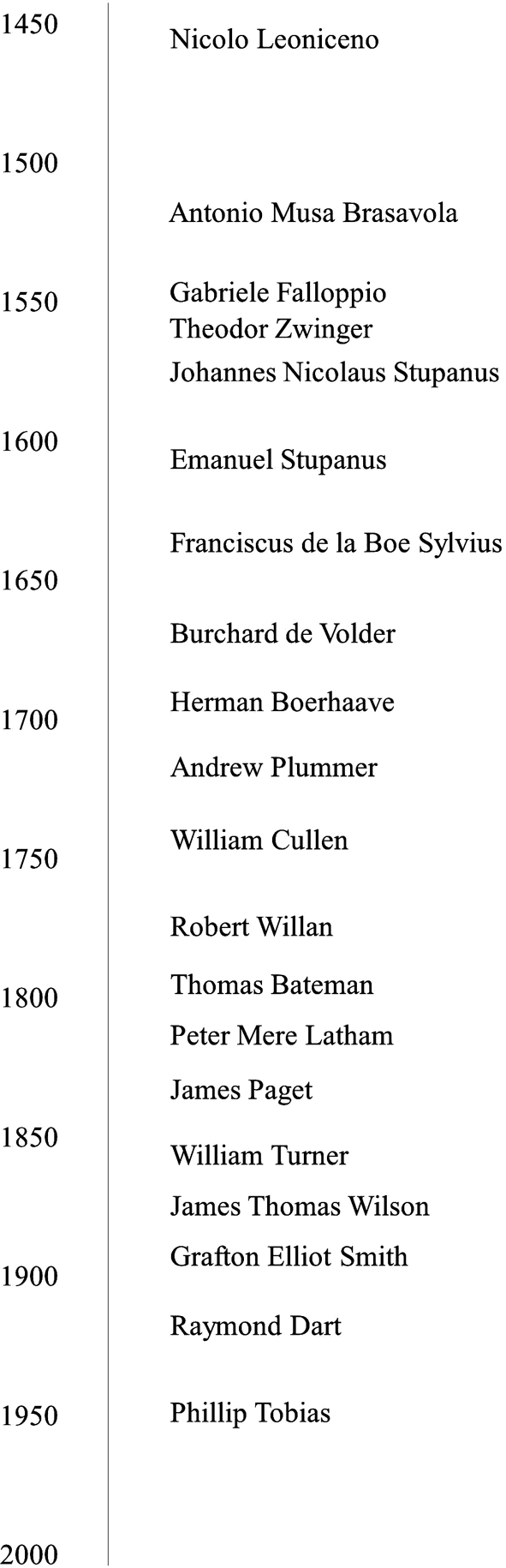
Figure 2.1. Academic lineage described in this chapter. Individuals are placed according to the dates of their highest relevant degrees.
Approaches to this genealogy
This exercise is by its nature an oversimplification. To be sure, no individual academic is influenced by only one mentor. In this sense, a genealogical plexus of blood vessels is probably a reasonable analogy, especially for the academic pedigree of an anatomical scientist! Our intellectual family tree more closely resembles a tangle of lianas connecting back and forth in seeming indecipherable chaos. Add to this the fact that ancestors came from many different academic traditions and that some individuals are better documented than others, and the task of tracing an academic genealogy becomes a formidable undertaking.
First and foremost, we must carefully define ‘mentor’ to make sense out of any academic genealogy. For this chapter, we identify a mentor as the individual who had the most documented influence on the student in the discipline of palaeoanthropology, or before the advent of palaeoanthropology, in the academic field for which that student became best known. This could be a teacher, a doctoral dissertation, research or clinical advisor, or a graduate or postdoctoral mentor. Academic genealogy is not an exact science. Some student and mentor relationships are obvious, whereas others are more difficult to establish and must be selected as ‘best choice’ among several possibilities.
Most of the individuals in this genealogy are well known from biographies, published or unpublished letters, detailed obituaries and other documents. This is fortunate, as the strength of a chain is only as good as its weakest link. Relationships between each mentor–student pair and facts about each individual were gathered from the primary literature and confirmed with demonstrably independent sources whenever possible. Rationales for ascribing relationships for less obvious links are offered as necessary.
Information on each individual is presented in a separate section. These sections provide only basic biographic facts because the emphasis here is on the linkages between mentor and student. Details provided include formal education and degrees, academic positions held and major contributions in research and teaching. Occasional anecdotes and quotations are also offered to give the reader a sense of these academicians as ‘real people’. References to more detailed biographic information are presented at the end of each section.
Phillip Vallentine Tobias (1925–)
Mentor: Raymond Arthur Dart
Phillip Tobias was born in Durban, South Africa in 1925. His university education began at the University of the Witwatersrand in 1942, where he earned BSc and BSc Honours degrees (1946, 1947), the medical degrees MB, BCh (1950) and a PhD (1953) for a thesis entitled Chromosomes, Sex-Cells and Evolution in the Gerbil. He was awarded a DSc degree for his works on hominid evolution in 1967. Tobias mentions Raymond Dart first among the ‘veritable Senatus Academicus’ that helped shape his academic career (Tobias, Reference Tobias2005). While Joseph Gillman advised Tobias on his cytogenetics doctoral thesis, Dart was clearly his mentor in palaeoanthropology – from the classroom to the laboratory and into the field.
Tobias was appointed demonstrator and instructor in histology and physiology at the University of the Witwatersrand in 1945. He served as lecturer (1951–2), senior lecturer (1953–8), professor and chair (1959–90) of anatomy, and as dean of the Faculty of Medicine (1980–2) at the University of the Witwatersrand, Johannesburg. He remains today professor emeritus and honorary professorial research fellow at that institution. Tobias is a captivating and respected teacher and lecturer, as well as a caring and diligent mentor. One of Tobias’s academic protégés, Frederick Grine (Reference Grine and Sperber1990), wrote of his ‘extraordinarily thorough, painstaking and incisive comments, suggestions and criticisms’, noting that his ‘unfailing encouragement and wise counsel have truly been inspirational’. Tobias has had many academic descendants to date, spanning at this point at least four academic generations. These include the first author of this article, Peter Ungar, who was Frederick Grine’s student. Ungar himself has now mentored several students, who today are in the process of training their own. And so it continues.
Phillip Tobias is best known for his landmark descriptions of early hominins. He has authored over 1150 works to date, spanning a dizzying variety of topics from genetics to human evolution, and anatomy, growth and development, to the history and philosophy of science. He has received numerous awards and honorary degrees, including three Nobel Prize nominations. He is a Fellow of the Royal Society (London) and a Foreign Associate of the National Academy of Sciences of the USA, Commander of the Order of Merit of France and Commander of the National Order of Merit of Italy. He has maintained an inspiring stance against apartheid from 1949 onward.
References: Sperber, Reference Sperber1990; Tobias, Reference Tobias2005; Koenig, Reference Koenig2005.
Raymond Arthur Dart (1893–1988)
Mentor: Grafton Elliot Smith, but see also James Thomas Wilson
Raymond Dart was born in Toowong, Brisbane, Australia in 1893. His university education began in 1910 at the University of Queensland, where he received a BSc in 1913 and MSc in 1914. He enrolled in the University of Sydney in 1913, where he received his MB and ChM in 1917 and MD in 1927. Dart studied anatomy under James Thomas Wilson and served as his assistant between 1914 and 1917. He wrote more than four decades later that Wilson’s influence on him was ‘so great that even today, I find myself guided by the standards he implanted in my young mind’ (Dart, Reference Dart1959).
Following brief military service, Dart was appointed senior demonstrator under Grafton Elliot Smith at University College, London. In 1919 he continued his studies of neuroanatomy. Smith had a tremendous influence on Dart’s interests in palaeoanthropology and thus may be considered Dart’s primary mentor for this genealogy. Dart left London at the end of 1922 to accept a post as professor of anatomy in the Medical School at the University of the Witwatersrand, Johannesburg, South Africa. He served as professor and head of the Department of Anatomy from 1923 to 1958. Concurrently he was dean of the Faculty of Medicine from 1925 to 1943. Dart was a ‘brilliant, gifted teacher who brought all the passion and conviction of a missionary preacher to his classes’ (Fagan, Reference Fagan1989). Raymond Dart’s best known accomplishment is his recognition of the human-like qualities in the famous Taung child skull discovered in 1924 and assigned by him to a new genus and species, Australopithecus africanus. His claim flew in the face of the prevailing paradigm, that mankind had evolved in Asia. He doggedly championed his view that it represented a species whose members have taken steps in a human direction and from the middle of the twentieth century saw its almost universal acceptance. He and his team recovered from the site of Makapansgat some 300 km north of Johannesburg further remains of Australopithecus, but his association with that site generated another revolutionary claim, namely that the thousands of broken bones had been artificially smashed and shaped by the australopithecines. Although his claim for a bone, tooth and horn culture has not been supported, the impact of that work catalysed the development of the field of taphonomy. Dart pioneered studies on the evolution of the human upright posture and made many contributions in southern African archaeology. It has been said of him that he was ‘a maker of men’ and this is perhaps his most lasting contribution. Raymond Dart played a major role in building up the infant Medical School of the University of the Witwatersrand, Johannesburg, including the establishment of the Witwatersrand Medical Library (now the Health Sciences Library), university courses for physiotherapists, occupational therapists and nurses, and the Medical BSc and honours degrees, which laid a foundation for many of the distinguished graduates of this School.
References: Dart, Reference Dart1959; Wheelhouse, Reference Wheelhouse1983; Tobias, Reference Tobias1984; Tobias, Reference Tobias1989; Fagan, Reference Fagan1989; Wheelhouse and Smithford, Reference Wheelhouse and Smithford2001.
Grafton Elliot Smith (1871–1937)
Mentor: James Thomas Wilson
Grafton Elliot Smith was born in Grafton, New South Wales, Australia in 1871. He entered the University of Sydney in 1888 to study medicine, and graduated as MB and ChM in 1893. He received an MD in 1895 for his dissertation on the anatomy and histology of the non-placental mammal brain. Smith served as a demonstrator of anatomy under his mentor James Thomas Wilson from 1894–6. He continued his research at Cambridge until 1900.
Elliot Smith’s first professorship was the chair of anatomy at the University of Cairo from 1900 to 1909. During that time he continued to develop his research on neuroanatomy, but added Egyptian bioarchaeology, human evolution and the origin and spread of civilisation to his repertoire of interests. He accepted the chair of anatomy at the Victoria University of Manchester, where he served until 1919. He then filled the chair of anatomy at University College, London until his retirement in 1936. Smith mentored many students and staff during his career, and more than twenty went on to fill chairs of anatomy. He must have been an inspiring lecturer, as Raymond Dart recounted after hearing him speak for the first time, ‘I fell under his spell that night and prayed that at some time I would be allowed to work under him’ (Dart, Reference Dart1959).
Elliot Smith was a remarkably prolific researcher with some 434 works to his credit, including eight books. He is perhaps best known for his work on the infamous Piltdown man and on hyperdiffusionism, but he published on an amazing assortment of topics, from mammalian comparative neuroanatomy to many aspects of human evolution, and the bioarchaeology of Dynastic Egypt. Elliot Smith received many accolades, including a Knighthood in 1934, and Cross of the French Legion of Honour in 1936.
References: Wilson, Reference Wilson1938; Dart, Reference Dart1959; Elkin and MacIntosh, Reference Elkin and MacIntosh1974; Blunt, Reference Blunt and Ritchie1988; Morison, Reference Morison1997.
James Thomas Wilson (1861–1945)
Mentor: William Turner
James Thomas Wilson was born in 1861 at Moniaive, Dumfriesshire, Scotland. He began his medical training at the University of Edinburgh in 1879 and received his BM degree there in 1883. After a surgical rotation at the Royal Infirmary in Edinburgh and a year as a surgeon on a cargo ship at sea, he returned to the University of Edinburgh as demonstrator of anatomy under William Turner for two winter sessions. Of his mentor, Wilson later wrote ‘I cannot omit a special reference to the Edinburgh School of Anatomy in which I received not only my early anatomical instruction, but my later training as a teacher of anatomy under my old chief Sir William Turner, to whom as in private duty bound, I must pay tribute’ (Morison, Reference Morison1997).
Wilson began his career as demonstrator of anatomy in the Medical School at the University of Sydney in 1887. He remained in Sydney for more than three decades, later serving as professor of anatomy and as dean of the Faculty of Medicine. He also served as director of the Prince Alfred Hospital and held numerous other appointments. Wilson returned to Britain in 1920 to fill the chair of anatomy at Cambridge University, a position he held until his retirement in 1934. Wilson was evidently not the most exciting of lecturers. His pupil, Elliot Smith, once wrote that his boring osteology lectures ‘rapidly killed all interest in the subject’ (Morison, Reference Morison1997). Nevertheless, he was an excellent research mentor, ‘advising, criticizing, and above all, encouraging, all with great vehemence’ (Morison, Reference Morison1997).
Wilson’s best known publications involve the anatomy, physiology and embryology of native Australian mammals, but he also published on other subjects, including human anatomy. Like his mentor before him, Wilson took an active role in military affairs, ascending through the ranks to Lieutenant-Colonel in the Australian Intelligence Corps and Honorary Colonel in the Censorship Service.
References: Hill, Reference Hill1949; Smith, Reference Smith1950; Morison, Reference Morison1997.
Sir William Turner (1832–1916)
Mentor: Sir James Paget
William Turner was born in Lancaster, England in 1832. He began his medical training as an apprentice to a local general practitioner in 1848 and his formal education two years later when he enrolled in St. Bartholomew’s Hospital Medical School to work under James Paget. Turner was qualified to practise by the Royal College of Surgeons and took honours in chemistry at the London University in 1853. He became the favourite pupil of Paget, who recommended him for the post of demonstrator at the University of Edinburgh in 1853.
Turner served the University of Edinburgh from 1854 to his death in 1916, first as demonstrator, then as professor, dean of the Faculty, and finally principal and vice-chancellor. He took a great interest in his students and trained, encouraged and guided them. It should come as no surprise then that, according to Hill (Reference Hill1949), ‘round about the turn of the century, the vast majority of professors of anatomy in the [British] Empire had been pupils of William Turner’. Turner had a distinguished career in the Volunteer Service, becoming a decorated Lieutenant Colonel. He was knighted in 1886 and created Knight Commander of the Order of Bath in 1901.
Turner was Britain’s leading anatomist for much of the nineteenth century, and had a diverse portfolio of interests. He published more than 200 works on topics ranging from human craniology to mammalian placentation. William Turner advised Charles Darwin during the development of natural selection theory, and was among the first researchers to look to comparative anatomy for evidence of evolution.
References: Keith, Reference Keith1916; M. A. (anon), Reference (anon)1917; Morison, Reference Morison1997; Anon, Reference Anon2002; Magee, Reference Magee2003.
Sir James Paget (1814–1899)
Mentor: Peter Mere Latham
James Paget was born in Great Yarmouth, Norfolk, England in 1814. His medical education began in 1830 with apprenticeship to a general practitioner-surgeon in Great Yarmouth. In 1834, he moved to London and became a student at St. Bartholomew’s Hospital. Paget spent much of his time attending the ward rounds of Peter Mere Latham, and served under Latham as clinical clerk between 1835 and 1836, when he was qualified to practise by the Royal College of Surgeons.
Paget’s teaching, research and clinical appointments, and accomplishments are too many to list here. He spent most of his career at St. Bartholomew’s Hospital Medical School, where he served first as the curator of the anatomy and pathology museum, then as demonstrator, lecturer, warden and, ultimately, surgeon. He also served as professor at the Royal College of Surgeons and ran a very busy private practice, seeing up to 200 patients a day at the hospital! He was appointed Surgeon Extraordinary to Queen Victoria in 1858, Surgeon-in-Ordinary to the Prince of Wales in 1863 and was conferred a baronetcy in 1871. He resigned from St. Bartholomew’s Hospital that year, but continued to practise medicine and hold various appointments, including that of President of the Royal College of Surgeons and Vice-Chancellor of the University of London.
Paget is best known as one of the founding fathers of scientific medical pathology, and his name is associated with Paget’s disease of the bone and nipple. His works include Lectures on Tumours (1851) and Lectures on Surgical Pathology (1853) and numerous papers on cancer, syphilis and typhoid. Despite all this, teaching remained important to Paget. He wrote to his pupil William Turner ‘I can feel with and for you the immense pleasure of lecturing to full benches of attentive men. Many and great as have been the pleasures that I have derived from my profession, none has been as great as this’ (Paget, Reference Paget1901).
References: Paget, Reference Paget1901; Roberts, Reference Roberts1989; Coppes-Zantinga and Coppes, Reference Coppes-Zantinga and Coppes2000; Royal College of Physicians, Reference Physicians2006a.
Peter Mere Latham (1789–1875)
Mentor: Thomas Bateman
Peter Mere Latham was born in London, England in 1789. After taking a BA at Brasenose College in Oxford in 1810, he began medical studies at St. Bartholomew’s Hospital and at the Carey Street Dispensary under the tutelage of Thomas Bateman. He earned an MA in 1813, MB in 1814 and MD from St. Bartholomew’s Hospital in 1816.
Latham worked as a physician at the Middlesex Hospital between 1815 and 1824, and then at St. Bartholomew’s Hospital until ill health forced him to resign in 1841 (though he maintained a small private practice until 1865). Latham had a decorated clinical career, including an appointment as Physician Extraordinary to Queen Victoria from 1837 to his death in 1875. Latham became a lecturer in medicine at St. Bartholomew’s Hospital Medical School in 1836, and taught students there for many years. He was a very dedicated teacher and he wrote passionately on medical education reform. As for his teaching, his pupil James Paget wrote, ‘I think there were none who did not thoroughly admire him, and imitate him in his mode of study, and very gratefully remember his teachings’ (Paget, Reference Paget1901). On his lecturing style, however, Paget added curiously ‘he was very pompous; sometimes almost laughably so, especially if he had to speak of general rules relating either to personal conduct or to modes of study; but this only helped the memory of his hearers’ (Paget, Reference Paget1901).
Latham is remembered for his descriptions of clinical symptoms and physical findings in cardiology as presented in his Essays on Some Diseases of the Heart (1828) and Lectures on Clinical Medicine Comprising Diseases of the Heart (1845). He is also remembered for his pioneering work on auscultation and percussion, published in Lectures on Subjects Connected with Clinical Medicine in 1836.
References: Munk, Reference Munk1878; Paget, Reference Paget1901; Spaulding, Reference Spaulding1971; Fleming, Reference Fleming1997; Royal College of Physicians, Reference Physicians2006b.
Thomas Bateman (1778–1821)
Mentor: Robert Willan
Thomas Bateman was born in Whitby, Yorkshire, England in 1778. His early medical training began with an apprenticeship to an apothecary in Whitby. Bateman’s formal studies began in 1797 at the Windmill Street School of Anatomy and St. George’s Hospital in London. He then matriculated at the University of Edinburgh in 1798, and received an MD in 1801 for a thesis on Haemorrhoea Petechialis. He returned to London that year and began training under Robert Willan. Bateman quickly became Willan’s disciple, championing his mentor’s works (and gratefully acknowledging his indebtedness to Willan) for many years.
Bateman began work as a physician at both the Fever Institution and the Carey Street Dispensary in 1804. He continued practising until ill health forced his resignation from the institution in 1818 and from the dispensary the following year. He died in 1821 at the age of 42. He evidently mentored several young physicians during his years at the dispensary, and was a serious and intense teacher. Rumsey (Reference Rumsey1827) wrote ‘the simplicity of his language and conscientious fidelity of his whole mind to his office, were admirably calculated to fix the attention and attachment of a scholar. No levity unworthy of his learning or his subject ever dishonoured either’.
Bateman is known for continuing Willan’s work to describe skin diseases and standardise dermatology nomenclature. His Practical Synopsis of Cutaneous Diseases According to the Arrangement of Dr. Willan in 1813 and Delineations of Cutaneous Diseases, Exhibiting the Characteristic Appearances of the Principal Genera and Species, Comprised in the Classification of Willan in 1817 are considered to have been the most influential textbooks of dermatology in the nineteenth century. Bateman is credited with identifying and describing several skin diseases, among them Herpes iris of Bateman and eczema. He published a collection of papers as the Reports on the Diseases of London and the State of the Weather that drew much attention, as well as other works based on his practice at the Fever Institution.
References: Bateman, Reference Bateman1812; Rumsey, Reference Rumsey1827; Booth, Reference Booth1999; Levell, Reference Levell2000; J. R. (anon), Reference (anon)2006; Royal College of Physicians, Reference Physicians2006c.
Robert Willan (1757–1812)
Mentor: William Cullen
Robert Willan was born at The Hill, near Sedbergh in Yorkshire, England in 1757. He began his medical training in Edinburgh in 1777, studying medicine under William Cullen and other teachers at the university. Cullen’s influence is evidenced in Willan’s later work classifying skin lesions, which followed his mentor’s efforts to categorise diseases using the Linnaean system (see below), just as Erasmus Darwin was to do. Willan received his MD in Edinburgh in 1780 for a thesis on inflammation of the liver.
After two years of private practice in Darlington, Willan moved to London. He was appointed physician to the newly established Carey Street Dispensary in 1783, where he treated patients and mentored some forty young physicians during his tenure. Such dispensaries catered for the poor, disheveled masses, providing Willan with a ‘dermatological goldmine’ (Booth, Reference Booth1999) upon which to base the research for which he became best known. He resigned from the dispensary in 1783, but continued to practise medicine until he became ill in 1811. Willan died in 1812.
Willan is recognised for bringing order to the discipline of dermatology with his classifications and descriptions of skin lesions. These he codified in his very successful treatise On Cutaneous Diseases. He has been called the father of modern dermatology, and his name remains attached to lupus vulgaris (Willan’s lupus) and psoriasis vulgaris (Willan’s lepra). He also wrote on a host of other medical topics ranging from the history of leprosy to the advantages of vaccination.
References: Bateman, Reference Bateman1812; Beswick, Reference Beswick1957; Hare, Reference Hare1973; Sharma, Reference Sharma1983; Doig et al., Reference Doig, Ferguson, Milne and Passmore1993; Booth, Reference Booth1999.
William Cullen (1710–1790)
Mentor: Andrew Plummer
William Cullen was born in Hamilton, Lanarkshire, Scotland in 1710. His early medical training was informal, involving apprenticeships in Glasgow and London. He began his formal medical education by attending winter classes in 1734–5 and 1735–6 at the University of Edinburgh. While he earned his MD in Glasgow in 1740, genealogists consider Andrew Plummer to have been his principal mentor, as Cullen was evidently greatly influenced by Plummer and his lectures in Edinburgh (Kerker, Reference Kerker1955; Gaffney and Marley, Reference Gaffney and Marley2002).
Cullen began lecturing on medicine at the University of Glasgow in 1744, and was appointed to its first lectureship in chemistry three years later. He taught chemistry and medicine in Glasgow until 1755, when he returned to Edinburgh to share a professorship with Plummer until his mentor died the following year. Cullen continued at Edinburgh until 1789, and died the following year. William Cullen is best remembered as a teacher and mentor. He was, by all accounts, a lucid and enthusiastic lecturer, more concerned with getting his points across than with formality. In one famous quotation, he referred to Carolus Linnaeus’s writings as ‘the most uncouth jargon and minute pedantry’ he had ever seen!
He is, nevertheless, well known for applying the Linnaean system to classify diseases by symptom. Cullen wrote many popular medical textbooks widely used throughout Europe and North America during the late eighteenth and early nineteenth centuries. His First Lines of the Practice of Physic and A Treatise of the Materia Medica, for example, set the standard for decades. In fact, it was in these works that he coined the term ‘neurosis’. On the other hand, while he is best known as a founding father of chemistry in Britain, he wrote only one research paper related to this field – an examination of the cooling effects of evaporating fluids.
References: Thomson, Reference Thomson1832; Wightman, Reference Wightman1955; Kerker, Reference Kerker1955; Doig et al., Reference Doig, Ferguson, Milne and Passmore1993; Gaffney and Marley, Reference Gaffney and Marley2002; Doyle, Reference Doyle2005b.
Andrew Plummer (1697–1756)
Mentor: Herman Boerhaave
Andrew Plummer was born in Edinburgh, Scotland, in 1697. He began his university studies in the arts at the University of Edinburgh from 1712 to 1717, but then switched to medicine, matriculating at the University of Leiden in 1720 under the direction of Herman Boerhaave. Of Boerhaave’s impact on Plummer, Kerker (Reference Kerker1955: 38) wrote that Plummer ‘could not have failed to succumb to his influence’. Plummer graduated MD in 1722 for a thesis De phthisi pulmonali a catarrho orto. He then returned to Scotland in 1724 and passed the licentiate examination of the Royal College of Physicians of Edinburgh permitting him to practise medicine.
Plummer and three other Leiden alumni began teaching medicine and chemistry at the new Edinburgh Dispensary in 1725, ‘according to the method of the celebrated Herman Boerhaave’ (Doyle, Reference Doyle2005a). The four were appointed professors, without salary, at the University of Edinburgh the following year, effectively founding the medical school. Plummer continued his private practice, taught chemistry and helped develop and run the group’s pharmaceutical laboratory. He continued this work until his death in 1756. Plummer was evidently a better chemist than teacher, as one student, Oliver Goldsmith wrote, ‘Plumer [sic] professor of chymistry understands his busines [sic] well but delivers himself so ill that he is but little regarded’ (Doyle, Reference Doyle2005a). John Fothergill later recounted ‘had not a native diffidence veil’d his talents as a praelector he would have been among the foremost in the pupils’ esteem’ (Doyle, Reference Doyle2005a).
Plummer published papers on clinical medicine and chemistry, including Remarks on chemical solutions and precipitations and Experiments on neutral salts, compounded of different acid liquors, and alcaline salts, fixt and volatile. He is best known for formulating Plummer’s pills – a preparation of calomel, antimony sulfide and mercuric acid used, rather ineffectively, for more than a century as a panacea for numerous ailments.
References: Kerker, Reference Kerker1955; Underwood, Reference Underwood1977; Gaffney and Marley, Reference Gaffney and Marley2002; Doyle, Reference Doyle2005a.
Herman Boerhaave (1668–1738)
Mentor: Burchard de Volder
Herman Boerhaave was born in 1668 in the parsonage at Voorhout near Leiden, the Netherlands. He entered the University of Leiden in 1684, and attended the lectures and demonstrations of Burchard de Volder. Boerhaave earned a doctorate in philosophy in 1690, after which De Volder promoted him to magister. Boerhaave later edited De Volder’s Oratio de novis et antique. The pupil’s respect for his mentor is clear in the preface, where he praises De Volder’s ‘sharpness of mind (acerrimam ingenii aciem), by which he exceeded everyone else’ (Knoeff, Reference Knoeff2002). Boerhaave also earned an MD from Harderwyck in 1693.
Boerhaave practised as a physician in Leiden for some years, and then was appointed to teach medicine at the University of Leiden in 1701. He worked at Leiden until his death in 1738, much of the time holding simultaneous chairs in botany, clinical medicine and chemistry. Boerhaave has been called one of the great teachers of all time (Kerker, Reference Kerker1955), and was named communis Europae praeceptor (the common teacher of Europe) by Albrecht von Haller (Underwood, Reference Underwood1977). Many of Boerhaave’s students, such as Carl Linnaeus and Andrew Plummer, became some of the most influential academicians in the world.
Boerhaave wrote the medical textbooks Institutiones medicae and Aphorismi de cognoscendis et curandis morbis, and his Elementa Chemiae was among the most influential texts of the eighteenth century. He is considered the father of physical chemistry, with contributions including the introduction of exact measurements to chemistry, demonstration that water is a product of combustion, proof that heat is weightless and performance of the first calorimetric studies.
References: Kerker, Reference Kerker1955; Lindeboom, Reference Lindeboom1968; Underwood, Reference Underwood1977; Luyendijk-Elshout, Reference Luyendijk-Elshout1998; Kidd and Modlin, Reference Kidd and Modlin1999; Knoeff, Reference Knoeff2002.
Burchard de Volder (1643–1709)
Mentor: Franciscus Sylvius
Burchard de Volder was born in Amsterdam, the Netherlands in 1643. He began to study medicine and philosophy in Amsterdam, and took an MA at Utrecht in 1660. He continued his education in Leiden, falling under the influence of Franciscus Sylvius. He earned an MD in 1664, with a dissertation Theses de la Nature, très opposes aux idées Péripateticiennes. De Volder then went back to Amsterdam to establish a medical practice, but returned to Leiden in 1670 following an offer of the chair of logic. During his time in Leiden, De Volder served also as professor of mathematics. He was appointed rector by William of Orange (then also the King of England) in 1697. De Volder taught the classics, mathematics and physics in Leiden, but resigned from his professorship due to illness in 1705.
Burchard de Volder did not produce a great volume of works, but his contributions were influential. His work reflected the ideas of his mentor Sylvius, and offers insights on some of De Volder’s contemporaries including Spinoza, Descartes, Newton, Huygens and Boyle. De Volder argued for the integration of mathematics and physics in his Oratio de conjungendis philosophicis et mathematicis disciplinis (1682) and later for the integration of these with medicine in De rationis viribus et usu in scientiis (1698). He published studies on the weight of air and invented an air pump. He set up the first physics laboratory in Leiden and his lectures and demonstrations on gases and the atmosphere had a clear impact, especially on his most renowned student, Herman Boerhaave.
References: Partington, Reference Partington1961; Klever, Reference Klever1988; Gaffney and Marley, Reference Gaffney and Marley2002; Knoeff, Reference Knoeff2002.
Franciscus Sylvius (1614–1672)
Mentor: Emanuel Stupanus
Franciscus Sylvius (François Dubois or De le Boë) was born in Hanau, Germany, in 1614. He began his formal education with courses in Sedan and at other universities in Germany and France, ultimately receiving his MB at the University of Leiden in 1634. Sylvius obtained his MD in Basel in 1637 for this thesis, Disputatio medica de animale motu einsque laesionibus, under the direction of Emanuel Stupanus. The strong Paracelsian tradition at Basel clearly exerted an influence on Sylvius, as is evident in his later works.
Sylvius practised for a short time in Hanau, and then returned to Leiden to give private lectures on anatomy. He started a lucrative practice in Amsterdam in 1641, but was drawn back to Leiden by an appointment as professor of medicine in 1658. Sylvius remained at the University of Leiden, ultimately becoming rector magnificus from 1669–70. Sylvius was evidently a great teacher, and ‘his clear, elegant and sometimes eloquent speech, slow enough to be followed by even somewhat dull intellects, drew around his chair an immense concourse of pupils who regarded him with strong affection’ (Baker, Reference Baker1909). He himself wrote ‘I have endeavoured with all my might to make sure that my auditors should profit as much as possible from my industry and labor and go out as excellent physicians’ (Baker, Reference Baker1909). Indeed, Sylvius drew students from all over Europe, teaching them anatomy, chemistry and clinical medicine.
Sylvius conducted research on anatomy, physiology and pathology. He was a leading proponent of the school of Iatrochemistry, a doctrine that held that life and disease processes are based on chemical actions, and that medicine could be understood in terms of universal rules of physics and chemistry. The basic idea was a good one, but it fell apart quickly when Sylvius tried to unite the Galenic notions of humoral medicine with seventeeth-century chemistry. Much of this work is laid out in Praxeos medicae idea nova published in 1671. We know the name of Franciscus Sylvius today by his research on the structure of the brain, and particularly by his recognition of the ‘Sylvian fissure’ (lateral sulcus) as described in Disputationes Medicae (1663), ‘Sylvian ventricle’ (cave of septum pellucidum), ‘Sylvian fossa’ (lateral cerebral fossa) and a number of other eponymously designated entities. However, the ‘Sylvian aqueduct’ (cerebral aqueduct) owes its name to Jacobus Sylvius (1478–1555).
References: Baker, Reference Baker1909; Baumann, Reference Baumann1949; Gubster, Reference Gubster1966; Underwood, Reference Underwood1972; van Gijn, Reference van Gijn2001.
Emanuel Stupanus (1587–1664)
Mentor: Johannes Nicolaus Stupanus
Emanuel Stupanus (Emanuele Stupano) was born in Basel, Switzerland, in 1587. His formal education began in Geneva under Esaïe Colladone and Caspar Laurentius, and he attended classes at various universities in Germany, France and Italy. Stupanus returned to the University of Basel to earn his MD with highest honours conferred by mathematics professor Petrus Ryffius (Peter Ryff), who studied under Theodor Zwinger (see below) in 1613. Emanuel served an apprenticeship under his father, Johannes Nicolaus, until 1620 when he replaced the older Stupanus as professor of theoretical medicine. We know little about Emanuel’s teaching prowess, though Baumann (Reference Baumann1949) reported that ‘as promoter he seems not to have been unattractive’.
Emanuel Stupanus was a very active scholar, producing dozens of works spanning a career of more than forty years. His known works include Vere’ Aureorum Aphorismorum Hippocratis enarrationes & commentaria aphoristica Nova Methodo eiusmodiin ordinem digesta (1615) and his translation and completion of Bartholomew Castelli’s Lexicon Medicum Graeco-Latinum (1628). He published on a broad range of medical subjects.
References: Hofmann, Reference Hofmann1698; Burckhardt, Reference Burckhardt1917; Baumann, Reference Baumann1949.
Johannes Nicolaus Stupanus (1542–1621)
Mentor: Theodor Zwinger
Johannes Nicolaus Stupanus (Juan Nicolás Stupano) was born in 1542 in Chiavenna, Italy. He took his formal education at the University of Basel, receiving his BA in 1563, MA in 1565 and MD in 1569 under the direction of Theodor Zwinger. Stupanus began teaching as professor of logic and rhetoric at the Basel Academy in 1560, and was appointed professor of theoretical medicine at the University of Basel in 1589, where he replaced Zwinger in 1589. He resigned from the University of Basel in 1620.
Stupanus senior was a prolific researcher and writer, publishing many works on physiology, pathology and diagnostic medicine. He was evidently a fervent advocate of the Paracelsian approach that presaged Sylvius’s Iatrochemical School. Johannes Nicolaus Stupanus translated many works from Italian into Latin. These included texts on astronomy, the works of Machiavelli (Prince, Discorsi) and histories (including a history of Naples by Pandulphis). He is best known for his treatise Medicina Theorica (1614).
References: Hofmann, Reference Hofmann1698; Koelbing, Reference Koelbing1970.
Theodor Zwinger (1533–1588)
Mentor: Gabriele Falloppio
Theodor Zwinger (Theodoro Zuingero) was born in 1533 in Basel, Switzerland. He studied in Basel, Lyon and Paris, where he attended the lectures of Petrus Ramus. Zwinger then studied anatomy at the University of Padua, perhaps the most renowned Medical School of the European Renaissance. He received his medical degree in 1559 at the University of Padua under the direction of Gabriele Falloppio. Zwinger took a faculty position in the medical school at the University of Basel in 1559, and was elected chair of Greek in 1565, ethics in 1571 and theoretical medicine in 1580.
Zwinger was an accomplished physician and philosopher known for his contributions in many fields. He is best remembered for his Theatrum vitae humanae, first published in 1565. This work is said to be ‘the most comprehensive compilation of knowledge ever achieved by a single human being in the Early Modern Period’ (Zedelmaier, Reference Zedelmaier2008). As for his teaching and mentoring, little is known, though Blair (Reference Blair, Campi, De Angelis and Groeing2008) does refer to a letter from the medical students at the University of Basel asking him to speak more slowly because of difficulty keeping up with him.
References: Herzog, Reference Herzog1778; Haeser, Reference Haeser1881; Dufournier, Reference Dufournier1936; Kolb, Reference Kolb1951; Karcher, Reference Karcher1956; Bietenholz, Reference Bietenholz1971; Portmann, Reference Portmann1988; Blair, Reference Blair, Campi, De Angelis and Groeing2008; Zedelmaier, Reference Blair, Campi, De Angelis and Groeing2008.
Gabriele Falloppio (1523–1562)
Mentor: Antonio Musa Brasavola
Gabriele Falloppio (Gabriel Fallopius, Gabriello Falloppio) was born in Modena, Italy in 1523. He began his studies in anatomy in 1544 in Modena with Niccolo Machella, and is said to have spent some time at the University of Padua with Ratteo Realdo Colombo. He evidently completed his education at the University of Ferrara in 1548, under the direction of Antonio Musa Brasavola and Giovanni Battista Canano. Academic genealogists consider Brasavola to have been his mentor. Falloppio briefly taught pharmacy at Ferrara, but became professor of anatomy at the University of Pisa in 1549 and, in 1551, chair of anatomy and surgery at the University of Padua, where he also held a professorship in botany.
Falloppio was an outstanding teacher and anatomist. Hamilton (Reference Hamilton1831) reported that his lectures both at Pisa and Padua ‘attracted crowds of auditors’, and that he was ‘most methodical in teaching’. According to O’Malley (Reference O’Malley2008), Falloppio ‘lectured and demonstrated with such success as to attract a number of later to be distinguished students’. While several works are attributed to him, only Observations anatomica (1561) was published during his lifetime. This important book includes a series of commentaries and criticisms on Vesalius’s De humane corporis fabricate. Falloppio is perhaps best known for his meticulous dissections and his descriptions of the vestibulococclear system, deciduous teeth and female reproductive tract, including the tubes that now bear his name.
References: Hamilton, Reference Hamilton1831; Walsh, Reference Walsh, Herbermann, Pace, Pallen, Shahan and Wynne1913; Sanchez, Reference Sanchez2009.
Antonio Musa Brasavola (1500–1555)
Mentor: Nicolo Leoniceno
Antonio Musa Brasavola (Brassavola, Brasavoli) was born in 1500 in Ferrara. He attended universities in Padua, Bologna and Paris before returning to Ferrara, where he studied medicine under Nicholas Leoniceno and Giovanni Manardi. Brasavola’s biography of Leoniceno, entitled Praeceptor meus (My teacher) makes the student–mentor relationship clear. Brasavola received his medical degree in 1521, though began lecturing in logic at Ferrara in 1519. While his tenure at Ferrara was interrupted periodically by breaks for private practice, Brasavola taught logic there until 1527, natural philosophy until 1536 and medicine until his death in 1555.
Brasavola was evidently a dedicated teacher. Thorndike (Reference Thorndike1941) tells of Brasavola being informed whilst lecturing that his house was on fire, and of his instance on finishing the lecture before leaving! He was also a well respected medical doctor, and served as court physician for Ercolo II, the Duke of Este, and for a time attended Pope Paul III in Rome. Brasavola also consulted for King Francis I of France, Kaiser Charles V of Germany and King Henry VIII of England, and treated patients from all walks of life. His principal research interests were in botany and pharmacology, and he is known for performing the first recorded successful tracheostomy. Brasavola was a prolific author, with more than forty major works to his credit. Some of the best know are Examen omnium simplicium medicamentorum, quorum in officinis usus est (1537), a witty imaginary conversation in which he introduced several new pharmaceuticals, and his commentaries on Hippocrates and Galen, In octo libros aphorismorum Hippocratis & Galeni commentaria & annotationes (1541), In libros de ratione victus in morbis acutis Hippocratis & Galeni commentaria & annotationes (1546) and Index refertissimus in omnes Galeni libros (1556).
References: Panoucke, 1820; Hamilton, Reference Hamilton1831; Bottoni, Reference Bottoni1892; Garrison, Reference Garrison1913; Thorndike, Reference Thorndike1941; Nutton, Reference Nutton1997.
Nicolo Leoniceno (1428–1524)
Nicolo Leoniceno (Nicolaus Leoninus, Nicolo da Lonigo) was born in Lonigo in 1428. He studied Latin and Greek under Ognibene da Lonigo in Vicenza, but moved to Padua in 1446. He completed his education in philosophy and medicine at the University of Padua in 1453. Most academic genealogies list Pelope, or Pietro, Roccabonella as Leoniceno’s primary mentor, but we have been unable to find confirmation in either case. Pietro Roccabonella, for example, evidently did not become professor of medicine at Padua until 1465. It is possible that Pietro’s grandfather, Niccolo Roccabonella, was Leoniceno’s mentor, as Niccolo also taught medicine at Padua, but more research is needed to evaluate this possibility. Leoniceno taught philosophy and medicine at the University of Ferrara for an extraordinary 60 years, from 1464 until his death in 1524, with sabbaticals to teach at Bologna in 1483 and 1508–9. He was also an accomplished clinician.
Leoniceno saw himself as an educator first, his motto being Plus ago docens omnes medicos (Nutton, Reference Nutton1997). He is best remembered for his translations of ancient Greek texts by Galen, Hippocrates and others. Among his many works, two stand out: his criticism of Pliny, Avicenna, Serapio and others in De Plinii et plurium aliorum in medicina erroribus liber ad doct. Virum Angelum Politianum (1492) and the documentation of a syphilis pandemic that spread across Europe in the late 1400s in Libellus de epidemia, quam vulgo morbum gallicum vocant (1497).
References: Castigloni, 1941; Major, Reference Major1954; Pepe, Reference Pepe1986; Nutton, Reference Nutton1997.
Discussion
The twists and turns of research focus and interests presented in this genealogy are a product of the personalities of the individuals involved and the historical contexts in which they lived. Linnaean taxonomy led Willan to his classification of skin lesions, and Darwinian Natural Selection led Turner to comparative anatomy. While their styles varied from ‘diffident’ (Plummer) to ‘pompous’ (Latham), most of the men in this genealogy shared a remarkable drive and enthusiasm for teaching and research. Some, such as Falloppio, Sylvius, Boerhaave and Cullen, were excellent teachers, whereas others, such as Elliot Smith and Paget, are best remembered for their scientific contributions. Several, including Plummer, Wilson and Dart laboured to establish new departments modelled on their own almae matres, demonstrating yet again how the kernels of academic thought can be passed from mentor to pupil over centuries.
In the end, it is likely that none of these men would have been the academicians they turned out to be without the contributions of their mentors.
Acknowledgements
We are grateful to Kristin Krueger and Jessica Scott for finding and gathering many of the background references used to confirm the links in this genealogy. We thank Daniel Levine and Lynda Coon for their help translating Latin texts and Jacob Adler for pointing out that Sylvius’s mentor’s name was Stupanus (not Stupaeus). We also thank Blaine Schubert and Qian Wang for discussions that led to this project.
References
African Genesis: Perspectives on Hominin Evolution, eds. Sally C. Reynolds and Andrew Gallagher. Published by Cambridge University Press. © Cambridge University Press 2012.
1 This phrase, from a poem by W. H. Auden, was used by Joseph Needham as the title of one of his books of essays (1943).
2 Quoted in Rees (Reference Rees2006).

