

1 Introduction
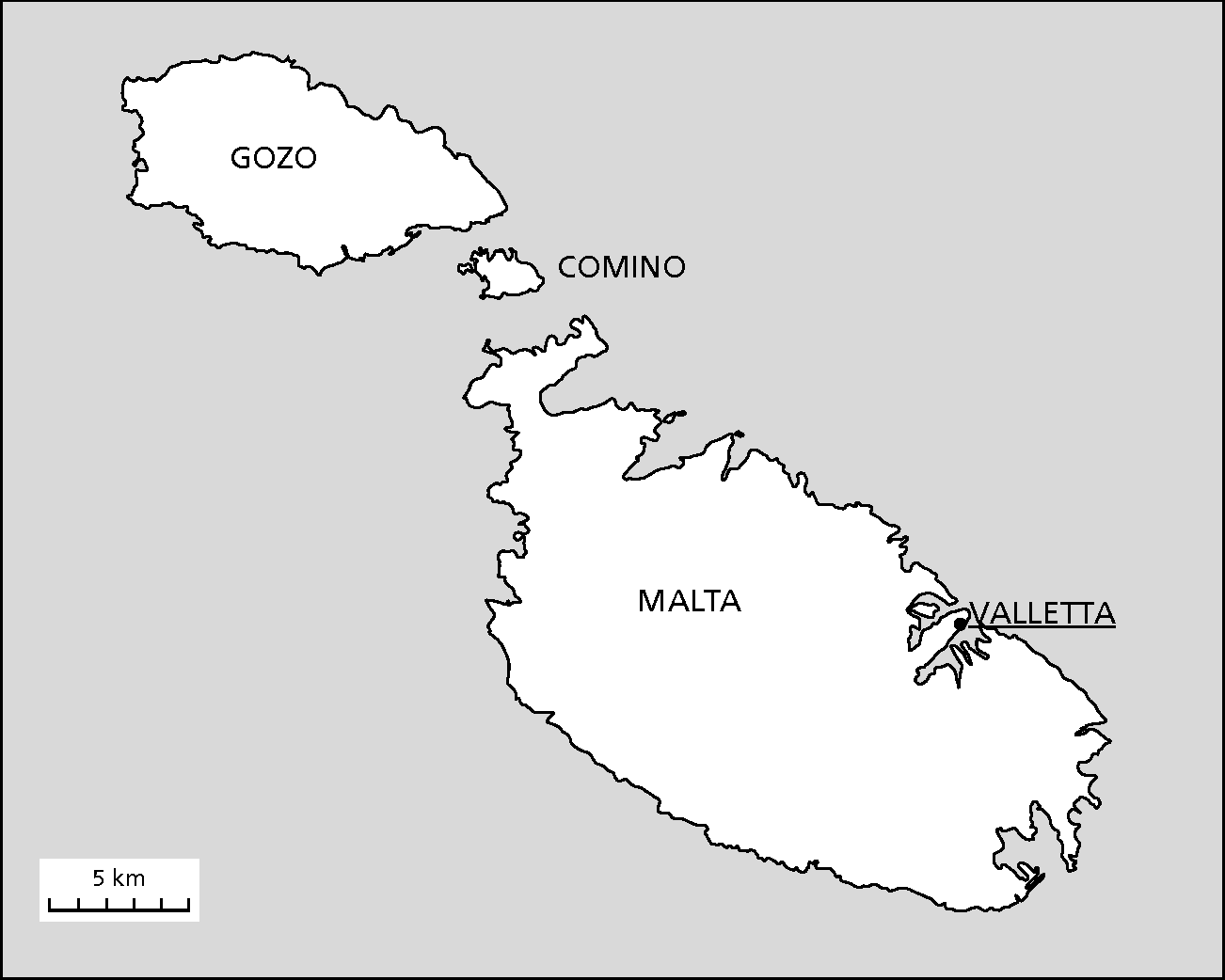
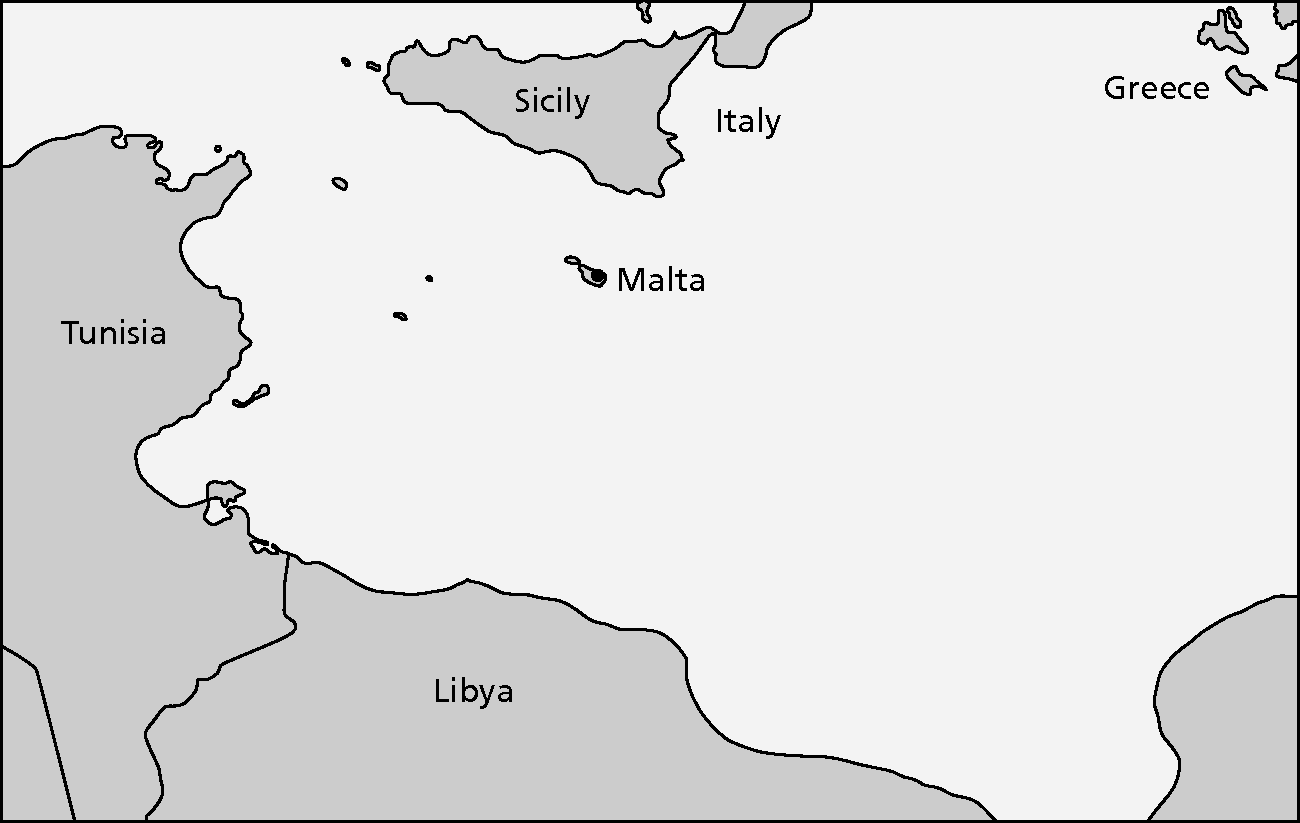
Due to migration, at least 100,000 speakers of English with a Maltese background (including approximately 50,000 speakers of Maltese, a language historically derived from Arabic; see Fabri Reference Fabri, Delcourt and van Sterkenburg2010; Stolz Reference Stolz, Kortmann and van der Auwera2011) live outside the Maltese islands, notably in Australia, Canada, the UK and the USA. The designation Maltese English (or, for short, MaltE) in the linguistic literature, however, applies only to the varieties spoken in the Republic of Malta, i.e. on the archipelago located in the Mediterranean about 100 km south of Sicily and about 300 km north of Libya and east of Tunisia. Its two biggest inhabited islands are Malta (population of c. 380,000) and Gozo (population of c. 30,000); the third inhabited Maltese island, Comino, has a permanent population of less than ten (Census of Population and Housing 2005; preliminary report of Census of Population and Housing 2011). (See Maps 2.1 and 2.2.)
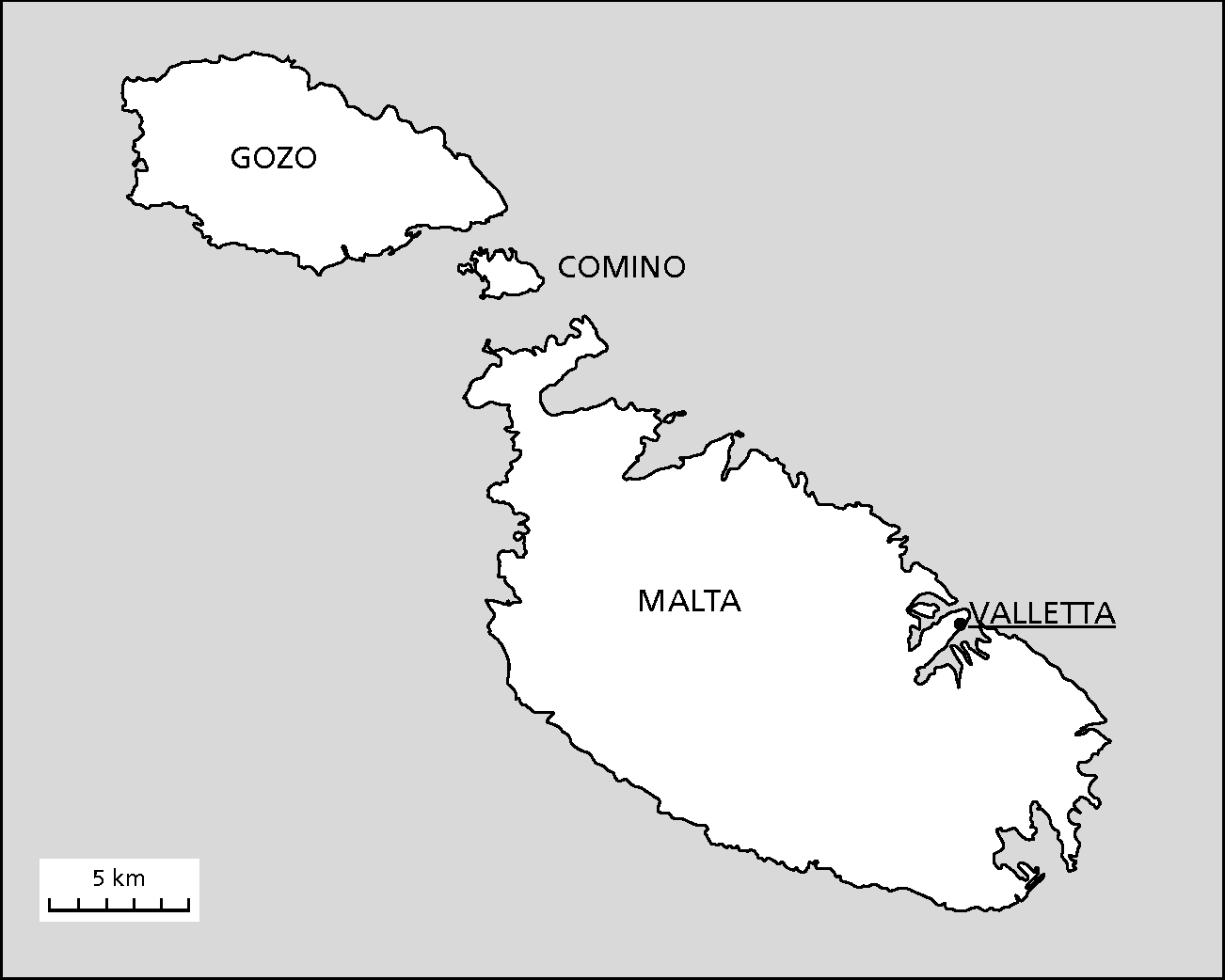
Map 2.1 Malta's three inhabited islands
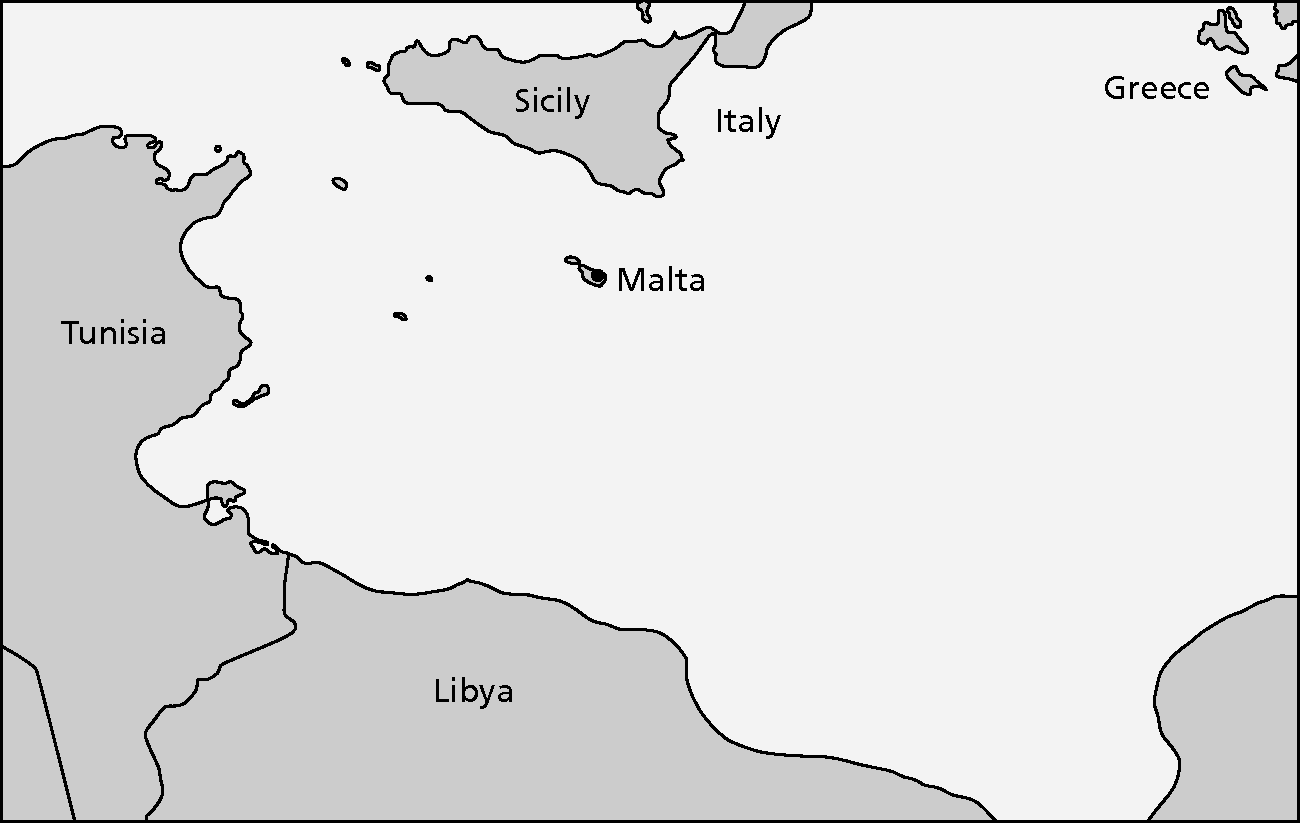
Map 2.2 Malta in its wider geographical context
It should be noted at the outset that, depending on the nature and intensity of language contact, the English spoken by individual people in Malta may be indistinguishable from a variety spoken and written in, say, England or Australia. For obvious reasons, these are not the varieties I will describe in the present chapter. Instead, I will focus on acrolectal Maltese English,1 which is, of course, a cover term conflating a number of language-internal and -external factors. The term is used here to refer to an idealized language variety spoken by university-educated speakers, who speak at least some English at home and at work, who have spent no more than short periods of their lives in English-speaking countries outside Malta and whose parents were both born in Malta.
Acrolectal MaltE thus correlates with higher socioeconomic strata, although this is more true of older than of younger speakers because Malta has in recent times encouraged tertiary-level education by grants and has a high proportion of young people from all social strata attending university. When I use MaltE in this chapter without qualifications such as acrolectal or basilectal, I will be referring to the English spoken by educated Maltese speakers, who have typically received or are still receiving a tertiary-level education, but with no assumptions regarding the languages spoken at home or at the workplace. It is also this larger group of speakers whose language forms the bulk of the material that is compiled for components of the International Corpus of English (ICE). In addition to the pertinent literature, this chapter is based on data from the Maltese component of ICE under compilation at the University of Bamberg (hereafter ICE-Malta; see Hilbert and Krug Reference Hilbert and Krug2010 for details) and data from a questionnaire for lexical and morphosyntactic variation in English (see Krug, Hilbert and Fabri, in press, for detail).
As is often the case in places with a colonial history involving British rule, the varieties of English that are spoken in Malta represent in actual fact a continuum between an acrolectal variety (a near-RP pronunciation with a grammar and lexicon that is very similar to standard BrE) on the one hand, and basilectal varieties on the other. The latter are characterized by typical EFL learner features and more structural parallels with Maltese, i.e. contact features, plus extensive code-switching (cf. the continuum described in Vella Reference Vella1994, Bonnici Reference Bonnici2010 and such notions as mixed Maltese English).
As will be seen, MaltE exhibits not only interspeaker but also intraspeaker, including stylistic, variation. I will concentrate here on the more formal English spoken and written at the workplace rather than that used at home or in private, informal emails (or other digitally transmitted informal messages), but point to important stylistic differences where necessary. In essence, acrolectal MaltE is thus taken to be a standardizing edulectal variety that is oriented towards the traditional exonormative British standard, but – to trained linguists at least – noticeably different from it.
2 Sociolinguistic history and current status of Maltese English as a lesser-known variety
Maltese English shares many of the typical characteristics of a lesser-known variety listed by Schreier, Trudgill, Schneider and Williams (Reference Schreier, Trudgill, Schneider, Williams, Schreier, Trudgill, Schneider and Williams2010: 4): it is far from exhaustively described (although there has occurred a surge in scientific interest recently); it is lesser known outside the country; it is associated with a stable region and was (in fact, still is being) formed by language and dialect contact. And while the notion of a specific, independent variety of Maltese English, replacing – or developing in addition to – the exonormative British standard would have seemed almost inconceivable to the majority of the Maltese population until quite recently, MaltE is increasingly conceived as a distinct variety by its own speakers. Like many other lesser-known varieties of English, MaltE is thus an identity carrier for the speech community, sometimes consciously used, but often below the level of awareness.2 MaltE is also felt to be distinct by speakers who come into contact with the variety, including speakers from other varieties of English. That this perception is justified on linguistic grounds will be seen in Sections 4 to 7 below.
There are other features of typical lesser-known varieties that MaltE shares not at all or only very arguably (figures from Census of Population and Housing 2005):
Being spoken by over 300,000 people (88 per cent of the population aged 10 and older speak at least some English), MaltE is not an endangered variety of English.
For the vast majority of the Maltese population, MaltE is a second language. It is Maltese that is the – or a – first language for around 93 per cent of the population.
Unlike in many regions with lesser-known varieties of English, bilingualism is therefore the norm rather than the exception in Malta.
Unless the term MaltE is understood in a narrow sense (i.e. restricted to just those c. 9 per cent of the population who use English as the – or a – main language in the home), then MaltE is not a minority language within the relevant regional confines.
British colonial rule and substantial British inputs are clearly in evidence, but MaltE was not transmitted by a settler community nor did it develop early in the colonial era in a newly formed community.
The next section will offer more figures and explanations for the claims laid out above.
3 History, language policies, education system
Malta and Gozo were first settled as early as about 5000 bc, probably by farmers from Sicily. The modern Republic of Malta's population density is the highest of all countries in the European Union and one of the highest on the planet. The island of Malta has an area of 246 square kilometres. Gozo (known as Għawdex in Maltese) is less densely populated with approximately a quarter of the bigger island's area (67 square kilometres) but less than 10 per cent of the Maltese population.
Due to its strategic importance in the Mediterranean, Malta has a long history of varying ruling powers, including Greeks, Phoenicians, Romans and Byzantines. The islands were under Arab control from 870 to 1090/91, when the Normans conquered Malta. The monastic order of the Knights of St John (also known as the Knights of Malta) ruled on the archipelago from the sixteenth century until 1798, when Napoleon conquered Malta, but the French were evicted only two years later by the Maltese, with British and Italian support. In 1814 Malta officially became part of the British Empire, i.e. a British colony. While remaining part of the Commonwealth, Malta became independent in 1964 and a republic in 1974. In 1979, the last British troops left the country. Since 2004, Malta has been a member of the European Union (EU); it adopted the euro in 2008.
Even though a small number of British citizens have stayed in Malta and a greater number have retired there, most British people who formerly worked for the administration and armed forces left the country after independence. The current administration is almost exclusively of Maltese descent. And the vast majority of the current educated elite learned English as a second language, often initially by reading rather than speaking the language, and only rarely through intense language contact with native speakers of British dialects (though this will often have occurred at later stages of their professional careers during stays abroad). Such facts explain why a number of especially non-acrolectal MaltE features are triggered by English spelling (e.g. the vowel pronunciations in words like secondary, the /l/ in palm, /nɡ/ clusters in ringing; for qualifications see below). There is, then, no unbroken line from British colonial settlers to the current elites or other linguistically significant social groups in Malta. Maltese English is therefore a rather young variety of English and not a settler variety.
Italian gained prominence during the rule of the Knights (1530–1798) and used to be a prestige language in the middle and upper classes until well into the twentieth century. Italian was the official language in Malta until 1934, i.e. for over a hundred years under British rule, when it was replaced by two co-official languages: English and Maltese. Both languages still enjoy official status, but Maltese – Malti (see Fabri Reference Fabri, Delcourt and van Sterkenburg2010 for a synopsis of the current situation and the history of the language) – is considered the ‘national language’. Maltese is the only Semitic language written in the Latin alphabet. While its grammar and core lexicon are solidly Arabic, Maltese has a high proportion of Italian and Sicilian as well as an increasing number of English loanwords.3 Until the 1930s English and Italian were the more prestigious languages, but Maltese has since steadily gained in status and recently seen a further boost: in 2002, i.e. two years before Malta's accession to the EU, Maltese became an official language of the European Union.
There is no grammar or dictionary of Maltese English, only a number of bilingual dictionaries of Maltese and standard (British) English. Maltese English is therefore not overtly codified. Given the relatively short period since English became one of the official languages, this may be no surprise. With the notable exception of Mazzon (Reference Mazzon1992), most early studies of MaltE focused on code-switching and the phonology of the variety. More recently, empirical studies of morphosyntax (Hilbert and Krug Reference Hilbert, Krug, Gut and Hundt2012; Krug et al. in press) and lexical items (Krug and Rosen Reference Krug, Rosen and Hickey2012) have followed. Effects of globalization as well as different or changing stylistic and intergenerational preferences have not been thoroughly studied for MaltE except for a few phenomena (notably quotatives and rhoticity; see Bonnici Reference Bonnici2010).
As indicated in Section 2, Maltese is the native language for about 93 per cent of the population. According to census data from 2005, nearly 90 per cent of the population aged 10 and older claim competence in English, although degrees of proficiency vary considerably: while 65 per cent of the over 10-year-olds claim to speak English well, 12 per cent do not speak it at all. Detailed statistics for the main languages in Malta are given in Table 2.1. While code-switching is common across the Maltese islands and across all social strata, only about 9 per cent use English as a main language at home and about 1 per cent of the population claim that English is their only L1 (census data from 2005; Sciriha and Vassallo Reference Sciriha and Vassallo2006: 26). L1-speakers of English are found primarily in the higher socioeconomic strata; in addition, higher usage rates of English vary regionally along the typical urban–rural cline. Particularly high rates have been reported for areas where tourism, administration or high education levels are concentrated. These include the capital of Valletta, the nearby conurbation of Tas-Sliema and San Ġiljan; and towns like Is-Swieqi, L-Ibraġġ, Ħ'Attard and Mellieħa.
Table 2.1 Question: How well do you speak…? (Census of Population and Housing 2005, data for population aged 10 years and over)
| Maltese | English | Italian | French | German | Arabic | Other language | |
|---|---|---|---|---|---|---|---|
| Well | 94.4% | 64.7% | 27.5% | 3.8% | 1.2% | 0.8% | 1.9% |
| Average | 1.6% | 13.0% | 13.0% | 5.1% | 1.0% | 0.5% | 0.6% |
| A little | 1.8% | 10.2% | 16.2% | 12.0% | 3.4% | 2.6% | 1.7% |
| Not at all | 2.1% | 12.1% | 43.3% | 79.1% | 94.5% | 96.1% | 95.8% |
Not only bilingualism, then, but also tri- and multilingualism are widespread in Malta, an aspect that is also well documented in the literature (e.g. Camilleri Reference Camilleri1991; Sciriha Reference Sciriha2001; Sciriha and Vassallo Reference Sciriha and Vassallo2006). As Table 2.1 shows, 57 per cent of the Maltese population claim (at least some) competence in Italian, 21 per cent in French, 6 per cent in German and 4 per cent in Arabic. Both in terms of speaker numbers and in terms of average competence, these languages trail well behind Maltese and English. This multilingual situation is partly due to historical language contact (see above), in particular as far as English and Italian are concerned. Other important factors are trade and tourism (which includes a significant English language teaching branch) in a country whose other official language has a small number of native speakers by international standards. Hence, Maltese has no privileged status in teaching syllabi outside Malta and the fact that English is sufficient for communicative purposes on the archipelago is a counterincentive for potential learners of Maltese as a foreign language.
Obviously, Maltese language and education policies play a role as well: Schooling in Malta is mandatory until the age of 16. There is no official policy on the classroom use of languages, but the National Minimum Curriculum from 1999 issued by the Ministry of Education emphasizes the importance of English and Maltese as official languages and states further that pupils in secondary schools are expected to learn a third or fourth language. Both Maltese and English are used from school entry, but Maltese is naturally more prominent in primary schools, while English is more prominent in secondary schools and dominant at tertiary level (in class). There is a tendency for state schools to use less English than Catholic (church) and private (‘independent’) schools (see Fabri Reference Fabri, Delcourt and van Sterkenburg2010 for detail). In particular, English is the dominant language of reading and writing. The language of instruction depends to a great extent on the language of the textbooks, most of which are in (British) English. For the same reasons, the subjects Maltese and History are largely taught in Maltese. In spoken interaction, code-switching is widespread among both pupils and teachers, although a change in teacher education has shifted the balance somewhat towards Maltese: until the 1970s, teachers were trained by British religious orders, but more recently teachers have been trained by bilingual Maltese native-speaker scholars at the University of Malta.
4 Phonology
Compared to other linguistic levels, it is the MaltE phonology that is probably most independent of exonormative standards. In this section I use standard Southern British English pronunciation (commonly known as Received Pronunciation or RP) as a reference point, which historically was – and for many Maltese speakers still is – the exonormative standard. This is in line with previous studies on MaltE phonetics and phonology, from which much of what follows is adopted, though often adapted (cf. in particular Vella Reference Vella1994: 57–86; Calleja Reference Calleja1987; Mazzon Reference Mazzon1992: 126–9; Camilleri Reference Camilleri1991: 108–9; Beer Reference Beer2011; Bonnici Reference Bonnici2010; Borg and Azzopardi-Alexander Reference Borg and Azzopardi-Alexander1997: 299–338).
4.1 Consonants
4.1.1 Clear and dark /l/
RP has complementary allophonic variation for the phoneme /l/. Word-initially before a vowel (as in lead or like), RP has ‘clear’ (or ‘light’) /l/. In prepausal and preconsonantal positions (as in bell or world), we find the velarized allophone [ɫ], known as ‘dark’ /l/ in RP. Intervocalic /l/ (as in belly) and /l/ before yod (a possible realization in lure) are somewhere in between, but in RP (unlike General American, for short: GenAm) tending towards clear /l/ (see Johnson and Britain Reference Johnson and Britain2007; Wrench and Scobbie Reference Wrench and Scobbie2003). The vast majority of MaltE speakers have only clear /l/ (e.g. Vella Reference Vella1994: 77–8) and this applies also to the acrolectal end of the continuum. Vocalized allophones of dark /l/, which are common in BrE in coda-position (e.g. bottle, hill), are rarely heard in MaltE.
4.1.2 Syllable-coda devoicing
The devoicing of word-internal, syllable-final lenis obstruents before fortis consonants (as in lobster, bagpipe or drugstore) is common in varieties of English around the world, although this assimilation process mostly goes unnoticed for speakers and hearers alike.
Word-final devoicing of consonants (as in feed) is also common in norm-providing inner-circle Englishes, including RP and GenAm, especially before fortis and in prepausal position. While existent in other varieties, syllable-coda devoicing is more widespread and conspicuous across all environments among many speakers of MaltE, though not at the acrolectal end of the MaltE continuum. Where it does occur, minimal pairs like feed–feet, mug–muck, flees–fleece, figs–fix, Hobbes–hops become homophones with a truly voiceless fortis (rather than just devoiced) final consonant or consonant cluster. Since Maltese exhibits word-final devoicing consistently, language contact is the most likely immediate source. It should also be noted that word-final and syllable-coda devoicing is frequent crosslinguistically and that MaltE shares this feature also with many ESL- and EFL-varieties, so that learner strategies and typological factors in all likelihood play additional roles in what prima facie appears to be a MaltE phenomenon.
4.1.3 Inter-sonorant and word-final voicing
The reverse assimilation process, i.e. voicing between two sounds that rank high on the sonority scale, can be observed too, notably with intervocalic /s/ in MaltE. While the same process is probably responsible for the variation found in RP and GenAm in words like intrinsic or forensic, lexical effects seem to play a role in MaltE too, as intervocalic voicing is more consistent in some words than in others: in the spoken ICE-Malta data, for instance, /z/ in basically is almost canonical across all social strata and styles of MaltE and can thus be said to be a hallmark, if not a norm, of the variety; /z/ is also common, though less consistent, in acrolectal MaltE pronunciations of basic, basis and usage. As for non-phonetic factors, the Maltese and Italian equivalents of basically and basis/base – i.e. Malt. bażikament, bażi and It. basicamente, base – also have the voiced sibilant /z/, just like MaltE, so that language contact plays a role, too.
In addition, this particular lexical effect seems to be connected to the previous point, the devoicing of word-final consonants and consonant clusters: based is frequently pronounced /beɪzd/ in MaltE, and this is in all likelihood – the lexical effect of base apart – also triggered by hypercorrection, because MaltE speakers here avoid precisely the final cluster /st/ that is often produced word-finally due to devoicing, for example in such words as raised, prized, gazed.
4.1.4 Spelling <ng> as /ŋɡ, ŋ, n/
Like some northern British English varieties, Maltese English features the cluster /ŋɡ/ in words like ringing (potentially twice) or running, though not to the same extent in all contexts. In the ICE Malta corpus data, some interesting differences in distribution at the word boundary can be observed across all styles:
(i) Coda-cluster /ŋɡ/ is most frequently articulated if it precedes a vowel-initial word, and in such cases the final /ɡ/ is often resyllabified as an onset of the next syllable. Thus, running on /ˈrʌnɪŋ(ɡ)ˌɒn/ and bring it /ˈbrɪŋ(ɡ)ˌɪt/ become /ˈrʌnɪŋˌɡɒn/ and /ˈbrɪŋˌɡɪt/, respectively.
(ii) In prepausal contexts, the cluster /ŋɡ/ is common, too.
(iii) Before consonants (other than /ɡ/ or /k/, which I had to exclude from the analysis), the cluster /ŋɡ/ is rarely realized, so that in this context MaltE conforms to RP in typically featuring the velar nasal /ŋ/.
(iv) Word-final alveolar nasal -/n/ instead of the velar RP realization -/ŋ/ is infrequent in MaltE.
Lexical and grammatical effects play a role too, however:
(v) In ICE Malta, the high-frequency item going features less often the cluster /ŋɡ/ in prevocalic contexts than running, for example.
(vi) An exception to (iv) above is the going to future, in which /ˈɡɔʊɪŋtʊ/ varies with /ˈɡɔʊɪntʊ/ and even /ˈɡɔnə/ (see below for the quality and variation of vowels). MaltE thus shows reductive frequency effects, which are typical of grammaticalization generally and therefore common in varieties of English worldwide (see Krug Reference Krug2000: ch. 5; Reference Krug, Heine and Narrog2011).
4.1.5 Rhoticity
MaltE is generally considered a rhotic variety (Mazzon Reference Mazzon1992: 127; Vella Reference Vella1994: 76, Beer Reference Beer2011) although non-prevocalic /r/ is commonly not sounded, especially at the acrolectal end of the continuum. Bonnici (Reference Bonnici2010: ch. 6), for instance, finds that postvocalic /r/ in the speech of L1 English-dominant and Maltese-English bilinguals favours the null realization in the vast majority of cases (around 80 per cent of the time). Exceptions in her data are the contractions you're, they're, we're, which are more often than not /r/-ful, probably due to functional reasons as the loss or vocalization of /r/ in these would lead to the loss of an entire phoneme and potentially to homophones (cf. your, their, there, which in Bonnici's data are usually non-rhotic).
Beer (Reference Beer2011) finds MaltE to be essentially rhotic if a different spectrum of the society is analysed. With around 80 per cent of realized non-prevocalic /r/, he obtains in fact almost exactly the inverse result of Bonnici (Reference Bonnici2010). Nevertheless, the two studies are compatible (see Bonnici Reference Bonnici2010: 205). The main reason is that Beer's informants are overwhelmingly Maltese-dominant L1 speakers. Furthermore, in his subsample analysed for self-reported home language, those speakers who report using mostly English and only some Maltese at home show dramatically lower rhoticity rates (of about 50 per cent) and a virtually categorical use of approximants, and thus near-absence of the more consonantal taps and trills.
As regards allophonic variation, MaltE /r/ has four important allophones, three of which are found in Maltese (on which see Borg and Azzopardi-Alexander Reference Borg and Azzopardi-Alexander1997; Stolz Reference Stolz, Kortmann and van der Auwera2011): poly-vibrant trill [r], alveolar tap [ɾ] and a retroflex approximant similar to AmE [ɻ]. The fourth MaltE allophone is the postalveolar frictionless approximant [ɹ] known from RP. All /r/ allophones occur essentially in free variation, but the following tendencies hold according to Beer (Reference Beer2011: ch. 4):
(i) At about 75 per cent overall, approximants clearly outnumber the remaining /r/ allophones in all positions.
(ii) With about 20 per cent of all /r/ allophones, taps are neither infrequent nor particularly frequent. Their share is higher in intervocalic positions, both word-internally (as in very, Europe, sorry) and across word boundaries (e.g. number of).
(iii) At around 5 per cent of all /r/ tokens, trills are rare, regardless of the phonetic environment, speech style and social characteristics of the speakers.
(iv) If /r/ is realized in non-prevocalic positions (as in hard, start, yesterday or prepausal singer), then the proportion of approximants is even higher than on average and, as a concomitant, that of taps and trills lower.
(v) Men use taps and trills more frequently than women, who in turn prefer approximants disproportionately.
In view of related sociolinguistic research (e.g. Labov Reference Labov1990), it appears that the approximant is currently becoming, or has already become, the prestige norm in MaltE.
4.1.6 TH-stopping and other substitutes
Although Maltese lacks the dental fricatives /θ/ and /ð/, acrolectal speakers of MaltE usually produce them as in RP, if sometimes slightly retracted, i.e. with an alveo-dental place of articulation. In this latter case, the fricatives are perceived as – or, if further retracted, become – alveolar [s, z] (see Vella Reference Vella1994: 76). Fully fledged TH-stopping occurs occasionally in the acrolect, in particular prepausally and in preconsonantal position, where the stop may be unreleased (e.g. with men, with people; personal observation). For basilectal varieties, stops [t] and [d] are common realizations, and the voiceless variant is often strongly aspirated. The voice contrast found in RP is typically preserved in all MaltE varieties for stops as well as fricative realizations of /θ/ and /ð/, except of course in cases of final devoicing.
4.2 Vowels
The vowel inventory of Maltese provides the repository from which the MaltE vowels are recruited for most speakers, except for those that, due to extensive training or language contact with an inner-circle variety, approximate an exonormative standard (usually RP). Maltese has a large inventory of diphthongs as well as long and short monophthongs covering almost the entire vowel space; MaltE vocalic realizations are therefore as a rule fairly close to their RP counterparts. A notable exception is schwa, which thus is the first vowel in the detailed discussion that follows.
4.2.1 Schwa and vowels followed by non-prevocalic /r/
Comma, Support, Secondary
Maltese has no schwa. Nor does Italian, and this fact seems noteworthy even though it is a much less important contact language for MaltE. However, since Italian was widely used among the higher social strata of the Maltese society before and even after the spread of English, the Italian phoneme inventory too can be expected to have had an effect on the development of the MaltE acrolect. While at the acrolectal end of the MaltE continuum all full vowels tend to have realizations very close to RP, it is a lesser degree of vowel reduction in unstressed syllables that is characteristic of the variety and common to all styles and strata in Malta.
What is a short schwa in RP may range from a schwa to a short, full vowel in MaltE. Full vowels are categorical in the basilect but also common in the acrolect. The exact quality in each word depends on the spelling of the relevant vowel and on typical sound–spelling correspondences found elsewhere in RP and MaltE. The reduced syllables in comma and support thus vary in MaltE between [ə] and [ɐ], the second vowel in secondary between [ə] and [ɔ]. When orthography alone triggers the pronunciation, a word like support can also feature [ʊ] in the unstressed syllable.
Words like secondary normally preserve four syllables, and the penultimate vowel varies between schwa and the full vowels [ɛ] (thus rhyming with MaltE berry) or [ɐ], if orthography holds sway over perceived vowel quality (cf. similarly the unstressed syllables in comma or about). As in the second syllables of RP wanted or ordinary, schwas with spelling <e> or <i> tend to vary between [ə] and [ɪ]. In MaltE, [ɪ] also occurs commonly for other spellings before consonants that are often syllabic in RP, i.e. /l/, /n/ or /m/, as in bottle, bottom or button (see Vella Reference Vella1994: 74).
Bird, Nurse, Father
There are rhotic and non-rhotic speakers of the acrolect (and a vast majority that is variably rhotic; see above on rhoticity in MaltE). This results in a number of different pronunciations of words like nurse and bird. Both acrolectal and basilectal MaltE rhotic speakers who have no central vowel tend to use [ɛr]. Non-rhotic acrolect speakers often have [ɜː] (‘long schwa’), as in RP. Rhotic acrolect speakers vary between an r-coloured schwa (long or short) and a short schwa with any allophone of /r/, which is indicated in the following phonetic transcriptions as italicized [r]. Due to the lack of long schwa, some acrolectal speakers produce homophones for words like were and where (or per and pair etc.). Such non-rhotic speakers tend to vary between [wɛə] and [wɛɐ], and rhotic speakers between [wɛr] and [wɛ:r]. For the RP short schwa in unstressed syllables ending in <er>, as in father, the same vowel qualities are found in MaltE as for the RP long schwa, but the duration is always short.
Start, North, Force
There is no perceptible difference in MaltE for the vowels of north and force. In words like start and force, rhotic MaltE has both short and long [ɐ] and [ɔ], respectively, either of which is followed by any MaltE allophone of /r/. Non-rhotic MaltE accents feature the vowels given in the relevant sections for bath and thought.
Near, Square, Cure
In the sets near, square, cure, rhotic MaltE has typically [ɪ(ə)r], [ɛ(ə)r] and [ʊ(ə)r], respectively. Notice, though, that the length of the non-central vowel varies considerably and that the MaltE schwa is optional or may be lowered to [ɐ]. Furthermore, the MaltE vowels in near and cure have somewhat tenser starting points than RP. The vowel qualities of non-rhotic and rhotic MaltE are similar for all three environments.
Triphthongs of RP
The RP triphthongs commonly found in tower, tire are typically [ɐʊɛr] and [ɐɪɛr], respectively, in MaltE. Non-rhotic accents typically have [ɐʊɐ] and [ɐɪɐ]. Diphthongization to [ɐːə] and monophthongization to [ɑː] (or similar vowel qualities), known as ‘smoothing’ from BrE (Wells Reference Wells1982: 238–9), are very rare in MaltE.
4.3 Other vowel contrasts between MaltE and RP
Trap
The RP trap vowel /æ/ has no equivalent in Maltese. In MaltE [ɐ] varies with [ɛ]. Both can be short or long, typically mirroring the low-level (i.e. sub-phonemic) lengthening found in RP before voiced consonants as in bad, sad or lag. Naturally, lengthening applies less frequently when speakers display final devoicing, but even here pronunciations with long vowels like [bɛːt] are common.
Kit, Foot, Fleece, Goose
The two lax high vowels /ɪ/ and /ʊ/ tend to be more peripheral in MaltE than their RP equivalents. The same is true for their tense and longer counterparts /iː/ and /uː/, which are typically even tenser in MaltE and less noticeably diphthongal in open syllables and before voiced consonants than in RP (e.g. see, shoe, seed, shoes).
Face
The face vowel /eɪ/ is [ɛi] in MaltE and thus similar to RP. As in many other varieties of English, including RP (see Wells Reference Wells1982: 240), monophthongal realizations [ɛ(ː)] and [e(ː)] are also commonly heard for this phoneme (see Stolz Reference Stolz, Kortmann and van der Auwera2011: 243 on the variation between open and close allophones of what is usually labelled the Maltese phoneme /ɛ/ in the literature).
Goat
The RP pronunciation [əʊ] for goat is similar to the typical MaltE pronunciation [ɔʊ]. As in many other varieties of English, including RP (see Wells Reference Wells1982: 240), monophthongs [o(ː)] and [ɔ(ː)] are heard for this phoneme too (see Stolz Reference Stolz, Kortmann and van der Auwera2011: 243 on the variation between open and close realizations of the Maltese phoneme /ɔ/).
Bath, Palm
The Maltese phoneme system has only a central /a/, both long and short, with the quality typically being [ɐ]. All varieties of MaltE use both long [ɐː] and short [ɐ] for the bath and palm vowels more frequently than the more back RP quality [ɑː]. The <l> in palm or calm is not consistently silent across varieties of MaltE, with mesolectal and basilectal varieties favouring /l/-ful pronunciations. If /l/ is pronounced in MaltE words like palm and calm, then the vowel tends to be short.
4.4 Minor vocalic differences between MaltE and RP
Thought, Price, Choice, Mouth
As in RP, the thought vowel is pronounced [ɔː] in MaltE and sometimes slightly raised. The raising diphthongs found in MaltE for price, mouth and choice, i.e. [ɐɪ] [ɐʊ] and [ɔɪ] respectively, are in most environments indistinguishable from their respective RP pronunciations [aɪ], [aʊ] and [ɔɪ].
Happy, Kit
Like in RP, the happY vowel is usually pronounced [i] or [iː] in MaltE. Since /i/ is tenser in MaltE than in RP, the rather central allophone [i] found in conservative RP is rarely used in Malta – except by English retirees.
Dress
Like in RP, the dress vowel /e/ in MaltE is [e̞] or [ɛ̝] and thus auditorily indistinguishable in the two varieties, even if the MaltE realization is generally somewhat more centralized.
Lot
The lot vowel in MaltE is typically [ɔ] and thus somewhat higher than the RP realization [ɒ]. In addition, the MaltE realization tends to be marginally more central than its RP counterpart.
Strut
The quality of the RP strut vowel /ʌ/ is [ɐ] in MaltE and thus almost identical to RP, if perhaps marginally more central. It can merge with the vowels of trap, palm, start and, less commonly, bath (see above).
4.5 Suprasegmental aspects
4.5.1 Fewer weak forms and contractions, less cluster reduction
The phonological integrity of individual words is more frequently preserved and, in all varieties of MaltE, vowels in unstressed syllables are generally less reduced than in RP. As a consequence, MaltE speakers – unless they were exposed to extensive language contact with, e.g. BrE or AmE – use fewer weak forms (of e.g. is, was, have, not) and contractions (like we've, they're, didn't, wanna). In a similar vein, Vella (Reference Vella1994: 76) observes ‘a tendency for glottal stop insertion at word boundaries’ for MaltE, which in sequences like he–is or go–east makes the liaison (frequently found in RP) by /j/ or /w/ unlikely.
In the spoken ICE Malta data, contraction ratios are then also consistently and significantly lower than for British English in the London–Lund Corpus and Bank of English Corpus (on which see Krug Reference Krug1998). In that study, a group of items that can immediately precede have and clitic ˈve (I, you, we, they, who, there, where, how, here) was investigated while controlling for a number of phonological and syntactic factors. It transpired that there was a diachronic trend towards higher contraction ratios for BrE from the 1960s to the 1990s. Another twenty years later, the share of clitic forms in acrolectal MaltE is on average about half the share found for educated BrE from the 1960s and 1970s, which shows that MaltE is very conservative with regard to the use of contractions. The same trend can be observed for written data from MaltE journalistic prose (on which see Krug et al. in press). It seems uncontroversial that the low spoken contraction ratios as well as adherence to an older written exonormative norm are the fundamental factors underlying the situation found in written MaltE.
4.5.2 Rhythm
Maltese English has a number of characteristics that have an effect on the perceived rhythm: fuller vowels relative to RP; /ɪ/ or /ə/ before /l/, /m/ or /n/ instead of syllabic consonants (in words like bottle, bottom; see Section 4.2.1 above); greater phonological integrity of individual words; less syllable compression and thus syllables of more equal length. In particular at the basilectal end of the continuum, where these features are most in evidence, MaltE sounds rather syllable-timed (a tendency noted already in Calleja Reference Calleja1987 and Mazzon Reference Mazzon1992) and thus close to an Italian EFL variety in terms of suprasegemental phonology. An ancillary role in this phenomenon is played by the creation of open syllables through full release and concomitant schwa epenthesis, which Vella (Reference Vella1994: 76–7) finds after closed syllables ending in stops or affricates, as for instance in stop, red, but, huge giving [ˈstɔphə], [ˈrɛdə], [ˈbɐthə], [ˈhju:ʤə] – a trait that figures similarly in Italian EFL varieties, which commonly feature open syllables in such contexts, too, e.g. [ˈstɔpe] or [ˈbatɛ].
4.5.3 Stress
Calleja (Reference Calleja1987: 71–85) and Vella (Reference Vella1994: 79–85) find postponed stress in MaltE for words that in RP have stress on the antepenultimate or an earlier syllable, as in examples (1) to (3). On a related note, single-stress words and compounds with an early primary stress in RP such as (4) and (5) often have late stress in MaltE or receive two full stresses, in which case a secondary stress is typically promoted to a primary one. Compare the following examples (from Calleja, Vella, Bonnici and ICE Malta):
(1) RP ˈcri.ti.ci.sm vs MaltE cri.ti. ˈci.sm
(2) RP ˈe.xer.cise vs MaltE e.xer. ˈcise
(3) RP ˈcen.ti.me.tre vs MaltE cen.ti. ˈme.tre
(4) RP ˈdish.ˌwa.sher vs MaltE ˌdish. ˈwa.sher
(5) RP ˈtrai.ning ˌpart.ners vs MaltE ˈtrai.ning ˈpart.ners
It is also striking that MaltE words ending in -ism (like tourism, fascism, plagiarism, socialism, communism) fairly consistently receive stress on the penultimate syllable. With some exceptions, English words ending in -ism have equivalents in Maltese ending in -iżmu, which in turn are loans from Italian ending in -ismo. Both languages have their stress in these words on the penultimate syllable. Furthermore, Maltese has regular stress on heavy final syllables (i.e. syllables with a long vowel or diphthong, and syllables with a short vowel followed by consonant clusters or geminates; Fabri Reference Fabri, Delcourt and van Sterkenburg2010: 800). Hence, late stress in words like criticism in MaltE can be borrowed directly from Italian or, even more likely, via Maltese.
More generally, transfer of the Maltese pattern ‘heavy late syllables receive stress’ seems to be applied to MaltE commonly, e.g. in the above MaltE examples (1) to (3): except in cases of vowel epenthesis, criticism features a consonant cluster in the final syllable, exercise a diphthong; and -metre a long vowel in the penultimate. Not all words are affected by the MaltE tendency to postpone stress, however. Vella (Reference Vella1994: 80) notes exceptions like messenger and characteristically, which are stressed as in RP. Apparently, therefore, stress shifting in MaltE depends on more than just which syllable is stressed in RP, Maltese or the Maltese equivalent of an English word, and it seems certain that lexical effects and effects related to secondary stress and degree of reduction in RP play important roles, too (see Vella Reference Vella1994: 81).
4.5.4 Intonation
Calleja (Reference Calleja1987: 112) finds that ‘changes in pitch patterns and the occurrence of tonic stresses are much more frequent’ in MaltE than RP. This is confirmed in essence and refined by Vella (Reference Vella1994: ch. 5), who provides a detailed investigation of intonation in MaltE interrogatives and demonstrates Maltese influence on MaltE intonation. Notably, Vella finds sentence-final high rise patterns and post-nuclear stressed syllables with a rather high pitch across (almost) all investigated structures – polar questions, interrogatives guised as statements and interrogatives with primary verbs and auxiliaries (examples below from Vella Reference Vella1994: 236–40). This is noteworthy, because in RP questions often show a fall or rise–fall at the end.
(6) Is that /all?
(7) You under- /stand?
(8) Can we com- /pare?
(9) Is there an abandoned cot- /tage?
(10) Do you have the old /mill?
In MaltE, final rises also occur more frequently in declarative sentences and imperatives than in RP. For instance in the Bamberg Questionnaire for Lexical and Morphosyntactic Variation in English (see Krug et al. in press, for the full questionnaire; Krug and Sell Reference Krug, Sell, Krug and Schlüter2013 for methodological detail), the sentences given below, read out by a female acrolectal bilingual speaker, also have a final rise on but (here meaning ‘though’ or ‘however’; see next section for a discussion of syntactic aspects) in (11); and a final rise on the last syllable in each of the examples (12) to (16). Crucially, such post-nuclear rising intonation patterns are no exceptions; they are paralleled by many other examples in the questionnaire recordings and also occur in MaltE spontaneous interaction.
(11) I like this painting, I prefer the other one, /but.
(12) My sister and me got along very well when we were youn- /ger.
(13) This car is more fast than the one I drove yester- /day.
(14) French I do not use a /lot.
(15) American English does not spell like British Eng- /lish.
(16) Don't stay walking on the /grass!
5 Morphosyntax
Prominent morphosyntactic features of acrolectal MaltE include want constructions with a subjective pronoun in the dependent clause, sentence-final but, definite article omission and marked uses of the progressive.
5.1 Special Want constructions
In addition to the standard English want construction (Do) You want me to get us some ice-cream? speakers of Maltese English produce want constructions with an overt subject in the subjective case and a finite verb in both the matrix and complement clause. They occur overwhelmingly in questions and offers (see Krug et al. in press for details):
(17) Do you want I stand over here?4
(18) Do you want I get us some ice-cream?
(19) You want I buy a drink for you?
Maltese has volitional constructions which are construed exactly like (17) to (19) above (see Borg and Azzopardi-Alexander Reference Borg and Azzopardi-Alexander1997: 32; Krug et al. in press). Language contact is therefore clearly the source of the MaltE structures. In the questionnaire data, usage ratings drop considerably from the spoken to the written mode, though. This suggests that we are dealing with a style marker or an overt marker of informal spoken MaltE. In addition, want interrogatives without do support such as (19) consistently produce higher usage ratings than those with do support like (17) and (18). Such data lend empirical support not only to claims made in the literature about the use of MaltE want constructions but also to the widely held belief that questions guised in statement syntax (i.e. lacking do support, e.g. Mazzon Reference Mazzon1992: 141) enjoy a high acceptance rate and are common in if not typical of MaltE. Informal syntactic constructions, like questions without do support, are of course an ideal context for a nonstandard MaltE construction to emerge, whose prototypical frame is an informal setting. As to the question of whether operator-free interrogatives are indeed typical of MaltE, it should be kept in mind that this phenomenon is the second-most common among 235 features in vernacular varieties of English worldwide (Kortmann and Lunkenheimer Reference Kortmann and Lunkenheimer2011; eWAVE feature 229; attested in 91 per cent of the documented varieties).
5.2 Sentence-final but
Another classic in treatments of MaltE grammar is sentence-final adversative but (see Mazzon Reference Mazzon1992: 142). Here, too, a parallel structure exists in Maltese, but also in Italian (see Krug and Rosen Reference Krug, Rosen and Hickey2012: 132; Bonnici et al. Reference Bonnici2012; Krug et al. in press, for details), so there is a complex contact scenario underlying the existence of Maltese English sentences like:
(20) I like this painting, I prefer the other one, but.
There may be more general factors than language contact at work as well. The feature is even more widespread than eWAVE data suggest (feature 211, attested in 23 per cent of the documented varieties). It is, for instance, also found in Irish and Northern Irish English (Walshe Reference Walshe2009: 123–4). And the Bamberg questionnaire data show high usage ratings for sentence-final but even in spoken educated AmE – not in the written mode, though, which points to normative pressures. Probably cognitive factors like the realization of a contrast only after starting the adversative second sentence and the desire on the part of the speaker to either express or stress the contrast help to explain the late position of but. In addition, many contrast markers in English and other languages figure predominantly in sentence-final position (e.g. though); yet others can figure sentence-initially, -medially and -finally (like however). Analogy with a semantic equivalent that has a different syntactic distribution in either English or a contact language, and thus general cognitive or L2-strategies, are consequently further possible triggers for sentence-final but in MaltE.
As in the case of want constructions above, usage ratings drop considerably from spoken to written MaltE, which again suggests that we are dealing with an overt style or identity marker of the variety. In addition, the questionnaire data reveal an interesting sociolinguistic pattern: while male Maltese subjects show only minimal differences between the two registers in their usage ratings of sentence-final but, the stylistic gap for female Maltese student informants is considerable.
5.3 Definite article omission
This section focuses on definite article omission, even though the definite article in MaltE may also occur where it does not normally figure in norm-providing inner-circle varieties, e.g. with so called ‘quasi-locatives’ such as college, church, school, hospital or university (see Quirk et al. Reference Quirk, Greenbaum, Leech and Svartvik1985: 277 for details and differences between BrE and AmE). Witness the following acrolectal spoken example from ICE Malta:
(21) So, NAME, when we look at Standard Arabic this is what we would learn at the school.
Definite article omission in MaltE is common with language adjectives in attributive function as in example (22), governmental bodies like cabinet, government as in examples (24)–(25), and posts (i.e. when not used as a title followed by a proper name), e.g. rector, receptionist, director, dean, as in example (23):
(22) and it was quite good you know and it was for the translated version so the Albanian student translate uh answered the questionnaire in Albanian language.
(23) So when Rector went off to China last year to sign the relative agreements…
Omission is more likely when the person or institution is clear from the context, in other words when the referent is inherently definite or unique (see Krug et al. in press for the relevant familiarity hierarchies). In such contexts, institutions and posts become similar to proper names, which are ungrammatical with the definite article in the major norm-providing varieties of English. Uniqueness, for instance, is in evidence for rector or university in Malta because there is only one university in the country and only the head of this institution (and not that of a college, for instance) is referred to as (the) Rector. Following this principle, cabinet and government occur without the article in MaltE newspaper language only when they refer to the Maltese government or cabinet. Compare the following examples from Krug et al. (in press):
(24) These are precisely the sort of proposals that Cabinet should be discussing, if we are to continue providing a decent service to future generations. [ed_M_059]
(25) He said the public should know why government was going back on its decision for offshore wind technology, by now considering land-based farms. ‘People have the right to ask whether government's decision is based on technical, or political criteria, and why is keeping government from publishing these studies.’
In a 100,000-word press corpus of Maltese English, cabinet occurs overwhelmingly without the definite article and is in these cases consistently capitalized, which indicates similarity to a proper noun and hence uniqueness. A stylistic difference is observable with government, which typically lacks the definite article in editorials, but usually figures with the definite article in press reportage (for quantitative detail see Krug et al. in press).
The following factors interact in definite article deletion in Maltese English:
(i) Nouns that rank high for definiteness, familiarity and referentiality (like rector or dean of a given university or faculty; or government and cabinet when the country is understood) omit definite articles more readily than nouns that rank low on these scales. It seems likely that these hierarchies play a role in definite article omission in varieties of English around the world.
(ii) The emergence of article deletion is facilitated if not triggered by the existence of variation between zero and obligatory definite article in standard inner-circle varieties, whose regulation may be partially free or complex, as in the case of titles, institutions (as opposed to abstract uses) and languages. Compare, e.g.: I'll go to university vs I'll visit the university today; Minister X /Rector Gerrardi announced vs the minister/rector announced; for English vs for the English language; an irrational belief in government as a form of magic fairy vs (the) Government has made it clear.
In such contexts, acrolectal speakers employ the article more frequently in closely monitored speech than in spontaneous situations. This hints at a stylistic preference rather than at a grammaticalization process nearing completion anytime soon. Finally, it is noteworthy that inner-circle varieties commonly exhibit definite article omission with language adjectives, too: questionnaire data show relatively high usage ratings for spoken informal English for the following sentence not only in Malta, but also in the US and the UK:
(26) Mary has a very good knowledge of Spanish language.
Each of the above varieties rate example (26) on average as ‘Could be said by many people’ and in the US (unlike in MaltE and BrE), usage ratings do not even drop significantly from informal spoken to semi-formal written English. Rather than exhibit nonstandard syntax in the case of definite article omission, therefore, MaltE seems to be taking part in a global trend, being similar to AmE and BrE in informal spoken English while siding with BrE in differentiating stylistically.
The following examples (all taken from acrolectal MaltE speech, all from radio interviews with academics) can serve to illustrate the variation found in standard Englishes around the world. A zero article would be normal in (27) and (28), less likely in (29) and (30) and out for most in formal English in (31):
(27) Now the ideal, the idea is to introduce and or enhance the teaching of Chinese language and culture.
(28) In simple English it is the headquarters of this idea of fostering Chinese language and culture.
(29) Malta is different from the UK and from Greece, this doesn't really take away also that even Maltese culture is becoming very quickly multicultural
(30) yet that boy's talents and fluency in Italian language cannot be assessed at the moment in the island simply because we're bound to the pen and the paper
(31) Okay so uhm when we look at Arabic language you have the script that's different
What the above examples have in common is that the adjectives make language inherently definite, which renders the definite article redundant. Norm-providing inner-circle varieties are variable in most of the above examples and omit the article obligatorily only when the adjective is nominalized (cf. when we look at Arabic; fluency in Italian).
A related case of variation is the inherent definiteness of universities. Compare the variation found in most inner-circle varieties and illustrated in (32) and (33):
(32) I taught at the University of Cambridge. vs I taught at Cambridge University.
(33) I taught at the University College of London. vs I taught at UCL.
Like the norm-providing inner-circle varieties, MaltE has grammaticalized the zero article for acronyms like UCL or UoM (short for University of Malta), but it can also do without the definite article when the full form is given, as in (34):
(34) NAME is the head of the Department of Communication Therapy and Deputy Dean of the Faculty of Health Sciences at University of Malta, our latest faculty, our newest faculty.
Ordinal numbers are equally unambiguous and logically, therefore, they need no additional definite article. MaltE more often than BrE omits it in such contexts, e.g.:
(35) The first year you know they are all new to the system yes finding their system, you don't really want to overload them. But from second year, especially third year, and fourth year I think it is very important to…
Finally, seasons of the year when used in a generic sense – that is without reference to a specific year – occur in free variation with and without the article in standard BrE and AmE (see Quirk et al. Reference Quirk, Greenbaum, Leech and Svartvik1985: 278–9), i.e. in (the) summer/winter/autumn/spring. Current BrE (as represented in the British National Corpus, hereafter: BNC) tends to use the definite article in the majority of cases, even though no definite summer or winter is being referred to.5 MaltE, by contrast, uses a higher proportion of examples without the definite article, e.g.:
(36) And the reason for that is uhm because if you buy a cheap house which is rated F, that means it's uh uh it has thin walls, it has single glass window panes its, its roof is very slim, it's too hot in summer and too cold in winter, you will end up spending a lot of money on your electricity and energy bills throughout the lifetime of that building.
In summary, it is not contact with Maltese or other contact dialects that motivate definite article omission in MaltE but general cognitive and grammatical factors. These are universal and thus help to explain why some of the phenomena described in this section enjoy a more global spread. Maltese English (like other varieties too, I suspect) seems to use the definite article most consistently only when it is semantically or grammatically required: it frequently omits the definite article when this would be redundant (as in the case of unambiguous posts, institutions, languages and ordinal numbers; or because the referent has been established in the discourse). Vice versa, MaltE avoids the definite article commonly where the NP is not definite but generic (as with summer/winter).
5.4 Progressives
In press language, MaltE usage of the progressive conforms closely to the exonormative British standard, with the noteworthy difference that it combines more frequently with modal verbs and modal constructions (Hilbert and Krug Reference Hilbert, Krug, Gut and Hundt2012). As in BrE, progressives have a higher text frequency in spoken MaltE than in journalistic prose. Spoken MaltE also features progressives with a limited number of stative verbs, notably have and be, which then often indicate dynamic meaning (with have) and ‘temporary behaviour’ or ‘transitory state’ (with be), e.g.:
(37) dance can be a wider, uh, can have a wider influence and use than it's currently having.
(38) Muscat may well score crucial political points by accusing Gonzi of misleading the public. But the sad truth of the matter is both sides are being deceptive here:…
Often, however, as in (39) and (40) for example, semantic changes to temporariness or dynamic meaning – which would license progressive be and have constructions in standard BrE or AmE (e.g. he is being funny; he is having a bath) – are hard to detect in MaltE:
(39) so that's why I think we're having the the older population that we're having apart from uh science which nowadays getting more into act which the older people are being uh more healthier
(40) but we have so much jargon here and there that the winding roads that we are having it's quite expensive yeah
As in most major varieties of English, the progressive in MaltE can have future time reference, e.g.:
(41) We're leaving Saturday.
The progressive in MaltE can also occur with habitual meaning, which would normally trigger simple (present or past) tense in standard BrE:
(42) so every month we're just gathering this all this this data
On a related note, MaltE has an additional aspectual marker, stay + V-ing (Bonnici Reference Bonnici2010, example taken from ibid.), which appears to overlap with iterative meaning:
(43) To go abroad, we don't want to stay changing currency and losing money off the currency.
Language contact plays an important role here because Maltese has a similar progressive construction. Most Maltese verbs form their progressive with the imperfective form following either qiegħed (the present participle of qagħad ‘he stayed, he was located’) or qed (a shortened form of qiegħed; Borg and Azzopardi-Alexander Reference Borg and Azzopardi-Alexander1997: 230).
Finally, innovative uses of the progressive for emphasis with verbs of personal (dis-)preference like (44) receive much lower usage ratings by Maltese than by British or American students:
(44) I'm (totally/so) wanting/liking/hating this!
This indicates that current MaltE is conservative with regard to this feature because an older grammatical constraint operates more rigorously than in BrE and AmE: no progressives for stative verbs. This is a recurrent pattern for MaltE, since the same is true for other colloquial features that have recently become common in many varieties of English, e.g. quotative be like (on which see Bonnici Reference Bonnici2010) and there's existentials with plural complements (see Krug Reference Krug, Friend, Ron Vaz, Hernández Santano and Casanova2007). Young acrolect speakers of MaltE seem to be adopting them, however.
5.5 Further features of especially mesolectal and basilectal MaltE
As can be expected, mesolectal and basilectal MaltE exhibit a great number of features that are either clear cases of language contact and interference from Maltese, typical EFL and ESL features (i.e. in line with typological markedness constraints and/or due to rule rearrangement and simplification) or a combination of these. Such features can be obtained from the usage rankings and comments on MaltE for eWAVE given by Bonnici, Hilbert and Krug (Reference Hilbert, Krug, Gut and Hundt2012); appendix A in Bonnici (Reference Bonnici2010); or Mazzon (Reference Mazzon1992). The exact patterning of these features according to language-internal, stylistic and social criteria, however, still requires further research:
absence or underuse of morphological third-person marking in the simple present tense (e.g. he go);
simple present for continuative or experiential perfect, as in I live here since 1999;
both nonstandard regularized (like *leaved for left) and irregular past tense and participial forms (like *mound for minded);
invariant don't for all persons in the present tense;
differential use of prepositions (over- and underuse of certain prepositions, absence of prepositions where standard inner-circle varieties of English have one; Philipp Reference Philipp2008);
much figures with plural nouns in non-acrolectal MaltE, in particular with plurals lacking an {-s} morpheme like people; language contact is relevant here as ħafna is Maltese for both ‘much’ and ‘many’ in standard English;
different or unsystematic division of labour between present perfect and simple past;
would in irrealis conditional clauses not indicating politeness, habitual or volitional aspects, e.g. I would go if he would come along.
inconsistent use of which and who with animate and inanimate referents;
relative pronoun that used in non-defining contexts;
absence of future markers and object pronoun drop, e.g. Will you have fresh basil next week? – On Monday I have;
use of would for future marking instead of will (Fabri Reference Fabri2008);
regularized plural forms, e.g. houses /ˈhaʊsɪz/ (as frequently found in AmE), sheeps;
double comparatives like more easier, more better, more healthier.
Yet other features occasionally mentioned in the literature on MaltE require more detailed quantitative studies, including comparisons with other standard spoken Englishes, because they seem good candidates for standard colloquial features of English around the world. Examples include some of the above, but in particular the following:
absence of subjects recoverable from context and/or of auxiliaries or copulas (see Krug Reference Krug2000: 178–80; Bonnici Reference Bonnici2010: 292), e.g. Wanna dance? You sure? You want ice-cream? Gotta go home now.
adjectives and adverbs have identical forms, e.g. He did it good/quick/real fast;
parataxis of two main clauses (with optional coordinator and), i.e. absence of if in conditional contexts, e.g. You go there, (and) he'll go mad;
resumptive pronouns, subject doubling and topicalization, e.g. This soup, I love it; This is the car which I saw it yesterday;
loosening of sequence of tense rule (Kmetova and Sciriha Reference Kmetova and Sciriha1992);
preverbal negator never, e.g. I never did it.
6 Discourse markers
Discourse markers have not received the attention they deserve in the literature on MaltE, even though their use, certainly in combination, seems quite unique. What follows are findings based on the Bamberg questionnaire and corpus data.
6.1 Discourse markers no and eh
Like sentence-final but and special uses of the progressive (see Sections 5.2 and 5.4 above), discourse markers no and eh are not distinctive of acrolectal MaltE, but characteristic of it. The invariant tag eh is clearly above the level of awareness among educated speakers of MaltE, as unusually strong reactions during the elicitation test (laughter, or ‘Yes, we do that a lot!’) showed when Maltese informants were exposed to the recording of the following test sentence:
(45) I've got no chance, eh?
A notable differentiation applies to the phonetic realization of the tag: while MaltE /ɛɪ/ is commonly perceived as acrolectal or even conceited, monophthongal realizations are typical of meso- and basilectal MaltE (Ray Fabri, p.c.). Furthermore, extreme differences in the usage ratings for spoken and written MaltE confirm the salience and stylistic markedness of the eh tag. It is also striking that the text frequency of eh is more than twice as high in the preliminary version of the ICE Malta subcorpus than in the spoken BNC. Apart from the fact that the tag exists in many varieties of English, including all major national varieties, the usage in MaltE is propagated by contact with Maltese (and maybe Italian), where similar tags exist, notably as /ɛ/ and /ɛː/. Below are some naturally occurring examples of both eh and no.
(46) I think here in Malta we do have a lot of very good, very creative researchers; perhaps even due to the limitations of our size eh. Sometimes w- we we we learn how to work you know and I think…
(47) We have the plate [pause]; and the sculptor [pause]; uh craft uh great craftsman eh This is the madonna here. It's really something wonderful eh. Alright yes this is…
(48) you know Francia buildings no? And there was uh Lady Francia. She used to go and all…
Unlike invariant eh, no tags seem to operate essentially below the level of consciousness, as is evidenced by almost identical questionnaire usage ratings for spoken and written English for the following sentence:
(49) Your sister is older than you, no?
On a more global level, high text frequencies of no tags might have the potential to become a widespread marker of English–Romance language contact, most obviously so for areas where English is in contact with Spanish or Italian. The facts that sentence negators are common tags typologically and that the invariant tag no exists in most codified varieties of English, too, should facilitate its further spread and may be responsible for the lack of stylistic markedness of no tags (according to the Bamberg questionnaire data, at least) in Maltese, Gibraltarian as well as Puerto Rican English.
6.2 Greeting alright?
In Maltese English, alright? /ɔˈraɪt/ or /ɔ:ˈraɪt/, both with a rising and falling intonation are more commonly heard as a greeting than in most inner-circle varieties of English. As in other varieties of English, MaltE alright? is relatively informal and roughly equivalent to British or American English Hello! or How are you? – and shortened versions thereof, like Hiya? It may well be that the greeting Alright? is even more typical of Maltese than of Maltese English (Ray Fabri, p.c.), but the exact ratio is difficult to determine due to frequent code switching and the common usage of English-origin discourse markers in Maltese (e.g. alright, okay, bye, thanks).
6.3 Multiple yes
Triple or even quadruple assertion by yes, often with other assertive expressions in the co-text is exceptionally frequent in MaltE. In our transitional ICE component of spoken MaltE, the discourse frequency of three or more consecutive yes is ten times higher than in the spoken BNC. Language contact may play a role: Italian commonly features the triple assertion si, si, si. Maltese has iva, iva, ‘yes, yes’, typically reduced to /i:vˈi:va/ (Ray Fabri, p.c.), so that the number of syllables is identical to English triple yes and Italian triple si. The phenomenon occurs utterance-internally as well as turn-initially:
(50) I think so, I think the weather makes the people be in one way or another, I think it's true, yes, yes, yes, for sure, definitely.
(51)
A: So we have to await that publication?
B: Yes yes yes, I'm uh I'm very very very interested in that part.
6.4 Discourse marker anyways
While most regional varieties of BrE – unlike AmE – predominantly use anyway, the speakers recorded for ICE Malta also prefer anyway but show a higher discourse frequency of anyways than BrE in the spoken BNC. Such corpus data receive strong support from the Bamberg questionnaire data: educated speakers from England clearly prefer anyway, while AmE has free variation. MaltE (like Channel Island and Australian English) leans towards BrE, i.e. shows a preference for anyway but less unequivocally so than speakers in the UK. There is thus some evidence that MaltE is part of a globalizing trend towards an increasing use of the discourse marker anyways.
6.5 Even I
Rather unobtrusive features of MaltE develop where an identical structure exists in norm-providing inner-circle varieties but the MaltE meaning differs in one of the following ways: (i) pragmatic enrichment by implicatures; (ii) generalization by semantic bleaching; (iii) specification or subtle semantic shift due to a lexical gap or under-/overdifferentiation in a contact language. Even I, for instance, in MaltE often just means ‘me too’ or ‘I also’ (if a verb follows); it thus lacks the emphatic or counter-to-expectation meaning aspects of, say, a British or American lexicon entry for even.6 Maltese lacks a lexical item synonymous with English even (Ray Fabri, p.c.), but it has two lexemes for ‘also’/‘too’: Semitic ukoll and the Italian borrowing anki. And since such brief and common phraseological units like anchˈio may have been borrowed into Maltese in toto during the long era of Maltese–Italian contact, the MaltE usage of even I might be a calque from Italian that made its way into MaltE via Maltese anki jien (‘also I’). Such subtle semantic differences would be interesting topics for further research. But even in the absence of more detailed studies, the fact that the discourse frequency of even in the spoken ICE Malta material is three times higher than in the spoken BNC strongly suggests that MaltE indeed employs even in the more general meaning ‘too’.
6.6 First of all
The discourse-structuring device first of all enjoys a higher text frequency in ICE Malta than in the BNC, although the function appears to be the same in both varieties. It often figures as a discourse marker and can occur turn-initially or following another turn-taking signal. Compare the following starts of speaker turns from the MaltE ICE material:
(52) Well first of all perhaps we could start off by saying a word about the institute for which you are now working.
(53) That's right. First of all the theme is dyslexia drama and self-esteem.
(54) First of all however I would like to put much more in, in the context, I mean, how how did it emerge…
7 Lexicon: British, American or globalizing?
The findings reported here stem from a lexicon questionnaire that was conducted among acrolectal as well as meso- and basilectal speakers. The informants gave judgements regarding their personal usage of lexical and orthographic alternatives that are preferred (or formerly were preferred) in British or American usage, e.g. centre vs center, autumn vs fall, lorry vs truck. For clarity of exposition, I will simplify in what follows and label the more (or traditionally more) British variants merely as ‘British’; the alternative merely as ‘American’ (see Krug and Sell Reference Krug, Sell, Krug and Schlüter2013 for methodological detail).
As can be expected given the country's history, MaltE is overall much closer to British than to American English as far as the lexicon is concerned. About half of the sixty-eight lexical items investigated in the questionnaire score close to categorically British usage. This is to say that the overwhelming majority of Maltese informants reported using only the British variants. It seems that, in particular, household and everyday vocabulary items tend to remain relatively stable and British due to their high entrenchment and predominant usage in domains that are not subjects of formal teaching. Examples include the British items nappies, pushchair, dummy, postman, dustbin, tap, fish fingers and football, which are strongly preferred over their American equivalents diapers, stroller, pacifier, mailman, trash can, faucet, fish sticks and soccer.
There is, however, an interesting tendency for younger speakers in Malta to opt less frequently for the British variants, a fact which points to Americanization or perhaps, if such tendencies should be found in more varieties, to globalization. On the basis of apparent-time data gleaned from the questionnaires (age bands: (i) ≤ 25; (ii) 26–50; (iii) ≥ 51), one can confidently confirm Americanization for a number of MaltE lexical items. They fall into three major groups: the first consists of items that already exhibit considerable Americanization across the entire Maltese population, but the tendency is nevertheless still in progress because younger speakers choose the American variants even more frequently than older speakers. To this group belong lorry, ill, forwards and sport, which in current Maltese English have already been marginalized by their more American alternatives truck, sick, forward and sports.
The second group of Americanizing items are close to neutral across the Maltese English speech community at large. This group contains the items parcel [package] and to let [for rent]. Overall these are almost free variants, but there is a clear trend for younger speakers to use the American variants given in brackets more frequently. For the last group of Americanizing items, it seems at this point more appropriate to speak merely of ‘weakening British exonormative influence’, rather than of ‘Americanization’ proper, because the items still have solidly British mean values overall. Relevant examples are the above-mentioned discourse marker Anyway…[Anyways…] as well as autumn [fall], biscuit [cookie], boot [trunk], dummy [pacifier], laund(e)rette [laundromat] and (potato) crisps [(potato) chips]. Interestingly, shopping trolley [shopping cart] as well as chemist's [drugstore] belong to the group of items that show a tendency towards a less regular British usage in MaltE, which in all probability is connected to the near-categorical use of shopping cart and drugstore in e-commerce. These two trends of MaltE are therefore not unlikely to be – or to become – globalizing developments.
In conclusion, in the MaltE lexicon, Americanizing tendencies are often in evidence and they are for the most part globalizing tendencies (see Krug and Rosen Reference Krug, Rosen and Hickey2012 for further discussion). There are some exceptions to this general trend, though: an ever strengthening preference for the more British variant in younger MaltE speakers is currently observable for aluminium [aluminum], anticlockwise [counterclockwise], backwards [backward],7centre [center], holiday [vacation], jacket potato [baked potato], globalisation, liberalisation, organisation [-ization], lift [elevator]. It is apparently the effect of formal teaching that encourages the use of traditional British variants for such salient and easily learnable items.
8 Some generalizations: MaltE as economical, crosslinguistically unmarked or globalized
Maltese speakers of English have regularly two distinct linguistic repertoires at their disposal. And over 50 per cent of the population – and an even higher share of acrolect speakers – command a third repertoire, Italian, which is not only spoken by many but also the source of about half of the Maltese lexicon. Since there is also extensive code-switching and code-mixing, Maltese speakers can combine these inventories and select from them – often below the level of linguistic awareness – individual features in the formation of their own idiolect of MaltE. Abstracting away from idiolectal variation (and idealizing somewhat, to be sure), the analyst will notice that MaltE is in various respects more economical than standard international English and standard inner-circle varieties of English, and also more in line with unmarked crosslinguistic preferences. This is especially obvious in the domain of phonology, where features tend to occur automatically, i.e. phonetically driven, and thus at a subconscious level, e.g.:
final obstruent devoicing
intervocalic voicing of /s/ to /z/, e.g. in basically (cf. /t/-flapping in other national standards)
creating more optimal syllables by resyllabification of /ɡ/ in prevocalic /ŋɡ/ clusters, thus creating onset in sequences like something else
creating onsets (speaker economy) and thus at the same time keeping neighbouring vowels more distinct (hearer economy) through intervocalic glottal stops (as in Malta is)
creating stronger onsets and thus at the same time keeping neighbouring vowels more distinct by choosing intervocalic taps (as in there is), rather than approximant /r/, which dominates elsewhere in rhotic accents.
None of the above features occurs in 100 per cent of the relevant contexts in any native speaker of MaltE, but their frequency in all types of MaltE is clearly higher than in, e.g., RP or GenAm.
In the domains of morphology and syntax, stigmatization of nonstandard features is more prominent and thus phenomena driven by economy and markedness occur mainly in mesolectal and basilectal MaltE. Various examples of regularization (e.g. plural forms like sheeps) and paradigm smoothing are given in Section 5.5. In the acrolect, economy-driven patterns tend to occur only in contexts where there is variation in inner-circle standard Englishes in the form of genuinely free variation or a complex distribution. In such cases even acrolectal MaltE occasionally regularizes the distribution. This comes in different shapes:
(a) MaltE makes the pattern or structure more economical (i.e. shorter or less complex);
(b) MaltE makes the pattern more consistent internally;
(c) MaltE makes a new distribution accord with cross-linguistic, i.e. typological, tendencies and preferences.
Some aspects of the above points are reminiscent of koinéization and trends in AmE when compared to BrE, and may thus be characteristics of transplanted varieties more generally that have lost their close contacts with (or become independent of) their former colonizers and thus the stabilizing influence of BrE (see Rohdenburg and Schlüter Reference Rohdenburg, Schlüter, Rohdenburg and Schlüter2009). A straightforward case is the aforementioned omission of definite articles, which is not a contact feature from Maltese but frequently due to the redundancy of doubly marking definiteness or even uniqueness (e.g. omission of the article in Talk to rector since there is only one rector on the island). Another is the omission of the definite article with language adjectives (e.g. Italian language) and seasons (e.g. summer) when used in a generic sense.
It therefore seems that, when deviating qualitatively or quantitatively from standard reference grammars of English, the emerging variety of Maltese English employs rule simplification more liberally and cognitive and economical factors more consistently than the more rigidly codified inner-circle varieties (see Trudgill Reference Trudgill2004: chs. 9 and 11 on regularization and paradigm simplification). However, more consistently is not meant to imply ‘categorically’ as the exonormative standard and MaltE systems coexist. Needless to say, principles of pattern and rule economization often apply at the same time by way of universal L2-learning strategies, and thus most often for non-acrolectal speakers of MaltE.
A related case of pattern smoothing can be observed in the MaltE lexicon, where sports has supplanted the older BrE variant sport. Crucially, MaltE is not the only variety adopting this strategy: in Channel Island English, too, sports is the second-most Americanized item in the Bamberg questionnaire (see Krug and Rosen Reference Krug, Rosen and Hickey2012). Since also Gibraltar English and, to a lesser extent, even questionnaire data from Wales, England and Australia display a similar tendency, one may tentatively propose a globalizing trend towards sports, though at differential speeds in different varieties. And while in this case globalization is synonymous with ‘Americanization’, one should probably not call it that, because maths (the solidly stable British variant) shows few signs of giving way to American math (which is equally stable in the US) in any of the varieties mentioned. Instead, what we seem to be witnessing around the world in these two cases is a cognitively driven regularization process by a semantic-structural analogy, where sports fits in with other school and university subjects (like physics, maths, linguistics) and features a form with -s that governs a singular verb.
9 Conclusion
9.1 Convergence, divergence and globalization in different linguistic domains
Maltese English is not overtly codified and, from a bird's-eye perspective, it still displays a clear orientation towards British English, most obviously so in its lexicon and morphosyntax. As early as 1998, Trudgill discusses convergence and divergence scenarios in the domains of phonology, grammar and lexicon. He points out that while the situation for grammar is difficult to determine, the ‘homogenisation in the direction of North American usage’ at the lexical level contrasts with divergence between British and American English – and between varieties of English around the world in general – for the level of phonology (1998: 30–2). The data reported here essentially confirm this view. It was seen that differences between acrolectal MaltE and standard Southern British English are more obvious for phonological features and lexical items than for morphosyntax, and that some lexical items show signs of Americanization or globalization (e.g. towards truck, sick, sports, package, for rent). In acrolectal MaltE grammar, especially in formal written genres, the exonormative BrE model is still very much adhered to, although differences in usage can be observed, for instance in the domains of progressives, verb complementation and determiners.
9.2 Stylistic variation, identity markers and issues related to prestige
As for stylistic and genre-specific variation, the data presented here suggest that while the BrE exonormative standard is still the model for formal text types of acrolectal MaltE, attitudes are currently changing for the spoken mode, in particular at the more informal end. Substantially higher usage ratings for informal spoken than for semi-formal written MaltE, on the one hand, and significant differences between educated MaltE and BrE only for informal spoken language, on the other, show that morphosyntactic and discourse features can indeed carry the potential to act as salient identity and style markers in cases where language contact (with Maltese plus maybe Italian) plays an important role. This was found to apply in MaltE to special want constructions, sentence-final but and the invariant tag eh.
As in many anglophone countries and regions, the notion of a specific, independent variety, enjoying a similar prestige as the exonormative British standard, would have seemed quite extraordinary to the majority of the Maltese population until quite recently. And while a codified endonormative standard remains extraordinary for formal writing, it is in informal spoken language that covert prestige is already being transmitted via MaltE identity markers. Such a less-than extraordinary linguistic situation with overt and covert prestige forms can reconcile what to many lay people must seem a contradiction in terms: two co-existing, diverging prestige standards.
What we encounter in Malta is in fact even more complex: competing systems – as in all varieties of English – including a conservatively (though, even by linguists, often poorly) understood, non-flexible ‘standard’ English, which is usually taught in a prescriptive manner in schools, and a whole gamut of systems with varying discourse frequencies of MaltE features.
On a related note, it is an interesting finding that in the Bamberg questionnaire data stylistic differentiation in MaltE is consistently more pronounced for women than for men. Such data allow for two interpretations: one is that the male students who participated in the questionnaire are less aware of stylistic nuances. The second is that these men are aware of the stylistic differences but do not feel the need or desire to opt for overtly prestigious forms in the written medium and instead almost indiscriminately choose forms with covert prestige that have greater potential to serve as MaltE identity markers.
MaltE is typically classified linguistically as a Phase III variety in Schneider's (Reference Schneider2007) model, i.e. as undergoing nativization. It was seen in this chapter, however, that there exist contact-induced stylistic differences in MaltE which suggest that the emergence of a local norm as an identity carrier is well under way. Malta is therefore not only sociopolitically further advanced than Phase III but, at least in some respects, also linguistically approaching Phase IV (endonormative stabilization), even though other hallmarks of that stage (like codification and literary creativity in the new variety) are not, or only very arguably, in evidence (see Thusat et al. Reference Thusat, Anderson, Davis, Ferris, Javed, Laughlin, McFarland, Sangsiri, Sinclair, Vastalo, Whelan and Wrubel2009; Bonnici et al. Reference Bonnici2012; Hilbert and Krug Reference Hilbert, Krug, Gut and Hundt2012).
There has been some discussion as to whether MaltE is a first- or second-language variety of English. The fact that in Kortmann and Lunkenheimer (Reference Kortmann and Lunkenheimer2012) MaltE consistently patterns with L2-varieties, suggests that it is – despite the undisputed existence of L1-speakers – indeed most appropriately labelled an ‘indigenized L2’. And as in many ESL contexts, there are two important forces continuously at work in (the) Maltese society: display of local identity and display of formal education involving prescriptivist overtones. In formal situations such as professional contexts within Malta as well as in international contexts, educated speakers of MaltE who are aware of specific MaltE features will generally opt for a conservative, inner-circle feature. The more relaxed and colloquial the speech situation, however, and the higher the number of Maltese participants in a conversation, the more likely it becomes for educated MaltE speakers to use the features discussed in this chapter. It seems likely that the same general rule applies for most L2 varieties of English.
9.3 The future of Maltese English
As has been shown, most features of MaltE are grounded in a complex interaction of the following factors: language contact (typically from Maltese, sometimes reinforced by Italian); general learner strategies (e.g. rule simplification, generalization) and crosslinguistic, typological preferences. The future of MaltE is consequently difficult to predict but will be the outcome of precisely the interaction of the above factors with exonormative pressures, globalizing forces and further endonormative developments. Let us nevertheless dare to venture briefly into the future of more specific linguistic domains and features of the variety.
More intense language contact with informal English among the younger generation is likely to further propagate the usage of colloquial constructions with global reach in informal genres, for instance, quotative be like and there's existentials followed by plural complements. For the acrolect and formal genres, adherence to an international standard grammar and British lexicon are likely to remain (except for globalizing items like sports and package, which are spreading at the expense of sport and parcel). It seems improbable, however, that RP or any other national accent will become a unanimously adhered to model for MaltE in the foreseeable future. While part of the educational elite in Malta certainly regard RP as their model, there also exists some antagonism towards RP when spoken by the indigenous population in Malta due to this accent's socio-economic associations. Occasional stop release of syllable-final <ng> as /ŋɡ/, variable rhoticity, predominance of clear /l/ and fuller unstressed vowels than in RP are therefore likely to stay part of educated MaltE for some time to come. What complicates matters is that what prima facie may look like an RP-induced language change (e.g. decreasing rhoticity among younger speakers of higher socioeconomic strata, as found by Bonnici Reference Bonnici2010) can equally plausibly be interpreted as an independent, economy-driven change. The exact impact of RP on the current and future development of MaltE is therefore far from clear.
To conclude on a more definitive note, there can be no doubt about the vitality of a variety which displays such systematic stylistic and register-specific differences if it is spoken by over 300,000 people, even when the vast majority of them acquire their most important identity marker, Maltese, first, and Maltese English only as a second language.
1 Introduction
Gibraltar is a British overseas territory situated on the southern tip of the Iberian Peninsula at the western entrance to the Mediterranean with the northern coast of Africa lying just 30km across the Strait of Gibraltar. It measures just 6.8 km2 and is one of the most densely populated areas in Europe (4.9 people per km2). It has very few natural resources and its economy is based mainly on tourism, shipping and financial services. Most of the population lives in the small town area in the shadow of the famous Rock, or el Peñón as it is known in Spanish, which soars magnificently to a height of some 426 metres. This Rock together with Jebel Musa, the mountain on the Moroccan coast opposite, are said to have formed the mythological Pillars of Hercules which, legend has it, were forced apart to form the African and European continents.
The British have been in Gibraltar for more than three centuries although the question of sovereignty remains contentious, and Spain has sought its return ever since it was ceded to Britain by the terms of the Treaty of Utrecht in 1713. Gibraltar and its people, for their part, have always rejected any suggestion that they are Spanish and have resisted all attempts by Spain to reclaim the Rock, vehemently defending their right to self-determination. This has been shown in the two referendums which have been held on the matter. In 1967, 99.6 per cent voted against the proposal of Spanish sovereignty and thirty-five years later, in 2002, 98.5 per cent of Gibraltarians voted against the option of joint sovereignty. Gibraltarians have traditionally felt strongly British and manifestations of this sentiment are clearly visible on the Rock in the form of Union Jacks, pictures of the Queen and pro-British slogans. In recent years, however, particularly when the local population has felt let down or abandoned by the UK government, a stronger sense of Gibraltarian nationalism has emerged. Although Gibraltar remains under the jurisdiction of the United Kingdom, which is still responsible for matters such as defence and foreign affairs, the new 2006 Constitution gave the local government increased autonomy in running its own affairs.
Of the 29,752 people who live in Gibraltar, 24,288 of these are ‘Gibraltarians’, 3,042 are ‘UK British’ and 2,422 are classified as ‘Others’.1 The Gibraltarian population is predominantly Roman Catholic (88 per cent) with Church of England and other Christians accounting for 6.6 per cent and a further 2 per cent of the population are Jewish. Hindus, Muslims, Atheists/Agnostics and ‘Other’ make up the remaining 3.5 per cent.2
English is the only official language in Gibraltar, yet largely due to geographical proximity and historical as well as family ties, Spanish and/or the local variant Yanito (also spelled Llanito) still arguably remain the most common forms of expression in the home domain and in informal contexts. The situation, however, appears to be changing and English use is increasing, particularly amongst younger speakers (see Levey Reference Levey2008a: 95–8). While the Spanish spoken in Gibraltar has certain distinctive features unique to the Rock, its dialectal form and accent, in general terms, are not dissimilar to, and are sometimes indistinguishable from, those used in the neighbouring Andalusian towns.3
Yanito is tricky to define and classify since it often implies different things to different people. For some, it is simply Gibraltarian Spanish, a variant of Andalusian Spanish but with some locally specific lexical items incorporated. These are often words borrowed or adapted, not only from English, but also from the languages of the immigrant communities who have settled on the Rock. For others, however, Yanito refers fundamentally to the local tendency to code-switch between Spanish and English.4 Some would therefore argue that there are three distinct languages spoken in Gibraltar: English, Spanish and Yanito (Ballantine Reference Ballantine2000: 118–19), albeit with considerable overlap.
Most Gibraltarians can converse, to varying degrees, in two or more languages, sometimes independently and sometimes simultaneously. Although many would consider themselves multilingual, this does not mean that they speak each language with equal ease and proficiency. Language choice and preference often depend on the situation and domain and are conditioned by factors such as age, social class, education and ethnic background (Levey Reference Levey2008a: 95–8). Older speakers, for example, who have not gone on to further education, may prefer to speak in Spanish or Yanito, and may find difficulties maintaining an extended complex conversation in English. Younger generations, on the other hand, having been educated in English, tend to consider their vocabulary is more extensive in English, and may feel less comfortable speaking formal Spanish in non-colloquial environments.
It is not unusual to find different languages spoken within the same nuclear family. While parents may choose to speak to their children in English for the benefit of their education, they may speak to each other in Yanito and to their parents in Spanish. Although English is seen as the prestige language and encouraged, this does not mean that other languages are rejected. Gibraltar has always been a multicultural speech community and language is seen fundamentally as a means of communication. Although some may view language choice as an act of identity or a declaration of allegiance, for the most part, Gibraltarians do not consider it paradoxical or a contradiction to feel staunchly British yet choose to speak in Spanish.
2 Sociohistorical background and influences on the variety
Gibraltar and the surrounding area is one of the oldest inhabited areas in Europe with evidence of Phoenician settlements in the vicinity dating back to about 950 BC. Various tribes subsequently settled including the Carthaginians, Goths and Visigoths. The period of Visigothic rule ended in 711 when an Arab and Berber force under Tariq-ibn-Zeyad invaded the strategically important Rock. It became known as Jebel-al-Tarik (‘the Mountain of Tariq’) in honour of the conquering leader, and it is from this that the toponym Gibraltar is derived. Except for a 25-year period (1309–33), Gibraltar was to remain in Arab hands until 1462 when it was finally reconquered. But it was not until 1501 that Gibraltar finally came to form part of the Spanish Crown, thus putting an end to more than 750 years of Muslim rule. The Arabs and Jews who had once inhabited the Rock were expelled and, subsequently, the Rock was repopulated by Spanish Christians.
The period of Spanish rule was to last 200 years until the turn of the eighteenth century when, during the struggle for power that surrounded the War of Spanish Succession (1701–14), the Anglo-Dutch allied naval fleet opportunistically seized the Rock on 4 August 1704 in the name of Archduke Charles of Austria, one of the contenders to the Spanish throne. Hostilities were finally brought to an end in 1713 with the signing of the Treaty of Utrecht. As part of this agreement, Gibraltar was ceded to the British Crown by Philip V of Spain in perpetuum. This treaty remains the legal justification for British sovereignty in Gibraltar.5
After Utrecht, most of the Spanish left and the national and ethnic balance of Gibraltar was to change considerably as immigrants, particularly from Genoa, began to arrive, seeing the trading potential that Gibraltar's unique location and status offered. In 1721, according to one surviving account, there were 310 citizens ‘able to bear arms’ of whom 169 were Genoese, 96 were Spanish and 45 were British (Howes Reference Howes1991: 2). This, of course, was not the whole population but is, nevertheless, a useful indication of the ethnic distribution in Gibraltar at the time. There is, however, one conspicuous omission from this account: the Jews, who were undoubtedly an important and influential presence in the early years of the British period. The reason why they are not officially mentioned is that by the terms of the Treaty of Utrecht, neither Jews nor Arabs were allowed to reside in Gibraltar.6 When the first full census appeared in 1753, however, their presence was reflected. Of the 1,816 persons officially living in Gibraltar, 597 were Genoese, 574 were Jews, 434 were British, 185 were Spanish and 25 were Portuguese. Thus, initially at least, the Genoese together with the Sephardic Jews formed the backbone of the new population, influencing its early cultural and linguistic development. The British, who were mostly military personnel, by and large, kept to themselves.
Italian and Spanish were the most spoken languages amongst the civilian population. Indeed, up to 1830, when Gibraltar became a British Crown Colony, important proclamations, decrees and announcements were given in Spanish and Italian as well as in English. Several languages and dialects, mostly of Romance origin, would have co-existed on the streets and docks of Gibraltar. Many of the Jews would have spoken Ladino (Judeo-Español), a language derived from Old Castilian, which was widely spoken by the exiled Sephardic Jews since their expulsion from Spain at the end of the fifteenth century. It has been suggested that a type of Mediterranean lingua franca or ‘Romance-based pidgin’ (Kramer Reference Kramer1986: 53) was also spoken during the eighteenth century. However, given the limited evidence, it is difficult to know for sure whether this did indeed exist as such and, if it did, how uniform or widespread it was. Speculation seems to partially stem from a brief and tantalizing allusion made by an eighteenth-century Spanish historian. In his Historía de Gibraltar published in 1782, Ignacio López de Ayala mentions the existence of an international vernacular spoken in Gibraltar which was apparently understood by all:
i tanto éstos (los Genoveses) como los Judios hablan bien ó mal el Castellano é Inglés, i un dialecto ó jerga común a todas las naciones, sin excluir las Africanas.
[both the Genoese as well as the Jews speak Castilian and English well or badly as well as a dialect or jargon common to all nations including Africans]
In the first half of the eighteenth century the population was to fluctuate considerably as deadly epidemics ravaged Europe. The demographics were also to change as people from different nations sought refuge from the wars and upheavals that marked the period. A new wave of Genoese immigrants, both Christian and Jewish, headed for the Iberian peninsula after the ‘Ligurian Republic’, as Napoleon Bonaparte renamed it, was annexed by France in 1805. There was also immigration from France, Portugal, Spain and also Minorca, which, like Gibraltar, had been ceded to Britain by the terms of the Treaty of Utrecht. Italian-speaking Maltese immigrants, who were to play an important role in Gibraltar's sociolinguistic and cultural development, began to arrive after the Mediterranean archipelago became part of the British Empire in 1814.
While other European ports and cities saw their commercial activities badly affected by events in Europe, Gibraltar was able to prosper and hang up a ‘business as usual’ sign. As the population increased, overcrowding became a major problem and it was not uncommon for six or seven family members to live in one room. In these cramped and usually unsanitary conditions, the contagious diseases such as influenza, cholera and typhoid which appeared in waves in Europe in the first half of the nineteenth century spread particularly rapidly, devastating the local population. Yet there was no shortage of new immigrants prepared to take their place and by 1871 official census figures reveal the population had grown to 18,695. As a result, the local authorities felt it necessary to curb immigration by introducing the ‘Aliens Order in Council’ in 1873 which permitted free access to the Rock only to the British and required ‘Aliens’ to obtain special permits. During the twentieth century, immigration continued, mostly from other British colonies such as Malta and later from India. Economic migrants from Morocco also began arriving in the 1970s and 1980s to fill the labour vacuum left after the closing of the border with Spain, adding to the racial and cultural fusion.7
Tentative attempts by the authorities to encourage the use of English had limited success. English was the official language, the language of education and administration, yet Spanish and its variants were the everyday means of communication. This of course is not to say that nobody spoke English. The UK serviceman and their families naturally spoke English along with other UK residents in Gibraltar. The more affluent classes, who could afford to, sent their children to private English schools. Many Jews and Indians, whose home language was often not Spanish, placed considerable importance on multilingualism. However, taking the population as a whole, it seems fair to say that levels of English proficiency remained low until well into the second half of the twentieth century.
The Second World War was to be an important turning point in Gibraltar's social and linguistic development. The Rock was of vital strategic importance to Britain and largely for its own safety the whole civil population of Gibraltar was evacuated for the duration of the war. The majority eventually went to the UK. For many it was the first time they had left their homes and were put in a situation where they were obliged to speak English. When they were eventually repatriated, they returned to Gibraltar with a stronger sense of national pride and a better level of English. The first seeds had been sown but there was no revolutionary change in the language habits. Many, or perhaps most, had started to acquire English as a second language. On returning to their homes, despite the best of intentions in some cases, it inevitably proved more comfortable and comforting to return to familiar language forms.
Although English language competence increased gradually after the war, the policies adopted by Spain under General Franco's dictatorship arguably did more, directly and indirectly, to improve the levels of English in Gibraltar than any local or UK initiatives could. In 1969, in a misguided attempt to starve the local population out, the frontier or verja, as it is known, was closed overnight, thereby cutting Gibraltar off from Spain and the rest of Europe. The decision had drastic and sometimes tragic consequences for those living on both sides of the border. The blockade was to last thirteen years and Gibraltarians, particularly older ones, find it hard to forgive and forget this singular action which divided families and changed lives. Besides the political consequences, the closing of the frontier had considerable effects on Gibraltar's linguistic development.
Resentment and hostility towards Spain intensified and for some language choice became a declaration of allegiance and provided a motivation for learning and speaking English. At the same time, the need or excuse to speak Spanish diminished. With the frontier closed, regular social contact with Spanish friends and family ceased as did commercial relations with Spain. Spanish labourers, domestic workers and childminders, who had always provided an important language input in the home and the workplace, and have been cited as one of the chief reasons for language maintenance, could no longer cross the border. As contact with Spain and its language decreased, so language contact with the UK increased. Coinciding with the 1970s tourist boom, there were now more regular flight connections between Gibraltar and the UK. With trips and holidays to Spain no longer possible, those who could afford to, flew to Britain. During this period, young Gibraltarians, helped by government grants, began to further their studies at UK universities in greater numbers. Therefore, when the border finally reopened on 15 December 1982 after thirteen years of isolation from its Spanish neighbours, a new speech community emerged with a stronger national identity and with greater English language confidence.
Many years have passed since then and, on the surface at least, it would appear that things have returned to relative normality. Cross-border relations have resumed, but some would argue that the close relationships that once existed have been lost and time is still needed to rebuild bridges. English language competence has notably increased and Gibraltar English is more widely used than ever before, but this does not mean that Spanish has been displaced.
3 Features of Gibraltar English
Considerable variation exists within the community and although Gibraltar English is gaining a degree of stability, there are notable generational differences.
3.1 Vowels
Kit/Fleece
Previous studies (West Reference West1956; Ballantine Reference Ballantine1983; Enriles Reference Enriles1992) note that Gibraltarians often fail to distinguish between kit and fleece vowels, thus chip and cheap may be perceived and produced identically.8 fleece tends to be shortened and realized as [i] or [i̞] and kit may be produced with a certain degree of tensing, especially before /l/. While kit–fleece merger still features in the speech of some Gibraltarians, particularly older ones, younger speakers today generally distinguish the two vowels by quality (see Cal Varela Reference Cal Varela2001; Levey Reference Levey2008a).
Foot/Goose
Enriles (Reference Enriles1992: 30); Errico (Reference Errico1997: 141) and Kellermann (Reference Kellermann2001: 362) noted the absence of a long close back vowel. More than twenty years ago, Enriles (Reference Enriles1992: 26) wrote that foot and goose tend to merge and were both pronounced [u̞+]. Although short realizations are still evident, a longer goose vowel is becoming more common and complete foot–goose merger was found in less than 10 per cent of pre-adolescents and adolescents Levey (Reference Levey2008a: 104–5).
Lot/Thought
The thought vowel in Gibraltar tends to be noticeably short and may merge with lot, with both being realized as [ɔ̞] and therefore cot/caught or wok/walk may not be differentiated. While merger is the norm amongst speakers over the age of 45, the two vowels are now distinguished by younger Gibraltarians with lot being lower than thought.
Trap/Strut and Start
trap and strut are not distinguished in traditional Gibraltar English (Ballantine Reference Ballantine1983: 50; Enriles Reference Enriles1992: 24–5), and thus the differences between cat/cut or match/much are often not perceived. Recent studies, however, reveal that more than 80 per cent of children and adolescents differentiated between the two vowels (Levey Reference Levey2008: 110) with trap increasingly being produced as a more open and front vowel, tending towards [æ].
Although some speakers pronounce bath or start with a back vowel, a short centralized short vowel is favoured, often overlapping with strut. Amongst the less anglophone speakers, triple trap/strut and start merger may occur with all three vowels being realized as [ä].
Nurse
In traditional Gibraltar English, the pronunciation of this vowel may be conditioned by orthography and accompanied by postvocalic /r/. Thus shirt and bird would be pronounced [ir], nurse and turn [ur], earth and earn [er] and word or work [or]. In modern Gibraltar English, which is non-rhotic, nurse is a realized as a notably short front vowel [ɛ] although [ɜː] is making inroads.
Letter
The use of weak vowels is not common in Gibraltar. letter tends to be produced as [a] by older speakers and as [ɐ] by younger speakers. The schwa is also beginning to appear.
Cure – Near – Square
cure [u̞ɐ ∼ u̞ä], square [eɐ ∼ eä̝] and near [iɐ ∼ iä] tend to be produced as broad opening diphthongs although shorter centring glides towards the schwa [ə] are increasingly favoured by younger speakers. Monophthongization remains uncommon.
3.2 Consonants
/p, t, k/
Initial plosives are generally released with aspiration with voice-onset time (VOT) values similar to those found in standard British English (Cal Varela Reference Cal Varela2001: 37). Final /p, t, k/ tend to be audibly released and, in the case of /t/, may be accompanied with some affrication.
/b/ /v/
Labiodental /v/ has no phonemic status in Spanish where the letters <b> and <v> are both produced bilabially. In Gibraltar English /b/ /v/ merger occurred very occasionally among older speakers. In a small number of cases, the use of [ʋ] substituted /v/, particularly after nasals (e.g. involved [iɱˈʋɔlvd]).
/ʃ/ /tʃ/
/ʃ/ /tʃ/ merger was once a typical feature of Gibraltar English and older Gibraltarians may not distinguish between minimal pairs (e.g. shoes/choose; she's/cheese; wash/watch), realizing both as fricatives. This, however, is considerably less common amongst the new generation.9
Initial s + consonant
Hispanophones speaking English often insert an epenthetic vowel before words beginning with /s/ + consonant. This is also a feature of traditional Gibraltar English (e.g. start [eˈstat]; strong [eˈstron]), although it is not widespread in modern Gibraltar English.
/r/
Gibraltar English is non-rhotic. Approximant [ɹ] and flap [ɾ] cohabit in Gibraltar. The use of Spanish coloured trill [r], which Kellermann (Reference Kellermann2001: 398) notes in a few informants born in the 1940s and 1950s, has now practically disappeared.
[l]
Gibraltar English /l/ is notably clear in all positions although there are signs of darkening amongst younger informants (see Levey Reference Levey2008a: 158–9).
H-dropping
Although an aspirated [h] realization is the norm in Gibraltar English, H-dropping is occasionally present in intervocalic environments (e.g. behind [bɪˈaind], behave [bɪˈeiv]) and in initial <hu> lexical sets (e.g. huge [judz]; human [ˈjuman].
TH-stopping and TH-fronting
Voiced TH-stopping is present in Gibraltar, particularly in common words (e.g. this, that, the) although /ð/ is the norm among younger speakers. Recently, incidences of TH-fronting have also been noted in the speech of young Gibraltarians (see Levey Reference Levey2008b). This is an interesting development as /θ/ /f/ and /ð/ /v/ mergers are unusual in Spain in both adults and children, and this would therefore suggest that young Gibraltarians are acquiring a more native English phonetic repertoire.
T-glottalling
T-glottalling, was found to be present sporadically in the speech of young Gibraltarians, but rarely occurred in intervocalic positions. No cases were recorded for speakers older than 45. As was the case with TH-fronting, it is significant that the glottal stop is not a feature of Spanish and indeed is quite difficult for hispanophones to produce. While T-glottalling in the UK has traditionally been associated with less prestigious lower-class accents, although this perception is undoubtedly changing, in Gibraltar, it is not a social marker and is essentially a fast speech phenomenon reflecting English language fluency.
3.3 Prosody
Little has been written on prosody in Gibraltar and it is an area, which is worthy of further study. Here I can merely offer a few brief impressions. Gibraltar English is fundamentally different from most UK regional varieties in that it has a syllable-timed rhythm rather than a stress-timed one and weak forms are rarely used. This, to some ears, makes it sound ‘non-native’. It has distinctive stress and intonation patterns. Compound nouns such as seashell, car ferry or dockyard, for example, are stressed on the second syllable and accompanied by a characteristic rising intonation.
It is often claimed that Gibraltar English is simply English coloured by Spanish. Findings suggest that this is a fallacy. When a Gibraltarian speaks English it is usually evident that he or she is not from the UK. But, to the trained ear, it is also clear that his or her accent is markedly different from that of an Andalusian speaking English. The Gibraltarian's tone and rhythm reveal different primary and secondary influences, perhaps as the direct or indirect result of a Genoese, Sephardic or Maltese ancestry.
4 Lexicon
Gibraltarians are renowned for their code switching. On entering Gibraltar one is soon struck by they way that locals maintain conversations in more than one language. As an example of the way this works I cite a short exchange I overheard in a shop on my last visit to Gibraltar:
Speaker 2: Sorry, no tengo, my dear. Business is slow today. Estamos en crisis!
[Excuse me handsome, have you got change for 10 pounds please?]
[Sorry my dear I haven't. Business is slow today. There's a recession on!]
Codeswitching may occur intersententially, with one person speaking in Spanish, say, and the other responding in English, or intrasententially with English and Spanish being used concurrently within the same phrase. Moyer (Reference Moyer1993: 247) identifies four code-switching patterns in Gibraltar: (i) alternate use of two languages by different participants in verbal exchange; (ii) combination of different syntactic constituents within the sentence; (iii) insertion of individual lexical items; (iv) insertion of ritualized expressions with culture-specific content. Attempts to determine why one language or another should be used at a given moment proved unsuccessful, leading her to conclude, ‘the language of lexical (or constituent) insertion is truly random’ (1993: 251).
There is also a characteristic ‘Yanito’ vocabulary, which has given rise to two or three locally published dictionaries as well as various web pages, wikis and blogs that have compiled popular words, expressions and sayings from Gibraltar.10 While some of these may be widely used within the Gibraltarian speech community as a whole, others are anecdotal, invented or exaggerated for comic effect. Some may have existed once but now have largely or completely fallen into disuse. There are other entries which, although existing in Gibraltar, are not really exclusive to it and may be heard further afield.11
It is not my place here to analyse or gauge if, when and to what extent these words are used today and by whom. We should, however, be aware of the dangers of falling into the trap of popular or false stereotyping. In the same way that some might be led to believe that Cockneys today speak in rhyming slang constantly and consistently, so many of the words often attributed to the speech of Gibraltarians are arguably not nearly as widespread as claimed, or at least not now.
Many of the entries in Yanito word lists are English borrowings which originated in past times when little English was spoken. Words such as beki sangui ‘bacon sandwich’, trafilai ‘traffic lights’ or siticonsi ‘City Council’ are really phonetic representations of Andalusian Spanish transfer.12 If these realizations were heard over the border in La Linea (Spain) in an ESL class they would probably be treated as English pronunciation errors and corrected. This raises the hundred-dollar question whether these should be considered bona fide lexical items or not. To take the debate one stage further, in terms of their pronunciation, given that English is the only official language in Gibraltar and Gibraltar is British, should they be accepted as legitimate British regional variants?
The idea of the Gibraltarian speaking Spanish with a thick Andalusian accent throwing in a word of badly pronounced English has a quaint and sometimes comical appeal. While this stereotype might have been the case in previous generations and may still exist in some older speakers, times have changed and continue to change. As levels of education and contact with the English language increase, there is a new generation of Gibraltarians who are competent in English and speak with a less marked pronunciation. Spanish transfer is less evident and if, for example, they do say rolipó, it is not because they can't pronounce ‘lollypop’. If they choose to pronounce it in the ‘Yanito’ way it may be for comic effect (Gibraltarians have a keen sense of humour and are not adverse to self-parody!), or, in some cases, it may be a case of accommodating to the speech of their interlocutor.
Much of the food imported to cater for British tastes from the late nineteenth century to the second half of the twentieth century was new to Gibraltar. The autochthonous population pronounced these new products as heard or read. This gave rise to: arishu ‘Irish Stew’; combi or carne con bí ‘corned beef’; greivi ‘gravy’; Oso ‘Oxo stock cube’; Quekaro ‘porridge’ (from Quaker Oats); chinchibía ‘ginger beer’; saltipina ‘salted peanuts’; bequipagua ‘baking powder’; capotín ‘cup of tea’; liqueribar ‘liquorice bar’; chingá ‘chewing gum’.
As is to be expected, there are numerous words related to work, particularly in the docks and construction. The fact that Gibraltarians have always worked side by side with Spanish workers may also partially explain why the pronunciation of English words was not anglicised. Some of the most common words included: doquia ‘dockyard’; forme ‘foreman’; cren ‘crane’; cimen ‘cement’; esprin ‘spring’; guasha ‘(tap) washer’; gerda ‘girder’; winchi ‘winch’; manpagua ‘manpower’; iunio or working iunio ‘trade union’; penshi ‘pension’. At home, there was juva ‘vaccum cleaner’ (from Hoover), hacer londri ‘do the laundry’.
While Spanish remained the principal home language, English was the enforced language of education. Not only was this reflected in the language of the classroom (e.g. tishe/tisha ‘teacher’; chó ‘chalk’; sepli ‘say please’) but also extended into the playground. The game of meblis ‘marbles’, for example, was popular amongst past generations of Gibraltarian children and had its own language to convey the dos and don'ts of flicking or shooting (e.g. follinacle ‘fold in knuckle’; fondinga ‘fold in finger’). It is interesting to note that the game, along with its corresponding English lexicon, spread well outside the confines of Gibraltar, as attested to by numerous Spanish colleagues who grew up in the 1960s and 1970s in the provinces of Cádiz and Málaga. Needless to say, in the modern computer age, the game and its vocabulary mean little to the younger generations.
English gerunds are commonly used after Spanish verb forms, giving rise to: tomamos un trinqui(ng) ‘Let's have a drink’, tomar a guashi(ng) ‘have a wash’, hacer nitin a champa ‘to knit a jumper’. Amongst younger speakers today, on both sides of the border, this tendency continues: voy shopping ‘I'm going shopping’, tengo training hoy ‘I've got training today’. It is also common to create Spanish-sounding words from English words: afordarse ‘to afford’; chitería ‘cheating’; dampista ‘dumptruck driver’; pipando ‘piping hot’; plomero ‘plumber’. Perhaps the most well-known example of what some would term Spanglish is the verb afolinarse which means to ‘line up’ and comes from the British military term ‘to fall in’. There is another slightly different variation of the hispanification process whereby, due to influence from English, existing Spanish words are given a different or second meaning, which they do not usually have. Examples of these ‘false friends’ include: aplicación ‘(job) application’ (Sp = solicitud); apología ‘apology’ (Sp = disculpa); soportar ‘support’ (Sp = apoyar); vacancia ‘vacancy’ (Sp = vacante); documentario ‘documentary’ (Sp = documental); orden ‘order’ (Sp = pedido). There are other Yanito words such as estación de policía ‘police station’ or teatro de operaciones, ‘operating theatre’ which are literal translations from English but make no sense in standard Spanish.
While most of Gibraltar's lexicon is English or Spanish in origin, there are several items, which have come about through contact with those immigrant communities who settled on the Rock. While the Maltese and Italian influence is notable in several local names and some of the typical Gibraltarian dishes such as rosto, panissa and calentita, the lexical legacy, which was undoubtedly once more evident, is now limited to a handful of words which are increasingly disappearing from use. In his Diccionario yanito, Cavilla includes the following examples: bucherío ‘a din or racket’ (It. = buscherio); tana ‘hiding place’ (It. = tana); chufo ‘tuft of hair’ (It. = ciuffo). The Jewish community has also contributed various words. Some unsubstantiated sources have put the figure as high as 500, but my own research seems to suggest that this figure is greatly exaggerated.13 Amongst those words of Hebrew or Haketia origins which are recognized by the wider Gibraltarian community are: bizim ‘balls, guts’; ha ham ’important person’; haiznear ‘observe carefully’; las nogas ‘synagogue’; haremos who ‘what can we do?’ (expression of resignation); echar el who ‘to curse someone’. Arabic has provided words such as jará ‘pigsty’; flus ‘money’; zup ‘penis’; bicef ‘enough’; and chuni ‘nice’ might come from German (schön). There are other items whose origins are less clear such as aliquindoi, meaning ‘keep a lookout’, which Vallejo (Reference Vallejo2001: 25) suggests might come from Caló, a Gypsy language spoken in Spain, or possibly from the French un clin d'oeil ‘a twinkling of the eye’.14
Although it might have once been considered a sign of lexical deficiency or semi-lingualism, Yanito is seen by many as a badge of identity which is worn with evident pride. Although not prestigious, it is not overtly stigmatized either and Gibraltarians generally look on it with a certain fondness and see it is a linguistic expression of their unique cultural heritage (Kellermann Reference Kellermann2001: 134–5; Fernández Martín Reference Fernández Martín2003: 190–1; Levey Reference Levey and Brown2006: 725). The new generation of Gibraltarians is increasingly competent in two languages and has a degree of language confidence that many of their parents and grandparents lacked. If they use ‘Spanglish’ it does not necessarily imply language weakness and ‘Yanitadas’, as they are known locally, are often expressions of multilingual word play. Thus, when Gibraltarians say es un cachofinger ‘it's a joke’, they are consciously playing with different languages and dialects.15 There is also a recent trend to add the English suffix -tion to Spanish words for deliberately absurd effect. This may take place when the speaker cannot call to mind the English word or when there is no easy equivalent (e.g. armondigations ‘meat balls’ [Sp = albondigas]; asergation de Spanish torti ‘chard pie’ [Sp = torta de acelgas]).
5 Conclusion
At present, it is difficult to talk about a homogeneous and uniform Gibraltarian speech community. Education, social class, ethnic background and particularly the age of the speaker condition language choice and proficiency (cf. Levey Reference Levey2008a). That children speak differently from parents and grandparents in any speech community is of course usual, but social and political events as well as educational policies have combined and contributed to widening the generation gap in the case of Gibraltar. The closing of the frontier from 1969 to 1982 was to leave its mark on the speech community and served as a catalyst for language change.
Although most Gibraltarians can communicate, to varying degrees, in two or more languages, it would be wrong to assume that everyone in Gibraltar is multilingual. There have always been an important number of monolingual UK residents in Gibraltar and monolingual Spanish day workers have been crossing over the border for centuries. English and Spanish have always cohabited in Gibraltar although the community's true bilingual potential has never been exploited. English is the only official language on the Rock and given the contentious question of sovereignty, it seems inconceivable that Spanish could ever be given any official status.
English has gained ground and today it is difficult to find young Gibraltarians who are not reasonably fluent. However the question is whether or not this has taken place at the expense of Spanish. Although colloquial Spanish variants are widely spoken in homes and on the streets, concerns have been voiced in certain sectors that the levels of formal and written Spanish have declined in recent years. Further research is necessary to gauge whether this is indeed the case. Spanish is not obligatory in schools but students can choose it as a second language or alternatively French, Russian, Portuguese or Italian. Perhaps not surprisingly, of all the GCSE and A level subjects available, Spanish is one of the most popular.16 English as a second language is of course not an option in Gibraltar, which follows the UK National Curriculum, but it is interesting to note that English Literature is the third most popular A level subject after Spanish and Psychology.
It is important to point out that at present, Gibraltar does not have its own university and so practically all nationals who want to further their studies and obtain a university degree have to do so in the UK.17 Despite proximity, there are no Gibraltarians currently studying in Spain, except those sent there on Erasmus exchange programmes from UK universities. The reason for this partially lies in the incompatibility of the respective education systems. Despite the Bologna Agreement, recognizing UK qualifications is not automatic in Spain and can be a lengthy and complicated process.18 This inevitably means that it is difficult for Gibraltarians to attain a high academic knowledge of Spanish. While their Spanish language and vocabulary are sufficient for dealing with everyday situations, they may be lacking in more formal or complex contexts.
In an interesting recent development, the Spanish government has now established an Instituto Cervantes in Gibraltar.19 This initiative was met with mistrust by certain sectors of the local population who see it as a Spanish Trojan Horse and have questioned why the Instituto Cervantes, ‘a public institution which promotes Spanish language and culture throughout the world’, would want to set up shop in a place where Spanish is apparently already widely spoken. The Instituto finally opened its doors in spring 2011 and according to the Spanish news agency Europa Press (5 May 2011) it had 150 enrolments divided into 20 groups before courses had even started.
Gibraltar enjoys a love–hate relationship with its Spanish neighbours. Periodically there is cross-border tension for one of a number of reasons: disputes over fishing rights, accusations of encroachment into territorial waters, protests over planned royal visits, fears over bilateral talks between UK and Spanish governments in which the future of Gibraltar may be discussed. Gibraltarians will complain about the exasperatingly long queues at the Spanish border posts, which they see as deliberate provocation, while the Spanish authorities will justify the need to control contraband and illegal immigration. The press on both sides of the border add fuel to the fire and the question of sovereignty will inevitably be raised once again. But then things die down and normality returns. Both neighbours have learnt to live with the situation and with each other. As long as the sensitive issues are avoided they get on fine and have much in common. National sentiment does not preclude Gibraltarians from chatting in Spanish and enjoying Andalusian food. Although some will follow the BBC on cable television, others will watch popular Spanish programmes and read Spanish magazines and newspapers. There is no contradiction or incongruence, as far as they are concerned, in feeling Gibraltarian and British while enjoying their neighbours’ language, customs and culture. This has always happened and there is no reason to suspect that it will change substantially in the near future. The Gibraltarian view is clearly summed up by Luis Montiel, the former Minister for Employment.
The privilege of the Gibraltarian is to live two cultures, two worlds: the Anglo-Saxon culture and the Spanish culture. We like the good things of both countries. So we live two cultures and enjoy the best of each. We reject the worst of one and the worst of the other. But we choose what we want. That's the privilege of the Gibraltarian.20
1 Introduction
Ireland is often considered to be a homogeneous bilingual country, and before the influx of foreigners in the boom years of the Celtic Tiger the Irish themselves may have regarded their country as a monocultural society. However, even though still widely disregarded in their cultural distinctiveness, the Irish Travellers have stood out as a separate community in Irish society for several centuries. The Irish Travellers are a native Irish community with a nomadic background, who naturally share a lot of history with settled Irish people, but culturally, religiously and linguistically they have preserved their own identity. According to researchers and the Irish Travellers themselves, there is no or very little genetic connection with other European nomadic or Gypsy groups, even though they may share with them many traditions and values, such as the preference of self-employment, birth, marriage and burial customs, and values concerning morality, taboos and purity (Freese Reference Freese1980: 53–63).
The Irish Travellers are recognized as an ethnic group in Northern Ireland and in the UK. In the Republic of Ireland their legal status has been widely discussed but remains insecure.1 According to the Census of 2011, there are 29,573 Irish Travellers living and travelling in the Republic of Ireland, which accounts for 0.6 per cent of the overall population in Ireland.2 There are also Irish Travellers living in Britain, Australia and the USA.
Linguistically, Irish Travellers differ from the settled community in a twofold way. Firstly, their in-group code ‘Shelta’ (also known as ‘Gammon’ or ‘Cant’), a distinctive communicative tool used in specific, Traveller-related contexts, provides the possibility to have private conversations in situations where settled people are present, such as trade and business situations, contexts where warnings need to be exchanged or when talking about taboo topics. Morphosyntactically, Shelta is a mixture of Irish English grammar and the Travellers’ own lexicon, a majority of which is derived from Irish Gaelic and disguised in various ways by means of transposition (deliberate switching around of consonants, insertion and deletion of syllables, etc.; see Hickey Reference Hickey2007b: 382 for an overview, Ó hAodha Reference Ó hAodha2002 for a detailed description of the Shelta lexicon), while a smaller amount is of unknown, though possibly very old origin. The combination of Shelta lexicon with Irish English grammar allows Travellers to speak privately without raising suspicion (for more information on Shelta: Binchy Reference Binchy1994, Reference Binchy1995, Reference Binchy2002; Browne Reference Browne2002; Cauley Reference Cauley2006; Grant Reference Grant1994; Hancock Reference Hancock1973, Reference Hancock1984, Reference Hancock1986; Macalister Reference Macalister1937; Ní Shuinéar Reference Ní Shuinéar2002; Ó hAodha Reference Ó hAodha2002).
Besides Shelta, also the Irish Travellers’ variety of English distinguishes Travellers from settled speakers and general Irish English. However, Traveller English has not yet been researched as a variety of its own and therefore the term ‘Traveller English’ is not yet commonly established. The linguistic analysis of the variety in this contribution will be based on a modest corpus of 40,000 words (Rieder, unpublished data). The corpus stems from a two-year ethnographic project carried out among the Irish Traveller community in the West of Ireland and consists of seven audio-recorded, semi-structured group interviews of about 40 minutes each. Both men and women were interviewed; the age group ranged from 18 to 65 and the participants came from varied socioeconomic backgrounds.
In what follows, the phonological, morphosyntactic and lexical characteristics of Traveller English will be analysed in depth, after a brief account of the Travellers’ sociolinguistic history.
2 Sociolinguistic history and current status of the variety
2.1 Outline of demographic and cultural history
In exactly what period of Irish history the Travellers emerged as a distinct cultural group is difficult to determine due to a lack of historical records typical of nomadic and oral cultures. A DNA study carried out in 2011 with samples taken from 40 Travellers confirmed that Travellers ‘have a shared heritage with settled people but that they separated at some point between 1000 and 2000 years ago’ (Irish Examiner, 31 May 2011).3
This very vague time frame gives room for a lot of debate and speculation. For instance, MacNeill (Reference MacNeill1937: 82) and Gmelch and Gmelch (Reference Gmelch and Gmelch1976: 227) suggested that the Travellers may be the descendants of a Celtic tribe dating back to pre-Christian times, which stayed nomadic and was, in the course of several centuries, joined by peasants, beggars, farmers, seasonal workers and monastic scholars, all of whom lost their permanent accommodation due to eviction, unemployment or other misfortunes. Underscoring that suggestion, Gmelch and Gmelch (Reference Gmelch and Gmelch1976: 227) reproduce a historical record from the fifth century ad, which testifies the existence of itinerant groups in Ireland at that time. Many centuries later, in 1175, the word ‘tinkler’ and ‘tynker’ appeared for the first time in written records as a surname and occupational name. As Irish Travellers are still often referred to as ‘tinkers’ (a term coming from the sound of a hammer hitting metal, which points to occupations as tinsmiths and jewellers), this led some researchers to believe in a historical connection of today's Travellers with the ‘tinklers’ in the twelfth-century records.
However, several historical facts need to be clarified in order to establish such connection. The above-mentioned early records do not reveal whether the featured itinerants or ‘tinklers’ were a clearly distinct social group different from the rest of the Irish population. The Irish society was generally highly nomadic until well into modern times, and clearly distinguishable categories, such as ‘nomadism’ vs ‘sedentariness’, ‘Traveller’ vs ‘settled’, did not exist with the same connotations in the twelfth century as today (see Bhreathnach Reference Bhreathnach2007: 32). Still today, the Irish Traveller community are very heterogeneous in terms of occupations, nomadic traditions etc., and cannot be reduced to any one occupation. Also, we cannot be sure of any cultural continuity of features attributed to Irish Travellers, such as family and marriage patterns, gender roles, religious beliefs, occupations and value system. Therefore, we do not know whether today's Travellers with all their cultural characteristics have a connection with one or several different itinerant groups of the past, and that the ‘tinklers’ mentioned in these first records are the ancestors of present-day Irish Travellers, even though the above-mentioned DNA study may suggest that.
The first direct hints of ‘tinkers’ as culturally comparable to our present-day Travellers can be found in the records of The Commission on the Condition of the Poorer Classes of the year 1834 (see Gmelch, Langan and Gmelch Reference Gmelch, Langan and Gmelch1975: 10). Also, Shelta as a common code must have been well established before the time of the Great Famine of 1845 to 1848, because Travellers who emigrated to America during that time have held on to Shelta as an in-group marker until today. Therefore, there are also linguistic reasons that support the hypothesis of dating the Travellers as a firmly established cultural group to the first half of the nineteenth century. We generally get a clearer picture of the Irish society in nineteenth-century records, as property ownership started to become important for the rural middle class and a polarity between nomadism and sedentariness was emerging (see Bhreathnach Reference Bhreathnach2007: 34). Even though the many famines and other cases of personal disadvantage forced many people onto the roads, the Travellers could now be distinguished from those for whom travelling was only a temporary necessity and who otherwise adhered to a sedentary lifestyle (see Helleiner Reference Helleiner2000: 35).
In the twentieth century an increasing number of written records and memories of older members of the community give us a better idea of their culture and lifestyle. Traditional occupations were manifold: until the 1970s many made a living as tinsmiths or repairers of metal items and china, helped out in farms and horse stables, worked as fortune tellers, and sold handmade goods, cattle and horses in markets, fairs or from house to house.
Changes in the Irish economy in the second half of the twentieth century resulted in a change in occupational orientation and in general lifestyle. The introduction of plastic led to a gradual replacement of handmade tin ware. Technological and industrial progress meant that work on farms became scarce. The Travellers therefore began to move into towns and cities, where large temporary settlements at town entrances began to be seen as a public problem by the settled community (Helleiner Reference Helleiner2000: 135ff.). Several actions by the Irish government and local authorities, such as the placement of boulders at roadsides, poorly serviced campsites and laws concerning illegal camping were aimed at settling Travellers in standard accommodation. Today, the majority of Travellers live in permanent social housing estates or Traveller halting sites outside bigger towns.
Nomadism was and still is a substantial pillar of Traveller culture and ideology and the endeavour to settle them is slowly affecting the other cultural characteristics. The lack of flexibility of accommodation makes leading a self-sufficient life extremely difficult. Today, some Travellers still deal in horses or collect and sell scrap, car parts and other metals. Few have gone into standard employment, and 74.5 per cent of Travellers are currently unemployed.4
Also, nomadism used to be deeply connected to the importance of family life, another core value of Traveller culture. Family weddings, funerals, christenings and other celebrations kept the contact with the extended family alive, and were also the setting where partners were found and new families planned (McDonagh Reference McDonagh1994: 89). Travelling therefore contributed to the reinforcement of family ties. Families are traditionally quite large and the age profile is very young with 41 per cent of the community under 14 years of age. Life expectancy, in turn, is considerably lower than in the settled community.5
Connected to social aspects, nomadism also had a cultural function. By regularly meeting friends or family, traditions, folk wisdoms, language, values and beliefs could be shared and kept alive (McDonagh Reference McDonagh1994: 89). Most values and the moral code centre around the Roman Catholic faith, in which a number of the Travellers’ own religious practices have been integrated. Some of these are older Catholic practices, for example novenas, praying for special intentions such as illnesses and relatives, faith in and visiting spiritual healers, old Irish superstitions and omens of good and bad luck. Traveller women's faith is very strong and openly expressed by wearing religious jewellery and carrying religious items, such as prayer books, prayer cards, saints’ images, holy water, oils and ointments. Most Traveller men usually display their faith less strongly than women. They participate in the sequence of sacraments but usually attend mass only on special occasions. Family meetings at events such as funerals, christenings and weddings usually draw a large number of Travellers from all over the country and keep these values and beliefs alive.
In conclusion, impeding the freedom of movement of Travellers is slowly wiping out traditional core values. Nevertheless, the Traveller community is trying to keep their cultural identity alive while at the same time expanding their networks towards the settled community.
2.2 Linguistic history and current status of the variety
Traveller English is a local variety in the sense that it is spoken in Ireland, and by Travellers who have emigrated from Ireland. In Ireland, Traveller English is an overarching social or cultural variety that, in contrast to settled Irish English which has much dialectal variation, is a more cohesive entity regardless of geographical location of the speakers (Ní Shuinéar Reference Ní Shuinéar1994: 58). A reason for this may be that Travellers, who in the past never stayed in one place for longer than a few months, did not pick up any one variable from a certain region, but are instead reproducing a peculiar dialect that exhibits mixed dialectal characteristics.
Phonological, morphosyntactic, lexical and pragmatic features of Traveller English differ slightly from ‘mainstream’ general Irish English of today in two respects. Firstly, Traveller English has retained Irish English features that would have been widespread decades ago among settled Irish people and can be called archaic Irish English features, which are becoming recessive in general Irish English. These features will be referred to as ‘Archaic Irish English’ in the following sections (for a detailed list of Irish English feature see Bliss Reference Bliss1979; Kallen Reference Kallen and Burchfield1994; Wells Reference Wells1982), in contrast to the ‘General Irish English’ spoken by settled people today, as collected in the ICE-Ireland Project (Kallen and Kirk, Reference Kallen and Kirk2008), which takes into consideration the many different regional dialects of settled Irish English in the Republic of Ireland. Irish English features have been described as resulting from the influence of an Irish substrate, as well as from historical and dialectal features of English settlers, that were retained due to a long period of language shift from Irish to English, and lastly from ‘other, primarily internal, principles of historical change and variation’ (Kallen Reference Kallen1997: 3ff.). Looking at the historical and modern situation of Irish Travellers, a secluded life, limited contact with the wider Irish society and learning English mainly from speakers based in rural areas may have preserved and reinforced Archaic Irish English features.
Secondly, Traveller English is experienced as being different beyond these Archaic Irish English features. To out-group speakers, Travellers are instantly recognizable by their language and often difficult to understand even for native Irish people for reasons that will be pointed out below. This led to suggestions of another substratum that could underlie Traveller English. Ní Shuinéar, for example, suggested a ‘Gammon underlay’ (Reference Ní Shuinéar1994: 58), i.e. a possible but lost Cant grammar, which still influences Traveller English besides Archaic Irish English features (Ó Baoill Reference Ó Baoill1994: 157). The distinctive elements lie primarily in the phonology and prosody, particularly the intonation of Traveller English, but are also found on all the other levels of language. The theory of a Gammon substratum, however, has not yet been proved historically.
Travellers themselves are well aware of their distinctive variety of English and have described it as a ‘flat accent’ in contrast to settled Irish English (Rieder, unpublished data), which again refers to phonology primarily. In terms of attitudes, Travellers usually defend their variety strongly against outsiders who might feel General Irish English to be superior to Traveller English, and claim that they would always refuse to adapt their speech in situations of contact with settled Irish people. In real-life situations, however, one can perceive a degree of convergence towards General Irish English, with a gradual appropriation of standard features also in in-group situations (O'Sullivan Reference O'Sullivan2008: 55).
3.1 Phonology
The influence of strong Archaic Irish English features, as well as other, unknown developments, is most strongly felt in Traveller English phonology. Particularly the greater tendency to mid-centralize kit, trap, strut and unstressed vowels towards /ə/, the close mid or mid-central onsets of many diphthongs, and rhoticity, pre-R breaking and pre-Schwa laxing processes surrounding near, square, cure centring diphthongs distinguish Traveller English from settled Irish English. Apart from these observations, however, single vowel realizations do not differ much from the Irish English still heard in rural areas, and it may rather be for prosodic reasons, i.e. intonation, rhythm etc. that Traveller English is perceived to be different. In what follows, peculiarities of Traveller English will be described in detail, especially in comparison to features of the General Irish English of the settled community (as described in Kallen Reference Kallen and Burchfield1994; Wells Reference Wells1982; Hickey Reference Hickey2007a).
3.1.1 Short vowels
Kit /ɪ/
A first, slight difference between Traveller English and General Irish English can be found in kit words, which often have a more rounded and central /ɤ/ in Traveller English than in RP or General Irish English, and can approximate [ə] also in many stressed syllables. In contrast, other words such as his, big or bit are lengthened to [i].
A peculiarity of Traveller English that may not be found in General Irish English is the approximation of certain kit words towards strut in an [ɨ]/[ʉ] realization: wrist [wrʉst], mirror [ˈmʉrə].
Dress /e̝/
While kit words often become centralized in a [ə] or at least a [ʚ] sound, words that would be in the dress category in RP, especially vowels followed by a nasal such as den, Ben, then, but also in get, settled etc., often have a raised [e̝] or kit [ɪ]. This is also a very common feature of General Irish English.
Trap /æ/
The trap group displays a great deal of variation in Traveller English. trap vowels are often more raised to [æ̝] and can approximate the open-mid vowel [ɛ] in syllable-final position. Also the words many, any, which most settled Irish realize as [æ] instead of the RP [ɛ] and which is seen as a ‘striking Irishism’ (Wells Reference Wells1982: 423), are mostly pronounced with a more raised [æ̝] by Irish Travellers.
Lot /ɒ/
As in General Irish English, LOT words frequently have the unrounded variant [ɑ] in Traveller English, especially before nasal consonants (e.g. long). Some words in this group are raised as far as to [ʌ], e.g. clock. In all other instances it is usually [ɒ]: got.
Strut /ɔ̈/
Realizations of the strut vowels can be similar to the General Irish English ‘mid centralized back somewhat rounded vowel’ [ɔ̈] (Wells Reference Wells1982: 422), an intermediate between [ɔ] and [ʊ], as in bus [bɔ̈s), summer [ˈsɔ̈mə˞]. The realization of [ɔ̈] can be found in some lexemes in Traveller English, but is less pronounced than in General Irish English. Most realizations of strut would either have [ɔ], which for some words may be influenced by the spelling, e.g. come, done, other, but also pub, but etc. are pronounced with an [ɔ]. Some words have [ɔ̈] or [ɑ], e.g. in husband, run, and many others are pronounced with a foot [ʊ], e.g. spuds.
As in General Irish English, some words that would have an onset strut vowel in General English can be realized with a kit [i] in Traveller English, e.g. onion [ˈɪɲən].
Foot /ʊ/
Some words in the strut group have not even been lowered to /ɔ/ or /ɔ̈/, but have a foot /ʊ/ vowel. This indicates that the foot–strut Split has not entirely taken place and words such as spuds, cut, bucket have an /ʊ/, resulting in some homophones with foot words, e.g. look and luck, which can still be found in vernacular forms of General Irish English.
Many foot words have retained the historical /uː/, which is also still present in General Irish English, a retention of the Middle English /oː/ which underwent the raising but not the shortening. Therefore, many words of the foot group can be included in the mood group, such as book, cook, crook (see also Wells Reference Wells1982: 423). This feature is also present in General Irish English, though it is becoming recessive.
A peculiarity of Traveller English absent in General Irish English is that words with an onset <u> are often aspirated, e.g. us [hʊs], under [hɔ̈ndə˞].
Weak vowels
Similar to General Irish English, Traveller English uses schwa extensively, especially in unstressed word-final syllables, where /i/ and /ə/ are often merged, e.g. happy [ˈhæpə]. Words ending in -er either have an r-coloured mid-central vowel: e.g. letter [ˈlɛtɚ] or, more commonly, the schwa absorbed, e.g. better [ˈbɛtr]. These features are also found in General Irish English, though especially the absorbed schwa would be more common in Traveller English.
Words ending in -ow also commonly have a [ə], and can even be raised to an [ɪ]: follow [ˈfɒlɪ], which can be lengthened: window [wɪndiː]. The raising to [ɪ] or [iː] is peculiar to Traveller English and may not be found in General Irish English.
The -ing suffix is mostly reduced to /-ɪn/ or /-ən/ in Traveller English, while schwa absorption (Wells Reference Wells1982: 434) is common for words ending in dentals: putting [ˈpʊtn], sitting [ˈsɪtn]. Likewise the endings of morning and evening are usually reduced to /ən/. O'Sullivan (Reference O'Sullivan2008: 34ff.) studied the reduction of the -ing suffix by the example of doing and going in a comparison of the Limerick Corpus of Irish English and her own corpora of Traveller English and found that this feature occurred in almost 100 per cent of all -ing forms used by Irish Travellers, in contrast to about 7 per cent by General Irish English speakers.
To in all meanings is usually weak in Traveller English and has either a schwa, [tə], or an unstressed front open vowel [ta]. Other, normally stressed words such as I, what, when, and occasionally verbs like went followed by a stressed preposition, are often used in their weak forms with a schwa. Also the weak form of my [mi] is very commonly used. Traveller English is very similar here to General Irish English, but again there may be quantitative differences in regard to the articulation of weak vowels and further quantitative research would be required for more precise distinctions.
Unstressed prefixes of multisyllabic verbs are often not audible: remember [ˈmembə], I decided [ai ˈsaidəd]. This may occasionally occur in General Irish English in connected speech, but is used very noticeably and consistently in Traveller English.
3.1.2 Diphthongs
Choice /aɪ/
The realization of choice diphthongs is typically shifted to price /aı/ as in boy [baı], noise [naɪs], annoyed [aˈnaid] and is more advanced/fronted than the General Irish English /bɑɪ/.
Price /aɪ/
This diphthong is unremarkable in Traveller English. While General Irish English tends to neutralize the opposition /ai/ and /ɔi/ by a low central onset: Irish [ˈəɪrɪʃ] ∼ [ˈɔɪrɪʃ] ∼ [ˈɔ̈ɪrɪʃ] ∼ [ˈʊɪrɪʃ], Traveller English usually shifts both diphthongs into the price direction with a slightly more advanced/fronted onset: Traveller English Irish [ˈaɪriʃ], boy [baɪ].
Mouth /oʊ/
mouth diphthongs have close/mid-back onsets: /oʊ/ ∼ /ɔʊ/ as in Traveller English bouncer [ˈboʊnsɚ] ∼ [ˈbɔʊnsɚ], in contrast to a low central onset in General Irish English.
3.1.3 Centring diphthongs
Near/Square/Cure
The RP vowels /ɪə/, /ɛə/ and /ʊə/ are absent in Traveller English as they are in General Irish English, but in contrast to traditional or rural General Irish English, Traveller English has only light rhoticity [ɛə˞], and often inserts a schwa sound between the vowel and the following /r/: beer: General Irish English [biːr] → Traveller English [biːɘ̆˞] (pre-R breaking, Wells Reference Wells1982: 213f.). At the same time, the subsequent process of pre-schwa laxing is carried through, by which formerly long vowels [iː, eː, oː, uː] are shortened to [ɪ, ɛ, ɔ, ʊ]: beer: [bɪə̆˞]. Words in the near, square and cure groups are pronounced in this way, with an unrounded front starting point moving towards a mid-central position: [ɪə˞], [ɛə˞] and [ʊə˞] respectively.
Start /a˞/
start words tend to be realized as /æ/ plus pre-R schwa: mark [ma˞k] ∼ [mæə˞k] and may have a somewhat shorter vowel than General Irish English for some members of the community. Travellers therefore seem not to have appropriated the pre-fricative lengthening that was completed around the end of the seventeenth century for RP (Wells Reference Wells1982: 203ff.) and which General Irish English seems to perform to a greater degree than Traveller English.
Nurse /ɜ˞/
The nurse merger is not completely carried through for Traveller English and therefore displays a great variation. nurse words that were pronounced as /ɪ/ or /ɛ/ before the merger was completed by the seventeenth century (Wells Reference Wells1982: 196), usually have an /ɜ˞/ realization, e.g. heard [hɜ˞d], bird [bɜ˞d], in Traveller English, and may have a lengthened vowel as in Germany [dʒɜːʳmənɪ]. Words that have an <i> are pronounced as [ɛ]: girl [gɛ˞l]. Words spelled with <o> tend towards an /ɔ/ sound: word [wɔ˞d], and those spelled with a <u> usually have a centralised /ʌ/ or /ɔ/ vowel, e.g. curb [kʌ̈˞b], turnip [tɔ̈˞nəp].
North /ɔ˞/
Like many other dialects north is merged with force in Traveller English. Both vowel groups have a shorter vowel than General Irish English: north [nɔ˞θ].
3.1.4 Long monophthongs
Fleece /iː/ vs /eː/
Pairs such as meet and meat, which were merged in the so-called fleece merger by 1700, can still be distinct in General Irish English and consistently so in Traveller English. Therefore meet and meat are not homophonous in Traveller English: meat [meːt] ∼ [me̝ːt] ∼ [meɪt], and likewise eat [eːt], seat [seːt], tea [teː]. Wells (Reference Wells1982: 195) explains in regard to this phenomenon that rival pronunciations of the <ea> group were current until well into the eighteenth century. One can argue that the Irish Travellers as a very isolated and rural group would have preserved this feature more than settled speakers, for whom it is becoming recessive and restricted to rural areas (Wells Reference Wells1982: 196).
Face /eː/
General Irish English face has not or only variably undergone the long-mid diphthonging completed around 1800 (Wells Reference Wells1982: 211), hence also Travellers use mostly an /eː/ vowel for the face group, though more consistently than settled Irish people would, e.g. today [tədeː], name [neːm]. Words ending in the /eɪ/ diphthong typically approximate fleece /iː/, as in they [d̪i:], or /ɛ/ in say [sɛ].
Bath/Palm /æː/
The vowels /aː/, /æː/, /æ/ may not be distinct in Traveller English, and generally the bath/palm vowel can be slightly more raised in Traveller English than in General Irish English and RP depending on the environment. Therefore, words such as calm, balm would have a vowel approximating the RP vowel /aː/, whereas man, Ann, tend towards /æː/. Father, which in General Irish English is often pronounced as [fɔːðə˞], usually has a slightly raised short [æ]. Likewise, the vowels in dance, advance and similar words are shortened and would therefore fall into the trap category.
Thought /ɔː/
The thought vowel is unremarkable in Traveller English, though it may be a slightly shorter [ɔ] than in RP.
Goat /oː/
Travellers have preserved the traditional use of the monophthong /oː/ for /əʊ/, which is, similar to the face group, a sign of the absence of long-mid diphthonging. This is also a feature of General Irish English, though it would be more consistent in Traveller English. A similarly recessive feature in General Irish English, but widespread in Traveller English, is that some of the goat words have a second variant with a mouth [aʊ]: old [oːld] / [aʊld], bold [boːld] / [baʊld], which has a jocular and non-literal meaning (Wells Reference Wells1982: 427). [aʊld] has a sentimental connotation when talking about times long gone by or affectionately about other people. Other words have as their only realization an approximation towards an /aʊ/ diphthong, e.g. cold [kaʊld], told [taʊld], shoulder [ˈʃaʊldɚ]. This feature is recessive in General Irish English of today (O'Sullivan Reference O'Sullivan2008: 48) but very present in Traveller English.
Mood /uː/
The mood vowel is a very close, back long vowel in Traveller English. As mentioned above, some RP foot words have a long /u:/ in Traveller English: cook [kuːk], book [buːk]. This feature is becoming recessive in General Irish English.
3.1.5 Consonants
As for vowel realizations, many consonantal features of General Irish English vernacular that are already or are becoming recessive can still be found extensively in Traveller English. A detailed comparative research and analysis will be required for a clear picture as to the quantitative difference of usage between General Irish English and Traveller English of the features summarized below. Those characteristics that may distinguish Traveller English from General Irish English and may have different origins are clearly marked and listed at the end of each subsection (examples from Rieder, unpublished data):
3.1.5.1 Alveolar and dental stops
Features common in both General Irish English and Traveller English (see also e.g. Kallen Reference Kallen, Auer, Hinskens and Kerswill2005; Wells Reference Wells1982), though more noticeable in Traveller English:
Fortition of dental fricatives /θ, ð/ to slightly aspirated dental plosives: think [t̪ʰɪŋk], that [d̪æt̪], therefore almost complete neutralization of oppositions between [θ]/[t] and [ð]/[d]. The contrast may be maintained depending on factors such as word position, position of the segment, and phonetics of the following segment by slight degrees of aspiration and a more dental vs more alveolar articulation in order to distinguish between minimal pairs such as thank [t̪æŋk] and tank [tæŋk];
Sometimes further dentalization of plosives to aspirated alveolar plosives or tapping: water [ˈwɒt̪ə˞] ∼ [ˈwɒɾə˞];
Lenition to a ‘slit fricative’ (Wells Reference Wells1982: 429) in word-final, postvocalic position: hit [hɪt̞];
Further lenition of /t/ to /h/ in some intervocalic positions: what it was [ˈʍɒhɪhˈwɒz], later [ˈleːhə], I bought one [aɪˈbɔːhwon];
Peculiar to Traveller English:
A peculiarity of Traveller English that may not be found in General Irish English is the dentalization of plosives between two vowels: city [ˈsɪt̪ʰi].
3.1.5.2 Alveolar fricatives
Alveolar fricatives /s, z/ tend to become palato-alveolar in word-final position especially before approximants: it is yeah [ɪhˈiʃjæ], god bless you [ˈgɒdˈblɛʃjæ]. This feature is also common in General Irish English;
Traveller English extends this rule to the dental fricative /θ/, which tends to become palato-alveolar in word-final position before approximants: with you [wɪt̪ʃjæ]. This feature is less frequent in General Irish English, but can occur in connected speech.
3.1.5.3 The liquids
Rhoticity or the presence of postvocalic and word-final /˞/;
Palatal rather than velar /l/.
Both of these features are characteristic for General Irish English as well as Traveller English.
3.1.5.4 Other consonants
Common in both General Irish English and Traveller English, though more noticeable in Traveller English:
Historical retention of the aspirated glide cluster /hw/ or /ʍ/ for words spelled <wh>;
Schwa epenthesis in clusters consisting of a liquid and a nasal: film [ˈfɪləm], harm [ˈharəm];
Strong aspiration of word final /p, k/.
Peculiar to Traveller English:
The nasal /m/ in word-final positions is often moved from its bilabial to an alveolar position: from [frən]. This feature also occurs in General Irish English, but usually only in connected speech. Traveller English uses it consistently in sentence-final position as well.
3.1.6 Phonological processes
Common in both General Irish English and Traveller English, though more frequent in Traveller English:
Yod coalescence in stressed syllables: did you [dɪdʒə], tune [tʃuːn];
Yod dropping in unstressed syllables: education [edɪˈkeːʃən];
Articulation of -ing forms as [ən] or merely [n];
/h/ dropping in her [ˈɛ˞], him [ˈɪm], humour [ˈjuːmə˞];
D epenthesis between an /r/ and a following /n/: different [ˈdifrdnd], burn [bɛrdn].
/k/ dropping in /kt/ clusters: picture [ˈpɪtʃə˞];
Features peculiar to Traveller English:
Metathesis of /sk/ clusters: ask [æks], which has disappeared in General Irish English, but is still very common in Traveller English;
Reduction of syllables in multisyllabic words: automatically [ɔːtoˈmækli]. This feature may not be found in General Irish English;
Epenthetic /h/ in certain clusters: conversation [kɒnʰvə˞ˈseːʃən]. This feature is absent in General Irish English.
3.1.7 Prosody
Most accountable for perceived differences between Traveller English and General Irish English are probably Traveller English prosodic aspects such as stress and intonation. Very limited study has been carried out in this field, however, and therefore the following points are only tentative descriptions.
A combination of the above named features, especially the tendency of kit, trap and strut vowels and some diphthongs towards a more mid-central realisation and the elimination of some unstressed syllables create a singular rhythm, which can sometimes impede comprehension between General Irish English and Traveller English speakers.
In terms of word stress, Traveller English varies a lot, but the main stress in polysyllabic words often falls on the second-last syllable: washing ˈmachine, she recogˈnised me. Difference between stressed and unstressed syllables may also be less marked than in General Irish English, with secondary stresses in many polysyllabic words, which give Traveller English a very strong rhythm: ˈshe ˈrecogˈNISED me.
The most recognizable feature of Traveller English is, however, intonation and pitch on the sentence level, which usually starts out with a very high starting point falling to a lower level. Towards the end of a phrase pitch rises again. The last stressed syllable in any phrase is lengthened and marked by a slight fall of intonation:
(H) If I GET a qualifiCAT\ion now ( = )
(L) that I get a ↗ GOOD STEAdy HOU\se;
(L) THEN I'd have a ↗ qualifCATion for /ME\
Questions follow the same pattern but go up again slightly in cases where there is a fall on an unstressed syllable.
For a more concise picture of Traveller English prosody further quantitative and qualitative research is required, particularly the exact measuring and computing of Traveller English speech rate, lexical tone and rhythm, detailed intonation transcription and analysis of voice quality in comparison with General Irish English are highly desirable, as prosody is such an important point of contrast between Traveller English and General Irish English.
3.1.8 Some conclusions about Traveller English phonology
The picture that emerges from the phonological analysis of Traveller English reveals two main patterns. Firstly, Traveller English displays Irish English characteristics that are recessive in General Irish English and would be called Archaic Irish English. In terms of vowel realizations, Traveller English only partially seems to have adopted processes such as the Great Vowel Shift processes, mergers and splits that would be associated with modern English. The monophthongal quality of vowels in face and goat, the low starting point of the diphthong in choice and the central starting point of the diphthong in mouth are, though not unique in the English-speaking world, the most distinguishing features used consistently in Traveller English, while mostly abandoned by General Irish English speakers. Also the consonants are marked by Archaic Irish English characteristics. The segregated lifestyle of Travellers as well as learning English mostly from rural people might be the reasons why Travellers have been slower in adapting to the new standard and retained many Middle English features.
Besides aspects related to General Irish English, Traveller English also features characteristics that are not found in settled General Irish English, such as cases of epenthesis, metathesis, reduction of syllables and the extending of General Irish English dentalization or alveolarization constraints. However, the main aspects differentiating Traveller English from General Irish English are found in prosody. The many weak vowels, reduced words, and unpronounced unstressed syllables, as well as a singular intonation pattern give Traveller English a distinctive and unique rhythm and sound quality.
3.2 Morphosyntax
Also in terms of morphosyntax, Traveller English displays strong vernacular and Archaic Irish English features, which, according to Forde's (Reference Forde2005) corpus-linguistic, lexico-grammatical analysis of modern Irish English speakers, are slowly being abandoned by the settled Irish population. Irish Travellers in turn, have held on to most features outlined in Forde and this section will therefore align itself to his taxonomy, while also pointing out some distinguishing characteristics of Traveller English.
3.2.1 The noun phrase
3.2.1.1 Plural formation
Traveller English speakers usually avoid redundant plural marking of quantity nouns following a numeral:
(1) might be two or three time a year they go
(2) it's about 25 mile back
While this redundancy rule is also still present in General Irish English vernacular, Traveller English speakers often extend this constraint to non-redundant cases:
(3) if you asked anythin’ else in year now gone by
The nonstandard use of quantifiers is also a feature that is distinctive in Traveller English: lots of is often used with an indefinite article:
(4) twas a lots o’ things there
Also absent in General Irish English is that many and much are frequently used interchangeably and can be followed by a plural noun:
(5) that'll tell ya how much crowds that was there
3.2.1.2 Definite article
The nonstandard use of the definite article is still a distinguishing feature in General Irish English (Forde Reference Forde2005: 26) as well as in Traveller English. In four of all categories of nonstandard definite article Traveller English deviates mostly from General Irish English, for which these features are becoming recessive. Differences between General Irish English and Traveller English are therefore of a quantitative nature:
(a) Non-count concrete nouns are often found with a definite article:
(6) they'd sit you at the table and give you the tea and the dinner
Forde, in his analysis of General Irish English regarding this feature found that 5 out of 15 instances of non-count concrete nouns included a definite article (Forde Reference Forde2005: 27). Traveller English has this feature slightly more frequently: 9 out of 15 cases of tea and dinner are preceded by the definite article.
(b) ‘Same’ and ‘both’ are usually expressed by the numerals ‘one’ and ‘two’:
(7) the two of them.
(8) Cant and Gammon is all the one.
The word same is exclusively used in the sense of ‘equal’:
(9) every woman is the same.
(c) The definite article is often used in a possessive sense:
(10) I just wonderin’ never see you an’ the husband
(d) Very typical of Traveller English as well as of General Irish English vernacular is the occasional use of a definite article with county names:
(11) he loved the Clare
(12) that is the County Galway
3.2.1.3 Pronouns
The pronoun systems are fairly standard. Subject pronouns follow general patterns of most standard varieties: I, you, he/she/it for singular, we for the first-person plural, the second-person plural pronoun is distinguished from the singular by ye, and they is the third-person plural pronoun. Object pronouns are unremarkable.
Reflexive pronouns can differ slightly from standard varieties as even the plural pronouns are usually composed of a possessive adjective plus the singular of self: meself, yourself, hisself, herself, ourself, yerself, theirself.
(13) the Travellers used that among theirself
The bold forms are absent in General Irish English and cannot be said to be Archaic Irish English either. The first-person reflexive pronoun meself could be seen as the weak form of the possessive adjective my, which is commonly used on its own as well:
(14) I remember me poor father and mother now
3.2.1.4 Adjective comparison
A feature that gives the impression of hypercorrection is the comparative form of adjectives: Several instances in the data show a tendency towards -er suffixation of adjectives that are already in their irregular comparative form, e.g. lesser, worser. Sometimes already inflected forms are preceded by a periphrastic more in a ‘double’ comparative, which functions as an intensifier:
(15) it's supposed to be more deeper
(16) so ‘twas a simple life, and twas % more happier
(17) it's getting lesser as it goes
Both of these observations do occur in other dialects of English as well. In comparison with settled Irish English speakers they occur much more frequently in Traveller English than in General Irish English.
3.2.1.5 Prepositions
Prepositions in Traveller English can often go unnoticed by the listener or are indeed missing. Very similar prepositions, such as in and on can sound identical due to centralisation of the weak vowels in both of these prepositions. In other cases conjoined syllables result in a missing preposition:
(18) I was goin up to my niece, she was livin’ the other side Oranmore.
(19) But then you could go other parts in the country.
Two other nonstandard usages of prepositions that are now very rare in General Irish English can be found in the preposition on, which is commonly replaced with of when referring to days of the week:
(20) we brought her of a Tuesday
(21) I don't eat meat of a Friday
and in the frequent intensification of in with inside:
(22) inside in the place
3.2.2 The verb group
3.2.2.1 Irregular verb forms
Some Traveller English verb forms were found to display the same characteristics as irregular comparatives, where a regular suffix is added to an existing irregular form. Examples are hurted, seened, growned and borned, all of which are regularly used preterite forms. This phenomenon does not occur in General Irish English.
Other verb features of Traveller English can also be observed in General Irish English, even though less frequently (Forde Reference Forde2005: 35). For example, the reduced number of irregular forms: seed or seen, and done are commonly used as a preterite:
(23) her daughters never seed her mother
(24) I seen the photos
(25) it's a person that done somethin’ for the poor and the sick
The forms broke, lighten, wrote and went are used for preterite and as past participles alike:
(26) it got broke
(27) all the candles lighten
(28) we've already wrote our names on them now
Regular verbs have often lost the preterite or past participle suffix:
(29) later years then it start comin to ‘feen’, didn't it?
A further form of deletion is evident in some cases of existential sentences, where the copular verb can be deleted:
(30) I'm not able to go up to Winnie's, that my niece
3.2.2.2 Subject–verb agreement
Nonstandard subject–verb concord is one of the most striking and typical features of Traveller English. As with many other features, some of the types of nonstandard concord listed below can, though becoming recessive, still be found in General Irish English and are also present in other dialects of English. However, again Traveller English speakers perform them to a greater quantitative degree than settled Irish English speakers would.
Most instances of nonstandard subject–verb agreement in Traveller English fall under the Northern Subject Rule, a system of verbal concord widespread in northern English varieties, which states that the use of the present-tense verb -s suffix can be extended to the first and second persons singular and plural, except when the subject is a personal pronoun that immediately precedes the verb. The Northern Subject Rule of verbal concord therefore relies not only on features of person and number, but also on the syntactic position and morphological features of the subject. Examples of instances according to this rule in Traveller English are:
(31) different countries has different languages (Subject ≠ Pronoun)
(32) they just thinks that they are just like everybody else (Subject = Pronoun, but not adjacent)
When searching the corpus for present-tense verbs immediately following the subjects my brothers, the people and Travellers, in 12 out of 27 cases the verb had an -s suffix.
Apart from the Northern Subject Rule Traveller English deviates from standard subject–verb concord by developments common in many other English dialects, such as:
(a) the extensive use of the -s suffix as a marker of historic present when introducing reported speech:
(33) I says ‘some poor mouth's waitn for it’
(b) the equally widely used -s suffix as a marker of habitual and generic present tense:
(34) that's where they does the Irish
(35) because they knows it
(c) the levelling of the contrast between was and were on was, as found in many other varieties of English:
(36) my brothers was born in Offaly
(37) we was talkin’ in front of him
(d) the frequent deletion of the verbal -s suffix after third-person subjects, which is also found in English dialects worldwide:
(38) he don't always use that language
(39) coffee don't make any difference to me
3.2.2.3 Habitual aspect
From the three different traditional General Irish English ways of marking habitual aspect (inflected do, inflected be, inflected do plus non-finite be; Kallen Reference Kallen and Burchfield1994: 180) the corpus revealed one instance of the third one:
(40) I walk three mile every morning and I swear I do be dead after it
The do be habitual form can also be negated, which is very rare in General Irish English but quite frequent in Traveller English:
(41) we don't be travelling now anymore
3.2.2.4 Perfect aspect
The area of tense and aspect in General Irish English has been described as being one of the most influenced by Gaelic (Forde Reference Forde2005: 40). Irish does not have a perfect tense, the expression of which is therefore substituted by other means e.g. by loan-translations from Irish (Trudgill and Hannah Reference Trudgill and Hannah2002: 103). Structures such as the after perfect for recently completed events, as in what I was after tellin’ ya, the extended-now perfect, as in he is dead for many years now, the resultative/accomplishment perfect with a split perfect, as in she has a good bit picked up now from him, and the indefinite-anterior perfect, as in we never went there in years, are all features of Traveller English that are still present in General Irish English, with a possibly higher frequency in Traveller English.
3.2.3 Complex sentences
Several more features that are associated with General Irish English vernacular are equally present in Traveller English:
topicalization for reasons of contrast and reassertion: It's Travellers that you're hearing;
the construction for to + infinitive to express purpose: if they were doin’ churnin’ the butter, you had to put your hands to the churn, for to put luck on it;
multiple negation: you cannot say nothn’ in Cant to the guards;
retention of question-inversion and frequent lack of subordinator in indirect questions: we can go to the library and see do they have any books on that.
Two other features became evident in the Traveller English corpus which are not found in General Irish English or Archaic Irish English:
nonstandard negation: that mornin’ the pain not allowed me; everything is not fitted well;
the corpus also revealed three examples of questions without the standard subject–verb inversion: why she didn't come back?
3.2.4 Some conclusions
Morphosyntactic features of Traveller English draw a picture similar to Traveller English phonology: on the one hand, many General Irish English features that have been abandoned by settled speakers have been retained by Travellers. On the other hand, Traveller English exhibits characteristics that are not found in General Irish English and could be seen as extensions of existing General Irish English constraints. Among these are cases of plural formation, reflexive pronouns, subject-verb concord, variable word order, nonstandard negation and most of all a phenomenon that Bliss (Reference Bliss1979: 284) described as regularity resulting from analogical reformation of irregular forms, apparent in the formation of some irregular verb forms and adjective comparatives.
3.3 Lexical and pragmatic features
Many Traveller English lexical features are found in nonstandard English around the world, and are common features of General Irish English vernacular, though they are becoming rarer for settled speakers. Examples are the use of childer for ‘children’ and the substitution of teach with learn, as in she wants to learn us that. The corpus revealed 5 cases of standard use of teach, but in 7 cases learn was used in the sense of teach.
Traveller English also makes wide use of nonstandard vocabulary and General Irish English slang. Frequent terms would be baba ‘child, baby’, yoke ‘thing, object’, spuds ‘potatoes’, young one ‘child/person younger than the speaker’, often used in a superior way, my fellow ‘my husband’, my small/young fellow ‘my child’, holy show ‘a scene, spectacle’, muppet ‘fool’. Settled people are usually called buffers among Travellers, and the Cant word pavee is used to refer to themselves. Other Cant words, such as lush ‘drink’, lurk ‘see’, stall ‘stop’, beoir ‘woman’ and feen ‘man’, have been adopted into General Irish English slang and are frequently used by both communities.
Some features can be considered exclusive to Traveller English or rarely occurring in General Irish English. For example, mispronunciations of relatively modern words are frequent: ulcer is normally a homophone of ulster; kilos is frequently pronounced as [ˈkilgəs] and traditional as [ɒ˞ˈdiʃənəl], which could be seen as a metathetic variant. Another commonly used metathetic feature is found in the word ask, which is pronounced as [aks].
Also, several words are used with a slightly different meaning in Traveller English. Little, for example, is often used as a term of endearment, meaning ‘sweet, nice, cute’. Especially when talking about people who have had to experience misfortune or hardship, little is used to express compassion.
In the same way, the lexeme old-fashioned (pronounced as [aʊldˈfæʃənd] can have two semantic connotations in Traveller English: in a negative sense it can describe badly educated, spoiled and rough children; used in a positive way old-fashioned describes a clever, assertive and self-confident person.
The phrase god bless you (6 hits in the corpus) is frequently used to express one's approval of someone's (new-born) child:
(42)
Ann: lovely girl, oh god bless her
Mary: bless her, in't she?
Religious expressions in general are very frequent in Traveller English. While in General Irish English god and oh my god are the most commonly used religious expressions (O'Sullivan Reference O'Sullivan2008: 44), Traveller English speakers prefer oh Lord or God bless you for the above-mentioned meaning. Other expressions frequently heard are the Lord have mercy on him/her (21 hits); I swear to God (8 hits); with the help of God and our Blessed Mother (2 hits), God forgive me (1 hit). Traveller English is also rich in religion-related metaphors and colourful expressions such as he/she is a soul of a person or he/she has a heart of gold.
Similar to Clancy's (Reference Clancy2011) findings in a comparative study of settled speakers’ vs Travellers’ hedging, the corpus showed very little use of hedges, such as like, actually, I think, etc. Clancy ascribes this to macro-social factors linked to socioeconomic and educational differences between the two communities: the strength and primacy of their family network provides Travellers with an ‘assuredness of their position’, which ‘reduces the need for Traveller family members to use hedges’ (Clancy Reference Clancy2011: 383). In contrast, the settled community are characterised by a more individualistic ideology and higher social mobility, which results in frequent family-external communicative situations where a higher amount of hedges is natural (Clancy Reference Clancy2011: 384f.).
A closer look at the type of hedges used by Travellers reveals an overwhelming use of you know in contrast to very few instances of I think. Similar to you know hedges, other reassuring strategies such as directly addressing their interlocutor or frequent expressions of solidarity point to a preference of hedges that address the positive rather than negative face of the interlocutor. Clancy (Reference Clancy2011: 385) argues that this tendency is rooted in a strong sense of community and serves to reinforce group bonds. However, the absence of hedges that have a more assertive connotation in circles of higher socioeconomic status ‘may have a direct influence on [the Travellers’] continuing marginalisation in modern-day Ireland’ (Clancy Reference Clancy2011: 385).
4 Conclusion
Phonological, morphosyntactic, lexical and pragmatic features of Traveller English have been shown to combine to create a variety of English that is rich in unique cultural characteristics, while at the same time it displays a great many Archaic Irish English features that are slowly being left behind by the settled Irish population. In its distinctiveness from and similarities to General Irish English, Traveller English reflects the positioning of Irish Travellers with regard to the settled Irish population. Despite their indigenously Irish origin, a secluded way of life separate from mainstream society as well as strong family ties and distinctive cultural aspects have characterized Irish Travellers for centuries, and perpetuated their variety of English.
It needs to be mentioned though that Traveller English is not a homogeneous variety, and the degree to which the vernacular is spoken depends very much on the level of education, accommodation and nature of networks of the individual speaker. Until recently, the women in the community used to be confined to their homes looking after a big family. This is now slowly changing with women starting to look beyond the community boundaries for work or free-time activities, which therefore opens up and loosens their network ties. This development may have an impact on the use of vernacular norms and may bring about language change. O'Sullivan's (Reference O'Sullivan2008: 55) study of communicative shifts in Travellers’ casual speech revealed a certain degree of accommodation towards General Irish English with regard to several pragmatic and morphosyntactic features, such as subject–verb concord, nonstandard negation, use of learn and teach, etc. However, Traveller English phonological characteristics seem to be among the most resistant to change. Pronunciation and intonation may also serve as a way to ‘differentiate themselves favorably from the out-group in order to maintain a positive social identity’ (O'Sullivan Reference O'Sullivan2008: 14). After all, the Irish Travellers are and perceive themselves as a separate cultural group. Years of denigration have led to a lot of opposition as well as the acquisition of a certain pride, which may be symbolically expressed by linguistic separation and the strong identification with their own variety of English.