
Skip to main content Accessibility help
×
  • Cited by 26
    • Show more authors
    • You may already have access via personal or institutional login
    • Select format
    • Publisher:
      Cambridge University Press
      Publication date:
      05 December 2014
      27 November 2014
      ISBN:
      9781139178976
      9781107025448
      9781107631595
      Dimensions:
      (228 x 152 mm)
      Weight & Pages:
      0.5kg, 248 Pages
      Dimensions:
      (229 x 152 mm)
      Weight & Pages:
      0.38kg, 248 Pages
    You may already have access via personal or institutional login
  • Selected: Digital
    Add to cart View cart Buy from Cambridge.org

    Book description

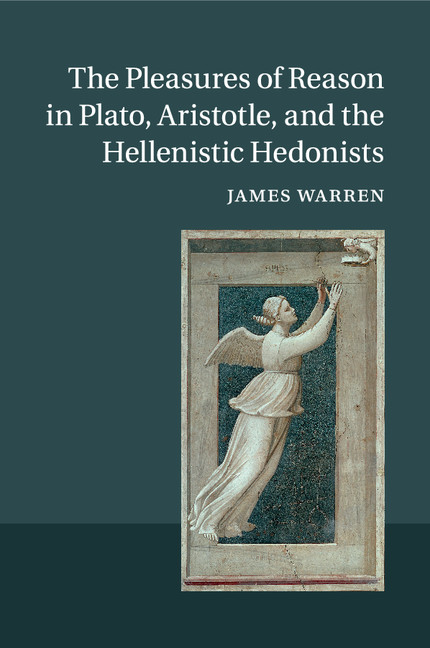
    Human lives are full of pleasures and pains. And humans are creatures that are able to think: to learn, understand, remember and recall, plan and anticipate. Ancient philosophers were interested in both of these facts and, what is more, were interested in how these two facts are related to one another. There appear to be, after all, pleasures and pains associated with learning and inquiring, recollecting and anticipating. We enjoy finding something out. We are pained to discover that a belief we hold is false. We can think back and enjoy or be upset by recalling past events. And we can plan for and enjoy imagining pleasures yet to come. This book is about what Plato, Aristotle, the Epicureans and the Cyrenaics had to say about these relationships between pleasure and reason.

    Reviews

    'Warren perfects the virtues exemplified in J. C. B. Gosling and C. C. W. Taylor, The Greeks on Pleasure, thanks to his historical accuracy, his subtle analysis of metaphors and analogies (consider, paradigmatically, the weighing and measuring of pleasures and pains in his chapter 5) and of other literary elements in the works he reads. He treads carefully whenever needed, and nurtures the sensitivity for aesthetic enjoyments, although they go beyond the scope of this inquiry. Consequently, I highly recommend this book to all specialists in ancient philosophy as well as budding ancient philosophy students. Both groups will benefit from experiencing anew, or for the first time, the understanding that trailblazing contributions do not emerge primarily from proposing a new exegesis of this or that line of text.'

    Georgia Mouroutsou Source: Bryn Mawr Classical Review

    Refine List

    Actions for selected content:

    Select all | Deselect all
    • View selected items
    • Export citations
    • Download PDF (zip)
    • Save to Kindle
    • Save to Dropbox
    • Save to Google Drive

    Save Search

    You can save your searches here and later view and run them again in "My saved searches".

    Please provide a title, maximum of 40 characters.
    ×

    Contents

    References

    Adam, H. (1974) Plutarchs Schrift non posse suaviter vivi secundum Epicurum, Amsterdam: Gruner Publishing
    Adam, J. (1902) The Republic of Plato (Edited with Critical Notes, Commentary and Appendices), 2 vols., Cambridge University Press
    Albini, F. (1993) Plutarco: Non posse suaviter vivi secundum Epicurum. Introduzione, traduzione, commento, Genoa: D. AR. FI. CL. ET. “F. Della Corte”
    Annas, J. (1981) An Introduction to Plato’s Republic, Oxford University Press
    Annas, J. (1992) ‘Aristotle on memory and the self’, in M. C. Nussbaum and A. O. Rorty (eds.), Essays on Aristotle’s De Anima, Oxford University Press: 297–311
    Annas, J. (1993) The Morality of Happiness, Oxford University Press
    Annas, J. (1999) Platonic Ethics, Old and New, Ithaca: Cornell University Press
    Asmis, E. (1995) ‘Epicurean poetics’, in D. Obbink (ed.), Philodemus and Poetry, Oxford University Press: 15–34
    Aufderheide, J. (2013) ‘Processes as pleasures in EN vii 11–14: a new approach’, Ancient Philosophy 33: 135–57
    Bernecker, S. (2010) Memory: a Philosophical Study, Oxford University Press
    Bailey, C. (1926) Epicurus: the Extant Remains, Oxford University Press
    Bigelow, J., Campbell, J., and Pargetter, R. (1990) ‘Death and well-being’, Pacific Philosophical Quarterly 71: 119–40
    Blank, D. (2009) ‘Philosophia and technē: Epicureans on the arts’, in J. Warren (ed.), The Cambridge Companion to Epicureanism, Cambridge University Press: 216–33
    Bobonich, C. (2002) Plato’s Utopia Recast, Oxford University Press
    Bostock, D. (1988) ‘Pleasure and activity in Aristotle’s Ethics’, Phronesis 33: 251–72
    Boys-Stones, G. (1997) ‘Thyrsus-bearer of the Academy or enthusiast for Plato? Plutarch’s de Stoicorum repugnatiis’, in J. Mossman (ed.), Plutarch and his Intellectual World, London: Duckworth: 41–58
    Brink, D. O. (1992) ‘Sidgwick and the rationale for rational egoism’, in B. Schultz (ed.), Essays on Henry Sidgwick, Cambridge University Press: 199–240
    Broadie, S. (1991) Ethics with Aristotle, Oxford University Press
    Broadie, S. (2012) ‘A science of first principles (Metaphysics A 2)’, in C. Steel (ed.), Aristotle’s Metaphysics Alpha, Oxford University Press: 43–67
    Brunschwig, J. (1986) ‘The cradle argument in Epicureanism and Stoicism’, in M. Schofield and G. Striker (eds.), The Norms of Nature, Cambridge University Press: 113–44
    Burnyeat, M. F. (1990) The Theaetetus of Plato, Indianapolis: Hackett
    Burnyeat, M. F. (2002) ‘De anima II 5’, Phronesis 47: 28–90
    Burnyeat, M. F. (2008) ‘Kinesis vs. Energeia: a much-read passage in (but not of) Aristotle’s Metaphysics’, Oxford Studies in Ancient Philosophy 34, 219–92
    Burnyeat, M. F. (2011) ‘Episteme’, in B. Morison and K. Ierodiakonou (eds.), Episteme, etc. Essays in Honour of Jonathan Barnes, Oxford University Press: 3–29
    Cambiano, G. (2012) ‘The desire to know (Metaphysics A 1)’, in C. Steel (ed.), Aristotle’s Metaphysics Alpha, Oxford University Press: 1–42
    Carone, G. R. (2000) ‘Hedonism and the pleasureless life in Plato’s Philebus’, Phronesis 45: 257–83
    Carone, G. R. (2005) Plato’s Cosmology and its Ethical Dimensions, Cambridge University Press
    Carpenter, A. (2003) ‘Phileban gods’, Ancient Philosphy 23: 93–112
    Carpenter, A. (2006) ‘Hedonistic persons: the good man argument in Plato’s Philebus’, British Journal for the History of Philosophy 14: 5–26
    Carpenter, A. (2010) ‘What is peculiar to Plato’s and Aristotle’s psychologies? What is common to them both?’, in V. Harte, M. M. McCabe, R. W. Sharples, and A. Sheppard (eds.), Aristotle and the Stoics Reading Plato (Bulletin of the Institute of Classical Studies Supplement 107), London: Institute of Classical Studies: 21–44
    Carpenter, A. (2011) ‘Pleasure as genesis in Plato’s Philebus’, Ancient Philosophy 31: 73–94
    Caston, V. (1996) ‘Why Aristotle needs imagination’, Phronesis 41: 20–55
    Caston, V. (1998) ‘Aristotle and the problem of intentionality’, Philosophy and Phenomenological Research 58: 249–98
    Caston, V. (2009) ‘Phantasia and thought’, in G. Anagnotopoulos (ed.), A Companion to Aristotle, Oxford: Blackwell: 322–34
    Cherniss, H. (1976) Plutarch’s Moralia: Volume XIII Part 1 (Loeb Classical Libary), Cambridge, Mass.: Harvard University Press
    Cockburn, D. (1997) Other Times: Philosophical Perspectives on Past, Present, and Future, Cambridge University Press
    Cole, E. B. (1992) ‘Theophrastus and Aristotle on animal intelligence’, in W. W. Fortenbaugh and D. Gutas (eds.), Theophrastus: His Psychological, Doxographical and Scientific Writings (Rutgers University Studies in Classical Humanities 5), New Brunswick: Transaction Publishers: 44–62
    Coles, A. (1997) ‘Animal and childhood cognition in Aristotle’s biology and the scala naturae’ in W. Kullmann and K. Abel (eds.), Aristotelische Biologie: Intentionen, Methoden, Ergebnisse, Stuttgart: Franz Steiner Verlag: 287–323
    Coope, U. (2012) ‘Why does Aristotle think that ethical virtue is required for practical wisdom?’, Phronesis 57: 142–63
    Cooper, J. (1996) ‘An Aristotelian theory of emotions’, in A. O. Rorty (ed.), Essays on Aristotle’s Rhetoric, Berkeley: University of California Press: 238–57
    Cooper, J. (1999a) ‘Plato’s theory of human good in the Philebus’, in his Reason and Emotion: Essays on Ancient Moral Psychology and Ethical Theory, Princeton University Press: 151–64
    Cooper, J. (1999b) ‘Pleasure and desire in Epicurus’, in his Reason and Emotion: Essays on Ancient Moral Psychology and Ethical Theory, Princeton University Press: 485–514
    Corcilius, K. (2011) ‘Aristotle’s definition of non-rational pleasure and pain and desire’, in J. Miller (ed.), Aristotle’s Nicomachean Ethics. A Critical Guide, Cambridge University Press: 117–43
    Delcomminette, S. (2003) ‘False pleasures, appearance and imagination in the Philebus’, Phronesis 48: 215–37
    Delcomminette, S. (2006) Le Philèbe de Platon: introduction à l’agathologie platonicienne, Leiden: E. J. Brill
    Denyer, N. (2008) Plato: Protagoras, Cambridge University Press
    Destrée, P. (2012) ‘Le plaisir “propre” de la tragédie est-il intellectuel?’, Methexis 25: 93–108
    Destrée, P. (2014) ‘Aristotle on the paradox of tragic pleasure’, in J. Levinson (ed.), Suffering Art Gladly: the Paradox of Negative Emotion in Art, Basingstoke: Palgrave Macmillan: 3–27
    Dow, J. (2009) ‘Feeling fantastic? Emotions and appearances in Aristotle’, Oxford Studies in Ancient Philosophy 37: 143–75
    Dow, J. (2011) ‘Aristotle’s theory of the emotions: emotions as pleasures and pains’, in M. Pakaluk and G. Pearson (eds.), Moral Psychology and Human Action in Aristotle, Oxford University Press: 47–74
    Einarson, B. and De Lacy, P. H. (1967) Plutarch’s Moralia: Volume XIV (Loeb Classical Library), Cambridge Mass.: Harvard University Press
    Erginel, M. M. (2004) ‘Pleasures in Republic IX’, PhD dissertation, University of Texas at Austin
    Erginel, M. M. (2011) ‘Inconsistency and ambiguity in Republic IX’, Classical Quarterly 61: 493–502
    Erler, M. (2012) ‘Aplanēs theoria. Einige Aspekte der Epikureischen Vorstellung vom Bios theōrētikos’, in T. Bénatouïl and M. Bonazzi (eds.), Theoria, Praxis and the Contemplative Life after Plato and Aristotle, Leiden: E. J. Brill: 41–55
    Evans, M. (2007a) ‘Plato and the meaning of pain’, Apeiron 40: 71–93
    Evans, M. (2007b) ‘Plato’s anti-hedonism’ (with commentary by V. Harte), Proceedings of the Boston Area Colloquium in Ancient Philosophy 23: 121–52
    Evans, M. (2007c) ‘Plato’s rejection of thoughtless and pleasureless lives’, Phronesis 52: 337–63
    Evans, M. (2008) ‘Plato on the possibility of hedonic mistakes’, Oxford Studies in Ancient Philosophy 35: 89–124
    Evans, M. (2010) ‘A partisan’s guide to Socratic intellectualism’, in S. Tenenbaum (ed.), Desire, Practical Reason, and the Good, Oxford University Press: 6–33
    Feldman, F. (2004) Pleasure and the Good Life: Concerning the Nature, Varieties and Plausibility of Hedonism, Oxford University Press
    Ferrari, G. R. F. (2002) ‘Plato Republic 9.585c–d’, Classical Quarterly 52: 383–8
    Ferrari, G. R. F. (2003) City and Soul in Plato’s Republic, Sankt Augustin: Akademia Verlag
    Frede, D. (1985) ‘Rumpelstiltskins’s pleasures: true and false pleasures in the Philebus’, Phronesis 30: 151–80
    Frede, D. (1992a) ‘The cognitive role of phantasia in Aristotle’, in M. Nussbaum and A. O. Rorty (eds.), Essays on Aristotle’s De Anima, Oxford University Press: 279–95
    Frede, D. (1992b) ‘Disintegration and restoration: pleasure and pain in the Philebus’, in R. Kraut (ed.), The Cambridge Companion to Plato, Cambridge University Press: 425–63
    Frede, D. (1993) Plato: Philebus, Indianapolis: Hackett
    Frede, D. (1996a) ‘The hedonist’s conversion: the role of Socrates in the Philebus’, in C. Gill and M. M. McCabe (eds.), Form and Argument in Late Plato, Oxford University Press: 213–48
    Frede, D. (1996b) ‘Mixed feelings in Aristotle’s Rhetoric’, in A. O. Rorty (ed.), Essays on Aristotle’s Rhetoric, Berkeley: University of California Press: 258–85
    Frede, D. (1997) Platon: Philebos. Übersetzung und Kommentar, Göttingen: Vandenhoeck & Ruprecht
    Frede, D. (2009) ‘NE VII.11–12: Pleasure’, in C. Natali (ed.), Aristotle: Nicomachean Ethics VII, Oxford University Press: 183–208
    Giannantoni, G. (1958) I Cirenaici, Florence: Sansoni
    Gibbs, B. (2001) ‘Pleasure, pain and rhetoric in Republic 9’, in D. Baltzly, D. Blyth, and H. Tarrant (eds.), Power and Pleasure, Virtues and Vices (Prudentia supplementary volume), Auckland: 7–34
    Gioé, A. (2002) Filosofi medioplatonici del II secolo D. C. Testimonianze e frammenti: Gaio, Albino, Lucio, Nicostrato, Tauro, Severo, Arpocrazione, Naples: Bibliopolis
    Giovacchini, J. (2007) ‘Le souvenir des plaisirs: le rôle de la mémoire dans la thérapeutique épicurienne’, in L. Boulègue and C. Lévy (eds.), Hédonismes: penser et dire le plaisir dans l’Antiquité et à la Renaissance, Lille: Presses Universitaires Septentrion: 69–83
    Gonzalez, F. (1991) ‘Aristotle on pleasure and perfection’, Phronesis 36, 141–59
    Gordon, P. (2012) The Invention and Gendering of Epicurus, Ann Arbor: University of Michigan Press
    Görler, W. (1997) ‘Storing up past pleasures. The soul-vessel-metaphor in Lucretius and in his Greek models’, in K. A. Algra, M. H. Koenen, and P. H. Schrijvers (eds.), Lucretius and his Intellectual Background, Amsterdam: Royal Netherlands Academy of Arts and Sciences: 193–207
    Gosling, J. C. B. (1975) Plato: Philebus, Oxford University Press
    Gosling, J. C. B. and Taylor, C. C. W. (1982) The Greeks on Pleasure, Oxford University Press
    Graver, M. (2002a) Cicero on the Emotions: Tusculan Disputations 3 and 4, University of Chicago Press
    Graver, M. (2002b) ‘Managing mental pain: Epicurus vs. Aristippus on the pre-rehearsal of future ills’, Proceedings of the Boston Area Colloquium in Ancient Philosophy 17: 155–77; with commentary by G. Striker: 178–84
    Hackforth, R. (1945) Plato’s Examination of Pleasure, Cambridge University Press
    Hall, J. C. (1966–7) ‘Quantity of pleasure’, Proceedings of the Aristotelian Society 67: 35–52
    Halliwell, S. (1992) ‘Pleasure, understanding, and emotion in Aristotle’s Poetics’, in A. O. Rorty (ed.), Essays on Aristotle’s Poetics, Princeton University Press: 241–60
    Halliwell, S. (2011) Between Ecstasy and Truth: Interpretations of Greek Poetics from Homer to Longinus, Oxford University Press
    Hamlyn, D. W. (1968) Aristotle’s De anima Books II and III (with Certain Passages from Book I), Oxford University Press
    Harte, V. (2002) Plato on Parts and Wholes: the Metaphysics of Structure, Oxford University Press
    Harte, V. (2004) ‘The Philebus on pleasure: the good, the bad and the false’, Proceedings of the Aristotelian Society 104: 111–28
    Harte, V. (2014a) ‘Desire, memory, and the authority of soul: Plato, Philebus 35c–d’, Oxford Studies in Ancient Philosophy 46: 33–72
    Harte, V. (2014b) ‘The life of Protarchus’ choosing: Plato Philebus 20b–22c’, in M. K. Lee (ed.), Strategies of Argument: Essays in Ancient Ethics, Epistemology, and Logic, Oxford University Press: 3–20
    Heath, M. (2009) ‘Cognition in Aristotle’s Poetics’, Mnemosyne 62: 51–75
    Heinaman, R. (2011) ‘Pleasure as an activity in the Nicomachean Ethics’, in M. Pakaluk and G. Pearson (eds.), Moral Psychology and Human Action in Aristotle, Oxford University Press: 7–45
    Hershbell, J. P. (1992) ‘Plutarch and Epicureanism’, Aufstieg und Niedergang der Römische Welt 2.36.5: 3353–83
    Hutchinson, D. S. and Johnson, M. R. (2005) ‘Authenticating Aristotle’s Protrepticus’, Oxford Studies in Ancient Philosophy 29: 193–294
    Indelli, G. (1978) Polistrato: sul disprezzo irrazionale delle opinion popolari, Naples: Bibliopolis
    Indelli, G. and Tsouna-McKirahan, V. (1995) [Philodemus] [On Choices and Avoidances], Naples: Bibliopolis
    Irwin, T. (1991) ‘Aristippus against happiness’, The Monist 74: 55–82
    Johansen, T. K. (2012) The Powers of Aristotle’s Soul, Oxford University Press
    Kechagia, E. (2011) Plutarch Against Colotes: a Lesson in History of Philosophy, Oxford University Press
    King, R. A. H. (2009) Aristotle and Plotinus on Memory, Berlin: de Gruyter
    Konstan, D. (2008) A Life Worthy of the Gods: the Materialist Psychology of Epicurus, Las Vegas: Parmenides Publishing
    Konstan, D. (2013) ‘Lucretius and the Epicurean attitude towards grief’, in D. LeHoux, A. D. Morrison, and A. Sharrock (eds.), Lucretius: Poetry, Philosophy, Science, Oxford University Press: 193–209
    Körte, A. (1890) ‘Metrodori Epicurei fragmenta’, Jahrbuch für classische Philologie, Suppl. 17, Leipzig: Teubner: 529–70
    LaBarge, S. (2012) ‘How (and maybe why) to grieve like an ancient philosopher’, in R. Kamtekar (ed.), Virtue and Happiness: Essays in Honour of Julia Annas (Oxford Studies in Ancient Philosophy supplementary volume), Oxford University Press: 321–42
    Lakmann, M.-L. (1995) Der Platoniker Taurus in der Darstellung des Aulus Gellius, Leiden: E. J. Brill
    Laks, A. (1993) ‘Annicéris et les plaisirs psychiques: quelques préalables doxographiques’, in J. Brunschwig and M. Nussbaum (eds.), Passions and Perceptions, Cambridge University Press: 18–50
    Lane, M. (2007) ‘Virtue as the love of knowledge in Plato’s Symposium and Republic’, in D. Scott (ed.), Maieusis: Essays on Ancient Philosophy in Honour of Myles Burnyeat, Oxford University Press: 44–67
    Lang, P. (2010) ‘The ranking of the goods at Philebus 66a–67b’, Phronesis 55: 153–69
    Lear, J. (1988) Aristotle: the Desire to Understand, Cambridge University Press
    Leone, G. (1984) ‘Epicuro Della natura libro XIV’, Cronache Ercolanesi 14: 17–107
    Lloyd, G. E. R. (1983) Science, Folklore and Ideology: Studies in the Life Sciences in Ancient Greece, Cambridge University Press
    Long, A. A. (1999) ‘The Socratic legacy’, in K. Algra, J. Barnes, J. Mansfeld, and M. Schofield (eds.), The Cambridge History of Hellenistic Philosophy, Cambridge University Press: 617–41
    Long, A. A. (2005) ‘Platonic souls as persons’, in R. Salles (ed.), Metaphysics, Soul, and Ethics in Ancient Thought: Themes from the Work of Richard Sorabji, Oxford University Press: 173–91
    Long, A. A. (2011) ‘Aristotle on eudaimonia, nous, and divinity’, in J. Milled (ed.), Aristotle’s Nicomachean Ethics. A Critical Guide, Cambridge University Press: 92–113
    Lorenz, H. (2006a) The Brute Within: Appetitive Desire in Plato and Aristotle, Oxford University Press
    Lorenz, H. (2006b) ‘The analysis of the soul in Plato’s Republic’, in G. Santas (ed.), The Blackwell Companion to Plato’s Republic, Oxford: Blackwell: 146–65
    Lorenz, H. (2007) ‘Aristotle’s assimilation of sense to sense-object’, Oxford Studies in Ancient Philosophy 33: 179–220
    Lovibond, S. (1989–90) ‘True and false pleasures’, Proceedings of the Aristotelian Society 90: 213–30
    Madvig, N. (1879) M. Tulli Ciceronis De finibus bonorun et malorum libri V (3rd edition), Copenhagen: Impensis Librariae Gyldendelianae
    Mannebach, E. (1961) Aristippi et Cyrenaicorum fragmenta, Leiden: E. J. Brill
    Margalit, A. (2002) The Ethics of Memory, Harvard University Press
    Matson, W. I. (1998) ‘Hegesias the Death-Persuader; or, the gloominess of hedonism’, Philosophy 73: 553–7
    McCabe, M. M. (2000) Plato and his Predecessors: the Dramatisation of Reason, Cambridge University Press
    McCabe, M. M. (2006) ‘Is dialectic as dialectic does? The virtue of philosophical conversation’, in B. Reis (ed.), The Virtuous Life in Greek Ethics, Cambridge University Press: 70–98
    Mellor, D. (1981) ‘Thank goodness that’s over’, Ratio 23: 20–30
    Meyer, S. Sauvé (2012) ‘Pleasure, pain, and “anticipation” in Plato’s Laws, Book 1’, in L. Patterson, V. Karasmanis, and A Hermann (eds.), Presocratics and Plato: Festschrift at Delphi in Honor of Charles Kahn, Las Vegas: Parmenides Publishing: 311–28
    Mitsis, P. (1988) Epicurus’ Ethical Theory: the Pleasures of Invulnerability, Ithaca: Cornell University Press
    Mooradian, M. (1996) ‘Converting Protarchus: relativism and false pleasures of anticipation in Plato’s Philebus’, Ancient Philosophy 16: 93–112
    Moore, G. E. (1903) Principia Ethica, Cambridge University Press
    Moss, J. (2006) ‘Pleasure and illusion in Plato’, Philosophy and Phenomenological Research 72: 503–35
    Moss, J. (2009) ‘Akrasia and perceptual illusion’, Archiv für Geschichte der Philosophie 91: 119–56
    Moss, J. (2012a) Aristotle on the Apparent Good: Perception, Phantasia, Thought, and Desire, Oxford University Press
    Moss, J. (2012b) ‘Pictures and passions in the Timaeus and Philebus’, in R. Barney, T. Brennan, and C. Brittain (eds.), Plato and the Divided Self, Cambridge University Press: 259–80
    Nagel, T. (1970) The Possibility of Altruism, Oxford University Press
    Nightingale, A. (2004) Spectacles of Truth in Classical Greek Philosophy, Cambridge University Press
    Nussbaum, M. C. (1978) Aristotle’s De motu animalium, Princeton University Press
    Nussbaum, M. C. (1986) The Fragility of Goodness: Luck and Ethics in Greek Tragedy and Philosophy, Cambridge University Press
    Nussbaum, M. C. (1995) ‘Aristotle on human nature and the foundations of ethics’, in J. E. J. Altham and R. Harrison (eds.), World, Mind, and Ethics: Essays on the Ethical Philosophy of Bernard Williams, Cambridge University Press: 86–131
    Oaklander, L. N. and Smith, Q. (eds.) (1994) The New Theory of Time, New Haven: Yale University Press
    Ogihara, S. (2012) ‘False pleasures: Philebus 36c–40e’, in L. Patterson, V. Karasmanis, and A Hermann (eds.), Presocratics and Plato: Festschrift at Delphi in Honor of Charles Kahn, Las Vegas: Parmenides Publishing: 291–309
    O’Keefe, T. (2002) ‘The Cyrenaics on pleasure, happiness, and future-concern’, Phronesis 47: 395–416
    Opsomer, J. (2005) ‘Plutarch’s Platonism revisited’, in M. Bonazzi and V. Celluprica (eds.), L’eredità platonica: studi sul Platonismo da Arcesilao a Proclo, Naples: Bibliopolis: 161–200
    Opsomer, J. (2012) ‘Plutarch on the division of the soul’, in R. Barney, T. Brennan, and C. Brittain (eds.), Plato and the Divided Self, Cambridge University Press: 311–330
    Osborne, C. (2007) Dumb Beasts and Dead Philosophers. Humanity and the Humane in Ancient Philosophy and Literature, Oxford University Press
    Pakaluk, M. (1998) Aristotle: Nicomachean Ethics Books VIII and IX, Oxford University Press
    Pangle, L. (2003) Aristotle and the Philosophy of Friendship, Cambridge University Press
    Pappas, N. (1995) Routledge Philosophy Guidebook to Plato and the Republic, London: Routledge
    Parfit, D. (1984) Reasons and Persons, Oxford University Press
    Pearson, G. (2012) Aristotle on Desire, Cambridge University Press
    Penner, T. (1970) ‘False anticipatory pleasures: Philebus 36a3–41a6’, Phronesis 15: 166–78
    Pepe, L. (2002) ‘Le livre d’Anaxagore lu par Platon’, in M. Dixsaut and A. Brancacci (eds.), Platon, Source des Présocratiques, Paris: J. Vrin: 107–28
    Persson, I. (2005) The Retreat of Reason, Oxford University Press
    Price, A. (2009) ‘Emotions in Plato and Aristotle’, in P. Goldie (ed.), The Oxford Handbook of Philosophy of Emotion, Oxford University Press: 121–42
    Prior, A. N. (1959) ‘Thank goodness that’s over’, Philosophy 34: 12–17
    Puglia, E. (1988) Demetrio Lacone: aporie testuali ed esegetiche in Epicuro (PHerc 1012), Naples: Bibliopolis
    Purinton, J. (1993) ‘Epicurus on the telos’, Phronesis 38: 281–320
    Quoidbach, J., Gilbert, D. T., and Wilson, T. D. (2013) ‘The end of history illusion’, Science 339 no. 6115: 96–8
    Rapp, C. (2009) ‘NE VII.12–14: pleasure and eudaimonia’, in C. Natali (ed.), Aristotle: Nicomachean Ethics VII. Oxford University Press: 209–236
    Rawls, J. (1971) A Theory of Justice, Cambridge Mass.: Belknap Press
    Richardson, H. S. (1990) ‘Measurement, pleasure, and practical science in Plato’s Protagoras’, Journal of the History of Philosophy 28: 7–32
    Richardson Lear, G. (2006) ‘Aristotle on moral virtue and the fine’, in R. Kraut (ed.), The Blackwell Companion to Aristotle’s Nicomachean Ethics, Oxford: Blackwell: 116–36
    Roberts, R. C. and Wood, W. J. (2007) Intellectual Virtues: an Essay in Regulative Epistemology, Oxford University Press
    Rosen, S. (2005) Plato’s Republic: a Study, New Haven: Yale University Press
    Roskam, G. (2005) ‘The displeasing secrets of the Epicurean life. Plutarch’s polemic against Epicurus’ political philosophy’, in A. Casanova (ed.), Plutarco e l’età ellenistica. Atti del convengo internazionale di studi. Firenze, 23–24 settembre 2004, Florence: Università degli studi di Firenze, Dipartimento di scienze dell’antichità ‘Giorgio Pasquali’: 351–68
    Roskam, G. (2007) A Commentary on Plutarch’s De latenter vivendo, Leuven University Press
    Rowett, C. (2013) ‘Relativism in Plato’s Protagoras’, in V. Harte and M. Lane (eds.), Politeia in Greek and Roman Philosophy, Cambridge University Press: 191–211
    Rudebusch, G. (1999) Socrates, Pleasure, and Value, Oxford University Press
    Russell, D. (2000) ‘Protagoras and Socrates on courage and pleasure: Protagoras 349d ad finem’, Ancient Philosophy 20: 311–38
    Russell, D. (2005) Plato on Pleasure and the Good Life, Oxford University Press
    Scheiter, K. M. (2012) ‘Images, appearances, and phantasia in Aristotle’, Phronesis 57: 251–78
    Schofield, M. (1978) ‘Aristotle on the imagination’ in G. E. R. Lloyd and G. E. L. Owen (eds.), Aristotle on Mind and the Senses, Cambridge University Press: 99–140
    Schofield, M. (1996) ‘Epilogismos: an appraisal’ in M. Frede and G. Striker (eds.), Rationality in Greek Thought, Oxford University Press: 221–37
    Schofield, M. (2007) ‘Metaspeleology’, in D. Scott (ed.), Maieusis: Essays in Ancient Philosophy in Honour of Myles Burnyeat, Oxford University Press: 216–31
    Schofield, M. (2011) ‘Phantasia in the De Motu Animalium’ in M. Pakaluk and G. Pearson (eds.), Moral Psychology and Human Action in Aristotle, Oxford University Press: 119–34
    Scott, D. (2000) ‘Plato’s critique of the democratic character’, Phronesis 45 : 19–37
    Scott, D. (2006) Plato’s Meno, Cambridge University Press
    Sedley, D. N. (1973) ‘Epicurus, On Nature book XXVIII’, Cronache Ercolanesi 3: 5–83
    Sedley, D. N. (1976) ‘Epicurus and his professional rivals’, in J. Bollack and A. Laks (eds.), Études sur l’Epicurisme antique (Cahiers de philologie 1), Publications de l’Université de Lille III: 121–59
    Sedley, D. N. (1996) ‘The inferential foundations of Epicurean ethics’, in M. Gigante and G. Giannantoni (eds.), Epicureismo greco e romano, Naples: Bibliopolis: 313–39
    Sedley, D. N. (2002) ‘Diogenes of Oenoanda on Cyrenaic hedonism’, Proceedings of the Cambridge Philological Society 48: 159–74
    Shields, C. (2011) ‘Perfecting pleasures: the metaphysics of pleasure in Nicomachean Ethics X’, in J. Miller (ed.), Aristotle’s Nicomachean Ethics: a Critical Guide, Cambridge University Press: 191–210
    Sidgwick, H. (1907) The Methods of Ethics (7th edition), London: Macmillan
    Sihvola, J. (1996) ‘Emotional animals: do Aristotelian emotions require beliefs?’, Apeiron 29: 105–44
    Slote, M. (1983) Goods and Virtues, Oxford University Press
    Small, J. P. (1997) Wax Tablets of the Mind: Cognitive Studies of Memory and Literacy in Classical Antiquity, London: Routledge
    Smith, M. F. (1993) Diogenes of Oinoanda: the Epicurean Inscription, Naples: Bibliopolis
    Sorabji, R. R. K. (1993) Animal Minds and Human Morals: the Origins of the Western Debate, London: Duckworth
    Sorabji, R. (2000) Emotion and Peace of Mind: From Stoic Agitation to Christian Temptation, Oxford University Press
    Sorabji, R. R. K. (2004) Aristotle on Memory (2nd edition), London: Duckworth
    Striker, G. (1988) ‘Commentary on Mitsis’, Proceedings of the Boston Area Colloquium in Ancient Philosophy 4: 323–8
    Striker, G. (1993) ‘Epicurean hedonism’, in J. Brunschwig and M. Nussbaum (eds.), Passions and Perceptions, Cambridge University Press: 3–17
    Striker, G. (1996a) ‘Emotions in context: Aristotle’s treatment of the passions in the Rhetoric and his moral psychology’, in A. O. Rorty (ed.), Essays on Aristotle’s Rhetoric, Berkeley: University of California Press: 286–302
    Striker, G. (1996b) ‘Κϱιτήϱιον τῆς ἀληθείας’, in her Essays on Hellenistic Epistemology and Ethics, Cambridge University Press: 22–76 (originally published in German in Nachrichten der Akademie der Wissenschaften zu Göttingen 1. Phil.-hist. Klasse 2 (1974), 48–110)
    Strohl, M. S. (2011) ‘Pleasure as perfection: Nicomachean Ethics 10.4–5’, Oxford Studies in Ancient Philosophy 41: 257–87
    Tarrant, H. (1996) ‘Platonic interpretation in Aulus Gellius’, Greek, Roman, and Byzantine Studies 37: 173–93
    Tarrant, H. (2007) ‘Platonist educators in a growing market: Gaius; Albinus; Taurus; Alcinous’, in R. R. R. Sorabji and R. W. Sharples (eds.), Greek and Roman Philosophy 100 BC–200 AD (BICS Supplementary volume 94): London Institute of Classical Studies: 449–65
    Taylor, C. C. W. (1991) Plato: Protagoras (revised edition), Oxford University Press
    Taylor, C. C. W. (1998) ‘Platonic ethics’, in S. Everson (ed.), Ethics (Companions to Ancient Thought 4), Cambridge University Press: 49–76
    Taylor, C. C. W. (2003) ‘Pleasure: Aristotle’s response to Plato’, in R. Heinaman (ed.), Plato and Aristotle’s Ethics, Aldershot: Ashgate: 1–20 (with response by S. Broadie, 21–7)
    Taylor, C. C. W. (2008) ‘Plato and Aristotle on the criterion of real pleasures’, in his Pleasure, Mind and Soul: Selected Papers in Ancient Philosophy, Oxford University Press: 91–106
    Teiserrenc, F. (1999) ‘L’empire du faux ou le plaisir de l’image (37a–41a)’, in M. Dixsaut (ed.), La fêlure du plaisir: études sur le Philèbe de Platon, vol. i: Commentaires, Paris: J. Vrin: 267–98
    Tepedino Guerra, A. (1987) ‘PHerc 1232 fr. 6 : una testimonanza del libro “Sul fine” di Epicuro?’, Cronache Ercolanesi 17: 85–8
    Tepedino Guerra, A. (1994) ‘L’opera filodemea Su Epicuro (PHerc 1232 1289β)’, Cronache Ercolanesi 24: 5–54
    Thein, K. (2012) ‘Imagination, self-awareness, and thought in the Philebus’, Oxford Studies in Ancient Philosophy 42: 109–49
    Trebilcot, J. (1974) ‘Aprudentialism’, American Journal of Philosophy 11: 203–10
    Tsouna, V. (1998) The Epistemology of the Cyrenaic School, Cambridge University Press
    Tsouna, V. (2002) ‘Is there an exception to Greek eudaimonism?’, in M. Canto and P. Pellegrin (eds.), Le style de la pensée: receuil de textes en hommage à Jacques Brunschwig, Paris: Les Belles Lettres: 464–89
    Tsouna-McKirahan, V. (1994) ‘The Socratic origins of the Cynics and Cyrenaics’, in P. A. Vander Waerdt (ed.), The Socratic Movement, Ithaca: Cornell University Press: 367–91
    Usener, H. (1887) Epicurea, Leipzig: Teubner
    Van Riel, G. (2000) Pleasure and the Good Life: Plato, Aristotle, and the Neoplatonists, Leiden: E. J. Brill
    Van Riel, G. (2012) ‘Damascius on the contemplative life’, in T. Bénatouïl and M. Bonazzi (eds.), Theoria, Praxis and the Contemplative Life after Plato and Aristotle, Leiden: E. J. Brill: 199–212
    Velleman, J. D. (1991) ‘Well-being and time’, Pacific Philosophical Quarterly 72: 48–77
    Vogt, K. (2012) Belief and Truth: a Skeptic Reading of Plato, Oxford University Press
    Vorobej, M. (1987) ‘Rationality and time preference’, Southern Journal of Philosophy 25: 407–23
    Waanders, F. M. J. (1983) The History of ΤΕΛΟΣ and ΤΕΛΕΩ in Ancient Greek, Amsterdam: B. R. Grüner
    Wardy, R. B. B. (1990) The Chain of Change, Cambridge University Press
    Warnock, M. (1987) Memory, London: Faber and Faber
    Warren, J. (2000) ‘Epicurean immortality’, Oxford Studies in Ancient Philosophy 18: 231–61
    Warren, J. (2001a) ‘Epicurus and the pleasures of the future’, Oxford Studies in Ancient Philosophy 21: 135–79
    Warren, J. (2001b) ‘Epicurus’ dying wishes’, Proceeding of the Cambridge Philological Society 47: 23–46
    Warren, J. (2001c) ‘Lucretian palingenesis recycled’, Classical Quarterly 51: 499–508
    Warren, J. (2001d) ‘Lucretius, symmetry arguments and fearing death’, Phronesis 46: 466–91
    Warren, J. (2002a) Epicurus and Democritean Ethics: an Archaeology of Ataraxia, Cambridge University Press
    Warren, J. (2002b) ‘Democritus, the Epicureans, death, and dying’, Classical Quarterly 52: 193–206
    Warren, J. (2004) Facing Death: Epicurus and his Critics, Oxford University Press
    Warren, J. (2006) ‘Psychic disharmony: Philoponus and Epicurus on Plato’s Phaedo’, Oxford Studies in Ancient Philosophy 30: 235–59
    Warren, J. (2007) ‘Lucretius and Greek philosophy’, in S. Gillespie and P. Hardie (eds.), The Cambridge Companion to Lucretius, Cambridge University Press: 19–32
    Warren, J. (2009) ‘Aristotle on Speusippus on Eudoxus on pleasure’, Oxford Studies in Ancient Philosophy 36: 249–81
    Warren, J. (2010) ‘Plato on the pleasures and pains of knowing’, Oxford Studies in Ancient Philosophy 39: 1–32
    Warren, J. (2011a) ‘Pleasure, Plutarch’s Non Posse, and Plato’s Republic’, Classical Quarterly 61: 278–93
    Warren, J. (2011b) ‘Socrates and the patients: Republic IX 583c–585a’, Phronesis 56: 113–37
    Warren, J. (2013a) ‘Comparing lives in Plato Laws V’, Phronesis 58: 319–46
    Warren, J. (2013b) ‘Epicureans and Cyrenaics on pleasure as a pathos’ in S. Marchand and F. Verde (eds.), Épicurisme et Scepticisme, Rome: Sapienza Università Editrice: 127–44
    Warren, J. (2014) ‘The Cyrenaics’, in F. Sheffield and J. Warren (eds.), The Routledge Companion to Ancient Philosophy, London: Routledge: 409–22
    Warren, J. (forthcoming a) ‘Epicurean pleasure in Cicero’s De Finibus’, in J. Annas and G. Betegh (eds.), Cicero: Ethics and Final Ends (Proceedings of the XII Symposium Hellenisticum), Cambridge University Press
    Warren, J. (forthcoming b) ‘Memory, anticipation, pleasure’, in F. Leigh (ed.), Moral Psychology in Ancient Thought. Proceedings of the 2011 Keeling Colloquium
    Webster, T. B. L. (1967) The Tragedies of Euripides, London: Methuen
    Wedin, M. V. (1988) Mind and Imagination in Aristotle, New Haven: Yale University Press
    Westerink. L. G. (1959) Damascius: Lectures on the Philebus, Amsterdam: North Holland Publishing Company
    Westman, R. (1955) Plutarch gegen Kolotes. Seine Schrift ‘Adversus Colotem’ als philosophiegeschichtliche Quelle (Acta Philosophica Fennica 7), Helsinki: Filosofinen Yhdistys
    Wiggins, D. (1987) ‘Deliberation and practical reasoning’, in his Needs, Values, Truth, Oxford University Press: 215–37
    Williams, B. (1959) ‘Pleasure and belief’, Proceedings of the Aristotelian Society Supplementary Volume 33: 57–72, reprinted in his 2006 Philosophy as a Humanistic Discipline (ed. A. W. Moore), Princeton University Press: 34–46
    Williams, B. (1976) ‘Persons, character and morality’, in A. O. Rorty (ed.), The Identities of Persons, Berkeley: University of California Press: 197–215
    Wolfsdorf, D. (2009) ‘Epicurus on Εὐϕϱοσύνη and Ἐνεϱγεία’, Apeiron 42: 221–57
    Wolfsdorf, D. (2011) ‘Prodicus on the correctness of names: the case of terpsis, chara, and euphrosyne’, Journal of Hellenic Studies 131: 131–45
    Wolfsdorf, D. (2013a) Pleasure in Ancient Greek Philosophy, Cambridge University Press
    Wolfsdorf, D. (2013b) ‘Pleasure and truth in Republic 9’, Classical Quarterly 63: 110–38
    Woolf, R. (2004) ‘What kind of hedonist was Epicurus?Phronesis 49: 303–22
    Wright, M. (2005) Euripides’ Escape Tragedies: a Study of Helen, Andromeda and Iphigenia among the Taurians, Oxford University Press
    Zacher, K.-D. (1982) Plutarchs Kritik an der Lustlehre Epikurs. Ein Kommentar zu Non posse suaviter vivi secundum Epicurum: Kap. 1–8, Königstein/Ts.: Hain
    Zilioli, U. (2012) The Cyrenaics, Durham: Acumen

    Metrics

    Altmetric attention score

    Full text views

    Total number of HTML views: 0
    Total number of PDF views: 0 *
    Loading metrics...

    Book summary page views

    Total views: 0 *
    Loading metrics...

    * Views captured on Cambridge Core between #date#. This data will be updated every 24 hours.

    Usage data cannot currently be displayed.

    Accessibility standard: Unknown

    Why this information is here

    This section outlines the accessibility features of this content - including support for screen readers, full keyboard navigation and high-contrast display options. This may not be relevant for you.

    Accessibility Information

    Accessibility compliance for the HTML of this book is currently unknown and may be updated in the future.
