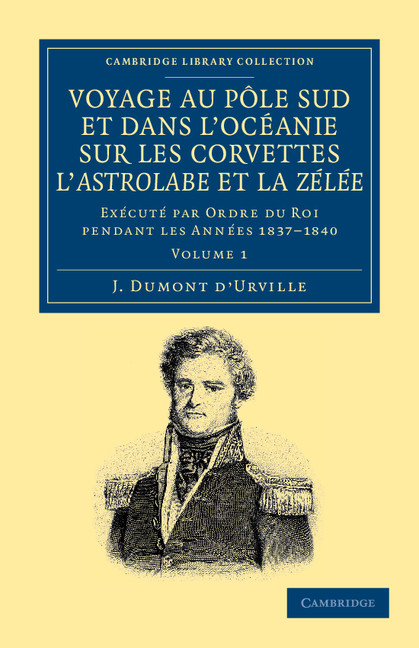
Voyage au Pole Sud et dans l'Océanie sur les corvettes l'Astrolabe et la Zélée

-
Select format
-
- Publisher:
- Cambridge University Press
- Publication date:
- 05 May 2013
- 24 May 2012
- ISBN:
- 9781139236386
- 9781108049887
- Dimensions:
- Weight & Pages:
- Dimensions:
- (216 x 140 mm)
- Weight & Pages:
- 0.49kg, 386 Pages
- Subjects:
- Geography, Historical Geography
You may already have access via personal or institutional login- Subjects:
- Geography, Historical Geography
Volume 1
Show more authors 
You may already have access via personal or institutional login
Book description
In 1836, the French King Louis-Philippe, enthusiastic for Southern Hemisphere exploration, supported J. Dumont d'Urville's plan for a circumnavigation focusing on the South Seas. D'Urville (1790–1842) had already distinguished himself on two Pacific expeditions and was eager to rival the achievements of James Cook. Between 1837 and 1840, the ships Astrolabe and Zélée explored the waters of the Antarctic area and Oceania in extremely harsh conditions: almost forty crew members died or deserted. However, d'Urville discovered a new portion of the Antarctic coast, shed light on the ethnography of several Pacific islands and brought back multitudes of botanical specimens. His impressive contributions to the fields of geography, natural history and ethnography were gathered in this ten-volume work, published between 1841 and 1846. In Volume 1, published in 1841, d'Urville recounts the perils of the journey from France to the Strait of Magellan, via Rio de Janeiro.
Contents
Contents
Metrics
Full text views
Full text views helpTotal number of HTML views: 0
Total number of PDF views: 0 *
 Loading metrics...
* Views captured on Cambridge Core between #date#. This data will be updated every 24 hours.
Usage data cannot currently be displayed.
Accessibility standard: Unknown
Why this information is here
This section outlines the accessibility features of this content - including support for screen readers, full keyboard navigation and high-contrast display options. This may not be relevant for you.
Accessibility Information
Accessibility compliance for the PDF of this book is currently unknown and may be updated in the future.