

Part IV The contextual experience of style
25 Iconicity
Introduction
Iconicity is a term used to indicate the strong drive human beings have to describe their world by means of signs (pictures, gestures and, in language, sounds, words and phrases), which are seen or felt to have a natural connection with the object or concept (often termed the signified or the referent) that the sign (more narrowly, the signifier) refers to. An iconic sign or icon is a natural sign in the sense that its physical (auditory, articulatory or visual) shape resembles the object or idea that it describes. Pictures (photographs, drawings, paintings), and to a lesser extent also gestures, are the most straightforward and direct iconic signs. Such signs, however, are rare in language use (except in signed languages), because spoken language consists of articulatory and acoustic sounds which cannot easily draw or mimic an object or concept. The best-known example of an icon in spoken language is therefore an onomatopoeic sign, where the sound of the utterance reflects the sound made by the object in question. Since most objects and activities (and even less so, abstract concepts!) do not make a sound, such icons are necessarily rare. For this reason, it is not surprising that there are more possibilities for ‘icons’ in visual (i.e. written and signed) language, where the shape, the relative position and order of words, and in written texts also the colour, the choice of font, the use of blank space and so on may help to picture or mimic the object or activity focused on (see, for example, A. Fischer Reference Fischer, Nänny and Fischer1999; Nänny and O. Fischer Reference Nänny, Fischer and Brown2006; Goh Reference Goh, Fischer and Nänny2001; van Peer Reference van Peer1993; Wolf Reference Wolf, Maeder, Fischer and Herlofsky2005).
As already indicated, a linguistic icon never mimes its object directly, it can only express partial similarity since the auditory nature of spoken language and its one-dimensional, strictly linear order can never capture all the features of the referent. Thus the word peewit (a common colloquial expression for ‘lapwing’) conveys the sound the bird makes, but not its colour, its size and its distinctive crest. And even the representation of its sound cannot be accurate because humans and birds produce sounds with different organs, while the sound structure itself is subject to and restricted by the language-specific phonological system that the language user has internalised in the course of acquiring his or her language (see Masuda Reference Masuda, Müller and Fischer2003). This also explains why the same bird or its sound may be referred to by different iconic signs in different languages (e.g. peewit in Dutch is kievit, and the sound a rooster makes is cockadoodledoo in English, kukeleku in Dutch, cocorico in French and chicchirichì in Italian and Spanish – although spelled differently in the latter). The situation is somewhat different in signed language because its system is three-dimensional, it can mime objects visually and it can express simultaneity as well as chronological order. On the other hand, also in this case, language signs can only partially picture an intended referent, due to its own specific system restrictions and economy.
Of much greater significance, linguistically, than the above iconic signs (often termed imagic icons because they replicate part of the ‘image’ that they represent) are the so-called diagrammatic icons. Here the similarity between sign and referent is of a more abstract nature: the relation between the linguistic signs approximates the relation between the referents. In other words, the iconic diagram always involves a combination of signs or words; there is no direct similarity relation between each separate sign and its referent. Such diagrams can be spatial or temporal, making use of order, distance and proximity between words, but the relation may also be subjective, reflecting the way our mind conceptualises the order in the world (this is often termed experiential iconicity, see Tabakowska Reference Tabakowska, Nänny and Fischer1999; Wolf Reference Wolf, Fischer and Nänny2001). For instance, a temporal sequence of actions is reflected in the sequence of verbs in Caesar’s famous dictum Veni, vidi, vici: here the phrase as a whole reflects the order of the activities performed by Caesar (i.e. he ‘came, oversaw the situation, and then conquered’). A different order would express a different idea, as Sylvia Adamson (in a talk given at the University of Jena in Reference Adamson, Hunter, Magnusson, Thompson and Wales2001) once jokingly remarked by alluding to Vidi, vici, veni as a possible iconic order in a sexual context.
The dictum Veni, vidi, vici can also be used to show yet a different kind of iconicity (termed second-degree or endophoric iconicity; see Johansen Reference Johansen1996 and Nöth Reference Nöth, Fischer and Nänny2001 respectively). This is iconicity of an internal kind in that the iconic sign does not refer diagrammatically to a concept in the external world but rather points to an iconic relation with a similar sign in the same text or in another text (i.e. intra- or intertextuality). Thus the formal similarity between veni, vidi and vici (all three forms begin with the same sound, end with the same sound, have two syllables of equal length, and are all relatively short) and its asyndeton (i.e. lack of linkage between the three verbs) ‘expresses a sense of achievement, the consciousness of a series of actions swiftly and expertly performed’ (Müller Reference Müller, Fischer and Nänny2001: 306), each action being as short and easy as the previous one. Second-degree iconicity is found extensively in poetry in the form of repetition, but also in slogans and advertising, while it plays a crucial role too in folk etymology (see R. Coates Reference Coates1987), in word formation, and in sound symbolism. In folk etymology, for instance, we often see that language users change the shape of a non-transparent word to make it look more like another, more common word that happens to be close to it in meaning; thus Earlier English bride-goom became bride-groom because goom was no longer understood, and in Modern Dutch many users refer to a roundabout as rontonde rather than (the originally French loan) rotonde because the referent happens to be rond ‘round’.
Diagrammatic relations (whether external or internal) are no longer strictly semiotic in that there is no longer a relationship of similarity between the signs and the objects/concepts in the world in a direct, imagic sense. This also applies to metaphor: here a diagrammatic semantic relation is perceived between the vehicle and the tenor, and this is expressed on the linguistic level by using the same formal sign; there is then no direct semiotic (‘imagic’) connection between the sign and its referent. Thus, when someone is called a fox, it is because the person referred to shows behaviour that is associated with a fox, but for which behaviour there is no separate sign; hence the sign fox is used to fill this gap.
The three types of iconicity (image, diagram, metaphor) can best be illustrated by Figure 25.1, where ↕/↔ indicates a direct connection and ╪ an indirect one.

Figure 25.1: Three types of iconicity
Linguistic research in the twentieth century has shown that iconicity operates at every level of language structure (phonology, morphology, syntax) and in practically every known language, and literary criticism has confirmed that iconicity is pervasive in the literary text: from its prosody and rhyme, its lineation, stanzaic ordering, its textual and narrative structure to its typographic layout on the page. It needs to be stressed, however, that the perception of iconicity in language and literary texts depends on an interpreter and on the context in which it is uttered, as no sign-function is self-explanatory. In addition, iconic diagrams in everyday spoken language may have become so entrenched (so much part of the conventional system) that they are hardly noticed: they have become ‘symbolic’. Johansen (Reference Johansen1993: 227) indeed notes, as have many others, that iconic signs play ‘a minor part in language as a system’ but ‘a leading character in literature, especially in poetry’. The awareness of its presence hence depends on how much it stands out in its context, on foregrounding and defamiliarisation.
An important occurrence in the new development of interest in iconicity was the publication of the collected papers of the philosopher and logician Charles Sanders Peirce in the early twentieth century. His division of icons into images and diagrams (and also metaphors) broke new ground for the study of iconicity. (In fact, Peirce refers to hypo-icons, rather than icons, because true icons cannot exist: nothing can resemble something else 100 per cent.) His contemporary in the 1920s, Ferdinand de Saussure, who is strongly associated with the idea that linguistic signs are arbitrary, concentrated on single morphemes, and hence did not realise the potential of iconicity – that is, of diagrammatic iconicity. When he describes (in 1922, on p. 101) the objections that ‘might be brought against the principle that linguistic signs are arbitrary’ (Saussure Reference Saussure and Harris1983: 69), he only mentions the exceptions formed by onomatopoeic words and exclamations such as ‘ouch’ (which in fact would be indexical in Peirce’s terms rather than onomatopoeic); these are indeed ‘rather marginal phenomena’ (Saussure Reference Saussure and Harris1983: 69). In most recent literature on iconicity, however, it is the pervasiveness of the iconic diagram that is emphasised (see Haiman Reference Haiman1980, Reference Haiman1985, the articles in Simone Reference Simone1994, Landsberg Reference Landsberg1995, Fischer and Nänny Reference Fischer and Nänny2001 and Nänny and O. Fischer Reference Fischer, Nänny and Fischer1999).
For this chapter, we will concentrate on diagrammatic iconicity since this plays a much more crucial role in language than imagic iconicity. We will compare ‘ordinary’ language use with literary language to discover the effect of iconicity. The mould into which writers and poets pour language often serves to enhance the meaning of a text. In literature, language works ‘at full stretch’ (Nowottny Reference Nowottny1962: 85) by being ‘hypersemanticized’ (Cureton Reference Cureton1980: 319): in other words, iconicity plays a much larger role because it promotes the ‘palpability of signs’ (Jakobson Reference Jakobson and Sebeok1960: 356). The purpose of this is to make us more aware. By inverting conventional language patterns, for instance by bringing them closer to ‘natural’ patterns or by using a painterly style, we may be made to see familiar things with fresh eyes, as if new. However, it is important to stress that the use of iconicity is not confined to literary language. The difference between everyday and literary language in this respect is one of degree, not of kind. Kiparsky has made this abundantly clear:
‘figures of language’ studied by poetics, such as alliteration, rhyme, parallelism, and metrical form . . . and the regularities which may govern their distribution in a work or body of literature, are grounded in the human language faculty; this is why they always involve linguistic categories of the sort that play a role in the grammars of languages, and why the rules governing them obey principles that also apply to linguistic rules and representations.
A similar suggestion was made by Lecercle (Reference Lecercle1990: 130), who distinguishes between the rules of grammar and the rules of what he has termed the ‘remainder’ (‘the area outside the map made by the cartographers [i.e. linguists], the uncharted territories’, 1990: 19). Both types of rules are intertwined in the production of language; the rules of grammar are normative and have a general application, while those of the remainder are idiosyncratic, the result of playing around with the normative rules.
Diagrammatic iconicity in syntax
Diagrammatic iconicity is especially common in the area of syntax because syntax is all about the way linguistic elements are positioned or arranged. A good reason to concentrate on syntax for this volume is also because syntax is the Cinderella in stylistic analyses of poetic texts. Usually most attention is paid to metre, rhyme (including assonance and alliteration), sound symbolism and metaphor. To begin with, I will list ways in which syntax may be used to shape meaning. After this I will show, by means of a number of poetic texts, how these devices can be or have been applied. By using the verb ‘apply’, I do not wish to suggest that writers or poets always do this consciously (except when they are following certain poetic conventions in choice of rhyme scheme, stanza form, etc. – but even these may be used iconically). What makes poets good poets is their instinct for the right phrase or the right sound in the right place. It is telling that these iconic devices can be used with various effects, because it is the combination of device and context that decides the effect in each case, as I indeed hope to show below.
Syntactic iconic devices
It is useful for our discussion to recognise some of the mechanisms involved in iconicity. Haiman (Reference Haiman1980) distinguishes three types of iconic syntactic principles or motivations:
1. the ‘principle of quantity’ (i.e. the use of many (or few) words to express differences in size, duration, or degree of complexity);
2. the ‘principle of proximity’ or ‘distance’ (i.e. the degree to which words ‘belong’ together or are syntactically (and hence semantically) linked to each other); and
3. the ‘principle of sequential order’ (the mimicking of the chronological or the experiential order in which events occur).
These three principles have mostly to do with (i) the position or arrangement of signs in a clause. Other important syntactic devices (often involving morphology and lexis too) are (ii) the omission of words, such as cases of ellipsis, or of loosely connected or disconnected sentences (enjambment and asyndeton belong here), and as a kind of opposite, (iii) the repetition of lexical elements or syntactic patterns, such as cases of parallelism, polysyndeton, chiasmus, epistrophe (word repeated in end position) and anadiplosis (last word repeated at the beginning) (see Müller Reference Müller, Fischer and Nänny2001). A repetition of patterns can also be found on a more abstract morphosyntactic or lexical level: for instance, a text may be shaped by the fact that it consists mainly of monosyllabic words (whose shortness then also involves the principle of quantity), or of abstract rather than concrete nouns (which may be said to involve the principle of distance in a mental sense), or makes use only of intransitive or stative verbs, of animate active subjects rather than inanimate passive ones, or of nominalisations rather than more active verbal constructions.
Even though I have tried to formulate categories here, it must be clear that the morphosyntactic devices mentioned under (ii) and (iii) are often intimately connected with the devices mentioned under (i), which themselves are related to principles (1)–(3). They are, in turn, also connected to other ways of formally foregrounding meaning; that is, as done by the ‘misuse’ of syntax: using a transitive verb, for instance, as if it is intransitive, or putting a verb or verbal argument in a position where it doesn’t normally occur.
We will analyse three poems to show these various devices at work. Some use the same devices with a similar outcome, but it is interesting to observe that a device may also have a radically different effect, depending as it does on the context, both in terms of its semantic pragmatic content and the way a device may interact with other formal patterns used in the poem. Often other non-syntactic iconic devices strengthen the syntactic ones. Where useful, this will also be indicated.
Three examples of the use of morphosyntactic patterns in poetry
Ted Hughes, ‘Hawk Roosting’: morphosyntax conveying firmness and strength
This poem shows a lot of repetition of elements and patterns. What strikes us most is the repetition of the first person: ‘I’ being the very first word of the poem. The world is seen through the eyes of a hawk; the author is completely absent. This is in itself noteworthy because we normally do not or cannot know what a hawk thinks. The pronouns ‘I’ and ‘me’ are everywhere (they are found, even when not repeated, in co-ordinated clauses, as in lines 4 and 13), and so are the corresponding possessives ‘my’ and ‘mine’. Together they occur twenty-one times in a poem of just twenty-four lines long – plus six hidden, because co-ordinated, instances. Also hidden but emphasising by its echo the importance of ‘I/my/mine’, is the manifold repetition of the /ai/ sound all through the poem in such words as ‘eye(s)’, ‘high’, ‘right’, ‘fly/flight’, which are themselves also words used in an assertive sense.
The hawk himself is centred because he functions frequently as the subject of the finite verb, or, if the hawk himself is not the subject, then often part of his body or his behaviour serves as subject (‘My feet’ (9), ‘My eye’ (23), ‘My manners’ (16)), which, being parallel with ‘I’, seem to personify the hawk as a whole, showing in addition the strength of each separate part. Even when the subject is not ‘I’, the subject of the sentence is often subjected to ‘I’ – as in lines 6–7 (‘The air’s buoyancy and the sun’s ray / Are of advantage to me’), 10–12 (‘It took the whole of Creation / To produce my foot . . . / Now I hold Creation in my foot’), 21 (‘The sun is behind me’) – or the subject is negative or verbless, showing that it has no effect on the ‘I’, as in (2) ‘no falsifying dream’, (15) ‘no sophistry’, (20) ‘No arguments’ and (22) ‘Nothing’, while a finite verb is missing in lines 2–3, 5 and 8, taking the action out of the clause.
The power and strength of the I-figure is further enhanced by the use of proportionally many monosyllabic words: only five words out of thirty in the first stanza do not consist of a monosyllable; in combination with the repeated consonant cluster /kt/ and other sharp voiceless plosives /k, t, p/ in the first stanza, this produces a staccato effect rather than one of ‘soft flowing’.
It is also to be noted that the verbs connected with the subject ‘I’ are mostly basic, concrete verbs, such as ‘sit’ (1), ‘eat’ (4), ‘hold’ (12) and ‘kill’ (14). Strangely enough, even though ‘eat’ and ‘kill’ are telic verbs of action, the verbs here do not convey actual activity because they are in the ‘eternal’ present and belong to the hawk’s inner monologue. In addition, many finite verbs are forms of to be, as can be seen in lines 7, 9, 14, 15, 16, 18, 21 and 24, expressing stasis or permanence rather than activity. This paradoxical situation of both activity and stasis is further foregrounded by the interesting use of the word ‘inaction’ (2) early in the poem, suggesting both inactivity as well as being ‘(in) action’. This is epitomised in the last three lines, which more than anything else indicate that the hawk allows no change. Like God, he is on top of the world, nothing can affect him, the world revolves around him, or, rather, he revolves the world (12–13), while the earth looks up to him (8). All the world serves him alone, both the air and the sun (6), and the whole of creation (10).
What makes the poem so striking is the image we are given of the hawk. A bird that sits absolutely still but yet is full of fierce energy: the body completely tense, with his ‘hooked head and hooked feet’ (3), ‘rehears[ing] perfect kills’ (4), always ready to kill (14) and tear (16) but yet with eyes closed (1) and feet locked (9). A bird that is its own master, in fact is God himself, who allows no one or nothing to interfere with his life as if he is not bound, like every other creature, to the rules of nature. All this is conveyed by the semantic choice of words that describe him, but even more, but more indirectly, by the form of the words (monosyllabic), the syntactic patterns used (choice of subject, use of verb) and the extreme brevity of the lines. The sentences in the poem are almost all main clauses; they are concise and usually fit within the short tetrameter lines. The stanzas themselves are stocky too, consisting of only four lines each. Most striking here is the last stanza, which contains four full sentences within four lines, each rounded off by a full stop.
T.S. Eliot, ‘The Hollow Men’: morphosyntax conveying weakness and loss
My second example concerns a poem which uses syntactic devices rather opposite to ‘Hawk Roosting’, creating an effect of looseness, lethargy and loss rather than strength, energy and purpose. Due to lack of space, I will only quote the first part here, and refer with line references to the other four parts, the text of the poem being freely available on the internet.
A completely different ‘feel’ is created by the syntactic forms used in Eliot’s poem. The choice of words and the subject discussed convey an atmosphere of waste, emptiness and infertility, a disembodied world. This is enhanced by the formal shape of the poem. The forms used provide a good contrast with Hughes’s poem. To illustrate this contrast more clearly, I will concentrate on similar syntactic devices and patterns, and lexical forms.
The first difference that strikes the eye are the long, drawn-out sentences containing a lot of finite and non-finite subordination. The sentences do not stick to the lines but crawl over them in a loose fashion, and this is further emphasised by the almost complete absence of punctuation within and sometimes even across the stanzas and sections. The very frequent use of enjambment – not only with syntactically looser, prepositional phrases but also with more direct verbal arguments such as direct objects, complements separated from the finite verb, subjects separated from the predicate, and, within the noun phrase, adjectives separated from their head noun, or even conjunctions separated from the rest of the clause (e.g. 5–6, 15–16 [where the isolated ‘lost’ is literally ‘lost’], 22–3, 31–2, 41–2, 42–3, etc.) – also conveys a sense of looseness and indirection, of a broken-up state. The stanzas themselves are also loose: the number of lines differ in each case, and line-length is far from fixed.
In Hughes’s poem, we saw that negatives, when they occur (there aren’t many) were used to strengthen the power of the hawk, to further delineate his domain by negating or denying other possible forces. In Eliot, there are many negatives, which, however, all add to the feeling of emptiness, of nothingness. Negative forms are encountered both semantically inside words (‘hollow’ (1, 17, 55, etc.), ‘dried voices’ (5), ‘paralysed’ (12), ‘broken’ (23), ‘fading’ (28), ‘avoid’ (59), etc.), lexically in prepositional phrases (‘without form, without colour’ (11–12), ‘between . . . and’ – i.e. nowhere – in (72–3, 74–5), repeated five times more) and, more explicitly, as bound morphemes inside words (‘meaningless’ (7), ‘sightless unless’ (61)), or syntactically (there are nine negative clauses in the poem, which are often extra foregrounded by repetition (‘let me be no nearer’, ‘no nearer’ (29, 36); ‘the eyes are not here’, ‘there are no eyes here’ (52–3)).
When we compare the type of verbs being used, it is noticeable that Eliot’s poem does not contain many telic activity verbs (such as ‘eat’ and ‘kill’ in ‘Hawk Roosting’). In main clauses, which normally convey the action or provide the plot, the most common finite verb is a form of to be, which is a linking verb and empty of meaning. Finite forms of to be occur twenty-one times in main clauses (and once in a subordinate clause (48)). When used as a copula, it often comes very close to an existential verb because of enjambment and/or the use of some existential phrase such as ‘there’ or ‘this’, as in ‘There, the eyes are / Sunlight on a broken column’ (22–3); ‘And voices are / In the wind’s singing / More distant and more solemn / Than a fading star’ (25–8); ‘This is the dead land / This is cactus land’ (39–40); ‘Thine is / Life is / For thine is the /’ (92–4), stressing the existence of emptiness. Mere existentiality comes still more to the fore when to be is used as an auxiliary of the progressive or passive, because it is then often separated from the non-finite verb by either enjambment (‘At the hour when we are / Trembling . . .’ (48–9)), or some other intervening phrase (‘We are the hollow men / We are the stuffed men / Leaning together (1–3)), or accompanied in addition by an existential pronoun (‘There is a tree swinging’ (24); ‘Here the stone images / are raised’ (41–2)).
Few other verbs occur in main clauses, I have only counted eleven full lexical verbs and three auxiliaries. The full verbs are either close to copulas (‘appear’ (21), ‘form’ (51)) or rather passive or intransitive (‘remember’ (15), ‘receive’ (42), ‘grope’ (58), ‘avoid’ (59), ‘falls’ (76, 82, 90), ‘go’ (68, 70), which do not constitute an effect or lead to some achievement as transitive telic verbs do. In other words, all these full verbs are low in transitivity in the sense of Hopper and Thompson (Reference Hopper and Thompson1980). Also noticeable in terms of transitivity is the much more frequent occurrence of inanimate subjects compared to animate ones. In the whole poem, only seven main clause subjects are animate, and these are all pronouns (‘we’ and ‘I’); all other subjects are inanimate, but quite often part of a human body (‘eyes’ (22, 52, 62), ‘voices’ (25), ‘lips’ (50)) again stressing the broken-up state. Note that this is very different from the use of body parts in ‘Hawk Roosting’: there, they serve as a pars pro toto for the hawk, and are thus fully animate, while in Eliot the eyes, lips and voices are elements separated from the body, not clearly belonging to anyone. Full verbs occur more often in non-finite form in infinitival, participal or periphrastic constructions, or as verbs in subordinate clauses, but these are by their very position descriptive rather than truly active or plot-advancing. Again, they do not show any strong (telic) activity (e.g. the participle ‘filled’ (4), ‘whisper’ (6), perfective ‘have crossed’ (13), ‘behaving’, ‘behaves’ (35), ‘waking’ (47), the participle ‘gathered’ (60), etc.). In addition, the number of clauses without any verb is also quite high (e.g. 8–10, 11–12, 37–8).
Another device that highlights description and stasis rather than activity is the use of attributive adjectives or participles and adjectivally used nouns. In ‘Hawk Roosting’, there are only four (three in the first stanza, and one in line 9) constituting 2.4 per cent of the total text, while in ‘The Hollow Men’ there are as many as forty-nine (e.g. ‘hollow’, ‘stuffed’, ‘dried’, ‘broken’, ‘rats’ [feet], ‘dry’ in the first stanza alone), making up 11 per cent of the total. Attributive adjectives, in contrast to predicative ones, tend to denote inherent qualities (stasis) rather than stage-level activities.
Finally, as to the morphological shape of words, the use of monosyllabic words is much less noticeable in Eliot’s poem. Rather – and highly noteworthy – we find the occurrence of many Latin-derived abstract nouns, which create distance and take away the emotion (see the totally insipid last lines: ‘This is the way the world ends / Not with a bang but a whimper’), and make the situation nebulous and shapeless. This is especially clear in part V, as can be seen from the use of polysyllabic Latinate words such as ‘reality’, ‘motion’, ‘conception’, ‘creation’, ‘emotion’, ‘response’, ‘potency’, ‘existence’, ‘essence’ and so on. Even though part V starts with a clear activity: ‘Here we go round the prickly pear’ (the only one in the poem!), at the same time this is undermined in that it echoes the lines of a nursery rhyme, making the activity look rather childish and ineffective. This effect is exacerbated by the fact that the words in the original (‘mulberry bush’), which at least contain some warm rounded sounds /m, b, u/, are replaced by ‘prickly pear’ with sharp plosives /p, k/ and high front vowels /i, ε/. The rest of part V is taken up by taking apart the Lord’s Prayer, replacing its positive line ‘the power and the glory, for ever and ever’, by the tedious remark: ‘Life is very long’ and interspersing it with totally lifeless activities that are all overshadowed and in vain. Not only is the ‘Fall[ing] Shadow’ (with the heavy stress on ‘Falls’ in initial position) a shadowy presence, also the places between which (note, not ‘on which’!) it falls (seven times!), are all abstract ideas, not concrete places. No wonder this world ends with a whimper!
Antjie Krog ‘Depressie 1’ and ‘2’: syntactic devices in opposition
My last example is a poem consisting of two parts by the Afrikaans poet Antjie Krog from her volume Verweerskrif (2006). It shows some of the same devices already discussed above. Some used with a similar effect, but, interestingly enough, some used with an almost opposite effect. This shows the strong effect of context. Simultaneously, this poem also shows how difficult it is to translate iconic devices into another language, which the English translation, made by the author herself, makes abundantly clear (many of the devices of sound, syntax and repetition are difficult to transfer). To save space I will only give ‘Depressie 1’ in full, and provide only the first lines of ‘2’ (Figure 25.2).
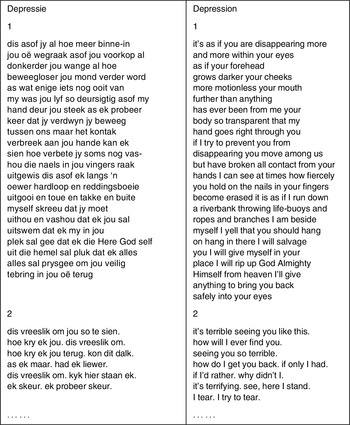
Figure 25.2: ‘Depressie 1’ and an extract from ‘Depressie 2’ by Antjie Krog with author’s English translation
There are a number of very interesting formal differences between the two ‘Depressie’ poems, which could be said to be linked to a difference between the two poems already discussed. ‘1’ has no punctuation at all, a bit like Eliot’s poem, but more strongly so, while ‘2’ has a full stop in every line, sometimes even more than one, making it similar to ‘Hawk Roosting’.This difference reflects similar emotions: ‘1’ represents a stage where the speaker still tries, but without much effect, to draw the beloved out of the swamp of his or her depression. This slow sinking, this inevitable falling away into nothingness, is well represented by the lack of sentence structure, the continuous stream of words, a stream that drowns all attempts at rescue: there is no stick, no life-buoy to hold on to. On the other hand, ‘2’ depicts the feeling of complete loss: the line between the speaker and the beloved seems completely severed. This impotence, this being torn apart, can be felt in the halting, broken-up lines. No sentence here is complete. The speaker is all alone. There is an unbridgeable distance between the two personae. This aloneness is well captured by the stone-like phrases, and thus, even though this is not seen as positive, it resembles the stony aloofness of the Hawk.
There is also a clear difference between ‘Depressie 1’ and ‘The Hollow Men’ in that in ‘1’ the situation of loss and emptiness is counteracted by very strong expressions of activity by the speaker. She or he (henceforth she) does not want to be sucked in, doesn’t want the beloved to be sucked in, so she tries with all her might to counter the situation. There is no lethargy, as there is in Eliot’s poem. This is clear from the very different type of verbs and clauses used by the speaker, and also from a difference in the use of sounds. In ‘1’, there are concrete, very physical verbs, such as hardloop (run-fast) and skreeu (yell) and telic, transitive verbs, such as uitgooi (throw-out), uitswem (salvage; literally ‘swim-out’; note the heavy use of telic uit ‘out’ – also in 13, 17, 20, all in initial position) and pluk (rip-up). The verbs depict the speaker’s fight and her energy (cf. the similar effect of this in the ‘Hawk Roosting’ poem), but at the same time, because they are couched in subordinate clauses (asof (as if)), they also show that the speaker does not advance, does not succeed. The sounds express strength too, there being an overload of plosives (I am looking at the last nine lines here, but they occur everywhere) such as /p/ (hardloop, pluk, prysgee), /t/ (repeatedly in uit-, toue, takke, buite) and /k/ (takke, skreeu, ek (four times), plek, pluk). This provides a clear contrast with Eliot’s poem, where the most regular consonants – considering only the first stanza, but the tendency continues throughout – are twenty-five liquids /l, r/, six semivowels /w/ and thirteen nasals /m, n, ŋ/, all representing the least forceful consonants.
The idea of being sucked in, as it were by a maelstrom, is expressed through the long clauses without a break, through the enjambments, through the heaping up of subordinate clauses one after the other, all of the same shape (asof), as if the speaker cannot get her breath, cannot stop. The first sentence streams on, it seems, as far as the middle of line 13: dis (it is) syntactically starts a new clause, with a new subject dis, but by using no full stop there, and by putting it in the middle of the line it is as if the sentence simply flows on. On a closer look, one can discern other sentences, but, as with the dis-sentence, they are hidden. Jou lyf (your body) also looks like a new subject, but since the clause has no verb, it is not truly a new sentence. Aan jou hande (from your hands) again starts a new clause, but here the fact that it is not itself a subject hides its structure. Similarly, die naels (the nails) starts a new clause but is semantically very narrowly linked to hande, making this new clause also less visible.
I have already noted the repetition of asof, introducing most subordinate clauses in the first thirteen lines of the poem. The repetition of dis asof divides the poem into two parts, the first part being a description of the gradual disappearance of the beloved (note words such as wegraak/verdwyn/uitgewis (disappear), beweegloser (more-motionless), deursigtig (transparent), verbreek (break-off)), while the second part, from line 13 onwards, describes the desperate attempts of the speaker to hold on to the beloved. Here the many subordinate clauses no longer start with asof (only the main clause does) – emphasising too, by the way, that the speaker cannot really accept reality yet – but with dat (that) (five clauses in all), as if to stress that these dat-clauses are still facts, real possibilities. Very effective is also the end of the poem: the lines chiastically refer to the beginning (ab–ba), circling the whole poem, emphasising the spiral, the maelstrom, from which there is no escape:
(a) te bring
(b) in jou oë terug
(b) binne-in jou oë
(a) wegraak.
Yet, paradoxically, they express a contrast: the speaker hopes to bring the beloved back into his eyes (te (bring) in jou oë terug), the eyes which she was disappearing into in the first two lines. The chiasmus makes clear that there can be no escape, that the speaker is trapped.
The two-part structure also becomes visible from the shift in the use of pronouns. Up to line 13, jy/jou (you) is the pronoun used most (twelve times, against only three occurrences of ek (I)), while in the second part, ek/my (six times) is more frequent, but still jy/jou occurs there too (five times). It shows a change of perspective. The speaker realises that the jou is disappearing, and all she has left is herself to cope with the situation. This also marks a sharp change when we look at ‘Depressie 2’. This is likewise divided into two halves: the first half runs to line 10; then we have two bridging lines, where jou and ek are closely combined; the second part then starts at line 13. In the first part we see eleven instances of ek as subject (once my), whereas jou occurs only four times, and all in object position. In the last part, we see jou/jy twelve times (first only as object, then also as subject), and ek/my only twice.
All activity is lost in ‘2’. This is clear from the fact that in the first half (of which only six lines are given here) we no longer encounter physical activity or telic verbs, as we did in ‘1’, and, when we do, they are framed by interrogative clauses introduced by hoe (kry ek) (how get I) (occurring nine times in the poem, four times line-initially) thus denying their effectivity. In the affirmative clauses we see copulas (dis in 1, 2, 5, etc.), or epistemic modal verbs (kon (could), [w]as, had (3, 4), or stative non-telic verbs kyk . . . staan (see . . . stand) (5)). The normally telic verb skeur (6) ‘tear’, has even been turned into a stative one by making it intransitive.
In the second half from line 12 onwards (not shown here) the speaker tries to force herself back into action by using a deontic modal (moet (must)) followed by affirmative dat-clauses, and by employing imperatives (wees (be)). The effect of the more active, factual dat-clauses is, however, counteracted in that they contain no verbs or lack essential syntactic arguments. And again as in ‘Depressie 1’, the poem ends with the same words but this time not arranged chiastically, but in a broken-up order: abc–bca, with the (a)-clause even broken up internally.
Some brief concluding remarks
We have seen that the three poems discussed often use similar syntactic iconic devices with the same effect, but they can also be given a different slant by the surrounding context, both the syntactic and lexicosemantic. Short clauses, and a preponderance of main clauses with full, end-stopped punctuation generally create a sense of aloofness, hardness or distance. That this is perceived as positive and powerful in the perspective of the ‘Hawk Roosting’, and as negative with a sense of loss in the case of ‘Depressie 2’ is related to the way it is combined with other syntactic devices, such as, for instance, ellipsis in ‘Depressie 2’. In a similar way the stative and missing verbs in the case of the ‘Hawk Roosting’ emphasise the power of the hawk’s (in)activity, whereas in Eliot’s poem they more straightforwardly foreground emptiness, the local difference being created by the use of animate subjects in Hughes’s poem versus mostly inanimate ones in Eliot’s. Similar verbs may get a different reading when they occur in main clauses rather than subordinate clauses, as we have seen in the use of concrete telic verbs which work positively and energetically in the main clauses in ‘Hawk Roosting’ but paradoxically emphasise the absence of achievement in ‘Depressie 1’ because they are confined to subordinate clauses. The same can be said for the use of negative elements. In ‘Hawk Roosting’, they affirm the hawk’s strength by negating the power of others, while in ‘The Hollow Men’ they enhance the layer of emptiness already pervasively present in its other forms.
I hope to have shown by this close analysis how looking at syntax, especially looking at the ‘misuse’ of syntax or the overuse of certain forms and patterns, helps to shape the meaning and impact of the poems.
26 Ethics
Introduction
Literature has long been recognised as having the potential to reflect, engage and influence our beliefs and values. Questions which are often asked of literary texts’ production and reception, such as: Why did the author write this? Should the characters have acted that way? What does this work mean? How do I feel about it? are all questions with ethical components (Schwartz Reference Schwartz, Davis and Womack2001: 3). Davis and Womack (Reference Davis and Womack2001: x) describe the study of literary ethics as a broad field incorporating a number of different perspectives. Some ethical criticism focuses on the life of the author or a literary work’s ethical content and status in society. These areas have been of particular interest in literary criticism, where ethical concerns have enjoyed renewed popularity recently (e.g. see J. Adamson et al. Reference Adamson, Freadman and Parker1998; Arizti and Martinez-Falquina Reference Arizti and Martinez-Falquina2007; Eskin Reference Eskin2004; Gregory Reference Gregory1998). Other forms of ethical criticism involve the close reading of a text and the situations it represents or consideration of the ethical experience of the reader ‘beyond the margins of the text’ (Davis and Womack Reference Davis and Womack2001: x). These areas are of particular interest within narratology and stylistics.
Some of the most significant work on the ethics of literature has been carried out by rhetorical narratologists such as Phelan (Reference Phelan1996, Reference Phelan, Davis and Womack2001, Reference Phelan2004, Reference Phelan2005, Reference Phelan2007a, Reference Phelan and Herman2007b; see also Booth Reference Booth1988 and Newton Reference Newton1995). Rhetorical approaches view narrative as a ‘multilayered event’ involving the establishment of relations among tellers, audiences and the story which is told (Phelan Reference Phelan and Herman2007b: 203). As they involve both emotions and values, these relations are viewed as inherently ethical.
Through narrative technique, readers are positioned in relation to the author, narrator, characters and audiences of a particular narrative, and these positionings influence and guide readers’ ethical and emotional experiences (Phelan Reference Phelan1996, Reference Phelan, Davis and Womack2001, Reference Phelan2005: 23; Rabinowitz Reference Rabinowitz1998). In his analyses, Phelan conducts close reading to examine how specific narrative techniques create ethical and emotional effects (e.g. see Phelan Reference Phelan, Davis and Womack2001, Reference Phelan2005). The approach taken in this chapter has affinities with Phelan’s, but while he is concerned with the development of narratological typologies, in this chapter I take a stylistic, cognitive poetic approach to the analysis of ethical positioning.
In general, stylistic frameworks are particularly useful for the detailed, systematic analysis of the representation of characters and events in literature. Ethical issues are implicit in stylistic analyses which examine the literary representation of marginalised groups, such as the work of Leech and Short (Reference Leech and Short2007: 162–6) and Semino (forthcoming) on the mind style of characters with learning disabilities, Gregoriou (Reference Gregoriou2011a) on the representation of criminal minds, and Mills (Reference Mills1995) on the representation of women in romance novels. Within the stylistic sub-discipline of cognitive poetics, the way stylistic features impact upon readers’ ethical experience is a key focus. The cognitive poetic framework Text World Theory (Gavins Reference Gavins2007; Werth Reference Werth1999) is particularly well suited to the examination of ethical issues in literary reading (Stockwell Reference Stockwell2009: 160), because it is concerned with tracing the interaction between textual worlds and readerly context. Literary texts are seen to present alternate world(s) for comparison with the world of a reader, and, drawing on the work of Phelan described above, the act of reading itself is also regarded as inherently ethical, because it involves the establishment of relationships between a reader and the entities (author, narrator, characters) represented in a text.
This chapter presents a Text World Theory analysis of two extracts from Never Let Me Go, a novel by contemporary British author Kazuo Ishiguro published in Reference Ishiguro2005. This novel is set in England in the 1990s (a counterfactual version of the past) and is narrated by Kathy, a 31-year-old human clone bred for organ harvesting. Like many of Ishiguro’s narrators, Kathy is primarily concerned with recounting and interpreting her life, and the novel details her childhood at a charity-run institution for clones called ‘Hailsham’, and her friendships and relationships into adulthood. The ethical dimensions of this novel have already received attention within literary criticism (e.g. Black Reference Black2009; Jerng Reference Jerng2008; Toker and Chertoff Reference Toker and Chertoff2008). Jerng, for instance, notes that the novel departs from the conventions of clone narratives and ‘foregrounds an ethical project to discover how cloning might change how we relate to each other’ (2008: 391). Ishiguro’s first-person style has also been recognised as ethically interesting in narratology (Phelan Reference Phelan2005: 31–65). I seek to contribute to these existing discussions of Ishiguro’s work with some detailed analysis of the language of this text and its influence on readers’ emotional and ethical experience.
I will begin by outlining some of the basic parameters of Text World Theory with reference to the opening of the novel. Then I will analyse ethical positioning in relation to an extract from the novel’s penultimate chapter. During my discussion I draw on my own introspective responses to the text in addition to the comments of reviewers and members of a reading group I recorded discussing the novel. Readers often report conflicting feelings about Kathy, which have interesting implications for the novel’s ethical effect, and I will examine the textual cues for these conflicts and discuss their influence on reader experience.
The text-worlds of Never Let Me Go
Text World Theory is a cognitive-linguistic model of human discourse processing, which views all instances of linguistic communication as presupposing at least two conditions. Firstly, they occur within a situational context, which is called the ‘discourse-world’; secondly, they involve a conceptual domain of understanding, which is jointly constructed by the producer and recipient(s), known as a ‘text-world’ (Werth Reference Werth1999: 17). These two levels and their interaction form the foundation of a text-world analysis.
The discourse-world must involve two or more human participants engaged in linguistic communication, and also incorporates all the perceptual, linguistic, experiential and cultural knowledge that these participants draw upon during discourse comprehension. In written communicative contexts, the reader and author typically do not communicate in a shared discourse-world, instead it is ‘split’ (Werth Reference Werth and Green1995: 54–5). This means that the text itself is the only means that readers have of reconstructing the communication between the author and themselves.
Text-worlds are the mental representations that participants form in order to comprehend linguistic communication (Werth Reference Werth1999: 87). They are conceptual or cognitive spaces that are constructed through the combination of linguistic cues and the participant’s knowledge and inferences (Werth Reference Werth1999: 7). Text-worlds are ontologically distinct, yet they share a structural similarity with the discourse-world in that they are spatio-temporally defined and contain entities, known as ‘enactors’ (Emmott Reference Emmott1997; Gavins Reference Gavins2007), and objects involved in situations. Text-worlds can be fleeting and undeveloped representations, but also have the potential to be richly detailed. Most discourse requires participants to imagine multiple, related text-worlds.
At the discourse-world level, Never Let Me Go features two discourse participants: Kazuo Ishiguro and a particular reader, but because the discourse-world is split, readers use the text to reconstruct communication between the author and themselves. Readers may imagine the author at the text-world level, as an ‘implied author’, and attribute some meaning creation to their mental representation of him. This is reinforced, I would argue, by the presence of textually deictic titles in the novel such as ‘Chapter One’ and ‘Part One’, which foreground an author’s organisation. Thus, upon opening the novel, readers may imagine fleeting and relatively undeveloped text-world containing the implied author (their imagined version of Kazuo Ishiguro). An implied author automatically implies the existence of an ‘implied reader’, who readers may imagine to be themselves.
The title-page of the novel reads ‘England, late 1990s’, and this cues the creation of another text-world, this time set in the past and in a particular country. As the main body of the narrative begins, this text-world becomes the main focus of the discourse and is richly detailed. The opening lines of the novel read:
Extract 1
My name is Kathy H. I’m thirty-one years old, and I’ve been a carer now for over eleven years. That sounds long enough, I know, but actually they want me to go on for another eight months, until the end of this year. That’ll make it almost exactly twelve years. . .
This establishes the presence of a first-person narrator who is ‘telling’ the story, and this automatically presupposes the existence of a narratee: someone who is being addressed (Prince Reference Prince1987; see also Lahey Reference Lahey2005; Phelan Reference Phelan2005). From this point on, Never Let Me Go establishes a series of text-worlds which are temporally remote from the discourse-world. Typically, readers assume that the world represented by the text operates in the same ways as the discourse-world until they are presented with information to the contrary. This is known as the ‘principle of minimal departure’, a cognitive mechanism for efficiency in understanding alternate worlds (Ryan Reference Ryan1991a; see also Emmott Reference Emmott1997: 129; Gavins Reference Gavins2007: 12; Stockwell Reference Stockwell2002: 96). At the novel’s publication in 2005, readers were likely to have lived through the 1990s and have some direct personal experience to draw upon when imagining the worlds of the text. However, several features of the opening of Never Let Me Go suggest this assumption of similarity may not wholly apply. For instance, Kathy describes herself as ‘carer’ who is in charge of looking after ‘donors’, without really explaining what these terms mean. As the novel progresses, it becomes evident that ‘carer’ and ‘donor’ are neosemes; words which exist in the discourse-world but have taken on a new, and in this case euphemistic, meaning in the context of the text-world (Stockwell Reference Stockwell2002: 119–22). Kathy works as a ‘carer’ for other clones who have begun donating their vital organs to medical science, and she cares for them until they eventually die (or ‘complete’). She will begin donations herself within a year. In this counter-factual version of the past, clones have existed since the 1950s and their organs have become staple supplies in medical science. The precise explanation of these terms and the existence of clones is only revealed slowly, around a quarter of the way into the book, and given further detail in the final chapters (Ishiguro Reference Ishiguro2005: 79–81, 251–67).
Through its representation of an alternate version of the 1990s, Never Let Me Go presents, for ethical comparison, an alternative state of affairs in which cloned humans exist. Furthermore, this entire world is represented through the eyes of a cloned narrator via fixed focalisation. Stockwell (Reference Stockwell2009: 162) notes that some novels have a ‘prototypically ethical reading’ which is highly preferred in their linguistic ‘texture’, and this is also the case with Never Let Me Go. Overall, the novel represents human cloning as undesirable and Kathy as a sympathetic character. Many reviewers and literary critics regard the novel as a contribution to bioethical debates and an illumination of the moral dangers surrounding cloning (e.g. Mirsky Reference Mirsky2006; Montello Reference Montello2005; Roos Reference Roos2008; Sim Reference Sim2006; Toker and Chertoff Reference Toker and Chertoff2008). It would be highly eccentric to reach the end of the novel seriously convinced that human cloning should be implemented immediately, for instance. But critics also regard the novel as more than just an anti-cloning narrative: Harrison (Reference Harrison2005), for instance, asks: ‘Who on earth would be “for” the exploitation of human beings in this way?’ The cloning scenario is seen by some as a useful setting for Ishiguro’s examination of more universal themes, such as the human condition in general. In such readings the plight of Kathy and the clones is seen as distinctly similar to the plight of everyday non-cloned humans: both facing a certain death and yet preoccupied with seemingly trivial day-to-day details (e.g. Harrison Reference Harrison2005; Montello Reference Montello2005; Robbins Reference Robbins2007; Roos Reference Roos2008; Toker and Chertoff Reference Toker and Chertoff2008).
Central to both these critical interpretations of the text is the question of the extent to which Kathy and the other clones are recognisably ‘human’, or ‘like us’. The message of the novel is dependent upon the establishment of relationships between the reader, the narrator, and a number of other textual entities. From a cognitive perspective, the ability to imagine another’s perspective (projection) and the comparison between oneself and another (identification or disassociation) are crucial in the novel’s meaning and effect. Below, I will argue that the language of Never Let Me Go can promote interesting and complex effects in this respect.
Ethical positioning in Never Let Me Go
Text World Theory draws upon a text-as-world metaphor which is fundamentally spatial. Worlds which depart from the discourse-world in time and space are conceived as more ‘remote’ than those which have more affinities with the immediate context of communication. Worlds which are created through the use of modality (e.g. It might work; I wish I was there) are also more conceptually remote, as their contents are unverifiable from the discourse-world (see Gavins Reference Gavins2007: 91–125). Human relationships and emotional and ethical issues are also often figured spatially. Expressions such as ‘we’re really close’ or ‘she’s being really distant’, for instance, draw on the ubiquitous conceptual metaphor EMOTIONAL RELATIONSHIP IS DISTANCE BETWEEN TWO ENTITIES (Kövecses Reference Kövecses2000; Stockwell Reference Stockwell2005: 148).
Recent work on emotional response within Text World Theory has capitalised on the notion that, during discourse, inhabitants of the discourse-world and text-world levels form relationships which can be thought of spatially. In the discourse of literary fiction, the positioning of the reader in relation to the other entities in the text-worlds is thought to be key in the creation of emotional effects and also in the ethical dimensions of a narrative (Gavins Reference Gavins2007; Lahey Reference Lahey2005; Stockwell Reference Stockwell2009; Whiteley Reference Whiteley2011a; see also Phelan Reference Phelan2005: 23). The reader’s position is influenced both by the personal traits, beliefs and values of an individual reader – the discourse-world ‘resources’ (Stockwell Reference Stockwell2009) which they bring to their interpretation of the text – as well as by the language of the text itself.
Positioning is typically achieved through processes of psychological projection and identification. Psychological projection is a development of the linguistic notion of ‘deictic projection’, which is the ability to shift one’s deictic centre from its anchorage in the ‘I’, ‘here’ and ‘now’ in order to create or comprehend certain linguistic expressions. For instance, when giving directions and uttering ‘Its on your left’, a speaker shifts their deictic centre into that of someone else (see Bühler Reference Bühler, Jarvella and Klein1982; see also Duchan et al. Reference Duchan, Bruder and Hewitt1995; K. Green Reference Green1995). In literary narrative discourse, which creates worlds that depart from the spatio-temporal parameters of the discourse-world, readers are thought to ‘take a cognitive stance within the world of the narrative and interpret the text from that perspective’ (Segal Reference Segal, Duchan, Bruder and Hewitt1995: 15). In Text World Theory, projection is understood as a process of cross-world metaphorical mapping between discourse-world participant and text-world enactor (Gavins Reference Gavins2007; Lahey Reference Lahey2005; Stockwell Reference Stockwell2009). This means that features of the reader in the discourse-world are thought to be mapped or transferred onto entities in the text-world during reading, and this establishes the relationships previously discussed. Stockwell characterises projection as part of the general human cognitive capacity for ‘taking one domain and mapping it onto another in order to gain access or understanding of the new domain’ (2009: 9; see also G. Lakoff and Johnson Reference Lakoff and Johnson1980). In other words, aspects of the readers’ ‘self’ become implicated in the text-worlds they create as they read (Kuiken et al. Reference Kuiken, Miall and Sikora2004).
I have argued elsewhere (Whiteley Reference Whiteley2011a) that psychological projection can involve varying degrees of mapping. At a basic level, a reader can project their sense of space and location into a text, and this facilitates the experience of immersion or engagement in a narrative (see Gerrig Reference Gerrig1993). A broader level of projection, which I have called ‘perspective-taking projection’, goes beyond this purely spatio-temporal anchorage so that other aspects of a particular entity’s perspective, including their world view, attitudes, emotions, goals and so on, are imaginatively reconstructed by the reader. Perspective-taking projection involves the mapping of particular human characteristics onto text-world enactors in order to flesh out their representation, and enables readers to treat text-world entities as ‘real’, life-like people (Gavins Reference Gavins2007: 42–3; see also Palmer Reference Palmer2004; Zunshine Reference Zunshine2006).
Processes of identification represent a further degree of psychological projection, which refers more specifically to the involvement of a reader’s ‘self-aware personality’ in the mappings between discourse-world and text-world (Stockwell Reference Stockwell2009: 88; see also Gavins Reference Gavins2007; Kuiken et al. Reference Kuiken, Miall and Sikora2004; Lahey Reference Lahey2005). Identification involves acts of comparison and recognition on the part of the reader in relation to a text-world entity. Readers may recognise aspects of their own experience, emotions or world view in characters, for instance, and identification can perhaps be seen as foundational in the development of empathy or sympathy for characters (see Keen Reference Keen2007; Sklar Reference Sklar2013; Stockwell Reference Stockwell2009). The strength of identification is dependent on the extent of the mappings between the reader and text-world entity. It is, of course, possible to compare yourself with others in a negative way – surmising that you are not like them – and I refer to this reverse identification as ‘disassociation’. It involves the same processes of comparison and recognition as identification, but with a distancing rather than connecting effect.
The text-worlds of Never Let Me Go contain a number of positions, henceforth referred to as ‘roles’, for readers to negotiate at the different communicative levels of the narrative (Lahey Reference Lahey2005; Phelan Reference Phelan2005). As noted above, conceptualising an implied author also involves the conceptualisation of an implied reader who is being addressed. Readers may project into this role to varying degrees (see Jeffries Reference Jeffries2001; Rabinowitz Reference Rabinowitz1998). The presence of a first-person narrator also evokes the role of a narratee. Readers will be positioned in relation to this first-person narrator and also the narratee role during their text-world construction. Finally, other characters in the narrative also provide possibilities for projection and identification. Thus, as Stockwell explains: ‘readers position themselves in different places relative to the minds they are modelling in the text world’, and these positions have both emotional and ethical implications, correlating with ‘the degree of support, acquiescence or resistance’ in the reading (Stockwell Reference Stockwell2009: 160; see also Phelan Reference Phelan2005: 18–23). In a novel such as Never Let Me Go, which is about what it means to be human, or how ‘human’ is defined (Black Reference Black2009: 785; Griffin Reference Griffin2009: 653–4; Jerng Reference Jerng2008: 370), these ethical positionings, which occur out of a projection from ‘self’ to ‘other’, take on further thematic significance.
Interestingly, reviewers, literary critics, and participants in a reading group who I recorded discussing the novel all express an interesting sense of partial-identification with and partial-disassociation from the protagonist Kathy. For instance, Robbins (Reference Robbins2007: 293) recognises similarities between himself and Kathy when he writes: ‘like Kathy, I depend for my daily dose of contentment on a blinkering of awareness’. Yet he also describes a sense of identification with the un-cloned which is ‘so deep as to make the reader wonder which side Ishiguro is on. And which side we’re on’ (2007: 293). Kerr (Reference Kerr2005) notes how ‘familiar’ Kathy’s childhood memories feel, and writes ‘it’s like a stripped down haiku version of children everywhere’ (2005: 1), but then expresses similar conflict when she remarks: ‘we root for Kathy – which is not quite the same as identifying with her . . . by definition she is personality challenged’ (2005: 2). In a generally negative review of the novel, Kermode (Reference Kermode2005) describes Kathy’s narrative style derogatively as ‘dear diary prose’ but acknowledges some experience of sympathy for her. And Black (Reference Black2009: 792) notes that the novel complicates our identifications with Kathy ‘in disturbing ways’.
Similarly mixed responses also featured in the reading group discussion about Never Let Me Go that I recorded as part of my investigations into the novel’s effects. In the extract below, three participants (A, C and E) are discussing the style and content of Kathy’s narrative – in particular her detailed recounting of quite trivial or mundane memories from her childhood, when the following exchange takes place:
Extract 2
A: . . . each time there was something like that Kathy would refer to ‘oh and when this happened’ and then tells a little tale of something happening and on most occasions you were kind of thinking ‘nothing really did happen’, it was all . . . kind of little events which seemed to be a big deal to her or to the people involved but were fairly kind of incidental events.
C: I suppose that’s what you remember though isn’t it, that’s the sort of things that I remember from my own childhood, little kind of stupid things when so and so said something to somebody else but it didn’t really mean anything.
E: That’s it, yeah, I thought that because it did remind me a bit . . . of the sort of stuff that you get obsessed about when you’re at school and you’d think was really important . . . I could probably think of some childhood memories I’ve got that are like she has when you have stupid arguments about hairbrushes or whatever, but you’d never sort of sit and tell someone about them would you, whereas she’s like a 31-year-old woman and she sort of thinks that’s an appropriate topic of conversation for a whole book basically (laughs)
The use of pronouns in Extract 2 and what they signal about the identifications which are being performed here are particularly interesting. For instance, in the utterances which are italicised (‘that’s what you remember though isn’t it’ and ‘the sort of stuff you remember when you’re at school’), participants C and E are using the second-person ‘you’ to express identification with Kathy. The second person functions to include the speaker, the other discussion group participants, and Kathy in the same group, as similarities between them are recognised (Kuiken et al. Reference Kuiken, Miall and Sikora2004). Participants C and E also explicitly declare their similarity to Kathy using the first person, indicated in bold (‘that’s the sort of things that I remember’, and ‘I could probably think of some’), which indicates close identification with the character. In the underlined utterances in Extract 2, however, the second-person pronoun is being used slightly differently: when Participant A says: ‘you were kind of thinking “nothing really did happen”’ and Participant E says: ‘but you’d never sort of sit and tell someone about them would you’. In these instances, the ‘you’ seems to express identification with a group of people which specifically excludes Kathy. The speakers identify characteristics of Kathy; namely, the opinion that trivial childhood memories are an important thing to discuss, which they cannot map onto themselves. Thus Participants C and E explicitly disassociate themselves from Kathy in these utterances. In fact, in the space of a single conversational turn, Participant E expresses identification with and disassociation from Kathy: she identifies with Kathy’s experiences of childhood but takes issue with her narration of such seemingly trivial memories.
I wish to argue that the language of Never Let Me Go contains features which both promote and problematise identification with Kathy and the clones and underpin the effects described by these readers. This complex positioning has interesting implications for the text’s ethical affect, because although the novel is ‘anti-cloning’, it also seems to prevent straightforward, close identification with Kathy, the cloned protagonist.
Positioning in the narrator–narratee roles
One interesting aspect of reader positioning in the novel occurs in relation to the narrator and narratee roles. As noted above, the first-person narrative at the opening of the novel (see Extract 1) presupposes the existence of a narratee who is being addressed. Lahey (Reference Lahey2005) argues that readers are likely to assume they are being directly addressed by a narrator, and project into the narratee role, unless textual cues indicate otherwise. But in Never Let Me Go, the identity of the narratee seems to fluctuate at different points in the novel, making it difficult for readers to maintain a stable position in relation to this role.
In the opening lines of the text, the presence of unexplained terms such as ‘carer’ and ‘donor’, and the mention of unfamiliar places and referents, suggest that Kathy assumes a certain degree of shared knowledge on the part of her narratee, which readers in the discourse-world do not possess. Indeed, until Chapter 8, Kathy often directly addresses the narratee (using the second-person pronoun ‘you’) as if they were a fellow clone and a graduate of an institution like Hailsham. For example, she says ‘I don’t know if you had “collections” where you were’ (Ishiguro Reference Ishiguro2005: 38) or, ‘I don’t know how it was where you were, but. . .’ followed by a fact about Hailsham, such as ‘at Hailsham we had to have some form of medical almost every week’ (2005: 13), ‘at Hailsham the guardians were really strict about smoking’ (2005: 67), ‘at Hailsham we definitely weren’t at all kind towards any signs of gay stuff’ (2005: 94). These textual cues suggest that Kathy is addressing a specific narratee who has a certain set of knowledge and experiences which a discourse-world reader does not share. Therefore, readers are likely to find it more difficult to project into the narratee role at these points in the text. While some readers may make attempts to ‘imaginatively enact’ the role of Kathy’s narratee, and ‘take on what he or she perceives to be the relevant schemata’ of that entity (Lahey Reference Lahey2005: 286; see also Black Reference Black2009: 790; Fludernik Reference Fludernik and Green1995; Jerng Reference Jerng2008: 390–1; Toker and Chertoff Reference Toker and Chertoff2008), others may instead feel shifted from a position of direct address to one of observation at a greater emotional or ethical distance (see Phelan Reference Phelan1996: 145–52, Reference Phelan and Herman2007b: 210). Either way, I would argue that in the moment of reading, a certain distancing or alienating effect is created as the reader adjusts their position in relation to a specific narratee whose identity differs from their own.
Elsewhere in the novel, however, it is easier for readers to project into the narratee role and feel directly addressed by Kathy. For instance, in the opening lines of the novel, Kathy introduces herself to her narratee, supplying them with her name, age and occupation. This creates the impression that she is addressing someone she doesn’t know, and when processing these initial sentences it may be quite easy for discourse-world readers to project into the narratee role (as they also have not ‘met’ Kathy before). This projection is also possible when Kathy makes more general attributions of thoughts or opinions to the narratee. For example, when attempting to justify her complicity in a joke designed to humiliate her friend Tommy, she addresses the narratee directly and says: ‘you’ve got to remember I was still young, and that I only had a few seconds to decide’ (Ishiguro Reference Ishiguro2005: 85). She also uses rhetorical questions such as ‘So why had we stayed silent that day?’ (Ishiguro Reference Ishiguro2005: 69) and ‘What was so special about this song?’ (Ishiguro Reference Ishiguro2005: 70), demonstrating an awareness of the narratee’s desire for particular details, which may or may not accord with those of the actual reader. Kathy is very attentive to the needs of her addressee, and often signposts her narrative with markers such as: ‘I should explain about. . .’ (Ishiguro Reference Ishiguro2005: 15) or ‘What I’m saying is. . .’ (Ishiguro Reference Ishiguro2005: 274). These forms of address contribute to the sense that readers are being directly addressed by the character at these points.
Throughout the novel, then, readers’ ability to comfortably project into the narratee role shifts depending upon the mode of address used within the narrative. I propose that this fluctuation can also encourage or problematise identification with Kathy the narrator, as readers feel closer or more distant to her act of narration. For example, when Kathy is describing her childhood at Hailsham she explicitly calls on the narratee to search their memories for experiences and emotions which may match hers, with utterances such as:
I’m sure somewhere in your childhood, you too had an experience like ours that day, similar if not in the actual details, then inside, in the feelings.
like a lot of things at that age; you don’t have any clear reason, you just do it . . . when you’re asked to explain it afterwards, it doesn’t seem to make any sense. We’ve all done things like that . . .
Here the reader is being invited to project themselves into the narratee role, and, by extension, imagine themselves in Kathy’s role too. The text also nominates aspects of the readers’ personal experience which should be compared with that of Kathy, promoting processes of identification. Whether identification is experienced is of course dependent upon the actual reader: their inclination, their personal memories, and their shared cultural knowledge about childhood. Another aspect of the text which facilitates identification with Kathy is the way information about the existence of clones is withheld from the reader until a quarter of the way into the novel. Toker and Chertoff (Reference Toker and Chertoff2008) argue that readers come to a slow realisation of Kathy’s cloned status in a way which mirrors Kathy’s own realisation of this in her childhood. They argue that this similarity between the experience of the reader and the experience of Kathy reinforces identification with the narrator.
Never Let Me Go encourages further complexity in positioning in relation to different versions (or ‘enactors’) of Kathy. For instance, in Extract 2 above, participants in the reading group discussion seem to be making a distinction between their response to two different enactors of Kathy. The first enactor, Kathy1, is the 31-year-old narrator who talks about her childhood memories. In doing so, she creates text-worlds which are set in the past (remote from the time of narration), and, within them, Kathy2, is the enactor which experiences that childhood. The reader remarks considered above seem to demonstrate close identification with Kathy2 through their shared childhood experiences, but disassociation from Kathy1 through their different perceptions of newsworthy material. This suggests that different enactors of Kathy are capable of attracting different levels of projection, identification and disassociation from readers, which adds further complexity to readers’ engagement with the narrative. At times, the language of the text appears to promote projection into the narratee role and identification with Kathy2, but the fluctuation of this narratee role, meaning that readers feel directly addressed at points in the narrative and distanced at others, may also work to promote a certain level of disassociation from Kathy1.
Positioning in the implied reader role
So far I have referred quite generally to the mode of narration throughout the novel and argued that textual cues encourage readers feel both close to and distant from Kathy the narrator, which has implications for their emotional and ethical responses to the text. In this section I will go on to discuss multiple projection in relation to a particular extract from the novel, broadening my discussion to include the level of communication between the implied author and the implied reader.
This extract comes from the opening of the third and final part of the novel. Though not a particularly climactic moment, it stood out as poignant in my reading of the text because it evoked markedly mixed emotions, and I will draw on my introspective experience of the text here. For me, this extract evokes both a sense of admiration for and affinity towards Kathy, coupled with a sense of underlying sadness and pity. I wish to argue that these mixed emotions are indicative of the complex projections involved imagining the text-worlds of the passage.
Kathy has been explaining the main features of her job as a ‘carer’, such as the long hours and exhausting travelling (the donors she cares for are kept in a number of centres across the country). She has also discussed the need for carers to keep their spirits up when their donors inevitably ‘complete’, and the solitude involved (carers do not work in teams). Throughout this description, Kathy sets herself and other competent carers apart from those carers who she believes cannot cope with the job. She explains that although she has suffered all the hardships of working as a carer, she has ‘learnt to live’ with them. She goes on to say:
Extract 3
(1) Even the solitude, I’ve actually grown to quite like. (2) That’s not to say I’m not looking forward to a bit more companionship come the end of the year when I’m finished with all of this. (3) But I do like the feeling of getting into my little car, knowing for the next couple of hours I’ll have only the roads, the big grey sky and my daydreams for company. (4) And if I’m in a town somewhere with several minutes to kill, I’ll enjoy myself wandering about looking in the shop windows. (5) Here in my bedsit, I’ve these four desk lamps, each a different colour, but all the same design – they have these ribbed necks you can bend whichever way you want. (6) So I might go looking for a shop with another lamp like that in its window – not to buy, but just to compare with my ones at home.
The text-world established at the beginning of the novel, containing Kathy and her narratee, still underpins the text-worlds created in Extract 3. There are further, multiple text-worlds created here through the use of modals (e.g. like, will, might), hypotheticals (if), negatives (not) and spatio-temporal shifts, which I do not have space to detail here (see Gavins Reference Gavins2007 for an overview of world creation, and Whiteley Reference Whiteley2010 for more detail about this extract).
More relevant to the present discussion is the way in which Text World Theory handles the knowledge and other discourse-world resources that readers utilise in their comprehension of discourse. Following established terms used in cognitive science and linguistics (e.g. Schank and Abelson Reference Schank and Abelson1977; Fillmore Reference Fillmore1985; G. Lakoff Reference Lakoff1987) Text World Theory regards participants’ knowledge as being organised into ‘frames’, which are collections of knowledge about a particular aspect of the world (such as people, objects, situations and events, and how they interact – see Stockwell Reference Stockwell2002: 75–90 for an introduction). Discourse-world participants have a potentially vast store of knowledge upon which they can draw, and Text World Theory focuses only on the knowledge which is cued as relevant for the particular discourse by the language of the text. For instance, when reading a novel by Thomas Hardy readers need only activate areas of knowledge which are specifically required by the text, such as those regarding farming in the nineteenth century, human relationships and the Dorset/Wessex countryside, for instance. Readers’ knowledge about football matches or how to reboot a computer will remain redundant (Gavins Reference Gavins2007: 29). Participants use their knowledge frames to flesh out their text-world representations with inferences (Werth Reference Werth1999: 148). In order to construct text-world representations of Extract 3, for instance, a reader’s knowledge frames relating to: driving, English motorways, English weather and provincial towns, desk lamps and window shopping become relevant, among others. As noted above, the perception of shared knowledge or experience is important in establishing relationships of identification between readers and textual entities, and in this extract the role of readers’ cultural knowledge is also significant in their ethical positioning.
In my interpretation of Extract 3, I experience quite close identification with Kathy the narrator. I recognise my own experience of driving in her descriptions here, and despite the fact that she uses quite vague expressions such as ‘the roads’, ‘the big grey sky’, ‘a town somewhere’ and ‘shop windows’ to describe her journey and the places she visits, I am able to draw on my rich knowledge of English roads, towns and weather (I have lived in England for my whole life) to imagine and recognise the scenes she describes. I also know exactly the type of desk lamps with ‘ribbed necks’ which she refers to (there is one on my desk as I type), and this also, however trivially, establishes a sense of recognition between me in the discourse-world and her text-world enactor.
For the majority of Extract 2, I also feel directly addressed by Kathy, suggesting that I can project into the narratee role here. Phrases such as ‘that’s not to say’ indicate that Kathy is shaping her narrative with an intended listener in mind, but further details regarding the identity of this listener are not specified. This projection into the narratee role is destabilised, however, by the introduction of deictic information ‘here in my bedsit’ in sentence 5, which again suggests shared knowledge (or perhaps a shared spatio-temporal location) between Kathy and her narratee. This has a distancing effect similar to the examples I have discussed above, and means my sense of identification with Kathy is not fully sustained throughout the passage.
So far I have discussed reader positioning in relation to the narrator and narratee, but this extract demonstrates the impact of positioning in relation to the role of the implied reader too. Readers’ projection into the role of the implied reader is highlighted here when there is a disjunction between the discourse-world knowledge frames evoked by the text and the content of Kathy’s text-worlds. For instance, the reference to a ‘big grey sky’ in sentence 3 fits in with my knowledge of typical English weather, facilitating identification with Kathy – but it also evokes a connection with my linguistic and cultural knowledge of the more commonly collocating phrase ‘big blue sky’. In my cultural knowledge, blue skies are viewed as having more positive connotations than grey skies (people who are sad or angry are said to be ‘under a black cloud’ for instance). Kathy is trying to present her day-to-day experience positively in this extract, but her mention of the ‘big grey sky’, with its bleak and depressing connotations, clashes with the positive attitude which she is expressing.
Another type of clash occurs at the end of Extract 2. In sentence 4 Kathy describes how she likes to go ‘wandering about looking in the shop windows’ in order to pass the time. However, Kathy’s view of window shopping, expressed in sentence 6, departs considerably from my cultural and experiential knowledge of this pastime. Window shopping tends to involve browsing for items which are both desirable and unattainable, perhaps due to cost or practicality. But Kathy is window shopping for a mundane household item, which she already possesses. There is a noticeable disjunction between my knowledge frames and Kathy’s representation of her activities here.
Both of these clashes suggest that the narrator and the narratee in the text-world do not share elements of my knowledge about grey skies and window shopping. This has implications for my ethical positioning, as it serves to highlight that the novel is a communication between an implied author and implied reader who do share cultural knowledge of the discourse-world. The sense of a conflict or clash here arises from my projection into the implied reader role.
My emotional and ethical experience of this passage arises from the amalgamation of positioning relative to multiple entities at the text-world level. My positive emotions and affinity towards Kathy seem to originate from my projection into the narratee role and identification with the narrator. But my sense of sadness and pity seem to be associated with my projection into the role of the implied reader, as the cultural knowledge I share with the implied author allows me to recognise Kathy’s poverty, misery and restricted world view. Though projection into the implied reader role creates a disassociative ‘pull’ which undercuts identification on other communicative levels, it also serves to reinforce the novel’s ethical ‘message’ about the undesirability of cloning, because in my experience it serves to maintain the distance which enables sympathy towards Kathy (Sklar Reference Sklar2013; Stockwell Reference Stockwell2009).
Through the above analyses, I hope to have demonstrated that readers’ complex state of partial-identification with and partial-disassociation from Kathy can be explained to some extent by the multiple positions which readers are encouraged to adopt by the language of the text. These positionings have ethical implications as they impact upon readers’ response to the events and characters represented within the text. Rather than being able to view Kathy as uncomplicatedly like yourself, the novel promotes a more sophisticatedly nuanced positioning in which the notion of what it means to be human can be explored.
Conclusion
In this chapter I hope to have shown that even macro-linguistic issues such as ethical experience can benefit from close, stylistic attention to the language of a text, and detailed consideration of the experience of readers. The idea I have proposed here – that readers can simultaneously experience both identification and disassociation due to the influence of various textual features in a particular moment of reading – actually presents a challenge to more established stylistic assumptions about distancing or estrangement in narrative. For instance, first-person narration is often thought to make readers feel closer to the characters (Leech and Short Reference Leech and Short1981: 275). And Simpson’s (Reference Simpson1993) modal grammar claims that narratives with a preponderance of epistemic modality, such as Never Let Me Go, have an estranging and alienating feel (Simpson Reference Simpson1993: 53, 75). My claim regarding the subtle and sometimes contradictory influence of textual features over readerly positioning adds a greater cognitive complexity to these grammatical models. It also problematises the tendency within stylistics to categorise the experiential ‘feel’ of a text based solely upon its linguistic features, without a detailed consideration of readers in interaction with those features. Cognitive poetic approaches have the potential to extend our understanding of how ethical meaning and experience are created in literary discourse.
27 Fictionality and ontology
Introduction
‘The struggle to define fictionality’, Punday (Reference Punday2010: 55) claims, ‘is an inherent part of the institutional construction of contemporary writing’. What he means by this is that the proliferation of the fictive in contemporary society, including ways in which the real itself is narrativised, makes the distinction between reality and fiction rather fluid. In his words, ‘the traditional institutional and disciplinary boundaries separating news and entertainment, fiction and politics have become blurred’ (2010: 11). Such enhanced permeation between actuality and virtuality in literature and culture makes fictionality a central issue for contemporary stylistics and narratology.
The focus of this chapter is a Text World Theory analysis of Ulrike and Eamon Compliant by Blast Theory, a group of artists who create stories using interactive media. Ulrike and Eamon Compliant is a mobile narrative, a genre hitherto unexplored in stylistics. Since participants engage with the story through mobile technology, the boundary between fiction and reality becomes increasingly convoluted.
Fictionality: style, ontology and readers
To consider fictionality using a stylistic method, it would be tempting to offer a taxonomy of linguistic features that mark a text as fictional. This is, in many ways, the approach taken by the narratologist Cohn (Reference Cohn1990, Reference Cohn1999), who places linguistic style at the centre of fictionality. In a 1990 article, Cohn contrasts fictional narratives with historical narratives through the examination of three criteria: levels of narrative (story and discourse), narrative situations (voice, mode, and point of view), and narrative agents (authors and narrators). Cohn concludes that there are qualitative differences in the form of generic features, for instance privileged access to characters’ thoughts is a typical attribute of fiction.
Studying linguistic markers alone, however, would be a flawed approach, as Prince (Reference Prince1991) points out. He claims (Reference Prince1991: 546) that classical narratological investigations have been too text-driven and should instead consider truth values:
I could, after all, begin a biography of Napoleon or Richelieu (entirely consonant with the truth and written for children or intended to highlight the legendary nature of characters) with ‘once upon a time.’
Prince advocates instead a modal logic or possible worlds model (Ryan Reference Ryan1991a) in which propositions are validated according to their truth conditions in relation to the fictional world(s). This therefore enables a spatialised ontological map of fiction(s).
Presenting disparate though not entirely polarised views, both Cohn’s stylistic ‘signposts of fictionality’ and Prince’s call to arms in the consideration of ontological spaces are useful for the stylistic analysis of fictionality, yet even together they still present an incomplete picture. In theorising fictionality, both approaches neglect the contextual interpretations of a reader or receiver of narrative. Working in the reader-response school of criticism, it is unsurprising that it is this readerly aspect of the fictional process that most interests Iser. In The Fictive and the Imaginary, he states:
The literary text is a mixture of reality and fictions, and as such it brings about an interaction between the given and the imagined. Because this interaction produces far more than just a contrast between the two, we might do better to discard the old opposition of fiction and reality altogether, and to replace this duality with a triad: the real, the fictive, and what we shall henceforth call the imaginary. It is out of this triad that the text arises. . .
For Iser, then, it is from the interaction between fiction and reality that the imagined world(s) of literary narratives emerge. A text is constituted through what he calls ‘fictionalising acts’. There are three varieties: selection, combination and self-disclosure. Selection is concerned with setting the parameters of the text in social, historical, cultural and literary terms – selecting in other words from referential reality and literary compositional systems; combination is the organisation of the text into linguistic and semantic patterns, while self-disclosure occurs when the text reveals its own fictionality. All of these processes involve the crossing of boundaries (in terms of the ways in which they extend beyond the limits of fiction).
While Iser’s approach draws on literary anthropology, it offers a valuable precedent to contemporary narratological and stylistic accounts of fictionality. Iser’s triad is particularly important since it considers the relationships between fictional, actual and reader-centric imaginary as well as gesturing towards the potential impact of this imagined world on the reader.
As the next section makes clear, the reader is at the heart of contemporary stylistic analyses of fictionality. These are interested in how the reader creates fictional text-worlds from the compositional fabric of the text, including integrating information from the actual discourse-world (style and cognition); how the reader experiences the landscapes of fictional text-worlds including the division between actual and virtual (ontology); and how the reader engages with characters in fictional text-worlds (psychological projection).
Metaleptic crossings and a stylistics of engagement
Stylistics has always been concerned with readers, but the growing interest in fictionality may, in part, be understood as a consequence of the increased fusion between fictive and real in contemporary narratives, discussed in the opening to this chapter. The idea of a ‘semipermeable membrane’ (McHale Reference McHale1987: 34–5) between the actual discourse-world (reality) and the reader’s text-world (in fiction) underlies many stylistic accounts of fictionality. Linguistically, this has often meant a consideration of narrative address, particularly metaleptic second-person address from a fictional text-world enactor to the reader in the discourse-world. Working within Text World Theory, Gavins (Reference Gavins2007) argues that second-person address leads to one of two possibilities: if the reader shares the characteristics of the ‘you’ described in the novel, they may process the narrative assertions as being directly addressed to them. Thus, ‘the text-world entity who is using the second-person pronoun to address the reader transcends the ontological boundaries of the text-world in order to enter the reader’s half of the split-discourse-world’ (2007: 85). However, readers may not identify with ‘you’ (either because the ‘you’ is not a descriptive match for the reader or through the reader’s deliberate resistant reading) and as such engagement is one of projection into the second-person deictic centre without assuming a self-identical persona. More recently, Whiteley (Reference Whiteley2011a) has proposed three forms of narrative projection into addressee or character roles which develop in terms of the degree of a reader’s psychological involvement: deictic projection, based on the linguistic mechanics of the text and involving a reader’s deictic shift into the spatio-temporal parameters of the text-world; perspective-taking projection, in which a reader also fleshes out characters through the attribution of psychological characteristics; and self-implication or identification, whereby readers implicate their own personalities into the addressee or character role and thus their sense of self is involved in trans-world mapping between the actual discourse-world and fictional text-world.
David Herman’s (Reference Herman2002) theory of contextual anchoring is also concerned with second-person narrative address. He suggests that, in some cases, narratives may offer concurrent deictic projections that are at once distinct and multiplex. He writes:
Contextual anchoring is my name for the process whereby a narrative, in a more or less explicit and reflexive way, asks its interpreters to search for analogies between the representations contained within the two classes of mental models [the story world and the reader’s actual world].
Contextual anchoring is a cognitive process, triggered by the linguistic composition of the text, whereby the space-time parameters of the fictional text-world and the space-time parameters of the discourse-world in which reading takes place are seen to be simultaneously referenced and thus appear to coincide. In Herman’s doubly deictic you, second-person address signals two deictic referents at once: a ‘you’ character internal to the fictional text-world and a ‘you’ external and thus present in the actual discourse-world. Such double referentiality blurs ontological clarity between fictional and actual, text-world and discourse-world, character and reader, leading to complex projection relations. In terms of psychological engagement then, projection relations with doubly deictic ‘you’ cannot be neatly classified. Readers self-implicate into the ‘you’ role which they feel apostrophically addresses them while also experiencing degrees of deictic projection, perspective-taking projection or indeed further self-implication, depending on their psychological engagement with the character in the context of the textual moment.
Multimodal, multimedial and hypertext fictions engender not only forms of psychological projection such as those encouraged by second-person address, but also actualised and physical responses from reader-users (see Alice Bell and Ensslin Reference Bell and Ensslin2011; Ensslin and Bell Reference Ensslin and Bell2012; Gibbons Reference Gibbons2012a, Reference Gibbons2012b). My own work, for instance, has considered the way in which multimodal and multimedial texts create double deixis when readers are required to perform concrete activities that are subjectively aligned with the actions of characters in the text-world. Such subjective resonance between text-world and discourse-world referents involves a similar superimposition in the form of doubly deictic subjectivity. Moreover, performative activity on the part of reader-users may create what I have called a figured trans-world (Gibbons Reference Gibbons2012a) in which trans-world projection occurs between reader and character through an embodied and enactive resonance.
Breaches of the semipermeable membrane between fiction and reality, text-world and discourse-world, are ultimately illusory. The ontological planes of each remain intact, yet it is in the realm of the imaginary, in the reader’s experience of the narrative, that the stylistics of fictionality shows up the complexity of reader-users’ projection relations and the ways in which these may lead to a powerful sense of psychological involvement. To demonstrate, in this chapter I present a Text World Theory analysis of a contemporary mobile narrative, with a particular focus on deictics.
Blast Theory’s Ulrike and Eamon Compliant
Blast Theory’s Ulrike and Eamon Compliant is a mobile narrative and a form of art installation: within the context of a city, participants are guided through the streets as the narrative unfolds. As in mobile narratives generally (see Raley Reference Raley, Scäfer and Gendolla2010), communication is, for the most part, unidirectional. Through a mobile phone, a narrative voice addresses and instructs participants, although responses are required at key points. Discussing the innovative nature of mobile narratives, Benford et al. (Reference Benford, Crabtree, Reeves, Flintham, Drozd, Sheridan and Dix2006: 427) state, ‘Mobile experiences that take place in public settings such as on city streets create new opportunities for interweaving the fictional world of a performance or game with the everyday physical world.’
There are two key aspects of mobile narratives that are of interest in the stylistic analysis of fictionality. Firstly, since mobile narratives take advantage of the immediacy of spoken discourse and take place in real time and in real-world locations (e.g. city streets), the context in which the narrative is received is used as the backdrop or as a world-building element for the text. Secondly, the participant is not only the receiver of second-person direct address during mobile phone calls, they are required to respond physically (e.g. by following instructions). As Raley (Reference Raley, Scäfer and Gendolla2010: 303) puts it, ‘Participating in a mobile narrative is . . . precisely that – physical participation that is also understandable as performance.’ Raley’s choice of the word ‘performance’ here is particularly telling, since it implies that while psychological engagement with literary narratives is understood in stylistics through the metaphors of readerly TRANSPORTATION and PERFORMANCE (Gerrig Reference Gerrig1993), mobile narratives actualise such metaphors in ways that make projection relations between discourse-world participants and text-world enactors considerably involving, in terms of the degree of self-implication. As such, the very nature of Ulrike and Eamon Compliant as mobile narrative suggests that David Herman’s (Reference Herman2002: 345) notion of contextual anchoring is at play with an ‘ontological interference pattern’.
Ulrike and Eamon Compliant was originally commissioned for the 53rd Venice Biennale in 2009 and later taken to the Seoul International Media Art Biennale in 2010 and the international Sheffield Doc/Fest in 2011. (While the published script for the work refers to its original production, having participated in the mobile narrative during Doc/Fest any self-reflexive comments made during analysis are in reference to my own experience of the work in Sheffield). It is structured as a series of telephone calls that lead participants through the city, addressing and engaging them in the second person and as a character in the narrative. There are two possible narratives, ‘Ulrike’ and ‘Eamon’, both based upon the real lives of two terrorists. The Ulrike narrative tells the tale of left-wing German radical Ulrike Meinhof, a leading member of the Red Army Faction committing various bank raids, shootings and bombings; the Eamon narrative focuses on IRA member Eamon Collins who, upon arrest and interrogation in 1982, gave details of IRA operations to the state, which he later retracted. While the two narratives differ in terms of character and content, over a 30-minute series of eight or twelve calls (depending on a choice made by the participant at a key narrative fork) they are structurally alike and therefore contain some overlapping text. In order to experience Ulrike and Eamon Compliant, participants must first choose between Ulrike and Eamon.
Call 1: Are you Ulrike or Eamon?
Starting Ulrike and Eamon Compliant, participants are given a mobile phone and must press the call button. A voice asks, ‘Are you Ulrike or Eamon?’ and gives the instructions to dial 1 for Ulrike or 2 for Eamon. This determines the choice of narrative and the character as whom the participant will be addressed. They are then directed out onto the streets; once they reach the instructed destination, they must call the narrator back. In the Ulrike narrative, the narrator answers ‘Hallo Ulrike, thanks for coming’, while Eamon’s narrator utters, ‘Hallo, it’s me’. In both texts, the narrator continues (Blast Theory 2009: 10 and 23):
You and I are going on a walk together but before we start, let’s take a minute. Now stand in the middle of the bridge and turn to look at the church towers. Can you see them? If you can see them nod your head slowly.
Both narratives open with direct and immediate deictics. The fictional text-world is aligned with the discourse-world of the participant through definite spatial references (‘the bridge’, ‘the church towers’) that relate to the city in which the mobile narrative is taking place, and temporally through present tense (continuous and simple) and the adverb ‘now’. Similarly, a sense of intimacy is quickly established with the pairing of the interpersonal pronouns in the construction ‘You and I’ and the adverb ‘together’. A metaleptic illusion is therefore created in which the narrator appears to transcend the semipermeable membrane of the fiction in order to talk, via mobile phone, with the participant. Moreover, the deception of a shared world-space between narrator and participant is heightened in the question ‘Can you see them?’ and the conditional directive ‘If you can see them nod your head slowly.’ The implication of the latter statement is that the narrator is in fact observing the participant and their actions. Participants who fulfil the directive by nodding are psychologically adopting the (false) premise of shared world-space. It is the first of many occasions throughout Ulrike and Eamon Compliant in which performative actions promote the participant’s self-implication with ‘you’ and increasingly with Ulrike or Eamon also.
After this psychologically involving aperture, the narratives diverge briefly in terms of content, both providing biographical introductions to the main characters Ulrike or Eamon. In Eamon’s narrative, the narrator instigates a deictic shift: ‘Outside it’s 1973, dark, cold. It’s late and the young man has been drinking with friends. He’s a legal student and is back home on the farm for the Easter break’ (p. 23). The participant’s psychological involvement with narrative and character becomes more distal across temporal, spatial and perceptual deictic fields: it is a temporal shift into the past (1973), a spatial shift to a rural landscape in which the point of view is disconnected from the narrative action which is happening ‘outside’, and a perceptual shift from second- to third-person address with the introduction of ‘the young man’. Alongside these deictic shifts, readers are thus moved from self-implication with ‘you’ to deictic projection into this scene. Despite the temporal shift to 1973, the narrative is in present-perfect continuous (‘has been drinking’) and present tense, maintaining a degree of immediacy. This is important since, as the narrative continues, the deictics become increasingly proximal: ‘You know what lawyers can be like, right? Priggish little fools, some of them. This one smokes a pipe if you don’t mind. Oh, you know the type alright. You know this one’ (p. 23). Second-person address returns, reconnecting narrator and participant. The colloquial register (rhetorical question, relational deixis, conversational collocations) suggests an intimate knowledge about ‘you’ on the part of the narrator. Moreover, the utterance ‘Oh, you know the type alright. You know this one’ implies that that ‘the young man’ is well known to ‘you’, that in fact it is ‘you’. The narrative resumes, ‘You walk up the street toward the door or the house. One hand on the latch and you see. . .’, thus marrying the deictic co-ordinates of ‘the young man’ with a textual ‘you’.
The effect of these deictic shifts from distal narrative to a narrative adjacent with ‘you’ is to encourage the participant’s identification with ‘you’ as Eamon (though, at this point, projection is likely to involve perspective-taking). Similar linguistic strategies are employed in Ulrike’s narrative. Ulrike and Eamon Compliant, therefore, initially enables self-implication through contextually anchoring the discourse-world as setting for the prominent text-world. The introduction of the main characters, however, starts distally yet is increasingly brought closer to the ‘you’ in order to aid the participant to project not only into an apostrophic ‘you’ role (as in the beginning) but to also accept the deictic and psychological positioning of the ‘you’ character of Ulrike or Eamon.
In the first telephone call, Blast Theory has one more tactic to secure the participant’s psychological engagement with character. In both narratives, Call 1 ends in the following way:
As everyone moves past you as you stand on the bridge, I would like to know how you describe your ability to make decisions. Are you a decisive or a hesitant person Ulrike/Eamon?
Now please record your answer. Start by saying ‘My name is Ulrike/Eamon’ and then tell me, are you a decisive or a hesitant person?
When you have finished your recording, hang up. I’m going to start recording now.
In deictic terms, the spatio-temporal co-ordinates are returned to the participant’s here and now, on the bridge, yet they continue to be addressed not only in second person but as Ulrike/Eamon. The act of speaking and recording is significant in terms of participant engagement. The initial act of nodding the head was a performance which signalled the acceptance of shared world-space, contextually anchoring the prominent fictive text-world within the participant’s discourse-world reality. The act of recording takes such contextual anchoring even further through a performative act that signals the acceptance of a trans-world identity: the participant identifies with and self-implicates into the character role. They must utter, ‘My name is Ulrike/Eamon. I am a decisive/hesitant person’. The first assertion (‘My name is Ulrike/Eamon’) is a locutionary act that marks the participant’s adoption of the character, while the second (‘I am a decisive/hesitant person’) enables the participant to map their own subjective personality traits onto Ulrike or Eamon. Thus while the biographical narratives instigate world-switches, such switches occur as definite temporal and spatial shifts. Perceptually, the reader is involved in a gradual strengthening of projection relations with Ulrike/Eamon, from deictic to perspective-taking to a doubly deictic self-implication whereby they maintain their own identity as ‘you’ in the discourse-world and psychologically integrate it with ‘you’ as Ulrike/Eamon of the text-world.
The participant’s verbal utterance as a performative act signals trans-world identity and double deixis through the phenomenological conflation of ‘you’ as participant in the discourse-world in which Ulrike and Eamon Compliant is taking place (e.g. Venice, Sheffield) with the ‘you’ character of Ulrike or Eamon in the story world. It therefore works to generate what I have called a figured trans-world (Gibbons Reference Gibbons2012a: 79–80). A figured trans-world emerges when a participant’s performative actions in the discourse-world map onto characters in the text-world and are indicative of active involvement. Such acts are concrete performances that create subjective resonances with characters and blur the boundaries between text- and discourse-world.
By saying ‘My name is Ulrike/Eamon. I am a decisive/hesitant person’, the participant effectively enters into a contract with Blast Theory. They commit to the narrative and to positioning themselves double deictically as Ulrike or Eamon. They maintain their own identities in the discourse-world walking around the city while simultaneously accepting the Ulrike/Eamon identity. The semipermeable membrane between fiction and reality in Ulrike and Eamon Compliant is exactly that – semipermeable. Text-world and discourse-world appear to have been compressed and the ontological distinction is troubled in experiential terms.
Calls 2–3: I see you; who do you see?
After an initial greeting, the second phone call starts with walking directions and the narrator assuring participants, ‘I’ll stay on the line while you walk’ (pp. 11 and 25). The notion that the narrator has the participant in eye-line is sustained with the instructions, ‘Keep your eyes open, act natural’. Both narratives in phone call 2 offer details of an act of insurgence. In Eamon’s narrative, it is the 1981 murder of Major Ivan Toombs of the Ulster Defence Regiment, which Eamon Collins was directly responsible for planning; in Ulrike’s narrative, it is a violent protest against the Shah of Iran outside the Berlin Opera House in 1967.
The stylistic construction of Ulrike’s tale is particularly interesting since, while a deictic shift occurs into Ulrike’s past, the narrator’s words simultaneously serve to remind the participant of their discourse-world location. The narrator relates:
I see you in the crowd at the Opera House when the Shah visits. I see you behind the police and Iranian Secret Agents. The Shah and his wife go inside. Within seconds, the Iranians turn on you with long wooden clubs and start to smash heads. Blood flows while the cops stand and do nothing. And when they finally rouse themselves they don’t help: they join in with smashing the demonstrators. I see you split and run with the others. I see the policeman draw his pistol. I see Benno Ohnesorg shot in the back of the head from half a metre away. . .
The repetition of the phrase ‘I see you. . .’, and later ‘I see. . .’ at the violent climax of the narrative, functions on one hand to suggest the vivacity of the (supposedly shared) memory. However, it also works to foreground the participant’s self-awareness: can the narrator really see them? Blast Theory collected participant feedback from Ulrike and Eamon Compliant on their microsite and many of the comments demonstrate that suspicion about being under observation is a significant part of the experience. Several comments mention ‘paranoia’ while one participant admits, ‘I felt watched constantly.’ Such responses suggest that a sense of surveillance in mobile narratives may serve to make the experience psychologically intense in terms of heightening their self-consciousness in the discourse-world context.
At this point in Call 2, the participant is faced with a decision. The narrator states, ‘Now if you want me to carry on just stay on the line. But if you want to take a different turn hang up now’ (pp. 11 and 25). In Ulrike’s narrative, the narrator underlines this, ‘Right now’. In Eamon’s narrative, the narrator instead says, ‘I’m going to count to ten. If you are still on the line when I get to ten then I’ll know where I stand.’ The counting, however, additionally narrates the violent climax to Eamon’s tale of Major Toombs’s murder:
- One:
the two killers ride into Warren point on a motorbike.
- Two:
they switch the engine off allowing the bike to glide the last 20 metres so as not to raise the alarm.
- Three:
once inside, Iceman goes down the corridor into Toombs’ office.
- Four:
he takes up a firing position with arms outstretched.
- Five:
his gun jams giving Toombs enough time to reach for his own weapon.
- Six:
Iceman leaps onto him and the two men struggle.
- Seven:
The second gunman comes running down the hall and shouts ‘Stand back.’
- Eight:
Iceman lets go and the second man fires several shots into Toombs.
- Nine:
Iceman clears his weapon.
- Ten:
he pumps several more rounds into Toombs as he lies dying.
The participant must choose whether to stay on the line or to hang up either immediately after (Ulrike) or during (Eamon) a violent description. Their decision therefore becomes somewhat loaded, since it appears to imply either acceptance of the act or condemnation. For participants who stay on the line, the narrator responds, ‘Ok I understand. In which case, you and I can speak freely’ (pp. 11 and 25). As such, this decision suggests complicity on the participant’s part with Ulrike or Eamon as characters and with their actions. It is, in other words, another performative act that binds participants psychologically closer to characters. Moreover, the detail in both narratives in terms of world-building elements and function-advancing propositions point to the fact that these accounts are stylised representations of real-world events. Not only does this add a further sense of slippage in terms of the narrative’s fictional status, it adds sombre weight to participants’ potential connivance with the actions of Ulrike Meinhof or Eamon Collins.
There are two different versions for Call 3 of each narrative, differing only in opening depending on whether participants previously stayed on the line or hung up. Unbeknown to participants, then, their decision makes very little difference. Crucially in terms of narrative engagement, the act creates a false impression of control – that the participant is empowered and their actions have some bearing on the narrative. This is important since it makes Ulrike and Eamon Compliant seem more of a dialogue than it actually is. Participants who continued to listen receive assertive greetings (pp. 12 and 26):

Both greetings exhibit strong epistemic certainty on the part of the narrator, through the use of categorical assertions and epistemic verbs (‘know’, ‘think’). Coupled with the sense of compliance felt by the participant having stayed on the phone, the narrator’s words suggest confidence in the participant as Ulrike/Eamon. Alternatively, participants who hung up hear the following (pp. 12 and 26):

Again, both narratives have similar functions. Both start with acknowledgement of the participant’s choice and both aim at emotional provocation. The rhetorical questions ‘That’s why we’re here isn’t it?’ and ‘Second thoughts, eh?’ both imply that, by hanging up, the participant made a cowardly choice, attempting to hide from a truth that they need to confront.
At the end of Call 3, the narrator commands (pp. 12 and 27):
Now I want you to pick a person as they walk past you. Choose someone and give them a name. Look carefully at them before they go. Now think about their home. Think about a treasured possession that they may have on their shelf.
Who is it that they love? Stare down at the canal and hold that person in your mind for a short while.
In this series of directives, the narrator asks participants to imaginatively construct a narrative for a passing stranger. It is an act of perspective-taking by which the participant’s empathy for the stranger is evoked through the personal investment of subjective imaginings. Creating an identity for the stranger begins with the act of naming and through the imagining of concrete objects (home, treasured possession, their loved ones). The reference to ‘their home’ creates a deictic shift whereby the participant moves in imaginative terms from the city streets into that person’s home. In my own experience of Ulrike and Eamon Compliant, this moment was very powerful. The deictic shift into their home felt almost like a breach of personal space. Moreover, the prepositional phrase ‘on their shelf’ offers specificity (although hedged with the epistemic modal ‘may’) to the treasured possession, making such imaginings seem strikingly vivid and thus more real.
This exercise of make-believe is another of Blast Theory’s tactics to evoke empathy from participants. The group has already exploited your feelings of identification and compassion with their central characters. Here, they offer only guidance: it is the participant’s own subjective storytelling which creates the felt sense of subjective connection. Indeed, this layering of empathetic relationships is deliberate. As artist Matt Adams admits in interview (Reference Adams2009):
How attuned and sensitive can you be to the people around you in the world without losing a sense of focus or perspective? If you’re able to empathise with a dictator or a mass murderer, at what point does that blur your ability to discriminate and think clearly?
Psychological engagements such as this act of perspective-taking projection with a stranger in the real world show up the fragility of fictionality and of the border between fiction and actuality. The imaginary identities of these strangers are no more real than those of characters in a novel. Yet, for participants, the personalisation of this act makes the subjective experience startlingly sincere and affecting.
Call 5: What is it that you can do?
In Call 5, the narrator warns: ‘In a moment, I’m going to ask you to make a recording for me’ (pp. 14 and 29), after which the participant hears another tale from Ulrike or Eamon’s past, both of which feature situations in which the characters are forced to contemplate how their actions can be used for the progression of their causes. The narrator then says:
Now you need to tell me this: as you sit looking at the windows and the alleys, what is it that you can do right now for the people around you? Don’t be shy; it’s a question we all have to answer from time to time. And today, here on this bench, it’s your turn. What can you do for the people around you?
When you have finished your recording, hang up. There’s no rush at all.
I’m going to start recording now.
Deictically, the narrative has shifted back (Ulrike was in Frankfurt, Eamon in Northern Ireland) to the participant’s discourse-world with the repetition of the temporal adverb ‘now’, definite spatial references (‘the windows’, ‘the alleys’) and the locative adverb and prepositional phrase ‘here on this bench’. Recording the message, though, raises questions as to exactly who the participant is supposed to speak as – themselves or Ulrike/Eamon? Indeed, in my own response, I found myself using emotive and politically charged lexis (such as ‘freedom’) not dissimilar from that I’d been hearing throughout the narrative. The tactics employed by Blast Theory have had a powerful effect. They have created a doubly deictic alignment so strong that it becomes difficult to divide the text-world and discourse-world identities of ‘you’. In making the recording, participants are therefore both speaking as themselves, through self-implication with the ‘you’ of the text-world that has been contextually anchored in the discourse-world, and as Ulrike/Eamon through either perspective-taking projection or further self-implication. Contextual anchoring, the participant’s actualised responses, and the creation of a figured trans-world have ultimately worked to problematise the participant’s recognition of the narrative’s fictionality. In experiential terms, the division between their discourse-world and text-world identities appear to have collapsed; the deictic positioning from which they speak as they record their message is double.
Calls 7+: Now you need to make a very important choice
Call 7 provides the central deciding moment for participants in terms of how the narrative will end. The narrator urges:
Now you need to make a very important choice. You can head for the room where questions get asked. Or you can take the easy way out and head home. . . .
If you hang up within the next 30 seconds then I will know that you have taken the easy route and are ready to quit. If you want to quit, hang up right now. I will sit quietly while you decide.
But if you stay on the line then your state of mind is clear to me.
[PAUSE FOR 25 SECS]
This is an intense moment for participants and the importance of their decision is stressed by the narrator through clear deontic modality (‘need’) and the intensifier ‘very’. The narrator’s words are also emotionally charged: the repetition of ‘easy’ in the colloquial collocations ‘easy way out’ and ‘easy route’ and of ‘quit’ in the verb phrases ‘ready to quit’ and ‘want to quit’ imply that hanging up represents an inferior choice.
If a participant does hang up, they receive one final call (7b) in which they are directed back to their starting location, where they return the mobile and the narrative ends. During the walk, the narrator first reacts to the act of hanging up and then completes the story. Participants in Eamon’s narrative initially hear: ‘So, there is not much more to say. You’ve taken the easy route. You spilled your guts to the British. Names, dates, details. Everyone who ever came near you got fingered by your evidence’ (p. 32). In this sequence of categorical statements, the narrator’s tone has certainly changed. It is accusative, using ‘easy’ to reinforce the inferiority associated with hanging up. Additionally, the repetition of the second person in subject position is used to apportion blame, setting a pattern from which it then deviates in order to cast the new grammatical subject ‘Everyone’ as your victims. In Ulrike’s narrative, participants are similarly berated: ‘OK, you have chosen to say nothing. I’m disappointed. What are our actions if we cannot explain them? And once the actions are over – once no more action is possible – what, then, are we left with Ulrike?’ (p. 17). The narrator poses a series of emotive rhetorical questions. Still addressed to Ulrike, they are designed to make the participant question whether they have made the right choice. Moreover, the use of inclusive first-person ‘we’ suggests that, in hanging up, the participant has ‘disappointed’ not just the narrator but a larger subjective group – all of the people around you for whom you said in your recording there was something you could do to help in some way, including the person with the treasured possession and their loved one.
In the remainder of this final call, participants are told of Ulrike’s/Eamon’s death. This is an eerie experience and one which becomes too incompatible with the participant’s own circumstances in order to maintain doubly deictic alignment. Participants in Eamon’s narrative are told: ‘When they found your body it was so battered that they thought you’d been hit by a car. It was only later that they could establish that your attackers had used hammers to kill you’ (p. 33), while participants in Ulrike’s narrative hear: ‘You are 41 years old when you tear a towel into long thin strips, weave them into a rope, thread them through the bars in your cell and tie them around your neck. Then you kick away the stool. It is May 9th 1976. Mother’s Day’ (pp. 17–18). Although both narratives continue to use second-person address, they foreground a past temporality which eases participants out of such strong connection with character. In Eamon’s narrative, this is the first consistent use of past tense whereas in Ulrike’s narrative, despite maintaining the historical present tense, the date is explicitly mentioned as is Ulrike’s age which is likely to differ from the participant’s thus allowing the mismatch to aid in the process of disidentification. Nevertheless, I suggest that, since the participant has been subject to an intense process of psychological projection through doubly deictic self-implication and perspective-taking, the deaths of these characters is nevertheless poignantly felt.
The room: what would you fight for?
Participants who choose, at the end of Call 7 to stay on the line, are warned at the start of Call 8: ‘Ulrike?/Eamon? You’ve made your choice. I hope you’re sure about this’ (pp. 18 and 33). Over Calls 8–12, they hear more stories from Ulrike and Eamon’s lives and are directed to a new location where they meet with a stranger (from the Ulrike and Eamon Compliant team) who leads them into a concealed wooden room. This is when the interview begins. Blast Theory describe this interview in the introduction to the narrative’s text in the following way:
The interviewer invites you to sit down and asks you their first question: ‘What would you fight for?’ They do not refer to you using the name Ulrike or Eamon. Over the next few minutes they explore whether you would kill. They may ask, ‘what would you do if people came into your area and killed your friends and neighbours?’ or ‘are your beliefs rational or emotional?’ They probe for inconsistencies in your stance and the gap between your ideas of social engagement and the reality of your lifestyle. The last question they ask is, ‘are you a hesitant or a decisive person?’
The interview is unsettling, for it once again causes conflict for participants in terms of whether they should speak as themselves or in character. This ambiguity is deliberately exploited by Blast Theory, as is evident in the fact that the interviewer does not address participants by name (character or otherwise). Having enlisted your compassion for, even self-implication and empathy with, a militant terrorist, the interview compels participants to reflect upon the morality and ethical implications of this identification.
For participants who struggle to detach the doubly deictic alignment of their own identities with the character of Ulrike or Eamon, this interview is therefore highly disconcerting. For instance, I found myself at times repeating phrases from Ulrike’s narrative, words she (I?) had supposedly said: ‘If you set fire to a car, it’s a crime. If a hundred cars are set on fire that’s political.’ I recall trying to utter these words with conviction yet found myself experiencing misgivings, doubts. Reflecting on the purpose of this final stage of Ulrike and Eamon Compliant, Adams (Reference Adams2009) comments that in the context of the narrative it is designed to
engage you in thinking about your relationship to these two extreme characters and invite you into a world or into a place where it’s inherently complex and uncomfortable. You know, you cannot either disregard them as complete psychopaths nor can you in any way condone the choices they’ve made in their lives. And so you have to try to position yourself in relation to them, and for us [Blast Theory] that’s a very interesting thing to do personally and politically.
Ultimately, then, in Ulrike and Eamon Compliant Blast Theory play with the boundaries between text-world and discourse-world, with the participant’s anchoring and investment of self and with their (non-)recognition of the fictionality of the mobile narrative not simply to provide an aesthetically absorbing and interactive experience. On the contrary, their aesthetics are inherently political. They are testing your compliance. Thus, the final question, ‘Are you a hesitant or decisive person?’ does not merely recall the narrative’s opening for neat stylistic symmetry. The act of answering reminds you just how compliant you are.
Conclusion
As with all approaches to fictionality, stylistic accounts are concerned with the ability to distinguish between the fictive and the real. Crucially, stylistics is able to explore fictionality not merely as a state created by linguistic devices or ontological borders. It acknowledges these and more. A stylistics of fictionality considers the ways in which readers interpret textual structures in order to create fictive worlds, including their ontological borders. By focusing on readers’ contextual understandings, stylistic accounts are able to recognise how such fictional worlds are not only experienced but how closely related or how far divorced those fictional worlds seem to be from readers’ realities.
The semipermeable membrane of fiction has always allowed for readers to feel transported into fictional worlds or to feel as though narrators or characters transcend fiction’s limits in order to escape into conversation with readers in the discourse-world. These illusions, however, are more striking in texts (such as multimodal, multimedial or hypertextual works) where readers must engage physically with the narrative. Mobile narratives set in real-world locations and in which readers seemingly respond through embodied actions to the text and/or its narrators make this deception all the more convincing. This analysis of Ulrike and Eamon Compliant has shown the ways in which second-person metaleptic address can be utilised in order to contextually anchor the fictive text-world within the participant’s discourse-world.
Blast Theory cleverly overlay text and context in order to disguise much of Ulrike and Eamon Compliant’s fictionality. In doing so, the narrator appears to breach the semipermeable membrane in order to share the reader’s world-space while the reader forges such a strong doubly deictic identity with character that they appear to both remain in the discourse-world and penetrate the text-world. Blast Theory artist Matt Adams claims (Reference Adams2009: ‘What participants experience’) that ‘by crossing that threshold and by putting yourself into this world where you’re exposed to some degree, you have a very powerful relationship. And what that means is that the work is heavily tailored to you as an individual.’ If, in participating in an interactive mobile narrative, you feel as though you are part of the fictional world, a stylistics of fictionality, unlike other approaches to fictionality, is capable of showing you how you got there.
28 Emotions, feelings and stylistics
The primacy of feelings
The recent turn to an embodied conception of cognition brings with it several significant implications for understanding literature and the processes of reading. I will begin with three important points made by Ralph Ellis (Reference Ellis2005) in Curious Emotions, who puts these forward as foundational. First, he emphasises the primacy of emotions: ‘fully intentional emotions, whether conscious or not, actually ground and shape all other conscious states’ (Reference Ellis2005: 4). Emotion is thus not, as it is commonly understood, a reaction to a prior cognitive appraisal of a situation, but an already functioning stance towards the world, interpreting the environment in pursuit of our existing aims – such as the insights we often gain about ourselves from the emotional experience of empathising with a character in a narrative. Second, beyond the pervasive functioning of homeostasis, Ellis develops the concept of ‘extropy’: this, as he puts it, is ‘the maintenance of a suitably complex and higher-energy pattern of overall activity for the organism’ (Reference Ellis2005: 4). Through extropy we pursue and may realise our aims, enabling us to identify and benefit from more elaborate conceptions – through the aroused process of literary reading, for instance, when we enjoy the complexities of bringing together setting, character, and narrative stance. Third, the cognitive system seems primarily designed for action. As Ralph Ellis points out, the occipital lobe that processes vision only begins to do so some 200 milliseconds after the mid-brain and cerebellum have already triggered the motor cortex. ‘When we then reflect on why we feel the way we do, the feeling reveals itself as already having been intentionally directed to the action affordances of an object or environmental situation’ (Reference Ellis2005: 25). While we are reading there is, of course, no possibility of realising the movement called for by a description of action, but this has potential literary implications for a reader: in Ellis’s account, ‘when we actually perform an action, we do not pay much if any conscious attention to the action imagery. It is when we inhibit the motor command that we are most fully conscious of the action image as a mental image’ (Reference Ellis2005: 42–3). This helps to account for the vividness of narratives that present themselves through the reader’s mental imagery for action.
These three issues – primacy of emotion, extropy and images of action – do not supersede cognition as vehicles for understanding the processes of literary reading – that is, cognitive concerns such as deixis, worlds theories or conceptual metaphor – but they do appear to argue for revising our set of priorities in seeking to understand the processes of response in literary reading, and how the literary may differ in significant ways from other forms and modes of reading. These three issues also effect a significant change in the discourse about a literary text: where this has been dominated until now by the insistence on interpretation – for example, Stanley Fish’s (Reference Fish1980: 355) comment that ‘interpretation is the only game in town’ – a shift has been taking place towards our experience of literature; that is, its impact on our feelings, imagery, autobiographical memory, self-concept issues and the like. Among the aims of the present chapter is to remind readers of the experiential resources that they can bring to bear on a literary text, and to outline ways in which an awareness of these and an ability to articulate them can facilitate appreciation of a text.
To provide an illustration of some of these possibilities, I will offer brief comments on the following well-known poem by Blake, from Songs of Innocence and Experience (1794):
To begin with the metre, there is a striking contrast in pace of movement, if we compare the first line with the following three or four lines: at first the Rose, devoid of movement, is immobile and stately, although this is soon qualified by the term sick. This first line, which obliges us to pronounce it slowly, has three evident stresses (O Rose, thou art sick!), but also has a fourth, unvoiced stress, at the end of the line. Here in this apparently blank moment the feelings that are generated create a space for all the (so far) unnamed implications of sickness to be guessed at. The feelings this calls into play seem ahead of our ability to understand the predicament of the Rose. The next line is pronounced much more rapidly – to be precise, twice as fast. Where the first line has four stresses, the next line has only two but accommodates six syllables, as does the first if the unvoiced stress is counted. This gives the worm a striking rapidity in its transit through the night.
But look again: the worm is invisible. Not only is the imagery of our response to the worm’s action inhibited in representing its flight, which makes it the more vivid, but where it should be on the inner mental radar it cannot be seen, giving it an uncanny presence. Note that, in the case of negatives, the brain creates the object in question first, then cancels it, just as the worm is both there and not there. The potency of this uncanny worm is increased, of course, by its ascendency over night and storm, a power through which its threat to the Rose is portended. The impact of this power is the greater for the main verb in this sentence, ‘Has found out’, being delayed until the second verse. The emotions in play by now are likely to be complex and conflicting. A principle part of extropy is the active nature of our current emotions: as Ellis notes, ‘Emotions are not responses to stimuli, but instead are ongoing, holistically motivated processes that attempt to use environmental affordances to further their self-organizational aims’ (Reference Ellis2005: 47). Thus by now the individual reader has probably already experienced, although perhaps not in full consciousness, feelings both for the predicament of the Rose and feelings of threat due to the worm’s affordances as antagonist – and found that these embody conflict. Extropy includes the monitoring of such threats, which for a given reader may envisage the worm as an identity for Satan, as a representation of a plague, or one or other of the individual’s acquired or invented meanings for such a portentious worm. But with the arrival of the main verb, ‘Has found out’, the poem baulks at stating a clear meaning to the conflict, since ‘found out’ can mean either an act of discovery (e.g. I have found out where you keep your money) or an attribution of guilt (e.g. I have found out that you stole the money). Such an ambivalence develops the affordances of Rose and worm; in particular it projects back to the status of the Rose and the worm, and forward to the ‘bed / Of crimson joy’, which raises its own conflicts of feeling: is the bed the site of a rape by the worm; or is it the site of an illegitimate desire to which the worm has found its way? Our sense (driven by the conflicts of feeling) is that large issues are at stake, but that now, and perhaps for all time, they are unresolvable. The ‘dark secret love’ works its destruction, but whether this is due to the Rose being sick with desire or whether the worm is the prime agent in introducing the sickness, we cannot decide – and, given the issues at stake, this is evidence of the power of this poem as a literary text.
Thus we note how the poem, through evoking conflicts in feeling, projects several possible larger meanings – meanings that seem uncountable and inexhaustible. The emphasis I have placed on feelings is due to several factors: first, the evidence (Griffiths Reference Griffiths1997; Panksepp Reference Panksepp1998) that emotions do not comprise one large system, but that each emotion is active through its own neural circuits. This finding is evident in many literary texts where a given feeling may often conflict with a subsequent feeling. We have previously noted (Miall and Kuiken Reference Miall and Kuiken2002a) that Aristotle’s model of catharsis, where pity and fear conflict, is one example of a conflict between feelings. Second, feelings project a state of emotion that brings with it its own history of individual and socially situated meanings, and as a central organising principle a state that can be regarded as a prototype (e.g. Hogan Reference Hogan2003: 86–9) – that is, how a given emotion is typically felt. In this respect feelings embody narrative-like scripts that inform us where a feeling has emerged and what it has meant in the past, as well as anticipatory intuitions about what the feeling might mean in the future. In this respect emotions seem likely to play a primary role in our experience as literary readers, shaping response, staging conflict, marking the limits of understanding. Third, depending on context, emotions are to some degree distinctive to the individual. As readers we bring to bear our own emotion prototypes and the links they have forged to the concerns of the self-concept, our autobiographical memories, and how emotions serve to recall a given memory as Bartlett (Reference Bartlett1932: 53–4) showed; and how, based on these, the narratives about our progress through life that we compile explain ourselves to ourself and to others. In various ways literary reading draws upon, and may help to reorganise, our arrays of feelings, memories and concerns.
In reading ‘The Sick Rose’ we paid attention to certain words or phrases that seemed important to shaping response to the poem: the significance of some of these can be restated as follows. The term ‘sick’ forms a striking conclusion to the first line, helping to personify the Rose (a stance already suggested by the initial apostrophe, as though the Rose was capable of understanding if spoken to). The ‘worm’ that is ‘invisible’ intimates a dimension of the universe beyond the mundane (especially when tracked through a ‘howling storm’), a dimension that already seems to connote a threat. To have ‘found out’ the Rose, in either sense of the term, signals a feat of navigation that further develops the uncanny resources of the worm. I point these terms out in particular, because they seem among the most striking words or phrases in the poem for two reasons: first because they play a central role in developing the cluster of feelings that dominates at least a first reading of the poem; and second because they demonstrate a pattern of foregrounding in the poem that is important for motivating the reader’s sense of significance, shaping experience of the poem as a whole. The motivation to read the poem through the network of feelings and foregrounding can be termed extropic, defined by Ellis as a ‘preference for high-energy states’ (R. D. Ellis Reference Ellis2005: 14); a will, we can say in the present case, to pursue the indefinable fate of the Rose, wherever that might lead, and to whatever degree we might find that pursuit uncomfortable or troubling.
These suppositions about reading the poem, however, call for empirical verification with real readers: one procedure would be to ask readers to identify the words or phrases that seem the most important in the poem, or that seem the most striking or evocative. These are not the same question: importance points to the words that lead most convincingly to an understanding of the poem; those that are striking or evocative make the greatest contribution to the reader’s felt experience of the poem. Would readers, given either question, point to the words that I have been discussing and which I have found the most striking?
To return to the question of the extropic is to approach an answer to the question why we read literary texts such as ‘The Sick Rose’ and find them both important and troubling. In Ellis’s terms ‘we need to have novelty, because novelty affords extropic activity’; to read a poem is to ‘find ways to further concretely embody our conscious states so as to amplify them, which entails symbolization’ (Reference Ellis2005: 125). Hence the symbols of the Rose and the invisible worm, which function so as to elicit that sense of the uncanny and to elaborate it, giving rise to perspectives that we seem only to half-comprehend however often we reread the poem. And central to this experience is the role of feelings and emotions. How are we to understand more systematically what feeling contributes, when and how it acts as a principal vehicle for the literary experience? In the next section I describe several studies that give some purchase on a particular aspect of feeling and how it supports a literary response.
Three empirical studies of feelings and texts
The first study I describe (Miall Reference Miall2006: 60–5) was with readers of a short story by Virginia Woolf (Reference Woolf and Dick1989), ‘Together and Apart’. It showed how feelings play a primary role in developing readers’ understanding, in particular how feelings contrast or at times conflict. In this brief story Miss Anning and Mr Serle are introduced at a party and try to engage in conversation. In the opening section of the story (about one page) the phrases of the story can be placed in one of two categories: either indicating a possible relationship of the two characters, or describing the setting (which includes the sky and the moon). In the study, all the readers read the opening section of the story first; they then received a version of the opening divided into phrases (fifty-six in all) for the purpose of rating. One group of readers rated the phrases for intensity of feeling on a six-point scale; then they attempted to recall as many phrases as they could. A second group of readers rated the phrases for importance (also on a six-point scale), then went on on to read the rest of the story, after which they rated the opening set of phrases for importance a second time. Readers also made written comments about their responses before completing the ratings.
Results showed that the understanding of the first group was dominated by the prospect of a relationship between the two characters. These readers, who rated for feeling, recalled an average of 14.65 phrases, but ‘relationship’ phrases were recalled significantly more frequently than ‘sky and setting’. In contrast, the sky and setting phrases were generally recalled by only half or fewer of these participants. For the second group, however, who rated for importance before and after reading the whole story, the ‘relationship’ phrases, also rated as more significant at first, declined in rated importance at a second reading. Yet several of the sky and setting phrases rated for feeling by the first group received ratings as high as those for the relationship phrases. It seems likely that the intensity of feeling in such phrases became available to readers later in their reading: as the relationship faltered so readers were able to draw upon the sky and setting phrases for their felt potential in re-construing the meaning of the story. The strong feeling attached to such phrases, in other words, tended to predict their subsequent importance in understanding the story. Some readers showed an awareness of an undercurrent created by references to the sky and setting, which might either support or cut across the relationship. As one put it, having only read the opening section, ‘the introduction of the idea of futility, insignificance. Although only shown so far in relation to the vastness of the sky, I feel the author may well take this further, bring it down to a more internalised level with all its attendant dangers.’ By the end of the story the failure of the potential relationship has become the main concern for readers, and some refer back to the setting phrases to bring this into focus: for example, ‘Moon and sky – awesome, tend to show the unimportance of people’s lives. They are not particularly romantic symbols – emotion is stunted and undeveloped.’
The study shows that feelings in response to the Woolf story were driven by two major perspectives. At first most readers gave prominence to only one – the prospective relationship. But, after the possibility of this declines on the second or third page, responses by the end of the story showed that readers had turned to the sky and setting descriptions to provide an alternative construal of the story. At the same time the traditional romantic associations of the moon have had to shift: the sky and moon now signified emptiness and the impossibility of genuine communication. The feelings central to the two perspectives have been found to conflict, and the second essentially cancels the first, or (depending on the reader) modifies it in such a way that its familiar meanings, while still in play, are rendered ineffectual. Readers who began by investing in the relationship perspective were likely to find themselves troubled by its evacuation as the story progresses. And, for some, it was this sense of conflict unresolved that remained: as one reader put it, ‘Story is about communication and the rejection of it, or inability to accept it and its implications. Love akin to dislike – preconceived notions being destroyed.’ This suggests one way of approaching the literariness of a text: through the conflicts or ambiguities of feeling that it makes evident.
The second study I will describe is based on the premise that words or phonemes have a relatively stable affective meaning, if this is examined over a large enough corpus of text. In her work Cynthia Whissell (Reference Whissell2001) compiled a Dictionary of Affect in Language by obtaining ratings of words on a scale of 1 to 3 from several participants, where ratings were for pleasantness, activation and imagery. The resulting Dictionary, consisting of 8,700 words, provides a score of the words in a given text based on an emotional space in which all words can be placed. The space is defined by two dimensions: Pleasantness-evaluation and Activation. Whissell made a study of Blake’s volume Songs of Innocence and Experience (1798/1794). She predicted that the Blake poems would evoke more imagery than materials relating to standard English (comparisons were made to a sample of English from a number of media consisting of 350,000 words), and she predicted that there should be emotional differences as measured by the Dictionary when comparing the Innocence with the Experience poems. She found that Innocence was significantly more pleasant than Experience (1.94 to 1.88), and both were higher than the normative corpus (1.85). Also, Innocence was higher on activation (1.69 to 1.67). Imagery scores (1.67, 1.68) did not differ, but were significantly higher than the corpus (1.53). Overall, words high in emotion constituted 33 per cent of the normative corpus, but were 40 per cent of Blake’s writing. For example:
A scan of the poem The Sick Rose . . . indicates the presence of several extreme emotional words of different types. ‘Sick’, ‘worm’, ‘howling’, ‘storm’, ‘dark’, and ‘destroy’ are the unpleasant words which create the mood of the poem. They do this, however, when placed in juxtaposition to ‘rose’, ‘joy’, and ‘love’, which are their counterpoints.
The method is effective in drawing attention to the relative emotionality of a text. One limitation of the dictionary approach, as Whissell notes, is that ‘the meaning of a word cannot be modified by the context in which the word occurs’ (Reference Whissell2001: 466). ‘Rose’ may mean the flower; or it may be a verb, as in ‘He rose to the surface.’ Over a large sample, however, the problem of multiple meanings is unlikely to seriously skew the findings.
In another, recent study (Whissell Reference Whissell2011), Whissell develops a wider range of categories: pleasant–unpleasant, cheerful–sad, active–passive, nasty, soft. These are used to score passages from Milton’s Paradise Lost; but now resorting to counting phonemes where these are reckoned to convey a particular affective meaning derived from the words in which they occur. This is to suggest that words may have an intrinsic meaning, which has not been a popular view among scholars who, following Saussure, argued for the arbitrariness of the sound of words. But Whissell suggests some counter-examples: the long-e (phonemically /i:/) that occurs in words for happiness (happy, peace); the /ɘʊ/ sound of sad words (lonely, low); the /ɡ/ that characterises a sense of disgust (grasp, guilty). The plosives /p/ and /t/ occur more often in words judged to be active. With this extended scheme Whissell demonstrates how poems can be scored in terms of their distinctive usage of the different classes of sound (Reference Whissell2011: 258). In this way, as A. Pope (Reference Pope and Dobrée1980: 67) puts it, ‘The sound’ will ‘seem an echo to the sense’.
For the study of Paradise Lost, phonemes are separately scored for occurrences of previously coded feelings (such as the presence of pleasant phonemes, /ɵ/, /v/, /ɪ/, etc.), and the presence of each feeling is then compared to the norms for the poem overall. In this way, a sample of lines can, for example, be judged less pleasant and more active (Whissell Reference Whissell2011: 259). The pattern of pleasant and passive sounds reveals three successive narratives within the poem, derived from marked changes in the frequencies of a class of feelings from high to low or low to high. For instance, she notes that ‘The central narrative [Books IV to IX] has an unhappy ending and is tragic in form. It begins with Adam and Eve in the Garden and descends to a trough for the use of Pleasant sounds in Book IX, where the two succumb to temptation’ (Whissell Reference Whissell2011: 264). Such results ‘confirm that the sound narrative of Paradise Lost enhances the poem’s story narrative, and that those listening to a verbal rendition of the poem would be exposed to appropriate emotional sounds at various points of the narrative’ (Reference Whissell2011: 265). The value of being able to identify the shifts of feeling inherent in such patterns of sound is suggested by T. S. Eliot (Reference Eliot1964). In his definition of the ‘auditory imagination’ he describes it as ‘a feeling for syllable and rhythm, penetrating far below the conscious levels of thought and feeling, invigorating every word; sinking to the most primitive and forgotten and returning to the origin and bringing something back, seeking the beginning and the end’ (Reference Eliot1964: 118–19).
Whissell’s work employing these and related techniques includes study of a Dickens novel, Pope’s translation of Homer, the poetry of Emily Dickinson, and the lyrics of the Beatles (Whissell Reference Whissell2006, Reference Whissell2004a, Reference Whissell2004b, Reference Whissell1999). Each of her studies depends on one form or another of the Dictionary of Affect, which presupposes that words and phonemes have a fixed affective meaning.
A third study of feelings to be outlined here is based on the observation that certain classes of words connote an affective stance or attitude. Biber and Finegan (Reference Biber and Finegan1989b) looked at various linguistic indicators of speaker’s affect (i.e. feelings, emotions or moods) and signs of evidentiality, as they termed it (i.e. a speaker’s attitude, its reliability or adequacy). Markers of evidentiality and affect were counted in four grammatical categories – verbs, adjectives, adverbs and modals – where these showed affect (positive or negative) or evidentiality (certainty or doubt). The texts studied were restricted to those presented in the first person. One other restriction noted was that, in the case of the spoken sample, intonation and other paralinguistic features were not included in the analysis. Among the categories of words included were: doubt verbs (disbelieve, expect, feel), certainty adjectives (impossible, true, undeniable), positive affect expressions (enjoy, hope, prefer), negative affect adjectives (alarmed, irritated, shocked), hedges (almost, maybe, sort of), possibility modals (may, might, could), and predictive modals (will, would, shall).
The occurrences of these words in a wide sampling of texts in twenty-four different genres were counted by computer. The counts were then subjected to cluster analysis, which brings together texts where the same features tend to co-occur in several larger clusters. Among their findings, analysis showed that overt expressions of affect were largely confined to one cluster: these include ‘frequent emphatics, certainty verbs, doubt verbs, hedges, and possibility modals’; and the genres of texts primarily involved were personal letters, face-to-face conversations and telephone conversations. Otherwise just one romance fiction occurred in this grouping, but no other fiction. Fiction more generally occurred in a second cluster, which they termed the ‘Faceless stance’, since stance features were markedly absent: 90 per cent of general fiction was grouped as faceless, also 92 per cent of adventure fiction, 85 per cent of mystery fiction, 100 per cent of science fiction, and some romance fiction (38 per cent). The reason for the faceless finding is said to be that fiction is expressed largely in an expository mode, emphasising the information being presented as if it were factual – that is, demonstrating a largely neutral style without markers of affect or stance (romance fiction being marginally different).
I describe this study here not only to present some of its findings, which seem surprising, but also as an example of a valuable methodology that might be adapted for other types of inquiry. The ‘Faceless’ finding seems at odds with the common assumption that reading literary fiction will usually be an emotional experience. Recall, however, that the fiction sampled was limited to first-person narratives: a different profile might emerge from extending the sampled texts to those in the third person (a follow-up study by Watson (Reference Watson1999) included second- and third-person texts and found increased affect as a result). The present approach misses examples of free indirect discourse, which typically conveys affective experiences by merging character and narrator points of view. It must also miss the evaluative comments typical of many third-person narrators (as in the fiction of Jane Austen or George Eliot).
The empirically based studies reviewed so far were based on the premise that affect plays an important role in reading. In the study of Miall (Reference Miall2006) it was suggested that two contrasting sources of feeling were a key to the development of a literary response to the Woolf short story. The several Whissell studies and that of Biber and Finegan (Reference Biber and Finegan1989b) demonstrated top-down methods for identifying and classifying the presence of feeling, and, in the examples of Whissell, also providing insights into the structure of a literary text. The emphasis on the affective colouration of words and phrases in each of these studies is intended to draw attention to the primacy of feeling while reading; feeling appears to form a key part of the response to the verbal experience that is prior to its cognitive construal (the given-new construct, the installation of a schema, the drawing of inferences, and so on). This is supported by studies in evoked response potentials (ERP) studies that track the brain’s first responses to a word or phrase: studies have shown that the detection of feeling occurs 150–200 milliseconds following the encounter with verbal prosody; the valence of feeling (i.e. whether positive or negative) is detected at 130–180 milliseconds (see Miall Reference Miall2011 for a review). These findings, while not based on literary reading, present the possibility that feeling originates and helps determine the subsequent course of a literary response, including the selection and shaping of cognitive resources. This will be examined in the last section of this chapter.
Feelings in ‘The Innocent’
A fourth study will now be presented in more detail, one that is currently under way, which aims to investigate the place of feeling in response to the discourse of an unreliable narrator. In brief, the argument to be pursued is whether the indeterminacy experienced in relation to the narrator’s conflicting account of himself and the events of the story necessitates the reader’s recourse to feeling as a mode of understanding. An initial report on this project has recently been published in the Italian journal Fictions (Miall Reference Miall2012), which outlined the theoretical issues raised by the unreliable narrator and presented a report of an empirical study focusing in particular on the responses of readers to the first-person narrator of a short story by Graham Greene, ‘The Innocent’ (Reference Greene1973). This first contribution to the study will be summarised next, followed by a more detailed analysis of one reader’s responses to the story and how far this casts light on the role of feeling and the question of its primacy in response.
That literary texts contain alternative perspectives is a common observation (see, for example, Schmidt’s Reference Schmidt and de Beaugrande1982 polyvalence thesis); the reader’s response may be characterised by uncertainty, in which reflections on different possible meanings are indexed by feeling. The unreliable narrator contributes to this by providing, for instance, conflicting versions of an event, more than one way of accounting for the behaviour of a character, or an inadequate meaning for an action; these uncertainties occur as a consequence of a narrator whose understanding of what he or she relates appears to be limited or deficient. Thus a reader is impelled to attempt a framework for the narrative which accounts for its disparities. Critical discussions of the unreliable narrator have suggested that readers achieve such a frame by recourse to the supposed norms of an implied author, or by importing an interpretative frame of their own. The unreliable narrator, however, is motivated by the implied author, and may be a symptom of some larger problem that the implied author sets out to present. Resolving such issues by appeal to norms implies an objective world, which it may be the object of the text to challenge. The implied author can also be seen as the origin of decisions such as whether to present the narrative in first or third person, what style of discourse (e.g. ironic) is to be used, whether to include interior views of a character’s subjective states, and the like. Such issues as they are first encountered by readers, given the uncertainties they raise, are likely to be installed as feelings – feelings that evolve and become more complex as the narrative progresses.
Readers will have resort to their feelings when encountering further uncertainties, seeking analogies in their own experience, memories or other texts to generate insights. At times, perhaps, the frame brought to bear proves inadequate and is itself modified in the light of the current narrative. Thus, I suggest, the issues raised by the unreliable narrator ‘represent a class of problems whose larger significance it is the peculiar facility of the literary text to present’. The text is not designed to resolve such problems by resort to norms: ‘Norms are what the literary text puts in question’ (Miall Reference Miall2012: 44).
This is the main question raised by our empirical study with the Greene story: to what extent readers notice norms and their violation in the discourse of the unreliable narrator, and what role feelings appear to play. To specify this in terms of textual features and readers’ responses to them, we look particularly at ambiguities, plurisignations, vagueness and other modes of uncertainty, whether present in the text or created by the reader. For the reader, in Iser’s terms, response to such features is central: ‘the vital process of consistency-building is used to make the reader himself produce discrepancies, and as he becomes aware of both the discrepancies and the processes that have produced them, so he becomes more and more entangled in the text’ (Reference Iser1978: 130).
‘The Innocent’ by Graham Greene (Reference Greene1973) consists of approximately 1,900 words. In it the narrator describes arriving back in the town where he grew up. He is with Lola, evidently an escort he had picked up in a bar and had paid five pounds to accompany him for the night. On an impulse, wanting to visit the country, they have come to this town, but the memories of his childhood are so strong that the narrator regrets having brought Lola here with him. He leaves her at the hotel bar and goes out to revisit the streets he used to know. Seeing a group of children coming down one street after dancing lessons he is reminded that he too took lessons at the same house when he was eight, and formed an intense love for the girl who partnered him. Convinced that she also loved him, but unable to get close to her, he recalls leaving a message for her in a hole in the garden gate. He finds the paper is still there, and to his surprise the message turns out to be an obscene picture of a man and a woman. Later that night he convinces himself that the picture is innocent. In his last comment in the story, he says ‘I had believed I was drawing something with a meaning and beautiful; it was only now after thirty years of life that the picture seemed obscene.’
The story was reviewed for ambiguities in the strict sense as defined by Shlomith Rimmon; that is, two opposing propositions that ‘remain equitenable and copresent’ (Rimmon Reference Rimmon1977: 9). We found three. Firstly, in describing his childhood the narrator remarks, ‘they had been ordinary years’; whereas later he claims in reference to the girl that he knew from the dancing lessons, that ‘I loved her with an intensity I have never felt since.’ Secondly, speaking of the birthday parties they both attended, he says ‘she always kept out of my way’; yet he also states that ‘She liked me too.’ Finally, perhaps the major ambiguity of the story, he remarks later that night that ‘I began to realize the deep innocence of that drawing.’ Do readers become ‘entangled’ in these ambiguities, and if so do they play a significant part in developing their sense of an unreliable narrator and an overall meaning for the story? And to what extent do readers respond in terms of feelings evoked by the unreliability of the narrator?
To collect responses to the story we solicited volunteers from senior classes in English and Comparative Literature at the University of Alberta. We obtained responses from over thirty readers in all. Readers were asked to read the Greene story on computer, one section at a time (the story was divided into twenty-two sections), and to think aloud as they did so. Their comments were recorded on tape for later transcription and analysis. In addition, readers were asked to respond to a questionnaire. First, before reading, they were given the title of the story and asked to suggest what the story might be about. After reading they were asked to choose three passages for specific comments. Finally they were asked several questions about their view of the characters and of the drawing that the narrator finds.
In the analysis that follows I focus on the comments of one female reader (I will call her J). J responds first to the title, ‘The Innocent’. Her opening comments show her bringing to bear several quite complex concepts that might provide a first perspective on the story: she suggests a trial of someone as guilty who is actually innocent; she refers to pre-war persecution of Jews; and she says ‘he’ will accept the verdict ‘along with all the others’ because of his innocence. The use of such a term as ‘The Innocent’ as the title is certainly auspicious; but her comments already suggest several potential themes involving a life story, inflected in part by a sense of history. At the same time her comments are fraught with uncertainty, such as the odd locutions ‘obviously maybe’, ‘he never really wanted to maybe save himself’, ‘it almost seems like’, and a single reference to ‘all the others’. J’s resort to history also indicates her sense that the term ‘innocence’ lacks present-day currency except in carefully framed legal contexts.
So far, however, J’s comments elaborate potential frames for the story; no feelings are mentioned. In response to the story itself, however, she comments on all but one of the twenty-two sections; of these, 20 of her comments mention feeling (12 refer to feelings of the reader, while 14 refer to feelings of the narrator, and of these 5 refer to both), and, among her 20 feeling comments, 13 specify ambiguities or uncertainties of some kind. In the earlier part of the story the feelings of the reader predominate: J feels that the two characters are running away from something, but finds it ambiguous whether in running to this small town they are starting anew or have come somewhere familiar. This sets up for the reader a central contrast of the story, since it turns out that for the narrator the town is familiar: he grew up here. For Lola the almshouses are ‘grim’; for the narrator they are like ‘music’. Yet for the narrator the visit is problematic, since he begins to recover some forgotten memories and wishes that Lola was not with him to distract him, especially, as the reader puts it, ‘he remembers that that’s the time that he felt innocent and didn’t do anything wrong’. That the reader has some trouble here points to what will be the central ambiguity of the story: the reader is building on this remark of the narrator, ‘I thought I knew what it was that held me. It was the smell of innocence.’ Since in response to the next section she says, it ‘now makes me think that he doesn’t feel so innocent anymore being back to this place where he was before, or brings him back to an innocent time when everything seemed to make sense.’ This begins to ask what the feelings of the narrator mean, and seems to bring into question his sense of innocence. Following her remarks on the title the reader has been alerted to ask this wider question, which represents perhaps the first indication of the unreliability of the narrator.
Following this opening phase of the story, which has established for the reader a tentative frame for understanding it, I will mention two other moments that develop this response. The narrator mentions leaving Lola at the hotel and setting out on his own to explore the town in the light of his memories. He remembers the girl he loved at dancing class as he stands outside the same house and hears a dancing lesson in progress. The narrator remarks, ‘There is something about innocence one is never quite resigned to lose.’ He then mentions how he aimed to leave a message for her in a hole on the gate outside, but that she never retrieved it and it was forgotten. The complex of feelings here is troubling for the reader, as shown by the broken syntax of her comments: ‘I get a sense of regret now because the speaker didn’t really get to express his feelings even though he was so young because there was really – you’re not supposed to really, at that age, it seems like, so I get this feeling of regret.’ It is as if the story at this point has expressed something too complex for the reader to articulate.
Finally the paper is retrieved by the narrator, and to his intense surprise he sees that it is an obscene picture of a man and a woman. The story now raises the question of its innocence. How is it to be judged? The reader appears to find particularly interesting the lack of a definite conclusion on the part of the narrator, since she seems to accept that the picture is open to alternative understandings. The ending shows, she says:
that you’ve grown a bit but also maybe that innocence from when we’re younger, its kind of nice, because you’re not understand[ing] exactly, I mean you can interpret it different ways and other people can interpret it when you’re that young because everybody sees things quite differently and quite out of the box compared to when you’re older and an adult.
The term ‘nice’ in this comment suggests an aesthetic response, a feeling for the shape of the story as a whole; that despite the unreliability she has indicated in a number of her comments, the story is not just confusing, but that it intrigues her by offering alternative meanings. The reader has oriented herself through feeling at many points of the story where she has encountered or expressed uncertainty, among the most frequently occurring evidence for this being her empathy for the narrator. This can often be identifed through the use of the second-person pronoun, which seems to refer to both the reader and the narrator. For instance, when referring to the narrator’s childhood love for the girl, the reader says: ‘you know they [the girl] feel the same way about you but you just can’t express it at such a young age so you can’t really say anything but just go with it.’
We have analysed just a few of the comments of one reader here, and suggested how feeling underlies a sense of the narrator’s unreliability in ‘The Innocent’. This is shown in several ways. For example, feeling is implicated in the three conflicting perspectives that help to motivate the issues of the story: that of the narrator in the present; that of the narrator of the past, when he was a child growing up in the town; and that of Lola, who dislikes the town. We have already mentioned some of the conflicts that occur in the narration. Other problems of intepretation are also raised by the question whether the young girl liked the narrator, whether his love was returned – the boy and the girl seem to have had differing understandings of this that creates contradictions in the narrative over how they regarded each other. In addition, at the end of the story we are faced with the narrator’s hesitations over whether the drawing is innocent or not. What if the narrator’s boyish interest in picturing human mating was known to the young girl? That would account for her keeping her distance. At a number of other points in the story other ambiguities occur which contribute to the sense of the narrator’s unreliability – too many to mention here. Beyond the comments of the reader that we have reviewed we might also consider the figure of the implied author as a way of asking what issues are raised by the design of the unreliable narrator in this story, how far the language of feeling in the story seems likely to frame the reader’s response, and what ‘entanglements’ occur in a reader’s responses to the ambiguities of the story and in what ways are these productive. Further research would triangulate on these questions about literary reading: how far ambiguity is characteristic or even essential to a literary text such as this; or, more specifically, whether the reader’s concept of the unreliable narrator is an agent for the feelings of the reader. There is much more to learn about the role of feelings in literary response. One aim of this chapter has been to show how empirical study of feelings offers an important vehicle for research on this topic.
29 Narrative structure
Narrative and story
Storytelling is a pervasive activity that people use to make sense of themselves and their surrounding world. Stories occur in literary forms (such as poetry, prose, drama) or non-literary genres (such as life-writing, news media and advertisements), and can narrate fictional or ‘real-life’ events (or versions of events which blur the boundaries between such categories). Although narratives are often told using words, narrative analysis takes into account a wide range of multimodal resources, such as image, sound and gesture (Page Reference Page2010) and the many kinds of media used to transmit stories (Grisakova and Ryan Reference Grisakova and Ryan2010). In his seminal essay on narrative structure, Barthes (Reference Barthes and Heath1977) reflected on the expansive nature of storytelling, concluding with the bold assertion that, ‘Caring nothing for the division between good and bad literature, narrative is international, transhistorical, transcultural: it is simply there, like life itself’ (1977: 79). Barthes’s essay was just one of many attempts to uncover the universal patterns that set apart narrative as a distinct genre. From the 1960s onwards, academic interest in narratives and their structure has increased exponentially.
In what has been described as the ‘narrative turn’, it is not just narratives that appear to be everywhere, but also interpretations of their form and function. Within stylistics, narratives have been explored from phenomenological (Ricoeur Reference Ricoeur, McLaughlin and Pellauer1984), cognitive (Turner Reference Turner1996), sociolinguistic (Labov Reference Labov1972) and literary perspectives, to name but a few. One outcome of the transdisciplinary expansion of narrative research is that what counts as a ‘narrative’ from these different perspectives can vary a great deal and, as Ryan (Reference Ryan2006: 6) suggests, the meaning of the term ‘narrative’ has become considerably diluted. From the outset, it is important to distinguish between narrow and liberal uses of the term ‘narrative’. At its most liberal, narrative has come to be quasi-synonymous with the concept of the ‘script’ or ‘interpretive pattern’, as in ‘cultural narratives’ or ‘election narratives’. While useful at an interpretive level, this rather general use of the term lacks semantic precision required for close textual analysis typical of stylistics. At the other end of the spectrum, ‘narrative’ can have very specific terminological referents, especially within the fields of narratology and poetics.
In these opening paragraphs, I have used the term ‘story’ and ‘narrative’ as if they were interchangeable. Classical narratology differentiates between these two terms. Building on the Saussurean separation of langue and parole (the underlying linguistic system and its individual realisation by particular speakers), narratologists distinguish similarly between story (the underlying event structure) and narrative discourse (the representation or narration of the events). Porter Abbott puts it like this: ‘story is an event or sequence of events (the action), and narrative discourse is those events as represented’ (2002: 16). The distinction between story and narrative discourse is useful insofar as it provides vocabulary for describing multiple narrations of the ‘same story’. But there are many criticisms of the structuralist distinction – for example, that stories are themselves a representation, and that it is the narration which evokes the mental construction of a storyworld (rather than documenting pre-existing story events). Even in cases of adaptation or multiple retellings of a recognised account, Hutcheon (Reference Hutcheon2006) cautions against assuming that there is an ‘original’, underlying story which can be retrospectively uncovered from the narrative discourse. The illustrative examples of narrative analysis provided later in this chapter return to this distinction and the problems that it poses.
In between the liberal and narrow definitions of ‘narrative’, there have been many attempts to establish the semantic and textual characteristics of narrative as a distinctive analytical category (as opposed to other categories such as expository discourse or instructional texts). The structural properties of a text are one of the criteria used in this definitive process. However, narratological and sociolinguistic traditions of narrative research articulate these structural criteria in slightly different ways (for example, with reference to various units such as clauses, or events, or episodes) and with rather different emphases. Given the literary-linguistic hybridity of stylistics, I will outline two examples of influential definitions of narrative: one which emerged from the literary-critical traditions of narratology, and one situated within sociolinguistic work on narrative.
Prince defines narrative as ‘the representation of at least one event, one change in a state of affairs’ (1999: 43). Based on this definition, eventhood is the minimum criterion for a text to be deemed a narrative, and the sentence ‘Stephen Lawrence was murdered’ would constitute a narrative, while ‘Stephen Lawrence was a Black British teenager from Eltham, south-east London’ would not. Beyond this primary criterion, Prince suggests that the connection between the narrated events can produce different kinds of narrativity, where causal connections are a preferred condition. Hence, ‘Stephen Lawrence was murdered. Two men were convicted for the crime’ is judged as showing more narrativity than the apparently disconnected pair of events ‘Stephen Lawrence was murdered. Lawnmowers were on sale in all British gardening stores.’ Furthermore, causally connected events should be combined into ‘autonomous whole[s] (with a well-defined and interacting beginning, middle, and end) which involves some kind of conflict’ (Prince Reference Prince, Grünzweig and Solbach1999: 45). These structuring principles of eventhood, causality and plot-like sequencing are taken to be definitive of narrative (as a universally applied category), used to interpret texts which vary in length from a few sentences to more complex examples, such as short stories, novels or plays.
Classical narratology took folk tales (Propp Reference Propp, Scott and Wagner1968), myth (Lévi-Strauss Reference Lévi-Strauss1955), and European literature (Barthes Reference Barthes and Heath1977; Genette Reference Genette and Lewin1980) as its object of study. In response (and reaction) to this literary focus, the sociolinguist William Labov claimed that we would know more about such complex narratives once ‘the simplest and most fundamental narrative structures’ were taken into account: oral narratives of personal experience (Labov and Waletzky Reference Labov, Waletzky and Helm1967: 12). As part of his study of African American Vernacular English, Labov analysed a corpus of many hundreds of narratives elicited in interviews with the prompt question, ‘Were you ever in danger of death?’ Based on these narratives, Labov proposed the minimal definition of narrative as ‘one method of recapitulating past experience by matching a verbal sequence of clauses to the sequence of events which (it is inferred) actually occurred’ (Labov Reference Labov1972: 359–60). This definition is at once more precise and narrow than that offered by Prince: constraining narrative to events told using past-tense verbs, focusing on the unit of the clause, and requiring that the temporal sequence of the narration match the sequence of the story events.
Labov’s description of a ‘fully formed’ narrative is also more precise than Prince’s description of narrative as an ‘autonomous whole’. Rather than a general description of a ‘beginning, middle and end’, Labov outlined the larger, cohesive narrative structures into which narrative clauses are organised, where six narrative components of a ‘fully formed’ narrative could be glossed as follows:
- Abstract:
what was this about?
- Orientation:
who, when, what, where?
- Complicating Action:
then what happened?
- Evaluation:
so what?
- Result:
what finally happened?
- Coda:
returns the listener to the present time
It is only the Complicating Action that need be present in order for a text to fulfil the criterion of temporally sequenced events necessary to be classed as a narrative, but Labov argued that, for a narrative to be successful, it must also be reportable. Labov’s concept of Evaluation (the means by which the narrator makes their telling engaging and meaningful to the audience), included a description of grammatical forms (such as intensifiers and comparators) which occurred typically in his dataset as a means of making a story more vivid. Labov regarded these devices as an open set, and later work has suggested that there may be other, culturally specific or modally restricted means of marking Evaluation (for example, through prosody or typography). While this grammatical typology of devices reflects the sociolinguistic interests of Labov’s project (and has mostly been taken up in discourse-analytic traditions of narrative research that followed), his notion that a narrative must be tellable is in some respects similar to classical narratologists’ observations that narratives should entail a disruption from the norm, often in the form of conflict which would later be resolved. However, classical narratologists such as Chatman (Reference Chatman1978) and Prince (Reference Prince, Grünzweig and Solbach1999) argued that determining whether or not a narrative was ‘tellable’ was distinct from a text’s perceived narrativity. After all, a narrative might not be a highly reportable narrative, but it can still be a narrative. Nonetheless, Evaluation plays an important structural role in Labov’s description, and was used to demarcate the climactic turning point from Complicating Action to Resolution.
Taken together, the literary-critical and discourse-analytic definitions and descriptions of narrative suggest that the genre entails core structural features (it must contain events which are sequenced in time), and non-obligatory patterns of storytelling preferences, where narratives might be more or less tellable and follow a problem-solution trajectory towards a defined point of closure. Later narrative research has moved away from attempts to define a universal structure that can account for any and all narratives. Instead, the narrowness of definitions such as Labov’s have been replaced by more flexible and relativist positions. In literary-critical approaches, discussions have moved towards the scalar concept of narrativity (the features which might prompt the perception of a text as more or less like a narrative). Discourse-analytic narrative research has followed a somewhat different path. Through analysis of many examples of narrative discourse beyond Labov’s original corpus, linguists have documented a range of different dimensions of narrative (Ochs and Capps Reference Ochs and Capps2001), which include structural concerns (in Ochs and Capps’s terms, ‘linearity’), but set these alongside factors related to the context of narration itself, such as tellership and how far a story can be detached from the broader conversations in which it is told. Other work, such as J. R. Martin and Plum’s (Reference Martin and Plum1997) systemic-functional study, identified a range of cognate story genres that sit alongside Labov’s narratives of personal experience. These story genres are identified on the basis of the story’s pragmatic function (for example, whether the story is told to entertain or to make a moral point), and also, crucially, on where the evaluative comment from the narrator is placed. Unlike the Labovian paradigm with its climactic mid-point, Recounts are factual reports of events, and do not contain an evaluative focus. In further contrast, Anecdotes are told to build solidarity by prompting an affectual response from the narrator’s audience, and are hallmarked by the presence of an evaluative punch-line that comes at the close (and not the mid-point) of the narrative sequence.
In the rest of this chapter, I will explore how far the core and non-obligatory elements of narrative structure occur in two texts which provide different responses to the same story: the murder of British teenager Stephen Lawrence. The analyses of these texts provide contrasting case-studies which test the structural definitions of narrative, and exemplify varying narrative genres. Finally, the case-studies illustrate the place of narrative structure in reaching interpretive conclusions of literary and non-literary texts, and suggest that these structural features can provide the basis for judgements about the function of particular narratives in their wider social and cultural contexts.
The murder of Stephen Lawrence: an outline of events
Stephen Lawrence was a Black British teenager, who lived in a suburb of south London. On the evening of 22 April 1993 he was attacked while waiting for a bus by five white youths shouting racial insults. He collapsed and bled to death on a nearby pavement, while trying to run away. Despite witnesses to the crime, no convictions were secured in the initial investigation. A civil inquiry followed two years later, which failed to reach a verdict on the grounds of insufficient evidence. It was not until January 2012, eighteen years after the attack, that two members of the gang (Gary Dobson and David Norris) were convicted of murder. At the time of writing, three members of the gang remain unconvicted for their involvement in events.
In the intervening years, the quest to achieve justice for Stephen Lawrence and his family achieved significant national impact. In 1998, a public inquiry was ordered by the Home Secretary, resulting in what became known as the Macpherson Report (Reference Macpherson1999). The report found significant failings on the part of the Metropolitan Police (including incompetent treatment of evidence in the initial investigation and inadequate responses at the scene of the crime) exposing ‘institutional racism’ and calling for reform not only in the police force but in government and the legal system. Although the report made plain the involvement of the five youths suspected of the attack, they could not be tried again until changes in the law took place in 2005. In 2006, under a cold-case review, new evidence resulting from forensic tests was brought to light, leading to the later trial (and conviction) of Dobson and Norris in 2011–12.
There have been many reports of and responses to Stephen Lawrence’s murder and its aftermath. The national media in the United Kingdom covered each landmark event, to the point of saturation by the time of the Macpherson Report (Reinelt Reference Reinelt2006). The growth of social media in the first decade of the twenty-first century led to further documentation and public response, with commentary of the 2011–12 trial published by bloggers, on the micro-blogging site Twitter, collated on a Facebook page (Justice for Stephen Lawrence) and an entry on Wikipedia. The events of the Macpherson inquiry were reworked as a play (The Colour of Justice, 1999) which later formed the basis of a 2006 BBC television documentary (The Murder of Stephen Lawrence). In 2006, Duwayne Brooks (the friend who was with Stephen when he was killed) published an autobiographical account, as did Doreen Lawrence (Stephen’s mother). Poetic tributes included Benjamin Zephaniah’s ‘What Stephen Lawrence Has Taught Us’ (Reference Zephaniah2001) and Carol Ann Duffy’s (Reference Duffy2012) ‘Stephen Lawrence’.
The complexity of the reports and responses to the Stephen Lawrence case which emerged over time illustrate neatly the problem of trying to define ‘narrative’ in narrow and liberal senses. The events of Stephen Lawrence’s murder and its aftermath contain many elements that imply narrativity. The events took place in a temporal sequence; they self-evidently entail conflict, and the need for a resolution (for instance, in a quest for truth and for justice). Reinelt (Reference Reinelt2006) points out that the protagonists in the events fall readily into the narrative roles typical of an Aristotelian plot. Drawing on Propp’s structuralist typology, we might describe Stephen as the victim, his parents as the heroes seeking justice, the members of the gang as villains, with the Macpherson report and attendant lawyers who acted on behalf of the Lawrence family cast as ‘helpers’.
But it is less than easy to draw boundaries around the events that constitute the ‘story’ of the Stephen Lawrence case. Writing in 2012, at least four options are possible. The story could equate to the events that took place on 22 April 1993: the murder of Stephen Lawrence. In a narrow definition of narrative, this event alone is all that is required. But the murder itself was only the start of a series of events. In terms of a plot, the problem is only the initiating element of a narrative sequence (in Longacre’s (Reference Longacre1983) terms, the ‘inciting moment’). In this case, the murder (the events of 22 April) was (and still is) part of a larger ‘autonomous whole’ which required a resolution in the identification and conviction of the killers. A third interpretation of the ‘story’ locates the murder of Stephen Lawrence within a trajectory of events that focuses instead on police behaviour, where the ‘problem’ to be resolved is not just the murder inquiry, but issue of ‘institutional racism’ in the Metropolitan Police, as addressed through the recommended reforms of the Macpherson report, and their relative success. Lastly, the case of Stephen Lawrence is part of a wider, cultural narrative of exposing and contesting racism, injustice and social inequality, where drawing discrete boundaries around particular events in isolation ignores the broader issues at stake.
Although there is no question that the murder of Stephen Lawrence happened, the ‘story’ of that event proved recoverable only through the narrative discourse found in the reports that followed: eyewitness accounts, police documents, inquiries, media reports and so on. These accounts exemplify the partial and selective nature of narrative, for the ‘story’ of Stephen’s murder varied considerably according to the narrator in question. For example, Duwayne Brooks’s (Reference Brooks2006) account of the events of the evening of 22 April 1993 is quite different from those given by the suspected killers in the controversial BBC Tonight interviews with Martin Bashir screened in 1999. The serial unfolding of both the story events and the narrative discourse in time troubles the distinction between ‘story’ and ‘narrative discourse’ further, for the narration of the Stephen Lawrence murder in turn became part of the ongoing pursuit of the killers, the wider stories of reforming the Metropolitan Police and the call for social justice more generally. For example, in 1997, British tabloid the Daily Mail ran a front-page headline accusing the suspects of murder, and inviting them to sue the newspaper if they were innocent (the suspects did not). The Macpherson Report called for the legal reforms that later enabled Dobson and Norris to be tried for murder in 2011–12. At a micro-level, the narratives of eyewitness accounts were part of the police investigation, and were later retold within the mainstream media and books (such as Cathcart Reference Cathcart2003). In the face of these many, sometimes conflicting accounts, which have evolved over time, it is clear that there is no single text or interpretation that will narrate the ‘complete’ story of the Stephen Lawrence case. Instead, I will take two examples that tell the story of Stephen Lawrence in very different ways, illustrating how an analysis of the narrative structure can help us understand differences in narrative genre and the different ‘stories’ in which the Stephen Lawrence case was embedded.
Wikipedia article: ‘The Murder of Stephen Lawrence’
Social media genres have provided many different platforms to circulate information about and responses to the Stephen Lawrence case. One source of information is the Wikipedia article headed ‘The Murder of Stephen Lawrence’. A Wikipedia article might seem an unlikely site for narrative discourse, and better suited to the expository discourse more typical of encyclopedia entries. I have argued elsewhere that the kinds of collaborative writing required for conventional narrativity are ill-suited to the bottom-up editorial practices of wiki-writing, where anyone can add their own content, change or remove the content written by someone else (Page Reference Page2012a). But given the chronological timeline that underpins the events which followed the murder of Stephen Lawrence, and the inherent narrativity of those events, the material collectively organised on the murder of Stephen Lawrence page does exhibit many narrative qualities.
Like other wikis, Wikipedia consists of web pages which anyone with access to the internet can edit. Every saved revision to a Wikipedia page is archived and can be retrieved in the history of that page, which records when the revisions were made, by whom, and may also include a summary of the changes that have been made. The article for ‘The Murder of Stephen Lawrence’ was first written on 4 November 2003. Between that date and 11 March 2012, it was edited 1,293 times by 594 different Wikipedia users. Not all of those users contributed to the creative process equally: over half the revisions were made by 10 per cent of the users (59 users), and, of those most frequent contributors, it is two users in particular who are responsible for most of the activity: FT2 and Graham87 both made over 100 revisions each. It is most likely that the article for Stephen Lawrence in Wikipedia will continue to evolve, and further changes will be made. Here I compare two versions: the initial stub written in November 2003 and the version most recent to the time of writing in March 2012. The stub published in November 2003 was relatively brief, consisting of 344 words. This is not unusual: most Wikipedia articles begin with a similarly brief outline to which more material can be added. Its relative brevity should not be regarded as a lack of interest or knowledge about the events on the part of the users who contributed. However, it does provide a starting point from which to trace the narrative development of the article in later years.
There are many different types of revisions made in the 9 years since the Stephen Lawrence Wikipedia article was started. These include adding new information or details that had been unavailable previously, revising the style of the article, correcting details, removing vandalism, providing further citations, and organising the material into headed sections. These processes of revision are typical of Wikipedia articles more generally (Myers Reference Myers2010), and the editorial behaviour of FT2 and Graham87 reflects typical patterns of contributing to a wiki, where FT2 primarily contributed new material while Graham87’s revisions tend to be more minor, correcting links and errors (B. Mason and Thomas Reference Mason and Thomas2008). But the history of the article’s revisions tells a story of its own, which is interwoven with key turning points in the timeline of bringing about the convictions of the suspected killers between 2003 and 2012. Editing activity and the addition of new material to the article are not evenly distributed over time. Instead, new material began to be added more frequently after July 2006, once the cold review re-opened the case and when a further investigation into police corruption took place. But the most significant increase in editing and the addition of new material occurred in November 2011, when the trial of Dobson and Norris commenced. In this sense, the evolution of the article reflects the points at which the Stephen Lawrence case was most newsworthy, perhaps because, during these periods, more information about the case circulated in the mainstream news and was available as a source for the verifiability of the article (51 of the 75 sources cited in the references section of the article are from news reports). In turn, this suggests that while Wikipedia’s principle for contributors might include ‘neutral point of view’, in fact the narrative development of the article might be shaped by wider news values which promote a particular event as more or less tellable at a given point in time.
Narrative structure of the article subheadings
Both versions of the Stephen Lawrence article are sub-divided into sections, which organise material into topics with subheadings which allow the reader to navigate through the entry. A summary of the table of contents for the 2003 and 2012 versions of the article is given in Table 29.1.
Table 29.1 Table of contents for 2003 and 2012 versions of the Stephen Lawrence Wikipedia article.

Clearly, the subheadings are not clauses that can form a narrative: they are noun phrases presented in a numerical list. However, they do refer to narrative events, or key elements in the story, such as its central protagonist: Stephen Lawrence. In both versions, the subheadings structure material so that the events are reported in an order which matches the chronological sequence in which they occurred (so conforming to Labov’s definition of a narrative). The material is punctuated throughout by dates which establish the timeline for events. For example, the 2003 section ‘Stephen Lawrence’ begins with his birth, ‘Born in Britain in 1974 to Jamaican parents’, and concludes with the Daily Mail’s intervention, ‘In February 1997 the Daily Mail newspaper sensationally labelled the five suspects “Murderers”.’ The second 2003 section, ‘Macpherson Report’ follows this chronological sequence, opening with ‘After two police inquiries found no cause for concern, the new Home Secretary Jack Straw ordered a public inquiry in 1977’ (an incorrect date later corrected to 1997), ending with a statement of the report’s outcome, ‘Macpherson found that the police were institutionally racist, and made a total of 70 recommendations for reform in his report dated February 24, 1999.’
The headed sections in the 2012 revision follow a similarly chronological sequence. However, there are obvious differences between the narrative structures implied in the two versions. The timeline implied by the 2012 subheadings extends further to include events which occurred subsequent to 2003, such as the cold-case review, the 2011–12 trial, further investigation of the police corruption (sections 3.5–3.8, section 4.3, section 5), and the awards and charitable initiatives carried out in Stephen’s memory. The timeline for the sub-sections also provides more detail about the events that took place, and separates the different narrative strands (the different ‘stories’) that were initiated by the murder in 1993. Section 2 provides a detailed account of the day of the murder, section 3 documents the event line related to the murder inquiry and the final conviction of the suspects, while section 4 deals with the national events that evolved in response to the problem of the police inquiry.
The narrativity implied by the sequenced sections in the 2012 version of the article also contrasts with that of the 2003 stub, especially regarding the extent to which the material is shaped into an ‘autonomous whole’ with a defined, value-laden end point. In 2003, the events of the case were still in process, and although Reinelt (Reference Reinelt2006) suggests that the Macpherson inquiry provided a climactic endpoint, there was much that remained unresolved. The narrativity of the 2003 article sequence is weak, for the ‘plot-line’ of the murder inquiry had not been completed. Hoey’s (Reference Hoey2001) description of the problem–solution pattern indicates that until a point of positive evaluation (signalling that the narrative’s problem has been resolved) occurs, a reader’s expectation is that the narrative pattern will continue to be recycled.
By the time that the article was revised in 2012, the ‘beginning, middle and end’ of the story of the murder inquiry, at least, could be told in full, culminating in the sentencing of Norris and Dobson (a positive outcome to the quest for justice). Likewise, the ongoing investigations into police corruption had reached at least a temporary end point, with a quotation stating: ‘No further action will be taken against the two men arrested following concerns identified by the internal Metropolitan police service (MPS) review of the murder of Stephen Lawrence.’ Moreover, the final section of the entry (5. Legacy and recognition) reinforces a sense of narrative closure by focusing on the positive legacy of the Lawrence case. The content of the final section appears to function as a Labovian coda, by bringing the reader back to the present time with a description of the ongoing charitable work carried out by the Stephen Lawrence Charitable Trust. The narration moves from past- to present-tense verbs:
The Stephen Lawrence Charitable Trust is a national educational charity committed to the advancement of social justice. The Trust provides educational and employability workshops and mentoring schemes. It also awards architectural and landscape bursaries. In 2008 the Trust, with architects RMJM, created the initiative Architecture for Everyone to help promote architecture and the creative industries to young people from ethnic minorities.
The sense of positive evaluation is reinforced by the quote included from Doreen Lawrence, whose words are reported in direct speech:
I would like Stephen to be remembered as a young man who had a future. He was well loved, and had he been given the chance to survive maybe he would have been the one to bridge the gap between black and white because he didn’t distinguish between black or white. He saw people as people.
The undeniably tragic story of Stephen Lawrence’s murder is thereby given a final outcome with a redemptive end point: one which speaks to the wider cultural narrative of racial injustice and recasts Stephen as the hero, rather than the victim of the events.
Narrativity: developing Evaluation
The changes made to the subheadings which organise the Wikipedia article suggest that revisions to that material have developed the story’s narrativity, where the later version is more complex (signalling the multiple stories initiated by the Stephen Lawrence case) and appears more complete, with an implied point of closure. The evolving narrativity of the Wikipedia article is also apparent at the micro-level development of the text within each sub-section. A sentence-by-sentence analysis of the full article is beyond the scope of this discussion. Instead, I focus on the opening lines of the 2003 stub and the version available in March 2012.
Like all Wikipedia articles, ‘The Murder of Stephen Lawrence’ begins with a short summary which precedes the table of contents. The text presented in the opening summary is similar to a Labovian Abstract, insofar as it provides a concise account of what the following material will be about. In the case of the murder of Stephen Lawrence article, the summary found in both the 2003 and 2012 revisions follows a narrative structure. There are various differences between the two versions. Unsurprisingly, and in keeping with the evolution of the structure of the article as a whole, the summary of the 2012 version is longer than the one given in 2003 (in fact, five times longer). Also unsurprisingly, the 2012 summary makes reference to events that took place subsequent to 2003, such as the changes in the law in 2005 to allow a retrial, the cold-case review, and the 2011–12 trial and sentencing of Dobson and Norris. More importantly, the addition of new Evaluation material that makes a further contribution to the developing narrativity of the story that is told.
The first two paragraphs of each summary are reproduced below.
2003: opening summary
(1) Stephen Lawrence was a black British teenager living in London, UK, who was murdered on April 22, 1993, aged 18.
(2) While waiting at a bus stop he was attacked and stabbed by a number of white teenagers.
(3) Whilst not the first such attack, but the publicity it received turned the case into a major national issue that threatened to cause civil disturbance and severely damaged relations between the Afro-Caribbean community, the Police and justice system.
2012: opening summary
(1) Stephen Lawrence (13 September 1974 – 22 April 1993) was a Black British teenager from Eltham, south east London, who was murdered in a racist attack while waiting for a bus on the evening of 22 April 1993.
(2) Witnesses said he was attacked by a gang of white youths chanting racist slogans. (3) After the initial investigation, five suspects were arrested but not convicted. (4) It was suggested during the course of that investigation that the murder was racially motivated and that Lawrence was killed because he was black, and that the handling of the case by the police and Crown Prosecution Service was affected by issues of race. (5) A public inquiry was held in 1998, headed by Sir William Macpherson, that examined the original Metropolitan Police Service (MPS) investigation and concluded that the force was ‘institutionally racist’. (6) It also recommended that the double jeopardy rule should be abrogated in murder cases to allow a retrial upon new and compelling evidence; this became law in 2005. (7) The publication in 1999 of the resulting Macpherson Report has been called ‘one of the most important moments in the modern history of criminal justice in Britain’. (8) The then-Home Secretary Jack Straw commented in 2012 that ordering the inquiry was ‘the single most important decision I made as Home Secretary’. (9) In 2010 the case was described as being ‘one of the highest-profile unsolved racially-motivated murders’.
The opening summary of the 2003 stub begins with Orientation (sentence 1), which describes the central protagonist, moving on to the Complicating Action in sentences two and three. The final sentence opens with a comparator, ‘Whilst not the first such attack’, and contains the intensifier ‘severely’ to indicate the national impact of the case on relations between ‘the Afro-Caribbean community, the Police and justice system’. But in terms of Labov’s framework, there is no external Evaluation from the narrator to signal why the events are significant, or to demarcate the transition between the Complicating Action and Result. In part, this might be because in 2003 there was no final result: the case was unresolved. However, the absence of Evaluation in the 2003 summary suggests that this narrative is closer to a Recount (J. R. Martin and Plum Reference Martin and Plum1997) than the ‘fully formed’ Labovian narrative outline.
The summary given in the opening of the 2012 version similarly opens with Orientation (sentence 1) and then moves on to an account of the events in a section of Complicating Action (sentences 2–6). In contrast to the 2003 stub, the 2012 version is rich in Evaluation. The evaluative statements are clustered in sentences 7–9, where the Macpherson Report is described as ‘one of the most important moments in the modern history of criminal justice in Britain’; the ordering of the report as ‘the single most important decision I made as Home Secretary’; and the case as ‘one of the highest-profile unsolved racially-motivated murders’. These superlative forms ‘most important’ and ‘highest-profile’ establish the tellability of the case in relation to national events with legal and political ramifications, where decisions made by leading politicians changed the ‘history of criminal justice in Britain’.
Given that the events which are evaluated in the opening summary of the 2012 version had taken place several years prior to 2003, it is all the more notable that the original stub does not contain such Evaluation. One reason for this might be that the three evaluative statements are all quotations from material that was published after 2003: a BBC news report (2004), and articles from The Times (2012) and The Independent (2010) newspapers. The tellability of the events has become apparent retrospectively, as the narrative’s level of significance emerged over time. The sources for the evaluative statements in this instance are quite different from that found in Labov’s corpus. In keeping with Wikipedia’s principles of ‘neutral point of view’ and the requirement that every statement must be verifiable (Myers Reference Myers2010: 149), the tellability of the Stephen Lawrence case draws on external material, rather than appraisal made by a first-person narrator. Nonetheless, the position of the evaluative statements appears at the climactic turning point between identifying failure in police behaviour and the ‘resolution’ of the murder inquiry in the later trial and sentencing of the suspects. The inclusion of the evaluation thus turns a narrative Recount (without resolution) to a ‘fully formed’, tellable, narrative sequence.
In summary, the analysis of the Wikipedia article shows that both earlier and later versions are narratives (according to a narrow definition), for they document a series of events that emerged over time, matching the reporting of events to the sequence in which the events occurred. But the analysis of the structure of these articles suggests that their narrativity is somewhat different. The later revisions transform the narrative Recount found in the stub to a more complex account, with narrativity that conforms to a conventional, plot-like sequence that moves from complication to resolution. The structural organisation of the later revision reflects the multiple event lines generated by the story of Stephen Lawrence’s murder: the murder inquiry, exposure and remedy of police corruption, and a wider cultural narrative of contesting racism and social injustice. The tellability of these stories is marked throughout, but the evaluative statements incorporated into the opening summary of the later revision suggest that it is the national-level legal and political reforms brought about by the Macpherson Report that in retrospect are most significant and form the pivotal turning point that enabled the resolution in at least two of the story strands.
What Stephen Lawrence has taught us
Published in Reference Zephaniah2001, Benjamin Zephaniah’s poem is less a reconstruction of the story of Stephen Lawrence’s murder, and more a reflection on those events, or more specifically, ‘What Stephen Lawrence Has Taught Us’. In this response, it is less easy to establish a clear timeline of events, for there are no dates and times that document the story. Although the poem alludes to the setting for the murder itself (‘the tedious task / of waiting for a bus’), the inquiry (‘watching his parents watching the cover-up’), failure to convict the suspects (‘They paraded before us / Like angels of death / Protected by the law’) and police corruption (‘institutionalised racism’), these allusions are not sequenced in the poem to match the order in which the events actually occurred: the murder scene is not mentioned until stanza three, and instead the poem opens with the statement that ‘We know who the killers are.’ The first four stanzas of the poem are reproduced below.
What Stephen Lawrence Has Taught Us
While Zephaniah’s poem tells a story of racial injustice, it is difficult to argue that the text is a narrative, in the narrow definition of the term. The past tense is used sparingly, occurring only in one line: ‘They paraded before us, / Like angels of death / Protected by the law.’ Instead, the poem favours the present perfect (‘has taught us’, ‘have watched them’), non-finite forms (‘Watching his parents’, ‘waiting for a bus’, ‘struggling to define’) and present-tense verbs (such as ‘know’, ‘have’, ‘is’, ‘begs’, ‘endow’, ‘watch’). Rather than a temporal sequence of clauses in the past tense, the temporality of the poem refuses to establish exact time frames and establishes a context which extends beyond particular events to a wider, ongoing situation.
At a surface level, this stylistic choice can be explained by the historical context of the poem. In 2001, the story of the murder inquiry and police corruption had not been resolved (even partially). Instead, the outcome that Zephaniah sets out is one of continued racial inequality, where the repeated refrain of ‘The death of Stephen Lawrence / Has taught us’ is followed by multiple morals, such as ‘That we cannot let the illusion of freedom / Endow us with a false sense of security as we walk the streets’ and ‘that racism is easy’. In terms of narrative structure, it would seem that Zephaniah’s poem is functioning more as a Labovian coda than a narrative in its own right. It brings the speaking voice and audience back to the present moment, with the repeated adverb, ‘now’, and, like other forms of narrative closure, makes a clear moral point. But the moral of Zephaniah’s poem is that there is no closure to the story of racial inequality: the pursuit of justice for Stephen Lawrence, his family and for people of colour was, and is, ongoing.
The lack of narrative resolution is underscored by the use of Evaluation. Zephaniah’s poem is rich in the devices that Labov described as internal evaluation, most notably comparators. Comparators imply duality, function by evaluating what happened with what might have happened, but did not. Examples of comparators include the use of modality, negation, questions, metaphors and similes, all of which abound in ‘What Stephen Lawrence Has Taught Us’. Similes liken the killers to fascist figures, ‘like sick Mussolinis’ and ‘angels of death’. Comparative statements point to ongoing racial injustice, ‘They just have injustice on their backs / And justice on their minds’; ‘the road to liberty / Is as long as the road from slavery’. Perhaps most pointedly, the questions asked at the ends of stanzas two and three are not given an answer:
Comparators are an apt evaluative device in this context, for they construct parallels between what has happened (the murder of Stephen Lawrence) and what has not (justice at specific and societal levels). The evaluation thus clearly draws attention to aspects of the Stephen Lawrence murder case, but positions these within a wider, cultural narrative of racial injustice: a story which remains unresolved and ongoing, even after the convictions of Dobson and Norris in 2012.
Conclusion
The discussion of the story of Stephen Lawrence’s murder in relation to the Wikipedia articles and Zephaniah’s poem points to the ongoing value of narrative analysis in stylistics. Narrative structure can be defined in a narrow sense to identify which texts are more like narratives than others, and also used in a more liberal fashion to articulate the relationship between particular texts and wider cultural narratives. The differences in the versions of the Wikipedia article remind us that narrative genres can vary from unmodulated accounts of events (Recounts) to more plot-like sequences, where the tellability is shaped by the changing value of the story in a wider social context. Even when a text (like Zephaniah’s poem) is less like a narrative (in its strictest definition), a close reading of the formal features typical of narrativity (such as the choice of verb tense or the use of Evaluation) is a valuable strategy for articulating how the text makes its ‘point’ to tell a broader story which reaches beyond the boundaries of a single text in isolation.
30 Performance
Introduction
Claiming that performance is neglected by stylistics is certainly not new. While there are notable exceptions, existing stylistic analyses of drama and performance tend, necessarily perhaps, to ignore the performance event itself in both practice and theory. Examples of the drama in such work, furthermore, tend to be drawn from television and film rather than play texts or other writing for performance. There are, of course, sound reasons for such omissions. The performance event in practice is ambiguous and inaccessible after the fact, and its interpretation individual and in flux at levels of both production and reception. Film and television scripts are dramatic without the complicating shadow of liveness; their realisations, by and large, recordable and somewhat more firmly fixed. Stylistic vocabularies and critical frameworks, however, are useful and pertinent for studies in drama and performance, allowing for us to actually account for the performance event and the cognitive behaviour of its audience. Also, as discourse events rely as much on performative behaviours as linguistic, an analysis that is seen, at least in part, from the perspective of performance, might be of some interest and use to the field.
Where, traditionally, stylistics concentrates on dramatic dialogue, recent work in the broader field points to more embodied concerns. In The Way We Think (Reference Fauconnier and Turner2002) Gilles Fauconnier and Mark Turner note how, in dramatic performance, spectators and actors deliberately ‘live in the blend’ of a network of mental spaces; an ability, they stress, that ‘provides the motive for the entire activity’ (Reference Fauconnier and Turner2002: 266–7). Though not concerned themselves with drama and performance per se, their work on conceptual blending has influenced recent work in cognitive studies. At its most basic level conceptual blending theory (CBT) allows us to account for and to understand complex processes of thinking and imagining, and in the theatre such processes are explicit. Taking knowledge from the three mental concepts of actor, character and identity, spectators ‘create an actor/character’; a selective process with which an actor similarly engages (McConachie Reference McConachie2008: 42–3). It is a process that can also be extended to explain theatre more broadly and, in particular, the peculiar ‘doubleness’ of performance where objects, words and bodies exist and operate in two places – one real and one imagined – all at once.
The theory is still in its infancy as an area of study, but Bruce McConachie and F. Elizabeth Hart (Reference McConachie and Hart2006) point to the possibility for future research in the area in their collection of essays on theatre and the ‘cognitive turn’. They claim that CBT validates and extends models of acting and performance put forward by Richard Schechner (Reference Schechner1985) and Bert O. States (Reference States1985), although it is not an area that significantly features in their study. Amy Cook, however, bases her essay in Stylistics and Shakespeare (Reference Cook, Ravassat and Culpeper2011) on CBT in her analyses of Hamlet and Richard III, illustrating how the linguistic as well as cultural structures of a community affect interpretation, understanding and thinking. Any application in the present chapter of CBT is far more rudimentary and is used by way of developing an analysis of the representation of dramatic and fictional space and place in drama and performance. Begun with reference to Text World Theory (TWT), this exploration is based on the acceptance of different world types at the level of the text that, in turn, allows us to mentally inhabit a performance space (see Cruickshank and Lahey Reference Cruickshank and Lahey2010; Werth Reference Werth1999).
This chapter, then, looks to recent and established positions in the fields from which stylistics and performance might respectively be plucked and offers, with further reference to cognate critical theories, an analysis of Richard Bean’s play England People Very Nice (Reference Bean2009) and Jez Butterworth’s Jerusalem (Reference Butterworth2009). Beginning with a discussion of the performance and representation of England in the staged and fictional worlds of the plays, analysis later focuses on Mark Rylance’s performance as Johnny Rooster Byron in the closing minutes of the 2011–12 production of Jerusalem at The Apollo Theatre, London (dir. Rickson Reference Rickson2011).
Staging the nation
Butterworth’s ‘dystopian hymn’, Jerusalem, lends itself to analysis in a number of contexts (Coveney Reference Coveney2009). Hailed as ‘a bold, ebullient and often hilarious State-of-England or (almost) State-of-Olde-England play’ Butterworth’s portrait of England is far from subtle, but it is a portrait that reflects concerns of national identity (Nightingale Reference Nightingale2009). Bean’s England People Very Nice similarly acts as a platform for discussion, debate and analysis but is itself a critique of various representations of place through its sometimes flagrantly derisive account of the history of England and its people. Both are plays in which boundaries and borders are crossed, between town and country, and between rural and urban territorial markers (visible and invisible) that constitute historical and cultural space and place. Both too are plays in which the construction, destruction and value of home are questioned in a variety of different, often conflicting, ways, and the plays have also been staged in theatres and by companies that are home to British writing and performance. Such homes are also implicitly and explicitly framed by notions of national identity. In both plays specific homes are defended, from a street in Bethnal Green to a rundown caravan in a clearing in a wood. But these homes are depicted in recognisable and atypical representations of England: the East End of London and the county of Wiltshire. As such they act as metaphors for an England both on and off the stage. The England represented in these two plays is an ambiguous one and is as ambiguously framed. It is a place of shifting identities where local, national and international relationships are negotiated and played out.
England People Very Nice and Jerusalem, then, are concerned with identity from a national perspective and question, or ask us to question not only the nation’s place in the world but the defining qualities of those who belong to it. A discussion of them together provokes further questions about the nature of this nation: where England is more apt a location for the world represented and performed in Jerusalem, Britain is very much the geographical space and place conjured in relation to England People Very Nice, in spite of the play’s title. In Jerusalem, of course, both England and Englishness specifically are celebrated and, in part, lamented. This is certainly not the case with England People Very Nice and, while the categorisation of plays about England as plays overly concerned with heritage and nostalgia is unhelpful, the performance of these in Jerusalem is striking: ‘the Flintock Fair; Wesley’s Morris dancing; the gang’s anti-council protest; Byron’s oral folkloric storytelling. Jerusalem is, in many ways, England (old and new) performed’ (Harpin Reference Harpin2011: 66). At the start of the play we are confronted with quite visible signs of England, with faded flags and a ‘rusted’ railway sign for Waterloo (Butterworth Reference Butterworth2009: 6). But these representations of an old world order are made somewhat more elderly than ancient by other ecologically unsound objects littering Byron’s clearing in the wood: an American-style fridge and ‘four Coca-Cola plastic chairs’ (Butterworth Reference Butterworth2009: 6). This is, on the one hand, a local play with national concerns but these items, as well as dating the clearing back to the 1980s and 1990s, remind us of England’s place on far larger stages.
In England People Very Nice characters question what it is to be English directly, but this is the least English of the two. In not supplying, or even attempting to supply, coherent answers to the questions raised about identity, Bean highlights, perhaps, the arbitrary nature of the politics of groups claiming to defend the country from the negative effects of immigration and asylum. But in the play-within divisions and tensions are drawn on almost entirely racial grounds and, throughout the play, the cultural and economic lives of those at risk from invasion are never clearly defined. What it is to be English for the fictional inhabitants of this East London, therefore, is confused and confusing. There is a conscious irony here, of course, but in the context of the National Theatre, and in spite of claims that the playwright is trying ‘to force [his] audience to engage with histories of prejudice’ this consciousness is not quite enough to protect Bean from criticism (J. Abrams Reference Abrams2010: 9).
This England
Bean’s crowded and chaotic portrait of a nation is framed by a recognisable dramatic device: ‘inmates’, as Charles Spencer puts it, of an immigration centre put on a play about immigration while they await the letter that may, or may not, grant them permission to stay in Britain (Spencer Reference Spencer2009). It is, in effect, a play within a play, and the framing of it is as politically charged as the content itself. The play does nothing, it should be noted, to address the troubled and problematised question of British immigration policy; those seeking asylum throughout the play, for example, are never clearly distinguished from those who are not. As James Moran notes, the play ‘seeks to flatten . . . distinctions, to create a narrative in which immigrant groups are shown as being fundamentally the same as one another’ (Reference Moran2012: 19). Nevertheless, Spencer sees ‘wisdom and humanity’ in it; Michael Billington merely ‘a procession of types’ (Billington Reference Billington2009; Spencer Reference Spencer2009). The play told by the Nigerian, Azerbaijani, Palestinian, Kosovan, Yemeni and Serbian players is a somewhat ironic take on a conventional love story framed by the history of British immigration. It is a boy-meets-girl tale told four times by characters whose idiosyncrasies are derived from stereotypes not unfamiliar in the British tabloid press: Philippa, the intolerable (and intolerant) director mixes prototypical theatre-speak with an unmasked rudeness; Elmar, the Azerbaijani film-maker, litters the play with seemingly inappropriate and out-of-context sayings; and Taher, a Palestinian theatre worker, makes constant anti-Israeli remarks and corrects the inaccuracies and inconsistencies in the history presented with reference to an online encyclopedia famed for inaccuracies and inconsistencies. Iqbal, from Yemen, shaves off his beard but makes a false one from the hair for the character he plays (somewhat too predictably a mad imam). While shown to be respected by the others, and held in regard particularly by Taher, the false beard adds a ridiculousness to him that is difficult to resolve. These characters are part of the core cast for the prologue and epilogue and constitute, in part, the cast for the play-within that begins in seventeenth-century Spitalfields.
Bean here is consciously, albeit controversially, playing with both the real and imagined East End of London, a place of disputed boundaries in relation to class, race and to space. It is a space-less place, located only imaginatively, but importantly so. In his investigation into the cultural construction of the East End, Paul Newland explains how, due to ‘the continued existence of a spatial idea of the East End, ideological divisions between classes, ethnic groups and religions can be conveniently placed, positioned, named, and worked-through’ (Newland Reference Newland2008: 9). It is, he writes, a place ‘defined not only in terms of class but also in terms of race, and, specifically, the imaginative impact of immigration’ (Reference Newland2008: 25). The imaginative space of the East End is commented on throughout the play by its fictional characters. Each depicted community, for example, claims ownership of the houses and streets in which they live. Far less subtle are the patronising appraisals of the area and the characters offered by St John and Camilla. It is a place not unaccustomed to sending itself up, although this too is an easy stereotype with, for example, the familiar evocation of stock East End figures: ‘Are you’ asks Barry of Ida ‘what the sociology books call an East End matriarch?’ (Bean Reference Bean2009: 91).
The play presents what has been termed a ‘riotous’ history of Britain, punctuated by the arrival of various communities into Bethnal Green (Bean Reference Bean2009). In addition to the play within a play Bean uses a variety of dramatic devices to reflect the supposed cyclical nature of British behaviour, policy and social environment through a history as fictional, in places, as the people represented. A violent male mob recurs throughout, for example, and other characters in the play-within recur in various guises, a pattern that is mirrored by stories, phrases and jokes. The boy lover begins the play as Norfolk Danny, is hanged and is later re-incarnated as Carlo the Italian Priest (who is stabbed to death) and is, by 1888, Aaron the Jewish Printer (whose death, we might assume, is interrupted by a fifteen-minute break). It is as Mushi, on his first night in Britain in 1941, that he utters the line that gives the play its title and later, having lost his own faith at the Natural History Museum, looks on in disbelief at the actions of his children as radical Islamists. Where the boy lover, then, begins, as it were, ‘British’ his later ‘selves’ are outsiders seeking Catholics, asylum and work, respectively. The path of the girl lover runs almost in the opposite direction: an immigrant (on religious and then economic grounds, as Camille and Mary respectively) until she becomes Ruth, an English Jewish aristocrat, and, later still, Deborah, a would-be East End Gracie Fields.
Just as the corner pub plays a crucial part in ‘the construction of an imagined East End’ so does it play its part in Bean’s more conscious ‘imagined community’ (Newland Reference Newland2008: 116; see also B. Anderson Reference Anderson1983). Ida (the pub barmaid), Laurie (the landlord) and Rennie (a regular) are, like the pub they occupy, constant characters whose language and beliefs reflect changing historical contexts but act also as a through line, almost a leitmotif. The love story between Laurie and Ida runs in parallel to that of the boy and girl lovers, and this relationship is mirrored through the dialogue in an often playful manner. Laurie, for example, continually finishes Ida’s sentences that recur, structurally, throughout the play. Rennie’s language is more obvious in its irony. Originally from Barbados (to where he returns at the end of the play), Rennie frequently makes reference to Enoch Powell’s so-called ‘Rivers of Blood’ speech from 1968: ‘There’ll be rivers of blood boy! War, across Europe!’ (Bean Reference Bean2009: 18). And later, at the arrival of the Irish: ‘The rivers of London will run with blood boy!’ (Bean Reference Bean2009: 35). Finally, in a deeply problematic celebration of the London tube bombings of 2007 alongside the unresolved (and arguably irresolvable) evocation of the phrase employed by far-right groups following Powell (‘Enoch was right’): ‘Rivers of blood! Ha, ha! Enoch Powell was right boy! He only got one thing wrong! It’s not us boy! It’s not us! Ha, ha!’ (Bean Reference Bean2009: 107). One of Bean’s most dubiously drawn characters, a Black British Nationalist from the Commonwealth, ‘as British’, according to BNP Barry, ‘as hot tea in a flask’, Rennie leaves England when it no longer feels like home (Bean Reference Bean2009: 107).
Where England People Very Nice is unapologetically brash and provocative, Jez Butterworth’s play Jerusalem is as much metaphor as myth. It is perhaps too obvious to point out that the play takes its name from the preface to Blake’s epic poem Milton, set to music by Parry a century later, and the hymn is directly referenced in the play through the character of Phaedra’s recital of it in the Prologue. The reference seems to operate primarily at surface level, reminding us of a green, pleasant and ancient land. Its revolutionary spirit is also echoed in the play and, through tradition, the hymn refers us to the day on which the play is set. It’s 23 April (St George’s Day); in the text of the play it is 2002. The play’s protagonist, Johnny Rooster Byron, lives in a mobile home in a forest on the edge of a new estate. His home is frequented by the local ‘youths’, used for late night parties and hang-outs. Byron, it transpires, provides them with drugs and alcohol, as he did their parents before them.
In the play we meet Ginger (a disciple of sorts) and a slightly younger crowd: Lee (on the eve of his unlikely departure to Australia), Davey, Pea and Tanya. The Professor, while not a regular party-goer, is clearly well known to the others, and, with Lee, Davey, Pea and Tanya, forms an army of sorts that rally, or at the very least purports to rally, around Byron. Other characters include: Wesley, a contemporary of Byron’s, the local pub landlord and much maligned Morris dancer; Marky, Byron’s 6-year-old son, and Marky’s mother Dawn. Phaedra, who opens the play, is the reigning May Queen, looked for by her stepfather, Troy. While we are asked, at times, to think about the social responsibility of the adults in the play towards the young people in their charge, this is not a play that preaches, but Johnny’s role in the community is a complicated and contradictory one and we are, as reader and as audience, made very aware of this.
Rooster Byron is a king of a crumbling castle, the last mythical giant, protector of a corner of England being subsumed by the spoils of capitalism and suburban banality. Kennet and Avon Council, the establishment represented in the play by the dowdy figures of Fawcett and Parsons, have been trying to evict Byron for 27 years. On the morning of 23 April he is given his final notice, and a forcible eviction looms. So too does an eviction of a different kind. Johnny’s status as ‘Puckish merrymaker’ is also under threat from the changing nature of the village whose outskirts he skirts and the changing attitude towards him by its inhabitants, inhabitants from whom he is increasingly marginalised (J. Abrams Reference Abrams2010: 11). The relationship between the character of Byron, then, and concepts of space and place is important. His is a space under attack; his place, perhaps, in the process of being erased. Newland reminds us how ‘places can become vessels of ideology’, pointing us to the expression ‘knowing one’s place’, noting how this implies ‘not only spatial meanings but also political meanings’ (Newland Reference Newland2008: 28). Byron’s place is somewhere, we realise, he has ceased to know.
While Byron’s place, framed by fantastical stories, is located in the historical (and often fictional) past, other characters are rooted more firmly in the present, defined by their relationship to the village:
Lee: You’re David Dean.
Davey: Yes, mate.
Lee: David Dean from Flintock.
Davey: Absolutely.
Lee: Nothing else.
Davey: Nothing but.
Throughout the play there are a variety of references to off-stage worlds. In Jerusalem, these references serve, at times, to emphasise the smallness of Byron’s own world and plight in relation to the rest of the country, as is summed up in an argument about local BBC news:
Davey: . . . You ask me, BBC Points West has lost its way.
Ginger: What?
Davey: Points West used to be solid local news. First they’ve done the cuts, merged with Bristol, now it’s half the bloody country.
[And]
Pea: Local is Bedwyn. Local is Devizes.
Davey: You want to gas yourself in your garage in Gloucester, be my guest. How could I possibly care less?
Tanya: Show me a good house fire in Salisbury. Now, that’s tragic.
Throughout the play we are confronted with not only the tensions between England on an international stage versus its national performance but the representation of a local England, an England in decline. The last ancient kingdom is threatened, perhaps, by what Owen Hatherley calls, with a nod to J. B. Priestley, the fifth Britain: ‘the post-1979 England of business parks [and] Barratt homes’ (Hatherley Reference Hatherley2010: xxxv).
The loss of England as local place is a cause of great anxiety to the characters in the play and a source of much of its humour:
Davey: I’ve never seen the point of other countries. I leave Wiltshire, my ears pop. Seriously. I’m on my bike, pedalling along, see a sign says ‘Welcome to Berkshire’, I turn straight round. I don’t like to go east of Wootton Basset. Suddenly it’s Reading, then London, then before you know where you are you’re in France, and then there’s countries popping up all over. What’s that about?
But this locality is as ambiguous as the national representation of England. Depicted most prominently by Thomas Hardy, Wessex is the home of King Alfred, Jane Austen, Stonehenge and, indeed, of England. Wiltshire is where the play is set, in the fictional village of Flintock (somewhere near Devizes in the ‘real’ world) but Wessex, or at least the idea of Wessex, frames the play: ‘The old Wessex flag (a golden Wyvern dragon against a red background) flies from one end. An old rusted metal railway sign screwed to the mobile home reads “Waterloo”’ (Butterworth Reference Butterworth2009: 6). It also, importantly, frames the fair: ‘The Annual St George’s Day Pageant and Wessex Country Fair in the Village of Flintock sponsored by John Deere Tractors and Arkell Ales’ (Butterworth Reference Butterworth2009: 46). Wessex (itself now an imaginary place) here becomes associated with a brewery and an American tractor firm, a not-unexpected commodification of legend and myth. The West Country has become what Newland might call ‘a mythic space, a spatial metaphor, a socio-cultural and historical referent and a symbolic territory’ (Newland Reference Newland2008: 18). It is a country, a place, imagined.
Where the England of England People Very Nice is presented as a cyclical, often brutal reaction to ‘the other’, the England of Jerusalem, while certainly sharing some of these traits, also takes a defiant, if ultimately futile, stand against change. Jerusalem can also be read as a play that celebrates the confused and ambiguous character of the nation but, through the nature in which it is framed and the language with which it is represented, there is another way of thinking about England here, one that is far less optimistic. This is mirrored also in Bean’s confused and chaotic portrait of Britain in England People Very Nice, a play that has both provoked and reflected anxiety in its non-fictional equivalent. While this has much to do with content and with character the language (or languages) with which the various textual worlds are presented, is equally problematic. These worlds are, at times, complicated and complicating.
The fictional world of England People Very Nice has two aspects: Britain in the present tense and a Britain of the past; the Britain that houses the ‘players’ and the Britain depicted by the players. While the two places overlap (the characters from one inhabit the other) they are framed as distinct, right from the beginning. The character lists, for example, are separated into ‘Recurring characters’ (for the play-within) and ‘Core cast’ (for the prologue and epilogue). Problematising further the fictional world is a distinction Bean makes between the representations of different locations within the representation of Britain: ‘The Play requires a large stage with the facility to fly in flats, or use still, or video projections, to establish locations as required. The process should be playful and non-naturalistic. The only constant location is the pub, which can be naturalistic’ (Bean Reference Bean2009: 7). There are different overlapping representations of places, then, within relatively confined locales that, while imaginary, also have equivalents in the real world. Act III, for example, begins in 1888 and ends with the players from the immigration centre in the present. In between these places action shifts, from outside the pub, for example, to ‘The Docks’, to ‘The revolutionaries flat in Whitechapel’, a ‘sweatshop’ and in ‘the pub’ (Bean Reference Bean2009: 48, 53, 55, 65). For all its chaos, however, the play hardly ever makes reference to itself as a play. With the exception of a number of ‘enters’ and ‘exits’ the only references to the stage as a stage occur in prologue-mode and there is some ambiguity concerning the status of even some of these directions, as the stage to which Bean is referring here could be the fictional one of the world inhabited by the players. Bean’s England, consequently, is an anxious one, because of not only the nature of the world represented, but also the nature in which it is represented: the sometimes ill-defined overlap of fictional worlds that leads to difficult reading and the seeming refusal to engage with this world as a staged world, ironically so given that the story of Britain is framed by such a staging.
In a similar way to Bean in England People Very Nice, Butterworth frames his representation with the dramatic device of a play within a play. Jerusalem forgets its staged-ness far more often than England People Very Nice but it is still presented as such, with two prologues that interrupt the fictionalised performance of England and its defenders:
A curtain with the faded Cross of St. George. A proscenium adorned with cherubs and woodland scenes. Dragons. Maidens. Devils. Half and half creatures. Across the beam:
– THE ENGLISH STAGE COMPANY –
A drum starts to beat. Accordions strike up. Pipes. The lights come down. A fifteen-year-old girl, PHAEDRA, dressed as a fairy, appears on the apron. She curtsies to the boxes and sings, unaccompanied.
And:
Spotlight. PHAEDRA appears, again dressed as a fairy. She sings ‘Werewolf’ by Barry Dransfield. As she finishes, the curtain rises on. . .
At the level of the text what Butterworth first presents us with is a representation of England as a stage with a faded flag. On this stage the players in a fictionalised corner tell their tales of giants defeated and defiant. If the prologues take place in a different England then it is not one to which we are returned. In this sense the play is not complete, as we are instead left waiting in the mythical England conjured by Byron’s call ‘Come, you giants!’ at the end of the play (Butterworth Reference Butterworth2009: 109). If the England of the prologues is a place we inhabit then we are, as Byron is, displaced. In performance, however, the blending of these two worlds allows for a more ambiguous interpretation.
On stage, in performance, the faded flag of St George is framed by the clearing in the wood; its contents spilling over onto the apron in front of the backdrop (Apollo Theatre 2011 production). The second fictional world of the play invades the first, the world inhabited by Phaedra and the world we, as the audience, might consider as being part of our own. Emerging from Byron’s trailer at the end of the second of three acts, then, Phaedra’s appearance in the play-proper, over and above a disturbing realisation in the context of the fictional narrative itself, can also be read as a telling merger or a blending of worlds of an altogether different kind: this England is our England. The beam, however, inscribed with The English Stage Company, remains intact and visible throughout the performance. The inscription reminds us of the play’s first (and spiritual) home, The Royal Court. It is a reminder also of this additional dramatic frame: there is a play within this play.
In performance the place of the audience is also questioned, and this is seen most clearly in the mock building of battlements, and also in the final scene. At the beginning of Act II, the characters prepare as if for battle:
On the side of the trailer is a big bedsheet stretched out which reads ‘FUCK OFF KENNET AND AVON’ . . . Nearby PEA is carefully painting on the last letter to another bedsheet sign which so far reads ‘FUCK OFF THE NEW ESTAT’.
Enter the PROFESSOR from behind the caravan, sleeves rolled up, whistling, pushing a wheelbarrow full of gnomes.
In performance the defences built by the actors are initially pointed at us; the characters defending themselves against a threat as real as it is imagined. The use of the audience space in the performance is ambiguous, and our roles as spectators shift: we are the forest and the ‘wild garlic and May blossom’ (Butterworth Reference Butterworth2009: 99). At other times we are, more simply, the audience of a performance of Jerusalem. The actors, and Mark Rylance in particular, play with the presence of the audience; Phaedra sings to us. We are acknowledged, then, as belonging to both of the fictional worlds and to our own.
The final scene is more challenging in this respect. Byron, bloodied and bruised, branded with crosses, calls forth the Byron boys of old to their place behind him. This call is not directed to the audience and not even, where we might also expect, to stage left towards the village, but to stage right towards the forest. This is a call back: into the forest, into the past. In the text there is some ambiguity as the detail suggests that Byron’s face can be seen. In performance, however, the pose Rylance takes, beating his drum in time with Byron’s call, suggests a far less determined enemy than the ones so far invoked by the language of the play (the council, the new estate, change and uncertainty) and earlier images (the audience as enemy).
Where we might, to use Paul Werth’s (Reference Werth1999) term, ‘toggle’ between the spaces both of and represented by the performance at some level, we also inhabit them at the same time. It is perfectly possible to simultaneously admire Rylance’s performance and be moved by Byron’s futile stand, just as it is possible to see the character as representing, if not England, then an image of England created by the play. What we see in performance is an actor (Rylance) and a character (Byron) and a metaphor of an altogether different kind (England). The very notion of a blended space, then, operates at a number of levels: it describes the process of acting and watching acting; it tells us how things mean in addition to what they might mean; and it allows us to account for and experience different representations of space and place, real and imagined, all at once.
31 Interpretation
Introduction
The question of how texts make meaning has been a source of continuing fascination in stylistics. The charge against stylistics that it generates meanings automatically from texts (Fish Reference Fish and Chatman1973) is now outdated, and for many years stylistics has been assimilating developments that have emanated from linguistics, cognitive science and literary and cultural studies. Many of these disciplines have emphasised the importance of the reader in producing meaning from texts, largely, though not comprehensively, to the exclusion of the notions of authorial and text-initiated meaning that were predominant in earlier times. Developments in cognitive stylistics (Stockwell Reference Stockwell2002) in the late twentieth and early twenty-first centuries were at the forefront of this changing focus, though in recent times the rise of corpus approaches to stylistic analysis has somewhat mitigated this movement towards a wholly reader-centred view of meaning by providing a corrective emphasis on the textual construction of meaning.
In this chapter, I will attempt to explain how we interpret texts, basing my discussion on a descriptive framework I am developing which uses Halliday’s (Reference Halliday1994) metafunctions of language as its starting point. This framework, which arises from my work on the stylistic aspects of critical discourse analysis (CDA; Jeffries Reference Jeffries2010b), has the potential to relate many of the existing descriptive frameworks in linguistics to each other. The aim is to provide a place in linguistic theory for the specific kind of meaning to be found in texts, whether they are written or spoken, lasting or ephemeral, literary or non-literary. I will also use in new ways some long-standing distinctions in linguistics between langue and parole (Saussure Reference Saussure1959) and between locution, illocution and perlocution (Austin Reference Austin1962). Combined, these dimensions allow for an integrated model of textual meaning, which will be illustrated through the analysis of a poem.
Interpretation and readings
This chapter sets out a framework for language that sets textual meaning in context and draws on some of the main theories and models of language that have been influential in the approximately 100-year period since the rise of modern linguistics. I make the assumption that there are (at least) two sorts of textual significance produced during the process of reading (or listening) and that, although these may be closely integrated in the reader’s experience, they are not fundamentally the same. So, on the one hand I do not think we can understand textual meaning without theoretical recognition of some kind of consensual meaning of texts, which I link to the word ‘interpretation’. On the other hand, there must also be a more personal kind of textually prompted significance which will vary almost as much as the individual readers do. It is important, however, to recognise that what I have called ‘consensual’ meaning is not therefore singular, automatically ‘decoded’ in some robotic manner or even fixed.
Short (Reference Short and Watson2008: 13) argues strongly against the idea that texts can mean an almost infinite number of different things, although he notes that texts also rarely have one single interpretation. When discussing the multiple meanings of texts, he notes that analysts need some way to understand ‘what counts as a different interpretation and what counts as a different instantiation of the same interpretation’. For Short, the term ‘reading’ is unhelpful in trying to understand this distinction because it does not elucidate the difference between individual response and post-processed interpretation. Short’s argument is dismissive of the word ‘reading’, and I share some of his discomfort with the overuse of this word in sanctioning unsystematic responses to texts as though they were the same as interpretations. However, I think we could make use of the word (readings) to refer precisely to the kinds of responses that arise from readers’ personal experience and can even arise from mistaken understanding of the text at times. What Short helps us see is that we need to identify the different origins of our responses to texts in order to make any progress in understanding how interpretation – and reading – work. One way to do this is to see textual interpretation as part of a larger model of language which includes how the basic elements of language work (phonology, morphology, grammar, semantics) and also how the context of language use can interact with textual features (pragmatics). The picture is not complete until we recognise a third, intermediate, aspect of language, arising from (co-)textual features of language, which produces insights into the combination of propositional meaning and style that constitutes all language use.
One of Halliday’s (Reference Halliday1994) contributions to our thinking about human language has been to propose an over-arching set of ‘metafunctions’ which together characterise all the different kinds of work (function) that linguistic forms can carry out. These metafunctions are labelled textual, ideational and interpersonal. What Halliday intended, within the terms of his systemic-functional linguistics model, was to identify different aspects of language structure (and use) and allocate them variously to the three metafunctions. Thus, the transitivity system, whereby verb choice is seen to influence the nature and number of participants labelled in the rest of the clause, would be considered ideational in Halliday’s terms, since it is a choice from a number of alternative ways of including the same propositional content and therefore is a way of presenting the world through language. The modal system, on the other hand, is for Halliday and his followers an example of an interpersonal linguistic system, since it explicitly provides the point-of-view of the producer. The third (textual) metafunction, refers to all those features that are basic to the structure and function of a language, such as the dummy auxiliary in English, which has no other function than to provide the usual auxiliary meanings of question, emphasis or negation.
Halliday’s evident insight in distinguishing the three metafunctions seems to me to serve an even better purpose if they are seen not as simple categories of language use into which the systems of a language should be fitted. If, instead, we see them as three major divisions of linguistic description, this allows us to integrate the insights from much of the work of linguistics into a single, unified model.
In Table 31.1, I have used Halliday’s metafunctions as generalised labels for the different kinds of meaning produced by language. While I value his distinction, since I am using it rather differently anyway, I will replace his term ‘textual’ with ‘linguistic’. The reason for this apparently cosmetic alteration is that I want to allocate to this type of meaning production only the de-contextual meaning that is recognised as basic to all language use, if difficult to isolate from its co-textual and contextual use. Unlike Toolan (Reference Toolan1996:125), I do not believe that this context-free aspect of linguistic meaning is needed only for descriptive convenience and will demonstrate the theoretical need to recognise the linguistic metafunction below. I reserve the word ‘textual’ for the meanings produced when linguistic forms are combined into text.
Table 31.1 The metafunctions and their relationship to linguistic form and meaning.

Though Halliday’s original metafunctions are envisaged as being on the same plane, I suggest that the linguistic metafunction can be seen as underlying the other two metafunctions as they rely on the basics of language, albeit in different and varying ways, for their ideational and interpersonal functions to be carried out. Let us therefore propose a slightly different alignment of the three metafunctions as shown in Figure 31.1.

Figure 31.1: Revised metafunctions of language and their relationship to meaning
Figure 31.1 suggests that the language system is the foundation of all language activity, but is not directly accessed by users who are engaged in simultaneously presenting (and/or receiving) a version of the world (or text-world) as they see it and also interacting with others. The first layer of effect, then, as seen in Figure 31.1, is for the ideational metafunction to produce conceptual meaning and cause the text to represent the world (the ‘real’ or a fictional world) in some way, and for the interpersonal metafunction to produce pragmatic meaning and cause the text to ‘act upon’ other people, either directly (spoken or immediate writing) or indirectly (written or remote speech). While not being definitively intentional or necessarily conscious, this level of meaning tends to indicate the viewpoint of the producer (or, if it is relevant, the author, narrator, etc.). At a secondary level, the text may have an effect on the world under the interpersonal metafunction by the recipient’s acceptance or rejection of the illocutionary force (or other pragmatic meaning) and an effect on the recipient under the ideational metafunction as she or he reads with or against the ideational or ideological grain of the text and accepts or rejects the construction of the world or text-world represented there.
The linguistic underpinning of text interpretation
Having renamed Halliday’s ‘textual metafunction’ a ‘linguistic metafunction’ and considering it as vital to the use of language, even if it is mostly operating beneath the level of conscious notice, we can see that it covers all that would have been covered in structuralist accounts of language by phonetics, phonology, morphology, syntax and semantics. Whether you adhere to this formalist view of the basis of language or take a more dynamic (transformational-generative) or even cognitive view of the basics, some such description of the fundamental particles of language and their behaviour is needed, whatever else you build upon it. Though Halliday’s model is intended to be functional at every level, the meaning of ‘function’ within this linguistic metafunction is not so different from the meaning it holds in more formalist accounts. The many different theories and models of this general level of language description may contribute different insights to our understanding of human language, but they all operate at a similar level.
Interpersonal meanings of texts
Under the new version of the interpersonal metafunction lie all of the features usually covered by the term pragmatics. Thus, implicatures and politeness/impoliteness phenomena such as positive and negative face threats would feature here as would features of interaction such as turn-taking, openings, closings and all the other observed patterns figuring in the endeavours of conversation analysis. Early pragmatic concepts such as speech acts (e.g. agreeing, warning, instructing, requesting and apologising) are also interpersonal; as I wish to use speech act theory in developing my framework in the next section, I will explore it a little further here as a prime example of the interpersonal metafunction of language. Readers may be familiar with the three simultaneous ‘actions’ which Austin (Reference Austin1962), and later Searle (Reference Searle1969), proposed (Figure 31.2).

Figure 31.2: Locution, illocution and perlocution
Though speech act theory is now largely the background against which other pragmatic developments take place, the reason that this distinction has been so powerful and has become axiomatic for pragmatic theories is that it helps us to understand why there are sometimes apparent mismatches between the superficial form of a text or utterance and its contexualised meaning. The utterance ‘I feel awful’ seems to simply describe the feelings of a person, and in another context it may do just that (for example, if they are feeling ill). But in the context of something having been done which is perceived as wrong by both the speaker and the addressee, it has the illocutionary force of an apology. The perlocution – whether the addressee accepts the apology as an apology – is not certain and will depend on individual circumstances, personalities, personal histories and so on.
What we see here, in the speech act model of interaction, is an example of what happens simultaneously at all times that language is used and received. There is no theoretical implication in this model that there are somehow three separate things going on at once which then have to be explained in terms of cognitive processing. The mistake of trying to test for the physical or literal truth of a model can often cause us to abandon models that are insightful and useful. It is worth remembering that even the most hard-science models of the universe and its constituent parts are also merely metaphors for what is going on. They can be tested, improved and sometimes also replaced entirely, but most good models provide some new insight into complex phenomena which are long-lasting even when superseded in some fashion.
In the next section, I will attempt to apply a three-way distinction similar to the speech act trio of locution–illocution–perlocution to the ideational metafunction of language and see what insights it affords us.
Ideational metafunctions of texts
Applying the three-way distinction inspired by speech act theory to the ideational metafunction of language creates some parallels between the two metafunctions, each of which has three co-occurring levels of action. In Table 31.2, I have used speech acts as the exemplar of pragmatic meaning and the construction of opposites (Jeffries Reference Jeffries2010a) as an example of ideational meaning. They are illustrated using an example from The Big Bang Theory, a US sitcom that focuses on the life and personal relationships of a group of young scientists. One of the scientists, Sheldon, represents a fairly extreme version of the nerdy stereotype, and his relationships with women are therefore fraught with misunderstanding and stress. One day, his girlfriend asks him (on Skype) whether he would be willing to meet her mother and he panics, not quite understanding what this signifies, but aware that it is meaningful. He asks his friend Leonard for help, and Leonard responds by his asking whether he has talked about how he is feeling to his girlfriend. He replies ‘Leonard, I’m a physicist, not a hippy.’
Table 31.2 Interpersonal and ideational metafunctions of textual meaning.

The first row in Table 31.2 is not really a feature of texts at all in my framework, but refers to the underlying linguistic structures and meanings that inform the textual meanings and effects. Speech act theory refers to this as ‘locution’, a term which emphasises the production of some kind of linguistic structure(s). It is not, however, very different from a simple admission that we cannot – and should not – ignore the basic linguistics of the text.
The second row of the table explains Sheldon’s utterance in terms of its illocutionary force on the interpersonal level though the utterance supplies not the actual denial (‘No, I will not talk to Amy’) but an implicit denial based on the fact that only hippies (and not physicists) talk about their feelings. On the ideational level, the text can be seen to produce a ‘constructed’ opposite between physicist and hippies which is the basis of the illocutionary force, as the implied world view is that you cannot be both at once. Thus, the text is concurrently constructing a world in which physicists and hippies are somehow complementary opposites (as evidenced by their differing levels of emotional literacy) and also producing a denial from Sheldon in response to Leonard’s suggestion that he should talk to Amy about how he feels.
The third row of the table is at the level of effect or perlocution. On the one hand, Leonard has to decide how to deal with the speech act of denial or refusal in coping with his very difficult friend. He can either accept that Sheldon will not change, or he can try further to persuade him. On the other hand, Leonard may or may not consciously realise that, in performing the denial or refusal, Sheldon is constructing a one-off opposite between physicists and hippies. If he notices this opposition construction, he might deliberately contradict (or accept) the contrast between hippies and physicists in relation to their emotional behaviour. He might find it amusing, as the sitcom audience is certainly intended to do – and does. Even if he does not consciously acknowledge the ideational force of Sheldon’s utterance, at some level he will certainly understand that the construction of this opposition is intended to perform the function of denial/refusal. At this junction between the ideational and the interpersonal, then, Sheldon’s utterance is unified, even though we as analysts, and Leonard as his addressee, can see the distinction between what Sheldon is saying and how he is presenting the world in order to do so.
Textual–conceptual functions
In my (2010b) model of textual meaning, I attempted to develop a text-based methodology for CDA. In doing so, I adopted the ideational metafunction as an umbrella term to cover a range of linguistic features, some of them already familiar from systemic-functional linguistics, and used regularly by CDA practitioners, but others newly included. Thus, I attempted to find a set of ideational functions that were performed by the language of texts and utterances which would explain how the text was constructing the world (or a fictional world) conceptually. In some ways, this was no more than bringing together ideas already well established and recognised in stylistics and CDA, but it seemed to me important to bring them under a more general umbrella of ideational meaning in order to help explain textual meaning more fully.
The result of this process was a list of a number of ways in which texts fulfil the ideational metafunction, which I label ‘textual-conceptual functions’. Some of these textual-conceptual functions overlap in particular ways, but since this is not intended to be a model of either the production or reception of language, such overlaps are not theoretically problematic. Here is the current list of textual-conceptual functions:
representing actions/events/states
equating and contrasting
exemplifying and enumerating
prioritising
implying and assuming
negating
hypothesising
presenting others’ speech and thoughts
representing time, space and society
The use of everyday phrases (e.g. naming and describing) to refer to quite technically complex linguistic features is not intended to dumb down the field nor to patronise students. The intention of these naming devices was rather to demonstrate that they refer to what texts are doing in constructing their view of the world, irrespective of the formal structures used to carry out this ideational representation.
The mechanisms by which texts carry out these textual-conceptual functions is a matter which links the ideational to the linguistic metafunction since it is through the underlying systems and structures that the textual-conceptual functions are produced. Though many of them have a prototypical delivery mechanism, they can also have a wide range of optional forms varying in their distance from the prototype. For example, negating is prototypically carried by the particles no or not, though its potential forms include morphological negation (un-, dis-), lexical negation (never, fail) and of course also paralinguistic gestures such as shaking the head or shrugging. Similarly, there are prototypical forms of deixis which deliver the time, space and social envelope in which a text-world functions, though there is no clear cut-off as to the kinds of linguistic items that can participate in this activity. This lack of one-to-one form-function relationship is, of course, fundamental to our understanding of how human language works. If all forms had one and only one function, and all functions only one form, we would live in a clear, but much impoverished world where lying and misleading might be absent, but so too would poetry and comedy.
Before I return to consider what this framework might tell us about interpretation, I will use one of the additional (non-Hallidayan) textual-conceptual functions to illustrate why I think that textual meaning is both separate from and reliant upon the meanings produced by the linguistic metafunction. When I first noticed the textual construction of (often temporary) opposites, it struck me that there was no place in the frameworks provided by linguistics for this phenomenon. The Larkin poem (‘Is it a trick or a trysting-place / These woods we have found to walk’; Larkin Reference Larkin and Thwaite1990: 296) and Conservative Party poster (‘Labour say he’s black. Tories say he’s British’) that first alerted me to constructed opposites (trick/trysting-place and black/British) confirmed for me that the same meaning construction processes work in both literary and non-literary genres. This suggested that textual construction of meaning may form part of linguistic meaning in general. However, the question remained whether we should replace the de-contextual frameworks of linguistic structure and meaning entirely as a result of recognising the online construction of meaning that takes place in texts and utterances.
The answer, it seemed to me, was no. The only way that textually constructed opposites could possibly be understood by text recipients was by reference to the prior existence of prototypical lexical opposites (e.g. hot/cold, right/wrong) as the model on which constructed opposites could be processed. This is not to deny the contingent nature of the conventional opposites that have to be taught to children and are clearly therefore not ‘natural’ in any biologically determined way. But the very fact that the interpretation of textually constructed opposites is dependent on an idealised form of opposition is enough to suggest that the linguistic metafunction and the structures and units that it subsumes (however you choose to theorise them) are psychologically real to language users as well as being convenient for descriptive linguistics.
A unified model of textual meaning
Here, I will try to formulate a simple picture of how the two important strands of meaning, conceptual and pragmatic, sit alongside each other in the interpretation of texts, which will (incidentally) demonstrate that stylistics truly does sit at the centre of linguistic concerns and not at its periphery.
By revisiting Figure 31.1 (see Figure 31.3 above), the two different levels of effect of the conceptual and pragmatic meaning can be linked to consensual and individual meaning respectively. Thus, although all pragmatic meaning is necessarily linked to context, there is a level at which even pragmatic meaning will be largely shared by a language community, and there is also a level at which the text or utterance is received by individual recipients that is less predictable from socially shared understanding and schematic knowledge alone and draws on their individual circumstances. Likewise with ideational meaning, there will be a level of meaning which is agreed on the whole by most readers because the text has constructed a particular text-world, whether fictional or non-fictional, and a level at which readers’ responses will be much more personal and individual and thus less predictable from the text itself.

Figure 31.3: Consensual and individual meaning
In the next section I will demonstrate these different aspects of meaning in relation to a poem. Here, I would point out that Figure 31.3 helps us to differentiate between the text’s putative construction of meaning and the reader’s potential response to that meaning. This, it seems to me, is more useful than simply asserting that there is an infinite and infinitely variable range of possible responses to any text, even though that is ultimately true. The point of scientific approaches to understanding natural phenomena, including language, is to produce a model of what is happening which will explain the phenomenon by focusing on significant patterns rather than reproducing the full complexity of the original data. Thus, while a reader who has certain schematic knowledge (of, for example, the architecture and layout of the city of Bath) might add a layer of personal meaning to their reading of Jane Austen’s Northanger Abbey that would not be shared by a reader who has never been there, there is, nevertheless, a level at which the text of that novel provides information for all readers to construct a mental image of (eighteenth-century) Bath that is adequate for reading the novel. Likewise, the reader of a piece of extremist propaganda may have a personal and sometimes strong (positive or negative) reaction to the text-world constructed there if it tries to naturalise, for example, a racist ideology. But readers with either kind of reaction would very probably agree on what it is that the text is doing, ideologically speaking.
Though I am making a distinction between consensual and individual meaning which is linked to textual features, there may also be some consensus among readers on their individual responses to the text. Thus, contemporary readers of Jane Austen will inevitably have had shared schematic knowledge of the social context of the time that is not available to the twenty-first-century reader and this will affect the range of personal readings that attach to Northanger Abbey. Even then, there would presumably be different possible kinds of reaction to Austen’s satirical view of her society, depending on the experience and ideology (and gender, class, etc.) of the reader. This variation in the reception of texts is certainly interesting, and in some areas of literary studies it is central to the examination of literary (and also non-literary) texts, but, in order to make any headway at all in analysing the text itself, it helps to make this distinction.
Short’s (Reference Short and Watson2008) view that there are limited interpretations of literary texts fits with the framework I have introduced above where there are limits to the possible interpretations of literary texts which are largely derived from the textual features. This does not mean that there will be only one interpretation or that there will be no arguments about interpretation. There can also be better and worse – or even wrong – interpretations that can be discussed, evidence produced and changes of opinion brought about. Any teacher of literature will recognise that this is one of the processes of the classroom.
Short (forthcoming) is of the view, and I agree, that ‘the popularity of “reading”, like the popularity of “intertextuality”, has resulted in an unfortunate lack of descriptive precision’. He adds that the interpretations should be ‘carefully considered, dispassionate, post-processed (and ideally post-analysis) accounts of texts, whereas readings can be more off-the-cuff (post-processed but less considered or less dispassionate), or related to a pre-existing ideological viewpoint (e.g. Marxist, feminist) and/or personal’. Short’s list of characteristics of interpretations versus readings may be reinterpreted themselves in the light of the framework presented in this chapter, so that the distinctions between the two can be cast in terms of the distinction between social/consensual textual meaning and personal/private.
Short claims that interpretations are produced by the kind of textual analysis that brings evidence to bear on the interpretative points being made by reference to features in the text itself and that the analyst has no pre-existing frame of reference (except a linguistic one) to inform the analysis. Of course, the analyst may well have a hypothesis about the ideology of a text or the particular features of a literary work that they expect to find, but this does not influence the actual analysis, only the reason for doing the analysis in the first place. It is a kind of objective/subjective distinction, which is one of the ideological differences between stylistics and many of the literary and cultural studies approaches to the text.
Table 31.3 allows us to make a distinction between the meanings that are created by features of texts themselves and those that are linked more closely to the readership, with all the variation that this implies. It should not, however, be seen as distinguishing between text and reader in any absolute or reactionary way. The left-hand column of this table can have just as much to do with cognition as the right-hand column; the difference is that the left-hand column refers to the processing of text which will be shared by most reasonably competent readers (possibly at a subconscious level) and stylisticians (at a conscious level). The columns in Table 31.3 are identical to the two levels of effect in Figures 31.1 and 31.3, so that the term ‘consensual’ in Figure 31.3 can be replaced by ‘interpretation’, and ‘individual’ by ‘reading’. In other words, both types of meaning can apply to both the conceptual and the pragmatic meaning. There are relatively agreed (or at least evidenced) interpretative features of texts which can be said to be either ideational or interpersonal, and there are also more individualised readings of texts which depend a little on the text itself but as much on the context of situation, the participant roles of producer and recipient and also their relationship, history, backgrounds and so on.
Table 31.3 Interpretations versus readings.

What should be added here, before I offer an analysis of a poem informed by the framework presented above, is that the interpretative process may, of course, be contextualised by a more individual goal, such as the desire felt by many CDA practitioners to critique public discourse or the enthusiasm felt by a literary researcher for a particular author’s works. As in the use of language in everyday life, the systematic and the personal are entwined. The duty of the researcher is to tease out the strands as clearly as possible.
Hardly Worth Mentioning
The first time I read this poem I was surprised. I had never noticed that my friend Peter (Sansom) had lost a finger. Such is the strength of the poetic voice that I honestly believed that this was something that had happened to him – perhaps in an earlier part of his life when he worked in a factory for a holiday job. Of course, it turned out to be not exactly his story (though there was an accident on a football field involving fingers) but one that he had adapted from a mixture of experience and other sources (perhaps half-remembered news articles) and chose to write in the first person. This is the first observation to make about the division between personal and consensual meaning. Readers not personally familiar with the poet may not be quite as focused as I was on the question of whose story this was, though they may also have thought subconsciously that it might be the poet’s own story. Neither of these trains of thought about the poem are part of its interpretation, in my view, though they may well make up part of the experience of reading the poem.
Slightly less personal, but not textually significant in interpretative terms, is the mention of a particular kind of sore-throat tablet, Strepsils. Many readers will perhaps not be familiar with these soothing sweets but their lack of specific knowledge will be enough to provide them with the scenario – a tin has been found in the office which is large enough to hold the severed finger. Those who know Strepsils will perhaps produce a more vivid mental picture of the scene, with the logo and colour of the tin more clearly marked, but that is not the role of the proper noun here. Its use, as with many other particulars in contemporary poetry, is to provide authentic detail which the reader can supplant with their own imagined version. Thus, to say ‘a tin’ would be less likely to produce the right image for the reader than ‘a Strepsils tin’ even if the actual reader produces an image instead of a tin of Buttercup Lozenges or Tyrozets.
The kind of background knowledge of particular items such as Strepsils is only different in specificity from the other background knowledge needed to be able to picture, for example, the ‘sparks at a whetstone’ that crosses the narrator’s mind as he goes in and out of consciousness in shock. It certainly enhances the reading of a text to know as much as possible about the reference of the lexical items used and it can produce incorrect interpretations if some of those references are misunderstood. The reference of linguistic items is, however, not the core of textual meaning as described in the framework above. The question is rather what the text is doing ideationally in presenting this particular world. Even in the process of naming, the text is making stylistic choices between options, and it is this choice that is central to stylistics and to text interpretation as well.
Hardly Worth Mentioning: an analysis
In this section, I will use the list of textual-conceptual functions presented above as a checklist to consider the ideational construction of the poem. It is, of course, also possible to look at the interpersonal aspects of any text, including poetry. However, it is generally assumed that the social purpose of poetry and similar literary genres is more conceptual than interpersonal, though of course one only has to consider love poetry or even the possible social intentions of Jane Austen’s novels, to see that all texts have both types of meaning. There are also, of course, features of poetic language that are best captured by reference to the linguistic metafunction (Halliday’s textual metafunction), and these form the basis of much traditional stylistic analysis of poetry, including my own (Jeffries Reference Jeffries1993). Though the analytical process under the ideational metafunction would normally be carried out by using each textual-conceptual function in turn, the presentation of the results is often integrated in practice, to show how they combine in a text. Because the text is a reasonably short poem, I will discuss it mostly in stanza order.
Stanza 1
The first stanza continues the syntax of the title, so they are considered together. The lexical choice of the first word (Hardly) enacts the textual-conceptual function of negation, which has the effect of making the question of whether this story is worth mentioning the uppermost consideration for the reader at the outset.
The representation of processes (transitivity) together with prioritisation (subordination) shows few intentional material actions at the higher levels of the syntax and as a result creates an effect of the static scene just after an accident has happened. The title has an ellipted subject and verb (It is) which leave the whole of the first sentence without an explicit main verb. The effect of this is to dislocate the described scene from any sense of real time (the narrator’s or reader’s time) and leave it as a past-tense story but with little sense of time passing within the scene itself. The first level of subordination in the sentence produces an intensive relational verb (was), which means that the top two levels (including the elided verb) are relatively static descriptions with little activity implied. Lower levels of subordination do show more in the way of action (to rest, gripping, to staunch) though they are all subordinate to staining, which is an event rather than an action, having, as it does, an inanimate subject (blood).
The naming here is mainly of the inanimate objects (the coaster, the table) and the only personal reference is made by the pronoun you, which refers to the generic ‘one’ as a result of participating in a hypothetical world produced by the modal auxiliary might with the mental cognition verb thought. The final three lines of this stanza, then, take the text into a hypothetical mental space where the narrator seems to be avoiding thinking too much about the actual situation by producing a hypothetical world in which an ordinary object on office tables (the coaster) is actually provided to staunch blood in the case of accidents.
Stanzas 2 and 3
These stanzas each begin with a negated clause (It didn’t seem much / It didn’t hurt). In both cases, this use of negation produces conceptually a parallel situation to the one asserted where in fact it does seem quite an event and where it might actually hurt (Nahajec Reference Nahajec2012). These parallel scenarios underlie the rest of these stanzas where the only material action of the narrator in the whole poem (showed) is overshadowed by the many verbs which lack any sense of intentional action in response to the accident. Thus the verb choices here are intensive relational (were), verbalisation (said, say), mental cognition (thought, think, suppose), event (lay) and mental perception (pictured). The post-accident situation, then, is not exactly full of activity to deal with what turns out to be quite a serious consequence for the narrator.
Negation features again in stanza 3 when the narrator points out how unhelpful the co-workers are when ‘they could think of nothing to say but / “It’s serious.”’ This negation (nothing) produces the concept of a situation in which they said something less self-evident than ‘It’s serious’, which underlines the frozen shock of all those involved in the situation.
Stanza 3, in addition to the transitivity choices mentioned above, makes use of modal forms (thought, must, suppose, could) to produce a hypothetical world, this time imagining the factory that produced the blade which caused the accident. There is also a created opposition here between the likely factory and the more romanticised image of a whetstone from the pre-industrial era. Like the earlier hypothetical world where coasters are provided to staunch blood rather than catch coffee drips, this is a conscious daydream rather than a hallucination. They both have the modality signals which demonstrate that this is an imagined situation in the mind of a rational human being who is coping with the dramatic events by focusing on how knife blades are produced – and how they were produced in the past.
Stanza 4
The hypothetical world of the next stanza, however, is neither modal nor seemingly rational. The text becomes incoherent as the narrator wakes up from a faint. The voices of the co-workers ‘reached me / down a corridor of doors that echoed closed / on a picnic with the girl who lost the child’. None of these clauses are modal and they are all presented as factual. This indicates the more comatose state of the narrator and his experience of trying to link up some kind of anxiety dream (about the girl) with the voices of his colleagues (the use of a male pronoun here reflects my inability to let go of the author as narrator in this instance). It is notable that the transitivity choices here are also lacking in intentional material actions as the events (reached, echoed) and the supervention (lost) underscore the narrator’s feeling of lack of control over his situation. Even when he gains consciousness again in the last two lines, he is not in control but is simply described by a relational circumstantial verb (was) as back in the office and still in this ludicrous predicament.
The naming patterns in this poem are striking because the people who figure in the poem are anonymous and referred to only by pronouns. The narrator and victim of the accident is I, the co-workers are they and only the girl who lost the child is drawn with a little more detail by the post-modified noun phrase. This patterning foregrounds the girl, as she is internally deviant by contrast with the other people in the poem. Though she is a shadowy figure in the unconscious narrator’s dream, the shock of the accident brings to the surface something that is very important to the narrator, though left unexplained.
By contrast with the naming of people, the naming of objects is either matter-of-fact and everyday (the table, the coaster, the blade) or extensively modified and therefore foregrounded: a corridor of doors that echoed closed / on a picnic with the girl who lost the child. The effect is to focus on this longer noun phrase which, though referring to a dream-sequence, has more significance than all the participants in the scene itself as a result of the foregrounding.
Stanza 5
While the whole poem is a straightforward past-tense narrative, with only a couple of diversions into hypothetical worlds, the adverbial (now) at the end of stanza 4 nevertheless causes the last part of the poem to seem more immediate, though the verbs remain past tense (’d wet, said, laughed). Though now is normally seen as bringing the text into the deictic present, this clearly remains a past narrative, but with more sense of progression as the adverb presupposes that there was a time before his awareness of having wet himself.
The stanza also contains a clichéd joke (‘I’ll never play the piano again’), which is dependent on the negation (never) and the presupposition that the speaker has played the piano before (triggered by the iterative adverb again). The joke is either not recognised or seen as inappropriate by the onlookers as we are told that no one laughed. This negation conceptually produces both the actual (negated) and also the positive situation in which people do laugh at jokes, emphasising by this contrast the unusual solemnity of the situation and the slightly hysterical gabbling of the narrator.
The transitivity choices in this final stanza suddenly become more active (took, sew, do) though the latter two are subordinated to verbalisations, which are equally frequent. There is, then, finally some activity to treat this injured person, though there is still delay being caused by a lot of talking as underlined by the final two lines of the stanza, which are direct speech (They’ll sew it back on) and free direct speech (they can do it really easily these days) respectively.
The final line of the poem introduces a new dimension to the text as it uses modality (couldn’t) and an ellipted clause (do it easily) to bring the text into a present tense made real by the final minor sentence in the form of an imperative (Look). This has the effect of creating an interpersonal link between the narrator and the addressee which the reader is conditioned to feel is him- or herself. This speech act (instruction) is foregrounded by its internal deviation from the rest of the poem, where there is no acknowledgement of the presence of an addressee and its effect is to make the reader shift from a spectator to a participant. It is at this point that the pragmatic meaning will make most readers wonder whether it is the poet who has lost a finger at the consensual level of interpersonal meaning, and it is also the trigger for a much more personal reaction to the poem for me as a friend of the poet.
Conclusions
This chapter has introduced a new framework for bringing together much of what we know and understand about human language into an integrated model of communication that acknowledges the place of the producer and the recipient in making meaning while also positioning the text itself as a central component of the process of communicating. For obvious reasons, the priority of the text is more evident when the producer and recipient may be at some distance from each other and/or unknown to each other, so literary works benefit from a model that places the text centrally. However, the increasing interest shown in the ideological potential of texts to influence readers (through CDA, for example) also makes this framework fit for the interpretation of non-literary texts, using the same set of textual-conceptual functions as for literary works.
Interpretation is a common word with many popular meanings and yet it is also used frequently in academic discourse, very often with an assumed rather than a defined meaning. This chapter has attempted to mark out the territory of interpretation as being analogous to the illocutionary level of meaning as defined in relation to speech acts, but relating in this case to the ideational rather than the interpersonal metafunction of language.
32 A portrait of historical stylistics
Introduction
This chapter examines the assumptions of historical stylistics, noting that the term has the potential to be used somewhat loosely, to cover a wide range of practices. If it refers simply to the application of stylistic tools to texts from any period other than the present day, then most work in stylistics would fall into this category, there being no obvious reason why late twentieth-century texts, for example, should not also be judged ‘historical’. This chapter makes the case instead for a more radical understanding of the term, arguing that to be properly historical, stylistic analysis must undertake a thorough investigation of its own practice, and the key methods and concepts it employs. Taking as an exemplary case the study of character, I show how the category itself was undergoing far-reaching changes at a particular point in its history, and how these can and should affect any discussion of character in texts from this period. A fully informed stylistic analysis, this chapter claims, needs to be aware not just of the particularity and contingency of the texts it investigates, but also of the means by which it does so.
(New) historical stylistics
Historical stylistics is a broad and not easily defined field, though one central strand has involved the use of corpora to investigate how styles change over time. A key article in this respect is Biber and Finegan (Reference Biber and Finegan1989a), which charts, based on a selection of linguistic features in a sample of fiction, essays and letters from the eighteenth to the twentieth centuries, a gradual shift from literate to oral styles. This kind of quantitative approach (see also Biber and Finegan Reference Biber, Finegan, Kytö, Ihalainen and Rissanen1988) has obvious parallels with the use of corpora in historical linguistics, historical sociolinguistics and historical pragmatics, all of which have blossomed since the early 1980s, especially with the advent of electronic resources such as the Helsinki and ARCHER corpora (see, for example, Fitzmaurice and Taavitsainen Reference Fitzmaurice and Taavitsainen2007; Mair Reference Mair, Lüdeling and Kytö2008; Nevalainen and Raumolin-Brunberg Reference Nevalainen and Raumolin-Brunberg2003; for a good recent survey see Kytö Reference Kytö2011). The difficulties, as well as the advantages, of using such large databases have frequently been highlighted, however, and stylisticians have tended either to stress that quantitative approaches must be combined with qualitative ones (see, for example, Semino and Short Reference Semino and Short2004), or to eschew the quantitative altogether as not providing an explanation for the ‘motives or mechanisms’ of historical changes (S. Adamson Reference Adamson and Romaine1999: 592). For all the recent developments in corpus linguistics, there remains a lack of a theoretical framework through which these could be harnessed in the service of stylistics, or, as Beatrix Busse puts it, ‘the potential of historical corpora for an explicit historical stylistic investigation has only rather tentatively been exploited’ (2010a: 33, though see Mahlberg Reference Mahlberg2010 and Reference Mahlberg2013a).
Busse herself calls for a ‘New Historical Stylistics’, which will ‘explore styles (in the broadest sense of the term) within larger quantitative and qualitative frameworks’ (Reference Busse, McIntyre and Busse2010a: 33). She defines this new ‘diachronic turn’ as ‘the application of the complex approaches, tools, methods, and theories from stylistics to historical (literary) texts’ (Reference Busse, McIntyre and Busse2010a: 34), identifying two main aims, one of which is ‘to investigate diachronically changing or stable and/or foregrounded styles in historical (literary) texts, in a particular situation, in a particular genre, writer, and so on’, while new historical stylistics ‘also includes the synchronic investigation of particular historical (literary) texts from a stylistic perspective’ (Reference Busse, McIntyre and Busse2010a: 34). According to Busse, a ‘New Historical Stylistic perspective’ will combine ‘the analytical potential recently offered to us by historical corpus linguistics’ with ‘an informed, systematic, and detailed microlinguistically oriented and qualitative analysis’ (Reference Busse, McIntyre and Busse2010a: 34). She elaborates that ‘A New Historical Stylistic analysis of texts from older stages of the English language presupposes a comprehensive knowledge of the period, the context, and the language in which the text was produced’, pointing to the ‘variety of contextual information which guides our reading: generic knowledge, encyclopaedic background knowledge, and knowledge of scripts and schemas’ (Reference Busse, McIntyre and Busse2010a: 35).
Some of the most compelling work in historical stylistics has demonstrated the benefits of just such contextual knowledge. Indeed, this kind of approach is valuable for any kind of stylistic practice. The term ‘historical’ is of course slippery and vague, as indicated by Busse’s ‘analysis of texts from older stages of the English language’. Just how old does a text have to be to be historical? A case could be made for many twentieth-, even twenty-first-century texts being further from the contemporary reader’s familiar experience, and hence requiring more ‘encyclopaedic background knowledge’ than, for example, the nineteenth-century realist novel. Some of the most striking and influential work in stylistics has involved bringing the kind of contextualisation that Busse calls for to bear on relatively recent examples (see, for example, Simpson Reference Simpson, Bex, Burke and Stockwell2000). Yet, beyond this difficulty with the term ‘historical’, there is a strong case for arguing that historical stylistics should involve more than the application of the tools of stylistics to texts, with knowledge of the context of the period in which the texts were written. To be properly ‘historical’, a stylistic analysis needs to interrogate fully its own critical practice, and consider diachronic changes in the meaning of the methods and concepts it employs.
Character and characterisation
As an example case-study, the rest of this chapter will consider the stylistic treatment of character, and the process of characterisation. In his discussion of the need for more harmony between literary and linguistic approaches in the integration of formal and contextual analysis, Willie van Peer draws attention to ‘a frequently addressed issue in literary studies, i.e. that of character’ (Reference van Peer1988: 9). Noting that ‘character, it can hardly be denied, is what readers infer from words, sentences, paragraphs and textual composition depicting, describing or suggesting actions, thoughts, utterances or feelings of a protagonist’, and that ‘the linguistic organization of a text will predetermine to a certain degree the kind of “picture” one may compose of a protagonist’, van Peer laments that ‘at present there is hardly a theoretical framework’ for the study of ‘the particular forms by which this is achieved’ (Reference van Peer1988: 9). This lack has been partially remedied in the subsequent decades, for example by Jonathan Culpeper, who sets out to ‘describe both the textual factors and the cognitive factors that jointly lead a reader to have a particular impression of a character’ (Reference Culpeper2001: 11). Culpeper thus brings into play recent developments in the emerging field of cognitive stylistics, such as schema theory and situation models, in an attempt to show that characters are ‘part of what goes on in a comprehender’s mind’ (Reference Culpeper2001: 27), and that ‘one’s impression of a character is formed in the interaction between the text and the interpreter’s background knowledge; in other words, as a result of both bottom-up and top-down processes’ (Reference Culpeper2001: 28).
Yet for all the innovation and sophistication of Culpeper’s framework, his approach to characterisation does not greatly vary according to the period of the text he is analysing. Though he admits that ‘if we have identified a play as a Morality Play (for example Everyman, c.1500), then we are likely to retrieve and use our knowledge about personified vices and virtues such as the fictional Seven Deadly Sins; whereas if we have identified a play as a “kitchen sink drama” (for example Arnold Wesker’s plays), then we are likely to give more weight to our knowledge about real people’ (2001: 36–7), the actual concept of character with which he is working does not change; as he explains, this is ‘a pragmatic view’, according to which character is ‘a sub-set of context, broadly understood to be the assumptions that interact with an utterance in the generation of meaning’ (2001: 25). Culpeper’s methodology embodies, in other words, Busse’s ideal of ‘the synchronic investigation of particular historical (literary) texts from a stylistic perspective’ coupled with ‘a comprehensive knowledge of the period, the context, and the language in which the text was produced.’
Yet ‘character’ can be not just ‘a sub-set of context’ in the pragmatic sense, but also a shifting, unstable category through which context is continually created and recreated. As van Peer notes in passing, ‘the very concept of character is itself susceptible to historical change’ (Reference van Peer1988: 9), and these changes have an impact on the way characters are formed, both on the page and in the mind. I argue that a diachronic consideration of the meaning of character, and the process of characterisation, needs to inform any stylistic analysis of, in van Peer’s terms, the ‘forms’ by which the ‘picture’ of a protagonist is composed. Indeed, as I will show, this metaphor of character as a picture or portrait is fundamental to late eighteenth- and early nineteenth-century understanding of the concept, and sheds light on its constantly changing complexity in this period.
Character and caricature in Emma
What, for example, is the stylistician to make of the following passage from Jane Austen’s Emma (1816):
Emma’s politeness was at hand directly, to say, with smiling interest –
‘Have you heard from Miss Fairfax so lately? I am extremely happy. I hope she is well?’
‘Thank you. You are so kind!’ replied the happily deceived aunt, while eagerly hunting for the letter. – ‘Oh! here it is. I was sure it could not be far off; but I had put my huswife upon it, you see, without being aware, and so it was quite hid, but I had it in my hand so very lately that I was almost sure it must be on the table. I was reading it to Mrs. Cole, and since she went away, I was reading it again to my mother, for it is such a pleasure to her – a letter from Jane – that she can never hear it often enough; so I knew it could not be far off, and here it is, only just under my huswife – and since you are so kind as to wish to hear what she says; – but, first of all, I really must, in justice to Jane, apologise for her writing so short a letter – only two pages you see – hardly two – and in general she fills the whole paper and crosses half. My mother often wonders that I can make it out so well. She often says, when the letter is first opened, “Well, Hetty, now I think you will be put to it to make out all that chequer-work” – don’t you, ma’am? – And then I tell her, I am sure she would contrive to make it out herself, if she had nobody to do it for her – every word of it – I am sure she would pore over it till she had made out every word. And, indeed, though my mother’s eyes are not so good as they were, she can see amazingly well still, thank God! with the help of spectacles. It is such a blessing! My mother’s are really very good indeed. Jane often says, when she is here, “I am sure, grandmamma you must have had very strong eyes to see as you do – and so much fine work as you have done too! – I only wish my eyes may last me as well.”’
All this spoken extremely fast obliged Miss Bates to stop for breath; and Emma said something very civil about the excellence of Miss Fairfax’s handwriting.
This scene comes from Emma’s first visit in the novel to the house of Mrs and Miss Bates. Though Emma generally finds such visits ‘very disagreeable, – a waste of time – tiresome women’ (Reference Austen and Stafford1996: 129), while on a walk with Harriet she makes a ‘sudden resolution’ to call on them, spurred on perhaps by ‘many a hint from Mr. Knightley, and some from her own heart, as to her deficiency’ (Reference Austen and Stafford1996: 129). The conversation soon turns from ‘thanks for their visit, solicitude for their shoes, anxious inquiries after Mr. Woodhouse’s health, cheerful communication about her mother’s, and sweet-cake from the beaufet’ (Reference Austen and Stafford1996: 129–30), to Jane Fairfax, Miss Bates’s niece and her favourite topic. Emma’s decision to drop in is partly based on her reasoning that, as she puts it to Harriet, ‘as well as she could calculate, they were just now quite safe from any letter from Jane Fairfax’ (Reference Austen and Stafford1996: 129), yet to her dismay, masked by smiling politeness, it turns out she is mistaken.
As the reader’s first sustained exposure to Miss Bates, the passage plays a key role in establishing what van Peer calls the ‘picture’ of her character. Those searching for what he terms ‘the particular forms by which this is achieved’ might focus on some or all of the following: her initial failure to pick up on Emma’s ironic politeness, ensuring she remains ‘happily deceived’; her inability to stay on the topic of the letter, drifting instead into a discussion of her mother’s eyesight; her direct quotation of the speech of both her mother and Jane; her references to her mother in both the second and third person, often in close proximity (‘don’t you, ma’am? – And then I tell her’), her verbose, repetitive style (‘And then I tell her, I am sure she would contrive to make it out herself, if she had nobody to do it for her – every word of it – I am sure she would pore over it till she had made out every word’); the use of dashes and exclamation marks to convey the breathless speed of her delivery (‘I really must, in justice to Jane, apologise for her writing so short a letter – only two pages you see – hardly two – ’). Taken together, these features reinforce the impression of Miss Bates given by the narrator’s early description: ‘She was a great talker upon little matters, which exactly suited Mr. Woodhouse, full of trivial communications and harmless gossip’ (Reference Austen and Stafford1996: 20).
At this point in his or her reading of the novel the reader may thus agree with Emma that Miss Bates is a rather tiresome old lady, tediously preoccupied with the accomplishments of her niece, and the trivial concerns of the neighbourhood; a caricature of a gossip. Like many of Austen’s apparently secondary characters, she does not seem central to the plot, or the heroine’s moral development. In a 1940 essay entitled ‘Character and caricature in Jane Austen’, the psychologist and critic D. W. Harding attempts to draw a line between Austen’s ‘characters’ and her ‘caricatures’. While the former are ‘full and natural portraits of imaginable people’, the latter ‘while certainly referring to types of people we might easily have come across are yet presented with such exaggeration and simplification that our response to them is expected to be rather different’ (Harding Reference Harding and Lawlor1998: 80). With her caricatures, he claims, ‘attention is . . . concentrated on a few features or a small segment of the personality to the neglect of much that would make the figure a full human being, and the understanding is that the reader will accept this convention and not inquire closely into the areas of behaviour and personality that the author chooses to avoid’ (Reference Harding and Lawlor1998: 87). In a passage that encapsulates Emma’s attitude to Miss Bates at this point in the novel Harding adds that
There is in fact a close relation between the handling of a fictional figure as caricature and the clinical attitude that we adopt in real life towards someone who is drunk, very ignorant, irritable with tiredness, or in some other way less than an equal companion. We have to pull our punches. Our forbearance, justifiable though it may be, reduces his interpersonal status; his actions are no longer allowed full social relevance, we belittle him by humouring him.
Harding does admit, however, that ‘transitional forms may occur on the borderline between character and caricature, and that there is occasionally a mixture of the two techniques in one figure’ (Reference Harding and Lawlor1998: 82). As an example he gives sustained attention to Miss Bates. Though he observes that she is given typical features of Austen’s caricatures, such as lengthy, uninterrupted speeches, she is a key demonstration, for him, of her ability to add ‘fuller human relevance as the outer layers are penetrated and less grotesque features of personality are indicated’ (Reference Harding and Lawlor1998: 102). ‘It is in Miss Bates’, he claims, ‘that Jane Austen exploits most delicately the technique of going beyond the ridiculous features of the caricature’ (Reference Harding and Lawlor1998: 102). Emma’s cutting remark on Box Hill, after Frank Churchill has proposed a group game to please her, has a small, but noticeable effect:
‘. . . I shall be sure to say three dull things as soon as ever I open my mouth, shan’t I? – (looking round with the most good-humoured dependence on every body’s assent) – Do not you all think I shall?’
Emma could not resist.
‘Ah, ma’am, but there may be a difficulty. Pardon me – but you will be limited as to number – only three at once.’
Miss Bates, deceived by the mock ceremony of her manner, did not immediately catch her meaning; but, when it burst upon her, it could not anger, though a slight blush showed that it could pain her.
This moment is a reminder to both the reader and Emma that Miss Bates is, in Harding’s words, not simply ‘a figure of fun, something to caricature’, but ‘after all a person’ (Reference Harding and Lawlor1998: 103). After Mr Knightley’s famous reproach (‘She is poor; she has sunk from the comforts she was born to; and, if she live to old age, must probably sink more. Her situation should secure your compassion. It was badly done indeed!’ (Reference Austen and Stafford1996: 309)), Emma is overcome with ‘anger against herself’ on the carriage ride home:
Never had she felt so agitated, mortified, grieved, at any circumstance in her life. She was most forcibly struck. The truth of his representation there was no denying. She felt it at her heart. How could she have been so brutal, so cruel to Miss Bates!
As many critics have noted, the Box Hill episode marks a crucial point in Emma’s increasing self-awareness and knowledge of her own feelings, not least for Knightley. That evening she reflects that ‘she had often been remiss, her conscience told her so; remiss, perhaps, more in thought than fact; scornful, ungracious’ (Reference Austen and Stafford1996: 311), and resolves to pay a visit to Miss Bates and her mother the next morning.
The way that Miss Bates moves from being a tiresome caricature, an exaggerated figure of fun, into a character deserving sympathy and understanding, hints then that caricature may be a more complex form of representation than might first appear, and that its dividing line with character may be hard to draw. Turning to the original context of the term helps to explore its potential complexities further. Consideration of contemporary artistic treatments of ‘caricature’ in fact reveals that its relationship to portraiture is somewhat fraught in this period, and that the ability of both to represent character is newly up for debate.
The Age of Caricature
The reign of George III (1760–1820) has often been designated the ‘Age of Caricature’. There was a huge upsurge in graphic satire, both political and social, in this period; the British Museum alone holds over ten thousand satirical etchings from the period of George III’s reign, and there would also of course have been numerous re-issues, pirated cheap copies and lost woodcuts, as well as adaptations in other forms. The most prolific and celebrated caricaturists included Thomas Rowlandson (1757–1827) and James Gillray (1756–1815). While Rowlandson’s drawings are often concerned with the comedy of social life, and revel in the ridiculous and the ribald, by the tumultuous decade of the 1790s Gillray had established himself as the period’s foremost political caricaturist. His prints were coveted by many of those who he satirised, including politicians such as Fox and Sheridan, and often valued more highly than the more formal portraits that could be seen at the Royal Academy exhibitions. Diana Donald notes that ‘One writer after another praised [Gillray’s] grasp of characteristic expression and gait which enabled the artist to convey character more tellingly than a conventional portraitist, and transformed caricature from a game into a dramatic art form’ (1996: 39). This notion of a ‘more telling’ representation of character is also current in modern criticism of caricature. Amelia Rauser points to the ‘fascinatingly paradoxical’ operation of the form, pointing out that ‘Caricature deforms the exterior appearance of a person, selecting and exaggerating certain notable elements of his or her visage; yet this exaggeration and deformation paradoxically makes a more-like likeness, a truer portrait. Furthermore, at least in a good caricature, the elements selected and deformed also, paradoxically, reveal a truth about the subject’s interior life, even though they are themselves only elements that lie on the surface of the person’ (Reference Rauser2008: 15). For her, caricature is thus ‘preoccupied with unmasking the authentic truth of subjective individuals’ (Reference Rauser2008: 15), and goes hand in hand with the emergence of what she calls ‘the modern notion of selfhood – with its “golden nugget” of identity deep within and its valorization of private authenticity, individualism, and consistency across time’ (Reference Rauser2008: 15).
Yet this emphasis on caricature’s ability to unmask the ‘authentic truth’ of selfhood only tells part of the story. The term itself was applied loosely in the period of its heyday, to refer to any kind of satirical print. At one end were the crude, cheap etchings which poked fun at the low sexual and political scandals of the day; at the other were often very elaborate engravings which brought caricature much nearer to ‘high’ art. It has always to be remembered that the ‘Age of Caricature’ coincided with the emergence of a national tradition in art, under the influence in particular of the Royal Academy, founded in 1768, and its first President, Sir Joshua Reynolds. Both Rowlandson and Gillray learned their trade as artists in the Academy schools, and, however far from the works of Reynolds and Gainsborough the satirical counter-culture of the 1780s and 1790s might have seemed, its leading proponents were always working in their shadow.
Some of Gillray’s more elaborate caricatures in particular achieved an artistic complexity, and a reputation, parallel, if not equivalent to the ‘history paintings’ of his more illustrious contemporaries. As an example, his Sin, Death, and the Devil (1792) presents Pitt and his recently dismissed Lord Chancellor, Edward Thurlow, with whom he had been feuding, as the warring figures of Death and the Devil from Paradise Lost. They are kept apart by the snaky sorceress Sin, a representation of Queen Charlotte, who was scurrilously rumoured to be Pitt’s secret lover and protector. As the grotesque figure of Thurlow – winged and be-wigged – approaches the Gate of Hell, bearing a broken mace and a shield decorated with the seal of his old office, the Queen’s withered torso rises from the ground and her hand shields Pitt, though there is a crude suggestion that it may be doing more. As well as its obvious allusion to Paradise Lost, the etching also refers to Hogarth’s painting Satan, Sin and Death, executed many decades earlier, but recently reproduced as an engraving by Rowlandson and John Ogborne. Furthermore, as a sentence that slithers along the bottom of Gillray’s image makes clear, his caricature also offers a satirical response to the modern pictorial representations of Milton’s poem being produced by Henry Fuseli and others.
Sin, Death, and the Devil is not alone among Gillray’s caricatures in being full of intertextual allusions and suggestions. Such works deliberately echo, indeed satirise, the ‘grand style’ of Reynolds and others, with their emphasis on classical models and abstract, universal ideals. The creation of ‘more-like likeness’ hardly seems the main point; the caricature’s meaning depends instead on a complex web of political and cultural signification. In other words, caricature can be used for more ends than simply ‘unmasking the authentic truth of subjective individuals’ as Rauser puts it. Furthermore, the potential ambiguity of ‘likeness’ illustrates the changing nature of portraiture more generally in the period, and signals a wider uncertainty surrounding the representation of character.
Character in art: the changing face of the portrait
According to the leading art critic Shearer West, between 1790 and 1815 ‘portraiture began to be a less defined art, as it took on the qualities of history or genre painting’ (1996: 76). Influenced by the theory and practice of Reynolds in particular, the boundary between the portrait and the history painting became increasingly blurred, such that the traditional association of the portrait with the accurate representation of its subject began to be questioned, or, as Shearer West puts it, ‘likeness was no longer the primary concern of the portraitist’ (1996: 76). For Reynolds in the Discourses, the most important feature of ‘grand style’ is that it ‘does not consist in mere imitation’: ‘I will now add that Nature herself is not to be too closely copied. There are excellencies in the art of painting beyond what is commonly called the imitation of nature: and these excellencies I wish to point out’ (Reference Reynolds and Wark1975: 41). ‘The true test of all the arts’, Reynolds argues in the thirteenth Discourse, ‘is not solely whether the production is a true copy of nature, but whether it answers the end of art, which is to produce a pleasing effect upon the mind’ (Reference Reynolds and Wark1975: 241). In the fourth Discourse he notes that ‘even in portraits, the grace, and, we may add, the likeness, consists more in taking the general air, than in observing the exact similitude of every feature’ (Reference Reynolds and Wark1975: 59). Such comments are evidence, for John Barrell, of ‘an insistence that portraiture should aim, as far as possible, at the excellencies of the grand style, and so at a clarity of marking though not at a laboured fidelity’ (Reference Barrell1986: 123), or, as Marcia Pointon observes, ‘likeness’, is ‘a shifting commodity, not an absolute point of reference; it is an idea to be annexed, rather than a standard by which to measure reality’ (1993: 9).
This shifting conception of ‘likeness’ in late eighteenth-century portraiture had consequences for the understanding and interpretation of character. Nicholas Penny quotes the comment of one contemporary that ‘in the male portraits Reynolds sometimes “lost likeness” in his endeavour to “give character where it did not exist”’ (Reference Penny and Penny1986: 17). ‘Character’ is here, as elsewhere in the period, held to be in opposition to, or tension with, ‘likeness’. In A Poetical Epistle to Sir Joshua Reynolds (Reference Combe1777) William Combe, having observed that ‘this seems to be a Portrait-painting Age’, and that ‘a Portrait is now interesting even to the stranger’ puts the form’s popularity down to its attempt to match the history-painting: ‘this Addition of Character, whether Historical, Allegorical, Domestic, or Professional, calls forth new sentiments to the Picture; for by seeing Persons represented with an appearance suited to them, or in employments natural to their situation, our ideas are multiplied, and branch forth into a pleasing variety, which a representation of a formal Figure, however strong the resemblance might be, can never afford’ (Reference Combe1777: ii). According to Combe, then, ‘the Addition of Character’ to the portrait, and the resultant shift away from ‘the representation of a formal Figure’, means that its ‘likeness’ to its subject is of secondary importance: ‘this interesting Cast of Character gives, to the well-painted Portrait, a right to demand a place in the Collection of those who are not only ignorant of the Original, but are careless about it’ (Reference Combe1777: ii).
The term ‘character’ itself has a long and complex association with the portrait. Writers on portraiture in the early eighteenth century were confident about the form’s ability to represent the subject’s ‘character’ comprehensively and accurately. The portrait-painter Jonathan Richardson claimed in 1719 that ‘A Portrait is a Sort of General History of the Life of the Person it represents, not only to Him who is acquainted with it, but to Many Others, who upon Occasion of seeing it are frequently told, of what is most Material concerning Them, or their General Character at least; The Face; and Figure is also Describ’d and as much of the Character as appears by These, which oftentimes is here seen in a very great Degree’ (Reference Richardson1719: 45). The portrait’s ability to represent ‘Character’ to ‘a very great degree’ became something of a commonplace, as Nadia Tscherny notes: ‘the connection between portraiture and biography has a history in British eighteenth-century thought’ as ‘it became fashionable to speak of written characterisations in the vocabulary of painting and vice-versa’ (1986: 8). In An Essay on the Theory of Painting (Reference Richardson1725), Richardson develops the analogy further, claiming that ‘upon the sight of a Portrait the Character, and Master-strokes of the History of the Person it represents are apt to flow in upon the Mind, and to be the Subject of Conversation: So that to sit for one’s Picture, is to have an Abstract of one’s Life written, and published, and ourselves thus consign’d over to Honour, or Infamy’ (Reference Richardson1725: 13–14). Indeed, Richardson even suggests that the portrait can give a clearer representation of ‘Character’ than the written biography:
Painting gives us not only the Persons, but the Characters of Great Men. The Air of the Head, and the Mien in general, gives strong Indications of the Mind, and illustrates what the Historian says more expressly, and particularly. Let a Man read a Character in my Lord Clarendon, (and certainly never was there a better Painter in that kind) he will find it improv’d by seeing a Picture of the same Person by Van Dyck.
A portrait by van Dyck can then, according to Richardson, illustrate ‘character’ both ‘more expressly’ and ‘particularly’ than the best efforts of the historian. Yet this early eighteenth-century confidence in the portrait’s representative ability has faded by the end of the century, partly because the notion of ‘character’ itself has become subject to greater scrutiny. Deidre Lynch outlines an early eighteenth-century typographical culture that has ‘an investment in the eloquence of the material surface – the face of the page, the outside of the body – and their culture’s idealization of what was graphically self-evident’ (Reference Lynch1998: 38). ‘Characters’ can therefore be found on the body, as well as on the page and the coin; as writers ‘seem eager to understand faces less as natural facts and more as signs, prototypical reading matter’ (Reference Lynch1998: 30). According to Lynch, there arose ‘an ideal of a legible, tell-tale body, one marked with characters that externalize character’ (2000: 354). As Lisa Freeman has observed, however, ‘the term “character” underwent a radical semantic transformation’ in the eighteenth century, as it ‘experienced an explosion in the number of figurative meanings with which it was associated’ (Reference Freeman2002: 20, 22). Freeman claims that ‘the one-to-one correspondence between signifier and signified that had once been embodied by this term was cleaved apart because the outside of a “character” no longer bore any necessary or meaningful resemblance to its inside’, and that ‘character lost its self-evident or transparent signature and entered into the grey area of fiction, fabrication, forgery, and fraud’ (Reference Freeman2002: 22). As a result, according to Freeman, ‘understanding “character” now required skills in observation, penetration, and interpretation’ (Reference Freeman2002: 22).
By the time that Jane Austen was beginning her career as a novelist, in other words, ‘character’ was a hotly debated, often problematic concept. Portrait-painters, and writers on portraiture, were no longer confident about the form’s ability to capture character fully and accurately, and the blurring of the boundary with caricature was a further complication. All her heroines struggle, in different ways, to read the ‘pictures’ of those around them; indeed, these struggles are the central theme of her novels. No protagonist makes more mistakes in the interpretation of character than the one she feared her readers would like least, Emma Woodhouse, and thus it is fitting that in the final novel to be published in her lifetime the metaphor of character as a portrait, so central to late eighteenth- and early nineteenth-century culture, is actually made literal.
The portrait in Emma
As an example of the distinction between a caricature and a character, Harding (Reference Harding and Lawlor1998) points to the contrast between Mrs Elton and Harriet Smith in Emma. While the former is revealed on her first visit to Hartfield as ‘a pushing, ill-judging woman’ by her long, uninterrupted speeches comparing Hartfield to Maple Grove and singing the praises of Bath and Jane Fairfax, Harriet’s presentation is, he claims, very different. Though he admits she is ‘exposed to our laughter’ at various points in the novel, she is still, he says, ‘presented as a character, a full portrait’: ‘Her speeches are always part of a true conversational interchange, and her absurdity (such as her treasuring up laughably trivial mementoes of Mr Elton) arises out of her particularized experience in the story and is not tacked on to her as if it were one of the identifying tags by which she is to be recognized’ (Harding Reference Harding and Lawlor1998: 91, 87).
Harriet’s ‘character’ is indeed the subject of much detailed discussion in the novel. In an early conversation, for example, Mr Elton praises Emma for ‘the striking improvement of Harriet’s manner, since her introduction at Hartfield’, observing that ‘You have given Miss Smith all that she required . . . you have made her graceful and easy. She was a beautiful creature when she came to you, but, in my opinion, the attractions you have added are infinitely superior to what she received from nature’ (1996: 37). Emma replies that ‘Harriet only wanted drawing out’ and ‘I have done very little’, though she does admit that ‘I have perhaps given her a little more decision of character, have taught her to think on points which had not fallen in her way before’ (1996: 37). The language of art criticism, which has been lurking under the surface of their conversation, then emerges clearly:
‘Exactly so; that is what principally strikes me. So much superadded decision of character! Skilful has been the hand.’
‘Great has been the pleasure, I am sure. I never met with a disposition more truly amiable.’
‘I have no doubt of it.’ And it was spoken with a sort of sighing animation which had a vast deal of the lover.
Mr Elton is thus suggesting here that Emma has been to some degree responsible for the moulding of Harriet’s ‘character’, comparing here to a painter who has not just ‘drawn her out’, but even ‘drawn her’, adding ‘character’ to make her into the ‘full portrait’ that Harding describes.
And of course Emma does indeed literally draw Harriet in the novel, in a famous episode which highlights some of the difficulties involved in representing and assessing ‘character’. Her proposal to attempt the ‘likeness’ of her friend earns Mr Elton’s instant enthusiasm. Believing that he is in love with Harriet, Emma is confused by his praise for her drawing: ‘Yes, good man! – thought Emma – but what has all that to do with taking likenesses? You know nothing of drawing. Don’t pretend to be in raptures about mine. Keep your raptures for Harriet’s face’ (1996: 38). As the drawing of the portrait progresses, Emma fails to see that it is her supposed skill at ‘taking likenesses’ rather than Harriet’s ‘likeness’ that Mr Elton admires. She is forced to admit that ‘There was no being displeased with such an encourager, for his admiration made him discern a likeness almost before it was possible. She could not respect his eye, but his love and his complaisance were unexceptionable’ (1996: 41).
When the portrait is finished Elton is in ‘continual raptures’ and defends it ‘through every criticism’ (1996: 41). He is particularly insistent on its ‘likeness’. To Mrs Weston’s observations that ‘Miss Woodhouse has given her friend the only beauty she wanted’ and ‘The expression of the eye is most correct, but Miss Smith has not those eye-brows and eye-lashes. It is the fault of her face that she has them not’, he replies ‘I cannot agree with you. It appears to me a most perfect resemblance in every feature. I never saw such a likeness in my life. We must allow for the effect of shade, you know’ (1996: 41). Similarly, when Mr Woodhouse expresses his anxiety that Harriet appears to be sitting out of doors, Mr Elton is fervent in his praise:
‘You, sir, may say any thing,’ cried Mr. Elton; ‘but I must confess that I regard it as a most happy thought, the placing of Miss Smith out of doors; and the tree is touched with such inimitable spirit! Any other situation would have been much less in character. The naïveté of Miss Smith’s manners – and altogether – Oh, it is most admirable! I cannot keep my eyes from it. I never saw such a likeness.’
Mr Elton’s repeated praise for the ‘likeness’ of the drawing is further evidence of the fact that, in Pointon’s words, this is ‘a shifting commodity, not an absolute point of reference; it is an idea to be annexed, rather than a standard by which to measure reality’ (1993: 9). It is his partiality which makes him see ‘likeness’ where others, even the artist herself, do not. After the first day’s sketch Emma judges that although there is ‘no want of likeness’, ‘she meant to throw in a little improvement to the figure, to give a little more height, and considerably more elegance’ (1996: 41), and she later acknowledges to herself the truth of Knightley’s criticism that she has made Harriet ‘too tall’: ‘Emma knew that she had, but would not own it’ (1996: 41).
The term ‘likeness’ in Emma is not, however, restricted to this episode. The novel also foregrounds the subjectivity involved in assessing ‘likeness’ in a broader sense; that is, the difficulty of judging whether characters are ‘like’ one another. The novel suggests how hard it is for characters to assess others in relation to themselves, to ‘unmask’ individual subjectivity and achieve ‘a more-like likeness’, in Rauser’s terms. The term usually occurs in Emma in the context of a comparison of two characters. For example, Emma is eager to stress what she and Frank Churchill have in common, after Frank’s engagement to Jane Fairfax has come to light. Though he at first rebuffs her suggestion that ‘in the midst of your perplexities at that time, you had very great amusement in tricking us all’, she persists with her interpretation:
‘I am sure it was a source of high entertainment to you, to feel that you were taking us all in. – Perhaps I am readier to suspect, because, to tell you the truth, I think it might have been some amusement to myself in the same situation. I think there is a little likeness between us.’
He bowed.
‘If not in our disposition,’ she presently added, with a look of true sensibility, ‘there is a likeness in our destiny; the destiny which bids fair to connect us with two characters so much superior to our own.’
Frank’s lack of response, coupled with Emma’s stagey ‘look of true sensibility’, invites the reader to question this comparison, especially given that Frank is eventually shown to have behaved almost as openly towards Jane as circumstances would permit. Emma’s assessment of ‘likeness’ here again illustrates the slipperiness and subjectivity of the concept.
In contrast, she is determined not to see a likeness between her and one other character in particular. When Harriet suggests to her that she will be ‘an old maid at last, like Miss Bates!’ after her friend has told her that she has ‘very little intention of ever marrying at all’, Emma’s characterisation (or caricaturisation?) of Miss Bates is withering:
‘That is as formidable an image as you could present, Harriet; and if I thought I should ever be like Miss Bates! so silly – so satisfied – so smiling – so prosing – so undistinguishing and fastidious – and so apt to tell every thing relative to every body about me, I would marry tomorrow. But between us, I am convinced there never can be any likeness, except in being unmarried.’
The reader is perhaps less likely to dismiss this ‘likeness’ given Emma’s self-satisfied behaviour towards Harriet early in the novel. The style of the passage also subtly suggests the mistakenness of her interpretation. For the way that Emma dismisses Miss Bates here ironically mimics the patterns of Miss Bates’s own speech, with its exclamation, its dashes and its repetition (see the discussion, above, of the passage describing her first visit to Miss Bates in the novel). Austen cleverly hints here then that the gap between Miss Bates and her may not be as great as Emma wishes, and that Harriet’s assessment of a ‘likeness’ may not be far from the truth.
Conclusion
The ‘picture’ of Miss Bates in Emma can thus, I have argued, only be fully understood through an investigation of the cultural meanings of ‘character’ at the time, and the way it is represented in other art forms. The changing nature of portraiture in the late eighteenth and early nineteenth centuries, coupled with its complex relationship to caricature, reveals a shifting, increasingly uncertain attitude towards character which pervades much literature of the period, and especially Austen’s novels. Any stylistic analysis of the means by which she constructs character would benefit from taking account of these fundamental changes, which were transforming the concept itself. The historical stylistician typically deploys the contents of his or her tool-kit judiciously, with due regard for context. At least occasionally, however, it might be worth considering whether the tools themselves need reconfiguring.


