The Politics of Prohibition

-
Select format
-
- Publisher:
- Cambridge University Press
- Publication date:
- 05 September 2013
- 09 September 2013
- ISBN:
- 9781139333627
- 9781107029378
- 9781316615928
- Dimensions:
- (228 x 152 mm)
- Weight & Pages:
- 0.59kg, 323 Pages
- Dimensions:
- (229 x 152 mm)
- Weight & Pages:
- 0.48kg, 328 Pages
You may already have access via personal or institutional login
Show more authors 
You may already have access via personal or institutional login
Book description
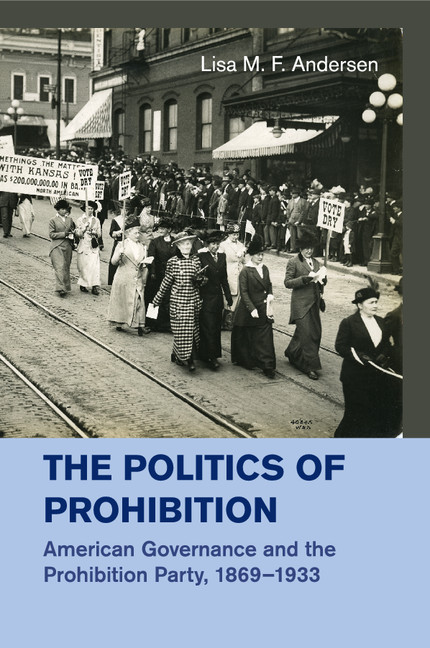
This book introduces the intrepid temperance advocates who formed America's longest-living minor political party - the Prohibition Party - drawing on the party's history to illuminate how American politics came to exclude minor parties from governance. Lisa M. F. Andersen traces the influence of pressure groups and ballot reforms, arguing that these innovations created a threshold for organization and maintenance that required extraordinary financial and personal resources from parties already lacking in both. More than most other minor parties, the Prohibition Party resisted an encroaching Democratic-Republican stranglehold over governance. When Prohibitionists found themselves excluded from elections, they devised a variety of tactics: they occupied saloons, pressed lawsuits, forged utopian communities, and organized dry consumers to solicit alcohol-free products.
Reviews
‘Lisa M. F. Andersen’s thoughtfully conceived and gracefully executed study adds to a growing body of historical analysis that explains how Americans’ political choices have become ever more restricted, while deliberation over policy has become less common and less inclusive. In addition, she shows why dedicated prohibitionists rejected the Eighteenth Amendment and elucidates the complex relationship between women activists and the first national party to declare for woman suffrage. The Politics of Prohibition draws cogent lessons for Americans today from a skilful anatomy of political failure.’
Jack Blocker - Professor Emeritus, University of Western Ontario, and Past President of the Society for Historians of the Gilded Age and Progressive Era
‘In this outstanding work of political history, Lisa M. F. Andersen provides the first comprehensive account of the Prohibition Party, the longest-living minor political party in American history. Her compelling analysis contributes significantly to our understanding of the political transformations of the late-nineteenth and early-twentieth centuries. This book will inspire every student of the era to think afresh about the major and minor political parties, the emergence of protest and reform, the roles of women in politics, the supposedly democratic legal changes of the Progressive era, the development of interest group politics, and the creation of twentieth-century administrative government.’
Richard L. McCormick - President Emeritus and Professor of History, Rutgers University, New Jersey
‘Andersen engagingly traces the twists and turns in the history of the often quixotic, always tiny Prohibition Party; the result is a challenging argument about the Republican and Democratic parties’ stranglehold on American democracy. This book is a beautiful example of using a group at the margins to change our understanding of the mainstream.’
Michael McGerr - Indiana University
‘Lisa M. F. Andersen has written an exciting new study of the Prohibition party that looks at generations of Prohibitionists in their efforts to eradicate liquor production and consumption. This book will be of interest to anyone who wants to understand not only prohibition politics but also the evolving strategies of parties and pressure groups, the expansion and retraction of citizenship rights, and the development of the American political system. Beautifully written and absolutely engaging, this book provides an excellent analysis of the connections between partisan politics and electoral laws, and a brilliant interpretation of the impact of cultural ideals on political activism and citizenship engagement. Andersen shows that elections matter, as do election laws and their administration, in shaping democracy.’
Melanie Gustafson - University of Vermont
Contents
Contents
Metrics
Altmetric attention score
Full text views
Full text views helpTotal number of HTML views: 0
Total number of PDF views: 0 *
 Loading metrics...
* Views captured on Cambridge Core between #date#. This data will be updated every 24 hours.
Usage data cannot currently be displayed.
Accessibility standard: Unknown
Why this information is here
This section outlines the accessibility features of this content - including support for screen readers, full keyboard navigation and high-contrast display options. This may not be relevant for you.
Accessibility Information
Accessibility compliance for the HTML of this book is currently unknown and may be updated in the future.