
Skip to main content Accessibility help
×
  • Cited by 5
    • Show more authors
    • You may already have access via personal or institutional login
    • Select format
    • Publisher:
      Cambridge University Press
      Publication date:
      05 October 2013
      07 October 2013
      ISBN:
      9781139343206
      9781107030138
      9781108792615
      Dimensions:
      (228 x 152 mm)
      Weight & Pages:
      0.55kg, 260 Pages
      Dimensions:
      (229 x 152 mm)
      Weight & Pages:
      0.35kg, 260 Pages
    You may already have access via personal or institutional login
  • Selected: Digital
    Add to cart View cart Buy from Cambridge.org

    Book description

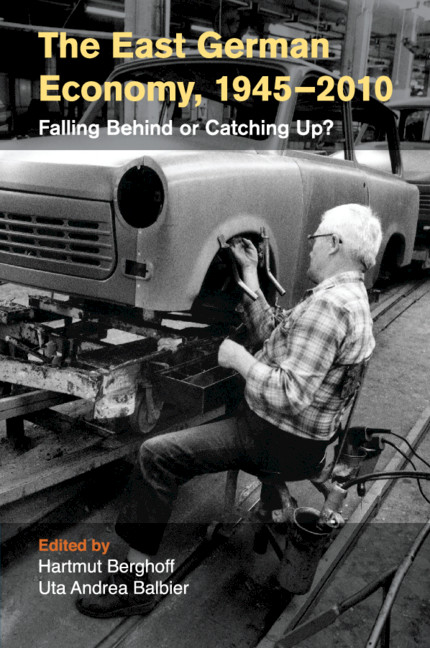
    By many measures, the German Democratic Republic (GDR) had the strongest economy in the Eastern bloc and was one of the most important industrial nations worldwide. Nonetheless, the economic history of the GDR has been primarily discussed as a failure when compared with the economic success of the Federal Republic and is often cited as one of the pre-eminent examples of central planning's deficiencies. This volume analyzes both the successes and failures of the East German economy. The contributors consider the economic history of East Germany within its broader political, cultural and social contexts. Rather than limit their perspective to the period of the GDR's existence, the essays additionally consider the decades before 1945 and the post-1990 era. Contributors also trace the present and future of the East German economy and suggest possible outcomes.

    Reviews

    ‘This stellar and invaluable volume of essays offers a state-of-the-art integrated narrative from the post-division to post-reunification East German economy. Avoiding a simple ‘failure’ story, it shows the contradictory qualities of the East German economy that once appeared as a star performer that might ‘overtake without catching up’ with the West, to use the famous paradoxical promise of Walter Ulbricht. This book reminds us that core parts of Eastern Germany were always ‘Central Germany’ (Mitteldeutschland) and that understanding the fading trajectory of the East German economic experiment is central to understanding German history more generally.’

    Jeffrey Fear - University of Glasgow

    'First as supposed industrial powerhouse of the Soviet economic bloc, then as alleged rust belt of a failed state socialism, the former German Democratic Republic and its successor component of united Germany generated lurid and exaggerated assessments of economic performance. Now, almost a quarter century after the Wall fell, a team of leading economic historians has produced a nuanced and indispensable assessment of its crisis-strewn history from World War II to the present.'

    Charles S. Maier - Harvard University and author of Dissolution: The Crisis of Communism and the End of East Germany

    Refine List

    Actions for selected content:

    Select all | Deselect all
    • View selected items
    • Export citations
    • Download PDF (zip)
    • Save to Kindle
    • Save to Dropbox
    • Save to Google Drive

    Save Search

    You can save your searches here and later view and run them again in "My saved searches".

    Please provide a title, maximum of 40 characters.
    ×

    Contents

    Metrics

    Altmetric attention score

    Full text views

    Total number of HTML views: 0
    Total number of PDF views: 0 *
    Loading metrics...

    Book summary page views

    Total views: 0 *
    Loading metrics...

    * Views captured on Cambridge Core between #date#. This data will be updated every 24 hours.

    Usage data cannot currently be displayed.

    Accessibility standard: Unknown

    Why this information is here

    This section outlines the accessibility features of this content - including support for screen readers, full keyboard navigation and high-contrast display options. This may not be relevant for you.

    Accessibility Information

    Accessibility compliance for the HTML of this book is currently unknown and may be updated in the future.
