
Skip to main content Accessibility help
×
  • Cited by 23
    • Show more authors
    • You may already have access via personal or institutional login
    • Select format
    • Publisher:
      Cambridge University Press
      Publication date:
      05 June 2014
      09 January 2014
      ISBN:
      9781139343497
      9781107030442
      9781107621398
      Dimensions:
      (247 x 174 mm)
      Weight & Pages:
      0.76kg, 306 Pages
      Dimensions:
      (247 x 174 mm)
      Weight & Pages:
      0.62kg, 306 Pages
    You may already have access via personal or institutional login
  • Selected: Digital
    Add to cart View cart Buy from Cambridge.org

    Book description

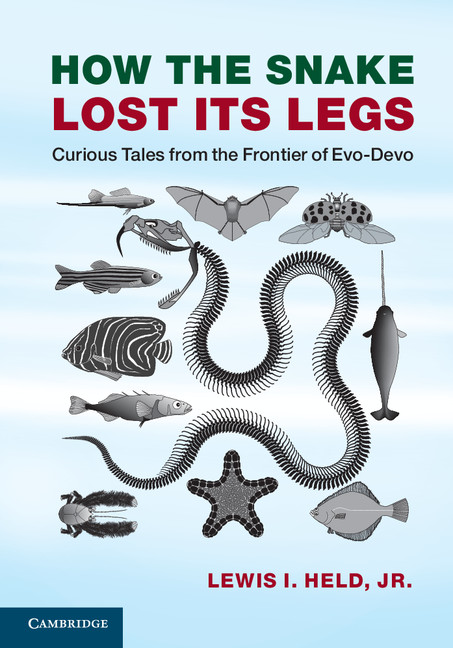
    How did the zebra really get its stripes, and the giraffe its long neck? What is the science behind camel humps, leopard spots, and other animal oddities? Such questions have fascinated us for centuries, but the expanding field of evo-devo (evolutionary developmental biology) is now providing, for the first time, a wealth of insights and answers. Taking inspiration from Kipling's 'Just So Stories', this book weaves emerging insights from evo-devo into a narrative that provides startling explanations for the origin and evolution of traits across the animal kingdom. Held's unique and engaging style makes this narrative both enlightening and entertaining, guiding students and researchers through even complex concepts and encouraging a fuller understanding of the latest developments in the field. The first five chapters cover the first bilaterally symmetric animals, flies, butterflies, snakes, and cheetahs. A final chapter surveys recent results about a menagerie of other animals.

    Reviews

    'In How the Snake Lost its Legs, Professor Held describes the key concepts that are at the foundation of evo/devo, in a language that is clear and simple as well as scientifically accurate, and in a manner that is sure to captivate the curious reader. In the second half of the book, he unveils a series of 'Just So' stories, a mixture of fascinating vignettes providing insights into what we now know about the evolution of various creatures, and teasing explorations of what remains to be learned. The book is a wonderful introduction to the field.'

    Cliff Tabin - Harvard Medical School

    'Professor Held has created a remarkable work of scholarship, notable for its accessibility, readability, and breadth with an overall welcoming tone that is reminiscent of those memorable professors who make the complex approachable through their lectures … The book works on several levels, suitable for sampling as well as for an entire read. The concluding 'bestiary' celebrates the diversity of life and the vast array of questions that await answers. Students in particular will benefit from the book’s presentation of multiple examples of the changing face of knowledge, how a story can be woven from a careful reading and cross-comparison of the literature, and the power of generating organization schemes (classifications) to help make sense of a complicated body of literature.'

    Richard L. Blanton - North Carolina State University

    'Lewis Held has explicitly not written a ‘textbook’ - it is much more informal and whimsical than that. He has succeeded admirably in exploring evo-devo through a format akin to Kipling’s Just So Stories (there is a fine irony here). He ranges from thoroughly researched topics … through to intriguing snippets … A wealth of information and ideas is conveyed with rigour, clarity and wit, and the text is supported by excellent, distinctive figures and by generous reference to the research literature. This remarkable book is a real ‘page-turner’ and it is likely to both inform and enchant all of us interested in biological diversity and how it arises.'

    Vernon French - University of Edinburgh

    'No single research study can convey what Lewis Held’s new book does: demonstrate the richness of evolutionary developmental biology as a way to understand major transitions in evolution and their mechanistic underpinnings. This is a must-have resource for anyone who is teaching or learning or simply interested in evolutionary biology.'

    Günter P. Wagner - Yale University

    '… accessible to any reader interested in evolutionary biology while also satisfying the more expert 'evo-devotees' willing to explore the depicted topics in depth.'

    Arnaud Martin Source: Evolution and Development

    'This is not a textbook, but delivers a wealth of information, much more so than any research study, with excellent figures and generous reference to scientific literature.'

    Elspeth Houlding Source: The Biologist

    ‘… a smorgasbord of developmental phenomena with titles echoing Rudyard Kipling throughout. Five chapters deal with bilaterians, flies, butterflies, snakes, and cheetahs, each of them addressing a handful of interesting questions. … this book is filled with superb diagrams and illustrations. There’s a seven-page glossary of 36 important evo-devo terms. And 2526 citations!’

    Mark Terry Source: American Biology Teacher

    Refine List

    Actions for selected content:

    Select all | Deselect all
    • View selected items
    • Export citations
    • Download PDF (zip)
    • Save to Kindle
    • Save to Dropbox
    • Save to Google Drive

    Save Search

    You can save your searches here and later view and run them again in "My saved searches".

    Please provide a title, maximum of 40 characters.
    ×

    Contents

    Metrics

    Altmetric attention score

    Full text views

    Total number of HTML views: 0
    Total number of PDF views: 0 *
    Loading metrics...

    Book summary page views

    Total views: 0 *
    Loading metrics...

    * Views captured on Cambridge Core between #date#. This data will be updated every 24 hours.

    Usage data cannot currently be displayed.

    Accessibility standard: Unknown

    Why this information is here

    This section outlines the accessibility features of this content - including support for screen readers, full keyboard navigation and high-contrast display options. This may not be relevant for you.

    Accessibility Information

    Accessibility compliance for the PDF of this book is currently unknown and may be updated in the future.
