


4 Broaden your views, but try to stay focused: a missing piece in the polarity system
1. Introduction
Epistemic indefinites (henceforth EIs) are existential elements that convey some form of ignorance (or indifference) with respect to the referent of the indefinite phrase, as in (2) below:
(1) I have to read the biography of an Italian composer.
| Tengo | que | leer | la | biografía | de | algún | compositor | italiano. | Spanish | |
| have.1sg | that | read | the | biography | of | algun | composer | Italian |
b.
| Je | dois | lire | la | biographie | d’un | compositeur | italien | quelconque. | French |
| I | must.1sg | read | the | biography | of-a | composer | Italian | quelconque |
For the sentences in (2) to be felicitous, there has to be more than one Italian composer that could satisfy the modal claim. Whereas the sentence in (1), with a simple indefinite, admits a continuation like namely Rossini, this is not possible in the examples in (2), with the Spanish EI algún or the French EI un quelconque.1 This much is common to all EIs (sometimes also called modal or anti-specific indefinites), and in fact characterizes a wider class of ‘polarity sensitive’ determiners, i.e. expressions which have a restricted distribution, such as negative polarity items (NPIs) like Italian alcuno (3a), free choice items (FCIs) like French n’importe quel (3b), or items that have both free choice and negative polarity uses, like any (3c):
a.
| Ascolta | molta | musica, | ma | non | suona | alcuno | strumento | musicale, | Italian | |
| listens_to | much | music | but | not | plays | alcuno | instrument | musical |
| #cioè | il | violino. |
| namely | the | violin |
b.
| Choisissez | n’importe | quell | instrument, | # | notamment | le | violon. | French |
| choose.imp. 2pl | no-matter | which | instrument | namely | the | violin |
c. You (don’t) like any Italian composer, #namely Rossini.
Ever since Haspelmath’s (Reference Haspelmath1997) typological survey, where many of these elements are discussed, EIs have received an increasing amount of attention in the literature (e.g., Aloni and PortReference Aloni, Port, Fainleib, LaCara and Park2010; Aloni and RooijReference Aloni, van Rooij, Bouma, Krämer and Zwarts2004; Alonso-Ovalle and Menéndez-BenitoReference Alonso-Ovalle, Menéndez-Benito, Abner and Bishop2008, Reference Alonso-Ovalle and Menéndez-Benito2010; Chierchia Reference Chierchia2006, to appear a; FarkasReference Farkas, Beyssade, Bok-Bennema, Drijkoningen and Monachesi2002, Reference Farkas, Birner and Ward2006; FălăuşReference Fălăuş2009, Reference Fălăuş, Li and Lutz2011; Giannakidou and QuerReference Giannakidou and Quer2011; Jayez and TovenaReference Jayez and Tovena2006, Reference Jayez, Tovena and Grønn2008; KratzerReference Kratzer, Carlson and Pelletier2005; Kratzer and ShimoyamaReference Kratzer, Shimoyama and Otsu2002; ZamparelliReference Zamparelli, Comorovski and von Heusinger2007, among many others). These studies reveal a heterogeneous class of elements across languages, but more interestingly they also establish that the attested diversity is amenable to a fairly small number of dimensions of variation. Distribution-wise, EIs vary with respect to their ability to occur in (i) episodic, (ii) modal, and (iii) negative polarity contexts. Meaning-wise, EIs have been shown to differ in terms of the free choice inference they trigger (which can be weaker or stronger, depending on whether it involves partial or total variation in the quantificational domain). These empirical findings led to a research agenda that aims not only to identify and explain the possible parameters of variation, but also to determine how they interact, a goal to which many of the above-mentioned studies subscribe.
This chapter deals with a hitherto unexplored parameter of variation among EIs, namely their interaction with focus. The goal of this investigation is twofold. On the one hand, I put together novel and existing empirical observations, and establish a correlation between the free choice inference triggered by an EI (more precisely, its ability to convey total variation) and the possibility to associate with focus. On the other hand, I explore an alternative-based account of these facts, couched in the framework developed in Chierchia (to appear a). The main hypothesis put forth is that the observed patterns can be derived from the interaction between lexically activated and focally activated alternatives. The relation between EIs and focus is a complex matter, and the preliminary discussion in this chapter addresses only a small subset of the empirical and theoretical issues it raises. But I hope to provide useful insights that can foster research in this area and contribute to a better understanding of EIs.
The discussion proceeds as follows: Section 2 provides a brief overview of the alternative-based approach to EIs due to Chierchia (to appear a), and the micro-variation we find in this area, by focusing on two parameters: (i) strength of the free choice inference and (ii) NPI use. Section 3 tackles the interaction with focus, and introduces evidence in favor of a correlation between the inference triggered by the EI and the possibility to associate with focus. To account for the observed patterns, it is argued that focus affects lexically activated domain alternatives. Section 4 concludes and discusses some open issues.
2. Epistemic indefinites in the polarity system: the role of alternatives
In this section, I briefly lay out the main assumptions underlying the approach to EIs developed in Chierchia (to appear a). I start by introducing the alternative-based framework in which this proposal is couched (Section 2.1), and follow by considering two parameters of variation that will turn out to be relevant for their association with focus – the free choice inference EIs give rise to (Section 2.2) and the possibility to be used as NPIs (Section 2.3). I limit myself here to an outline of the theory, referring the reader to Chierchia’s work for detailed discussion and argumentation. The only aspect that is relevant for our present purposes concerns the role of alternatives in deriving the distribution and interpretation of EIs. This will provide the basis for the interaction with focus alternatives.
2.1 Alternatives and exhaustification
Chierchia (to appear a) extensively argues that the properties of EIs are best understood within a more general theory of polarity and free choice phenomena, within an alternative-based semantics. The core hypothesis underlying this strongly unitary program is that all kinds of polarity sensitive items (e.g. NPIs and FCIs like those in (3) above, or the EIs under consideration here) are (weak) indefinites (i.e., existentially quantified elements) that activate sets of alternatives. Once they are active, alternatives must be factored into meaning (just like alternatives activated through focus). One way to do this is via the insertion of covert exhaustification operators, whose semantics is roughly akin to only and even. Exhaustification through a silent only has been argued to be at work when calculating scalar implicatures (cf. Chierchia, Fox, and SpectorReference Chierchia, Fox, Spector, Maienborn, von Heusinger and Portner2012; Chierchia to appear b), but there is evidence that such covert operators can be found in a wide variety of instances:
| a. | A: Who did you see? | b. | A: Did many people come to the party? | |
| B: Paul and Sue. | B: Yes. Imagine – [my ex]F was there. | |||
| O (I saw [Paul and Sue]F) | E ([My ex]F was at the party) |
In (4a), we normally interpret B’s answer as conveying that the speaker only saw Paul and Sue, i.e., he did not see any other individual(s) that might have also been contextually relevant. The positive answer in (4b) indicates that such an exhaustive meaning can also come about via an even-like operator, whereby we get the interpretation that B’s ex came to the party, and she was the least likely person to do that (plus an additional inference that someone else was there too, an additive component which is not relevant here). The semantics of these alternative-sensitive operators is as in (5) below:
a. Only-exhaustification:
OC(p) = p ∧ ∀q ∈ C [q → p ⊆ q]
where p ⊆ q means p entails q
b. Even-exhaustification:
EC(p) = p ∧ ∀q ∈ C [p <C q]
where ‘p <C q’ means p is less likely than a contextually relevant alternative q
O and E are binary operators that combine with a set of propositional alternatives (here represented by the subscript C) and a proposition p (the prejacent). According to the definitions in (5), O says that that p (and its entailments) is the only true member of the set of alternatives C, and the application of E conveys that p is the least likely among the relevant set of alternatives C. This mechanism is assumed to enrich meaning whenever alternatives are activated, regardless of whether they come about through focus, contextual factors, or are lexically determined. To understand the alternative-based treatment of polarity sensitive items, let us briefly go through an example:
a. *I teach any class (this semester).
b. I don’t teach any class (this semester).
The assertion in (6a) is identical to what we would have with a plain indefinitea class, i.e., an existential statement, made with respect to a contextually relevant domain of quantification D. For simplicity, assume D is a set consisting of only two elements, a semantics class and a pragmatics class. The presence of the polarity sensitive elementany leads to the consideration of subdomain alternatives, i.e., subsets of the relevant contextual domain. Active alternatives compose via pointwise functional application, so at the sentential level we have alternatives that look as in (7b):
a. Assertion:
∃x ∈D [class(x) ∧ teach(I, x)] where D = {semantics, pragmatics}
b. Alternatives:
| C = | {∃x ∈D′[class(x) ∧teach(I, x)], D′ ⊆D} = |
| {I teach a semantics class, I teach a pragmatics class} |
c. OC[I teach any class] =
OC[∃x ∈ {semantics, pragmatics} [class(x) ∧ teach(I, x)]] =
∃x ∈ {semantics, pragmatics} [class(x) ∧ teach(I, x)] ∧
¬∃x ∈ {semantics}[class(x) ∧ teach(I, x)] ∧
¬∃x ∈ {pragmatics} [class(x) ∧ teach(I, x-)] = ⊥
d. OC[I don’t teach any class] =
OC[¬∃x ∈{semantics, pragmatics} [class(x) ∧ teach(I, x)]] =
¬∃x ∈ {semantics, pragmatics}[class(x) ∧ teach(I, x)]
The alternatives introduced by the NPI must be exhaustified, i.e., require the presence of an appropriate alternative-sensitive operator in the structure, O in (7c). As defined in (5a) above, the application of the operator O says that the assertion is true and all non-entailed alternatives (in C) are false. Therefore, once we apply O to the assertion in (7a), we get a contradictory meaning: I teach a class chosen from the set {semantics, pragmatics}, but I do not teach a semantics class and I do not teach a pragmatics class. Whence its deviance.2 Things are different in a negative statement like (6b), where the presence of negation (or any other downward-entailing operator) renders the exhaustified meaning non-contradictory. Since all alternatives are entailed by the assertion, there are no stronger alternatives, and therefore nothing gets eliminated via exhaustification (7d). Put another way, exhaustification in this configuration is vacuous, meaning it simply amounts to the initial assertion I do not teach a class in D.
Let us now turn to EIs, which in this framework are characterized as alternative bearing existentials, on a par with the other members of the polarity system. To understand how their interpretation comes about, it is best to consider the following set of modal sentences:
a. You may play the guitar or the violin.
b. You may play the guitar and you may play the violin.
(9)
| Tu | peux | étudier | un | instrument | musical | quelconque. | French | |
| you | can | study | a | instrument | musical | quelconque |
The disjunction in (8) and the EI un quelconque in (9) – both existential elements under the scope of an existential modal – end up having a conjunctive interpretation, where each of the relevant alternatives (guitar or violin in (8) or any musical instrument in (9)) constitutes a legitimate choice. On the present alternative-based account, the observed free choice effects uniformly arise via recursive application of O, the exhaustification operator defined in (5a).3 More specifically, it is assumed that the alternatives activated in both cases are identical, and come in two varieties: scalar alternatives (sc-alt), which are stronger alternatives on a numerical scale, two, three, etc. (10b), and subdomain alternatives (d-alt), which consist of subdomains of the relevant set of musical instruments (10c).
a. assertion: ◊∃x ∈ D [one(x) ∧instrument(x) ∧study(you,x)]
b. sc-alt = {◊∃x ∈ D [n(x) ∧ instrument(x) ∧study(you,x)]: one < n}
c. d-alt = {◊∃x ∈ D′[one(x) ∧instrument(x) ∧study(you,x)]: D’ ⊆ D}
To emphasize the parallel with disjunction, let us assume that the EI in (9) existentially quantifies over a domain with only two elements, i.e. guitar and violin. If D = {guitar, violin}, then the assertion and the alternatives can be represented as follows:4
| ◊ (guitar ∨violin) | assertion |
| ◊ (guitar ∧violin) | sc-alt |
| ◊ guitar ◊ violin | d-alt |
Exhaustification with respect to this set of alternatives leads to a contradiction (e.g., SauerlandReference Sauerland2004). The solution, extensively discussed in Fox (Reference Fox, Sauerland and Stateva2007a) and Chierchia (to appear b) to whom I refer for details, is to allow for recursive exhaustification, i.e., the consideration of ‘pre-exhaustified’ domain alternatives.5 Roughly speaking, exhaustified domain alternatives (exh d-alt) are obtained by applying O to each one of the alternatives in (11c), as shown in (12a,b). For an alternative like “you may study the guitar,” the exhaustified meaning is equivalent to “you may only study the guitar,” i.e., “you may study the guitar and you may not study the violin” (12a), and similarly for the other active alternative (12b).
| O ◊ guitar = ◊ guitar ∧ ¬ ◊ violin | exh d-alt |
| O ◊ violin = ◊ violin ∧ ¬ ◊ guitar | exh d-alt |
Exhaustification relative to this set leads to the enriched meaning in (13):
(13) O ◊ (guitar ∨ violin) =
◊ (guitar ∨ violin) ∧ ¬ ◊ (guitar ∧ violin) ∧ ¬ O ◊ guitar ∧ ¬ O ◊ violin =
◊ (guitar ∨ violin) ∧ ¬ ◊ (guitar ∧ violin) ∧ ¬ (◊ guitar ∧ ¬ ◊ violin) ∧
¬ (◊ violin ∧ ¬ ◊ guitar) =
◊ guitar ∧ ◊ violin ∧ ¬ ◊ (guitar ∧ violin)6
Once we put together the assertion with the derived implicatures, the enriched meaning of the sentence in (9) expresses that every musical instrument in D (i.e. both the guitar and the violin) is a possible option. The assumption that EIs activate scalar and (pre-exhaustified) domain alternatives, just like disjunction or other scalar terms, thus derives the free choice inference observed in (9).
These considerations suffice to illustrate the alternative-based analysis of EIs adopted in this chapter. The account just sketched relies on obligatory activation of alternatives, a property EIs share with polarity sensitive elements. The idea that polarity or free choice indefinites activate alternatives of some kind is not new, and various aspects of the theory defended by Chierchia have been made in previous literature (cf. Kadmon and LandmanReference Kadmon and Landman1993; KrifkaReference Krifka1995; LahiriReference Lahiri1998; Kratzer and ShimoyamaReference Kratzer, Shimoyama and Otsu2002; Aloni and van RooijReference Aloni, van Rooij, Bouma, Krämer and Zwarts2004, among others). The novelty lies in the execution of this proposal in a framework which deals uniformly with ordinary scalar implicatures (cf. Chierchia, Fox, and SpectorReference Chierchia, Fox, Spector, Maienborn, von Heusinger and Portner2012 and references therein) and a wide variety of polarity sensitive phenomena. The result is a conceptually unitary system, with a broad empirical coverage, where the interplay between alternatives and exhaustification generates the various patterns of polarity attested across languages. On this view, the main difference between scalar terms (e.g. disjunction, simple indefinites) and polarity sensitive indefinites is that alternatives associated with the former are only optionally active, whereas those associated with the latter are obligatorily active. As briefly illustrated for NPIs and EIs above, the narrower distribution of polarity sensitive items falls out from their conjectured lexical semantics (active alternatives and constraints on exhaustification) and the way it interacts with the operators in their context of occurrence (e.g. downward-entailing or modal operators). Variation in the polarity system is captured through a restricted number of parametrical choices, along two interconnected dimensions: (i) types of active alternatives and (ii) modes of exhaustification. A closer look at variation among EIs offers the opportunity to illustrate both.
2.2 Variation among EIs: free choice inference
It has been recently shown that the free choice inference triggered by EIs can be of two kinds, depending on whether it concerns the entire domain of quantification or only a part of it (e.g., Jayez and TovenaReference Jayez, Tovena and Grønn2008; Alonso-Ovalle and Menéndez-BenitoReference Alonso-Ovalle, Menéndez-Benito, Abner and Bishop2008, Reference Alonso-Ovalle and Menéndez-Benito2010; FălăuşReference Fălăuş2009, Reference Fălăuş, Li and Lutz2011; Aloni and Port Reference Aloni, Port, Fainleib, LaCara and Park2010). In the examples in (14), the EI conveys that the speaker is ignorant/indifferent with respect to the referent of the indefinite and all alternatives in the relevant domain qualify as possible options. Following Chierchia (to appear a), I refer to this inference as total variation:
a.
| Tu | peux | étudier | un | instrument | musical | quelconque. | French | |
| you | can | study | a | instrument | musical | quelconque |
b.
| Dovrei | imparare | a | suonare | uno | strumento | musicale | qualsiasi. | Italian |
| should.1sg | learn | to | play | a | instrument | musical | qualsiasi |
In contrast to this total freedom of choice among relevant alternatives, certain EIs convey a weaker free choice effect, called partial variation: some, but not necessarily all alternatives qualify as possible options. The difference is most readily seen in the following hide-and-seek scenario (due to Alonso-Ovalle and Menéndez-Benito Reference Alonso-Ovalle and Menéndez-Benito2010):
(15) Context: Maria, Juan, and Pedro are playing hide-and-seek in their country house. Juan is hiding. Pedro believes that Juan is inside the house, but not in the bathroom or in the bedroom.
a.
| Juan | tiene | que | estar | en | alguna | habitación | de | la | casa. | Spanish | |
| Juan | must | be | in | algun | room | of | the | house |
b.
| Juan | trebuie | să | fie | în | vreo | cameră | la | etaj. | Romanian | |
| Juan | must | subj | be | in | vreun | room | on | floor |
The context makes it clear that not all rooms of the house are possible choices, and as such the variation associated with the EI is limited to a subset of elements in the relevant domain. While the use of algún or vreun is perfectly acceptable in this scenario, a total variation item like un NP quelconque or qualsiasi would be infelicitous.
On the alternative-based approach to EIs, the total vs. partial variation difference is argued to stem from a different choice of domain alternatives. More precisely, if the active domain alternatives are non-minimal, i.e., include any subset of the relevant D, we get the usual free choice, i.e., total variation, meaning effect. If on the other hand, domain alternatives are restricted to singletons, once we exhaustify over these alternatives, we obtain the partial variation inference. To demonstrate how this difference derives the desired interpretation, let us look at two EIs in Romanian in the scope of a possibility modal, the total variation EI un NP oarecare (16a) and the partial variation vreun (16b):
a.
| Luca | poate | cânta | la | un | instrument | muzical | oarecare | (e | foarte | talentat). | Romanian | |
| Luca | can | play | at | a | instrument | musical | oarecare | is | very | talented |
b. A: I would like to learn how to read musical notes.
B: Poate cântă Luca la vreun instrument muzical (şitepoateajuta). Roman.
maybe play Luca at vreun instrument musical and you can.3sg help
‘Maybe Luca plays some musical instrument (and he can help you).’
Assuming a domain of quantification with three elements, the assertion and the scalar alternatives are as in (17):
a. assertion: ◊∃x ∈D[one(x) ∧ instrument(x) ∧ play(Luca,x)]
b. sc-alg t = {◊ ∃x ∈ D[n(x) ∧ instrument(x) ∧ play(Luca,x)]: one < n}
| ◊ (guitar ∨ violin ∨ cello) | assertion |
| ◊ (guitar ∧ violin) | ◊ (guitar ∧ cello) | ◊ (violin ∧ cello) | sc-alt | |
| ◊ (guitar ∧ violin ∧ cello) | ||||
More relevant for our present purposes are domain alternatives, plain and exhaustified, in (18):
a. Domain alternatives activated by un instrument oarecare
| ◊ (guitar ∨ violin) | ◊ (guitar ∨ cello) | ◊ (violin ∨ cello) | d-alt | |
| ◊ guitar | ◊ violin | ◊ cello |
b. Exhaustified domain alternatives for un instrument oarecare
| ◊ (guitar ∨ violin) ∧ ¬ ◊ cello | ◊ guitar ∧ ¬ ◊ violin ∧ ¬ ◊ cello | exh d-alt | |
| ◊ (guitar ∨ cello) ∧ ¬ ◊ violin | ◊ violin ∧ ¬ ◊ guitar ∧ ¬ ◊ cello | ||
| ◊ (violin ∨ cello) ∧ ¬ ◊ guitar | ◊ cello ∧ ¬ ◊ guitar ∧ ¬ ◊ violin |
c. Domain alternatives activated by vreun instrument
| ◊ guitar | ◊ violin | ◊ cello | d-alt |
d. Exhaustified domain alternatives for vreun instrument
| ◊ guitar ∧ ¬ ◊ violin ∧ ¬ ◊ cello | ◊ violin ∧ ¬ ◊ guitar ∧ ¬ ◊ cello | exh d-alt | |
| ◊ cello ∧ ¬ ◊ guitar ∧ ¬ ◊ violin | |||
After exhaustification, the enriched meaning of (16a) amounts to the free choice inference familiar from (9) above: Luca can play a single instrument chosen among the guitar, the violin, and the cello, and each one of them is a possible choice. This is the total variation implicature given in (19).
a. O ◊ (guitar ∨ violin ∨ cello) = ◊ (guitar ∨ violin ∨ cello) ∧
¬ ◊ (guitar ∧ violin) ∧ ¬ ◊ (guitar ∧ cello ) ∧ ¬ ◊ (violin ∧ cello) ∧
| i. ◊ (guitar ∨ violin) → ◊ cello | ∧ | iv. ◊ guitar → (◊ violin ∨ ◊ cello) ∧ |
| ii.◊ (guitar ∨ cello) → ◊ violin | ∧ | v. ◊ violin → (◊ guitar ∨ ◊ cello) ∧ |
| iii. ◊ (violin ∨ cello) → ◊ guitar | ∧ | vi. ◊ cello → (◊ guitar ∨ ◊ violin) |
| O ◊ (guitar ∨ violin ∨ cello) = ◊ (guitar ∨ violin ∨ cello) ∧ | (= Assertion) |
| ¬◊(guitar ∧ violin) ∧ ¬◊ (guitar ∧ cello ) ∧ ¬◊ (violin ∧ cello) ∧ | (= Scalar Implicature) |
| ◊ guitar ∧ ◊ violin ∧ ◊ cello | (= Total Variation) |
If on the other hand, exhaustification applies to the singleton domain alternatives activated by vreun (18c–d), the enriched meaning winds up looking as in (20):
(20)
| O ◊ (guitar ∨ violin ∨ cello) = ◊ (guitar ∨ violin ∨ cello) ∧ | (= Assertion) |
| ¬◊ (guitar ∧ violin) ∧ ¬◊ (guitar ∧ cello ) ∧ ¬◊ (violin ∧ cello) ∧ | (= Scalar Implicature) |
| i.◊ guitar → (◊ violin ∨ ◊ cello) ∧ | (= Partial Variation) |
| ii.◊ violin → (◊ guitar ∨ ◊ cello) ∧ | |
| iii.◊ cello → (◊ guitar ∨ ◊ violin) |
According to the meaning derived in (20), Luca can play one of the three instruments in D, and if he can play one of them, he can also play some other one (i.e., not necessarily all of them). This is the weaker partial variation inference, satisfied in scenarios like (15) above.
This briefly illustrates how a different choice of alternatives (singleton vs. non-singleton subdomains) determines the two meaning effects triggered by EIs. The total versus partial variation distinction thus appears to be wholly derivable from a constraint on domain alternatives, a matter of lexical choice.
As we have just seen, across languages, we find EIs that only sustain total variation (Romanian un NP oarecare, Italian un NP qualsiasi, or French un NP quelconque) and EIs that only sustain partial variation (Romanian vreun, Spanish algún, Italian un qualche). In addition, it has been recently pointed out (mainly in work by Aloni and Port) that certain EIs can trigger both kinds of inferences, depending on the context of occurrence. More precisely, German irgendein gives rise to a total variation implicature under a deontic modal, as in (21a), but can also be used in a partial variation scenario analogous to (15) above, as attested by the example in in (21b):
a.
| Maria | muss | irgendeinen | Arzt | heiraten. | German | |
| Maria | must | irgendein | doctor | marry |
b.
| Juan | muss | in | irgendeinem | Zimmer | im | Haus | sein. |
| Juan | must | in | irgendein | room | in-the | house | be |
In Chierchia (2011), the behavior of irgendein is suggested to be the result of an ambiguity: irgendein can activate both minimal and ‘larger’ (i.e. non-singleton) subdomains, but the large alternatives are optional. Such an EI can then go both ways depending on the properties of the operators with which it interacts: deontic modalities typically force a total variation implicature, whereas partial variation is satisfied in epistemic modal contexts (for an extensive discussion of this difference between modalities see FălăuşReference Fălăuş2012, and Aloni and Franke, this volume). I come back to this ambiguity hypothesis in Section 3.3, where I consider the interaction between irgendein and focus.
2.3 Variation among EIs: NPI use
A second parameter of variation among EIs, which will turn out to be relevant for the possibility to associate with focus, concerns the use as a negative polarity item. Some EIs can be freely used in downward-entailing contexts, where they behave as regular NPIs and have narrow scope existential readings:
a.
| Nimeni | nu | are | vreo | informaţie | despre | concert. | Romanian | |
| Nobody | neg | have.3sg | vreun | information | about | concert |
b.
| Niemand | hat | irgendein | Buch | mitgebracht. | German | |
| No_one | had | irgendein | book | brought_along |
The disappearance of the scalar and the free choice implicature in downward-entailing contexts is fully expected on the present approach. To see this in slightly more detail, assume that the domain relevant for the interpretation of irgendein in (22a) contains three books {a,b,c}. The assertion to which exhaustification applies looks as in (23a) (assuming for simplicity that niemand translates as sentential negation), and the alternatives as in (23b):
| ¬ (a ∨ b ∨ c) | assertion |
| ¬ (a ∧ b) | ¬ (b ∧ c) | ¬ (a ∧ c) | sc-alt | |
| ¬ (a ∧ b ∧ c) |
| ¬ (a ∨ b) | ¬ (b ∨ c) | ¬ (a ∨ c) | d-alt | |
| ¬ a | ¬ b | ¬ c |
| ¬ (a ∨ b) ∧ c | ¬ (b ∨ c) ∧ a | ¬ (a ∨ c) ∧ b | exh d-alt | |
| ¬ a ∧ (b ∨ c) | ¬ b ∧ (a ∨ c) | ¬ c ∧ (a ∨ b) |
It is clear that both the scalar alternatives and the negation of the exhaustified domain alternatives are entailed by the assertion.7 As a result, no scalar or free choice inference arises and the EI is interpreted as an existential, i.e., it acquires an NPI-reading.
In contrast to this, some other EIs do not have NPI uses: if they occur under a downward-entailing operator, they can only acquire a “not just any” reading (in the presence of focus or contextual bias), illustrated in (24b) and (25b):
| Dubito | che | Luca | abbia | visto | un | concerto | qualunque. | Italian | |
| doubt.1sg | that | Luca | has | seen | a | concert | qualunque |
a. *‘I doubt Luca has seen any concert.’
b. ✓ ‘I doubt that Luca has seen just any concert (he only attends classical music concerts).’
| Nimeni | nu | a | vizitat | un | muzeu | oarecare. | Romanian | |
| Nobody | neg | has | visited | a | museum | oarecare |
a. *‘Nobody has visited any museum.’
b. ✓ ‘Nobody has visited just any museum (everyone picked their favorite one).’
On the present account, this difference among EIs is captured by assuming a restriction on exhaustification. More precisely, certain EIs (and more generally free choice indefinites) require that the result of exhaustification be properly stronger than the assertion. This requirement cannot be satisfied in downward-entailing contexts, where the assertion entails all alternatives, and hence, exhaustification simply returns the assertion. Formally, this is cashed out by defining OPS, a presuppositional operator selected by certain EIs:
(26) The Proper Strengthening (PS) parameter (Chierchia to appear a: Ch. 5)
OPS(p) = O(p), if [O(p) ⊂ p]; ⊥, otherwise
(where O(p) = p ∧ ∀q ∈ C [q → p ⊆ q])
OPS functions like the usual exhaustification operator O (i.e., eliminates stronger alternatives), but is defined only if the result of exhaustification properly entails the assertion. In modal contexts, the derived free choice interpretation is clearly stronger than the assertion, and thus EIs that select for OPS, e.g., un NP qualunque or oarecare, can be felicitously used. On the other hand, in downward-entailing contexts, the presuppositional exhaustification does not work, and the EIs that select for it are therefore ruled out.
This brief overview demonstrates how differences among EIs are captured on an alternative-based framework. Just like everywhere else in the polarity system, variation stems from constraints on lexically determined sets of alternatives (e.g., minimal vs. non-minimal subdomains lead to partial and total variation inferences) or on exhaustification (the proper strengthening requirement precludes an NPI use). With this background in mind, we now turn to a further parameter of variation, namely the interaction with focus.
3. Epistemic indefinites and focus: facts and issues
On the alternative-based approach pursued here, it is clear how EIs relate to other types of (polarity sensitive) indefinites. Just like simple indefinites (and disjunction), universal free choice indefinites (any, qualsiasi) and basic NPIs (alcuno, ever), they activate (scalar and subdomain) alternatives, and allow for pre-exhaustified alternatives. All these three categories can associate with focus (at least contrastively), as illustrated in the following examples:
a. Paul doesn’t buy me a flower a day, he buys me three flowers a day.
b. Verdi didn’t compose La TraviataorAida, he composed both.
c.
A: Do you like Lisa’s cat?
B: I don’t like any cat, I’m allergic to cats.
d.
A: Can the queen move sideways?
B: The queen can move in any direction, it’s the most powerful piece in the game.
The presence of focal stress on these elements has different effects: in the case of a scalar element (indefinite or disjunction), focus signals the fact that the item receives an enriched interpretation under negation, e.g., the sentence in (27b) receives a coherent interpretation only if disjunction is construed as exclusive. Emphatic any, both in its NPI and FCI use, has often been claimed to signal the consideration of a quantificational domain wider than the one it contrasts with, the so-called “domain widening” effect discussed in Kadmon and Landman (Reference Kadmon and Landman1993) and Krifka (Reference Krifka1995), among many others.
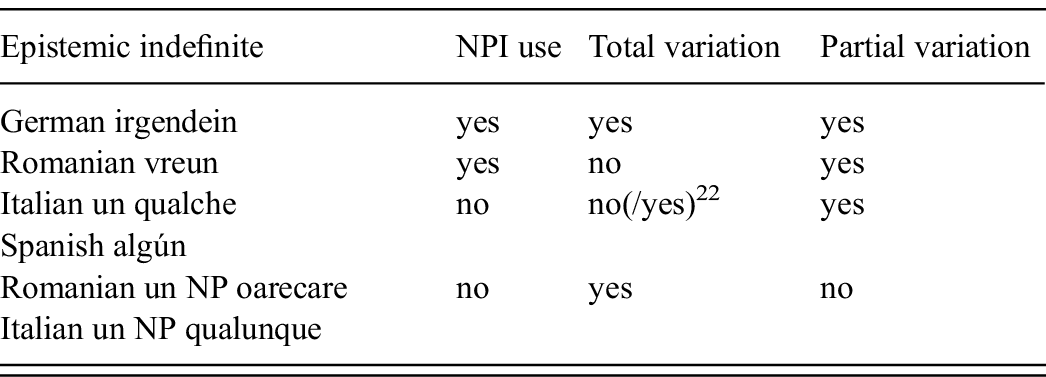
We are now set to examine the interaction between EIs and focus, a parameter of variation that to my knowledge hasn’t been explored in previous literature. For the purposes of this chapter, I limit myself to the subset of EIs in Table 4.1, which summarizes their relevant empirical properties:
Putting together novel and previous observations, I will provide preliminary evidence in favor of a correlation between the type of modal inference triggered by the EI and the possibility to associate with focus. More precisely, it will be shown that items that sustain total variation can bear focal stress, whereas items that convey partial variation (only) cannot. This interesting restriction will be argued to follow from the interaction between lexically determined and focally activated alternatives. I will focus on data from Romanian, dealing primarily with the total variation EI un NP oarecare (Section 3.1), and partial variation vreun (Section 3.2), but I will mention parallel facts from other Romance languages along the way. Finally, I will have some remarks on German irgendein (Section 3.3), which triggers both partial and total variation, but can associate with focus only in the latter case.
Table 4.1. (Some) Properties of (some) EIs
3.1 Total variation and focus in downward-entailing contexts
It has often been observed that certain EIs can acquire a “not just any” reading in downward-entailing (DE) contexts, if they are used in a denial context or if focused. The following Italian examples (from Chierchia to appear a) and Romanian sentences (due to Săvescu-Ciucivara Reference Săvescu-Ciucivara, Alboiu, Avram, Avram and Isac2007) illustrate this behavior:8
a.
| Nessuno | ha | letto | un | libro | qualunque. | Italian | |
| Nobody | has | read | a | book | qualunque |
b.
| Dubito | che | Gianni | abbia | visto | uno | studente | qualunque. |
| I doubt | that | Gianni | has | seen | a | student | qualunque |
a.
| Puţini | copii | au | rezolvat | o | problemă | oarecare | din | manual. | Romanian |
| few | kids | have | solved | a | problem | oarecare | from | textbook |
b.
| Maria | nu | poate | să | rezolve | o | problemă | oarecare. |
| Maria | neg | can | subj | solve | a | problem | oarecare |
Recall that these EIs do not have NPI-uses, and hence are typically ruled out under downward-entailing operators. Here however, we see that emphatic stress, which I assume to signal focus, enables their occurrence in these environments, and (28a) for instance conveys that the speaker doubts that Gianni saw any old student, and thinks Gianni saw some special student. A similar reading arises if a modal is present in the structure, as in (29b), where the free choice effect is denied. The main issue to be dealt with in this connection concerns the way the presence of focus affects the meaning of the EI.
Given the parallel treatment of EIs and disjunction, it seems reasonable to look for an answer by considering what happens with focus on scalar items outside the polarity system. Implicatures typically disappear under downward-entailing operators, but it is well-known that focus on the implicature trigger signals that the implicature is retained (e.g., HornReference Horn1989, Chierchia, Fox and SpectorReference Chierchia, Fox, Spector, Maienborn, von Heusinger and Portner2012 among others), as illustrated in the following example repeated from above:
(30) Verdi didn’t compose La TraviataorAida, he composed both.
How is this effect of focus derived on the alternative-based approach we are pursuing? Recall that disjunction optionally activates scalar and possibly domain alternatives. When active, scalar alternatives lead to the scalar implicature, i.e., the exclusive interpretation, whereas (recursive) exhaustification over domain alternatives is responsible for the free choice effects arising in modal contexts (cf. (8)–(9) above). Let us assume in the sentence in (30) only scalar alternatives are active and see how the exclusive construal of disjunction comes about. If exhaustification applies above negation, the assertion entails all its alternatives and hence the enriched meaning would be identical to the assertion (cf. (23) above). To derive the correct interpretation of (30), we must assume that the exhaustification operator applies below negation, as in the following LF:
(31) ¬ O (Verdi composed La Traviata or Aida)
Focus thus simply signals that the (scalar) alternatives are active and exhaustification takes place within the scope of negation. Could we envisage a similar solution for EIs? The answer is negative: EIs obligatorily activate both scalar and domain alternatives, and consequently, if exhaustification were to take place in the scope of negation, the associated LF of (28a) would be as follows:
a. Nessunoi O [ti ha letto un libro qualunque]
b. O [ti ha letto un libro qualunque]
This however does not seem a viable option: exhaustification in (32b) yields ungrammaticality (something which can be easily checked) – in the absence of a modal, the scalar and the free choice implicature contradict each other. On the basis of this, we must conclude that exhaustification applies above negation, at least in the absence of modal operators. In other words, the assumption that exhaustification takes place below negation can only be exploited in modal contexts, leaving us with no (or a different) explanation for the “not just any” reading arising in non-modal contexts. But the examples above show that the “not just any” reading arises regardless of whether a modal “intervenes” between the downward-entailing operator and the EI, if the EI is focused. So we are back to our original question: how does focus lead to the “not just any” interpretation of a total variation EI like un NP qualunque/oarecare?
In principle, there are two options we could pursue. Focus can either affect the way in which alternatives get factored into meaning (i.e., mode of exhaustification) or can have an effect on the alternatives considered for exhaustification. The first line of analysis is pursued in Crnič (Reference Crnič2011a), who convincingly argues (building mainly on KrifkaReference Krifka1995; Chierchia to appear a) that stressed any behaves on a par with emphatic NPIs and selects for exhaustification via silent even (as defined in (5b)). The assumption that the presence of focus involves even-like exhaustification is exploited to derive the licensing of stressed any in non-downward-entailing contexts (e.g., non-monotone quantifiers or desire predicates). It remains to be seen to what extent this solution is applicable to EIs, a matter I will leave for future research. In the remainder of this chapter, I would like to explore the latter option, namely the hypothesis that focus affects the alternatives to which the exhaustification operator O applies. More precisely, I will defend the claim in (33):
(33) Focus adds domain alternatives.
This hypothesis is directly inspired by the treatment of Chinese wh-indefinites in Liao (Reference Liao2011).9 Let me briefly review the relevant aspects of her proposal, and then show how it extends to EIs.
In a detailed study of Chinese wh-indefinites, within the alternative-based framework adopted here, Liao discusses focused wh-phrases in negative sentences, illustrated in the following example:10
(34) Zhangsan mei mai shenme shu. (Mandarin Chinese, Liao Reference Liao2011: 88)
Zhangsan neg buy what book
a. ‘Zhangsan didn’t buy any book.’
b. ‘Zhangsan didn’t buy any special book.’
The wh-indefinite shenme can acquire either an NPI-reading (34a), or the interpretation in (34b), whereby Zhangsan did buy some (ordinary) book. Wh-indefinites are similar to EIs in that they activate both scalar and domain alternatives (of any size). The NPI-reading is obtained along the lines of (23) above. More relevant for our present purposes is the second construal of the wh-indefinite in (34). According to Liao, this can be derived by conjecturing that (34) involves focus and the presence of focus leads to the consideration of a domain wider than the one initially associated with the assertion. The desired interpretation then comes about in the following way. Assuming Rooth’s (Reference Rooth1992) focus theory, and putting the entire proposition in (34) in focus, its LF representation is as in (35a):
a. OC [~C [¬ ∃x ∈ D ∩ book [bought(ZS,x)]][+F]]
b. C = {¬ ∃x ∈ D ∩ book [bought(ZS,x)], ¬ ∃x ∈ D′∩ book [bought(ZS,x)],
where D ⊂ D′}
Focus adds alternatives that range over the wider domain D′, i.e. the second alternative in the set in (35b). Since this proposition is stronger than the assertion, it will get excluded through exhaustification. Once we put together the assertion and the derived implicatures, the resulting interpretation is that Zhangsan didn’t buy any book in D, but he did buy some book in D’.11
Liao’s proposal provides a straightforward account for the “not just any” reading of the focused EIs in (28) and (29). To see this in more detail, consider once again the following sentence:
(36)
| Gianni | non | ha | letto | un | libro | qualunque. | Italian | |
| Gianni | neg | has | read | a | book | qualunque |
Recall that a total variation EI like un qualunque lexically activates scalar and subdomain alternatives, given in (37)–(38). As we have already seen in (23), exhaustification applied above negation is vacuous (all alternatives are entailed by the assertion), i.e., it returns the assertion: Gianni didn’t read any book in D, where D is {a,b,c}:
a. assertion: ¬ ∃x ∈ D[one(x) ∧ book(x) ∧ read(G,x)]
b. sc-alt = {¬ ∃x ∈ D[n(x) ∧ book(x) ∧ read(G, x)]: one < n}
c. d-alt = {¬ ∃x ∈ D’[one(x) ∧ book(x) ∧ read(G, x)]: D’ ⊆ D}
| ¬ (a ∨ b ∨ c) | assertion |
| ¬ (a ∧ b) | ¬ (b ∧ c) | ¬ (a ∧ c) | sc-alt | |
| ¬ (a ∧ b ∧ c) |
| ¬ (a ∨ b) | ¬ (b ∨ c) | ¬ (a ∨ c) | d-alt | |
| ¬ a | ¬ b | ¬ c |
| O ¬ (a ∨ b) | O ¬ (b ∨ c) | O ¬ (a ∨ c) | exh d-alt | |
| O ¬ a | O ¬ b | O ¬ c |
Since the NPI reading is disallowed by “proper strengtheningm,” this configuration is normally ruled out for un qualunque. In the absence of focus, this sentence is ungrammatical. But here the EI is focused and consequently, the LF for (36) is as in (39a). Following Liao’s proposal reviewed above (formulated as in (33)), we assume that the presence of focus adds domain alternatives, i.e., leads to the consideration of a superset of D, namely D’= {a,b,c,d}:
a. OC [~C [ un libro qualunque[+F] [ Gianni didn’t read ti]]]
b. {¬ ∃x ∈ D′[one(x) ∧ book(x) ∧ read(G, x)]: D′ ⊆ D or D ⊆ D′}
Exhaustification applies to this enlarged set and seeks to eliminate stronger alternatives. The alternatives in (38) are all entailed by the assertion (i.e. ¬(a ∨ b ∨ c)), but the alternative based on D’ (¬(a ∨ b ∨ c ∨ d)) is not. So through exhaustification, it will be excluded. The resulting meaning can be represented as in (40):
(40) OC [Gianni didn’t read un libro qualunque] =
= ¬ ∃x ∈ D[one(x) ∧ book(x) ∧ read(G,x)] ∧ ¬([¬ ∃x ∈ D′[one(x) ∧ book(x) ∧ read(G,x)]), where D ⊆ D’
= ¬ ∃x ∈ D[one(x) ∧ book(x) ∧ read(G,x)] ∧ ∃x ∈ D′[one(x) ∧ book(x) ∧ read(G,x)]
According to (40), the sentence in (36), with un libro qualunque focused, is interpreted as saying that Gianni did not read a book in the initially considered domain of quantification, but he did read a book in some other, special domain. This does not explain how the book in the “special” domain is singled out. However, there is little doubt that it is a contextual matter, and a pragmatic effect of having changed the initial domain. Importantly, it is not something that comes from how exhaustification proceeds. For this proposal to work and derive the intended reading, it is crucial that the set considered at the final level of exhaustification (i.e., exhaustification applying to the lexically activated alternatives plus those brought in by focus) includes alternatives that are not entailed by the assertion. This ensures that we get a coherent meaning after applying O. But the choice of D and D’ is regulated by pragmatic factors. As we have seen in the previous example, a reasonable way to get the right result (and thus explain why focus rescues sentences like (40)) is by adding alternatives to D. But there are cases involving a different strategy. For example, imagine the initial D is set to the books on a given reading list. Clearly one can use (40) in this situation and add a continuation like I read the most difficult one (on the list).12 What this means is that the difference between the books that have not been read (D) and the one(s) that have been read (D’) is established by bringing in additional factors (e.g., difficulty). I do not have a full story on how the various contextual factors may affect the observed readings. But I hope the general line of reasoning is clear even in the absence of more precise assumptions on the choice of domains. What matters for our present purposes is that focus on total variation EIs adds domain alternatives, thus offering a way to avoid the ungrammaticality of configurations like (40).13 In DE-contexts, the addition of non-entailed alternatives amounts to the consideration of super-domains (something we represented by adding alternative d to the initial domain of books).
In the following, I will extend this proposal and exploit the hypothesis in (33) to account for the restrictions governing focus on partial variation EIs likevreun or un qualche.14
3.2 Partial variation and focus
In the previous section, we have seen that EIs like un NP qualunque or oarecare can be focused, acquiring a “not just any” reading in DE-contexts. In order to make sense of this behavior, I have adopted the proposal in Liao (Reference Liao2011) whereby focus adds domain alternatives to the set of lexically activated alternatives.
I now turn to what I think is a previously unnoticed restriction, namely the impossibility of Romanian vreun to associate with focus, illustrated below: as soon as vreun is focused in the sentences in (41), they become unacceptable:15
a.
| *Nimeni | nu | are | vreun | bilet | la | concert. | Romanian | |
| Nobody | neg | have.3sg | vreun | ticket | to | concert |
b.
| Se | poate | ca | Maria | să | meargă | la | vreun | concert | diseară. |
| refl | may | that | Maria | subj | go | to | vreun | concert | tonight |
The fact that vreun cannot be stressed is surprising, on at least two grounds. First, we have just seen that EIs like un qualunque/oarecare can be focused. Second, vreun also has an NPI use, and NPIs are well-known to be able to carry emphasis (cf. (27)). So no matter how we look at the data in (41), we are faced with a puzzle. Moreover, as illustrated in (42), this restriction seems to be shared by other partial variation EIs – focus on algún or un qualche is systematically rejected:
a.
| *Dudo | que | María | tenga | alguna | entrada | para | el | concierto. | Spanish | |
| doubt.1sg | that | Maria | has | algun | ticket | for | the | concert |
‘I doubt that Maria has any ticket to the concert.’
b.
| *Es | possible | que | María | vaya | a | algún | concierto | esta | noche. |
| is | possible | that | Maria | goes | to | algun | concert | this | night |
‘It’s possible that Maria goes to some concert tonight.’
c.
| *Voglio | imparare | a | suonare | un | qualche | strumento | musicale. | Italian | |
| want.1sg | learn | to | play | a | qualche | instrument | musical |
The conclusion that can be drawn from these facts is that partial variation EIs cannot be focused, unlike total variation EIs, NPIs, or simple indefinites, to which they are closely related. How can an alternatives-and-exhaustification approach accommodate this behavior? Ideally, from the interaction between lexically activated alternatives and focus activated alternatives. Recall that the sole difference between un oarecare and vreun (and more generally between total and partial variation EIs) lies in the set of subdomain alternatives they activate, which must consist of all subdomains of the relevant quantificational domain for the former, and singleton subdomains only for the latter. Accordingly, if we pursue the same line of reasoning as before, we expect the (im)possibility to associate with focus to be somehow related to this difference. In other words, the fact that vreun activates singleton domain alternatives has to be incompatible with the posited effect of focus on domain alternatives. In the following, I will argue that this route can be fruitfully pursued to capture the restriction in (41b), and show that this explanation can be extended to the partial variation EIs exemplified in (42). I briefly return to the negative polarity uses of vreun in Section 4.
In the previous section, we accounted for the interpretation of the focused occurrences of EIs like un oarecare by assuming that focus adds domain alternatives to the set of lexically activated alternatives. Recall that on the present approach, the choice of the relevant quantificational domain D is a matter of pragmatics, but the subdomains are semantically determined and must consist of all subdomains of D (a property that is responsible for the total variation inference). Consequently, the only way to add domain alternatives (in the presence of focus) is by extending the initial domain, thus making exhaustification apply over both sub- and super-domain alternatives. This delivers the right interpretation.
Things are different for partial variation EIs. In particular, their lexically determined alternatives are different, in that they are restricted to singleton domain alternatives. As shown in Section 2.2, this assumption derives the fact that EIs like vreun or un qualche always prompt partial variation. I will now argue that it is this very same restriction to singleton alternatives that can explain the ban on focus illustrated in (41b). To see this, consider the set of domain alternatives lexically activated by vreun (in a context with three elements in D):
| ◊ a | ◊ b | ◊ c |
In the absence of focus, the sentence is grammatical and triggers a partial variation inference. Once we bring in focus, domain alternatives must be added to the set in (43). Here however, we can include domain alternatives that look as in (44a), i.e., non-minimal subdomains, and as a result, exhaustification will apply to the set in (44b). Once we allow for pre-exhaustification of these alternatives, and put together the assertion with the derived (scalar and free choice) implicatures, through steps familiar from Section 2.2 above, we wind up with the total variation meaning in (44c).
| ◊ (a ∨ b) | ◊ (b ∨ c) | ◊ (a ∨ c) |
| ◊ (a ∨ b) | ◊ (b ∨ c) | ◊ (a ∨ c) |
| ◊ a | ◊ b | ◊ c |
| O ◊ (a ∨ b ∨ c) = ◊ (a ∨ b ∨ c) ∧ | (= Assertion) |
| ¬◊ (a ∧ b) ∧ ¬◊ (a ∧ c) ∧ ¬◊ (b ∧ c) ∧ | (= Scalar Implicature) |
| ◊ a ∧ ◊ b ∧ ◊ c | (= Total Variation) |
This state of affairs is not tolerated by vreun, which lexically encodes a ban on total variation, as extensively argued in Fălăuş (Reference Fălăuş2012). The gist of the proposal I am referring to can be summarized as follows. Romanian vreun is only felicitous in contexts where one of the alternatives in the quantificational domain can be excluded (although the speaker does not necessarily know which one). In other words, instead of triggering the partial variation inference (i.e., some but not necessarily all), it imposes a stronger – anti-total variation – restriction (i.e., it is necessary that not all alternatives constitute viable options). This requirement is built in the semantics of vreun, an idea that is formally implemented by assuming that vreun includes among its alternatives the total variation element un oarecare (and its alternatives). Essentially, the total variation inference normally associated with un oarecare (i.e. ◊ a ∧ ◊ b ∧ ◊ c) gets added to the set of alternatives in (43) and excluded via exhaustification, as sketched in (45):
a. O ◊ (a ∨ b ∨ c)) = ◊ (a ∨ b ∨ c) ∧ ¬◊ (a ∧ b) ∧ ¬◊ (a ∧ c) ∧ ¬◊ (b ∧ c)
∧ ◊ a → (◊ b ∨ ◊ c)
∧ ◊ b → (◊ a ∨ ◊ c)
∧ ◊ c → (◊ a ∨ ◊ b)
∧ ¬ (◊ a ∧ ◊ b ∧ ◊ c)
| = (◊ a ∧ ◊ b) ∨ (◊ a ∧ ◊ c) ∨ (◊ b ∧ ◊ c) | (= Partial Variation) | |
| ∧ ¬(◊ a ∧ ◊ b ∧ ◊ c) | (= Ban on Total Variation) |
This derives the correct “partial variation only” associated with vreun and accounts for its restricted distribution (most prominently its exclusion from deontic contexts), a property that is not directly relevant here. The crucial aspect of the analysis is that the lexical semantics of vreun encodes a ban on total variation. Focus on the other hand derives total variation, as illustrated in (44). This correctly accounts for the clash observed in (41b): the alternatives brought in by focus conflict with the standard meaning of vreun. On the theory outlined here, the non-association of vreun with focus in modal contexts receives a principled explanation, based on two independently motivated assumptions, namely the constraint on singleton subdomains and the role of focus.
Crucial to the analysis proposed above is the hypothesis that focus affects the set of domain alternatives considered for exhaustification. Importantly, the shape of the domain alternatives that get added through focus depends on the shape of the lexically activated subdomains. In case the initial domain alternatives are singletons, focus brings in larger (i.e., non-singleton) subdomains. If focus were allowed to add further singleton domain alternatives (like for example in the case of total variation EIs), we would expect to get a partial variation inference that holds for a wider quantificational domain. The fact that this never happens indicates that the effect of focus on the domain alternatives is constrained by the lexical alternatives.16
This brings us to un qualche and algún, which are similar to vreun in that they never trigger total variation inferences. However, they are not so strictly incompatible with total variation set-ups: the sentence in (42c) for example, without focus on un qualche, is perfectly acceptable in a context where the speaker would be happy to play any musical instrument, without excluding any relevant alternative. In other words, unlike in the case of vreun, nothing in the meaning of un qualche (or algún) enforces partial variation. Focus is nevertheless infelicitous, as indicated in (42). On the present line of analysis, this means that these EIs disallow total variation (although this requirement is not as strong as in the case of Romanian vreun). A plausible way of thinking about this is in terms of a blocking effect: the fact that both Spanish and Italian have total variation elements (un NP qualsiasi/cualquiera) arguably blocks the possibility of the partial variation item to sustain the total variation inference triggered by focus. This leaves open the option that if for some reason (or for some speakers) this blocking effect can be overridden, focus becomes acceptable. Further empirical investigations are needed to see if this expectation is borne out in Spanish and Italian.
A related prediction made by the account outlined here is that an EI that can convey both partial and total variation inferences should be able to associate with focus, and the presence of focus should correlate with total variation. As shown in the next section, there is interesting preliminary evidence that German irgendein verifies this prediction.
3.3 Irgendein and focus
The previous section proposed an explanation for the fact that vreun does not associate with focus in modal contexts. Building on the conjecture that focus adds domain alternatives, we have tied the behavior of vreun to the activation of singleton domain alternatives and the ban on total variation which is part of its core meaning. Furthermore, we have seen evidence indicating that this restriction is shared by other partial variation EIs. What all these EIs have in common is the fact that they can never trigger total variation. This option however is available for the German EI irgendein, as illustrated in the following examples repeated from Section 2.2:
a.
| Maria | muss | irgendeinen | Arzt | heiraten. | German | |
| Maria | must | irgendein | doctor | marry. |
b.
| Juan | muss | in | irgendeinem | Zimmer | im | Haus | sein. |
| Juan | must | in | irgendein | room | in_the | house | be |
As discussed in detail in Aloni and Port (Reference Aloni, Port, Fainleib, LaCara and Park2010), the sentence in (46a) receives a total variation interpretation, whereby any doctor could satisfy the modal requirement. The epistemic statement in (46b) on the other hand is most readily used in partial variation scenarios (e.g., the hide-and-seek context in (15)). The precise distribution of the partial vs. total variation inferences is not directly relevant for our present purposes. What is crucial to the current discussion is that the configurations where irgendein associates with total variation seem to require focus. According to Haspelmath (Reference Haspelmath1997: 249), “in the free choice function, the irgend-series may occur, but it must be stressed”:
(47)
| Dieses | Problem | kann | irgendjemand | lösen | German | |
| This | problem | can | irgendjmand | solve |
Similar observations can be found in Aloni and Port (Reference Aloni and Port2011), who furthermore note that irgend- cannot be stressed in contexts where it triggers partial variation (i.e., episodic and epistemic modal contexts):
a.
| # | irgendjemand | hat | angerufen. | German | |
| irgendjmand | has | called |
b.
| # | Maria | muss | irgendeinen | Dokter | geheiratet | haben. |
| Maria | must | irgendein | doctor | married | have |
I think the data require closer scrutiny, but if these facts turn out to be solid, we have a further argument in favor of the hypothesis that focus leads to the addition of domain alternatives. As mentioned in Section 2.2 above, Chierchia (to appear a) suggests that irgendein can activate both singleton and non-singleton subdomains, but the larger alternatives are optional. By default, exhaustification applies to the active singleton alternatives (together with the scalar alternatives), yielding partial variation. If on the other hand irgendein occurs in a context where total variation is enforced (by the operator in the context of occurrence, in particular by deontic modals, cf. Fălăuş Reference Fălăuş2012 and Aloni and Franke, this volume), irgendein is focused.17 As soon as focus is present (i.e., non-minimal domains are considered for exhaustification), irgendein winds up sustaining the total variation inference. Put another way, focus is required to avoid drawing the weaker, partial variation inference.18 A more careful empirical investigation is clearly needed before drawing any conclusions on the interaction between the “licensing” operators, the interpretation of irgendein and focus. But the evidence available at this point provides interesting support in favor of the correlation between focus and total variation observed for the Romance EIs discussed in the previous sections.
4. Further issues and concluding remarks
This chapter examined the interaction between epistemic indefinites and focus, and proposed an alternative-based account for the observed patterns, within the framework developed in Chierchia (to appear a). The facts that I have considered here provide preliminary evidence in favor of a correlation between the strength of the free choice inference and the possibility to bear focal stress. More specifically, we have seen that whereas total variation EIs can be focused (and give rise to a “not just any” reading in DE-contexts), partial variation EIs disallow focus. This difference among EIs was argued to follow from the interaction between lexically activated alternatives and focus triggered alternatives, which get factored into meaning in essentially identical ways (through the application of a covert operator akin to only). Drawing on a hypothesis put forth in Liao (Reference Liao2011), we assumed that the role of focus is to add domain alternatives to the set of alternatives activated by the EI, and showed that the way this gets realized depends on the shape of the domain alternatives lexically activated by the EI. These assumptions enabled us (i) to capture the non-association with focus of partial EIs as a conflict between lexically induced and focus driven alternatives, and (ii) to derive the readings attested for the focused occurrences of total variation EIs. If my proposal is on the right track, the different interaction between EIs and focus is derivable from independently motivated properties of (domain) alternatives.
There are several issues that our discussion left open and which call for further research. One important set of issues concerns the behavior of partial variation EIs in contexts that license NPIs. In particular, as illustrated in (41a) above, the use of vreun as an NPI is also incompatible with focus. This restriction sets vreun apart from other NPIs, which are well-known to be able to bear focal stress.19 At this point, I do not have an explanation for this fact and further empirical investigation will need to determine whether this restriction is shared by any other NPIs across languages. Let me simply mention two ways of accounting for stressed NPIs that are compatible with the present alternative-based framework and which could in principle serve as a starting point for any analysis of the unexpected behavior of vreun. The first one is due to Krifka (Reference Krifka1995) and Lahiri (Reference Lahiri1998), and has been recently taken up in Crnič (Reference Crnič2011a). It consists in assuming that the licensing of stressed NPIs (on a par with minimizers like lift a finger) involves an even-like exhaustification operator (EmphAssert in Krifka’s proposal). For the NPIs to be licit, the presuppositions triggered by the covert even need to satisfied in the context of utterance.
A related account of stressed NPIs is pursued in Chierchia (to appear a), which embeds the ideas developed in Krifka (Reference Krifka1995) in the general theory of alternatives and exhaustification adopted here. The assumption that NPIs obligatorily activate alternatives is argued not only to be responsible for their distribution (as sketched in Section 2.1), but also to determine their behavior under contrastive focus, illustrated in (49):
| a. | Dialogue I | b. | Dialogue II | |
| A: Do you have an egg? | A: Do you have any egg? | |||
| B: No. | B: No. | |||
| A: Maybe a pickled one? | A: Maybe a pickled one? | |||
| B: I don’t have any egg. | B: *I don’t have an egg. |
The contrast between (49a) and (49b) is captured by assuming (i) that any activates subdomain (and scalar) alternatives which call for the insertion of the covert exhaustification operator O, and (ii) Rooth’s anaphoric principle of focus interpretation. Roughly speaking, the contrastively focused expression must find an “antecedent” in the context, which must be a member of the focus value of the contrastively stressed counterpart. Since the focus value of a sentence involving any includes its lexically determined alternatives, the anaphoric condition can be satisfied only if the domain associated with the simple indefinite is a subset of the domain associated with any. This derives the observation that any seems to indicate reference to a wider domain of quantification, when contrasted with other existentials.
It remains to be seen to what extent the behavior of vreun in NPI-contexts, namely the fact that it disallows focus, can be captured along the lines of the theories mentioned above. I will leave this as a point for future investigation.
A related question arises in connection with the behavior of partial variation EIs that do not have NPI-uses, e.g., un qualche. Within the present framework, this is derived from a constraint on the mode of exhaustification (i.e. selection of OPS, discussed in Section 2.3). In this respect, it is similar to the total variation un qualunque, which doesn’t have an NPI-interpretation either. But whereas focus provides a way to rescue the use of the total variation EI un qualunque in DE-contexts (and acquire a “not just any” reading), this option is not available for partial variation EIs. More research is necessary to understand the constraints on the alternatives induced by focus and its rescuing effects.20
Finally, the chapter dealt with a small number of EIs and further empirical study is required before assessing the cross-linguistic validity of the observed correlation between focus and free choice inference. The interaction between EIs and overt focus markers (such as focus-sensitive particles, only, even, at least) can shed further light on the restrictions governing the interaction between EIs and focus. Whatever properties will be uncovered through future research, the facts considered here indicate that this is an interesting area of investigation, and the alternative-based approach is well equipped to accommodate the observed patterns. Not only can the interaction with focus contribute to a better understanding of the properties of EIs (and more generally of polarity sensitive elements), but it also provides an interesting empirical domain for exploring the relation between lexically induced and focus alternatives. The results can turn out to be relevant to the current debates concerning the possible unified treatment of different phenomena that make reference to sets of alternatives.21
Acknowledgments
I am extremely glad and honored to contribute to this volume and have the opportunity to honor Gennaro Chierchia and his inspiring work. Gennaro is the first to have made semantics meaningful to me and working with him is a constant and very pleasant reminder of how serious and beautiful is the project on which I embarked. His confidence broadened my views beyond what I thought possible, thus making everything more challenging; his incredibly generous and continuous support help me stay focused and optimistic all throughout. I wish to thank two anonymous reviewers and the audience at ZAS for thoughtful feedback and valuable suggestions on previous versions of this material. All errors are of course my own. This research was financially supported by the Spanish Ministry of Science and Innovation (FFI2011–29218), the Basque Government (GIC07/144-IT-210–07) and the University of the Basque Country – UPV/EHU (UFI11/14).
Notes
1. On the use of the namely test in connection with free relatives, which also have an ignorance or an indifference reading, see e.g., Dayal (Reference Dayal and Lawson1997), Fintel (Reference Fintel, Jackson and Matthews2000c), Rawlins (Reference Fintel2008). An interesting comparison between wh-ever relatives and EIs like some or other can be found in Dayal (Reference Dayal, Mohanty and Menon2009).
2. See Gajewski (2002) and Chierchia (to appear a) for details on when and why contradictions can give rise to ungrammaticality.
3. In the following, I omit the subscript indicating the set of propositions with respect to which exhaustification takes place (cf. C in (5a)). Unless mentioned otherwise, this set includes both scalar and (possibly pre-exhaustified) domain alternatives.
4. Where “guitar” is an abbreviation for “you study guitar,” “◊ guitar” for “you may study guitar,” and similarly for all other alternatives.
5. “Pre-exhaustification” of domain alternatives corresponds to “recursive exhaustification” in Fox (Reference Fox, Sauerland and Stateva2007a) (and is closely related to the anti-exhaustivity implicature in Kratzer and ShimoyamaReference Kratzer, Shimoyama and Otsu2002). As correctly observed by a reviewer, for more complex sets of alternatives, it is important that pre-exhaustification takes place with respect to sets of alternatives that are Innocently Excludable, in the sense of Fox (which roughly speaking ensures that the elimination of one element will not lead to the arbitrary inclusion of another element). See Chierchia (to appear a) for a detailed discussion of these issues.
6. This is due to the following equivalences:
¬ (◊ guitar ∧ ¬ ◊ violin) = (◊ guitar → ◊ violin)
¬ (◊ violin ∧ ¬ ◊ guitar) = (◊ violin → ◊ guitar).
7. Excluding an exhaustified alternative like ¬ O¬ (a ∨ b) = ¬ (¬ (a ∨ b) ∧ c) amounts to c → (a ∨ b), and similarly for all other alternatives.
8. Insofar as I can tell, French un quelconque behaves similarly (see Jayez and TovenaReference Jayez and Tovena2006). Alonso-Ovalle and Menéndez-Benito (Reference Alonso-Ovalle, Menéndez-Benito, Ashton, Chereches and Lutz2011) claim that the Spanish EI un cualquiera receives the “not just any” interpretation in downward-entailing contexts without any focus operator or emphatic stress. My informants disagree. More research is required to identify the source of this difference in judgments.
9. Chierchia (to appear a) mentions Liao’s treatment of Chinese wh-indefinites as a promising way to derive the “not just any” reading of EIs like un qualsiasi, without however getting into the details of this proposal (at least in the draft version available to me upon completion of this chapter). The present discussion can be viewed as an attempt to pursue this route and extend it to partial variation EIs.
10. The present chapter deals only with structures that do not involve any overt focus particle, but it should be mentioned that Liao provides a detailed account of a further focus-related configuration, namely the interaction between wh-indefinites and dou. She argues that dou is a focus marker, which introduces an additive presupposition and a universality requirement, and furthermore signals the application of the even-exhaustification operator. This derives the fact that the presence of dou leads to a free choice/universal use of Chinese wh-indefinites. For extensive discussion of the role of focus in the two configurations, the reader is referred to Liao (Reference Liao2011).
11. Liao further discusses the pragmatic assumptions needed to derive the fact that Zhangsan bought some ordinary book. Since this is slightly different from the reading we want to derive for EIs, I will not get into the details of her proposal, and simply note that the relevant pragmatic constraints may differ.
12. I’m grateful to an anonymous reviewer for drawing my attention to this issue.
13. Chierchia (to appear a) discusses universal free choice items like any or qualsiasi in sentences like It is not true that Gianni read ANY book he found (in denial contexts). He suggests that focal stress indicates uniformly that exhaustification (which derives a universal reading of the free choice item) takes place within the scope of negation, resulting in a “not every” interpretation. The “not just any” reading, which is also possible, stems from an additional scalar alternative (“We may assume that after D-exhaustification, any may get an existential scalar alternative, a change prompted by the fact that exhaustification yields a universal reading” – Chierchia to appear a: Ch. 6, p. 28). It is not entirely clear to me how this works for any, and so it is difficult to compare this proposal with the one advocated here. Note however two differences with EIs, which indicate that perhaps different routes need to be pursued for different elements. First, I have discarded the hypothesis that EIs allow for exhaustification below negation (see the discussion of (32) above). Second, EIs do not yield universal readings, and consequently, the motivation for the additional scalar alternative seems to be absent. The two proposals however converge in assuming that the reading whereby John read a special book (or set of books) should be attributed to pragmatic factors. For now, I remain neutral on the derivation of the “not just any” reading of universal free choice items.
14. This analysis raises the question of the interaction between focus and un oarecare in modal contexts. The facts are not entirely clear at this point. Many speakers resort to the universal free choice orice “any” or a construction equivalent to a book, any book instead of focusing un oarecare. For the speakers who accept it, focus on un oarecare results in stronger free choice effects, i.e., the freedom of choice holds of a larger number of alternatives. Similar considerations hold for Spanish un cualquiera. This is consistent with the present proposal: if to the initial assertion ◊ (a ∨ b ∨ c), we add an alternative, high exhaustification applies to ◊ (a ∨ b ∨ c ∨ d). This yields the free choice effects discussed in Section 3, the only difference being that these effects are perceived as stronger as a result of having extended D.
15. This claim obviously does not apply to corrective focus, which can affect any linguistic expression, e.g., In my dialect, I pronounce [vrun], not [vréun].
16. This brings into focus a crucial difference between the present proposal and the domain widening approach due to Kadmon and Landman (Reference Kadmon and Landman1993), to which it may look similar. On their proposal, polarity sensitive items like any must widen domains and are subject to a constraint that domain widening is acceptable only if it leads to strengthening. On the alternative-based approach advocated here, domain widening effects may arise only in the presence of focus, which triggers the addition of alternatives to the set of active subdomain alternatives. Whether or not the initial quantificational domain gets eventually widened depends on the shape of the lexically constrained subdomains. See Chierchia (to appear a) for more extensive discussion of the issues raised by the original domain widening hypothesis.
17. To my knowledge, the only other context where irgendein requires focus are comparatives. For an interesting account of this fact, which I think is amenable to the alternative-based account pursued here, see Aloni and Roelofsen (Reference Aloni, Roelofsen, Ashton, Chereches and Lutz2011).
18. As pointed out by an anonymous reviewer, this raises the question of why focus on irgendein is disallowed in epistemic contexts. Given our current assumptions, we would expect focus to be possible and trigger total variation effects, contrary to what seems to be the case. This suggests that total variation is blocked in epistemic contexts, for reasons yet to be explained. A proper answer to this question must be postponed until the empirical facts become better understood.
19. There are interesting, conflicting reports concerning stressed irgendein in DE-contexts. According to Kratzer and Shimoyama (Reference Kratzer, Shimoyama and Otsu2002: 14), the “not just any” reading emerges in the presence of negation (and other DE-operators). On the analysis proposed here, this interpretation is derived from the consideration of super-domain alternatives (added by focus), as discussed in Section 3.2. On the other hand, Aloni and Port (Reference Aloni and Port2011) report an NPI reading for examples like (i):
| Niemand | hat | irgendeine | Frage | beantwortet. |
| nobody | has | irgendein | question | answered |
At this point, it is not entirely clear to me what is the difference in interpretation between (i) and its equivalent without focus. If the effect is akin to the domain widening attested for stressed any and other NPIs, it will have to be derived through whatever mechanism turns out to be responsible for the behavior in (49).
20. See Liao (Reference Liao2011) for an explanation of the fact that focus cannot rescue polarity sensitive items in episodic sentences.
21. See e.g. Fox and Katzir (Reference Fox2011) for a unitary theory of alternatives for both scalar implicatures and association with focus.
22. The EI itself never conveys total variation. The “no(/yes)” choice reflects the fact that un qualche (just like Spanish algún) is compatible with total variation contexts, e.g. Voglio imparare a suonare un qualche strumento musicale ‘I want to learn to play some musical instrument’ can be used by a speaker who would be happy to play any musical instrument. This is a logical consequence of the fact that total variation entails partial variation. In contrast to this, vreun is only compatible with partial variation contexts, and thus qualifies as a “strict” partial variation EI. I come back to this issue in Section 3.2.

