

2 After greenwashing
Symbolic corporate environmentalism pervades all firms’ attempts to address environmental issues but is not usually addressed explicitly in conventional corporate environmental strategy research. What we do have, however, is a growing body of research on the narrower concept of greenwashing. One aim of this book is to build theory on the drivers and consequences of symbolic corporate environmentalism in the tradition of research on greenwashing. As discussed in this chapter, the academic definition of the term ‘greenwashing’ has evolved in the past twenty years and has recently become more specific to deliberate, disclosure-based firm activities. In contrast, broader symbolic corporate environmentalism resonates after greenwashing in the sense that it builds on an earlier, more politicised and critical version of greenwashing from twenty years ago. This chapter demonstrates how symbolic corporate environmentalism is ‘after greenwashing’ in two significant ways. First, it is after greenwashing in time. I show the rise and fall of greenwashing in practice but caution against neglecting symbols around corporate greening in a post-greenwash era. Second, it is after greenwashing in tradition. I show how redirecting research attention from greenwashing to symbolic corporate environmentalism provides a richer understanding of corporate greening and also opens up new research challenges.
The rise and fall of greenwashing
In 1985, the US oil company Chevron started running its famous People Do advertisements in print media and on US television.1 The ads show various scenes from nature – a grizzly bear settling down to hibernate; a turtle swimming free around a disused oil platform recast as a nature sanctuary; endangered birds basking under a Hawaiian sunrise – while a voiceover or text box asks rhetorical questions: ‘Do people sometimes work through the winter so nature can have spring all to herself?’ ‘Do people help nature reach a new dawn?’ The answer each time, beneath a corporate logo, is Chevron People Do. These grainy, low-resolution television adverts appear to be from a more naïve, pre-media-savvy era. But, in the late 1980s, Chevron recorded an improvement – compared with other oil companies – in its environmental-reputation rankings among consumers in areas where the ad campaign ran. In 1990, the campaign was recognised with an Effie Award from the American Marketing Association for effectiveness in marketing communications.
Fast-forward to 2007: Chevron launched a new global advertising campaign, this time based on Human Energy. The ads aimed to illustrate challenges related to the growing global demand for energy and what Chevron was doing to address them (Chevron 2007). Again, this campaign was praised for marketing effectiveness and awarded an Effie – by now the preeminent global award for advertising effectiveness – in the Corporate Reputation category in 2007. Chevron hoped to build on the success of the Human Energy campaign by launching a follow-up campaign, We Agree, on October 18, 2010. This time, the advertisements emphasised the ‘common ground Chevron shares with people around the world on key energy issues’ (Chevron 2010). The ads feature declarative statements in the passive voice, such as ‘Protecting the planet is everyone’s job’ and ‘It’s time oil companies get behind the development of renewable energy’. The ads contain the signatures of a Chevron employee and a community partner and are stamped with ‘We Agree’ in red letters.
What might have been a business-as-usual attempt to put a green veneer on high environmental impact activities backfired on the very day Chevron launched the campaign. Unbeknownst to Chevron, details of the We Agree launch had been leaked to environmental activists at the Rainforest Action Network via an actor who received a casting call to appear in one of the television ads and by a street artist asked to help produce the print posters. The details found their way to ‘The Yes Men’, Andy Bichlbaum and Mike Bonanno, who are infamous for their credible but spoof impersonations of representatives from the world of big business, ranging from the World Trade Organisation (WTO) to Dow Chemical and Exxon.2 A few hours before Chevron’s official launch of the We Agree campaign, The Yes Men produced their own press release from a spoof Chevron domain announcing the launch and their own version of an accompanying website. The Yes Men’s website featured ‘improved’ adverts that were almost indistinguishable from the Chevron originals other than the more direct, active voice messages: ‘Oil companies should clean up their messes’ and ‘Oil companies should fix the problems they create’ – each stamped ‘We Agree’ in red.
The hoax was revealed later that day and widely reported in the mainstream media, as well as being admired in environmental blogs and websites. For some commentators, this prank signalled that ‘the era of greenwashing is over’ (Werbach Reference Werbach2010). In our contemporary networked and digital social economy, it is becoming increasingly difficult for companies to maintain separation between positive environmental communications and not-so-positive actual environmental impacts. Chevron’s experience demonstrates the rise – and, ultimately, the hubris – and fall of environmental marketing that does not quite match a firm’s environmental performance.
As environmental marketing has matured, so have environmental non-governmental organisations (ENGOs) and consumer sophistication with environmental messaging. Although there will still be flagrant examples of greenwashed environmental communications, there also are well-informed, tech-savvy activists ready to expose them. The rise of greenwashing was driven by a combination of increasing environmental consciousness and poor environmental information through the 1980s and 1990s. Today, we may be witnessing the fall of greenwashing because the most egregious examples can be easily exposed by anyone with a copycat URL address, slick production values and the wit to help a spoof go viral. In our Web 2.0 era, websites such as greenwashingindex.com enable users even to view and rank examples of greenwashing posted by others.
The Oxford English Dictionary (OED) defines ‘greenwash’ as ‘disinformation disseminated by an organisation so as to present an environmentally responsible public image’ (Oxford Dictionary of English 2012). According to the OED, the term blends ‘green’, in the sense of environmental, with ‘whitewash: a deliberate attempt to conceal unpleasant or incriminating facts about a person or organisation in order to protect their reputation’. Although the term likely originated in the 1980s, it entered the OED in 1999 and was identified by John Simpson, the then chief editor of the OED, as an emerging business buzzword for the new millennium (Simpson Reference Simpson2000).3 Simpson’s prediction proved accurate because the term began to appear more frequently in newspapers starting in 2005 (Figure 2.1). Greenwashing became a common theme in the printed press, peaking in 2009 at more than two hundred articles mentioning the term per year in the United Kingdom. In 2008 seventy-three articles mentioned greenwashing in The New York Times alone (with seventy-one in 2009).

Figure 2.1 Number of articles mentioning greenwashing in academic and popular outlets, 1998–2012. Sources: ‘Google Scholar’ series is number of unique hits per year on scholar.google.co.uk. ‘UK newspapers’ is number of unique hits per year in the content of all newspapers carried on LexisNexis that are published in the UK. ‘Major world newspapers’ includes articles in more than forty full-text newspapers within LexisNexis that are ‘generally regarded by the reading public as most comprehensive and reliable’.
The earliest widely cited works on greenwashing are Greer and Bruno’s (Reference Greer and Bruno1996) Greenwash: The Reality behind Corporate Environmentalism and Tokar’s (Reference Tokar1997) Earth for Sale. Both of these books are firmly rooted in the US environmental justice movement, focusing on the power and ideology related to corporate environmental activities. The provenance of these early books explains a subtle difference in the definition of greenwashing between US and UK English. The US-based Merriam-Webster’s Collegiate Dictionary defines ‘greenwashing’ as ‘expressions of environmentalist concerns especially as a cover for products, policies, or activities’ (emphasis added). In US English, ‘greenwashing’ is derived from ‘green’ and ‘brainwashing: a forcible indoctrination to induce someone to give up basic political, social, or religious beliefs and attitudes and to accept contrasting regimented ideas’ (Merriam-Webster’s Collegiate Dictionary 2011). Thus, the early US use of the term ‘greenwashing’ is more ideologically loaded than the UK English ‘whitewashing’ of a reputation. Early US conceptions of greenwashing emphasised the importance of elite power and propaganda in successful greenwashing, and it is these resonances that ensure that Greer and Bruno (1996) and Toker (1997) are still widely cited in critiques of corporate environmentalism.
About the same time – and a full decade after the beginning of Chevron’s People Do campaign – marketing scholars started to become more serious about examining environmental claims made in firms’ advertising. For example, Polonsky et al. (Reference Polonsky, Carlson, Grove and N. Kangun1997) compared claims made about substantive changes in organisational environmental behaviour with claims designed to enhance a firm’s environmental image in a sample of environmental advertising. They noticed cross-national differences in which firms in the United States made more environmental ‘posturing’ claims and less substantive claims than firms in Canada, Australia and the United Kingdom. They speculated about whether this was because at that time there was a higher cultural and regulatory tolerance in the US marketplace for efforts to position a firm as environmentally sensitive or perhaps because the other countries were farther along a path to greening.4 These potential explanations highlight important aspects of greenwashing. First, greenwashing is a deliberate communication strategy by firms that, by definition, is disconnected from substantive greening. Second, the likelihood of greenwashing depends on the strength of monitoring in the institutional field surrounding a firm.
Similar to other new management phenomena (Abrahamson Reference Abrahamson1996), the increase in academic literature mentioning greenwashing lagged the increase in the popular press by a year or two. Unlike other management fashions (e.g., quality circles, lean production and total quality management), ‘greening’ was always a more difficult ‘sell’ than other management fashions with more obvious managerial benefits (Fineman Reference Fineman2001). Nevertheless, as academic interest in corporate environmentalism flourished, so did mentions of greenwashing in academic articles (see Figure 2.1). By 2012, Google Scholar listed more than two articles a day that mentioned the concepts of greenwash or greenwashing.5 However, looking more closely at these articles reveals that, more often than not, greenwashing makes a guest appearance in most contemporary corporate environmentalism scholarship. Of the 752 Google Scholar hits in 2012, for example, fewer than a dozen were peer-reviewed academic journal articles that discuss greenwashing in more than a cursory way. These articles include two typical varieties of current academic research on greenwashing: (1) empirical studies on the incidence and consequences of deliberate environmental communication (see, e.g., Chen and Chang Reference Chen and Chang2013 and Vidovic and Khanna Reference Vidovic and Khanna2012); and (2) evaluations of whether particular events or discourses are primarily about environmental image or substance (see, e.g., Allenby Reference Allenby2012 on the Rio+20 conference and Stephenson, Doukas, and Shaw Reference Stephenson, Doukas and Shaw2012 on the discourse about shale gas). In a new development in the greenwashing literature, both Haack, Schoeneborn, and Wickert (Reference Haack, Schoeneborn and Wickert2012) and Dauvergne and Lister (Reference Dauvergne and Lister2012) echo the end of naïve greenwashing as exemplified by The Yes Men’s We Agree hoax. They encourage us to go ‘beyond simply greenwash’ in the narrow sense of positive environmental communication coupled with poor environmental performance. The slowing growth in academic papers mentioning greenwashing – and early calls to place greenwashing within a broader organisational context – may signal the decline of narrow greenwashing in academic circles as well.
Academic conceptions and definitions of greenwashing have only recently become more refined (Table 2.1). Many have simply adopted variants of the original OED definition, such as Haack et al.’s (Reference Haack, Schoeneborn and Wickert2012: 828) ‘active dissemination of misleading information to present an environmentally responsible public image’ (see also Laufer Reference Laufer2003; Ramus and Montiel Reference Ramus and I. Montiel2005; and Vos Reference Vos2009). Laufer’s (Reference Laufer2003) study of greenwashing in the socially responsible investment industry became a canonical early description of how ‘corporations creatively manage their reputations with the public, financial community, and regulators, so as to hide deviance, deflect attributions of fault, obscure the nature of the problem of allegation, reattribute blame, ensure an entity’s reputation and, finally, seem to appear in a leadership position’ (Laufer Reference Laufer2003: 255). In this definition of greenwashing, firms deliberately propagate disinformation about their environmental activities through confusion, fronting and posturing (Beder Reference Beder1997).
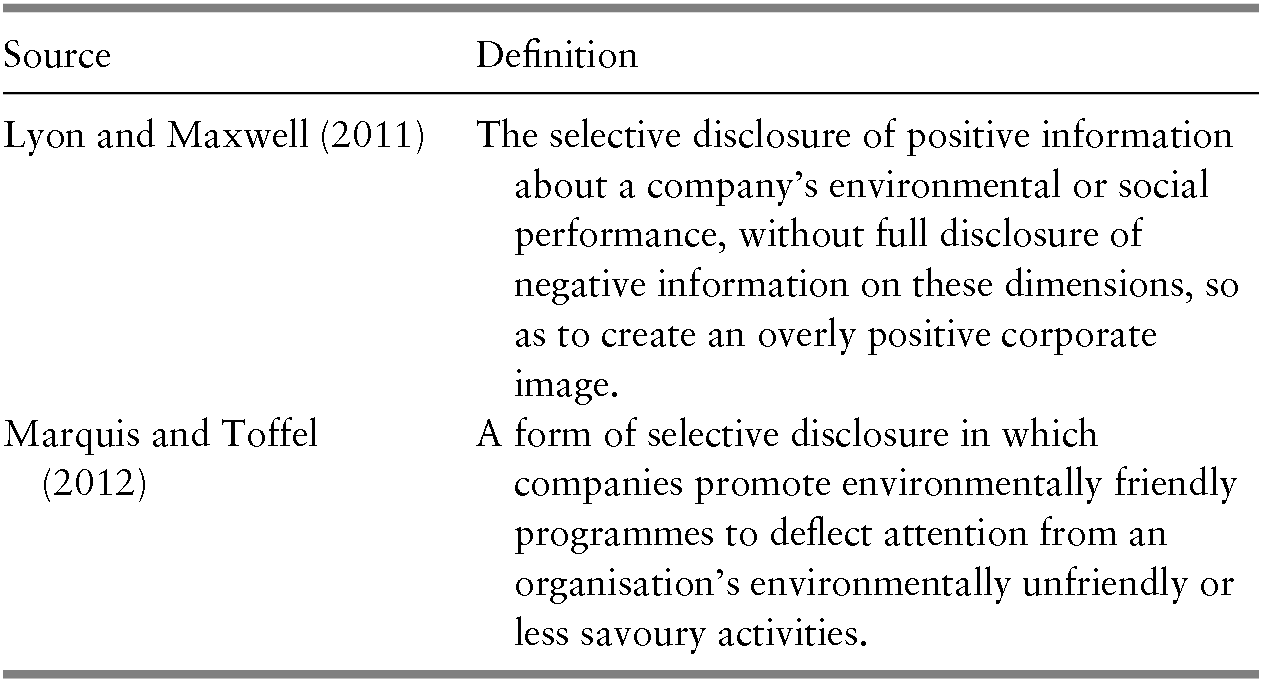
Table 2.1 Definitions of greenwashing
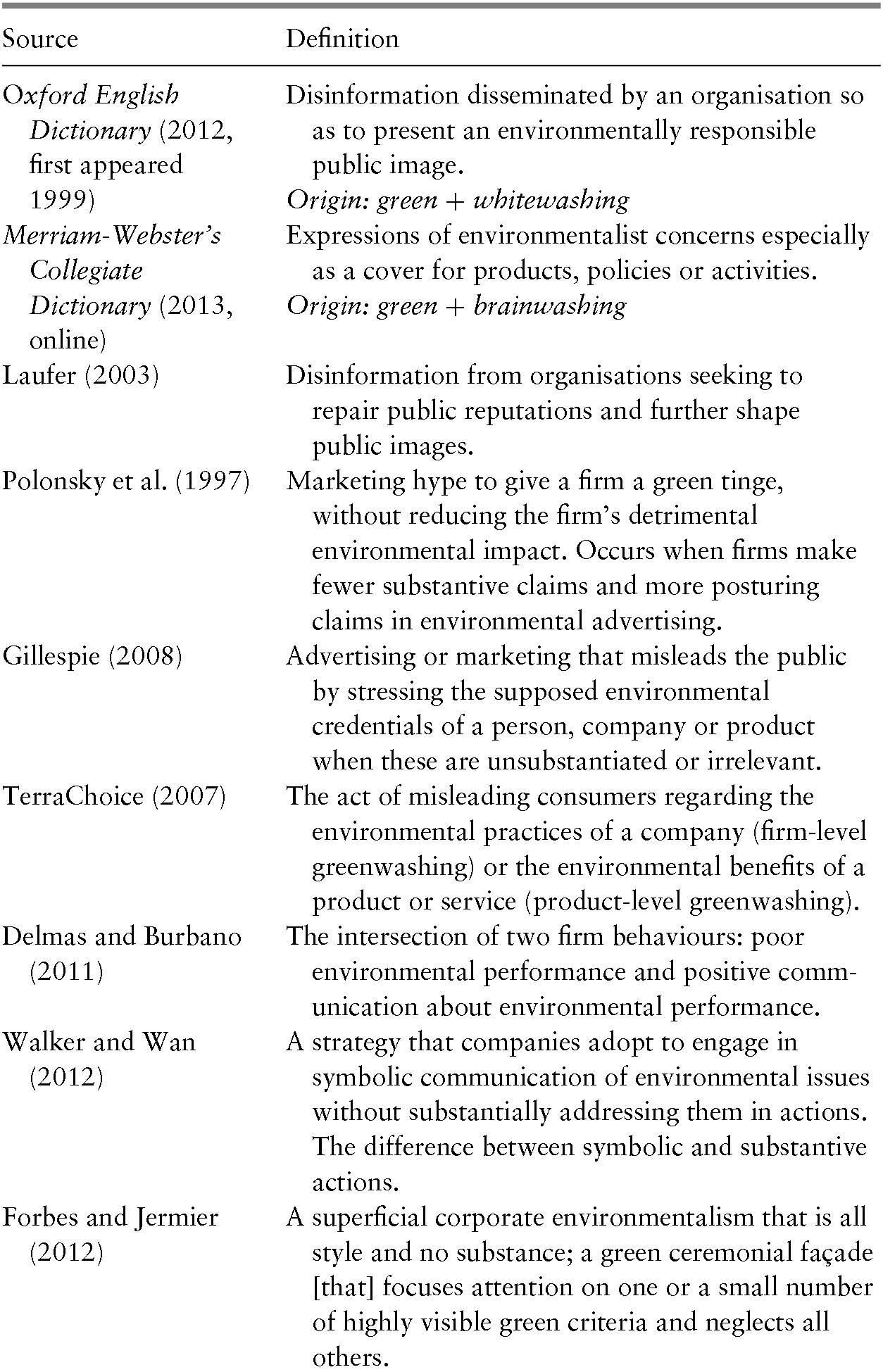
Definitions of greenwashing in marketing-oriented studies emphasise the nature of claims made by firms. Greenwashing is ‘marketing hype to give a firm a green tinge’ (Polonsky et al. Reference Polonsky, Carlson, Grove and N. Kangun1997: 227) or ‘supposed environmental credentials’ that are ‘unsubstantiated or irrelevant’ (Gillespie Reference Gillespie2008: 79). TerraChoice’s (2007) definition separates claims about the environmental practices of a company (i.e., firm-level greenwashing) from claims about a product or service (i.e., product-level service). Its ‘Six [later seven] Sins of Greenwashing’ highlight claims that hide trade-offs, provide inadequate proof, are vague, are based on false labels, are irrelevant, are based on spurious comparisons or are simply false. Whereas marketing definitions imply a difference between a firm’s claims and actions, this gap is more explicit in the most recent definitions of greenwashing. Both Delmas and Burbano (Reference Delmas and Burbano2011) and Walker and Wan (Reference Walker and Wan2012), for example, emphasise firms’ simultaneous positive communication on environmental issues combined with poor substantive performance. From their symbolic organisational theory perspective, Forbes and Jermier (Reference Forbes, Jermier, Bansal and Hoffman2012) also notice this symbol–substance gap, describing greenwashing as a firm’s deliberate use of ‘mere symbols’ or ‘a superficial corporate environmentalism that is all style and no substance’ (2012: 561). Greenwashing focuses attention on highly visible green initiatives or criteria, thereby deflecting attention from a more comprehensive analysis.
Recent definitions of ‘greenwashing’ by strategy scholars and economists turn stakeholders’ limited information and attention to a firm’s advantage. They model greenwashing as a deliberate information management strategy in which firms can selectively disclose positive information about their environmental performance without full disclosure of less favourable activities (Lyon and Maxwell Reference Lyon and Maxwell2011; Marquis and Toffel Reference Marquis and Toffel2012). The most careful, and narrowest, definition of all of these is Lyon and Maxwell’s (Reference Lyon and Maxwell2011: 9): ‘selective disclosure of positive information about a company’s environmental or social performance, without full disclosure of negative information on these dimensions, so as to create an overly positive corporate image’. This definition provides a foundation for Lyon and Maxwell’s (Reference Lyon and Maxwell2011) ‘persuasion game’ analysis of the drivers of greenwashing for firms with different levels of environmental performance. If we attempt to model greenwashing using economic game theory models such as this, then we certainly need more precise definitions of greenwashing. However, as with many economic models, the downside of idealised precision is that the definition of ‘greenwashing’ is much narrower than the politicised ‘brainwashing’ of the Merriam-Webster Collegiate Dictionary and the early writers in the US environmental justice movement.
A review of the definitions in Table 2.1 shows both the rise and the fall of the greenwashing concept. As greenwashing became more common in the popular press, academics followed with increasingly precise studies and definitions. Simply naming a phenomenon more carefully encourages others to examine it in more depth. As greenwashing becomes more delineated and easier for economists to study and model, the term begins to lose its broader ideological origins from the early literature. Most contemporary definitions of ‘greenwashing’ relate explicitly to a firm’s choice about whether and what to disclose – not a choice about the form and substance of a firm’s environmental actions in the first place. The earlier Merriam-Webster’s definition focuses on broader ‘expressions of environmentalist concerns’. Although these expressions might include selective disclosure through discretionary advertising or environmental reporting, ‘expressions’ also could take the form of actions that are understood symbolically in the field in which the firm operates. For example, Walmart’s green reception area and IBM’s Smarter Planet initiatives would not be captured within Lyon and Maxwell’s (Reference Lyon and Maxwell2011) ‘selective disclosure’ definition, but they surely would qualify as the more ideologically loaded ‘expressions of environmentalist concerns especially as a cover for products, policies, or activities’ (Merriam-Webster’s Collegiate Dictionary 2011). Similarly, the OED definition includes the admittedly rather broad term ‘disinformation’, but this captures significantly more potential greenwash than the more specific ‘positive information about a company’s environmental or social performance’ (Lyon and Maxwell Reference Lyon and Maxwell2011).
During the past thirty years or so, we have seen first the dramatic rise and then the beginnings of the fall of greenwashing. Newspaper articles mentioning greenwashing peaked in 2009, and early indications suggest that the number of academic articles may have reached a peak in 2012. There is no doubt about the wide variety of factors driving this trend, and answers to why greenwashing may have peaked in this way appear to be little more than speculation. However, it does seem sensible to suggest that the rise and fall in reporting about greenwashing in the popular press (at least) mirrors that of the attention given to environmental issues in newspapers more generally. Coverage increased as environmental awareness increased but then began to decline, along with media attention to environmental, energy and climate change since the financial crisis in 2008 and the failed United Nations (UN) climate talks in Copenhagen in 2009.
Looking past the decline in media coverage, Chevron’s experience with the We Agree campaign and HSBC’s ‘virtual trees’ suggest the potential for a real decline in the naïve greenwashing phenomenon. It is simply more difficult to maintain prima facie greenwash over time in an era of social media. Emerging research that theorises the impact of social media on greenwashing highlights the differences in corporate-stakeholder information flows between traditional and social media (Lyon and Montgomery 2013). Social media is nonhierarchical, lacks elite gatekeepers, is highly dynamic and public, and lacks formal controls within an environment of broad monitoring. Lyon and Montgomery (2013) further suggest that in a ‘high information’ social media context, there may be no greenwash at all – at least in the sense of simultaneous positive environmental information and poor environmental performance.
The decline of greenwashing seems likely to accelerate as new technologies enable anyone with a smartphone to directly monitor their environment and expose undisclosed, poor environmental performance. For example, HabitatMap – an ENGO based in New York that aims to raise awareness about the links between the environment and human health – launched AirCasting, ‘a platform for recording, mapping, and sharing health and environmental data using your smartphone’.6 Smartphone users can download the app and then use it to record, map and share sound levels recorded by the phone’s microphone. Advanced users can connect this with AirCasting’s air monitor (which records temperature, humidity, and carbon monoxide [CO] and nitrogen dioxide [NO2] gas concentrations) and its custom-designed heart-rate monitor to record and share how users’ heart rates respond to exposure to noise and air pollution. The commercial potential of this monitoring equipment has not gone unnoticed by major companies such as IBM, which launched a WaterWatchers app that enables mobile-phone users in South Africa to photograph and report water problems they observe (Simjee Reference Simjee2013). IBM’s app is designed to centrally collect the water data and then distribute it to water planners, utilities and municipalities; however, it is not difficult to imagine a parallel, open-source water data collection platform operated by tech-savvy activists. Direct and diffused monitoring of environmental impacts is likely to further close the gap between naïve positive communication and poor performance on environmental issues. Social media, smartphones and smart monitoring will soon confine environmental advertising like Chevron’s People Do campaign to the marketing history archives.
From greenwashing to symbolic corporate environmentalism
Outright greenwashing as it was in the 1980s, 1990s and early 2000s may soon take its place in history with other cultural phenomena of that era. But does this mean that companies have stopped trying to confuse, inflate, cover or creatively manage their reputations on environmental issues? Just because corporate environmentalism is maturing, can we now expect alignment between the symbolic and material components of firms’ green activities? More important, can we expect firms to unquestioningly comply with societal environmental demands now that these are more clearly articulated and less uncertain? This does not seem likely. The stakes are high: for firms that require access to increasingly stressed ecosystem services, for NGOs and activists who want to protect natural systems, for consumers who demand a wide variety of goods and services at low prices, and for politicians who want to be reelected. It seems unlikely that a distributed force of informal monitors armed with smartphones and social media will stop ‘big business’ in its tracks. It is more likely that firms’ tactics will change and that activists, academics and analysts will have to approach the contested terrain of who decides how to solve environmental problems in a more sophisticated way. Throughout this book, I argue that we need to expand our conception of the shared meanings and representations around firms’ environmental behaviour, from narrow greenwashing to a much broader symbolic corporate environmentalism. It will always be important for activists to expose examples of greenwashing and for academics to develop increasingly robust and sophisticated analyses to understand this cultural phenomenon. However, greenwashing is only part of a much broader and potentially more socially costly contestation over how corporate greening is defined, described and socially rewarded. Specifically, the academic literature on greenwashing is limited by four significant assumptions: it is focused on information disclosure decisions, it is assumed to be a deliberate strategy, it is conceived primarily as a corporate phenomenon, and it is usually assumed to be beneficial for firms and detrimental to society. Unpacking each of these assumptions provides a more realistic and powerful analysis of symbolic corporate environmentalism after greenwashing.
Greenwashing is an information disclosure decision
Most of the definitions listed in Table 2.1 frame greenwashing as an information disclosure decision. The focus is on a firm’s communicative activities directed at particular stakeholder audiences. Greenwashing can be information that is directed at consumers through advertising (see, e.g., Gillespie Reference Gillespie2008 and Polonsky et al. Reference Polonsky, Bailey, Baker, Basche, Jepson and Neath1998); at investors through environmental disclosure schemes such as the Carbon Disclosure Project (CDP) (see, e.g., Lyon and Maxwell Reference Lyon and Maxwell2011); or at a broader public through corporate websites (see, e.g., Walker and Wan Reference Walker and Wan2012). Firms also signal environmental quality through disclosing awards or certifications such as the International Organisation for Standardisation (ISO) 14001 standard. This focus on greenwashing as disclosure is understandable. It is much easier for researchers to collect data on large samples of firms based on visible metrics from publicly available data. Tracking memberships of industry clubs, the use of logos, and responses to investor questionnaires has allowed researchers to contrast positive environmental information with measurable environmental performance, such as toxic releases or carbon intensity of operations.
Recent disclosure-based studies help in understanding the nature, contingencies and dynamics of a particular type of greenwashing – but focusing on disclosure does not tell the whole story. Lyon and Maxwell (Reference Lyon and Maxwell2011: 9) recognised the limitations of defining greenwashing as selective disclosure and leaving ‘for future research the important challenge of integrating a disclosure model with a model of corporate choice of environmental projects’. A fuller model should work backward from the decision to disclose environmental information to integrate it with the symbolic aspects of adopting a given green initiative in the first place. More important, focusing on disclosure draws attention to a firm’s communicative practices such as reporting, public relations (PR) and marketing. However, Merriam-Webster’s ‘expressions of environmentalist concerns’ can include a wide variety of firm practices, not only communicative practices. We must pay attention to the symbolic dimension of the ordinary activities of firms (Forbes and Jermier Reference Forbes, Jermier, Bansal and Hoffman2012). Moving beyond greenwashing as disclosure allows the broadening of greenwashing back to its ideological roots: that is, examining how powerful elites use the shared meanings surrounding a wide range of organisational artefacts and practices to redirect the environmental conversation. Firms may not actively disclose environmental information through their mission statements, organisational structures, environmental technology choices, human resource routines, cultural stories or workplace rituals, but these practices can be powerful symbolic manifestations of green activities (Forbes and Jermier Reference Forbes, Jermier, Bansal and Hoffman2012). We must relax the dominant assumption of greenwashing as being about disclosure choices to include the shared meanings around all of an organisation’s green activities.7
Greenwashing is deliberate
A second assumption found in most of the definitions in Table 2.1 is that greenwashing is deliberate. It is ‘a strategy that companies adopt’ (Walker and Wan Reference Walker and Wan2012), ‘active dissemination’ (Haack et al. Reference Haack, Schoeneborn and Wickert2012), or disclosure that is ‘selective’ (Lyon and Maxwell Reference Lyon and Maxwell2011; Marquis and Toffel Reference Marquis and Toffel2012). All of these definitions imply that someone, somewhere in a firm decides to greenwash, whether it is the chief executive officer (CEO), marketing staff, PR department or whoever. This assumption about greenwashing makes sense among activists who are trying to expose particular firms or individuals for poor environmental performance. They need someone to blame for the lack of authentic action on environmental issues. It also makes sense among academics who study firms’ decisions, including most economists, strategists, marketers and accountants. They need to ascribe agency to firms – or at least to managers within them – so as to contrast effective with ineffective firm actions. However, assuming that greenwashing is deliberate narrows the phenomenon and seriously limits how we conceptualise it.
Mintzberg and his colleagues famously pointed out that not all strategies are deliberate – some emerge from a pattern of actions rather than a pattern of decisions (Mintzberg and Waters Reference Mintzberg and Waters1985). A firm’s words and actions on environmental issues can become disconnected because its intended strategies can be unrealised or because this disconnect emerges from a pattern of actions conducted in different parts of the firm. Contemporary decoupling literature builds on this disconnect to argue that it may not make sense to define ‘decoupling’ as separating stated intent from action; intentions may be generated simultaneously with actions or even after them (Bromley and Powell Reference Bromley and Powell2012).
Gaps between the symbolic and substantive effects of green activities might emerge as an unintended consequence of the process of corporate greening (Winn and Angell Reference Winn and Angell2000). Gaps might arise for various reasons, including unexpected results from environmental programmes, poor project implementation, managers’ cognitive biases, internal politics, middle managers’ discretionary resource allocation and other external factors (Delmas and Burbano Reference Delmas and Burbano2011). When HSBC announced in 2011 that it would no longer be carbon neutral, it stated that this was because the market for carbon offsets had not developed as expected when it made the commitment in 2005. According to HSBC’s explanation, external factors led to an unintended mismatch between the firm’s carbon neutral goals and its ability to meet them. Pointing out that symbolic gaps do not always need to be deliberate does not exonerate the cases of outright deception about firms’ performance – these deliberate deceptions should always be exposed and corrected. Widening our understanding of how differences between green words and actions can occur to include unintended or emergent gaps will provide a richer and more realistic analysis of firms’ environmental strategies.
Greenwashing is initiated by companies
The third assumption embedded in the academic definitions in Table 2.1 is that greenwashing is primarily a company-led activity. Delmas and Burbano (Reference Delmas and Burbano2011) define it as ‘the intersection of two firm behaviours’; Marquis and Toffel (Reference Marquis and Toffel2012) note that it is companies that promote environmental programmes; and for Walker and Wan (Reference Walker and Wan2012), greenwashing is ‘a strategy that companies adopt’ (emphases added). Early and dictionary-based definitions do not have this embedded assumption about firms doing the greenwashing. Some definitions include no actor at all (e.g., Merriam-Webster’s Collegiate Dictionary) or else a more general actor, such as ‘organisations’ (e.g., Laufer Reference Laufer2003 and Oxford English Dictionary 2012). In the transition to a more formalised approach in the management research literature, we somehow acquired the assumption that greenwashing is, by definition, a company-led activity. Many greenwashing examples are promulgated by companies, but other social actors can spread disinformation or deflect attention on green issues as well. Governments, public sector organisations, individual politicians and even NGOs have all been criticised for communicating false progress on environmental issues. Although recent greenwashing literature focuses on greenwashing in voluntary, industry-led regulation, we must understand a firm’s environmental strategies in a context in which formal environmental regulation also may be primarily symbolic (Matten Reference Matten2003; Newig Reference Newig2007).
Of course, it may not always be obvious who is responsible for greenwashing. A crucial assumption in Lyon and Maxwell (Reference Lyon and Maxwell2011) is that disclosures are verifiable by outside parties – that activists can audit and detect greenwash and act accordingly on this information. Active greenwash detection mechanisms using distributed monitoring via smartphones and social media may increase the likelihood that activists will be able to recognise outright communicative greenwashing. But what about more dispersed symbolic information embedded in the everyday activities of firms? It is notoriously difficult for participants in a social field to see past that field’s shared symbolic meanings. Even a firm’s own employees may be unable to see decoupling between a firm’s words and actions (Boxenbaum and Jonsson Reference Boxenbaum, Jonsson, Greenwood, Oliver and Sahlin-Anderson2008). Activist groups such as the Rainforest Action Network and the World Wide Fund for Nature (WWF) adopt corporate language, receive corporate donations, and enter into strategic partnerships with companies, thereby contributing to the generation of shared meanings about environmental responsibility. This has earned these groups criticism for participating in greenwash. These activists might counter that they need to strategically suspend disbelief around a company’s environmental intentions to be able to engage in a productive dialogue; build relationships; and drive longer-term, deeper environmental change. The problem is that this also can drift easily into a collective self-deception that misrecognises reassuring symbols of environmental change from those in authority for real environmental improvement (Bourdieu and Thompson Reference Bourdieu1991; Newig Reference Newig2007). It is not clear whether the merely symbolic greening begins with companies, with governments that generate stringent rhetoric without implementing green legislation, with well-intentioned ENGOs that want to participate in the green public debate, with a citizenry that is quite willing to accept false reassurances about environmental action, or with the interactions among all of these field participants. Assuming that greenwashing is a company-led activity absolves individuals as consumers, employees or voters from needing to change their own behaviour.
Greenwashing is beneficial to firms and costly to society
The fourth key assumption in current scholarship is that greenwashing is beneficial to firms and costly to society. On the one hand, firms can reap private reputational benefit from environmental disclosure that is ahead of true environmental performance by lowering regulatory costs, improving brand image and so on (Delmas and Burbano Reference Delmas and Burbano2011). On the other hand, communicative activity that does not match a firm’s underlying environmental performance imposes a negative externality on society that arises from the distortion of a company’s image (Lyon and Maxwell Reference Lyon and Maxwell2011). So far, too little research has focused on the welfare implications of symbolic greening. Economists and strategists tend to assume that firms are deliberately greenwashing because they are responding rationally to incentives and payoffs to do so and that this gap is bad for society. However, we need to examine more closely the social and private costs and benefits of shared meanings about corporate greening. In considering costs, we must find a way to account for not only the direct costs of marketing and PR on firms but also the indirect cost of loss of productivity from diverting social energy into merely symbolic activities. We may be seriously underestimating the social costs of corporate control over the rhetoric surrounding environmental initiatives.
We also need a more sophisticated approach to the potential social benefits of environmental symbols. Even merely symbolic green initiatives may be beneficial to society in the long run. Labels, logos, programmes, policies and associations may help to integrate green issues into everyday business practice, communicate abstract scientific concepts, change employee attitudes and behaviour, and give managers tools to achieve apparent rationality in addressing nebulous environmental issues (see, e.g., Matten Reference Matten2003 and Rhee and Lee Reference Rhee and Lee2003). Current research tends to define greenwashing as it relates to policy implementation depth – that is, the extent to which a disclosed policy is actually translated into improved firm-level environmental performance. This emphasises social costs because incorrect information about a firm’s environmental quality creates distortions in firm valuation. However, analysing the breadth of the diffusion of symbols, rather than simply the depth, allows a more sophisticated understanding of how new greening ideas spread and become established in a particular organisational field. What may be dismissed as greenwash in the early stages of an institutionalisation process ultimately may lead to a broader social conversation and to a deeper environmental commitment (Haack et al. Reference Haack, Schoeneborn and Wickert2012). Gaps between a firm’s words and actions may be costly to society in the short run but may help stabilise, legitimate and, ultimately, raise the quality of environmental solutions in the longer run.
From greenwashing to symbolic corporate environmentalism
Recent definitions of greenwashing are useful because they allow enough precision for greenwashing to be economically modelled and measured. However, deliberate, disclosure-based greenwashing initiated by companies is only part of the broader symbolic contestation over environmental issues. We need a wider perspective on how differences between the symbolic and substantive effects of green activities arise in an organisational field, as well as the social costs and benefits of these gaps in various contexts. In the tradition of the original wider scope of the ‘greenwashing’ term, I suggest that we consider a more general phenomenon: symbolic corporate environmentalism. This refers to the shared meanings and representations surrounding changes made by managers within firms that they describe as primarily for environmental reasons. Greenwashing is an important subset of activity within symbolic corporate environmentalism, but it is only a part of the broader shared meanings related to corporate greening. The broader concept of symbolic corporate environmentalism allows us to break out of the limitations imposed by the four assumptions about greenwashing in the recent literature to generate a richer explanation of the symbolic component of the environmental behaviour of firms. Although greenwashing may be on the decline, symbolic corporate environmentalism is unlikely to diminish in the near future. To provide a foundation to better understand this new concept, I next outline the differences between narrow greenwashing and symbolic corporate environmentalism.
The primary difference between greenwashing and symbolic corporate environmentalism is the way in which symbol and substance are connected. In conventional definitions of greenwashing, a firm’s communications can be separated from actual environmental impacts. ‘Greenwashing’ is the label given when deliberate positive disclosure exists in parallel with poor substantive environmental performance. Thus, by definition, a firm’s communications are disconnected from environmental impact. There is only a symbolic link between the signal – such as adopting an empty eco-label – and the abstract concept it is intended to signify (e.g., corporate environmental concern). In greenwashing, there is no necessary link between the symbol and materially improved environmental performance. Greenwashing is a special case within symbolic corporate environmentalism in which firms deliberately manipulate symbols so as to open up a gap between their symbolic and substantive performance.
Symbolic corporate environmentalism is both broader and more nuanced. This concept captures all of the shared meanings relative to changes that managers make for environmental reasons. All corporate environmental practices have both material and symbolic components (Forbes and Jermier Reference Forbes, Jermier, Bansal and Hoffman2012). For example, constructing a green headquarters building has the material components of high-efficiency lighting, a rainwater-utilisation system, a green roof or solar-power windows. It also has symbolic components such as showcasing environmental concern to internal and external stakeholders, signifying high status through association with a famous architect, and projecting an image of environmental responsibility through acquiring a green building certification (e.g., LEED Gold). Crucially, these components may or may not be linked with substantive environmental improvements. A green headquarters building has symbolic and material components regardless of whether it is actually beneficial for the environment. Indeed, even the most advanced green buildings may not match an absolute standard of building the greenest buildings (Pierre-Louis Reference Pierre-Louis2012). For example, the architect of HSBC’s new North American headquarters in Mettawa, outside Chicago, claimed that ‘this is the most sophisticated environmentally sensitive building we’ve ever designed’ (Hwa-Shu Reference Hwa-Shu2008), thereby vouching for the building’s technologically advanced material components. But the Natural Resources Defense Council (NRDC) countered, ‘What we really have here is yet another high-tech building calling itself “green” but that warrants the label only if you completely discount the sprawling, totally automobile-dependent location…[that] cause[s] far more carbon emissions from employees and visitors driving to and from than they save with energy-efficient building technology’ (Benfield Reference Benfield2008). Obviously, it is not the building that calls itself green but rather the people commentating on and describing the building – in this case, The New York Times, HSBC and the LEED agency that awarded the Gold certification. The building’s symbolic component evolves as shared meanings develop through interactions among actors within the field, and symbols like ‘LEED Gold’ and ‘green building’ come to represent the abstract concept of a building that does not damage the environment. The material and symbolic components of an environmental change may or may not be linked to reducing substantive environmental impact.
All environmental practices embody both material changes and powerful symbolic messages. Symbolic corporate environmentalism refers to the latter: the shared meanings and representations related to the environmental activities. Some symbolic corporate environmentalism has only a symbolic effect and is not linked to improved substantive performance. This type of symbolic corporate environmentalism is termed ‘merely symbolic’ (Short and Toffel Reference Short and Toffel2010; Stevens et al. Reference Stevens, Steensma, Harrison and Cochran2005). Greenwashing is a special case of ‘merely symbolic’ in which firms deliberately manipulate their communications and symbolic practices so as to build a ceremonial façade (Forbes and Jermier Reference Forbes, Jermier, Bansal and Hoffman2012).
However, there is another aspect of symbolic corporate environmentalism in which the symbolic and material components are indeed linked to substantive environmental improvement. It may be the case that the NRDC’s criticism is too harsh: there may be substantive environmental improvements associated with HSBC’s building. We could use a tool such as an environmental impact assessment or a life-cycle analysis of the building to assess this concern. Even if there is a substantive environmental impact improvement, it does not erase the symbolic function of social labels such as ‘green buildings’ and ‘LEED Gold’. The current corporate environmental strategy literature tends to underrate symbolic corporate environmentalism by looking only at merely symbolic activities, such as greenwashing, and not at the shared meanings around greening that might also have a substantive impact.
Table 2.2 illustrates how other features show that greenwashing differs from broader symbolic corporate environmentalism. First, symbolic corporate environmentalism is about more than environmental information disclosure. Contemporary greenwashing research has increasingly focused on easily visible environmental disclosures. Disclosure practices such as publishing sustainability reports, declaring support for green clubs, adopting labels and certification schemes such as ISO 14001 and EnergyStar, and participating in the CDP are all ways for firms to signal environmental quality. These environmental disclosures lend themselves to large-scale empirical studies in which firms can be easily categorised as disclosing support for a visible scheme or not. But we need to remember that the adoption of an internal environmental management system can signify environmental concerns as much as an ISO 14001 certificate. All changes to firm environmental practices are symbolically connected to the abstract idea of greening; all environmental practices embody a shared meaning that they represent an attempt to improve the natural environment. Therefore, symbolic corporate environmentalism includes not only disclosure and communication practices but also the symbolic aspects of the full range of environmental practices, including implementing an environmental technology, creating an environmental department, launching internal environmental programmes, instituting measurement and reporting systems and constructing physical buildings. We must expand our analysis beyond specific disclosure practices to include the symbolic components of all corporate environmental actions.

Second, symbolic corporate environmentalism may emerge as an unintended consequence of a firm’s environmental decisions. Contemporary definitions of greenwashing tend to emphasise deliberate strategies. This view implies that firms make strategically interrelated deliberate decisions about disclosing environmental information and about levels of environmental performance. But a more realistic view recognises that the shared meanings about corporate greening emerge from a broader pattern of practices. Corporate environmentalism is a systematic pattern of voluntary practices across a firm (Aragon-Correa and Rubio-López Reference Aragon-Correa and Rubio-López2007). Strategies often actually emerge as middle managers support their own pet projects and local managers respond to specific local environmental concerns or provide ‘knee-jerk’ reactions to a perceived environmental crisis. It is easy to see the potential for environmental practices within firms to become diffuse or contradictory. If a firm’s practices are messy, then the symbolic aspects of those actions can also be messy. All environmental practices have symbolic meanings, whether or not those shared meanings are deliberately manipulated. The symbolic component of green practices may or may not accurately represent substantive environmental performance, regardless of whether a manager set out to deliberately mislead.
Third, symbolic corporate environmentalism is deeply embedded within an institutional field and may be constructed by a diverse range of actors or the interactions among them. Motivated activists are becoming better adept at recognising deliberate greenwash. However, they need to put aside their most critical voices to be able to maintain productive conversations with firms and governments. This can lead them to inadvertently support symbolic actions over no action at all. For an illustration of how this can work in practice, consider the WWF’s response to the failed UN Rio+20 environmental summit in July 2012. The ENGO criticised the intergovernmental draft agreement, pointing out that it included the words ‘encourage’ fifty times and ‘support’ ninety-nine times but mentioned the words ‘we will’ and ‘must’ fewer than ten times in total (The Economist 2012). It criticised the negotiations as ‘a process with no serious content’ (WWF 2012). In the same press release, WWF praised the governments, banks, investors and large corporations – including Unilever, Puma and Dow Chemical – that collectively produced the ‘Natural Capital Declaration’ (NCD). Participants who signed the declaration ‘wish to demonstrate our commitment to the eventual integration of natural capital considerations into private-sector reporting, accounting and decision making, with standardisation of measurement and disclosure of natural capital use by the private sector’ (Natural Capital Declaration 2012a). The NCD lists benefits for firms in signing the declaration, such as showing leadership and commitment, risk management and reputational gains. It also reassures potential signatories that the NCD ‘does not require from endorsers to report or disclose additional information’ (Natural Capital Declaration 2012b). As discussed in Chapter 7, the more that high-status corporate actors are involved in designing a performance standard, the more likely that that standard is to be based on symbolic rather than substantive criteria. The WWF may be inadvertently promoting a new green initiative with little prospect for substantive change. Its support helps to construct and maintain cultural symbols related to corporate environmentalism – symbols that are misrecognised as legitimate by a disengaged public because of the high status of those promoting them. Giving more attention to how symbolic corporate environmentalism emerges within a field highlights the roles of power and status – dimensions that often are neglected in rational economic analyses of greenwashing.
Fourth, symbolic corporate environmentalism may have a range of private costs and benefits for firms as well as welfare costs and benefits at the societal level. At the firm level, individual companies might face both negative and positive consequences of merely symbolic greening. Private reputational benefits must be balanced against the potential private costs of loss of consumer confidence, lawsuits from false advertising, and other risks when consumers or NGOs question firms’ claims (Delmas and Burbano Reference Delmas and Burbano2011). We should also move the analysis from the firm to the social level and examine both the social benefits and the costs of symbolic corporate environmentalism. The Rio+20 environmental summit, for example, was rightly criticised for the excessive direct cost of convening thousands of participants from across the globe and the indirect cost of missing an opportunity for a step change in environmental cooperation. But it also gave rise to more than seven hundred voluntary commitments on various improvements towards sustainable development by individual companies, associations, governments and civil society groups.8 Many of these commitments will turn out to lack substance or may have already been forgotten. But many, taken together, may plant the seeds of distributed incremental changes, each taken according to the self-interest of individual adopters, and which may raise the level of conversation and action on environmental improvement (Allenby Reference Allenby2012). A more dynamic view hints at the potential for social benefit as particular experiments for environmental improvement gain meaning, momentum and support. The main conceptual framework I introduce in this book provides a way to trade off the social costs and benefits of symbolic corporate environmentalism. A more contingent view of when symbolic corporate environmentalism may be most damaging is vital so that regulators and activists can focus their change efforts on the most socially harmful merely symbolic activities.
After greenwashing
This book is the first systematic analysis of the drivers and consequences of symbolic corporate environmentalism after greenwashing. I move beyond firm-centric greenwashing that is deliberate and disclosure based to include the symbolic component of a wider range of greening activities within institutional fields. Optimists argue that the ‘bad days’ of corporate greenwashing are behind us as academics and activists are becoming more adept at calling to account companies that commit greenwashing. Cynics dismiss corporate environmentalism as deflective manoeuvres by powerful social actors, and they emphasise the costs imposed on society by firms acting in their own self-interest. Realists accept that stakeholders need corporate symbols to assess environmental quality but that these symbols are designed and promoted by actors that have a stake and a position to maintain in the field. Symbolic corporate environmentalism pervades contemporary organisational life. But when are these symbols particularly socially costly? Moreover, when might even merely symbolic changes be justified in the short run and outweighed by positive effects of information sharing, raising the quality of a public conversation or stimulating monitoring and surveillance? Providing guidance on these contemporary dilemmas is at the core of this book.


