Crossref Citations

This Book has been cited by the following publications. This list is generated based on data provided by Crossref.
Jeffery, Renée
2013.
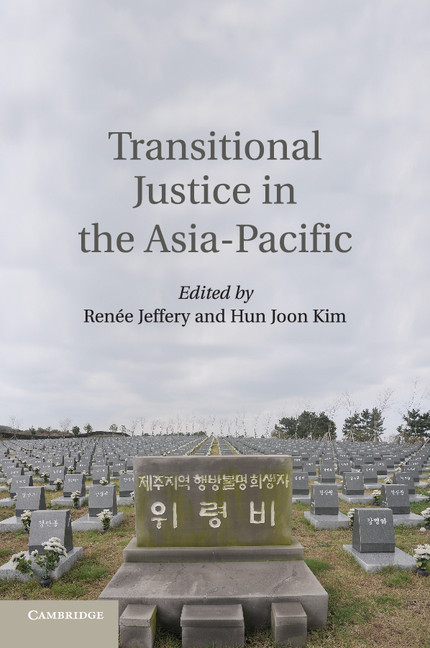
Transitional Justice in the Asia-Pacific.
p.
195.
Souillac, Geneviève
and
Fry, Douglas P.
2016.
The Palgrave Handbook of Disciplinary and Regional Approaches to Peace.
p.
69.
Renshaw, Catherine
2019.
Civil Society and Transitional Justice in Asia and the Pacific.
p.
127.
Kim, Hun Joon
2019.
Why Do States Adopt Truth Commissions After Transition?.
Social Science Quarterly,
Vol. 100,
Issue. 5,
p.
1485.
DeFalco, Randle C.
and
Sirik, Savina
2021.
The Fluctuating Visibility of Everyday Violence in Khmer Rouge Era Cambodia.
SSRN Electronic Journal ,
Kochanski, Adam
2021.
Framing, truth-telling, and the limits of local transitional justice.
Review of International Studies,
Vol. 47,
Issue. 4,
p.
468.
Moreno Cantano , Antonio César
2024.
La memoria del dolor en el espacio Indo-Pacífico: justicia transicional y construcción nacionalista a través de digital games.
Relaciones Internacionales,
p.
155.


