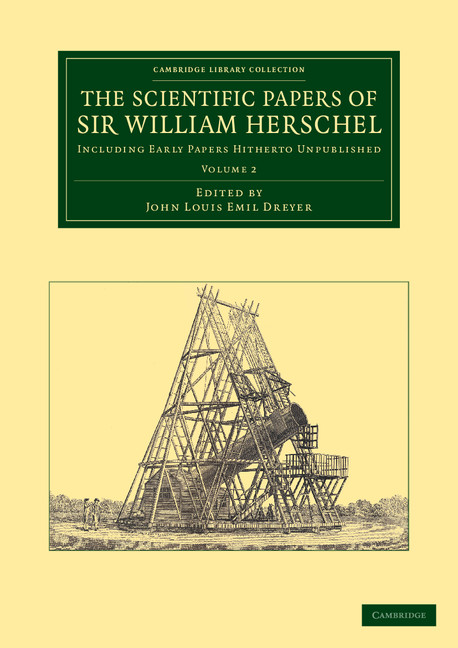

By the time of his death, William Herschel (1738–1822) had built revolutionary telescopes, identified hundreds of binary stars, and published astronomical papers in over forty volumes of the Royal Society's Philosophical Transactions. This two-volume collection, which originally appeared in 1912, was the first to gather together his scattered publications. It draws also on a wealth of previously unpublished material, from personal letters to numerous papers presented to the Philosophical Society of Bath. Although Herschel is best known for his discovery of Uranus, this collection highlights the true range of his observations and interests. Focusing on his later work, Volume 2 includes notes on some of the moons of Uranus, studies of solar heat and the atmosphere of Saturn, and some practical experiments investigating the capabilities of contemporary telescopes. It also features an appendix of work compiled by his son, John Herschel, and sister Caroline.
Loading metrics...
* Views captured on Cambridge Core between #date#. This data will be updated every 24 hours.
Usage data cannot currently be displayed.
This section outlines the accessibility features of this content - including support for screen readers, full keyboard navigation and high-contrast display options. This may not be relevant for you.
Accessibility compliance for the PDF of this book is currently unknown and may be updated in the future.
