

Discussions about the complex Japanese honorific system are often grounded in the implicit assumption that honorifics are an inherent trait of the Japanese language and have been from time immemorial.
Nihongo no keigo wa, kodai kara gendai ni itaru made shuju no henka o tadorinagara, ikkan shite ningen kankei o fumaeta kotoba no tsukaiwake no tame no gengo keishiki to shite sonzai shite kita. Shitagatte, keigo shiyō wa nihon no shakai ya bunka no arikata o kotobazukai no ue ni han’ei suru mono de ari, nihonjin no gengo seikatsu ni jūyō na ichi o shimete iru.
Japanese honorifics, while going through numerous changes from ancient times to the present, have existed as linguistic forms for language differentiation based consistently on interpersonal relationships. Therefore, honorific use reflects in language the essential nature of Japan’s society and culture, and occupies an important space in Japanese people’s language lives.
Honorifics are often also regarded as evidence for a cultural emphasis on an innate, always already present, Japanese politeness; indeed, keigo forms are so strongly associated with the enactment of linguistic politeness that other ways of being linguistically polite – using positive instead of negative phrasing, offering supportive backchannels and questions soliciting interlocutor opinion, etc. – have been seriously neglected (notable exceptions being Dunn Reference Dunn2011; Kikuchi Reference Kikuchi1994; Minami Reference Minami1987).Footnote 1 Furthermore, the basis of government concernFootnote 2 over “polite” or “respectful” speech up to the end of the twentieth century was focused on the proper or correct forms of keigo and their prescriptive “meanings” vis-à-vis specific qualities of addressee and/or referents. In this chapter, we examine metapragmatic discourses about honorifics, or “reflexive models of language use” (Agha Reference Agha2003, Reference Agha2005, Reference Agha2007) as they are articulated “officially” through institutional policy, scholarly work, and the popular media. We explore the common claims of Japanese politeness being linked centrally, if not exclusively, to honorifics and the inherent cultural politeness of “the” Japanese people as being sufficiently evidenced by the honorific system. In this, we aim to expose some of the occlusions that underlie them, and to begin an inquiry into why these two parts of the keigo story are so strongly persistent over time.
This chapter, then, is a historicized and critical look at the construction of dominant social norms for keigo, which offers a backdrop for the discussion of how and why these particular linguistic forms have come to be so central to portraits of a particularly Japanese sociolinguistic and cultural identity in the modern era. In Section 3.1, we look at how and why keigo came to take the shape it did in the modern period, with a focus on official policy as it has shifted over time. In Section 3.2, we examine a sample of academic linguists’ authoritative descriptions (Cameron Reference Cameron1995; Milroy and Milroy Reference Milroy and Milroy1999) of honorifics, and in Section 3.3, we look at how that policy is reflected in popular media presentations of honorifics.
For those unfamiliar with Japanese honorifics, we introduce the basic shape of the Japanese honorific system. Honorific forms are divided into two sets: addressee honorifics (taisha keigo or teineigo) and referent honorifics (sozai keigo), with referent honorifics further subdivided into other-elevating honorifics (sonkeigo) and self-lowering honorifics (kenjōgo). For accounts of this system in English, see Shibatani (Reference Shibatani1990) and Wetzel (Reference Wetzel2004). Although fundamentally a two-way division, broadly circulated public understandings of keigo focus on a three-way distinction (that is, teineigo, sonkeigo, and kenjōgo), which was the framework for articulating usage in official and scholarly documents as well. This categorization was modified in 2006 to accommodate new usages, which we address in Section 3.1, but this tripartite classificatory scheme has played a major role in discussions of Japanese honorifics over the twentieth century and serves as a good introduction even today. Table 3.1 offers a summary of the linguistic structural properties of the older, tripartite system.
Table 3.1. Keigo (honorific) typology, prior to 2006 (adapted from Bunka Shingikai Kokugo Bunkakai 2007: 64)
The type of honorific to which the Japanese term keigo most often refers in everyday use is the category of referent honorifics. This category is divided into the two subcategories sonkeigo and kenjōgo noted above. The first indexes respect to a deference-entitled referent, typically the subject of the clause, by other-elevating means. The second subcategory indexes respect for a deference-entitled referent through speaker self-lowering. There are two basic structural mechanisms for creating honorific verbs in both these categories. First, speakers can use the productive grammatical device o-verb stem ni naru, as in o-yomi ni naru/narimasu for yomu ‘read’ in the case of sonkeigo or through the grammatical device o-verb stem suru/itasu, as in o-mochi suru/shimasu for motsu ‘to hold, carry’ in the case of kenjōgo. An alternative productive device, addition of the suffix -(r)areru to verbs as in iwareru for iu ‘say’ is also available for sonkeigo; no productive counterpart is available for kenjōgo. Finally, there are a series of suppletive forms both for sonkeigo (for example, ossharu for iu ‘say’, meshiagaru for taberu ‘eat’) and for kenjōgo (for example, mōshiageru for iu, or itadaku for taberu).
Teineigo ‘polite forms’ are addressee honorifics, as in the verbal teineigo form yomimasu ‘X read(s)’ versus plain form yomu, the adjectival teineigo form utsukushii desu ‘X is beautiful’ versus utsukushii, or copula desu ‘is’ versus da. Choice between plain and polite forms is typically held to index a speaker’s deference to an addressee by marking recognition of either vertical (status-based) or horizontal (negative solidarity-based) social distance. In practice, however, the situation is a considerably more complex than simple assessment of social distance, as will be taken up in detail in Chapter 4.
3.1 Institutional policy on honorific form and use: Constructing the Japanese essence
In this section, we address the history of policy on keigo throughout the twentieth century with the aim of pointing to certain issues that have arisen over time, demonstrating how the keigo of today was constructed, rather than emerging naturally from a font of ahistorically present lingua-cultural Japanese politeness, as claimed in many official publications from the early decades of the twentieth century to the present, as seen in the Kokugo Shingikai (2000) report quoted at the beginning of the chapter. We offer some thoughts on what interests have driven keigo to such prominence in the sociolinguistic landscape. More specifically, we discuss the process of norm construction from the perspective of the Japanese government’s policy regarding the form and use of honorifics as it is circulated through official institutional messaging.
In the Meiji period (1868–1912), projects of standard language building were directed at establishing Standard Japanese by eradicating regional dialects and unifying the written and spoken forms around that new standard (genbun itchi), as discussed in Chapter 1. Wetzel (Reference Wetzel2004: 44–46) offers keigo as another focus;Footnote 3 she stresses, however, that script choice and reform dominated early standardization efforts, and that through the end of the nineteenth century, there was no tradition of keigo analysis. Keigo, then, came late to the standardization party. But it is necessary to ask why honorifics came to the party at all. After all, eastern dialects – including the Tōkyō dialect group –were not characterized by highly developed honorific systems, so it would seem unnecessary to go out of the way to introduce an honorific system into the new Standard language.Footnote 4 One possible line of speculation of what might account for this draws upon recent critical work on the “emergence” of national language and literature, work which stresses the struggles over the cultural capital of language during the early years of Meiji,Footnote 5 when there were anxieties about how to articulate Japan as a modern nation.
One strategy was to posit a modernity that was equal to but different from Western modernity. Inoue Tetsujirō (1855–1925), for example, claimed moral superiority for Japanese capitalism over that of the West because it elevated the interests of the social whole over those of the individual. On the literary front, figures such as Japanese literary scholar Haga Yaichi (1867–1927) developed the discipline of classical Japanese literary study in a fashion that allowed Japan to accumulate “symbolic capital that supports Japan’s case for international status as both a civilized nation and a great civilization in its own right” (Anderson Reference Anderson2009: 12). And language planners working in the context of a nationalist backlash against the wholesale importation of Western institutions and practices were determined that this symbolic capital would be expressed in a suitably modern, standard language that was equal to but different from the standard languages of modern Western states. Keigo, one might easily conclude, is precisely one arena where that difference would be highly visible and particularly suited to making linkages to the early twentieth century anti-Western backlash against rampant individualism, since honorification, by its very nature, is a constant reminder to the speaker (and the hearer) of her or his place in the social body. A fully developed system of honorifics was something Western languages, with only minimal second person pronominal T/V systems, lacked.Footnote 6 The ideological apparatus of the last decade of the nineteenth century and the first two decades of the twentieth was intent on articulating the modern state of Japan as a “panchronic ethnic nation”Footnote 7 whose national character could be read through its linguistic qualities.
It was also around this time that keigo began to be naturalized as something that had always been present in “Japanese”; native grammarians of the time argued that “at least in effect, the Tōkyō-standard honorific register showed the natural national tendency for the Japanese people, [versus] raggedly individualistic and selfish Westerners, who speak languages without honorifics to respect the [hierarchical] social order [created by the Meiji state]” (Koyama Reference Koyama2004: 426). Mitsuhashi Kanaya was the first to make a systematic description of keigo in his 1892 work Hōbunjō no Keigo ‘Vernacular Keigo’, and he also was one of the first to advertise keigo as evidence for the timelessness of the superior moral and aesthetic traits that honorifics marked Japan as always having had (Wetzel Reference Wetzel2004: 21).
In a biting critique of the misrecognition of the linguistic treatment of keigo by linguists throughout the modern era, Koyama (Reference Koyama2004: 427) characterized Mitsuhashi’s work as offering Japanese honorifics as linguistic evidence for the eternal continuity of the moral and aesthetic tradition of the Imperial nation, which he called “a happy nation replete with auspices of Sprachgeist (language-spirit) … in which words had been always refined and the speakers had naturally shown deference to their superiors both behaviorally and linguistically, in explicit contrast to China and the West.” Others followed in Mitsuhashi’s wake to link honorifics to an essentialized national culture, from literary scholar Haga, who claimed honorifics to be an example of courtesy, one of the ten distinctive features of “the Japanese,” through the nihonjinron theorists of the 1970s–1990s and beyond, as evidenced by the quotation from the Kokugo Shingikai’s (National Language Council) 2000 report with which this chapter began. An even more recent report reiterated the timelessness of this characteristic feature of “the” Japanese language and offered additional specifics about the nature of the role keigo has played.
Beginning with the Kokugo Chōsa I’inkai in 1902, the government agencies charged with overseeing language policy for the modern state solidified the “proper” forms and uses of honorifics based on nationwide surveys (Chapter 1).Footnote 8 Recommendations based on the results of such surveys were then disseminated through the national education system (T. Tsujimura Reference Tsujimura, Toshiki, Kazuo, Muneaki, Mitsuaki, Hisao and Yutaka1971: 23). Recommendations concerning the proper forms and uses of keigo were centered around the concept that the primary function of honorific forms was to encode the vertical relationship between speaker and other. Wetzel (Reference Wetzel2004: 50–51) provides an English translation of the description of keigo in the first report from the Kokugo Chōsa I’inkai, which is instructive in this regard:
We list the language that self (jiko) uses in order to show the action(s) of other (aite) or anything else pertaining to other when other is equal (dōtō) to self – ordinary language (jōgo); we list the language that self uses in order to show the action(s) of self or anything else pertaining to self when other is superior (meue) – humble language (kengo); we list the language that self uses in order to show the action(s) of the other or anything else pertaining to the other when the other is superior to self – respect language (keigo).
Ideologically at least, the status differences between personsFootnote 9 were still seen as sufficiently clear during the first half of the twentieth century that the “rules” of keigo – which involved knowing who might be a status superior and who a status inferior – were held to be reasonably isomorphic with the new system of statuses developing in modern Japan.
Wetzel (Reference Wetzel2004: 19) notes that “from the outset … Japanese linguists have had an overriding concern for taxonomy – that is to say, delineation of the whole category of keigo in addition to its subdivisions.” The project of conducting a systematic study of honorifics and devising a comprehensive system of honorific forms to be used in rigidly specifiable circumstances had the additional benefit of being very much in line with the modernist linguistics of the times, which was characterized by a drive to treat languages and their constituent parts as museological collectables, bounded and countable (Silverstein Reference Silverstein, Segal and Yanagisako2005: 111) and to limit interest in the “meanings” of linguistic signs to the denotational (Shibamoto-Smith Reference Shibamoto-Smith2011: 3707–3708).
This modernist trend meshed well with the Japanese orientation toward “the Sino-Confucian tradition of cataloguing, re-cataloguing and detailed taxonomy” (Wetzel Reference Wetzel2004: 23–24). But no matter how exhaustively forms were introduced to cover all cases of status differences and no matter how carefully the various policies about normative use were framed, inevitably some uses of keigo that could not be accounted for within the normative system were encountered; and from the early years of the twentieth century, the Kokugo Chōsa I’inkai was issuing publications dealing with “mistaken” keigo (Wetzel Reference Wetzel2004: 51). “Mistaken” keigo use is a topic of persistent interest in both scholarly and popular treatments of keigo as we demonstrate here and in Chapter 4.
Throughout the first half of the twentietih century, the romanticized version of keigo as an inherent and timeless trait of the Japanese language, which in turn was a manifestation of the cultural level of the Japanese people, continued to circulate unabated; its essence, moreover, came to be linked to the properties of the Emperor system and the family system. After the war, ridding Japan of all “feudal,” distinctly non-modern, traits that were held to have led it into its fateful experience with colonial expansion and ultimate defeat in WWII was the highest priority. The “feudal” overtones of keigo, which up until the end of the war had centered on the hierarchically organized vision of society based on the Imperial system and on the equally hierarchically organized pre-war family system, became a matter of concern. In order to retain keigo as the social emblematic marker of Japan’s timeless civilizational quality, it was imperative that keigo narratives be divorced from their ties with both the Imperial and the old family systems; it was only when that narrative shift was accomplished that keigo as a system could be reworked at the policy level to fit the needs of the post-war democratization projects (Yasuda Reference Yasuda2007: 207–208).
In the post-war period, trends toward the simplification and the mutualization of respect offerings in the form of keigo have proceeded in conjunction with the ideological democratization of Japanese social life more generally. And to some degree these trends have forced their way into official language policy, although as we argue below, official policy texts contain numerous internal contradictions. The first post-war policy document on keigo, and the document which was to remain the foundational statement on keigo for over two decades, emanated from the newly reconstituted Kokugo Shingikai’s Keigo Bukai ‘Honorifics Subcommittee’ chaired by linguist – and Imperial apologist (Yasuda Reference Yasuda2007: 209) – Kindaichi Kyōsuke (1882–1971). The work of the subcommittee was, first, to determine whether keigo should even be retained in a democratizing language. The answer to this was yes, but with some restrictions on “excessive” forms and a shift in the functions to be served.Footnote 10 The subcommittee submitted their report, entitled Kore kara no keigo ‘Keigo for the Future’ to the Minister of Education in April 1952. This document proclaimed a profound shift in the basic function(s) of keigo: “Until now keigo developed based mainly on vertical relationship(s), but from now on keigo must be based on the mutual respect that derives from valuing the essential character of each person.” It was not undemocratic but rather mannerly to offer deference to interlocutors that you respected; this simply has to do with “whether keigo will be unified with the manners and etiquette of real life” (quotations from Kore kara no keigo [Bunkachō 1952]; English translations from Wetzel Reference Wetzel2004: 117).Footnote 11 However, just what that mutual respect derives from is left unspecified, and in the event, it turned out that status asymmetries continued as a basis for judging where respect was due, mutual or not. Subsequent policy documents continued to propose very specific guidelines involving terms like meue ‘status superior’ to explain when deference vocabulary should be used. Indeed, Takiura (Reference Takiura2005) claims that all the new talk about a shift toward honorifics used to indicate mutual respect was in fact just a cover for recycling the old, hierarchically based structures.
After setting out the new, etiquette-based, functions of post-war keigo, Kore kara no keigo devoted the remainder of its pages to specifying particular forms that were suitable for a new, slightly simplified (“non-excessive”) keigo. The report covers terms of address and reference, the prefix o-/go-, desu/-masu forms (teineigo), and reduced the number of verbal forms of referent honorifics (in the sonkeigo subcategory) from three to two. Whereas the paradigm had been to have three levels of deference as in, for example, a verb like kaku ‘to write’ (kakareru, o-kaki ni naru, o-kaki asobasu), only the first two were retained; the third did not fit in with the new clear and simple (heimei~kanso) version of keigo for the future.Footnote 12 It is notable, however, that although the tone is aimed toward a democratic (that is, egalitarian) policy, there are very few examples included to illustrate to whom sonkeigo and kenjōgo would properly be directed. And of even greater interest is that those few examples that are provided offer evidence that status difference remains an underlying (albeit now implicit) factor in post-war keigo policy.
The bulk of the examples given are simply single lexical items; in fact, there are only three examples that offer adequate information about the speech context in which a given keigo form might be used. Two of these examples have to do with the honorific prefix o-/go-. First, its use is generally frowned upon;Footnote 13 however, when a speaker wishes to express genuine respect (shin ni sonkei no i), then this prefix is permitted and the example sentences given both involve a prospective status superior, sensei ‘teacher/master’. At an even greater status-asymmetric extreme, the third example (or example set) concerns the language used to and about the Imperial household.Footnote 14 Again, the report offers the opinion that the old, “excessive” usage is to be abandoned; nonetheless, the highest level of keigo (o … ni naru, -(r)araru) within the scope of normal language (futsū no kotoba) is prescribed. The point here, of course, is not the specific examples offered in this key post-war policy document; it is rather that, even in the context of the explicit message of mutual respect as the basis for keigo use as the new way, an old set of hierarchically superior individuals (parents, teachers, the Imperial family) are the only ones invoked in the guidelines as meriting deference.
A review of subsequent government policy, as seen in the recommendations given by the later Kokugo Shingikai ‘National Language Council’ in its reports on honorific usage (see, for example, Bunkachō 1996b, 2000) and by its successor, the Bunka Shingikai (2007), suggests more changes in how normative honorifics over the last half of the twentieth century and the first decade of the twenty-first are characterized. For example, the 1996 Kokugo Shingikai report lists the following four characteristics of contemporary honorific usage: (1) the number of honorific forms used to differentiate degrees of status deference offered has been reduced and simplified; (2) the use of honorifics based on hierarchical relationships has decreased in favor of uses marking degree of horizontal distance, or degree of intimacy (shinso no kankei); (3) the use of addressee honorifics rather than referent honorifics has come to be considered more important; and (4) honorifics are explicitly recognized as playing a role in calibrating interpersonal relationships (taijin kankei no chōsei) in particular situations (Bunkachō 1996b: 301). Both the first and second characteristics refer to the decreasing use of honorifics as indexes of status differences (on this point, see also T. Tsujimura Reference Tsujimura, Toshiki, Kazuo, Muneaki, Mitsuaki, Hisao and Yutaka1971 and Minami Reference Minami1987). The third characteristic implies that even when an utterance’s referent is a person of higher status (that is, normatively deference-entitled), honorific uses may not be automatically triggered, but rather are dependent upon the speaker’s assessment of her or his relationship to the addressee (see Section 4.2 for examples). The fourth characteristic indicates that honorifics can be used strategically for dealing with interlocutors in particular contexts, which is a point that is further elaborated in subsequent reports.
Some of the changes noted in 1996, particularly the third and fourth points described above, substantially alter the way honorifics are seen to operate in late twentieth-century Japan. And more recognition of these changes, along with some new twists in the narrative, was to come. There was a brief government-sponsored turn away from a focus on the keigo form toward a broader notion – kei-i hyōgen ‘respectful expressions’ – going beyond the formal lexico-morphological properties of keigo in the early years of the twenty-first century (Bunkachō 2000). The report of the Kokugo Shingikai, Gendai Shakai ni okeru Kei’i Hyōgen ‘Respectful Expressions in Contemporary Society’, proposed the notion of kei’i ‘respect’ as more useful than the linguistic form-based keigo, literally, ‘respect language’, for understanding polite (or civil) linguistic communication in the modern era. The report stressed the importance of considering not just keigo but other ways (verbal and non-verbal) of showing respect. This report met with harsh criticism (for example, Usami Reference Usami2001), and when the 2006 report (Bunka Shingikai 2007) came out, it returned the focus to keigo specifically.
We focus our discussion here on this latest report, Keigo no Shishin (Bunka Shingikai 2007), in which even the very tripartite division of keigo described in Table 3.1 was morphed into a five-category system (the particulars of which are displayed in Table 3.2). Keigo no Shishin continues the post-war pattern of stressing mutual respect as the basis for honorific use (sōgo sonchō no kimochi o kiban to shita mono) rather than the marking of hierarchical status asymmetries as had been the emphasis in pre-war guidelines. There is also a very clear, highly explicit articulation of the in-group/out-group (or horizontal solidarity versus distance) dimension of keigo, concluding with the prescription that one does not elevate oneself or one’s in-group (jibungawa wa tatenai) (Bunka Shingikai 2007: 22). To these dimensions, having to do with mutual respect, the new guidelines add a second basic feature of honorifics, self-expression (jiko hyōgen). Together the dimensions of keigo as an offering of mutual respect and keigo as a means of self-expression form the foundations for considering how to choose and deliver keigo properly in everyday life in the twenty-first century.
The first dimension, a stress on the use of honorifics to index mutual rather than asymmetric respect, is not new but is newly privileged here. The shift follows a pattern outlined in the foundational work on Indo-European T/V pronouns (Brown and Gilman Reference Brown and Gilman1960) that traced a premodern shift from pronominal use based on asymmetric (vertical) power or status relations to a shift in modern European states to a symmetric use of second person pronouns based on what they called the “solidarity semantic.” The notion that an asymmetric use of deference forms gives way in modern history to a mutual use based on interpersonal assessments of solidarity or horizontal distance has been much studied, and it is not surprising to see such a shift in a post-WWII Japan that set itself the task of rebuilding itself on a democratic basis.Footnote 15 Indeed, to see this stressed in the 2007 guidelines is perhaps long overdue. When it comes down to specifics, however, there are no examples of how symmetric deference offerings (sōgo sonchō ‘mutual respect’) might play out in a real interaction; indeed, every concrete example offered in the document is to cases of deference offerings that are not likely to be reciprocated symmetrically. This point will be illustrated in more detail below, where we turn to a discussion of jiko hyōgen ‘self-expression’.
While emphasizing the use of honorifics based on mutual respect, the guidelines also state clearly that the use of honorifics should be based on the speaker’s subjective stance (shutaiteki na sentaku ya handan) toward the context (including the participants) rather than on an automatic reaction to a set of socially fixed objective criteria such as class status as in the past (mibun nado ni motozuku kyūrai no koteiteki na mono de wa naku) (Bunka Shingikai 2007: 7). This premise is certainly a departure from earlier reports. The term for this subjective stance marking, jiko hyōgen, was also used, albeit sparingly, in the Kokugo Shingikai’s 2000 report, Gendai Shakai ni okeru Kei’i Hyōgen ‘Respectful Expressions for Contemporary Society’. Jiko hyōgen in the 2000 report was defined as the act of expressing through words the individual’s personality/character (jinkaku), her or his social position (tachiba), and her or his stance (taido) [in a given speaking situation]. This may appear to allow for a very great range of options, including choosing not to offer linguistic deference forms to a status superior, but the following sentence offers a slightly less open-ended caveat: The choice [the speaker] makes among the various possible expressions can indicate what kind of person the speaker is (Bunkachō 2000). In other words, if you want to be taken seriously by society, it is probably best to stay within the range of the normatively acceptable, rather than the transgressively subjective. This contradictory limitation on jiko hyōgen becomes even clearer in the more detailed treatment the notion received in 2007.
Throughout the 2007 document and particularly in Section 3, specific examples of hypothetical uses are offered in the form of questions (from a hypothetical speaker) and answers. The answers give appropriate honorific forms, accompanied by the reasons for one use or another being appropriate (tekisetsu) or inappropriate (futekisetsu).Footnote 16 And in the course of these answers, it becomes apparent that a subjective stance of sincere respect toward a referent or addressee is not necessary or important. If, for example, the report tells a hypothetical questioner, you don’t respect your boss (jōshi), then is it okay not to use keigo? Well, not exactly. Perhaps you don’t respect your boss, but you could respect the jōshi position. This shouldn’t, they add, be a betrayal of your feeling that your boss doesn’t deserve respect. In fact, you should keep in mind that not using keigo in contexts where it is [prescriptively] called for (tsukau beki bamen) runs the risk of being rude to your addressee. And here is where that foundational piece of the new keigo normativity, self-expression (jiko hyōgen) comes into play: one of the functions of keigo is the aspect of expressing “yourself as a mature and discerning social actor”; you can say, then, that keigo is used for the sake of your own dignity (songen) (Bunka Shingikai 2007: 34, emphasis added). And expressing that individual dignity is achieved precisely by knowing, internalizing, and using the normative, prescriptive guidelines for when and how – and to or about whom – keigo should be used.
This is very much like the discernment model of politeness,Footnote 17 which posits that appropriate linguistic forms are selected on the basis of social convention (norms) rather than on the basis of a given speaker’s subjective stance toward an interactional setting and its personnel. And again the majority of the example sentences offered and the follow-up discussions about what keigo is appropriate in certain specific contexts refer back to objective measures of status difference (for example, the target of deference being a sensei ‘teacher’, a titled co-worker such as a kachō ‘section chief’ or the more general jōshi ‘[workplace] higher up’). It is notable that virtually all the examples are drawn from the workplace. These observations reveal the contradiction between the two major new aspects of the guidelines – the use of honorifics based on mutual respect and that based on subjective stance – and the traces of the older guidelines stressing asymmetric honorific choice.
Taken as a whole, the changes in policy documents from 1952 to the present include explicit attention to (a) the tendency to prefer generally less formal styles; (b) the tendency to privilege addressee over referent honorifics and to place more emphasis on symmetric use (or non-use) of honorifics based on an assessment of the horizontal distance (degree of intimacy) between the speaker and the addressee rather than on the vertical distance (status difference) between them;Footnote 18 (c) the qualified introduction of ways in which honorifics might be used strategically as in, for example, to using keigo to regulate or to fine-tune (chōsei) relationships in particular interactions in ways that seem to creatively index particular social roles (rather than social statuses) or to using keigo in accordance with your own subjective stance toward a potentially deference-entitled referent or addressee, albeit with the common sense of a mature social actor (Bunkachō 1996b, 2000; Bunka Shingikai 2007). These changes suggest on the surface that official stances toward honorifics have, indeed, become more “democratic” in general over the years, reflecting changes in Japanese society after WWII, although the older vertically stratified considerations are woven into the guidelines to a considerable degree.
Further, the various post-war Shingikai and Bunkakai reports tend to focus on the decontextualizable denotational typification (Agha Reference Agha2007: 118) of specific honorific forms, without touching upon the relative importance of mutual/reciprocal versus non-reciprocal use of keigo or discussing how deference (or non-deference) on the vertical dimension interacts with deference (or non-deference) on the horizontal dimension – all critical for understanding the semiotic effects of honorific forms in actual scenarios of use. In these documents, various interpersonal and contextual factors that normatively trigger use of keigo tend simply to be listed, without principled consideration of how the various factors interact with each other. This leaves the Japanese speaker (here limiting the meaning of this phrase to the Japanese person using Standard Japanese, or attempting to) with little in the way of guidance for everyday, on-the-ground use, and real life situations tend to have real life messiness. Finally, there is little overt acknowledgment of the role the changes in the content of the cultural ideology of Japanese politeness play in shaping the changes in keigo over the last decades.
Along with the changes in the post-war policy documents outlined above, some of what had formerly been labeled “mistaken” keigo seemed in the post-war decades to have become increasingly common and increasingly seen by everyday speakers as acceptable. The extent of the changes eventually became too great for the government (including the national education apparatus) to continue disseminating the old framework for honorifics as an adequate account. Thus, in 2006, a new five-part system was introduced, dividing the referent honorific kenjōgo category and the addressee honorific categories into two subparts each (Bunka Shingikai 2007). In the new system, sonkeigo ‘respect’ referent honorifics remain as a single category, but the kenjōgo ‘humble’ category has been divided into two separate types. Kenjōgo I forms retain the original force of elevating the referent via self-lowering whereas kenjōgo II forms simply relate the speaker’s own actions or those of some other object or person, not necessarily involving deference to a referent, but to mark for the interlocutor that the speaker is making verbal offerings ‘courteously’ (teichō ni). This new system and its relation to the older, three-part system are found in Table 3.2, which is a modification of Table 3.1.
Table 3.2. Keigo (honorific) typology (adapted from Bunka Shingikai Kokugo Bunkakai 2007: 64)
| Tripartite systema | Pentapartite system | Functionb | Examples |
|---|---|---|---|
| sonkeigo ‘respect forms’ |
sonkeigo | Elevates the referent involved in the action, state, or object being described | productive type: o-V-ni naru and (r)-are kaku ‘to write’ → o-kaki-ni naru and kakareru suppletive type: irassharu, ossharu iku ‘go’→ irassharu, iu ‘say’ → ossharu |
| kenjōgo‘humble forms’ | kenjōgo I | Elevates the recipient of an action or event by lowering the speaker | productive type: o-V-suru todokeru ‘to deliver’ → o-todoke suru suppletive type: ukagau, mōshiageru tazuneru ‘to visit’ → ukagau, iu ‘say’ [to a deference-entitled referent] → mōshiageru |
| kenjōgo IIc | Expresses politeness | mairu, mōsu type kuru ‘to come’ → mairu iu ‘say’ → mōsu | |
| teineigo‘polite forms’ | teineigo | Expresses politeness toward the addressee | da → desu, V-(VC)u → -masu gakusei da ‘[X] is a student’ → gakusei desu utsukushii [‘is beautiful’] → utsukushii desu yomu ‘to read’ → yomimasu |
| bikago | ‘Beautifies’ the objects or topics talked about | sake ‘rice wine’ → o-sake ryōri ‘cooking, food’ → o-ryōri typed |
a Rows one and two in this column constitute the category of referent honorifics; the last row, addressee honorifics.
b From Kokuritsu Kokugo Kenkyūjo (Reference Kenkyūjo2007).
d The bikago ‘refined’ prefixes are underlined.
From this review of official policy about honorifics and changes therein over the post-war period, it is clear that government-sanctioned honorific usage itself has not remained the same, as noted by the remark tadashii keigo wa korokoro kawaru ‘correct honorific use changes frequently’ in a self-help book on honorifics (Kajiwara Reference Kajiwara2010). Nonetheless, there still remains a strong belief about the existence of a single correct way to use honorifics,Footnote 19 a belief that the official institutions of the state continue to promote. The 2006 classification was meant to specify the “new correct” (if not the new normal). Yet responses, both academic and popular, to the new classification were mixed. Respected linguist Inoue Fumio, for example, contributed an opinion piece to the Asahi Shimbun immediately after the plan was unveiled entitled Keigo gobunrui wa konran no moto ‘The pentapartite classification of keigo [is/will be] the basis for confusion)’, and this was followed by another linguist, Hagino Sadao, chiming in with his own opinion piece, “Bikago” shinsetsu ni gigi ari ‘Doubts about the new category “bikago”’ (see Section 4.1 for a discussion of the confusion regarding kenjōgo I and II).Footnote 20 And the question of whether the new system helps students acquire a better understanding of the systematic underpinnings of keigo and thus achieve better mastery of it remains in doubt. To date, educators have raised serious questions about the value of the new system, assessing it as difficult to teach at the elementary school and even at the middle school level (see, for example, Suda Reference Suda2008a, Reference Sudab).
The new system does seem to open the paradigm to an explicit understanding of keigo as used in different contexts, by different types of speakers (generational differences, and differences in regional dialect speakers’ honorific use are pinpointed). However, this latest report remains largely focused on classification of forms and the criteria for their correct use, without addressing the larger issue of whether categorical classifications, no matter how refined, can in and of themselves be adequate. Further, although the change indicates that, by the addition of kenjōgo II and bikago, the indexical values of honorifics have shifted significantly in the directions of indexing a deferent stance vis-à-vis one’s interlocutor (versus indexing deference to some present or non-present referent) and – increasingly – indexing one’s own cultured refinement, the social and ideological implications for keigo as a timeless marker of Japanese politeness are not addressed. Rather, the effects of such a taxonomic approach may contribute to reinforcing the view that honorifics are characterizable as a categorical taxonomic system, albeit a very complex one, and that the task for speakers is to master that system so as to be able to deploy keigo correctly in every situation.Footnote 21 That is, current government policy remains primarily focused on classification, with reference to but no critical discussion of historical changes and without attempting to reconcile taxonomic categories with one of the most fundamental properties of honorifics, which is that they are inherently polyindexical, a point we take up in Chapter 4. Neither does government policy address honorifics outside the realm of linguistic or cultural politeness, when, for example, they are used for non-deferent purposes, as they are well known to be.
Thus far, we have addressed, and challenged, the popular notion that honorifics are and always have been an inherent trait of the Japanese language, showing that what is today encompassed in the term keigo is rather a constructed system, and one that the government has been very active in constructing and also in disseminating the idea that there are correct honorifics for every situation. The public is told what these correct form-use relationships are through detailed guidelines. The particular sets of direct form-use linkages specified in government policy documents change from time to time, as we have seen. Nonetheless, popular opinion remains largely unchanged. People may not like to have to use keigo, may question whether it is always (or ever) reflective of a sincere speaker stance, but that does not alter the sense of the linguistic community at large that keigo is a central trait of “the” Japanese language.
3.2 Keigo for the public: Authoritative accounts by linguists
Not all linguistic scholarship on honorifics was directly linked to the development of language policy, of course. Certainly, linguists were recruited to serve on the governmental committeesFootnote 22 and they and others, particularly those aligned with the kokugogaku ‘national language studies’ strand of Japanese linguistics, were employed at the then National Language Research Institute.Footnote 23 Nonetheless, their scholarly work published separately from government documents exhibits some key points of difference from such policy-driven materials. Many have also produced trade books that have had a substantial impact on public thinking about honorificsFootnote 24 and deserve a brief consideration here.
In his 1967 volume Gendai no Keigo ‘Contemporary Honorifics’, for example, Tsujimura Toshiki reviews a number of proposals for a taxonomy of keigo, then proposes his own “plan” (T. Tsujimura Reference Tsujimura1967: 108–109). His proposal divides keigo forms into two major categories: referent honorifics and addressee honorifics (sozai keigo, taisha keigo, respectively). Taisha keigo are the usual desu, -masu verbal endings; sozai keigo incorporated sonkeigo, kenjōgo, and – unusually – bikago.Footnote 25 The two-way division (referent and addressee honorifics) is a major contribution to the study of Japanese honorifics, first, because the tripartite distinction into sonkeigo, kenjōgo, and teineigo fails to encode the commonality between sonkeigo and kenjōgo, and, second, because this two-way division as the starting point for further subclassification clearly highlights the nature of the targets of honorifics in terms of grammatical structure.
Two other major works, both simply entitled Keigo, warrant mention. Minami Fujio’s Reference Minami1987 Keigo pushes the boundaries of keigo outward toward a more comprehensive vision that is today known as taigū hyōgen ‘expressions of interpersonal stances of concern toward the referent or addressee’Footnote 26 or kei’i hyōgen ‘respectful expressions’ by including not only the formal categories of linguistic expressions that include respectful, humble, or polite usages of honorifics, but also numerous other linguistic expressions not usually considered within the scope of keigo (for instance, sentence-final particles) and elements in other semiotic modalities such as gesture, dress, and table manners (Minami Reference Minami1987: 17–30). Even after returning to the basic formal keigo forms (sonkeigo, kenjōgo, teineigo, and bikago), Minami stresses that the common points among them are consideration (or respectfulness): the Sender [speaker, writer] has some kind of koryo ‘concern, consideration, solicitude’ toward the Receiver [listener, reader] or the referent.Footnote 27 Further, an evaluative stance (with respect to, for example, the status relation to the receiver or referent, their solidarity, or formality of the context) on the part of the sender is also present (Minami Reference Minami1987: 4–7, 66–67). His introduction of koryo and his insistence on the evaluative aspect of honorific usage are a major opening toward a different way of conceptualizing honorificsFootnote 28 as a set of forms with a multiplicity of interactional indexical potentials (Pizziconi Reference Pizziconi2004). Minami did not contribute to the ongoing debates over keigo taxonomy, although in a sense he assumed them as a starting point. In extending the conception of honorifics in these two ways, however, Minami’s work forges a path away from taxonomic debate, which tends to reify one or another form-social meaning link and effectively efface possible (or observable) other linkages, and toward a strategic model of linguistic politeness. And in this, Minami’s work prefigures the official policy shifts in the 1990s discussed in the previous section, which on the surface turn away from a strict focus on formal keigo linguistic elements attached to a singular social meaning and toward a broader interest in kei’i hyōgen ‘respectful expressions’. We stress again, however, that this avenue has not yet been fully explored and theorized.
Finally, some years later, we encounter Kikuchi Yasuto’s book on keigo (Kikuchi Reference Kikuchi1994). Like Minami, Kikuchi is a functionalist whose primary interest is to account for the role honorific forms serve in social life rather than to offer a description of the taxonomic properties of keigo. And he goes even further than Minami in identifying an array of factors – personal and contextual – that can influence a speaker’s choice to use or not to use keigo. Some of the social factors of influence are the interpersonal relationships among speaker, interlocutor, and referent (with respect to relative social positionality, relative familiarity, in-group/out-group identity, and so on). These are the old classics of honorific research. He also includes factors such as where an interaction is taking place, the topic of the interaction, and the relation of these particularities to the generic status or familiarity levels between speaker and addressee. Kikuchi proceeds from these to also consider psychological factors such as the intention of the speaker in using polite speech (or, the strategic decisions of the speaker), how individual speakers feel about the interaction of status with solidarity (which Kikuchi stresses is not to be assumed the same for all speakers), how skilled the speaker is in expression, and speaker intention in a particular situation (that is, is the speaker performing amae ‘dependency’ by choosing not to use honorifics? Is the speaker trying for humor by using honorifics for her/his own actions?). All these are listed and exemplified in rich detail (Kikuchi Reference Kikuchi1994: 30–58).
What counts as keigo for Kikuchi, however, is basically the same set of forms that we see repeatedly in policy and scholarship (sonkeigo, kenjōgo, teineigo, with bikago thrown in as an afterthought). That is, Kikuchi implicitly positions keigo as central to the expression of politeness; and the volume is explicitly premised on the further assumptions that many people think using honorifics correctly is good and that they would like to, but surveys also show that people are not confident that they know how to do that. The book sets out to provide a framework for conceptualizing honorifics’ structural and functional properties, so that users will have more than a handful of good or bad examples; they will have a firm basis for understanding this linguistic register and able to use honorifics correctly.
However, although Kikuchi provides a close look at the indexicalities of various honorific forms in largely normative situations (or by largely normative users) and offers many insightful analyses of micro-level [constructed] interactional possibilities which are discussed in detail against the backdrop of the macro-level dominant discourse concerning honorifics, the overall effect is less to offer a systematic description of lexico-grammatical choices characterized well enough for a speaker to know how to choose the “right” form on any given occasion and more to suggest that there are an endless list of possible considerations that could go into each choice of honorific or non-honorific utterance form. This discouraging open-endedness is, of course, a weakness of functional linguistics in general. Further, although Kikuchi’s analyses are thoughtful, they are not critical. And they are not theorized.
None of the scholarship here, no matter how fine it is, attempts to tie Japanese honorific form or use to larger sociolinguistic interests such as developing a systematic diachronic model of the tensions between status marking and solidarity marking or theorizing the relationship of class or gender structures to honorifics, the cases of regional dialects, or the use of honorifics by ethnic others born in Japan or coming to Japan as immigrants. Given the close connections many scholars doing academic research have to the policymaking bodies described earlier, it is not surprising to find their published works concerned with the centralizing tendencies that play a role, at the ideological level at least, in defining Japanese (and the Japanese speaker) directly as inherently honorific-using and, thus, polite.Footnote 29 Although this scholarship leaves many thorny questions about honorifics unanswered, it also provides us with many insights into keigo’s complexities, which beg to be integrated more thoroughly into the global debates on linguistic politeness.
Generally, then, this strand of scholarly research on Japanese keigo can be characterized by a general focus on Japanese without extension into cross-(socio)linguistic understandings of honorific systems and their relation to either linguistic or social politeness more generally.Footnote 30 One strand of scholarly work that does engage with global debates is wakimae riron ‘discernment theory’ (Ide Reference Ide1989, Reference Ide2006), which offers a direct critique of the Brown and Levinson “universal” model of linguistic politeness (Brown and Levinson Reference Brown and Levinson1987)Footnote 31 using Japanese honorifics as supporting evidence for its claims.Footnote 32 The claims of discernment theory are that, far from the strategic choices made by Brown and Levinson’s goal-oriented rational actor, or even the less specifically defined evaluative bases of honorific choice posited by Minami (Reference Minami1987) described above, the use of honorifics in Japanese is governed by convention or, in its most extreme versions, by obligatory, “grammatical” rules that bind a given form to a specific set of social and contextual relations. Speakers are forced by the structure of the very grammar of their language to recognize specific contextual features and to encode them linguistically, just as English grammar requires speakers to recognize the singularity or plurality of count nouns and encode that linguistically. That is, in Japanese, speakers must ascertain whether their addressee is a friend or a stranger, a status equal or a status superior (or inferior) and mark those differences via honorifics.
The compulsory and directly indexical nature of discernment theory puts it distinctly at odds with the strategic (volitional) theory of linguistic politeness proposed as universal by Brown and Levinson; it also, we note, sets it apart from the nativist scholarship treated above. Although Tsujimura, Minami, and Kikuchi are not explicit about the nature of the indexicalities of specific linguistic forms to the particular social variables that they describe, in general we see their traditional approach to honorifics as closer to the indirect indexicality identified in Ochs (Reference Ochs, Duranti and Goodwin1992). That is, keigo’s relation to the social context is filtered through its more direct link to a stance of deference than is discernment theory’s commitment to a grammaticalized view of a direct (and, because grammaticalized, automatic) encoding of social structure. The problematic nature of keigo’s indexical relationships to context and to politeness are taken up in detail in Chapter 4.
Ide (Reference Ide1989, Reference Ide2006) and other Asian critics of Brown and Levinson’s theory of linguistic politeness add a particularly important vision of a different kind of speaker need from the “face needs” of Brown and Levinson’s (Reference Brown and Levinson1987) rational-actor speaker. That need is essentially to belong and to know where you stand in the group to which you belong: Matsumoto (Reference Matsumoto1989: 218) argues that “a [Japanese] speaker’s main concern is … to become and remain accepted by the members of the [person’s] group”; Byon (Reference Byon2006: 268, emphasis added), similarly, argues that Korean “face” is not individual but “self-image in relation to others”; and so on. Discernment theory pinpoints this need, and in doing so draws in considerations of addressivity (Bakhtin et al. Reference Bakhtin, Holquist and Emerson1986: 95)Footnote 33 that were also not a major part of linguistic politeness as developed in Western sociolinguistics and pragmatics.
In stressing the importance of this contribution to politeness theory in general, it is also essential to offer a caveat here. Whereas ideas like Matsumoto’s “Japanese speaker’s main concern” and Byron’s “Korean face” assume an essential Japanese or Korean need that is different from “the” equally essential Westerners’ need (based on individualism) and is, implicitly, held to be shared by all Japanese or Koreans, we emphasize the importance of this need for all speakers, Asian or Western or something else. Japanese and Koreans who like to know where they stand vis-à-vis a group also have individual face needs. Equally, “individualistic” Westerners have the need to feel that they know where they stand in society and in the groups with which they align. This latter need is something that the Brown and Levinson model largely ignores but which discernment theory has offered, although it was not offered to (or posited for) all speakers, only Asian ones.
It is, in our opinion, unfortunate that the primary force in the development of wakimae ‘discernment’ theory was a kind of Japanese cultural particularism that resonates with nihonjinron-style claims of Japanese uniqueness, and that what has received the most attention – certainly the most negative attention – has been discernment theory’s explicit claims that all Japanese speakers have the same wakimae ‘discernment [grammar]’ and will therefore respond identically (because of the unconscious automaticity of grammar) to any particular interactional context. Leaving issues of the grammatical nature of honorifics aside, sufficient serious work on the extension of other aspects of wakimae theory to non-Japanese (and non-honorific possessing) languages has yet to be done, and serious consideration of how the two theories might work together to form a richer understanding of how a speaker negotiates the two kinds of needs outlined in, respectively, Brown and Levinson’s universal theory of linguistic politeness and Ide’s discernment theory has yet to have made much progress (for a very nice start, however, see Dunn Reference Dunn2011; Pizziconi Reference Pizziconi, Kadar and Mills2011). And as a step toward this goal, we too attempt in Chapter 4 to clarify some aspects of the interrelationship between norms and individual speakers’ strategies.
Although they differ in terms of specifics as to whether honorific choices are strategic or conventional as well as in the nature of the indexicalities between linguistic form and interactional context that they appear to propose, the models proposed by the traditional scholars treated above and discernment theory are closely aligned with government policymaking. In their approaches to the many questions surrounding “correct” use of honorific forms, they add their “expert” and authoritative voices to those of the government policy documents in the macro-social project of producing and normativizing keigo as a shared marker of membership in the Japanese communitas.
3.3 Honorifics: Popular pedagogy
As is the case with the arguments for Standard Japanese as “the best” speech for the nation as opposed to regional dialects, the various government pronouncements and scholarly work concerning the categories of honorifics, their normative social meanings, and tadashii keigo ‘correct honorifics’ do not operate alone; keigo norms, too, are reproduced and reinforced by popular cultural materials. It is to this more popular dissemination of norms of honorifics we turn in this section, illustrating how, once constructed, not only state institutions (such as the national education system) but also popular media texts actively circulate these normativizing policies to the general public.
In the popular realm, it is considered particularly important to know tadashii keigo in order to be able to function successfully in society. Many native speakers of Japanese seem to believe – or at least report in official or academic surveys that they believe – that there are rules of correct honorific usage and that it is desirable to make use of the correct forms for each situation. In scholarly surveys, respondents generally stop at reporting that “it would be good” to use honorifics when the social context normatively calls for them or that they think many people use honorifics incorrectly, and researchers generally stop at simply summarizing surveys to that effect (Bunkachō 2006; Kokuritsu Kokugo Kenkyūjo 1957, Reference Kenkyūjo1983; see also Section 4.1).Footnote 34 But popular messages concerning the need to use “correct” keigo are much stronger than that.
This is evident in the commercial success of schools that train new corporate employees how to be polite (Dunn Reference Dunn2011) and in the enormous number of self-help books published every year on how to use honorifics. A search in September 2012 on keigo no tsukaikata ‘how to use honorifics’ on Amazon Japan yielded sixty-one books published since 2000. Of the sixty-one titles, ten included the word tadashii ‘correct’ in the title, as illustrated below:
Tadashii keigo no tsukaikata
‘How to use honorifics correctly’
Utsukushii nihongo to tadashii keigo ga mi ni tsuku hon
‘A book that enables you to acquire beautiful Japanese and correct honorifics’
Tadashii keigo ga omoshiroi hodo mi ni tsuku hon
‘A book that makes it fun and interesting to acquire correct honorifics’
Furthermore, quite a few titles (another ten of the sixty-one books found) mentioned knowing how to use honorifics as part of the common-sense (jōshiki) knowledge expected of adult Japanese or hinted that not knowing how to use keigo correctly would be socially embarrassing:
Shakaijin no jōshiki keigo doriru
‘Drill of common-sense honorifics for adults’
Zettai haji o kakanai keigo no tsukaikata: Tsukatte imasen ka? Tondemonai keigo o!
‘Honorific usage that will not embarrass you: Are you using honorifics all wrong?’
Shakaijin ni nattara kore dake wa shitte okitai keigo no kihon
‘The basics of honorifics – what you would at least want to know as a [real] grown-up’
These titles give the impression that there are rigorous rules of honorifics, and that it is essential to know these rules in order to function successfully in society. The fact that these books sell well suggests that many Japanese are insecure about honorific use (Miller Reference Miller1989; Okamoto Reference Okamoto1999) – an insecurity or even fear that is generated in part by the books themselves, which often sport catchphrases on their covers such as Fudan nanigenaku tsukatte ita keigo wa jitsu wa machigai darake deshita ‘The honorifics you were using every day were in fact full of mistakes’ (Hanya Reference Hanya2009) and Machigai keigo o tuskatte imasen ka? ‘Aren’t you using incorrect honorifics?’ (A. Suzuki Reference Suzuki2010). Many of these books offer examples of “incorrect” uses and “correct” uses so that the reader can practice, as indicated by words such as doriru ‘drills’ and ressun ‘lessons’, used in some of the book titles. Many other books also list questions that many readers are assumed to have regarding honorific use and provide answers that offer up the correct or appropriate usage, as seen, for example, in the book title Keigo no gimon ga subete tokeru hon ‘A book that enables you to solve all your doubts about honorifics’ (Kitadate Reference Kitadate2012).
It is important to note that the government guidelines and scholarly work have considerable influence on these books. These books resort to the rules and categories presented in official guidelines to convince the reader that the Japanese honorific system is so complex that it requires special training to master it. For example, of twelve self-help books in our sample published since 2006, eleven of them explicitly refer to the 2006 government guidelines and give instructions based on the new five-part categorization of honorifics presented above. These books construct the idea that there are many people who do not know these rules well, not by presenting evidence for it, but by essentially telling consumers that because they do not know honorific rules, they often make mistakes and therefore need expert help – a strategy identified by Lippi-Green (Reference Lippi-Green2012) in her language subordination model to make people believe they do not know their own language, or standard or correct usage. This strategy seems particularly effective in the case of Japanese honorifics. For example, all twelve books mentioned earlier – those published since 2006 – treat expressions like ossharareru ‘say’ as typical mistakes involving nijū-keigo (using two honorific forms ossharu and -rareru where one would suffice). They also emphasize the importance of not using kajō keigo ‘excessive keigo’ (for example, -sasete itataku ‘literally, receive humbly the favor of your allowing me to do’), because it is wordy, and because the permission of the addressee is often not required (as in, for example, Honjitsu wa kyūgyō sasete itadakimasu ‘We [a shop] now humbly receive the favor of being allowed to close for the day’). Readers are warned against obsequiousness. Excessive self-lowering can easily be interpreted as insincere, or even as inginburei ‘insolently polite’.Footnote 35 The self-help literature also uniformly warns readers not to make the common mistake of using kenjōgo I honorifics such as agent-lowering itadaku ‘eat’ when urging a status superior to partake of some food (itadaite kudasai ‘please eatHUM’) or to wait for a minute (o-machi-shite kudasai ‘please waitHUM’). This is, they stress, the heart of the difference between kenjōgo I and kenjōgo II. Using forms of the new kenjōgo II sort such as mairu ‘to come’ – formerly thought to be a speaker self-lowering form – in sentences like Densha ga mairimasu ‘The train is coming’ is no longer a mistake because it is now merely an expression of politeness toward the addressee, with no connotations of an asymmetric status relationship between speaker and interlocutor, nor of one between the incoming train and anyone. It is, plainly and simply, teichō ‘courteous’.
Such instructions certainly give the impression that there are agreed-upon rules of honorifics that one should follow. However, a closer examination of these instructions turns up many cases in which different authors disagree over the use of particular forms so that that the existence of agreed-upon rules of honorifics use cannot be taken for granted. Just to give one example, if it is possible to use the donatory auxiliary itadaku ‘receive [the favor]’ in the sense of kenjōgo II, as an expression of politeness toward an addressee as seen argued above, then its use in the examples in the previous paragraph cannot be regarded as a mistake outright.
One of the reasons that self-help books may fail to reach complete mutual agreement is that, while they definitely emphasize rules such as “Use honorifics toward higher-status persons,” their instructions at the same time indicate that honorifics are not simply automatic responses to certain contextual features like the presence of status superior interlocutors or the “need” to mark deference to a status superior referent, but rather can be used strategically to create one’s own desired persona and to manage the tenor of interpersonal relationships. That is, these books clearly promote the idea that knowing the rules of honorific use is a valuable resource for getting ahead in life and that keigo mastery is a critical kind of linguistic capital (Miller Reference Miller1989). The following titles illustrate this point:
Dekiru hito no keigo no tadashii tsukaikata
‘Competent people’s correct ways of using honorifics’
Shigoto de sa ga tsuku keigo no tsukaikata
‘Honorific usage that can differentiate you from others at work’
The writers – and the readers – of these self-help books are, thus, aware of the fact that honorifics can function as resources for constructing certain features of the interactional context, including interpersonal relationships and the speaker’s persona. Despite this understanding of the strategic and thus volitional functions of honorifics, all of the volumes analyzed fall back on the prescriptive social norms for honorifics when they stress that they are presenting correct instructions for correct keigo, offering full alignment with the ideology of tadashii keigo.
Another obstacle to achieving consistency across popular guidebooks on best honorific use is the fact that real speakers often differ in their perceptions of whether honorifics used in specific contexts are actually the “correct” ones to use, or even if they are actually polite (Chapter 4, Section 4.1); they may also make fine adjustments in their own use of honorific and plain verbal forms by mixing them in the same conversation or even in the same utterance (Chapter 4, Section 4.2). As in the case of official policy statements, self-help books usually do not discuss such issues, and indeed this is hardly their goal. So in this respect, these books may not be as useful to their readers as they claim to be. They are, however, highly successful in creating the illusion that keigo expertise is sadly lacking in the speaking population but necessary for successful adult life. They are also successful at convincing Japanese consumers that reading these books will enable them to become expert users of honorifics.
And messages flow through other media circuits as well. Television audiences, for example, are offered instruction on the correct use of keigo on popular variety shows, and are also shown the humiliation that comes with failure to produce the proper forms. An example of how these messages convey such ideas is drawn from Fuji Television’s variety quiz game show Peke x Pon (Fuji Terebi 2007–), where a team of four regulars is pitted against a counterpart four guests in tasks such as completing comic haiku, solving riddles, and coming up with “MAX Keigo” (maximally high keigo) to replace inadequate keigo in skits involving MAX Company’s president and a new female employee. The MAX Keigo game starts by setting the tone with the following shakun ‘company credos’: Meue no hito ni taishi tadashii keigo o tsukau beshi ‘One should use correct keigo toward status superiors’ and Saikō no keigo o tsukaete koso ichininmae ‘It is using the highest level of keigo that makes you a true adult’.Footnote 36 Skits are then presented, in which the hapless young female employee uses an insufficiently honorific honorific form, which the contestants take turns trying to replace with the proper MAX (maximally high) form. The contestants make a lot of mistakes, and there is an “expert” standing by to point out the problems with their sometimes wildly off-the-mark guesses,Footnote 37 adding to the humor of this segment of the show. Watching this game, audiences not only learn many maximally honorific forms of common nominals (oboshimeshi for o-kizukai ‘thoughtfulness toward others’) but also some of the more abstruse rules of honorific verb formations, especially those tricky self-lowering kenjōgo forms. In one skit, for example, the Young Female Employee asks the President’s advice:
| Go- | iken | o | o-kiki shitaku | zonji- | masu |
| RSP- | opinion | DO | [hear-want to do]HUM | think/feelHUM - | AH |
| ‘I would like to hear your opinion’ | |||||
The president stops here, saying “What do you mean??!! O-kiki isn’t right! Use MAX keigo!” And the contestants spend more than eight turns trying to figure out what that MAX keigo might be. At one point, one of the regular team guesses go-haichō ‘HON + listen respectfully’, but he gets booed (or bū ‘the sound of a buzzer indicating a wrong answer’) and the game goes on. Finally, one of the guest team suggests haichō and gets the win. When the regular team protests, the expert instructs them (and the audience) as follows: “Haichō is already a self-lowering (kenjōgo) form. If you add (the honorific prefix) go-, it becomes nijū keigo ‘double keigo’ and is wrong (dame nan da)”.Footnote 38 Lesson learned. And the home team loses, amidst groans, mutual blaming, and the battering they take from the rotating arm of the mechanical genkotsu senmu ‘ironfisted director’ who comes out on a track, arm cycling, and hits the members of the losing team on their shoulders. The audience is left with several clear messages: honorifics are complicated but there is a correct honorific form for every occasion; it is important for one’s position in society to use them correctly; humiliation follows if one doesn’t (Figure 3.1).
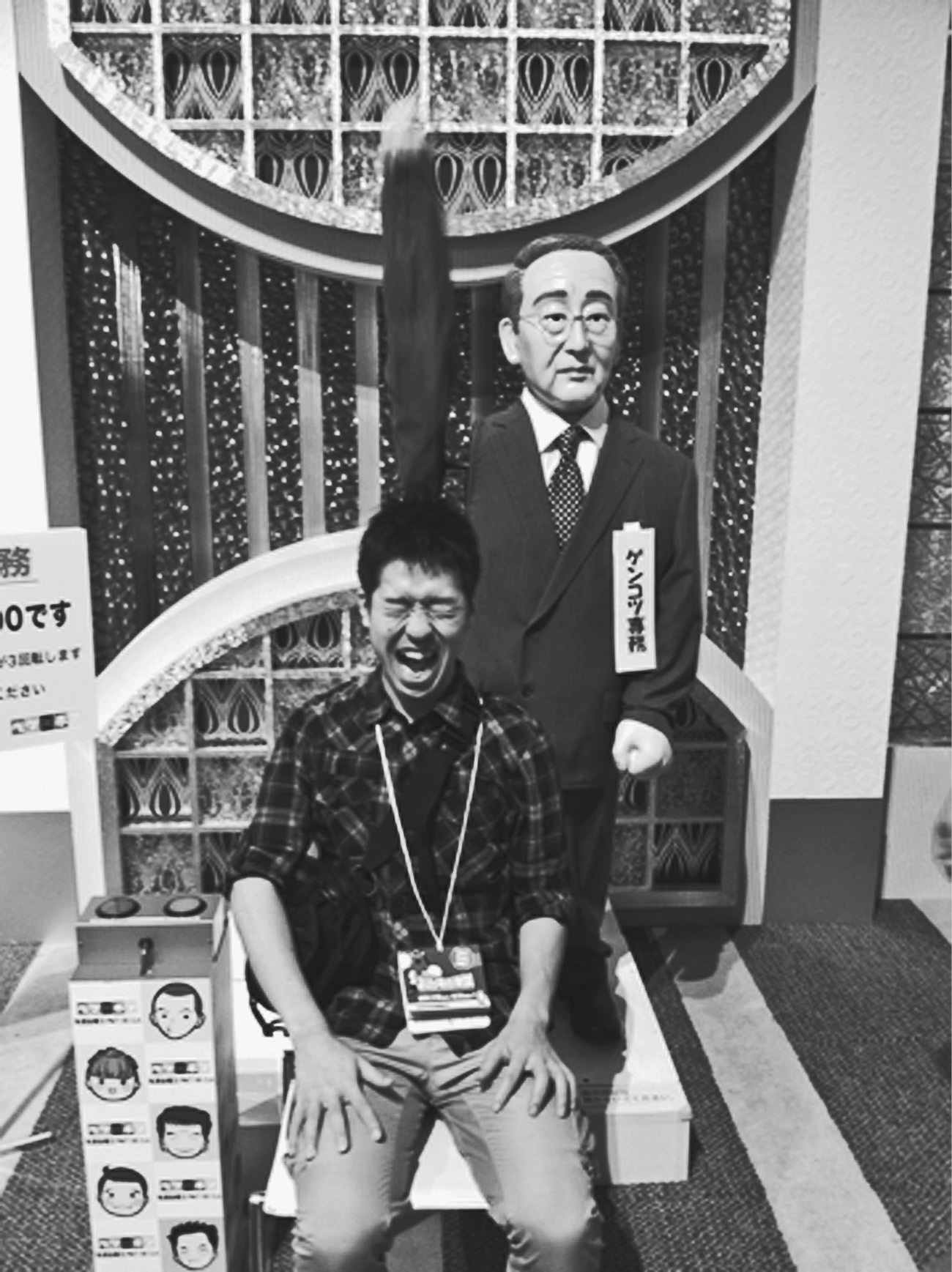
Figure 3.1. Genkotsu senmu hitting a visitor at the Fuji TV headquarters, Odaiba.
Such extended and explicit metapragmatic commentary is not, moreover, the only way that the tadashii keigo message (that mastering the correct use of honorifics is essential to being socially acknowledged as a skillful speaker of Japanese) is expressed in the popular media. The message is contained implicitly in many televisual productions.Footnote 39
We see that many powerful messages are “sent” to Japanese speakers through a variety of channels, that knowledge of honorifics is regarded as a valuable resource for improving one’s social status. Agha (Reference Agha2005: 55) describes honorifics as a register, which “is itself a form of semiotic capital that advances certain rights and privileges. And to be able to speak the register is to be able to perform an image of social personhood as one’s own image and to perform it in a register-dependent way.” And this is surely the way in which keigo is narrated in Japan today, both in policy and in popular texts.
And the additional bottom-line message – critical in understanding the importance not just of politeness but of politeness through honorifics – is that “the” Japanese language has a very important and specialFootnote 40 quality: it “has” honorifics. The non-honorific regional dialects (mukeigo hōgen)Footnote 41 are erased in this message, as is the work (and the politicking) that went into Standard Japanese’s keigo construction. Further, since honorifics are taxonomically characterizable and normatively associated with particular social indexicalities, there is a “correct” way to use them. By this extension, the historical shifts and changes in any given keigo form’s social meanings is erased. What is left for the speaker to imagine is that honorifics are an essential quality of Japanese that has existed in the language ahistorically and across all the social space of the Japanese archipelago. We see in Chapter 4, however, that such assumptions of an ahistoric and essential homogeneity in speaker understandings of the social-indexical meanings of honorifics is by no means empirically verifiable. Rather, what we will see is a highly fluid, often contested set of ideas across speakers about what the “correct” or “most appropriate” deployment of honorifics might be. A close examination of real cases of verbal interaction, moreover, allows us to contribute to the discussion of the notion of fluid indexicality that has increasingly engaged sociolinguists worldwide. Our analyses in the next chapter are aimed at providing a better, more flexible way to consider the linkages of linguistic forms to particular social actions, carried out by speaking agents who, while not free from normative constraints, are not automatically bound to them either. These speaking agents are, we show in the next chapter, all too invisible in most work on Japanese linguistic politeness.Footnote 42 And at the end of Chapter 4, we consider the implications of this flexible framework for thinking about indexicality in everyday speaking life in light of the strongly persistent culturalist explanation of Japanese linguistic (and social) politeness to interrogate the social relationships between the micro-interactional and the macro-narrative of “the Japanese” as a polite people.
While Chapter 3 focused on the norm construction for honorific use, this chapter considers how norms are actually interpreted and put into use in order to consider how micro-level choices relate to the macro-level norms. In Chapter 3, we examined normativizing discourses about honorifics to observe how the prescriptive norms for their use are constructed in various segments of society. We paid special attention to the ideological notion of “correct honorifics,” which stereotypically links honorific forms to certain social personae or speech contexts. While details may differ, we saw that in the official policies, scholarly characterizations, and media discourses reviewed, honorifics have been largely regarded as expressions of politeness and deference toward those seen as deserving of such deference and politeness, these being, in particular, status superiors and out-group individuals. Such social identities have generally been linked directly to honorifics – indexicalities uniformly accepted by society. Such presentations are based on the referentialist notion that the meaning is in the word (Silverstein Reference Silverstein, Basso and Selby1976).
However, the enregistered links (Agha Reference Agha2007) between honorific forms and fixed social identities or social contexts that figure so largely in the dominant discourse surrounding honorifics are not fixed and universally shared givens. That is, meanings such as deference, politeness, status difference, and social distance represent stereotypical possibilities for the uptake of social meanings in the indexical field of honorifics. But they are only possibilities and, in fact, forms normatively considered polite, and particularly the social indexicalities associated with them, can vary across contexts and over time. The relationship between linguistic forms and social indexicalities is made and remade through the processes of ideological embedding in ways that mask the social rather than linguistic projects that underlie the makings of these ties (Silverstein Reference Silverstein, Brenneis and Macaulay1996). One indexical meaning, or n-th order indexical value, is always available for further reinterpretation, or functional reanalysis, through use in specific contexts (Silverstein Reference Silverstein2003).
In this chapter, we reconsider the stereotypical (or enregistered) social semiotics built into the dominant norms of honorific use and examine uses that clearly go beyond such stereotypified abstractions. That is, we consider a broader array of potential meanings in the indexical field of honorifics by considering the use and interpretation of specific honorific forms in actual verbal or written interactions. In this chapter, we begin by examining native speakers’ metapragmatic comments about specific cases of honorific use (or non-use) and outline some of the theoretical challenges presented by the diversity of stances speakers are seen to take toward the dominant norms for honorific forms and use (Section 4.1). We then examine situated uses of honorific (and plain) forms to illustrate the complex ways in which speakers deal with normative “rules” for honorifics as they negotiate between those “rules” and their own position with respect to the kind of speech appropriate to specific contexts and their relationships to specific interlocutors (Section 4.2).
4.1 Diversity in attitudes toward honorifics
The dominant ideology of honorifics emphasizes the importance of knowing tadashii, or correct, honorific usage. Thus, when particular honorific uses deviate from these assumed to be socially agreed-upon “rules,” they are seen as mistakes. And in fact, the large numbers of self-help books on the market support the idea that Japanese speakers are acutely aware of the potential for making mistakes, and worry about making them themselves. Survey reports tell us the same thing, as illustrated by the following results from a 2005 government survey (Bunkachō 2005). Of the 3,000 respondents, 81% agreed that mistakes in honorific use are increasing, 57% said they themselves were unsure of or ignorant about correct honorific use, 27% that they were bothered (ki ni naru) by other people’s usage, and 24% that they were troubled by the way honorifics were used on television and other media. Only 28% of respondents reported being unconcerned about keigo.
Surveys of this sort suggest that many people believe, or feel that they should say that they believe, the use of honorifics to be a matter of discernment (Ide Reference Ide2006) and that there are honorific rules for use that “the best” speakers of the language are supposed to follow. At the same time, however, they also suggest that there are many speakers who think that they themselves or others fail to follow these rules. Moreover, although people may share the belief that there are correct honorific uses that conform to the presupposed honorific rules of use, they do not necessarily share beliefs about exactly what those correct uses are. That is, one speaker’s correct use is another’s error. And people’s attitudes about honorific usage vary even more in periods of significant social change. Diversity in actual language use has come to be studied more intensively, but diversity in attitudes about language use has not received the same serious attention. In what follows, we look at this diversity by first examining survey data and then metapragmatic commentaries of ordinary speakers.
4.1.1 Survey data
One of the issues often raised in surveys is whether the more complex aspects of honorific usage should be simplified. According to a 2008 Yomiuri Shinbun survey, 61% of respondents to the question “What should the future of honorifics (keigo no shōrai) be?” reported that accurate expressions (seikaku na hyōgen) should be maintained, but 31% thought honorifics should be simpler and easier to understand than they are now. Evidence of such simplification taking place on the ground is seen in survey reports about the domains and genres in which honorifics are still thought to be normatively required. The well-known 1953 and 1972 Okazaki City surveys (Kokuritsu Kokugo Kenkyūjo Reference Kenkyūjo1983), for example, show that the proportion of respondents who agreed that speakers should use honorifics when speaking to older or senior family members decreased substantially in all five age groups (from 50% in 1953 to 20% in 1982). In a 2006 survey in the same city, an even further decrease (to only 6%) was seen (Asahi 2007: 71).
Honorific use in written correspondence may also be undergoing simplification. In the past, personal letters were usually written in a formal style minimally including addressee honorifics even if the addressee was someone with whom one usually spoke in an informal style using plain forms. The change away from this style may, in part, be an effect of new technologies for written communication, such as email. University students in one 2006–2007 study reported using plain forms in emails to their parents, although their parents reportedly responded with addressee honorifics (T. Kumagai Reference Kumagai2007). In fact, meeru buntai ‘email style’, consisting of plain forms and many other informal expressions, is well known (and, by some, greatly lamented) to be common in young people’s messages (H. Satake Reference Satake and Yoshiaki2005). Even in business emails, simpler styles than those used in face-to-face interaction are coming to be preferred, as indicated by the many self-help books that urge honorific simplicity in emails (for example, Mērubun wa keigo mo kanketsu ni ‘In emails, use simpler honorifics’; Shain Kyōiku Kenkyūkai Reference Kenkyūkai2009). The long-term effects of these practices on communicative norms more generally have yet to be explored.
Simplification of honorifics can also be seen in certain aspects of the honorifics themselves, as in, for example, a decline in the reported use of the addressee honorific (de) gozaimasu ‘to beHUM’’, a more formal variant of desu, except in certain situations, such as service encounters and formal speech events.Footnote 1 Simpler keigo has been part of government policy since the 1952 Kokugo Shingikai “approved” the use of adjective + desu as a clear and simple expression, and this pattern seems to have taken hold. By 1996, only10% of the respondents to another government survey objected to adjective-desu, while 45% objected to adjective-gozaimasu.
There are other kinds of diversity in what survey respondents react to as (in) correct honorific use. One issue that often comes up is the use of so-called nijū-keigo ‘double honorifics’;Footnote 2 another is the use of humble forms. According to government statements, “nijū-keigo is generally considered inappropriate. However, certain words are fixed in custom” (Bunka Shingikai 2007: 30). Examples are offered: o-mie-ni-naru ‘s/he will comeRSP’, including both mieru ‘to comeRSP’ and o- ni naruRSP, and o-ukagai suru, with both ukagau ‘I will visit [you] HUM’ and o- suruHUM kenjōgo I forms. And negative messages also circulate through the popular media such as the self-help books introduced in Chapter 3. For example, in an advice book for women’s speech, Shimodaira (Reference Shimodaira2004: 58) notes that while women are encouraged to be polite and to use keigo, the use of nijū-keigo is not advisable because it doesn’t sound smart. Despite a fair amount of official and popular reluctance to accept nijū-keigo, however, they are widely used and considered acceptable by many people. The National Language Research Institute conducted a survey in Tōkyō (n=306) in 1998 and found that fewer than 20% of respondents objected to sentences that contain nijū-keigo, such as Kōchō-sensei ga ossharRSParetaRSP tōri desu ‘It is as the principal said’. Almost 80% of respondents found such sentences to be just fine (Yoshioka Reference Yoshioka2006). The fact that an overwhelming majority of survey respondents report finding nijū-keigo appropriate raises the question of how grammaticality or correctness should be determined. Indeed, this may not be an issue of grammaticality or correctness but rather social appropriateness. And what is deemed appropriate is at the time of writing far from a universally agreed-upon matter.
People also express different views on what to do about “humble” keigo forms. We saw in Chapter 3 that the 2006 Bunka Shingikai’s guidelines for honorifics divided the kenjōgo category of humble forms into two separate categories: kenjōgo I (used for elevating the target of the action by lowering the agent of the action) and kenjōgo II (used for showing politeness toward the addressee). Survey respondents offer widely differing views about humble forms used in the sense of kenjōgo II. The same 1998 survey on honorifics found that opinions divided almost evenly on the appropriateness or inappropriateness of sentences such as X-san, orimashitara go-renraku kudasai. ‘Mr./Ms. X, if you are here, please contact us’ (Yoshioka Reference Yoshioka2006).
Prescriptively, orimashitara is a mistake. Self-help books all treat this as a typical mistaken application of a kenjōgo I form: that is, referring to a higher-status person’s action with a humiliative verb. However, many respondents (42%) found orimashitara appropriate (versus 44% who did not). It is possible that these respondents consider the orimashitara a kenjōgo II form since the referent is also the addressee. But the distinctions between addressee-directed deference through teineigo and addressee-directed deference through kenjōgo II forms has not, to date, been clarified; and the relatively even “split” between approval and disapproval may not be resolved until such clarification is made. That may, however, not be soon. The distinction between kenjōgo I and II seems unclear not only to ordinary speakers, but also to “experts.” The verb mairu ‘go/come’ in a sentence like Sensei no o-taku ni mairimasu ‘I will go to the teacher’s house’ got a thumbs-up in some of the self-help books we examined (for example, Kajiwara Reference Kajiwara2010: 58), but was rejected in others (for example, A. Suzuki Reference Suzuki2010: 214). The linguists have yet fully to weigh in on this issue.
Thus, what is considered correct or incorrect horrific use differs from individual to individual. One of the questions in the 2005 government survey mentioned above asked what kinds of honorifics the respondents think are commonly used incorrectly and gave the following four items to choose from: (a) Sonkeigo, kenjōgo, and teineigo are used incorrectly (chosen by 55% of the respondents); (b) honorifics are not used when they should be (51%); (c) honorifics are used when they are not necessary (36%); and (d) there are many excessive uses of honorifics, such as nijū keigo ‘double honorifics’ (25%) (Bunkachō 2005). These items suggest that the judgments of an honorific as correct or incorrect primarily rests on the following criteria: (a) categories of specific honorific forms; (b) the level of honorifics to be used; (c) the contexts in which honorifics should be used; and (d) how many honorifics should be used in any given stretch of speech (see below for further discussion on these points). Our observations of the survey results indicate that speakers can be expected to differ widely in their assessments of whether any specific honorific use is correct or incorrect. In what follows we examine this point further by examining metapragmatic comments on honorifics from a more popular source.
4.1.2 Blogs
Metapragmatic comments on honorific use are often expressed in letters to the editor in newspapers and magazines (Okamoto Reference Okamoto1999). Another avenue that is increasingly visible is the online blog. Here, we examine threads of posts on the topic of honorifics appearing between 2010–2013 on the blog site Hatsugen Komachi on Yomiuri Online.Footnote 3 The comments expressed in these posts can tell us more specifically than the survey results we examined above about why there is variation in people’s views on honorific use. Furthermore, they also reveal the extent to which the use of honorifics is viewed as a way of actively constructing interpersonal relationships and one’s own social persona, that is, using honorifics as creative indexes to define or change the context (Silverstein Reference Silverstein, Basso and Selby1976).
Our search for the word keigo ‘honorifics’ in posts to Hatsugen Komachi over a one-year period (April 5, 2012–April 5, 2013) yielded forty-one threads. The number of responses to the first post in each thread varied from 3 to 127. In seven (17%) of the forty-one threads, all respondents agreed with the writer of the first post, while in twenty-nine (71%) there were disagreements, which we focus on below.Footnote 4 Blog writers from one site in no way represent all segments of Japanese society, but our purpose here is to illustrate how extensive the diversity is across even this limited group of contributors. Following the questions asked in the aforementioned 2005 government survey regarding incorrect use of honorifics, we examined our blog data with regard to the following three issues: (a) the identification of certain forms as honorifics and of the category into which a given form would fall; (b) questions of how many (and what level) of honorifics should be used in a given interaction; and (c) determination of the contexts in which honorifics should be used.
Identification and categorization of honorifics. We start with examples that concern what forms “count” as belonging to the various categories of honorifics. Disagreements over the allocation of particular honorific forms into the taxonomic categories described in Chapter 3 suggest that speakers have different understandings of the functions prescriptively attributed to the various honorific categories. This may be related to the shift away from the old tripartite system for categorizing honorifics, as the negative commentary about the “confusing” nature of the five-part system at the time of its unveiling suggests. In the blogs, the first thread on this topic is about the nominal prefix ‘beautification’ o-. The writer of the first post to one thread wrote:
(1) [What bothers me] is the use of o- for things you yourself made, like ‘I did o-ryōri (cooking) today,’ ‘The o-ryōri (food) I make is …’ We say o-ryōri to show respect for things others made and I feel embarrassed to use o- for things I myself made. Likewise, I’m bothered by o-tomodachi ‘[my] friend’.
There were forty-five responses to this post: sixteen of them agreed with the writer, fourteen disagreed, and fifteen said it depends on the inherent qualities of the noun to which it is prefixed or the context. The first writer and those who agreed regarded o- as sonkeigo ‘respect forms’. But some of those who disagreed explicitly treated o- as bikago ‘beautification forms’, as in Example (2):Footnote 5
(2) If it’s bikago, there are cases in which o-xx is fine … These forms are not honorifics for showing deference to the interlocutor, but for creating a civil or kindly atmosphere for the interaction … The original writer’s example o-tomodachi is a case of bikago.
There were also writers who consider the o- in question as teineigo. As noted earlier, the distinction between teineigo and bikago is quite unclear even in the 2007 guidelines, which defines both in terms of politeness and care toward the addressee. Some of those who disagreed with the opinions expressed in the initial post also accorded this prefix other meanings, such as refined (jōhin na) and feminine (onnarashii).
In another thread, focused on the word itadaku ‘receive/eat/drink’, we see a similar range of contradictory responses. The original post, entitled Itadakanai de ~ ~ ~! ‘Please do not itadaku’ is given in Example (3):
(3) Itadaku is a verb I often hear these days. (For example) “On a sunny day, I like drinking (itadaku) draft beer on the patio,” “In a beer hall, I always eat (itadaku) yakitori,” “Today, I had (itadakimashita) a sunny-side up egg for breakfast.” Why don’t people just say, “I like drinking (nomu) very much” and “I eat (taberu) sunny-side up eggs”? Are they putting on airs (kidotte iru)? This isn’t correct Japanese, is it? Am I the only person who feels queasy (muzumuzu suru) and finds these expressions unpleasant?
This post triggered lively exchanges of agreements and disagreements. There were eighty-five responses (as of July 5, 2012). Approximately 60% of them agreed with the writer, 25% disagreed, and 15% agreed to some degree.
Many writers who agreed with the initial post rationalized their opinions in terms of rejection of the general politeness interpretation of kenjōgo (the new kenjōgo II), as in the following example:
(4) I understand [what you are saying] … What always bothers me is recipes for cooking. “Cut (kirimasu) ~, move it into (utsushite) a pot, put it (moritsukete) on a plate, and eat (itadaku).” Why is itadaku suddenly used here? You make and eat [the food], so it [the use of itadaku] gives a sense of incongruity (iwakan). I can understand if you use itadaku when you eat food made by someone else [but not when you’re eating food you made from a recipe] … Recipes in the past didn’t use such expressions. It’s only started in perhaps the last ten years. Like you, I also feel queasy about it. It’s not just being polite (teinei), but it feels feigned (totte tsuketa). I don’t like it because it’s like saying, “Well, I’m refined, am I not (Ufu, o-jōhin desho)?”
For this writer, self-lowering itadaku should be used when receiving something from someone else; that is, it is kenjōgo I. The use of itadaku in the original post’s examples cannot fit the definition of deference of the other by self-lowering, so comes across instead as an artificial effort to make oneself look refined. Note, however, that this offers the possibility that those who use itadaku in the sense of kenjōgo II may be trying to be polite and refined, but that it strikes this writer as feigned. The writer of the original post also offered her opinion of this use as pretentious.
Many respondents, on the other hand, disagreed with the original writer and explained why, as in the following post:
(5) It [using itadaku] is correct and beautiful Japanese. Itadaku is a humble or polite form of taberu ‘eat’ and nomu ‘drink’. I’m surprised that there are people who find [using] this word unpleasant. Isn’t it used in the original blogger’s family? … You had better study how to use language.
This writer thus seems to be interpreting itadaku as the generically polite kenjōgo II rather than the self-lowering kenjōgo I.
Itadaku has been traditionally regarded as kenjōgo (that is, kenjōgo I), but, as we see in Example (5), some bloggers’ comments made it clear that they were interpreting it as kenjōgo II. As we saw in Chapter 3, the 2007 guidelines added kenjōgo II as a new category because kenjōgo I forms such as mairu ‘go/come’ and mōsu ‘say’ had, over the years, come to be used to index the interactional context (including some type of “consideration” for the addressee or audience) as one of gentility or cultured politeness (kikite ni hairyo o shimesu) (Kokuritsu Kokugo Kenkyūjo Reference Kenkyūjo2007: 90). But this definition of kenjōgo II overlaps significantly with the definition of teineigo.Footnote 6 Accordingly, the perception of itadaku as either teineigo or kenjōgo II is understandable. In fact, treating itadaku as a kind of bikago ‘beautification honorifics’ is not unreasonable, either, as the guidelines note that bikago tend to be used when encoding ‘consideration’ for (rather than encoding deference to) the addressee (Kokuritsu Kokugo Kenkyūjo Reference Kenkyūjo2007: 111).
What level or frequency of honorifics is best? The next point of contention revolves around what level of honorific to use and what proportion of honorifics to be used in a given interaction. Using too many honorifics is often discouraged in prescriptive accounts, whether official grammars or popular self-help books, but what counts as “too many” varies from speaker to speaker.Footnote 7 In the itadaku thread, about, twelve posts characterized using itadaku when talking about one’s own beer consumption, whether on the patio or elsewhere, as too polite or pretentious, whereas eighteen respondents argued it was appropriate. The post shown in Example (6) is one that comes down on the side of excessive use (kajō keigo):
(6) I think it’s an excessively polite word (kajō keigo). In Japan, in general, there seems to be a tendency [to use this kind of honorific in inappropriate contexts] these days. I wonder if this use emerges, like a magical formula, from the immature (mijuku) [understanding] of correct honorifics or polite language.
This bifurcated set of responses is not limited to the single verb itadaku, of course, but is found in the typically divided support for and critique of other kinds of honorifics as well. Another set of forms that frequently come up for debate, on the grounds that their use is “excessive,” are the nijū keigo ‘double honorifics’ discussed previously, but they too are widely used. In fact, the 2007 guidelines note that some nijū keigo forms are today conventionalized and accepted; they offer five examples. Interestingly, one of the five also has to do with eating (or drinking): o-meshiagari-ni naru ‘eat’. Beyond the five verbs listed in the guidelines, however, just which forms are “acceptable” by virtue of conventionalization is unclear. And the guidelines themselves are inconsistent with an earlier 1998 survey (reported in Kokuritsu Kokugo Kenkyūjo Reference Kenkyūjo2007) that included two nijū keigo forms not included in the 2007 guidelines: osshararata ‘said’ and o-kaki-ni narareta ‘wrote’. More than 60% of the 1,136 respondents in that earlier survey judged both to be acceptable.
When are honorifics needed? The most frequently discussed topic on Hatsugen Komachi, comprising 71% of the forty-one threads posted during the year, had to do with what contexts called for honorifics. Particularly interesting subsets of our blog corpus are posts about how to assess the vertical or horizontal relationship between interlocutors and what stance to take toward that perceived vertical or horizontal relationship (twenty threads) and about how to assess the relationship between the vertical and horizontal relationship and what stance to take toward the complex of vertical and horizontal distances combined (six threads).
The first concern centers on what to make of a vertical, that is, status asymmetric, relationship. One blogger (August 2, 2012) complained about a colleague who was five years younger but who did not use honorifics when speaking to her. There were nineteen responses to this post: six expressed agreement with the opinion that the younger colleague should use honorifics, nine disagreed, and four were ambivalent or ambiguous. Some posts suggested that a five-year age difference was not enough to trigger honorifics, especially since the blogger wasn’t the younger colleague’s supervisor. This post and the responses to it suggest a general preference for constructing egalitarian relationships in the workplace, but this preference is hardly categorical. Other posts clearly supported a preference for the linguistic maintenance of workplace hierarchies.
Another thread addressed the way hospital personnel (doctors and nurses) talk to elderly patients.Footnote 8 In terms of age, “elderly patients” are likely to be older than the hospital personnel, but in terms of medical expertise, patients are the status subordinates, even though in recent years the media have taken up the notion that patients should be treated as customers (kanja-sama ‘Mr./Ms. patient’). The following is part of the first post in a thread about how patients should be spoken to (May 8, 2012):
(7) At hospitals, I often see a doctor, nurse, or receptionist talking with an elderly [patient] using tameguchi ‘plain language’. [Such casual language] is heard at all kinds of hospitals, including university hospitals and small clinics … I feel very bad when I hear [that kind of language], and wonder what kinds of effects the speakers are aiming at by taking that informal tone. Are they trying to express friendliness (shitashimi)?
This blogger apparently thinks that elderly people should be addressed with deference encoded in honorifics and that using plain forms toward them is rude, although at the same time wonders if medical personnel are attempting to show friendliness. There were seventy-seven responses to this post (as of May 9, 2012), including many from hospital personnel. About 40% of them agreed with the sentiments expressed in the initial post. Many who agreed with the post expressed the opinion that the age difference should be acknowledged,Footnote 9 and that the use of plain forms in this interactional context is rude, as illustrated in Example (8):
(8) I totally agree. I visited my mother, who is in her 70s, every time she was hospitalized … but the nurses in all the hospitals used tameguchi! … It made me uncomfortable and I felt like my mother was being patronized. If they think they are trying to have a friendly conversation, they are mistaken … I want them to treat elderly people with respect.
Clearly the person who posted this response is interpreting the use of tameguchi (informal style using plain forms) by nurses as talking down and rude, and not as an indication of friendliness. (Note that we do not know how the mother felt about the use of hospital personnel’s tameguchi toward her, which may not be at all the same as her blogging child’s reaction.) Several people made similar comments, including: “When friendliness goes too far, it reverses the relative positions/statuses of the participants (tachiba o gyakuten saseru)” (May 8, 2012); “Isn’t it because they see themselves as superior (ue kara no mesen)?” (May 9, 2012); “These doctors may not understand the difference between friendly talk (shinkinkan o yobu kotobazukai) and overbearing (ōhei na) talk” (May 9, 2012); “Tameguchi sounds self-important (erasō) and cold” (May 9, 2012). These opinions demonstrate that even if a speaker uses plain forms intending them to mark friendliness, the absence of honorifics may be interpreted otherwise, that is, as an index of vertical distance or as a marker of status superiority – a possibility inherently associated with polyindexical forms such as these. A few posts also pointed out that friendliness/closeness (shitashisa) is different from excessive friendliness (narenareshisa), a thin line with an indeterminate location, as the posts in this thread reveal.
In contrast to those who express opinions to the effect that honorifics should be used when talking with the elderly, privileging an age or generational hierarchy, other posts take a different stance, expressing the opinion that hospital personnel should use honorifics toward the patients because they are customers (okyaku-sama).
(9) I’m 42 and my nurse is in her 60s. It’s not the age. Patients are customers, right? … I complained [to the nurse], “You are rude! How can you talk like that? You should know your position.” … [Later] the head doctor called me at home and apologized. I still go to this hospital, but the nurses’ attitude is just hypocritical and excessive “politeness” (inginburei). It is only me that they call XX-sama!
In response to this blogger’s complaint, the nurses stopped using tameguchi, but not out of sincere politeness, and so the blogger interprets their use of polite or honorific forms as sarcastic and, thus, rude.Footnote 10 This post is not the only one offering the opinion that hospital staff should use honorifics toward patients because they are customers. Several posts written, not by patients, but by hospital personnel, note that some patients want to be treated as customers (see Example (11)).
There were, however, also many posts to this thread that disagreed with the position that tameguchi were inappropriate. Many argued that tameguchi is a sign of friendliness, while honorifics sound aloof and create distance. See Example (10):
(10) It [the use of tameguchi] doesn’t bother me … It’s actually better because it doesn’t create a wall [between patients and doctors]. A wall tends to be built between a doctor and a patient. So if my doctor uses tameguchi, I don’t have to feel nervous.
Many hospital personnel also expressed this view. Although a few said that they consistently use honorifics when talking with their patients, the majority said they use both honorific and tameguchi, depending on the details of the specific situation.
(11) It depends on the patient. Young people have a strong awareness of being “customers” (oyaku-sama), so I use honorifics. But when the patient is hospitalized for a long time, there are people who feel that the use of honorifics sound distant (yosoyososhii) and that makes them feel lonely (sabishii). Toward those who [seem to] wish to keep their distance, I use honorifics. You seem to be a “customer,” so I would use honorifics [for you]. I don’t care either way, but I sometimes hear people speaking in a very rude way using tameguchi. I admit that is indeed unpleasant (fukai).
Although the post does not explicitly indicate it, the writer clearly works at a hospital and is aware of the potentially different meanings of honorific and plain forms in the medical context. The choice to strategically differentiate their use depending on the patient’s age, expressed or assumed preference for a formal or informal speech style, degree of intimacy, and the like is one of this individual’s ways of dealing with the complexities of these interactions. But even this strategy does not suit all interlocutors. The writer of the following post from a nurse expresses frustrations with the difficulties involved in adequately fine-tuning the use of honorifics and tameguchi:
(12) I’m a nurse. I basically use honorifics, but if I [only] use honorifics, I get complaints that I sound too businesslike and cold (jumuteki de tsumetai). So I use tameguchi, and then patients’ visitors complain. Honestly, I feel like saying, What do you want me to do (dō shiro to yū no)!? … So I’ve decided to give priority to what the patients [want me to do] … I differentiate my choices according to the situation and the patient.
This post is a good example of how hard it is to please everyone, since her experience has been that different people (not only patients but their visiting relatives and friends) “hear” the same expression differently.
Quite a few hospital personnel remarked that elderly patients often have difficulty understanding them when they use honorifics because the sentences become more complicated. One example of this kind of post offers that thought, along with the opinion that honorifics inherently produce indirection:Footnote 11 “I think honorifics are difficult to hear for elderly persons, because they make utterances roundabout” (May 9, 2012). Several posts linked tameguchi and regional dialects (or honorifics and Standard Japanese) to assert the merits of using tameguchi and regional dialect as being straightforward, easy to understand, and effective in helping the patient relax. Note the presumptive pairing of informal speech with simple, socially and/or geographically peripheral people. This is illustrated in Example (13):
(13) I’m in social work. There are many cases in which [the lack of honorifics] indicates a lack of care. But in the case of elderly patients, they have difficulty understanding [what I say] if I use honorifics. There are also cases when I can’t elicit their true feelings if I use honorifics. So I often use friendly expressions, including the regional dialect.
For this person, friendly talk includes non-use of honorifics and use of the regional dialect. Another hospital worker posted that it is often impossible to convey the most important information using honorifics, and that it also makes patients uneasy and guarded; patients are happy to be addressed with expressions “other than honorifics,” such as dialect (May 8, 2012). Both writers appear to assume that honorifics are used together with Standard Japanese, and plain forms with a regional dialect (see also Chapter 2). And this hints at a more common understanding of Standard Japanese and the Standard Japanese-based system of honorifics as formal, creating distance, and making it difficult to speak openly and honestly. One writer simply said: “Using Standard Japanese and honorifics feels cold, lacking warmth” (May 9, 2012).Footnote 12
Posters in other threads worry about how horizontal distance (lack of social intimacy or solidarity) should be marked. One woman initiated a thread with a post (November 11, 2012) offering her observation that, regardless of age, the mothers of the other children at her child’s nursery school talked to her using tameguchi even from their first meeting, while she used honorifics. Only one respondent agreed, saying that she too would use honorifics in that situation. Two respondents claimed that they would use tameguchi, and the remaining six posts offered a compromise solution, saying that they would adjust their speech to align with the interlocutor or mix honorifics and tameguchi.
These observations gesture toward the normatively muted reality that individuals differ widely in their assessments, first, of the vertical or horizontal relationship, largely because, if the posts we have examined are anything to go by, individuals draw on different criteria in making their choices. The posts in our corpus also offer evidence of how individuals differ in the stances they take toward the perceived vertical or horizontal relationships due to how they assess various factors outside the simple facts of vertical status asymmetry or a measure of social distance; these may include a sense of interlocutor preference, the need for the efficient transmission of information critical to the interlocutor’s well-being, and response to interlocutors’ use or non-use of honorifics forms on a case-by-case basis.
The second issue involves the complexities that arise when both vertical and horizontal distance must be assessed simultaneously. The blogs we examined demonstrate that how to assess the relationship between the two kinds of distance and what stance to take toward such combinations can be a pesky matter. This is a classic example of the ideological struggles between a primary interest in power (hierarchy) and an emergent orientation toward solidarity (egalitarianism) in changing societies (Morford Reference Morford1997; Silverstein Reference Silverstein, Mertz and Parmentier1985, Reference Silverstein2003). Our bloggers clearly showed us that this concern emerges in a wide variety of social situations or interpersonal relationships. Example (11) touched upon the issue of horizontal distance in relation to vertical distance in the case of hospital personnel and patients. We also found many other threads that discussed this issue as it arises in other social situations. Two threads, for example, addressed the question of whether to use honorifics when talking with one’s in-laws. The original post in one thread was from a writer disturbed by her younger sister-in-law’s use of tameguchi when talking with her, while she has been using honorifics.
(14) I’ve been married for ten years. My sister-in-law is twelve years younger than me, but she has been using tameguchi with me since we first met. In contrast, I’ve been using honorifics. I’ve been thinking it’s strange (hen) to continue to use honorifics (keigo) to a sister-in-law who is so much younger than me and recently, I’m trying to use tameguchi. It didn’t bother me much before, but recently, her tameguchi started to bother me.
In this post, the writer implicitly acknowledges that vertical distance is more important to her than expressing horizontal closeness, and expresses some frustration that her younger sister-in-law does not use honorifics in their interactions, even though she – the writer – has been using honorifics. At the same time, the very fact that this writer has been using honorifics to the younger woman indicates that she considers expressing mutual respect important as well. There were four responses to this post (as of July 5, 2010). One of them (July 3, 2010) supported the writer, saying Nihon ni wa chōyō no jo to yū reigi, dōtoku ga aru no desu yo ‘In Japan, there is an etiquette, an ethics, of respect for age hierarchies’. Here, vertical distance is articulated as the most important basis for choice. But the other three responses disagreed, as illustrated in Example (15):
(15) My sister-in-law is nine years younger than me, but she uses tameguchi with me. Moreover, she has never addressed me as onee-san ‘older sister’, but it doesn’t bother me. If she used honorifics, it would feel distant (yosoyososhii). Isn’t tameguchi a marker of friendliness? Even if you are an older sister-in-law, it doesn’t mean that you are superior, so I think you should also use tameguchi.
This writer articulates using tameguchi as an attempt to be friendly. For her, then, the use of honorifics would mark distance or aloofness (yosoyososhii). In other words, she privileges egalitarian horizontal closeness over normative prescripts to acknowledge socially defined status asymmetries (at least, those based on the relative ages of the interlocutors).
Another thread concerns the use of honorific and plain forms in interactions with parents-in-law. Example (16) gives part of the original post:
(16) I’ve known my parents-in-law for ten years. Our relationship is good, but I’m worried, because I can’t interact with them like I do with my own parents … I like them very much and respect them, but … even today, I can’t stop using honorifics toward them. I enjoy talking with them about various things, but I wonder if I’m seen as an unfriendly daughter-in-law (issen o hiita yome).
Here, the use of honorifics is openly described as both a way of acknowledging vertical distance and as a way of denying social closeness (maintaining horizontal distance). The post describes a struggle between two competing needs – the need to show respect for the writer’s parents-in-law and a concern to indicate closeness with them. Among the eighteen responses (as of July 5, 2010), eleven wrote that they also use honorifics toward their parents-in-law. See Example (17):
(17) It’s been nine years since I got married. My parents-in-law live next door, but I still use honorifics and I think it will be like this forever. I never thought about not using honorifics toward them. I wonder if this is strange. Our relationship is good.
This writer is clearly aligning herself with the idea that vertical distance is more important than horizontal closeness.
Two other writers, however, claimed to know people who use tameguchi with their parents-in-law. And four wrote that they themselves use both honorifics and tameguchi, sometimes in ways that appear to be highly strategic, as illustrated in Examples (18) and (19):
(18) I use both [honorifics and tameguchi]. Depending on the time, place, and atmosphere, I use honorifics or talk informally. But the basic choice may be honorifics.
(19) We’ve been living with my parents-in-law for thirty years and I now use tameguchi toward them … But when I’m asking for a favor or thanking them, I speak politely (teinei ni) like Ryokō iku node, rusu o o-negai shimasu ne ‘I’m going on a trip. So pleaseHUM+AH [look after the house] while I’m away’.
This begins with the writer claiming that she normally does not use honorifics, which suggests that the effects of increased intimacy over time have overridden the generational status asymmetry. However, she then goes on to admit that she does sometimes use honorifics. Unsurprisingly, this is in cases when she is asking for something or thanking her parents-in-law for something. That is because, on the one hand, it is nice to be polite to anyone when you want something from them and, on the other, formulaic speech acts, of which there are many in Japanese, are known to elicit semi-fixed and formal phrasings. Strategic uses of honorifics are also illustrated in a post from a different thread that addresses the issue of caring for elderly parents-in-law (June 14, 2012). In the initial post, the writer says that she does not wish to look after her parents-in-law when they get old and is making every effort to keep her distance from them, including using baribari no keigo ‘full-scale honorifics’ like the keigo she uses when talking with aka no tanin ‘total strangers’.
As these examples show, how a speaker assesses the horizontal distance between self and interlocutor vis-à-vis the vertical distance between them varies widely. In the examples we have presented so far, the writers have made it clear that they have had a relatively long-term relationship with their parents-in-law. But even when the relationship is not (yet) of very long duration – a situation in which honorific use is expected – various posts indicate that speakers differ in their opinions about honorific use. See Example (20):
(20) My older brother’s fiancée … uses tameguchi after having met our parents only two or three times … My mother says she doesn’t mind. I think honorifics should be used when speaking to a mother-in-law. I can’t believe this!
Of the forty-one responses to this post, nine respondents agreed with the initial writer’s outrage, nineteen disagreed, and thirteen offered limited or ambivalent agreement. As in other threads, disagreements were founded in arguments for tameguchi’s friendliness and warmth, coupled with claims that the use of honorifics might sound cold or pretentious.
Another thread also involves issues of both vertical and horizontal distance and illustrates another fraught arena of concern: naming practices. In Japanese, it is standard practice to call someone by either their first or their last name plus a title suffix. In Standard Japanese, these title suffixes include -sama, -san, -kun (or -chan) in descending order of level of deference. Use of a bare first or last name without any title suffix is the least deferential possibility. In the initial post to this thread, a mother complains about her son’s elementary school teacher because she does not use the honorific suffix -kun to address her son. She just calls him Masao, without any suffix (called keishō in Japanese) at all. The writer argues that the teacher should be polite toward her son and furthermore, that maintaining a horizontally distant relationship between teacher and student is important. In other words, this mother says in her post that she expects students to be polite toward their teachers, who should also show mutual respect by being polite toward them.Footnote 13 The mother includes in her post that the teacher has said she doesn’t use title suffixes because she wants to treat her students like friends (tomodachi no yō ni), but the mother, nonetheless, writes that she thinks it is rude.
There were seventy-six responses to this post (as of July 5, 2010); many of them supported the mother, but others disagreed with her complaint. Among those who disagreed with the mother, many of them simply said yobisute is fine because she is a teacher, that is, a higher-status person. This view regards the non-reciprocal use of plain forms as a sign of occupying the superior position in a status asymmetry; in other words, for people who responded in disagreement with this post, honorifics are used, at least in the context in question, non-reciprocally; they are not for showing mutual respect but for marking status asymmetries. It is, thus, appropriate for the teacher to “talk down,” as it were, to the children in her charge. This view, however, is different from that expressed to the mother by the teacher, who claimed to use plain first name forms to reduce the distance between her and her students by treating them as “friends,” a term which suggests both equal status and social intimacy. This example illustrates how, even if a speaker intends to be democratic and friendly and to indicate that by using plain forms, there is the ever-present alternative indexicality of a status-superior speaking to a status inferior (for the multiple possible interpretations of the much simpler pair of French pronominals tu and vous, see Morford Reference Morford1997).
In the posts discussed above, bloggers offer an interpretive landscape in which plain forms are largely seen as a sign of, alternatively, intimacy, power, or disrespect, while honorifics are variously seen a sign of deference or one of rudeness offered by someone inappropriately holding her- or himself distant or aloof. They are, thus, inherently poly-, or at least, bi-indexical. Honorifics are generally associated with a formal or deferential stance, which is in turn linked to specific social structures, that is, either to status asymmetries or social distance. However, in any specific context, depending on interlocutor uptake, an honorific may trigger a range of interpretations, not all of which are straightforwardly related to politeness, but ones in which the speaker is seen as aloof, distant, unfriendly, or pretentious, as illustrated above. Plain forms tend to be associated with informality or lack of deference, which in turn may be linked to a specific aspect of the social context, that is, the close social relationship or the speaker’s higher status. But again in a given context, it may offend the addressee, who perceives the speaker as being too friendly, overbearing, or rude. This built-in polyindexicality is typically treated as unproblematic when discussing form-meaning relationships out of context, but we argue that in terms of coming to agreement about what counts in any given interaction, this is far from the case, as we hope we have illustrated above. The stereotypical meanings of honorifics as indexes of politeness, deference, status difference, and lack of intimacy may be accepted by everyone in the abstract, but those meanings may take on further construal in specific contexts and may be interpreted even with opposite meanings.
Furthermore, in addition to the polyindexicalities centering on the immediate social relationship between the speaker and the addressee (or referent), that is, the first-order indexicalities, there is yet another order of indexicality complicating speaker choices and hearer interpretations. We refer here to second-order indexicality, the indexicality that associates certain honorific choices with social types of speakers (Silverstein Reference Silverstein2003). A second pass through the blog posts examined above reveals that there coexists with the normative association of specific speaker-hearer relationships with certain patterns of honorific use a second order of indexical relations related specifically to the construction of certain social personae of the speaker. For example, in the thread from Hatsugen Komachi that discussed the word itadaku we observed that the use of itadaku in question can be interpreted variously as kenjōgo I or II or bikago. The interpretation of itadaku as kenjōgo I is said to be based on self-lowering in order to elevate a deference-entitled referent, while the other three categories are determined on the basis of a speaker’s “consideration” for an addressee (Chapter 3). However, many of the blogs indicated that the appropriateness or inappropriateness of the use of itadaku is related to the user’s social persona, as variously characterized in terms of refinement, classiness, or some other criteria rather than simply about the form in some particular setting. As we saw in Examples (4) and (5), there were some writers who characterized the use of itadaku to refer to the eating of food one had prepared oneself as refined, beautiful, and also as feminine. The writer of the post in Example (21) clearly relates itadaku to the (imaged) speaker’s persona:
(21) Isn’t itadaku a humble word? It evokes an image of a refined (jōhin na) woman with a good upbringing (sodachi no yoi) using it. I was surprised to learn that it wasn’t correct Japanese!!
This post clearly characterizes itadaku as a humble form and then links its self-lowering humility to the class positionality and refinement of the people – in particular, the female people – he or she imagines associated with that kind of language practice. The association of form to person draws on stereotypified notions of women – or of normative femininity – as elegant, refined, and polite, or humble (Okamoto and Shibamoto Smith Reference Okamoto and Shibamoto Smith2008).
Example (22) expresses a similar view, while also relating honorifics to Japanese “tradition”:
(22) It is the correct way. [Using] tabemashita ‘ate’ is rather rough and unrefined (gasatsu) … [In one rakugoFootnote 14 story, a husband tells his wife] Why do you open your mouth wide and say, Tabechatta? Women’s attractiveness changes depending on how they talk. In a case like this, you should say, “Itadakimashita” … People who don’t know [traditional etiquette] say they find it weird or feel uncomfortable. I don’t know how to respond to them because such feelings themselves derive from their ignorance and misunderstanding. They don’t need to be ashamed of the fact that they didn’t know [Japanese] traditions, but I don’t want them to make fun of those who are proud of [it] and [are] trying to maintain it.
This writer relates the use of honorifics to refinement and femininity (see Chapter 6 for further discussion of the indexical relationship between honorifics and femininity; see also Okamoto Reference Okamoto, Sato and Doer2014; Okamoto and Shibamoto Smith Reference Okamoto and Shibamoto Smith2008; Shibamoto Smith Reference Shibamoto Smith2006). “Tradition,” that is, declares that the use of itadaku in question is correct. People like the writer of the initial post are themselves to be criticized for using plain forms like taberu ‘eat’, which are gasatsu ‘rough and unrefined’. At the very least, they should not get in the way of those who are merely trying to uphold the “traditional” order.
The above metapragmatic comments regarding honorifics speak eloquently of how diverse interpretations of honorifics and plain forms can be, challenging notions such as “socially agreed-upon rules of honorifics,” or “shared norms” [for honorifics use], and “correct” honorific usage. Such differing views are not surprising given the changes in the dominant narrative of “proper” honorific use reviewed in Chapter 3. Diachronic changes entail synchronic variation, and here we have offered ample evidence of the synchronic variation in honorific evaluation. Normative, or prescriptive, characterizations of honorifics as indexes of politeness, deference, status difference, or lack of intimacy may be generally accepted in the abstract, but the same honorific form may take on further indexicalities in specific contexts, even being interpreted as aloof or deliberately insulting. Such different interpretations suggest different stances that speakers may take toward the relevant relationships (Du Bois Reference Du Bois and Englebretson2007) or differing stances toward the normative rules. Some speakers, for example, may wish to construct a hierarchical relationship by using honorifics non-reciprocally, while others may prefer to construct an egalitarian relationship through the reciprocal use of honorifics or by the reciprocal use of plain forms. This cross-speaker (and cross-interlocutor) variability may be unproblematic when considering form-meaning relationships in the abstract, but we argue that when it comes to agreeing about what counts in a given interaction, this is far from the case, as our analyses above demonstrated.
Variation in views about proper honorific use indicates that the same honorific form used in equivalent contexts may not always be interpreted in the same way. Speakers who believe that nijū-keigo is appropriate may find those who do not use it to be rude. Or those who use oru as kenjōgo II (or as sonkeigo) may be perceived as impolite by those who believe oru is (or “should” be) used only in the sense of kenjōgo I. Variability in the interpretation of the same linguistic form is, of course, not unique to the interpretation of Japanese honorifics. Morford (Reference Morford1997) offers examples of similar issues with regard to the indexical “meanings” of the second-person pronouns tu and vous in Parisian French. The generalized or wider use of tu may be seen as a sign of “egalitarian sensitivity” or “intimacy,” but it may also be construed as “evidence of a decline in decency” or a loss of “true intimacy” due to its indiscriminate use. These examples as well as the comments from Hatsugen Komachi we saw above illustrate how one’s beliefs affect language use and interpretation in a specific context. Eckert (Reference Eckert2008) draws on the voluminous work on the variable -ing in English to point out that the velar variant may be variously construed positively as articulated and educated or negatively as pretentious and that the apical variant may be interpreted favorably as unpretentious and relaxed, but unfavorably as lazy and impolite. We concur with Eckert (Reference Eckert2008: 466), who argues that “since the same variable will be used to make ideological moves by different people, in different situations, and to different purposes, its meaning in practice will not be uniform across the population.”
Our analysis offers support for our claim that, while many speakers may share some broad or abstract ideas about how keigo should be used, there are no universally shared norms for “correct” keigo use that are mechanically useful in deciding what to say in specific contexts or, for that matter, useful in estimating how one’s utterance will be interpreted by one’s interlocutor. Individuals come to the meaning of words/utterances through a historical chain of experiences, which are always and inevitably different, informed by different pasts (Bakhtin Reference Bakhtin1981). We see that there are many possible interpretations of the meanings of one honorific form or another available within the indexical fields of these forms. And all these interpretations make sense to some people but not necessarily to others, in any given instance, because they are drawing on particular metapragmatic beliefs or cultural models of honorifics. That is, if signs are interpretable, it is only because there are definite sets of beliefs within a community that members draw on regarding the relationship between linguistic forms and social structure (Agha Reference Agha2007; Morford Reference Morford1997; Silverstein Reference Silverstein1992). But such beliefs may not be shared universally in a community, which in turn brings about diverse interpretations in specific contexts. Analysis of the contexts in which honorifics are observed to occur (or not to occur), no matter how fine-grained the consideration of constituent features of those contexts may be, cannot offer a prediction model of honorific use, precisely because of the ever-present tension between the normative model and the individual agency of the speaker. We address this issue further in the following section in which we analyze the use and interpretation of honorifics in actual discourses.
4.2 Honorifics in practice: Negotiating norms
In the preceding section, we saw that while the dominant ideology of correct honorifics has been emphasized in institutional policy and circulated through the media, actual speaker understandings of honorifics may vary considerably depending on the individual and the context. We now turn to questions of how this complexity is related to situated practice. Much recent work on language ideologies focuses on metapragmatic discourse rather than on linguistic practice (Woolard Reference Woolard2008). In the case of Japanese honorifics, actual honorific practice has been well studied, but not from the standpoint of relating actual practice to its ideological context. Two contextual features, that is, status difference and in-group/out-group distinctions (which is often conflated with degree of intimacy, although these are not, in principle, isomorphic), have been said to be the major social factors that determine the use of honorifics as expressions of deference or social distance. Rules such as “Use honorifics to show respect toward higher-status individuals” and “Use honorifics to be polite toward members of out-groups” constitute the canonical rules of honorifics in the dominant discourse. Recent studies of actual conversations, however, have uncovered many cases of speakers breaking these rules (Cook Reference Cook1998, Reference Cook2006; Dunn Reference Dunn2005; Geyer Reference Geyer2008a, Reference Geyer, Jones and Onob; Maynard Reference Maynard1991; Okamoto Reference Okamoto1998, Reference Okamoto2011b; Shibamoto-Smith Reference Shibamoto-Smith2011). Additional considerations are clearly needed in order to account for these cases.
Furthermore, the canonical rules based on status difference and degree of intimacy do not tell us how the two major factors interact with each other. In official policy descriptions, they are simply listed as important factors that determine the use of honorifics. Nor has the issue of reciprocal versus non-reciprocal use of honorifics been closely examined, even though it continues to be part of the everyday practice of speakers using honorifics, as illustrated in the metapragmatic comments in Hatsugen Komachi we saw in the last section. Whereas in the early twentieth century, non-reciprocal, status-based use was stressed in policy documents, in the post-WWII period, government policy has emphasized the importance of mutual respect, or reciprocal use. But simply noting the relative importance of one or the other in such a global fashion does not help us to understand how they manifest in actual conversation. The case of Japanese honorific use is an excellent example of the fact that “language ideologies are subject to change” (Irvine Reference Irvine1992: 261) and calls for an investigation of how speakers deal with the changing language ideologies and norms in situated practice.
In order to further advance the recent empirically grounded research on this topic, we examine actual discourse drawn from diverse social situations. The metapragmatic discourses we examined above are primarily concerned with social relations between the speaker and the addressee or referent and the speaker’s own persona. However, as Morford (Reference Morford1997: 7) points out with regard to the use of tu and vous in French, contextual considerations in actual speech involve not only macrosociological variables, but also “interactional variables, or considerations that relate to the specifics of the speech event.” Through our analysis of actual uses of honorifics in this section, we identify a number of contextual features that appear to affect speakers’ choices. We argue, however, that these features, or factors, do not straightforwardly determine the use of honorifics. We emphasize that the link between honorific forms and contextual features, or social meanings, is mediated by a cultural ideology of honorifics (Irvine Reference Irvine1992; Silverstein Reference Silverstein, Mertz and Parmentier1985; Woolard Reference Woolard1992, Reference Woolard2008). Beliefs that speakers commonly express about the uses and users of (their) language mediate forms of talk and social structure and such beliefs can vary considerably among speakers, as seen in the online blog data above. For example, while one high-status speaker may use plain forms to lower-status interlocutors, another may use addressee honorifics only. It is also well known that speakers mix honorifics with plain forms in the course of a single interaction (Cook Reference Cook1998, Reference Cook2006; Okamoto Reference Okamoto1999, Reference Okamoto2011b). These are well-known facts about Japanese speaking practice but are not as fully integrated into a model of keigo use as they are offered as examples of what one should or shouldn’t do in particular situations (as, for example, in Kikuchi Reference Kikuchi1994: 2). We are persuaded that no matter how many contextual features are identified, they will not enable analysts to predict the use of honorifics accurately – a critical point that requires a more central place than it has occupied in politeness theory in general and especially in theories about how linguistic politeness operates in languages that, like Japanese, have a substantial system of honorifics.
In order to account for this variation in a systematic and theoretically grounded way, we argue that the use of honorifics is based on the affective stance that a speaker takes toward a given context (see the Introduction of this volume for discussion of the notion of stance). In the case of Japanese, affective stance is necessarilyFootnote 15 highly influenced by a speaker’s alignment or disalignment with the dominant ideology of honorifics. Whether or not to encode a deferential/polite or formal attitude – or something else – in a given social context is, then, a negotiation of sorts. In other words, speakers decide how or whether to deploy honorific forms in the context in question based on the balance they come to between what they believe to be normatively called for and their own individual sense of the most effective resources for constructing the persona they want to present. It is, thus, ultimately the individual speaker who makes the decision about what forms to use, and not the context. In this approach, speakers’ agency plays a vital role in linguistic choice.
We emphasize, however, that this does not mean that speakers can use any forms they please. Our analysis indicates that speakers are clearly affected by the dominant norms of speech (see below for further discussion). Laura Ahearn has neatly summed this point up by defining agency as “the socioculturally mediated capacity to act” (Ahearn Reference Ahearn2001: 112; emphasis added; see also Bucholtz and Hall Reference Bucholtz and Hall2004 for a similar discussion). Dominant norms often serve as the interpretive framework for specific linguistic forms used in specific contexts. At the same time, we reiterate that there is wide inter- and intra-speaker variation in the use and interpretation of honorifics. In other words, speakers are neither puppets mouthing predetermined “correct” honorific forms nor linguistic renegades who speak without reference to what they believe to be the linguistic etiquette of their society, but active speaking agents who negotiate those norms against specific contextual contingencies and decide what forms to use. That is, speakers actively choose expressions strategically based on their assessment of what the prescriptive social norm for a given situation is, and their inclination (or disinclination) to align with it. In other words, strategy and discernment are neither mutually exclusive nor contrastive (see Cook Reference Cook2006, Okamoto Reference Okamoto, Locher and Graham2010, Reference Okamoto2011b and Pizziconi Reference Pizziconi, Kadar and Mills2011 for related discussions).
In this section, we examine actual discourses regarding the following three issues: (a) the use and interpretation of addressee honorifics, (b) the use and interpretation of referent honorifics in relation to the use of addressee honorifics, and (c) the relation of honorifics and Standard Japanese to that of plain forms and regional dialects. With regard to the first issue, while many recent studies have pointed out uses that do not conform to the canonical rules, or norms, of honorific use, how these “exceptional” cases relate to the canonical rules has not been adequately examined. In this section, we attempt to pay closer attention to this issue. With regard to the second issue, while many previous studies based on empirical discourse data have analyzed both addressee honorifics (Cook Reference Cook, Pütz and Dirven1996, Reference Cook1998, Reference Cook2006, Reference Cook, Jones and Ono2008; Geyer Reference Geyer2008a, Reference Geyer, Jones and Onob; Ikuta Reference Ikuta, Jones and Ono2008; Maynard Reference Maynard1991; Okamoto Reference Okamoto1997, Reference Okamoto1999, Reference Okamoto, Locher and Graham2010, Reference Okamoto2011b; Usami Reference Usami2002) and referent honorifics (Cook Reference Cook2011; Dunn Reference Dunn2005; Ohkubo Reference Ohkubo2009; Okamoto Reference Okamoto1998; Shibamoto-Smith Reference Shibamoto-Smith2011), few studies have closely examined the relationship between these two kinds of honorifics (although see Cook Reference Cook2011; Okamoto Reference Okamoto2012). Our analysis in this section includes consideration of this relationship in order to further explore the complexity involved in the use of honorifics. The third issue has also escaped close attention. Institutional policy regarding honorifics has focused on Standard Japanese and there is a strong tendency for speakers to associate honorifics with the use of Standard Japanese, while regional dialects are perceived as only using plain (non-honorific) forms. The last part of this section examines how this issue may manifest in actual discourse.
4.2.1 The use and interpretation of addressee honorifics
We first discuss the use and interpretation of addressee honorifics, re-examining data from Okamoto (Reference Okamoto2011b), which consists of six dyadic conversations.Footnote 16 The participants in these conversations are listed in Table 4.1.
Table 4.1. Participants in the conversations
All participants are native speakers of Japanese.Footnote 17 The two speakers in each conversation were in some kind of hierarchical relationship (vertical distance) in terms of their age, social role, and the like. The degrees of intimacy (horizontal distance) in these six pairs of speakers differed considerably from very close to quite distant. In Tables 4.1 and 4.2, the conversations are listed in ascending order of social intimacy between the participants, with those in Conversation 1 having the most distant relationship and those in Conversation 6 the closest. The use of addressee honorifics and plain forms by each speaker was analyzed for the first sixty relevant tokens.
Table 4.2. Use of addressee honorifics (AH) and plain forms (PLN) by each participant (%)
Generally speaking, both vertical and horizontal distance seems to have had considerable influence on the use of honorific and plain forms by these speakers. In each conversation, we see status asymmetry, and in each case, the lower-status speaker’s use of plain forms was much more limited both in frequency and function than the higher-status person’s in each dyad, as dominant norms would dictate. In general, then, we see substantial effects of the dominant ideology of honorifics. On the other hand, there was also wide variation among the speakers that may be an indication of their different relations in terms of horizontal distance. For example, the higher-status persons differed greatly in the use of addressee honorifics, ranging from 61% by O1 to 2% by O6 (see Table 4.2). This variation seems in part due to the different stances speakers took toward the combination of horizontal and vertical distance. O1, for example, used addressee honorifics 62% of the time, the highest frequency among the six higher-status participants. If we take into consideration the diverse metapragmatic comments in Section 4.1, we could interpret O1’s use of honorifics as a polite gesture toward a newly employed, highly educated interlocutor by offering reciprocal honorific forms in order to reduce the vertical distance between them even though O1 is both a status superior (a supervisor) and older than Y1. However, it is also possible that O1 was instead simply marking the social (horizontal) distance between them, since they were not closely acquainted; that is, O1 may have privileged marking the horizontal distance – which would call for more addressee honorific forms – over the vertical distance – which would not. Note, however, on the interpretive side, that it is also possible that some people would find O1 too polite and formal in using a high proportion of addressee honorifics in conversation with a lower-status person. O1’s use of these forms thus potentially has multiple and ambiguous indexicalities.
O4, on the other hand, used addressee honorifics only 3% of the time. O4 is much older than Y4 and does not know Y4 very well. O4’s very infrequent uses of honorifics may suggest that she considers the vertical distance, here based on age or generational status rather than workplace, hierarchically defined status, as more central than considerations of horizontal distance in making her linguistic choices. But it could also be that she is trying to construct a friendly, or horizontally close, relationship, in part because Y4 is O4’s daughter’s friend and also because the conversation is taking place in Y4’s home rather than her office. There is nothing in either of these texts (O1’s and O4’s speech) that speaks to which of these indexicalities is in play in the minds of the speakers. In this respect, any use of honorific and plain forms always offers polyindexical and ambiguous potential. Furthermore, this potential polyindexicality applies not only on the side of speaker intention but also on the side of interlocutors who interpret the interaction through their own stances toward honorific norms.
We also see the effects of horizontal distance in the speech choices of the status-inferior participant. For example, Y1, a newly employed subordinate of O1, used the greatest proportion of honorifics (72%) of all the six lower-status persons in the data, while Y5, who knows O5 quite well, used honorifics much less frequently (45%) than Y1. Note, also, that Y6 – speaking to his mother – used virtually no addressee honorifics (2%), which is today normative in most families, as indicated by the survey results we saw earlier. However, while it is evident that horizontal distance affects or constrains the speakers, there was also variation among individuals, beyond simply the nuclear family pair (O/Y6). For example, even when the horizontal distance was similar,Footnote 18 not everyone used honorifics in the same way. O2 and O4, for instance, were not close to Y2 and Y4, respectively, and interacted with them only infrequently, but O2 used addressee honorifics 41% of the time while O4 used them only 3% of the time. Considering the first pair, Y2 is a former student of O2, but is now a graduate student elsewhere and has returned for a visit; the setting is in the office of O2. Again, returning to the metapragmatic commentary in the preceding section, O2’s greater use of honorifics may suggest that he is acknowledging the horizontal distance between Y2 and himself more than marking the vertical distance that still obtains between them. Or, he may be intending to construct a less hierarchical relationship by approximating a reciprocal honorific use (42% to 68%). And, of course, the setting – an office, which would prescriptively call for more formality – is a factor that may be affecting his use of honorifics. In contrast, O4 hardly used honorifics at all. As discussed above, this may be a sign of her acknowledgment of vertical distance based on a significant age difference, a sign of her attempt to create a friendly relationship based on Y4’s relationship with her daughter, or a more private (home) setting. It may indeed be all of the above, and more.Footnote 19
Furthermore, there are other contextual factors besides the two major interpersonal factors (vertical and horizontal distance) and one contextual factor (setting) that seem to have affected, but not determined, the use of these forms in the conversations above. These contextual factors include speech event and genre, discourse organization, and the linguistic environment. In what follows, we discuss these factors and offer examples, but in doing so, we also stress that the multiple indexicalities that inhere to each linguistic form are available for interlocutor uptake in any given context.
We discuss the linguistic environment first. In Japanese prescriptive grammar, honorifics are said not to be used in dependent clauses, but as our data show, they may be used in very formal conversations. In other words, this is not simply a matter of grammar, but of choosing forms for their social significance (Lavandera Reference Lavandera1978). Speakers may opt to choose honorific or plain forms. Although the numbers of tokens were small in some of the conversations, our analysis shows that the use of plain forms by lower-status persons was more limited in main clauses than in dependent clauses, while higher-status persons used plain forms frequently both in main and dependent clauses. Y3’s utterance in Example (23) illustrates the use of a plain form in a dependent clause by a lower-status person. In this example and in examples 24–32, addressee honorifics are marked by a single underline and plain forms by a double underline.
[From Conversation 1: Y1 and O1, talking about possible courses to offer]
| 1 | Y1: | Anō | sakki | osshat- te- ta sono ryokō kankei no gyōmu dat- tara, |
| uh earlier sayRSP PRG PST that travel related GN business COP if | ||||
‘Uh, if it’s travel-related businesses that you were talking about earlier,’
| 2 | O1: | Sō | desu | ne, | hai. |
| so | COP.AH | PRT | yes |
‘That’s right, isn’t it? Yes.’
| 3 | Y1: | mō | tēma | ga | hakkiri shite | iru wake | desu yo ne. |
| already | theme | SM | clear do | AUX AUX | COP.AH PRT PRT |
‘The theme is already clear, right?’
| 4 | O1: | Sō | desu | yo | ne, | hai. |
| so | COP.AH | PRT | PRT | yes |
‘That’s right, isn’t it? Yes.’
In the first dependent clause, or relative clause, in line 1, Y1 used the plain form osshatteta rather than osshatte imashita with an addressee honorific, which she could have used; in the second dependent clause, or if-clause, she also used the plain form dattara rather than deshitara with an addressee honorific. She then used an addressee honorific desu in line 3 in the main clause. The greater use of plain forms in dependent clauses, then, may be related to the normative prescriptive grammar convention that plain forms should be used in dependent clauses, or a concern that using honorifics even in dependent clauses may sound too odd, as overly formal or even pompous in the situation. It may also simply reflect the speaker’s strategy for organizing information, as dependent clauses tend to convey background information (Cook Reference Cook2006).
Similar uses of plain forms were often observed when speakers ended a sentence with a structurally non-final or dependent clause marker, as illustrated in line 2 in Example (24):
[From Conversation 2: O2 and Y2 meet after a long absence and talk about the courses Y2 took when she was a student at O2’s college.]
| 1 | O2: | Natsukashii | desu nee. |
| good to see you after so long | AUX.AH PRT |
‘It’s good to see you after all this time.’
| 2 | Y2: | Hai, | nanka | kaette kite | zehi | O- | sensei o | tazunete |
| yes | somehow | came back | by all means | O | Professor OM | visit | ||
| miyō | to | omot- te. [laughter] | ||||||
| try | COMP | think GER | ||||||
‘Yes, when I came back, I thought I’d make sure to drop in on you.’
‘For example, at B college, we didn’t teach linguistics at all, right?’
‘That’s right.’
| tot- ta? | T-sensei | no, un. | |||||
| take PST | T Professor | GN right |
‘In my seminar, we only touched on it a little. Did you take General Linguistics? Professor T’s course, right?’
| 6 | Y2: | Tori-mashita. | A, anō |
| take PST AH | u, well |
‘I took it. U, uh …’
| 7 | O2: | Eigogaku- gairon ØFootnote 20 | kā: |
| English linguistics introduction | Q |
‘Wasn’t it general English Linguistics?’
| 8 | Y2: | Eigogaku- gairon Ø. | Ano, S-sensei de. |
| English Linguistics introduction | well S Professor with |
‘General English Linguistics. With Professor S.’
In line 2, Y2 ended her sentence using the non-final, or continuative, form omotte ‘think and’ rather than ending with an honorific form (omotte ukagaimashita ‘thought and came’ or omoimashita ‘thought’), even though she was in fact ending her utterance. This can be interpreted as an attempt to avoid sounding blunt by ending an utterance clearly with a finite form. Moreover, using a plain form in a structurally dependent clause may have been easier for Y2 than using it in a clearly final main clause (for example, omotta no or omotta n da ‘thought’). At the same time, the use of the plain form in (24) can also be interpreted as the speaker’s attempt to avoid using addressee honorifics constantly at every possible place in order to hint at a certain degree of friendliness than always using sentence-final forms with addressee honorifics, but without going too far into narenareshisa ‘over-familiarity’. The lower-status participants in this data used this strategy quite frequently.
Although lower-status speakers’ use of plain forms in main clauses was more restricted than that of their higher-status interlocutors, there were some cases in which they used plain forms in main clauses with final verb forms. These seem to be related to strategies for discourse organization or particular speech acts. Examples where plain forms appeared included exclamations, soliloquy-like utterances, and emphasis.Footnote 21 We saw above that one of the effects of plain forms in dependent clauses, as in (23), is to avoid highlighting background information. Conversely, the avoidance of honorifics in main clauses may have the effect of focusing on the new information being conveyed. This is often seen when a speaker asks or answers a question focusing only on the information at issue in the exchange, as in line 8 in (24) or when the speaker is offering only a short supporting utterance or backchannel, as in line 3 in (25). In (24), for example, in lines 4 and 6, Y2 used addressee honorifics, but in line 8 she did not but simply provided an answer to O2’s question.Footnote 22 This efficiently meets O2’s current need for information, and addressee honorifics (Eigogaku-gairon deshita, Ano S-sensei deshita) may have been taken as too formal and stiff – or presented Y2 as less the friendly visitor she had been constructing herself to be.
[Conversation 5: Y5 and O5, talking about Y5’s friend who is studying in the United States.]
| 1 | Y5: | Ā | S-chō | desu. |
| oh | S-town | COP. AH |
‘Uh, [she is from] S Town.’
‘Oh, is that so? Wow, that’s awesome. Then, she must speak English fluently.’
| 3 | Y5: | Un, | pera pera Ø. |
| yeah | fluent |
‘Yeah, fluently.’
| 4 | O5: | Sugoi | ne. |
| awesome | PRT |
‘It’s awesome, isn’t it?’
In line 3 in (25), Y5 repeated the key phrase in O5’s utterance in line 2. She could have used an addressee honorific (pera pera desu), but here she is simply supporting what O5 said, and adding a verbal form, especially one with addressee honorification, would make her offering more intrusive. As it is, the focus remains on the most important part of the exchange in O5’s utterance. In general, plain forms seem more effective for performing a kind of exclamatory or emphatic speech act; and at the same time, they have the added benefit of supporting Y5’s overall construction of friendliness as instantiated in an office setting. In her examination of three dyadic conversations between professors and students, Cook (Reference Cook2006: 278–281) also found similar examples. For example, when one professor said that the proportion of Christians in Korea is 30% (sanwari), much higher (ōi) than the 1% of Christians in Japan, the student interlocutor only offers sanwari and ōi, which overlap with the professor’s utterance. Cook explains that the student’s use of these phrases helps co-construct an utterance with the professor. In examining interview discourses, Ikuta (Reference Ikuta, Jones and Ono2008) also observed many similar uses of plain forms by the interviewer who repeated or paraphrased (part of) what the interviewee said. Ikuta argues that such uses of plain forms can indicate that the speaker is playing a supportive role without taking the floor; they may function as backchannels. At the same time, depending on the content, they may function as indirect requests for clarification, elaboration, emphasis, or expressions of emotional reaction.
Speech acts (soliloquy, exclamation, complaint, joke) also seem to play an important role in speaker choice of honorific or plain forms. We found this in our data, when lower-status participants used plain forms in main clauses in soliloquy-like utterances, as illustrated in Example (26):
[Conversation 2: Y2 and O2 are talking about a professor both of them knew.]
| 1 | Y2: | Nanka | ima | mo, | A, AEI de, | (O2: Un), | nanka | ichiban |
| somehow | now | also | A, AEI at | (O2: Yeah) | somehow | most |
‘Somehow, he is somehow at present, too, at A, AEI (O2: Yeah) at the top’
| 2 | O2: | Ue | no | hō Ø? |
| top | GN | side |
‘the top?’
| 3 | Y2: | ue | no | hito | nan ja nai ka nā, | |
| top | GN | person | COP AUX | NEG PRT PRT | ||
‘I’m thinking he’s probably toward the top’
| 4 | O2: | Ā | honto? | Un, | sō desu ka. | ||
| oh | really | yeah | right | COP.AH | Q | ||
‘Oh, really? Yeah, is that so?’
In Example (26), Y2 used a plain form in line 3 rather than ending with an addressee honorific (ja nai ka to omoimasu ‘I think it’s the case that …’). This may be because it is in a soliloquy-like utterance (see also Hudson Reference Hudson2011). If, instead, Y2 used the plain form omou ‘[I] think’ as in ja nai ka to omou ‘I think it’s the case that …’, directly addressing O2, that would transform the utterance into one of direct address to her interlocutor and she would have been making a more direct violation of the status-asymmetric norms for addressee honorifics. It is the overtone of self-address that allows a simultaneous encoding of normative alignment – use of a plain form when “addressing” oneself – and allowing Y2 to indicate a degree of informality or friendliness by producing a plain form in the presence of a status-superior interlocutor, thus avoiding the construction of excessive formality. In examining the discourse of faculty meetings at a junior high school which were primarily carried out using addressee honorifics, Geyer (Reference Geyer2008a, Reference Geyer, Jones and Onob) also found that plain forms were strategically used in monologue-like utterances in order to mitigate the force of face-threatening speech acts such as non-compliance (see also Makino Reference Makino, Akatsuka and Strauss2002 and Maynard Reference Maynard1993, Reference Maynard2004 for similar cases).
Lower-status speakers in our data also often used plain forms in main clauses in speech acts, such as exclamations, emphasis, and expressions of disbelief, as illustrated in (27):
[Conversation 3: Y3 and O3, talking about a famous baseball coach who seems oblivious to things happening around him.]
| 1 | Y3: | Torofii toka | nanka | sō yū | no | mo | nanka |
| trophies etc. | something | like that | ones | also | somehow |
| nai n desu | tte. | ||||
| not have AUX.AH | they say | ||||
‘They say [he] doesn’t have trophies and things like that.’
‘Well, even if they gave him [trophies, etc.], he would lose them, right?’
| 3 | Y3: | [laughter] | Kantoku | tte | sō | kamoshirenai | desu ne. |
| coaches | COMP | so | may be | AUX.AH PRT |
‘[laughter] [People like] coaches may be like that, aren’t they?’
| 4 | O3: | Naku, | nakushi-chai- | sō Ø | yo ne:: |
| lo- lose look like PRT PRT | |||||
‘He seems like he’d lose them [trophies], don’t you think?’
| 5 | Y3: | [laughter] |
| 6 | O3: | Datte sa, | nanka, | hito no | kutsu | hai- te | heiki da | ||
| well PRT | somehow | [other] people GN | shoes | wear GER | indifferent is | ||||
| tte yū ja nai. | |||||||||
| QUO SAY AUX NEG | |||||||||
‘Well, they say he’s even fine with walking off wearing someone else’s shoes, don’t they?’
| 7 | Y3: | Dare? Ø |
| who |
‘Who?’
| 8 | O3: | Nagashima (.) | [kantoku] | [laughter] |
| Nagashima | coach | |||
‘Coach Nagashima. [laughter]’
| 9 | Y3: | [*Yadā::] *Shinjiran nai. *Yadā:: | ||
| oh no | believePOT NEG | oh no | ||
‘Oh, no! I can’t believe it! Oh, no!’
Y3 used the addressee honorific desu in lines 1 and 3. But she simply said dare without an honorific in line 7, which can be considered a case of focusing on the key information as discussed above, while also expressing an informal attitude. Then in line 9, she uttered three sentences consecutively using plain forms. These utterances are exclamatory, expressing her surprise and strong disbelief about what O3 had said in line 8, which is more effectively conveyed using brief plain forms. And it seems to be the strategy that Y3 adopted here. This strategy was also used by some of the other lower-status speakers, particularly Y2 and Y5.
The nature of the speech event is another factor to consider. For example, Cook (Reference Cook, Pütz and Dirven1996, Reference Cook, Jones and Ono2008) found that students in elementary schools used addressee honorifics when engaging in happyō ‘presentations’, while they used plain forms when talking to their teachers individually. Setting is another factor. Okamoto (Reference Okamoto1998) observed the effect of the setting in the conversations she observed in sales encounters. That is, in department stores, sales clerks used mostly honorifics toward their customers, whereas vendors in casual marketplaces often used plain forms when addressing their customers. This also indicates that speakers make and react to assessments of the context in which an interaction takes place; in this case, department store clerks used honorifics to show deference, but also to create a formal atmosphere, indicate the class status of the store, etc., while the market vendors used plain forms to show friendliness toward the customers as well as to create a casual and lively atmosphere in the marketplace. Note, however, that again, while the setting may shape choices, it is not determinative; in both cases, there was also inter- and intra-speaker variation. Moreover, customers’ perceptions of the same use of forms by salespeople may differ; some customers who are addressed by plain forms in marketplaces may feel that the salespeople are rude or too familiar. The effect of setting may also be relevant to the six conversations we examine here, as mentioned above with regard to the difference in the use of honorifics between O2, who spoke in the office, and O4, who spoke at Y4’s home, but again, we cannot single out setting as more than a shaping factor in speaker choice.
The preceding discussion suggests that even if a lower-status speaker in a particular interaction tends to use addressee honorifics as normatively prescribed, she or he may “deviate” from that norm in order to achieve a variety of effects. These effects include the use of plain forms in dependent clauses to avoid highlighting background information and in structurally non-final forms to avoid constructing an excessively formal persona. In main clauses, we see plain forms used in soliloquy-like utterances and in performing speech acts such as exclamations and complaints. Plain forms were used in ways that highlight and support the main information offered by a higher-status interlocutor while playing a supportive role in the interaction. But this is not an exhaustive list, nor, we argue, is such a list possible. As our examples illustrate, speakers constantly negotiate what they consider normative for a particular context and make active and strategic choices of honorific or plain forms depending on the context.
Negotiation of what speakers believe to be the norm is, of course, not limited to lower-status persons. Higher-status speakers in our data also used plain forms in main clauses for particular speech acts and the like, as the lower-status speakers did.Footnote 23 Moreover, as normatively prescribed, the high-status speakers seem to have more “freedom” to use plain forms in main clauses, and the data in Table 4.2 show that they indeed produced proportionally more plain forms than their lower-status interlocutors. This “freedom,” however, may actually create certain difficulties. As the metapragmatic comments seen in Section 4.1 indicate, a higher-status speaker’s use of plain forms can be interpreted minimally as a marker of vertical distance or one of egalitarian friendliness; conversely, their use of honorifics may be interpreted as an attempt to maintain horizontal distance (being unfriendly) or as an attempt to create an egalitarian relationship via reciprocal honorification (being egalitarian, without necessarily being friendly). These possible ambiguities may cause high-status speakers to negotiate between these various possible indexicalities by mixing both honorific and plain forms in interactions with the same addressee. Such uses of both forms were observed particularly in the case of Speakers O2 and O3, as illustrated in Example (28):
[Conversation 3: O3 and Y3, talking about baseball coaches and players]
| 1 | O3: | Shinbun | sutete | aru | tokoro kara mata | hiroidashi- | te sa, | |
| newspaper | thrown away | AUX | place from | again | pick up | GER PRT | ||
‘I picked up newspapers that I had thrown away and was skimming through them. Then (Y3: yeah) there was one [article] written about the wives’ feelings (Y3: yeah), right?’
| 2 | Y3: | Hā, | un | un | un. |
| oh | yeah | yeah | yeah |
‘Oh, yeah, yeah, yeah.’
| 3 | O3: | dakedo | (Y3: un un un) | soko ni ne, | (Y3: un) | ano |
| but | (Y3: yeah, yeah, yeah) | there in PRT | (Y3: yeah) | uh |
| Nagashima-kantoku | ni ne, | (Y3: un) | denwa | ippon de ne, | ||
| Nagashima-coach | by PRT | (Y3: yeah) | phone call | one by PRT |
| (Y3: un) | anō | ūn | desu | tt ne? | [Iwareta | ||
| (Y3: yeah) | well | right | COP.AH | they say | [sayPASS |
‘but (Y3: yeah yeah yeah) in it [the paper] (Y3: yeah) uh it said that Yashiki and some other players, really (Y3: y, yeah), got one call (Y3: yeah) from Coach Nagashima (Y3: yeah). Right, they say. And they were told [what to do], you know?’
| 4 | Y3: | [Ā sō (?)] | Hora ano | hito | nanka | mo | totsuzen yokoku | nashi ni | |
| yes right | look that | person | and others | also | suddenly warning | without | |||
| kaiko | sare- ta | n desu | yo | ne? | Taiyō ni (ike?) | te nē | |||
| fire | doPASS PST | AUX.AH | PRT | PRT | Taiyō to (goIMP) | COMP PRT | |||
‘[Yes, that’s right.] Look, he and others were suddenly fired without warning, right? Telling him “Go to Taiyō” [baseball team], you know …’
| 5 | O3: | Un un, | a yappari | sō Ø na no? | Nanka | sonna | koto | |
| yeah yeah | oh as expected | so PRT | somehow | such | things | |||
| kaite | ari- mashi- ta | yo. | ||||||
| written | were.AH PST | PRT | ||||||
‘Yeah, yeah, was it like that, after all? The paper said something like that.’
In line 1, O3 used a plain form in three main clauses (shiteta no, yū no kashira, and atta no ne). In line 3, she used the addressee honorific desu in two main clauses (two instances of desu tte ne). In line 5, she used a plain form (sō na no?) in the first main clause, and then an addressee honorific (arimashita yo) in the second main clause. Why did O3 switch back and forth between honorific and plain forms? We cannot, of course, know for sure, but if O3 had used only plain forms, it may have been interpreted by her younger interlocutor Y3 as marking her higher status in terms of her position and age, but that could well be taken as rude or as an excessive orientation toward social hierarchies, especially since the age difference is small and the seniority gap may also be small. And the possibility of using plain forms to mark social intimacy is ever-present. If O3 had used only addressee honorifics, on the other hand, that too may have been taken up as respectful, as an attempt to reciprocate the deference that her colleague was offering her, who did use relatively more addressee honorifics. But then, it could also be seen as too distant, because the two meet on a daily basis, and too formal for the kind of topic – baseball – being talked about. It is thus likely that O3’s mixing of honorific and plain forms is a result of her negotiation of these possible varying interpretations. These same sorts of negotiations can also be seen in the speech of the higher-status speakers in the other conversations.
And it may be, as Errington (Reference Errington1992) and Sankoff (Reference Sankoff and Sankoff1980) demonstrated with respect to the mixing of language in rural Indonesia and among the Headwaters Buang in Papua New Guinea, respectively, that it is the right mix of forms that is the key to some particular style (or register) and that it is the very mix that is “normative,” not in the sense of a dominant prescriptive discourse, but in the on-the-ground sense of people’s normal expectations of what a particular kind of conversation is “supposed” to sound like. Here, the dominant model fails not just because the inherent polyindexicality of the forms causes leakages of social meaning outside the scope of the dominant norms, or even because there are simply too many variant potentials (or potential variants) of all the non-linguistic variables that go into choice, but because the model fails absolutely to consider the probabilistic nature of verbal productions and hearer response to probabilistically “determined” productions.Footnote 24
4.2.2 The use and interpretation of referent honorifics in relation to the use of addressee honorifics
The findings discussed above suggest that speakers negotiate what they believe to be the norm in a complex way and use addressee honorifics and plain forms strategically in order to construct a desired context. There are, of course, many other linguistic resources besides addressee honorifics and plain forms that speakers can employ as resources for the construction of a desired context. One such resource is referent honorifics. In what follows, using the same data, we examine how the speakers in the six conversations used referent honorifics and the corresponding plain forms in relation to their use of addressee honorifics. Since many of the topics of conversations concerned non-human matters, there were not a large number of places in which the participants used or could have used referent honorifics so our data here do not permit a systematic quantitative analysis. Yet, the data exhibited many interesting uses and non-uses of referent honorifics that can help us understand how they are related to the use of addressee honorifics and how the two kinds of honorifics together contribute to the construction of the context. In what follows, we first discuss the use of referent honorifics used for third persons and then those used for the addressees.Footnote 25
Let us first look at Examples (29) and (30):
[Conversation 1: O1 and Y1, talking about the author of a book on internet education.]
| intānetto | rangeeji | ejukeeshon | ni kanshite, | ētto:: | dono yō na | kansō | ||
| internet | language | education | about | uh | what kind of | thoughts |
| o | motareta | ka | sono | ten | de | chotto | anō | go-iken | o nobete | ||
| OM | have.RH | Q | that | point | about | a little bit | uh | opinionRSP | OM state |
| morai- | tai n desu | kedo. | ||
| receive | want AUX.AH | but |
‘Uh, well, the book that Professor Conrad wrote, uh, about internet language education, I’d like to hear your thoughts about that point, but …’
‘I think this professor is utilizing email sufficiently, but …’
[Conversation 2: O2 and Y2, talking about a professor that O2 knew about twenty years ago, when he was a graduate student at the school that Y2 is currently attending.]
| 1 | O2: | Anō mae ni | mo | kii- ta | kanā | GH tte | iru? | Un. |
| uh before | also | ask PST | probably | GH called | is | Um |
‘Uh, I wonder if I asked you this before, but is [a professor] called GH there? Um.’
| 2 | Y2: | Ā | i- masu. | Irasshai- masu | [laugh]. |
| oh | [he] is there AH | [he] is thereRSP AH |
‘Oh, he is there. He is there.’ [laugh]
‘When I was in F … he was serving as the head of AE, American English or something.’
‘Oh, uh, he is still doing it. Uh.’
| 5 | O2: | Yat-temasu | ka. | A, honto? |
| do PRG | Q | oh really |
‘He is [still] doing it? Really?’
| 6 | Y2: | Ā sonna | mae | kara | irassharu | n desu | ka. |
| Oh that much | before | from | be thereRSP | AUX.AH | Q |
‘Oh, he’s been there from such a long time ago?’
The speakers in these examples all talked about someone that they refer to as sensei ‘teacher/professor’, or their social superiors. But some of them used referent honorifics toward them, while others did not. In Example (29), O1 and Y1 were talking about a book on internet education. Both speakers used referent honorifics (o-kaki ni natta by O1 in line 1 and nasatteru by Y1 in line 2) when referring to Conrad, the author of the book. This segment had only two places that O1 and Y1 could have used referent honorifics. But later in the same conversation, when O1 was talking about Japanese professors and when Y1 was talking about American professors, both of them used referent honorifics (O1’s Kono sensei-gata ga iwarete iru koto wa ‘what these professors are saying is that’ and Y1’s Amerika no sensei-gata mo konpyūtā tsukatte, kitto komame ni shidō shite kudasaru deshō ‘I’m sure American professors will give careful instructions by computer’). In all these instances, O1 and Y1 also used addressee honorifics as well as the referent honorifics.
In Example (30), O2 and Y2 were talking about GH, a professor at the American university that both O2 and Y2 attended (at different times). In this segment, there were three places in which O2 could have used a referent honorific for GH, but he used plain forms in all three of them – iru instead of irassharu in line 1; yatte instead of nasatte or yatte (i)rasshatte in lines 3 and 5. Y2, on the other hand, first used a plain form (i-) in line 2 for GH, but immediately rephrased the same utterance using a referent honorific (irasshai-), laughing as she self-corrected as if embarrassed about the lack of deference in her previous utterance; Y2 then used a referent honorific for GH in the remaining two relevant places (yatte rasshai- in line 4 and irassharu in line 6). In each of the four cases, Y2 used addressee honorifics (imasu, irasshaimasu, yatterasshaimasu, and irrasharu n desu ka), while O2 used an addressee honorific in the second and third instances (yatteta n desu and yatte masu), but not in the first instance (iru).
The variation in the use of referent honorifics toward higher-status third persons in these examples demonstrates that speakers are not automatically following rules like “Use honorifics when speaking about a higher-status person.” A closer look at these examples and other similar examples in the data suggests that the use of referent honorifics is not simply triggered by the referent, but is even more closely related to how the speaker perceives, or wishes to relate to, the addressee and how he/she uses addressee honorifics. Table 4.2 shows that the speakers in Conversation 1 used the highest proportions of addressee honorifics. Even status-superior O1 used addressee honorifics 62% of the time, and Y1 72%. In other words, both speakers seem to be quite formal and reserved in their mutual markings of social distance. This seems also to be reflected in their use of referent honorifics toward higher-status third persons even in their absence, as illustrated in Example (29). In Example (30), on the other hand, O2 used fewer addressee honorifics (42%) than O1 did. In addition, unlike O1 in the first conversation, O2 used plain forms in main clauses frequently, as mentioned above. He also did not use referent honorifics to talk about his former (non-present) professor. In contrast, Y2 is seen to use addressee honorifics 68% of the time and, correspondingly, to use referent honorifics to refer to the same absent professor. Given the similarity in status differentials, age differentials, the settings where the conversations took place, and the like, it is easy to see that gaps in the prescriptions for keigo use exist and that more empirical study of action rather than attitude is urgently called for.
Let us now look at the use of referent honorifics for the addressees, including both the use of referent honorifics to refer to the addressee’s actions (other-elevating sonkeigo) and referent honorifics to refer to the speaker’s own actions that are related to the addressee (self-lowering kenjōgo I). Here, too, our analysis indicates a close relationship between the use of referent and addressee honorifics. To illustrate this, we return to the conversational pairs displayed in Table 4.2.
In Conversation 1, an excerpt from which is found in Example (29), both speakers used referent honorifics for the addressee quite frequently: O1 used them 63% of the time (14 out of 22 relevant tokens) and Y1 73% of the time (11 out of 15 relevant tokens). In line 1 in Example (29), O1 used the referent honorific motareta to refer to Y1’s action, although he is not consistent in this usage; later in the same line, he used the plain form moraitai rather than referent honorific itadakitai to refer to his own action as related to Y1. In line 2, Y1 used the referent honorific mōshi and another referent honorific kangaete rassharu.
In contrast, there were not many referent honorifics used for the addressee in the other conversations. O2 in Conversation 2, for example, used only one referent honorific for Y2 (the humble form o-hanashi-shita koto ‘what I told you’) in a total of thirty-four relevant tokens. As we saw earlier, O2 used addressee honorifics 42% of the time in Conversation 2. Yet, with a single exception, this did not extend to him using referent honorifics for her actions. Y2 also used plain verbals more than referent honorifics (two times out of six relevant tokens), even though she used addressee honorifics quite frequently (68%) in Conversation 2. We see, then, that even if a speaker marks deference (or “respect”) to an addressee via addressee honorifics, that is insufficient to predict that referent honorifics will also be used. Just as the mixed use of addressee-oriented plain and honorific forms seems to serve as a resource for achieving the right degree of deference and formality versus social solidarity and casualness, so does a mixture of referent honorifics and plain verbals index similar balances between the prescriptive and the socially constructed individual.
Other conversations show the same tendencies: in Conversation 4, O4 produced 19 relevant tokens where a referent honorific could have been used for Y4, but she used plain forms consistently (tsukaretā? ‘Are you tired?’; hanashi o kiite yatte ne ‘please listen to her story’). Recall, too, that her use of addressee honorifics was also very infrequent (3%) and limited to formulaic speech acts such as apologies. As mentioned earlier, the degree of intimacy between the participants in Conversation 4 is similar to that between the participants in Conversation 2, but O4 created a more informal speech style than O2 did in Conversation 2. Y4 had only six referent honorific relevant tokens and used referent honorifics for O4 in three of them. These examples hint at a richness of to-date underexplored relationships between the various components of the keigo typology and provide a bit of preliminary evidence that the speaker’s stance toward the addressee and, beyond that, toward the nature of friendly-but-respectful conversation, affects the use of referent honorifics in a non-trivial way.
We now discuss the third issue: the relation between honorifics and Standard Japanese, or that between plain forms and regional dialects. As noted in Chapter 3, there is a close relationship between Standard Japanese and modern honorifics, resulting from language policies developed by the Meiji state and continuing to the present. Honorifics as a core symbol of Standard Japanese “served as the social emblem of the modern Japanese nation-state” (Koyama Reference Koyama2004: 429) and through public education and the media, Standard Japanese honorific norms became available to most Japanese. Today, many Japanese seem to associate Standard Japanese with formal or polite speech, characterized especially by the use of honorifics, and regional dialects with informal speech, characterized especially by the use of plain forms.Footnote 26 But these associations require more careful empirical analyses across many more regional dialect areas than they have received to date.
4.2.3 The relation of honorifics and Standard Japanese to that of plain forms and regional dialects
Based on the observations made above, one may conclude that there is a tendency for Standard Japanese phonological, lexical, and morpho-syntactic forms to co-occur with (Standard Japanese) honorifics, while regional dialect forms co-occur with plain forms. In this respect, we can see a clear effect of the dominant norm that dictates the use of honorifics along with – or as part of – Standard Japanese. However, a closer look at the data shows that such a characterization is too broad, as the distribution of these forms is not clear-cut and rather much more complex for a variety of reasons. Some regional dialects had honorific forms used prior to the modern era of language standardization; these may no longer be recognized as honorific systems, but simply as dialect forms (Miyake Reference Miyake1995).
Another complicating factor is the way in which – and the timing of which – Standard Japanese honorifics are introduced in schools. Although Japanese children do not get explicit school instruction about honorifics until the higher grades of elementary school, they are from the beginning guided to use ‘polite’ language (teinei na kotoba). And that, in the schools, means exposure to Standard Japanese and Standard Japanese honorifics. Thus, children acquire some ability to use Standard Japanese honorifics before they are at an age when the honorifics of their local regional dialect would be acquired. They are also absorbing the implicit message that “polite” language is Standard Japanese. Thus, especially in those Japanese dialects without a systematic, surface-segmentable set of “honorific” forms (especially predominant in eastern Japan), children’s attention is directed away from the more discursively constructed linguistic politeness of their dialects (K. Satō Reference Satō1996). How and whether these discursive politeness forms are absorbed later in language socialization or whether Standard Japanese honorific forms are appropriated into otherwise dialectal speech for displays of deference is a question that has yet to be fully addressed.
In order to begin to outline a process for examining the stereotypified association of honorific use exclusively with Standard Japanese, however, we offer examples of conversational data and written texts in the form of email messages from one area where regional honorifics are known to have survived – the Kansai area. Urban Kansai dialects (Kōbe, Kyōto, Nara, and Ōsaka) have their own honorific systems, and they may occur in relatively formal or even in informal speech. In other words, the disengagement of regional dialect speakers from regional honorifics may be exaggerated.
We return, then, to Speaker A, the 28-year-old woman from Ōsaka who worked in a Kyōto department store. In Chapter 2, we examined her use of Ōsaka dialect and Standard Japanese when talking with different people in different contexts. In Example (31), A is talking to a customer in the department store. In this and the next example, a solid-underlined item is an addressee or referent honorific and a double-underlined item is a plain form; a bolded item is a regional dialectal variant, and an item shaded with diagonal lines is a Standard Japanese variant. When an item is not marked as either regional or Standard Japanese, it is common to both varieties.
[From Conversation 6: Speaker A, talking to her customer at the department store where she works about shoes that the customer just purchased.]
| 1 | A: | haite | itadaite | imashite, | nan ka | iwakan | ga aru | toka yappari |
| put on | receiveHUM | PROG.AH | somehow | discomfort | SM have | etc. after all |
| 2 | saizu | no | hō ga | awa-nai | n ja nai | ka toka | chotto | |
| size | GN | side SM | fit NEG | AUX NEG | Q etc. | a little |
| 3 | gimon ni | omoware- | mashi- tara | go- sōdan ni | norasete | |
| doubt to | thinkRSP | AUX.AH if | PFX.RH consult to | participateCAUS |
| 4 | itadaki- masu | nde. |
| receive AH | so |
‘When you try them on, if they don’t fit or if you think the size isn’t right after all, or if you’re a little uncertain or anything, we would be happy to advise you (literally, we would receiveHUM the favor of [you] consulting [us]), so …’
Speaker A’s speech style in (31) was very formal, as she was talking with a customer at the department store where she worked. She used addressee honorifics consistently in all three relevant places (imashi in line 1, mashi in line 3 and masu in line 4). In addition, she used four referent honorifics in her address to the customer (the humble form itada(ite) in line 1, the respectful form (omow)are in line 3, and the humble form itadak(imasu) in line 4 and the prefix go- for the noun sōdan in line 3). Speaker A also used the Standard Japanese form -nai in awanai ‘not fit’ instead of the Ōsaka form -hen, as in awahen. Speaker A’s consistent use of honorifics and frequent use of Standard Japanese morphology may be interpreted as an attempt to index speaker/referent-oriented deference, while at the same time indexing the class status of the department store.
However, Speaker A did not use Standard Japanese variants exclusively, and it is important to keep in mind that, throughout, the phonological features of her speech are uniformly Ōsaka dialect. In this respect, her speech indexes her regionality quite clearly, as a phonological matrix into which Standard Japanese morphological features can be inserted as needed. And they appear to be “needed” more in public contexts, as would be expected from at least a partial alignment with the dominant national discourse. But in the case of urban Kansai dialects, regional honorifics do not disappear even in the more private context. Example (32) offers another sample of Speaker A’s conversation, this time in a much less formal setting.
[From Conversation 2: Speaker A, talking with her husband at home, about a male friend.]
| 2 | yū no. | Gorufu suru | toki | toka sa, shi-ha-, | ki- haru yaro. | Āyū no | |
| call PRT | golf do when etc. PRT do RH wear RH TQ that kind one | ||||||
| 3 | poroshatsu Ø. | Are pichipichi | no poroshatsu ni | nanka pitchitto shita | |
| polo shirt | that tight | GN polo shirt with somewhat tight-fitting | |||
| 4 | kakkō shi-totta | kara na, | kanari | yabakat- ta | n yat-te. | Nano ni na, | |
| form do AUX | so PRT | pretty | bad PST | AUX I heard | yet PRT |
| 5 | sore ni | mo kakawarazu na, | nā nā nā | mi- te mi- te | toka yut- te, | ||
| despite that | PRT | hey hey hey | see IMP see IMP | etc. say GER | |||
| 6 | utsutteru yaro | toka yut-te. | ||||
| become [one] TQ | etc. say GER |
‘That’s the one you bought the other day. That kind of thing is called a polo shirt. When they play golf and so on, they do, they put that on, right? That kind of thing is a polo shirt. He was wearing tight-fitting clothes with that tight polo shirt, so it was pretty bad. Yet, even so, I heard he was going, “Hey, hey, hey, look at me, look at me.” (He was) saying, “it looks good on me, right?”’
In contrast to (31), in (32) Speaker A was very informal. She used no addressee honorifics; she also used many Ōsakan lexical and morphological forms, as the bolded items show, as well as an Ōsaka phonological frame. Nor did she use any Standard Japanese referent honorific forms, as she did in her conversation with customers at work. This example can be said to illustrate the tendency for plain forms to co-occur with variants of a regional dialect. However, Speaker A did not use plain forms alone; she also used one referent honorific haru, which is an Ōsaka dialect form. Moreover, A used haru even in parts of the conversation with her husband. It has previously been observed that haru was used quite frequently by salespeople when talking with customers (Okamoto Reference Okamoto1998). In Okamoto’s study, this was particularly noticeable among market vendors, who often did not use addressee honorifics toward their customers but did sprinkle their speech with the other-elevating Ōsaka dialect referent honorific haru, as in okahattara kirei ya shi ne ‘it would bePLAIN pretty if you put (this) onHON’, where hat- is a variant form of haru. Note also that okahattara is followed by the plain form kirei ya, in which ya ‘is/would be’ is an Ōsaka dialect form, this time a plain (non-honorific) one. These observations suggest that the distribution of honorifics and plain forms is more complexly organized in relation to Standard Japanese and regional dialect use than the stereotypified dichotomous associations would have us believe.
A brief summary of another data set, consisting of email messages, will further illustrate this complexity. The messages we examined were written by IH,Footnote 27 a man in his early sixties, to his former high school classmates. IH lives in Nara and is a native speaker of the Nara dialect, which is part of the Kansai dialect group. Our data included two kinds of messages written by IH: (a) approximately fifty messages sent specifically to one female recipient, MY, IH’s high school classmate, and (b) approximately thirty messages sent as mass mailings between 2010–2011 to the approximately one hundred classmates from his graduating class. Most of the messages were quite short, consisting of only a few sentences.
Both types of messages are in general written in Standard Japanese using addressee honorifics, but there were differences in the two sets of messages. First, the addressee honorifics used in the mass mailings were often higher-level keigo forms than those in personal emails to MY. In the group emails, IH occasionally used the very formal addressee honorifics gozaimasu, as in Chūshajō wa gozaimasen ‘There is no parking lot’, and de arimasu, as in X-shi was Nihon gaka de arimasu ‘Mr. X is a Japanese painter’. The individual emails contained no such forms. IH also used referent honorifics, both sonkeigo and kenjōgo (I and II), frequently in the group mailings, as in o-kaimotome kudasai ‘please buy them’,Footnote 28 but only occasionally in his personal emails.
Furthermore, although IH generally used Standard Japanese and honorifics in all his emails, he did not use them all the time. Plain forms and Nara dialect forms were used not only for certain speech acts, such as joking or exclamations (for example, ore yori monoshiri yan ka! ‘you know better than I do!’), but also for dealing with the somewhat ambiguous relationship between him and his recipients. That is, IH and the recipients are not high school students any more, and he meets with most of them only infrequently. In this respect, Standard Japanese and Standard Japanese-based honorifics are likely to be expected. Yet, they had been classmates and friends in the past. IH’s use of plain forms and dialect variants may have been his attempt to construct a friendly or solidary relationship. Moreover, even in mass mailings, IH occasionally used dialect forms (for example, Doyōbi N-san ni noboru to erai hito deshita ‘On Saturday, when I went up Mt. N, there were lots of people’, in which erai is a dialectal form of Standard Japanese ōzei no. So, in these emails, we see that it is not simply a matter of using honorifics or plain forms, but that IH makes fine adjustments using Standard Japanese and dialect as well as honorifics and plain forms to convey manifold meanings, adding to our sense that what is needed in models for interpreting the social meanings of honorifics is a more thorough examination from the perspective of a probabilistic model of mixed production.
In this section, we have seen diversity in situated honorific use to match the diversity of opinions about such use as provided by attitude surveys and blog commentaries covered in the preceding section. We have demonstrated that dominant norms defined in terms of status difference and degree of intimacy definitely affect speakers’ decisions to use honorific or plain forms. At the same time, we have also seen wide enough inter- and intra-speaker variation to suggest that speakers do not automatically adopt and enact those norms but negotiate them in reference to multiple contextual features and deploy a variety of variant forms – involving (Standard and regional) honorific and plain forms as well as Standard and regional (morphological, lexical, and phonological) forms – in an intricate way to construct a particular persona, acknowledge particular interpersonal relationships, and display their understanding of other aspects of the context such as setting. Furthermore, we have shown that the social “meanings” of situated uses of honorifics and plain forms are potentially as multiple and ambiguous as the orientations, or ideologically based stances, toward normative usage that individual speakers articulated in the preceding section.
Through our analyses in the two chapters in Part II, we have considered the relationship between the meanings of honorifics at the macrosociological level and the meaning of honorifics at the micro-interactional level. As we saw in Chapter 3, the dominant ideology of Japanese honorifics has been tirelessly constructed and reconstructed in modern Japan through a variety of avenues, which has led to a common belief that honorifics are an essential element of the Japanese language and culture and that there are shared norms of honorific use that native speakers are expected to follow in order to be competent members of society.
The data presented in Chapter 4, however, have demonstrated that the notion of “shared” norms cannot be taken for granted. The linkage between honorifics and their stereotypical social meanings is in fact in constant negotiation with a wide variety of contingencies in actual practice, and this in turn requires us to recognize the polyindexical nature of honorific forms. The perpetual suppression (or erasure, see Irvine and Gal Reference Irvine, Gal and Kroskrity2000) of this polyindexicality in the dominant discourse is, we argue, one of the sources of speaker anxiety about the tricky art of evidencing their membership in the Japanese communitas in speech, since their real experiences with honorifics does not and in principle cannot match the standards of “correctness” set out in the dominant story, given the erasure of the multiply indexical nature of the empirical use of honorifics from the official narrative record. Our findings in Part II demonstrate that while the stereotypical meaning (Agha Reference Agha2007) of a certain linguistic form endorsed by the dominant discourse can be so powerful that it may appear natural and the only possibility, it is in fact only one of the many potential meanings in its indexical field (Eckert Reference Eckert2008). It is important to consider the diverse and complex processes by which ideologically dominant and alternative (or even oppositional) meanings are negotiated in interaction in the everyday social life of speakers in specific historical contexts.

