An Earnest Appeal for Mercy to the Children of the Poor

-
Select format
-
- Publisher:
- Cambridge University Press
- Publication date:
- 05 March 2014
- 22 August 2013
- ISBN:
- 9781139794879
- 9781108060929
- Dimensions:
- Weight & Pages:
- Dimensions:
- (254 x 178 mm)
- Weight & Pages:
- 0.28kg, 156 Pages
You may already have access via personal or institutional login
Show more authors 
You may already have access via personal or institutional login
Book description
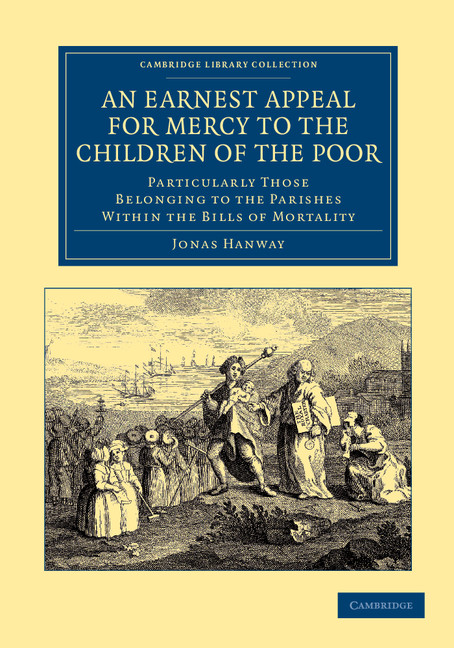
In eighteenth-century London, abandoned children were one of the social groups most affected by the harsh living conditions. Several charitable initiatives had endeavoured to alleviate the problem, not least the Foundling Hospital, of which Jonas Hanway (c.1712–86) was a governor. His tireless philanthropy and campaigning resulted in the 1762 Registers Bill, which required parishes to keep records of the poor children they looked after. In this tract, first published in 1766, Hanway uses information collected from these registers to demonstrate the appalling mortality rates of orphans in care in London, calling for radical reform. This work was instrumental in the passage of the 1767 act that resulted in a dramatic fall in the number of infant deaths over the following decade. It is a powerful exposé of the failures of the capital's care system, as well as a testament to the influence of philanthropic activism.
Contents
Contents
Metrics
Altmetric attention score
Full text views
Full text views helpTotal number of HTML views: 0
Total number of PDF views: 0 *
 Loading metrics...
* Views captured on Cambridge Core between #date#. This data will be updated every 24 hours.
Usage data cannot currently be displayed.
Accessibility standard: Unknown
Why this information is here
This section outlines the accessibility features of this content - including support for screen readers, full keyboard navigation and high-contrast display options. This may not be relevant for you.
Accessibility Information
Accessibility compliance for the PDF of this book is currently unknown and may be updated in the future.