
Skip to main content Accessibility help
×
  • Cited by 10
    • Show more authors
    • You may already have access via personal or institutional login
    • Select format
    • Publisher:
      Cambridge University Press
      Publication date:
      05 September 2014
      11 August 2014
      ISBN:
      9781139860574
      9781107074590
      9781107426986
      Dimensions:
      (228 x 152 mm)
      Weight & Pages:
      0.58kg, 313 Pages
      Dimensions:
      (229 x 152 mm)
      Weight & Pages:
      0.49kg, 314 Pages
    You may already have access via personal or institutional login
  • Selected: Digital
    Add to cart View cart Buy from Cambridge.org

    Book description

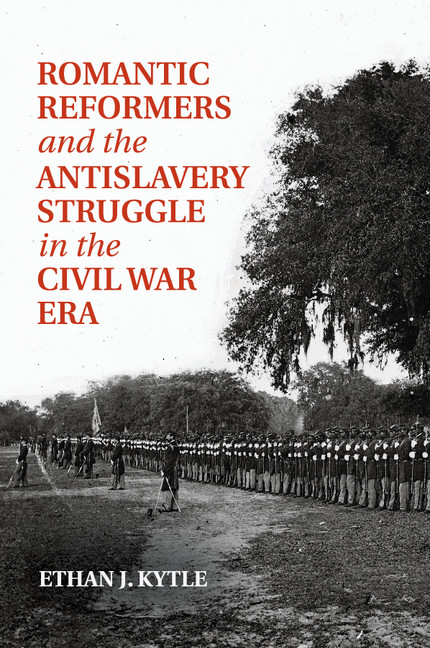
    On the cusp of the American Civil War, a new generation of reformers, including Theodore Parker, Frederick Douglass, Harriet Beecher Stowe, Martin Robison Delany and Thomas Wentworth Higginson, took the lead in the antislavery struggle. Frustrated by political defeats, a more aggressive Slave Power, and the inability of early abolitionists like William Lloyd Garrison to rid the nation of slavery, the New Romantics crafted fresh, often more combative, approaches to the peculiar institution. Contrary to what many scholars have argued, however, they did not reject Romantic reform in the process. Instead, the New Romantics roamed widely through Romantic modes of thought, embracing not only the immediatism and perfectionism pioneered by Garrisonians but also new motifs and doctrines, including sentimentalism, self-culture, martial heroism, Romantic racialism, and Manifest Destiny. This book tells the story of how antebellum America's most important intellectual current, Romanticism, shaped the coming and course of the nation's bloodiest - and most revolutionary - conflict.

    Reviews

    'In this stunningly original work, Ethan J. Kytle uncovers the critical connection between romanticism and the antislavery crusade of the 1850s. Based on a deep reading of archival sources and bristling with fresh insights, Romantic Reformers and the Antislavery Struggle in the Civil War Era reveals how these abolitionists blended the perfectionism of an earlier generation with sentimentalism and martial heroism. Sophisticated and elegantly written, it is a stimulating and altogether absorbing book.'

    Douglas R. Egerton - author of Year of Meteors: Stephen Douglas, Abraham Lincoln, and the Election That Brought on the Civil War

    'Ethan Kytle’s adept and sympathetic recapitulation of the lives and thought of five antislavery figures is collective biography at its best. His book makes the most convincing case for the significance of abolitionist romanticism in the coming of the Civil War and Emancipation.'

    Manisha Sinha - author of The Slave’s Cause: Abolition and the Origins of American Democracy

    'Ethan J. Kytle focuses on five prominent figures - Theodore Parker, Frederick Douglass, Harriet Beecher Stowe, Martin Robison Delany, and Thomas Wentworth Higginson - with a chapter devoted to each. Although the scholarly literature on these subjects is substantial, Kytle is able to accomplish much. First, his writing is refreshingly lucid, and the organization well honed. Second, the selection of these five individuals allows not only for a close biographical analysis but also comparisons with their contemporaries in the decades spanning the Civil War … With deft integration of the copious historiography and primary sources, Kytle is able to provide fresh perspectives on seemingly familiar topics.'

    Lawrence B. Goodheart Source: Journal of American History

    'Romantic Reformers [and the Antislavery Struggle in the Civil War Era] fulfills its promise to delineate the various ways in which romanticism, 'America’s most important intellectual current', was strategically and thoughtfully deployed by second-generation abolitionists during the 1850s … It offers a valuable and lively contribution, for scholars and students alike, to the scholarship of antebellum American history and literary studies as well as to the expanding genre of reform biography.'

    Source: The Journal of the Civil War Era

    '… an interesting, well-written, and engaging collective biography that challenges long-held assumptions about the pacifist and apolitical nature of abolition in nineteenth-century America. [This book] is sure to be an attractive option for instructors to assign in introductory surveys and upper-level seminars.'

    Suzanne Cooper Guasco Source: American Historical Review

    'For the lay student of the American history, abolitionism begins with the tepid gradualism of the founding generation, is followed by the emigrationism of the American Colonization Society, and culminates in either the radical, though effectively pacifist immediatism of William Lloyd Garrison or the violence of John Brown. Ethan J. Kytle lends nuance to this narrative with his exploration of the ideological background and the moral impetus of the generation of abolitionist who came of age in the 1840s and 1850s and drew on romantic ideals … In this regard, Kytle adds significantly to our understanding of American abolitionism on the eve of the Civil War.'

    Jason Stacy Source: The Journal of Southern History

    Refine List

    Actions for selected content:

    Select all | Deselect all
    • View selected items
    • Export citations
    • Download PDF (zip)
    • Save to Kindle
    • Save to Dropbox
    • Save to Google Drive

    Save Search

    You can save your searches here and later view and run them again in "My saved searches".

    Please provide a title, maximum of 40 characters.
    ×

    Contents

    • 3 - Harriet Beecher Stowe and the Divided Heart ofUncle Tom’s Cabin
      pp 114-158

    Metrics

    Altmetric attention score

    Full text views

    Total number of HTML views: 0
    Total number of PDF views: 0 *
    Loading metrics...

    Book summary page views

    Total views: 0 *
    Loading metrics...

    * Views captured on Cambridge Core between #date#. This data will be updated every 24 hours.

    Usage data cannot currently be displayed.

    Accessibility standard: Unknown

    Why this information is here

    This section outlines the accessibility features of this content - including support for screen readers, full keyboard navigation and high-contrast display options. This may not be relevant for you.

    Accessibility Information

    Accessibility compliance for the HTML of this book is currently unknown and may be updated in the future.
