

We hope nevertheless that everyone will learn for the future the lesson that the financial economy and the real economy should never be split to a degree that the former could be perceived by the public as merely a «paper economy» or worse as a «waste paper economy». … These effects call for the role of Institutions which must never be neglected, in order to have well-functioning markets.
1. Introduction
The assumption that there is a necessary connection between the real and the monetary/financial sides of the economy is a central theme of this volume. These two sides cannot be divorced, because their coordination and harmonization is a necessary condition for a well-functioning economic system. A ‘paper economy’, and the monetary/financial institutions that support it, can facilitate economic transactions because liquidity is a necessary ingredient of economic activity in a monetary economy. Nevertheless, when the virtuous circle between the monetary/financial institutions and the real economy is disrupted, the stage is set for economic disorder, with consequences that may go beyond the strictly economic realm and impact on the political and social spheres of human activity. The risks of such disruptions are so great that appropriate institutions should be devised in order to prevent their occurrence, thereby promoting well-functioning markets and healthy economic relations.
The integration of the monetary sector into the analytical framework of structural analysis has a double rationale. Firstly, structural analysis includes, and indeed requires, an understanding of how different sectors interact in shaping the evolution of the whole economy. Now, the financial/monetary sector has been an integral, important part of the economy since the Middle Ages. Consequently, this analytical framework would be incomplete without the analysis of the interactions between the real and the monetary/financial sectors of economic systems. In particular, one aspect of structural economic dynamics concerns technical progress. Financial innovation is the form that technical progress takes in the monetary/financial sector of the economy. One of the earliest, most striking examples of financial innovation was the passage from a purely metallic money to fiduciary money at the initiative of appropriate institutions, and is the subject matter of the present chapter.
Secondly, one of the founding principles of structural analysis is the ‘principle of antagonism-coexistence and synergy between scarcity and reproducibility’ (Quadrio Curzio, Reference Quadrio Curzio, Baranzini and Scazzieri1986, p. 313). Antagonism can be turned into synergy by appropriate institutional development. A paradigmatic example of this principle is the antagonism-coexistence between the scarcity of the precious metals and the reproducibility of paper money. This chapter illustrates the aforementioned principle through the analysis of how the ‘scarcity of (metallic) money’ plagued economic systems in the early stages of modern economic growth, and how institutional development in this field provided a solution via the invention of paper money, which is easily reproducible.
The first aim of this chapter is to clarify what the coordination and harmonization between the real and the monetary/financial sides of the economy means, by elucidating the physiological role of liquidity in the economic mechanism, and the causes and consequences of a ‘scarcity of money’, or, in modern parlance, of liquidity constraints. The problem is illustrated by means of the historical example of the Kingdom of Naples between the second half of the sixteenth century and the first decades of the seventeenth century. At that time, there was intense debate among Neapolitan economists concerning the causes of severe money shortage in the Kingdom, and the devices that could be implemented in order to remedy it. This example helps clarify how economies struggled with liquidity constraints at a time when metallic money was the dominant medium of exchange.
The second, related, aim of this chapter is to inquire into the ingenious remedies devised by economic agents in order to transform money scarcity into ‘abundance’. The solution, in the historical example discussed here, was to invent an institution in charge of the creation of liquidity: the ‘public banks of Naples’, which, among the first in the Western world (De Rosa, Reference De Rosa1955, Reference De Rosa1958, Reference De Rosa1987, Reference De Rosa2002a, Reference De Rosa and De Rosab), initiated the circulation of fiduciary money in the form of paper notes. These notes were nothing but the banks’ ‘promises’ to honour their debts by paying the precious metals on demand. They were one of the greatest examples of financial innovation in economic history.
However, financial innovation is always a mixed blessing. The solution found in Naples was an effective remedy for the liquidity constraints then biting on the national economy and restraining economic transactions. Nevertheless, it opened the way to a system of interactions between the real and the financial sides of the economy more complex and, in some way, more dangerous than had existed before. The circulation of paper money was based on ‘public faith’, and one of the issues in this new, complex interaction was the ‘convertibility’ of paper money into the metallic money to which debtors’ ‘promises to pay’ referred. A betrayal of public faith thus became possible, via ‘inconvertibility’. While in the historical conditions of the time disciplining factors restrained debtors’ ability to renege on their own debts, the seeds had been sown for more serious convertibility problems in the future. This is illustrative of the principle that in the dynamics of economic systems the interactions between the real and the monetary/financial side of the economy never reach a standstill. Financial innovations may provide helpful solutions for the growth of the economy, but they often do so by imposing new instability costs, which then require new solutions, in an endless chain.
The chapter is structured as follows. Sections 2, 3 and 4 are devoted to three protagonists of the debate on the money shortage in the Neapolitan Kingdom in the first decades of the seventeenth century: Antonio Serra, Marc'Antonio De Santis and Giovan Donato Turbolo. In order to shed further light on the historical context, Section 5 adds another cause of the money shortage to those analysed by these three economists. Section 6 explains how the ‘invention’ of paper money as a substitute for metallic money in domestic circulation solved the problem. The process started when the ‘public banks of Naples’, owned by well-respected charities based in the Kingdom's capital, started to produce bank money; and, as we will see, it was reinforced when the government effectively transformed this private paper money into fiat money. Section 7 concludes by suggesting that the issue of convertibility raised by the invention of paper money was to become a more serious problem in the twentieth century, when the fiduciary circulation was extended to the world economy, and a paper currency became the international means of payments.
2. Antonio Serra
At the beginning of the seventeenth century, Neapolitan economists were investigating the causes of the money shortage in the Kingdom and were warning the authorities against its consequences. In particular, a lively debate flared up among three of them: Antonio Serra, Marc'Antonio De Santis and Giovan Donato Turbolo.
It would be a mistake to interpret these debates as merely reflecting their protagonists’ ‘bullionist’ fancies. Their preoccupation with the scarcity of money did not reflect a confusion between money and wealth, nor did it imply their unduly concentration on the ‘sphere of exchange’ rather than production. The rationale for their concern is now well-established in the literature: in a monetary economy the smooth operation of production activities requires that liquidity constraints do not bite. The underlying reason is that no commodity other than those performing the role of money is accepted in this economy as means of payments. Whilst in barter economies, ‘any commodity can be offered directly in exchange for any other commodity’, in monetary economies ‘transactions necessarily involve intermediate monetary transactions’ (Clower, Reference Clower1967, pp. 4–5), which means that would-be buyers need to offer money – not goods, services or assets – for the goods, labour services, capital goods and assets that they wish to purchase.
It is for this reason that the relationships between money and the ‘real economy’ need to be investigated. And it is not by chance that Keynes – whose theoretical work may be interpreted as a far-reaching attempt to differentiate monetary economies from barter economies – proposed a rehabilitation of mercantilist economic writers. Put briefly, he did not accept the idea ‘that the mercantilist argument is based, from start to finish, on an intellectual confusion’, and he was convinced that there was an ‘element of scientific truth in mercantilist doctrine’ (Keynes, [Reference Keynes1936] 1973a, ch. 23, pp. 334–5). In similar vein, in what follows I investigate the element of scientific truth in, and also the historical truth underlying, the arguments put forward by the Neapolitan economists at the beginning of the seventeenth century in order to explain the scarcity of money and their denouncement of it, their diagnoses, and their policy recommendations.
Let us start with Antonio Serra from Cosenza. This mysterious writer, while imprisoned in the Vicaria jail of Naples,1 produced his book A short treatise on the causes that can make kingdoms abound in gold and silver even in the absence of mines (Breve trattato delle cause che possono far abbondare li regni d'oro e d'argento dove non sono miniere) (Serra, [Reference Serra1613] 1973).2 His entire book was an answer to the question of how to explain, and remedy, the scarcity of money that plagued the Kingdom, which was then part of the Spanish Empire's system of Viceroyalties.3
Serra's main point was that the problems of the Kingdom of Naples were rooted in the sectorial composition of its production structure, or, as we would say today, in its product-mix. In other words, what was to blame was the Kingdom's unfavourable economic specialization, which determined an efflux of the precious metals towards its commercial partners.
With regard to the production of tangible goods, Serra thought that the main cause of the Kingdom's disadvantage in international trade was its underdeveloped manufacturing sector, a problem made more serious by the scant entrepreneurship of its inhabitants (Serra, [Reference Serra1613] 1973, pp. 172–3). By way of comparison, he referred to the abundance of manufacturing activities as the main advantage of cities like Venice. In order to investigate this problem, Serra produced one of the earliest examples of structural analysis, centred on the structural characteristics of manufactures as opposed to agricultural production. First of all, the manufacturing industry was able to multiply its products ‘with proportionally less expense’ (Serra, [Reference Serra1613] 1973, p. 172), a point that many commentators (e.g. Schumpeter, Reference Schumpeter1954, p. 258; Reinert, editing Serra, Reference Serra and Reinert2011; Thirlwall, Reference Thirlwall2011, pp. 6–7) have interpreted as an early formulation of the law of increasing returns to scale, as opposed to decreasing returns in agriculture. Secondly, industry yielded more reliable profits than agriculture, because of both its independence from the weather and the less perishable nature of its products. This analysis of the characteristics of manufactures as opposed to agriculture, as well as to mining, sets Serra apart from contemporary writers as a theorist of structural analysis, because he introduced the principle of antagonism/coexistence between reproducibility (of manufactured goods) and the scarcity of natural resources as the main factor in the process of economic dynamics.
The Kingdom's unfavourable product specialization was the main reason for its disadvantage in international trade. Serra noticed that the Kingdom was also at a disadvantage in the service sector because, owing to its ‘very bad’ peripheral geographic position (as the hand of the Italian peninsula's ‘arm’ projecting into the Mediterranean sea), it could not become a site of trafico grande (great trade), i.e. develop as a hub of international trade as Venice had done, nor could it give rise to a transport industry (Serra, [Reference Serra1613] 1973), pp.174–5). In addition, Serra also acknowledged the role of the Kingdom's external debt, which explained both the (high) interests paid on the public debt instruments held by foreigners and the repatriation of profits on foreign investment.
As a consequence of the cumulative operation of these disadvantages, he argued, the monetary flows out of the kingdom exceeded monetary inflows. This explained the drain on the country's stock of metallic money.
A very interesting aspect of Serra's approach was the importance that it gave to institutions, to the point that they played a more important function in the efficient functioning of the economic system than the other ‘accidents’, such as the abundance of manufactures, ‘great trade’, and the quality of people. Good government was ‘the most powerful of all in making the kingdom abound in gold and silver, for it may be described as the efficient cause and superior agent of all the other accidents’ (Reference Serraibid., p.176). He praised republican governments because of the institutional continuity that they provided. Kings lasted for fifty years at most, and the kingdom's policies and strategic objectives would then change with the advent of the new monarch. In republics, by contrast, the coexistence of old and new generations in the governing institutions, such as the Senate, ensured strategic continuity and – simultaneously – the constant rejuvenation of the governing body. Venice was again the example to admire, and possibly to imitate (Reference Serraibid., pp. 176–7).
We may sum up Serra's position by saying that good institutional design is the main foundation of a healthy economic system: good government would create the conditions and provide the incentives for developing a modern manufacturing sector and, through this channel, generate a positive external account, which in its turn would make the kingdom rich in silver and gold ‘even in the absence of mines’.
3. Marc'Antonio De Santis
Serra presented his book as a confutation of the arguments put forth by Marc'Antonio De Santis's two Discourses, published in 1605. He thought it still useful to comment upon, and strongly criticize, those arguments although eight years had already passed since their publication, and in spite of the failure of De Santis's proposed law, or Prammatica, which had been enacted but then soon repealed.
Serra's polemical attitude, coupled with the unconditional support given to him by Ferdinando Galiani against De Santis more than 150 years later in his rather sweeping comments on the controversy between the two men (Galiani, Reference Galiani and Merola1780, p. 340),4 determined the unfortunate undervaluation of De Santis's contribution to economic analysis. A more dispassionate analysis shows that, notwithstanding the failure of his policy recommendations, there was a grain of truth in his analysis as well.
De Santis had proposed completely different views than Serra's on the origins of the outflow of the precious metals from the Kingdom. He did not consider the roots of the problem as originating in the sectorial composition of production on the real side of the economy, which he regarded as quite competitive in the international context. The agricultural specialization, he argued, only meant that foreigners could not do without imports from the Kingdom, which were, so to speak, ‘necessary goods’, while, on the contrary, the domestic citizens could do without at least some of the imported goods. This advantage was so strong, he maintained, that the country could have easily confronted an appreciation of its currency and still keep its privileged position in international trade. De Santis, like Serra and Turbolo (see next section), was aware of the repatriation of rents and profits earned by foreigners on their investments in the Kingdom, which weakened the latter's position. Nevertheless, all things considered, his basic argument was that, even so, there was no outflow of metallic money to be expected from these items in the Kingdom's international transactions.
The culprit, he argued, was the structure of the financial market, which favoured the continuing export of the precious metals. In this context, differently from Serra, he interpreted the liquidity constraint impairing the productive capacity of the Kingdom as a consequence of the malfunctioning of the monetary/financial markets, rather than as a consequence of its ‘product mix’.
Let us consider De Santis's analysis of financial markets in detail. He explained the money outflow as a consequence of the co-existence of two distinct means of international payments, namely silver coins and ‘letters of exchange’. The latter introduced a larger wedge between the equilibrium and the market exchange rates than would be the case in their absence. An incentive was thus created to send silver coins out of the country, both to finance commercial transactions and to speculate on that wedge.
His starting point was the definition of the equilibrium level of the exchange rate as that level at which the flow of precious metals into and out of the country would come to a full stop (De Santis, Reference De Santis1605a [1973], p. 132). According to De Santis, to establish this equilibrium exchange rate was a very important practical objective, because at this level there would be no drain on the country's stock of silver coins, and the liquidity constraint impairing the Kingdom's production activities would be relaxed.
How, then, would this equilibrium level of the exchange rate be determined? De Santis referred to the metallic content of currencies as the basis for its determination (Reference De Santisibid., pp. 138–9). In other words, the equilibrium level of the bilateral exchange rate was determined by the mint par between any two national currencies. The legal par corresponded to the mint par under some reasonable simplifying assumptions.5 Thus, at the theoretical level, the equilibrium exchange rate was determined by the demand for and supply of metallic money, which would bring it into equality with the underlying mint parity6.
De Santis was well aware of the institutional settings under which financial markets operated at this time. He explained that the actual process whereby exchange rates were set took place in the ‘Piacenza fair’. Here a restricted number of well-respected merchants fixed the exchange rates, having taken into account the conditions of demand of, and supply for, all the currencies in the system. These exchange rates then served as the basis for individual bargaining in local markets.
De Santis described the fixing process in Piacenza as ‘fair’, because the merchants in charge usually ‘took the rule’ from the markets, by which he meant that they respected the actual conditions of demand and supply (Reference De Santisibid., p. 123). Thus, he thought the Piacenza fair was the place were the equilibrium exchange rates between national currencies were established, as if the wise merchants supervising the fixing process were acting like a sort of Walrasian auctioneer. The problems of the Neapolitan economy, then, did not originate in the Piacenza fair, but in the decentralized markets for ‘letters of exchange’, where the market exchange rates were determined on the basis of local bargaining.
Letters of exchange were the means of payments that local merchants could use to settle their international accounts as an alternative to cash payments. By buying a letter of exchange in Naples in exchange for the local currency (the silver carlino, or its multiple, the ducat), a Neapolitan merchant would be entitled to a given amount of the foreign currency in the foreign country (e.g. florins in Florence) where he had to make international payments.
In Naples the sellers of letters of exchange, whom De Santis called ‘negotianti’, were very few. Consequently, as it happens in oligopolistic markets, they were able to manipulate the price of these letters through collusive practices. And it was obviously in their collective interest to set the price of these letters (the ‘price of the exchange’) as high as possible; or, to put it the other way around, it was in their interest to quote the local currency at the lowest possible level. Thus, the market power of these negotianti determined a systematically high price of the exchange and, accordingly, a systematically depreciated carlino.
This systematic depreciation, De Santis thought, was the cause of the continuous outflow of silver coins plaguing the Kingdom of Naples. This happened because the ‘price signals’, as we would call them today, worked in an unfavourable direction: firstly, for Neapolitan importers of foreign goods, sending cash abroad was more convenient than buying letters of exchange at an overpriced exchange rate. Secondly, it was convenient for foreigners to make their payments into the Kingdom by means of cheap letters of exchange, rather than more expensive carlinos. Consequently, they sent pieces of paper, rather than silver coins. Finally, speculators, expecting a further depreciation of the carlino, sent cash out of the Kingdom in order to repatriate it later at a profit.
As a consequence of his diagnosis, De Santis refused to think of the exchange rate as a price set by the forces of demand and supply in a competitive market. Because the market for letters of exchange was vitiated by an oligopolistic element on its supply side, he proposed that the exchange rate be administered via legislation, rather than left prey to manipulation by the rapacious negotianti. This was his proposed remedy for stopping the silver efflux and solving the ‘scarcity of money’ problem in the nation.
A few remarks may be useful to understand De Santis's point in comparison to Serra's position. Serra, as we have seen, considered structural analysis as limited to the real side of the economy, and therefore concentrated on the sectorial imbalances between manufacturing production and agriculture. In this field, he reached very high theoretical standards, unequalled at his time. But De Santis, too, was making a very interesting point: even an otherwise healthy economic system (as he, for right or wrong, regarded the Kingdom's economy to be on its real side) can be disrupted by a faulty financial structure. Because of lack of competition in the financial sector, the price to be paid by local traders for the services of financial intermediation was higher than their cost. Consequently, the negotianti earned rents, resulting in an exchange rate different from its equilibrium level. These rents weighted heavily on the national economy, paradoxically turning its competitive advantage in production into a continuing drain on its monetary base.
Thus, De Santis's contribution was to show that the structure of financial markets interacts with the real side of the economy in determining the overall economic performance of countries. Although De Santis's analysis was inspired more by his practical preoccupations as a merchant than by purely theoretical motivations, his investigation of the role of financial markets as an integral part of the economic process marks an important step forward in economic analysis.
4. Giovan Donato Turbolo
Yet another interpretation was proposed in a series of Discourses written between 1616 and 1629 by Giovan Donato Turbolo, head officer (gran maestro) of the Royal Mint in Naples. Firstly, Turbolo was well aware of the role of money as a means of payments, and the consequent need for a monetary circulation adequate to the needs of domestic trade: ‘very important for the public and for contracts in the Kingdom is the quantity of coins, which facilitates trade and the collection of revenues by both the King and private individuals’ (Turbolo, Reference Turbolo1629, p. 320: this sentence is part of a speech originally given in 1619).7
Secondly, like Serra, he was convinced that the drain on the country's silver stock was determined by both the high volume of imports and the huge amount of interests and rents to be paid abroad (Turbolo, Reference Turbolo1616, p. 290): in 1619, he estimated the Kingdom's annual deficit at two million ducats (Turbolo, Reference Turbolo1629, p. 354). Given this large external deficit, it was no wonder that the national currency was depreciating; and because there was no reason to expect a reversal in the current situation, it could not but undergo further depreciation in the future. This depreciation was ‘unavoidable’. However, contrary to De Santis, Turbolo thought that a depreciated currency was favourable to the balance of payments, for two reasons.
First, a weak currency stimulated exports, as the example of the merchant Stefano Saluzzo from Genoa had clearly shown: at an exchange rate set at 170, he had exported from the Kingdom clothes and merchandises for more than 200,000 ducats in that year 1619, with great advantage for the State, thanks to the duties paid at customs. And Saluzzo certainly would not have been able to do that at an exchange rate of 160 (Turbolo, Reference Turbolo1629, p. 313).
Second, because rents and interests were now paid out in a devalued currency, the real value of the service of the country's external debt was reduced. And if foreign debtors objected to this, they should be reminded that they had better ‘maintain their debtors’, as the Kingdom was declining and in need of help (Turbolo, Reference Turbolo1629, pp. 304–5).
Turbolo's analysis, although not developed in details, is perhaps the clearest of the three reviewed thus far: if you cannot avoid the deficit, then let your currency depreciate, thus bringing some relief via both increased exports and the reduced burden of the external debt. After all, this recipe is still followed today by important nations, such as the United States, a country indebted in its own currency. However, in a system of international payments based upon metallic money, the situation was more complicated than in today's ‘paper’ system, because a persistent deficit would produce a continuous drain on the country's silver stock. And this was in fact the problem with the Kingdom's money stock.
Turbolo had a diagnosis for the drain and a remedy for it. The problem, he argued, derived from the high silver content of the national currency, which had not been adjusted to the rise in the market exchange rate.8 Because silver for the coinage was imported, the price paid by Neapolitans to buy silver abroad had been rising with the market exchange rate. However, the silver content of the Neapolitan coins had remained unchanged. Thus, when the Neapolitan mint bought a given weight of silver abroad at a market rate of, say, 170 carlini, and then melted it into coins, that weight of silver was worth only 130 Neapolitan carlini. ‘Thus I have seen silver bought and coined at a lower price than it had cost … and because of this abuse more than 400,000 ducats have been lost’ (Turbolo, Reference Turbolo1629, p.31). That is where the outflow of silver from the country originated. The nation had been willing to suffer the loss by keeping its money ‘good’ – that is, better than the currencies of the foreign countries – because it would have been dishonourable to devalue its silver coin. But reducing the silver content of the national currency was the only remedy by which the silver outflow could be curbed. Thus, Turbolo's was an early argument for debasement or ‘raising the coin’ (alzamento), as it came to be called in the literature.
The difference between Turbolo's position and those of his fellow economists, Serra and De Santis, can now be clearly seen. For Serra, there was still hope of turning the current account deficit into a surplus by adopting measures acting on the real side of the economy (education, industrial investments, good government, etc.). But, differently from Turbolo, he did not contemplate the positive effects of a currency depreciation on exports. De Santis, by contrast, proposed legislative intervention on the financial side of the economy, via realignment of the market exchange rate with the underlying mint par, in order to cut financial rents and curb speculation, which he considered the main causes of the drain on silver reserves. Turbolo's recipe was also monetary in nature. But his remedy reflected his more pessimistic diagnosis: currency depreciation was so deeply rooted in the weaknesses of the national economy, and in the burdens imposed upon it by foreign economic domination, that the only remedy was to accept that depreciation and bring the mint parity into line with the market parity, which was the reverse of what De Santis had proposed.
5. Spanish fiscalism
Our three authors (perhaps for reasons of prudence) did not comment on a fourth cause of the continuous silver outflow. To a large extent, the scarcity of money was due to Spanish fiscal policy, which in its turn was necessitated by the financial needs of the empire, particularly to finance the wars in which Spain was involved: against the French, against Algeria and Tunisia, against pirates, etc. In order to meet these needs, Spain imposed harsh taxes on the Kingdom. Between ordinary and extraordinary taxes, millions of ducats left the country between 1520 and 1647 (De Rosa, Reference De Rosa1987, chs. 1 and 2).
Moreover, in order to raise the money to be sent to Spain as taxes and ‘donations’, the Neapolitan government was forced to sell the sources of public income (entrate)9 to foreigners (Venetians, Florentines, Genoese, and the Roman Church, which also extracted ecclesiastical rents from the Kingdom), thus generating a further drain on domestic money in the form of interest and rent payments abroad, as denounced by our three writers. These historical circumstances explain why, in the words of a modern writer, the crisis in the Kingdom ‘was complex and difficult, and certainly not endogenous’ (De Rosa, Reference De Rosa1987, p. 102).
Thus we have four alternative accounts of the scarcity of money in the Neapolitan Kingdom: Serra's ‘real’ interpretation was in opposition to the one put forward by De Santis, which blamed financial rents and speculation. Turbolo combined real and financial analysis in his diagnosis, and proposed a remedy consisting in a change in the legal parity. Moreover, the ‘fiscal’ interpretation has been borne out by the historical facts. My aim here is not to ascertain whether one explanation is better than the others; nor the extent to which they may be regarded as complementary rather than alternative (the fiscal interpretation, in any case, is certainly not in contrast with any of the others). Rather, my point is that the intense debate just described reflects a money shortage that was a historical fact, rather than the phantom produced by the fevered imaginations of ‘Bullionist’ writers identifying money with wealth.
Official documents in 1581, 1587, 1590, 1592, 1594, and many years afterwards, complained of a ‘great scarcity of cash’ (gran penuria di denari contanti), and they also recorded that the silver coins exiting the country were melted at the mints of foreign cities, such as Ancona, and transformed into foreign coins (De Rosa, Reference De Rosa1987, pp. 95–8). To remedy this constant drain, silver had to be imported from Spain and paid for either in cash or by the sale of future government revenues, only to be transformed by the mint into coins that would soon again leave the Kingdom. Yet, as we know, if money is the means of payment, money is needed to finance every economic transaction.
Thus, given the serious shortage of money afflicting the Kingdom for so many years, the internal circulation might be seriously impaired, and economic activity might consequently come to a complete halt. This, however, did not happen. Deflation, on the other hand, was not recorded until many years later, and it was a cure worse than the disease. How, then, were Neapolitans able to circumvent the problem?
6. The invention of fiduciary money
The Neapolitan solution is a remarkable example of financial innovation, one of the most momentous in monetary/financial history: the invention of a substitute for metallic money, of which such a ‘great scarcity’ was felt. Starting in the second half of the sixteenth century, both in the capital and in the Kingdom at large, silver coins were substituted by paper money, the ingenious invention of the Neapolitan banchi pubblici. From 1570, when the Monte di Pietà (founded in 1539) started to function as a bank, to 1600, six public banks were established in Naples. The banchi pubblici were not state-owned: they were private banks, and we will presently see who their owners were. They were ‘public’ only in the sense that their operations were guaranteed by the state and were subject to some degree of public regulation.
The public banks introduced paper money in the form of deposit certificates called fedi di credito, which is an interesting term, given that fede means both ‘statement’ and ‘trust’ or ‘faith’. Thus, the deposit certificate stated both that the owner had deposited such and such amount of money at the bank, and that he was trustworthy because he was in credit with the bank for that amount. Indeed, the public banks worked as great builders of trust in economic transactions, and more generally in the societal network, because they themselves were trustworthy. One may read this, for instance, in the high praise given to ‘our banks’ in Galiani's Della Moneta ([Reference Galiani and Merola1780] 1963, pp. 278–80), which extolled the credit enjoyed by ‘our banks’, the great honesty of their administrators, their ‘religious’ scrupulosity in saving the coins deposited in their vaults, their ability to ‘multiply money’, and, last but not least, their readiness to give back cash on demand10.
It was because of trust that the fedi di credito become generally accepted as means of payments, and circulated, from hand to hand, in endless payment rounds. This was a great relief: the larger the trust in paper money and, consequently, the greater the amount of deposit certificates circulating in the system, the less was the amount of metallic money needed for circulation. This happened because the demand for cash was reduced: people brought the deposit certificates received in exchange for their goods back to the banks, in order to register their transactions on the banks’ books, but they did not ask to convert these certificates into silver coins. Thus, whilst in theory the fedi di credito were convertible on demand, in fact they functioned as such good substitutes for silver money that ‘everything is paid for at the Bank with a sign, without cash’, as an anonymous Genoese writer remarked in 1605 in his critique of De Santis, who conscientiously reported all the arguments made by his critic (De Santis, Reference De Santis1605b, p. 147).
The public banks of Naples were able to create liquidity because they were trustworthy debtors: their deposit certificates were in fact nothing but statements notifying the amounts of hard cash that the public banks owed their creditors, namely the depositors, and pledging that they would pay cash for that debt on demand. Technically, they functioned as a fractional reserves system, creating liquidity as a multiple of the silver reserves that they held in their coffers, according to the rules of a modern multiplier. At times, the public banks were even recorded as having issued fedi di credito without any previous deposits of cash (De Rosa, Reference De Rosa1987, p.62), thus anticipating the overdraft system which was to become common only centuries later.
One of the reasons why the public banks were so successful in gaining the trust of the population, and in redistributing this asset (as in fact it was) among their clients, was the support that they received from the state. This support culminated in 1584 when the state, by ordering that all payments to itself must be made with bank deposit certificates, de facto transformed this fiduciary money into legal tender. The course of paper money from private money to legal tender was thus completed in two decades.
Another reason for the banks’ success was the nature of their owners, which were charities: two pawnbrokers (Monte di Pietà and Monte dei Poveri); four hospitals (Incurabili, S.Eligio, S. Giacomo e Vittoria, SS Annunziata), and one charity offering shelter to young women in need (Casa Santa dello Spirito Santo). They were highly regarded because of their support of the poor and needy, and also because in some instances they promoted scientific research in the health sector (Valerio, Reference Valerio2010). Trust in these charities was so deep that their pledge concerning the full metal backing of paper money was taken at face value, even if the coverage was at best partial, as we saw earlier. Antonio De Santis's words testify to the great respect enjoyed by these charitable institutions in their banking activities. Most importantly, they testify to his full acknowledgement of their role in relaxing the monetary constraint on economic activity. In response to the anonymous Genoese writer previously mentioned, who had suggested that ‘payments by writing’ may have aggravated the problem of money scarcity by concealing it, De Santis wrote:
Paying in cash what everybody owes to each other is impossible, given that the Kingdom abounds with business transactions; because what is paid into the Banks and withdrawn from them in one day could not be paid in one month in the form of cash; and, since all Banks today belong to charitable institutions, which permit nobody to spend more than the amount for which they are creditors at the Bank, it does not follow what he says that all the payments are made at the stroke of a pen.11
7. Conclusions: back to the future
Neapolitan citizens under the Spanish domination had to make do with a scarce and dwindling stock of metallic money. Like a leaking bucket, the Kingdom had to pay foreigners whatever amount of silver it coined, whether in payments for imports, rents, taxes or as ‘donations’ to finance the Spanish wars. They solved the problem with paper money, which became accepted by virtue of both the reputation of its issuers, the public banks of Naples, and the state's authority. By means of this device, they made that scarce stock of silver adequate to the needs of the domestic circulation: an ingenious solution which enabled them to conduct the Kingdom's ‘abundant’ business transactions even in the presence of a severe money shortage.
There is no question that the Neapolitan invention of paper money, an outstanding example of financial innovation, was a major achievement in history. Its main benefit, in Naples as elsewhere, was a closer integration between the monetary and the real sides of the economy, which set economic activity free from the constraints imposed by the precious metals. But its benefits should be weighed against its costs in terms of both instability and the economic power conferred upon the producers of paper money. One example is their power to renege on their own debts, by suspending convertibility.
Since that period, banks have always oscillated between trust building and trust betrayal: on the one hand, they have built trust by producing generally accepted means of payments which relax the liquidity constraints biting on economic transactions; on the other, they have betrayed the public trust when they have refused to honour their promises to pay by declaring banknotes irredeemable.
At the time in history that we have been dealing with in the present chapter, discipline was imposed on debtors by the national boundaries within which the circulation of paper money was restricted, because the liquidation of international payments still required metallic money. Consequently, the power to declare one's own debt inconvertible did not extend beyond the national borders.
Hence, whilst the Neapolitan banks could sometimes renege on their own domestic debt by refusing to convert paper into the precious metals, currency inconvertibility in international transactions was not an option for the Kingdom, a peripheral state in the international economic and political order of the time. The discipline of the external constraint was not relaxed by the ingenious invention of paper money.
The circulation of paper money still had a long way to go in the following centuries, gradually extending its benefits and costs beyond national borders to the international economy. Eventually, inconvertibility became an option for the central power in the economic and political landscape of the twentieth century. When, starting in July 1961, US liabilities to foreigners surpassed their gold reserves (Meltzer, Reference Meltzer2009, p. 394), the remedies originally devised included the proposal to ‘internationalise the provision of world currency and to eliminate the special role of the dollar’ as suggested by Tobin. Others proposed a devaluation of the dollar in terms of gold (just as Turbolo had proposed for the Neapolitan carlino in terms of silver), while still others suggested a revaluation of the partner countries’ currencies.
The solution that eventually prevailed – inconvertibility followed by a pure dollar standard – meant the transformation of the international currency into pure ‘fiat’ money, or, as others have put it, the establishment of a pure debt-credit relationship among countries (Quadrio Curzio, Reference 230Quadrio Curzio1982, p. 12; and also Reference Quadrio Curzio1981). This was a new sort of financial innovation by which the liquidity constraint on the international economy ceased to bite, and in the issuing country discipline in international economic transactions became just a memory of the past.
The passage to full inconvertibility in the international monetary system set the scene for the new forms of interactions between the real and the financial side of the world economy that we have witnessed in recent years (Quadrio Curzio, Reference Quadrio Curzio2008; Quadrio Curzio and Miceli, Reference Quadrio Curzio and Miceli2010; Costabile, Reference Costabile2007, Reference Costabile2009, Reference 229Costabile2010, Reference Costabile2011). As we have observed before, structural analysis of evolving economic systems would be incomplete without a full understanding of the significance of these new, complex interactions.
1. Introduction
The analysis of the interplay between material and technological linkages is central to the analysis of resource-constrained economies undergoing structural economic dynamics (see e.g. Quadrio-Curzio, Reference Quadrio Curzio, Baranzini and Scazzieri1986, and Quadrio-Curzio and Pellizzari, Reference Quadrio-Curzio and Pellizzari1999). In particular, the relationship between material and technological linkages highlights the classical theme of the analysis of structural change, i.e. the relationship between changes in the economic structure and the adjustment of an existing institutional set-up compatible with such changes. Historical processes of structural change illuminate the importance of the relationship between the structural composition of the economy, the distribution of agents among different institutional clusters and the overall growth performance of the economy. Institutions are the ‘Carriers of History’ (David, Reference David1994), i.e. institutions are a decisive constraint upon growth and structural change. This has been an important insight in development economics where economists such as Albert Hirschman have identified the connection between political and economic progress and emphasized that certain institutional changes are clearly favourable to a process of sustained economic growth. The work of North (Reference North1990, Reference 257North2005) and others has shown the importance of institutions and institutional changes for economic performance. This also holds in particular for post-socialist transition economies, where a radical shock therapy neglecting the existing institutions – and the importance of the search and evolution of the right institutions for the completely different reality of everyday life – has proven a failure (Rodrik, Reference Rodrik2000). Initially, authors such as Przeworski and Limongi (Reference Przeworski and Limongi1993) have pointed out that there is no simple answer to the question whether democracy fosters or hinders economic growth and that a credible commitment to economic growth may be difficult to achieve under autocratic rule, in which there is a high probability that the society will be plundered, as well as with democratic institutions in which too much weight may be given to a more egalitarian distribution of income and wealth with possibly detrimental effects on growth.
From an institutional economist's point of view the countries of the former Soviet Union depict one lucky accident that allows special research possibilities. The often discussed matter of institutional transformation with all its perils can be observed by means of Russia and its cohorts. There, we have a dramatic systemic change from one of the dominating sociopolitical directions of the twentieth century – Communism – to the other – Capitalism. Hence what is often discussed in theory did actually happen on the ground of the former Soviet Union: the shift of a complete system, that is, the transition from a centrally planned to a market economy. This systemic change is interesting for institutional economics in several ways. Institutions as the rules of the game are thought to influence a country's economic development path (Acemoglu, Johnson and Robinson, Reference Acemoglu, Johnson, Robinson, Aghion and Durlauf2005). Now, countries differ regarding their level of economic development and regarding their institutional environments. Hence, the crucial question is whether certain institutions are generally more growth-supportive than others and thus yield higher growth rates and higher development levels in the long run. The crux is that a country's institutional environment depicts a complex entity with myriads of institutions and other factors influencing each other. Hence, the political and economic institutions of an economically successful country might not cause the same results if applied in another country. Institutions depend on history, culture, religion, geography, and reverse causalities. During the time of Soviet transition, mainstream economic opinion was that institutional transformation is possible. Hence, free-enterprise institutions could be implemented in every country and would then lead to economic growth and development. The necessary modifications were summarized in the ‘Washington Consensus’. The complex dependencies that exist between institutions and other exogenous and endogenous factors were ignored.
Empirical evidence, however, proved that things were not so easy. It looks as if many institutions cannot just be transplanted into certain societies, although they might support efficient outcomes in other economies. Whether the transformation of institutions is possible or not seems to depend on a country's history and culture, that is, on its roots and established morals, worldview and traditions (Boettke et al., Reference Boettke, Coyne and Leeson2008; Landes, Reference Landes1998). Hence, the rule of law cannot be easily installed in a country that has no tradition of law and property. Rule of law, property rights, division of power and other institutions, which have evolved in the Western countries, may not be simply transplanted to other historical, cultural and institutional environments (Hedlund, Reference Hedlund2005; Huff, Reference Huff2003; Jacob, Reference Jacob1997; Lipsey et al., Reference Lipsey, Carlaw and Bekar2005). Therefore, the former Soviet Union depicts a kind of natural experiment where institutional economists can observe what happens if systems change and transition is conducted rapidly or gradually.
The current chapter emphasizes the transition in Russia and the role institutions played before and during the process. It broadly describes the developments of the last two decades. In Russia, first a Big Bang approach was applied. Transition was conducted all of a sudden, omitting important underlying reforms. This practice should function as a shock therapy. After the institutional vacuum would be established, new growth-promoting free-market rules would come into play and foster development. However, since Russian GDP per capita and thereby living standards deteriorated dramatically in the years after the collapse of the Soviet Union in December 1991, the plan did not work. At any rate, since then Russian economic indicators recovered and partly achieved their pre-1991 levels at the end of the last decade. Therefore, we have to examine whether Russia at least made its way to a path of sustained growth (Lipsey et al., Reference Lipsey, Carlaw and Bekar2005). One characteristic of recent Russian economic history is that – in remarkable contrast to the economic growth process in China – Russia in the 1990s went back to a ‘pre-manufactory’ stage of economic growth based on primary resource exports.
2. Signs of structural change
Economic transition describes the process of change from a centrally planned to a free-market economy. Centrally planned or socialist economies are characterized by heavy industry, state-owned enterprises, physical management systems, and underdeveloped service and finance sectors (Ickes and Ofer, 2005). Hence, privatization and structural change are central elements of economic transition. Therefore, the current chapter first demonstrates some core indicators of the Russian economy and then explores whether structural change is observable since 1991.
According to the World Bank classification, the Russian Federation belongs to the group of high-income economies.1 Development of GDP per capita can be observed in Figure 14.1. In 1990, Russian GDP per capita amounted for US$5,685. After the breakdown of the Soviet Union in 1991, per capita income continually decreased, reaching its lowest point in 1998 with US$3,300. After 1998 a recovery began. The 1990-level, however, was not reached until 2006 – that is fifteen years after the end of the Soviet Union. This, however, was not the original intention of economic transition. Living standards and therefore GDP per capita were thought to increase right from the start of the reforms.2

Figure 14.1 Russian GDP per capita in constant 2005 US dollars
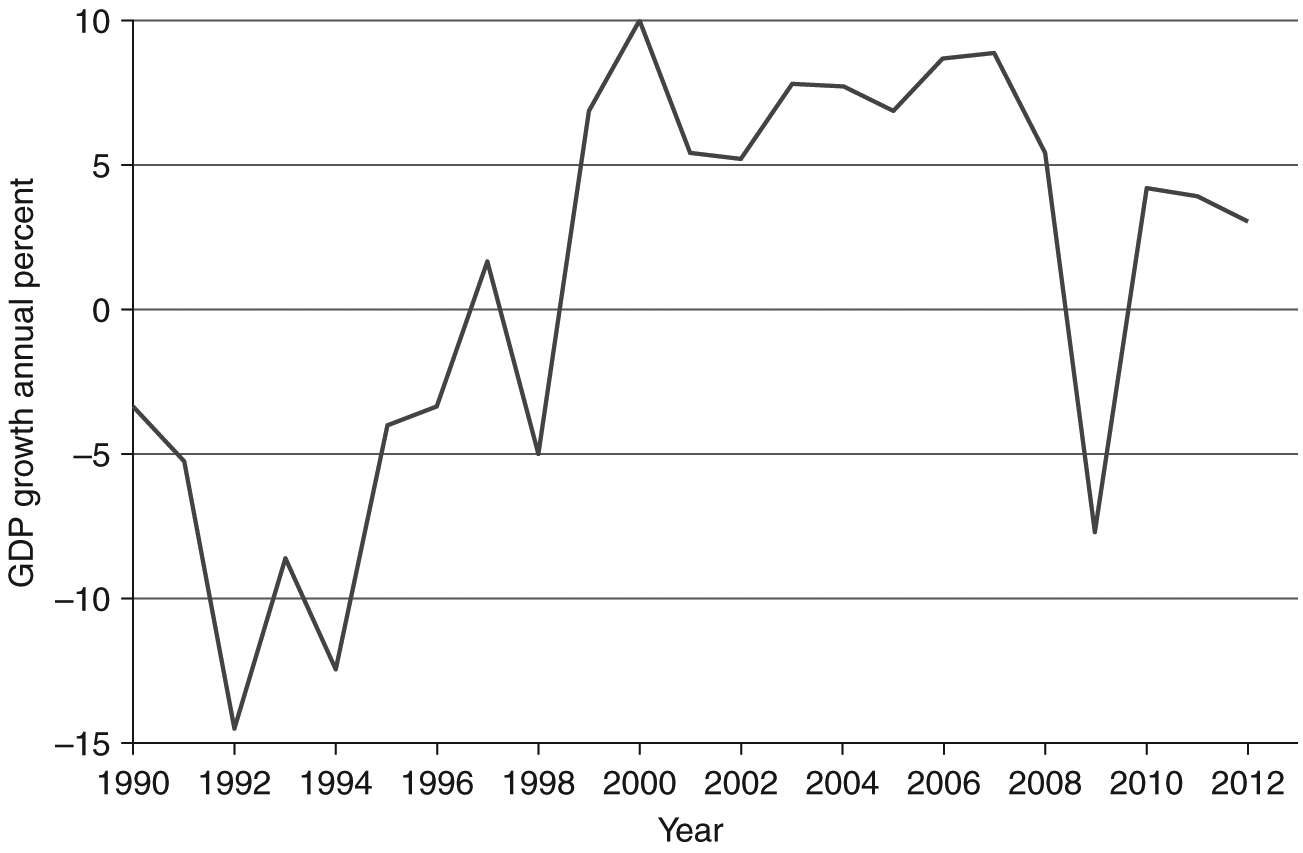
Figure 14.2 depicts GDP per capita growth rates. Between 1990 and 1998, GDP per capita on average fell by-6.10 per cent per year. The average yearly growth rate of the period between 1999 and 2008 amounted to 7.29 per cent. After the financial crisis of 2008, however, the growth rate in 2009 accounted for -7.79 per cent and 4.15 per cent in 2010. The average GDP per capita growth rate between 1990 and 2012, however, is merely 0.914 per cent. Hence, on average, almost no growth in GDP per capita can be observed within a time span of twenty years. Russian growth until 2006/07 can be described as mere recovery.

Figure 14.2 Russian GDP per capita growth annual per cent
Another critical point regarding living standards in Russia in the phase after the breakdown of the Soviet Union is the development of the GINI-index, which increased from 0.289 in 1992 to 0.418 in 2013, indicating a growing gap in income distribution.3 Income disparities may form social and political tension, especially in the Russian regions (Hagemann and Kufenko, Reference Hagemann and Kufenko2013).
Since economic transition describes the change from a centrally planned to a free-market economy, several modifications of the structure of the economy should be observable during and after the phase of transition. Employment shares, for example, are a sign for structural change. In 1992, according to Goskomstat, 14 per cent of total employment was registered in agriculture. The value decreased to 9.5 per cent in 2013. In industry, employment dropped from 29.6 per cent in 1992 to 15.1 per cent in 2012, and in services employment increased from 31.5 per cent in 1992 to 54 per cent in 2012. According to World Bank data, unemployment in the Russian Federation rose from 5.3 per cent in 1992 to 13.0 per cent in 1999. In the 2000s, the unemployment rate was decreasing up to 5.5 per cent in 2012.4 Value-added as percentage of GDP in agriculture decreased from 17 per cent in 1990 to 3.9 per cent in 2012. In industry, value-added decreased from 48 per cent in 1990 to 36 per cent in 2012, and in services an increase from 35 per cent in 1990 to 60.1 per cent in 2012 is observable.5
Net inflows of foreign direct investment (FDI) increased from 0.25 per cent of GDP in 1992 to 4.5 per cent in 2008. FDI then, however, dropped to 2.5 per cent in 2012. These indicators indeed refer to structural change, which usually comes along with decreasing employment and value-added rates in agriculture and industry and increasing shares in services.
Transition had an effect on enterprises, as can be seen in Figures 14.3–14.6. Accordingly, the market capitalization of listed companies as percentage of GDP rose from 0.05 per cent in 1991 to 115.64 per cent in 2007. Afterwards it crashed to 23.91 per cent in 2008 due to the financial crisis, but recovered to 43.41 per cent in 2012. The total value of stocks traded as percentage of GDP also increased from 0.07 per cent in 1994 to 58.05 per cent in 2007, 33.85 per cent in 2008, and 36.34 per cent in 2012. The turnover ratio of stocks traded increased from 11.14 per cent in 1996 with several ups and downs to 87.64 per cent in 2012. The number of total businesses registered increased from 1,609,423 in 2000 (first year for which data are available) to 3,267,325 in 2007.6
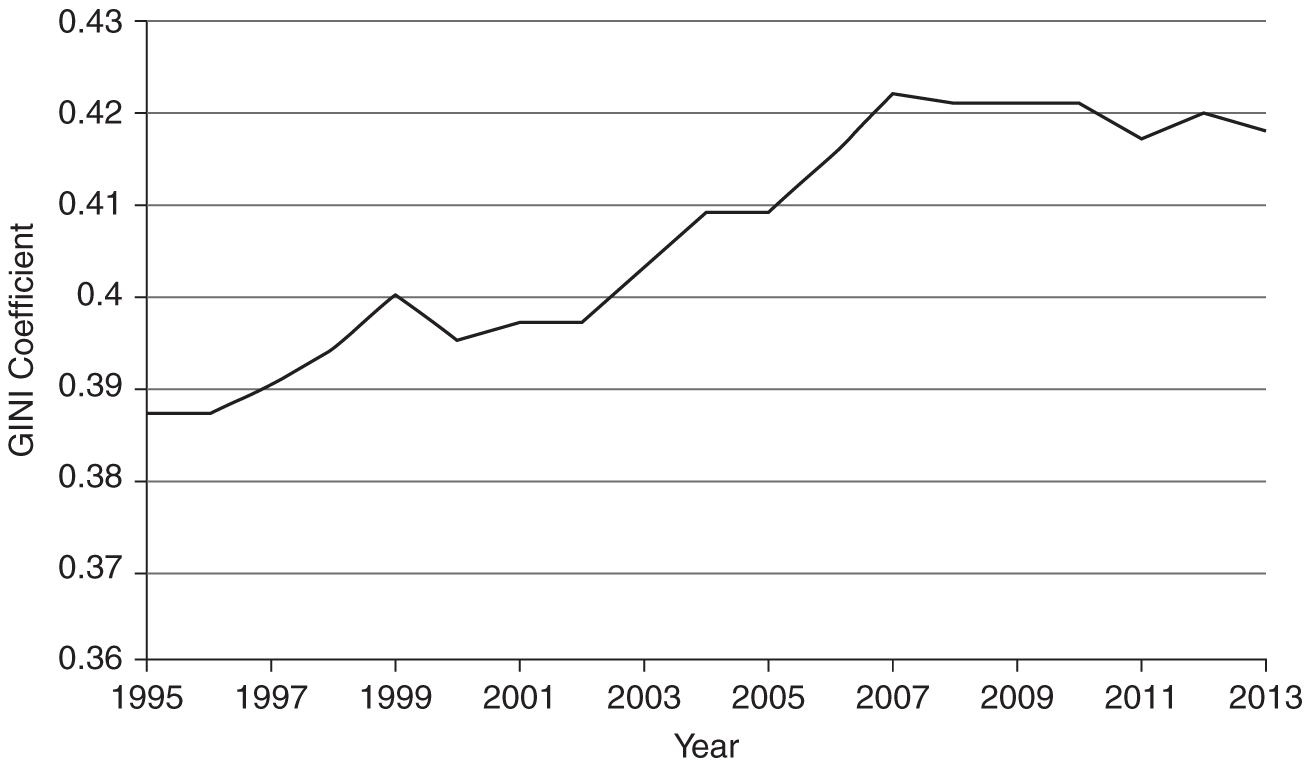
Figure 14.3 Increasing income inequality in Russia
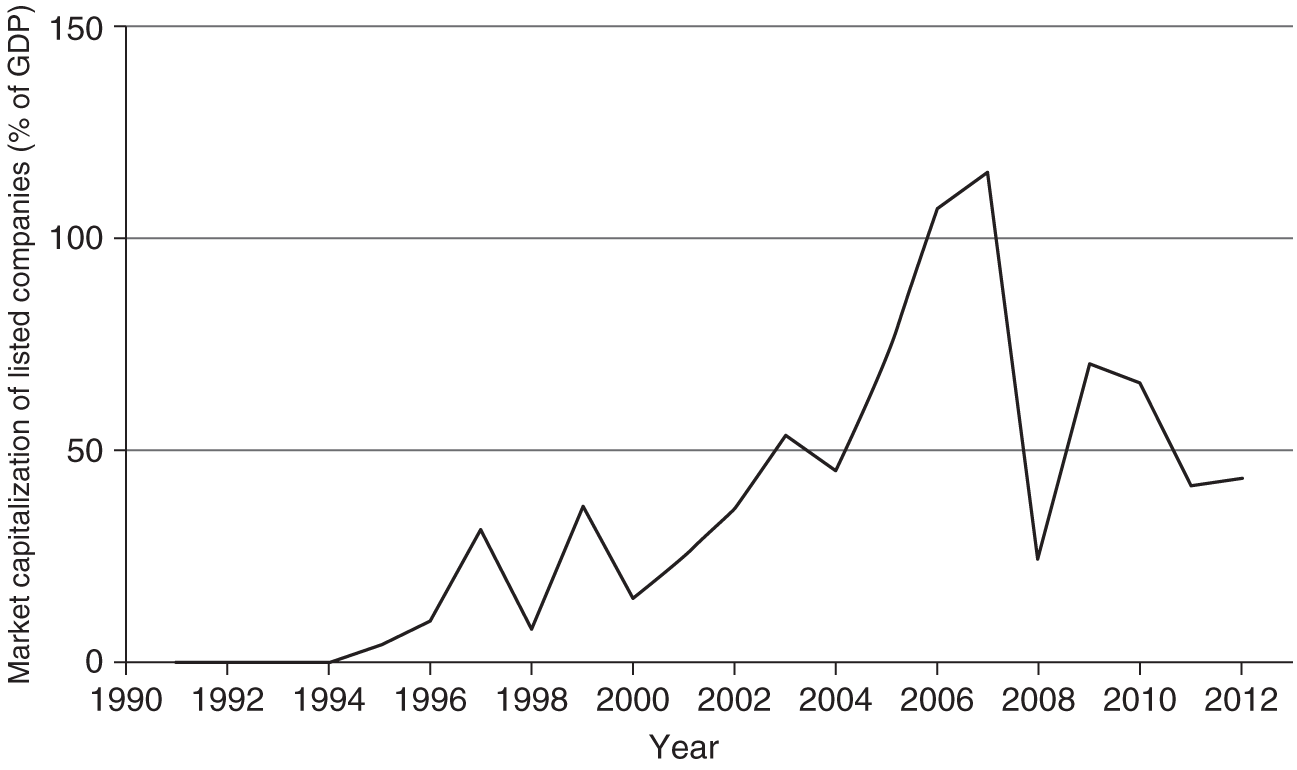
Figure 14.4 Russian market capitalization of listed companies, per cent of GDP

Figure 14.5 Russian stocks traded; total value of GDP, per cent of GDP
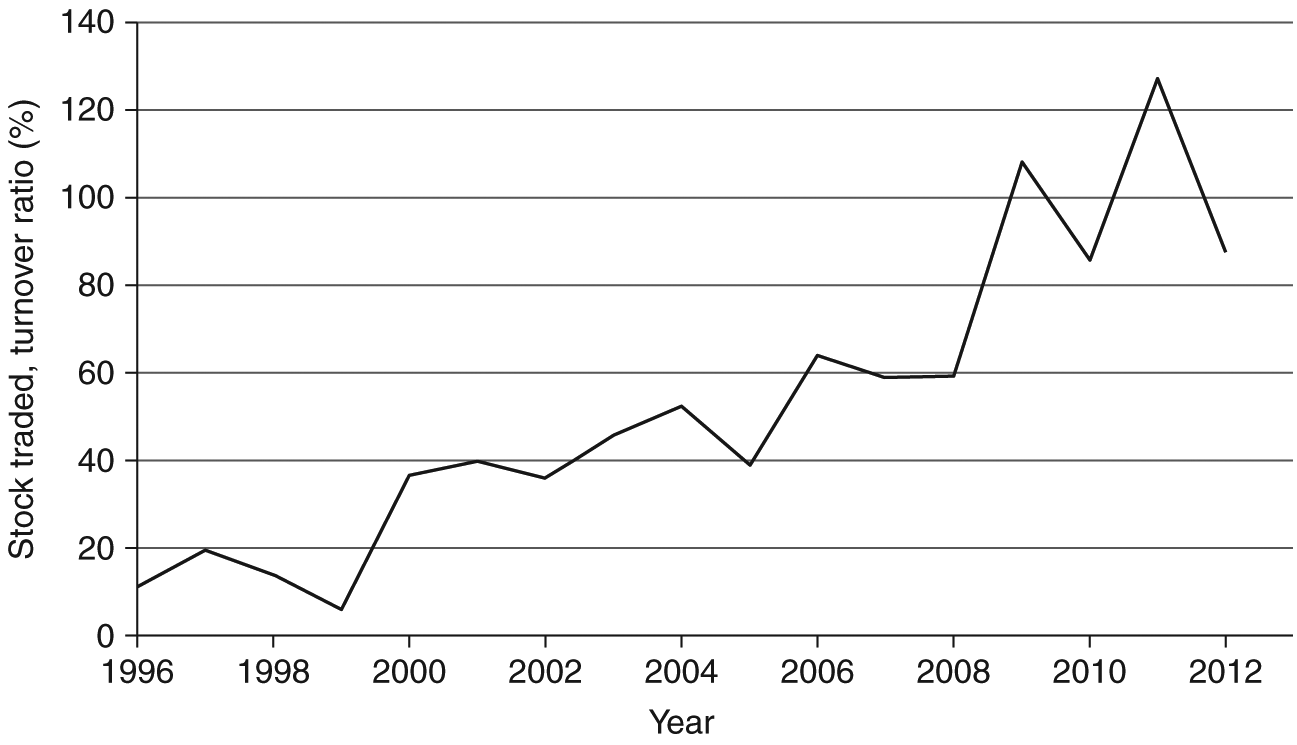
Figure 14.6 Russian stocks traded turnover ratio, per cent
3. The early years
These indicators, however, indicate signs of structural change. According to Ickes and Ofer (Reference Ickes and Ofer2006), structural change proceeded too slow and still lacks behind the respective expectations. Hence, ‘[Russian] enterprises continue to produce the wrong products, with too many workers and in the wrong place’ (Ickes and Ofer, Reference Ickes and Ofer2006, p. 1). This statement hints at the low productivity of the Russian economy, which is a legacy of its Soviet past. Soviet economic performance has almost never been as successful as predicted. At least under Reform Communism (1953–1991) official Soviet as well as Western data were overestimated. On the contrary, Angus Maddison's data of GDP and GDP per capita (Maddison Reference Maddison2001, Reference Maddison2003) demonstrate an almost continuous decrease compared to the US level (see also Rosefielde, Reference Rosefield2007, pp. 145–60; Rosefielde and Hedlund, Reference Rosefielde and Hedlund2009, pp. 78–91). Hence, the Soviet Union never caught up to the United States but was falling behind in GDP per capita, at least during the Cold War. This is not surprising since centrally planned economies and the Soviet strategy of physical systems management lacked sufficient attention for the demand side. Therefore, demand and supply were not equilibrated, and prices and wages were fixed by the respective bureaucratic bodies. Emphasis was on heavy industry and within that, on arms production. Therefore, although it can hardly be proven with statistical facts, since the respective data are not available, probably a negative factor productivity growth was haunting Russia for decades. However, after the collapse of the Soviet Union, Russia was not able to bury its past. This is not surprising from an institutional point of view. Institutions, understood as informal mental models and belief systems and, more practically, as formal rules like the political or legal system of a state or certain laws, cannot be easily changed, added or omitted. Transition in Russia meant more than merely adapting some economic rules. The political, legal, economic, and at best the societal system had to be modified heavily. This is a difficult task, the more so since transition should be conducted ‘overnight’.
Emphasis of the so-called shock therapy was on macroeconomic stabilization, price liberalization and finally privatization. Their implementation neglected two important aspects. First, the inherited institutional structure was not sufficiently adapted. Hence, the reforms were realized without implementing the rule of law and therewith an independent judiciary, democracy, and certain civil rights such as freedom of the press. Secondly, in reality the reforms conducted differed considerably from what was officially decided and written down.
Liberalization inter alia meant that prices, which were fixed by the governmental bureaucracy until then, were liberalized on 2 January 1992. It was hoped that this step would fill the retail traders’ shops and would enable the population to buy the necessary goods. Furthermore, price liberalization would force productivity since the consumers would determine which goods to produce. First individual one-man firms were allowed in May 1987 and private cooperative enterprises were introduced as a form of organization in May 1988; however, during liberalization establishment of private trade, private enterprise and manufacture was enforced with legislative basis on a larger scale. Subsidies to state enterprises and farms were cut. Barriers to foreign trade were decreased to allow foreign imports with which the indigenous producers had to compete.
It was overlooked that firm managers who were educated in fulfilling state directives did not have a clue about efficiency, productivity and profit maximization. Firms suddenly had to deal with the fact that the state reduced subsidies and did not fulfil its role as reliable purchaser anymore. Price liberalization led to a much higher inflation than expected. Fixed incomes and pensions of workers, pensioners, widows, etc. lost value and therefore, living standards decreased drastically.
The central bank's expansive monetary policy, which was introduced to finance the state's debts, mainly inherited from its Soviet past, exacerbated inflation. The expansive supply of money and credit in 1992 and 1993 let the rouble devaluate. The situation ended in the well-known hyperinflation that hit Russia in the 1990s. The development of the inflation rate is depicted in Figure 14.7. Enterprises lost their production plans and additionally the state as reliable purchaser. For decades the firms’ existence had been based on physical systems management. They got their production plans from the appropriate authority that told them what, how, and which quantity to produce. Wages were fixed by the state; hence, enterprises never had to calculate on labour and other input costs. After a time of interfirm credit lending supported by the central bank in 1991 and 1992, which further boosted inflation, the government restricted credit expansion to state-owned firms (Robinson, Reference Robinson1999). Since the firms, instead of decreasing production, were producing inventory stocks, the credit crunch resulted in monetary shortages. Many firms had to be shut down. This had far-reaching consequences. Often, a certain firm was the only employer in the region, like in cases of the so-called mono-cities (‘monogoroda’). Therefore, a region's whole working-age population got unemployed at once. The Soviet enterprises were not only mere employers, they also covered many social services. Industrial firms dealt with their employees’ housing, health service, education and other social functions. Furthermore, the state was heavily in debt and not able to pay wages or pensions and had to cut the few services that existed. Altogether, the 1990s were characterized by a severe decrease in living standards and social indicators. A more thoughtful plan for transition that incorporated these issues could have resulted in a better outcome. In reality, Russia's economic transition ended in circa 3.4 million premature deaths between 1990 and 1998 and in impoverishment of large parts of its population (Rosefielde, Reference Rosefielde2001).

Figure 14.7 Russian inflation, consumer prices, annual per cent
Macroeconomic instability in the first half of the 1990s was due to a sudden price and exchange rate liberalization, high and growing government debt, excessive money expansion, the resulting devaluation of the exchange rate and hyperinflation. Since 1993, however, macroeconomic stability became a main target. A restrictive monetary and fiscal policy was implemented, interest rates were increased, credits restricted, and subsidies reduced.
Polterovich (Reference Polterovich1995, p. 277) argues that the negative results of the shock therapy, which were unforeseen by proponents and opponents alike, are not only due to monopolies and incompetence to perform in a market economy but that, above all, ‘it was the particular “cooperative” structure of relationships and interests that had been established during the process of the evolution of the Soviet enterprise that was a root cause of the economic crisis’. He calculates that labour collectives in industry, construction, trade, and consumer services, gave work to more than 50 per cent of the employed population in 1992. ‘The economic “battle” that took place in that year consisted of the struggle between the liberally oriented government and the labour collectives (including their managers), the latter of which regarded the government's reform program as an encroachment upon their wages; their jobs; and their rights to use, manage, and own principal funds’ (Polterovich, Reference Polterovich1995, pp. 266–7). The resistance of labour collective enterprises to the austere credit and monetary policies of the government and their continued practice of reliance on governmental help contributed to economic inefficiency and social injustice. Workers were suffering most in all those sectors that could not develop markets for their final products – such as health, culture, education, the arts and sciences – and therefore could not follow the double-strategy of raising output prices and delaying payments to suppliers in the interenterprise debt crises which developed.
These economic and political struggles and conflicts that would come to exist had not been considered before by the Russian and foreign inventors of the ‘shock therapy’. However, looking back at the Soviet history, this is something that could have been expected. At any rate, it was not, and political fights endured after the coup that ended Gorbatchev's reign and brought Boris Yeltsin into the leading state position. The replacement of Yegor Gaidar as Prime Minister by Viktor Chernomyrdin complicated things for the economic reformers since economic and political pragmatism entered the stage (Robinson, Reference Robinson1999). The never-abolished Russian properties of networks, relationships, authoritarianism and rent-granting defined daily business. Yeltsin's plan for re-election necessitated this strategy. However, it was not incorporated in mainstream economic modelling of transition. Political struggles continued to influence economic development in several ways. Policy, economy, and business got mixed up by the implementation of the respective personnel, especially from the banking sector, in political positions. Lobbyism affected every sphere of governmental decisions, such as subsidies granted to certain sectors, possibilities of tax evasion, or unfairly gained profits from privatization. In this way, lobbyism and rent-granting had an influence on the budget deficit, since they inhibited policies of debt reduction and a restructuring of the state budget. Especially the intertwining of banks and politics caused problems. The hyperinflation caused a demonetization of the economy that left the commercial banks as the only liquid actors. Therefore, the state relied heavily on the banks to finance the budget deficit. To reduce the budget deficit, the lax taxation system had to be reformed and tax evasion reduced. However, strict taxation would hit the banks and the industrial firms (which were partly owned by banks) particularly hard. Therefore, the government was filled by internal power struggles while the President had his re-election in mind. The banks’ linkages with the government can be demonstrated with the appointment of Vladimir Potanin and Boris Berezovsky in 1996. Again in 1997, Anatoli Chubais and Boris Nemtsov became part of the government while Vladimir Potanin had to leave. Boris Berezovsky and Vladimir Potanin became two of the Yeltsin-era Russian oligarchs. Their places in government simplified enforcing their interests. The entanglements between banks and government had far-reaching consequences regarding the second wave of privatization and the 1998 currency crisis.
4. Privatization
Privatization was conducted in two steps. The first privatization program, the ‘voucher’ privatization, started in 1992. Beforehand, retail shops and other small enterprises were just transferred to the employee(s). Then, it was decided which of the large enterprises, with thousands or tens of thousands of employees, should be privatized. Here the struggle started. The firms to be sold within the voucher program were the more or less worthless, inefficient enterprises whose production until then was planned via physical systems management. On a free market, those enterprises were valueless. The remaining high-value enterprises, often those exploiting natural resources, stayed in the hands of the state for the present. The firms taking part were transformed into stock companies. The stock was managed by property funds until the auctions were put into practice. However, the insider dominance that characterized the privatization process already started before the first firm was privatized with specifying the rules for the distribution of shares. It was decided that 51 per cent of the enterprise shares should be sold to worker collectives at favourable prices. Hence, a majority of the shares went directly to insiders – that is, worker collectives and former managers (Hedlund, Reference Hedlund2001). The remaining shares were to be open for purchase by the Russian citizens. Therefore, every Russian was provided with a voucher worth 10.000 roubles in nominal value, so every Russian individual should have been able to purchase an enterprise-share using her or his voucher at the upcoming auctions. In reality, however, due to hyperinflation vouchers lost almost all their value. Additionally, since people did not trust the program and thought it would not take place anyway, vouchers were traded at street kiosks for the price of a bottle of vodka or were sold cheaply to speculators. When the auctions at last took place in 1993/1994, the outcome was quite dubious. Some auctions were announced only shortly before they started, they were conducted at places far apart and access could be restricted via arrangements with the police or the security services. Hedlund (Reference Hedlund2001), referring to Lieberman et al. (Reference Lieberman, Ewing, Mejstrik, Mukherjee and Fidler1995), states that ‘80% of the capital [of the enterprises that participated in the voucher privatization], had either remained in the hands of the state or gone straight to enterprise management and the worker collectives’ (pp. 230–1). Hence, already the voucher privatization ended in ownership dominated by insiders and therefore by the former managers.
The second step of privatization took place in 1995–97 and should have privatized the high-value oil, natural resource, and telecommunication companies. This part of the privatization, however, was influenced by the political struggle penetrating the government. The commercial banks played an important role since they were the last liquid actors that could help the government shoulder its high debt burden. The privatization deal known as ‘loans for shares’ was as follows: the shares of the enterprises were given to the banks as collateral. In return, the state got credit from the banks to finance the budget. In case the credit was not repaid by August 1996 the banks were allowed to hold auctions and sell the enterprise shares. The credit was never repaid and the banks sold the firms under value to insiders, often themselves. Treisman (Reference Treisman2010, p. 1) provides examples of various tricks (see case of the oil company Surgutneftegaz) used by the red directors to eliminate the competition during the auctions.

Figure 14.8 Privatization waves of the state-owned enterprises
The political context becomes clear when we look at the relevant dates – the loans were made before the 1996 election, but the auctions took place afterwards. That way the potential buyers and the bankers had a reason to support Yeltsin's re-election campaign and to inhibit a return of the Communists. The buyers, however, were probably selected long before the auctions occurred and often the lenders more or less sold the shares to themselves at low prices (Hedlund, Reference Hedlund2008; Treisman, Reference Treisman2010). It is often argued, and in some cases it is in fact true, that the loans-for-shares auctions led to the emergence of the Russian oligarchs, who thus were able to buy lucrative enterprises at low prices. The economic outcome of these developments is discussed controversially. Patronage, manipulation and insider trading led to a form of privatization that differed from what was intended by Russian and Western reformers. However, Woodruff (Reference Woodruff2004, p. 92) points out that some of the distortions incorporated in the privatization programs were wanted by the Russian reformers and their Western advisors. They must have been aware that the Soviet managers would try to strip assets and to self-enrich themselves. Therefore, they wanted to give the managers an advantage in acquiring shares and in controlling enterprises to force them to join the new competitive environment and to produce according to efficiency criteria. However, if this were true, it seems to have been a naïve plan, ignoring the Soviet managers’ past and environment they had to deal with up to then.
At any rate, the Russian privatization program is often described as a betrayal of the Russian population, as plundering and theft (Hedlund, Reference Hedlund2001, Reference Hedlund2008; Rosefielde, Reference Rosefield2007). It has been argued that the oligarchs owe their wealth to the loans-for-shares auctions and these oligarchs inhibit the development of free-enterprise institutions such as secure property rights, contract law and independent judiciary. Guriev and Rachinsky (Reference Guriev and Rachinsky2005), however, find that only a few oligarchs owe their wealth to the auctions, including, for example, Roman Abramovich, Mikhail Khodorkovsky, Vladimir Potanin, Vagit Alekperov and Vladimir Bogdanov. The rest of the 627 owners considered in the study got rich in different ways. Most of them, however, already belonged to the old Soviet nomenklatura (red directors), or they were able to take an advantage of the power struggles and reform efforts of the 1980s and 1990s. The authors further figure out that the oligarchs’ enterprises are more productive than other Russian firms. Yet, oligarchs do not support free-enterprise institutions. Treisman (Reference Treisman2010) also demonstrates that oligarchism as it appeared in Russia is not a unique phenomenon in emerging markets and can take on even greater dimensions as is the case, for example, in Mexico. Obviously, the winners in the loans-for-shares privatization were the red directors, who took advantage of their positions to accumulate more wealth.
5. On the way to the 1998 crisis
In 1996–1997, however, the Russian economy was characterized by strong connections between the government and the banking sector. The government was unable to collect taxes and hence, to pay its bills. Therefore, the strange relationship with the banking sector was a necessity. Wages were not paid, living standards decreased and industries were provided with non-monetary subsidies in the form of fuel. This contributed to the demonetization of the economy and the emergence of a barter system, and it further decreased the government's ability to raise taxes (Robinson, Reference Robinson1999, p. 550).
The lack of deeper institutional reforms, coupled with events in Asia, contributed to the Russian currency crisis of 1998. The Asian crisis might have hit Russia anyway; however, the prevalent structures were responsible for its severity. Political struggles, lax tax collection, hyperinflation, demonetization of the economy and a high fiscal deficit had a share in Russia's extreme downturn in 1998/1999.
Reformists politically lost ground in 1994, when Yegor Gaidar and Boris Fedorov resigned from government after the Duma elections. The growing influence of lobbyists had affected state finances, tax collection and subsidies. Since many of the bankers that gained influence owned stakes in the privatized enterprises, they were busy inhibiting a more severe tax system. Lax tax collection, on the other hand, led to a further decrease in state revenues and to an increase of the budget deficit. Non-monetary subsidies, primarily fuel, worsened the situation and further contributed to the demonetization of the economy. In October 1994 the rouble collapsed, inflation further shot up and in 1995 a fixed exchange rate corridor was implemented. Since many members of the Soviet nomenklatura were part of the new banking sector and had close ties to the government, both sides were already mingled. The state needed the banks to finance its deficit. The banks, on the other hand, used their influence to gain an advantage in the upcoming loans-for-shares auctions. Hence, the state further lost its ability to collect taxes, paid non-monetary subsidies to the industry and continued to run into debt. Commercial banks invested in treasury bills and hence helped the government to finance its deficit. On the other hand, they influenced the loans-for-shares auctions and inhibited the formation of market prices for the firms to be sold. Then, they prevented the government from tax collection and therewith exacerbated the state's financial situation. The banks supported Boris Yeltsin during his re-election campaign and in 1996, after the election, two from their ranks, Vladimir Potanin and Boris Berezovsky, became members of the government. It was discovered that the only way to cover the state's debt was through international finance. However, to attract international investors, the state needed regular revenues to create confidence. Besides opening the bonds market to foreigners, a stronger tax collection was enacted. This led to a conflict between the state and the banks. Vladimir Potanin was released from government, whereas Anatoli Chubais and Boris Nemtsov were brought in. These policy changes as well as anti-inflationary actions led to an international upgrading of Russia's solvency. Exports of natural resources, especially fuel, resulted in a balanced foreign trade. Oil was sold at a high price on the world markets. The World Bank and the IMF promised further assistance. Inflation decreased from 131 per cent (1995) to 11 per cent (1997) (Chiodo and Owyang, Reference 256Chiodo and Owyang2002). Limitations for foreign investors on the bond markets were removed. In 1997 the market for short-term government bills almost exploded. Within one year foreigners tripled their holdings of government bonds and foreign cash financed 56 per cent of the government's deficit (Robinson, Reference Robinson1999, p. 552). However, although from an outsider's point of view the situation seemed to improve, no real changes were made to the economy apart from bond markets. Tax receipts improved compared to the previous year, but the general trend did not change, and tax evasion and indebtedness even increased. Real wages were significantly lower than in 1991, and large parts of the workforce still suffered from wage arrears. The linkages between bankers and government were ravaged by conflicts since more severe tax laws affected the banks’ interests. A scandal concerning the loans-for-shares auctions caused the degradation of Anatoli Chubais and ended in the dissolution of the government in March 1998. Prime Minister Victor Chernomyrdin was fired and replaced by Sergei Kiriyenko.
In 1997, prices for fuels and other natural resources began to fall on the world markets. The drop in prices resulted in a deterioration of the trade balance. The government crisis and the Asian crisis led to a decline in investors’ confidence. In November 1997 the Russian central bank had to defend the rouble with almost US$6 billion. The short-term government bonds expired within a year and hence, investors started to withdraw their money. In August 1998, Russia announced a debt default, floated and therewith devalued the rouble, and suspended payments by banks to foreign lenders (Chiodo and Owyang, Reference 256Chiodo and Owyang2002; Kharas, Pinto and Ulatov, Reference Kharas, Pinto and Ulatov2001; Robinson, Reference Robinson1999).
The crisis of 1998 can be attributed to the prevalence of weak economic fundamentals. Public debt problems, large parts of it inherited from the Soviet past, could not be solved with the political and economic structures at hand. After the break-up of the Soviet Union, the country was thrown in at the deep end without the necessary reforms of the economic, political and legal fundamentals. The omitted reforms, for example the introduction of secure property rights via an independent judiciary and the rule of law, made a solution to the debt problem and everything it incorporated – expansive monetary policy, hyperinflation, demonetization, real appreciation of the rouble, economic recession, and strongly decreasing living standards – impossible.
6. A new decade – time for reform?
In the aftermath of the 1998 crisis, however, Russia exhibited a surprisingly fast recovery with an average growth rate of 6.7 per cent per year between 1999 and 2007 (Hanson, Reference Hanson2007, p. 869). Such a positive economic development after a severe crisis came unexpected. It is often argued that Russia's impressive growth performance in the 2000s is due to developments in the world markets for natural resources. Accordingly, the increasing oil price in particular enhanced Russia's economic growth, especially between 2000 and 2004. The economic downturn of the 1990s is described as ‘transition recession’ (‘valley of tears’), which was overcome with the end of the crisis in 1998; thereafter Russia had performed relatively well compared to other transition countries until the 2008/9 crisis. However, according to Vinhas de Souza (Reference Vinhas de Souza2009), 70 per cent of Russia's economic growth since 1999 cannot be directly attributed to natural resources. A boom in services and construction contributed to the improved growth performance (Hanson, Reference Hanson2007). Although oil, gas and other natural resources might have had a limited direct effect on the growth rate, their indirect contribution is enormous. The revenues created in the natural resource sector went largely into the state budget and contributed to a fast decrease in external and internal government debt, which was less than 5 per cent of GDP in 2007. Furthermore, the natural resource revenues increased personal gains and enterprises’ profits, driving domestic demand for consumption and investment. Therefore, Russia's government budget, its trade balance, and GDP in general depend on natural resource extraction and especially on oil production and exports. The fast economic upturn after the 1998 crisis can be contributed to increasing oil prices as well as to the fivefold devaluation of the Russian currency (Hanson, Reference Hanson2007, p. 870).7 Still the early 2000s were characterized by an enormous increase in exports, especially oil. Ahrend (Reference Ahrend2006, p. 5) estimates that, between 2001 and 2004, 70 (45) per cent of the growth in industrial production can be attributed to the natural resource (oil) sector. The oil sector's direct contribution to GDP growth in 2000–03 was 24.8 per cent and its export share accounted for more than 50 per cent. Hence, at least until 2004 the oil sector strongly influenced GDP development.
The Russian government, however, dealt wisely with the growth benefits – mainly the oil windfalls – after the 1998 crisis. A Stabilization Fund was created that collected parts of the natural resource windfalls, which were then used to pay off state debt. Oil exports and rising oil prices resulted in an inflow of foreign currency, which the central bank used to build up the third-largest foreign-exchange reserves worldwide (Hanson, Reference Hanson2009, p. 25). Inflation was successfully brought down into the single-digit range in 2006 and the tax system was reformed (Hanson, Reference Hanson2007, p. 871).
Now there is concern that Russia might suffer from the ‘Dutch Disease’ phenomenon without a ‘Polder model’ yet in sight. Until 2008 natural resource exports drove up the rouble exchange rate while other sectors of the economy were losing competitiveness on world markets. These sectors are not able to catch up because the exchange rate pushes up the prices for Russian products.
The problem of Russia's oil and gas industry is its low technology level. Natural resource exports are not much processed and research-based high-technology production is also missing in other sectors. This, however, could also be a sign of the ‘Dutch disease’ (Hanson, Reference Hanson2007, p. 875). Investment shares are generally low and productivity gains can be traced back to the formerly under-utilized capital stock. After the 1998 crisis, many of the production facilities lay idle, so that production and productivity could be increased by using the idle capital stock. Therefore, even the oil sector might face future problems since necessary investments to keep up its production capacity are missing. ‘Easy oil’, that is oil extracted from fields with under-utilized capacity, has been running out for years, which might have contributed to the slowdown in oil production in 2004. The private oil firms did not make substantial long-term investment to adjust their production facilities to new technology levels. Investment was only conducted to absorb short-term gains. The reason for this behaviour may be due to the insecure situation regarding property rights. Since 2003 the government distinctly increased its influence in the oil sector by state-acquisition of oil firms. Examples are Yukos, which was overtaken by the state-controlled oil firm Rosneft, and Sibneft, which was bought up by Gazprom, a state-owned gas monopolist. State intervention was also observable in other sectors, for example electricity, arms production, automobile production, shipbuilding and nuclear industry (Ahrend, Reference Ahrend2006, p. 7; Hanson, Reference Hanson2007, p. 877).
A result of the state intervention was a slowdown in the oil sector. Insecure property rights and under-utilized capacity inhibited long-term investments in the exploitation of new oil fields in the early 2000s. The Yukos affair caused an even more severe crisis regarding secure ownership rights and let the business climate deteriorate. Therefore, growth in oil exports have decreased since 2004. However, Russian exports are still governed by natural resources. According to Hanson (Reference Hanson2009, p. 21), oil and gas were still responsible for 65.9 per cent of merchandise exports in 2008, while metals and coal added another 15 per cent.
At any rate, despite the slowdown in oil exports since 2004, the Russian economy in general has become more productive between 1998 and 2008. This is due to productivity increases of the labour force and the use of under-utilized capacities (Hanson, Reference Hanson2009, p. 12). The economic boost in 1999–2000 can be traced back to the severe rouble devaluation and increasing oil prices. The upturn between 1998 and 2008 must be attributed to additional factors. Resources were reallocated from heavy industry to the service sector and into new industries such as telecommunication (especially mobile phones) and software development. Employment shifts were observable from agriculture and manufacturing into construction, services, finances and trade. FDI provided more productive management skills, new technologies, machinery and equipment. Estimates exist that certify Russia a TFP growth of 3.3 to 4.7 per cent per year (Hanson, Reference Hanson2009, p. 13). However, Russia started from a low level. Hence, despite productivity increases its labour productivity is still only between one-fifth and one-third of the US level (Hanson, Reference Hanson2009, p. 19). The same is true regarding its production facilities and machinery. Russia is still unable to compete with low-wage manufactures from Asian countries.
Indicators positively highlight Russia's macroeconomic stability, its educational level and its market size (Hanson, Reference Hanson2009, p. 16). On the other hand, indicators measuring the institutional quality rate the country worse. In the World Bank's Doing Business 2014 report Russia achieves only the 92nd place out of 189 countries. The report measures business regulations and the security of property rights and hence, the quality of regulations influencing business activity. The World Economic Forum's Global Competitiveness Report 2013–14 (Schwab, Reference Schwab2013) paints a slightly different picture. In 2013–14 Russia is ranked 64th out of 148 countries, between Hungary and Sri Lanka. However, the index incorporates areas where Russia shows a better performance. This is the case regarding infrastructure (45), higher education and training (47), and market size (7). Russia exhibits a bad valuation regarding its institutions (121), especially property rights (133), judicial independence (119), burden of government regulation (120), reliability of police services (122) and protection of minority shareholders’ interests (132). Still inflation depicts a major problem for the country's competitiveness (91), as well as its inefficient goods markets (126), and its underdeveloped financial markets (121). Russia's technology level is also badly rated (Schwab, Reference Schwab2013, p. 327). Hence, it can be stated that Russia's institutional development, as measured by the here-mentioned indicators, is economically inefficient and inhibits a better economic performance.
The 2008/9 crisis, however, hit Russia particularly – much harder than the other BRIC economies China, India and Brazil – due to Russia's relatively high integration into world markets and its export dependence. As helpful as these characteristics are in normal times, they make a country vulnerable to external crises. Furthermore, Russia experienced a capital flight after investors’ confidence declined. Foreign creditors reclaimed their money, investors withdrew and Russian businessmen switched their assets from roubles into other currencies, mainly dollars and euros (Hanson, Reference Hanson2009, p. 27). All emerging economies were affected by capital withdrawals and investors staying away; Russia, however, was hit particularly hard. This can be traced back to the fact that both Russians and foreigners involved were conscious about the institutional environment. The financial sector is still underdeveloped. Most banks are controlled by the state; the stock market consists mainly of natural-resource based and state-controlled companies, and the turnover ratio is still relatively low. Even private Russian companies send their profits out of the state to offshore holding firms situated in other countries (Hanson, Reference Hanson2009). Hence, Russia's corrupt regime, its missing property rights, its absent rule of law, its interventionist government, and the knowledge that the state is the patrimony – enforcing its interests when necessary against all resistance – have made foreign and Russian investors and businessmen cautious.
Our investigation of the problems facing the Russian oil sector has pointed out the lack of investment into modern technology and the ensuing backwardness of extraction facilities. Here we can state an interesting parallel with a situation analysed by classical political economists in which rents generated by resource bottlenecks are not ploughed back in the production process in order to secure the capital facilities needed for intensive utilization of a ‘mine’, in Ricardo's terminology, or of an oil or gas field in the case of Russia. Strengthening innovative investment activities and an associated increase in the demand for higher skills, thereby not only stimulating incentives to acquire skills but also reducing Russia's extremely high number of expatriates with high skills, are an essential condition for future growth.
7. Historical institutional reasons
Regarding the role of institutions in Russia's economic history of the last twenty-two years, almost everything that happened can be referred to the country's ‘rules of the game’. Its ambitious transformation into a free-enterprise economy with the shock therapy at the beginning of the 1990s was permeated by the omission of institutional influences. The idea of fast liberalization and privatization without previous adjustment of the formal and informal rules might work theoretically. In reality, however, people's minds are inert and cannot suddenly adjust to efficiency criteria. The slow-moving informal and proto-institutions are persistent and subject to strong path dependence. Therefore, the transplantation of new formal institutions may be seriously distorted by the already well-established and path-dependent informal ones. For example, property rights were never sufficiently enforced in Russia. On the contrary, although Russian citizens were the owners of their assets, they were aware of the fact that the patriarch, whether the Grand Prince, the Tsar or the President, could always access their property. According to Pipes (Reference Pipes1974), the Russian head of state had the same function as the patriarch of a family, with the family members being the Russian population: his wife and his children had rights to which everybody respected, but the patriarch could override them whenever he wanted to. The characteristics of Russian history, politics, and society were, and still are, that sovereignty has always been equated with ownership. Sovereignty and property were an entity and the sovereign owned everything within the realm. These patterns of a patrimonial state are still observable today due to an exercise of a centralized and virtually absolute power. This behaviour appeared in the 2000s, when the Russian state intervened repeatedly in private enterprise ownership and got hold of majority shares, no matter how. However, it was already observable earlier during the processes of privatization. The procedures were influenced by interest groups and the government, grabbing the most valuable entities themselves.
Other properties permeating Russian history, politics and society since early times are networks of patronage and nepotism. Nepotism could be partly explained by the absence of formal reputation mechanisms. Nevertheless, loyalty, informal connections and patronage relations, were historically much more important than efficiency and new investment opportunities (Buss, Reference Buss2003, p. 36). Today, the strength of patronage networks depicts some of Russia's largest problems regarding its business environment. A good example is the hiring and firing of government members in the 1990s and 2000s, depending on which interest group was most influential and which policy was followed.
Regarding its formal institutional framework Russia never had a tradition of property rights and the rule of law. Secure property rights and the rule of law necessitate a third-party enforcement mechanism able to implement the rights against private persons or the state. Hence, the state has to subordinate itself to a constitution and to an independent judiciary. According to Hedlund (Reference Hedlund2001) the Russian state had never established law as an instrument to secure individual property and the individual per se. On the contrary, law was used as an instrument when favourable for the state. Hence, Russians always had to trust in personal relationships and social networks, but not in the state. Personal connections and patronage could help to achieve a certain goal, rather than law enforcement by an independent judiciary. Accordingly, Russia is characterized by ‘the path dependent absence in Russian tradition of a state that is ready, willing and able to shoulder a role as legitimate guarantor of the rules of the game, and in the equally path dependent evolution of organizational responses and mental models that help economic actors in exploiting the opportunities for gain that are offered by such a weak state’ (Hedlund, Reference Hedlund2001, p. 227).
It can be stated that institutions as the rules that regulate social interaction, whether habits and conventions or formal laws and directives, influenced Russia's development since 1991 despite reform efforts appealing to rational behaviour and efficiency criteria. Nowadays the economic decline of the 1990s is called a ‘transition recession’ and describes the logical economic development after reform efforts transforming a planned economy into a market economy (Vinhas de Souza, Reference Vinhas de Souza2009). Hence, the reforms caused a downturn and economic development took a u-shape. However, such a process was not intended by the Russian and Western architects of the ‘shock therapy’. The term ‘transition recession’ emerged afterwards, when the empirical evidence required it. It would have been irresponsible anyway, to promote transition, being aware of the fact that it would cause an economic recession leading to the loss of millions of lives and impoverishing millions of people (Rosefielde, Reference Rosefielde2001). The original intention was that growth would take-off immediately after the implementation of the reforms.
The rule of law, protection of property, contracts, civil liberties, and state's separation of powers may not be realizable in every society, at least not overnight. The lack of certain proto-institutions and patrimonial traditions limit and distort institutional transplantation from the West to Russia. Therefore, even after the transition process, the path dependence will still prevail, making the country diverge from the original blueprints of the reformers of the 1990s. Hence, certain habits and patterns, regarding, for example, the role of the state, might never completely change. Still, development and growth are possible, as Russia demonstrated in the 2000s and might demonstrate in the near future. Despite the fear that the country could suffer from the ‘Dutch Disease’ – it certainly does – it might find a way to keep up its economic performance. Because of its export dependence, Russia will stay vulnerable to global crises. This necessitates a government that knows how to handle crises and how to stabilize the economy. At any rate, ups and downs cannot be prevented when a country is as dependent on natural resource exports as Russia is.
With only five years since the 2008/9 crisis, it is difficult to make assumptions about the economic future of Russia. It appears as if, again, Russia survived the crisis better than expected. Although the country was hit hard, effects on unemployment, for example, were less severe than expected. Real GDP growth in 2008 amounted to 5.2 per cent, followed by-7.8 per cent in 2009, 4.5 per cent in 2010, 4.3 per cent in 2011, 3.4 per cent in 2012 and 1.5 per cent in 2013 (OECD 2014). Hence, the recession following the crisis merely lasted for a year. Unemployment fell from 8.2 per cent in 2009 to 5.5 per cent in 2013. Most sectors experienced negative growth rates in 2009, but again positive growth since 2010. Similar to the 1998 crisis, oil prices and exports were responsible for at least some growth after the 2008/9 global economic crisis.
With a trend growth estimated of ca. 3 per cent in the next years the Russian economy is neither fully exploiting the potential offered by its wealth of natural resources nor by the high skill level of its population. Due to technological backwardness the energy-intensiveness of GDP remains one of the highest in the world. Although progress has been made in the gradual decline in the inflation rate since the late 1990s, with an estimated inflation rate of 6.6 per cent in 2013 Russia remains a relatively high-inflation economy.
8. Conclusion
In their survey of the first decade of economic performance of post-socialist transition economies Campos and Coricelli (Reference Campos and Coricelli2002, p. 817) have provided us with ‘the magnificent seven’ stylized facts: (1) a major fall in GDP; (2) a massive reduction in the technologically outdated capital stock; (3) a massive reallocation of labour; (4) a collapse of CMEA trade and an almost complete structural reorientation of trade towards the leading international economies; (5) high costs due to a rise in unemployment and income inequality; (6) an institutional vacuum being created due to the collapse of the old communist regime; and (7) a rapid decline of industry and consequential major structural changes in the composition of output and employment.
In general this also holds for the Russian economy, with some modifications. Thus the rise of mortality rates of Russian men has been quite severe, whereas the institutional vacuum has been less pronounced in countries such as Poland, Hungary or the Czech Republic, which have a better basis for a historical and cultural path dependency towards a blueprint version of democratic Western institutions.8
The output fall in the countries of the former Soviet Union was notably higher than in other post-socialist transition economies, not least because of institutional reasons. However, the shock therapy of the fundamentalist ‘big-bang’ approach, which relied on the imposition of an idealized version of Anglo-American institutions and neglected the existing institutions and a historical and cultural path dependency, has proven a failure and made things worse. Serious economists such as Kenneth Arrow (Reference Arrow2000) have early on favoured a mixed strategy where a rapid entry of private-ownership activities into commerce and light industry and a massive start up of private services is combined with a more gradual transition process in the management of a declining sector of heavy industry by the government, which is also responsible for the provision of infrastructure in traffic and communication to private industry, and in particular for the restructuring and developing of the legal and financial institutions required for a modern viable economy. Institutional changes are path dependent and should try to avoid institutional traps (Polterovich, Reference Polterovich, Durlauf and Blume2008), which are supported by cultural inertia and serious obstacles to economic reforms and to a better growth performance in transitional economies.
Although prospects might not look that bright regarding systemic reforms, especially concerning property rights, the rule of law, the business environment and the end of state interventionism, it is conceivable that Russia will go its own way – as it did before. Hence, it will not develop into a perfect free-enterprise economy and therefore, it will not satisfy efficiency criteria of economic theory. Russia will face some severe issues in the upcoming years. Its population, and thereby its labour force, is in decline. Its technology level is low and its research and development sector is not comparable with world standards. In general, Russia's economy, apart from the natural resource sector, is not competitive on world markets. Technologically, its natural resource sector is also uncompetitive, but still it produces urgently needed oil, gas and metals. Therefore it will keep on driving growth. The Russian government might implement some reforms, however, its general pattern will not change. Basic institutions cannot be easily modified, particularly not when they are rooted in certain convictions and habits that persisted for decades or centuries and peremeated the whole society. The level of Russia's growth rate will continue to depend on natural resource exports and it will be vulnerable to external economic crises. Living standards will probably stay behind those of highly developed industrial nations. Hence, Russia will not belong to the richest countries soon, but it will also not fail completely. In this sense, Russia might be described as a ‘normal’ middle-income country, whatever that means (Shleifer and Treisman, Reference Shleifer and Treisman2005). The term ‘normal’ requires that there is one true, normal standard development path, probably defined by a theoretical model. It suggests that the high-technology and high-income countries followed this path once they got there. Each country deviating from this standard path is ‘abnormal’. According to Rosefielde (Reference Rosefield2005) this is the case for Russia, since it will not democratize and become a free-enterprise economy, soon. However, the classification into ‘normal’ and ‘abnormal’ countries seems rather odd. Any country follows its logical, normal development path. This path leads some of them to democracy, the rule of law, individualism and eventually to high technology levels and living standards. Other paths lead to autocracy, oppression, low growth and therewith low living standards9. Anyway, every path depicts a logical consequence of accidents that cannot necessarily be consciously influenced. Still it can be tried to improve a country's development pattern and hence, to improve its growth performance. But it cannot be transformed into a perfect copy of another country or into a model. Hence, Russia departs from certain models and other countries since its prerequisites and its institutional environment differs. Some factors influencing its economic performance may be improved; others are more difficult to change, as, for example, Russia's incomplete protection of formal property rights, the ‘vertical’ character of the Russian political system, and the resulting necessity of patronage relationships. These are difficulties that may inhibit the realization of its full growth potential.
1. Introduction
It is quite difficult to point to a specific time as marking the birth of political economy as a social science. There are good reasons to invoke the name of William Petty (1623–87) in this respect, and his political arithmetic; however, some important notions were already present in previous writings. Often, such notions first appeared with a somewhat vague meaning, and were increasingly closely specified at a later stage, especially when embodied in formal models of the economy. Scientific progress in economic analysis is connected to increasing precision in the definition of the concepts utilized in the analysis.1 Quite often, though, what is left out in pursuing clear-cut definition is not irrelevant for a fuller grasp of the societies in which we live. In other words, we should keep in the back of our minds the multifacetedness of the original notions, although they are too vague for ‘scientific’ analysis, for they can provide useful reminders of the various different aspects involved in our general object of study; moreover, even if such aspects are better analysed separately, their interconnections may be very important.
There is thus, so to say, an ‘internal’ evolution in the connotation of the concepts utilized in economic analysis, connected to the pursuit of scientific progress in our analysis. Obviously, there is also an ‘external’ evolution, connected to historical events affecting human societies, which modify their inner structure in such a way as to require changes in the way we view and represent the economy and society.
One of the aspects that often come to light when considering the evolution of a concept is the relationship between the positive and normative side of our analytical efforts, between the ‘objective’ description of the state of affairs and our desire to find out what we should do to improve the situation. Since we are not interested in a one-to-one mapping of reality, ‘objective’ description implies simplification, hence choices – quite often difficult ones – concerning what to take into account and what to leave out of our analysis. It is first of all through the definition of the concepts utilized in our analysis that such choices take shape, and it is through such choices that our interests, and hence our ethical position, come into play.
A basic concept in economic analysis, whose (very complex) evolution provides a test ground for the methodological issues previously mentioned, is the notion of the common weal. Considered a central issue for analysis of human societies in the sixteenth century, it is now more or less forgotten, possibly because of the difficulty of arriving at a clear-cut definition of the term, but its original content reappears, and has forever been reappearing in the history of economic thought, within other concepts and within different contexts.
Though certainly in a not univocal way, such a concept lies behind analysis of any specific issue, together with some elements of institutional background. Specifically, the common weal notion (as we shall see, quite a complex notion) involves an aspect that is behind the very setting of the analysis: the relationship between theoretical analysis, with its unavoidable simplifying assumptions, and the ethical element that is the (often unrecognized) prime mover for the economists who try to understand the world in order to change it, whatever is the theoretical topic they deal with: natural resources and technical choice, value and distribution, or monetary and financial institutions.
Basic choices concerning the use of natural resources (specifically, land: either for cattle-raising or for crop-growing) constitutes, as we shall see in the next section, the testing ground for the early development of the notion of the common weal. Issues concerning institutions, technical choice and income distribution all come into play in the subsequent developments of the notion. The opposition between a ‘subjective’ and an ‘objective’ approach – with their well-known different ways of treating natural resources, scarcity and production2 – reappear, also recently, in the opposition between the so-called economics of happiness and the common weal notion as illustrated later.
In the following pages we consider some aspects involved in the evolution of the concept of common weal, with no attempt at completeness – neither from the point of view of the history of economic thought, nor with regard to the many aspects included in the substantive content of the notion.
In Section 2 we recall an early instance of the use of this notion, the Discourse on the Common Weal of This Realm of England ([Reference Lamond1581] 1893). Subsequent sections are devoted to considering the different aspects of its substantive content, from the material idea of the common weal identified with the wealth of nations to the contemporary notion of happiness as the true aim of human behaviour. Thus Section 3 considers Smith's notion of the wealth of nations, focused on the material aspect of production, and his notion of self-interest, where the pursuit of material welfare is balanced with the ethical element of care for others. In Section 4 we discuss Bentham's reduction of the common weal to a monodimensional magnitude with his utilitarianism, and John Stuart Mill's criticisms, which in a sense bring us back to Smith's views. In Section 5, then, we consider marginalist-neoclassical individualism, with cursory consideration of Pareto's notion of optimality; commenting on its limits, we point out the absence from the marginalist approach of an equivalent to the notion of common weal, accounted for by its methodological individualism. Finally, Section 6 is devoted to discussion of some contemporary theories concerning aspects of the notion of common weal, such as the growing recourse to the notion of happiness and the notions of social capital or civil economy, and Amartya K. Sen's notion of development of capabilities.
2. The original notion of common weal
Written in 1549 but first published only in 1581, the Discourse of the Common Weal of This Realm of England is a dialogue between a doctor, a knight, a merchant, an artisan (a capper) and a husbandman – representing the different classes of society and their different interests and points of view – dealing with the economic and social situation of England at the time. Long attributed to John Hales, it has also been ascribed to Thomas Smith or to William Stafford.3
The very title of the Discourse points to the common weal as the object of the analysis. No definition of it is given. Among cultured people, the implicit reference was possibly to the notion of bonum commune, present in the debate of the Late Middle Ages and early Renaissance on political institutions though extraneous to the corpus of Roman law.4 In the Discourse, the notion of common weal acquires more precise connotations from the very content of the text itself.
At the time of the Dialogue, English society was experiencing massive upheaval due to the enclosure revolution. The feudal regime of property meant political, juridical and economic domination by the landlord over the peasant-serfs in the context of a socio-economic set-up that guaranteed the serfs a life of mere subsistence through cultivation of plots of land (servile lands), the product of which went to meet their own subsistence needs, side by side with cultivation of the landlord's lands (terrae dominicae), and through the right, for instance, to gather – in the woods where the landlord asserted his exclusive right to hunt – wood to build their huts and heat them. The landlords, however, had discovered that cattle-raising was more profitable than crop-growing, in that it produced a greater surplus for themselves, largely thanks to the fact that it required fewer hands. (In modern terms, gross production fell but the difference between gross production and costs of production increased.) Thus gradually, but ever more relentlessly between the end of the fifteenth and beginning of the sixteenth century, the landlords proceeded to ‘enclose’ lands that had hitherto provided the traditional basis for subsistence for the serfs and their families, simply driving out those who were not needed to mind the cattle. So it was that multitudes lost their traditional means of subsistence. As a contemporary writer, Thomas More (Reference More1516, pp. 65–7), observed, sheep ‘which are usually so tame and so cheaply fed, begin now … to be so greedy and wild that they devour human beings themselves and devastate and depopulate fields, houses, and towns’.
Enclosures were a social tragedy, but they also marked a step in the direction of modern property relations, conducive to higher productivity, accumulation and economic growth. Feudal relations gave way to private property, and a radical restructuring of agriculture – by far the most important sector of the economy at the time – was enacted. The way the change took place saw landlords ruthlessly utilizing their political strength to change the rules of the game to their own advantage, appropriating as their own private property what had originally been common lands over which they had political dominion but, in accordance with consuetudinary practice, together with responsibility for survival of the dominated classes.
The Discourse discusses this situation in precise terms. The situation is seen to be one of transition, and the simultaneous presence of positive and negative features in the process of transition is recognized, as well as a role of monetary disorders (the debasing of coins) in the accelerating pace of enclosures. The ‘common weal’ is precisely the standpoint from which the observer judges the positive or negative features of the transition; namely, in some vague sense, it points to what is good for the community as a whole: ‘eche man, added to another, maketh up the whole bodie of the common weale’ (Anonymous, [Reference Lamond1581] 1893, p. 51).
There are two aspects to be stressed here. First, the point of view adopted in the Dialogue is that of the community as a whole rather than that of the sovereign. The latter was indeed the typical point of view for many – indeed, most – writings of the time and for a couple of centuries subsequently (the so-called mercantilist literature, a catch-all label for the political and economic writings of the long period of naissance of the nation-state). Indeed, as we shall see, Smith's notion of ‘the wealth of nations’, which can be considered as a radical departure from the previous dominant consensus viewpoint, has significant similarities with the point of view adopted in the Discourse. Second – and here is an important element distinguishing this from Smith's later notion – here the notion of the common weal embodies a strong ethical component, present in the culture of the time as the religious tenet that we are all sons (and daughters) of God so that we must care for each other.
The author of the Discourse to a certain extent accepts that the enclosures embody an element of progress, but is also well aware that they constitute a social tragedy. His point is that enclosures cannot be stopped by the law,5 but the transition process should follow a path such as not to imply the ruin of the poor people (‘an vndoinge of the poore commons’, Anonymous, [Reference Lamond1581] 1893, p. 53).6 The common weal appears here to be a multidimensional notion, taking into account both the increase of net production and the social malaise it involved, the latter stemming from a very unequal distribution of the gains and losses among the different classes of society.
The problem which the Discourse tackles is how to pursue the common weal, interpreted in such a multidimensional way, while taking into account the conflicting interests of the different social classes. Obviously, this depends on the way the process of transition takes place, and this in turn depends on the choices of those who govern the process, both the sovereign and the landlords (represented by the Knight in the Discourse). It is up to them to follow such a path as to keep to a minimum the negative consequences of the enclosures. The author of the Discourse does not argue that such a course is in their own interest (as one might try to maintain invoking fear of a revolution), but refers instead to an ethical precept. In pursuing their interests, the Discourse says, the sovereign and landlords should also keep account of the common weal, namely the weal of the whole community: ‘they may not purchace them seules profit by that that may be hurtfull to others. But how to bringe them that [they] would not doe so, is all the matter’ (Anonymous, [Reference Lamond1581] 1893, p. 50). And again, in a passage which foreshadows the notion of Pareto optimality, answering the Knight's argument that whatever is profitable to somebody is profitable to the common weal (‘Euerie man is a member of the common weale, and that that is proffitable to one maie be proffitable to another, yf he would exercise the same feat’), the Doctor states:
that thinge which is proffitable to eche man by him seule, (so it be not preiudiciall to anie other,) is proffitable to the whole common weale, and not other wise; or els robbinge and stelinge, which percase is proffitable to some men, weare profitable to the whole common weale, which no man will admitt. But this feate of Inclosing is so that, wheare it is proffitable to one man, it is preiudiciall to manie’.
What the doctor appears to suggest is that in a good society, where the common weal is pursued, the behaviour of the main agents must conform to a complex rule: pursuit of self-interest, but constrained by social responsibility. Implicit here, albeit in rudimentary form, is the complex notion of self-interest which, as we shall see, is developed two centuries later in the writings of Adam Smith, when we consider the The Theory of Moral Sentiments (Reference Smith1759) and the The Wealth of Nations (Reference Smith1776) as proposing a unified worldview.
3. Smith's notions of wealth of nations and self-interest
Smith's notion of the wealth of nations is clearly set out in the very first lines of his magnum opus:
The annual labour of every nation is the fund which originally supplies it with all the necessaries and conveniences of life which it annually consumes, and which consist always, either in the immediate produce of that labour, or in what is purchased with the produce from other nations.
According therefore, as this produce, or what is purchased with it, bears a greater or smaller proportion to the number of those who are to consume it, the nation will be better or worse supplied with all the necessaries and conveniences for which it has occasion.
Thus Smith's notion of the wealth of nations more or less corresponds to what today we call per capita income, or in other terms to the standard of living of the citizens of the country under consideration. It is therefore a more restricted notion than the Discourse's common weal, leaving aside the dimension of greater or lesser social inequality. At the same time, thanks to its clear-cut specification Smith is able to analyse it and show that it depends on two elements, productivity (product per worker) and the share of productive workers over population, and subsequently to analyse the factors that affect productivity – mainly the division of labour – and the share of the active population – mainly accumulation. Furthermore, Smith's notion has in common with the Discourse's common weal notion reference to the point of view of the individual members of society, as opposed to the point of view of the sovereign, for whom the wealth of the nation corresponds to total and not to per capita product, as the ground for the military/political strength of the nation as well as the sumptuousness of the sovereign's court.7
Obviously, the fact that Smith's notion of the wealth of nations does not embody the ethical element implicit in the earlier notion of the common weal does not mean that Smith himself is uninterested in income distribution or social inequality. Far from it: Smith is clearly aware of the distributive conflict (in relation to which he stresses, for instance, the unbalance in bargaining power between the masters and the workers), as indeed he is of the negative social effects of the division of labour (an aspect for which he can be considered a precursor of the Marxian notion of alienation, and on account of which he proposes recourse to generalized free public education).8 Quite simply, different issues need be considered separately in the analysis of society.
It is undeniable that Smith attributed great importance to the element of material welfare. Progress in the wealth of nations, in the specific sense of increase in per capita product, is considered by Smith as related to progress in civilization and in general well-being. Thus, for instance, Smith recalls that the habit of putting to death malformed children was widespread in primitive societies due to a level of productivity too low for workers to be able to produce enough for the subsistence of the unable, and points out that economic development is a prerequisite for the development of the arts.9
The idea of a civilizing role played by growing economic interchange – the idea of the doux commerce – was widely supported in the eighteenth century: Montesquieu, Hume, Condorcet and Paine all express ideas similar to Smith's. The opposite idea, namely that the market economy corrodes its own moral and cultural foundations (what Hirschman, Reference Hirschman1982, p. 1466, calls ‘the self-destruction thesis’), found support at the time on the conservative side, reacting to Walpole and the Whig government who were favourable to progress for the market society, by revolutionaries such as Marx and Engels in the following century,10 and by economists taking different standpoints such as Schumpeter and Hirsh in the twentieth century.11
Today we might prefer to stress other – more ‘objective’ – elements, such as the correlation, both over time and across countries, of per capita income with various dimensions of human development such as life expectancy, child mortality and literacy.12 These other elements are also positively related to public expenditure on education, medical assistance, retirement provisions and support for the poor: in other words, the pillars of the welfare state.13 While the welfare state is clearly beyond Smith's cultural horizon, there is nothing in his theoretical construction directly opposed to it; in fact, the idea that support for the poorer strata of society is not only morally good but also favourable to sound economic development can be found in Smith as well as Turgot, Condorcet and many other writers of the Enlightenment period.14
Thus, we can understand and sympathize with Smith's overall positive attitude to the wealth of nations in its material characterization, notwithstanding the recognized presence of negative implications. However, there are also good reasons for the opposite attitude, the idea of material growth as a positive aim for society being subjected to widespread criticism. A very important element, which did not loom large in Smith's times, is the environmental issue (which did, however, receive attention from John Stuart Mill a century after Smith).15 This issue becomes increasingly important with growth in gross production and consumption, while at the same time, with famine and the worst aspects of poverty perceived as problems having more to do with income distribution than the level of per capita product,16 economic growth appears less important for the issues that were central to Adam Smith.17
Another, more subterraneous element underlies negative attitudes towards assigning pride of place to the target of economic growth, namely the corruption in customs and ethics engendered by unilateral focus on the pursuit of material wealth.18 A persistent aspect in economic debate at all times, it is also implicit in the work of Adam Smith himself (in a passage in the The Theory of Moral Sentiments, which should be borne in mind when discussing the notion of happiness, in that once again it stresses its multidimensional character):
What can be added to the happiness of the man who is in health, who is out of debt, and has a clear conscience? To one in this situation, all accessions of fortune may properly be said to be superfluous; and if he is much elevated upon account of them, it must be the effect of the most frivolous levity.
Thus, two centuries after the Discourse, in Adam Smith the notion of the common weal gives way to the more specific notion of wealth of nations, focused on material production; however, the other elements intrinsic to the common weal do not disappear but, on the contrary, take on a clearer physiognomy and find an appropriate place in Smith's complex and balanced discourse on human societies.
Another nexus between the economic and ethical sides of the notion of the common weal is the relationship between selfishness and care for others in the motivation of each person's choices. As we saw, this aspect is already present in the Discourse, as a problem the solution to which is crucial for the pursuit of the common weal. Smith, as we shall briefly recall, provides a solution to this problem with a well-guarded notion of self-interest, not to be confused with mere selfishness. In order to understand this point, we must consider the two books published by Smith in his lifetime, the The Theory of Moral Sentiments (Reference Smith1759) and the The Wealth of Nations (1776), as complementary rather than opposite, focusing one on the ethical issue, the other on the material issue in the behaviour of human agents and the evolution of human societies.
The thesis of a contradiction between the two works prevailed for a certain time, constituting what was labelled das Adam Smith Problem.19 According to this view, at first, in The Theory of Moral Sentiments Smith developed an ethical theory based on ‘the moral principle of sympathy’, more or less meaning (in the etymological sense of the word) the ability to share the feelings of others, while subsequently, in The Wealth of Nations, he relied on the basic assumption that individuals pursue their own personal interest. However, the idea of a contradiction between the contents of the two books is clearly absurd: Smith reprinted his first book after publishing the second one, introducing changes that, however, did not concern the basic idea of sympathy, thus showing that he himself saw no contradiction between it and his notion of self-interest. Let us see how the apparent contradiction can be transformed into complementariness between the two notions.
In The Theory of Moral Sentiments Smith considers sufficiently widespread adoption of the ethic of sympathy (reinforced by the law and the police, since men are basically good but not perfect)20 as a prerequisite for the very survival of human societies: ‘Society … cannot subsist among those who are at all times ready to hurt and injure one another’ (Smith, Reference Smith1759, p. 86).21 Now, it is clear that such a prerequisite – namely the assumption that the market economy subsists in the context of a civilized society – also underlies the analysis of The Wealth of Nations. There (Smith, Reference Smith1776, pp. 26–7) we find Smith's celebrated remark that ‘It is not from the benevolence of the butcher, the brewer, or the baker, that we expect our dinner, but from their regard to their own interest’ (with an implicit critique of his teacher Hutcheson's theory of benevolence). Quite simply, self-interest is not to be interpreted as perfect selfishness, but as constrained by adhesion to the ethic of sympathy, once again supported by the law and the police (as is stressed in the The Wealth of Nations as well, where Smith sees the administration of justice as a basic task of the State).22
Indeed, Smith's reliance on self-interest stems from his confidence in the self-governing capacity of individuals: ‘Every man is, no doubt, by nature, first and principally recommended to his own care; and as he is fitter to take care of himself than of any other person, it is fit and right that it should be so’ (Smith, Reference Smith1759, p. 82). In other words, the free pursuit of personal interest is constrained, and addressed to society's common weal, both by an element external to the individual (the administration of justice) and an element internal to him (‘sympathy’ for his fellow human beings). Let us recall in passing that, from the context of Smith's discourse, it is clear that enforcement of the law is seen as a prerequisite for a civilized society and not – or at least not necessarily and not primarily – as an instrument of domination of the higher classes over the lower classes. The latter point of view found a place in the anarchist and Marxian traditions, while Smith (Reference Smith1776), with his characteristic concern for the multifaceted nature of humans and human societies, is also able to observe that ‘Civil government, so far as it is instituted for the security of property, is in reality instituted for the defence of the rich against the poor, or of those who have some property against those who have none at all’ (p.715). Obviously, there is a ‘violence from below’, which is dreadfully feared by the dominant classes; when we speak of a ‘police state’ we mean a state with laws forbidding any manifestation of dissent and the police enforcing compliance to these laws. But history also offers examples of ‘violence from above’, when the dominant classes utilize violence, even against existing laws, to subjugate the lower classes: the Fascist regime is an obvious instance.23 Besides, common (non-political) violence is in general more damaging for the lower classes than for the rich, who have the means to defend themselves directly.24
4. Bentham's greatest happiness principle
We should recall that when identifying the Smithian notion of the wealth of nations with per capita income we refer to a modern notion, which did not exist in Smith's times. We have to wait a couple of centuries more for the naissance and development of national accounting and for a precisely defined notion of national income as a monodimensional magnitude. Thus, the notion of the wealth of nations simply implied reference to material well-being in a rather general way.
A monodimensional translation of the wealth of nations in subjective terms was accomplished, in the same years that saw publications of Smith's magnum opus, by Jeremy Bentham with his ‘greatest happiness principle’. According to Bentham (Reference Bentham and Bowring1776, p. 393), ‘it is the greatest happiness of the greatest number that is the measure of right or wrong’. Literally taken, this implies two elements to be simultaneously maximized: ‘greatest happiness’ for the individual and ‘greatest number’ of happy individuals. However, Bentham assumes as a principle that all individuals are equal (as he is entitled to, since his aim is the construction of a normative theory, not a descriptive one), so that individual pleasures and pains can be algebraically added up in what Bentham calls ‘felicific calculus’, implying maximization of a single magnitude, total social happiness. Bentham's great contribution was, of course, his consequentialist ethics, as opposed to the deontological ethics that in various forms had been the principle hitherto commonly adopted. With a good deal of simplification, we may state this opposition in the following terms. The deontological approach maintains that human actions are intrinsically ‘good’ or ‘bad’; the terms for judgement of the intrinsic characteristics of each action must somehow or other be established, since peaceful coexistence within a community requires a common ethical ground. Apart from some fairly obvious instances (e.g. killing a person is bad, at least in peacetime), this is commonly obtained by recourse to some authority, be it religious commandments or the strength of traditions sanctioned by political authorities. Bentham's consequentialist approach, instead, maintains that any action can, with recourse to the felicific calculus, be judged on the basis of its consequences and their impact on the general happiness.25
In principle, the felicific calculus may be utilized to evaluate the impact on the general happiness of both individual actions and public policy choices. Bentham focuses on the latter, with a variety of proposals for ‘rational’ institutional set-ups. His main aim is the enactment of a legal code such as to achieve the supremacy of reason within human societies, the felicific calculus being the legislator's main tool. In Bentham's opinion, enlightened reason should drive all citizens to support the same institutions, and specifically those rationally designed by him; in practice, realization of the “rational” legal code is entrusted to the enlightened prince. This may even imply an authoritarian turn, which is common in Enlightenment culture among those favouring the ésprit de systeme; within the Enlightenment, this tendency was opposed by advocates of the critical rather than constructive role of reason, the ésprit de finesse; Voltaire, for instance, is a well-known advocate of this position, but Adam Smith is also to be recalled in this context.26
The idea that we can rely on the felicific calculus to solve our ethical problems and any problem of choice, be it individual or concerning policy issues, has a basic prerequisite: a full knowledge of the pleasures and pains consequent upon any action must be possible, and all sorts of pleasures and pains must be comparable on the same quantitative scale. This is, in fact, Bentham's basic tenet, and it is on this tenet that John Stuart Mill exercises his critical powers.
Mill does not reject consequentialist ethics. Quite the contrary: he supports it as superior to deontological ethics, because of the latter's authoritarian, traditionalist nature. However, he also stresses that the felicific calculus cannot be applied in many important instances, since pleasures and pains of different sorts are not comparable. Specifically, there are different levels of pleasure – elevated and commonplace pleasures, for instance, such as the pleasure derived from reading poetry and enjoyment of a card game.27 And there are the ‘tragic’ issues (those that constitute the basic structure of Greek tragedies) where choosing is so painful as to be practically impossible – love for one's country versus love for one's family, obeying a religious duty versus survival of a son, and so on. In essence, what Mill stresses is that the practical application of consequentialist ethics is no easy task, and certainly not one that involves univocal answers.
This is most important on two accounts. First, the idea of the perfect rational scheme (and the associated idea that such a perfect scheme can be entrusted to an enlightened prince, with all its authoritarian implications) falls away. Second, this implies a basic critique of attempts to import into the realm of economics the principles of felicific calculus, which are discussed in the next section.
5. Resources, common weal and methodological individualism: the case of marginalist economics
Bentham, and the supporters of a consequentialist ethics, did not offer a theoretical treatment of the relationship between utility and value. When considering the issue, they limited themselves to the vague observations, common since classical antiquity, to the effect that scarcity and utility determine exchange value. In fact, theoretical treatment of the issue requires substantive changes in the Benthamite notion of the felicific calculus.
First of all, there is a change in perspective, from the pursuit of the common weal (the ‘greatest happiness’ principle) to analysis of individual behaviour. The individualistic turn was so strong that the Smithian notion of self-interest discussed earlier came to be identified with the mono-dimensional notion of selfishness. Simultaneously, the subjectivist turn was so strong that the leading exponents of the new economics denied the interpersonal comparability of pleasures and pains.28
Second, Mill's criticism regarding the existence of different kinds of pleasure and pain was circumvented either by assuming – as Jevons did –29 that economics only refers to the lowest kinds of human activity, those having to do with the satisfaction of mere material needs, or more often by simply ignoring it. In fact, since the satisfaction of both ‘higher level’ and ‘lower level’ desires implies buying goods and services, Jevons's suggested solution cannot be accepted.
Third, the notion of the common weal remains, but constrained into the straightjacket of Pareto optimality: namely, a situation such that no individual can improve his or her position without a worsening for somebody else.30 The so-called fundamental theorems of welfare economics link the optimal position of the economy to perfect competition, specifying that i) each competitive equilibrium is Pareto-optimal and ii) each Pareto optimum corresponds to a competitive equilibrium.
This would have allowed for identification of the common weal with the institution of perfectly competitive markets for all goods and services: the Gospel of the invisible hand of the market (a thesis erroneously attributed to Adam Smith).31 However, if we consider the precise nature of these fundamental theorems, we can reach a different conclusion. They only point to a ‘local’ optimality: general equilibrium theory shows that it is impossible to demonstrate the uniqueness of competitive equilibrium, so that any specific solution, interpreted as the optimal point to which a competitive market leads, can be far inferior to other optimal points, and even to non-optimal points in the vicinity of other equilibriums. Moreover, the theorems hold only under very specific assumptions (such as convexity of individuals’ preference sets and of production sets, so that increasing returns to scale, so common in reality, are ruled out). Stability too – namely a tendency to an optimal equilibrium from any nearby point – cannot be held as a general property even in perfectly competitive markets.
As a general principle, methodological individualism cannot lead to any useful proposition endowed with general validity applying to the economy as a whole.32 This means that even specified in the very restrictive sense of the ‘maximum utility principle’ the common weal turns out to be a notion on which marginalist/neoclassical economics has nothing to say. Since the invisible hand of the market proves to be nothing but a myth, identification of the common weal with a perfectly competitive market economy is a mere rhetorical tool for ideological propaganda.
6. A few notes on the current debates: common weal, non-producible resources, happiness and civil society
If we renounce to the ‘maximum utility principle’, we are driven back to the old idea of the common weal as a multidimensional notion. In this direction, we can here briefly consider some apparently similar but basically different notions present in contemporary debate: the notions of happiness and the civil economy, human development, social capital and civic development. The notion of ‘happiness’ has been developed within the conceptual framework of the traditional marginalist/neoclassical approach, although presented as critical towards mainstream economics.33 The element of critique lies in rejection of a restricted ‘economicist’ view, based on the individual (selfish) pursuit of material well-being. Thus, happiness is pursued through various drivers, such as the family, work, liberty, health, friends, personal values and riches, within a lifestyle more open to a community dimension. The persistent element is the subjective/individualist viewpoint, and hence a hedonist interpretation of individual behaviour.
This latter element must be kept in mind: happiness economics implies some economics, namely some theorizing. The case is different if we refer to happiness in a general way, as the aim of human behaviour. For instance, a declaration on the inalienable right of the citizens to the pursuit of happiness is famously embedded in the American Declaration of Independence. There, it corresponds to a declaration on the individuals’ right to pursue their own chosen life objectives; it is implied neither that happiness can be measured nor that maximum happiness can be operationally defined.
More recently, dissatisfaction with the materialist measure provided by per capita GNP has driven researchers in the new ‘happiness’ field to endeavour in attempts to construct indexes of happiness and/or to analyse its determinants. Such measures differ from the ‘human development index’, which we shall briefly consider later, in that they stress the subjective viewpoint of individuals, as expressed in opinion surveys. Some national statistical institutions have been happy to embrace the new happiness notion, since the statistical exercise to measure it opens new and interesting research areas. However, it is quite clear that happiness is a composite notion, like the common weal, and that it is best illustrated by looking at its constituent elements, while the construction of aggregate indexes is more of an exercise in communication than an addition to our knowledge of the situation.34
The notion of human development, sufficiently well established by now, is in certain respects different from the notion of happiness discussed earlier. Both are, of course, multidimensional notions; moreover, their dimensions are partly the same (material well-being remains a component of both; health and a low crime rate also enter both notions). However, ‘human development’ is directly opposed to ‘happiness’ in that the former notion points to an objective viewpoint rather than a subjective one. Its foundation is provided by Amartya Sen's notion of ‘capabilities’,35 which expand on the notion of per capita GDP by taking into account elements (correlated with GDP, but not perfectly) empowering humans to pursue their own ends. As developed in a series of studies and embodied in the human development index, the notion of capabilities includes an income aspect (per capita income and its more or less unequal distribution), health (life expectancy at birth, infant mortality and so on) and education.36
The notion of ‘social capital’ (more or less meaning civic traditions, sociability) and the associated notion of ‘civic development’ have also taken on an important role in the contemporary debate.37 However, they should be distinguished from the notion of the ‘civil economy’ as suggested in a series of writings by Zamagni and others (and hinted at in Pope Benedict XVI's recent epistle).38 The first notion concerns the presence of non-egoistic motivations for human action and points to the simultaneous presence of a complex set of motivations, namely in the direction of the Smithian notion of self-interest discussed earlier. The ‘civil economy’ notion, on the other hand, points to the existence of a third sector – represented mainly by the voluntary work associations – characterized by altruistic behaviour, side by side with the public (state) and the private sector of the economy, the latter characterized by selfish behaviour. The third sector – the civil economy – is considered essential to the good functioning of the economy and society. However, the distinction between the civil economy and the market (private) economy implies a great – indeed, an excessive – simplification of the motivations for human action, which are never fully selfish nor fully altruistic, and avoids the crucial issue of striking the right balance between the different motivations. Of course such a balance can be different as occurring between different individuals, partly at least depending on the kind of activity involved; in any case, as Smith shows, it is also required for self-interested agents, or in other words for the private sector of the economy without which a market economy cannot subsist. Thus, the mere existence of a third sector, useful as it may be, cannot in itself constitute the solution to keep society on the right track of civilized life.
7. Summing up
To sum up, the sixteenth-century notion of common weal, primitive and vague as it was, embodies an essential element, namely its multidimensional nature, which has been re-evaluated in present-day debates. In essence, the common weal notion appears as a criterion for evaluation: the common weal is pursued, or obtained, whenever we pursue, or obtain, a ‘good’ situation for society as a whole. Thus economic well-being (per capita income) matters, but also its sufficiently egalitarian distribution, as well as other elements such as – in casual order – peace, personal security, a healthy natural environment, political freedoms, culture, solidarity and so on. In a global context, we might add, pursuit of the common weal implies – possibly, first and foremost – consideration of the underdevelopment issue.
The monodimensional specifications that the notion of common weal received, such as the Smithian notion of the wealth of nations, are useful – even very useful – if we recognize their limits and utilize them – as Smith did – in a context open to taking other relevant elements into account. However, we must retain a distinction between subjective and objective notions: the former (from the maximum utility principle to the notion of happiness) are connected to marginalist/neoclassical economics, while the latter are derived from the objective Smithian notion of the wealth of nations. Failure to perceive this distinction is a drawback in the debate: when dealing with a multidimensional notion, interpreting its dimensions entails clear specification of the underlying vision of the economy and the society.
Taking into account the multidimensional nature of the common weal notion, then, implies – as we saw earlier, in the case of the Discourse – recognizing the social implications of fundamental choices such as those concerning the use of the basic natural resource, land. The issue here is not the scarcity of the natural resource, as in mainstream economics, but the institutional and social context in which its use is decided. The relationship between technical choice, economic progress and income distribution should then be considered not in search for an univocal solution to the unavoidable conflicts of interest (even less for denying their existence), but in search for a ‘common understanding’ around possible ways of composition of these conflicts.
The furrow will be straight [and the crop abundant] if the two horses dragging the plough proceed at the same speed.
1. Introduction
Both economists and social scientists tend to share an awareness of the need, indeed the urgent need, to establish indices of the well-being of a nation or a community that go beyond the traditional measure of gross domestic product (GDP), without excluding the latter nevertheless. This awareness was a familiar one to classical economists, from A. Smith to J. S. Mill. The Marginalist Revolution, in the second half of nineteenth century, side-lined the well-being dimension, substituting it with the notion of (cardinal or ordinal) utility. To the neoclassical paradigm, economics should limit itself to optimal individual choice and efficient resource allocations. All the rest, in particular personal well-being and its components (values, culture, beliefs, social norms) should be treated as exogeneous primitives. One major consequence of such a methodological stance is that the huge neoclassical literature dealing with economic growth is almost obsessed by the role that the misallocation of resources has in explaining the path of structural dynamics of a country. It is certainly true that the way in which the stock of physical capital, labour and human capital are allocated across firms, industries and within firms determines the economy’s overall level of production and ultimately of welfare. However, what this literature tends to underrate is the importance of explaining why people living in society should seek to achieve the optimal resources allocation. If people do not perceive that such a goal will improve their well-being – which is not the same thing as welfare – the optimal allocation of resources will never be achieved.
In the last decade or so, a growing number of studies incorporate endogenous cultural change and the notion of well-being into economic models. This comes after a belated recognition that the notion of integral human development includes three fundamental dimensions: the material, the social-relational and the spiritual. While GDP tends to measure the first of these three aspects of well-being, it is plainly incapable of accounting for the other two. And since the three dimensions are related among them in a multiplicative, rather than an additive, manner, one cannot assume that an increase in material well-being may in some way ‘compensate’ for a reduction in relational and/or spiritual wellbeing. As Plato’s famous metaphor, cited at the beginning of this chapter, clearly points out, integral human development requires that the aforesaid three dimensions proceed at the same pace.
As an example to clarify the point, consider the case of economic irrelevance. People are deemed to be economically irrelevant if their actions do not contribute, in any way, towards the production of wealth. Irrelevance is clearly perceptible today in the new face of an emerging social degradation, a phenomenon evident above all in the workplace. The removal of millions of people from productive activity is not just evidence of an inefficient allocation of resources, and hence of a loss of aggregate output (i.e. of GDP), but introduces into our advanced societies a real rationing of freedom, as von Hayek himself recognized in his The Constitution of Liberty (Reference Hayek1960). Indeed, it is by now clear that people who remain unemployed for long periods of time suffer psychologically, a suffering that has nothing to do with their reduced income, but with their capacity to act and to learn. In terms of Sen’s capabilities approach, this means that long-term unemployed people’s ability to function is modified, in the sense that their actual ability to carry out previously set tasks is reduced drastically – a circumstance that no official statistic about GDP will ever be able to reveal. This implies that placing at the same level the availability of an income from work and that same income from a transfer (such as unemployment pay, minimum guaranteed income, etc.) signifies a negation of human identity. When values such as self-esteem or personal autonomy are at stake it is not a matter of indifference to know the sources of one’s income. As Margalit (Reference Margalit2000) acutely observed, it is not enough to struggle to create a just society. A more important goal is a ‘decent society’, that is, a society that does not humiliate its members by distributing benefits and advantages, but at the same time denying them their identity. When this happens, as history teaches us, the weakening of social norms of behaviour and the spread of cynical practices become inevitable phenomena. In situations of this kind, the GDP of a country may indeed rise, and with it material well-being, but certainly not the degree of integral human well-being.
Today, it is recognized that modern economic development did not derive principally from the adoption of more effective incentives or from the availability of new resources, but rather from the creation of a new culture. The idea that incentives or efficient allocations will generate positive economic results regardless of the prevailing culture is simply baseless, since what makes the difference is not the incentives per se but the way agents perceive and respond to them. And reactions depend precisely on the specificity of the cultural matrix conceived as a set of organized beliefs. (See McCleary and Barro, Reference McCleary and Barro2006; Guiso, Sapienza, Zingales, Reference Guiso, Sapienza and Zingales2006; Jones, Reference Jones, Acemoglu, Arellano and Dekel2013)
A recent contribution attempting to overcome the strictures of the still prevailing mode of analysing the relationship between production and structural dynamics is the Report by the Commission on the Measurement of Economic Performance and Social Progress, edited by J. E. Stiglitz, A. K. Sen, and J. P. Fitoussi (Reference Stiglitz, Sen and Fitoussi2010) and submitted on 14 September 2009 to the French President Sarkozy. The main thesis of the Report is that GDP has serious limits as an indicator not only of social progress but also of economic performance. This is due to the fact that it is based solely on the economy’s product, forgetting the other two dimensions of society’s well-being. It follows that it is not enough trying to perfectionate the GDP indicator on technical grounds. What is needed is a change of the current way to represent the economic process: a change centred on the notion of sustainable well-being. In turn, this implies a redefinition of ‘production boundaries’ to include those non-market processes enhancing the quality of life. (Think of defensive consumption, domestic care, leisure, families’ self-consumption, etc.) An important and, to a certain degree, decisive contribution in this direction has been made by the theoretical and empirical studies in the area of economics of happiness, dating back to the pioneering work in 1974 of Richard Easterlin, the discoverer of the well-known ‘happiness paradox’.
In this chapter, I shall question the still prevailing approach to happiness studies based on a subjective notion of happiness and consisting in the identification and measurement of the major determinants of happiness (i.e. income, unemployment, inflation, personality traits, socio-demographic and political and institutional factors). A considerable number of researchers are by now wary of using subjective evaluations of well-being (SWB) as the basis for national and cross-national comparisons of well-being. They are unsure that a given question can mean the same thing in different languages. They also worry that the answers are likely to fluctuate with whim, mood and personality. Such critical remarks are certainly relevant, but to me they are not of decisive importance. A more fundamental critique is the one that focuses on the nature of the subjective metrics for assessing human well-being. I will speak in favour of eudaemonic analyses of happiness based on a version of the capabilities approach (CA) in the sense of A. Sen and M. Nussbaum (Alkire, Reference Alkire2002). The eudaemonic approach heavily relies upon the Aristotelian concept of the good life and appeals to the common shared intuition that there is more to life than a mere balance of pleasure and pain, along Benthaminian lines. Authenticity, self-actualization, participation and purpose in life are elements of the lay concept of well-being.
I believe that the happiness research program will increase its grasp on reality and as a consequence will contribute to solving not few of the serious problems of present times, if it manages to mingle with the categories of the CA. The core of the CA is its focus on what people are effectively capable of doing and being. The basic idea advanced by this approach is that people should have more freedom to live the kind of life they have reason to value. It follows that the CA is not insensitive at all to mental states such as desire–fulfilment or happiness. Rather, what the CA claims is that people’s capabilities to function come ‘before’, in a logical sense, considerations of the type ‘how subjectively happy you feel’ or ‘how happy you are these days’. This is tantamount to say that capabilities, ontologically speaking, ‘precede’ subjective declarations of well-being. In this specific sense one can talk of complementarity between the two approaches, a statement that finds some support in the most recent work by Kahneman and Riis (Reference Kahneman, Riis, Huppert, Baylis and Keverne2005). Recognizing that both the subjective conception of well-being and the eudaemonic one are both valuable and insightful, Kahneman indicates that the important issue in happiness research is to move from the exclusive concern with the ‘remembering self’ (the self that keeps score and maintains records) to the ‘experiencing self’ (the self that draws happiness on immediate introspection). Kahneman’s proposal to start exploring the well-being of the experiencing self applies both to the SWB and eudaemonic approaches.
My argument rests on four grounds. The first one is concerned with the distinction between happiness and utility. The conflation of the two notions has given rise to endless misunderstandings and unproductive disputes among scholars. Secondly, Section 3 clarifies that freedom of choice does not imply freedom of being able to choose for the fundamental reason that choosing does not necessarily imply consenting. My third ground addresses the question whereby a fruitful approach to happiness should include a genuine understanding of the notion of relationality. Indeed, persons cannot be happy in solitude – whereas one can be a utility maximizer even in complete isolation. Finally, starting from the concept of inexpressive laws, I suggest why it is necessary to consider the role played by institutions, both political and economic, in the pursuit of public happiness.
This chapter was written in honour of Alberto Quadrio Curzio, whose scientific work constitutes an important benchmark for all those who refuse to accept the idea that economics is merely a question of calculation. The ‘paradigm of the three Ss’ (in Italian: Sussidiarietà, Solidarietà e Sviluppo – Subsidiarity, Solidarity and Development), which he formulated and effectively applied in various different contexts – including, noticeably, the process of European unification – is the clearest example of his peculiar approach to economic theorizing (see Quadrio Curzio, Reference Quadrio Curzio2002; Reference Quadrio Curzio, Curzio and Fortis2007).
2. Happiness versus utility
My first ground has to do with a semantic problem. The term ‘utility’ has become so ambiguous as to cause great confusion in happiness research. ‘I take the terms happiness, utility, well-being … to be interchangeable’ (Easterlin, Reference Easterlin2004, p.1176). ‘If utility is whatever represents an individual’s preferences, the question arises: is the one that an individual prefers always the one that is better for him? In other words, is it necessarily good for a person to have what he prefers’? (Broome, Reference Broome1991, p. 4). The answer provided by Benthamian economic theory is that a person always prefers what is better for him or her. To recall, to Bentham utility refers to the hedonic dimension of experience: each moment is characterized by the quality and intensity of pleasure or pain. Yet, contemporary axiomatic utility theory, following Robbins’s lead, makes no assumption that people are self-interested. All it assumes is preference consistency. ‘So far as we are concerned’ – wrote Robbins in his famous Essay (Reference Robbins1935, p. 34) – ‘our economic subjects can be pure egoists, pure altruists, pure ascetics, pure sensualists or – what is much more likely – bundles of all these impulses’. So, how can the same word ‘utility’ possibly stand for an individual’s preferences and at the same time for the individual’s good? Which meaning should one choose? If one proposes the first meaning – utility as preference – one cannot use happiness and utility as interchangeable terms. On the other hand, if one proposes the second meaning, one needs to specify what constitutes a person’s good and in this case the reference to his or her capabilities becomes unavoidable. (See more on this in Zamagni, Reference Zamagni, Bruni and Porta2005.)
Following Broome (Reference Broome1991), I propose to use the term ‘utility’ to represent an individual’s preferences and to reserve the term ‘happiness’ to denote the good of a person. In this sense happiness is a component of well-being. Macpherson (Reference Macpherson1973) was among the first to anchor well-being to the existence of a plurality of essentially human capabilities, such as our ability to acquire knowledge, to think and act rationally, to make moral judgements, and to develop our own capabilities, i.e. to flourish in the Aristotelian sense. Macpherson takes the existence of such capabilities as a ‘value postulate, in the sense that rights and obligations can be derived from it without any additional value premise’ (Macpherson, Reference Macpherson1973, p. 53). He argues that this is so because ‘the very structure of our thought and language puts an evaluative content into our descriptive statements about humanity’ (p. 54). It is certainly possible to evaluate capabilities differently and to proceed to revising their ordering as time goes by. Yet, because they are about common aspects of our humanity, there is something quite objective about the notion of well-being that cuts across other differences that may exist between individuals. Macpherson opposes curtailed, narrow conceptions of what it is to be human, and of what the constituents of well-being are. His view is that humanity’s essence is ‘not as a consumer of utilities, but as a doer, a creator, an enjoyer of broad human attributes’ (p. 4). Macpherson’s ideas foreshadow the CA developed later by A. K. Sen and M. C. Nussbaum.
The meaning of integral human development must focus on the well-being of individuals and must be seen in terms of both its subjective and objective components. According to the former one, ‘well-being encompasses three different aspects: cognitive evaluations of one’s life, positive emotions … and negative ones’ (Report, p. 216). On the other hand, the objective perspective identifies the ‘objective conditions and opportunities available to the population’ that determine the ‘capabilities of people, i.e. the extent of their opportunity set and of their freedom to choose among this set the life they value’ (ibid., p. 15). Both approaches provide relevant information about people’s quality of life: that is why they should be kept united. The ultimate focus of economic development has of course always been human development, but too often this has become obscured by too narrow concentration on expanding the supply of commodities. Capabilities and commodities are certainly linked ones to the others, for example through the distribution of income, which affects the degree to which the basic needs of the population are satisfied, and through the system of entitlements that determine to what extent specific needs in society are met. But commodities and capabilities are distinct categories and should be kept differentiated if one wants to enhance and expand the well-being production boundaries.
A revealing example of how self-reported happiness, i.e. the subjective component of well-being, may conflict with the objective one can be found in a work by Sen (Reference Sen2002) comparing the lives of people in Bihar, Kerala and the United States. Bihar is the poorest state in India, while Kerala is the Indian state that has invested more than others in the field of education. Predictably enough, life expectancy is lowest in Bihar and highest in the United States, with Kerala falling somewhere in between. However, the rates of self-reported illness are paradoxical, as they are low in Bihar and very high in the United States. Kerala combines the greatest longevity and the highest rate of self-reported illness of all the Indian States. It seems that the more people are exposed to health care, the sicker they feel. What, then, is the relationship between perceived and observed health? It seems that the achievement of longer and, by all objective measures, healthier lives, may result in those lives being increasingly dominated by feelings of illness (more on this question can be found in Nussbaum, Reference Nussbaum2011).
I would like to conclude this section by pointing out that reducing happiness to utility, as is done in standard economic theory, would lead to a paradoxical outcome: the negation, in actual fact, of the individual. In fact, the word ‘individual’ has a meaning in a social context that emphasizes individual differences, and differences can emerge only within a social context of interpersonal interaction. Put in another way, individualism, understood as self-differentiation from others, has a meaning only when there are others around us with whom comparison is possible. After all, communitarianism, as a specific and particular form of collectivism, differs from individualism only in one thing: the ‘self’ is a collective self (‘my group’; ‘my nation’; ‘both’). However, in neither case can we escape the same conclusion. What changes is that the subject analysed is in the one case the single individual, and in the other case the group or society as a whole. It follows that the rational choice model, a true pillar of mainstream economics, is in reality an atomistic model, rather than an individualistic one as it is commonly believed. Indeed, it is a model that has taken over the perspective of Leibniz’s Monadology, according to which human beings are seen not as interacting individuals, but as self-sufficient monads who do not need to relate to others. Frank Knight’s well-known assumption of independence – an assumption that is still central to economic theory – succinctly expresses this position: ‘It is assumed that every member of society acts only as an individual, [actually, as a monad] in total independence of all other agents’ (Knight, Reference Knight1933, p. 17). This position has been reiterated more recently by Robert Lucas: ‘I prefer to use the term “theory” in a very narrow sense, to refer to an explicit dynamic system, something that can be put on a computer and run. This is what I mean by the “mechanics” of economic development – the construction of a mechanical, artificial world, populated by the interacting robots that economics typically studies’! (Lucas, quoted in Frydman and Goldberg, Reference Frydman and Goldberg2011).
3. Freedom of choice does not necessarily imply consent
I now move to the second ground on which my argument lies. The subjective approach to well-being would pose no serious problem if we could take it for granted that in our market economies the mere act of choosing would always imply the agent’s consent. If such an assumption were warranted, it would be possible to conclude that to choose is to consent to the consequences of the choices made. If so, that agent would be happy, coeteris paribus, since he or she obtains what he or she wants.
Unfortunately, the assumption in question is a very weak one, since there are many cases of significantly constrained volition in economic life that give one reason to believe that the constraints on an agent’s choices may matter in the analysis of individual happiness. The point is that the notion of freedom of choice does not include the range of constraints the agent is faced with. Only if the agent could also choose (or contribute towards choosing) this set of constraints, would it then be true that ‘to choose is to consent to’. Scitovsky points to the difference between being free to choose among alternatives in a given set, and being free also to choose the set of alternatives itself. ‘People exercise freedom of choice whenever they use money to pay for goods and services and are free to decide what to pay and in what quantities. That freedom must not be confused with consumer sovereignty. The consumer is sovereign insofar as his choices influence the nature and quantity of the goods and services produced’ (Scitovsky, Reference Scitovsky1976, p. 7).
It follows – as Peter (Reference Peter2004) argues – that I may certainly choose freely without, however, consenting to the consequences of my choice. ‘The fact that people choose to sell their organs does not imply that they have consented to the institutional arrangements that confront them with such alternatives. Or that a woman who gets married may not have consented to the gender relations on which the institution of marriage is based’ (p. 4). In situations of this type, an expansion of freedom of choice does not guarantee an increase in the happiness index; indeed, it may even reduce it. (By the way, this is a further mode to explain the ‘happiness paradox’.) The tendency in economic theory to focus on people’s choices, whilst neglecting to analyse constraints, elevates the freedom to choose between given alternatives to freedom tout court.
Yet, as Sen (Reference Sen1997) has, among others, repeatedly noted, the opportunity set an individual is presented with is as important to evaluating his or her freedom as is his or her decision-making autonomy. Indeed, it is not true that the preferences economic agents seek to maximize on the market have as their exclusive objects the goods that enter their choice sets. The way in which those objects are chosen is also relevant, since people attribute value to the possibility itself of acting (hence of choosing) on the basis, e.g., of their moral or social convictions. It is perfectly coherent for me to say that option x is superior, according to my preference ordering, to option y – perhaps because x contains a greater quantity of all goods than y – but if buying x contradicted my personal moral code, I could decide to buy y. Taking into account these types of consideration implies rejecting the tenet according to which ‘goods are goods’ and so that ‘more is always better than less’. This is never the case when object of preference is also the act of choice and not simply what is chosen. It is not irrelevant for the consumer to know or not to know where the goods he or she is consuming came from or how they have been produced.
In arguing that freedom consists in the ability to achieve self-determined ends, Sen incorporates a substantive claim into his analysis of freedom: an agent’s freedom is directly linked to what opportunities he has to realize his ends. As one can see, such a position differs considerably from the one taken by Posner (Reference Posner1981) when he writes: ‘It is my contention that a person who buys a lottery ticket and then loses the lottery has consented to the loss so long as there is no question of fraud or duress’ (p. 94). Posner thus assumes that the choice situation fully describes all the features of a proposal that may need justification through consent. The notion that choice expresses consent is symptomatic, however, of any theory that confines all evaluation to a single value function, as is the case with rational choice theory. Since utility depends on the alternatives that can be obtained, the evaluative exercise is exhausted by the choice from a given set of alternatives. In other words, since there is no basis for any other form of evaluation, a choice that does not involve duress or fraud is thus perceived as an act of consent (Peter, Reference Peter2004).
Furthermore, even granting that to choose means to consent, the absence of coercion is neither a necessary, nor a sufficient, condition for happiness. Indeed, there are many examples of systems where consent (i.e. lack of coercion) does not lead to happiness. Most of these examples concern externalities; many others concern the phenomenon of endogenous changes in preferences. Let us consider the latter case. In such situations, actions taken to increase an individual’s capabilities can be justified even on strictly libertarian grounds. Assume that the agent is in possession of complete information: he or she knows how his or her preferences will change in the future. Can it be that the agent is nevertheless at a disadvantage? Yes! The disadvantage of having endogenous changes in tastes lies in the fact that even with perfect information and perfect foresight, the agent may be forced by rationality to follow a course of action which, by the agent’s own standards, is inefficient. As Yaari (Reference Yaari1977) has shown, if in an exchange process, an agent although endowed with perfect information is in a position where behaving inefficiently is the only rational thing to do, then this exchange process is ethically flawed. Thus intervention by society to correct or mitigate this flaw is fully warranted from the perspective of the individual’s well-being.
It may be of interest to note that the SWB approach to happiness poses no conceptual problem in so far as preferences are taken to be exogenous and stationary. The very distinction introduced by Kahneman between ‘experienced well-being’ and ‘remembered well-being’ is meaningful if, and only if, preferences remain constant over time. Whenever the ‘moment preferences’ undergo a process of endogenous change, the notion itself of moment utility, which is the basic element of ‘experienced well-being’, loses most of its explicative power. In particular, it makes no sense trying to derive total utility from the integration of momentary utilities. Yet it is a well-known fact that preferences do indeed change endogenously. The CA tells us why this happens in reality. Considering people’s capability to operate ‘in a normal way’ in society as a goal introduces a strongly relational element to the concept of well-being. Aristotle’s account of the human good was explicitly linked to the necessity to ‘first ascertain the function of man’ – explains Sen – ‘and then to explore life in the sense of activity as the basic building block of normative analysis’ (Sen, Reference Sen1999, p.73).
This consideration turns on the increasing dissatisfaction with the way in which the principle of liberty is commonly interpreted. There are three constituent dimensions to freedom: autonomy, immunity and opportunity. Autonomy means freedom of choice. One is not free if one is not in a position to choose. Immunity means lack of coercion by outside agents. This is the negative freedom in the sense of yes, it is ‘I’ (according to Sir Isaiah Berlin). Opportunity, i.e. capability, means the capacity to choose, to actually attain the objectives that individuals set themselves. One is not positively free if he or she is never able to realize, at least partly, his or her life plan. A famous maxim by W. Goethe is of particular importance here: ‘Treat a human being for what he is and he will remain what he is. Treat a human being for what he can and must be and he will become what he can and must be’. Goethe’s maxim introduces the dimension of possibility – hence of capabilities – that is, of what persons can be. Responding to people as they can be implies taking account of their capability to flourish and to develop as individuals. However, the maxim also contains the concept of necessity. What a person has to be refers to the project of the person that each one of us tends to be, a project where each one aims at recognizing him/herself and at being recognized by others (within the context of labour relations, for example, the maxim implies that people are to be treated in such a way that their identity as moral agents is acknowledged and respected).
4. Relationality and happiness
In a rightly famous essay, Romano Guardini writes: ‘The human person cannot understand himself as if closed within himself, because he exists in the form of a relation. Although the person is not born from an encounter, it is certain that he becomes real only in the encounter’ (Guardini, Reference Guardini1964, p. 90). If human beings discover themselves in interpersonal relationships, and fulfil themselves in their relations with others, it follows that their fundamental need is one of relationality. If we think about it, the demand for a better quality of life goes well beyond the simple demand for goods ‘made well’. Rather, it is a demand for care, for participation – in other words, for relationality. The quality we increasingly hear about today does not just involve consumer products, but also (and perhaps above all) human relations. If it is true, as I believe it is, that the quality of life is measured along the axis of freedom, perceived as the possibility of self-realization, whereas increases in per-capita income only point to individuals’ greater spending power, then it is equally true that interpersonal relationships are real goods, and as such cannot be excluded from economic discourse.
What is characteristic of the human person is relationality, the fact that the other becomes a you. If my being in relation to another can only be justified in terms of opportunity – the opportunity to obtain consensus or to resolve conflicts, as the neo-contractualist school of thought would have it – I shall never be able to escape from the ‘unsociable sociability’ Kant spoke of. In this case, I shall of course be free in the sense of self-determination, but certainly not in the much weightier sense of self-realization, since freedom as self-realization requires relating to others as a value in itself. If it is true that today no one is any longer prepared to dissolve his or her ‘I’ into any kind of ‘we’, it is equally true that the alternative cannot be the social atom, so dear to individualist thinking, but an ‘I-person’ who does not accept dissolving into any kind of mechanism, even if it is an efficient one like the market.
It follows that the full realization of personal identity cannot be limited to mere respect for the freedom of others, as liberal–individualistic philosophy, for which living together is an option, would have it. We know, in fact, that for each of us this is just not the case. The choice is never between living in solitude or living in society, but between living in a society according to one set of rules or another. The radical perception of freedom claims that it is simply not enough to think of individuality by leaving out relationships with others. If it is true that personal identity derives from our relationships with others, then reducing happiness to utility would prevent us from gaining a proper understanding of a fundamental element of personal well-being.
That interpersonal relations make a significant positive contribution to happiness is now a widely accepted, well-known fact. Yet, interpersonal relations are not analysed in economic theory. They are simply taken for granted, as if they were a particular kind of preference, specifically, the preference for interpersonal relations. It follows that interpersonal relations are treated as if they were one of the market fundamentals, along with technology and natural resources.
Today it is a well-documented fact that several transactions in our societies are based on the principle of reciprocity (Bruni and Zamagni, Reference Bruni and Zamagni2007). It is widely acknowledged that reciprocity entails deep relational aspects that cannot be adequately accounted for by strict instrumentality. Consider a situation in which I decide to reciprocate another person’s action. From an individualistic perspective, I may have both instrumental reasons and ‘communicative’ reasons to do so. In a rational choice set-up, the only way to account for those reasons is to use them as an argument of my objective function. However, an interpersonal relation is characterized both by the linked persons and by the nature of their link. It is common practice in economics to represent the utility function of an individual who has relations with others in the form: Ui =f(Yi, Ri), where Ri denotes the i’s preference to maintain relations with others. However, this is a very simplistic way of representing interpersonal relations, since it forgets the fact that a relationship always affects (either positively or negatively) the well-being of both parties.
To clarify this point, consider the two different kinds of relations: the ‘I-it’ and the ‘I-You’ relations. The former is the everyday relation of a human being with the things surrounding that person. Here, the self confronts an external object world and proceeds to give this world shape and meaning. The I-it relation is one of detachment and mastery, and is regulated by purely technical interest in manipulation and control. In the I-You relation, on the contrary, ‘I’ appears as a person and becomes conscious of him/herself as subjectivity. Therefore, the relationship with the ‘You’ is immediate. The ‘I-You’ relation established a new type of entity, a ‘We’. The point is well expressed by Nagel (Reference 298Nagel1970) in his famous essay on the possibility of (true) altruism, when he writes: ‘Altruism depends on a recognition of the reality of other persons, and the equivalent capacity to regard oneself as one individual among many … Altruism is not a feeling’ (Nagel, Reference 298Nagel1970, p. 3). A few pages later he adds: ‘The general thesis to be defended concerning altruism is that one has a direct reason to promote interests of others, a reason which does not depend on immediate factors such as one’s own interests or one’s antecedent sentiments of sympathy and benevolence’ (Nagel, Reference 298Nagel1970, p. 16).
What is the ultimate foundation of interpersonal relationships? The principle of self-preservation. My fundamental aim that I be preserved in time cannot be achieved if I isolate myself from others. I need other human beings to judge whether I am worth preserving. Do they have grounds for doing so? They certainly do, since they themselves need to be recognized by me as worth preserving. In needing the same form of recognition, I act as a mirror. Preservation of the self is the outcome of this interaction. The original resource a human being can offer to another is the capacity to recognize the worth of the other to exist, a resource that can only be produced if it is shared. In this way, recognizing other human beings as ends in themselves, and recognizing the same human beings as means to the end of preserving oneself, are united. The good of self-preservation is achieved. The fact that recognizing others brings about the reciprocal recognition that oneself needs, does not make this attitude merely instrumental. Oneself is constituted by the recognition thereof by the other. A person’s capacity to calculate the means needed to achieve a given end depends on the achievement of reciprocal recognition. This is why one can say that mutual recognition is basically antecedent to self-interest. Before becoming a possible means for individual ends, the interaction with others appears as an end in itself. Individual ends themselves emerge because such interaction is possible. Recognition of the other person’s reality and the possibility of putting yourself in his or her place is of essential importance. Another person’s interests are someone else’s interests as much as yours are.
One simple way of summarizing this argument is to say that while one cannot be happy in isolation, a lonely person can be a perfect utility maximizer. Yet the fact is that the SWB approach, by conflating happiness and utility, is unable to see that happiness has fundamentally to do with relationality. This is the price one has to pay for accepting utilitarianism as one’s own theoretical horizon. Consider the following passage from J. Bentham’s opus magnum: ‘The community is a fictitious body, composed of the individual persons who are considered as constituting as it were its members. The interest of the community is, what? – the sum of the interests of the several members who compose it’ (Bentham, Reference Bentham1789; I, IV).
The economic importance of relationality is clearly understood by Akerlof (Reference 297Akerlof1997), who recognizes that ‘social decisions’ affect, and are affected by, one’s social network, and are induced, and in turn determine, one’s social distance from other individuals and groups, and thus shape an individual’s social identity. Bourdieu (Reference Bourdieu1979) in the field of sociology, together with Akerlof and Kranton (Reference Akerlof and Kranton2000) in the economics sphere, extensively document the fact that by shaping an individual’s social identity, social decisions are a major determinant of his or her future preferences and choices. This means that if we reduce reciprocity to the maximization of given preferences, we certainly miss its real significance. The concept of ‘socially provided goods’ (cfr. Sacco, Vanin and Zamagni, Reference Sacco, Vanin, Zamagni, Kolm and Ythier2006) is of some relevance in this regard. The peculiar feature of socially provided goods is that they are not provided by either the market or the state, but rather by social interaction. Examples of socially provided goods include friendship, social approval, social identification, mates and social status. Evidently, such goods differ from standard commodities, since they directly shape human relationships. One consequence of the fact that they are provided through social interaction, is that an individual’s decision to purchase is not sufficient to obtain such goods, since their enjoyment does not depend solely on individual choices, but also on a whole series of characteristics of social interaction, such as other people’s behaviour, identity and motivation, and the rules, relational networks and opportunities to be found in the social environment.
We can distinguish between two basic motivational orientations vis-à-vis other people: the ‘positional’ and the ‘relational’. A relational orientation corresponds to the desire to get closer to someone else, whereas a positional orientation corresponds to the desire to gain a better position than others on a given scale. While an interaction based on ‘relationality’ generates ‘relational goods’, an interaction based on ‘positionality’, with its prevalence of competitive behaviour, generates ‘positional goods’. Contrary to what one might expect, these two orientations are not opposed to one another in any trivial way. For example, the desire to share one’s life with a given partner may generate the need to win the social competition to get that partner, and a relational orientation towards the members of the upper class may just be the flip side of a general positional orientation. In other words, both positional competition and relational attitudes may be either pursued per se or instrumentally: a good position may serve to gain desired relations, and certain relations may serve to gain a higher social position. Needless to say, all this has a lot to do with the issue of well-being: the relational orientation entails, apart from very specific contexts, a greater potential for well-being than the positional one.
Notwithstanding the fact that the majority of works on the economics of human relations are very recent, the discussion of positional and relational orientations, and of their connections with public happiness, goes back a long way to the early debates among the founding fathers of political economics and of moral and political philosophy. Two key figures in such debates were Hobbes (Reference Hobbes1651) and Rousseau (1762). For the former, in the ‘state of nature’ human relations are characterized by violence, and the need for self-preservation from the bellum omnium contra omnes leads to a social contract and to the attribution of power to a superior ‘artificial person’, the State. Therefore, Hobbes might be seen as the modern father of a ‘positional’ view on human beings. The following passage is self-explanatory: ‘By art is created that great Leviathan called a commonwealth or State (in Latin, Civitas) which is but an artificial man’ (Hobbes, Reference Hobbes1651, Introduction). In contrast, Rousseau develops a radical criticism of competitive passions and desire for distinction, based on the fact that they produce a division between being and appearing. His solution lies in the refusal of competition in favour of the re-discovery of the authenticity of the self. Moreover, he thinks that the origins of competitive passions and false identity lie in social relations, rather than in ‘pre-historical’ human nature. Hence, the internal transformation of the individual is the prelude to the transition from a society based on competition, to a community based on solidarity and philia. We could see Rousseau as a modern interpreter of a ‘relational’ conception of human beings.
Although somewhat stimulating, simplistic interpretations of this kind tend to be misleading, because they may give the idea that relational orientations are intrinsically always ‘good’, while positional ones are intrinsically always ‘bad’. That the matter is more complicated than this has been clear since the times of Mandeville (1714) and Tocqueville (1835), at least (for a thorough and illuminating discussion of this point, see McCloskey, Reference McCloskey2008). We need to uncover factors that determine whether, and under what conditions, positional orientation undermines relational orientation in our contemporary societies. In pursuing this aim, we need to adopt a rather broader account of human motivation than is normally found in the advocates of the SWB approach. It is not possible to analyse whether particular institutional arrangements inhibit or encourage the production of happiness, unless the latter is recognized as an important, independent category, that is, unless we move away from the narrow confines of homo oeconomicus.
Placing sustainable well-being at the centre of the reproduction process of society constitutes a major step towards a conceptualization of the functioning of the economy and of its structural dynamics where market production is seen to be part of a broader concept of production that also includes non-market goods such as relational goods (Gnesutta, Reference Gnesutta2013).
5. Inexpressive laws and public happiness
Finally, I come to the fourth reason why the happiness approach should go hand in hand with the CA. It is widely accepted that there are three types of rules required by any society, regardless of time or place, in order to maintain social order. They are: legal norms, which are an expression of the coercive power of the State, the enforceability of which is dependent upon penalties and sanctions; social norms, which are the result of conventions and traditions, the enforceability of which depends on shame that always accompanies the stigmatization of deviant forms of behaviour (loss of social status and social reputation); and moral norms, which are associated with the prevalence of clearly defined cultural matrices (religious and non-religious), breach of which triggers a feeling of guilt in the individuals concerned. It was the American anthropologist Ruth Benedict (Reference Bar-Gill and Fershtman1946) who first distinguished the civilization of shame from the civilization of guilt, and in doing so affirmed the belief that the transition from the first to the second type of civilization represented genuine moral progress. Such a view is supported by the American philosopher Bernard Williams, who wrote that while ‘[t]he most primitive experiences of shame are connected with sight and being seen’, guilt ‘is rooted in hearing, the sound in oneself of the voice of judgement’ (Williams, Reference Williams1993, p. 89).
The fact is that the culture of modernity has eroded the relational foundations of values, which have ended up acquiring an increasingly private standing. By subjectivizing values through their reduction to the level of mere individual preference, this culture has undermined the social weight that such values have always possessed. The idea of freedom as the freedom of the isolated individual has deprived the sense of guilt of its proper function, and has led to the prevalence of the sense of shame. As Lal (Reference Lal1999) clearly points out, there are basically two types of non-legal norms governing self-interested forms of human behaviour: those based on the feeling of shame, which are in turn based on external social sanctions; and those based on the feeling of guilt, which depend on the conscience of the individual. Lal shows that in those societies where the culture of shame prevails, the social order tends to be established from above, with managerial-type measures based on principles of public rigour; in those societies founded upon the feeling of guilt, on the other hand, the institutional arrangement is founded on citizens’ interiorized moral norms.
The question is: what kind of relationship is there between these three types of norms? If the norms that are promulgated ‘run counter’ to social norms and/or to the moral norms prevailing within that society, then not only will the former fail to produce the desired results, but what is worse, they will undermine the credibility and/or the acceptability of the other two categories of norms, thus threatening the stability of the social order itself. This is the case whenever society is facing ‘inexpressive laws’, that is, laws that fail to express the prevailing social and moral norms. Unfortunately, current economic theory continues to remain silent on the question of the relationship between the three types of norms. With few rare exceptions, the subdivision of intellectual labour is such that jurists deal exclusively with laws, sociologists solely with social rules, and ethicists with moral rules. Thus it is not difficult to understand why a great deal of legal norms are of the ‘inexpressive’ variety (Carbonara et al., Reference Carbonara, Parisi and van Wangenheim2010). It is easy to imagine the perverse effects due to inexpressive laws. An illuminating example can be found in the paper by Guiso et al. (Reference Guiso, Sapienza and Zingales2006). With specific reference to the European Union crisis, the authors show that if voters of different countries are called to interact to solve a problem of common interest, the political elites may find it impossible to agree on efficient policies since they are bound by a ‘conformity constraint’ that requires them to advance policies that do not go against those norms, even though in so doing the well-being of the citizens is not enhanced at all.
The question arises spontaneously: what is it that determines the degree of law inexpressivity in a given society at a given time in history? The answer is not to be found in the methods of legislating, i.e. in the technicalities of law making, nor in the lack of resources. Rather, it rests on the prevailing political-institutional set-up. It is widely acknowledged that the differences in the economic and social performance of diverse countries depends largely on the differing quality of the institutional capital within those countries, even when they possess similar levels of physical and human capital. In fact, despite the lasting importance of geographical-natural factors, and of human capital, the institutional arrangements of a country are, today, the one factor that more than any other accounts for the quality and intensity of the process of human development. Political institutions, i.e. the rules of the political game according to the famous definition by Douglas North, determine the distribution of political power in society. In turn, political institutions give birth to the economic institutional set-up. Following the distinction introduced by Acemoglu and Robinson (Reference Acemoglu and Robinson2012), institutions can be either inclusive – those fostering human progress and economic activity – or extractive – those designed to extract income and wealth from a large portion of society to benefit a small elite. The prevalence in a given community of extractive institutions is the major factor determining the production of inexpensive laws. Once created, these laws tend to persist generating vicious circles reinforcing each other over time, unless a radical change brought about by reactive social forces modifies the incumbent social equilibrium. (Think for a typical, although not unique, case to the Glorious Revolution (1688) in England, showing that vicious circles, although resilient, are not unbreakable.)
In view of the above, it comes to no surprise that the well-being of people, in both of its components – subjective and objective – heavily depend on the type of laws that are being enacted within society. As Bar-Gill and Fershtman (Reference Bar-Gill and Fershtman2004, p. 349) have pointed out: ‘Legal rules do more than provide incentives; they change people’. A vast survey conducted recently by the World Bank in thirty-seven countries (see: www.govindicators.org) supplies an important empirical confirmation of the link between the degree of law expressivity and an index of public well-being. Over 100 years ago, Lawrence Lowell, the President of Harvard University, argued that: ‘Institutions are rarely murdered; that meet their end by suicide … They die because they have outlived their usefulness or fail to do the work that the world wants done’ (Inaugural Address, 10 October 1909). Perhaps, quite a number of political and economic institutions today need to be put on suicide watch.
6. In lieu of a conclusion
The main message I want to convey is the following. It is by now a well-acknowledged fact that market economies are in keeping with many cultures, conceived as traceable patterns of behaviour or, more generally, as organized systems of values. In turn, the type and degree of congruence of market systems with cultures tends to affect not only the overall performance of the systems themselves but also the quality of life of people. Thus one would expect that a culture of extreme individualism will produce different results from a culture where individuals, although also motivated by self-interest, give importance to the principle of reciprocity. In the same way, a culture of cooperative competition will certainly produce different results from a culture of confrontational, i.e. positional competition, in terms of the value production process. It is time to start building bridges between the set-up of an economic system and its institutional framework. As suggested by Scazzieri (Reference Scazzieri1997, p. 2): ‘Current research in structural economic dynamics has introduced a distinction between the “natural” and the “institutional” features of a dynamic path, thus calling attention upon the critical linkages between structural change and its institutional (or “moral”) prerequisites’.
However, cultures are not to be taken for granted. Cultures respond to the investment of resources in cultural patterns, and in many circumstances it may be socially beneficial to engage in cultural engineering. Indeed, the quality of performance of an economic system also depends on whether certain conceptions and ways of life have achieved dominance, albeit a precarious one. Contrary to what many economists continue to believe, economic phenomena possess a fundamental interpersonal dimension. Individual behaviour is embedded in a pre-existing network of social relations that cannot be thought of as a mere constraint; rather, they are one of the driving factors that prompt individual goals and motivation. People’s aspirations are deeply conditioned by the conventional wisdom about what makes life worth living.
One of the fundamental questions that surfaces in dealing with this type of problems is the following: should not efficiency be the criterion by which to gauge the institutional set-up of society? If so, would it not be true to say that the existing rules of the game and current consumer models have proven to be more effective than others? The question is a complex one, and it cannot be addressed fully here. For our present purposes, suffice it to say that the answers to the foregoing questions are both negative for two key reasons. Firstly, the concept of efficiency – as used in economics – is not a primitive notion, since it derives from Bentham’s utilitarian principle, which is neither an economic principle nor the only possible criterion by which to assess efficiency. Therefore, efficiency is not a neutral evaluation criterion, and it is certainly not an undisputable principle by which to measure market efficiency. In fact, market economies existed well before utilitarian philosophy made inroads into economic discourse. The second reason is that efficiency does not take account of the social externalities of economic activity, whether positive or negative. Consider a scenario in which the goal of efficiency is achieved in opposition to that of liberty. If positive liberty is sacrificed in the name of efficiency, what will guarantee the sustainability of the market order over the course of time? The market cannot last long without liberty, as John Hicks (Reference Hicks1969) always insisted in highlighting.
I would like to conclude by recalling the fact that the early history of economics was characterized by the centrality of the happiness category. Political economy was essentially seen as the ‘science of public happiness’. It was only with the acritical acceptance of utilitarianism within economic discourse during the latter half of the nineteenth century that the category of utility completely superseded that of happiness. And since then economics managed to be referred to as the ‘dismal science’ (Zamagni, Reference Zamagni2014). A passage from the letter Vilfredo Pareto wrote to his colleague and friend Maffeo Pantaleoni on 30 July 1896 is revealing in this regard: ‘I am more and more convinced that no study is more useless than that of Political Economy. Tell me, had this science never been studied, would we be in a worse state than the present? All our Political Economy is a vaniloquium’. I honestly believe that economists should not accept that economic discourse be reduced to a vaniloquium. All in all, this is the clear admonition stemming from the precious teaching and scholarship of Alberto Quadrio Curzio.
1. Introduction: resource scarcity and institutional dynamics
The relationship between scarcity of resources and the institutional set up of any given economic system is a complex one. For it could be argued that, in certain cases, scarcity itself is relative not only to the structure of human needs but also to the way in which institutional relationships determine the quantity and utilization patterns of the resources available at any given time and across time. The purpose of this chapter is to highlight the relationship between scarcity and creativity in the history of economic thought, and to explore the manifold routes that have been proposed in order to ‘conquer scarcity’ through institutional change. The chapter starts by setting the ground of the analysis by examining the intellectual setting of the Enlightenment and its manifold approach to the relationship between scarcity and institutional change. Against this background, the chapter examines the Italian ‘civil economy’ tradition by emphasizing its contribution to the foregrounding of institutional dynamics as a major trigger of human creativity, and therefore as a major condition favouring the overcoming of resource scarcity in human societies. The implications of this case study in the history of economic thought are further explored by investigating the influence of the ‘civil economy’ tradition upon the recent reappraisal of classical political economy and by calling attention to the distinction between its Smithian and Ricardian strands. A section of concluding remarks brings the chapter to a close.
2. Sketching the European context
A necessary preliminary to the analysis of the relationship between creativity and scarcity in economic thinking is an overall image of the European context concerning the economic studies through the modern age. In a bird's eye view we shall try to outline a few specific characteristics that appear to be of special significance in highlighting the rise and the influence of the Italian school. Through the modern age the main issue across the board of the economic discipline and of economic analysis (in Schumpeter's sense of the word) is the focus on wealth. Parallel with the study of wealth and wealth attainment, there is a whole set of inquiries into the motivation to human action, which gradually come to an intersection with the search on wealth.
If we take, as a random example, the Handbook of Economic Growth, even such editors as do not care much for the history of analysis venture to note that ‘interest in economic growth has been an integral part of economics since its inception as a scholarly discipline’.1 Indeed it is perhaps among the few undisputed facts of the history of the discipline that what distinguishes the economic discipline through the modern times is its focus on the question of aggregate wealth. Defining the nature of wealth, in the first place, and suggesting ways to improve and increase wealth overall turn into some of the few essential problems of the modern discipline that gradually came to be universally called ‘political economy’. Wealth will certainly remain, along with distribution, one of the principal problems of the whole of the so-called classical political economy. That, of course, also explains why Adam Smith wrote an inquiry into the nature and causes of the wealth of nations, rather than simply a treatise of principles of political economy. Political economy can be described as a long series of endeavours to solve what is sometimes mentioned as the ‘mystery’ of economic growth.2
In ancient times, wealth had been originally conceived to be instrumental to happiness: through the modern age, instead, wealth turns into an end in itself or, rather, the end of economic policy; and it is economic policy, in modern times, that provides the main source of inspiration in the construction of the discipline of political economy.
The transformation takes place particularly during the sixteenth and seventeenth centuries and extends well into the eighteenth century. It entails a transition from an idea of possessive acquisitiveness, based on commerce in a zero-sum game (Mercantilism), to one of productivity, based on primary production and on circulation (Physiocracy), to approach, as a further step, a line of thinking based on creativity, founded on learning and on human and social capital (classical approach). It is here, at this third classical stage, that the study of wealth and the study of motivations come together. It is not only a matter of a study of material wealth, but it is a matter of judging satisfaction. One of the novelties of the classical approach is the unusually large space given to the analysis of the motives to action and to the analysis of institutions. This last strand of thinking finds its typical personification in Adam Smith, as the unwitting ‘founder’ of the ‘Classical School’ in economics, even if it can be shown that Smith's contribution could hardly be understood independently of other strands of the Enlightenment movement.3 It is in that context that an analysis of such issues as trust, relationality versus sociality and institutions acquires vital significance.
3. A first case study: economic analysis in the Italian Enlightenment
The notion of civil economy surfaces in the Neapolitan School as an offspring both of the intellectual contributions of the previous generation of Neapolitan thinkers – especially Giambattista Vico, Paolo Mattia Doria and Pietro Giannone – and of a new political situation created by the accession to the throne of Charles of Bourbon who would be king for over twenty years towards the middle of the century. The Neapolitan school is entirely dominated by notions of sociality and social relations as the foundation of a social order. This as an issue is full of philosophical and even theological implications. For instance, Vico's Scienza nova may be seen as a preparation of the ground for the ensuing generation of civil economists by making the point that the development of a notion of sociality inspired by a hedonic canon does not by itself clash with the recognition of a role for divine providence.4
On the practical side of policy the role of Bartolomeo Intieri and his ideals and plans of reform are important; their direct influence on Genovesi, who came to be part of the circle around Intieri, is well-known. Genovesi develops a research program focused on theology and society, which includes a positive stand on free trade and a positive appreciation of luxury. His view of the social order is already much more sophisticated compared with the Mercantilist view.
It is, however, when we extend the analysis to the Milanese group, under the leadership of Pietro Verri, that we can fully appreciate the importance of civil economy as a canon of the economic discipline in its influence, especially on the Scottish Enlightenment and on the subsequent developments of the Italian tradition of Political Economy down to the present day.
The Milanese experience derives its origin from a compelling practical need for understanding the facts and the phenomena affecting the economy and for producing a design of interventions, which would become the frame of the famous reforms in eighteenth-century Italy. It goes back to the experience of a generation before Verri, a generation that includes (among others) Pompeo Neri (1706–76), the Florentine civil servant who had served in Milan especially during the 1750s. Besides the practical aims of the reformers, Milan hosts an important intellectual movement. Much of that is about the notion of ‘public happiness’, as it is testified by Verri's lifelong work linking together happiness, pain and pleasure and political economy. This is particularly evident from Verri's Discorsi of 1781, a work which makes perfectly clear the parallel between the administrative work and the philosophical reflection.5 To Pietro Verri in particular political economy is the true new science of politics and of civil society.
Pietro Verri, as a thinker and a political economist, is first and foremost an eminent representative of eighteenth-century eudemonistic philosophy. At the same time any view on him as a political economist would not be complete if we excluded his practical inclination as an applied economist and a reformer, bearing the mark of exquisitely Lombard traits, within the Austrian Empire after Aix-la-Chapelle under the reign of Maria Theresa and, later, of her children Joseph and Leopold. The intellectual inspiration of the Milanese thinkers and their ideal masters were in Paris, London, in the American Provinces and more generally in all places where political experience or ideological critique more clearly pointed towards a new social order, an order (it is important to notice) no longer founded on princely despotism.
If we consider Pietro Verri in that light, then his whole approach and his political economy show a very substantial coherence with his constitutionalism. Verri's continuing conscious efforts are entirely in the constitutional sense. In Pietro Verri's conception the role of competition and of the market are linked up as the bases of his overall view of the civitas or civil society. Verri's political economy, in other words, amounts to a ‘science of the legislator’, which owes a great deal to Montesquieu in France and to Locke and Hume in Britain. The legislator – as distinguished from the politician – is the public figure who establishes the constitutive links of civil society.6 In Montesquieu the safeguard against despotism depends on the potential for developing a government as a limited power under the supreme authority of the law. However, the supreme authority of the law cannot be established in the absence of independent institutions – the pouvoirs intermédiaires – to which the law itself attributes identity and powers. A widespread canon in political philosophy suggests a parallel between one of the most celebrated chapters of the Esprit des Lois – the sixth of the eleventh book, namely ‘De la constitution d'Angleterre’ – and another text on the division of powers, which had been produced half a century earlier and which is also well-known – the twelfth chapter of the second treatise on government by John Locke, ‘Of the Legislative, Executive, and Federative Power of the Commonwealth’. Both of these texts deal with the English constitution. It is significant that Locke and Montesquieu are, in general, among the most important sources for Pietro Verri. Concerning his constitutional view of the polity, this, as an intellectual connection, qualifies Verri's conception in a fundamental way.
The intellectual experience of Verri shows that the anti-absolutist doctrine – in which the power of the government or of the sovereign is limited by the law, and society subsists on the basis of a relationship of trust7 – has definite connections with the rise of political economy as an intellectual development. Political liberty is defined by Verri in terms of civil liberty. By the name of political liberty, he states meaningfully, we should mean the opinion that each citizen has about self-possession and the possession of whatever is his own and the freedom to make use of such assets at his own pleasure insofar as he does not trespass the laws made by the legitimate authority. Law's empire is defined by him to be il più dolce, il più benefico impero, the sweetest and most beneficial empire.8
Liberty – much as in Montesquieu (xi, iv) – is defined by Verri as subjection to the laws (to which also the sovereign is subjected). The great art of the legislator – in Verri's premise – is to know how to ben dirigere la cupidigia degli uomini, or channel the cupidity of men to the proper direction. Thereby the citizens’ utile industria, useful industry, is revived: for example, by emulation and habit useful citizens themselves are multiplied. They compete and strive to get rich by supplying the country with better goods at a lower price. Verri goes on to maintain that liberty and competition – made possible by good laws – are l'anima del commercio, or the secret life of commerce. Liberty nasce dalle leggi, non dalla licenza: liberty comes from the laws, not from license. It follows therefrom that the inner life of commerce lies in the security of property founded on clear, not arbitrary, laws and that monopolies, or exclusive privileges, are the outright opposite of a spirit of commerce.9
We find here the building blocks of the paradigm of the economia civile. It may be useful to recall here what Schumpeter argues about the fundamental sources of economic thinking such as they can be detected by analysing the historical experience of the development of economic ideas. Three points are relevant in Schumpeter's treatment:
1. The significance and the historical primacy of the Natural law philosophy as a source of economic analysis.
2. The influence of Political Arithmetic or the empirical-inductive notion of episteme.
3. The fundamental role of Economic policy in inspiring and shaping economic analysis.
In the Italian modern tradition the first point acquires great importance, largely – but not exclusively – through a sophisticated utilitarian framework. However it is important to realize that in the Italian tradition the moral content of economic analysis does not simply boil down to some form of utilitarian calculation, but it involves some kind of qualitative judgement of the hedonic experience. The ‘tension’, as it were, between happiness and liberty is thereby resolved precisely through the canon of economia civile.
4. A second case study: the Anglo-Italian School vis-à-vis the Italian tradition of economia civile
An overview of the formation of the Italian tradition requires us to go back to the eighteenth century. An analysis of its development during the nineteenth and twentieth centuries would involve the treatment of the following authors and schools, only cursorily mentioned at this stage.
1. Romagnosi and Cattaneo (nineteenth century): in particular Cattaneo's conception of the ‘morality of industry’, implying an essential role for economic dynamics and for creativity, is a significant pillar of the whole idea of the economia civile.
2. The economists of the Risorgimento (Manzoni, Rosmini, Mazzini, P. Rossi, Ferrara, Cavour, Minghetti, Cernuschi, etc.).
3. The Historical School and the Methodenstreit in Italy (nineteenth to twentieth centuries).
4. The Italian School of Public Economics or Scienza delle finanze. Pareto.
5. The interwar period and the influence of Luigi Einaudi: the survival of the Italian liberal tradition in Economics.
6. Political economy in Italy in the latter half of the twentieth century.
7. The leading themes of the civil economy: ethics, society and institutions; economic dynamics; and the History of economics as part of Economics itself.
A sketch of the main schools of the post-war period would include at least Giacomo Becattini, Alberto Bertolino, Giovanni Demaria, Giorgio Fuà, Siro Lombardini, Luigi Pasinetti, Alberto Quadrio Curzio, Michele Salvati, Sergio Steve and Paolo Sylos Labini. Italy is the case of a country where the interest that economists have shown for the history of the discipline has been stronger than perhaps in any other country; this is a tendency that continues today. Riccardo Faucci, in his book on Italian economic thought (Faucci, Reference 317Faucci2000) explicitly brings out some of the general lines of his own reconstruction. Two characteristics of the Italian background stand out in Faucci's opinion:
1. A strong connection between thought and action, economics and policy, and positive and normative seems to be typical of the Italian tradition.
2. Further, another characteristic of the tradition is the link between political economy and ethics. It is interesting to see the large extent to which these two ‘styles of thought’, as Faucci writes, are pervasive through the narrative. The characteristics brought out by Faucci's book mean that in the Italian tradition there are strong forces leading to contextualize, i.e. putting the analysis in its proper empirical and historical context, on one side; additionally there is the widespread need to go beyond pure economic analysis in order to understand the real motivations of economic action. Under both respects economic analysis appears to intersect historical interests, whether of factual or intellectual history.10
3. The two characteristics above are conducive to what another author (Bellanca, Reference Bellanca2000) has represented as the hallmark of the Italian tradition, namely to be focused on ‘economic dynamics and institutions’.
Introducing the reader to the Italian tradition generally, Faucci then lists three economists – Ferdinando Galiani, Vilfredo Pareto and Piero Sraffa – among the greatest. These are names, in a sense, beyond good and evil; names from the Italian tradition that also belong to political economy as such. Still, even for a full understanding of them, it is important to put them also in their proper context and analyse their background. It would be interesting to discuss the extent to which those names embody and give actual expression to the characteristics just mentioned as typical of the Italian tradition. In the present context we single out the case of Sraffa.
The influence of Piero Sraffa (1898–1983) was of course pervasive for many years in contemporary economic thought, particularly so in the Italian context especially during the 1960s until the early 1980s. Piero Sraffa had become the central figure of the so-called Anglo-Italian school. There is today a widely felt need for retrospective appreciation of the significance of the contribution of the Cambridge school of political economy, particularly in its Anglo-Italian developments. Moreover it is a special feature of the Cambridge tradition that it has itself developed relevant justifications of its own for historical-analytical research. It is commonly accepted that the Cambridge school took off with Marshall, later to become centred on Keynes and later still, under Keynes's pupils, it continued to exert a significant influence, both in theoretical and applied economics, through much of the post-war period.11 It is particularly through the latter stage that the Anglo-Italian component of the Cambridge school became prominent and developed – especially under the spread and influence of Piero Sraffa's contributions – a characteristic bent for the history of economic thought. This is a moot question that has some general bearing on the place of the history of economic thought in its relationship with economic research and teaching and possibly also on the future of the history of economic thought (HET) as a discipline, as some have recently argued (as we shall see presently). Thus this seems a subject where the Italian tradition can be analysed in its relation with the development of a successful strand of economic analysis. The question is interesting also because the Anglo-Italian line of thought, superficially considered, would rather appear as a decided break with the Italian tradition. It is now high time to reconsider the issue.
5. A digression into the Cambridge intellectual tradition of economics
An appreciation of the case of Piero Sraffa and the Anglo-Italian branch of the Cambridge school in the Italian post-war context would imply reference to a fairly large literature. Fortunately enough E. Roy Weintraub recently edited a book on the problematic future of the History of Economics as a discipline, in which also the Italian case is discussed. It so happens that the authors of the article on the Italian case have chosen to single out and focus almost exclusively on a specific line of economic thinking within the Anglo-Italian school. This treatment of the Italian case is perfectly suited to our purposes in the present chapter; its singularity is appropriate in order to critically discuss the view of the Anglo-Italian school.12
The Italian paper in Weintraub's book starts from a description of the state and retrospect view of what the history of economic thought in Italy has been through the post-war years. More particularly the declared purpose is to ‘look at the peculiar Italian way of doing HET, which germinated in the late 1960s, blossomed in the mid-1970s, and withered away in the early 1980s, involving people who considered themselves and were generally perceived as economists rather than historians of economic thought’ (Marcuzzo and Rosselli, Reference Marcuzzo and Rosselli2002, p.98). In the authors' opinion what was peculiar of the Italian case ‘was a way of doing the history of economics as if doing economics’ with an approach ‘characterized by two essential features: (1) the primary role assigned to textual exegesis; and (2) the almost exclusive attention given to great economists (who did not, however, reach ten in number)’ (Marcuzzo and Rosselli, Reference Marcuzzo and Rosselli2002, p. 99). Of the style in question the paper proceeds to provide three examples: Marco Lippi's 1979 book on Marx (Value and Naturalism in Marx), which first appeared in Italian in 1976; Pierangelo Garegnani's 1978 ‘Notes on Consumption, Investment, and Effective Demand’ (first presented in Italian at a much earlier date); and finally Luigi Pasinetti classic 1960 ‘Mathematical Formulation of the Ricardian System’ and 1977 Lectures on the Theory of Production – the latter first produced in Italian at an earlier date. In the background there is the Cambridge School: in Italy ‘Marx and Sraffa were highly influential from the late 1960s to the early 1980s’ (Marcuzzo and Rosselli, Reference Marcuzzo and Rosselli2002, p. 102) owing to, first, the prestige of Piero Sraffa in attracting Italians to Cambridge and, second, the brain drain from almost any discipline towards economics, a massive drift taking place in the wake of the 1968 disturbances. Through these channels – it is argued – the HET developed as a discipline ‘as part of a program to build an alternative economic theory … and became synonymous with doing non-mainstream economics’(Marcuzzo and Rosselli, Reference Marcuzzo and Rosselli2002, p. 104).
However, the story continued, interlacing Cambridge with Marx, Sraffa and Italy, and suddenly came to an end in the subsequent years, as soon as ‘a number of people distanced themselves from previously held views’. Recantation became fashionable and quite often recantation sounded as betrayal and opportunism: people sometimes changed their heroes (typically, ‘for instance, Hayek rather than Keynes’). The result of such and similar moves was to make the HET the culprit. The HET came to be ‘seen as “antique collecting”, possibly a subject for social conversation but hardly a professional field in an economics department. … In conclusion, in Italy, too, doing HET is now seen simply as not doing economics, or better, doing second-rate economics’ (Marcuzzo and Rosselli, Reference Marcuzzo and Rosselli2002, p. 106).
Should this narrative be taken literally, one would have to conclude that the case of Sraffa and the Anglo-Italian school both embody and lead to a very different view of the basic characteristics of the Italian tradition, compared to the picture outlined in the opening sections of the present chapter. However, this chapter proceeds to show that the story has a different reading, which leads to highlighting the basic characteristics of the Italian tradition and, more generally the fact that the Italian tradition has a very strong and recognizable continuity in the research line of economia civile.
This narrative, in fact, closely reflects the particular experience of the so-called school or group of Modena, active approximately from 1968 to the early 1980s. What we argue here is that a concentration of attention upon the Modena school does not make full justice to the history of economics in Italy along the Cambridge tradition. The leading characteristics of the Modena school are in fact a reflection of the need and the purpose to revive a neo-Marxian tradition: it is precisely as a result of that purpose that the characteristics of the Modena school come to coincide with the two features of being based on textual exegesis and on a limited number of great masters.13
With Marco Lippi, the first example given in this chapter, we are confronted with a scholar turning to Economics from his initial choice of Mathematics. The important thing in the present context is Lippi's strict adherence to the two aforementioned criteria of attributing the highest importance to textual exegesis and to a restricted number of major historical figures. Lippi's work was highly regarded in many quarters and Lippi himself was then among the young scholars who aimed at qualifying themselves as historians of economic thought in addition to being economists. However, he later reverted to his original interest in quantitative techniques and became a distinguished econometrician.
6. Sraffa's theory of production
The second example concerns the scholarly contribution by Pierangelo Garegnani. His scientific work was absorbed by the effort of continuing the work of the Cambridge School especially through the interpretation of Sraffa's contribution. What distinguishes Garegnani among other scholars working along the same broad intellectual tradition is his ambitious construction of the new and definitive Sraffian paradigm. It is not the place here to revisit Piero Sraffa's scientific biography. While a complete knowledge of his literary remains is still lacking, a debate has set in through recent years especially on the formative stages and the construction of Sraffa's scientific contribution. A useful collection of papers on the subject is offered by the September 2005 issue of the European Journal for the History of Economic Thought, from which we now take a few examples in order to illustrate the point.
Pierangelo Garegnani (Reference Garegnani2005, p.453) maintains that a ‘turning point’ (emphasis added) occurs at an early stage (soon after the mid-1920s) in Piero Sraffa's thought: from a critical appraisal (in content and tendency turning on the negative) of the neoclassical conception of the system in its Marshallian version, Piero Sraffa goes on to a more constructive approach and starts his own attempts at building up a new theoretical construction on the foundation of ‘physical real costs’, while psychological costs (in the Marshallian sense) are criticized. Luigi Pasinetti's (Reference Pasinetti, Cozzi and Marchionatti2001) essay contains a discussion on Piero Sraffa's literary remains at the Wren Library in Cambridge. He argues that the extant documents suggest a reconstruction of continuity in a constant attempt by Sraffa to develop a unique research program. Sraffa proceeds by gradually concentrating on a retreat to the essential preconditions for a critical appraisal of mainstream economics, or (as he wrote) on a ‘prelude’ (emphasis added) to a critique of economic theory.
The interpretation of Sraffa's research programme proposed by Luigi Pasinetti provides our third example. In this connection, one should first emphasize that Pasinetti's aim is primarily not to propose an interpretation of the central contributions of classical political economy, but to draw freely from the classical tradition in order to develop a new dynamic theory.14
Pasinetti himself has repeatedly stressed the point; for example the preface to Pasinetti (Reference Pasinetti1981) describes very effectively the intellectual climate of the Cambridge school during the post-war years and makes an explicit acknowledgement to that school as the source of his theory. Nevertheless, it remains perfectly clear that his theory remains his own, and cannot in any sense be reduced to a purely interpretative exercise. Thus, though it is perfectly understandable that in a discussion of the Cambridge tradition Pasinetti should be included among its most distinguished representatives, at the same time it must be emphasized that Pasinetti's analysis is not primarily an exegetical exercise.
The above is particularly relevant when the history of economic thought is at stake. Classical economic analysis, of course, provides the foundation of Luigi Pasinetti's theoretical framework. The opening pages of Pasinetti (Reference Pasinetti1993), for example, convey an idea of what classical analysis is meant to represent. The main authors referred to – Smith, Malthus, Ricardo, Marx and others – are clear landmarks of the line of economic thinking pursued in the book. However, and more important, in Pasinetti's view the study of the classics is primarily to stimulate constructive theoretical work. The main point is that, far from seeing the function of the history of thought in a purely retrospective sense, a notion of what the frontier of current analysis actually is, in Pasinetti's conception, can only be acquired through the awareness and fully fledged openness to the historical-analytical background. At the present time, when analysis and history increasingly appear to drift apart, Pasinetti goes the other way round and shows directly, through the development of his own theoretical contribution, that the Schumpeterian paradigm of the history of economic analysis is well alive and how fruitful it can be made to be. In this sense Pasinetti's scheme lives on the integration of analysis and history; it thus also comes to represent, normatively, a model in method of what analysis should be. It would prove impossible to understand Pasinetti's scheme abstracting from the historical component of it. If we wish to establish a paradigm of Cambridge style history of economics, Pasinetti's theory – with particular reference to his schemes of structural dynamics – shows the open and innovative side of that tradition precisely in the use he makes of the historical-analytical material. Pasinetti's works show that he is developing a classical perspective on technical progress and on the consequences of human learning, a perspective where ‘economic dynamics and institutions’ play a fundamental role.15
At the same time, we should stress in the present context that Pasinetti's dynamic theory, together with its historical-analytical components, seems entirely consistent with some basic continuities of the Italian economic tradition, where the emphasis on ‘thought for action’, as it were, had very frequently implied a direct and deep interest in economic dynamics.16 The argument here should take into account also Pasinetti's emphasis on the institutional side of his theory, which is also an aspect in line with the practical and applied character of the Italian tradition, as emphasized by Faucci and Bellanca (see earlier).
This same argument applies even when such a sensitive issue as the theory of value is at stake. As it is well-known Pasinetti discusses at length the significance of a ‘pure labour model’. As he argues, the ‘logical process of generalization’ should proceed further in this field and ‘this can be done precisely through a very logical and indeed complete generalization of the pure labour theory of value’.17 In this way the theory of value is put at the centre of the stage; but it is a theory of value that must be judged from its fruits and it is not an end in itself:
If this theoretical construction stands the consequences are far-reaching in economic theory. For, it would imply a revolutionary change even in economic methodology, in terms of a separation of those economic relations that are to be investigated at a normative level (giving a complete content to the classical notions of natural features of an economic system) from those relations that are to be investigated at a behavioural level, on rules and criteria that are no longer constrained by the limitations of the individualistic and competitive scheme of traditional economic theory, though being capable of absorbing it.
This as a perspective is firmly rooted in the history of economics as well as in history itself. ‘The relevance of history to economics’ – Baranzini and Scazzieri wrote (Reference Baranzini and Scazzieri1986, p. 50) – ‘is strengthened by the role of learning processes in human activity’; this emerges strongly from Pasinetti's theory in which ‘human beings are able to learn from past experience and to communicate among themselves the results of their learning activity’.19
In his contribution to a volume on the economics of happiness Luigi Pasinetti (Pasinetti, Reference Pasinetti2005a) discusses the issue of happiness in the classical economists and their acknowledged shift from happiness to wealth. This contribution illustrates very clearly Pasinetti's idea of a classical approach to political economy. Pasinetti acknowledges that, with their focus on wealth, the classical economists did narrow the scope of their analysis; at the same time the economists of the classical school were able to sharpen their tools and offer more coherent inquiries, while at the same time keeping their horizon wide open to a whole range of factors in their explanation of the working of the economy. Pasinetti adds that ‘a Classically-inspired framework is favourable to the adoption of theories which are conceived from the outset in a dynamic setting. These kinds of theories would consider novelty, creativity, and human learning not as a perturbation of a (statically conceived) equilibrium, but as the essence itself of the basic movements of modern economies for which human beings must face the task of continuous adaptation’ (Pasinetti, Reference Pasinetti2005a, p.341). This line of analysis makes the emergence of appropriate notions of ‘common good’ and of ‘public happiness’ possible in a natural way within the classical context of analysis.
What is argued here is that Pasinetti's method of analysis and dynamic theory do provide an example of the Cambridge style of doing the history of economic thought conceived as the work of an economist, which is in fact the Schumpeterian sense of the history of economic analysis. It is possible to add here that this kind of ‘Schumpeterian’ use of the history of economics was indeed entirely shared by Sraffa himself.20 Particularly in introducing his 1928 lectures on the theory of value,21 Piero Sraffa emphasizes that, in order to understand the (then) current theory of value, it is necessary to have some knowledge of its history. To Sraffa history is not only necessary for a proper understanding of the origin of the theory, as it is obvious, more than that the historical-analytical perspective is necessary to appreciate the significance of the theory and above all to see exactly the scope and purpose of the theory and the nature of the problems it is designed to solve. These words express very clearly the main justification for the study of the history of the discipline by the practitioners themselves in the case of Economics: and the main reason, in fact, is that we cannot indeed identify the present-day frontier of the discipline without some considerable degree of historical analysis.22 In Sraffa's time there were those – much as nowadays – who thought that the history of economic doctrines should only be a history of ‘true’ doctrines. Piero Sraffa criticizes that view very neatly, by observing that such a conception of the discipline implies absolute certainty of what are the ‘true’ doctrines; it further implies a belief in the final character of present-day theory. This is probably the most relevant point: the latter-day frontier of the discipline is not an absolute to be explained in purely logical terms, but it requires to be understood in context. Sraffa's own achievements as an economist provide of course a signal instance of a fruitful way of combining historical-analytical research with advanced theory.
On the other hand, whenever the analysis reduces to textual exegesis and concentrates on a restricted number of authors, this is a sign that historical-analytical research is not open-ended, but it increasingly risks turning into a sterile business of justifying a pre-conceived theoretical status quo. This is in line with the diagnosis of the crisis of HET in the Italian context, such as it is given in the paper on Italy in Weintraub's book, and it is a curious nemesis indeed that a risk of that kind should have affected precisely some of the most brilliant minds in non-mainstream economics in Italy. To that extent, indeed, the history of economic thought in Italy has turned into a comparatively unattractive discipline. Fortunately, however, as we have seen, the discipline has also taken other and different routes and has shown its merits in the Italian context, both in general terms and within the Anglo-Italian tradition itself. In other words, we might conclude that the Cambridge legacy is much closer to the Italian style than the Modena school.
7. Learning, creativity and institutions: conquering scarcity through a structural dynamics point of view
At various points in this chapter I have considered the development of a tradition of economic tradition rooted in creativity and learning rather than in the overwhelming influence of scarcity constraints. As we have seen, there are reasons to believe that one important element of this intellectual tradition is attention to the structural analysis of economic systems, and in particular to the structural dynamics of economic systems. Piero Sraffa's intellectual development can be understood (although the point has not been developed in the present chapter) as a result of a typical Italian way of studying Marx's economics, which through the years produces the basis for theoretical developments along new directions, unforeseen to Sraffa himself, but for which he was conscious to have provided the prelude.23 Another important strand of that tradition is the critical attitude to the self-interest theory of economic behaviour, which was expressed already at the times of classical economics by scholars such as Gian Domenico Romagnosi (Romagnosi, Reference Romagnosi1827), and was recently taken up by economists calling attention to the pre-classical lineage of ‘civil economy’ (Bruni and Zamagni, Reference Bruni and Zamagni2004).
A recent reappraisal and reformulation of some fundamental themes of the civil economy tradition may also be found in the contributions of the Florence economics school, and particularly in the works of Alberto Bertolino, Giacomo Becattini and Piero Barucci.24 We trust that the references, given in the course of this chapter, may be sufficient to present the reader with an idea of the impressive scientific work that is being done in many quarters. What is more significant in the present context is not only that a number of strands in those developments are indeed the offspring of a new reading of the history of economic thought and particularly of the Italian tradition, but also that a new reading of the history of economic thought is the real source of many such developments, even when they are the result of the work of scholars relatively unaware of those historical roots. The fact remains, at any rate, that this is a field where – much as in the case of the Cambridge tradition, as we have seen – historical awareness is likely to play an invariably significant and often decisive role.
Let us finally consider the relationship between the contribution of Luigi Pasinetti and the intellectual tradition discussed in this chapter. In this connection, we may note that Pasinetti's approach complements the tradition of institutional economics emphasizing creativity and learning over scarcity constraints. This is partly due to the fact that the latter tradition focuses upon ‘thought for action’, which has so frequently implied, both in a distant and in a more recent past, a direct and deep interest in economic dynamics.25 The argument here should take into account also Pasinetti's emphasis on the institutional side of his theory, which is an additional aspect of his model of the economy, and which happens to be in line with the practical and applied character of the Italian tradition. Paolo Sylos Labini, in one of his late contributions, singles out Pasinetti's analysis on vertical integration and technical progress as one of the main routes for a ‘return to the Classics’.26 In his recent book Pasinetti maintains that the foundations of his analysis lies in the separation theorem, and states that: ‘we must make it possible to disengage those investigations that concern the foundational bases of economic relations – to be detected at a strictly essential level of basic economic analysis – from those investigations that must be carried out at the level of the actual economic institutions’ (Pasinetti, Reference Pasinetti2007, p. 275). Investigations of the former type consider fundamental economic relationships detected independently of specific behavioural patterns and institutional set-ups. This level of investigation, which Pasinetti calls ‘natural’, allows for the determination of economic magnitudes ‘at a level which is so fundamental as to allow us to investigate them independently of the rules of individual and social behaviour to be chosen in order to achieve them’ (Pasinetti, Reference Pasinetti2007, p. 275).
What I wish to contend here is that this approach, adopted by Pasinetti, embodies the essence of what has been called ‘civil economy’ (economia civile) in the Italian tradition. This is a tradition that is widely revisited today through a number of contributions by economists and historians of ideas. I should recall here that Genovesi's works do indeed give rise to a line and a style of economic thought in Italy that exhibits continuity from the eighteenth century down to the present day. Among the recent studies on civil economy I should single out a contribution by Alberto Quadrio Curzio in a recent book of his, which is especially useful in highlighting the continuity, through Italian economic thought and analysis, of the ‘civil economy’ perspective.27 So, it is hardly surprising that Alberto Quadrio Curzio himself, in treatment of the formative experience of Italian economists in the post-war years, finds important elements of the Italian tradition precisely in Pasinetti's analysis.28 In particular, as a significant element of what ‘civil economy’ means, let us recall that Pasinetti's natural economic system is definitely not aimed at endogenizing the institutions, even if it ‘has the power to give indications for institutional blueprints. It has the power to clarify the aims pursued by the institutions and in so doing to set the priorities in institutions building’ (Pasinetti, Reference Pasinetti2007, p. 325).
Mauro Baranzini and Geoffrey Colin Harcourt, in introducing the Pasinetti Festschrift published in 1993,29 have rightly called Luigi Pasinetti the ‘senior heir of the Cambridge Post-Keynesian School’. In the book Structural Dynamics and Economic Growth, edited by Richard Arena and myself (Arena and Porta, Reference Arena and Porta2012), William Baumol recalls the initial drift of Luigi Pasinetti, together with Spaventa, on structural dynamics. ‘It is indeed a very fruitful development’ − Baumol argues – ‘one that has usefully been taken in Keynesian directions, but whose spirit can also take us far along other significant avenues’.30
Indeed this probably captures best the spirit of Pasinetti's intellectual legacy: for his analysis is much wider in scope than is commonly allowed. It opens up new vistas rooted both in the Cambridge and in the Italian tradition alike,31 and at the same time goes well beyond the horizon of both. More particularly it opens the way to an understanding of the new views on social justice and on the welfare state, which are objects of current political discussion in many countries today.