

Acknowledgments
Having now completed my first book, I have a newfound appreciation for the opportunity to write an acknowledgments section. Although my name is the only one on the spine, several others belong there in spirit. Because it would require writing a tome longer than War and Peace to get a spine that could accommodate all of the names of the people who deserve recognition, I opted for this route instead. What follows is my attempt to thank the many people who helped in many ways, and at many different points, over the many years this book was in progress.
The idea at the core of this book came out of my PhD dissertation at the University of Michigan, where I benefited greatly from having a fantastic committee. Paul Huth and Jim Morrow served as cochairs, and both brought valuable strengths to the project. Paul has always been, and continues to be, as my colleague at Maryland, an absolute model of how to carry out empirical political science research. Without his example and encouragement, and the opportunities to coauthor with him on other projects, this book would have been a far more daunting task. Jim Morrow also proved to be critical in my development as a scholar, having been my advisor since day one of graduate school. During my time at Michigan, his door was always open to help sharpen a theoretical argument or work through a data issue. He continues to be a terrific source of support and advice. Ben Valentino served as the committee’s third member and was an invaluable advisor despite being hundreds of miles away from Ann Arbor in Hanover, New Hampshire. Ben read countless drafts of chapters from both the dissertation and the book and was always happy to talk on the phone. Above all, Ben’s enthusiasm for the project inspired me to keep going when things got hard, as book projects often do.
Two other scholars who deserve top billing in any list of thanks are Dani Reiter and Hein Goemans, both of whom graciously agreed to participate in a book conference on an earlier draft of the manuscript, along with Ben and Paul. Dani has always been supportive of the project, even when it was in its infancy as a dissertation, and proved to be a wonderful book conference participant. The theory chapter, especially, benefited enormously from his thoughtful suggestions. I am very grateful for his advice and kindness over the years. Hein’s extensive knowledge about leaders and domestic punishment were also critical to improving the book, especially in terms of how to think about the case studies. His boundless enthusiasm for the subject matter was also a pleasure to be around. Hein’s first book was an inspiration for this one, and I feel incredibly fortunate to have had his feedback.
Irfan Nooruddin, Dan Corstange, and Ben Appel also played critical roles. Irfan read every chapter of this book, some multiple times, and always offered great advice for how to improve them. His guidance for navigating the book publishing process was equally essential. Dan also served a crucial function by being one of my primary comrades in the “first book” trenches. Though we study very different things, I knew his door was always open when I needed to vent my frustrations or celebrate finishing a chapter. Ben helped in innumerable ways: answering endless Stata questions, reading version after version of troublesome sections, and serving as both a friend and sounding board ever since I arrived at Maryland.
Another equally important group in the long list of people to whom I owe a debt of gratitude are the numerous undergraduate research assistants from the University of Michigan and University of Maryland who helped at every stage of the process, from building the dissertation data set to proofreading the final manuscript. They are, in rough chronological order: Jessica Enger, Megan Irving, David Larson, Alexandra Link, Rachel Welford, Christopher Caruso, Roberto Rosales, Marcus Johnson, Alex Knobel, and Jessica Liu. They have my eternal gratitude for the energy and dedication they brought to the project.
I am also deeply indebted to the wonderful community of scholars I am privileged to call my colleagues at the University of Maryland. David Cunningham, Kathleen Cunningham, and Joel Simmons all read substantial portions of the manuscript, often on very short notice, and offered their invaluable support in myriad ways throughout the process. Antoine Banks, Jóhanna Birnir, Kanisha Bond, Jennifer Hadden, Mike Hanmer, Virginia Haufler, Paul Hernson, David Karol, Scott Kastner, Karen Kaufmann, Frances Lee, Kris Miler, Irwin Morris, Bill Reed, Stella Rouse, Shibley Telhami, Ric Uslaner, Ian Ward, and Patrick Wohlfarth also provided valuable feedback on everything from methods questions, to chapter organization, to the ins and outs of the publishing process. Chapter 5 also benefited enormously from comments from the American politics faculty and graduate students, who were kind enough to discuss it at their regular workshop. Special thanks are also due to Jim Curry who patiently walked me through the basics of roll call vote analysis and offered valuable feedback on the empirical setup. I am also grateful to Mark Lichbach who, as department chair, provided financial support for the book conference with additional funding and encouragement provided by Wanye McIntosh from the Dean’s Office in the College of Behavioral and Social Sciences. The Dean’s Office has also been exceedingly generous in terms of sponsoring programs for undergraduate research assistant support, without which I would have never been able to work with Alex or Jessica.
Several scholars outside of the University of Maryland also contributed to the project. Bear Braumoeller is responsible (culpable?) for my becoming a political scientist, having been such an inspiring undergraduate thesis advisor many years ago. I am grateful he’s still willing to put up with endless questions from me with his equally infinite kindness. I am also indebted to many other scholars for the countless conversations and e-mails about this project over the years. Foremost among them (with my deepest apologies to anyone I might have missed): Emily Beaulieu, Adam Berinsky, Carew Boulding, Grace Cho, Jeff Colgan, Allan Dafoe, Andrew Enterline, Scott Gartner, Christian Grose, Michael Horowitz, Gary Jacobson, Michael Koch, Greg Koger, Douglas Kriner, Rob Salmond, Elizabeth Saunders, Katie Simmons, David Smith, Elizabeth Stanley, Manny Teodoro, and Jana von Stein. I am especially grateful to Dominic Tierney who, in addition to initiating several thought-provoking conversations about the major themes of the book, read and provided incredibly helpful comments on a large portion of the manuscript in very short order. I am also thankful for having found in Jessica Weeks a fantastic, supportive friend and wonderful coauthor for exploring other applications of culpability.
In addition to those mentioned, I am exceedingly grateful to a select group of scholars who provided crucial support along the way, often on a daily basis, through our writing group. Michelle Allendoerfer, Sarah Fischer, Tom Flores, Jessi Grieser, and Leanne Powner helped me to continue putting one foot in front of the other, even when the to-do list seemed endless, often offering feedback or advice when I ran into an obstacle. Above all, their camaraderie made the process far less isolating. Leanne also read over several versions of many chapters with her unmatched eye for clarity. This book is infinitely better thanks to her guidance, and I am incredibly grateful for the amount of “ink” she spilled in the form of corrections and comments in the margins.
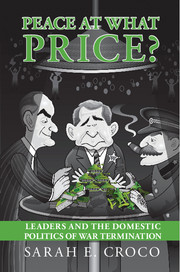
I am also fortunate to have received extensive and thoughtful feedback from several reviewers and editors, foremost among them Arthur Stein, at The American Political Science Review, where an article related to this book was published. This book and related work also benefited from workshops at several schools including (in rough chronological order): The Pennsylvania State University, The University of Virginia, Harvard University, Dartmouth College, The University of Pennsylvania, Cornell University, Princeton University, and American University. Thanks are also in order for my editor, Robert Dreesen, and Elizabeth Janetschek at Cambridge University Press for their advice and patience, and for guiding the book through the publication process. I am also deeply grateful for the thoughtful feedback from the scholars who served as anonymous reviewers. Their suggestions helped me improve the manuscript significantly. Finally, working with Scott Nychay, who created the artwork used for the cover, was an absolute pleasure.
Last but certainly not least, words cannot express how grateful I am for the love and encouragement from my family. Foremost among them, of course, are my parents, Ed and Suzanne Croco, whose support never wavered, even when I came home from college and declared I was off to graduate school to become a political scientist. I have both of them to thank for instilling in me through their example a love of reading and learning; the dedication required to complete such a massive project; and the drive to pursue a career I loved. Special thanks are also due to my husband, Ian, for not only reading the entire manuscript but for also providing steadfast support during the time I spent writing it. Living under the same roof of someone writing a book is no easy task. The project spans years and can become all-consuming for the author. I am thankful every day for having a partner in life who was willing to put up with my messy home office, the erratic hours I kept, and, above all, the constant presence of this book in my mind.
