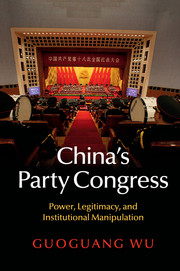


To explain the political necessity and institutional characteristics of China's Party Congress wrought within the duality of its constitutional significance and practical powerlessness, this monograph presents a theory of authoritarian legitimization which emphasizes two interrelated and interplaying aspects, namely institutional manipulations and ceremonial performance, in the construction of political legitimacy in contemporary authoritarian politics. These two together make the institutions of China's Party Congress a “metaphysical theater,”Footnote 1 theater that combines power plots with formalistic pomp, political seriousness with institutional cynicism, and rulers’ self-congratulations with followers’ self-importance. It is the theater through which power fabricates its own legitimacy; it is the theater upon which elite enactments are designed and displayed according to rulers’ preferences.
This chapter is devoted to the elaboration of this theory in order to sketch a framework within which the empirical chapters that follow will provide practical illustrations of how such manipulations are conducted and institutionalized for the purpose of making the Party Congress the ceremonial celebration of legitimization to confirm the leadership's will in all ideological, political, and personnel matters. It will begin by tracing back to classical discussions of the concept of legitimacy. In disputing those lines of reasoning that emphasize government's accomplishments as a source of legitimacy, this book suggests that political legitimacy is primarily concerned with how an individual leader gains power. A further discussion will take place on how democracy and authoritarianism diverge in this regard and, especially, on the distinct features of the legitimacy issue under authoritarian politics. Four features of authoritarian legitimization will be analyzed with emphasis: in terms of the method of coming to power, authoritarianism always suffers from a “legitimacy deficit”; in terms of the scope of political involvement, authoritarian legitimacy focuses on a smaller, elite level rather than on the acceptance of a wider citizen populace; in terms of the connections between those who are legitimized and those who are involved in the legitimizing, authoritarian legitimization requests the latter's overall attachment and personal loyalty to the former, which in this book is conceptualized as “confirmative legitimacy” in comparison with “participative legitimacy” under a democracy; combining the three above gives the fourth feature, which is that in contrast to the democratic mechanism, which solves elite competition and societal legitimacy in a single equation through popular, competitive elections, the process of authoritarian legitimization is institutionally more complicated in a way that leaves a larger space for manipulation and is politically more demanding of uniform support that can only be achieved through manipulation. It is argued that those democratic elements incorporated into authoritarian institutions are highly vulnerable to political manipulations, and that, through such manipulations of institutions, the de facto incumbent leadership legitimizes itself into de jure authority.
Complementary to this approach, as the discussion will also move to argue, is the theatrical display, which gains extraordinary significance in providing those elites involved with an illusion of meaningful participation, in creating ceremonial magnificence and collective rituals for strengthening the symbolic acceptance of leaders by elites and, in a relatively open authoritarian society, in impressing the masses with semiotic performances of political legitimization. Drawing such discussions together, the chapter will put those constitutionally prestigious but politically impotent institutions exemplified by China's Party Congress under a theoretical lens in order to investigate the central puzzle of this book, namely the incoherence between norms of political power and the power that determines institutional norms, and to explore a major hypocrisy of political life, namely authoritarian legitimacy rooted in institutional discrepancy.
What is legitimacy, and whose is it? Theoretical traditions and contemporary confusions
Legitimization means the creation, construction, and acceptance of legitimacy. Legitimacy, however, is among the vaguest concepts in contemporary politics, in spite of having had a long history that occupies a central position in intellectual explorations of political phenomena. In Plato's political philosophy, legitimacy is a significant form of human justice, as it concerns who is qualified to rule. The Republic, one of Plato's representative works, regards justice as the central issue of public life, as justice in this context means that in a given society every person gets the position suitable to that person. “The justice of the society would secure that each member of it should perform his duties and enjoy his rights,” according to an expert's interpretation of Plato, “with respect to the rights and duties of each part of his nature.”Footnote 2 A major conclusion of The Republic, nevertheless, is about the philosopher-king, concerning what kind of person is qualified to hold public power. In this sense, Platonic political philosophy can be seen as a meritocratic theory of political legitimacy which emphasizes the personal, mental, intellectual, and ideational qualities of rulers as their legitimate qualifications as the power-holders governing human societies.
Thomas Hobbes, though concurring with the centrality of legitimacy in politics, provides an alternative approach to the issue, which focuses on the responsibilities of rulers. For him, “the central task of politics was to settle who had the ultimate legal authority, and to make sure that the possessor of authority could get the law enforced.”Footnote 3 In comparison with Plato's emphasis on a ruler's personal traits, such as intellectual capacity and his or her suitability as ruler, Hobbes pays particular attention to the functions of legitimate leaders, which for him are primarily law-making and law enforcement. The personal qualifications of those who have the “ultimate legal authority” are not emphasized, nor is the way in which to “settle” this central task of politics. Accomplishments, to Hobbes, seem more important than qualifications in the legitimization of rulers, a line of reasoning that prevails today among contemporary scholars.
In addition to both Plato and Hobbes, who underline the issue of legitimization, namely the way in which legitimacy is gained, Max Weber opens a third path, which offers a comprehension of legitimacy that distinguishes itself from, and to an extent also blends itself with, both the meritocratic Platonic and the utilitarian Hobbesian traditions. This approach looks at how a person gains authority, and according to the various ways in which a leader wins legitimation, Weber develops his classic typology of legitimate authorities, which includes the validity of claims to legitimacy based on “rational grounds,” “traditional grounds,” and “charismatic grounds.” For Weber, the first type, “legal authority” with “rational grounds,” rests “on a belief in the legality of enacted rules and the right of those elevated to authority under such rules to issue commands”; the second, “traditional authority,” rests on “an established belief in the sanctity of immemorial traditions and the legitimacy of those exercising authority under them”; the third, “charismatic authority,” rests on “devotion to the exceptional sanctity, heroism or exemplary character of an individual person, and of the normative patterns or order revealed or ordained by him.”Footnote 4 Here Weber introduces an institutional dimension to the understanding of legitimacy, as he pays special attention to the norms and rules (such as “legal” or “traditional”) that support claims to legitimacy. Though in his third category of “charismatic” authority he still follows Plato to attribute legitimacy to the personal attributes of a leader, Weber's contribution can be interpreted as adding the dimension of acceptance of the ruler's authority by the masses, rather than basing legitimacy solely on the ruler's temperament per se. Weber is perhaps not necessarily an institutionalist here, but he has definitely taken note of institutional elements in the issue of political legitimacy which both Plato and Hobbes failed to address sufficiently. This is a very important point to which I shall return in later discussions.
Differences aside, a major point shared by Plato, Hobbes, and Weber on legitimacy concerns the level of analysis: they all focus on rulers as persons and view individual leaders as the domain whereupon political authority is unfolded and whereupon the concept of legitimacy is applied. Actually, they are just examples of classic statements concerning legitimacy, which are exclusively concerned with a ruler's individual, personified legitimacy. This logic, from a materialist methodological point of view, may reflect the political reality of their times, as kings and chiefs enjoyed power, authority, and legitimacy for themselves rather than for their “regimes.” The notorious declaration made by Louis XV at the Paris Parliament in 1766 indicates this extreme identification between personal and national authorities:
As if anyone could forget that the sovereign power resides in my person only…that public order in its entirety emanated from me, and that the rights and interests of the nation, which some dare to regard as a separate body from the monarchy, are necessarily united with my rights and interests, and repose only in my hands.Footnote 5
The intellectual merit of this academic tradition of working at the level of individual persons in the analysis of legitimacy should be recognized of its own accord in a scientific context that detaches it from the practical politics once supporting its conceptualization. This classical scholarship of legitimacy, however, has been ignored due to its focus on the individual, from the point in time when, as examined by Mlada Bukovansky, a great transformation of political legitimacy took place “from dynastically legitimate monarchical sovereignty to popularly legitimate national sovereignty.”Footnote 6 During the process of this historical transformation, first of all occurring in Western European societies from the sixteenth century on and then spreading to other parts of the world in the following centuries, “the effort to reconstitute authority in the name of the people has involved a search for a new mandate to rule that is more valid than the authority of kings.”Footnote 7 This significant and profound transformation has since enriched the concept of legitimacy, but it has also caused two major conceptual confusions in this regard. First of all, it expands the level of analysis from individual rulers to institutional arrangements, and second but not less importantly, it mixes the possession of legitimacy with the acquisition of it. The first problem, for this author, concerns the question of “whose legitimacy”; the second, the question of “how to gain legitimacy.”
Recent studies have often discussed legitimacy at the organizational, institutional, and, in particular, the state level, as reflected in such prevalent terms as “state legitimacy,” “regime legitimacy,” and “institutional legitimacy,” while the individual legitimacy of political leaders is often neglected or sidelined. As Russell Hardin points out, contemporary scholars now regard legitimacy as “inherently a system-level concept” relevant to “a state or a regime or a particular government,” and social scientists and political theorists typically ascribe legitimacy to a regime based on how it came into existence, what it does for citizens, and citizens’ relation to it both historically and now.Footnote 8 Such a notion of legitimacy is, of course, useful, particularly in the non-dictatorship context of politics, but it can sometimes be misleading because, by confusing it with the prominence of the institutions through which power is obtained, organized, and exercised, it overshadows the problem of how rulers gain power. To use a metaphor, it confuses the distinction between travelers and their traveling paths. Indeed, in various acquisitions of power, rulers often utilize, create, and reinforce institutions of various kinds, and the acceptance or questioning of a ruler's legitimacy often leads to the acceptance or questioning of the very institutions that support the ruler. But institutions cover much wider aspects and domains of political life, and it is clear that they should be differentiated from those leaders who rule through the institutions.
That is why this book raises the issue of levels of analysis in discussing legitimacy, which may help to clarify what Hardin views as the conceptual “mess” around this difficult, “confused and confusing,” notion. For this author, there are clearly three levels of analysis in regard to legitimacy, as summarized in Table 2.1. One level is that of individual leaders, around which the classic scholarship unfold discussions about the rightness of rulers requesting the obedience of the governed. The second is in regard to the leaders as a collective – in other words, as a group in a certain type of organization, often in the form of the government representing the state. The third level concerns that of political institutions in the sense that institutions are defined as rules of the game (rather than the institutions being understood as organizations). Because of the profound layers of understanding surrounding the concept of institutions, the second and third levels are easily mixed up; but it is not difficult to see the second level as a logical extension of the first in the context of a democratic age; thus the important distinction should be drawn primarily between leadership legitimacy, which is the classic line of thinking in this regard shared by Plato and Hobbes, and institutional legitimacy, which has been added to contemplations of the issue by later thinkers, and which has prevailed in contemporary literature inquiring into, in Ronald Rogowski's formulation, “how people choose to accept or not to accept particular governments.”Footnote 9
Table 2.1. The concept of legitimacy: three levels of analysis and different lines of reasoning
| Lines of reasoning | ||
|---|---|---|
| Level of analysis | Acquisition of power | Exercises of power |
| Individual leader | Plato, Weber | Hobbes |
| Leadership as a group | “Neoclassic” (this book) | Various arguments that emphasize “performance of governance” as the delivery of economic and other benefits by the leadership to the governed |
| Institutionsi | Various notions of “regime legitimacy” | |
i In recent literature the concept of legitimacy is also extended to the domain of international politics, which is not covered in this table and the discussion here. That line of reasoning, however, shares the emphasis on institutions, though here the table intentionally does not differentiate between domestic and international institutions. For examples of the literature, see Allen Buchanan, Justice, Legitimacy, and Self-Determination: Moral Foundations for International Law, Oxford University Press, 2004; Ian Clark, Legitimacy in International Society, Oxford University Press, 2005; Ian Hurd, After Anarchy: Legitimacy and Power in the United Nations Security Council, Princeton University Press, 2007.
One confusion seemingly comes from the term government, which can be understood either as an administration coming into power in a given period and consisting of leaders who have successfully gained their power through whatever means; or as an organization, an institution, or, in a behavioral functionalist term, a political system in which both the power and the power-holders are imbedded as rulers. If we follow the widely adopted definition of institutions to view them as the rules of the game,Footnote 10 those various prevailing concepts about the legitimacy of institutions have simply confused the admission of players into this political playing field with the adherent regulations that the players are required to follow. Taking an approach that can be termed “neoclassic,” this book suggests a revisionist pursuit of the classic political thinkers to focus on the legitimacy of leaders both as individuals and as collectives rather than as regimes.
On what qualities legitimacy recognizes, however, the classic thinkers, as indicated earlier, have their disagreements: Plato emphasizes personal traits, Hobbes highlights rulers’ performance, and Weber brings in leaders’ connections with norms. It seems that most contemporary scholars prefer the Hobbesian tradition of a utilitarian perspective in this regard. For example, in investigating “how states win and lose legitimacy,” Bruce Gilley emphasizes legitimacy as a question central to “the effective exercise of political power,” or to “how political power can be used in a legitimate manner.”Footnote 11 Peter Lange and Hudson Meadwell elaborate the concept of “legitimacy” in a similar way: “Legitimacy has often been used in studies of performance, on the grounds that ‘the extent that a polity is regarded by its members as worthy of support’,” and “measured by a variety of political and political-economic outcomes.”Footnote 12 In contemporary China studies, this approach has also prevailed in emphasizing the regime's economic performance in particular. Dali Yang, for instance, understands the legitimacy of the government in connection with “efficiency” or corruption,Footnote 13 while Lynn White clearly states, “Legitimate rule was thus linked to national results, of which the most obvious was the reform era's economic boom.”Footnote 14 Feng Chen investigates how the Chinese leadership in the post-Mao era turned to a strategy of “eudaemonic legitimacy” that redefined socialism in terms of increasing economic productivity, thereby seeking to sustain the regime's legitimacy through economic achievements.Footnote 15
This line of reasoning follows the Hobbesian approach in the sense that it emphasizes the exercise, functions, and aftermaths of political power in order to analyze legitimacy, but it does so using the state organizations (such as regime, government, or even “system”) as the unit, or level, of analysis, having drifted away from the level of analysis that Hobbes shares with both Plato and Weber, which focuses on leaders. As a “utilitarian” approach, in measuring legitimacy it highlights performance, outcomes, and accomplishments that a regime, government, or political system is able to achieve. Perhaps, as Hardin states, “It is not strictly about economic benefits, although these may be and commonly are an important consideration.”Footnote 16 In those extreme conceptions, however, it is not a surprise to see that the major outcomes of governance and political ruling are simply materialized, or at best crystallized, into essentially either welfarist (in industrialized countries) or developmentalist (in developing nations) economic performance. It has enriched the comprehension of legitimacy by emphasizing for what purpose political power is exercised, and it has also contributed to the literature by bringing political economy to prominence in understanding popular support for government. But a hidden intellectual pitfall can exist if an analyst is not cautious in the following way: sophisticated Hobbesian utilitarianism can be devolved into a kind of materialism, which might use “economic men” to replace citizens and assumes that they need rulers and government in order to make a living and that the state works not very differently from how a corporation does. The issue of legitimacy, in the most vulgar method, can be equated to the statistics of GDP growth.
Another problem of this materialist, and generally utilitarian, approach to legitimacy lies in its “outcome-oriented” logic of using the accomplishments gained with power to justify the acquisition of power, which ignores a critical issue of sequence. One must gain power before using it, performing it, and benefiting whomever with it. When this utilitarian approach bases the “right to rule” on material (or whatever) achievements of rulers, it thus faces a consequential dilemma: legitimacy becomes an aftereffect of winning the right to rule. In this regard, both the Platonic way of stressing the personal qualifications of rulers and the Weberian approach of looking at the roots of authorities based on an established legitimacy have an advantage, as they view legitimacy as more about the acquisition of power than about the exercising of it, and they try to explore the preconditions of power rather than the impacts of power. Without denying the conceptual richness of legitimacy and its ability to be widely applied to various circumstances, this book follows the Platonic and Weberian line of reasoning to highlight the relevance of legitimacy to the justification of gaining power rather than exercising power. Political legitimacy, therefore, primarily refers to the justified obtainment of public power within the given group, whether the group is a political party, a nation, or international society, and whether justification is rooted in sources that may include personal traits, ideological persuasion, policy promises, or power performance with previous credits.
The legitimacy deficit of authoritarianism: contrasts with democracy and institutional implications
At this point the difference between democracy and nondemocracy, which is mainly authoritarianism in the contemporary world, should be brought into the discussion, as this difference helps to reveal both the nature of legitimacy as a useful concept of political analysis and, closely relevant to our topic of China's Party Congress as a unique institution with a democratic veneer but a nondemocratic nature, the essential distinction between democratic and authoritarian legitimization. While taking into account its numerous types, richness of development, and various degrees, democracy, according to Joseph Schumpeter's classic definition, “is that institutional arrangement for arriving at political decisions in which individuals acquire the power to decide by means of a competitive struggle for the people's vote.”Footnote 17 This concept of democracy has been criticized as “proceduralist,” since it ignores the substantial essence of democracy in which the people should rule. For this author, however, this criticism simply reflects the notion that democracy should be improved, while the Schumpeterian definition is more a description reflecting real democracy at work in the modern world.Footnote 18 Being different from ancient Greek democracy, which was a collective decision-making mechanism with citizens’ direct participation, modern democracy is a representative system in which decision-makers are elected to hold power on behalf of the people.Footnote 19 It can be improved by involving more citizens in public deliberations and decision-making, but so far, by essence, it has been a political system in which rulers are decided upon by popular vote through candidates’ competition for voters’ support. In this sense, democracy is basically and at minimum a way to solve the problem of legitimacy by counting ballots, under which the person who is able to win the majority of votes will be the person qualified to be the leader. A leader who wins pertinent elections is a legitimate leader; his or her performance in governance after coming to power may affect his or her popularity, but usually will not lead to a conclusion concerning this leader's legitimacy except in the case that he or she violates relevant laws to the degree that the leader should be removed from office in due course. In other words, democracy is a special arrangement of legitimization before it operates as any possibly richer and more complicated political mechanism; the adoption of popular voting as the method of legitimization differentiates democracy from other methods of legitimization. In the jargon of contemporary political science on state–society relations, democracy means that society decides who may become state leaders. Or, in the elitist tradition of political analyses, democracy is an arrangement in which the circulation of political elites is not determined by a game played exclusively among elites;Footnote 20 rather, the masses carry sufficient weight to intervene in settling the result of elite competitions for public offices.
By contrast, authoritarianism can be understood as an institutional arrangement that does not allow the populace to be involved in the decision of choosing leaders. It means the absence of a nonelite arbitrator, a role played by the mass of voters under democracy, who is institutionally eligible and constitutionally capable of making the final choice of a winner among the elites who rival to gain public power. The winner in authoritarian politics is, therefore, self-appointed and without blessing from the judge as the third procedural component, a role which in democracy is at least symbolically, but also procedurally, performed by ordinary citizens. The self-claimed victory in competition for political power within an authoritarian system is thus always suspicious in the eyes of both elite rivals and the ordinary populace, implying that the winner's legitimacy is institutionally weak despite the political victory. Furthermore, the winner decides the rules of the game in the way that the victory justifies the means by which the victor has won. It implies that challengers may not follow the incumbent winner's rules but rather may pursue their own rules of the game, which would be recognized as long as they eventually win. At the intersection of two challenges stand the authoritarian leaders, who must constantly suffer from a fundamental fragility of their authority: in terms of result, their self-appointment is always a liability in terms of its validity, and it can remain unaccepted by the losing parties and the masses. In terms of means, their legitimacy can be denied at a fundamental level when their method of winning power is questioned, and, ironically, they are under threat when new challengers rise up using the same method of coming to power. In any case, authoritarian leaders have to constantly worry about the justification of their position, power, and authority, and in the worst case they are in perpetual fear of losing this power and authority. This phenomenon can be termed the “legitimacy deficit” of authoritarianism.
Two conceptually and practically interconnected implications of the above discussion are especially important for understanding both the concept of legitimacy and the politics of authoritarianism. One concerns a deeper analysis of the concept of legitimacy as it is framed under authoritarianism, mainly regarding the scope of involvement in legitimization; this further analysis arrives at the concept of “elite legitimacy” in contrast to “mass legitimacy.” The other implication concerns the institutional distortion of contemporary authoritarianism following the transplantation of some democratic elements to remedy its legitimacy deficit, which leads to an authoritarian dilemma of legitimization. The rest of this section will examine each of these.
It is obvious that authoritarianism and democracy involve different scopes of participants with different institutions for legitimization. Involvement is, of course, the crux of legitimacy, as without involvement there would be no such thing as legitimacy, or acceptance of certain power-holders. Roughly speaking, two scopes of involvement can be observed in political life in general and in legitimization in particular: the involvement of a small and prestigious portion of society, namely the elite; and the involvement of the masses, which bases legitimacy on the endorsement of the majority of an entire society. Two layers of legitimacy, therefore, are manifest in these two scopes of involvement: the first layer is intra-elite legitimacy, simplified as elite legitimacy, which implies the required support and approval among the elite in order to gain the leadership positions of a larger group, be it the group of a political party or the state; the second refers to citizens’ or mass support and the approval of power-holders, which can be called societal legitimacy, mass legitimacy, or popular legitimacy.
Power is always the game of elites, but they need to face the masses in various ways, especially in the politics of ruling and the governance of the state, including the politics of modern political parties, which are closely associated with state politics. Thus contemporary politics, at least on a national scale, is always a two-level game:Footnote 21 competitions among the elite while, at the same time, these elite have to confront the masses. Both democratic and authoritarian politics are the same in terms of this two-level game, but they are different in the scope of involvement: a contemporary democracy involves, virtually, the entire society, or the entire group in non-state politics, while authoritarian politics by definition excludes participation by ordinary citizens or average members. When a leader defeats his or her rivals among the elite, he or she can simply become an authoritarian ruler without need to further seek ordinary citizens’ agreement; thus authoritarian legitimacy is, by nature, elite legitimacy. A democratic leader, however, has to win popular voters’ support, which is the way he or she defeats elite competitors. In this sense, democracy is the institutional arrangement that combines the two levels of the political game into one by putting the final decision about who is the winner among elite into the hands of citizens. This is the one-shot approach of legitimization, with which democracy simultaneously solves the problems of intra-elite legitimacy and mass legitimacy together, rather than treating them as separated tasks in different spheres; its appeal to societal legitimacy creates the institutional fusion of the two layers into an integrated game, with which the power holder wins intra-elite and popular legitimacy at the same time via the same path. In one sentence, a democracy is a mechanism of legitimization in which the one who wins the popular vote also unquestionably and simultaneously gains victory in competitions with other elite rivals.
By contrast, authoritarian legitimization focuses on only intra-elite legitimacy, as by definition and by procedure it does not appeal to ordinary citizens to endorse its power. Obtaining intra-elite legitimacy is often among the most challenging issues to the power practice of authoritarian leaders, however. Although an authoritarian regime is always in fear of being “subverted” by social forces, the more realistic threats to authoritarian leaders’ power and positions come frequently and primarily from their peers and close followers. This does not mean that authoritarian political leaders can avoid or ignore the issue of mass legitimacy; on the contrary, they tackle this challenge in authoritarian ways without involving the populace in their game of power acquisition, but often employing tools to pursue other dimensions of legitimacy, primarily including ideological propaganda and materialist benefits in order to legitimize their core of coercive power. In authoritarian politics, winning a victory in an intra-elite competition does not directly and necessarily mean acceptance by the masses, and vice versa; this implies that intra-elite legitimacy cannot automatically be transferred to mass legitimacy, and again vice versa. An authoritarian leadership often has to fight simultaneously on two separate fronts for legitimacy, which increases the severity of its legitimacy deficit.
This is particularly so with the increasing appeal of democracy in the contemporary world.Footnote 22 This problem of legitimacy deficit under authoritarianism can become worse as the intra-elite layer and the layer of state and society become less isolated from each other in real politics, leading to frequent interplay between the two, especially when politics inevitably expands to the wider scope of mass involvement or, in Schattschneider's term, to become “socialized” due to those elites in rivalry tending to gain social support in order to win intra-elite competitions.Footnote 23 This will cause any lack of mass appeal to be a huge liability for a leader, even in the eyes of an authoritarian elite; it is particularly so for contemporary authoritarianism in general surviving in the age of democracy, and for a postcommunist authoritarianism such as China's, in particular, that has devolved from a legitimacy based on revolutionary, populist ideology such as Mao Zedong Thought. Intra-elite power struggles can be inspired to become even harsher and grimmer than they were without such factors, or with a limited number of them, and threats to legitimacy from within the political elite will be maximized rather than minimized with the absence of popular participation. We may call this a “spiral effect” between elite power struggles and state–society tensions, which may lead to a legitimacy crisis of authoritarian politics.
To cope with the profound and multifaceted challenge of legitimization, contemporary authoritarianism makes various efforts to overcome, or at least to remedy, its legitimacy deficit. Such efforts will not be able to solve its intrinsic deficit, but they have an impact on the institutional arrangement of authoritarianism and its institutional change. The efforts may first include the ideological programing of society and the fabrication of the leader's charismatic image, as Maoist politics in China often did. At least for two reasons, however, some attempts must also be made in the direction of the “importation” or “transplantation” of democratic elements into authoritarian politics. It is such an importation that often distinguishes “contemporary” authoritarianism from its classic incarnations. Those democratic elements, through the authoritarian operation of them, are expected to remedy the legitimacy deficit by involving mass representation in the constant and deadly war within elite circles, thus creating an institutional and rhetorical base to fend off both the possible challenges to the incumbent leaders by other elite and the populace's questioning of their exclusion from participation. This is the first reason for such an “importation.” How these democratic elements are managed will be the focus of our empirical investigation.
At the same time, the waning of other resources that support contemporary political legitimacy makes it clear that democracy has an institutional advantage in legitimization, if not in other political aspects. Yes, democracy simplifies the way to gain legitimacy into a single type of institution, which is election; moreover, it has also trimmed down various sources of legitimacy such as bloodlines, ideology, records of accomplishment, and personal charisma into one stream that is eventually symbolized in a ballot. Ideology matters, of course, in democratic politics in many significant ways,Footnote 24 but a leader or government cannot appeal to ideology for gaining power; they may use ideology to appeal to citizens, whose ballots, in turn, send them legitimately to power. Charisma also works in this way under a democracy, as do some other possible resources, such as money, rhetoric, good records of previous office, prestigious family networks, and public relations, all of which may be employed to gain the popular vote. In one sentence, everything that might be helpful for gaining public power has eventually to be transferred to the number of ballots. Yes, traditional autocracy solves the problem of legitimacy in “traditional” ways, which include, in Weber's typology, individual leaders’ charismatic personality, usually applying to the leaders of the first generation who have established the regime; or succession according to bloodlines. These ways, especially the dynastic way based on family succession, however, have faced crisis since the democratic political transformation occurred centuries ago. It has become a general trend, then, that institutions have become more and more vital to authoritarian legitimization, which helps to explain not only the increasing institutionalization in authoritarian politics, of the type that we shall find in the recent regularization of the operation of China's Party Congress, but also, as the second reason, why contemporary authoritarianism must often incorporate some “democratic elements” into its institutions, as evidenced by the fact that parliament, congress, political parties, and elections are commonly observed in many authoritarian states.Footnote 25
A dilemma emerges, however: to run these institutions while simultaneously curbing their potential democratic effects becomes a major challenge. Contemporary authoritarian leaders thus need, on the one hand, to work out a series of secondary, detailed, and perhaps deeper institutions, namely the real rules of the political game, to make these organizational elements of democratic institutions as shallow as possible; on the other hand, they struggle to keep these “democratic” institutions in operation in a manner that does not interrupt their real game of power but rather endorses, strengthens, or at the very least formalizes, their legitimacy. The institutional inconsistency thus arises, and so emerges the issue of institutional manipulation, a central matrix of the theory of authoritarian legitimization which the next section will focus on.
Institutional manipulation in action: integrating formal and informal politics
The question of legitimacy deficit under authoritarianism is often neglected by contemporary political science, which is mainly developed in democratic countries.Footnote 26 When it is sometimes tackled, two inclinations emerge to explain why authoritarianism persists and even sometimes enjoys better stability than some democratic regimes. One inclination virtually denies the legitimacy deficit of authoritarianism by emphasizing the social-economic achievements that can remarkably be accomplished by the authoritarian state, as in the case of China in recent decades. Thus, as discussed above, it conceptually mixes the method of gaining power and the outcome of exercising this power. The other inclination underestimates the ability of authoritarianism to survive against the legitimacy deficit, often assuming that such authoritarianism has to be under a transformation toward democracy sooner or later, slower or faster, either by gradually incorporating democratic elements, which may create a variety of “hybrid regimes,” or by being replaced as a whole by democracy.
The research presented in this book, however, has discovered a third possibility, in which some democratic institutions, e.g., political parties, congress, constitutions, and elections, are borrowed but also hollowed out by authoritarianism for the purpose of manipulatively remedying its legitimacy. Such borrowing and hollowing is not merely a technical transplantation across regime types; it has ample institutional and conceptual implications. Nor is it for the purpose of winning power; rather, it is mostly for the purpose of legitimately confirming the triumph already gained in the power game. Within this scenario of importing democratic forms to authoritarian politics, two kinds of institutional manipulation take place: at the macro level, this transplantation of some institutions originating from representative politics and serving democratic purposes can be seen as institutional manipulation, because they are now harnessed to serve authoritarian purposes; furthermore, this kind of service must be realized through institutional manipulation at the micro level, namely through a series of norms and procedures that are devised to kill the democratic spirit of those forms while leaving their outwardly shallow appearance of democracy. As will be presented in the chapters that follow, the investigation of such micro-level institutional manipulations is the focus of this book, in which it is discovered that China's Party Congress pretends to decide the most important issues of CCP politics, the delegates pretend to discuss and deliberate the platforms and policies, and the elections are conducted with voters pretending to choose their favored candidates.
In one sentence, what is suggested here is an institutional theory of political manipulation, and it is a theory of institutional manipulation for the purposes of legitimization. William Riker, in studying political manipulation, does so in the sense of treating political manipulation as the skillful maneuvers of various elements for the politician's favor and benefits.Footnote 27 Traditionally, the “royal arts” of statesmanship are also composed of many such skills, including intra-personal maneuvers in politics. China especially is a place with rich traditions in this regard, where a sophisticated “art of rulership” has been developed for at least two thousand years.Footnote 28 Having learnt from Riker and other scholars, this book, however, presents its research in a different theoretical context, which is that of neoinstitutionalism in comparative political studies, and it therefore contributes a study of institutional manipulation rather than simply an understanding of manipulation as a series of actor-centered political skills.
In doing so, this research highlights the two seemingly contradictory sides of institutions that have often been neglected in studies of institutions, which are, on the one hand, the vulnerability of institutions to political conduct and, on the other, institutions as enabling and empowering entities rather than simply constraints on human behavior. Moreover, it is through such institutional manipulations that informal politics and formal institutions interplay with one another. Thus, in investigating how legitimacy is constructed through this institutional manipulation, the theory of institutional manipulation emphatically addresses the conceptual integration of informal politics and formal institutions into one coherent perspective, and in in empirical research accordingly integrates political and institutional aspects into one single picture.
Institutions generate legitimacy; legitimization is mainly an institutional process; and, to put it alternatively, legitimacy is mostly an institutional outcome. This point has theoretical implications for the concepts of both institutions and legitimacy: institutions, as the “rules of game” asserted in Douglass North's widely adopted definition, have normative meanings which justify those conducts that follow the rules; legitimacy, on the other hand, should be understood in the institutional sense, and a major asset that institutions provide to politics lies in their significant capacities, or incapacities, to create, facilitate, and construct legitimacy. Although existing research on legitimacy, in its reference to “institutional legitimacy,” often distorts the link between institutions and legitimacy and thus elides the point that institutions provide resources to support legitimacy, some leading scholars have had sufficient, if only scattered, insight to point out the role that institutions play in shaping legitimacy. Many years ago, Talcott Parsons opined that institutions are “those patterns which define the essentials of the legitimately expected behavior of persons insofar as they perform structurally important roles in the social system.”Footnote 29 In this argument, he seized, though quite awkwardly, on two points stressed above and again here: the focus of legitimacy on persons, and the definitional function of institutions for legitimization. In recent publications by leading scholars of neoinstitutionalism one may read sentences such as the following: for Daniel Galvin, Ian Shapiro, and Stephen Skowronek, “Institutions are the art of the state. They give it shape, articulate its relationships, and express its legitimacy.”Footnote 30 Here they explicitly include legitimacy in the results of institutional actions. For James March and Johan Olsen, “Legitimacy depends not only on showing that actions accomplish appropriate objectives, but also that actors behave in accordance with legitimate procedures ingrained in a culture.”Footnote 31 They imply the argument that the proper following of institutions paves the way to legitimacy. To repeat what was discussed in the last section: different institutions construct legitimacy in different ways, and here lies the fundamental distinction between democracy and nondemocracy. Political institutions, of course, matter profoundly in every aspect of political life, but regime types are primarily a reflection of the different institutional arrangements that provide different ways to decide the path along which rulers come to power.
Furthermore, this understanding of institutions reveals the enabling function of institutions rather than simply their impact to constrain. As economist Richard Musgrave has observed, “The function of rules, as I see it, is not only to restrain but also to enable”; moreover,“the function of rules is to provide a framework that will restrain behavior harmful to the constructive interaction of individuals in society. But it is also the function of rules to enable, to bring such constructive interaction about.”Footnote 32 This is an important point for introducing manipulation into institutional conduct, as it goes beyond the prevailing conceptual confrontation between institutions and political manipulation, the confrontation as stated by some leading experts on institutions in this way: “If institutions are about preservation, politics is about manipulation and leadership is about overturning constraints.”Footnote 33 No, institutions are also about empowerment, they are not immune to manipulation, and politics and institutions are not mutually exclusive. Informal politics and formal institutions unfold in a mutually interdependent context; informal politics can be imbedded in formal institutions, while formal institutions can be maneuvered by informal politics. As will be discussed below, this is particularly the case regarding authoritarian legitimization.
This theoretical assumption, therefore, implies an intellectual reach beyond a binary distinction between formal and informal politics, which has often been employed to discuss and comprehend Chinese Communist politics in spite of various efforts being made to integrate the two dimensions. Within this dichotomy, institutions are often treated as a formal realm with superficial political meanings while the notion of “informal politics” is often suggested to deepen understanding.Footnote 34 From this point of view, the Party Congress would tragically fall among those institutional novelties, simply nominal and formalistic, studies of which would not really be helpful in exploring the essence of Chinese politics. The research presented here, however, does not pursue a logic which explains Chinese politics solely in terms of informal politics; the dichotomy between formal and informal politics is abandoned and transcended in the sense that it focuses on something that may be termed “informal” formal politics, namely how informal politics and formal institutions are operated in a coherent way that mutually contextualizes them.
Institutional manipulations, therefore, are the game in which norms, rules, and procedures are played out through the political power of leaders. In other words, political manipulation here is mainly realized through the varied maneuvering of institutional rules. It is, of course, difficult to artificially distinguish between “political” manipulation and “institutional” manipulation for political purposes, but what is clear is that institutional manipulation works in the realms of rules that govern the operation of politics, especially in the domains where organizational rules apply, while “political” manipulation is perhaps more general and, at the same time, as revealed by Riker, more dependent upon personal conduct.
Institutional manipulation is possible because, theoretically speaking, norms, procedures, and institutions as rules of the game are not preprogrammed for politics; they are shaped by the conduct and unfolding of politics. Institutions are not static, not only in the temporal sense that institutions change over time by being subject to fundamental changes of politics and other aspects of human life, but also in the synchronous sense that mechanically, operationally, and practically there is room for flexibility, complexity, and subtlety of rules. In every sense, institutional manipulation works within the context of various inevitable interactions of political dynamics.
Such institutional manipulation takes place under both democratic and nondemocratic politics, but the institutional framework in this regard may greatly affect the nature, degree and impact of the manipulation. In a democracy, such institutional manipulations often encounter tremendous difficulties due to various reasons that in authoritarian politics either do not exist or can easily be overcome. The first difficulty for manipulating democratic institutions comes from the presence of popular participation. Size matters here: manipulating the masses institutionally, if not sentimentally, is usually harder to do than manipulating a small group.Footnote 35 A relatively higher degree of political transparency also makes democratic politicians more constrained than their authoritarian counterparts in terms of institutional manipulation. The third obstacle is competition from the opposition and checks of power which are inherent in a democratic political system. The last, but not least, form of resistance in a democracy against institutional manipulation is imbedded in the significant and widely scrutinized system of procedures in politics, for which even a slight procedural change often has to go through partisan bargaining, political negotiation, and even popular approval.
Under an authoritarian arrangement, however, these elements are much weaker, if they even exist, which not only invites institutional manipulation but also enables institutional manipulation to succeed more conveniently. With the powerful incentive to remedy the legitimacy deficit, it often becomes an irresistible temptation for an authoritarian leadership to conduct institutional manipulation for the purpose of legitimization. Therefore the inconsistency between norms, rules, and institutions on the one hand and politics, power, and manipulation on the other occurs to dominate the political operation of those formal institutions under contemporary authoritarianism, as we will investigate in detail in the following chapters. To better grasp the essence of such an operation, neither informal politics nor organizational rules are sufficient; only the combination of both provides a way to focus on their interactions. It cannot be overestimated for the analyses of authoritarian politics that individual leaders, the ruling group, and the regime as a whole always struggle hard for legitimacy, and that such a struggle often determines such a regime's institutions and operations, and the leaders’ political behaviors.
Does manipulation actually delegitimize the formal institutions that are expected to enhance legitimacy? Yes and no. “Yes” when manipulation is exposed manipulation, “no” for several reasons. The first answer is that of course manipulation always takes place with secrecy, surreptitiousness, and camouflage; by definition manipulation will not be manipulation if it is seen through. Manipulation fails if it is not able to reach the goal of maneuvering; it becomes more than a failure if it is penetrated. As noted before, that is among the various reasons why authoritarian politics, which always holds a very low degree of political transparency, is much more favorable than democratic politics for the performance of manipulation. By the same token, we talked about the size of a group that is involved: authoritarian politics involves an elite, usually a much smaller group than the citizen populace that participates in democratic politics. Furthermore, this elite nature of authoritarian politics helps to maintain group solidarity in terms of political values, patron–client loyalty, and common interests (if not in terms of power rivalry) within the circle of political involvement, and these shared values, often in the form of ideology in communist politics or a proto-ideology in postcommunist politics, as well as the common interests, are serviceable to blind trust in the leaders who actually perform manipulations. After all, authoritarian politics is not politics within which one feels free to question the leaders; this factor also facilitates the success of institutional manipulation for legitimization. Finally, one more reason why manipulation works resides in authoritarian political pomp, which will be discussed in the next section.
Why the show? Confirmative legitimacy and ritualistic enactment
Institutional manipulations, at first thought, are seen to be conducted mostly behind closed doors; they can, for many, be viewed as plots, schemes, and intrigues, or at the very least tricks mechanically maneuvered within the vital parts of an institutional system, altering the institution to run in a way which veers away from its designated operation and purpose. This conspiratorial interpretation, however, reveals only a partial truth of the politics of institutional manipulation, often the less important part in terms of institutional manipulation for legitimization. Real-life politics, as is frequently observed elsewhere and intensively investigated in this monograph, is, more often than not, a strange combination of plots and prestige, secrets and showing off, smoking-room subterfuge and public-stage performance; the nature of politics in regard to public affairs, after all, requires it to go beyond merely maintaining secrecy and mystery. Moreover, legitimacy involves persuasion, and “legitimating” can be understood as “convincing,”Footnote 36 which implies that the politics of legitimization has to face the community from which the rulers seek political recognition. In this sense, the politics of legitimization resembles a drama which aims to attract the attention of the audience, to touch upon their feelings and provide them with reason and justification for the purpose of winning their applause, which is the symbolic endorsement of those onstage, or the legitimacy of rulers.
This thespian feature of the politics of legitimization exists everywhere, regardless of regime type. To some observers, democratic politics, or at least the politics of democratic transition, are highly dramatic in the sense of spectacular performance. Laurence Whitehead is among these observers, who suggests the “theatrical metaphor” as an “interpretative device for structuring the comparative analysis of democratic transitions,” or “the drama perspective” of democratization.Footnote 37 For him,
The most essential aspect of political leadership is the capacity to persuade – and perhaps inspire – others. This is not just a question of appealing to their direct self-interest, or threatening them with coercion. It involves a capacity for rhetoric, an ear for the musicality of language, an ability to judge the mood of an audience, to conjure up images of possible futures, and to divert attention from intractable obstacles. In short, leadership requires mastery of a range of performance arts.Footnote 38
And “‘Charismatic leadership’ approximates in form to the performance of a convincing dramatic actor.”Footnote 39
There are other social scientists, prominently Clifford Geertz, who recognize the “expressive nature” of spectacular ceremony in nondemocratic politics. In his study of the traditional Balinese state, Geertz has observed that this “theater state” always pointed “toward spectacle, toward ceremony, toward the public dramatization of the ruling obsessions of Balinese culture,” such as social inequality and status pride. “It was a theatre state in which the kings and princes were the impresarios, the priests the directors, and the peasants the supporting cast, stage crew, and audience.”Footnote 40 Rituals, therefore, are significant for such politics. According to Geertz, “The ritual extravaganzas of the theatre state, its half-divine lord immobile, tranced, or dead at the dramatic center of them, were the symbolic expression less of the peasantry's greatness than of its notion of what greatness is.” This is “an illustration of the power of grandeur to organize the world.”Footnote 41
Incorporating this line of reasoning into the earlier discussions of this chapter, this monograph intends to further highlight the institutional connections between the political manipulation of procedures, on the one hand, and the use of public dramatization as ritual, on the other, in the process of creating the spectacle of political legitimacy. This is, to borrow from Whitehead, “the drama perspective” on political legitimacy, or, in Geertz's tradition, “the theater state” of self-legitimization. To elaborate upon the significance of the theatrical display in the construction of political legitimacy, this theory emphasizes three interrelating elements that are indispensable to comprehending the politics and institutions through which legitimacy, especially authoritarian legitimacy, is fabricated in contemporary circumstances. These elements are: first, the “moral” essence of authoritarian authority, which, similar to popular delegation under democracy but in a contrasting way, concerns the source of legitimacy; second, the ritual weight of such authority, which confronts procedural fairness and focuses on the conduct of legitimization and its relevance to the convincing of a community to accept legitimacy; and third, the mobilization of collective consciousness and even unconsciousness for the purpose of political persuasion. The hypocrisy of authoritarian legitimization often combines the three.
Many experts on developing nations have explored such concepts as “the cultural logic of legitimacy” and “the moral matrix of legitimate governance.”Footnote 42 This is often echoed in Asian and/or China studies when scholars talk about the cultural basis of power or the “moral regime.”Footnote 43 The term “moral,” this monograph would argue, should not be understood in its apparent meaning of a ruler's possession of virtues; by contrast, being “moral” here goes against being proceduralistic. In other words, the moral matrix of legitimacy addresses the personal qualities of leaders that can be, in Geertz's term, “exemplary” for followers and for wider society under the rule of the leaders. It is a higher, “refined” level of ruling that moves beyond the everyday business of governance and focuses on the question of legitimacy. As Geertz thoughtfully analyzes, there are two levels of governance: the lower level, having to be “functional” when forced to engage in the many hundreds of conflicting local polities; while, “at the higher, progressively removed from contact with such polities and the crudenesses associated with them, it was turned toward the central business of exemplary mimesis, toward staging the operas.”Footnote 44 It was “aesthetical,” Geertz concludes, in the meaning that “the center is exemplary, status is the ground of power, statecraft is a thespian art,” and also transcendent and metaphysical, as it was “in the ability to stage productions of an eleven-roof scale, to mobilize the men, the resourses, and, not least, the expertise, that made one an eleven-roof lord.”Footnote 45
In the world of contemporary politics that has been more or less tainted by democratic ideas, however, moral claims to legitimacy often have to be made in the name of public interest. In ancient Greece, Thucydides noticed that party strife, greed, and ambition can be “masked by specious names”: “The one party professing to uphold the constitutional equality of the many, the other wisdom of an aristocracy, while they made the public interests, to which in name they were devoted, in reality their prize.”Footnote 46 This has not disappeared in today's politics in spite of historical evolution or regime diversification; politics, under either democracy or authoritarianism, is often a competition among the elite about which of them represents the public interest, and, in a more abstract sense, often transforms what is, perhaps, the utilitarian representation of the public interest into a “moral” claim of legitimacy. Authoritarianism is particularly hungry in this regard; lacking the palpable procedures through which public interests are at least nominally collected and represented, it turns to the parable of the self-appointed representation of all the people's benefits. This “moral” image, either as a political illusion or as an ideological construction, is a vital component of the legitimization of an authoritarian regime.
Ritual in such politics, therefore, is far more important than people often might like to think, because it symbolizes politics, and, according to Murray Edelman, an expert on the symbolic use of politics, such political forms “come to symbolize what large masses of men need to believe about the state to assure themselves.”Footnote 47 For Edelman, even a democratic election is not able to serve the vital social function in policy formation of “direct popular control over governmental policy,” as has been often claimed, but it is “a ritual act” that can “give people a chance to express discontents and enthusiasms, to enjoy a sense of involvement.”Footnote 48 Parallel to Geertz's emphasis on the theatrical spectacle, Edelman recognizes politics as “a spectator sport,” which is “a series of pictures” as “the pictures create a moving panorama,” and he thus maintains that politics “is for most of us a passing parade of abstract symbols.”Footnote 49 Lucian Pye, a veteran China expert, suggests that in Asian nations “their leaders are concerned about questions of dignity, the need to uphold national pride, and other highly symbolic matters.”Footnote 50 For this book, the Party Congress is the enactment of power and legitimacy through ritual.
At this point, this book further suggests a “degree theory” of legitimacy to highlight the necessity of authoritarian ceremony in accordance with the institutionalist perspective of legitimization. Legitimization means the acceptance of leaders by those who are involved; however, there are different degrees of such acceptance. A citizen (or a member in the non-state context – the same applies to the statements below) may express his or her personal support to a leader, which under a democracy usually means a vote by the citizen for that particular leader among the contending candidates. Here I would propose to term it “confirmative legitimacy,” which is the highest degree of engagement showing the strongest support for and acceptance of a political authority. At a lower ladder of such engagement, a citizen turns out to vote, but he or she casts the ballot for a candidate who eventually does not win the election. Under a democracy, the losers’ consent, as some scholars have insightfully revealed, forms a critical base of the winner's legitimacy; such voters’ own preferences do not go to the individual leader who eventually wins, but, through their participation in the process and the acceptance of the general result, they endorse the way through which the leader whom they don't personally support has gained power, and they therefore accept this leader.Footnote 51 This may be called “participative legitimacy,” an advantage often enjoyed by a democratically elected political leader when he or she wins office despite the rate of his or her popularity. On the bottom there is what I coin “submissive legitimacy,” in which a citizen accepts the authority by choosing to not take any action of disobedience and recalcitrance, nor to engage in protest and subversion, or simply by choosing not to exit from the game the authority covers. This degree of acceptance is obviously low, passive, and often un-institutionalized.
A democracy obviously distinguishes itself from nondemocratic politics in conjunction with these three degrees of legitimacy, an issue relevant to the concept of political theater. It is obvious that “participatory legitimacy” is critical to a democracy, while democracy allows relatively low degrees of confirmative and submissive legitimacies: a leader who gains a small margin of victory in the election, as long as the entire process meets legal requirements, is still a legitimate leader; and mass protests on a normal scale usually do not shake the status of such a leader holding office within his or her constitutional term. Such a leader can be unpopular during the term, which clearly indicates that public popularity is not equal to political legitimacy as the latter is an institutional outcome, though the former can be turned through certain institutional methods into the latter. By contrast, authoritarian legitimacy demands a high degree of both confirmative and submissive levels, but tolerates little non-confirmative participatory legitimacy. In other words, an authoritarian leader needs the supporters’ personal attachment to him/her, which often occurs within the elite circle, while from the masses he or she can be satisfied with their passive acceptance without obvious disobedience; moreover, such a conception of legitimacy sees those who participate but are not directly supportive of the leadership as threats. “Confirmative legitimacy,” therefore, is what the authoritarian leaders are institutionally determined to pursue in legitimization.
In an attempt to summarize the differences between democracy and authoritarianism in their correlations with the three levels of legitimacy discussed above, Table 2.2 helps to highlight two points concerning the features of authoritarian legitimacy. One point is about opposition: as well as confirming the importance of the opposition for democratic legitimacy,Footnote 52 and maintaining that authoritarianism allows virtually no opposition in any form, a new observation should be highlighted, which finds that authoritarian politics not only disallows opposition to the regime in terms of state–society relations, but also, in both societal and elite spheres, forbids dissension against specific leaders. The second point is more extensive, but also more significant for understanding authoritarian legitimization: the absence of opposition inevitably means that the authority intends to demand the full support of all persons who are involved in endorsing this authority; thus authoritarian legitimization expects homogeneous, confirmative legitimacy, rather than a majority support in political competition.
Table 2.2. Correlations between three levels of legitimacy and regime types
| Democracy | Authoritarianism | |
|---|---|---|
| Confirmative legitimacy | Can be low, allowing oppositions within the community the authority covers | Very high, demanding every possible personal attachment to the particular leader, and virtually forbidding opposition to the leader |
| Participative legitimacy | Ideally high, demanding the involvement of as many members as possible | Indifferent, nominally high, but no genuine participation in the sense of participants expressing their autonomous preferences |
| Submissive legitimacy | Low, tolerating a high degree of discontent, disobedience, and protest | High, requesting as much obedience to the leadership as possible |
In the political reality it is usually very difficult to gain such homogeneous support from everyone who is involved, even within a relatively small group, therefore institutional manipulation is necessary even in the case where the leadership is popular enough to win widespread support. More importantly, authoritarian legitimization is hungry for the creation of ceremonies which show off the highest degrees of acceptance it has received. Ceremonies alone provide convenient occasions to perform such highly harmonious endorsements of authoritarian legitimacy, whereas politics as an arena of conflict cannot. Similar to being in a theater, loud complaints and any form of challenge are annoying and often intolerable to both those onstage and those on the floor, in spite of the fact that those who complain and challenge are simply participating in the event. Objection can be made through withdrawal, which means that one does not want to be involved.Footnote 53 Otherwise, one must join the applause as long as one is present; the applause mutes everything else. For this author, this helps to explain why authoritarian power desperately needs pomp. The dictatorship's tendency towards ostentation and extravagance is not only a taste of “authoritarian aesthetics”; it actually, in this book's analysis, has institutional roots in the leadership's lack of political legitimacy and, further, in its propensity for pomposity in order to show off its confirmative legitimacy from the circle of the elite and submissive legitimacy from society as a whole.
Moreover, rituals are powerful in mobilizing collective consciousness and even unconsciousness, thus via them authoritarian legitimization can complete its penetration into those who are involved to a level beyond rationality. As Durkheim points out, public rituals enact “collective representations” through which a “collective consciousness” is constructed;Footnote 54 in a similar vein, historian Lucien Febvre is more concerned with those unconscious assumptions than with articulated theories as they are “expressed in current symbols, metaphors and categorical distinctions ritually expressed.”Footnote 55 In doing research for this book, those delegates who are manipulated do sometimes complicate the explanation of their unawareness in their minds and behaviors, not only in following the leaders but also in appreciating the greatness the leaders demonstrate in their maneuvering of these very delegates. Cultural factors aside, Durkheim and Febvre may provide a complementary dimension regarding what the rituals supply for authoritarian legitimization.
It is, perhaps, bold and arbitrary to say that the more the institutions are manipulated, the more the ritual significance is highlighted, but it is safe to conclude that those manipulated institutions are very eager to seek political pomposity, and that the legitimacy deficit creates powerful incentives to seek a ceremonial performance of homogeneous, confirmative legitimacy. It should be noted that the concept of the “performance” of legitimacy as used here must not be confused with the prevailing use of the notion of “performance legitimacy”; in the latter, “performance” refers to the official accomplishment of ruling and governance, which, this chapter has argued earlier, is misleading for the comprehension of the very concept of legitimacy. This chapter, however, often uses the term “performance” in its very literal meaning of “an entertainment presented before an audience” and “the act of performing a ceremony, play, a piece of music, etc.”Footnote 56 In this context it is political legitimacy that is performed as a ceremony and a play through institutional arrangements and organized expressions. It is through such performance, this book argues, that formal politics provides the facilities that are able to ritualize informal politics, that institutional manipulations are furnished with collective magnificence, and that naked power becomes legitimized authority.
Concluding remarks
This chapter has attempted to develop a theory of institutional manipulation for authoritarian legitimization, which explains why democratically oriented institutions work with authoritarianism without a democratic impact, and which resolves the enigma of the mismatch between the constitutional significance of such institutions and their practical impotence in fulfilling their declared political functions. To summarize, this theory emphasizes the following points. (1) Legitimacy should be clarified in its meaning, essence, and nature, as the justification of the person who rules; legitimization, accordingly, is about how a leader convinces the group or society he or she leads about the fairness and validity of the manner in which he or she gains authority. (2) The political elite compete with each other to gain power to rule a society; thus the leaders have to convince both elite peers and society as a whole in legitimizing their power; the democratic arrangement solves this issue of the two levels in one shot, which is popular voting, but contemporary authoritarianism suffers from legitimacy deficit because the leaders cannot allow society to decide, who among the elite, is the winner of power. (3) Contemporary authoritarianism has to borrow some democratic elements to tackle its legitimacy deficits, primarily those elements such as a congress, a charter, representation, deliberation, and election, which, joined by other factors such as the omnipresent gap between regulations and implementations, creates institutional inconsistency. (4) Institutional manipulations take place within this institutional inconsistency for the purpose of mobilizing those democratic elements to legitimize those who are already in power, or, in other words, in order to transfer these persons’ naked power to legitimized authority. (5) This legitimization process allows no competition, as competition for power has already been completed on other occasions via other means; here the winners demand the unquestioning and full endorsement of those who are involved in the legitimization process, or, to use a single concept, they demand “confirmative legitimacy.” (6) This confirmative legitimacy gained through institutional manipulations is necessarily displayed with ceremonial magnificence; institutional manipulation and ritualistic solemnity, being complementary to each other, together make the politics of authoritarian legitimization a drama in the form of theatrical expression on a pompous stage.
The National Congress of the Chinese Communist Party is such a theater of power which mixes the political maneuvers of the congressional institution with a semiotic display on the front stage of meetings in order to complete the final legitimization of the Party's ideology, policy, and, especially, leadership bodies. It is, by its constitutional definition, a representative institution for authoritarian power; this is a self-contradiction that pushes it into the gap of institutional inconsistency. Similar to other institutions of Chinese politics, such as the National People's Congress, the judicial court, and laws in general, which always enjoy constitutional magnificence, the Party Congress often fails to carry out its declared tasks of decision-making, legislation, and governance. In the lens of the suggested theory of authoritarian legitimization, it operates under manipulation, and works more as a series of ceremonial rites than as a decision-making body; in Geertz's terms, it is designed to carve out “great collective gestures” and display elite enactments (and, to a lesser degree, enactments of the “masses” through its institutional connections with Party congresses at lower levels) of leadership legitimacy.Footnote 57 It is the theater of power that stages the thespian performance of the confirmative legitimacy won by the leadership, rather than a congress in the more prevalent sense of making rules or/and deciding upon rulers. Its significance does not reside in the realization of its constitutional roles, but in the symbolic, thespian performance of the de jure roles for legitimizing those who enjoy de facto power and their decisions.
This book, it should be mentioned, does not follow the “selectorate theory,” which emphasizes the role of elite groups in deciding the leadership. The selectorate, defined by Bueno de Mesquita and his coauthors, is “the set of people with a say in choosing leaders and with a prospect of gaining access to special privilege doled out by leaders.”Footnote 58 Some closed elite circles choose their leaders in this way in the form of elections, such as the papal elections in Vatican City.Footnote 59 In China studies, Susan Shirk concisely defines a selectorate as “the group within a political party that has effective power to choose leaders.”Footnote 60 In the case of China's Party Congress, however, the trick, this book argues, is that delegates only nominally choose the Central Committee rather than effectively doing so. Institutional manipulations take place both for the purpose of making them simply accept the incumbent leadership's nominations of candidates and of making the Party Congress as a whole pretend to choose leaders. This book, as showed in the empirical chapters, especially Chapter 6, does not focus on how the leaders are decided, which the Party Congress does not do in spite of this being its designated constitutional task. Along with the theoretical assumption that, under such authoritarianism, becoming a leader and being legitimized as a leader take different methods, this book is primarily concerned with how the leaders are legitimized.
It is argued that the pretending is also important, as analyzed in the prior section, “Why the show?” The solemnity, magnificence, and ornamentalism for displaying power, authority, and legitimacy, on one hand, and the vacuousness, impotence, and cynicism for arranging real power, on the other, work together to make the Party Congress an institutional vainglory. Over a long period of institutional building, political crafting, and being affected by other historically and practically dynamic elements, China's Party Congress has shaped its distinct institutional characteristics and, with institutional changes over time, has gradually established its political significance in CCP politics; an ironic significance that is imbedded in the shallowness of its constitutionally claimed political functions and is utilized to guarantee that the Party Congress works well to accept, endorse, and legitimize the incumbent Party leadership's policy platforms and the arrangement of the next leadership. The Party Congress is an institutional paradox, one that stands at the center of Chinese party-state institutions to bridge political conduct and the legitimation of authority, and that demonstrates and explains a series of paradoxical phenomena in CCP politics. There are dialectic and dynamic interconnections and interactions between the two sides, which should be observed and analyzed back and forth rather than in a linear flow of logic. The chapters that follow will take this approach to investigate these interconnections and interactions.
