

The twin processes of democratization and economic liberalization have raised the global profile of courts. Judicial strength and the rule of law are increasingly understood as vital to political and economic development. In the political arena, effective courts provide crucial mechanisms of accountability, maintaining checks and balances and guarding against corruption (Schedler et al. Reference Schedler, Diamond and Plattner1999; Gloppen et al. Reference Gloppen, Gargarella and Skaar2004; Power and Taylor Reference Power and Taylor2011). Echoing Marshall's (Reference Marshall1965) trichotomy of rights, the United Nations Development Program (UNDP 2004) identified political, social, and civil dimensions of democratic citizenship, noting that courts and other components of the “legal complex” (Halliday et al. Reference Halliday, Karpik and Feeley2007), when working well, enhance the civil dimension of democratic citizenship – that valence of citizenship based on the day-to-day effectiveness of a bundle of legal rights and liberties that constitutes real agency and participation in modern democracies (Marshall Reference Marshall1965; Sen Reference Sen2000; O'Donnell Reference O'Donnell1993; Reference O'Donnell2004). In the economic arena, effective courts enable the efficient enforcement of contract and property rights, leading to transparency and predictability in business and commercial transactions, promising greater investment, growth, and prosperity (Kaufman et al. Reference Kaufman1999; Cross Reference Cross2002; Hirschl Reference Hirschl2004: 46–47). The sound development of both democracy and markets, in short, hinges in part on the strength of courts.Footnote 1 However, despite the evidence of political and economic benefits from strong judicial institutions, courts are not always empowered. Thus, in the burgeoning literature on the “global expansion of judicial power,” “judicialization” (Tate and Vallinder Reference Tate and Vallinder1995), and “juristocracy” (Hirschl Reference Hirschl2004), a central question focuses on explaining variation in judicial reform and empowerment (or counterreform and disempowerment) (Shapiro Reference Shapiro1980; Stone Sweet Reference Stone Sweet2000; Shapiro and Stone Sweet Reference Shapiro and Sweet2002; Ginsburg Reference Ginsburg2003), and Latin America has figured prominently in these studies of crafting courts.Footnote 2
Yet, even in the context of expanding scholarship on judiciaries, local courts remain neglected subjects of inquiry. Existing research focuses on national high courts – apex or peak courts such as constitutional tribunals, supreme courts, and other judicial fora of last resort – overlooking subnational judiciaries with only a few notable exceptions (e.g., Chavez Reference Chavez2004; Beer Reference Beer2006; Ingram Reference Ingram2012a, Reference Ingram2013a, Reference Ingram, MacKinnon and Feoli2013b). The neglect of subnational courts is remarkable for several reasons. First, the vast majority of litigation originates locally. For example, more than 80 percent of judicial activity in Mexico takes place in state courts (e.g., INEGI 2005; Poiré Reference Poiré, Philip and Berruecos2012), and similar figures hold for Brazil (CNJ 2004) and other federal systems, including the United States. Second, local institutions are the locus of ordinary, routine, day-to-day forms of justice that most directly affect citizens' daily lives. Third, to a much greater extent than the federal or national judiciary, or even local executive or legislative offices, local courts have an extensive geographic presence well beyond capitals or large cities, and local judges have direct, regular, and sustained contact with individuals. Thus, due to volume, case types, and geographic extension, local courts arguably have the greatest potential to shape citizen views and direct experience of democracy. Given the preoccupying trend of persistently low or decreasing public confidence in justice institutions throughout the region (Seligson and Smith Reference Seligson and Smith2010), and the association between low public confidence in these institutions and support for nondemocratic forms of government (e.g., Donoso Reference Donoso and Seligson2008), there is a strong case to be made for understanding how to empower institutions such as local courts that are uniquely situated to influence state-society relations. By neglecting subnational courts in federal and other decentralized countries, scholars fail to understand both the form and function of local judiciaries, and overlook most of the volume and key outcomes of courts, including accessibility, efficiency, independence, and the quality of decisions. Further, as we seek to understand local institutional change, we remain unaware whether theories derived from studying apex courts – national supreme courts and constitutional tribunals – translate well to subnational courts.
This book documents and explains variation in subnational judicial capacity across the twenty-seven Brazilian and thirty-two Mexican states from 1985 to 2010. The core outcome of interest is institutional change – positive reform (empowerment) or regressive counterreform (disempowerment). The multi-method research design combines quantitative and qualitative techniques, sequencing regression analyses and 6 state-level case studies, and drawing on 117 personal interviews with judges and other legal elites, as well as archival analysis and direct observation conducted over 22 months of fieldwork funded by the National Science Foundation, Social Science Research Council, and Fulbright Program. The project first describes key judicial outcomes and then explains temporal and spatial variation in these outcomes across states within the same country and then across the two countries. Alternate measures capture institutional change at different stages of analysis. In the quantitative analysis, the dependent variable is judicial budgets per capita; in a region historically marked by chronic political dependence and institutional dysfunction linked to weak court budgets, this variable is a fundamental measure of reform and has the methodological strength of being comparable over time and across states in both countries (see Part II; Ingram Reference Ingram2013a). In the qualitative analysis, the dependent variable includes judicial budgets but extends to other measures, including institutional design, judicial selection, career structure, and overall administrative capacity (see Chapters 6–7; Ingram Reference Ingram2012a; Reference Ingram, MacKinnon and Feoli2013b). This triangulation among complementary streams of evidence and methods enhances the validity of conclusions, and the subnational analysis in more than one country enhances generalizability. The findings contribute to literatures on subnational politics, rule of law, and the challenge of building institutional capacity in new democracies.
Argument
The argument highlights the causal role of ideas in explaining subnational judicial reform. Ideas – understood as nonmaterial, principled, programmatic commitments about the proper role of courts in democratic societies – illuminate both the timing and content of reform, as well as the puzzle of why political and legal elites would engage in costly behavior in pursuit of reform. Each of these phenomena – timing, content, and costly behavior – is puzzling for rational-strategic accounts of judicial reform and political action more broadly, which assume that material incentives motivate behavior.
Crafting Courts, in contrast, emphasizes that ideas are consequential, calling for revitalized attention to the causal role of ideas. A growing literature documents divisions in legal cultures within countries, divisions that roughly coincide with political-ideological orientations (Woods Reference Woods2008; Woods and Hilbink Reference Hilbink2009; Couso Reference Couso, Couso, Huneeus and Sieder2010; Rodriguez-Garavito 2011; Hilbink Reference Hilbink2012). I argue that the programmatic commitments of these legal-cultural profiles motivate actors to prefer certain institutional designs over others, and therefore to shape reform outcomes, resolving otherwise puzzling phenomena. On timing, the programmatic commitments of relevant actors help explain why some actors may promote reform despite the absence of material incentives while others do not promote reform despite the presence of these incentives. On content, highlighting ideas elucidates why the substance of reform projects varies so widely across space and time despite similar material conditions. Centrally, while a dominant current in the literature anticipates that actors follow material incentives like those derived from electoral competition, ideas illuminate why actors promote reform despite material costs, obstacles, and constraints, even expending great effort over long periods of time to overcome barriers, and even pursuing reform efforts despite substantial personal risks, including risks to life and safety. That is, legal-cultural ideas help us understand what motivates forms of “high-risk activism” (McAdam Reference McAdam1986), “courageous challenges,” “reckless exemplary acts,” “ethical witnessing” (Eley Reference Eley2002; quoted in Grandin Reference Grandin2004: 16), and other forms of risky or costly behavior.Footnote 3 Further, while I discuss politicians and other actors external to judicial institutions, the main analytic focus of the research is on judges and other legal professionals internal to courts, and on the ideas held by these institutional insiders. Judges and ideas play key analytic roles throughout, complementing recent work on judicial leadership in the United States (Crowe Reference Crowe2007; Reference Crowe2012) and abroad (Hilbink Reference Hilbink, Halliday, Karpik and Feeley2007b; Reference Hilbink2012). In some cases, judges’ advocacy reinforces leadership provided by elected officials; in other cases, judges’ lobbying changes the preferences and goals of elected officials, producing reforms in states where other factors such as competition and the a priori ideology of elected officials would not have been favorable to reform.Footnote 4 Thus, I argue that judicial reform is not a mechanical, almost unintentional side-effect of increasing electoral competition. Rather, reform is the product of purposeful action – in large part by judges seeking to shape their home institution – and that the motivations underlying that purposefulness consist of principled, programmatic commitments. Ideas matter, and judges are key agents motivated by these ideas, even transferring them to politicians.
Offering the first book-length explanation of subnational court empowerment in more than one country, the research design draws on a mixed-methods approach, sequencing large-N and small-N analyses at the subnational level in each country. The theoretical emphasis on nonmaterial, ideational factors complements and challenges contributions of rational-strategic accounts, and also builds on and contributes to recent developments in cultural-ideational accounts of legal and institutional change.
Broader Overview
The subnational variation in judicial strength within Brazil and Mexico poses two kinds of challenges for scholars of public law, the quality of democracy, and development. These two challenges come in the form of (1) empirical problems and (2) theoretical puzzles.
Empirical Problems
Variation in subnational court strength presents an important empirical problem. Figures 1.1 and 1.2 illustrate this intranational variation in court strength, using court budgets as a proxy for the broader concept of judicial strength discussed earlier (additional dimensions of court strength are discussed later in this chapter and in Part II). These figures map data on judicial spending per capita across the Mexican and Brazilian states, respectively. Figure 1.1 shows the average amount of judicial spending per capita in Mexico in constant, 2000 pesos, from 1993 to 2009. Figure 1.2 shows the average amount of judicial spending per capita in Brazil in constant, 2000 reais, from 1985 to 2006. In both figures, light shading indicates low court budgets and dark shading indicates high court budgets.Footnote 5

Figure 1.1. Average judicial spending per capita in Mexican states, 1993–2009 (constant 2000 pesos).
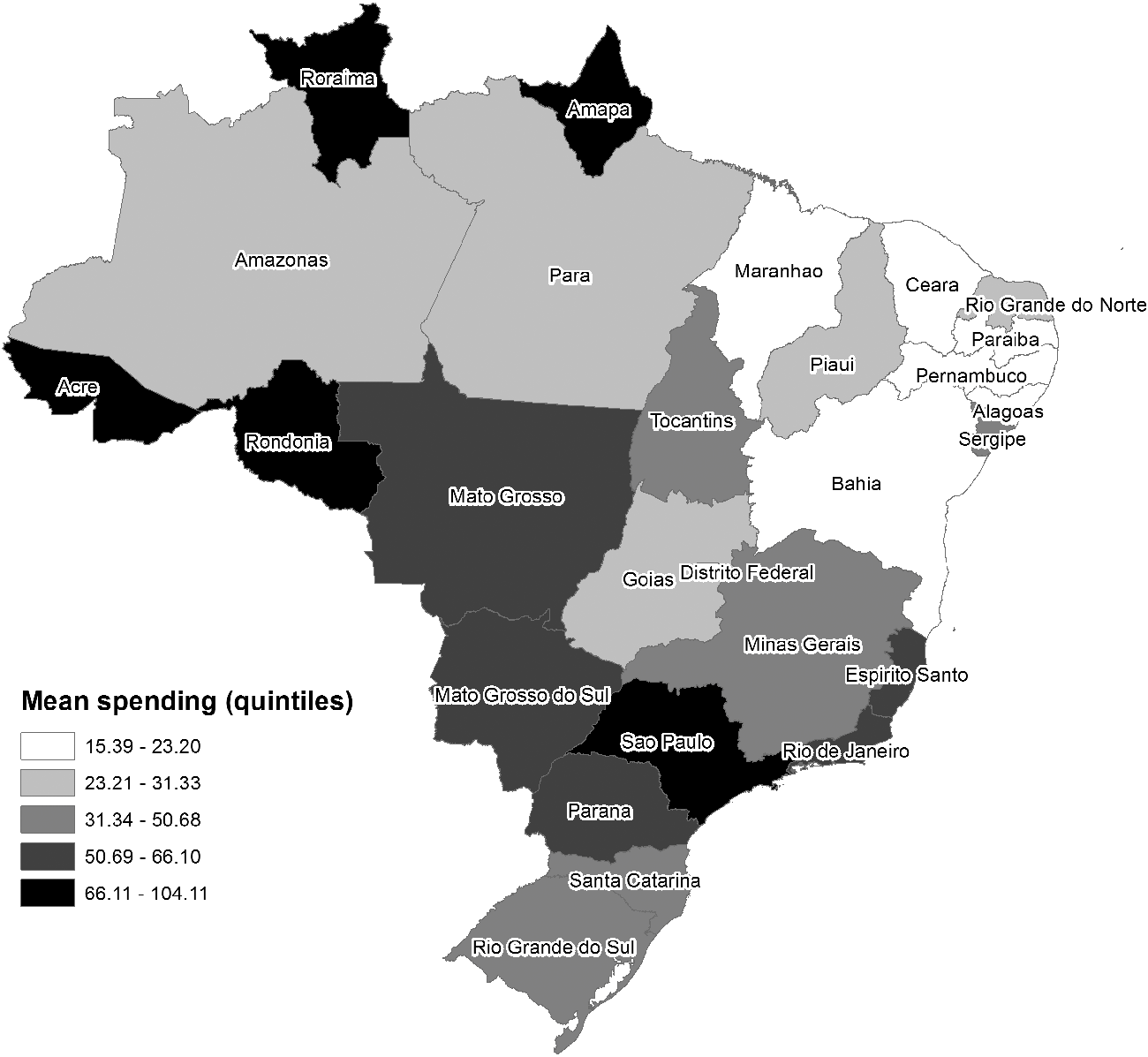
Figure 1.2. Average judicial spending per capita in Brazilian states, 1985–2006 (constant 2000 reais).
The financial strength of courts varies substantially across territorial units within both Mexico and Brazil, granting vastly different financial resources to local judiciaries within these single countries. As one Brazilian judge noted, echoing repeated comments from judges in both countries, “the budget is the lifeblood of the judiciary” (Interview 136). Without resources, no reform or improvements can be made, including staffing, materials, and physical investments.Footnote 6 Thus, the variation in Figures 1.1 and 1.2 signals vastly different institutional capacities for the judiciary across territorial units within each country.
Variation in the strength of state courts extends beyond the size of judicial budgets. The following vignettes outline the general contours of institutional changes in Mexico and Brazil, along with some of the central political dynamics associated with these reforms.
On May 23, 2006, a constitutional reform in the Mexican state of Michoacán altered the financial autonomy, institutional design, and the career structure of judges in the local judiciary, yielding one of the strongest administrative designs across the thirty-two Mexican states. The reform process was highly contested, capping more than three years of local political struggles in which left-of-center politicians belonging to the Party of the Democratic Revolution (PRD, by its Spanish initials) promoted the reform initiative of which ideologically sympathetic, progressive judges were chief architects. The reform project was opposed by politicians and judges affiliated with the previously hegemonic Institutional Revolutionary Party (PRI). In the central state of Aguascalientes more than a decade earlier, in 1994, a neoliberalFootnote 7 PRI governor, closer ideologically to the right-wing National Action Party (PAN), also pursued a judicial reform. Even though this earlier reform was milder than the one in Michoacán, it nonetheless encountered strong opposition, especially from traditional, local judicial elites, some of whom resigned rather than submit to the institutional alterations. Once the neoliberal PRI governor left office, the gains from his project were reversed by the combination of traditional judges and a more traditional, clientelist PAN administration. And in the state of Hidalgo, which continues to be a bastion of the once dominant (and recently resurgent) PRI, reform arrived late in 2006 and in weak, superficial form, essentially leaving existing political and judicial elites undisturbed.
In Brazil, in the southern state of Rio Grande do Sul, a center-left governor belonging to the Democratic Labor Party (PDT) was the first to delegate financial and administrative autonomy to the local judiciary in 1991–1992. In doing so, the governor was limiting his own power, effectively constraining himself. Crucially, he was responding to reformist initiatives from the judicial leadership and to the recent pressure of striking judges. A close friendship between the governor and the president of the state court facilitated communication about reform. Several years later, in 1999–2000, a leftist governor belonging to the Workers' Party (PT) sought to reduce the court's budget, generating constitutional litigation in which the judiciary sued the governor. Meanwhile, in the state of Acre, a governor from the same leftist party (PT) combined with progressive, ideologically sympathetic judicial leaders to strengthen the financial resources and staffing of the court. In contrast, in the northern state of Maranhão, where traditional, conservative elites sympathetic to the military dictatorship of 1964–1985 still dominated local politics, courts were by all accounts extremely weak institutions, financially and administratively. The judiciary remained a source of patronage for local elites, and there was increasing tension between progressive, reformist lower-level judges and conservative, anti-reform judicial elders.
Overall, court strength varies substantially over time and across space within both Mexico and Brazil. Judicial budgets vary widely. Further, institutional design and career structure in Mexico vary from state to state. In some of the strongest cases of reform, the selection of judges follows a fairly transparent civil service process, and selection to the state's highest court is no longer dominated by the executive branch, having been delegated to administrative organs that are often composed of judges, legislators, and other politicians. The administrative organs generate a list of candidates, which is then turned to the legislature for a vote. Indeed, these administrative organs – judicial councils – can offer meaningful benefits depending on their structure, composition, and powers. Michoacán offers a strong council on all three counts, and is an example of positive court strengthening in Mexico. Conversely, in other states the judiciary remains fairly impoverished and council reforms are superficial, perpetuating institutional weaknesses. Selection to the state's supreme court is still dominated by the governor, raising questions about independence, competence, and corruption. Hidalgo is an example if this kind of state.Footnote 8
In Brazil, institutional designs and career structure are fairly centralized nationally, yielding minimal variation along these two dimensions compared with Mexico. Variation in Brazil emerges in terms of administrative capacity – adequate staffing, materials, and physical infrastructure. Indeed, variation in these areas led one prominent observer of Brazilian courts to comment, contrary to the conventional perception that courts are uniform across states, that the administrative unevenness across Brazil's state courts yields “multiple judiciaries” (Falcão Reference Falcão and Sadek2006). In some states, courts are well staffed and well equipped, and therefore function reasonably well. This is the case in Rio Grande do Sul. It is also increasingly the case in Acre, where judges who complained of once having to cover two or three different geographic jurisdictions for lack of judges, or bring their own paper on which to write decisions, are now relatively satisfied with staffing levels and working conditions. Other states offer striking examples of poor staffing and infrastructure, as well as misuse or abuse of materials, resources, and power. Maranhão is an example of this kind of state, where judges on the state supreme court have historically appropriated most of the institution's resources for themselves, paying little attention to first-instance courts or the daily operation and administration of justice.Footnote 9
Summing up thus far, judicial strength varies dramatically across states within Mexico and Brazil. This “problem of unevenness” is particularly pressing because of scholarly neglect of local courts. The understudied aspect of subnational courts is remarkable in light of the fact that, as noted earlier, in large federal systems like Brazil and Mexico, the vast majority of litigation occurs at the subnational level. In addition to carrying a large volume of judicial work, local courts tend to process the kinds of legal claims that touch individuals' daily lives, including criminal proceedings but also extending to most routine civil claims involving family law, property, contracts, torts, and small claims. Apex courts may attract singular, high-profile, and difficult cases, but local courts adjudicate these types of daily justice. Local courts, then, for reasons of both volume and the everyday nature of their work, call out for attention.
Beyond the underexamined character and daily relevance of subnational courts, the persistent and ongoing unevenness of local judiciaries within single countries represents a substantive problem with the quality of democracy in both countries, namely that there are better institutions in some territorial units than in others. To be clear, to draw attention to problems of unevenness in the judiciary is not a call for uniformity. There will always be some variation, and courts need not be identical across subnational units, whether in centralized or decentralized contexts. However, dramatic unevenness demands an explanation because of the multiple ways highly irregular state capacity affects the everyday lives of ordinary citizens. Ultimately, large differences in court strength across territorial units within a single country mean citizens' experience of justice depends largely on their domicile, a phenomenon others have called “justice by geography” (Feld Reference Feld1991). Further, the variation in court strength across the Mexican and Brazilian states is part of the broader problem of uneven democratic institutions more generally (O'Donnell Reference O'Donnell1993; Cornelius Reference Cornelius, Cornelius, Eisenstadt and Hindley1999; Snyder Reference Snyder2001a; Reference Snyder2001b; Gibson Reference Gibson2005; Gervasoni Reference Gervasoni2010). Regional institutional weakness within individual countries resonates with O'Donnell's criticism of the coexistence of regions with strong public institutions alongside “brown areas” in new democracies – territorial spaces where functional public institutions fail to develop. These institutional lacunae undermine the ability of citizens to seek redress and vindicate individual rights and liberties, eroding the real effectiveness of these rights and liberties. Under these conditions, the core of the legal or civil dimension of citizenship is diminished, eroding the capabilities for individual development (Sen Reference Sen2000), and truncating or inhibiting full democratic citizenship (Marshall Reference Marshall1965; O'Donnell Reference O'Donnell1993; Collier and Levitsky Reference Collier and Levitsky1997; UNDP 2004). Weak judiciaries also translate into poor restraints on other branches of government, undermining accountability (Schedler et al. Reference Schedler, Diamond and Plattner1999; Maravall and Przeworski Reference Maravall and Przeworski2003; Gloppen et al. Reference Gloppen, Gargarella and Skaar2004) and increasing the risk of arbitrary, abusive, or unchecked power. The problem of uneven courts, then, is also of concern to scholars of subnational pockets or enclaves of authoritarianism (Gibson Reference Gibson2005; Reference Gibson2013) and “subnational undemocratic regimes” (Giraudy Reference Giraudy2015).
Variation in court strength within a single country is a meaningful empirical problem, posing the kind of “big, substantive question” or “real-world puzzle” that Pierson and Skocpol (Reference Pierson, Skocpol, Katznelson and Milner2002: 695–696) emphasize as being “inherently of interest to broad publics as well as to fellow scholars,” and therefore as important for political research as are more formal theoretical puzzles (see also Bates et al. 1998; Thelen Reference Thelen1999). Political research should be relevant to and engaged with public concerns. Understanding the nature and sources of the “patchwork” (Snyder Reference Snyder2001b) or “archipelagic” (Cornelius Reference Cornelius, Cornelius, Eisenstadt and Hindley1999 character of the state – the “crazy quilt” of democracy and democratization (Cornelius Reference Cornelius, Cornelius, Eisenstadt and Hindley1999: 4, 12) – is a crucial challenge for students of democracy and the rule of law, and a central concern of this book.
Theoretical Puzzles
A core question driving a wide range of academic and policy agendas concerns the construction of effective democratic institutions. How is this accomplished, especially in new democracies? Why do effective institutions develop in one place and time and not in others? These same concerns motivate the comparative study of justice institutions. How can we better understand how to craft stronger democratic legal institutions?
In both Mexico and Brazil, the uneven strength of local courts highlights these theoretical concerns in the study of democratic institutions. Despite the compelling normative argument for building strong courts, descriptive accounts teach us that there is wide variation in court strength, not only cross-nationally but also across regions within countries, as shown earlier. Given cultural and institutional pressures for policy convergence and harmonization, variation within single countries, such as Mexico and Brazil, is perhaps most intriguing from a theoretical perspective.
I argue that to understand subnational patterns of judicial empowerment, we must examine local politics. Because Brazil and Mexico consist of multiple subnational units, and both local political conditions and judicial strength vary widely both spatially and temporally, each country offers a rich laboratory environment in which to test multiple theories across space and over time.
In the burgeoning literature on comparative law and courts (e.g., Tate and Vallinder Reference Tate and Vallinder1995; Stone Sweet Reference Stone Sweet2000; Hirschl Reference Hirschl2004), a dominant theoretical account of judicial empowerment argues that electoral competition generates the rational-strategic incentives to strengthen courts (Ramseyer Reference Ramseyer1994; Magalhães Reference Magalhães1999; Elster Reference Elster2000; Ginsburg Reference Ginsburg2003; Helmke Reference Helmke2005; Finkel Reference Finkel2008). That is, close electoral competition creates uncertainty for politicians about whether they can remain in (or attain) office, and they respond by promoting judicial reform as a way of protecting themselves or preserving preferred policies. Accounts based on electoral uncertainty, however, have shortcomings. Despite a broad consensus regarding the benefits of competitive politics, rival causal logics lie behind the anticipated effects of competition. Moreover, the incentives generated by electoral uncertainty are assumed to be material and to apply to all politicians equally, thus anticipating that better institutions depend less on the nonmaterial ideas or identity of any given politician and arise mechanically, as a quasi-automatic side effect of competition, thereby “flattening”Footnote 10 political behavior. Further, dysfunctional courts persist even in competitive settings; reforms frequently occur long after the start of electoral openings; and the specific content of reforms varies widely across similarly competitive settings, showing electoral accounts to be overly optimistic, or at least ambiguous, about their predictions regarding both the timing and content of reforms.
Introducing additional complications, a core insight of a strategic bargaining account of reform anticipates that competition in previously noncompetitive settings, for example Mexico, increases the number of relevant actors, hindering policy change and inhibiting reform (Tsebelis Reference Tsebelis2002; Negretto Reference Negretto2006; Pozas-Loyo and Rios-Figueroa Reference Pozas-Loyo and Ríos-Figueroa2010). That is, tighter electoral competition might produce less reform, not more. Indeed, a motivated actor in a noncompetitive setting may have the easiest task of effectuating reform. Electoral accounts do not anticipate this negative effect and tell us nothing of the underlying motivations of such actors. In sum, as discussed in greater detail in Chapter 2, current theories of judicial change are inconsistent and inconclusive, suffering from problems of both behavioral equivalence and indeterminacy. Rival hypotheses are in play, blurring causal relationships and making predictions unclear, unstable, and even contradictory.
Attention to the causal role of programmatic commitments helps us understand underlying motivations, which in turn clarify expectations regarding the timing and content of reform, as well as instances of costly behavior. Reform may not accompany an electoral opening until programmatic actors gain power, and the content of ideational orientations – the ideas motivating institutional change – explain why reform content varies despite occurring under similar electoral conditions (see Béland 2007: 23–24). Further, commitments to reform based on deeply held values or principles can motivate actors to confront risks and persist in their efforts despite ongoing costs, helping us understand otherwise puzzling forms of high-risk or costly behavior.
To be clear, I do not argue that strategic considerations are wholly irrelevant or that ideas explain everything. That is, I am not making a “monocausal” argument (Hanson Reference Hanson2010: xx). Rather, acknowledging that strategic accounts dominate the literature on reform and contribute useful insights, I argue that attention to ideas can also help understand why some actors engage in court building, especially where rational-strategic accounts fail to anticipate the absence or incidence of reform, fail to account for reform content, or fail to anticipate costly behavior in the pursuit of reform, thereby providing a fuller understanding of judicial change.
Alongside the analytic attention to ideational factors, Crafting Courts highlights the role of judges in judicial change. Indeed, the ideas of judges are central to the book. Extant accounts tend to emphasize politician-led reform “from the outside”, neglecting institutional insiders. While politicians must ultimately change the legislation or constitution, I argue judges play an active role in shaping, lobbying for, and obtaining institutional change. Indeed, judges can play an active role in changing how politicians think about institutional change, affecting politicians' preferences along the way. Thus, attention to the combination of ideas and to the agency of judges themselves contributes to an understudied area of institutional development (Crowe Reference Crowe2007; Reference Crowe2012), helping clarify and resolve central puzzles of existing explanations. These analytic gains develop our theories of legal and judicial change, improving our ability to craft better institutions.
Conceptual Clarification: Court Strength in the Mexican and Brazilian States
Within the literature on judicial politics and public law, and the rapidly expanding literature in comparative judicial politics, “court strength” can refer to at least four different phenomena of interest. In roughly chronological order from the perspective of the sequence of court activities, research addresses (i) institution building, (ii) activation of these institutions once “built,” (iii) decision making within these institutions once activated, and (iv) the societal impact of judicial decisions once these are rendered. As with many categories in the social sciences, these four categories overlap, and there is feedback between and among them. For instance, a weak institution may not have the jurisdictional power (i.e., authority), resources, or administrative capacity necessary to either decide a case or shape good decisions on a consistent basis. Alternatively, a poor decision may hurt legitimacy and thereby weaken the institution from which it emanates. Nonetheless, the four categories are analytically distinct and are useful for situating the current study and for clarifying the concept of judicial strength that will later be operationalized as the dependent variable.
First, institution building refers to the process of creating a functional judiciary. The current study fits squarely in this area. In asking whether a court is strong, scholars are generally concerned with whether a court is independent, efficient, and accessible (e.g., Prillaman Reference Prillaman2000; Domingo and Sieder Reference Domingo and Sieder2001). Although each of these individual concepts could be queried further (see Kapiszewski and Taylor Reference Kapiszewski and Taylor2008), independence or autonomy generally refers to the lack of political interference in the judiciary, efficiency refers to the speed or timeliness with which judicial work is conducted, and accessibility refers to the ability of individuals to reach the court and have their interests effectively represented during all phases of adjudication. The concept of independence can be usefully divided into at least two components: institutional independence and behavioral independence. Institutional independence refers to the absence of interference in the judiciary as an organizational structure, including budgetary independence and administrative autonomy. For instance, is the court free to prepare and execute its own budget? Is the court free to develop its own strategic plan for institutional development? Behavioral independence refers to the ability of judges to render opinions and pronouncements on legal matters, including decisions in individual cases, but also extending to activities off the bench such as public lectures or writings, without political interference. This last distinction leads to references to judicial behavior on and off the bench (see Chapter 2, as well as qualitative analysis in Chapters 6 and 7).
In asking how a court becomes strong – how a court becomes independent, efficient, and accessible – scholars seek to understand instances of crafting and constructing democratic institutions, specifically the origins or genesis of positive institutional change. Who promotes stronger institutions? Why do they work toward this end? How does institutional growth and expansion happen? This area of research can also explore the persistence or stability of weak or strong institutions, as well as the decay or deterioration of institutions, fitting broadly into a category of institutional “development” rather than institutional “choice” or “selection” (Pierson Reference Pierson2000).
Second, activation of the judiciary refers primarily to those studies of legal mobilization that bring issues to the attention of the court via litigation (e.g., McCann Reference McCann1994; Epp Reference Epp1998). Third, perhaps the largest set of scholars (this is certainly true of judicial politics in the United States), examine judicial decision making. Whether called “executive-judicial relations” (Helmke Reference Helmke2005) or “constitutional interpretation” (Whittington Reference Whittington1999; Reference Whittington2007), this set of scholarship focuses on the behavior of judges on the bench. The phenomena under examination are instances of court rulings. Why did the judge or judges decide in favor of the executive branch? Why did they decide not to hear a case? How did a judge go about making her decision? Fourth, judicial impact refers to the aftermath of a decision, including compliance and enforcement (e.g., Rosenberg Reference Rosenberg2008[1991]; Kapiszewski and Taylor Reference Kapiszewski and Taylor2013). Once a judicial body made a decision, what were the societal consequences? Why was the order carried out? Why was a judgment not enforced? More broadly, how was society changed?Footnote 11 As noted earlier, this study is concerned with the first phenomenon – institution building or development. Why build courts? Why and how are strong democratic institutions constructed?
Clarifying further, “crafting courts” here refers specifically to building functional judicial institutions – independent, efficient, and accessible – at the subnational level in Latin America's two largest democracies. However, it is also possible that once institutions begin to change in a positive direction, opposing actors may promote negative, corrosive counterreforms. Throughout this study, judicial change and judicial reform are used interchangeably, although change can also refer to negative, counterreform. In this regard, the current study resonates with broader studies of the genesis of institutions, as well as with research on institutional change and continuity in comparative politics (Mahoney and Rueschemeyer Reference Mahoney, Rueschemeyer, Mahoney and Rueschemeyer2003b; Pierson Reference Pierson2004; Thelen Reference Thelen2004; Mahoney and Thelen Reference Mahoney and Thelen2010). Importantly, in contrast to much “new institutionalist” work – which examines the effects of formal institutional arrangements – judicial institutions here are the dependent variable.
Understanding Reform Options within Landscape of Institutions and Ideas
In a study of the role of ideas in shaping the politics of institutional change, a review is in order of three topics: (1) the basic form and function of the judicial institutions in question, that is, state courts in both Brazil and Mexico, as well as the failings of these institutions, and thus the reasons why reform was deemed necessary in the first place; (2) what reform agendas or policy options were in circulation and competing for attention during the time period examined here; and (3) how different reform agendas coincided with ideational profiles, that is, how ideas made some forms of institutional change more (or less) attractive to relevant actors. The sections that follow treat each of these topics in order.
Institutional Landscape
Brazil and Mexico are both federal systems, but they exhibit different patterns of institutional design and decision making power in the judiciary, or what could be called different styles of judicial federalism. Both countries emerged from authoritarian regimes – Brazil in 1985 from twenty years of military rule, and Mexico in 2000 from seventy-one years of single-party rule by the PRI – but Brazil chose to experience a constitutional moment, holding a constitutional convention and writing a new, rights-rich constitution in 1988, its seventh constitution since independence in 1822. Mexico, on the other hand, kept its constitution that dates back to 1917 – written as the main portion of the 1910 revolution came to a close – which was its third constitution since independence in 1810. Thus, the Brazilian constitution is a recent document informed by the human rights and democratization movements of the late twentieth century, while the much-amended Mexican constitutionFootnote 12 is, as of 2015, almost 100 years old. Crucially, while the Brazilian constitution contains multiple rights and might be considered a progressive, rights-rich charter, the constitutional moment and aftermath were closely managed by conservative-elite politicians closely associated with the military regime (Power Reference Power1996). Later, the national profile of the administration shifted to the center (1994–2002), conservative elites lost influence, and ultimately the left rose to national power (2003–present). Thus, the constitutional arrangement evolved alongside a national political environment that shifted steadily from right to left over three decades: military rule, center-right, center, center-left. In Mexico, working with a much older although much-amended charter, the democratic transition was managed first by political elites associated with the economically liberal, market-friendly wing of the PRI, and then by elites associated with the socially and economically conservative PAN. The PAN managed to stay in office for two administrations, but national power eventually reverted to the PRI in 2012. Thus, the constitutional arrangement evolved in the context of a national political environment that shifted from the center to the right and back to the center.
In Brazil, the highest court in the land is the Supreme Federal Tribunal (Supremo Tribunal Federal, STF), which existed prior to 1988. The 1988 Constitution created a separate, new national court, the Superior Tribunal de Justiça (STJ), alongside the existing STF. According to the new constitution, the STJ would hear federal cases and appeals that did not raise constitutional issues. Because the STJ was explicitly an infraconstitutional court, the STF implicitly became the nation's constitutional court (Taylor Reference Taylor2008; Kapiszewski Reference Kapiszewski2012). Several lesser reforms followed in the aftermath of 1988, including the expansion of certain mechanisms of constitutional review (ADCs in 1993; ADIs in 1998), and small claims courts were created throughout the country in 1996.
However, the general consensus was that the judiciary – especially local courts in Brazil's twenty-seven states – was not working well, either because it was overrun with a high volume of claims, or because it was simply unable to process existing claims, even if minor or moderate in number. There are multiple ways to initiate a legal action and multiple opportunities to appeal, but there are also clear abuses in the form of mismanaged resources, influence peddling, hiring of incompetent staff, and other problems.
As early as 1992, members of the opposition PT had promoted a broader judicial reform project (Sadek and Arantes Reference Sadek, Arantes and Sadek2001). However, it was not until 2004 that this reform was approved, known as Constitutional Amendment 45 (Emenda Constitucional 45, or EC45). In terms of institutional structure, the STF had already ruled that the judiciary was one body – from its apex, the STF, down to state courts (see footnote 13). Now, EC45 created a new judicial administrative body, the National Justice Council (Conselho Nacional de Justiça, CNJ), and the CNJ provided a mechanism to oversee the administration of every state judiciary and the federal courts. Indeed, some critics might oppose the CNJ's reach as interfering with the independence of judges, although the CNJ has demonstrated restraint in this regard (CNJ 2012; 2014).
In Mexico, a prominent reform in 1994 – still during the single-party regime of the PRI – dismantled the national high court, shrinking its size and replacing all but one member, and expanded an existing mechanism of judicial review, while creating an entirely new mechanism. Further, the reform created a Federal Judicial Council (Consejo Federal de la Judicatura, CFJ) (Finkel Reference Finkel2005; Reference Finkel2008; Ríos-Figueroa Reference Ríos-Figueroa2006). However, in contrast to the CNJ in Brazil, the CFJ in Mexico only had jurisdiction over the federal judiciary. There was no mandate for state courts to reform, but the implicit message was that state courts should pursue changes along similar lines. Chapter 6 examines many of these changes.
These major differences among state courts in Brazil and Mexico can be organized along two dimensions: (1) the formal design of courts (institutional federalism), and (2) the decision-making power of judges within these courts (jurisprudential federalism). In terms of institutional design, Brazil is very centralized, and Mexico is very decentralized. Specifically, there is little formal variation in the shape or design of judicial institutions across the twenty-seven subnational units in Brazil. Like most other Brazilian public institutions, courts follow a principle of isonomy, generally regarded as structural similarity from one level of government to another, but also connoting that there is one, single judiciary throughout Brazil, not multiple judiciaries at the state, federal, and national levels.Footnote 13 Thus, state courts tend to be fairly uniform subnationally in terms of formal design throughout Brazil. In contrast, there is wide variation in the formal design of courts across Mexico's thirty-two subnational units. Unlike Brazil, there is no pervasive principle of isonomy, only a much more diluted, informal expectation that state institutions generally mimic the design of national institutions. Importantly, states do not always mimic national designs, so the formal institutional landscape of the judiciary in Mexico is much more varied across subnational units than in Brazil.
Conversely, in terms of decision-making power over constitutional issues, this power is highly centralized (concentrated) in Mexico and very decentralized (diffuse) in Brazil. In Brazil, state courts have the power to review the constitutionality of state actions undertaken under the local constitution (e.g., Brinks Reference Brinks2005; Nunes Reference Nunes2010a). In Mexico, constitutional challenges of state actions flow directly to federal courts, although this practice is increasingly debated and challenged by reforms seeking to create local constitutional tribunals, or constitutional chambers within state supreme courts (see, e.g., TEPJF 2008; Estrada Michel Reference Estrada Michel2008: 8; Camacho Quiroz Reference Camacho Quiroz2008: 123). In short, as a general characterization of styles of judicial federalism, Brazil is institutionally centralized and jurisprudentially decentralized, whereas Mexico is institutionally decentralized and jurisprudentially centralized.
Complementing these styles of judicial federalism, the two countries have very different styles of organizing judges as interest groups. Brazil has a strong tradition of judicial associations and bar associations. This tradition is perhaps not surprising given the history of corporatism in Brazilian state-society relations. At the national level, the Brazilian Judges Association (Associação dos Magistrados Brasileiros, AMB) and the national bar association, the Order of Lawyers of Brazil (Ordem dos Advogados do Brasil, OAB), are extremely active and well organized. Further, each of these national groups acts as an umbrella organization for state chapters. Thus, there is a neo-corporatist network of AMB and OAB membership throughout the country, with virtually every judge belonging to its local chapter of the AMB. These national organizations and their local chapters provide a strong base from which to generate public statements on various issues, as well as to mobilize judges and legal professionals to lobby for preferred policies. No similar organizations exist at either the national or local level in Mexico. To be sure, there are a variety of national lawyers’ or judges’ groups in Mexico, called “barras” or “colegios,” but they do not have compulsory membership and none has the prominence, organizational structure, or resources of either the AMB or OAB in Brazil, much less the formal, structured network of state chapters. Additionally, while Brazilian judges have frequently lobbied and engaged in a wide range of labor actions, including strikes, this kind of activity is frowned on, if not deemed illegal, in Mexico, where until 2014 (Pigeonutt Reference Pigeonutt2014) there had never been a single strike by judges. Indeed, when court staff – not judges, but secretaries and other support staff – went on strike in the state of Michoacán in 2003, even this labor action generated controversy and news coverage because no strikes had ever taken place within the Mexican judiciary (see Chapter 6).
These differences in styles of judicial federalism and judicial organization generate very different expectations about the kind of institutional change that we should see across the Brazilian states vis-à-vis the Mexican states.Footnote 14 Across the Brazilian states, we should not expect to see local politics drive major shifts in formal institutional design; this kind of institutional change should largely be a centralized or national-level phenomenon. Rather, we should expect to see local politics driving how existing institutional designs are made more fully effective, or how existing institutional designs are adapted to local needs. For instance, a formal institutional design across all states may call for the judiciary to have planning and executional autonomy over its own budget, but despite the formal rule, the informal or de facto practice may be different among states. Further, the Brazilian style of judicial organization generates an expectation that we should see more interactions between state judges and federal or national-level judges in reform episodes in Brazil, since they are far more connected organizationally across states and across levels of government than are their Mexican counterparts. Notably, state judges may not always have the same interests or ideas as do national judges, and judges in one state may differ in their ideas and interests from judges in another state, on the basis of the condition of the judiciary in their state, generating territorial variation in the desire and motivations for reform (Falleti Reference Falleti2010), points to which I return in Chapter 2 and the case studies in Chapters 6 and 7.
Beyond these general points about judicial federalism and neo-corporatist organization, both Brazil and Mexico are federal systems. The federal structure in both countries generates different levels of the judiciary based on territorial jurisdiction – with local coverage for state courts and regional or national coverage for federal courts – and different substantive jurisdictions based on the legal subject matter in question (i.e., subject matter jurisdiction). This book focuses on state-level institutions, but a better understanding of the form and function of these institutions within the broader judicial apparatus is in order.
In Brazil, there are four main areas of the law with separate adjudicatory structures within the judiciary: (1) ordinary civil and criminal litigation, (2) military law, (3) labor law, and (4) electoral law. State courts handle the overwhelming majority of litigation, consisting of civil and criminal cases, as well as cases arising under local constitutions. Each of the four major areas of law has its own peak court, or court of last resort. The STJ and STF sit atop the apparatus of ordinary civil and criminal litigation, hearing disputes of a constitutional and statutory nature, and are primarily occupied with hearing appeals from lower-level courts. For disputes involving military personnel, labor or employment issues, and electoral matters, the peak courts are the Superior Military Tribunal (Superior Tribunal Militar, STM), the Superior Labor Tribunal (Tribunal Superior de Trabalho, TST), and the Superior Electoral Tribunal (Tribunal Superior Eleitoral, TSE), respectively. Below the STF, STJ, STM, TST, and TSE, various regional federal courts adjudicate disputes within each of their regional and substantive jurisdictions. Returning to the subnational units, below all of the national peak courts and their federal counterparts, each state has its own judicial apparatus.
By far, state courts process the majority of litigation. For example, in 2004, there were a total of approximately 22,290,000 new cases entering all judicial organs (with the exception of the military tribunals). Of this total, 71 percent were cases entering state courts, and fully two-thirds (67.83 percent) of all new cases in the country were ordinary criminal, civil, and family law cases entering first-instance courts in the states.Footnote 15
In the states, the last-instance, top court is uniformly called the Tribunal of Justice (Tribunal de Justiça, TJ), and these courts are usually identified by the initials “TJ” followed by the two-letter state identifier. For instance, the top court in the states of Acre, Maranhão, and Rio Grande do Sul – cases examined in greater depth in Chapter 7 – are TJAC, TJMA, and TJRS. Beyond the top court, each state is divided into judicial districts (comarcas), comprised of one or more courthouses (foros or foruns), where judges sit individually in their own courtrooms (varas; e.g., vara criminal). Judges usually begin their career as a substitute judge (juiz substituto) in a rural comarca, then become a permanent judge (juiz), and almost universally aspire to ascend to an urban comarca, preferably in the state capital, where they have more seniority, prestige, and resources, and where their families have access to better schools, infrastructure, and services. If promoted to the state's high court, the TJ, a judge is thereafter referred to not as juiz but rather as a desembargador.Footnote 16 As noted previously, state judicial institutions are remarkably similar in formal design and appearance throughout the country. Indeed, this uniformity is intentional, as noted in the jurisprudence of the STF (see footnote 13).
Turning to Mexico, the judicial apparatus is also layered across subnational units and various territorial and subject-matter jurisdictions. The National Supreme Court of Justice (Suprema Corte de Justicia Nacional, SCJN) sits atop the judiciary and operates as a court of original jurisdiction, the final instance for other matters, and a constitutional tribunal. Alongside the SCJN sits the federal electoral court (Tribunal Electoral del Poder Judicial de la Federación, TEPJF, sometimes referred to as TRIFE). Below the SCJN are a large number of federal circuit and district courts, the arrangement of which looks a lot like the U.S. federal judiciary.
Within each of the thirty-two subnational units (including Mexico City), a separate judicial apparatus exists. In each of these subnational units, the state supreme court is the court of last resort for local matters, and is generally called a high or superior court or tribunal, for example, Tribunal Superior de Justicia (TSJ). It should be noted, however, that the uniformity in the structure of court names seen in Brazil is not seen in Mexico. In some Mexican states, the court takes the name of “supreme” tribunal, which is at least a nominal rejection of the SCJN's authority, but which also reflects the history of regionalized evolution of the national court, as it was established while Mexico was still fighting for independence from Spain. For instance, the national supreme court was located in Ario de Rosales, in the state of Michoacán, during the independence era (Luna Ramos Reference Luna Ramos2015).Footnote 17
An electoral court handles electoral matters in each state, and some states have created their own constitutional tribunals, or smaller constitutional chambers within the TSJ. Again, paralleling the variation in the names of state high courts, the formal design of state judiciaries varies widely across Mexico. Beyond the TSJ, a state is divided into judicial districts (“distritos” or “partidos”). First-instance judges are called “juez” and, as in Brazil, generally begin their careers in rural districts. As was the case in Brazil, for reasons of professional prestige and lifestyle, judges almost universally aspire to promote to more urban and busier judicial districts, preferably the state capital. If they ascend to the state supreme court, the TSJ, judges are called “magistrado.”Footnote 18
State courts hear a wide range of criminal and civil cases, and, as in Brazil, are responsible for the vast majority of the judiciary's volume of work. Approximately 80 percent of all criminal cases begin in first-instance, state courts (INEGI 2005; Poiré Reference Poiré, Philip and Berruecos2012). Further, although historically all drug and firearms cases were automatically federal cases, starting in 2010, jurisdiction over an increasing number of narcotics cases has been delegated to the states. All family and most civil cases are also initiated in state courts. Thus, paralleling Brazil, the vast majority of ordinary, daily litigation in the country occurs in first-instance courts in the Mexican states.
The baseline condition of judicial institutions in the 1980s in both of these countries – and in Latin America more broadly – was one of chronic weakness. Persistent complaints regarding courts in Brazil and Mexico concerned independence, efficiency, and access (Méndez, O'Donnell, and Pinheiro Reference Magalhães1999; Prillaman Reference Prillaman2000; Domingo and Sieder Reference Domingo and Sieder2001), and these concerns extended to state courts (e.g., Chavez Reference Chavez2004; Beer Reference Beer2006; Ingram Reference Ingram2012a; Reference Ingram2013a; Reference Ingram, MacKinnon and Feoli2013b). Of these three components of judicial performance, independence (or the lack thereof) has received the most attention, and almost exclusively at the level of national, apex courts (Helmke Reference Helmke2005; Ríos-Figueroa Reference Ríos-Figueroa2007; cf. Chavez Reference Chavez2004; Beer Reference Beer2006).
In Brazil, despite the near uniformity of formal institutional design, real differences in actual, practical independence, efficiency, and accessibility exist. For instance, the 1988 Constitution called for the budgetary autonomy of the judiciary, and states reformed their own constitutions in 1989 to affirm the same principle. Yet, obtaining real and effective financial and administrative autonomy for state judiciaries – with the court studying and assessing its own performance and needs, planning its activities for the year, proposing its own budget to the legislature according to the judiciary's needs, and then administering its own budget and activities – was very slow to come and is still a regular struggle in several states. In some states, the court's budget was disbursed by the governor on a month-to-month basis, keeping the judiciary in a chronically dependent, vulnerable position. Governors thus used the budget as a tool to leverage ongoing influence over the courts’ decisions, ensuring judicial deference and docility. In other states, court budgets flowed directly to the desembargadores on the TJ and stayed there, failing to reach lower courts, especially those in rural areas (see Chapter 7). For either reason – deliberately withholding the judicial budget or various forms of corruption or malfeasance in the cupula of the judiciary – courts were chronically underfunded, particularly at the first instance where ordinary citizens first attempt to access the judiciary to vindicate rights and liberties, and where two-thirds of the nation's litigation takes place. Chronically underfunded courts are unlikely to challenge or disagree with politicians, and they also find it difficult to staff and supply courts, as well as provide a timely, quality, competent service, much less plan for the future. Thus, persistent complaints regarding the Brazilian local judiciary painted a picture of courts that were largely dependent, inefficient, and inaccessible. This weakness was particularly acute for ordinary citizens, and especially so for poor and rural communities. Where desembargadores retained the vast majority of the judicial budget and used it to equip and staff their own offices to the point of excess while first-instance courts were under-equipped and/or understaffed, complaints regarding accountability, corruption, and incompetence joined those regarding independence, efficiency, and access. The selection and tenure of judges was governed by well-established civil service rules, insulating judges from complaints about favoritism in hiring and other career-related decisions. However, the discretionary and arbitrary hiring of court staff also generated complaints of nepotism and favoritism (see Chapter 7).
In Mexico, governors serve a six-year term (called a “sexenio”), and incoming governors historically appointed their own, new judges to the state supreme court, leading to the term “sexenio judicial” to refer to the instability of judicial tenure and, implicitly, to the pernicious effects of this instability on judicial independence. In the single-party environment of the PRI (1929–2000), judges in unstable and underpaid positions tended to remain compliant in order to ensure their political loyalty was not in question, so that they could remain eligible for an appointment to a future job within the party or public sector (see Domingo Reference Domingo2000; Ingram Reference Ingram2012a). Because judges on state supreme courts (magistrados) were the de facto court administrators for the state judiciary, magistrados were endowed with the power to hire other judges and court staff, as well as control all the resources of the judiciary. The arbitrary manner in which magistrados were selected to the states’ top courts, therefore, generated similarly arbitrary and opaque hiring practices for lower court judges, clerks, secretaries, process servers, and other court staff, creating a network of patronage and personal favors that extended from custodians all the way to the governor. The use of court resources was similarly arbitrary and opaque. In the single-party environment of the PRI, employment opportunities and resources – especially in the public sector – hinged on party loyalty, so the patronage network went largely uncontested, and the court never acted as a meaningful brake on the political branches (see Domingo Reference Domingo2000). Indeed, the party was the state, so the judiciary was subsumed, along with the legislature and executive office, as part of the party-state that was the PRI during its dominant period. For these reasons, the judiciary was regarded as lacking independence from dominant political actors and for being unresponsive to the needs of ordinary citizens.
Under these conditions, even judges who wanted to get their work done faced a daunting task. Suffering from a combination of chronically low budgets, low salaries, political interference, and pervasive incompetence due to opaque and arbitrary hiring, judges had to overcome the lack of infrastructure and supplies (including even security for their own courtrooms), the temptation of corruption to supplement their low incomes, and the myriad political and professional pressures of a single-party regime. Thus, the business of courts was completed very slowly, if it was completed at all and not shelved (i.e., “archived”), generating criticisms of inefficiency and fundamental ineffectiveness. Aside from causing delays for cases currently being considered by judges, inefficient courts generated backlogs that made it very difficult for new cases to be heard. Thus, inefficiency led to inaccessibility, effectively closing the courthouse doors for large numbers of new cases.
Agendas of Judicial Reform: Policy Options in Circulation, 1985–2005
Given the poor and dysfunctional condition of local judicial institutions in the 1980s in these two countries (and in the region as a whole), several agendas or options for institutional change were in circulation. Summarizing work on the promotion of rule of law in Latin America, Carothers (Reference Carothers, Domingo and Sieder2001) identified four clusters or menus of foreign rule of law assistance to the region: (1) human rights and social justice, (2) democracy promotion, (3) economic development, and (4) international law enforcement (7–8). While not all of the policies discussed by Carothers are properly judicial, that is, court-related, the categories are useful for thinking about the range of policies in circulation to improve the performance of courts.
First, the concern with human rights was connected to efforts to combat the abuses perpetrated under authoritarianism in developing countries, and grew out of attention to forced disappearance, torture, and other violations of first-generation, physical integrity rights perpetrated under these authoritarian regimes since the 1960s. Once the third wave of democracy swept across the region, new concerns arose about effective responses to official abuses perpetrated under democratic regimes, specifically, an effective judicial response to these abuses, for example, police violence (see, e.g., Brinks Reference Brinks2007). Thus, the concerns with holding perpetrators of human rights abuses accountable via mechanisms of transitional justice (Hayner Reference Hayner2010; Keck and Sikkink Reference Keck and Sikkink1998; Sikkink Reference Sikkink2011; González Ocantos Reference González Ocantos2014) combined with broader concerns about making civil rights effective in new democracies. Policy objectives included making courts more accessible to ordinary citizens by supporting public legal assistance and outreach, which could be the responsibility of civic groups, law school clinics, public defenders, or the courts themselves. Other civil rights issues related to the independence and timeliness of courts. In short, the emphasis on judicial reform in order to vindicate human rights violations in the transitional justice movement complemented the emphasis on vindicating civil rights that was a centerpiece of the project of enhancing the quality of democracy. The concern with civil rights more generally thus complemented the broader project of democracy promotion below.
Second, democracy promotion posits that strong courts – independent, efficient, and accessible – are crucial to protecting the “constitutional order, the separation of powers, individual liberties, and other cornerstones of democratic political systems” (Carothers Reference Carothers, Domingo and Sieder2001: 9). Policies aimed at enhancing independence included redesigning mechanisms of judicial selection and tenure to afford greater insulation from political interference and greater professional stability. This stability enhanced judicial independence, but also promised to contribute to building a pool of experience and expertise within the judiciary, increasing the quality of judging. Merit-based career structures governing the hiring, promotion, discipline, and termination of judges and courts staff also enhanced the odds that courts would be populated by competent professionals, rather than by political cronies or personal favorites with questionable qualifications. Finally, increasing judicial budgets and expanding the administrative autonomy of courts ensured that they would have the resources to attract the best talent, insulate staff from corruption, perform all responsibilities effectively, and plan for future demands for judicial services (see also, Domingo Reference Domingo2000; Domingo and Sieder Reference Domingo and Sieder2001; Ginsburg Reference Ginsburg2003: ch. 1). Well-trained, competent, and politically independent judges should also yield more efficient results than less-qualified individuals concerned with meeting opaque political standards, and a more efficient, well-planned institution should be more accessible to its citizens.
Judicial councils were a key policy option in order to achieve many of these goals (Carothers Reference Carothers, Domingo and Sieder2001: 8). Judicial councils are organs that take over all administrative responsibilities of the judiciary – budgetary preparation and management, personnel issues (hiring, supervising, disciplining, firing), training and education, statistics and evaluation, and strategic planning (including decisions regarding the location and construction of new courts) (Hammergren Reference Hammergren2002b; Garoupa and Ginsburg Reference Garoupa and Ginsburg2009; Ingram Reference Ingram2012a). Previously, judges themselves managed all of these activities. Indeed, in the absence of judicial councils, interviews in Brazil and Mexico found judges handling all manner of non-judicial activities, including the purchase of supplies, the hiring and firing of staff, and repairs to court buildings. Some judges interviewed for this project expressed dismay at the amount of time they spent on administrative duties, stating that a clear majority of their work, and estimating that up to 90 percent of work, was administrative in nature, rather than related to evaluating legal cases. Thus, a key benefit derived from judicial councils is that by removing these administrative tasks from judges, judges have more time for the task of judging. In this way, judicial councils should lead to gains in efficiency. Further, by clearing cases faster and making room for new cases, more efficient courts should be more accessible ones. Combined with a more exam-oriented and transparent judicial career structure, councils can also generate more independence, as judges should be competitively selected on the basis of merit, and these judges should be increasingly more competent and qualified. Paired with rising resources and salaries, courts should also be increasingly attractive to the best talent from law schools and the legal professions, contributing further to enhancing competence, the quality of the judicial services provided, efficiency, and access.
The third cluster of reform policies was oriented toward economic development. Here, a key concern was to make courts efficient and competent for business transactions and investors. Multilateral banks, especially the World Bank, were the “dominant external actors” promoting rule of law for the sake of economic development (Carothers Reference Carothers, Domingo and Sieder2001: 9), and legal and judicial reform as a tool of economic development evolved in two phases. First, as international financial institutions (IFIs) began pushing neoliberal market reforms in the late 1970s and 1980s, they made law reform part of their agenda, including laws governing banking, bankruptcy, taxation, investment, etc. (Carothers Reference Carothers, Domingo and Sieder2001: 9). Second, the reform agenda broadened in the 1990s, when IFIs realized that simply reforming codes and statutes was not enough and turned to reforming judicial institutions, primarily courts and court-like institutions (e.g., arbitration and other forms of alternative dispute resolution). Seeking to facilitate the adjudication of commercial and investment-related claims, IFIs sought to make courts more efficient and competent in economic matters. Put simply, judicial reform was seen as a way of “deepening the market reform process” (Carothers Reference Carothers, Domingo and Sieder2001: 10). For these reasons, “the World Bank tends to emphasi[z]e the importance of foreign investors receiving reasonable treatment by the legal systems of the countries where they invest and private domestic actors enjoying sanctity of contract and other basic elements necessary for regularity and predictability in business life.…[Thus, the Bank's] rule of law program[s] focus on the updating of commercial laws and improving the efficiency of the courts, with emphasis on the commercial work of the courts” (Carothers Reference Carothers, Domingo and Sieder2001: 10).
Whereas judicial independence was often touted as a policy goal in this cluster of reform agendas, it is perhaps more accurate to say the goal was a pro-business environment, not independence per se. Further, while accessibility and efficiency were also goals, these goals were not “popular” in nature, that is, they were not sought for the wider population of ordinary citizens. Rather, the goal was that the business community and foreign investors would have access to the efficient adjudication of any conflict that might arise in the course of their transactions. For these reasons, the economic development cluster of activities was often in tension with the democracy promotion and human rights or social justice clusters of activities. “Economic developmentalists intent on improving the functioning of a legal system for economic elites sometimes push for measures – such as special access courts for high-stakes business litigation or narrowly targeted alternative dispute resolution mechanisms – that can mean resources being shifted from justice for the many (a democratic imperative) to justice for the few” (Carothers Reference Carothers, Domingo and Sieder2001: 13).
Lastly, international law enforcement constitutes a fourth and final cluster of rule of law initiatives. Here, controlling forms of transnational crime is the core goal, but this goal is achieved on several fronts, including drug trafficking, money laundering, and human trafficking (see Carothers Reference Carothers, Domingo and Sieder2001: 11). In the domestic judicial arena, this cluster of activities is connected to the role of courts in promoting security more generally, particularly via the criminal law courts. Policies related to criminal law are essentially the same as those already mentioned under social justice and democracy promotion. Specifically, from the suspect's or defendant's perspective, policies sought to strengthen the provision of legal defense services, as well as efficient and timely proceedings. From the victim's or society's perspective, policies also sought a more efficient resolution of proceedings, as well as independence in order to prevent corruption and impunity. More recently, reforms have sought a transition from the inquisitorial style of criminal procedure traditionally associated with civil law countries to an accusatorial style of criminal procedure traditionally associated with the common law tradition. Notably, these policies were not pervasively debated in Mexico until the passage of a 2008 reform (e.g., Ingram Reference Ingram2013c), and while small-claims courts in Brazil have some of the features of accusatorial proceedings, a law governing this kind of procedural shift in Brazil was still being debated in the national legislature at the close of 2014 (PL 8045/2010).Footnote 19
In this broader context of reform options, Brazil and Mexico each experienced a variety of national judicial reforms, exposing the states to their own domestic versions of the global judicial reform agenda. Given the key concerns regarding independence, efficiency, and accessibility, reform agendas in Brazil and Mexico included policies and projects to strengthen courts in each of these areas. Regarding independence, various proposals sought to (a) enhance the size of judicial budgets and the judiciary's control over the planning and execution of its own budget, and (b) reduce political interference in judicial selection and tenure. Regarding efficiency, proposals aimed to enhance workload management or move certain types of cases to more informal fora, for example, alternative dispute resolution (ADR) mechanisms, such as mediation, conciliation, and arbitration. Less attention has been paid to access to justice (Méndez, O'Donnell, and Pinheiro Reference Magalhães1999; Salas Reference Salas, Domingo and Sieder2001), although proposals in this area include increasing the availability of lawyers and legal representation, alternative fora for dispute resolution (ADR, but also including mobile or traveling courts, especially in rural areas), small claims courts, and increased access to interpreters for indigenous communities.
In Brazil, interviews note that the single most important moment since the 1980s was the passage of the Federal Constitution in 1988, and the subsequent passage of new local constitutions in 1989 across Brazil's subnational units to adjust to the federal standard. These constitutions included formal provisions for judicial autonomy and respect for a wide range of rights. However, as noted earlier, at the local level, the real struggle involved making the terms of the local and federal constitutions effective. With regard to the judiciary, this meant turning constitutional provisions about “budgetary autonomy” and “administrative autonomy” into reality, which ultimately involved a struggle to remove powers from the executive (e.g., Interview 194). Following on the heels of the 1988 Constitution, the single most prominent national judicial reform project began in 1992, just four years after the approval of the new constitution. Although the reform was not finally approved until 2004 (and not effective until January 1, 2005), the debate maintained a high national profile in academic and policy circles for twelve years (Sadek and Arantes Reference Sadek, Arantes and Sadek2001; EC 45/2004). The elements of the reform included a national judicial council, which was eventually approved, as well as various notions of precedent, that is, granting court decisions the weight of binding authority on individuals beyond the immediate parties to the case decided. Crucially, the national reform project aimed to create a single national council, not a network of local ones. Thus, even a powerful council would have greater control over federal courts and a reduced capacity to influence the wide array of differences and challenges across twenty-seven subnational units. Still, even a national council would be able to afford at least some level of standardization in terms of assessing workloads and the use of resources, including the hiring of support staff. As seen in Chapter 7, the National Justice Council (Conselho Nacional de Justiça, CNJ) has become a kind of “federal foothold” for local actors seeking to improve local courts, actors who leverage the supervisory authority of the CNJ to hold local judges accountable for the use of resources and questionable hiring practices.
Aside from the performance gains expected from the council reform, the rationale for establishing precedential authority for STF decisions was that this authority was supposed to yield efficiency gains. Given that the decisions of the nation's high court were previously binding only on the parties to the case (inter partes effects), the creation of binding, erga omnes effects was supposed to eliminate the kind of repetitive litigation that occupied the high court's time and resources. While this reform was being debated, two lower-profile reforms in 1993 and 1999 expanded the effect of decisions rendered by the STF in two types of constitutional review: Declaratory Actions of Constitutionality (ADC) and Direct Actions of Unconstitutionality (ADI), respectively (Brinks Reference Brinks2005; Nunes Reference Nunes2010a; Kapiszewski Reference Kapiszewski2012; Desposato, Ingram, and Lannes Reference Desposato, Ingram and Lannes2015).
Beyond the national judicial reform project that spanned 1992–2004, several other efforts to improve judicial performance filtered through the states. For instance, a national, 1996 law created small-claims courts that then slowly began to emerge in the states. In addition, the Getulio Vargas Foundation in Brazil (Fundação Getulio Vargas, FGV) began sponsoring a “Judicial MBA” (MBA do Judiciário), targeting judges via required seminars that taught better caseload management and tracking statistics (see Chapter 7). Additionally, in both Brazil and Mexico, the use of small-claims courts and various mechanisms of alternative dispute resolution (mediation, arbitration, and conciliation) has been increasingly promoted since the 1990s. Regarding accessibility, the efforts to increase efficiency are generally regarded as having a salutary effect on accessibility – that is, as current cases move more quickly through the courts, there is more room for new cases. Additionally, small-claims courts are regarded as being more accessible than is full-scale litigation. However, deeper calls for increased access to legal services for ordinary people persist in both countries, especially for those at the margins of society, including those in poor, rural, or minority communities. In Brazil, this concern with marginalized populations in rural areas led to several versions of mobile or ambulatory courts where judges leave the fixed and formal settings of the courthouses and go themselves to communities where legal services are needed. Indeed, under the leadership of Arquilau de Castro Melo judges in the state of Acre engaged in precisely this kind of nontraditional outreach, leaving the formal setting of the courthouse, which is remote for most citizens, to personally take legal services to underserved communities (see Chapter 7).
In Mexico, the key national transformation in the time period examined here is the 1994 judicial reform, passed on December 31, 1994, and implemented in 1995. This reform restructured the SCJN and the judicial career, created a national judicial council (Consejo de la Judicatura Federal, CJF), expanded the resources available to the federal judiciary, enhanced an existing mechanism of constitutional review (controversias constitucionales), and created a new mechanism of constitutional review (acciones de inconstitucionalidad). The new mechanisms of constitutional review created new avenues by which to challenge state action in individual litigation in federal courts, and increased the SCJN's standing as a constitutional tribunal. However, from the perspective of building overall institutional capacity, the creation of the national judicial council, changes to the judicial career, and the increase in resources were the more important changes.
Notably, the 1994 reform produced a council and the other changes only for the federal judiciary. None of the provisions of the 1994 reform directly touched state judiciaries. States were implicitly expected to follow suit by creating their own judicial councils, but there was no explicit mandate to do so. Thus, while some states chose to create councils almost immediately in 1995, the spread of councils was slow and uneven. By the end of 1995, nine of thirty-two states passed a council reform (28 percent). However, by 2000 only fourteen (44 percent), and by 2010 – fifteen years after the national reform – twenty-five states had a council, leaving 22 percent of states still choosing to maintain the traditional institutional design, with judges heavily occupied with managing the court's day-to-day administrative business. Indeed, by 2008, when a second, national, high-profile reform was passed, this time requiring states to transition to an accusatorial style of criminal procedure traditionally associated with common law countries, judicial councils had largely fallen off the reform radar, losing resources and expertise to the new reform projects as states scrambled to decipher the massive challenges of the new criminal procedure transformation (see Ingram and Shirk Reference Ingram, Shirk, Philip and Berruecos2012; Ingram Reference Ingram2013c).
Ideational Landscape
This section clarifies which ideas I expect to matter as motivations for court reform. The various policy options for judicial reform discussed previously have different motivations or rationales, and these motivations align with different ideational profiles relevant in this study. A fuller discussion of the theory is reserved for Chapter 2, but this section outlines which kinds of programmatic ideas I expect to be consequential and which actors I expect to hold these ideas.
The motivations for judicial reform can be usefully summarized in two categories: (1) a political rationale, and (2) an economic rationale (see Domingo and Sieder Reference Domingo and Sieder2001). The political rationale prioritizes political liberalization and the deepening, consolidation, or quality of democracy, while the economic rationale prioritizes economic interests and growth, which for all practical purposes since the 1980s has meant economic liberalization and the consolidation of a neoliberal, market economy. While other authors might identify additional goals or rationales for judicial reform, I argue that any other goals can be subsumed within these two principal rationales, and that in any case, most observers would agree that the political and economic rationales capture the two main bundles of ideas guiding policy choices for judicial reform since the 1980s, if not earlier. Further, I argue that programmatic commitments on the ideological left tend to align more with the political rationale for reform, while programmatic commitments on the ideological right tend to align more with the economic rationale for reform. In the paragraphs that follow, I first outline the development of the political and economic rationales for justice reform, and then identify how the programmatic ideas of the left and right overlap with these two rationales.
Dating back to the 1960s, the U.S. government sought to promote development in Latin America by, among other things, influencing legal education in the region's major law schools. This broader project came to be known as the “law and development movement” (Trubek and Galanter Reference Trubek and Galanter1974). In partnership with U.S. law professors and private foundations such as Ford and Rockefeller, “law and development” complemented the modernization theory of development popular at the time, which posited that a certain amount of social differentiation was a social requisite of democracy, and that economic development helped achieve that differentiation. Thus, economic development needed to precede democratization (Lipset Reference Lipset1950; see Salas Reference Salas, Domingo and Sieder2001: 18, citing Apter 1987 and Tamanaha 1995). Within this modernization framework, the law and development movement argued that legal reforms were also a necessary step on the way to democracy, and advocated that “adoption of a U.S.-style legal system would cure many of these countries’ ills” (Salas Reference Salas, Domingo and Sieder2001: 18).
The law and development movement lost influence because of historical events unanticipated by modernization theory, and also because some of the contradictions generated by the movement itself. First, modernization theory fell out of favor in economics, political science, and other social sciences as military coups spread authoritarianism in the 1960s and early 1970s, contradicting the optimistic, linear equation between economic development and democratization anticipated by modernization advocates (see O'Donnell Reference O'Donnell1973; Cardoso and Faletto Reference Cardoso, Faletto and Mattingly1979). Second, because legal reform was part of the U.S. government's broader foreign policy agenda in the region, law and development advocates found themselves working to further the goals of the infamous “public safety program” – the strengthening of security forces to constrain protests, student movements, and “curb potential revolutionary movements” (Salas Reference Salas, Domingo and Sieder2001: 19). Most of the security threats were perceived as coming from the political left, with communism and any left-leaning current considered a rising regional concern for the United States after the Cuban Revolution of 1959 (Castañeda Reference Castañeda1993). Once authoritarianism took hold of the region, as was the case in Brazil in 1964, the fact that legal reformers were working hand-in-hand with increasingly repressive military regimes exposed the movement to critiques from promoters of democracy, the left, and human rights advocates (see Salas Reference Salas, Domingo and Sieder2001: 18, fn. 9). Thus, even progressives within the law and development movement often found themselves at odds with the work they were doing, and the movement as a whole became equated with U.S. foreign policy and security objectives – which at least implicitly were buttressing authoritarian practices and regimes – and was therefore criticized harshly by both nationalists and progressives in the region. For these reasons, by the mid-1970s the U.S. Agency for International Development (AID) “abandoned justice reform as a tool for development” (Salas Reference Salas, Domingo and Sieder2001: 20).
Government-sponsored justice reforms came back suddenly in the mid-1980s, much to the dismay of some USAID insiders (Salas Reference Salas, Domingo and Sieder2001: 20), and have evolved under various labels since then, including administration of justice, rule of law, civil society reform, and governance. Starting in El Salvador in 1984, the main thrust of these projects was a kind of technocratic improvement in the management of justice institutions. Some of the main contrasts with previous law and development projects were: (i) the exclusion of law schools and legal education, (ii) the use of contractors and consulting agencies, who then hired their own experts, mostly from Latin America, (iii) the United States acting alone, with private foundations (and foreign governments) funding smaller, competing projects, (iv) rather than partnering with local law schools, projects contracted with local governments, excluding civil society, and (iv) public legal assistance was ignored (Salas Reference Salas, Domingo and Sieder2001: 27; Méndez et al. Reference Magalhães1999).
Toward the early 1990s, major donors began to move away from working only with governments and formal justice institutions, and started integrating civil society. That is, judicial reform projects began to coordinate with and develop local stakeholders beyond officials in the public sector. Carothers notes that a concern primarily with human rights and transitional justice evolved into a broader concern with women's rights, indigenous rights, antipoverty measures, and the underprivileged or disadvantaged; this evolution sometimes goes under the “expanding rubric of ‘civil society development’” (Carothers Reference Carothers, Domingo and Sieder2001: 10). Further, “although growing out of the progressive side of the international aid community, the idea of supporting legal advocacy by grassroots groups [was, in the late 1990s] being mainstreamed by the aid community as a whole” (ibid.: 10–11). That is, civic groups and nongovernmental organizations exist at all points on the ideological spectrum, progressive and conservative, and donors could find both progressive and conservative recipients for their funding within civil society. For instance, whereas a local antipoverty group might use resources for reform to seek the expansion or greater inclusion of democratic citizenship by promoting an access-to-justice program for the poor, a chamber of commerce or other pro-business organization might use those resources to seek the deepening or consolidation of markets by promoting a commercial arbitration program. Civil society is not necessarily or inherently progressive. Indeed, as noted later, the political right has demonstrated a preference for organizing and articulating interests via civil society rather than via political parties (Middlebrook Reference Middlebrook2000: 48). In the extreme, whether pursuing progressive or conservative goals, civil society need not necessarily even be “civil.” In this regard, justice reform programs might work at odds or in tension with each other as different projects might develop civic bases or constituencies for competing projects, or compete for the same resources. For example, while an economic rationale might seek improved commercial adjudication for economic elites, a political rationale might seek enhanced access to courts in poor or rural communities. Resource limitations may force a choice between the two (see Carothers Reference Carothers, Domingo and Sieder2001: 13). Further, under the rubric of “governance,” many of the same policies continue to be pursued, although under an increasingly neutral and uncontroversial term.Footnote 20
Reforms that grew out of human rights organizations and the progressive side of the international community followed more of a political rationale for judicial reform – concerned with transitional justice, civil rights, social justice, and the deepening of democracy. These reforms sought a more inclusive and equitable democratic society, with expanded notions of democratic citizenship. In contrast, reforms that grew out of international financial institutions and the more conservative side of the international community followed an economic rationale – concerned primarily with fomenting trade, commerce, business, and investment – and focused more on elite economic actors and activities.
Importantly, security is a concern for promoters of both democracy and markets. High levels of crime and insecurity erode public trust and confidence in democratic institutions, and tear at the social fabric in ways that undermine support for democracy. Similarly, high crime and insecurity intimidate investors and consumers, increase costs for the movement of goods, and dampen business relations. From one perspective, therefore, fighting crime and increasing security is good for both democracy and markets.Footnote 21 Still, the motivations of those promoting security for the purpose of strengthening democracy should be distinguishable from those promoting security for the purpose of deepening markets.
In terms of the programmatic ideas that we can expect to support either the political or economic rationales for reform, I argue that, all else being equal, the left is more likely to support the political rationale for judicial reform while the right is more likely to support the economic rationale. A growing literature documents divisions in legal cultures within countries, divisions that roughly coincide with the left-right spectrum of ideological orientations (Woods Reference Woods2008; Woods and Hilbink Reference Hilbink2009; Couso Reference Couso, Couso, Huneeus and Sieder2010; Rodriguez-Garavito 2011; Hilbink Reference Hilbink2012; see Chapter 2). I argue that the programmatic commitments of these legal-cultural profiles motivate actors to shape reform outcomes, resolving otherwise puzzling phenomena.
Eley (Reference Eley2002) reminds us that the “vocabulary of ‘Left’ and ‘Right’ came from the radical democratic ambiance of the French Revolution. When the French Constituent Assembly divided on the question of the royal veto and the power reserved for the king during 1789–91, radicals took a position physically on the left-hand side of the chamber as viewed from the president's seat, facing conservatives on the right” (17). Thus, to be leftist in eighteenth-century France meant to take a “strong democratic stance, embracing abolition of the royal veto, single-chamber legislature, an elected rather than an appointed judiciary, legislative supremacy rather than separation of powers and a strong executive, and – most vital of all – the democratic franchise of one man, one vote” (17). Later radicalizations added “a people's militia as opposed to a standing army, anticlericalism, and a progressive system of taxation.” Further, ideals implied by the “great rhetorical trinity – ‘liberty, equality, fraternity’” included social solidarity and a profound opposition to unequal social structures and any regime that sustained them. In short, “in the Left's tradition, some notion of social justice was practically inseparable from the pursuit of democracy” (18). The right was associated with the contrasting ideas, supporting the existing, highly stratified, unequal, and exclusive economic order, the equally exclusive and aristocratic political order (resistant to popular sovereignty), including support for the royal veto, a blurring of boundaries between state and religion, an appointed judiciary (which remained loyal to the aristocracy), a standing army, and flat or regressive taxation. Traditional social divisions were pronounced and even encouraged by the right, political participation was severely limited (in the extreme, real participation reduced to a single person endowed with hereditary power), and the vast majority of wealth was in the hands of a small dominant class. Further, the right – conservative of traditions and resistant to change – supported the elite, aristocratic establishment, even if corrupt and repressive. Along with the seating arrangements and ideas, “the terms ‘Left’ and ‘Right’ passed into general…usage” (Eley Reference Eley2002: 17).
The ideas associated with the left and right have, in part, changed over time, and in part remained the same. Early on, in the late eighteenth and early nineteenth centuries, democracy itself was a radical idea and was linked to the “just society, organized around an ideal of independent small property and local self-government” (Eley Reference Eley2002: 18). At the time, the combination of small private holdings and direct, popular, local democracy seemed an appropriate reaction or alternative to large, aristocratic estates and remote, exclusive decision making. However, capitalist industrialization “necessarily changed the worker's place in society…[as workers] surrendered autonomy of the workshop [and other forms of cottage industry and small-scale production] to practical forms of dependence on larger-scale business organization, before eventually becoming integrated into superordinate structures of capitalist production, employment, and control” (ibid.: 19–20). Under these conditions, “social ideals of small-scale organization, local community, and personal independence became far harder to sustain…and people began exploring the possibilities of collective ownership and cooperative production” (20). The permanence of the capitalist transformation came more clearly and sharply into focus in the early and mid-nineteenth century, and “in that juncture of socioeconomic change and political rethinking the ideas of socialism were born” (20).
The idea of democracy transformed from one that foregrounded the independence of small property holdings to one that emphasized collectivism. This transformation of democracy necessarily involved a “contest of ideas” (Eley Reference Eley2002: 20), as actors considered and strategized how best to respond to the changing practical realities and socioeconomic conditions. However, as capitalism progressed, and especially as liberalism “crystallized into an ideology celebrating an entirely individualist type of society,” socialism emerged as the dominant ideological countercurrent. Where liberalism was based on the centrality of the individual, and accepted – even encouraged – socioeconomic inequalities as basic drivers of individual competition, socialism was based on the centrality of the group or collective, and a “moral economy” (19) of equality, cooperation, and common good. Put simply, liberalism was more accepting of social differentiation and inequality while socialism sought greater equality. In this way, social democracy, or the “making of democracy social,” according to Eley, “came to signify not only the most radical form of parliamentary government but also the desire to extend democratic precepts to society at large, including the organization of the economy” (21–22, emphasis in original). In short, social democracy advocated a democratic economic and political and social order. To achieve the goal of deeper and broader democracy, socialists and social democrats abandoned the idea of small, individual private property in the face of ascendant liberal capitalism, and advocated a combination of new ideas of collectivism in order to match the strength of large-scale capitalist enterprises with the older ideas of 1789 – solidarity, equality, inclusion, and popular participation.
As forecasted earlier, the right found a new ally in both the capitalist transformation and the individualist features of the ideology of liberalism. The accumulation of new capital was in many ways facilitated by existing capital, so the elevated status of economic elites remained or was augmented. The traditional, feudal forms of economic domination and subordination – lord-peasant, or aristocrat-tradesperson – were replaced by new forms of domination and subordination – capital-labor, employer-employee – and in the logics of individual, capitalist competition, commodification, and marketization, social and political hierarchies were re-clothed and repackaged but maintained. Old economic, political, and social winners emerged as the new winners, and the old losers emerged as the new, still, losers. Ironically, the early vision of radical democracy in France – combining small property holdings and local self-government (Eley Reference Eley2002: 18) – found a new home at the intersection of ideas on private property and individualism in liberal ideology. The combination of small government, private property, and individualism remains central to the right, and was made manifest in the post-1973 march of neoliberalism, which swept across Latin America and the rest of the world. In theory and in practice, the right has been far more tolerant and accepting, even encouraging, of inequality, exclusion, and limited participation, and has resisted collective forms of economic organization, including resisting a prominent role of the state in protecting notions of public or common goods from the forces of market competition.
Recalling Eley, the enduring struggle between the left and the right can be understood as an inherent tension between private, individual interests and public, social interests. Any effort to generate more deeply democratic economic, political, or social orders – inclusive, equitable, and participatory – is met with resistance from dominant sectors, relying on “political [and] bureaucratic” power, and also on the “ideological power” of tradition and the ideas of private property, small government, and individualism to maintain the existing order that privileges them. That is, “[i]n practice, democratic goals can only ever be pursued against the resistance of dominant social groups.” Further, how this tension between private, individual interests and public, social interests “tended to be resolved became one of the main dividing lines between reformist and revolutionary movements” (Eley Reference Eley2002: 22).
Notably, even in Scandinavian countries and other parts of Europe, the ideas of social democracy do not reflect the ideas or economic organization of socialism (Eley Reference Eley2002: 483). Leftists everywhere have felt obliged to adopt some form of market mechanisms and have generally been fairly pragmatic in their management of national economies. However, even in weakened, pro-capitalist forms, left governments in Europe are still “stronger advocates of democracy, more likely to uphold civil rights, and more generous guardians of citizenship” (490) than their counterparts on the right.
These historical ideas of the left and the right resonate deeply in Latin America and help us understand the foundational motivations for different types of judicial reform in the region. That is, these ideas help us understand why the left and right in Latin America have differentiated affinities toward various components of the reform options outlined earlier.
Like their nineteenth-century counterparts, the historical socialist and Marxist left in the region was associated with “a relatively well-defined alternative to capitalist models of development, one that emphasized public ownership of the means of production and central planning as opposed to market allocation of basic goods and services” (Levitsky and Roberts Reference Levitsky and Roberts2011: 4; Eley Reference Eley2002: 22). The historical left also struggled between reformist and revolutionary approaches, but the militant, revolutionary path was a viable path to power (e.g., Cuba, Nicaragua). In contrast, the left turn of the 1990s and 2000s in Latin America was “not a transition to socialism” (Levitsky and Roberts Reference Levitsky and Roberts2011: 19); rather, the left resembled something closer to “varieties of capitalism,” and was also decidedly democratic and reformist, not militant and revolutionary (Levitsky and Roberts Reference Levitsky and Roberts2011: 20; Weyland Reference Weyland, Weyland, Madrid and Hunter2010: 8). As the influence of Marxism waned in the 1980s and the left struggled to define an alternative to the rise and dominance of neoliberalism, the left shifted from a teleological conceptualization of socialism as the end of history to a more ongoing, “open-ended process of social transformation…[and] ‘deepening’ democracy” (Levitsky and Roberts Reference Levitsky and Roberts2011: 4; citing Garretón Reference Garretón1987; Roberts Reference Roberts1998; see also Rodríguez-Garavito Reference Rodríguez-Garavito, Dezalay and Garth2011).
In this new conceptualization, several key features of the modern left echo the core pillars of the early French democrats. The “central programmatic objective” that unites even disparate variants of the new left in Latin America is a commitment to “reduce social and economic inequalities” (Levitsky and Roberts Reference Levitsky and Roberts2011: 5) and enhance social justice (Flores-Macías Reference Flores-Macías2012: 17). This is accomplished by “redistribut[ing] wealth and/or income to lower-income groups…combat[ing] inequalities rooted in market competition and concentrated property ownership…enhanc[ing] opportunities for the poor…erod[ing] social hierarchies, and strengthen[ing] the voice of disadvantaged [marginalized, or underprivileged] groups…[including the reduction of] inequalities rooted in gender, race, and ethnicity” (Levitsky and Roberts Reference Levitsky and Roberts2011: 5). Further, the left “rejects the idea that unregulated market forces can be relied on to meet social needs” (5). This is not a rejection of private property or even of the market as a whole, but only of an unregulated market and unrestrained competition. Further, this stance highlights the value of solidarity and collective goods, focusing on the role of the state and public institutions in achieving the goals of equality, participation, and inclusion. Lastly, while other groups may include redistribution or the reduction of inequality among their values or goals, only the left places social and economic equality “at the top of their programmatic agenda” (5). Still, Levitsky and Roberts stop short of connecting even the more programmatic lefts in the region with “social democracy”; rather, they use the term “social liberalism” to characterize the left as having the same goals as do European social democracies but one that has not yet achieved the same breadth or coverage of redistribution, social citizenship, corporatist bargaining, or macroeconomic regulation (23–24).
Reprising Eley's language about the “great rhetorical trinity” of the French Revolution, the left in Latin America stands for three core principles – inclusion, equality, and participation – and adheres to a strong belief in the role of the state in protecting and advancing these principles. Thus, public policies – programs led by public authorities – that promote a more inclusive, equitable, and participatory form of democracy are deeply consonant with the programmatic ideas of the left.
In pursuing these goals, the left has frequently conflicted with traditional, conservative elites on the right side of the political spectrum who dominate economic power and influence, including the large, private media industry in many countries in the region (e.g., Gates Reference Gates, Morris and Blake2010; Gingerich Reference Gingerich, Morris and Blake2010). The liberal right was closely tied to brutally repressive military regimes throughout the region during the twentieth century. The Augusto Pinochet dictatorship in Chile adopted neoliberalism as its economic banner in the mid-1970s, and became a regional referent for the association between economic liberalism and autocracy, and for the implicit association between dominant elites and despots. After the third wave of democracy spread across the region in the 1980s, the political right continued to favor the economic variations of liberalism, and reduced the size and role of public institutions in managing the economy and social conflicts. Especially during the 1980s, 1990s, and 2000s, the right has been inseparable from neoliberal orthodoxy (Levitsky and Roberts Reference Levitsky and Roberts2011; Luna and Rovira Kaltwasser Reference Luna, Kaltwasser, Luna and Kaltwasser2014). Luna and Rovira Kaltwasser (Reference Luna, Kaltwasser, Luna and Kaltwasser2014: 4) define the core ideological commitment of the right as a “belief that the main inequalities between people are natural and outside the purview of the state,” contrasting with the left's view that these inequalities are artificial, produced and reproduced by social, political, and economic processes. In short, the right differs from the left in its conceptualization of equality, assuming some degree of inequality to be natural, unavoidable, and not an appropriate target of public policy. For these reasons, the right is frequently associated with its core constituency, “upper social and economic strata,” although from this base it may seek to form multiclass alliances (Middlebrook Reference Middlebrook2000: 3). In this regard, the ideas and elite bases of the right in Latin America harken back to the ideas and elite bases of the right in eighteenth-century France. The right also maintains a deep faith in the private sector, favoring civil society forms of organization even over political parties, not to mention government and public institutions (Middlebrook Reference Middlebrook2000: 48). Overall, the ideas of small government, private property, and individualism from the early, proto-democratic movements of late eighteenth-century and early nineteenth-centruy France are very much alive in the Latin American right – having resisted ideological change despite the massive transformations wrought by industrial capitalism and globalization – and they frequently combine with other conservative impulses that favor traditional social and economic arrangements, and blur lines between religion and public functions.
To be sure, some actors on the right, conservative side of the political spectrum may favor variants of the political rationale for judicial reform, opposing the worst abuses of repressive military regimes (Middlebrook Reference Middlebrook2000: 26–27), supporting basic individual rights and liberties, and agreeing at least in principle that the democracy should be deepened and consolidated. Similarly, some actors on the left, progressive side of the political spectrum may favor or feel obliged to favor variants of the economic rationale, supporting policies that promote commerce, business, and investment (Flores-Macías Reference Flores-Macías2012; Roberts Reference Roberts2013; Reference Roberts2014). There is some degree of policy variation on both sides of the political spectrum. Overall, however, the political left has tended to favor a more inclusive and participatory vision of democratic society and sees a strong role for the state and public institutions, including courts, to play in expanding democratic citizenship and participation.
Thus, all else being equal, I anticipate that left-leaning actors will favor policies that expand public access to legal assistance for ordinary citizens, and that make democratic citizenship more extensive and inclusive, enhancing the core values of inclusion, equality, and participation. Conversely, I anticipate that right-leaning actors will favor policies that promote more efficient business transactions, safer and more predictable conditions for investment, and otherwise facilitate commerce and market-oriented economic development, but will not be as supportive of policies that promote broad-based inclusion, popular participation, and a more equitable distribution of resources. In short, left-leaning actors will favor what I earlier termed a political rationale for judicial reform, while right-leaning actors will favor an economic rationale for judicial reform. Stated more starkly and provocatively using the language of Carothers (Reference Carothers, Domingo and Sieder2001: 13), I expect left-leaning actors to favor “justice for the many” – emphasizing popular classes, ordinary citizens and the underserved and underrepresented – and expect right-leaning actors to favor “justice for the few” – emphasizing economic elites and the security and predictability of business, commerce, and investment. This expectation – as well as the identification of specific actors holding these ideas – is developed in greater detail in Chapter 2.
In sum, as reprised by Carothers (Reference Carothers, Domingo and Sieder2001: 11), as governments aimed to complete “transitions to democracy and a market economy,” the judicial reform agenda by the late 1980s and 1990s sought to “advance the two main elements of the dual transition challenge, deepening democracy and facilitating market reform processes.” The project of institutional change in the judiciary cannot be separated from the broader goals of political and economic change. As might be expected, then, the judicial reform process is inextricably linked to the ideological struggle between the left and the right over the nature of democracy and development – inclusive or exclusive, participatory or delegative, equitable or inequitable.
Country Selection, Boundary Conditions, and Interactions
I argue that ideas have a meaningful and identifiable causal effect on judicial reform. But why study this phenomenon in Brazil and Mexico? Why not other countries? Brazil and Mexico are important in their own right, but are the findings relevant only to these two countries? If not limited to Brazil and Mexico, is the generalizability of findings limited or bounded by some temporal or spatial domain, or perhaps by some other set of conditions or preconditions that interact with ideas? The following paragraphs address these questions of country selection, boundary conditions, and interactions.
Country Selection
Why Brazil and Mexico? Chapter 3 offers a detailed rationale for the case selection of the six states within Brazil and Mexico that constitute the in-depth case studies, but why did I pick Brazil and Mexico in the first place? The answer to this question is in part practical, in part methodological (including theoretical reasons), and in part personal. Regarding practical reasons, in order to examine subnational court systems – state courts – there are only a limited number of federal systems from which to choose. In Latin America, the choice of federal systems is effectively restricted to Argentina, Brazil, and Mexico. Among these three cases, it would have been easier to select Argentina and Mexico, since I already spoke Spanish and selecting Brazil required me to learn Portuguese. It might have been easier – and cheaper – to pick Argentina and Brazil, since travel between them would be shorter. However, Brazil and Mexico are Latin America's two largest democracies, markets, and federal systems, accounting for more than half of the region's population and economic output (ECLAC 2010). In part, their federal structure and regional (and increasingly global) prominence motivate their selection.
Turning to methodological reasons, Mexico and Brazil offered the most variation across important conditions. First, Brazil and Mexico offered the most variation in the style of authoritarianism (Argentina and Brazil both endured military regimes, where Mexico had a dominant-party regime). Second, Brazil and Mexico offered greater variation in the temporal span of authoritarianism (Argentina and Brazil both had uneven patterns of autocracy and democracy throughout much of the twentieth century, but had recently lived through similar phases of autocracy – 1966–1973 and 1976–1983 in Argentina, and 1964–1985 in Brazil – whereas Mexico was emerging from seven decades of authoritarian rule). Moreover, Brazil and Mexico exhibited different party systems and the most variation in terms of styles of judicial federalism. Brazil's party system consists of multiple parties, with fourteen different parties winning governor races in the post-authoritarian period, whereas Mexico's is essentially a three-party system dominated by the PRI, PAN, and PRD. Counterintuitively, Brazil's judiciary is highly centralized in terms of institutional structure and design, while Mexico's judiciary is highly decentralized. As a result, there is greater system-level variation across Mexico and Brazil than across either Mexico and Argentina or Argentina and Brazil. Lastly, Brazil's post-authoritarian trajectory was marked by a steady progression to the left of the political spectrum, proceeding from a rightist military regime, a conservative transition government, through a couple of centrist administrations under Fernando Henrique Cardoso (1994–2002), and ultimately to several center-left administrations under both Luiz Inácio “Lula” da Silva (2002–2008) and Dilma Rousseff (2010–2018). Conversely, Mexico transitioned from a decades-long authoritarianism (variously center-left, centrist, or center-right, and generally non-ideological), to a conservative, center-right series of administrations under Vicente Fox (2000–2006) and Felipe Calderon (2006–2012). Mexico and Brazil, then, provide variation across styles and duration of authoritarianism, party systems, judicial federalism, and national partisan-ideological trajectories. If a theory of judicial reform can survive across these two dissimilar settings – and it does – then our confidence in the conclusions can be strong. Thus, the selection of these two countries draws on the advantages of combining intranational and international research designs, that is, of conducting subnational research in more than one country and maximizing the variation in relevant variables across the two countries in order to enhance the validity of conclusions (Snyder Reference Snyder2001b; see also Chapter 3). Beyond these practical and methodological reasons, I was born and raised in Mexico and my family background there disposed me to favor selecting that country; the pairing with Brazil again offered more variation (including language) than did the pairing with Argentina. In sum, in addition to practical and personal motivations, Brazil and Mexico offer substantive breadth and appeal, as well as enhanced methodological leverage.
Boundary Conditions
Regarding boundary conditions, one possible concern is that the argument may be limited to a particular set of conditions that are found in Brazil and Mexico from the 1980s to the 2000s, but that are not found elsewhere. Given the core argument about the causal role of ideas in shaping judicial reform, the book is a general call for revitalized theoretical attention to ideas and ideology (see Chapter 2). Some readers may wonder whether the argument travels to countries in the region that have experienced programmatic dealignment (Roberts Reference Roberts2013; Reference Roberts2014), party brand dilution (Lupu Reference Lupu2013; Reference Lupu2014; Reference Lupu2015), or the instability, breakdown, or collapse of parties that dealignment and dilution frequently trigger, and therefore whether the call for greater attention to ideas is merited in those settings. This concern is related to the reduced level of party system institutionalization in Brazil examined in Chapter 5, although institutionalization and programmatic alignment are different concepts and therefore raise slightly different issues. Further, the concern raised here (and developed further in the conclusion, Chapter 8) focuses on the challenge of generalizing to environments of more severe party system instability, even collapse. Put simply, do ideas matter where the traditional vehicles of ideology – political parties – have become unstable or collapsed entirely? These concerns might be particularly acute where there have been apparent attacks on the judiciary during periods of instability. That is, does the argument travel to settings where ideas seem to matter less and the judiciary appears to be under attack?
I maintain that the argument still travels to contexts beyond Brazil and Mexico, even in settings where the institutionalization and programmaticness of parties is weak. First, it bears emphasizing that my argument is not only about the influence of formal political parties. Rather, my argument emphasizes the causal role of ideas, and indeed emphasizes judges and other institutional insiders – not solely politicians – as key actors holding these ideas. Still, politicians are frequent partners in reform projects, so the ideological identity of parties and politicians deserves further clarification. Second, and in the spirit of this clarification, I would expect the argument to travel most easily to settings where party systems remain relatively stable and institutionalized, and where there is a clear ideological component to partisan identity and political action, for example, in Chile (Flores-Macías Reference Flores-Macías2012; Roberts Reference Roberts2013; Reference Roberts2014). In settings of programmatic dealignment, brand dilution, or party breakdown (e.g., Bolivia, Venezuela), the argument still travels but deserves more attention.
At first glance, the phenomena of dealignment and brand dilution suggest that ideology may have reduced traction in places such as Bolivia and Venezuela, and therefore perhaps that ideas matter less in these settings. I argue that quite the opposite is true. That is, a closer look at the literatures on programmatic alignment and dealignment, brand dilution, and party system instability or breakdown suggests that these phenomena occur precisely as a reaction to ideological inconsistency when parties fail to offer meaningful differences, that is, as a desire for greater ideological consistency (e.g., Morgan Reference Morgan2012; Seawright Reference Seawright2012; Roberts Reference Roberts2013; Reference Roberts2014; Lupu Reference Lupu2014; Reference Lupu2015), supporting the emphasis here on the causal role of ideas. In short, ideas matter in these literatures and in these countries – and they matter a lot.Footnote 22
A related concern may question what happens when the broad ideology of a leftist party changes. For instance, what happens when the ideology shifts from seeking to strengthen democracy to, say, pursuing policies that seek to create equal conditions among the population or, in other words, when the focus of a leftist party is on redistribution and decreasing socioeconomic inequality? As long as the shift is still ideologically consistent, for example, promoting a transition to democracy and then promoting a deeper consolidation of democracy (e.g., Roberts Reference Roberts1998), these shifts do not create analytic problems. These positions are programmatically consistent. However, where these shifts are inconsistent, I would expect – following Roberts and Lupu – that there would be a decline in “name-brand loyalties” (Roberts Reference Roberts2013: 1424) and an erosion of partisan attachments (Lupu Reference Lupu2014; Reference Lupu2015). However, repeating for emphasis, neither of these phenomena suggests that ideas do not matter. Rephrasing Lupu (Reference Lupu2014), erratic parties do not mean voters are erratic or that other political actors – here judges and other institutional insiders – have no principled, programmatic commitments. Rather, these phenomena suggest parties and party systems break down precisely because of an ideological inconsistency among political elites that confuses or disappoints voters seeking greater ideological consistency. Again, put simply, ideas matter a lot.
Another related question concerns the findings that the left has the strongest and most beneficial effect on courts. Some critics may question whether the argument extends to places beyond Brazil and Mexico where Latin America's “left turn” has returned the political left to power but where the left appears either less programmatic, more populist, more authoritarian, or some combination of all three, such as Argentina, Bolivia, or Venezuela. As the literature on the left turn emphasizes, there is no single left in Latin America. Rather, there are varieties of the left, including some more pragmatic, populist, statist, and even authoritarian variants (Weyland, Madrid, and Hunter Reference Weyland, Weyland, Madrid and Hunter2010; Levitsky and Roberts Reference Levitsky and Roberts2011). However, as noted in the previous section, a shared feature that allows all variants to be grouped under the umbrella category of the left is a concern with enhancing social inclusion, equity, and participation. Thus, I anticipate the left to support policies that enhance inclusion, an equitable distribution of resources, and participation – including judicial reform projects that expand the formal scope and depth of rights and the real, informal effectiveness of these rights.
Examining these issues in greater detail, Roberts (Reference Roberts2013; Reference Roberts2014) argues that the neoliberal, market-oriented structural adjustments of the 1980s and 1990s constituted a critical juncture in Latin America, and that the nature of actors promoting and opposing the reforms deeply affected the stability of political parties and the political system in the aftermath of this juncture. Specifically, if a conservative or business-based party led the neoliberal reform effort and a leftist party resisted the effort, then parties and party systems survived the critical juncture by remaining or becoming even more programmatically aligned and stable. However, if a leftist or populist party unexpectedly or suddenly led the market reform effort – what Roberts calls a “bait-and-switch” pattern of reform – the resulting ideological confusion generated uncertainty and “inhibit[ed] the creation or reproduction of name-brand loyalties among the electorate” (Roberts Reference Roberts2013: 1424), and parties and party systems emerged from the juncture in a programmatically dealigned and unstable way, even breaking down or collapsing. That is, if there was ideological consistency in the way actors supported and resisted neoliberalism, the result was programmatic alignment and stability; but if there was ideological inconsistency in the support or resistance to neoliberalism, the result was programmatic dealignment, instability, and even collapse. Looking back at the adjustment period of the 1990s, ideology appeared to have collapsed not because ideas ceased to matter, but rather because parties behaved inconsistently. This was the case in both Bolivia and Venezuela prior to the rise of Evo Morales and Hugo Chavez, respectively. Indeed, the appeal of figures such as Morales and Chavez could arguably be attributed to their more programmatic profile in a landscape of ideological inconsistency. In the post-adjustment period, social inequalities were re-politicized ideologically (Roberts Reference Roberts2014: 391), and political competition restructured along programmatic lines. Parties that had been inconsistent suffered severely, even disappeared, but ideas mattered throughout, and they mattered a lot.
Lupu (Reference Lupu2014; Reference Lupu2015) argues that party breakdown is due to a combination of two factors that are individually insufficient but jointly sufficient: brand dilution and poor performance in office. Lupu defines a party's “brand” as the combined “perceptions of party prototypes based on what [citizens] see the parties say and do over time.…[People] learn what to associate with the prototypical partisan by observing what politicians say and do, and they use these prototypes to inform their identity” (2014: 568). Brand dilution, then, is the uncertainty that is generated about these prototypes when parties “implemen[t] policies that [are] inconsistent with the traditional positions of their party, provok[e] internal party conflicts, and [form] strange-bedfellow alliances with traditional rivals” (563); shifts in position and convergence or overlap with other parties would also cause uncertainty (569). That is, these inconsistent or confusing actions lead to a “blurring” of a party's position, eroding an individual voter's ability to identify with the party, and causing a decline in citizen attachment to the party (Lupu Reference Lupu2014: 563–564). The breakdown of parties, then, is a result of the combined effect of (a) brand dilution and reduced partisan attachments, which makes parties vulnerable, and (b) poor performance, which affects vulnerable parties more when voters express their negative evaluations at the ballot box (569).
Crucially, Lupu's account of party breakdown does not mean ideas are inconsequential. Lupu's account is not one of erratic voters, but of voters who become at least subconsciously disaffected with certain erratic parties.Footnote 23 Further, this disaffection could be interpreted to mean that citizens have strong commitments to certain programs or positions – strong commitments to particular ideas – and that if a party behaves inconsistently then that party is likely to betray those positions (if it has not betrayed them already, as in the bait-and-switch episodes of market reform), so voters abandon the party and seek satisfaction elsewhere – either in a more consistent party or in other ways. Indeed, Lupu conceptualizes ideas along the same general left-right continuum that is central throughout this book – what he calls the “standard left-right ideological dimension that orients politics in much of the world” – and that is “the most salient in Latin America” (567, fn.30).
Turning to a concrete case that tests the generalizability of my argument, Bolivia combines all of the previously discussed features and questions about boundary conditions.Footnote 24 Unlike Brazil and Mexico, Bolivia's party system experienced extreme programmatic dealignment. Indeed, Roberts (Reference Roberts2013: 1441) identifies Bolivia as the country with the highest net change in electoral volatility in the aftermath of a neoliberal critical juncture, so it could reasonably be classified as the most dealigned country in the region. Further, while the party system broke down prior to the ascent to national power of a radical, leftist, outsider – Evo Morales, who became the first indigenous president in the country's history – traditional parties were almost completely undone by the time he reached the presidency in 2006. Morales has pursued statist policies of nationalization but has also combined these policies with a more pragmatic approach to business and management of the economy, and in the 2014 election even won 57 percent of the vote in the stronghold of the business-friendly opposition, the province of Santa Cruz (Valdez Reference Valdez2014). Also unlike Brazil and Mexico, Bolivia has a more movement-based variety of the left (Levitsky and Roberts Reference Levitsky and Roberts2011: 12–13). Morales and his Movement toward Socialism (Movimiento al Socialismo, MAS) resonate with many traditional programmatic messages from the left, including social inclusion and participation, but challenge traditional notions of a social-democratic left in other ways, including an anti-imperial rhetoric and roots in a broad-based indigenous movement rather than traditional party organizations. Further, Morales pursued a dismantling and reshuffling of the country's high courts in his first administration (Castagnola and Pérez-Liñán Reference Castagnola, Pérez-Liñán, Helmke and Ríos-Figueroa2011), and due in part to this apparent politicization of the judiciary, he has been called authoritarian. Still, at the same time, he pursued a broader constitutional reform in 2009 that strengthened indigenous and women's rights, and also established a system of judicial elections that was historically novel – especially for Latin America – and that would determine the composition of all national high courts, a global novelty (Driscoll and Nelson Reference Driscoll and Nelson2012). Thus, at least in form if not substance, Morales took steps to establish a system that would take his power to shape the composition of high courts (via conventional nomination and confirmation proceedings) and transferred this power to the electorate, rooting the composition of the courts in popular sovereignty. It is quite possible that these judicial elections will have the effect of politicizing the judiciary, but it was also clearly a risky political strategy for Morales because the electoral rules (single, non-transferable vote) – and the simple fact of the election itself – removed the executive's strong influence over court composition (Driscoll and Nelson Reference Driscoll and Nelson2012). Further, Morales's program of inclusion, participation, and redistribution resonated with the core values of the left dating as far back to those asserted by French radicals in 1789–1791, including the push for judicial elections (Eley Reference Eley2002: 17; see earlier discussion). In the conclusion, I return to the example of Bolivia and develop a brief case study to propose that – for all of these reasons – the core argument about the causal role of ideas extends to Bolivia.
Thus, the main argument of the book is not constrained to a limited domain of institutionalized, programmatically aligned settings where there are traditional parties with conventional ideological profiles and “name-brand loyalties.” Rather, since the argument travels to a deinstitutionalized and programmatically “dealigned” setting with nontraditional political organizations and unconventional ideological profiles – still leftist, but not a recognizable, Western European, social-democratic left – and even a setting where there are apparent attacks on the judiciary, then the argument should travel widely to settings beyond Brazil and Mexico. Following Berman (Reference Berman1998) and Hanson (Reference Hanson2010), ideas may matter most in environments of high uncertainty (although, see contrasting findings in analysis of institutionalization in Chapter 5).
In sum, as stated elsewhere, much of the analytic focus in this book is on the causal role of ideas held by judges, legal elites, and other institutional insiders within the judiciary, not necessarily on the ideas or programs of politicians or parties. Politicians and other actors external to courts can also help reform the judiciary, but the analysis here emphasizes the role of judges and other insiders seeking to reform their home institution. Further, there is nothing in the literatures on party breakdown that is inconsistent with the argument here. If anything, as noted with regard to the analytic emphasis Roberts and Lupu place on the consequences of ideological (in)consistency, and specifically on the value voters place on this consistency, the argument here complements the more recent findings from the literature on party alignment and breakdown. This literature shows that ideas mattered a lot, supporting the call for revitalized attention to the causal role of ideas implicit in this book's argument.
Interactions
Beyond issues of country selection and boundary conditions, I anticipate conditional relationships between ideology and three factors: (1) the current or baseline strength of judicial institutions, (2) the availability of federal institutions or other federal partners for reform, and (3) the ideological location of the prior authoritarian regime. Regarding the current or baseline strength of institutions, it is not really that ideology does not have an effect where judicial institutions are already strong, but rather that the effect may be empirically more difficult to observe in these settings. However, in one aspect, the current state of the judiciary may cause the relationship between ideology and court strength to reverse. Specifically, in some places, it is quite possible that the court is so strong that in effect it becomes too strong. For instance, a court may be so financially and politically independent that it is essentially unaccountable. Here, ordinary indicators of court strength, for example, court budget, might give the court high marks, yet ideological actors may be working against these high marks in order to bring about greater accountability and oversight. These patterns in the data could make it look as if ideology has a negative relationship with court strength, where it is actually an interactive relationship: ideology has a positive relationship with court strength, up to a point; once the court becomes so strong it is effectively unaccountable, ideology then has a negative relationship with court strength, trying to rein in the judiciary and make it more accountable. Indeed, this is what I observe in one case study – in the southernmost Brazilian state of Rio Grande do Sul. Here, the judiciary is quite strong by any measure. Further, it was one of the earliest state courts to obtain financial and administrative autonomy, and it has a long and proud history of performing well and producing judges for the federal courts. The relationship between the judiciary and the left is quite tense, due in part to the accountability dynamics discussed earlier. The left sees the court as perhaps too strong and in need of greater transparency and accountability, while the court is quite happy with its current position of strength and sees any external check as an intrusion on its autonomy (see Chapter 7).
Regarding federal institutions, some institutions may help or amplify the effect of local actors and their ideas, while other institutions might hurt or dampen that effect. In the case of Brazil, national associations of legal professionals (including lawyers and judges), and the National Justice Council (created in 2004), provided national partners that helped local reform movements. The National Justice Council (Conselho Nacional de Justiça, CNJ) provided particularly effective national leverage for weaker local actors struggling against powerful local adversaries, as was the case in Maranhão, where the CNJ operated as a kind of “federal foothold” for local reform movements (Chapter 7). In Mexico, national umbrella associations of legal professionals like the ones in Brazil (or in the United States) do not exist, and the Federal Judicial Council only has jurisdiction over the administrative matters of the federal judiciary, so the same federal institutions were not available as partners for local actors. In this way, reform movements were more local in nature in Mexico than in Brazil. The main analytic point, however, is that the full causal effect of local ideas cannot be appreciated without examining the presence or absence of federal institutions, as well as understanding the way in which local actors leveraged these institutions in their reform efforts.
Lastly, I anticipate that the ideological location of the prior authoritarian regime conditions the effect of ideology. In Brazil, the prior authoritarian regime was located on the right of the ideological spectrum, while the prior authoritarian regime in Mexico was difficult to locate ideologically, but is perhaps best described as centrist or non-ideological. The result was that the democratic credentials and legitimacy of the right were undermined in Brazil, and it was more difficult for actors on the right to argue that institutions with which they had been affiliated should be changed. Meanwhile, the democratic credentials of the long-dominant PRI in Mexico were in question and it was more difficult for the PRI to argue that its own institutions should be changed. More importantly, the right in Brazil and PRI in Mexico had fewer incentives to displace institutions and personnel that had been bases of support during the authoritarian period. Thus, pro-democratic movements that stood in opposition to the authoritarian regime were more likely to displace these institutions and personnel. The empirical implications are the following: (a) in countries transitioning from a rightist authoritarian regime, promoters of reform are more likely to come from unaffiliated sectors in the center or left; (b) in countries transitioning from a centrist authoritarian regime, promoters of reform are more likely to come from sectors on the left and right; and (c) in countries transitioning from a leftist authoritarian regime, promoters of reform are more likely to come from sectors in the center or on the right (more on this in Chapter 2). Here, the country selection allows a test of both (a) and (b), but not (c). Perhaps at some point in the future it may be possible to test (c) if a country in the region transitions from a leftist authoritarianism, for example, Cuba. For now, countries that are part of the left turn are either clearly democratic (e.g., Brazil) or only questionably democratic (e.g., Venezuela).Footnote 25
The interactions identified previously highlight a main analytic point. The causal influence of ideas cannot be fully understood without examining the interactive and constitutive relationship between the changing strength of courts, the existing federal institutions, and the ideological location of the preexisting regime. However, these interactions are difficult to examine in the large-N component of the research design, but the process tracing in the qualitative research is well suited to this task (Thelen Reference Thelen1999: 389). Thus, the six case studies examine these relationships in closer detail. Additionally, I return to all three of the earlier issues – country selection, boundary conditions, and interactions – in the conclusion.
Plan of the Book
The remainder of the book is organized as follows. Chapter 2 examines the relevant theory on crafting courts. The chapter focuses on the central argument about the causal role of ideas in greater detail, clarifying what is meant by the ideational factors highlighted here, revisiting the political and economic rationales for judicial reform, and comparing the logic of this core argument with alternative explanations. Thus, the chapter examines central theoretical approaches to answering the question: Why build strong courts? The chapter also identifies concrete, empirical, observable implications that flow from the core argument and alternative explanations at the subnational level in Brazil and Mexico, setting the stage for the empirical analysis that seeks to adjudicate among these competing or complementary explanations in Chapters 4–7.
Chapter 3 lays out the methods employed in the empirical analysis. Readers not interested in the technical details of the research design may want to skip this chapter, but I strongly encourage all readers to at least cover the second half of Chapter 3, which outlines the local political context in each of the six state-level case studies. Even a cursory reading of the whole chapter should help readers understand the analytic leverage gained by the empirical strategy, but the local political context provides a richer background for the case studies. The subnational research in two countries joins other studies seeking to maximize substantive breadth and theoretical generalizability by conducting intranational comparisons across more than one country (e.g., Jepsen Reference Jepsen2006; Armesto Reference Maria Alejandra2009; Reference Armesto2015; Giraudy Reference Giraudy2015). Further, the mixed-methods research design explicitly integrates quantitative and qualitative methods in a “nested” analysis at the subnational level in the two countries (Lieberman Reference Lieberman2005). I first conducted time-series cross-section (TSCS) regressions in each country with court budgets as a proxy for judicial strength as a dependent variable. Subsequently, post-estimation diagnostics identify well-predicted observations, leading to the identification of generally well-predicted cases, that is, states (Gerring and Seawright Reference Gerring2007; Gerring Reference Gerring, Box-Steffensmeier, Brady and Collier2008). On the basis of these diagnostics and variation on key independent variables or the dependent variable, I identify promising states for “model-testing” case studies (Lieberman Reference Lieberman2005), and build a “most similar” small-N research design around these observations, nesting three case studies in each country within the econometric analysis. Thus, the large-N analysis serves to both test causal arguments from Chapter 2 and structure a more purposeful selection of cases for in-depth analysis. In sum, a total of six state-level case studies provide the basis for a qualitative analysis that offers a more textured complement to the statistical analysis, extending the theoretical framework to other measures of judicial strength.
Having selected the cases for qualitative analysis, I employ theory-guided process tracing (Hall Reference Hall, Mahoney and Rueschemeyer2003; Falleti Reference Falleti2006) to further test the causal relationships anticipated in Chapter 2. Specifically, I compare theoretically expected causal patterns with empirically observed causal processes. The case studies rely on 117 personal, semi-structured interviews with judges and other legal elites, archival analysis, and direct observation to trace the local process of judicial change. The case studies extend the analysis of judicial budgets to other dependent variables, including institutional design, composition, and career structure.
The empirical analysis begins in Part II, starting with Chapter 4, and continues through Chapter 7. Chapters 4 and 5 offer large-N, quantitative studies of judicial spending across the thirty-two Mexican states and the twenty-seven Brazilian states, respectively. First, Chapter 4 offers a time-series cross-section analysis of state courts in Mexico, explaining variation in judicial spending across Mexico's states from 1993–2009. Cutting against mainstream accounts of judicial empowerment that highlight electoral competition, I conclude that increasing competition, while a necessary precondition for the emergence of new political actors, has mixed results after a minimum, threshold level. Ideological motivations, especially on the political left, exert the greatest positive effect on court budgets. Similarly, Chapter 5 offers a time-series cross-section analysis of state courts in Brazil, explaining variation in judicial spending across Brazil's states from 1985–2007. Contrasting with the accompanying chapter on Mexico, electoral competition does not increase judicial spending; in fact, competition exerts a small negative effect on court budgets. Grouping parties into three categories – left successor parties, centrist parties, and right successor parties (a grouping that roughly matches the organization of parties in Mexico) – yields robust findings that both left and center parties exert a positive, upward pressure on spending, although the left's effect is stronger, while right successor parties depress spending. Taken together, these two chapters support the conclusion that, across both Mexican states and Brazilian states, the political left exerts the most meaningful positive influence on judicial empowerment.
Building explicitly on post-estimation diagnostics of the large-N analyses in the previous two chapters, Chapters 6 and 7 identify a “well-predicted” case in each country and build “most similar,” small-N research designs around these cases. Leveraging this “most similar” comparative design at the subnational level across three Mexican states (Aguascalientes, Hidalgo, and Michoacán), and drawing on archival analysis and sixty-one interviews with judges and other legal elites, Chapter 6 examines variation in judicial councils – a key institutional transformation in Mexico in the past twenty years – and finds that principled-ideological factors shape reform. Notably, both the political left and political right appear to motivate council reforms, but the strongest judicial council reform occurs in the state of Michoacán, a leftist stronghold. These findings complement the large-N findings.
Leveraging a subnational comparative design similar to the one in Mexico, and drawing on fifty-six interviews and archival analysis, Chapter 7 conducts a qualitative examination of judicial change in three Brazilian states since the 1985 transition to democracy. The empirical analysis highlights how programmatically progressive, left-leaning politicians and judges are the main agents of judicial empowerment in each state. Further, contrary to many politician-centered explanations, the analysis emphasizes the role of judges in judicial change and identifies three mechanisms employed by these legal elites in Brazil – lobbying, litigation, and labor actions. The results contribute substantive content on state courts in Latin America's largest democracy and the multi-level dynamics of subnational reforms. Again, the presence of the political left – inside and outside the courts – exerts a meaningful influence of court improvements, complementing the large-N findings.
Chapter 8 concludes by summarizing the main findings in both Mexico and Brazil and considering their broader implications for the judiciary in other countries and future research. Building on the discussion of boundary conditions initiated in this chapter, I return to a brief case study of Bolivia to show how the argument here extends to settings where the party system is not institutionalized or programmatically aligned. Further, adding to the discussion of interactions begun in this chapter and developed in the qualitative case studies (Chapters 6 and 7), I return to the issue of authoritarian legacies. Overall, the main finding is that ideas on the political left exert a meaningful and positive effect on court strength. However, subtle differences in the findings between Brazil and Mexico also shed light on the dynamics of opposition and anti-systemic behavior, as well as on territorial interests and the dynamics of reform across national and subnational levels of government (Snyder Reference Snyder2001b; Falleti Reference Falleti2010). The conclusion addresses these issues and offers a way to reconcile the differences between the two countries by examining the ideational legacies of authoritarianism. Specifically, the ideological baseline of authoritarianism was on the political right in Brazil, while this baseline was generally in the center in Mexico. Thus, opposition to authoritarianism emerged from the center and left in Brazil, but in Mexico emerged from the right and left. Attention to these ideological baselines of authoritarianism and to the long-term effect they have on ideational forces helps understand why both the left and right pushed for judicial reform in Mexico, and why only the center and left pushed for reform in Brazil. However, far from reducing the ideational argument to one of government-opposition dynamics, the findings reinforce the fact that ideas matter. Specifically, despite both being opposition forces, there remain clear differences in the impact of the left and right in Mexico, and clear differences in the impact on courts of the left and center in Brazil. Thus, the ideological baseline of authoritarianism has a “legacy effect,” but ideas still matter. Stated otherwise, we cannot tell the differential effect between different factions within the opposition movement without recourse to the content of ideas. In sum, the conclusion summarizes the findings across both countries, and also develops a broader theory of the contingent effect of the kinds of programmatic commitments highlighted in this study: ideas matter, but they are conditioned by the current strength of judicial institutions, the availability of federal partners for reform, and the ideological location of the prior authoritarian regime. The central focus on the causal role of ideas remains, but this conditional approach yields a broader theory that helps understand other justice reforms and more general forms of institutional change, in Latin America from the 1980s to the 2000s, but also in other geographic and temporal settings.


