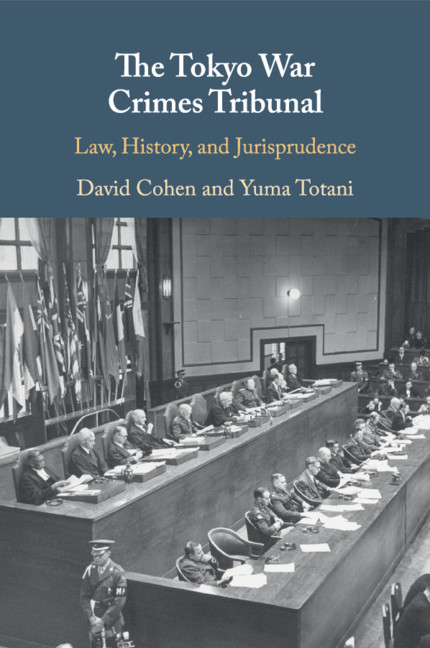

Like its Nuremberg counterpart, the Tokyo Trial was foundational in the field of international law. However, until now, the persistent notion of 'victor's justice' in the existing historical literature has made it difficult to treat it as such. David Cohen and Yuma Totani seek to redress this by cutting through persistent orthodoxies and ideologies that have plagued the trial. Instead they present it simply as a judicial process, and in so doing reveal its enduring importance for international jurisprudence. A wide range of primary sources are considered, including court transcripts, court exhibits, the majority judgment, and five separate concurring and dissenting opinions. The authors also provide comparative analysis of the Allied trials at Nuremberg, resulting in a comprehensive and empirically grounded study of the trial. The Tokyo Tribunal was a watershed moment in the history of the Asia-Pacific region. This groundbreaking study reveals it is of continuing relevance today.
‘In The Tokyo War Crimes Tribunal David Cohen and Yuma Totani, two of the most preeminent scholars on Japanese war crimes law and history, engage in the most thorough rebalancing of the legal analysis and historical appraisal of the tribunal yet to be undertaken.'
Neil Boister - University of Canterbury, New Zealand
‘A welcome new take on the Tokyo War Crimes Trials. Ironically, the freshness of this work rests in its classic framing. It studies the tribunal as a judicial process, examining the legal procedures by which evidence was presented and assessed. It offers a baseline for all future study of the tribunal.'
Andrew Gordon - Harvard University, Massachusetts
'… The Tokyo War Crimes Tribunal is the kind of achievement reached by devoting a career to the field - or indeed the topic - and it promises to hold a key position in the historiography on the Tokyo trial.'
Luigi Lonardo Source: Journal of Contemporary History
Loading metrics...
* Views captured on Cambridge Core between #date#. This data will be updated every 24 hours.
Usage data cannot currently be displayed.
This section outlines the accessibility features of this content - including support for screen readers, full keyboard navigation and high-contrast display options. This may not be relevant for you.
Accessibility compliance for the HTML of this book is currently unknown and may be updated in the future.
