
Skip to main content Accessibility help
×
  • Cited by 1
    • Show more authors
    • You may already have access via personal or institutional login
    • Select format
    • Publisher:
      Cambridge University Press
      Publication date:
      18 August 2022
      25 August 2022
      ISBN:
      9781316417591
      9781107124707
      9781107561977
      Dimensions:
      (228 x 152 mm)
      Weight & Pages:
      0.651kg, 334 Pages
      Dimensions:
      (229 x 152 mm)
      Weight & Pages:
      0.55kg, 334 Pages
    You may already have access via personal or institutional login
  • Selected: Digital
    Add to cart View cart Buy from Cambridge.org

    Book description

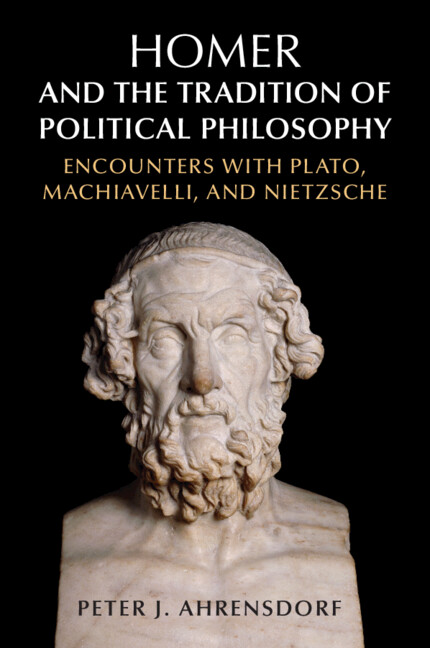
    In this book, Peter Ahrensdorf explores an overlooked but crucial role that Homer played in the thought of Plato, Machiavelli, and Nietzsche concerning, notably, the relationship between politics, religion, and philosophy; and in their debates about human nature, morality, the proper education for human excellence, and the best way of life. By studying Homer in conjunction with these three political philosophers, Ahrensdorf demonstrates that Homer was himself a philosophical thinker and educator. He presents the full force of Plato's critique of Homer and the paramount significance of Plato's achievement in winning honor for philosophy. Ahrensdorf also makes possible an appreciation of the powerful concerns expressed by Machiavelli and Nietzsche regarding that achievement. By uncovering and bringing to life the rich philosophic conversation among these four foundational thinkers, Ahrensdorf shows that there are many ways of living a philosophic life. His book broadens and deepens our understanding of what a philosopher is.

    Reviews

    ‘Ahrensdorf’s study not only explores the extraordinary influence of Homer in the tradition of Western philosophy, but it also now illuminates the ways in which Homer challenges three of the most powerful minds in that tradition, and us, to examine the question of philosophy itself … Among Ahrensdorf’s great virtues as a writer is his exceptional attentiveness to textual detail, capacity to draw out the human meaning of the texts, and ability to richly imagine the characters that people them. His work marries these qualities with a focus on the most fundamental human concerns, treating them with the gravity they demand and the levity they occasionally evoke. Scholars may quarrel with his arguments or conclusions, but none will doubt the perspicacity of his understanding of the most serious questions of human concern.’

    Susan Collins - Associate Professor of Political Science, University of Notre Dame

    ‘… this is a challenging reimagining of the relationships between key thinkers in the tradition of political thought. Taken together, these interpretations make for a very good volume and one that will likely be a valued contribution to the field of political theory and literature.’

    Seaver Holter Source: The Review of Politics

    Refine List

    Actions for selected content:

    Select all | Deselect all
    • View selected items
    • Export citations
    • Download PDF (zip)
    • Save to Kindle
    • Save to Dropbox
    • Save to Google Drive

    Save Search

    You can save your searches here and later view and run them again in "My saved searches".

    Please provide a title, maximum of 40 characters.
    ×

    Contents

    Metrics

    Altmetric attention score

    Full text views

    Total number of HTML views: 0
    Total number of PDF views: 0 *
    Loading metrics...

    Book summary page views

    Total views: 0 *
    Loading metrics...

    * Views captured on Cambridge Core between #date#. This data will be updated every 24 hours.

    Usage data cannot currently be displayed.

    Accessibility standard: Unknown

    Why this information is here

    This section outlines the accessibility features of this content - including support for screen readers, full keyboard navigation and high-contrast display options. This may not be relevant for you.

    Accessibility Information

    Accessibility compliance for the HTML of this book is currently unknown and may be updated in the future.
