
Skip to main content Accessibility help
×
  • Cited by 13
    • Show more authors
    • You may already have access via personal or institutional login
    • Select format
    • Publisher:
      Cambridge University Press
      Publication date:
      16 March 2017
      27 February 2017
      ISBN:
      9781316488362
      9781107139084
      Dimensions:
      (279 x 216 mm)
      Weight & Pages:
      1.73kg, 436 Pages
      Dimensions:
      Weight & Pages:
    You may already have access via personal or institutional login
  • Selected: Digital
    Add to cart View cart Buy from Cambridge.org

    Book description

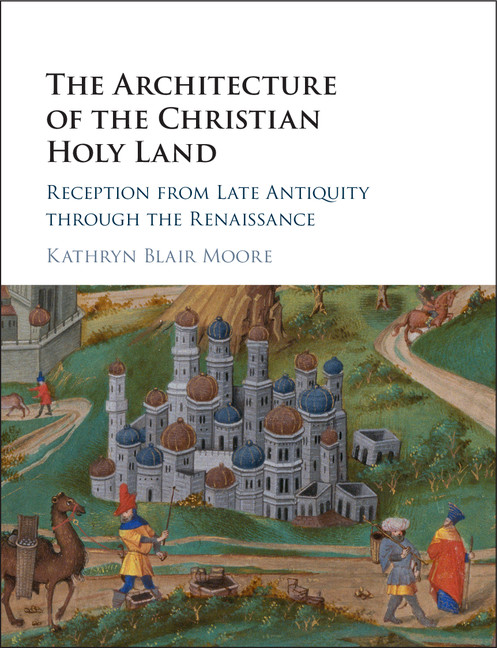
    In the absence of the bodies of Christ and Mary, architecture took on a special representational role during the Christian Middle Ages, marking out sites associated with the bodily presence of the dominant figures of the religion. Throughout this period, buildings were reinterpreted in relation to the mediating role of textual and pictorial representations that shaped the pilgrimage experience across expansive geographies. In this study, Kathryn Blair Moore challenges fundamental ideas within architectural history regarding the origins and significance of European recreations of buildings in Jerusalem, Bethlehem, and Nazareth. From these conceptual foundations, she traces and re-interprets the significance of the architecture of the Holy Land within changing religious and political contexts, from the First Crusade and the emergence of the Franciscan Custody of the Holy Land to the anti-Islamic crusade movements of the Renaissance, as well as the Reformation.

    Awards

    Winner, 2018 PROSE Award for Art History and Criticism

    Winner, 2019 Otto Gründler Book Prize, Medieval Institute at Western Michigan University

    Reviews

    'Most significantly, Moore focuses on the varying perceptions about these architectural landmarks over time and the ways they were visualized in different artistic media. Well written, including ample notes, and illustrated with images. Highly Recommended.'

    J. Pollini Source: Choice

    'The book provides a first attempt at a general synthesis of a topic that was never discussed from a longue durée perspective. The author politely reacts against the tendency, still underlying many art-historical studies following a famous article by Richard Krautheimer, to consider all buildings that came to be described in medieval and early modern sources as inspired by or stemming directly from the Jerusalem Holy Sepulcher and other loca sancta churches as generic, symbolic, or basically inaccurate replicas of their archetypes.'

    Michele Bacci Source: The American Historical Review

    Refine List

    Actions for selected content:

    Select all | Deselect all
    • View selected items
    • Export citations
    • Download PDF (zip)
    • Save to Kindle
    • Save to Dropbox
    • Save to Google Drive

    Save Search

    You can save your searches here and later view and run them again in "My saved searches".

    Please provide a title, maximum of 40 characters.
    ×

    Contents


    Page 1 of 2


    Page 1 of 2


    Metrics

    Altmetric attention score

    Full text views

    Total number of HTML views: 0
    Total number of PDF views: 0 *
    Loading metrics...

    Book summary page views

    Total views: 0 *
    Loading metrics...

    * Views captured on Cambridge Core between #date#. This data will be updated every 24 hours.

    Usage data cannot currently be displayed.

    Accessibility standard: Unknown

    Why this information is here

    This section outlines the accessibility features of this content - including support for screen readers, full keyboard navigation and high-contrast display options. This may not be relevant for you.

    Accessibility Information

    Accessibility compliance for the HTML of this book is currently unknown and may be updated in the future.
