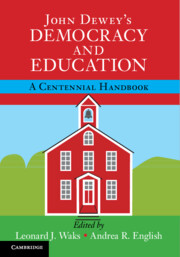


The year 2016 marks the centenary of the publication of John Dewey’s Democracy and Education. This magisterial work stands alongside Plato’s Republic and Rousseau’s Emile as canonical works in philosophy of education. It has been continuously in print since its initial publication, and is cited more frequently each year than all of the other classic works in educational studies – those by Edward Thorndike, G. Stanley Hall, and Lewis Termin among others – combined.
The text has had worldwide influence and is regarded as a classic in philosophy of education. The sheer numbers of international publications and events planned for 2016 to celebrate this magisterial work indicate its profound relevance, within the field of philosophy of education and beyond.
What is it about this book that so many people are drawn to?
Democracy and Education was written as a textbook in philosophy of education; it is still frequently assigned in many education courses – in whole or part – as course reading. At first, some may find the book a daunting read. Most pre-service teachers have not heard of Dewey. However, it is often the case, as teacher educators report, that as soon as university students read a few passages of Democracy and Education, they start to discuss how the ideas apply to the classrooms they have experienced, either as students during their own schooling, or as teachers.
Dewey’s book covers a wide range of themes and issues relating to education, including teaching, learning, educational environments, subject matter, values, and the nature of work and play. Dewey discusses various aspects of these issues and how they relate to underlying philosophical positions on the mind, knowledge, and morality. As the title indicates, the text offers a way of looking at the relationship between democracy and education. Dewey writes in the preface that he will not only discuss “the constructive aims and methods of public education,” but also provide “a critical estimate of the theories of knowing and moral development which […] still operate, in societies nominally democratic, to hamper the adequate realization of the democratic ideal.”
For educators, the book offers insight into the importance of their work. It makes clear that educating is not an isolated task, something that has influence on just the one person being “educated” in one particular moment. Rather, the work of the educator is embedded in the web of relationships – political, social, moral, etc. – that make up our groups, communities, and societies, and can, in turn, influence those relationships.
One reason philosophers of education admire this book is the contribution it makes to establishing philosophy of education as indispensable to the education of teachers. As is seen in many of his other texts, Dewey regarded teaching as a profession that entails thinking and reflection (on this point he was in agreement with thinkers of other traditions, such as J. F. Herbart and R. S. Peters).
Democracy and Education illuminates how philosophy is intimately intertwined with education and this is seen in how the book sets out to define what education is, and culminates with a definition of philosophy as “a general theory of education.” Sidney Hook wrote in his introduction to Democracy and Education that it is “the one book that no student concerned with philosophy of education today should leave unread.”
This handbook is designed to help experts and non-experts to navigate the text. The authors of each chapter in our handbook are experts in the fields of philosophy and education and are writing on a part of Dewey’s work that has particularly resonated with them, and that they have returned to time and time again throughout their careers.
The handbook is divided into two parts. Part I features short companion chapters corresponding to each of Dewey’s chapters in Democracy and Education. These serve to guide readers through the complex arguments developed in the book. Part II features general articles placing the book into historical, philosophical, and practical contexts.
