

Acknowledgments
The idea for this book originated in conversations with Ad Putter and Myra Stokes. Their foundational work made it possible for me to think in concrete terms about how alliterative meter evolved from its remote beginnings to the dawn of the modern era. At the “Conference on the Metres of Alliterative Verse,” hosted by the University of Bristol in July 2005, I also profited from conversations with J. A. Burrow, Thomas Cable, Hoyt Duggan, and Thorlac Turville-Petre. Preliminary work toward this book has been presented at the Bristol conference, at SHEL conferences in Seattle and Ann Arbor, and at the “Frontiers in Comparative Metrics” conference co-hosted in 2008 by the University of Tallinn and the University of Tartu. At these conferences I obtained useful ideas from many linguists interested in poetic form, including Lev Blumenfeld, Maria-Kristiina Lotman, Mihhail Lotman, Donka Minkova, Gregory Nagy, Seiichi Suzuki, Yasuko Suzuki, Marina Tarlinskaya, Reuven Tsur, and Gilbert Youmans. R. D. Fulk and Leonard Neidorf read a draft of the book and responded with valuable comments on Old English topics. Bruce Hayes and Paul Kiparsky answered questions about aspects of their recent work that turned out to be very helpful. As always, Jacqueline Haring Russom has contributed linguistic and editorial insights. Linda Bree and her team guided me through the intricacies of twenty-first century publishing. I appreciate the advice from outside my core specializations of Old English language and literature. It hardly needs to be added that any errors are my own responsibility.
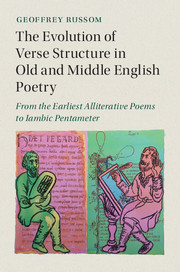
My efforts to understand artistic language from the creator’s perspective have been supported over the years by colleagues in Brown’s Literary Arts department, especially Robert Coover, Forrest Gander, Michael Harper, John Hawkes, Edwin Honig, Gale Nelson, Aishah Rahman, Meredith Steinbach, Paula Vogel, Keith Waldrop, Rosemary Waldrop, and C. D. Wright. English department colleagues Catherine Imbriglio and Larry Stanley were always willing to converse about literary style. I have also profited from conversations about aesthetic form with musicians Jesse Holstein, Bevin Kelley, Michael Kelley, Susan Kelley, Gavin Russom, Sebastian Ruth, and Chase Spruill. Jane Unrue and Jennifer Martenson provided the valuable perspectives of accomplished creative writers who are also accomplished musicians. Michael Russom has been my advisor on visual aesthetics. His cover illustration for this book imagines a Middle English scribe (on the right) trying to understand an Old English poet who composed about eight hundred years earlier (on the left). Michael’s illustration captures the idea of an archaic meter that persisted for a remarkably long time and changed significantly as it evolved.
“A Kodiak Poem” is reprinted from Effort at Speech: New and Selected Poems by William Meredith, published by TriQuarterly Books/Northwestern University Press in 1997. Copyright © 1997 by William Meredith. All rights reserved; used by permission of Northwestern University Press and Richard Harteis.
Finally, thanks to Cambridge University Press for adapting the cover to their series format and for their exemplary support of English language studies.
