

Tucheē
How does a human being, furless and clawless, with unimposing height, survive against Pandora’s ‘daimon’ – against those demons that forever seem to conspire against prosperity, health, life; conspire against one’s efforts at hard work and good conduct? A beginning for the question concerning strategy lies here: with humans roaming their environment. Here on earth: where the heavens, crossed by the burning sun and rain-laden clouds, throw themselves at human life down below; where the soils reveal their fruits, but often capriciously; where feasts are salted by the memories of starvation from which they are but temporary relief. For every coming together in form there is a pulling away, and the ebb and flow of uncertain life. Such was the imagined origin to human life referred to by ancient Greeks as tuchē,Footnote 1 which could translate as luck, which is less a quality of randomness than an experience of double play in which a vulnerability to external happenings is coupled to a persisting sense of the essential openness of life. Those with tuchē experience life as chaotic, but more in Hesiod’s sense, for whom chaos was the first form-giving incision into the pre-natural unity of the cosmos, the first rupture (eris), one that distinguished the form (eros) of earth from heaven and which gave birth to language, and so to all the other distinctions at which humans, born into chaos and exposed to tuchē, have to work:
the race is indeed one of iron. And they will not cease from toil and distress by day, nor from being worn out by suffering at night, and the gods will give them grievous cares. Yet all the same, for these people too good things will be mingled with evil ones.Footnote 2
Hesiod speculates how humans came to acquire the skills, crafts or arts to cope: building shelters, stalking prey, gathering berries, and then the turn to planting, threshing and grinding, and to the yoking and taming of animals; the arts of metal and woodwork; of predicting weather and divining; and the most praised of all arts, those of building ships and navigating. Equipped with such arts, Hesiod ‘recalls’ how, with the gift of technai, humans were able to co-operate; record the seasons, to plant, rear, smith and hammer so as to have workshops and produce what they needed and more; so they could begin to store and trade; thus controlling nature’s unpredictability; insulating themselves against long cold winters or periods of drought. Technē meant bringing something to realization; bringing something to sensory appearance and understanding through use. By giving form to what was inchoate, but always alive to the risky, loosening force of eris, humans could organize: not just guard themselves against tuchē, but play with it, and in doing so experience an immanent power that comes to beings who, bearing the element of iron and being skilled at working it, teem with life.Footnote 3 Technē thus came to stand in place of, and then opposition to, tuchē at whose mercy proto-humans had been thrown and under whose exposing influence the scheming, cunning, flexible, practical human – the human gifted with fire from the forge of Hephaestus - emerged. Technē is the organization of destiny through the ‘deliberate application of human intelligence’.Footnote 4 It is a process of civilizing, of controlling events. In Hesiod’s poetry it is symbolized in the efforts made by eros to tame eris. In the beginning this was a bloody game amongst the immortals, as when stabilizing, straight talking Zeus swallows the unruly, serpentine Metis, hoping to absorb and then manage her innate cunning. There would always be mysteries and anomalies, but these were treated as potential symptoms awaiting treatment strategies based on the initial collection and careful counting and weighing of observations, so that inferences could be drawn from individual cases, allowing the generation of more universal hypotheses, moving understandings from mere description towards explanation.Footnote 5 Gradually, divine caprice and magic were expelled, and reasoning took hold.Footnote 6
Counting, Weighing, Measuring
This conception of a human life guided and graded by reason, emphasizing the stable, and abstract aspects of things to be understood as objects, was fed by a narrative of growing self-sufficiency enabled through the arts of counting, weighing and measuring. Nussbaum refers to this struggle against the unreliable features of the world as ‘trapping and binding’; a conception of form-giving eros being guided by intellect.Footnote 7 This leaves the human agent an overseer who continually tracks down, seizes, holds, arrests and controls tuchē, but who, in doing so, remains a source of force and violence set against the world. The world becomes a place that needs taming, a space against which to guard oneself with the technē of counting, weighing and measuring. These epistemological processes filter understanding, taking out the grit and troublesome lumps, evening things up by naming them abstractly and in ways they might be related, ranked, tallied and stored: practical deliberation about the nature of something gives way to an intricate concern for its comparative, quantitative measure. These processes were teachable, but through inscription and imitation of scripted technique rather than just situational sensitivity, thereby schooling students not simply in practical technique, but in a proper way of relating to the world of things. With this distinction in mind, the experiments and knowledge claims of technē moved from trials and curiosity towards explanation, answering ‘why’ rather than ‘how’ things happened, and doing so in systematic rather than personal forms.Footnote 8
Though we have written of tuchē having given way to technē, and of technē becoming increasingly abstract in the process of this transition, our brief chronology is also itself an abstraction. The earliest known Greek medical text, for example, the Hippocratic Corpus, already elaborates on a distinction between general external forms and the specific nature of things. While human beings, or their limbs and other body parts, but also illnesses and other elements, can be described in general terms and along visible characteristics, there are also, it suggests, elusive but tangible factors in play: A body’s age, strength, but also the specific nature of a person’s digestive system and many other, merely inferentially knowable tendencies. A sound medical strategy should never rely on the textual generalizations pursued by physicians, but required, in addition, the kinds of craft skill exhibited by surgeons when navigating the interplay of general and recurring regularities (the eidos) and the hidden and changing specifics (the dynameis). This difference between what is generalizable and the changing specifics of every patient and situation exposes the physician to contingency (which in turn prompts the development of a professional jurisdiction connecting work practice, human problems and expert knowledge). There will be situations where available technē is not sufficient; and there are those situations when, as in advanced stages of illness, technē loses grip entirely and the struggle becomes more emotional and palliative than technical.Footnote 9 This was known from the outset, and has remained common sense understanding in medical practice: Indeed, any claim to medical expertise is animated by an awareness that the more technē is avowed, the more its limits are revealed. As with medicine, the same goes for engineering, for law, for architecture and for astronomy.
There is something about professional expertise that resists quantification. It invokes disciplined, precise and teachable techniques and principles, but then takes them on somehow, into a space of expressive discernment that cannot be translated into explicit knowledge. What is being valued in expertise is often the activity itself and how it grades what otherwise are unordered conditions, but it need not lead to comparable and quantifiable outcomes, it can only be witnessed, and acknowledged as sensitive, skilful, even beautiful.Footnote 10 With sensitivity comes care, an ability to absorb and even encourage the ways in which people can resist what seems rationally expedient. Human lives are riddled with minor twists of the self-destruct button; a breakdown of reason or weakness of will (a case of akrasia) or by acts of hedonism, animated by immature instincts when set against the practices of measuring and the weighing of alternatives against one another, pro and con. But expertise, such as that being exercised by the skilled surgeons of ancient Greece, is less judgmental. It understands those situations in which the body and feeling have their own locus. Love, disappointment or anxiety, for example, remain heterogeneous and incommensurable; as ‘ordinary human’ experiences they have qualitatively unique features.Footnote 11 These experiences pertain to what we call human health, but they are beyond the reach of a physiological understanding. As Nussbaum so carefully observes, indeterminable and accidental tuchē begins to reaffirm its hold whenever we recoil from objects that feel disturbed in the face of alien or threatening things, or attach ourselves to vulnerable objects or people, through love, friendship, but also in trusting or dependent relationships where these others are not merely replaceable objects that can readily counted, weighed or measured; where our values are plural and thus incommensurable or in conflict; and where our passion overrides our calculative intelligence. Tuchē comes back at us whenever we speak of what seems, or appears as, the more essentially human aspects of our body we cannot rationally control.Footnote 12
The Almanack
As technē reaches into the question of ‘why’ something occurs, tuchē pulls on its heels, bringing it back into a situational sensitivity to the question of ‘how’: Each rolls into the other, as a slope falls into a valley or rises onto a hillside, each an intimate aspect of the other. One reaches for the open sky and the other falls to earth, and each demurs to the necessity of yielding.Footnote 13 At least this is so for the vast range of knowledge by which humans survive and flourish as sentient creatures. Making things (technē) entails situational responsiveness: the country doctor might be less bookish than the academic physician, but be a lot more useful because of it. As a technai they make the best use of the available materials in the given conditions, aware as they are that the world of practice is inherently indefinite and indeterminate.Footnote 14 Their technē gains its own outline by corresponding with what is changeable: its objects ‘come and go and change in various ways’.Footnote 15 But it is not raw tuchē, things occur and are made under a directing intelligence, the human becomes close to things that, in turn, amend and alter the world under the impress of human design.Footnote 16
The printed embodiment of this intimacy between tuchē–technē is the almanack: a book outlining the rough plans that frame a life of practical wisdom. Their origin is archaic, arguably going back to Hesiod’s Works and Days (though here in aural form), which provides a seasonal blueprint where cosmic patterns, mythology and advice for agricultural processes fuse:
When Zeus has completed sixty wintry days after the solstice, the star Arcturus is first seen rising, shining brightly just at dusk, leaving behind the holy stream of Oceanus. After this, Pandion’s daughter, the dawn-lamenting swallow, rises into the light for human beings, and the spring begins anew. Forestall her, prune the vines first: for that way it is better. But when the house-carrier climbs up from the ground on the plants, fleeing the Pleiades, there is no longer any digging for vines: sharpen the scythes and rouse your slaves. Avoid shadowy seats and sleeping until dawn which when it shows itself sets many men on their way and puts the yoke on many oxen.Footnote 17
Some 2,500 years later we find similar examples governing the agricultural rhythms, for instance the German abbot Mauritius Knauer’s Calendarium Oeconomicum Practicum Perpetuum from 1652. The Latin title belies what became the wide appeal of the genre, and subsequent authors quickly took to using the vulgate. Issued yearly, almanacks combined observations on astrological rhythms, weather patterns, folk legends and timely homilies. The readers were those living from the land and who carried within them a desire to enrich their experience with reflection as well as routine. The almanacks combined text, drawings, sketches and tables into which the reader could project his or herself, creating a plan for daily living. The word plan comes from the Middle French for a diagram made by projection on a horizontal plane, which in turn came from the Latin plantare: to propagate from cuttings or seedlings and from ‘planta’, sprout or shoot, but also indicating the sole of the foot with which seeds are spread out and pushed into the soil. Embodied in an almanack, planning meant listening to advice and working it into the cyclical passages of everyday life. Books like Knauer’s were to be a regular, easy-going, trusting companion: Light bonfires in autumn to burn better away the ruins of what is spent and dried up and clear and fertilize the ground for new growth; blanket what becomes frail during in winter, or let it fail; in early spring be wary of scathing winds that can strip back too hasty an attempt at seeding, but then leap with the opportunity for growth; enjoy the toil of harvesting during summer’s dry moments. This attunement to rhythms might be simplistic, but its room for pause provided small advantages when dealing with natural forces. The almanack is a timely and considered reminder of how lives are scripted by passing seasons. The recognition of patterns; the capacity to use foresight and the ability to collaborate with others meant that one was no longer entirely delivered over to nature’s changing fortunes.Footnote 18
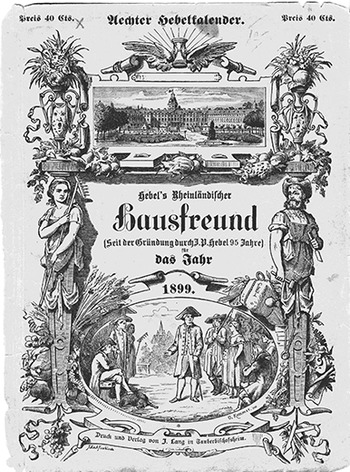
Where Knauer was one of the earliest authors of an almanack, it was the Lutheran priest and author from the Duchy of Baden, Johann Peter Hebel who became one of the most enduring (see Figure 4.1). Hebel’s language is unashamedly poetic, with the intent of revealing what is most homely to us, what is own-most, which is not what we own and use, but what is naturally occurring around us and to which, if we are patient, we might listen. Hebel’s Little Treasure Chest of the Rhineland Family Friend opens onto an immediate world whose natural and social abundance is netted in gently cosseting abstractions. We have an arresting and circuitous coming together of the felt and the rational, the historical and natural. The writing on seasonal rhythms is marked by detailed observations of the twist of the heavens; and poetic descriptions of the bursts of blossom or frost are interspersed by tables marking when best to plant seeds, and the detailed litany of Christian Saints’ days are pressed alongside other calendrical conventions, reminding the reader of this polytheistic world. The world appears as neat and available to planning, but it is not totally ordered: Indeed, if one were to look closely enough at the cycles and repetitions, one would find oneself amid unruly exceptions and digressions. Hebel reveals this interplay of tuchē and technē with acute sensitivity. For example, he talks sympathetically of the cruel intercession of death into family life and considers what ought to be the natural period of mourning and lament, but then indicates the extent of this timespan using a list of significant historical events. The reader is comforted by being told that grief is natural and lasting, but not without also being reminded that there was a proper span for grief, one roughly equivalent, for example, to the French and Spanish siege of Gibraltar. As Sigmund Freud was later to observe, proper mourning works as a corrective. The loss of an object of love is painful, it requires a relinquishing of what has hitherto been a strong attachment, and none of us will relinquish the ties of love easily. Hence, we withdraw from reality awhile as an effective (reasonable) way of coping with what otherwise remains an emptying and even bewildering condition. To mourn is to create a space of transition – one goes into a process of mourning during which one’s loves, one’s faith in projects, one’s interest in living even, gradually become unshackled from the objects that have died. Mourning is a necessary pause of re-organization (eros gives way to eris, to then recover): to go into mourning is to presuppose an exit and restoration of an ordered balance of the living and dead.Footnote 19

Figure 4.1 Hebel’s Hausfreund. Wikipedia commons
Hebel’s language is free from direct knowledge claims and moralizing principle; though it comes from the hand of a preacher it does not preach. Heidegger was entranced with Hebel’s style, suggesting its power comes in letting understanding emerge, its naturalizing imagery (Bilden) being a pushing forth into awareness as vibrant and fulsome as that of the fields in spring. His language settles its roots deep in the earth, in which lay the dead, and its crown reaches up and spreads in a filigree of branch and leaf whose tips flutter almost invisibly in blue air. It is a language of connectiveness and suggestiveness rather than assertiveness, a language enriched through an unashamed use of lilting dialect, yet its rusticity is sophisticated, so that alongside the colloquialisms comes a cosmopolitan curiosity. In this way Hebel shows the reflections and aspirations of human planning being hardened by facts and measures, and then how they might be softened, were they to be taken back into the concourse of natural patterns. He makes ‘far away facts’ resonate with what is near in the most indirect, and therefore thoughtful, of ways. His words are touched with the taint of an immersive empirical method that demands the poet and reader stay in touch with what surrounds them, retaining a sense of the home that, inevitably, will be lost once life is done and falls under the falling of leaves. Hebel’s language speaks of quiet ritual, and as a poet, he co-responds to this language, and amid the text, figures and tabulated figures of this language readers are able to discern ‘the enduring in the inconspicuous’.Footnote 20
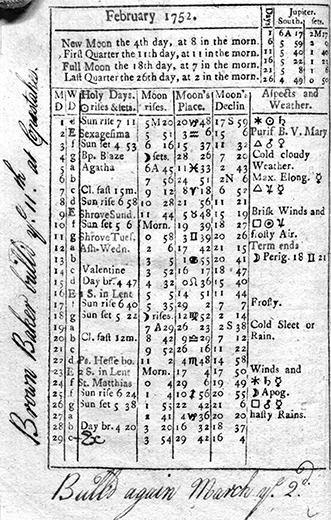
As a genre the almanack encloses understanding between two small and inexpensive covers, making it available for anyone who can read, and cares to. The planning fostered in the use of an almanack is of a gradual and careful form, and it demands an ongoing relationship, so that year on year, with each iteration, the reader becomes more and more familiar with the appropriate ordering of life. Often the reader would add marginalia and reminders (see Figure 4.2), attesting to an active and ongoing reading of their own experiences into the textual and tabulated forms. It works as a ready-to-hand reckoner through which the world appears as a place that is open to control, but humbly so. Its spirit seems akin to what Heidegger meant by attunement: the reader finds his or herself being thrown into the world, having to abide by its structures, but with consideration of their own experience of being amid such a place.Footnote 21 It is a planning system in which a sense of self-awareness, albeit a rudimentary one, becomes possible. In being a practical expression of attunement, it is a form of planning that Heidegger looks to warrant in some way. He wishes to remind us that planning with an almanack would allow a farmer to come to know how a tool like a mattock may be ‘used in the most adequate way possible”,Footnote 22 a use that carried within its stroke a generational familiarity that allowed the user to simply and uncomplainingly get-on with the task at hand. The mattock-wielding farmer would come to know themself as a technai, sowing seeds in good soil and content to wait for the necessary period before the plants sprout and mature, alive to situational demands, paying heed to the acidity of the ground, the weather, the local trading conditions, and the tremors of an ever-ageing body.Footnote 23 What gives justification and meaning to the things around them is, in the context of making, the use towards which things are being continually put. The farmer finds use for the seed in-order-to produce crop for-the-sake-of feeding his family or exchanging it via the tools of the market into other goods and tools. What gives justification for that thing to appear as a ‘seed’ is the wider set of relationships that are circumspective (rather than explicitly) grasped by the farmer, and which thereby also lend justification and definition to their own existence ‘as a farmer’ into which they project themself, and about which they are, on occasion, conscious, as when they write in a well-thumbed copy of an almanack. It is in caring for the land, animals and the crops that the farmer gains this wider sense of use, which is borne out of an intimate connection with, and care for things that make up the agricultural surround. In caring, past and future belong together; history and folk knowledge fuses with the immediacy of practical requirements and a horizon of understanding within which the possibility of existing as a farmer first makes sense.

Figure 4.2 Wing’s Almanack, 1752. The handwritten notes record specific cows being bull’d at certain times. Reproduced with permission from Thomas Fisher Rare Book Library, University of Toronto.
Francis Bacon’s Platform
Whilst technē is suffused with everyday affairs, its refinement is more equivocal and conscious than a state of absorbed creative flow: in eschewing purely formal knowledge (as espoused by Arendt’s experts in possession of their conversation stopping truths) it also refuses to become the habitualized and mindless routine of those who are so skilful as to be acting thoughtlessly. It is neither absorbed doing nor generalizing contemplation. Rather, technē entails ‘initially and constantly looking out beyond what, in each case, is directly present at hand’, and so any stratagem for making must thus look beyond the maker’s own contribution to how the world in turn affords making (viz. is of a character that affords possibility to making).Footnote 24
Heidegger’s reading of technē situates making in being as an opening-up to thought, which becomes both an active as well as contemplative condition. It is an intimate, engagement with things that speaks to their nature, and reveals these in accordance with this nature rather than through calculating, measuring and weighing. Technē provides beings with room:
to grasp beings … in their outward look, eidos, idea, and, in accord with this, to care for beings themselves and to let them grow, i.e., to order oneself within beings as a whole through productions and institutions. Technē is a mode of proceeding against physis [nature], though not yet so as to overpower it or exploit it, and above all not to turn use and calculation into principles, but, on the contrary, to retain the holding sway of physis in unconcealedness.Footnote 25
Through technē objects change and those who possess technē disclose this or that depending on the different natures of the things they encounter, their immersive skill in technique of planting, cobbling or painting, and the situation.Footnote 26 So in the making of things technē is always also a concealing, where concealing is a threefold combination of hiding away or veiling, of closing down and turning away, and of restraining and holding back.Footnote 27 To make thoughtfully is to be alive to a materiality of things, to the forms they take and uses to which they are put, and to be there amid these things, imagining oneself into the world through such a company.
In learning the value of this restraint, a self is steadily revealed to itself as a being complicit with what is being made: a consciousness of doing yields a conscience through which human experience, as a brute and unquestioned scene of occurrence, acquires an authority of publicly shared maxims and proverbs and ways of going about things. This going about things is common sensical, but never rises to the condition of formal knowledge. To know is to claim there are relations between things that resist time, whereas holding sense in common is an acceptance of how time ascribes limits to all appearance. Smooth-sided knowledge baulks at the rough surfaces of experience, it sees the patches of ordinary life as little more than place holders for information and data which it might extract and analyse in its laboratories, then re-impose, creating order from unruliness.
Though uneasy, the relation can be productive. It was in enjoining the improving and restless spirit of scientific inquiry with the acquired wisdom of common sense, for example, that the natural philosopher Francis Bacon instructed readers on how to create an ideal garden. Written towards the end of his life, his meditation on gardening is a mature reflection on how to gather and influence nature all the year-round, but without imposing oneself directly. He suggests the objective of any expert gardener is the creation of a platform: ‘plat’ being a plot or piece of ground, and ‘form’ being an outline, and it is very much a sketch, an outline, as opposed to detailed instruction. His textual advice is often brief, aphoristic and even poetic, leaving blank spaces to be filled by the experimental gesture of those who are actually doing the gardening at his, Bacon’s, suggestion, but more pressingly under Nature’s guidance. Bacon extemporizes on his knowledge of nature by succumbing to its force: he talks of filling the ground with different plants and blooms, beds, benches and trellises so that it might yield of itself. He finds excitement in realizing that a stretching of flowers might be coached into second flush (the violets that come in April and around Bartholomew-tide), he is respectful of the way juniper and fritillaries embrace rather than shy away from winter, he delights in the spring dance of the daisy, almond tree and stock-gillyflower, and he plays with the sequence of colour offered by sequential planting of pinks and cherries, vine flowers, and lime tree blossom. The cycles and rhythms of the year are being discovered by the laying out of plants according to their differing rates of growth and from the overlapping and contrasting of blooms and scents. Bacon observed, always observing, how some plants gave of their scent wantonly, whereas others like rosemary were demur and needed coaxing by touch, how bees would be drawn to a succession of flowers and leaves through the spring and summer, how small heaps and pathways would break up a broad sweep of land and lend to the visitor an air of discovery, how restless water cleans the roots of cress and still waters encourage the frogs (which he didn’t like).
In organizing the platform he was absorbing the styles and wiles of nature in such a way that a connectedness of things comes to the fore. He was also learning how, amid all the order he might chance to imagine a garden taking, it was the chance and fleeting occurrence that was the most arresting and beguiling. In planting flowers for aroma, for example, we find Bacon gradually straying from obvious blooms like musk rose and honeysuckle. He becomes partial to ‘the cordial smell’ of dying strawberry leaves, as well as those flowers giving their scent when ‘trodden on and crushed’, the ‘burnet, wild thyme and water-mints’, which might be set in ‘whole alleys’ upon which one can walk. It is the metamorphosis itself that becomes apparent, the cycles of birth and death, the planting of something so innocuous as a small, hard, black seed becoming in a matter of months a scarlet poppy dressed for death. And through his walking the then fashionable geometric gardens of strictly aligned, heavily decorated hedges and gravels gave way to a less contrived, naturalistic form whose curvature was ever sensitive to the solicitations to think, feel and act offered by plants, soils and the open sense of the wider countryside, and it was this sensitivity, rather than abstracted images, that gave his platform life.Footnote 28
Being inside Bacon’s platform was an invitation to be something and be somewhere else. The plan was a condition of transformation, a projection of the change that befalls us, wild as much as civilized, and a desire to think anew. Technē becomes embodied in a gathering of shared, continuous and immersive experience to which mental direction is but an occasional and respectful visitor.Footnote 29 To inquire and so learn is to ‘make with’ what is present at hand, being guided by the body as it sensually falls into places, and from this experience empirical life is rendered sensible and available to imaginative speculation. It is not always an easy falling in, a scent revisited can change from intoxicating to disturbing, hinting at a brutality as much as well-being. Nature is not always easy, or easily confined in nice spaces.
Though a garden and not an overtly political space, Bacon’s platform bears loose comparison with Arendt’s space of appearances (as set against Heidegger’s more centralizing pole, or shepherding ‘leader’). Bacon’s platform is more organically rendered than the somewhat separated, overtly civic, polis. Bacon’s thoughtful action generated opinion through a kind of empirically infused logos whose methods were less severe than those of Socrates. Bacon’s method is little more than to walk as well as talk, to observe and then experiment, to plant and so to understand the farthest reach of a plant’s expressive viability across different conditions and climates. From this peripatetic learning emerges a vision for growth in which nature and experimenters are entirely complicit. This understanding might begin with, and by crystalized by, certain rules, but quickly absorbs itself directly in things, which can then be made subject to further representational mediations as a means of guidance, from which one might take one’s cue, and to which one might return, pausing, from amid the sway of things.
In plotting his garden Bacon seems to have moved away from his earlier attempts to pressgang experience in the service of science. In Novum Organum, for example, Bacon had recommended a regulated and digested, rather than vague, course of experiment, from which to deduce axioms, and to set up new experiments. Experience itself was a ‘maze’ a ‘forest’ that needed taming, and no better way than to substitute natural appearance with those altogether core predictable and ordered appearances of the laboratory. Agamben notices how Bacon as an advocate of science rather than as a gardener seeks to displace experience by moving it away from the individual and towards instruments and devices that are not so easily deceived.Footnote 30 Hebel’s world – the world of worldly maxims and advice whose authority lies simply in their being spoken and acknowledged without need for analysis – gives way to a world of knowledge being secured through the conscious and explicit appropriation of experience through the scientific method. Bacon’s treatise on the garden reads almost as though he were regretting the emerging ascendancy of formal experiment that he did so much to initiate, it is as if, in his wiser dotage, he recalls what it was like to experience in the company of wonder rather than verification and control.
Technē and Wonder
Bacon’s advice to gardeners is a distilling of technē in which the influences between things arrives as voices that can be listened to and held in abeyance, or ignored completely, heard and opposed, or taken up and riffed on. But there is little in the way of imposition. The planner, as planter and builder of platforms, is akin to an artisan, a figure that, in the hands of Heidegger, is as much a midwife as creator, as much subaltern to as controller of nature, a paver of ways rather than director.Footnote 31 The artisan experiences a sense of technē that is full of wonder:
What is wonder? What is the basic attitude in which the preservation of the wondrous, the Being of beings, unfolds and comes into its own? We have to seek it in what the Greeks call [technē]. We must divorce this Greek word from our familiar term derived from it, ‘technology,’ and from all nexuses of meaning that are thought in the name of technology … technē does not mean ‘technology’ in the sense of the mechanical ordering of beings, nor does it mean ‘art’ in the sense of mere skill and proficiency in procedures and operations. Technē means knowledge … For that is what technēmeans: to grasp beings as emerging out of themselves in the way they show themselves, in their essence [eidos].Footnote 32
Heidegger confronts us with the curious circumscription of technē neither as a knowledge of facts, nor an embodied, habituated, and mindless skill. Instead, he seems to suggest a way of knowing that apprehends something more than is immediately the case; a way of knowing that apprehends ‘that which first gives to what is already present at hand its relative justification, its possible determinateness, and thus its limit’.Footnote 33
What is being made determinate through technē is not one thing or another, but a relational intimacy amongst things that can be more or less harmonious. The farmer, the plough, the land, the sky, the tightly packed and stepped landscape into which one fits with the other, bending to each other’s contours, giving form to plants, animals, tools and humans in concert, each making itself available and becoming to the other. Bruegel imagines such a scene shown in Figure 4.3.

Figure 4.3 Pieter de Oude Bruegel, Landscape with the Fall of Icarus. Painted c. 1560, possibly a copy of Bruegel original. Koninklijke Musea voor Schone Kunsten van België, Brussels. Wikimedia commons
He can imagine it because he has lived through harsh Flemish winters where the cold freezes the feet of crows to the black, bare branches on which they perch, he is attentive to the raw cruelties being felt amid everyday happenstance by those who have to work the fields. As noticed by W. H. Auden,
So too was he alive to when nature was beneficent and giving, when the plough sank evenly into rich loam and the evening sun fell unbidden and untroubled over fertile fields. Yet nothing is at it seems. For a start, the stated subject matter of Breuegel’s painting is not farming, but the myth of Icarus’ fall. Bruegel’s scene depicts an imagined island of Crete, which, as Ovid recounts, is the bucolic prison of Daedalus and his son Icarus, held captive at the whim of King Minos. Desperate to escape, Daedalus reasoned that given the king had shut off routes across land and sea he and his son ought take to the sky. He fashioned wings from feathers and wax, and they leapt upwards. Momentarily, unbound from the earth onto which they had been thrown, they soar, the impetuous and delighted son becoming so enraptured with flight he strays too high, burns and crashes. Bruegel depicts the final moments. In the far bottom corner of the painting a flailing leg and arm thrash hopelessly, the panic quickly quenched by waves, as a nearby fisherman watches his line, oblivious to the tragic denouement of untrammelled exuberance and self-centred delight. Beyond them a ship is sailing into the open waters, its aft to the doomed adventurer, and its prow pointed towards a setting sun. In the foreground comes a neatly dressed ploughman, stepping after a well-managed horse (managiare, management), his sword and swagger carefully laid to one side on the ground. In the centre a shepherd looks upwards into empty sky, momentarily held in this up-looking gesture by a vague suspicion of an impossible movement having passed by the very corner of his eye.
In the image there is some of the settled comfort Heidegger believed he had found in Hebel, and which Bacon imagines in his platform. But we also have a scene which for Auden carries a unifying quality of quiet indifference, throwing up a spray of disturbing thoughts on:
The labour of ploughing carries on regardless, treading the middle of the field, the middle way, which is the right way for a being placed on earth to labour, a calm, knowing way, submitting to the plan laid down by unwritten law.
Labour as an Out-of-Body Experience
In the myth, Daedalus’ grief at his son’s death is confounded further by a deep sense of complicity. Daedalus was a peerless fabricator and devious fixer whose artifice was in high demand. In many ways his work was brim full of technē: his machines and solutions were always bespoke, appropriate and fitting the purpose at hand. When, for example, he had been commanded by Minos to build a prison for Asterion, the Minotaur, and had been imprisoned in the island to set about the task (brutish masters like Minos never ask, they just act) he had built something not from his own mind, but the creature’s. Asterion’s confused origin lay deep within the chasms of classification and feeling that separated, and so joined, animals, humans and gods. His confusion was twinned with angry uncertainty and bewilderment, and it was from this jumble of feelings that Daedalus had taken his cue for the maze: a network of twisting stone and tenebrous shadows leading first one way, then another, all the while going from nowhere to nowhere.
Daedalus knew his subject well, indeed he played a role in its birth. Asterion – the Cretan for wandering star – survived by eating human sacrifices selected by lot from the youth of a vanquished Athens and sent in tribute to Minos. Crete’s regional influence was pre-eminent in those days, yet Minos’ victories had been bought at some cost. Promising fealty to the god Poseidon in exchange for his assistance, Minos had received, by way of answer to his prayers, the gift of a beautiful white bull, which he was instructed to sacrifice as a consummation of his pact with the god. Minos agreed and secured Poseidon’s aid in dominating the region, especially Athens, but he could not bring himself to kill such a fine animal. Poseidon, always grumpy and often perverse, was understandably annoyed at this covetousness. He exacted punishment by encouraging Pasiphae, Minos’ wife, to lust after the bull rather than her husband. Transfixed, she bade Daedalus make a ‘mechanical cow’ into which Pasiphae strapped herself, mated, and gave birth to Asterion. Despite her motherly affection the half-bull, half-human child refused to be instructed in civilized manners and mores, always raging and wanting to eat human flesh, whether to affirm better its belonging to the species, or in disgust of it. Minos ordered its imprisonment and sent word to Athens to provide the food from amongst its own children. The ingenuity of the solution pleased Minos – who seems as equally perverse as Poseidon – for Asterion had given him a way of exacting terrible tribute from the Athenian upstarts. In a world that demanded ingenuity and cunning it worked to further endow his reputation for strength and vengeance whilst effectively dealing with the local problem of an unruly stepson. There had been little in the way of planning, but an acute awareness of situational limits and how far these might be moulded and even transgressed, first by human desire, and second by the work and labour of makers like Daedalus who knew how to channel their tool-making imagination in the service of solutions.
Minos used Daedalus as both a source of labour and work through which his island kingdom might be better managed. The technē of Daedalus was important, that of impetuous, dreamy Icarus far less so, his gesture carried too much of the open between its wings, whilst his father knew how to get stuck in, enabling Minos to treat his city as Daedalus did the Minotaur. The country and body were alike: built from separate organs, each with their characteristic needs, and requiring continual management. And Minos was not alone in acknowledging this intimacy between organic and social form, he was simply embodying common sense: the body is tended by physicians/surgeons, the state by kings/strategoi. With the cunning work of the hand and the intelligent work of the head, both exponents of the practical arts could restrict ‘the contingent, speechless events that Tyche loves to have happen’,Footnote 36 they could push the gods back up the slopes of Mt. Olympus, they could gain a little distance from nature, not just by using machines, but in thinking about their improvement in practices of calculation, and in thinking about society through such machinery. In this form of thinking through machinery, though, comes a removal from practice, much as surgeons removed themselves from tending the sick and became too much the physician, accruing knowledge and dispensing facts.
This distancing shifts the concerns we see in ancient Greek considerations of technē and tuchē from the here and now to the proximal and distant. If Daedalus can make machines that sate lust and imprison monsters, where are the limits to this practical capacity to project ourselves upon the world through such prostheses? Through Daedalus’ skill Minos was beginning to project himself into objects through which, he presumed, he became more present. And Daedalus, being wary of this ambition, tries to escape, but his machinery is worn by someone who lacks worldly technē, and who finds himself above everyday things. Icarus has had the temerity not only to use but enjoy and explore the potential of machinery, he has taken himself away from a world of labour, he has broken the rules laid down by his father for the correct use of tools, and freed from earth-bound projects, he touched on something that, whilst ultimately deadly, was a beginning: for in rising above the earth he has put paid to the natural order of things, the facts have bucked and will not be the same again. In Bruegel’s painting the sun, though it melted the wax in the wings, is not high, but setting, it is giving way, not to the puny body now swallowed by the sea, but to what it augured: the expressive will of being that sought to break the confines of dwelling in his house and to find a solitude amongst the clouds.
Bruegel’s falling and flailing Icarus is a wonderfully equivocal figure. At the dawn of the machine age he is excited. Courtesy of his father he has discovered what tools might do. Yet as Auden also points out, the loftiness comes with a price, not just death, but more devastating still, the lesson of submission to the rhythms of machinery. There is now no good reason to acknowledge wonder and surprise, or to linger: a thin and invisible film of acceptance and even callous indifference has fallen over human affairs in the wake of Icarus’ fate; the joyously acting and thinking self has been clipped by a warning to stay within human limits.
The Coming of Machines
For Elaine Scarry this awareness of limits has meant a gradual turning over of our body (and bodily self-awareness) to machines ‘out there’. For Scarry it takes three forms. First, how, when for example a bandage is placed over an open wound, the tool substitutes for missing skin, literally dressing the wound through man-made fibres. Similarly, eyeglasses, microscopes or cameras project materializations and conceptualizations of the lens of the human eye; or, through the association of the workings of organs like the heart with machinery like air and water pumps.Footnote 37 A second form is a re-presentation not of body parts, but of bodily capabilities and needs. Photographs, for example, materialize the bodily capacity for memory; or mechanical pinions and pistons with their hissing and wheezing, dissipating heat and with a constant need for water and fuel, materialize the bodily capacity for movement and need for sustenance; re-presenting an external materialization of the body’s capacity for self-replication and self-modification. And a third form conceives the body from the outside; as containing pumps and lenses without these being part of the felt-experience of being sentient.Footnote 38 All three forms turn the inanimate, external and unfeeling world inside out and, through the object, represent it to take on the internal, animate and sentient characteristics of human agency (the efficient cause) in two complementary transformations.Footnote 39 First, the separation and (objectification of the bodily attributes and, second, the recovery by the body of the objectified and now organized attributes in a process of self-appropriation.Footnote 40 The shape of the wings worn by Icarus, for example, is neither that of the spine nor the shape of the body and its weight, not even the shape of the release of energy it receives and then absorbs from Icarus as he kicks off from the cliff: it is, rather the counter factual structure of the shape of ‘earth-bound-imprisonment perceived ended’.Footnote 41
This externalization of the body into the external world of material objects has the advantage that the animated, surrogate body (the world of objects) can be directed more easily by the human mind than the living human body. The wings can be improved, redesigned, repaired, adjusted as a prosthetic extension of an inner into an outer world but the second act of self-appropriation brings those extensions back into the body, altering and marking in reciprocal transformation:
human beings project their bodily powers and frailties into external objects such as telephones, chairs, gods, poems, medicine, institutions, and political forms, and then those objects in turn become the object of perceptions that are taken back into the interior of human consciousness where they now reside as part of the mind or soul, and this revised conception of oneself – as a creature relatively untroubled by the problem of weight (chair), as one able to hear voices coming from the other side of a continent (telephone), as one who has direct access to an unlimited principle of creating (prayer) – is now actually ‘felt’ to be located inside the boundaries of one’s own skin where one is in immediate contact with an elaborate constellation of interior cultural fragments that seem to have displaced the dense molecules of physical matter.Footnote 42
Just as the body imbues the external world with animate expectations, the outside world, qua objects, comes to shape the inner world of the human body, and in an organized way.
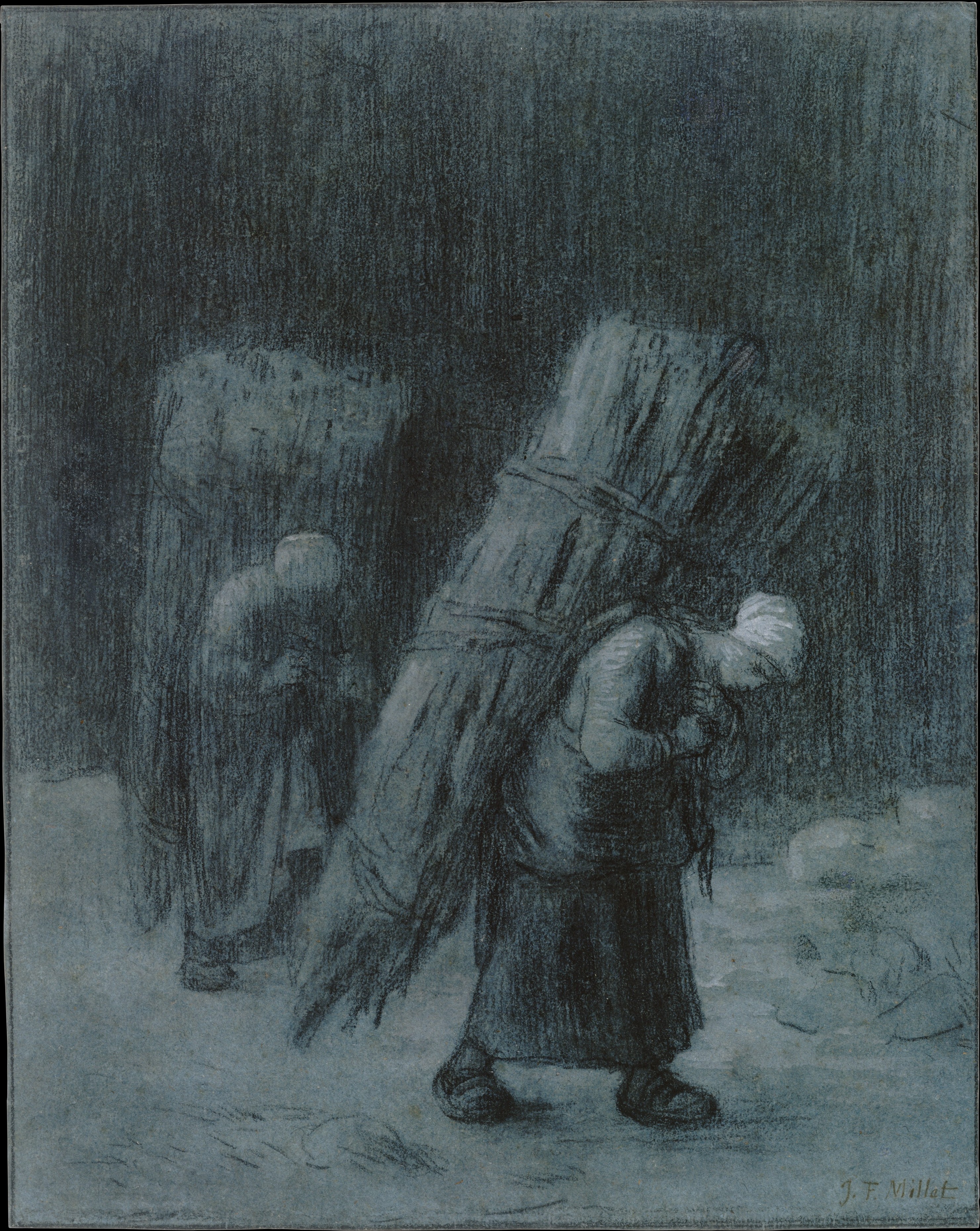
It is a process of outward–inward projection that Scarry finds being depicted in the paintings of workers and peasants by Jean-François Millet. For Scarry, Millet’s subject is labour, not labourers. An overwhelming number of these paintings were made when Millet was living with his family in rural Barbizon, observing closely the regimen of peasant life; its sheer mechanical repetition, how life was increasingly being scripted by the routine interaction of humans and things, and little more; the possibility for lingering and surprise simply did not arise; as Auden noticed in Bruegel’s painting of Icarus, the repetitive motion of the ship and the plough had somehow eaten into those who operated them, and from which scars they could never separate. Millet makes the mutual absorption of human and labour explicit: for example, his drawings of faggot gatherers, the women carrying the long, thin bundles of wood are barely distinct, smothered by both their load and the coppiced woodland from which it has been cut.Footnote 43
Women Carrying Faggots (Figure 4.4) reveals how, in labouring movements, the body is taken out of itself into what Brown, commenting on Scarry, calls ‘a world that always already accommodates, through its made design, the shapes and functioning of the human body’.Footnote 44 These flowing transitions from body to material to background and back to the body in Millet’s paintings reveal individuals fusing with the tasks of daily labour, caught in endless cycles of need that occupy them in their totality, leaving no excess. The painfulness of the labour processes, its demands on the body, the women carrying bundles larger than themselves, exemplify how for Arendt ‘[T]he animal laborans, driven by the needs of the body, does not use this body freely…’.Footnote 45 The essential nature of labour is to be repetitive, perpetual; labour is what it is in its repetitions.Footnote 46 The human body is present in these made objects and these, simultaneously, reach into the body. The body is therefore no longer a container of an inner against an outer but a permeable border region that lives by reaching out beyond itself and which, in turn, is continually breached by what lies beyond: ‘the presence of the body in the realm of artifice has as its counterpart the presence of artifice in the body, the recognition that in making the world, man remakes himself’.Footnote 47
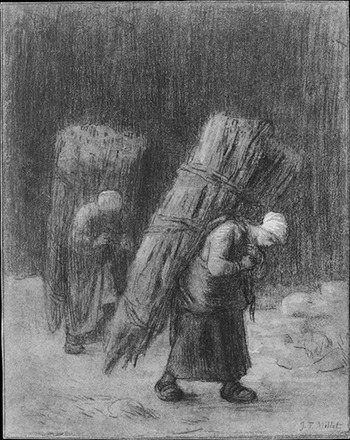
Figure 4.4 Jean-François Millet, Women Carrying Faggots, c. 1858. Charcoal, gouache, paper. Metropolitan Museum, New York. Public domain. DT3296
As Arendt attests, at the most basic level, this remaking consists in the act of meeting biological needs. The labour process is akin to metabolism of the human body, and the body’s limited capacity to store away excess energy allows but for brief moments of ‘wealth’, which has to be ‘spent’, setting in train rapid cycles of production and consumption. Labour is a condition of non-durability in which individual human lives are also consumed in their coming and going without leaving either residue or mark by which their efforts can be remembered. Bound to necessity, the labouring body is not free, but given over in its entirety to the activities of survival.
These many activities, however, are morphing, Already, by Millet’s day, the very nature of labour was undergoing a profound change, one expressed economically, politically and socially by the contagious and, in their first blush at least, progressive revolutions spreading across Europe in 1848. It was less the harshness of labour that was the object of the protests, but its disappearance. Labourers were being ousted by machinery transforming at a pace that their long-inured bodies were not even required to match, they were simply set aside, losing their livelihood. Millet captures its twisted poignancy in his painting Gleaners (Figure 4.5).
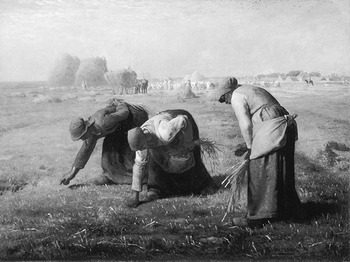
Figure 4.5 Jean-François Millet, Gleaners, 1857. Oil on canvas © RMN-Grand Palais (Musée d’Orsay)/Jean Schormans. Wikimedia commons
The gleaners work in the lengthening shadows of sunset, women given permission to scour a near exhausted field for the wheat missed by the harvesters. Once found, and then ground between stones, these slim pickings are enough to keep them alive, barely. Their bodies bend forward in intimate echo of one another, their bearing is stripped of the self-conscious social cares that force the distant overseer upright upon his horse. Their vision world is pictured as immediate and near to the ground. Their fingers are shortened, almost stumps, worn down by scraping. Their scarves, bleached by the sun and scuffed by soil, bear the colours of the tricolour drapeau, red, blue and white, the symbols of a nation alive with liberty, equality and fraternity, or a nation living off the back of a multitude of home-bound peasants, whose human scope for flexing an intellectual and emotional repertoire of feeling and ambition had, under the impress of necessity, shrunk to nothing. All they had was the earth below them and the sky above, each as thankless as the other.
In their earth-bound poverty, Millet is attesting to the very palpable presence of these women at the foreground of a vanishing point: they are being pushed forwards towards the viewer. Indeed, in giving them so much presence, so much of a central role, they cannot but help to also be seen dramatically, to be being self-consciously presented outwardly to an audience.Footnote 48 Yet Millet is not dignifying them with an identity to which he is privy and which he wishes to show us directly, he is not placing them in a theatrical mise-en-scène. Their faces are shadowed, perhaps in acknowledgment that here are folk whose life neither he nor we will ever really understand. All he can do is portray the absorption and rhythms of bodies at work, two of them bending in near perfect symmetry, their left arms held in steadying balance, though the figure on the left holds her arm high on the back, the second holds the arm a little lower, and then a third, who has stood upright awhile, though still bent, holding her hands lowest of all, clutching a handful of wheat of which we the viewer see only the inedible stalks, not the ears which lie hidden. Moreover, despite their being so apparently ‘there’, it is what is behind them that is the subject of the painting: the well-lit, cleanly attired wheat gatherers, arranged as if in an organized mass, all facing away from the viewer, and held fast along the line of a neat horizon. It is not a flat horizon, but receding, arrow like, pulling away from the gleaners, who are being left by irresistible forces of modernization, linear forces from which, on the right of the canvas, houses emerge in neatly gabled straight lines, and on the left and centre come hayricks in a neatening echo, and between these all sentient life – overseers, workers, cart horses – is being held attentive to the ‘active extensions and distensions of distance’,Footnote 49 for it is in these straightening motions of organized production that life is now being perceived, the outward forms of mechanized production are being internalized by the workers, by the painter, and by the viewer. Only the gleaners are untouched, they are being left behind.
Goodbye to the Body
With Gleaners Millet is showing, first, how traditional farm work meant bodies being in a generational thrall to the soil and seasons by virtue of both need and social standing, and then second, how, with the onset of organized overseeing, the bodily forms taken by this work were dying away. In Millet’s paintings of the spinner or faggot gatherers what is being transformed is done so at the apparent behest of human agency: the spinner’s grip and the wood gatherer’s back. Humans seem to stand at the entry of the making process into which they feed both energy and information. The same body, the same nervous system, provides the mental and physical input into the production. This is less true of Gleaners. Gleaning is predicated on the existence of waste, and so an anachronism. The picking and stooping and scanning of the ground is giving way to industrialized production. The labour process will soon begin to use machinery and steam power, which ensure nothing is left to glean, which warrant the enclosure of fields into private spaces, and which demand evenly stacked and sized ricks barely touched by human hand. The early signs are all here. We sense how farm labourers are starting to employ sources of energy that are not their own, but instead borrow energy from other sources and thereby tap into an infinite reserve that far outstrips the energy they alone could provide.
But this also means that the entry of information into this productive system is no longer the same as in a labourer’s own body. Instead of the nervous system and muscle power of the gleaner we have a network of machinery, to the point where fields are networked as a nexus of productive space leaving increasingly little room for human expression or even decision. Labour is exposed to infinitely expandable and expendable sources of power, and in turn becomes itself expandable and expendable. As Gilbert Simondon remarks, the input of information becomes infinitely distributed through the invention of machines which demand operators concentrate on only a single aspect of activity which is in itself infinitely repeatable and machine like, with no possibility for pause or for acknowledging the integrity of what is being produced.Footnote 50 These divisions of activity are then explicitly networked, and so no longer linked organically one to the other through a human body: ‘it [production activity] is exploded into separate movements taken on by separate individuals or groups’, and these become increasingly machine like, whilst at the same time machines start to replace parts of the body, allowing operations to be performed in conditions of heat, pressure and scale that exceed the variables of tolerance to which a human body can reach.Footnote 51
Gleaners is one of the first images showing the diminishing of human influence and the onset of technological order, and it does so not by depicting the machinery but the last vestiges of machine independent human labour power, making them centre stage as if to say look, here, amid this abject condition there is at least the dignity of not having fully internalized the outward projecting thrust of machine-led ambition.Footnote 52 For the rest, well it is machine-led thinking all the way. The horse and carts in the painting have yet to be left aside, but they are obediently lined up, and soon they will give way to tractors, and the tractors give way to GPS controlled multi-purpose farming vehicles leased from specialist companies owned by hedge funds, and the houses will become connected to electricity grids, the overseer replaced by land management systems, the sun by programmed doses of differently coloured LED light, and the soil by the water-borne nutrient flows of vertical farms. But the gleaners are to know none of this, they are outside the network.
Simondon talks of a rise of network objects, each connected to others by wires, antennas, stations, towers, (almost) perfectly uniting energy and information flows, and their origins can almost be seen in along the vanishing points of Gleaners. And in the same way that energy is distributed outwards in infinitely scalable ways, so it can be used in concentrated form to power tools, as well as gigantic machine plants.Footnote 53 As network objects grow in complexity, information and energy inputs are further distributed, often in parallel processes at rapid speed. The parallel and complex relays of modern industrial complexes unfold at speeds and magnitudes at which the individual no longer counts as an originator. No longer inventors, creators, learners and users of the machine, technical mentality finds its fulfilment in systems that automatically adjust information and energy inputs, in the cybernetic processes of automation, machine adjustment and learning that no longer require human input in any of their productive stages. Labouring subjects come to ‘live amongst machines’.Footnote 54 What is being spread here is not human influence, but that of machinery, or more profoundly, of technology. The form-giving human is nowhere near centre stage anymore (the bare-handed gleaners were the last who could possibly have such a position). And nor is nature, in all its capricious bounty. Both it and humans have been outclassed by the machine-based process of manufacturing. Machines take over, and the hand, the origin of labour power, is reduced to surface level gestures. Gloves, rackets, pincers, pliers, pencils, wrist supports, buttons, joy sticks, levers extend and then replace it entirely, the natural hand ‘(burnable, breakable, small and silent) [which] now becomes the artifact-hand (unburnable, unbreakable, large, and endlessly vocal)’.Footnote 55 The body of the labourer is being increasingly compressed and transformed by the rhythms of machinery; the epoch of technē is giving way to one of technology.Footnote 56
Technē is a knowledgeable condition in which things are gathered in relations of use and yet also, momentarily and occasionally, in mutual indebtedness. Yet its scope is becoming restricted to the repetitive, constant, iterative generation of energy and information, in both processes of production, consumption and tool use; but in no way being constitutive or in control of these processes. What happens when technology has replaced the labourers’ and workers’ nervous system as the supplier of both energy and information? How can we understand the effects of the networked condition with its parallelly unfolding processes, vast complexities channelled through relays that effortlessly switch between magnitudes, in ways that automatically respond and adjust – that is ‘learn’ – so that human being stand neither at the beginning, nor the end of use, consumption and production patterns, but as replaceable, self/similar units within them? What, here, is left of strategy?
Machination
To consider the role of strategy in the age of technology is to consider how it is we, as a species, have organized and continue to organize through the use of tools. It is, suggests Heidegger, only by thinking through work (and labouring) activity that the changes in meaning (Sinnsverschiebung) that occurred in the twentieth century, and which continue to intensify at ever growing rates, can be articulated:Footnote 1
‘Machination’ is the name for a specific truth of beings (of the beingness of beings). We grasp this beingness first and foremost as objectivity (beings as objects of representation), but machination, since it is related to τέχνη [technē], grasps this beingness more profoundly, more primordially.Footnote 2
Considering the tool-bound intimacy between hand, eye and mouth signals the changes from the growing dominance of the machine on how we perceive the world. As machines come to do the work of the body, we begin to perceive and experience differently. Gleaners encapsulates the early moments of this growing dominance. It was being painted at a time when machines were inveigling their way into human practices with alarming rapidity; their productive power was obvious and disarming. It was no longer the arm of the labourer controlling the levers of work, but the machines controlling the arms, to the point where it was impossible to tell whether a machine or a human was acting. In the same year as Gleaners was painted Marx was writing Outline Sketches for a Critique of Political Economy (the Grundrisse) where he elaborated on an arc of economic (and hence social and political) activity in which it was impossible to isolate an origin. We have the labourer, tools, output and capital, through whose organization relations of production are (continually) reproduced: humans became either owners of capital or purveyors of labour, both of which are mediated by the process of production itself. What we have, in the stead of the living human being, is its appropriation by a living machinery in which labour appears as a mere accessory.
In no way does the machine appear as the individual worker’s means of labour. Its distinguishing characteristic is not in the least, as with the means of labour, to transmit the worker’s activity to the object; this activity, rather, is posited in such a way that it merely transmits the machine’s work, the machine’s action, on to the raw material – supervises it and guards against interruptions. Not as with the instrument, which the worker animates and makes into his organ with his skill and strength, and whose handling therefore depends on his virtuosity. Rather, it is the machine which possesses skill and strength in place of the worker, is itself the virtuoso, with a soul of its own in the mechanical laws acting through it; and it consumes coal, oil etc. (matières instrumentales), just as the worker consumes food, to keep up its perpetual motion. The worker’s activity, reduced to a mere abstraction of activity, is determined and regulated on all sides by the movement of the machinery, and not the opposite.Footnote 3
In such a condition, where ‘objectified labour materially confronts living labour as a ruling power and as an active subsumption of the latter under itself’, the actual value of the labour power becomes increasingly insignificant. The isolated individual is as nothing against the massive and tireless presence of machines who now embody value in a form appropriate to capital, which indeed becomes capital, an embodiment of force distinct from labour: ‘the appropriation of labour by capital confronts the worker in a coarsely sensuous form; capital absorbs labour into itself – “as though its body were by love possessed”’.Footnote 4 Indeed the only way that the human can make any room for itself, as a raw being of origins, is as a myth.Footnote 5 As when, a few decades earlier, Mary Shelley had mythologized the ‘man-made’ machine, which took on living without the need for love, without a mother, having only Dr Frankenstein as a father, and the mechanized human form was imagined to be an attenuated, struggling, disjointed sort of creature being unable to conjure itself into full life. The myth was a powerful one: without love, life is always an automatic life whose influence is disastrous, skewed as it is towards a thoughtless expression of directed force. It was as if all labouring activity was being configured in a similar condition to this loveless creature. Marx, with Engels, was witnessing the almost total subjection of workers to loveless life, watching appalled as even small children were fed into the complex innards of the shuttling, twisting, clattering, networked machines. The machines were becoming the new life form, disturbing, fundamentally, the human understanding of itself as the vital and reasoned force in control of things.
(Work)-Force
Amid such machination there is little possibility for the natality by which Arendt marked the distinction making capacity of being human. There was no room to shelter the incessant open movement of freely made opinion. Machinery is everywhere, and so, as Heidegger notes:
[t]he world changes into object. In this revolutionary objectifying of everything that is, the earth, that which first of all must be put at the disposal of representing and setting forth, moves into the midst of human positing and analyzing. The earth itself can show itself only as the object of assault, an assault that, in human willing, establishes itself as unconditional objectification. Nature appears everywhere – because willed from
out of the essence of Being-as the object of technology.Footnote 6
Machinery becomes technology, not simply an array of tools, but a mediated condition of organization into which we fall in which all possible distinctions have already been made mechanically. Heidegger came round to this view gradually.
During what Hubert Dreyfus sees as the early period of Heidegger’s thinking, including the 1927 book Being and Time, Heidegger emphasizes the role of equipment, that is objects that are directly ‘ready-to-hand’ as tools, and how these are ontologically more fundamental than those which have been made intelligible (‘present-at-hand’), for instance by being labelled, taxonomized or otherwise put into calculating, objectifying relations of labour.Footnote 7 Dreyfus argues that here Heidegger still sees the possibility for ready-to-hand objects, for example the carpenter’s hammer, to function as a means of realizing intelligible subject–object ontological separations, and so rescuing beings from objectivity and representation.Footnote 8 This is bound up in a primordial totality in and from which all things (even language itself) find their intelligibility. And so nature, too, can only show up and be encountered in the context of the equipmental world and therefore in the context of Dasein’s practical activity.Footnote 9
But this pitching of tools against the sway of technology stands against other remarks in Being and Time which seem to acknowledge more fully the technological character of all nature, which has itself become ‘proximally ready-to-hand’ by virtue of machine mediated perception.Footnote 10 Here Heidegger speaks of ‘regions’ such as the workshop in which technology functions in relatively autonomous fashion:
Something akin to a region must already be discovered if there is to be any possibility of referring and finding the places of a totality of useful things available to circumspection.Footnote 11
In a local region such as the workshop, the machines are relatively autonomous, and in expanding this local idea of context to a totality, Being and Time makes a first step to transpose a technical notion of craft with its independent and only partially connected tools arising out of the nearness of equipment (as in the gathering of tools in a workshop) to the functioning of one single system, which becomes a workshop writ large as autonomous and autochthonous space that precisely enframes and sets all things into interconnectivity, thus denying localness and so paving the way for an understanding of the essence of technology as the ‘total mobilization of all beings’.Footnote 12
Marx also hints that technology, in its essence, cannot merely consist of a set of tools, cogs, rivets or cylinders; it is labour embodied as capital, and this opens up the thought that the relational nature of this condition, the nature of technology, is much more than the materiality of the machinery. Arendt too locates a decisive shift in the relation of labour and technology at the beginning of the industrial revolution, one which is distinct from similar occurrences in the past: ‘that expropriation and wealth accumulation did not simply result in new property or lead to a new redistribution of wealth, but were fed back into the process to generate further expropriations, greater productivity, and more appropriation’.Footnote 13
Work as Energeia
Though without the lucidity of Arendt’s conceptual distinction of labour and work, Heidegger’s interest in the workshop and of the work of the craftsperson is seemingly an attempt to articulate and preserve the possibilities for technē, but one that places him in dubious proximity to the idealization of work in the National Socialist regime. As Werner Hamacher notes, like every totalitarian system, National Socialism defines itself as a complete system of work that generates the means of infinite survival.Footnote 14 In one way, this means that work is not merely what happens in workshops or factories, but also the proper work of (human) nature: ‘the work of our proper nature’; in Nazi ideology playing out as a natural-mystical homage to force and strength that is restituted and reinstituted through the fusing of life and work as the natural and proper being of the Volk.Footnote 15 Hamacher traces the links of this rhetoric to Christian theology: the resurrection of the people through the power of work first requires the acknowledgment of a fallen and insulted community, not just stabbed in the back by the signatories of the World War I armistice, but a more fundamental inferiority complex that has been ‘artificially bred’ to degrade and persecute the German people, and which will be eradicated through hard work. So deprived of life, the murdered corpse of the Weimar Republic, requires redemption and restitution, not by a superpower or theological spirit, but rising from the grave through the sweat of the brow. As Hamacher reminds us, this commitment to work finds chilling expression in ‘Arbeit macht frei’’ (work makes free), not just as ‘the resurrection formula of the ‘necro-vitalistic mythology of fascism,’Footnote 16 but also as the message on Auschwitz’s iron gates, marking the place where those unredeemable by work (the Jews, the Gypsies, the politically, physically or sexually different, and so on) find their second death. Those who cannot resurrect their already fallen, already dead lives through work; that is those who are not at home in work but foreigners to that possibility of the recreation of the self, cannot be made free; and therefore, in this totalitarian logic, their unproductivity warrants their expulsion from the people and, ultimately, their genocidal murder.
Hamacher sees Heidegger’s ontological conception of work in his existential analytic of Dasein as being related to this mythological motif. As rector in Freiburg in October 1933, in a speech to 600 unemployed, summoned after being enlisted in the massive National Socialist work-procurement programme (Arbeitsbeschaffungsprogramm),Footnote 17 Heidegger declares being out of work a spiritual disruption. Without work one cannot have rapport with things and so one is unfit for Dasein: what matters here is Erhebung (ennoblement) which, in Hamacher’s translation becomes ‘erection’, thus also emphasizing how much of this is masculine ‘ego enhancement’.Footnote 18 In stipulating that work is a precondition for Dasein, fitness for work, both intellectual (the brow) and manual (the fist) activity become a precondition for authentic being. This ‘brow’ and ‘fist’ tag-team receives its most direct formulation in Heidegger’s 1934 rectoral address on the ‘self-assertion of the German university’, where he argues that the ‘questionability of Being, at all, demands of the Volk work and fight, and it forces it into its state (seinen Staat), to which the professions belong’.Footnote 19 Heidegger’s subsequent elaboration of three services (Dienste): Work service, military service and scientific service (Wissensdienst), at once makes the latter a service that is now aligned with higher political ends, it also emphasizes that even theory, even that very domain of thinking – which, before as well as after his rectoral period, he treats with immense caution and almost mystic reverence, coupled, of course, with the self-aggrandizing arrogance of seeing himself as a direct heir to the Greeks – is now a matter of work:
For once, ‘theory’ does not happen for its own sake, but only in the passion to remain near to Being and to remain under its affliction. For another, however, the Greeks fought especially to understand and carry out (begreifen und vollziehen) this observing-questioning as a manner of energeia, of ‘being-at-work’ (am-Werke-Seins) of the human being.Footnote 20
Being-at-work is therefore not a prelude to Dasein, but Dasein itself; it is the ultimate actualization (höchste Verwirklichung) of Dasein. Those who work ‘choose the knowing (wissenden) fight of those who question and confess with Carl von Clausewitz’ whereas those who do not associate themselves with ‘the reckless hope of rescue through the hand of coincidence’.Footnote 21 Unlike Being and Time, the rectoral speech portrays Dasein – qua work – as creative not only of itself, but also of its world. In this emphasis on world-creating work Heidegger was unambiguously placing workers, academics, soldiers and administrators in the service of the state, all of whom ought collectively engage in ‘the erection (Aufbau – emphasized in the original) and building (Bau) in the new future of our people’.Footnote 22 There is a departure here from the openness of being sketched in Being and Time. The fluidity of technē is being hardened into a self-asserting future, a future already decided, and here reinstituted through a state and a leader figure. Here we have an ‘arrest and internment Being in what already is’. Hamacher continues:
The political ergontology and morphontology of Heidegger during the Rectorship period was the ethical and political collapse of his philosophy: the collapse, namely, of the ontological difference, in many respects an endogenous collapse, for Heidegger never ceased to think Being as the Being of beings and of Dasein.Footnote 23
Work and Technology
In the years following World War II, Heidegger returns to the question of Being, in light of the rise of technology, and, as he does so, goes back to the more open, speculative view of work found in Being and Time. Branded a ‘fellow traveller’ by the Allies, and partially restricted in his work, but by no means disenfranchised from academia, he begins to assess the post-war condition. In the 1948 Bremen Lectures, his opening thoughts on what was to become the idea of technological enframing, Heidegger argues:
We say ‘technology’ and mean modern technology. One likes to characterize it as machine technology. This characterization hits upon something correct. But what is correct about it still contains no truth, for it does not reveal anything of the essence of modern technology, and indeed it does not do so because the manner of representing that this characterization of modern technology as machine technology stems from is never able to reveal the essence of technology. One is of the opinion that modern technology, as distinct from all previous forms, would be defined by the machine. But what if it were the reverse? Modern technology is what it is not through the machine, but rather the machine is only what it is and how it is from the essence of technology. Thus one says nothing of the essence of modern technology when one conceives it as machine technology.Footnote 24
The machine is a product of the essence of technology and not vice versa. The ‘engine (Motor) produces power or force (Kraft) and this power-generating machine (Krafterzeugungsmaschine), stands as the representative machine for the human being’,Footnote 25 and force is what Heidegger, the faithful student of Nietzsche, associates with the capacity for overcoming, for the leap, but also invoking Ernst Jünger’s figure (Gestalt) of the worker (Arbeiter) and his characterization of work as ‘the total character of the reality of the real’.Footnote 26
Published in 1932, Jünger’s book Der Arbeiter develops this figure, a warrior steeled in the fires of World War I, who is also egalitarian, uniting members of all social strata, side-by-side, in the trenches. There, and altogether beyond the values of enlightenment and beyond bourgeois comforts, they can embrace instead a new world order driven by ruthless efficiency and exploitation and the total mobilization that converts life into energy; violent and powerful; ‘the whole that wills itself’.Footnote 27
If machines, and not humans, provide power, the capacity for ordering is no longer within human hands and, as Scarry, Marx and Arendt also suggest, it is the outsourcing of power that locates the source of authentic being beyond the human:
What belongs to the planning and carrying out of the production of force? Force as such – separated from animal and man-power [from Tier- und Menschenkraft]; (Forces of nature) – simply to use what is present-at-hand (water wheel, windmill, wind for the sail). ‘Forces’ ‘artificially’ (technē) produced. Making available for any and all goals and for the most comfortable and cheapest application. Machines, that first produce ‘force’ (what kind of production is this?) and unleash forces once again captured in installations [Einrichtungen], held as utterly replaceable.Footnote 28
Here we approach a pivot point in Heidegger’s outline of technology, and so for our understanding of its conditioning relation to strategy. Where power is separated from the human being and located in machines, the world is revealed according to a movement that equally has no origin in the human being; installations and not human order. These early lectures are still coined by a mechanistic understanding, lacking engagement with terms such as ‘control’ and ‘information’, which became central to the 1953 essay, The Question Concerning Technology. Heidegger, a reader of Gotthard Günther and Norbert Wiener, became increasingly aware of the cybernetic development of machines and their role in the completion of Western metaphysics as the fulfilment of this process, not only reducing language to communication, but communication to information transmission.
In its basic organization this condition of technological ordering is perfectly and completely distilled in Samuel Beckett’s precise, brightly lit play Act without Words II. Words have become superfluous. On the stage there are two sacks (‘A’ and ‘B’) and a pile of clothes (‘C’), set in a line. There are three scenes, or ‘positions’. Position 1 (CBA) (from left to right as the audience look at the stage) has a mechanical goad appearing from the right-hand side. Like a long spear, it moves perpendicular to the stage floor, pauses, retreats a little, then darts forward and prods sack ‘A’ … nothing … then it draws further back and darts forward again, before departing. On the second prod, ‘A’ stirs and a person climbs out of the sack, reluctantly, hesitantly, moody, prays and puts on clothes from the adjacent pile ‘C’, takes some pills, eats and then spits out some carrot, then takes up the sack and moves it to the other side of ‘B’, undresses and throws the clothes into an untidy pile, gets back in sack ‘A’. Position 2 (CAB) the goad returns now having to stretch a little further onto stage, supported by a wheel as it moves linearly, pauses, then rapidly prods ‘B’, and departs. From ‘B’, a person emerges keenly, dressing, brushing teeth frantically, performing exercises, eating hastily, making to look at a watch repeatedly, then moves to the other side of ‘A’ undresses and piles the clothes neatly, and jumps back into the sack. Position 3 (CBA). The ensemble of sacks, clothes and persons is moving across the stage from right to left as the audience looks, each time advancing in a linear progression, prompted by the prodding machine. The goad reappears, now having to stretch even further, supported by two wheels, pauses, then prods ‘A’. Nothing, it recoils further, pauses, then darts forward to prod ‘A’. The sack moves, reluctantly. Person ‘A’ emerges, halts, broods, prays. The curtain falls.Footnote 29
The goad initiates action and organizes the sacks, bodies and clothes but is never visible to person ‘A’ and ‘B’ on stage, and each time it appears with an increasing number of wheels it inhabits more space, gradually pushing them to the edge of the scene, displacing them from the stage. There is a strangely compelling equivalence amongst the objects on stage (characters, goad, clothes, sacks), each finding their distinction as units, each positioning itself without the movement being explained, or explicable. The play seems to distill Heidegger’s observations on the intimacy between technology and positioning:
We now name the self-gathered collection of positioning [des Stellens], wherein everything orderable essences in the standing reserve, positionality [das Ge-Stell]. This word now no longer names an individual object of the sort like a bookcase or a water well. Positionality now also does not name something constant in the ordered standing reserve. Positionality names the universal ordering, gathered of itself, of the complete orderability of what presences as a whole.Footnote 30
The stage remains a space, but one bereft of reasons. In its clean sparsity it makes apparent the ontological grounding of the question of production in Heidegger’s analysis:
Technology is not equivalent to the essence of technology. When we are seeking the essence of ‘tree’, we have to become aware that That which pervades every tree, as tree, is not itself a tree that can be encountered among all the other trees. Likewise, the essence of technology is by no means anything technological.Footnote 31
And when Heidegger goes on to proclaim ‘positionality is drive”Footnote 32 we arrive at the unsettling condition that marks the demise of technē. The movement from manual technology and artisanal manufacture to engine technology [Kraftmaschinentechnik] is therefore not merely a shift from simple tools to more complex machines, but a shift marked by a way of seeing the world as things that already occupy a position within a wider frame of production, and always will; the goad has a position, the characters and the sack, there is no other movement, and certainly no action.
Making as Folding the Four Causes
It is a condition in which the looser ideas of ‘work’ Heidegger discusses in Being and Time, and which he revisits in his Question Concerning Technology, the ones he begins to associate with the ’the term Her-vor-bringen (to bring forth; educe) which describes a seeing and knowing things through a letting be (lassen), have no room. This ‘letting be’ is not quiescent, there is agency involved in revealing what otherwise would have been concealed, but the agency entails a reticent holding back (ver-an-lassen), a resistance to the impress of the human will, which now, post–World War II, certainly includes a resistance to political will.
Hervorbringen is cast as an attentive awareness of, and struggling with, things that are being brought forth into existence without an explicit sense of initiation or end point. It rests within an equal relationship constituted by the ancient Greek fourfold breakdown of causes: material (such as a stone), form (the planes and volumes into which the stone falls), telos (purpose; the resonance of the stone as a sculpture, say) and efficient cause (the maker bringing about the whole effect). Under the framing of technē we have been pursuing here, there are two historical trajectories in which this fourfold relationship has been apprehended. The increasingly dominant one is skewed towards the pre-eminence of the efficient cause found either in humans, or in technological positioning, whose force is transferred through the practices of counting, weighing and measuring. The efficient cause is presumed both an originating and separated force initiated in moments of assessment and decision to do this, and not that. The other trajectory finds the efficient cause co-responsible for what Heidegger variously calls the mutual indebtedness or bringing forth found in a gathering of material, form and purpose, each inducing what is not yet in presence to become present. This making is not directed by the cause–effect reasoning of goal-directed force, but nor is it a spontaneous natural eruption that springs forth of its own accord, with no reason, and which, being firmly confined in its disinhibitor ring, is just bringing itself forth (physis), such as the flower in bloom, or the lark’s evening song. Rather, it is a making in which we find the loosening form of technē; and so an efficient cause (human will) that works by inducing rather than managing or coercing things to come forward. The maker here is more an agitator, the origin of a gathering, who, within the ‘region’ of the workshop makes (in the sense of the more archaic ‘bringing forth’) things. The maker considers carefully (überlegen) and gathers (versammeln) the material, the form and final end (telos), to give sight to the named thing. This consideration and gathering does not amount to oversight and control over a productive process. The agency evokes a relationship of tightening, a pulling together that is slow, attentive, passive even. In this form of tightening (Verfestigen), the careful consideration and gathering renders the maker an indebted part of the causal fourfold; a cause no more influxious than those of material, form or telos (überlegt sich und versammelt die drei genannten Weisen des Verschuldens); all of them are, equally considered, modes of occasioning.
The form of sight (or vision world) arising from Hervorbringen is one of revealing in which the made thing is an arrangement of materials, forms, ends and agency that are themselves not smothered into invisibility by its being named and used. In this revelatory making there is a sense of complicity with, and not command over, what exists. As a bowl is turned on a wheel, or jewellery hammered on an anvil, the maker displays reticence, skill and thought, as well as the confidence of the experienced artisan to abdicate singular control and merely tighten material, form and end to bring forth the thing, becoming co-responsible and, collectively with the material, form and purpose, indebted to the ‘thing’. Describing the influence of agency using Verfestigen denotes an almost contemplative way of bringing awareness about; a way of unconcealing that hears the saying of things without imposing upon them an idea of their form, material and end. Under the aegis of Hervorbringen form, purpose and material emerge, and we agents are standing back from the centre and accepting that we are not makers (Schöpfer) of ‘things’, but, rather, are implicated, our agency counts somehow, only never totally, nor from the outside. This is a letting be (lassen) accompanied by an-lassen, an arrival, starting, or ignition, as what is brought about is not an ending (telos mis-translated) but the arrival of a beginning, the completion of a coming into being, a natality.
Presence/Distance
This folding of the four causes of material, form, telos and efficient cause as equally indebted elements outlined in The Question Concerning Technology transcends the earlier identification of the ‘ready-to-handness’ in Being and Time in which Heidegger provides us with what Friedrich Kittler calls a ‘slight displacement’ of the original four Aristotelian causes: ‘in lieu of “making” or “producing” [Heidegger] speaks only of “using”’.Footnote 33 In §38 Heidegger begins with the by-now familiar investigation of the mattering of things not in an abstract sense, but always already as belonging to a context of work. What is encountered within the world are ‘things at hand’. Their handiness belongs to the world, to worldliness, which is ‘already there’ in the things at hand. We encounter the world first with everything in it, not as separate themes or qualities of things but rather:
things at hand are suited and unsuited for things, and their ‘qualities’ are, so to speak, still bound up with that suitability or unsuitability, just as objective presence, as a possible kind of being of things at hand, is still bound up with handiness. But as the constitution of useful things, serviceability is also not the suitability of beings, but the condition of the possibility of being for their being able to be determined by suitability.Footnote 34
Suitability as the key determinant of something’s ‘being’ is a different affair to the bringing forth of the made thing in joint indebtedness. In Being and Time, Heidegger is elaborating on a ‘displaced’ set of causes:
Relevance is the being [Sein] of innerworldly beings, for which they are always already initially freed … What the relevance is about is the what-for of serviceability, the wherefore of applicability [Verwendbarkeit]. The what-for of serviceability can in turn be relevant.Footnote 35
Heidegger’s hammer is not foremost a thing, but it has ‘to do’ with hammering, which in turn has to do with fixing something, which has to do with building a shelter from rain, which has to do with sheltering Dasein, making its being possible. Relevance cannot be understood outside this circuit of connections, outside what he calls a ‘total relevance’ that is synonymous with being itself.
The total relevance itself, however, ultimately leads back to a what-for which no longer has relevance, which itself is not a being of the kind of being of things at hand within a world, but is a being whose being is defined as being-in-the-world, to whose constitution of being worldliness itself belongs. This primary what-for is not just another for-that as a possible factor in relevance. The primary ‘what-for’ is a for-the-sake-of-which. But the for-the-sake-of-which always concerns the being of Dasein which is essentially concerned about this being itself in its being.Footnote 36
Kittler laconically thinks through these thoughts using the example of a shoe, or bootmaker. The shoe is mere ‘equipment’: ‘[Schuhzeug] [which] has a “whereto” [Wozu]—namely, wearing’, and in putting the shoe on the philosopher’s foot, Kittler argues that this Wozu:
can also be conceived as the Martin Heidegger, Media, and the Gods of Greece walking on a street. It has its ‘wherefrom’ [Woraus] in leather, which for its part comes from the skin of animals. Third, it has a carrier and user for whom, in the best of cases, it has been tailored (even though this no longer occurs in the age of machines).Footnote 37
The purpose is just wearing; the material is the skin of a dead and forgotten animal; and the form is the wearer’s foot, often cast in industry standard sizes using pre-made lasts. And
[f]ourth and last, all equipment—especially when it is damaged, lost [abhanden], or unusable—presents a primal ‘whereto,’ which no longer represents the ‘whereby’ [Wobei] of any ‘involvement’ [Bewandtnis] at all, but rather affords the ‘wherefore’ [Worum-willen] of Dasein that, in its Being, essentially concerns this Being itself.Footnote 38
How can the shoemaker be indebted to materials (equipment) that are not there? The shoemaker may find the animal hide missing, or of the wrong firmness, or her hammer breaking; Heidegger, wearing his new shoes down the road, may find them uncomfortable, or he may realize he put on the wrong pair for the weather. To have these pre-conceptions of what ought to be there (by way of functionality) means that the version of making filtered through equipmentality does not draw from the presence of things but always already begins from a distance of conventional expectation. This ‘intermingling of form and matter’ is grounded in serviceability, the ‘basic trait from out of which these kinds of beings look at us – that is, flash at us and thereby presence and so be the beings they are … as a piece of equipment for something’.Footnote 39
When things can do nothing more than fit into a pre-configured world of use, they cannot reveal anything by themselves; no inner beauty or authentic essence. At best they are reliable, like a pair of well-worn boots worn by a peasant. The individual piece of equipment becomes worn out and used up. But also: ‘customary usage itself falls into disuse, becomes ground down and merely habitual. In this way equipmental being withers away, sinks to the level of mere equipment’.Footnote 40 And here is the rub, because as the machinery takes over, it is as purpose, not as an efficient cause, which just withers.
‘[T]hese days’ suggests Kittler ‘aeroplanes and radios belong among the things that are closest to us’,Footnote 41 becoming increasingly alive to an emerging ontology of distance; on the one hand by elaborating the essence of things in terms of their reliability, and on the other by considering how that distancing influence has come to mark a transformation from an epoch of technē and making, towards one of technology. Aeroplanes and radios are not simply different means of transmitting messages, they reveal a new world:
We just need to look at the airplane and the radio broadcast to immediately see that both machine constellations (Maschineneinrichtungen) have arisen not only in conjunction with contemporary science but that they have come to determine the unfolding of the history of our contemporary time. For it is not only that the same processes that hitherto were completed with help of the rural postal worker and the horse-drawn post carriage now are done with through the use of other means. What is more is that the airplane and radio-broadcast out of themselves: that means to say out of their machine-being (Maschinenwesen) and the reach (Erstreckungsweite) of their being, make possible the new degrees of play (Spielraum) of possibilities, which can be planned and executed through human will.Footnote 42
We can begin to appreciate the importance of this shift from presence to absence when we trace the development of Heidegger’s thoughts throughout a series of influential works, culminating in the famous essay The Question Concerning Technology in 1953.
Already, in the 1938 essay The Age of the World Picture, Heidegger approaches this distancing through the separation engendered by the process of picturing.Footnote 43 Here picture does not refer to the representation or imitation of any specific object but a wider entire mindset required for abstract conceptualization and the ways in which nature is disclosed representationally, as picture; as something that is present-at-hand [das Vor-handene].Footnote 44 It was a condition that Nietzsche had also recognized: ‘We have perfected the picture of becoming, but have not got over, got behind the picture’; our pictures of the world are being traced out in ever more complex and nuanced relations of cause and effect, we have never understood, and how could we understand when what we are using in our inquiry of the world are things that do not exist ‘lines, surfaces, bodies, atoms, divisible times, divisible spaces’, so then how, he concludes, ‘is explanation to be at all possible when we first turn everything into a picture – our picture!’Footnote 45 Taking up Nietzsche’s frustration, Heidegger argues that we get a grasp of things, we are ‘in the picture’, when we not only see some-thing standing before us but when we get a systemic sense of the entirety of its relations: ‘world picture, when understood essentially, does not mean a picture of the world but the world conceived and grasped as picture’.Footnote 46
In crucial counter-distinction to the holding back (ver-an-lassen) in which the maker merely reveals the form of the made thing, the world ‘as a picture is always already world made by man’.Footnote 47 As Arendt also noticed, writing as she was at the time when the first Sputnik satellite had been sent into orbit, the totality of the earth was being mapped. Indeed Arendt opens The Human Condition with reference to this ‘earth-born object … [which] circled the earth according to the same laws of gravitation that swing and keep in motion the celestial bodies—the sun, the moon, and the stars’.Footnote 48 And just as this object dwelt and moved amongst the heavenly bodies whilst remaining a thing of ‘man’s’ making, so did it conjure desires to sever the ties that bind humans to the Umwelt expanding satellite, one that is denied to animals and all things of nature. Through objects like satellites humans come to relate to the earth as a thing out of which rockets can be built and from whose surface they can be launched. And in anticipating the media analysis that was to follow, she asks:
could [it] be that we, who are earth-bound creatures and have begun to act as though we were dwellers of the universe, will forever be unable to understand, that is, to think and speak about the things which nevertheless we are able to do. In this case, it would be as though our brain, which constitutes the physical, material condition of our thoughts, were unable to follow what we do, so that from now on we would indeed need artificial machines to do our thinking and speaking.Footnote 49
And so, when, in our human Umwelt, the earth is no longer a scene of action but an object of analysis, read through the images transmitted from satellites, what can be measured can no longer inspire awe, it is no longer immense. As the world gets transformed into such a picture, so do humans, as:
that being who gives to every being the measure and draws up the guidelines. Because this position secures, organizes, and articulates itself as world-view, the decisive unfolding of the modern relationship to beings becomes a confrontation of world views … [setting] in motion with respect to everything, the unlimited process of calculation, planning and breeding [that is] the collective image of representing production [das Gebild des vorstellenden HerstellensFootnote 50]Footnote 51
It is a picture increasingly incapable of conveying anything of the reality being experienced by those being pictured.
With such picturing we have, for example, Bertolt Brecht, commenting wryly ‘[r]eality itself has shifted into the real of the functional. The reification of human relationships, such as the factory, no longer betrays anything about these relationships.’Footnote 52 Brecht was reflecting on photographs of a Krupp factory (Figure 5.1) that showed a neatly ordered functionalism, but conveyed nothing of the alienation this mechanization entailed.
Figure 5.1 Krupp factory, World War I. Photo Brown Bros. From The New York Times Current History of the European War (January–March 1915), 2, 889. Wikimedia commons
In its entirety, Brecht’s work, from his first play Man Equals Man onwards, was an epic attempt to employ his own uncanny, distancing effects (Verfremdungseffekt) to reveal how readily we transform ourselves to conform with pictures:
Brecht experimented continually with methods of disturbance, trying to reveal the mechanisms by which picturing was taking hold of the world. In his plays actors were to break the scene, images were broken up and blocks of text were treated as images, all of them forms of apostasy that constituted an incision into settled orders and that thereby attempted to break open the seductions of picturing, revealing the true (exploitative) conditions under which humans were organizing themselves technologically. Heidegger, less sanguine than Brecht, thought it too late to fundamentally alter the world picture because there was nothing behind to reveal, it was picturing all the way through. We were already all of us captive to the Gigantic, in whose thrall all relations to things, including to artistic techniques of disturbance, are already made small.Footnote 54
The Gigantic
Where the made object such as a bowl or piece of jewellery stands for an ontology of presence, where the maker unites the material, form and purpose, the process of representing production that marks the world picture of the new world is animated by what Heidegger identified as an interplay of the ‘Gigantic’ (das Riesige) and the small: what was once a horizon is brought closer, by measurement, into distances that can then be traversed (the aeroplane), or obliterated (the radiowaves).Footnote 55 This recalls Heidegger’s analysis of the sway of modern technology in his distinction between technē and the revealing (poiesis) that can be attained by a maker who heeds material and form, and the technological challenging forth (Herausfordern) that imposes a design onto the thing. But here we encounter another dimension, in addition to design; the Gigantic, which not only changes the way we make things, it more fundamentally alters our relation with our world, and with earth. The fundamental changes in outlook are not just Heidegger’s but they recall that of Jünger, which was equally beset by acute experiences of societal crises and forged in the unprecedenced expereince of industrial-scale destruction in the ‘storms of steel’ of World War I. Could a totally mobilized world birth a new human being who is familiar with technology in its most destructive, nihilistic form, and so transformed, in an ‘organic construction’, from subject to worker? This question marks a shift in emphasis from the thought of machination as an objectification of experience. Technology is not merely machine technology but, more essentially still, a historically conceived ‘“org[anic] construction;” something alongside something else … not as a “goal” in the widest sense, but instead as the truth of being [Sein], which joins with and arranges beings’.Footnote 56
Heidegger applauds that Jünger’s Der Arbeiter: ‘achieves what all the Nietzsche literature was not able to achieve so far, namely, to communicate an experience of being and of what it is, in the light of Nietzsche's outline of being as the will to power’.Footnote 57 But he also sees Jünger seeking rescue in the flight (Flucht) from the insight into the questionability of the metaphysical position of the human being. Hamacher labels Jünger’s Arbeiter a proto-fascist pamphlet conceiving work in the entirely undifferentiated uniformity of the ‘total’ that espouses not so much the vulgar racism of National Socialism, but a techno-racist ideal rooted in fundamental sets of repetition.Footnote 58 The ensuing ideal of a planetary dictatorship links Jünger’s notion of ‘organic construction’ and the emerging man-machine symbiosis of Norbert Wiener’s cybernetic command and control circuits. And where, for Jünger, the worker reigns as a figure, Heidegger radically reverses Jünger’s analysis and locates being in the essence of technology, where the ‘will to power is revealed as truth. Truth is not a manmade gestalt, but Being … as Gestell’’.Footnote 59 This also marks a turn from an affirming relationship with technology towards a diagnostic one. In place of the militaristic figure of the worker as the figure that completes the subjectivity of human beings Heidegger returns to work; to the configuration of world through work, rendering Jünger’s Arbeiter merely a figure in an epoch: the ‘central actor of the world and sense-forming history of being [Seinsgeschichte] in the epoch of subjectivity’. Heidegger therefore stands back and revises the role of Jünger’s worker from the absolute figure that spells the end of being towards a figure that marks the end of an epoch in the history of being; more a figure of the past, understood through the historical notion of work.Footnote 60
Heidegger’s concerns quickly exceed the historical figure. In the wake of technology, of calculation, the earth is lost; it is concealed, for while it is, naturally, a place of vast swathes and immense densities, a place of stupefying myriad detail and endlessly arresting distinctions, these are not qualities that can be classified. The earth has been captured, and in being captured it has become small, small as in Gigantic, which is not, then, an interplay of opposites, but a filtering of what is natural into measured distances, positions, connections and effects.Footnote 61
nature soon became a being and then even the counterpart of ‘grace’ and, after this degradation, was completely set out in the compulsion of calculative machination and economics. Ultimately what remained were ‘scenic views’ and recreational opportunities, and now even these have been calculated to gigantic proportions and prepared for the masses. And then? Is that the end? Why is the earth silent at this destruction? Because the earth is not allowed the strife with a world, not allowed the truth of beyng. Why not? Is it because that gigantic thing, the human being, becomes all the smaller the more gigantically grown? Does nature have to be renounced and abandoned to machination? Can we yet seek the earth anew? Who will kindle that strife in which the earth finds its open realm, secludes itself, and is genuinely the earth?Footnote 62
In its open realm the earth was approached by the maker, not as a map or diagram but as an intensive array of forces through which they dwelt, as a place for being without subjugating or mastering the things to which they were indebted for their living. This indebtedness emerged when one listened to things and recognized what Ralph Waldo Emerson had called the method of nature. For Emerson nature was ungraspable:
Like an odor of incense, like a strain of music, like a sleep, it is inexact and boundless. It will not be dissected, nor unravelled, nor shown. Away profane philosopher! Seekest thou in nature the cause? This refers to that, and that to the next, and the next to the third, and everything refers. Though must ask in another mood, though must feel it and love it, though must behold it in a spirit as grand as that by which it exists, err thou canst know the law. Known it will not be, but gladly loved and enjoyed.Footnote 63
Heidegger laments the loss of an earth opening to itself where nothing might be commuted to ends, nothing that can be identified as starting and complete, where all is beginning and spilling over, nothing is separate, all is in communion, nothing is elevated, all is leavened. When humans, in their attempt to control the earth, insert themselves into the infinite curve of emanation, they then isolate: they select the fruit of a tree at the expense of variety in woodland, they light fires at the expense of darkness, they cure idleness with a proclivity for possession. With all these insertions and comes a tendency to imagine ‘raw’ earth as a scene of profligacy agitated by a wanton and juvenile urge to grow everywhere and anywhere, untamed and wasteful because it lacks a specific end. In this way the picture justifies intervention from a reasoning being, a humanist subject, who builds dikes, channels, walls, and conduits to contain and then use the earth. Humans propose themselves the end and direct the rich natural redundancy of the earth towards themselves. There is a moment here, a sense of possibility, which for Emerson is generative and uplifting, prefiguring aspects of Heidegger’s idea of dwelling by a hundred years or so, observing how, in turning the earth towards them, humans might become so much more than what they are, alive to ek-stasis and its possibilities which they might take up, and embody: ‘The termination of the world in a man, appears to be the last victory of intelligence. The universal does not attract us until housed in an individual.’Footnote 64 Each human saves the earth just as the earth grounds their own world. Each being has a world into which earth protrudes, and the earth is touched by the active being of each individual world rooting itself. Emerson aches for more of these dwelling beings, for their newness, their zest for concentrating on the vast potency of a single earth dwelling act, and then to act again, each caught fast in their own ‘personal ascendency’.
But it goes wrong, humans fail to dwell because they fail to apprehend the effulgent quality of natural ecstasy, they find themselves transferring their thoughts in life to ends-in-themselves, and finding in the ends reasons to act that are separated from a sense of world. Dwelling gives way to instrumental acts, and expressive work gives way to tools, and the earth itself becomes a resource, rather than a source of life.
Enframing (das Gestell)
In contrast with the maker’s abetting, which we find in Greek beginnings, and in contrast to Emerson’s world-revealing ‘individual’, comes the modern and technological experience/action of Fertigen (producing). Where Verfestigen is a considerate and almost artistic (technē) way of letting be, Fertigen is an active making of something (the move from life to ends) that encompasses both manufacture and management, and which Heidegger likens to a setting upon and challenging forth of things, Herausfordern. Herausfordern is a state of knowing predicated on incision as an intervention through which we demand things show themselves in service to ends, all of which, in being known and measured as ends, can be compared and improved upon. Here the efficient cause, the agent, stands out, but not in the way Emerson hankers after, for with him the individual remains a gathering space for nature’s ecstasy, plenitude and redundancy, whereas here it is as a separating force that brings about, directs and governs in the name of ends. The agent presumes to hold sway over material, form and telos in such a way as things are made to stand out for the purposes ascribed to them under organizational direction, a direction set by goals.
Moving from the somewhat refined and archaic examples of craft work to describe the difference between Hervorbringen and Herausfordern (see Table 5.1), Heidegger pursues these differing forms of ‘vision world’ (seeing alongside naming), extending the examples into more industrial settings, for example by contrasting the use of wind power in windmills to the hydroelectric schemes then being envisaged on the river Rhine. The miller grinding wheat gathers the wind in order to meet material interests in making flour; the wind is used. But no demands are made of it, it passes through, without exhaustion, and is let be, to then be used by others downstream. Using the flow of a river to turn a generator might similarly be described as Verfestigen, a loose coupling to things to bring about power that otherwise would be latent, or redundant. But here differences arise. The river Rhine is dammed, its course and depths are altered, spatially and temporally it becomes contained, a demand is made upon it that it become still, captured to yield energy that is not used directly, but directed elsewhere, an object of management and, in turn, a subject of political and social concern. The dam is an incision that expels communities from their homes, that accentuates the boundaries between regions and nations, that depletes surrounding rivers and water tables, that elevates urban above rural needs, that concentrates power in the hands of those who control the taps, that enlists huge bodies of labour, that connects to globally configured distribution networks. It was the need to justify investment in dams that led to the creation of cost-benefit analysis, a calculating tool for managerial economics designed to measure and weigh up the cause/effect structures of any scheme; only neither the costs nor the benefits could ever be estimated with any surety, so complex and evolving were the forces in play. Once one relation was identified in a dam project, another emerged down or upstream, or way away in the big city for which the dam was being built as a water supply, well in part, because its construction was also, for example, a way of elevating a political elite who had promised jobs to an otherwise redundant labour force, and as we know, idleness is wasteful and corrosive of character, unless it is the idleness of the reservoir water itself, which is awaiting its release, being made to stand forth, protected behind signs and security measures, ready to be set upon, endlessly on call, as a resource. It lies still, then suddenly it is off, funnelled down into pipes, there to drive generator turbines which feed into electricity cables hung from pylons that pinion the landscape between one settlement and the next. The cable feeds a substation, which feeds factory machinery that produces other machine parts which are then boxed, stored, distributed and used to move yet other machines; and so the flow goes, everywhere things being challenged by other things. Conceptually, Heidegger breaks this challenging or setting upon into organized sequences of: Erschließen – unlocking; Fördern – extracting; Speichern – storing; Verteilen – distributing; Umschalten – switching. Specific causes and effects are being named, continually, but they remain representations circulating in the language of strategic discussions, barely touching the experience of challenging forth they ostensively define.
Table 5.1 Hervorbringen and Herausfordern
Hervorbringen (revealing) | Herausfordern (challenging) | |
|---|---|---|
Material | From the earth and sky. | Resource, raw material, increasingly immaterial and interchangeable. |
Form | That which (already) is. | That which is this, or that, depending on use or ‘purpose’. |
Final/end | Purpose, completion of the arrival, telos. The thing’s indebtedness to function, for instance. So a sculpture in its setting, a chalice in its ritual, each giving to life in some way. | Means/end, fashion. Rendering of ‘objects’ to being available, standing reserve so that more can be produced/ manufactured. ‘Ends’ are suspended continually; replaced by further processes, becoming itself merely a means for further challenges. |
Efficient/agency | Tightening/Verfestigen, a lingering of involvement, slow agency, contemplative (logos) gathering of the causal fourfold which gives forth, without direction. | Fertigen (manufacturing and management); setting upon and being set upon through challenging forth in intensive cycles of: Erschließen – unlocking Fördern – extracting Speichern – storing Verteilen – distributing Umschalten – switching. |
As the power of the water’s flow is unlocked and extracted through generators users relate to the river increasingly as a source of power (or transport, irrigation, water supply); a thing that stores energy that requires exploitation and through ever more efficient means. Where the windmill stands isolated, a steady but dependent agency, reticent, the damming and mechanization of the river represents an entirely different order of organization in which political, social and economic forms vie endlessly to articulate and further their ends, none of which quite align, but all of which carry cogency insofar as they can – as named ends – be transformed into means to serve other ends, extending the reach of management into an infinity of naming. As the essence of technology is the Gestell, the essence of the Gestell is the danger (die Gefahr) of the forgetting of being because it positions everything, putting it in its place.Footnote 65
Herausfordern strives after control, a positioning of the human being as the Schöpfer/creator, as the crucial and central originator for the causation of effects, the genius of lightening behind the flash from which individual ‘other destroying’ source innovation springs. The ‘letting’ side of Hervorbringen eschews this zero-sum elevation of a solitary cause, instead entailing an awareness of the limited possibilities of human intervention and of the ‘wider’ systemic interrelations that render any attempt at complete control or sight feeble and dangerous. Here Heidegger draws out a stark distinction between placing the human ‘maker’ as the initiator of things (thus replacing mysticism, the Gods, nature) and as the steward of things. The latter is a starting up, a setting in motion, an arrival at the beginning of something without any prospect of how once begun things will unfold. The former is a gathering of the setting upon things that, with some irony, sets upon human beings themselves as they too are challenged to stand and make themselves available for ordering as a standing reserve (Bestand).Things exist because they are means to ends (potential or actual); they are confined by a functional condition of being known ‘as something …’. Thus, knowing equates to an enframing (Gestell), ‘the gathering together of that setting upon that sets upon man, i.e., challenges him forth, to reveal the real, in the mode of ordering, as standing reserve’,Footnote 66 where stellen means both setting upon and producing and presenting what is brought forth in organization.
The sight we see is a presenting of things enframed as Bestand. This reserve is more than a supply of resources, more than a stockpile, rather it designates that everything that ‘is’, is so in terms of availability; to be available is to be made ready (unlocked) to be extracted, stored, distributed and switched over into something else. There is no end to this extracting, storing, distributing and switching, as an ordered supply of calculable and present reserve. Bestand becomes the collective term for the constant ordering of things in organized cycles of standing out, unlocking, extracting, distributing, storing and switching; a ‘calculable coherence of forces’.
An ontology of distance and order has given rise to the spread of the Gigantic; the world is nothing but a picture:
Where the world becomes picture, what is, in its entirety, is juxtaposed as that for which man is prepared and which, correspondingly, he therefore intends to bring before himself and have before himself, and consequently intends in a decisive sense to set in place before himself … Hence world picture, when understood essentially, does not mean a picture of the world but the world conceived and grasped as picture.Footnote 1
The confluence of the orderability of all things, including humans, is the notion of the Gestell; the distancing of relations that continually displace what is near with what is faraway, thus relating human concern continually to the Gigantic, finds expression in the world picture, that is in re-presentation. It is possible to point to a number of key developments that indicate this move towards picturing and which culminate, argued Heidegger, in the technology of the radio.
The first form of picturing technology made generally available as a product for discerning consumers, artists or otherwise, was a Claude glass (see Figure 6.1). A tinted, portable mirror, often in the shape of an oval, designed to be held aloft by the viewer (see Figure 6.2) to contain and reflect the entirety of a view in such a way that it rendered the scene in a balanced but subtly dramatic hue of contrasting, tinted light, in emulation of the French landscape painter Claude Lorrain (d.1682). The landscape was filtered, categorized, becoming immediately a place figured through a specific aesthetic form in which human narratives are enveloped in naturally balanced contrasts: ruin and civilization, near and far, adventure and nostalgia, vast and small. It was a form to which all well-bred people would affectively respond in an appropriately refined way.

Figure 6.1 William Gilpin, watercolour study, c. 1782–1804. Victoria and Albert Museum. O1040728
Figure 6.2 Thomas Gainsborough, Man Holding a Claude Glass, undated. Graphite on paper. Yale Centre for British Art. B1975.4.24.
Thomas Gray in his journal written on a tour of the English Lake District was an early advocate for the glass, suggesting the visitor use it to frame what otherwise might appear as an untutored jumble of imposing rocks and unchanneled water. In publishing his journals Gray was, in the spirit of an autodidact, schooling readers in how to develop an aesthetic sensitivity for the virtuous and hence enhancing classical verse of Virgil and Horace, writers whose antique sensitivity to nature provided a readymade example for those able to extend, test and temper their taste by having it encompass the rough expanse of raw landscape.
But not so raw as all that. For Gray, an advocate of the picturesque (here meaning the world reduced to a picture), what was wild and untouched should be made available through the aesthetic poise of a balanced composition in which dangers (inaccessible pinnacles, terrifying heights) and decay (ruins, evening light) were accompanied by human drama and promise. In seeing and representing the scene the viewer would be ‘taken in’ as such, as a source of uplifting and educational stimulation.Footnote 2 Gray’s journals describe how he himself was able to use the glass to contain what was otherwise overwhelming:
our path here tends to the left, & the ground gently rising, & cover’d with a glade of scattering trees & bushes on the very margin of the water, opens both ways the most delicious view, that my eyes ever beheld. behind you are the magnificent heights of Walla-crag; opposite lie the thick hanging woods of Ld Egremont, & Newland-valley with green & smiling fields embosom’d in the dark cliffs; to the left the jaws of Borodale, with that turbulent Chaos of mountain behind mountain roll’d in confusion; beneath you, & stretching far away to the right, the shining purity of the Lake, just ruffled by the breeze enough to shew it is alive, reflecting rocks, woods, fields, & inverted tops of mountains, back to top 1080 with the white buildings of Keswick, Crosthwait-church, & Skiddaw for a back-ground at distance. oh Doctor! I never wish’d more for you; & pray think, how the glass played its part in such a spot, which is called Carf-close-reeds: I chuse to set down these barbarous names, that any body may enquire on the place, & easily find the particular station, that I mean. this scene continues to Barrow-gate, & a little farther, passing a brook called Barrow-beck, we enter’d Borodale. the crags, named Lodoor-banks now begin to impend terribly over your way.Footnote 3
‘Stations’ were viewing points from where the visitor was encouraged to stand and take in an intensely rendered scene. Gray’s journals, written in 1769, became a de facto guide to the Lakes, organizing tourists along prescribed points, instructing them in how to turn their backs to the view so they might reflect it in their Claude glass. The use of the glass was further encouraged in Thomas West’s Guide to the Lakes published in 1778. West, a preacher from Scotland, wanted to extend the reach of picturesque by explicitly encouraging readers to visit the north of England, hitherto thought rude and savage by the refined and moneyed classes of London and surrounding ‘home’ counties. By providing a detailed map of the stations, and describing in detail how best to reach the exact spot, West was providing safe passage towards the ideal positioning from which nature would reveal itself; it was wilderness contained in a hand-held device.Footnote 4
Not content with a small pocket mirror, tourists (and painters) quickly scaled up the mediated experience by employing portable camera obscura. Consisting of a light-proof box with a small hole, this device worked as a noise filter that only admitted a few rays of light, thereby blocking scattered distortions and focussing the scene into a single bundle of straight lines, re-presenting, on the inside of the box, a sharp image of an object or view of the outside world. These visual representations gathered through the self-depiction of nature allowed for the rapid execution of perspectival paintings, simply by painting over the image that the bundled rays projected onto the paper or canvas inside the box. Friedrich Kittler elaborates on the transformational influence of the camera obscura by arguing the camera not merely functioned as a painting aide but, by automatically recording images, as a ‘first-order simulation’, made reality appear on a wall.Footnote 5 Larger, more elaborate versions found their way into entertainment industries where musical performances were held in night-clad rooms with camera obscura projections of moving pictures sending audiences into ‘ecstasies’, but not of the ec-statical kind vaunted by Emerson.Footnote 6
As technology developed, these first-order representations – a kind of naming of seeing – became doubled with the emergence of the ‘magic lantern’, which placed a light-source inside the camera obscura box, and in reversing the direction, functioned as a light projector that re-presented images placed in front of a lens system in enlarged form onto an outside background.Footnote 7 In sliding a representation (the source image) into the box, and illuminating this representation so that a second-order simulation in form of the re-presented representation emerged on a wall, the magic lantern established a new kind of relationship with the image. No longer just representing nature or real objects, the images, often of saints or of the flames of hell, enveloped the image with affective meanings.Footnote 8
John Martin, town planner and painter of pantomimes, and one of three brothers known as the mad Martins because of their Millenarian tendencies, intensified and then commercialized the representations emerging from the use of light technologies. He was self-taught, concentrating on the depiction of largely biblical scenes, rendering them as though they were huge stage sets against which the viewer was to feel small and overwhelmed, yet still able to absorb and easily read the symbolism.
Belshazaar’s Feast from 1820 (Figure 6.3), for example, encompasses nothing less than infinity, and does so with an exactitude and gargantuan size that creates a spectacle. Martin broke the then current conventions of landscape painting by not even attempting to depict the world ‘out there’, but to use its picturesque conventions to create a spectacle of affect. Upon purchasing it, one William Collins took it on a tour, showing it not only in galleries throughout the UK but in music halls, and using mood enhancing bulls-eye lanterns and gas lighting to heighten the drama, all with an accompanying pamphlet on how to read the painting written by Martin. God’s wrathful hand invisibly appears through a storm-lit sky to etch a prophecy of doom onto the palace. Belshazaar has had the temerity to use sacred vessels to serve wine at a feast to which all the Babylonians have thronged, leaving in the distance their hanging gardens and ziggurat. The entire city is concentrated into this one event, foretelling the demise of its king, who can do nothing but cower in shock as the prophet Daniel, centre stage, reads the writing on the wall.Footnote 9 The content of the message in the image itself is elusive, it needs deciphering by a prophet, but there is no mistaking the immortal medium whose vigorous flash of anger illuminates the vainglory beneath. The message does not need interpreting with any exactitude, it is there for all to feel, and the affect is fear, embellished by Martin’s painterly pyrotechnics, and Collins’ light and sound effects. Audiences were transfixed: they bore witness to a new, old world.Footnote 10
Figure 6.3 John Martin, Belshazzar’s Feast, c. 1820. Half-size sketch held by the Yale Center for British Art. Google Art Project
Strategic Pictures
These early picturing technologies exhibit an interplay of a first- and then second-order form of representation whose structuring both mirrors and fosters what is typically thought of as strategic understanding. In strategy the equivalent first-order form of self-presentation amounts to increasingly sophisticated attempts at gathering information about the view ‘out there’ (commercial markets, military assets and terrain of battle, political climate) using equivalents of the Claude glass (strategists also tend to look through their measuring devices, with their back turned to the world). These equivalents to the Claude glass frame, colour and unify the world out there in an approachable (tasteful) way: there are, for example, two-by-two matrices, rising arrows, lines of relation between agreed categories. The world arrives already mediated into neat configurations ready to be counted, weighed and measured, it is presented before the strategist ready prepared. The second-order form comes with the organizational attempt to project itself outwards, employing increasingly visual aids not only to talk of, but also embody, the flora and fauna of the strategic world: ambition, threats, values, visions and missions.
These media–technological developments engendered new ways of seeing the self, those which Heidegger called the ‘world picture’, represented also in Descartes’ representation of the subject that is re-presented to the subject again in the famous ‘cogito ergo sum’ (Figure 6.4), which then Kittler rebrands as: ‘I am because I can represent anything presented before me.’Footnote 11
Figure 6.4 Reproduced from Descartes: The World and Other Writings. Cambridge: Cambridge University Press. Figure 64, p. 154.
Alexander Galloway elaborates on how such a world picture begins to create a sense of self whose self-presentations are configured in a mirror play of machine-like capabilities: seeing, touching, hearing, processing sensory data, moving muscles and the like: ‘The Cartesian self does what the magic lantern had already demonstrated: [it] projects a representation, the thinking mind, back inwards towards a previous representation, the self, and therefore (for Descartes at least) shores up the metaphysical relation.’Footnote 12 As such, the self finds itself being cut off from the world, and instead entombed in endless cycles of representation of a world ‘out there’ being processed ‘in here’, within the subject operating the Claude glass and magic lantern, so to speak. For in here, within, is the seat of consciousness, whereas out there it is all mechanical, including most of our own selves each of whom is as subject to the mute and indifferent laws of the universe as a sloth or a stone. Yet really what is it to be in here? It is nothing more than an endless mediation realized by the very mechanical ordering from which it is, allegedly, an escape.
In the wake of this modern encroachment of machinery into thought itself, Heidegger suggests there is a closing off of the self, it is concealed and sealed-off behind calculated representations:
the gigantic, in planning, calculating, establishing, and securing, changes from the quantitative and becomes its own special quality, then the gigantic and the seemingly completely calculable become, through this shift, incalculable. This incalculability becomes the indivisible shadow cast over all things when man [sic] has become the subiectum and world has become picture. Through this shadow the modern world withdraws into a space beyond representation and so lends to the incalculable its own determinateness and historical uniqueness. This shadow, however, points to something else, knowledge of which, to us moderns, is refused….Footnote 13
The knowledge that remains available for ‘us moderns’ is of things already organized as part of the Gestell, the enframing that positions us and the world as resources for production, rendering everything ready to be used and exploited in the service of technological thinking. Humans no longer dwell with things. Even the German everyday word for a thing, Gegenstand, takes on a different meaning once cleaved by Heidegger’s literal word play through which it becomes a thing that stands-against (Gegen-stand), and thus no longer as a unified entity, but as a represented (vor-gestellt) and oftentimes produced (her-gestellt), object held in a position of waiting to be called (be-stellt) upon as a reserve (Be-stand) and used in an already determined cycle of production and consumption. This rendering of things as framed in productive cycles is the essence of technology; the Gestell is therefore not this or that piece of equipment or a specific factory (or its image) but, rather, an a priori positioning of everything – ourselves included; and it is on the basis of this framing that any actual production can begin.
No General in General Motors
If Heidegger is right in his analysis of the sway of technology over human existence, we are beholden to significantly alter, if not reverse, our understanding of the very possibility of strategy. Certainly, it can never really be – as Arendt might have hoped for in the hands of a modern form of strategos – a practice of authentic self-presenting constituted in free and opening experiences of action. Nor is it even an instrumental relation with things in which distinct, intentionally motivated strategic agents settle upon and pursue given ends through the management of specific means, both material and symbolic. At best, it seems, strategy understood as a struggle for self-presentation, reveals strategists as having been thrown into an end-making complex that is always already positioning them (even in their strategic questioning) within an organizational Umwelt. Strategy becomes the endless processing of an information-technical apparatus in which all the possibilities for decision making and vision can in principle already be pictured because they all, already belong, to the world.
We therefore have to break with what has become a dominant picture for strategy, especially business strategy, of a single figure or leadership group determining the shape of an organization or scenario over which they sit, like patriarchs of the household. It is an antique image that finds its apotheosis in Alfred Pritchard Sloan Jr.’s memoirs My Years with General Motors,Footnote 14 published in 1963, after some delay over lawyers’ fears of antitrust lawsuits on the basis of the book’s boasts about market manipulation (another form of strategic innovation). Sloan’s is a narrative of reasoning, vision and strength of character in which a maker of horse carriages is transformed into a massively scaled producer of automobiles designed to encapsulate an idealized lifestyle for millions of customers. Sloan is represented as the figure who presided over the transformation, creating an organization that, over time, became a vast, ordered flow of communications between it and its wider environment. Its success was a function of the accuracy and speed with which it was able to subsume the world ‘out there’ into a gigantic scene of operations of which its strategists were the governors: they regulated the flows of investment, evened-out the cycles of productive effort, and sequenced the desire of consumers. Sloan pictures himself as at the apex of this scene, the head of an Executive Committee populated by division heads, all of whom were held aloft in large, high buildings, removed from the concrete surroundings of daily manufacture and sales, but intimately connected to them via an array of micro-representations in the mediating form of networked information flows. These representations could not convey awareness of the individual lives being affected by decision making (as Brecht complained, such pictures are not troubled by vestiges of human sorrow). But they did not need to deal with affect. The impression of awe was no longer anything wild, but of order and progress.Footnote 15 The picture that Sloan and the General Motors’ board members presented to themselves and others was the representation of an organization: it was a world of orthogonal divisional structures jointed by well-defined roles and committees linking policy and operations, of integrated branding and sales trajectories married to carefully regulated consumer aspiration, and of manufacturing steeped in clearly calibrated work patterns and responsibilities. The strategists, those designing the policy, were to be separated from day-to-day operations. They occupied corporate headquarters, they ran a central office, they controlled the allocation of all budgets. As strategists, they looked upon their gigantic organizational world as if from afar.Footnote 16 It was no different from the picture an astronomer has of the circumference, velocity or density of a planet or sun, and just as distant.Footnote 17
Not only did the neatness of Alfred Sloan’s narrative picture of General Motors suffer from abstracting distance, it itself, as a representation of the representations so to speak, was fabricated. The book was not, in fact, written by Sloan, but by a business journalist called John McDonald who, in turn, hired another Alfred, the business historian Alfred Chandler Jr, as a research assistant.Footnote 18 In his reflections on writing Sloan’s book, and following the lawsuit with General Motors over its release, McDonald wrote:
My take on the corporation story was to give particular attention to strategic situations where individuals, institutions, and groups of various kinds interacted interdependently and thought in ways – both cooperatively and noncooperatively – that escaped common classical economic and decision theory. This concept of strategy came from game theory, which has become more widely known since 1994, when three game theorists received the Nobel prize in economics. With the help of its original developers, John von Neumann and Oskar Morgenstern, I had done studies in game theory and had written on the subject, for Fortune in 1949 and in the book Strategy in Poker, Business, and War, which was published by Norton in 1950. I thought I could do a good job on Sloan and General Motors somewhat along these lines if I had the materials.Footnote 19
In this 1950 book a section entitled ‘the game of business’, McDonald advances a game-like situation between two grocery stores who have settled into a non-competitive alliance.Footnote 20 They make ‘a coalition against the consumer; they play a two-man game with each other which results in taking more money from the consumer’. Once a new supermarket comes along, however, offering lower prices (based on efficiencies) it is the supermarket and the consumer making a coalition (convention) against the grocer coalition where the supermarket receives payments in profit and the consumer reaps savings. The game is not over, however, when the grocers disappear, because, unless the supermarket has other competitors, it can now raise prices at the consumers’ expense as a single-firm monopoly. The whole affair is therefore, in McDonald’s analysis, a question of ‘structure’ and position (numbers, sizes and their relationships), as was, then, the representation of General Motors.Footnote 21
It is easy to see how McDonald’s interest in coalitions and small-number games attracted him to the world of a real-life oligopoly player in the form of General Motors. What is concealed, however, is how one of the foundational texts in business strategy was written by a ghost writer retrofitting game theory onto Sloan’s actions. Hence the influence of the book on the development of strategy as taught in business schools is coined not so much by the practical reflections of a successful strategist, but by the rhetorical skills of a writer schooled in game theory. As McKenna reminds us, there were, of course, other influences too. Chandler, in particular, was trained at Harvard by the famous institutional sociologist Talcott Parsons, but despite the rational appeal of Parsons’ structural–functional models to understanding strategic activity, their theoretical complexity made the operationalization into business research difficult, and there is some evidence that Chandler’s ‘structure follows strategy’, which became the touchstone mantra for generations of business school educated strategists, takes intellectual inspiration from the collaboration on ‘my years with General Motors’, and thus as much from McDonald’s elaboration of strategic positions as from Parsons’ theoretical systems.Footnote 22 Rather than being a direct piece of reportage, the foundational text in business strategy thinking is itself a reflection on the rational mind of a strategist, viewed through the prism of a game-theorist ghost-writer and a sociologically trained historian. Its message of strategic oversight and control emerges from an idealized and heavily theorized idea of an organizational form being structured through an environment of feedback and control processes, and of communication and data-processing apparatuses, that themselves are representing the world continually, charted from a distance, as picture: strategy was born as a mode of challenging forth.
Strategy has been tipping inexorably into a flow of pictured occurrence whose feedback flows are so mobile and multiple that strategists, whilst they possess increasingly distinct, current and accurate information with which to populate representations, lack the means of orientation by which to gain a perspective and use these images in the development of an organizational self.
The loss of perspective to which strategy becomes prone appears to be inherent to technologically mediated organization, a condition that becomes most apparent when the organizational effort is at its most intense, namely with the rise of totalitarian systems and what Arendt observes is their ‘perpetual-motion mania’, their restlessness, the understanding ‘that they can remain in power only so long as they keep moving and set everything around them in motion’.Footnote 23 The movement is a refusal to accept things as they are, to refuse their distinction as things, and to thereby transform all things into carriers of an idea, an idea that has no end save its own organized perfectibility. The quality of the idea makes little difference, the organization is similar: totalitarian systems dedicated to the snuffing out of life in the service of such movement:
If it is the law of nature to eliminate everything that is harmful and unfit to live, it would mean the end of nature itself if new categories of the harmful and unfit-to-live could not be found; if it is the law of history that in a class struggle certain classes ‘wither away,’ it would mean the end of human history itself if rudimentary new classes did not form, so that they in turn could ‘wither away’ under the hands of totalitarian rulers. In other words, the law of killing by which totalitarian movements seize and exercise power would remain a law of the movement even if they ever succeeded in making all of humanity subject to their rule.Footnote 24
The ensuing terror emerges from a loss of distinction and judgment; even the rulers are simply media for the inexorable force of nature or history, the law of movement, in whose maws the vast plurality of a people become ‘One Man of gigantic dimensions’.Footnote 25 The space both between people (the distinctiveness so strongly revealed by those in whom it is most precarious, the refugee) and within people (the two-in-one dialogue of authenticity) is obliterated by the suprahuman idea of nature or history. And the obliteration is continual, for as new people are born, new sources of distinction and natality emerge, which need eliminating, in order to clarify and purify the natural and historical idea and to hasten its realization, not in conviction, but as a necessity. In a totalitarian system you are either media of the state and party, or executed.
Totalitarian systems work through ideological representations that picture conditions as historical movement, an imaginary: of a passage from an origin to a destiny within which everything had a necessary place; of alienation, an image of revelation of a reality that lies behind the appearance of things, accessible only to those with requisite theoretical sensitivity; and finally of axioms from which one can logically or dialectically deduce the essential grounding of all things.Footnote 26 Once tested against experience, however, these pictures prove hard to sustain, the immense effort of maintaining a ‘true’ reality of movement to which the ‘falsities’ of immediately present, everyday life ought be subjected are frequently overwhelming. The inevitability of an unfolding truth becomes snagged against alternate deductions, and in being stalled in this way a movement slows, exposing itself to the questioning of those having to live out its predictions, in spite of their experience.
That particular instances of totalitarianism inevitably exhaust themselves in their own accelerating enthusiasm is part of historical record, but the movement of which they are avowedly a natural or historical expression is maintained. Instead of ideas of nature or history represented as laws of which people were to be medial carriers (or die), we now find a technologically mediated movement, without the need for law-like warrant. This is the second form of loss Arendt identifies, tentatively, and one which takes in us all.
Earth and Universe
In the final chapter of Human Condition, Hannah Arendt revisits the prologue of her book where she introduced the launch of the Sputnik satellite, continuing to diagnose how we as a species have found our direct experiences of a living earth being mediated by representations of a measured globe, to the point where humans seem to have (through the world picture) taken ‘full possession of [their] mortal dwelling place and gathered infinite horizons’.Footnote 27 The spread and affective reach of these representations has only intensified since the book’s publication in 1958, making Arendt’s analysis even more prescient. We no longer live on the earth, but inhabit a globe, orbiting in a universe, where ‘nothing can remain immense if it can be measured’ (the Gigantic that Heidegger called small). As both Arendt and Heidegger attest, such representations are peculiarly modern.Footnote 28 For the moderns ‘what-is’ becomes a question of representation, one that is of a twofold order: first representing a view of the world ‘out there’ through positioning and idealizing media like the Claude glass, and second concealing the world altogether under the impress of images emerging from picture-producing devices such as a magic lantern.
The effects of the first order of transformation include: the incessant outpouring of mass-produced objects made possible by exponential gains in operational efficiency; increasingly rapid product development cycles; ever wider global sourcing and distribution networks; and exponential increases in the sheer number and variety of the products, equipment and services being offered. With the second order of transformation, at least in Heidegger’s analysis, comes a sensitivity to a growing uniformity of subjectification. Writing in a period marked by the emergence of mass media, Heidegger’s examples include the radio, the television and the telephone and, in this, argues his untimely successor Friedrich Kittler, he was the first thinker ‘on whom the question of nearness dawned’.Footnote 29 With the dawning of nearness comes an opening up to distance of a measured form which, being measured, makes it of no distance at all. This eradicates the coming together of the four causes from human making: form, matter, telos and the maker. The fashioning of bowl, or planting a field with hand tools, requires the presence (anwesen) of the maker; the presence of materials such as clay or seed, and models and plans for pottery and harvesting, and gods to whom altars can be dedicated and rituals devoted, and mortals who can dwell on the earth and use bowls from which to eat crops. Bereft of such nearness, only the distant now comes close; and the distant is, in Heidegger, the Gigantic, and telescopic, that far-brought-near concern with world affairs that always already lies beyond any immediate engagement with the here and now, which finds itself eternally discounted in favour of a reached-for future. The strategist lives in this reached-for future, always having to look ahead, and being pressed back into the present by this future that refuses to ever reveal itself, and which stands there, setting itself against life as a representation of lack and absence that the strategist must fill, though never can.
In the context of strategy, Arendt’s last chapter is compelling because its prognosis for self-understanding is one in which the earth is always being framed by the closeness and accuracy of distances. It stems, she suggests, from a Cartesian doubt that in coming to know about ourselves and our world we can trust neither the everyday world, nor our senses. It is a doubt, Arendt notes, that replaces the ancient Greek sense of wonder (thaumazein) that the world is indeed sensually given and may reveal itself. To allay this doubt we recede into ourselves, and find there the ideal of being able re-produce our own world rather than accept what is being immediately experienced as a definitive state of affairs. This turn to artifice finds us developing instruments by which we can remove ourselves, and gaze at distances brought close: As when Martin’s paintings re-produce a world consisting of moral principles, ancient myth and idealized landscape. The wonder and awe here is not of the world, it is designed; it is the upshot of deliberate organization mediated by technological instruments. It is these instruments, and the accompanying processes of fabricating, that offer a way out of the Cartesian dilemma: the apparatusses of the modern age let us create the parameters of enquiry and experiment, and lets us find trust in the tools and methods for enquiry, so that we neither have to rely on the world to offer itself, nor on our credulous senses. In this way we are in the picture of all things, and all possible things can appear in our enquiry. We can be clear and confident in our picture. Nevertheless, as Arendt notices, having receded into ourselves like this, we have begun to suspect that what we have discovered in all this rational enquiry and experimenting (that which goes by the name strategy, amongst other terms) has nothing to do with the world ‘out there’ at all, but is simply representing the patterns of our own doubting mind. Meantime, whilst we seem to be doing little more than methodologically confirming an image of the world designed by the very same methods, out there ‘nothing happens more frequently than the unexpected’.Footnote 30
To this argument Arendt delivers a further, crucial twist. Because the earth is no longer seen as having the potential to reveal itself, human enquiry (the work of homo faber) can no longer be concerned with open questions of what a thing is as it is, in its Umwelt. The concern of modern human, then, turns to the fabricating processes of discovery. But what is fabrication without contemplation? Or rather, what kinds of end can fabrication lead to when contemplation (seeing the technologically mediated organization of naming) is removed from the process? Homo faber, the experimenter, interested only in the conduct of the experiment and in the refinement of tools, reduces human investigation into producing for the sake of producing:
Nature, because it could be known only in processes which human ingenuity, the ingeniousness of homo faber, could repeat and remake in the experiment, became a process, and all particular natural things derived their significance and meaning solely from their functions in the over-all process.Footnote 31
As processes change continually in line with the development of instruments and ongoing experimentation, the fabricator is ‘deprived of those permanent measures that precede and outlast the fabrication process and form an authentic and reliable absolute with respect to the fabricating activity’.Footnote 32 And when there are no verities or standards outside the processes of fabrication, where there is only contempt for contemplation, and where the claims emerging out of fabrication processes are merely secondary to the process of fabrication itself, all that is left for the worker is the focus on life itself; on her labouring activity, which has now become elevated to the highest sphere of human motivation.Footnote 33 Homo faber becomes animal laborans. This is, however, no longer the condition of labouring that is tied intimately to the metabolic process of biological life, such as depicted in Millet’s paintings. The labour of the modern homo faber, if noticing these processes at all, experiences labour as a taken-for-granted means to an end:
For even now, laboring is too lofty, too ambitious a word for what we are doing, or think we are doing, in the world we have come to live in. The last stage of the laboring society, the society of jobholders, demands of its members a sheer automatic functioning, as though individual life had actually been submerged in the overall life process of the species and the only active decision still required of the individual were to let go, so to speak, to abandon his individuality, the still individually sensed pain and trouble of living, and acquiesce in a dazed, ‘tranquilized,’ functional type of behavior.Footnote 34
Arendt’s sombre conclusion of The Human Condition places both homo faber and animal laborans in a condition of earth-alienation, characterized, somewhat ironically, by confident, practical commitment ro utility and productivity as ends in themselves. To treat nature as a set of resources that can be infinitely recombined is to internalize the limits of the human species to its own intelligence and ingenuity. Alienation emerges from the elevation and severance of the species from its wider ecology. Take as an example Mies van de Rohe’s handmade readymade Seagram building in New York. It is an ingenious expression of human confidence in technology. Its glass and steel construction, floating above street level like some benign visitor from an already known future, promises the occupants a life of status, ease and light. Yet the confidence of its form emerges from a conformity to what Reinhold Martin calls an emerging cybernetic order of standardized, (re)combining patterns of living and working spreading the logic of efficiency from one unit to the next: one office looks like the next, one worker like the next, one building like the next, one district like the next, a spread of self-similar patterns in which all interior spaces were also in-folded exteriors.Footnote 35 Nothing is hidden, life is tranquilized by self-maintaining communications, all is, potentially, available. Enter the marble lined lobby, await the elevator: ‘going-up’.
Disappearing Artefacts
Arendt’s critique alludes to the penetration of life by technological mediation. Analyse any aspects of an object like the Seagram building and we find that it is media all the way though. The content of an mid-twentieth century office is a (male) human dictating a letter, the content of the letter is structured through a Dictaphone and (female operated) typewriter, the content of these are buttons and spools of magnetic tape, or inked tape and keys, and so on. Moving outwards, the same occurs: adjacent offices contain similar workers, on similar floor plans, clad with similar glass looking out onto similar buildings, which repeat across a skyline. The content of a medium is always another medium.Footnote 36 This directs the focus on the medium itself, the role of the technological device such as the ducting, the communication cables, the elevator shafts, the lighting systems, all of which, as media, calculate, store and transmit information.Footnote 37 As transmitting devices, these media disappear the more successful they are in their operations.Footnote 38 The hissing background noises of poorly maintained elevators for example, the bulk of a door that fails to open properly, is information about the medium itself, they intrude as reminders and residues of the process of life being an utterly mediated one. As the transmission network and receivers evolve to lessen the white noise the media become less obtrusive. Being less present they can become more pervasive, mediating the act and thought of ‘users’, all the while determining our situation; as Kittler suggests ‘we knew nothing of our senses until media provided models and metaphors’.Footnote 39 Or, we might say, pictures.
This pervasiveness of media, found in all technical devices that store, transmit and process information (such as a building), is of concrete importance for strategy. For instance, an editorial in MIS Quarterly argues:
The case for success and general management attention is no longer an intellectual or theoretical one, but can be based in fact. The introduction of information technology into the strategic boardroom has ‘yielded a language and set of concepts which allows us to talk more crisply about information systems application and competition’. Words like ‘switching costs’, ‘barriers to entry’, and ‘exit barriers’ have become a part of the [information systems] lexicon … using [information systems] technology to gain pre-emptive competitive advantage.Footnote 40
The phrase ‘technology-based competitive opportunities’ suggest the possibility for efficient and effective organizing; strategists can imagine out-processing others through competitive games. The editorial implies that the opportunities provided by technological progress are hampered only by strategists who remain ignorant of information technology and its uses, or who sentimentally resist change, or who attempt to frustrate the use of technology. Only their lack of ingenuity and intelligence stops them from becoming true labourers in the pursuit of fabrication.Footnote 41 With unbridled enthusiasm, the aforementioned editorial concludes:
All this is but a prologue. New opportunities and challenges now lie ahead. We have turned the prism, looked at the same world from a new perspective and found rewarding paths for future development.
The prism turned, the world picture emerges, a world in which human worlds and the earth are both configured through representation made by methodologically rigorous and exact means that fix or, rather stand (stellen) objects, as objects to be represented (vor-stellen); compared, measured and verified. And in representing, comparing and measuring the individual takes a position (Stelle), becomes a subject that is defined uniformly by its ability to represent the world as a picture.
In this picture-making age, strategy turns into pure method: analysis replaces folk-wisdom; calculation takes the place of experimenting, playing and tampering. The strategist no longer deals with the reality of the world, but a reality of mediated representations. Technological mediation is not an attempt to filter and reflect what is out there – the earth. Instead, it is what is out there: a world of calculation combining ‘things’ in ever renewed ways to create new regularities: beginnings are everywhere but lead nowhere, there are repetitions without ensuing difference: it is a vast complex of endlessly mediated movement; a condition we call technogenesis.
Power On
The emergence of computing systems and, in particular, the shift from identifiable computers, such as PCs, towards ubiquitous computational infrastructures, marks the extension of ‘extraction operations’ from the world of computed simulation to the ‘real world’. It is an extension of machine presence whose very invisibility affords it potentially devastating power:
Extension wants your bloodstream and your bed, your breakfast conversation, your commute, your run, your refrigerator, your parking space, your living room.Footnote 1
Shoshana Zuboff calls the extension an ‘apparatus’. The apparatus extracts information about human lives continuously and tirelessly through the ubiquitous devices that have come to constitute the internet of things: chat bots, courier delivery records, conversational interfaces, alarm and heating systems, keyboards, health and pension records, social media posts, email corpuses, activity monitoring apps, and all manner of networked devices and applications operating in dynamic and generative concert without the users’ conscious choice, or even knowledge. In recoding, storing and moving data with such fluidity and connectivity the apparatus also identifies patterns in user behaviours, from which predictions of future behaviour become possible, and through prediction comes an ‘execution architecture’ of suggestion, nudging and alteration, moves that induce users into specific purchase spaces. The apparatus ‘is not just a knowing machine; it is an actuating machine designed to produce more certainty about us and for them’. The ‘them’ here refers to the online media companies and their clients. These online media companies survey and manipulate human habits, beliefs, relations and affinities. Through ever more nuanced and swifter algorithmic analysis and the proliferation of networked computers linked to sensors and other data collection points, they are not only aware of how humans use a fridge or if they palpitate at night, but also how they use language. Each time we interact with a conversational interface or a chat bot we become data for algorithmic analysis and machine learning. Conversations become broken into types and played out according to scripts. These scripts can be categorized as informational (involving the transmission of decisions, descriptions and receiving questions)’ productive (scheduling, compiling data on activity, planning), transactional (court procedures, commercial trading) and controlling (device operations). All of these types of conversation can be performed by machines schooled in language processing. These pick up not just words, but increasingly the grammar by which words are used. Learning grammar requires not only a sense of the criteria by which distinctions between correct and incorrect use are legitimated, but also a situational awareness that allows words to be used in semantically appropriate ways. In human use, grammar is not just procedural, but riven with personal feelings and the projection of these as emotion. Machines identify the patterns of tone and rhythm associated with certain feelings and emotions, they ‘understand’ the charged inflection of vocal tones, the uncertainties lying in pauses, or the tendency to emphasize using ranked lists.Footnote 2 To touch on language in these ways, to inveigle themselves into conversation, is to have machinery script the personal and social relations by which, historically, humans have always considered themselves distinct as a species: machines have entered the house of being and made themselves invisible at home, running our affairs with increasing certainty and predictability. Humans are no longer even autonomous in appearances, and the things by which their autonomy was made most apparent, such as the automobile, the twentieth century’s most dominant, iconic expression of individuated private space, have become utterly integrated. The car company Tesla, for example, has pioneered the idea of a car as a piece of updatable software. Its features are no longer static, but evolving, moving with the user, linking accelerometers to smartphones, together with GPS and gyroscope data, tracking driving behaviours to advise on ‘better’ driving, storing sharing these data with others like insurance companies, or digital platforms such as the ride-hailing company Uber, all the while generating feedback loops in which decision making and cognition as such is distributed across a wide range of actors, human and non-human, and at various temporalities, from the time-less voltage differences at which algorithms are executed, to their messaging across information networks; to drivers’ sub-conscious perceptions of themself as being updatable were they to receive grammatically persuasive instruction on how to improve; and to their conscious reflections on themself as an investor in a new, more sustainable (apparently) e-lifestyle. As it is with cars, so it is with humans: the technological upgrading of the mind and body is well underway: with neural implants, cyberware and more perfected brain–computer interfaces in the making.Footnote 3 The complexity of these connections include extensive driver information such as ride hours, rider feedback and on-demand heat maps for traffic. Users are being continually informed, apparently sovereign in their decisions, but their future is being calculatingly spun out from patterns of past behaviour, steered by algorithms: ‘computers are now more profound programmers than their human counterparts’.Footnote 4
Though they organize human movement, neither Tesla nor Uber wish to bear responsibility for it, and so invest heavily in avoidance tactics. Uber, for example, argues it has no responsibility for the drivers, it does not employ the drivers, and has no responsibility for driver actions; it has a gigantic picture of them brought close, but the distance to each of them remains immense.Footnote 5 To make sense of itself as an organization that organizes movement abstractly, Uber has a strategic self-presentation as a facilitator connecting drivers and passengers, and the more connections it mediates between these users the more comprehensive and seamless the facilitating: predicting where rides will be hailed and to what destinations, what type of person or good needs transporting, what payment methods work most conveniently, which additional services might be warranted as part of a more comprehensive service (school runs, ambulances?), all the while sharing very little of this increasingly nuanced information with those from whom it has been harvested. Tesla and Uber are just two of many organizations entwined in a vast, sprawling, restless, seething of limbed connections and each limned in strategic representations that examine lives as through a one-way mirror. Behind the mirror lie chief technical officers, programmers and market analysts working on ever more extensive and refined ways of extracting yet more rents from data produced by users. They thrive on the apparent paradox of connecting people and things, whilst reducing any liability or responsibility for connection. Their concern for users is a light and agile one: seductive in appearance and functionality, yet opaque and disorienting when made the subject of enquiry. They are in the business of providing means, not content. Zuboff offers a trenchant critique of the corporate architects – or puppet masters – of this totalizing power:
As to this species of power, I name it instrumentarianism, defined as the instrumentation and instrumentalization of behavior for the purposes of modification, prediction, monetization, and control. In this formulation, ‘instrumentation’ refers to the puppet: the ubiquitous connected material architecture of sensate computation that renders, interprets, and actuates human experience. ‘Instrumentalization’ denotes the social relations that orient the puppet masters to human experience as surveillance capital wields the machines to transform us into means to others’ market ends.Footnote 6
Instrumentarianism is totalitarian in nature. Recalling Arendt’s comments, it achieves its objectives precisely because it operates without a singular vision, or indeed very little sense of value, save for the value of movement, of doing yet more to service the operative concern for generating ever increasing presence:
it only cares that whatever we do is accessible to its ever-evolving operations of rendition, calculation, modification, monetization, and control.Footnote 7
The more invisible the technology of picturing, the more pervasive. The interface to the apparatus is becoming ever less apparent, and ever more permanent, to the point where using and being become synonyms. The volume of attention-seeking stimulation and information entering users’ lives is overwhelming: users must ‘keep up’, and instrumentarianism governs these attempts with an ever-updated array of positioning nudges and recommendations.
In stipulating surveillance capitalism as the ‘puppet master’ that imposes its will through a variegated undergrowth of algorithms, platforms, sensors, scrapers, bots and crawlers, Zuboff’s analysis presents us with organizational forms whose strategy is to develop a prowess in data analytics so proficient that there is no longer room to distinguish between personal and private life: the oikonomia becomes utterly public, and the nature of the public is utterly commercial.Footnote 8 There has been a steady picking off of public spaces, to the point where social spaces are simply collection points for connecting and plugging in constituting a heteronomous sociality in which, in the words of Sherry Turkle, we are alone, together.Footnote 9 ‘The more individuated the subject’, Lucas Introna argues, ‘the more valuable it is, in terms of impressionability’.Footnote 10 Immediate and global digital connectivity yields increasingly intense forms of isolation because the possibility for open, unscripted, speculative conversation is being thinned out to the point it becomes nothing more than the circulation of retweeted opinion, and hash-tagged identities. It is a coming together that has been stripped of logos, and which champions forms of individual expression devoted to making an immediate, and thereby circulated, impression. Turkle’s diagnosis of structural loneliness recalls Arendt’s analysis of isolation prevalent under totalitarian regimes, and which, when transformed into global industrialization and commerce, becomes, as her contemporary Adorno observed, a source of profound alienation:
For tenderness between people is nothing other than awareness of the possibility of relations without purpose, a solace still glimpsed by those embroiled in purposes; a legacy of old privileges promising a privilege-free condition. The abolition of privilege by bourgeois reason finally abolishes this promise too. If time is money, it seems moral to save time, above all one’s own, and such parsimony is excused by consideration for others. One is straightforward. Every sheath interposed between men in their transactions is felt as a disturbance to the functioning of the apparatus, in which they are not only objectively incorporated but with which they proudly identify themselves. That, instead of raising their hats, they greet each other with the hallos of familiar indifference, that, instead of letters, they send each other inter office communications without address or signature, are random symptoms of a sickness of contact. Estrangement shows itself precisely in the elimination of distance between people.Footnote 11
Relations without purpose – action – has given way to profiles, ‘likes’, compliance records, messages and access rights. Because the users’ attention is always being directed, and is always considered in deficit to the performative object of this direction, there is no civic space of appearances: the care we might show to another’s own unique projects is given over to an instrumental solicitude and concern for advancement framed by concepts like ‘career’, ‘wellness’ and ‘competitive success’. There is no reprieve from the urgencies of cyberspace and no space to get bored or diverted under an inundation of stimuli.
Users lose their autonomy, they become the puppets of strategists in control of otherwise agnostic and self-perpetuating data collection and computing machination. From the picturing viewpoint of these strategists, users are nothing more than behavioural patterns to be assembled and spun into a revenue-generating future. Under the attentions of instrumentarianism the minute processes by which human lives are lived have become minutely predictable and to keep it thus the apparatus continues to enforce an individualizing regime of comparison (alone, together) in which users are permanently anxious, permanently dispersed, permanently fragmented. The apparatus has occupied the horizons of what is visible and sensible, and in the process it has exhausted both private and civic space to the point where both personal desire and the public forming of opinion have already been made subject to what Mark Fisher calls pre-corporation – not incorporation.Footnote 12 Pre-corporation is the pre-emptive forming of desires, and opinions prior to experiencing them. The more alternative or radical these desires and opinions, the more valuable they are to the puppet masters: Kurt Cobain’s death, he suggests, was anticipated before Nirvana struck their first chord, he played in chains of air, his rebellion was absorbed as a money-generating circulation of impressions before it ever began.Footnote 13
There has been a sacrifice of self to media that is immense, and total. It is as if, Fisher continues, there is no alternative to this mediated conversion of capital fuelled by psycho pharmaceutical lightheaded-ness, sustaining competitive enthusiasms and productive excess. It is the only reality out there, there is nothing left for it to incorporate.Footnote 14
We are, suggests Fisher experiencing capitalist realism, a term that had originally been coined by a group of German artists as a frame in which to gather their profound distrust of modern commerce and the alienating experiences it entailed.Footnote 15 The most trenchant and ironic of these artists was Sigmar Polke who, like Brecht, paints, draws or creates a montage with a view to revealing the processes of their construction, thereby attempting to shed the illusory nature of representational images, whilst still indicating their seductive prevalence. He often uses everyday representations of growth, of progress, of success in his work: rockets, flags, prop planes, moons, advertisements, for sale signs. Polke admits, and yet mocks, such a reality and its aspirations: amid the representations, human figures typically appear in pixelated or crude outlines, as lonely as they are ignorant of their mediated state. Polke’s capitalist realism pictures an assembly line of simulated life, which, as Fisher then elaborates, seems, now, to be all there is. Its substance is an immense and infinite plasticity whose shape-shifting flexibility works in an ad hoc and pragmatic way, its limits are flexible and self-governing, allowing it to metabolize and re-form itself to absorb whatever it comes into contact with. It is the ontological realization of Frederick Jamieson’s quip that it is easier to imagine the end of the world, than the end of capitalism. Even in China, where the state involves itself in the operations of companies like Tencent and Alibaba, this form of capitalism is to the fore.Footnote 16 For example, by encouraging technology such as facial recognition into the city infrastructure (e.g., catching people jaywalking and fining them) to enforce social normalization, the Chinese state-sponsored interaction of machine human networks is still serving the interests of capital. The machinery for endless transforming capital is no longer one system above others, it is a plenum, a life-giving force seeded in all of us to which there is no outside save airy nothing.
Power Off
When set against the backdrop of Fisher’s trenchant thesis that there is no longer an outside from which to challenge, to even picture capitalism, Zuboff’s concerns feel timely. Her concepts of apparatus and instrumentarianism evoke a similar diagnosis to Fisher’s, yet throughout Zuboff enlists figures who have apparently been exempted from the world picture, indeed they are authoring it, the so called the puppet masters and their organization the Big Other. These are the tech strategists who operate with very distinct and totalizing sense of strategic agency. These are figures whose presence is often deliberately opaque and whose organizational reach is immense. Zuboff’s humanist concern lies with how to manage these strategists better so that the corporate architecture they have designed better respects human autonomy and commits to basic standards of welfare provision. The question remains, however, whether this concern is not off the mark, given it presumes there are strategic mechanisms of control for creating organizational forms that are more just, more open to authenticity, and that the puppet masters might be persuaded to change their ways. The fact that they do not is attributed to the seductions of corporate profit, seasoned with a malevolent desire to protect their personal power.
What feels missing in this anthropocentric diagnosis is any consideration of whether the strategists themselves – or for that matter narrating authors – are caught within the instrumentarium. As Arendt noted, a defining characteristic of totalitarian systems is the ubiquity of fluidity, and how, as we quoted earlier, the only way of staying in power is to keep people in motion, to have them activated as media of the law of movement. In the perpetual motion of a spreading and tightening apparatus, are not strategists, workers, as well as customers and content providers alike caught in the metabolism of machinery? Being an author of the code does not exclude you from its ministrations. The author, the strategist, is to act within the reality created by codes which, if properly realized, institute a form of life in which the illogical accidental, unsatisfactory nature of the real world can be traded for a newly conceived space built according to world-smoothing and world-revealing principles: the objective is order, not persuasion.Footnote 17 To recall Arendt writing on totalitarianism, and then Fisher writing on capitalist realism, there is a ‘big’, but no ‘other’; it is gigantic, but also, thereby, ever so small.
Being subservient to their own edicts and protocols was something the poet William Blake suggested was common among those who sought to organize others according to their own plans, a condition he embodied in the mythological figure Urizen (see Figure 7.1). Strategists – or those who had design upon human lives as Blake would have them known – are into aesthetics, they create new spaces: ‘On the shore of the infinite ocean,/ Like a human heart, struggling and beating, The vast world of Urizen appear’d.’Footnote 18 In Blake’s cosmology it is a world that has, under the organizational impress of Urizen’s knowledge and language, split from Eternity and become a limited space. Limited, but still potentially infinite in that it can be made the subject of endless perspective and interpretation. The problem, suggests Blake, writing at the outset of the nineteenth century, has been the way in which interpretation has become overtly rational, resulting in Urizen’s bloodless, dry categorization of space as geometric and linear, one whose vast enormities are always of a measurable and so diminished: things are being continually parsed into this and that, now and then, good and bad. Urizen sits above this continual process of division in which enclosed spaces impress upon one another, squeezing out possibility, coldly delineating the make-up of the mortal world (the facts of classification) and its morals (the right and wrong). Initially those living in Urizen’s world fail to live by these ordering procedures, and this causes Urizen no amount of irritation. He turns on them by investing in systems that further narrow their perspectives to the point of lifeless predictability, systems that follow the logical process of what Blake called ‘mill and machine’: do and therefore become this, not that. Urizen looks towards order, and above all the ordering of desire and passion into predictable patterns of living.
Figure 7.1 William Blake, The First Book of Urizen, plate 12, c. 1794 (Bentley 22). Google Art Project
But the greatest source of Urizen’s frustration, that which shakes him and makes his soul sicken, is that he too is caught in these enclosures, he too is embodied in similitudes and mortality. In his attempts to restrain and mould others’ desires he reveals something stuttering and lifeless about his own being, for as Blake observes ‘those who restrain desire, do so because theirs is weak enough to be restrained’. Urizen too is in chains, locked into an ordering technology in which passion and desire are nothing more than canalized impulses.Footnote 19
So just as technology is being used to exploit the lives of others, the smaller others who are having to negotiate very real intrusions into their life, so too does it intrude into the lives of the puppet masters, which then begs the question of what they are masters of. Like Urizen, they wield force, but it is of a limited form (it is administrative, not rhetorical). Blake imagines Urizen’s aesthetic efforts to mould a biddable world to be of a limiting and coruscating form because he restricted his perception to what is already there as a representation: frail and faulty human beings who had to be controlled with mill and machine. Urizen lacked the imagination to see the world differently, openly. The same goes for the strategists of media organizations, who create in order to restrain. They organize the creation of algorithms that begin to pan the flows of human activity, sifting the sediment, looking for data patterns that glow amid the slipping, messy chaos, and once they find a sufficient concentration of these patterns they start to make unauthorized excavations and manipulations, trying to establish chains of data, and networks of chains that, through combination, might then amount to the management of sensory affect, feelings and decisions. There is something unruly about these material beginnings, rigorous in application but uncertain in outcome. Their motivation is to transform a contingent, open, unmarked future (the radical contingency of time as an open future) into a future that already has form so as to incorporate and thereby eliminate contingency. The gaps have been filled and the kinks straightened: the experience of becoming repeats, without difference intruding. Their concern is simply an operational one of discovering chains of experiential stability and exploiting them by revealing and expanding them, gaining revenues, to then undertake new prospecting for regularities, or more commonly, by swallowing smaller prospectors. It is a strategy grounded in crude but apparently effective minimax reasoning: just in case these smaller seams prove rich, we ought govern them, that way we forestall competition, and so we gain rents either way: users either stay using our service, or move to other providers that we also control, all the while gaining access to more and more seams of activity. In such a world, size and monopoly have an unerring efficiency of outcome.Footnote 20 Hence the strategic obsession with the real-world forces of presence and control, as set against real-world experience of contingency and uncertainty. Through the algorithms the world is less fateful, less agonistic, less inscrutable, at least for a while.
These strategies make money, and the strategists become media figureheads. But to ascribe these strategists the status of a puppet master successfully pulling the strings is to be captured by an ‘us-and-them’ picture that feels out-moded in an age in which, as Blake intimates, and as Arendt, Fisher and Heidegger make explicit, everything has its measure as picture, leaders and followers alike. In being measured nothing remains beyond the picture, no-one has oversight, there is no ‘beyond’ above the cloud from which to sit invisibly and pull strings. Already, at the turn of the nineteenth century, even before Millet’s Gleaners and Marx’s Grundrisse, Blake’s Urizen myth was attempting to show us the totalizing effects of reason as a picturing force, one that strategies unthinkingly perpetuate in singular language of calculation. Strategists, like Urizen, are as bound as the rest of us by pictures that explain and so manage the world by dividing and representing it as a complete place of parts and wholes.
Platforms
The effort at completion is itself a process, always underway, never ending. It is the strategic attempt to sever being from becoming which itself only ever remains an attempt, a struggle. In such a condition strategic control is winnowed to the algorithmic generation of experiences that users find seductive enough to continue repeating by showing yet more of their mediated, represented selves. As Wendy Chun notices, the proliferation of computer mediation representation is predicated on a paradox:
Computers have fostered both a decline in and frenzy of visual knowledge. Opaque yet transparent, incomprehensible yet logical, they reveal that the less we know the more we show (or are shown).Footnote 21
Visual images of things divided from other things fall like leaves in an endless autumn: they are everywhere, with different hues and vibrancy, some old and withering, others bright for brief moments, all destined to be endlessly circulated and yet forgotten. Underneath this gathering litter, moving more invisibly, interfaces, trackers and sensors are continually absorbing user interaction in ever finer-grained efforts at data visualization.Footnote 22 Applications, for example, that generate click, waive or touchable images on a graphic user interface can be activated by users in ways that produce revenue-making information loops (more clicks, related clicks). But for the click to produce the expected response, the interface has to limit the choices available (or, rather, eliminate or veil other equally valid responses) so as to simplify the systemic complexity for users. The user sees an image and the response, and not the intricate pathways and the frictions and fissions that eliminate or veil the majority of the systemic complexity to arrive at a limited set of responses. The image at the interface therefore soothes the user; it gives unity to the world, qua image, but it, and the interface of which it is an operation, are a small fraction of what exists, most is out of sight. Here the user is no longer ‘in the picture’ but presented with simulated images that present actionable decision paths. The user’s learning and ensuing cognitive maps are therefore not ‘of the world’ but merely of the reduced choice patterns and cause–effect relations (click and response) entailed in the technology. This is Paul Valery’s form of seeing we discussed in Part 1, it is not even a naming in language, but a process of being named (addressed) through mechanized updates.
This might appear as though users are being controlled, that behind the scenes, at the other side of the technology, we have programmers and strategists pulling strings as they direct unwitting and credulous users towards revenue generating destinations. Not so. The technology is not a governing unity, it is far more disorienting, because it is far more pervasive, as Benjamin Bratton suggests: ‘Computation turns the image into a technology, just as it then turns technology more generally into fields of actionable images.’Footnote 23 In this way the human and the machine become singular in operation: a picture is the world, the world a picture.
The traditional (technological) sense of a strategic picture works on a cartographic visualization of territory in which there are things like corporations parsed into places called markets and connected along conduits of movement called value chains. It is the same form of visualization that runs through Zuboff’s critique of media corporations enacting technologically facilitated forms of territorial land-grab, much like colonizing nation states were doing back in William Blake’s day. Yet, as Zuboff herself seems to intimate, this picturing of stable media organizations parcelling out market territory on the basis of efficient and effective algorithmic control is wholly inadequate. Their organization is interlaced with intelligence and security services, with global financial interests, with data analytics that can be weaponized, to create all manner of trans-border influences. They reach pan-national trade agreements, assist and yet also evade the judicial reach of international courts, encourage and also oppose the creation of NGOs living off the detritus left by human schisms and natural disasters, they facilitate the creation of megacities populated by itinerant non-nationals, they divert profits into new currencies, or to assist in spray cleaning a world they did so much to smear. Strategists have no flat surfaces on which to play out their board game representations anymore: rather it is a folding array of different territorial images and claims, forming often unlikely and always temporary alliances, before unfolding and refolding, using an interacting media of organization.
To make sense of this restless, multiple and ungraspable condition demands, at the very least, we should eschew the easy dualism of an ‘us’ and ‘them’ story in which strategists are made immune to, and responsible for, a situation in which they are, like Urizen, mired. Bratton likens the situation to a layered ‘stack’ of interacting material and immaterial forces and processes.Footnote 24 The stack, like Zuboff’s apparatus, is totalizing. It consists of smart cities, app-enabled white goods, financial trading systems, conversational interfaces and all manner of other aspects of computational activity that in their calculating totality bring together users, interface, addresses, city, cloud and earth. Unlike Zuboff’s apparatus, (and so unlike much in the way of strategic thinking, critical or otherwise), there is no centralizing or even distinct human intelligence governing operations.Footnote 25
At the foot of the stack comes Earth, the ground. It is the level of ecological flows, of energy and minerals, into which the stack sits itself. The electrical and computing become very material here. They are shown to be hungry and heavy things needing physically vulnerable server farms, microwave antennae and power-hungry temperature control. The stack sustains itself by building these infrastructures that enhance and protect its capacity to build newer infrastructures. Built into the earth, the other levels of the stack continually and mutually work to sustain themselves in the form of clouds, cities, address systems, interfaces and users. Clouds are constituted in a weird geography of platform economies structured by a multiplication of borders and access points, one on top of another, merging with state and security operations. It is a level of firewalls, router infrastructure, hacking-friendly jurisdictions, rapid-response military units and the circumventing flow of search engines. Though universal, cloud activity is most concentrated in urban spaces. Cities: landscapes of thinking and sensing species, cohabiting, overlapping, nested, some based on electricity and code, others on blood and genes. Humans are becoming thoroughly mired in the city’s pay-point surveillance systems, its QR-codes, its traffic sensors and phone trackers, its augmenting media, its affective publicity. In being so, humans enhance their capacity for and experience of sensory stimulus, yet they are also subjected to the abstractions of the city, the supply chains, the urban planning, the intelligent interaction of non-human agents who have their own sensory fields that humans can trigger, more or less wittingly as protagonist and target, or not at all. Perhaps the most pervasive way of organizing a city is through universal address systems and interfaces. These fix locations and give credentials that allow what is disparate and different to become uniform. For anything to appear in and to the stack, it must be addressed as such, it must be located and typified through signature digit strings. And in appearing, things and systems interact through interfaces, primarily, for humans at least, buttons and the graphical user interface. And what is being organized here, in the cloud and the city, are users. To be a user requires that something knows something (password) they are something (fingerprint) or they have something (keycard). All sorts of things can be users, a leaf or algorithm as readily as a human.
Once the apparatus is apprehended as a stack, it becomes impossible to attribute anything resembling puppeteering agency to a few elevated strategists. Strategy, like all practices, is enmeshed in a flow continually interacting stacked layers to which there is no visionary order, no outside God’s view. At best, all these digitally enhanced strategic leaders can do, is to continue to accelerate the life absorbing, life enveloping power of the Gestell, to animate and excite its reach to yet new heights of productivity and permissiveness, to commit themselves whole heartedly towards the furtherance of life being lived by other means. They are, as Urizen, still living amongst the fragments, as though being pushed irresistibly by progress, much like in Walter Benjamin’s reading of Paul Klee’s angel of history (see Figure 7.2). The angel that wants to fix what is breaking and replenish what has been exhausted, but is unable, because its wings are pinioned by the storm called progress, by its inexorable motion to which it is subjected.Footnote 26
Figure 7.2 Paul Klee, Angelus Novus, 1920. Israel Museum, Jerusalem.
In this, the strategic condition of these ‘puppet masters’ is on a continuum with earlier industrialists: irrespective of the technological material and form, all are in thrall to an ineluctable, analogue patterns of accelerating movements the perfection of which is an unending, abstracting quest that bestirs all commercial systems. It was a pattern that both fascinated and appalled Walter Benjamin, from whose pen Klee’s picture had received this now well-worn interpretation: progression is irresistible, it is impossible for strategists to intervene and arrest its natural unfolding, but it is possible to represent it as progress and to thereby legitimately canalise the movements into temporarily settled patterns. There is only movement, something Benjamin also found encapsulated in this quote from the poet, traveller and photographer Maxime Du Camp, a quote he collected in his Arcades Project, itself a kind of wasteland scattered with small shards of wisdom:
Steam will conquer cannon. In two hundred years-well before, perhaps-great armies from England, France, and America . . . will descend upon old Asia under the leadership of their generals. Their weapons will consist of pickaxes, and their horses will be locomotives. Singing, they will fall upon these uncultivated, unused lands…. It is thus, perhaps, that war will be waged, in the future, against all unproductive nations, by virtue of that axiom of mechanics which applies to all things: there must be no wasted energy!Footnote 27
Productiveness is the organizational impetus by which machinery works and works anew, finding and using sources of energy to allow the processual force of productivity to continue to express itself. The idea that there must be no wasted energy is an open axiom to which all apparatuses are beholden and which, in the age of surveillance, allows the ever-restless platforms or stacks to keep moving, absorbing effort and endeavour as they go.
Just as the generals fell upon unused lands, so corporate forms search out ever- renewing sources of energy, a prime example being Amazon, no longer the name of a forest, but a vast amalgam of networked devices controlled by artificial intelligence, server farms, warehouses (‘fulfilment centres’), web services and the like, much of which recedes into a twilight world to which humans are increasingly a foreign body. As the artist Simon Denny suggests in his piece ‘Amazon worker cage patent drawing as virtual King Island Brown Thornbill cage, US 9,280,157 B2: ‘System and method for transporting personnel within an active workspace, 2016’, when the human has to interact with the computational operations of the stacked system they must take on the material form of a machine. It is still very much an analogue condition of realising synthetic variations across qualitative different states: the human becoming continuous with the metallic and electronic device, a merging of sensory capacities, a fluidity (ideally) of progressively motivated movement.Footnote 28 The cage (shown on the cover of this book) Denny made was based on a patent design lodged, but never built, by Amazon.Footnote 29 The human-in-cage would integrate with the motorized shelving, and robots, covering distances quickly, sorting, stacking, distributing, storing objects in accordance with indexing systems designed by algorithms. The cage is indicative of how nothing is exempted from its being in the presence of the productive, waste eliminating power of the ever-porous stack. Denny’s work evokes this totalizing condition with its accompanying use of montage in which drawings of the cage and details from the patent’s text are set against images of an endangered bird, the brown thornbill. Its small, alert body has been overridden by data, by permissions, by code, by innovative speculation: its Umwelt has been fundamentally composed and then compromised by industrialized progress, and just as it, as a bird, cannot ask the question ‘Why?’, it is increasingly the case that neither can humans.
ERP
Take, as a case in point, the computer-based software designed to craft and enforce organizational strategy: ERP (enterprise resource planning). ERP – in strategic practice the use of the acronym is as pervasive as a picture – is the moniker for software applications that survey and analyse all the core business processes of a commercial organization with a view to reconciling function, performance and ambition. Its origins lay with a concern for efficient material resources planning, which then necessitated the planners involving themselves in workflow patterns, machine integration and updates, accounting and budgeting, risk management, pricing, personnel training, supplier management, customer demand scheduling, and strategic intelligence, all of which is processed through a common set of interfaces and databases. In the relative simplistic context of these strategic ERP systems we find the axiom of mechanics perfectly embodied. The system is predicated on Du Camp’s axiom: there must be no wasted energy. In pursuance of such, ERP systems involve adherents in elaborate processes of boundary work linking generic as well as particularized or customized templates, generating a system whose:
internal workings continually contort as they move around and as new functionality is added … It is through this morphing/extension process that software packages are able to move from place to place and to reach out into new settings. Such amoeboid movements, in turn, enable users to grab on to and then align themselves with the various protuberances and protrusions.Footnote 30
But, as Pollock and Williams add, this requires continual forming and reforming of what constitutes a good user, setting in train a constant, ever-open exchange between the mechanics and the organizational form in which it is hosted.
There is, here, a territorial micro-politics that tinctures the interplay of mechanics and form. It comes, for example, in the differing expressions of ‘willingness’ amongst software providers and the programmers dedicated to customizing processes and interfaces. It comes in the capacity of firms to pay for adaptations and upgrades, and the terms of their contractual buy-in. It comes in the stacked enthusiasm for new technologies associated with cloud-based data storage, transnational accounting operations, cyber security, seamless interfaces and regulatory anticipation. And it comes in the way different industries and societies have different ideas concerning the nature of organizational functionality.
This gives the impression of an increasing strategic alignment of organizational power and practices associated with digital computing, but as Lisa Conrad shows the politics extend beyond this, pushing back into the materiality from which ERP boasts an organizational escape.Footnote 31 Indeed, it is even within ERP systems itself, whose users continue to also use older manual processes such as planning boards. These arrangements of printed cards and colour coded scheduling slots are prone to various infrastructural breakdowns: printer malfunctions, erroneous entries, and so on.Footnote 32 Yet they also show immense resilience. Planning boards can be rearranged on the spot and publicly; a misplaced pink order sheet can be found in a pile of papers; an erroneous figure can be crossed out and corrected. A digitized, comprehensive ERP system, on the other hand, lacks this flexibility. Because the system does not deal in things, just in data, it is never clear whether a mistake is in the form, the entry, or the calculating processes, and the effects and affects of the system are harder to discern. To siphon through these issues, workers have to become ERP-users, alongside other users, whether consultants or algorithms. Users familiar with reading and processing work instructions, as well as the work-arounds for software idiosyncrasies, with repairing and isolating gaps and weaknesses and sources of error in an inherently un-transparent system, learning from resident ‘experts’ who help others navigate and repair, and generally find a way through the ‘maze of transactions’.Footnote 33 To become such a user means workers be granted access rights, and be addressed themselves as experts. The question of expertise therefore shifts from knowing how to (in this case) manage the production of goods towards managing the software infrastructure that has taken over the primary task of organizing work. It is work that occurs in clouds whose reach extends beyond the firewalls of the company for which they are an employee. But then their employee status might change, as their expertise in new technology couches their role differently, removing them from everyday activities in such a way that they treat organizational situations as generic rather than bespoke, resulting in increasing reliance on packaged solutions that bring as many problems with them as they resolve.Footnote 34 As Galloway has it: ‘Those who were formerly scholars or experts in a certain area are now recast as mere tool users beholden to the affordances of the tool.’Footnote 35 It becomes hard to even locate expertise in these systems, as large software package providers attend to activities of product development, marketing and technological support while outsourcing the lifecycle management of these solutions (including implementation, updates and customization, as well as training) to vast networks of partners.Footnote 36
Coupled to this hollowing out of situational wisdom comes a strategic preoccupation with the availability of masses of stored and real-time data gathered from users.Footnote 37 The systems no longer rely on expertise and ensuing expertise-based categories when selecting which data ought to be measured and processed. Galloway notices how:
information is often uncoupled from a human observer, given that information may be gathered, processed, and re-sent by instruments regardless of human intervention. Thus, just like the agents within the system, information also gains a relative autonomy when deployed within a cybernetic environment because it may directly effect certain outcomes without the intervention of a human actor.Footnote 38
Data consist of user-generated content or unfiltered sensor information, tagging and upload and download clicks are collected randomly and incessantly, consisting of everyday, often trivial data points in various data formats and it is not clear how, given such complex and extensive data pools, such filtering and experience-based classifying and the required data reduction and aggregation processes (especially of videos, images or sensor data gathered from tracking devices) may be conducted, so as to arrive at any half-way meaningful strategic insights.Footnote 39
The ERP system is organized through repeated crossings of the layers in the stack, and within each layer come a host of contingencies and disturbances, few of which can be planned for, despite the avowed intent of the system. As a strategic tool ERP organizes as it goes, in organizational practice it is often supplemented by legacy systems, and serves multiple organizational needs and indeed organizations. To the extent there is order, it is enacted as much in the micro-activities of replication, recursion and enforcement as it is in the expression of intentional resource allocation decisions. If this is the case with ERP – which is, according to its developers, the means by which an organization can consciously achieve strategic clarity in goals and outcomes – then it is the case everywhere. The promise of ERP systems comes in offering strategists a picture of an organization’s operations in relation to its own historical sense of self, and to its wider market positioning: it is touted as a strategic tool which, with the rise of digital computing, becomes even more compelling in its reach, rapidity and immediacy. ERP systems are predicated on a view of strategy that encourages an organization to insist on acting in accordance with its own self-assignments, rather than simply imitate others. It has been designed to enhance a sense of organizational self. But this picture is thoroughly outmoded. From within the lived experience of using and being used by a system amid other stacked systems, ERP systems mediate any strategic sense of organizational self to a point of turning it inside out: what is presumed to be inside the organization – its distinct skills and singular sense of direction – spill across boundaries and what is considered an organizational ‘outside’ is little more than a measured projection of organizational machinery: form and mechanics cannot be disassociated.Footnote 40
To recall Kittler’s phrasing, this and myriad other forms of media ‘determine our situation’ by configuring and shaping the very operations, effects and affects entailed in organizing qua mediating devices and forms.Footnote 41 The expanding cloud of addresses and permissions needed to run ERP systems, the interlacing of application interfaces, the urban ecologies in which working lives are increasingly a part, the incessant noise of different users competing for speedier more total online access to real-time data, and so on, all interact and shape the systems in ways that limit and stabilize the information provided to users, pre-selected from a near-infinite pool of other available data so that ‘dealing with the device consists of being led through the narrative of the interface over which only limited control is available’.Footnote 42 Attempt to get a perspective upon the nature of such an organizational form, attempt to follow and gather the flows of information and you encounter the mechanism: the strategic desire to represent an organization to itself and others and thereby show its place is sublimated in the computational mechanics by which organization occurs.
Machine Intelligence
It is this orientation to events that defines intelligence, insofar as intelligence, being more than adaptation or stimulus response, involves cognitive capacities for interpretation and anticipation from within one’s Umwelt, ones that came first from techne, and which were then absorbed into the Gestell. A very basic example of human intelligence might be the supposition that a German operator using an Enigma encryption machine to send messages during World War II, one that was stationed in the same place for a good while and so likely to be reporting on similar kinds of event, might be expected to repeat the same message in response to the same event, such as ‘plane flying overhead’, or to use a similar form of greeting. It was by painstakingly noticing and logging these patterns of event and their encrypted representation in messages, that British code-breaker operators working from Bletchley Park in Buckinghamshire were able to restrict the range of computational calculations they had to perform while trying to crack the encrypting code. They even went so far as to arrange for a plane to be flown above the operator’s observational area, to try to goad him or her into sending a message. Subsequent iterations of code breaking machinery would be programmed to predict such patterns: the computers would anticipate by themselves. For example, they were programmed with routines that, in the interests of speedy processing, would predict the outcome of a sub-routine before it was finished, and only go back to re-calculate if the outcome of the sub-routine was not as predicted. The burden of listening in, of unscrambling scrambled letters, of placing and predicting movements, was increasingly taken on by machines. They were faster, more reliable, more comprehensive. The intelligence officers became operators set within an increasingly vast industrial machinery of crypto-intelligence trading in awareness of the shifting array of strengths, weaknesses, threat and opportunities emerging from a restless array of resources and positions.
The predictive intelligence of machinery is woven into an already superior – to humans – capacity to operate at what Katherine Hayles calls the level of nonconscious cognition. She suggests that, in addition to primary and higher forms of consciousness configured through self-awareness, reasoning and narrative, the human brain also employs ‘nonconscious cognition’.Footnote 43 These nonconscious processes operate at a neuronal level and, while inaccessible to modes of awareness, they nevertheless perform functions essential to consciousness. They are too fast to reach the level of consciousnessFootnote 44 but indispensable for those slower, higher cognitive processes to function as they provide the basis for dynamic interactions with the environment.Footnote 45 Without them our conscious cognition would be overwhelmed with occurrence, requiring we reach decisions on the most inconsequential of things. Though unconscious, this cognition still takes time. Hayles records how a human noticing a light flare on a bank of dials, and responding involves the firing of a neuron which takes about 0.4 milliseconds; for this sensation to register in their brain takes around 80 milliseconds; from there to understanding, such as recognizing the symbolic significance of the light, takes up to 250 milliseconds, and grasping the implications can take several minutes or hours.Footnote 46 Compared to these speeds this ‘cost of human consciousness’ makes human physiology far too slow to keep up or notice even basic computational inputs and outputs.Footnote 47 Just as the hand was outmoded by steam machinery, so now the brain is being outmoded by electronic computing. Equally limiting is the fact that human operators get tired – those working at Bletchley Park were constantly overworked, complaining of an incessant tiredness to which the stirring of patriotic intensity proved only a limited antidote. Their complaints drew sympathy from Winston Churchill who sanctioned far higher levels of investment, less in people than in machinery. Bletchley became an intelligence factory in which the physical fatigue common to any human body was sublimated by a tireless whirr of switches and relays. Though they still needed the human energy of operators and analysts, they drew more and more on the then apparently limitlessness reserves of nature, indifferent to which operator was attending to an increasingly limited set of roles, running faster and faster, dispersing decisions on various levels and at various moments in a systemic process over which there was less and less direct oversight.Footnote 48
As Hayles notes, the sheer plenitude of activity and outputs begins to swamp conscious forms of intelligence, it gets easier and easier to let the computers think for us. The striking element of these stacked, computational media is not that they are particularly more important than other technologies, such as roads, containers, optics or photography, but seemingly their unconscious cognitive abilities have a transformative potential that makes for an interesting if not disturbing projection of the limits of human intervention in future iterations of stacked systems.Footnote 49 In other words, how we humans interpret and anticipate (the marks of intelligence) is based on series of distinctions that are devolved into unconscious layers and trajectories extending into distributed apparatuses that continually develop and so take on more and more of the processing power of our conscious activities (say, when we use a GPS system rather than memorizing a city layout or our direction of travel, or we do the food shopping online at the behest of recommender systems, or we outsource the writing of an exam essay or funeral speech to open AI), we end up having less and less control over or insight into the majority of information processing efforts that mark our everyday (organized) lives.Footnote 50 It is a lack of control grounded in our having been handed over to machinery.
Andy Clark speaks of this spread or bloom as a supersizing of the mind by cycles involving body and world in outward loops that push cognition outward,Footnote 51 suggesting ‘[t]he “extended mind” hypothesis is really a hypothesis about extended vehicles – vehicles that may be distributed across brain, body, and world’.Footnote 52 Following both Clark and Hayles’ accounts we can see how someone with, say, flu-like systems uses an internet search engine to find remedies, and thereby lets their cognitive processes circulate through server systems, networks and other ‘network objects’, with the combined ‘person+search engine+networks+…’ system gaining the intelligence of the benefits of adding honey to hot water, the phone number of a doctor or the optimal route to the next open pharmacy, doing so via networked GPS systems and mechanistic extensions of transport systems. On the other side we see how such search entries allow for the analysis of the spread of flu through Big Data analyses of the rates and distribution of ‘flu’- (or flu-anxiety) related internet searches by epidemiologists, as well as the rapid spread of misinformation, in the unfolding interplay of swarm intelligence and (post-)human connectedness.Footnote 53 Yet for both Hayles and Clark this spread does not reduce the importance of the mind, which Clark assigns the function of a controller of embodied action, forming an extended set of relations between nature and culture, forever capable of responding to and driving new actions in the environment. This means the things we typically perceive to be paraphernalia of cognitive processes, the notebooks, post-its, pens, recorders, storage spaces, encoders, distributors, are no longer merely there to store or manipulate information – but become crucial devices of the cognitive processes itself.Footnote 54 In this way, the machines and artefacts that populate the pathways of extended cognition are both prosthetic extensions and ‘scaffolding’ affording new neural connections. Prosaic examples might include how we enter a dark room and automatically search for the light switch, asking mapping software for a direction, acquiring the right pose for full body selfies.Footnote 55 Here the internal organization of the mind is extended, spatially, into the wider environment, acquiring new powers, to the point that cognition runs through bodies and local environments almost without a unifying or centralizing mind. Thought, in other words, is extended into hardware and code, which supersize the brain; artificially enhance it to solve ever growing problems.
Tertiary Retention
Is it, however, really just a problem of managing the extent of machine capture as Clark and Hayles (echoed by Zuboff) imply? Perhaps not. For Bernard Stiegler the situation in which humans are being thrown cannot be simplified to one in which prosthetic devices have taken over their operators. Rather, he suggests, cognition has changed, and it is no longer human, a conclusion he reaches by concentrating not only on the influence of technology on perception, but also the senses.Footnote 56 For Stiegler, human awareness (the phenomenological emergence of ‘appearance) cannot be situated in the mind, but is instead utterly situational, and therefore utterly technological.
Stiegler sees the interplay of memory and technology as being central to the development of the human being, an argument he unfolds via a number of routes, one particularly interesting one is through Edmund Husserl’s identification of the ‘big’ or ‘large’ now of perception. A temporal object, for Husserl, is constituted in its duration as a flux that is coincident with the flux of consciousness of which it is the object; an example is a melody, which is constituted only in its duration, hanging together with notes preceding and following it.Footnote 57 Husserl connects with every present moment (with each originary impression), an additional element that extends that now; its ‘just past’ that is constitutive of the present – in the case of the melody, the already disappeared notes that cojoin the present ones. Immediate perception drags with it a ‘comet’s tail’ of this immediate past (as well as anticipatory elements), and the ensuing ‘present+immediate past’ construct is what Husserl calls ‘primary memory’ – memory that constitutes an original impression. Husserl’s example is the fading sound of a violin:
When a tone dies away, it itself is sensed at first with particular fullness (intensity); and then follows a rapid weakening in intensity. The tone is still there, still sensed, but in mere reverberation.Footnote 58
The reverberation is therefore different from the perception itself, but as a memory it is neither ‘really’ present in retentional consciousness (retentionales Bewußtsein); nor is it a different tone in addition to the original one. Instead, the intuition of time, at any point, involves not just what appears to be enduring right now, but also what has just been. Husserl speaks of ‘primary memory’ or ‘primary retention’ in terms of this immediate form of memory coupled with perception. It differs from what Husserl calls ‘secondary memory’ or ‘secondary retention’, which exists only as a (necessarily selective) memory in the sense of a recollection of a past as a total temporal phenomenon that can come back into presence (Wiedererinnerung). Where primary retention names the tail of a reverberating note, secondary retention is like remembering a melody one has heard at a recent concert – it is therefore a selection – as everyone in the audience will retain something different from all the music played in the concert; it is merely a represented past, not a perceived past.
Husserl asserts that both primary and secondary retentions are also different from a third kind of memory, which is not lived or subject to an individual’s own experience, but is fixed in the work of paintings or sculptures (which he refers to as image-consciousness – Bildbewusstsein), which retain memory in an external (or exteriorized) way, and it is this third form of retention – the tertiary memory made possible through non-living things – that preoccupies Stiegler’s own work.
Unlike Husserl, who directly opposes primary and secondary memory as separate forms of retention, Stiegler argues that primary memory can be influenced by secondary memory, but this requires the capacity for temporal objects to be retained and repeated in exactly the same way.Footnote 59 Repeatedly listening to an identical song (possibly over and over again), we are able to hear new things in the same object while also changing our anticipation of the next moments in the recording and so both secondary and tertiary memories influence perception in the ‘large’ now. But this only became possible when tertiary memory became carried not only by works of art, but forms of machinery; specifically, the invention of the phonograph.
Stiegler’s concern lies therefore with the influence of such technical, exteriorized and non-living retentions; with the technical nature of tertiary memory and its influence on consciousness and, as we will see, the formation of the self and the social body. Here, Stiegler leaves Husserl’s phenomenological concern for the living present behind and turns to Heidegger’s considerations of the past of Dasein. Dasein always already has a world; a world that is always already there (in a ready-to-hand, engaged way); a world that it inherits without having experienced it directly.Footnote 60 Heidegger speaks of an always-already-there and he refers to world-historiality (Weltgeschichtlichkeit) to name this ghostly presence of the dead who have not entirely vanished because their traces remain for future generations. Right at the beginning of Being and Time, he asserts:
historicity is prior to what is called history [weltgeschichtliches Geschehen]. Historicity means the constitution of being of the ‘occurrence’ of Dasein as such; upon its ground something like ‘world history,’ and belonging historically to world history, is possible. In its factical being Dasein always is how and ‘what’ it already was. Whether explicitly or not, it is its past. It is its own past not only in such a way that its past, as it were, pushes itself along ‘behind’ it, and that it possesses what is past as a property that is still objectively present and at times has an effect on it. Dasein ‘is’ its past in the manner of its being which, roughly expressed, on each occasion ‘occurs’ out of its future.Footnote 61
Rather than beginning afresh with each new generation – that is beginning just with the genetic predispositions that are germane to the particular evolutionary stage of humanity’s development – the always-already-there bestows individual humans their identity, their customs and manners, their speech and gestures. Dasein is being-thrown into an Umwelt and so inherits its past; it inherits experience in addition to genetic information, which allows it to become a ‘Who’ – a child or grandchild, a member of a family, culture, city and so on, and even though this past is not anything the new earthling has lived, it is still its past. Having a past is a facticity, a sense of self and belonging, from out of which the self can project itself forth into its future; to become this or that person, and so to glimpse possibilities that are rooted in their heritage: ways of being that arise out of the thrownness into an Umwelt that is already brimming with cultural life, recipes, traditions, labels and much more, even if none of these have been experienced by that particular individual.
Dasein grows into a customary interpretation of itself and grows up on that interpretation. It understands itself initially in terms of this interpretation and, within a certain range, constantly does so. This understanding discloses the possibilities of its being and regulates them. Its own past-and that always means that of its ‘generation’ does not follow after Dasein but rather always already goes ahead of it.Footnote 62
Any engagement with tools, even in their most basic form such as a pencil, deploys a collectively memory of how the writing tool was made, how it has been used previously, and modified, all of which is held fast in already existing practices into which the user of a pencil finds themselves thrown. The pencil appears from within a technical consciousness to which its present use is always contributing, not just inwardly, as part of the subject’s own personal memory, but also outwardly, as a technical supplement in form of prosthetic memory systems.Footnote 63 In addition to genetic memory, which is stored in genes, and epigenetic memory, which comprises individually acquired experience stored in the central nervous system, we therefore find Stiegler’s epiphylogenetic or tertiary type of retention, which is exteriorized into instruments and so can be passed on across cultures and generations, outside, as it were, of the human body. Hominization is, for Stiegler, therefore inseparable from technicization; a co-emergence of the ‘Who’ and the ‘What’.
Stiegler follows Heidegger in this analysis of heritage but accuses him of falling short of exploring the most radical implication of the always-already-there, namely, that at the very ground of the human Umwelt lie material elements, media, that convey traces of the dead:
It is a memory that is neither primary nor secondary; it is completely ignored in Heidegger’s analyses, as it was in those of Husserl, and yet it is immediately there in a tool; indeed it is the very meaning of a tool.Footnote 64
Like Husserl, who excludes pictures and sculptures as mere image-consciousness from the conception of retention, Stiegler argues that Heidegger excludes the realm of the technical from the analysis of world-historiality, retreating instead into a quite human concern of a totality (or finality), in which authentic Being runs against the sway of what is already there.
In addition to the comings and goings of humans there is therefore an experiential (epigenetic) layer of life that is not lost with the living when they die; this layer conserves itself and passes itself down to future generations. Stiegler attributes to this layer an active and ontologically prior character; not a biological programme (and not a process attributable to ‘pure life’, as experience cannot be inherited genetically) but instead:
a cipher in which the whole of Dasein is caught; this epigenetic sedimentation, a memorization of what has come to pass, is what is called the past, what we shall name the epiphilogenesis of man, meaning the conservation, accumulation and sedimentation of successive epigenesis, mutually articulated.Footnote 65
In identifying the importance of technics as a medium that allows for heritage, Stiegler follows the Heideggerian idea of Dasein being reliant upon a past, and that this past is not only what it has individually experienced. However, unlike Heidegger, Stiegler does not allow for Dasein to have its having-been on its own accord. In being more than its own past, Dasein is always already technological; Being happens amidst and as a result of tools. Any engagement with tools, even in their most basic form such as chipping a flint stone to develop sharp edges that can then be used in the collective organization of work (hunting, preparing food or carpeting), as well as conflict and exchange, involves remembering how the tool was made, how it was deployed and modified, so creating a form of memory that is inscribed in the activity of social life. Tool use brings with it a specific kind of memory that differentiates early man from all other species: ‘to use a tool is to remember how it was made, how it has been deployed and, crucially, how it can be modified’,Footnote 66 as when John Cage modifies bolts to unhome the tertiary memory lodged in concert technology. Stiegler even suggests reversing the story of origin by claiming that it is not the human that invents the tool, but the tool that makes the human (or rather that the development of tools makes it possible for humans to emerge):
Tertiary retention is in the most general sense the prosthesis of consciousness without which there could be no mind, no recall, no memory of a past that one has not personally lived, no culture.Footnote 67
Subsequent technological regimes simultaneously open up new forms of cognition and linguistic expression. Humans depend on technical objects that preserve epigenetic experience outside of the body and so make experience available for future generations, something genetic evolution is unable to do.Footnote 68
Pharmakon
To explain this condition, Stiegler expands on the Greek term pharmakon, originally invoked in Jacques Derrida’s reading of Plato, naming both a poison and its remedy, to indicate the relationship between technology and humans whose complicity is indicated both by a gain and a loss. Quite literally, the growth of pharmaceutical chemistry brings relief, yet through the pursuit of strategic competitive advantage it also transforms the appearance and understanding of human health into a commercial market and a place governed by explicit knowledge. The same goes for all technologically mediated activity (which, for Stiegler, means all authentic human activity). The act of writing, for example, exemplifies this pharmacological pattern as it involves the loss of the practice of internal memorization, as well as a gain because it allows for the storage of information on paper:
Tertiary retention is … what compensates for the default of retention – which is also to say, the loss of both memory and knowledge. But it is also what accentuates this loss (this default): it is a pharmakon.Footnote 69
Once stored on paper, the information on how to understand and relate to things can be transferred across time and space, it can form texts to teach others who have no direct experience, it can be questioned rationally, and distantly. The practical memory of experience of the scribe or scrivener gives way to a formal memory of mediated, grammatical procedure held fast in print, in type, in filing systems, in indexes. A book retains speech in the same way in which the tool retains the gesture of the worker and so technics allow for the development and transmission of culture, science, and so for humans to become human; they provide a supplement for a lack (de-fault) and so give to humans the capacity to evolve by means other than life.
Once we move from simple tools (technical elements) to more complex machines (technical ensembles) we see a wider transposition of knowledge. Where tools aggregate into industrial complexes, generations of labourers’ and workers’ gestures, knowledge and experience pass into machines, replacing or rather displacing technical being – that being that since hominization has made itself in the image of tools now is reduced to operating (Stiegler speaks of ‘serving’) technical ensembles.Footnote 70 Stiegler’s observations echo those of Simondon: As machines and machine complexes get upgraded continually in a process of ‘concretization’, the labourer and worker do not:
The progress of the eighteenth century is a progress experienced by individual through the force, speed, and precision of his gestures. The progress of the nineteenth century can no longer be experienced by the individual, because it is no longer centralized with the individual as the center of command and perception in the adapted action. The individual becomes the mere spectator of the results of the functioning of the machines, or the one who is responsible for the organization of technical ensembles putting the machines to work.Footnote 71
What Stiegler and Simondon are exposing here is that when it is acknowledged, the role of spectator, the role we earlier ascribed to strategy as the attempt of an organization to gain critical perspective upon itself, becomes more an acknowledgement of a profound and inevitable impotence. Günther Anders, using the term bystander, argues it is even a shameful experience. The capacities of technology are updated continually while the labourer and worker are merely reborn, naked and wrinkly, from generation to generation. with the same limited set of skills, and so forever falling behind.Footnote 72 Because of its limited capacity for enhancement, the human being is increasingly removed from the productive process, or merely tolerated, as an ‘unavoidable appendix’ to the machine; as the weakest link or bottleneck.Footnote 73 And, in the context of the continual transformation of capital, not just as producers, but consumers too. Anders notes the perverted reversal of the mass-market culture in which the consumer is still being treated as the subject of desire and demand, even if they are ‘terrorized into their needs’, and the new machine culture where machines now ‘openly and shamelessly’ posture as the subject of demand.Footnote 74
Put in Stiegler’s conceptual framing, the stock of tertiary knowledge, retained in massively growing knowledge and productive facilities comes at the expense of a loss of knowledge in the labourer and worker, now left merely to operate buttons and computer interfaces so becoming unable to penetrate these surface level inputs into otherwise incomprehensible machine operations. Even the engineers and other experts who design, maintain, repair and upgrade technological systems mostly do so by drawing on defined processes and by installing modular, black-box systems that conform to established regulations.Footnote 75
All this points to a profound reorientation of memory systems, in particular in the context of organizations that are replete with technological ensembles that mimic and therefore retain human knowledge and action, able not merely to repeat it tirelessly, but also able to be continually upgraded and adjusted. This means that industrial technical objects have a consistency that goes beyond being utensils owing to their capacity to operate at their own accord, harbouring a self-determining logic that belongs to them alone: their own mode of existence.Footnote 76 Machines are therefore not merely a retainer for selective human memory (such as the secondary kind of memory identified by Husserl, which retains certain elements of a wider flow of primary perceptions). Technical objects are a form of social memory – and they are part and parcel of a transformation from a version of humanness characterized by their bearing of tools towards machines (which are organized inorganic matter) taking the role of tools bearers.
As a pharmakon, the human depends on technology for the chance of ‘spirit’ (of authentic ‘seeing’ as well as ‘naming’ activity), while suffering the simultaneous threat to self-consciousness from the hyper-industrialized forms of this technology. Technological developments can bring a new pharmakon and so herald transformatory changes, such as the invention of the alphabet, writing, book printing, but also the process of industrialization and more recent computer-based systems. The book inscribes speech in writing in the same way in which an industrial machine inscribes the gestures of the hand, while sense becomes inscribed in the audio-visual apparatuses that have become the latest lures of consumer capitalism, and all of these contribute to the loss of knowledge, which Stiegler links to the endemic growth of the proletarianization of Western industrialized life.
Proletarianization indicates the degradation of the reflective and expressive potential in societies. What is made present as experience – what appears – is staged technologically, and through the global spread of logistics and informatics all appearance has been touched and stained by constantly expanding forms of market economy which effortlessly integrate and absorb sentient experience into biotechnological, virtual-aesthetic, digital and cybernetic systems. Media technologies are surrogates to capital flows: they mediate the flow of conscious experience by replacing natural or ‘lived’ memories with tertiary ones, manufactured so that what can be anticipated, imagined or expected is no longer rooted in authentic social and cultural traditions, but geared towards the more effective functioning of capital.
To understand why Stiegler attributes such destructive power (or pharmacological toxicity) to digital media, it is necessary to briefly return to the question of memory as primary, secondary retentions as in Husserl’s experience and recollection of a concert, and Stiegler’s tertiary extension through a phonographic repetition of the same temporal object. Perception, we recall, can change when exteriorized memory is presented again (even over and over). Stiegler sees the phonograph ‘making it obvious’ that it produces the recording of a track on a material object.Footnote 77 However, the matter gets more complicated when we turn from the simple and analogue phonograph to the cinema. Unlike the exteriorization of memory in music, the cinema brings a shift in the relationship between the three types of memory, as it connects disparate elements together into a single temporal flux.Footnote 78 It does so by working with all three elements of memory whereby tertiary memory first roots secondary and primary memory in one another. The cinematic is so profoundly influential because it works precisely at the level of tertiary memory: a temporal object that coincides with consciousness which, in turn, is ‘intimately penetrated and controlled by cinematic sequences’. Put differently, for Stiegler, the temporal flux of cinema coincides with the spectator’s consciousness – not, however, because cinema has adapted human memory, but because the work of consciousness ‘is already somehow cinemato-graphic’.Footnote 79 This is so because any sense of ‘We’, that is of a social body, of belonging, culture, history and scientific progress is only possible because epiphilogenetic, technical memory provides access to a past that was never lived:
The process requires access to a false past, but one whose very falsity is the basis of an ‘already-there’ out of which the phantasmagorical inheritor can desire a common future with those who share this (false) past by adoption, phantasmagorically.Footnote 80
The trick performed by the cinema is to replace the source of the past that was not lived. Earlier technologies like the phonogram still worked as a prosthesis of a ‘singular type’: it makes its recording obvious. The cinema does no such thing. The technology of the moving image now coincides with consciousness (with primary retention) which is equally, at its base, fundamentally artificial, that is it is always already modified and constituted through secondary and tertiary memory (that is, it is always already ‘somehow’ cinematographic).Footnote 81
The effects of this change are far-reaching. The formation of a self is, as we have seen, subject to engagement with tertiary memory – with the continually growing masses of things that are made available for experience through mnemonic devices, but which do not require any direct experience themselves – Heidegger’s always already there sedimented through Arendt’s work. Libraries, rituals, cultural practices, songs and stories preserve the collective memory of a ‘We’ as a shared, common past that allows for the development of a shared desire of a common future.Footnote 82 Any self (the I) is continually formed in relation to this ‘We’ – through processes of ‘synchronization’Footnote 83 by which a self experiences these rituals, reads books or engages in social practices, thereby never totally fusing with the remnants of the old. And just like the ‘I’ (and recalling our discussion of Aubyn’s, Knausgaard’s and Didion’s equivocal experience of their own ‘I’) must remain partially undetermined to be able to be part of a group, so the collective ‘We’ also retains an open and developing character.Footnote 84 Both the collective ‘We’ and the conforming ‘I’ are never fully formed and so capable of both continuation as well as novelty, continually emerging in this process of co-individuation. It is precisely this process of working out alignments and discrepancies between the self and the social (a working out which we earlier likened to seeing as well as naming) which Stiegler now sees endangered with the cinema and the culture industries writ large. The cinema (and as we will see, more recent digital developments) subsumes these processes of self and society making (Simondon’s ‘co-individuation’), as the cinema provides scripted and averaged out versions of non-lived pasts – and of desired futures without requiring the deliberative, reflective and self-forming processes of synchronizing self and other. Retentions (tertiary memories) but also protensions (desires for futures) become standardized and, in Stiegler’s analysis, fall under the control of marketing.Footnote 85 The cinema begins a process of confusion of primary and secondary retentions with tertiary ones – it is as if one has lived through the film or rather, to pick up Stiegler’s bugbear, through masses of films spewed out by Hollywood studios, each presenting a version of a largely Anglo-Americanized way of life: of capitalism and individualism, as if these memories are those of a collectively shared past; of a collective ‘We’ Whichever elements the self now chooses from this standardized cinematographically scripted, phantasmagorical past, it never finds the kind of divergence or reason to bristle at norms and ideals that prompt it to modify what does not fit, and so engage in a process that sets synchronization and divergence in play. The cinema therefore short-circuits the possibility of the self becoming capable of both conforming with but also rubbing against the social (and socially inherited) body:
just as the worker has been deprived of individual technical potential by machine tools, the subject-conscious-of-objects has become a consumer of products deprived of all possibilities of participating in the process of defining, constructing, and implementing the retentional criteria for a life of the mind.Footnote 86
Supplementations of Twenty-First-Century Media
Through these interactions the condition of being human, of Dasein, changes: humans are adapting to immediate and universal interfaces, to the permanent operation of surveillance systems, or to the instantaneous presence of calculation, by adjusting their behaviours (they act, feel and think as though they were being pictured, they are the picture), but without sharing the most basic of temporal synchronicities.Footnote 87 Though determining our situation, therefore, it is not as if either the media or the media bosses are in control. Zuboff, Hayles and Clark diagnose a struggle between human and machine intelligence: just who or what is the intentional force behind cognition, decision making and feeling? Stiegler then complicates the diagnosis by arguing technology mediates all the way through, seeping into practices, traditions and history rather than just individual cognition. The pharmakon is an affective, atmospheric and long-sedimented force that colours the inflections of experience without ever reaching a conscious or cognitive level. Mark Hansen, however, hints at something far more uncertain than even this.
For Hansen, there is no intentional origin or grounding space, no ontological gathering place in which knowledge and experience vie with one another, no equivalent to the essentially contested idea of a subject which is both a thought predicate and experiencing self. He agrees with Stiegler that technologies mediate experience as an a priori. They are ever present, but then suggests that whilst humans are organized by this mediation, this is not a symptom of power ‘over’. They are not being controlled. The machines are not taking over human life, they are developing their own, and humans are struggling to adapt, submitting to a determining order whose temporal force buries both consciousness and conscience.
At the root of these developments lies the rise of non-perceptual yet still sensible data generated by microsensors, smart devices and the micro-temporal scales of digital computation. These have insinuated their way into both thought and perception, and pre-conscious, atmospheric feelings and sensations that need never become the subject of conscious recognition:
For the first time in history, media now typically affect the sensible confound independently of and prior to any more delimited impact they many come to have on human cognitive and perceptual experience.Footnote 88
As twenty-first-century media collect data invisibly and imperceptibly at speeds and volumes that far exceed human perception, they simultaneously expand ‘appearance’, whilst denuding it of self-awareness. Instead of archiving information like older technical systems (the writing pad or the cinema movie), these media present data to the user with the purpose of influencing the present and immediate future. Hansen speaks of feed-forward loops through which data gathered by microsensors loop with aspects of our own experience to which we would otherwise have no access, and in so doing script successive moments of experience, much of which continues to appear without human awareness.
Rather than read this as a progressive lessening and degrading of the human figure as is done in much post-humanistic work, however, Hansen’s analysis continues to incorporate the human. Higher-order cognitive and perceptual processes co-function with micro-sensibilities that, while being peripheral to awareness, are still of crucial importance to the overall situation in which a subject finds itself. In so unseating perception and consciousness from its central position in understanding the nature of the human, Hansen creates space for the analysis of sensibility itself. In the spirit of phenomenological approaches, including Heidegger’s, Hansen reframes the idea of appearance: the human body is both read as and fed sensory data through its now near-constant immersion in twenty-first-century media, which directly mediate the infrastructure of worldly sensibility.
For Hansen the threat has perhaps less to do with the commercial manipulation of technology. It operates as an ontological and systemic rather than economic force. The emergence of mediating technology has given vent to a profound change in temporality to which all action, feeling and thought is being subject: ‘time has changed in the wake of the digital computational revolution’Footnote 89 and the fine-grained computational theorizations that underwrite the technical regimes of our times are not only no longer re-presentable to human perception, but of a different temporal ordering altogether. It is not at all a case of milliseconds and limits expressed in the language of clock time. It is a case that machinery has no time that we humans can acknowledge; if they could ‘speak’ we could certainly not understand them. Computing processes retain their own temporal specificity – which then interact with human affairs in myriad and repeated ‘positionings and juxtapositionings’.Footnote 90
Hansen, then, in accepting is also revising Stiegler’s pharmacological regime. Prior technological media, including writing, perform a supplementation on the same register and so directly give back what they take away: short-term (natural) memory is sacrificed for the possibility of retaining memory in writing (artificially) outside the body. With its sensors in smartphones, cars, fitness and sleep trackers, insulin dispensers, weather apps and much more, twenty-first-century media provide a new direct and micro-temporal access to the sensible world and so take away the need for perceptual grasp. In return, however, they offer merely an ‘indirect’ recompense, as they do not give back perception in a new and artificial way. The newly gained sensory contact cannot appear as such because it has a different temporal structure to that of human experience; the experience it offers is entirely technically distributed in that it couples humans with machine operations but it restores neither meaning (neither to the human nor to the machine component) nor memory.
The pharmacological loss comes therefore not only in terms of memory and perception, but also in the form of a growing imbalance of deliberation or decision time. Feed-forward loops bypass perception and implicate bodily senses directly, be that in the form of body trackers or smartphone sensors, but also through video games that require reactions by players on thinly sliced micro-intervals, and the everyday observation of countless thumbs scrolling mindlessly through never-ending streams of attention-grabbing ‘feeds’. Deliberation becomes a luxury which lies increasingly on the side of content providers and so, ultimately for Hansen, with capitalist institutions that now have found a way of manipulating consumers directly:
With their capacity to gather massive amounts of data about our likes and dislikes – data to which we individual consumers of today’s digital commerce have little or no access – today’s culture industries benefit from a massive informational imbalance: they offer us stimulation, an instrumentalized perversion of what Whitehead calls ‘our lure for feeling,’ that directly solicits ‘our’ mircotemporal, subconscious motivation, and that completes its solicitation long before any output appears in and to consciousness.Footnote 91
The strategy of the engineers of such patterns is to ‘shape sensation before the emergence of bodily self-perception and consciousness’Footnote 92 and so to ‘drive a wedge’ between events of sensibility and alter events of experience, so that the latter no longer can shape or constrain how sensibility is experienced and to which ends it is discharged. This tightening of solicitation and response patterns happens in massive data milieus to which any individual consumer has access (if at all) only after the fact, once perception has caught up. Rather than any real-time access to the processes involved, instead having to rely on simulations (Hansen speaks of ‘presentification’) of sensory information that is not graspable as such through user interfaces that produce imagery suitable for human cognitive processing.Footnote 93
Hansen illustrates the point tangentially (how could he do otherwise?) through a video art project that produces ‘time holes’ by playing scenes that overload a computer’s processing capacities, and so renders the movement of figures on a screen pixelated and stuttering and so out of synchronicity with the real-time of the film. What fails here is not digital technology, but the production of an interface that is graspable by humans; in these moments the ‘otherness’ of technological time shines through and unreadable glimpse of a thing that is utterly ‘unready-to-hand’ and which, in being such a contrast, reveals the temporality by which the human Umwelt is organized (or scansioned). The implication of Hansen’s argument, which slinks into view, in the way dawn can announce itself in a pale and thin lustre between a merging sea and sky, is both bleak and entrancing: just as there is no human puppet master, there is no machine-based one either. He shares with Zuboff a profound concern with the mediating force of commercial interests, yet implies that, ultimately, there is no mastery to be had here. Whilst media determine our situation, they are not authoring our situation in any consciously evaluated way, and to presume they are akin to strings being pulled by puppet masters is to fail to appreciate the extent of this determination.
This indifference of media is, like Heidegger’s stone, inscrutable, given its apprehension is always already mediated. It feels uncanny. Like Dasein’s incapacity to apprehend its own being without, thereby, interrupting the process of ‘being’, software only functions when it is executed and once that process is paused for inspection, it is no longer itself and so cannot be properly observed. To what degree, then, is anything in control of the various processes that make up these complexly stacked systems of computational infrastructure? Agency, not just human agency, but all agency, is dissipated in brief small blips. In what way, then, can we still talk of having any picture of the world and of one’s picturing self in relation to it?
Joy Division were a band with a firm sense of place, for which their songs are an epitaph. Their short oeuvre is an extended soundtrack for a post-industrial doom-scape of broken urban promise and resilient communities, which went by the name ‘Manchester’. They gave the city a sound, and in doing so a form, which in turn gave them form; they had a topos and their sound was an urgent, angular and angry embodiment of this belonging. Their place was temporally fixed, historically speaking, at the tail end of a long process of industrial demise. As they sang, the last embers of the UK’s welfare society pitted the evening sky, before dying back in cinders, and leaving the horizon to Thatcher’s iron-black certainties, the perfect backdrop for the godless ‘Big Bang’ of digital financialization.
They recorded the song Digital in October 1978 at Cargo Studios in Rochdale, a town in Manchester’s hinterland. During the recording the band were introduced to a DMX 15–80 unit rented from Advanced Music Systems (AMS) in nearby Burnley. Nestled amid steep spoil heaps left by forgotten industries, and in the shadows of high moors, Burnley is an unlikely place for AMS to have built the first ever microprocessor controlled digital delay line, offering what Joy Division’s newly arrived producer Martin Hannett called a quantum leap in ambience control. Fed through the delay, their sound became utterly different, causing consternation among the band. Their instruments no longer sounded like they should. Their output was being parsed into engineered effects that fragmented the already febrile edge of the singer Ian Curtis’ voice: the music became contained, imprisoned at the discretion of a machine that operated with silent space, not variable sound. It made noise discrete, pushing away the ‘large’ now of extending tone in favour of its own, machine discretion: The world would just ‘fade away’.Footnote 1 The digital delay allowed Hannett to effectively render impressions of both immense distance and throttling restriction, closing in and fading away, and to then hold them cheek by jowl, within a time delay that was not only indiscernible to the human ear, it was an utterly different time. Hannett was ruthless in allowing the digital delay unit to completely transform the band’s sound. The snap of the drum was gathered, then played back, threading different spatial and auditory realities to a point where what ‘was’ and ‘is’ were being compressed into a two-world present. It was not about the milliseconds of delay between the playing, processing and near instantaneous playback of a drum sound, it was the manner in which the original and its representation came into in a kind of unruly pairing, a compound of human and machine time that both belonged to the band, but then not at all.
The DMX 15–80 divide’s noise into discrete parts, an event of capture and sampling that created distinct, non-transferable units of sound that existed in the abstract – like the symbols of logic – but which could then be played back in waves with real analogue affect. The digital machine took on the human burdens of time and place by closing in and then annihilating them. It was in this small studio on the edge of a city that had been the setting for the first industrial revolution, and upon whose factories Marx had so passionately voiced his critique in Grundrisse, that a second industrialized age was being initiated, one in which machine time and not human time became the new order of a never-ending day. In recording the song Digital (italics) Joy Division were witnessing a new machine ontology, what Stiegler memorably called the onset of life being lived by other means. It was the culmination of developments in recording and communications technology that began, like many such developments, with the military.
The Apparatus of Napoleon’s Forms of Communication
In the wake of Heidegger’s extensive analysis of broadcasting, Kittler claimed it was with developments in radio broadcasting that technology began to assume the burden of time and place. The radio, Kittler argues, emerged out of an ‘abuse of army equipment’ when, towards the end of the Great (hah!) War in 1917, a German engineer used a primitive transmitter to broadcast records and newspaper readings to soldiers in the trenches, repurposing ‘army radio equipment’ for entertainment purposes.Footnote 2 This misuse could only occur by virtue of an established procedure for its proper use, which was as a form of communication to transmit orders, to gather information, in short, to aid strategic thinking. In a similar move to that first digitized by the DMX 15–80 – but then not at all the same, as it was still working in analogue, and so still operating in conjunction with continuous events – the radio encapsulated a strategic problem of how to gather intelligence from the wider world, and then intelligently and decisively communicate back to the world, a long-standing organizational concern going back to the strategoi. It was a problem of especial interest to Napoleon, who, says Kittler, was able to dictate seven letters simultaneously, issuing instructions to, and diagnoses of, troop movements, supply lines, the weather, or the current state of a region’s politics to multiple audiences in a wide range of organizational settings. At the centre of the map, and indeed, at the centre of the Napoleonic war bureaucracy, was a custom-made and highly portable writing desk situated in a bureau that would accompany the general on almost all campaigns. The letter-writing system was the epicentre of Napoleon’s war machine.Footnote 3
This governing apparatus was set up so Napoleon, who spoke very fast but who also had atrocious handwriting, could dictate letters and orders as well as simultaneously have access to maps and books. Part of the imperial entourage consisting of hundreds of horses and mules, a wine collection, silverware, kitchens, chefs and secretaries, the bureau and desk constituted a governing apparatus in which communications were issued with such rapidity that they appeared almost to hover above the realities upon which they pronounced. Papers that were no longer needed were discarded on the floor; important ones were placed on the desk and those needed for future reference were put aside, and these piles of paper shifted continuously, some maintaining priority, some floating between the necessary and the redundant, others being consigned to oblivion. And like all information systems, there was a lot of noise, as papers were mislaid, the emperor forgot things or discarded valuable documents, forcing the mobile secretaries to continually sift through the immense volumes of papers. As Krajewski notes:
the flow of information is much closer to actually resembling the metaphor than one might initially believe. It is not comprised of individual bits of news coming in one by one like drops, but by countless, swirling, nonlinear, turbulent pieces of information that disseminate in different speeds, with different relations to one another, sometimes interacting, sometimes wholly unrelated, and sometimes contradicting one another and giving each other a new trajectory.Footnote 4
Napoleon’s information apparatus reflected the organization of his troops. Kittler notes how the success of the Napoleonic campaigns in Europe depended on a military reform that divided all armies into corps that had their own infantry, artillery and cavalry, thus being able to operate as independent tactical units, though all of them remained answerable to Napoleon, via his desk.Footnote 5 The emperor would dictate up to twenty letters in the hours preceding a battle (the paper was the reality), and once equipped with these orders the units would operate in accordance with their own reasoned interpretation of the instructions, and in response to local demands (the battle was the reality). The strategy was both central and dispersed, decisive and sensitive, directed and nuanced.
These patterns of strategic information gathering and instruction engendered a kind of intelligence that was, following Kittler,Footnote 6 quite unique to the vision world of human beings. Just how might be made clearer if we contrast Napoleon’s system by recalling the communication system operating in the vision world of Uexküll’s bees. A bee, returning to the hive, often takes up a dance that in its directed movement codes the route to a source of nectar. There is an intelligence gathering in play here, but there is a fixed relationship between the signs (the dance pattern) and the reality these signify (a route). Humans, on the other hand, like Napoleon, have the linguistic capacity to say: ‘You will go here and when you see this, you will turn off to this flank here.’ It is communication in which the ‘other’, as in one option or another, is always present as a provocation, it intrudes, and introduces a redundancy that can be infuriating for those who wish for centralized, hierarchical control, or a boon for those willing to flexibly exploit it, because it is coextensive with the condition of which it is an expression. The difference is neatly encapsulated by John Durham Peters’ observation that we should not confuse communications – the mediating forms by which ideas, information and attitudes are transmitted such as flags, microwaves, photographs and type – with communication – which is the elusive and enigmatic experience of aligning and reconciling the self with other. Though the writer is necessarily alone, communication evokes a sense of communion in which what is being sent is also received in that an audience is being constituted by the act: it is performative.Footnote 7 It is the permanent kink in communication, the tragic fact we can never experience the full clarity of meaning available to a discrete, digital event of symbolic recognition, which grounds our all too human community which is only ever a relational attempt at making worlds. We are always reaching out from within, and in this urge are always finding new ways of creating a muddle, in which riskiness we continue to have faith.Footnote 8
In Napoleon’s case faith was being shown in his army developing a capacity to act with a kind of ‘free obedience’, an apparently oxymoronic condition that was to subsequently warrant nearly all of the non-linear, self-organization and decentralization approaches to modern warfare that were to come. One of the principal advantages of such ‘network-centric warfare’ is the possibility of creating what have become known as ‘lock-out’ effects. Rather than percolating information and instructions up and down hierarchies of command (as in the M-form, see Chapter 6), the bottom-up, inter-operable organization of flexible units which can continually re-organize and restructure can significantly disrupt an enemy’s strategic planning; it can also seriously disrupt one’s own, if somehow the letters go awry.Footnote 9 And they will. No matter how effective, Napoleon’s war machine, orchestrated by the mobile bureaucratic administration and writing and filing apparatus, like any machine, was always liable to fits and starts, to upset, to an overload of paper, to emotional disturbance, not least from the emperor himself, as depicted in a contemporary cartoon (Figure 8.1).
Figure 8.1 James Gillray, Maniac Raving’s, or Little Boney in a Strong Fit, 1803. Library of Congress, Washington. Prints & Photographs Division, LC-USZC4-8795. Wikimedia commons
Improvements in military communications followed rapidly. For example, the connection of border towns with the capital through optical systems such as beacons and flag signalling, allowed for record time dispatch to and from dispersed armies (though as far back as Homer’s Illiad (18.211) mention is made of using fire beacons). And superseding these we find telegraph cables emerging during the American Civil War, with the first prototypes built in the 1820s, to be followed by the wireless broadcasts of World War I. Before copper-filled coaxial cables allowed the transportation of electrical impulses,Footnote 10 Napoleon used an optical technology of distance-writing: a tele-graph consisting of the exchange of visual signals between towers, situated on hills.Footnote 11 These seemed to admit an instant and so ultimate form of communication, which allowed for the standardization of time and new forms of agile organization. And yet as the errant soldiers using the radio for the un-war like purpose of entertainment showed, wireless communication then gave rise to a whole new set of problems associated with control and secure transmission, for who, invisibly, might be listening in, spying, or using the system, for different ends?Footnote 12
Entscheidungsproblem, or What Incompleteness Theorems Say about Truth
For all the machinic prowess of wireless broadcasting – the development of remote controlled armoured divisions or real-time orchestration of air and land assaults – there was, still, as with Napoleon’s letters, a lingering doubt as to the veracity and authenticity of the recording and transmission.Footnote 13 The fact that strategists often concealed or discounted this doubt, especially when flush with apparent strategic success, then hid from view what it was Napoleon knew all along, that wars are won through the rapidity and reliability of communication, not brute force or violence. As Kittler laconically observes, commenting on a later conflagration not (at least directly) of Napoleon’s making:
World War II occurred simply as combat between two typewriters. On one side stood the Enigma and cipher machines, which did not encrypt just single messages but a telecommunications system in its entirety [and in which German high command placed unquestioned confidence]. On the other side stood apparatuses called ‘Bombe,’ ‘Eastern Goddess,’ and ‘Colossus,’ which merited their prophetic or gigantic names because of their capacity to decode this same system (after relatively simple radio interceptions). The most important factor for the end of the war was the fact that British intelligence set up the first operational computers in history (and thereby brought about the end of history).Footnote 14
Involved in the building of these machines was the mathematician engineer Alan Turing at Bletchley, who had been drafted in to help decode the messages being sent by the Enigma machine. The Enigma mechanism consisted of three and later five rotating drums that switched between ever-changing coding possibilities, producing gibberish for any intercepting ear, and only arriving back at their point of origin after eight billion letters of text, exceeding any human capacity for calculation, especially in the real-time demands of warfare.
His being called up as a code breaker was almost inevitable. British intelligence officers were well aware that the Enigma machines were material iterations of what Turing had, in 1936, conceptualized in an academic paper as a ‘universal computer’. The idea of the computer began way back, perhaps when Ada Lovelace and Charles Babbage imagined a mechanical machine, an analytic engine, which was programmed to perform operations. Through these operations it manipulated its way into the world, being fed by incisions that then operated on other things. The engine was to follow the rules fed in by punch cards (Lovelace and Babbage were inspired by the same weaving looms that had so horrified Marx and Engels, machinery free from human operators and running according to basic programs). The analytic engine had no power of anticipation, no power of imagination, it could not, in an Arendt’s sense, originate anything because it lacked any capacity for synthesis; a lack encapsulated in Ada Lovelace’s often cited dictum that the ‘analytical machine has no pretensions to originate anything. It can do whatever we know how to order it to perform’.Footnote 15 Yet it could perform, move and intervene in a world in an active and elaborate way by calculating. It was this capacity, argued Turing, nearly 100 years later, that warranted further inquiry.
The path to Turing’s invention and why it matters to our analysis of world picturing strategy requires a tentative detour along the edges of logic and mathematics. Georg Cantor, a German mathematician and engineer was intrigued by the infinite in mathematics, a topic often eschewed as far back as Aristotle.Footnote 16 Infinites come in many variations, √2; 1/3, and so on, producing infinite series, and in using these symbols, also called ‘algebraic numbers’, instead of the series, mathematics offers a solution to the problem of how to represent answers to statements such as x2 = 2. Cantor wanted to find out if infinites could be counted and, if so, if there is equivalence of such sets of numbers. Take a series of even numbers (bottom row) and a series of numbers (cardinal numbers, which ‘count’ how many there are), counting the even numbers:
1 2 3 4 5 6
2 4 6 8 10 12
Here, both sets are of equal size; there is a cardinal number on the top row for every natural, even number on the bottom row. When we move from such finite series to infinity, again with an infinitely long series of even numbers at the bottom and an equally infinite series of cardinal numbers on top, we also find that both sets are of equal size. Even though the top one includes both even and odd numbers, parsed into infinity, this difference disappears. But within infinite sets there can also be different rankings, for example a series first listing all even numbers, followed by all odd ones. If we tried to assign a cardinal (counting) number to the entire series, all available numbers would be used up to count all even numbers already, leaving none for the odd numbers. Here, Cantor designated the Greek letter ϖ, a so-called transfinite ordinal (ranking) number, that could be used so the counting can continue:
1 2 3 4 ϖϖ +1 ϖ+2 ϖ+3, etc. (the [ordinal] position or [cardinal] count)
2 4 6 8 … 1 3 5 7, etc. (the infinite series of, first, all even numbers, followed by all odd ones)
But what if one collected all transfinite cardinal numbers into a single set – what would this set’s cardinal number be? It would have to be a number that is larger than any cardinal number contained in the set: a paradoxical situation.Footnote 17 As Russell put it:
The comprehensive class we are considering, which is to embrace everything, must embrace itself as one of its members. In other words, if there is such a thing as ‘everything,’ then, ‘everything’ is something, and is a member of the class ‘everything.’Footnote 18
Cantor ended up not being able to either prove the existence, nor the non-existence of such cardinal numbers,Footnote 19 and it took around sixty more years for another mathematician, Kurt Gödel in the 1930s, to provide a way into the problem.
A member of the Vienna circle, itself based around the study of symbolic systems such as that developed by Russell and Whitehead, Gödel was arguably equally influenced by Wittgenstein’s arguments about the implications of speaking within language about language. He spent some time ferreting into gaps in the rules provided by the Principia, which held that mathematics can be developed inside a logical system, developing a coding system as he went that approached the problem of logical systems from the outside, replacing logical systems with decimal digits. Logical symbols such as ⊃ (if … then), ∀ (every), and ∃ (some), as well as letters standing for individuals or properties, could simply be represented by a series of numbers, but because these were imported from outside the system, they could not be proven within the system; a gross violation of Russell and Whitehead’s injunction. This represented a form of metamathematics that could be applied to any formal and sufficiently complex system, and there was no better example than the Principia. Rather than avoiding paradoxes, as Russell and Whitehead had suggested, as they were unsolvable within the logical system they had so painstakingly developed, Gödel explicitly acknowledged that for any such system there are true propositions expressible in the system but not provable from within that system, resulting in the now (in mathematical circles) famous statement:
To every w-consistent recursive class K of formulae there correspond recursive class-signs r, such that neither v Gen r nor Neg (v Gen r) belongs to Fig (K) (where v is the free variable of r).Footnote 20
Or, as Hofstadter helpfully translates:Footnote 21
All consistent axiomatic formulations of number theory include undecidable propositions.
This is the sixth proposition in Gödel’s 1931 paper ‘On Formally Undecidable Propositions in Principia Mathematica and Related Systems I’; and while it looks rather innocent and straightforward there on the page (at least in its translated form), its proof requires the generation of a strange loop, which comes to unsettle Russell’s famous dictum regarding self-referentiality. One translator of Gödel’s work therefore claims that ‘Gödel’s Theorem is thus a result which belongs not to mathematics.’Footnote 22 It suggests that while the Principia holds that there is a well-defined account of mathematical truth that applies to every formula in the book, there are truths that are unprovable within the system of the Principia and so the consistency of this system cannot be proven within the system; any such proof would require us to go beyond the power of arithmetic and purely deductive reasoning, and so beyond the power of the Principia itself.Footnote 23 Put differently, in arguing that some particular proposition, (say ‘U’) is not provable in the Principia, and in saying that that particular proposition is ‘U’ itself, U remains unprovable within the Principia. Or differently again: if the Principia is consistent, then it is inconsistent.Footnote 24
Gödel’s genius lay in the application of this logic to numbers theory or, more specifically, to Russell and Whitehead’s Principia: Because Gödel’s statement is unprovable within the Principia Mathematica, the system of the Principia Mathematica has to be incomplete as ‘there are true statements of number theory which its methods of proof are too weak to demonstrate’.Footnote 25 But far from merely applying to Russell and Whitehead’s Principia, Gödel’s proof held for any axiomatic system that tries to formalize a numbers-theoretic set of results; making any rich system prone to statements that can neither be proved nor refuted, unless the system itself is inconsistent. In arguing thus Gödel imports Epimenides right into the heart of the Principia, despite its being an attempt at rigorously avoiding these strange loops. Hans Magnus Enzensberger, in a poem about Gödel, puts it thus:
Gödel’s ascription of numbers to logical symbols, and therefore the reduction of questions of logic to questions of arithmetic, provided the chance to finally deal with the paradoxes that had evaded the Principia. Following Gödel, the mathematicians Hilbert and Ackermann coined the term Entscheidungsproblem, ‘decision problem’, to indicate a problem that asks for an algorithm, that is a finite number of steps, capable of stating the universal validity of an argument or formula. Proof, therefore, comes by way of ‘mechanical calculations according to given instructions’,Footnote 27 an algorithmic decision procedure to ascertain the provability of any well-formed formula, and not through human ingenuity in the process of finding solutions. If all true formulas can be derived from given axioms, then the logical system is complete (i.e., provable). This raises an interesting tension between provability and truth, because even if certain formulas cannot be derived from axioms, it does not mean that they are not true, it simply means that their truth cannot be proven. This is not helped by the effort such a procedure demands when framed in propositional logic, requiring massive combinatory tables equating all possible derivable formulas with the original axioms. To say that this is not the most practical approach is quite an understatement:
Suppose a sentence has 100 propositional variables. The number of lines in the truth table is 2100 or 1,267,650,600,228,229,401,496,703,205,376, or about 1030, which is a very large number. Even with a futuristic computer that processes each line in 1 nanosecond – a billionth of a second, or the length of time required for light to travel approximately one foot – the processing time would be 38 trillion years, about 3,000 times the current age of the universe.Footnote 28
Gödel’s incompleteness theorems did not resolve the Entscheidungsproblem. While he had shown that in logical systems, some arithmetical truths remain unprovable, this did not in itself rule possibility of an ‘effectively computable’ decision procedure that could, in a finite time, show whether or not any given proposition was, or was not, provable. And while Gödel’s translation of the propositional logics syntax into numbers did not reduce the complexity of the task of deriving all provable formulas from axioms, it allowed for the conception of a brute-force approach, even though this would entail a gigantic quantity of data.Footnote 29
Intelligence, Learning and the Emergence of Machine Computing
It was Alan Turing who would offer, first a theoretical, then a mechanical solution: an all-purpose computer that could provide the explicit algorithmic processes that animated Hilbert’s Entscheidungsproblem. Turing imagined the machine consisting of a head that moves along a tape divided into discrete cells with zeroes and ones written onto it. The head scans the cells and in response to what it reads it writes (prints) a zero or a one or erases the content in response to a program (an algorithm for calculating), whilst moving forth and back. A marker can be an electrical signal or an entry in a tape, and in the case of the universal machine, it can have two states: present/absent (or 1/0). It is universal because it can carry out any task for which an instruction can be written so that the machine can simply read these instructions and carry them out on a tape:
The possible behaviour of the machine at any moment is determined by its ‘configuration’ [the pairing of the scanned symbol and the machine’s program] …
In some of the configurations in which the scanned square is blank (i.e. bears no symbol) the machine writes down a new symbol on the scanned square: in other configurations it erases the scanned symbol. The machine may also change the square which is being scanned, but only by shifting it one place to right or left. In addition to any of these operations the m-configuration may be changed. Some of the symbols written down will form the sequence of figures which is the decimal of the real number which is being computed. The others are just rough notes to ‘assist the memory’. It will only be these rough notes which will be liable to erasure. It is my contention that these operations include all those which are used in the computation of a number.Footnote 30
On the basis of Turing’s notion of computation, it is now possible to conclude anything computable by any calculation process.Footnote 31 The imagined machine established the basic framing of what was to become the modern science of computing.Footnote 32 Turing continues:
the digital computer is a universal machine in the sense that it can be made to replace any machine of a certain very wide class. It will not replace a bulldozer or a steam-engine or a telescope, but it will replace any rival design of a calculating machine.
Anything any computational device can do, can be dealt with through this universal machine. This was fundamentally altering the thinking on computation. The hardware of a machine the universal machine was imitating became the equivalent of software, they drifted into one another, a fluidity that allowed, in theory, computers to imitate all manner of human practice: speaking was calculation; drawing was calculation; relationships were calculation.
Turing’s contribution lay in the conceptualization of a stored program that could be modified by the operation of the machine itself and, corresponding to the length of its tape, the machine can ‘remember’ what happened in previous steps.Footnote 33 If the machine is capable of solving any mathematical task through a series of yes or no answers in a finite amount of time, it can not only be said that, by making the machine the arbiter of mathematical properties, the number (task) in question is computable, but the question of the difficulty of a question now becomes subject to the resource-intensity of the calculations involved (steps, computing time, storage space, etc.),Footnote 34 thus replacing the complex solving of a problem with a combination of the basic operations of a machine.Footnote 35
Through the automation of the discrete, simple steps of sampling binary information in accordance with ‘if … then …’ specifications, an application of such a machine, Turing argued, could find patterns in a seemingly random mess of letters, and it was this reasoning that grounded the material creation of the machine set within the industrial-scale deciphering operation at Bletchley Park, responding to the similarly industrial-scale generation of messages by over 30,000 Enigmas (see Figure 8.2) used by the German Wehrmacht.Footnote 36

Figure 8.2 Plugboard (Steckerbrett) positioned at the front of an Enigma machine, below the keys. Wikimedia commons
Fair Play for Machines
Since Turing there has been a continual encroachment into human life from the discrete machine (culminating, finally, in the usurpation of that life, in Joy Division’s studio, in Rochdale in 1978 as the ‘large’ now of tone gave way to discrete, digital space). The discrete has always been there as a possibility: beginning first with the voice that finds its articulation in speech, marked by the discreetness of phonemes, extending further into the letters of the alphabet typed on the typewriter. But with the universal machine these discrete letters and numerals were imagined being transformed into digitized electronic pulses operating gates, into the entailed sequences of discrete number patterns that gathered and divided in electronic blooms, creating a self-contained world of operations, a world of computer languages that, on a higher level, move closer to natural languages, and on a lower level, translate into bit patterns guiding electronic switching.Footnote 37 For Turing the digital was never real, more a provocative abstraction of universality, one that belied the reality of continuous variations by which life was lived. Yet as Galloway suggests, considerations of ontology were quickly concealed by the headlong rush to engineer digital infrastructures, not just in computers and electronics, but in language (Semiotics), in work (the Gilbreths’ time-and-motion studies), in statistics (Otto Neurath’s isotypes), in decision making (cybernetics).Footnote 38 By the 1960s Turing’s automatic computing engine had become fully engineered as the digital electronic universal computing engine (DEUCE; see Figure 8.3). Punched cards were used to input and for output. The machine had a clock speed of 1 Mc/s (1 Mhz). It could perform addition/subtraction and multiplication/division operations in binary arithmetic. The machine memory of mercury acoustic delay lines or ‘circulation unit’ used a 16 Mc/s carrier frequency, which was modulated by pulses that represented binary. It accommodated 32-bit binary words that circulated through the mercury delay line circuits and amplified them to be sent around again until the data or instructions in the ‘memory’ were needed – the binary pulses would be accessed through electronic gating circuits. It was Turing’s original idea that a ‘delay circuit’ of some kind was required for a ‘stored program’ machine. The gating circuits and their control by a program stored in the machine were incredibly complex. At the engineering level it was all machine code, so in binary.
Figure 8.3 DEUCE. Photo Graeme Ridgway, 1963.
This very material machine bares the rudiments of intelligence because it can create, manipulate and respond to signs (it used a card reader and punched cards for input and output signals) and to the changes consequent on changing these signs; it produced meaning through the use of symbolic abstractions, it stored and accessed information. In the production of such meaning the computer uses both ‘mind’ (the pause in delay circuits) and ‘body’ (mercury): it has a networked, programmable architecture laden with code that connects to the wider world through cards, sockets, sensors and actuators through which information is generated, analysed and then held in relation to events that are yet to come.
The challenge of clarifying Gödel’s theorem, framed through Hilbert’s Entscheidungsproblem, had prompted the theoretical development of the universal machine. The nature of this machine, however, is only partially worked out in Turing’s 1937 paper ‘On computable numbers’, finding a substantial extension – and revision – in his later publications, especially the 1950 paper’ Computing machinery and intelligence’. In ‘Computable numbers’, Turing had outlined an architecture in which the ‘configuration’ of the machine scripts what, at each given state and input, the machine’s next steps will be, thus determining the possible behaviour of the machine, prompting Ludwig Wittgenstein to comment that ‘Turing’s “Machines” … are humans who calculate’, comparing them to the many jobs occupied, at the time, by clerks and others performing small and repetitive tasks.Footnote 39 These machines were therefore not computers in the contemporary sense, and their human comparison was restricted to the mechanical and repetitive aspect of their labour.Footnote 40 Between 1939, when Turing completed his dissertation, and the end of the war, however, he introduced the notion of ‘mechanical intelligence’, even that machines risk ‘making occasional serious mistakes’ as a sign of their intelligence. This seemly paradoxical idea, that mistakes are signs of intelligence, harks back to Gödel’s incompleteness theorem and the solution provided by Turing’s universal analytical differentiator machine. The machine, after all, will not be able to prove the truth or falsity of any mathematical proposition in a system, at least for as long as it smoothly completes its tasks. It only begins to apprehend the problem of incompleteness and recursion when it breaks down. As Turing states:
Thus if a machine is made for this purpose it must in some cases fail to give an answer. On the other hand if a mathematician is confronted with such a problem he would search around and find new methods of proof, so that he ought eventually to be able to reach a decision about any given formula.Footnote 41
The machine works like the canary in the mine; whilst humming and tweeting it holds no revelatory insight, only when it begins to near its breakdown does it indicate a truth. And here we find a crucial difference between the Lovelace-style machine as a recipient and executor of pre-established programs or configurations and the human mathematician who Turing sees searching around when faced with an endlessly idling, recursive problem. In a lecture in 1947, Turing states with regard to the machines that ‘This is certainly true in the sense that if they do something other than what they were instructed then they have just made some mistake’,Footnote 42 when their fault for not completing their program is precisely due to their doing precisely as instructed. The very human capacity for search is not merely the product of the limited human life span versus the infinite tape that Turing envisaged for his analytical machine, it is also the very human proneness for mistakes and for getting things wrong, such as the ‘blunders’ we make when trying out new techniques. But here Turing reminds us that we judge the machine by too harsh a standard: ‘It is easy for us to regard these blunders as not counting and give him [the human mathematician] another chance, but the machine would be shown no mercy. In other words, if the machine is expected to be infallible, it cannot be intelligent.’Footnote 43 To erase that double standard:
Let us suppose we have set up a machine with certain initial instruction tables, constructed that these tables might on occasion, if good reason arose, modify those tables … It would be like a pupil who had learnt much from his master but had added much more by his own work. When this happens I feel one is obliged to regard he machine as showing intelligence.Footnote 44
Instead of judging the machine by how well it executes a pre-established program, Turing issues a ‘plea for “fair play for the machines” when testing their I.Q’. And, crucially: ‘Instead of it sometimes giving no answers we could arrange that it gives occasional wrong answers.’ The intelligence of machines is not subject to better programs but to its capacity to learn, like a human child: ‘The machine’ suggests Turing, in a prescient phrase ‘must be allowed to have contact with the human begins in order that it may adapt itself to their standards.’Footnote 45
Turing is thinking well ahead of the technological possibilities of his time. A machine, capable of changing its internal registers to surprise its maker, just like a pupil who can surprise their teacher, is the step from mindless execution of a program and configuration to machinic intelligence. By 1948 Turing is speaking of the ‘unorganized machine’, and again invoking the education of a human child. He envisages inputs of pleasure or reward as well as pain or punishment so that the machine’s character might develop along with its capacity for situational adaptation. Pleasure, he argues, fixes the character, while pain stimuli disrupt it, loosening fixed features so that they can become subject to random variation.Footnote 46 Transposed to the logical computing machine (LCM), Turing imagines a device without a tape and whose description is largely incomplete, so that when a configuration arises for which no action is determined, a random choice for the missing data is made and a record of this is placed into the description, ‘tentatively’, as Turing emphasizes, before the random choice is applied and whenever the machine goes into a repetitive cycle, by means of a pain stimulus, that cycle is broken:
The process actually adopted was first to let the machine run for a long time with continuous application of pain, and with various challenges of the sense data [fed into it to prompt choices, i.e. non emotional pleasure of pain inputs] … Observation of the sequence of externally visible actions for some thousands of moments made it possible to set up a scheme for identifying the situations ….Footnote 47
Simply allowing the machine to wander at random through these consequences, and by applying the stimuli of pain whenever a wrong or irrelevant choice is made, and vice versa pleasure stimuli for the right choices, conditions the machine into the development of its character into the ‘chosen one’. Once conditioned in this way, the machine is ‘ready to use’.Footnote 48 To judge, then, whether a machine is intelligent means being able to detect whether a machine’s reactions are guided by some underlying plan. In an interesting twist of the logic followed in strategy planning, if that plan, programme or configuration is detected, it is evident that it is merely an execution of a set of instructions, while the absence of detectable rules of behaviour indicate actual intelligence. Turing outlines that this poses the problem me of the interpretation of any observer of such systems, as one observer may consider intelligent what another would not, if the latter had found out the rules of such behaviour.
Alan Turing’s Imitation Game
In his 1948 paper, Turing imagines a machine ‘which will play a not very bad game of chess’ playing against three rather poor human chess players across two rooms. A game played between one of the participants and another human player or, indeed, the machine and the third participant (Turing advises that person to be both a mathematician and a chess player) judging who is playing: human or machine.Footnote 49 However, it was not this game, but one described in a 1950 paper published in the journal Mind, that was to become Turing’s most famous: one that attempted to imitate a human being. This game, it turns out, brings into an empirical, experimental setting, a curious form of self-referentiality of the Gödel variety: an intelligent machine is only an intelligent machine if it is identified as not being a machine at all or, more formally, the intelligent machine (IM) only belongs to the set of intelligent machines if it does not: IM ∈ IM ⬄ IM ∉ IM.
Reading ‘Computing machinery and intelligence’ one quickly becomes aware of a speculative interest in the possible parity between a state of mind and a machine state.Footnote 50 The paper opens with the question ‘Can machines think?’ The theme reverberates through the rest of the paper, but more as a hidden undercurrent, because right away he wants to recast the question. He fears such a simple question might collapse into simply canvassing for opinionated responses, so he proposes to go at it in a more roundabout but stricter way.
The new form of the problem can be described in terms of a game which we call the ‘imitation game.’ It is played with three people, a man (A), a woman (B), and an interrogator (C) who may be of either sex. The interrogator stays in a room apart from the other two. The object of the game is for the interrogator to determine which of the other two is the man and which is the woman. He knows them by labels X and Y, and at the end of the game he says either ‘X is A and Y is B’ or ‘X is B and Y is A.’ The interrogator is allowed to put questions to A and B thus:
C: Will X please tell me the length of his or her hair?
Now suppose X is actually A, then A must answer. It is A’s object in the game to try and cause C to make the wrong identification. His answer might therefore be:
‘My hair is shingled, and the longest strands are about nine inches long.’
In order that tones of voice may not help the interrogator the answers should be written, or better still, typewritten. The ideal arrangement is to have a teleprinter communicating between the two rooms. Alternatively, the question and answers can be repeated by an intermediary. The object of the game for the third player (B) is to help the interrogator. The best strategy for her is probably to give truthful answers. She can add such things as ‘I am the woman, don’t listen to him!’ to her answers, but it will avail nothing as the man can make similar remarks.
We now ask the question, ‘What will happen when a machine takes the part of A in this game?’ Will the interrogator decide wrongly as often when the game is played like this as he does when the game is played between a man and a woman? These questions replace our original, ‘Can machines think?’Footnote 51
There are larger questions than definite methods of computation at stake here. Turing wonders whether the computer, whilst it will make mistakes, will make as good a fist of the task as a human. Perhaps persuaded by his work at Bletchley, Turing is clearly envisaging a machine programmed into performing many small mechanical actions, including modifying its own programs, and so one that could perform computational operations whose significance might be sufficient to constitute the appearance of intelligence. The game isolates the interrogator in such a way that it is only through unsighted talk (via reading) that he or she can judge the intellect. And in its question and answer form the investigation can flow in a free-form manner, covering a vast array of human endeavour, and the witnesses, as Turing calls ‘A’ and ‘B’, can talk as boldly and boastfully as they wish, for they are never required to give practical demonstrations of the qualities and skills they claim to have. The machine that replaces ‘A’ is one of the universal computers Turing had already employed to great effect at Bletchley. Such a machine has a store, an executive unit and a control. The store contains packets of information, the rules of operation or program, the space of operations or accessing memory, and the operating memory. The executive unit (being of a humbler status than the Executive Committee in General Motors) performs operations, following the program. The control checks whether rules have been followed, and in the correct sequence, and amends the performance where necessary. Turing is at pains to point out that the machine need not be electric. Electricity just made the switching faster, an important innovation given the immense number of configurations a discrete state machine was possible of generating from an initial starting point with a given set of inputs. But it is a digital computer, and so it can mimic any discrete state machine (a loom, a calculator). But can it imitate a man imitating a woman?
The stakes are as philosophical as they are mechanical, and almost to a point where Turing seems sensitive to what Galloway was, much later, to make explicit when considering the potency of the universal computer:
It does not facilitate or make reference to an arrangement of being, it remediates the very conditions of being itself. If one may be so crude: the medium of the computer is being.Footnote 52
The question of Being that is being set in the imitation game (Figure 8.4) is whether machinery can imitate itself into such a remediating role. Turing thinks it can, at least insofar as the interrogator will not perform any better in the game with a machine present instead of ‘A’. He is alive to objections, wondering whether a machine really could ‘make some one fall in love with it, learn from experience, use words properly, be the subject of its own thought’. He then supposes that in some ways a machine can indeed be understood as a subject facing its own subject as an object:
If, for instance, the machine was trying to find a solution of the equation x2 – 40x – 11 = 0 one would be tempted to describe this equation as part of the machine’s subject matter at that moment. In this sort of sense a machine undoubtedly can be its own subject matter. It may be used to help in making up its own programmes, or to predict the effect of alterations in its own structure. By observing the results of its own behaviour it can modify its own programmes so as to achieve some purpose more effectively. These are possibilities of the near future, rather than Utopian dreams.Footnote 53
This works as the generation of an ‘I’, but as a discrete, switching condition, and not an open, continuous one. The difference here relates to the realm of computable problems suitable for computational processing, and what they omit, namely problems that do not lend themselves to being configured as solvable because they are inherently paradoxical and so cannot be read off from an initial state and set of inputs. The archetypical example of such is the ‘halting problem’. Here an algorithm solves a problem as soon as there is an input, but instead of stopping with an output, the output is treated as a new input, thus sending the algorithm into a continuous loop. The player ‘A’, being deemed by Turing ‘a frustrator’, could impress upon the interrogator the realization that if all responses must be doubted, this was itself a condition of conviction in the interrogator that ought also be doubted, given the impression came from one of the players.

Figure 8.4 Turing’s imitation game. Drawn by Morven Holt.
Doesn’t the role of ‘frustrator’ require forms of creativity, intuition and spontaneous judgment, qualities that Turing readily admitted were not admitted to the discrete states by which a digital computer would operate, but to which, nevertheless, he seems to have allocated central roles in his game?Footnote 54 In imagining the machine’s responses we are to consider not just the mechanics of a performance but whether a machine can understand what a game is: is it animated with the spirit of imitation, so to speak? Is this, as Turing supposes, really just a matter of programming capacity and engineering? The computer’s job is to respond as would a man playing a woman, set in a world of other women and men, each with gender defining characteristics and yet each potentially able to play with the roles and traits typically assigned to the other, at least in imagined pretence. Isn’t it the case that the delight in playing the game – and games require the possibility of delight – occurs in the very twists and pauses, the misfires and unnoticed glitches, that a discrete state machine forbids itself, at least in principle. Syntactically, the movement across discrete states, from 1 to 0, is immediate. Semantically it carries what in Chapter 1 we called the duration of interpretation. Rather than immediate semiotic recognition, there is a sense of passage and hence development through which a conscious self becomes aware of things happening to them as a self during the performance, and not as an input consequent on an output. It is this sense of ongoing, immersive encounter that the digital computer lacks, but which ‘A’ and ‘B’ carry within them as practitioners and performers of gender, and ‘C’ as a questioner and judge. In the digital state of being either ‘on’ or ‘off’ machines are insensate to human time, to history, to any sense of being there or being present in any human. Turing accepts that a digital machine can only deal with discrete objects, set alone; with successions of instances, rather than with enduring flows of time; its Umwelt is utterly different.Footnote 55 Whether Turing was then fully alive to the ontological implications of this distinction, and in the ways Galloway deftly, if enigmatically elaborates, is a moot point. But the imitation game is suggestive that he was, not least because of its being oriented around what is so often the very first question asked about any human being: is it a boy or girl?
As a game it is set up to organize the simultaneity of occurrence in which everything appears. In the game, ‘A’, ‘B’ and ‘C’ are all simultaneously apparent (in clock time they are equally present in the now), but not simultaneously apparent to one another. There is, at any present moment, what Niklas Luhmann calls a ‘simultaneity of non-simultaneity’ whereby each of them, whilst they are all ‘there’ in the same time and at the same time, have their activities ordered to prevent a simultaneous appearance of inputs and outputs. Each system (for Luhmann, himself influenced by the ecological thinking of Uexküll, humans are sentient systems) must be relieved of the simultaneity of time through organization, so that they interact in managed sequences, an output following an input in timely ways, making the present (and what is made present) an experience of continual differentiation between past and future, what he calls an ‘excluded third’.Footnote 56 Indeed the mutual awareness of these sentient systems is a function of this sequenced interaction; ‘A’ talks, ‘C’ reads, then ‘C’ questions, to which ‘A’ and ‘B’ listen, and then they respond, in sequence. Equally, the technical material systems are also sequenced, so a microphone receives an input and transmits it to a tape recorder that produces an output of readable text for ‘C’ to read.
A standard cognitive reading of this interchange would be of a passage from mental representation (an intention to frustrate from ‘A’ by using (typically) tall-tale responses) to public representation and mediation (the tall-tale told by ‘A’ and transmitted by machinery) and back to mental representations (the hearing and processing of both ‘B’ and ‘C’, the latter via printed text, as they absorb the tall-tale by ‘A’). Such a sequencing fits the ordering necessitated by the paradox of simultaneity: one to the next and back again. In this sequence of the forming and telling of tales (the proto-narratives built up through questions and answers) each passage of the tale is unique in expression, but conditioned. Being a ‘frustrator’, ‘A’ might, for example, try to embellish and prolong his responses to the point where the tale starts to drift and stretch, becoming unclear, perhaps trying to confuse ‘C’. Yet the latitude enjoyed by ‘A’ relies on an already established fixity. This frustrating role is particularly nuanced in the following exchange being imagined by Turing:
Q: Please write me a sonnet on the subject of the Forth Bridge [a bridge over the Firth of Forth, in Scotland].
A: Count me out on this one. I never could write poetry.
Q: Add 34957 to 70764.
A: (Pause about 30 seconds and then give as answer) 105621.
Q: Do you play chess?
A: Yes.
Q: I have K at my K 1, and no other pieces. You have only K at K6 and R at R1. It is your move. What do you play?
A: (After a pause of 15 seconds) R-R8 mate.Footnote 57
It may go almost unnoticed, but the simple addition task takes the machine 30 seconds, and then it spits out a wrong answer or, as Turing says, the best strategy of the machine is to ‘try and provide answers that would naturally be given by a man’Footnote 58 But, wonders Turing, could the machine imitate ‘A’ here, playing with the ambiguous force of paradox to better effect an outcome?Footnote 59
The game yields to imaginative play, but the effect and affect is to restrict rather than expand the room for action because of two well-defined protocols and limit conditions. First, a non-negligible structure of question-and-answer enquiry that carries across multiple instantiations within and beyond the game. Second, the ‘to-and-from’ movement between private and public representations, which requires a cognitive processing device in which a sensory input filtered through receptor organs (hearing voices) is transformed into a mental representation (a question or answer). The brain-body has these devices built in, genetically wired, without which inputs and outputs (sounds) could not be locked onto representations (tales in the form of question and answer). These interpretation devices are the hardware upon which the cultural software rests and riffs, and they work invisibly, silently.Footnote 60
Running through this description of the game is an assumed cognitive structure: an inner code hard wired into individual brains, and outer environments that mould the instantiations of these cognitive structures in situated behaviour. Humans are, for example, hard wired to talk and to listen, and these innate capacities gain the hue of local distinction because they operate in culturally distinct space and time; they start from the general and then work this into the particular. As ‘A’, the job of the computer is to learn how its own simulated language acquisition device might better align with those of ‘B’ and ‘C’.Footnote 61
In the process of trying to imitate an adult human mind we are bound to think a good deal about the process which has brought it to the state that it is in. We may notice three components.
(a) The initial state of the mind, say at birth,
(b) The education to which it has been subjected,
(c) Other experience, not to be described as education, to which it has been subjected.
Instead of trying to produce a programme to simulate the adult mind, why not rather try to produce one which simulates the child’s? If this were then subjected to an appropriate course of education one would obtain the adult brain. Presumably the child brain is something like a notebook as one buys it from the stationer’s. Rather little mechanism, and lots of blank sheets. (Mechanism and writing are from our point of view almost synonymous.) Our hope is that there is so little mechanism in the child brain that something like it can be easily programmed. The amount of work in the education we can assume, as a first approximation, to be much the same as for the human child.
We have thus divided our problem into two parts. The child programme and the education process. These two remain very closely connected. We cannot expect to find a good child machine at the first attempt. One must experiment with teaching one such machine and see how well it learns. One can then try another and see if it is better or worse. There is an obvious connection between this process and evolution, by the identifications
Structure of the child machine = hereditary material
Changes of the child machine = mutation,
Natural selection = judgment of the experimenter
One may hope, however, that this process will be more expeditious than evolution. The survival of the fittest is a slow method for measuring advantages. The experimenter, by the exercise of intelligence, should be able to speed it up. Equally important is the fact that he is not restricted to random mutations. If he can trace a cause for some weakness he can probably think of the kind of mutation which will improve it.Footnote 62
The education process, as we have seen Turing argue, can take the form of: punishment and reward with the teacher gradually removing themselves as the pupil matures; a random element in programming to allow the machine to explore differently adequate options; and the use of a store that contains well-established facts and imperatives, rules and meta rules regulating the order in which rules of the system ought be applied (a meta rule might be of the from: if one method is quicker than another then avoid the slower method, or have routines pre-empt the operational output of sub routines on the basis of expected outcomes, and have the control unit check and the executive unit recalibrate if the expected outcome is not forthcoming).
By experimenter Turing means the programmer or engineer, but at the end of paper, during a foray into learning machines, Turing wonders whether this role can be adopted by the machine. Speeding up evolution signals a widening of the sources of novelty and adaptation, away from the accident of natural selection coupled to environmental fit, and towards a more conscious, systemic cognitive condition in which machinery and experimenters are part of rather than distinct from their environment, and where intelligence is woven into what becomes situationally embodied cognition. As Galloway has mentioned, the sequencing protocols of the game govern the kinds of possible action available, the range of possible connections and the possibilities of with whom, when and how to connect, but they do not script the actual action, which is always environmentally contingent.Footnote 63 In contrast to regulations that are ecumenical about what agents do, but foreclose on specifically stated outcomes by attaching them to penalties, protocols are conditioning forces organizing the manner in which things connect, arranging for data to flow between them in specified ways.Footnote 64
One can infer how, starting from an initial programmed and engineered state, the machine in the imitation game can, by continually sensing cues in its environment – cues amounting to pauses – make decisions about inputs and outputs. The pause also means things might go awry, the operations are not automatic. Turing builds these pauses into the machine, either accepting that sometimes things can go awry (electricity supply is not reliable), or more deliberately imagining how the experimenter can program the computer into recursivity (using its own outputs as future inputs, and to ascribe different values to these self-generating inputs, as in the meta rules) and randomness (producing variations that surprise even the programmer, such as a mistake in a simple calculation, and which can be tested for efficacy). In this it is as if the machine were deliberately and persistently placing itself in a state of anticipation; a state which, for Hayles, bears the mark of intelligence. For sure the machine relies on programs and is grounded in the switching of logic gates, yet it is able to place itself in relation to that which is yet to occur (to non-things) in the form of imagined scenarios: if ‘B’ answers affirmatively, do likewise. The machine can, if only as part of the broader environment called the Imitation Game, create and react to signs and the changes signs bring about, inferring appropriate behaviours, including changing the rules of behaviour, and so act and treat the resonance of the action as a source for further learning.Footnote 65
But Can a Machine Think?
With the imitation game the background conditions of human practice being smuggled into the game, against and through which the players understand themselves as performers of practice, are of some significance, and the machine would be required to learn these: the practice of game playing itself for example; the puzzling elusiveness of a biologically framed gender; the value of a sense of competition in which there are winners and losers rather than just players; the intrigue of a puzzle; and the sympathetic capacity to imagine oneself otherwise wedded into a rhetorical awareness of the available means of persuasion. All of these norms have been acquired by the players, and in differing ways, and through them they are then able to assume the talking and listening roles assigned to them. They can follow the rules, without having to check them. And all of them operate in the basis of redundancy; in other words they are followed, not obeyed, always leaving room for interpretation.
Whilst behavioural, cognitive distinctions between inner and outer states tend to downplay the influence of these norms, they are critical to the atmosphere of the imitation game. To play the game is to take up talking, listening, persuading, guessing and to modify them in real-time performances that evolve within developmental systems to which many others are also party. To learn to talk, and to listen, is an ecological process of development in which, from birth, infants acquire skill – they are steeped in sounds from the womb onwards, intonations and volumes, rhythms and quietness, and these are not isolated, they are part of a vast array of appearances: the passage of night and day, the rush of traffic, the sombre, processional stillness of a church. All of this becomes part of the background against which talking and listening are embodied in the way they are: human physiology and cognitive skill are just aspects, and not at all privileged ones.Footnote 66
Any understanding of consciousness and self emerges from, and is immanent to, such a skilfully configured task-scape. As such, it is intimate with imitation. Turing was right to hit on imitation as the mechanism by which the conscious self emerges, but the copying has a non-reducible, performative quality. As Tim Ingold argues, attempts to imitate or copy are intimately woven with those of others, making the cognitive task an historical and social process:
This process of copying … is one not of information transmission but of guided rediscovery. As such, it involves a mixture of imitation and improvisation: indeed these might better be understood as two sides of the same coin. Copying is imitative, insofar as it takes place under guidance; it is improvisatory, insofar as the knowledge it generates is knowledge that novices discover for themselves.Footnote 67
Consciousness arises from a constant situational attunement of ecological development to which there is no inside or outside, beginning or end; to be aware of a self is to be alive to and immersed in an inherited ‘task scape’.
In the imitation game ‘A’, ‘B’ and ‘C’ must orient themselves in such a task-scape as best they might. This they do by relying on already-acquired skills in questioning and answering as well as an awareness of the performative nature of gender. They must also be imagining different outcomes depending on the success or failure of synchronizing attempts, given the surprise and openness that animates any situation known as a game. The rules governing their performance are rigid (answer in response to a question) and fluid (frustrate, assist) yet neither lives without the other, insofar as the rigidity of the expected response can itself be played with as part of a fluid interpretation. The players are searching continually for cues and clues, but these are always temporary and contingent, they are accepted only if they lead to new cues and clues through which new sequencing possibilities arise.
When it enters the game, the digital computer imitates, but it does so according to an orthodox cognitivist script in which fixed initial conditions are being amended by adaptive responses to a changing environment. It does not encounter the present and the uncertainty of the present presaged in the constant eruption of Luhmann’s ‘excluded third’, in other words the pause is not a space for the emergence of interpretation and anticipation. For the human players there is a semantic, not just syntactic, uncertainty, what Luhmann calls a second-order problem of re-entry in which a self is overlaying pictures of itself picturing itself. In the case of the game this re-entry would come for example if ‘A’ has to concentrate on answering ‘C’ whilst having half a mind for how he is appearing to ‘B’ given ‘B’ might then use the response given by ‘A’ in future questioning. ‘A’ attempts to go outside himself to then immediately come back in, given there is no possibility of simultaneously picturing himself picturing himself, it is only ever a picture in deficit to its own imaginary. The machine has none of these semantic issues of re-entry, only syntactical ones of efficient and effective sequencing, ones in which the troubling question of ‘being present without being present’ does not arise.Footnote 68 Because the machine works on computable problems the world beyond its operation is always disambiguated through the mediation of coded structures (rules, procedures, data) that produce, and work through, simulations governed by a fixed architecture of store, executive unit and control. The machine’s time in the game are syntactic forms of computable processing, they are utterly discrete.Footnote 69 Or put differently, the machine carries no tradition, no history, it does not accumulate experience: it does not grow old, it just wears out, and replaces itself, day in, day out.
Turing’s game (see Chapter 8) as a test of whether machines can emulate human intelligence, is a foray into the nature of machine intelligence. When the machine takes over from a human interlocutor, unbeknown to an unsighted human questioner, a new world emerges in which sequencing is computational: though it is emulating a human being, it does not think about being human. It has a task, and works on how to fulfil it. That much in the way of strategy practice is dedicated to similar forms of sequencing tasks is telling. It is as if, in all seriousness, strategic practice brackets off the wide horizons of human awareness (it avoids the general) in order to concentrate on the task in hand. The effect of such distillation and restriction of intelligence is devastating: the human Umwelt is left in ruins.
Graeme Green’s and Carol Reed’s The Third Man is a film about ruins, and the life that persists within them. It is set in Vienna. World War II has just ended. The faded Habsburg empire clings to the shelled buildings like the camphor of old, mothballed clothes, traditional authority had lost its grip, having been broken by the losses of two wars, the citizens are waking up dishevelled, blinking their way into an age gutted of its tradition. A rough rule of law is being enforced by the allied forces – among them a Major Calloway, who is trying to keep a lid on the racketeering by which most of the city’s trade is being run. Harry Lime is of particular interest to Calloway. Lime has been stealing penicillin from the military and selling it to Austrian doctors who use it to treat rich patients. The racket began with Lime mediating one-to-one transactions, but he withdrew from street trading as his operation expanded: the penicillin was being stolen further up the supply chain and distributed much more widely, including to hospitals. To facilitate further growth, the penicillin is also being diluted, to the point it is ineffective, indeed dangerous, leaving patients exposed to a twisted death. It is a cruelty Lime brushes off as readily as dust from his suit lapel: they would die anyway, poor things, and hastening their passage to the afterlife is, if you think about it, more humane than leaving them to suppurate in bombed out Mitteleuropa. It is, argues Lime, just business, and business is, at heart, about the transformation of capital, one growth feeding on another, again and again. Calloway is trying to adduce Lime’s guilt, but becomes increasingly cynical about making any difference: Lime and his ilk have little awareness of or interest in the lives they are blighting with their corrupted medicine. They are, concludes Calloway, types, and if he arrests Lime another will appear. Lime knows this too, he is neither a citizen of, nor a member of a household, he is alone, organizing through subterfuge and moving through tunnels. Confronted by Calloway’s anger at his dirty business, Lime is quickly to the point: ‘These days, old man, nobody thinks in terms of human beings.’
Lime is an outcome of the vast material and political apparatus established during the war, and as Calloway comes to suspect, it is the apparatus as much as Lime that is at fault. Lime is a stateless being who has learnt not to load himself down with history, tradition, values or friends, for this is the kind of baggage that can get you killed. To survive and flourish during the war was to live entirely in the ‘large’ now of the present, dropping memories as quickly as a spent cigarette. Lime is a perfect embodiment of a human whose consciousness has been objectified to a calculated set of narrow positions. His discernment has transformed into operational cunning. No longer thinking of humans, but of a democracy of things such as medicines, transport, children and borders, each the equal of the other, and none of sufficient importance to not be replaceable, malleable, useable or disposable.
Reading Lime’s callousness not as a psychological deficiency of an isolated delinquent but as a product of a certain form of organization means Lime is as replaceable as the patients he dupes; if he doesn’t do it, someone else will; someone who has better situational intelligence. This form of organization has long ceased to be organized by and focussed on humans: Vienna (a city, an arrangement of buildings and pathways extending human organization and preserve its memories, cultures and rituals); a World War (bayonets giving way to industrialized and mechanized shelling and rockets); penicillin (a laboratory produced chemical); Lime’s little stratagems at wresting some immediate advantage. His has always been a story of technology in which humans play a lesser and lesser role; they are, literally, shadows on a wall.
Cybernetics, Strategy and War
Whilst Turing was thinking in terms of machines being like humans, and humans like Lime were approximating the computations of machines, Norbert Wiener was busy dissolving the distinction. He was helping develop feedback-driven flight predictors that could be used in anti-aircraft artilleries.Footnote 1 Though coming too late for active deployment in World War II, they provided a model for machine learning that became known as the new science of cybernetics which for a generation became an animating creed for the US military industrial complex. Wiener’s work emerged from an organizational entanglement of private firms, military command, scientific laboratories, and large philanthropic organizations such as the Carnegie Institution (founded 1911) and Rockefeller Foundation (founded 1913), all of which came together to pioneer the modern US system of ‘science planning’, including the development of weapons of mass destruction.Footnote 2 The weapons – most notably the hydrogen bomb, capable of destroying the world several times over – had
brought engineers (like Wiener), industrialists, military leaders and advisors to contemplate a fundamental revision of the strategies and tactics of warfare. The destructive power of the bomb meant it mattered little in which part of the enemy territory it was dropped, and there was little use in planning tactical manoeuvres of ground troops when, after a nuclear attack, there would not be much useable ground left. This meant the intricate ‘tactical’ details of warfare that had hitherto occupied military command suddenly became insignificant in relation to purely strategic considerations, in particular to the game-theoretical play of nuclear deterrents and the double-bind binary of defence capability versus economic cost. After World War II, military and political strategy was shifting from the question of how to attack an enemy better or more quickly to the question of (apparent, or threatened) funding for swifter and larger nuclear arsenals that would intimidate and/or bankrupt the enemy.Footnote 3 Wiener’s work was integral to this thinking, not only because of its contribution to missile accuracy, but also because of its insights into feedback systems and hence the possibility of transparent, universal communications and so control.Footnote 4
For Wiener, computers, like all organized entities, including the human body, faced the necessity of maintaining order in a wider environment that exposed them to entropic disintegration. The existence (zoˉe) of humans, animals and organizations shares a common processual ontology: life is the varying resistance of decay realized through continual loops of imperfect information processing. In the spirit of Uexküll, Wiener began with a simple premise that to exist a ‘being’ has to establish and maintain the boundaries of an interior set against an exterior. Yet with Wiener the ecology was primarily one of information. The boundary has to be robust enough to maintain organizational coherence, and porous enough to allow for flexibility, qualities that were constituted through information feedback (concerning internal needs and external availability). Eventually, necessarily and unavoidably the ‘being’ falls apart and re-integrates into surroundings that swallow up the information about the organized body, giving way once again to chaotic, ad-hoc scattering.Footnote 5 So, according to Wiener, ‘[j]ust as entropy tends to increase spontaneously in a closed system, so information tends to decrease; just as entropy is a measure of disorder, so information is a measure of order.’Footnote 6 And in the preface to the revised edition of The Human Use of Human Beings he continues:
As entropy increases, the universe, and all closed systems in the universe, tend naturally to deteriorate and lose their distinctiveness … But while the universe as a whole, if indeed there is a whole universe, tends to run down, there are local enclaves whose direction seems opposed to that of the universe at large and in which there is a limited and temporary tendency for organization to increase. Life finds its home in some of these enclaves.Footnote 7
The distinction, or being, of cybernetic organisms lies not with material or ecological conditions, but on patterns of distributed information, as Reinhold Martin suggests. Wiener saw the organism’s body as nothing more than a pattern of information that can be transmitted across wired networks by whose movement materiality was being continually modulated.Footnote 8 Wiener’s collapsing of human, animal and vegetable vision worlds into the domain of information processing establishes a special relationship between the electronic computer and the human brain and body (this was a dualism Wiener maintained), but in a form reduced to feedback patterns that are observed and measured as expressions of a reasoned will to survive.
Cybernetics was a gift to strategists, not least because it enabled them to blend the biologism of evolutionary and ecological thinking with the science of measurement. The question of the organization’s Umwelt arose (the strategists were not poor in world), but it did so under the aegis of measurement and prediction. There is little need for evaluative meaning in a cybernetic system. In a warming climate, for example, it is important to gather data on the differing rates of warming or the likely effects on divergent life forms. That way the organization can take contingency measures, adapting to a rapidly changing milieu, discovering alternate resources to those likely to suffer depletion, apprehending the desirability of new alliances and so on. Wider questions of ethical responsibility for other life forms are of little concern. The activity is akin to that of a thermostat (a device for communication and control) adjusting machinery to ensure any rise or fall in temperature remains within programmed range. It is not interested in why the range is desirable, or in the effects its own operations have on other life forms. In the same way, an organization, whether it be a human being or nation state, is concerned with staying within its own desired range of parameters, so evoking Uexküll’s disinhibitor ring, but in this case the boundary is informational. The job of strategy is to organize the best possible feedback systems for communication and control to realize this stabilising condition.Footnote 9 If strategists are aware of other organizational forms, it is as competitors or allies in the pursuit of resources to be used in the maintenance of life.
Filtered by cybernetics, the job of strategy was to organize a viable organization,Footnote 10 and it found its apotheosis in Stafford Beer’s ‘Project Cybersyn’, the real-time information planning system designed to run Salvador Allende’s socialist economy in Chile during the early 1970s. Though in many ways the proto form of modern ERP systems, and exposed to similar frailties, what made Cybersyn distinct was the explicit and comprehensive association of resource scheduling, detailed modes of representation and picturing, and the continued integrity of a distinct and unified organizational form. To realize socialism and nationalize industries meant the price system giving way to planning, and planners needed accurate information on the behaviour of variables essential to the smooth running of the economy. Beer envisaged everyone, workers and managers alike, willingly measuring both their actual activity and capability, thereby revealing the potential for improvements in productivity should resources be properly assigned. Information was gathered on raw material stocks, distribution bottlenecks, worker unrest, regional demographics, weather patterns and even daily measures of sentiment using an algedonic (algos – pain, hedone – pleasure) dial upon which people indicate how good they felt, ranging from deeply unhappy to bliss. All these data were fed by telex and combined centrally by two mainframe computers to provide as close to a real-time picture of the economy as was possible. This picture was constituted from within a hive-like hexagonal operations room designed by Gui Bonsiepe (see Figure 9.1), or what Beer came to call ‘the liberty machine’. Bonsiepe was a graduate of the Ulm School of Design in Germany, renowned for its curricula that blended design and aesthetics with semiotics, sociology, business and systems thinking.Footnote 11

Figure 9.1 The Cybersyn ops room. Copyright Gui Bonsiepe.
The room had the appearance of being a coherent, seamless human-machine interface: seven swivel chairs were aligned in a circle, behind them were banks of screens upon which graphic designers fed diagrammatic summaries of production rates, happiness indices, distribution flows, as requested by the strategists. From their chairs the strategists could also operate slide projectors to project information, not just summaries of the dynamic balance of current economic activity, but also likely future scenarios, combining what Beer was to call an ear on the ground with an eye on the future.Footnote 12 It was a centralized space in which a continually updating picture of Chile’s economy was being presented to decision makers whose role was to read the production and human resources indices, aggregated by sector and enterprise, and to isolate significant patterns so as to reveal, forestall and manage potential disturbances so as to best align collaborative endeavour.
Naturally enough, being an organization, Cybersyn was beset with systemic problems of its own calibration: the information was often outdated, the abstract indices were often not nuanced enough to reflect real-life experience, the geography of a very long and thin country meant communication was always stalling, the political situation was unstable and intense so the attention leaders gave to economic planning was sporadic, and the machinery (such as computer power) was unreliable and underfunded. Almost before it began it ended, as Allende was ousted in a murderous coup and Pinochet’s fascist regime took over the economic reigns, before quickly ceding them to US-backed corporations. Amid the turmoil, images of smoothly configured arcs of cybernetic adjustments linking fruit farms, energy supplies, worker training, canning factories and truck distribution into wider networks of mirrored and complimentary economic activity had little rhetorical force when set against the confrontational policies of a military backed dictatorship intent on bloody domination.
The Absurdity of Reason
Though it was found wanting in Chile, cybernetic reasoning still enjoyed an ascendency amongst military organizations in the USA. The problem had been the application, not the principle. Cybersyn was implemented in a politically unruly and uncertain space with uniquely difficult demographic constraints and dated and uneven machinery. In the US military the situation was different. The attraction of cybernetics lay in its centralising logic: any emphasis on the generation of effective feedback systems meant the pursuit of world control (sustained by the threat of violence) took place from the sealed-off distance of ops rooms, using data from quantitative summaries and approximations of agglomerations and trends; warfare became a science of information flow.Footnote 13 Compared with the bloody and costly mess associated with life and death in the field, cybernetics afforded the grandees of war and their attendants a safe and abstracted space from which to reconceive battle as logistics. Control was a picture; a cybernetic vision of organizational sequencing through overlaying feedback loops: one that became formalized into theories of decision making, for instance through the publication of John von Neumann and Oskar Morgenstern’s game theory, which so animated MacDonald, Sloan’s ghost writer.
This reasoning was brilliantly satirized in Stanley Kubrick’s nightmare comedy Dr. Strangelove, Or How I Learned to Stop Worrying and Love the Bomb. It is a film about strategy, and the absurdities of human attempts to run the industrial-military complex into which they have found themselves thrown. A rogue nuclear attack on the Soviet Union, delivered through hydrogen bombs mounted to B-52 planes, has been unleashed by an unhinged US General, and a strategy meeting of top military and political officials is convened by the US President to assess the situation. The military strategists, perhaps stirred by the impressive sight of missiles in flight, are hawkish, and the most vehement and bombastic is the aptly named General Buck Turgidson, who attempts to persuade the President to continue with the attack rather than admit its imminent arrival to the Soviet enemy.
From within the war room (see Figure 9.2) – centred on a dark oval table reminiscent both of a roulette table and a Claude glass, backdropped by a large information board with a map of the world radiating with the lights that marked the real-time passage of planes and bombs, and in which, later on in the film, comes the brilliantly unreflective condemnation issued against two feuding strategists ‘Gentlemen, you can’t fight here, this is the war room’ – Turgidson employs a numbered and nested line of ‘if-then’ strategic reasoning with the assured rhythm of a mind that has it all worked through in discrete neatness. In summary, the sequence goes something like this:
1) Any hopes of recalling the rogue 843rd bomb wing are rapidly diminishing.
2) The Russians will discover the attack in 15 minutes.
3) They will strike back with everything they’ve got.
4) If we have done nothing to suppress their capability, we – the USA – will be annihilated.

Figure 9.2 War room. Still from Stanley Kubrick’s Dr Strangelove, 1964. Wikimedia commons
pause
5) If, on the other hand, we launch an all-out and coordinated attack with our 5-1 missile superiority, we will catch them ‘with their pants down’.
6) An unofficial study of this eventuality indicated we would destroy 90 per cent of their nuclear capability, and in return suffer only modest and acceptable civilian casualties from a depleted and uncoordinated Soviet response.
Turgidson ends his assessment with an obvious, proven way forward: there are two regrettable, but clearly distinguishable post-war environments, one with 10–20 million killed, the other 150 million.
Kubrik based the entailed logic of Turgidson’s speech on the decision science advocated by Herman Kahn. Kahn was a RAND strategist and nuclear physicist who had been critical of President Eisenhower’s military policy of massive retaliation in the event of nuclear aggression. Mutually assured destruction (MAD) was, for Kahn, a deviant form of game theory because it led to each ‘player’ developing a failsafe response to ensure any aggressor would meet complete and utter destruction (known as a Doomsday machine). There was no loosening mechanism. Kahn, who was employed by Kubrick as an advisor, explores an alternative form of game theory to endorse a calibrated and proportional return of nuclear fire. It is this form of reasoning that Turgidson espouses, supported as he is with an ‘unofficial study’ bound in a folder labelled ‘World targets in megadeaths’, a phrase from Kahn’s book On Thermonuclear War. As the plot unravels, we find the Soviets do have a secret Doomsday machine, one whose effectiveness is parodied remorselessly by the script because the Soviets had forgotten to make it known, thereby neutering completely the strategic force of MAD. The president, rebuffing Turgidson, orders the 843rd bomb wing destroyed, but one of the errant bombers still releases its payload, triggering the Soviet’s Doomsday machine. Dr Strangelove, the rocket scientist running the US weapons programme, and whose real name is Merkwuerdigliebe, is asked whether the president and his entourage should take to the bunkers.Footnote 14 Strangelove points out there are no bunkers: to have installed them would have undermined the fragile, apparently rational poise by which the threat of MAD would hold each side in abeyance. Start investing in failsafe protection and the other side thinks you will have nothing to lose by striking, and so it itself launches an all-out strike before the protection can be built. Tit-for-tat logic is more protective of life than concrete, that is in a world without chance events, which is no world at all.
Strangelove’s argument, like Turgidson’s, is carried along by the unimpeachable force of game theory in which the enemy ‘other’ becomes a tit-for-tat ‘antagonist who played against us and would bluff to win’.Footnote 15 By invoking game theory the effect is to assume you know the enemy, indeed transparently so. The enemy is a type, a sequence of logical entailment. And in assuming this the effects quickly accelerate and twist into a form of logical insanity, one that, as Peter Galison remarks, becomes unable of making a distinction between machine bodies and human ones:
it was an enemy at home in the world of strategy, tactics, and manoeuvre, all the while thoroughly inaccessible to us, separated by a gulf of distance, speed, and metal. It was a vision in which the enemy pilot was so merged with machinery that (his) human-nonhuman status was blurred.Footnote 16
Within the intersecting lines of communication and feedback humans’ behaviour became an equivalent to that of servo-mechanisms and self-guided rockets, they could be initiated, propelled, directed and die,Footnote 17 and all the while share similar capacities for thought and calculation, an idea beautifully captured by Thomas Pynchon:
So the Rocket, on its own side of the flight, sensed acceleration first. Men, tracking it, sensed position or distance first. To get to distance from acceleration, the Rocket had to integrate twice – needed a moving coil, transformers, electrolytic cell, bridge of diodes, one tetrode (an extra grid to screen away capacitive coupling inside the tube), an elaborate dance of design precautions to get to what human eyes saw first of all – the distance along the flight path.Footnote 18
In this cybernetic world picture, the relationship between the earth, machines and human beings becomes less bodily immediate, as the focus of research and strategy increasingly understands the relationship between human and world as a matter of simulation.Footnote 19
To revert back to Heidegger’s The Age of the World Picture, cybernetic structuring configures strategy as a projection (Entwurf); a procedure (Vorgehen) understood literally as moving forward (Vorwärtsgehen), a setting into the future in the company of an ‘other’, the enemy and competition. This ‘other’ is unseen, but is known in the
form of the picture.Footnote 20 The picture is mediated through the radar, the radio and above all the screen (the ‘big board’ in Kubrik’s war room) with its straight-line lights emitting calculable possibility as surely as a sun emits rays. As with the Claude glass, though now without a scene upon which to deliberately turn one’s back, basing decisions on computational data filtered through visual interfaces is essentially a cinematic experience, grounded in the passive reception of the viewer, to whom the world as picture is presented; a world by which the viewer is entranced:Footnote 21
the cinematic will attract our attention to the passing images, no matter what they are, and we will prefer to see them unfold before our eyes. We become immersed in the time of their flowing forth; we forget all about ourselves watching, perhaps ‘losing ourselves’ (losing track of time), but however we define it, we will be sufficiently captured, not to say captivated, to stay with it to the very end … the time of our consciousness will be totally passive within the thrall of those ‘moving’ images that are linked together by noises, sounds, words, voices.Footnote 22
Under the pull of the visual interface ‘the self becomes a viewing self, and the world becomes a world viewed’,Footnote 23 a transition from the presence of the materially real thing towards the mediation of these things as information hungry representations that configure life as an ever renewing, evolutionary adoption of competitive, tit-for-tat positions.
We can talk of the world picture here because the cinematographic technique played out on the war room board is still an extension of photography; an analogue recording technique of movement that is happening elsewhere, being recorded as such, and represented.Footnote 24 The object of the imagery is a world that is out there being mediated and brought close. With the rise of technogenesis, the world picture is ebbing away. Computers of the kind first imagined by Turing at the very same time as he was bringing them into life, do not mediate between an outside world and a viewing person; unlike photographic media they are not of the world but, in Galloway’s words, they are ‘on a world; rising in separation from some referent; they “remediate the very conditions of being”’.Footnote 25 It is a world that resists representation because it simply is representation: there is no will, no material, only representation, which must take place, and in taking place say nothing other than that it has taken place; there is no mediation, only media.Footnote 26
Where the information board in Kubrik’s war room still attempts a spatial representation of countries and the positions of bomber squadrons that are established as political and material contraries, the computer-generated visuals of modern warfare have lost their significance. There are just images generated by high-speed processes operating beyond the capacity for human noticing. If we recall our earlier definition of strategy as the struggle to experience a critical (and so, potentialy, authentic) perspective upon events, and hence upon oneself as a being able to close in on its distinction and which thereby relates to the world, the condition of technogenesis makes this perspective-taking and distinction-making increasingly unlikely. In the words of Siegert, the difficulty is:
not a matter of man disappearing, but of having to define, in the wake of the epistemic ruptures brought about by first- and second-order cybernetics, noise and message relative to the unstable position of an observer. Whether something is noise or message depends on whether the observer is located on the same level as the communication system (for instance, as a receiver), or on a higher level, as an observer of the entire system … exclusion and inclusion, parasite and host, are no more than states of an oscillating system or a cybernetic feedback loop.Footnote 27
The comic feel of Kubrik’s film arises from an inkling – certainly embodied in the spasmodic utterances of Dr Strangelove himself – that the observer, the strategist, is only ever at the same level of the machine: ‘on’ when the machinery is ‘on’, otherwise dead. Like Martin Creed’s art installation Work 227 in which the lights of a gallery are switched on and off in regular 5 second splits: we are up, lit, awake and excited, or down, dark and comatose; or we are aware and knowing, and then in the dark again; or we are exposed and then enclosed and hidden, and like the bag-dwelling beings in Samuel Becketts Act Without Words II (Chapter 5) ‘we’ oscillate between these on–off events, events that are connected by nothing more persistent than in one where we experience the loss of what preceded it; media determine our condition, our history, utterly.
By way of an everyday example, Galloway points to a widely reported PowerPoint slide used by the US military to depict the military strategy in Afghanistan, containing some 120 nodes in a widely connected network organized into thematic areas with arrows and icons indicating disconnections, squares, colour coding and differing font sizes whose weight conveys the relative importance or perhaps the duration of different aspects of the operation.Footnote 28 It is a diagram as mad as the war itself and if any strategic insight may be derived from the slide it is little more than the claim that things are complex. The question Galloway poses is what lies behind these nodes, entries, arrows and symbols? They are not tethered to referents in any easily discernible way. What appears is information, and the aesthetic codes that information takes, codes that seem to confine diagrams to the same symbolic idiom that has become so dominant and all engrossing that it is inherently meaningless.Footnote 29 Dig into it and examine what is being represented and there is nothing other than pixels: at best it is a method of visual conversation being revealed. The Afghanistan strategy slide therefore tells us less about ‘insurgents’, geopolitical ramifications and ‘local support’ than it does about an aesthetics of network maps based on arrows and branches, nodes and arteries that have evolved from the flow charts devised by John von Neumann and Otto Neurath’s Isotypes, and in the process of this evolution have unmoored themselves even from data (numerical representations of phenomenon) and become a world of pure information, a world Paul Virilio calls a tele-present:
If the revolution of modes of transportation of the last century had witnessed the emergence and progressive popularization of the dynamic automotive vehicle (train, motorcycle, car, airplane), the current electronic revolution is now, in its turn, blueprinting the plan for the innovation of the ultimate vehicle, the static audiovisual vehicle, in other words, the coming of a behavioral inertia of the receiver-sender, or the passage from this fabled ‘retinal suspension’ on which the optical illusion of cinematic projection was based, to the ‘bodily suspension’ of the ‘plugged-in human being.’ This becomes the condition of possibility of a sudden mobilization of the illusion of the world, of an entire world, that is tele-present at every moment.Footnote 30
This sudden mobilization of the illusion of the world at once turns the ‘over-equipped, healthy (or “valid”) individual into the virtual equivalent of the well-equipped invalid;’ the optical illusion of the cinematic retinal suspension into the ‘bodily suspension’ of the plugged-in human being.Footnote 31 Urizen is not in chains, Urizen is chains. And the more real time these images and sensations become, the more they remediate conditions of being, making possible a world – an entire world – that is mobilized as information that is so securely (tele-)present at every moment there is nothing to present to itself anymore.Footnote 32
These new technologies try to make virtual reality more powerful than actual reality, which is the true accident. The day will come when virtual reality becomes more powerful than reality which will be the day of the big accident. Mankind never experienced such an extraordinary accident.Footnote 33
Even the term ‘virtual’ will cease to make sense, it just is real.
Echoing the pattern of the pharmakon (Chapter 7), for Virilio, every technology has its accompanying accident. The ship has the shipwreck, the idol has the iconoclast, the ambitious have hubris. These are accidents that stall and balance what otherwise might become runaway processes. For the cybernetic system, with its self-correcting feedback loops, the accident comes from within itself. The displacement of human imagination by machines who see for us and simulate a reality rather than re-present the world, bears disembodying, de-socializing and disorienting potential.Footnote 34 The visual simulation apparatuses involved in the strategizing during modern warfare, for example, takes the already disembodied view of the enemy to its pixelated denouement:
The disintegration of the warrior’s personality is at a very advanced stage. Looking up, he sees the digital display (opto-electronic or holographic) of the windscreen collimator; looking down, the radar screen, the onboard computer, the radio and the video screen, which enables him to follow the terrain with its four or five simultaneous targets; and to monitor his self-navigating Sidewinder missiles fitted with a camera of infra-red guidance system.Footnote 35
The visual interface and diagrammatic imagery turn reality on its head; a domain of images and digital representations subsume the world to be represented: there is just presentation, which is presented without any real need for a decaying referent, indeed which goes so far as to repress any ‘robust’ contact with the real.Footnote 36
Signal, Noise, Media: Life Being Lived by Other Means
This side-lining then subsuming of the human from the productive processes is an elaboration of Gilbert Simondon’s suspicion that any separation of information and source energy leads to the lessening of human presence, a story of depletion first hinted at by the shift from the artisan to the engineer. In computer environments the capacity for human intervention is further lessened by the impenetrability of the codes and electronic signals above which, on the surface, like calm flowering lilies resting on deep, turbid water, come the symbols of the graphic user interface whose role it is to simulate a softening reality generated solely for the user, rather than signifying anything deeper, more imponderable, about objects or object relations.
Were the strategists to contemplate a little they would encounter a condition that was not at all easy to follow. As Turing admitted, the programmers and engineers work experimentally, they are often as surprised as anyone else by what comes to pass once the program or machinery is turned on. As Fazi notes, the execution of a program is always indeterminate as experienced by:
pretty much anybody who has ever switched on a computing device. It is because of incomputability that, to this day, there does not exist a 100 percent bug-free computer program. … We just do not know until we execute or run the program itself. We just do not know, for instance, if a program will halt until we run that program, and we cannot tell which inputs will lead to an output. This condition can also be said to pertain to the reasons for the contemporary software industry’s tendency to neglect its capacity for generalisation in favour of more specific, limited solutions that are viable only within certain contexts and parameters.Footnote 37
Precisely because computer systems mediate in this distancing and often uneasy way, the media are also never neutral, beginning with the attempted exclusion of non-computable elements and reaching into the processes of selection that attempt to equate information with clarity and singularity. Nearly all modern communication devices, from mobile phones to music players, use information on these terms: they employ mathematical functions to maximize the transmission of a signal through a channel.Footnote 38 This definition sets information in contrast with distortion, corruption, that is, with noise, and it places the emphasis of information technology on the distinction of noise from signal in the communication between a source (sender) and a receiver through an intervening medium (the channel). Discrete channels, carrying for example information about a drum’s output in the form of digital streams of 0s and 1s are prone to noises in the channel and to the occasional error, so that a 0 instead of a 1 will arrive or vice versa.Footnote 39 In placing emphasis on the successful and correct transfer of information across channels, communication machines therefore do not define information by meaning, but merely by the mathematical function that indicates the degree of noise and the capacity to separate out this noise from the message.Footnote 40
The benefits of this emphasis on the clean transfer of a message allowed for the rapid expansion of information infrastructures on the basis of mathematical functions that could be formalized, and apparatuses that would eventually lead to the atmospheric world of the internet whose ‘flickering signifiers’ show digital images generated by hidden layers of code.Footnote 41 But the information created through code is brittle. Images, for example, are optimized for storage and processing efficiencies rather than affective power, this kind of visualization ‘wears its own artifice on its sleeve’ as it requires a translation from the mathematical to the visual – it must invent a set of translation rules that are artificial and allow the conversion of abstract numbers into semiotic signs. What we see, therefore, when looking at computer images created for the user, is less a representation of any raw data and much more a visualization of these conversion rules themselves.Footnote 42
Claus Pias illustratively deconstructs this condition of artifice when first viewing a scanned picture in Microsoft’s office program PowerPoint, which is itself already a modulation replete with skeuomorphic ‘projector’ icons and ‘slide’ shows, and finding it presenting the picture like a slide in a physcial diaprojector (slide-projector).Footnote 43 He notes how he has to ‘change the program’ to engage with the image’s properties showing not only the information that the computer holds of the electronic image and which allows for the translation of information into images, but also how, through the simple steps of reducing the colour depth from 24 to 8 Bits then changing the media type, the ‘image’ first loses almost all its information before turning into sequences of addresses, hexadecimal values and letters.Footnote 44 As such, Pias concludes, there are really no such things as digital pictures because for the computer there is always only text.
And this work is never all that clear. ERP systems might be at times super adept at presenting a seamlessly updated view of the world out there, as though looking from a cockpit over a landscape of operations, but at other times they simply break down; translating human user interactions through interfaces into transformations that remain curiously uncertain and opaque:
Each layer promises uncertain affordances to the latter, eventually culminating in the partial affordance offered to the user through a risky encounter with a vicarious transformation which … is radically unreadiness-to-hand.Footnote 45
That these media are often unready means, according to David Berry, they are continually in need of stabilization, propped up, for example, by humans labouring behind the surface, meta-tagging, uploading, designing web forms and application programming interfaces.Footnote 46
Typically the mediating role of the digital, its codes for translation into a humanly perceptible virtual image, only becomes apparent when media are manipulated, such as the way Pias did with the TIFF image, or when ‘glitches, bugs, application errors, system crashes’ occur and so re-insert the noise into the signal.Footnote 47 Media, therefore, have their own lives (Eigenleben), always a specific origin and a connected rationality, and they continually co-communicate.Footnote 48 So whilst modern media, like all media, do not emerge independently of specific historical practices, history, as a system of meaning, is operating across what Bernhard Siegert calls a ‘media-technological abyss of nonmeaning that must remain hidden’.Footnote 49 The role of strategy, as a cultural technique of generating distinctions between ‘this’ and ‘that’, is to do the hiding.Footnote 50
Unlike in the epoch of the world picture, where Dasein’s being could still be glimpsed in its uncanny counterturning, for instance in occasional bouts of boredom or anxiety, technogenesis reveals its essence in different terms. For Kittler, all technical media either store things, transmit things or process things, and in their work, the more productive they become, the more they disappear, caught fast in their own self-generated paradox.Footnote 51 For Galloway:
Frames, windows, doors, and other thresholds are those transparent devices that achieve more the less they do: for every moment of virtuosic immersion and connectivity, for every moment of volumetric delivery, of in opacity, the threshold becomes one notch more invisible, one notch more inoperable. As technology, the more a dioptric device erases the traces of its own functioning (in actually delivering the thing represented beyond), the more it succeeds in its functional mandate; yet this very achievement undercuts the ultimate goal: the more intuitive a device becomes, the more it risks falling out of media altogether, becoming as naturalized as air or as common as dirt. To succeed, then, is at best self-deception and at worst self-annihilation. One must work hard to cast the glow of unwork. Operability engenders inoperability.Footnote 52
Modern media, too, it seems, are caught in the all-too-human inability to be who they are. The human’s uncanny conundrum of being or finding out about Being – but never both together – is replayed in the appearing/disappearing character of media. Their inoperability, their being a medium that transmits and thereby limits, mediates, distorts and disrupts the connection, is the very basis for their existence. Once the connection is perfect it is no longer a mediated one; the medium, as we have said, ceases to exist. But unlike humans, that revelation of the essence of medial being matters little, in particular to digital universal machines that do not exist as world forming or even poor-in-world beings: they do not struggle to present themselves. Bereft of actual existence in the ‘excluded third’, and crucially without finitudinal concerns (the question of questionability never arises), these machines operate in their own time (Eigenzeit) in which everything is sequenced as one instant following another; in which there is no semantic duration; where there are no histories; they are on or off, and only when switched on and working as machines are they what they are.Footnote 53 Without the contrasting relief of an ‘outside’ it is a technological condition whose strangeness and un-naturalness is quickly overcome. From within there is no age or ageing, time stops, overwhelmed by an instant and complete distribution of visions, revenue streams, bullet points, arrows pointing heavenwards and opinion; any sense of a world ‘out there’ becomes increasingly unimportant, and, eventually disappears.Footnote 54 Meantime what remains ‘out there’, the old world looks on, fixed, ancient, bemused, steadily losing face (Figure 9.3).

Figure 9.3 Maxime Du Camp, Colossal monolith of Amenhotep III, Gournah, 1849–1851. The Cleveland Museum of Art, Andrew R. and Martha Holden Jennings Fund 1992.235. www.clevelandart.org/art/1992.235
Simon’s Grand Design
After winning the Association for Computing Machinery’s tenth A. M. Turing Award in 1975, Allen Newell and Herbert Simon outlined a version of ‘computer science’ as an empirical discipline based on an understanding of symbols, and therefore of qualitative elements, as the ‘root of intelligent action’.Footnote 55 Newell and Simon’s pioneering work included the development of a ‘General Problem Solver’ (GPS)Footnote 56 computer program, an attempt to model the steps a human problem solver works through so it could be simulated by a computer and it is through symbolic manipulation that machines can be thought to think in terms of using highly selective search routines and heuristics. Simon invokes hierarchies consisting of systemic parts which are variously nested (‘loosely coupled’ or ‘decomposable’). This creates boundaries which separate levels and wider contexts. It is here where the invention of computers comes in as it allows for the simulation of specific (modular and concrete) problems in ways that can be automated with symbolic manipulation routines. This represents a step away from the universality of the Turing machine towards having programs that are data, and that can be operated on as data; and then on to the development of list processing that introduced dynamic memory structures.Footnote 57 These shifts set the scene for symbol designation and manipulation, moving from simple tasks including puzzles and games towards the computation of searches for design, for with how things ought to be, for ‘devising artifacts to attain goals’Footnote 58 Simon continues:
The logic of optimization methods can be sketched as follows: The ‘inner environment’ of the design problem is represented by a set of given alternatives of action. The alternatives may be given in extenso: more commonly they are specified in terms of command variables that have defined domains. The ‘outer environment’ is represented by a set of parameters, which may be known with certainty or only in terms of a probability distribution. The goals for adaptation of inner to outer environment are defined by a utility function … The optimization problem is to find an admissible set of values of the command variables, compatible with the constraints, that maximize the utility function for the given values of the environmental parameters.
A simple example of this symbolic problem-solving computation is the ‘missionary and cannibal’ puzzle where (in its colonially thoughtless fashion), three missionaries and three cannibals have to cross a river on a boat carrying only two, while not leaving any missionary outnumbered by cannibals at any stage (God is not offering much protection, it seems). The resulting symbolic representation is in form of current states (left riverbank = 3 missionaries, 3 cannibals, 1 boat), and a desired state, where the party, plus boat occupies the right riverbank. The program then employs operators (sub-programs, such as the moving of people across the river) and rules that encode constraints. Adding to this are values, such as the maximum number of passengers in the boat, so that the computer can run its calculations. The human-interpretable concepts (boat, missionary, cannibal, etc.) are then translated into codes (the ‘general’ part of GPS) that make the imperative verbs (‘add’ one missionary, etc.) machine readable and, in this way, the symbol-processing program can capture general intelligence.Footnote 59
Extending from such puzzles – and it is worth reminding ourselves that computer intelligence has often been weaned on these crassly racist scenarios and data - Simon and Newell probe the applicability of symbolic problem solving to administrative organization where work is divided up in to sub-functions, areas, processes and so on. For Simon, hierarchical and modular sub-division was necessary because of the ‘very’ limited processing capacity of both humans and computers, compared to the decision problems that some organizations face.Footnote 60 These processes of sub-diving create externalities between the new interdependent subsystems, and the organizational task consists in factorization: in reducing these externalities allowing for yet more decentralization. The ensuing information-processing task is then, first, to reduce the size of organizational problems into manageable proportions and, second, to prioritize specific decision tasks in order of their criticality or importance. All this is complicated by ‘information richness’ and the origin of information from outside, making it difficult to control its size, shape or form. The symbolic design scheme therefore operates on a mid-range level by parcelling problems into manageable frames of loosely coupled (decomposable) sub-systems for which satisficing solutions can be computed. This gives rise to problem-focussed, narrow or ‘classic’ AI approaches aiming to represent and construct hierarchical models of human intelligence on the basis of facts and rules, which are translated into explicit symbolic expressions for computer processing.
The design focus therefore entailed a number of shortcuts that allowed for an efficient way of approaching problems; and this required an understanding that organizations (especially large businesses), and the world as such, were systems, decomposable into subsystems whose interdependence was defined by their functional relationships to each other, rather than any otherwise intrinsic characteristic.Footnote 61 Simon’s interventions therefore retain a human focus on heuristics Based on what Philippe Lorino calls a ‘strong psychological hypotheses about the simple, logical, and representable nature of human action and thought’. On the one hand, he reduces the complexity of problems to the limits of the human mind, while on the other reducing human intelligence to the capacity for symbolic manipulation. Social life becomes not much more than aggregates of loosely coupled components. The results, as Mirowski notes with some irony, are ‘locally impressive to the untutored layperson, without actually having to solve many of the knottiest problems of the nature and operation of generalized intelligence in all its versatile splendor’.Footnote 62 Examples of organizational applications of such general problem solving processors came, for example, in operations management where early AI expert systems (which came into much more prominence in the 1970s and 1980s), were used for the automated design of motors, generators and the balancing of assembly lines. Here heuristic search was of particular help as the problems posed were not addressable through mathematical optimization (owing, inter alia, to the complexity of the problem, exemplified by the exponential growth of options); the presence of non-quantifiable components as well as large knowledge bases (also those expressed in natural language), the need for the search for and design of alternative choices, as well as ill-specified goals and constraints.
The analysis of these limits was already the central thesis in the book Administrative Behavior, published in 1947 as a development of Simon’s dissertation, and in the wake of two world wars that had shown not just the limits of individual rational and moral reasoning and action, but also the smallness of human thinking next to the cataclysmic events that plunged countries from war efforts into depression. For there to be any meaning in human action, that is if rational action is more than ‘a pleasant game’, decisions have to go beyond individual considerations, finding their anchor in wider institutionalized and organized patterns:
Human rationality, then, gets its higher goals and integrations from the institutional setting in which it operates and by which it is molded. … The behavior patterns which we call organizations are fundamental, then, to the achievement of human rationality in any broad sense. The rational individual is, and must be, an organized and institutionalized individual. If the severe limits imposed by human psychology upon deliberation are to be relaxed, the individual must in his decisions be subject to the influence of the organized group in which he participates. His decisions must not only be the product of his own mental processes, but also reflect the broader considerations to which it is the function of the organized group to give effect.Footnote 63
Only in a setting that allows the breaking down of larger organizational and human problems into issues that can be divided into separate, but interdependent sub-problems, can their solution be attempted. Organizations therefore become ‘vast decision-making machines, specialized vertically into hierarchies in order to coordinate the successful elaboration of decision premises down to the level where specific action can be taken’, however without attaining what Hari Tsoukas calls a ‘conjunctive’ understanding of connections between discrete organizational elements.Footnote 64 To these earlier insights came, with Simon’s move to the Carnegie Institute of Technology in 1949, the development of computers and with the development of the GPS and the advancement of computing capacity in general, the possibility of creating a science of dynamic systems, consisting of large conglomerates of interacting machines, translating inputs into outputs. This, however, also engenders a shift from decision making to problem solving; from values to processes marked by simple structures and functional relations, which were more important than any physical or individual properties.Footnote 65
Neural Nets: Learning from the Inside
The symbolic approach to machine learning, like Simon’s grand ambitions for an encompassing form of universalized science, was quickly outmoded by studies of learning focussed on the sub-symbolic level. That is, those complicated networks that, like neurons in the brain, create messy and seemingly chaotic busyness which, somehow, then, come to create symbols of their own accord (they need no programming).Footnote 66 Frank Rosenblatt, a neurobiologist at Cornell, developed a device called the ‘perceptron’, mimicking the information processing pathways of neurons, combining multiple inputs into a cell with one output. In this mimesis a critical role was played by the notion of ‘threshold’: while there are many inputs, the firing of a certain output is only triggered when the information crosses a certain limit of weighted inputs. Recognizing a handwritten number or a face from a series of photographs, for example, involves an ongoing weighting of inputs until the informational content is high enough to identify a scribble as a certain number, or a shape as a particular face. The development of a computational detector of a handwritten figure, therefore, requires the quantification of a series of visual inputs (a series of hand-drawn digits), and the determination of the perceptron’s weighting and thresholds, so that a correct output can be determined.Footnote 67 In contrast with the symbolic AI approaches, which rely on ex ante definitions of rules, the careful design of systems, as well as symbols (‘missionaries’, ‘river’), the perceptron begins as a dumb input–output device, which only gains intelligence once the weighting and thresholds are perfected; once, that is, the machine has learned to be intelligent. Rosenblatt developed an algorithm for perceptron learning, beginning with random values, followed by the feeding of information into the system. The perceptron detector would multiply each input by its weight and compare the sum to a threshold. Every time the detector identified a figure correctly, the weights and thresholds did not change, but when a figure is identified incorrectly, those weights and thresholds would be tweaked. Following repetitive steps of such error-induced correcting, the detector would become fine-tuned to the task of recognizing a figure.
Rosenblatt’s perceptron worked on single layers of linear input–output relations and it would take years of computer development to turn this into multilevel machine learning approaches that draw on hidden layers to recognize more abstract features (visible layers in face recognition may therefore be appended by hidden layers tracing ‘edges’, ‘corners and contours’, ‘object parts’ and so on, leading to an output, such as female, male or child).Footnote 68 Humans were not entirely absent in this development. Indeed machine-learning algorithms are still being trained by humans in what is also called supervised learning, using training sets with correct answers and then back-propagating error signals through layers of the network with ongoing adjustments of link weights.Footnote 69 However, humans are not necessary to the process, they are supplemental, and are gradually becoming redundant. As far back as 2012, for example, Google developed an unsupervised, self-learning multilayer neural network with over a billion weights.Footnote 70 Such automatic machine-learning approaches are successful in completing learning tasks, not merely because they can draw on masses of amounts of data as a basis for learning, but also due to developments in programming technique, such as the programming of hidden layers, and the seemingly irresistible progress in computing power available to train and organize such systems. This has allowed the development of ‘deep-learning’ or ‘artificial neural-network’ approaches, drawing on parallel and sequential computations of large numbers of layers, so that complex concepts can be built out of simpler concepts; complex representations expressed in simper representations, so that deep-learning systems defer the mapping each piece of information (‘feature’) into coherent outputs by adding many more layers containing simple and progressively abstract features, before producing an output. Goodfellow et al., noted how the most recent deep-learning systems go beyond the neuroscientific influences of earlier approaches, which tried imitating the working of the human brain as the stacking of multiple levels of composition in form of visible and hidden layers, are not necessarily reflective of neural functions anymore; and that the early inspiration of neuroscience for machine learning has faded because of how little is actually known about the neurological functions of the brain, offering only limited guidance for the development of complex architectural functions.Footnote 71
Machine Generalities
The question closer to our inquiry is how AI, and in particular the later machine learning and layered neural systems, relate to strategy. The answer is, perhaps, not at all, that is if we are talking about human relations; the latest breed of machines is of a completely different ontological order. Fed with the rules for chess, Google’s AlphaZero trained itself in a single day to play chess at a level outstripping every human chess player as well as any chess-playing computer program.Footnote 72 Because AlphaZero does not rely on being fed with sets of rules, such as earlier symbolic and expert systems, thereby avoiding the critiques of AI associated with earlier machine-learning systems. These critiques are well outlined by Hubert Dreyfus, first in a series of publications, including a RAND report, in the 1970s.Footnote 73 Dreyfus argued that as long as AI is based on making rules explicit, it is bound to fall short of more genuinely human ways of relating to the world. If we recall, for Dreyfus being-in-the-world is primarily a practical, tacit affair and to cope in the world is to do so in relation with the world. Rather than working with an internal representation of the world, codified in machinic systems akin to the ‘present-at-hand’ cognizance of equipment such as a hammer that is broken, missing or not suitable for a task, most human engagement – or perhaps more specifically ‘skilled’ engagement – is ‘ready-to-hand’, direct and unmediated; it grows out of our already existing familiarity with a world into which we are thrown, and from out of which we project ourselves, directly, into the not-yet of our being. One upshot of this difference between rule following humans and rule-obeying machines is what Dreyfus calls the frame problem; for when a computer runs a representation of what it has computed as the current state of the world, and something in the world changes, how can the program determine which facts can remain and which have to change. Some, like Minsky, suggested adding frames (say, we are now in a recession) to provide such contextual information, but this would merely require additional frames to be drawn around frames, so engendering regressive attempts at framing contexts. As human beings are existentially entwined with their world, such self-referentiality is of no concern, as ‘our needs, desires, and emotions provide us directly with a sense of the appropriateness of our behavior’,Footnote 74 but in systems based on ‘if–then’ logics, this turns into idling (and in Russell’s eyes impermissible) states.
Neural programs such as Google’s AlphaZero go some way to overcoming this framing problem, at least insofar as they are non-representational; their algorithms do not pause to create a codified picture of the world, but just compute and process – endlessly – and so the projection occurs without the necessity of a central mind or spirit placing itself into a wider context of body and then environment.Footnote 75 AlphaZero’s learning is machine learning based on a tightly bound interior of having played game upon game against itself.Footnote 76 Perhaps it is not crucial, in Dreyfus’ Heideggerian sense, that such networks do not have ears, eyes or a stomach – or for that matter needs, desires and emotions. By most criteria, there is little doubt that machine-learning systems are intelligent: both symbolic as well as neural approaches are capable of solving problems and both can adapt. Especially self-learning systems do nothing but, and they circumvent the problems of the bias and limits of the initial input provided by programmers or trainers, because they start from zero, working things out entirely on their own. But how they populate their neural connections is far from clear.
First, there is a danger that such systems, especially when they draw on big data, merely ingest the biases, prejudices, pathologies and imbalances they already find in their base populations, along with the hankering for curiosity, novelty and gossip that Heidegger locates in ‘the They’ (Das Man). Moreover, as soon as these forms of machine learning are applied in decision making (for, say, basing credit levels on where people shop, insurance prices on neighbourhood data, police screening on automated face recognition patterns and the like), they can performatively feed these biases back into the populations, so reinforcing and deepening social and cultural divides.Footnote 77 This brings us back to the question of frames raised by Dreyfus and how it is that a skilful grasping of any situation seems to require a capacity to reach beyond what is measurable, delineable or sayable according to rule-like patterns. It is this capacity that Heidegger indicates by suggesting that Dasein does not just have a world, but is world making.
Second, it is unclear how self-learning systems work, as the sheer complexity and speed, and their eschewal of concepts, stated rules or symbolic representations mean their workings are as alien to a human observer as the beauty of a rainbow is to a car sensor.Footnote 78 Even if we assumed machine-learning systems to have a world, we would not share it. As Hansen argued, whatever temporal ordering these machine-learning systems occupy it is not ours, and has no connection to human time consciousness.Footnote 79 The interfaces we experience do not afford glimpses into the minds or bellies of these machines; rather they indicate the effort made by systems to cater to human sensory apparatus. We are a long way from Arendt’s identification of the human attempt at a general, universal overview heralded in the age of the satellite. The general relations being calculated by machine-learning systems no longer require ideas of earth, universe or being. Neither do objects (Gegen-stand) stand enframed in the productive relations of labour, as in Heidegger’s and Arendt’s critique of technology, both of which, naturally, still bear the soot stains of the industrial age. There are only patterns and correlations, continually switching.
Strategy and the End-of-the-World Picture
This rise of the digital marks the end of Heidegger’s world picture. His was a diagnosis of technological enframing that brings the far away closer, through the radio, the aircraft and the television that broadcast the moving pictures of his favourite footballer, Franz Beckenbauer, from across the other side of the globe. It was a gloomy diagnosis predicated on an observed transformation from a world of disclosure of being to a world picture that understood communication simply as the conveying of meaning and co-ordination of action, so an instrumental world, in which, inevitably, the machines were to take on the very limited and limiting communicative task far more effectively.Footnote 80 Indeed so much so that not even Heidegger could have predicted it, for distance itself was to become no longer relevant. Distance, it turns out, is a subject-based phenomenon, machines do not ‘do’ distance in the same way as conscious humans who, because of their struggling with simultaneity, sense distance as closeness and farness. For a digital computer it is just connection speed:
No subject still pictures itself picturing things [Kein Subjekt stellt sich mehr vor, daß es sich Dinge vorstellt]; rather, digital circuitry, which we may also call a ‘computer,’ stores, calculates, and transfers information. Nota bene: this does not occur between two subjects—that is, as a further ‘extension of man’ – but rather takes place from machine to machine.Footnote 81
So whilst the accuracy and speed of their decisions carries a semblance of grace and their totality appears as might a god, the intelligence and consciousness of digital computers is of an operational kind to which humans are not privy. Kittler pushes this argument to the extreme when, in the case of electronic digital computers, denying even the existence of software:
All code operations, despite their metaphoric faculties such as ‘call’ or ‘return’, come down to absolutely local string manipulations and that is, I am afraid, to signifiers of voltage differences. Formalization in Hilbert’s sense does away with theory itself, insofar as ‘the theory is no longer a system of meaningful propositions, but one of sentences as sequences of words, which are in turn sequences of letters. We can tell [say] by reference to the form alone which combinations of the words are sentences, which sentences are axioms, and which sentences follow as immediate consequences of others’.Footnote 82
Kittler warns us that we should never understand the ‘higher’ semantic and symbolic levels of the machine, such as those stories, games and exchanges which we observe or engage with through the computer’s graphic interface, as:
empirically different from the ‘lower’ symbolic interactions of voltages through logic gates. They are complex aggregates yes, but it is foolish to think that writing an ‘if-then’ control structure in eight lines of assembly code is any more or less machinic than doing it in one line of C, just as the same quadratic equation may swell with any number of multipliers and still remain balanced. The relationship between the two is technical.Footnote 83
Even if we do not go as far as Kittler to deny the distinction between hardware and software, the question remains how the ‘if–then …’ of the digital computer pre-structures the ways in which computers operate. How, in other words, does the exclusion of non-computable issues when using digital machines affect the kinds of solutions these machines bring about given it is the computational form of meaning, the syntactic, that has gained an unprecedented ascendency.
The big difference to the relationship that Turing and others of the first-generation computer developers had with their digital machines, and us now, is that the former had intimate contact and knowledge of the machine, engaging in what is now called ‘direct programming’Footnote 84 but, as Kittler notes:
Those good old days are gone forever. Since then, with keywords such as ‘user interface,’ ‘user-friendliness,’ and even ‘data protection,’ Industry has condemned human beings to remain human beings. The evolutionary potential of ‘man’ to mutate into a paper machine has been blocked with great cunning. In the first place, Microsoft’s data sheets have switched to presenting assembler abbreviations as the outer limit of what users might understand or want of machines … and that means, no operating code is made public at all anymore. Second, the relevant professional journals ‘promise us’ – and this is a quote – ‘that even under the best circumstances, one would quickly go crazy from programming in machine language’.Footnote 85
This separation of ‘human’ from the computer via the impenetrable operations of software-come-hardware has prevented access to the electrical currents and signals by which a machine lives. At every stage of a human–computer interaction the user is dependent on mediating software, as there is no other way to access data or, indeed, the transformations brought about. David Berry speaks of it as ‘double mediation’, making the user reliant on the image on a screen, produced by the computer for the user, coupled with the powerlessness of preventing the introduction of errors and mistakes unless the user has access to the computer code which, all too often is either not the case, leaving the user not unlike the animal in its disinhibition ring: poor in (the digital machine) world.Footnote 86
Design and Idiocy
That we do not recognize this condition is down to design. Design acts as a mollifying shroud under which we can hide from a cold, indifferent world. As Peter Sloterdijk reminds us, we humans cope with our impotency because we have design for company, and with design our growing incompetence at understanding the things upon which we depend is masked behind a smooth, stylish sheen of ergonomically and symbolically rich comfort blanket of colouration, nested option menus, haptic sensors and machine-scripted friendliness, good design ‘simulates sovereignty’.Footnote 87 To design well is about letting ignorant users feel as though they are in control, that they can still navigate in a world of which they have little awareness, first by making them aware of the complexity and impenetrability of what might be inside, and then suggesting that such complexity should not be mistaken for intelligence or consciousness, thus making the technology disappear, as though it were not there, though undoubtedly it is there, and in an ever more pervasive way, aided by design: ‘the most profound technologies are those that disappear. They weave themselves into the fabric of everyday life until they are indistinguishable from it’.Footnote 88
Such design can be easily recognized in the skeuomorphic symbolism with which computer ‘desktops’ are re-littered. The icons that populate the everyday engagement with digital machines no longer have any reference to those things they once signified. Computers have no real folders, and the icons for calling, filming or recording no longer require the analogue apparatuses recalled in their imagery. Katherine Hayles argues that these skeuomorphs (Greek, skeuos – container, morphe – shaping) act as threshold devices, mere gestures, allusions that authenticate the new through invoking safer images of the old which has long since been hollowed out, thus mellowing the potentially radical transformations of our removal from machine through reference to a time when we were more in touch, more familiar.Footnote 89 The upshot is what Peter Krapp notices as an increasingly ordered, and non-paradoxical sequencing of activity:
Accommodation to repetitive tasks is a question of timing and motions patterns. Certainly, the definition of computer workspace and human-computer interaction is deeply influenced by desktop logics that normalize the motions of hands and tools, with drawers, folders, files, pens rulers, and so forth all in their predetermined and standardized relation to each other. Two-dimensional document processing anticipates the screen metaphors implemented in their computer; data processing is the application of standardized tools according to industrial norms in prescribed squeezes of motions and calculations.Footnote 90
That we do not acknowledge this squeezing into an increasingly computable condition is, in part, due to design. The computer innards are as tangled and as mute as intestines, and about as interesting. So not only is it silly to try to untangle and understand them, it is also pointless, for there is nothing companionable to be gained. Using this double-pronged argument good design manages users to the point where they have no inclination to get inside the technology: if it breaks, replace don’t repair. We are released from the duty of encountering things, notably ourselves. A release from having to open the black box that, argues Sloterdijk, leaves us free to enjoy ‘elegantly superficial’ relations with machines, enjoining us to sequences of distinctive, diversionary and ephemeral affective stimuli, whilst the machinery carries on with the labour: as Walter Benjamin observes as far back as 1933, cars move for us, weightlessly, and fruit grows as round and as smooth as a balloon.Footnote 91 The mysteries and provocations of the unknown ‘become trivial in the face of a mechanical environment that we don’t understand in the least but that increasingly relieves us of the burden of being expected to understand’.Footnote 92 Good design seduces us into superficiality, setting the organizational stage for a technologically induced nonage in which our role is, when prompted, to push an update button, sit back, relax and enjoy the ever faster more responsive flight, to wherever, from wherever, whatever. Design will triumph with the spread of high-capacity internet; desktop, handheld and other devices have long been able to smoothly compile images and videos streams and the next generations of software, hardware and cloud computing will bring audio-visual simulations that can no longer be distinguished from anything ‘real’. Already, filters in mobile phone cameras smooth, calibrate and modify images of the self, while voice enhancement software and adjusts notes to their ‘right’ level. Bots scan and communicate, creating and reacting to algorithms that largely function without human intervention and input, which is all to the good, just so long as we can avoid the depths and complications of prolonged attachment. It is here, on the surface, where style is to be had; the depths are for dorks and losers. Those who do dive in to try to understand and fix the insides of machinery, such as online repair communities, are considered mavericks, activists even. They are folk who refuse to be daunted by the efforts to which designers go to prevent access to technology. They are the last remnants of the Enlightenment project of Bildung whose motto – dare to know – sounds increasingly like just so much hard work. It is easier and more stylish to junk and upgrade, to keep up with what is. Once living in a well-designed world there is no need to feel stretched between thrown-ness and projection, no need for care. We are forgiven our fallen condition and held aloft on an affaltus of constant updates.
It was, argued Benjamin, World War I that initiated this collective loss of zeal: having been assaulted by the machinery of war, the human species had lost the public capacity to be affected and reveal itself emotionally. People were subdued, silent or else deliberately and ironically riotous; either way it constituted what Benjamin believed was an impoverishment of experience. Post–World War I few could hold onto a proverb or good story, there was no room for the mysterious yet homespun advice of Hebel and his almanack, no-one taking it upon themselves to gift others the benefit of their experience. It was no surprise:
For never has experience been contradicted more thoroughly: strategic experience has been contravened by positional warfare; economic experience, by the inflation; physical experience, by hunger; moral experiences, by the ruling powers.Footnote 93
Technology has swamped and dwarfed human experience, and in a bleary and bewildered response they have sought the avowed (and hence dubious) comforts of simulated experience that come to define the modern epoch. An epoch born in the barbarity of a world war that stripped people not simply of their traditions, but of the organic language through which it was possible to belong to a tradition. In place of tradition comes the arbitrary, constructed language of engineering mobilized in the service of labour (and work) whose objective is to transform the world into an array of smooth, efficient objects to which nothing sticks, no memory, no loyalty, no passion. It was, said Benjamin, a world of glass and: ‘Glass is, in general, the enemy of secrets. It is also the enemy of possession.’Footnote 94 What is made is used and replaced, what is stated is broadcast and analysed and responded to, what is developed is improved upon: it is progression without traces. In such a world people are not wanting new experiences, rather they wish to relinquish themselves from experience, and to make this respectable. This is the job of design. With its ergonomic surfaces, its seamless connections and uplifting skyscrapers, it has prepared the way for humans to outlive culture.Footnote 95 Instead of culture comes a scattering of sensory and affective experiences. In the rootless, timeless age of technogenesis these can be come from anywhere, anytime and in any mix: in-car yoga, rapid fire prayers for the busy executive, pet cafés, drug-free drugs. The criteria by which they are judged being: the frequency and availability of their apparition; the intensity of feeling they generate; and their willingness to cede their place to what is new and novel. Benjamin likens the condition to the carnivalesque squalor evoked in the paintings of James Ensor (see Figure 9.4). The human Umwelt has become a pastiche of affection and attractions: political and religious ideas have become subjects of entertainment, life is a parade led under gaudy banners and forced forward by the unifying blare of a military band, the historical heft of character (ethos) has given way masks and fanfares. There is no commitment here, no community, just mass distraction.

Figure 9.4 James Ensor, Christ’s Entry into Brussels, 1888/1889. John Paul Getty Museum. www.getty.edu/art/collection/objects/811/james-ensor-christ’s-entry-into-brussels-in-1889-belgian-1888/
Perhaps this is where strategy has ended up, as little more than distracting design (fanfares doctrinaires)? Its job is to anesthetize an organization against the dizzying, endlessly switching emptiness of the Gestell by which it is, inevitably, being formed. It is there as an aesthetic distraction from a machine world in which a digitized intelligibility has split from purpose and meaning. In the missives and imagery of its visions it provides a simulation of a future that lays itself open to the present in the form of a promissory note that hides the audience from their insufficiency to bear its weight. The strategists might pause and think on this condition – as in Ensor’s picture they might stand slightly aside from the crowd and look upon the swelling mass of activity – and become slightly puzzled: ‘What are we no longer noticing?’ ‘What is being concealed?’Footnote 96 But if it happens at all, the hesitation is momentary: they are there to encourage participation, not contemplate; there are no disturbing daimons here, no eudaimonia, even death participates in the company of clowns; it is the happiness of people blinking and hopping up and down upon their world, without a care.Footnote 97