
Skip to main content Accessibility help
×
  • Cited by 42
    • Show more authors
    • You may already have access via personal or institutional login
    • Select format
    • Publisher:
      Cambridge University Press
      Publication date:
      04 July 2017
      17 April 2017
      ISBN:
      9781316591260
      9781107152441
      9781316606582
      Dimensions:
      (228 x 152 mm)
      Weight & Pages:
      0.54kg, 298 Pages
      Dimensions:
      (228 x 152 mm)
      Weight & Pages:
      0.43kg, 298 Pages
    You may already have access via personal or institutional login
  • Selected: Digital
    Add to cart View cart Buy from Cambridge.org

    Book description

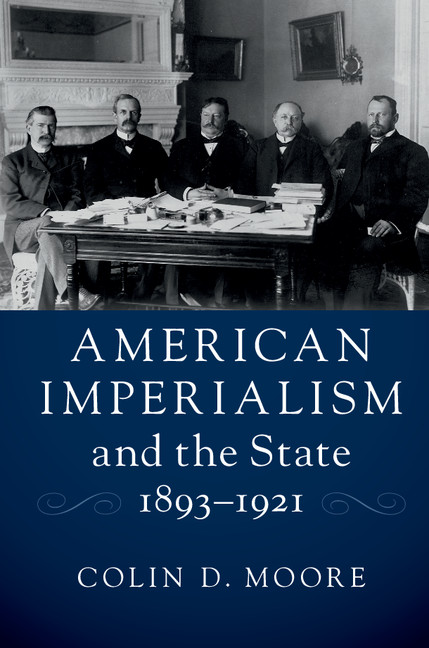
    How did the acquisition of overseas colonies affect the development of the American state? How did the constitutional system shape the expansion and governance of American empire? American Imperialism and the State offers a new perspective on these questions by recasting American imperial governance as an episode of state building. Colin D. Moore argues that the empire was decisively shaped by the efforts of colonial state officials to achieve greater autonomy in the face of congressional obstruction, public indifference and limitations on administrative capacity. Drawing on extensive archival research, the book focuses principally upon four cases of imperial governance - Hawai'i, the Philippines, the Dominican Republic and Haiti - to highlight the essential tension between American mass democracy and imperial expansion.

    Reviews

    'American Imperialism and the State, 1893–1921 is an important book, filled with cross-disciplinary insights that bring the history of formal overseas empire to the study of US state formation, while also bringing a precise attention to the shape of the imperial state to the burgeoning historiography of early twentieth-century US empire-building.'

    Katherine Moran Source: H-SHGAPE

    'Moore’s analysis is compelling; the book moves through issues of politics, economics, culture, ideas, race, constitutionalism and law, international and bureaucratic relations, collaboration with local elites and state-building - as well as of course the opposition within the various local settings … This book makes an important contribution to the historiography of US colonialism. It opposes many existing interpretations - in a systematic, measured and deeply informed manner - and it will need to be taken very seriously, not least because of its implications for contemporary US foreign policy.'

    David Ryan Source: International Affairs

    Refine List

    Actions for selected content:

    Select all | Deselect all
    • View selected items
    • Export citations
    • Download PDF (zip)
    • Save to Kindle
    • Save to Dropbox
    • Save to Google Drive

    Save Search

    You can save your searches here and later view and run them again in "My saved searches".

    Please provide a title, maximum of 40 characters.
    ×

    Contents

    Metrics

    Altmetric attention score

    Full text views

    Total number of HTML views: 0
    Total number of PDF views: 0 *
    Loading metrics...

    Book summary page views

    Total views: 0 *
    Loading metrics...

    * Views captured on Cambridge Core between #date#. This data will be updated every 24 hours.

    Usage data cannot currently be displayed.

    Accessibility standard: Unknown

    Why this information is here

    This section outlines the accessibility features of this content - including support for screen readers, full keyboard navigation and high-contrast display options. This may not be relevant for you.

    Accessibility Information

    Accessibility compliance for the HTML of this book is currently unknown and may be updated in the future.
