

The kinds of global urbanism emerging from the current wave of hypermodernist city building marks “an unprecedented radical departure from existing patterns of place.”Footnote 1 As redevelopment projects have progressively refashioned cityscapes into assemblages of urban enclaves outfitted in a glittering new global image, existing land-use patterns and long-standing spatial connections are disrupted, if not eliminated outright. The steady accumulation of enclosed enclaves has transformed urban landscapes into a multitude of relatively autonomous “sovereignscapes,” or discontinuous territorial fragments where the administrative rules through which they are governed are “free of any incumbent bureaucracy.”Footnote 2
The proliferation of autonomous zones complicates the complex territorial configurations of singular sovereign authority. In conventional thinking, sovereignty (i.e., the singular and centralized capacity to make rules and enforce them) represents the ultimate or last-resort power of decision-making over a carefully demarcated territory and the population which inhabits it.Footnote 3 The formation of autonomous zones breaks down the strict imbrication between sovereignty and territory, a largely symbiotic relationship where reliance upon a singular authority establishes a governance structure carved out of the same set of rules. This unbundling of territorial sovereignty is a highly selective process, and does not conform to any overriding logic that suggests a single route. The zone format operates through the enactment of variegated, truncated, or compromised sovereignties.Footnote 4
At a time of hypermodernity, new conceptualizations that refer to the decoupling of territoriality and sovereignty – sometimes called “new medievalism,” “neomedievalism,” or “postmodern territorialities” – recognize that geographic space has become more complex, fluid, and “relational” where overlapping authorities disrupt singular systems of monolithic control. As a general rule, conventional concepts based on idealized notions of “absolute” space are increasingly problematic for understanding the spatial complexities of city building at the present historical conjuncture.Footnote 5
The zone format converges around the peculiar nexus of global modernity, investment capital, and exception. The steady multiplication of autonomous zones means that power is no longer identified in the singular sovereignty of state-sanctioned authority, but is distributed across the entirety of urban landscapes. This devolution from centralized authority creates bifurcated sovereignty regimes.Footnote 6
Operating as an emergent strategy of city building, the zone format has increasingly filtered through urban landscapes as sites of both production and consumption. As extralegal habitats that nurture and grow their own sources of power, autonomous zones possess an organizational logic that favors stealth and camouflage over transparency and openness. These innovations in governance appear in strange disguises and under unexpected circumstances, sometimes by adopting various kinds of imitative or “simulated sovereignty.” The zone format has become a persistent yet mutable instrument, adapting to new circumstances and changing shape in ways that could not have been imagined at the start. Autonomous zones can turn temporary exceptions – sometimes created out of the immediacy of emergency situations – into permanent mutations.Footnote 7
As the zone format has multiplied and spread, it has also evolved and mutated, mixing with other increasingly popular spatial typologies like tourist-entertainment sites, business hubs, office parks, warehousing precincts, logistics centers, facilities for light assembly, innovation districts, and gated residential estates, to become the basic template, or building block, for fashioning emergent “cities of tomorrow.”Footnote 8 This new “free zone” paradigm provides new kinds of socio technical infrastructures that are grafted onto, transplant, and extend existing ideas about city building at a time of rapid globalization. As a distinctive socio spatial formation of late modernity, the zone format has adapted and consolidated into a new prototype for fast-track urbanism. Employing the rhetoric of freedom and openness, autonomous zones operate as a kind of “shadow state” existing parallel with, but beyond the reach of public administration. As undeclared constellations of private authority, they are actively engaged in transforming extraterritorial spaces into profit-making machines for corporate enterprise.Footnote 9
As built manifestations of prescriptive commercial formulas enabling corporate enterprise, autonomous zones are hybrid assemblages of hard and soft infrastructures, generic design blueprints, and administrative rules. The zone format is as much a distinctive social practice as it is a physical place. As repeatable spatial templates that constitute the architecture of the city itself, autonomous zones act as a distinctive kind of aspirant “global space” through the convergence of three intersecting and overlapping practices: jurisdictional envelopes (or “rule-through-exception”), technological hardwares and softwares (logistics and infrastructure), and imaginative aesthetics (the unencumbered “free spaces” of frictionless movement of capital, goods, and information). By combining infrastructure and information technology, the zone format has become the very operating system for constructing the city itself.Footnote 10
Concessionary Urbanism
Concessions – that is, territorial spaces within which some aspects of state sovereignty are either permanently or temporarily transferred to private corporate interests – have a long history. Most notably, concessions were especially significant for the extractive and developmental functions they performed during late colonialism and, notably in China, as treaty ports, entrepôts, and administrative outposts of free trade imposed under imperialism.Footnote 11 While many concessions disappeared with the end of colonialism, they survive today in the form of resource-extractive enclaves managed by such powerful entities as multinational oil companies or mining giants. These large-scale corporate enterprises have continued to exercise state-like coercive and sometimes welfare activities that replicate state functions, most recently in the new guise of corporate social welfare programs that appear under the discourse of social responsibility.Footnote 12
The proliferation of new modes of urban governance – such as free trade zones, business improvement districts, gated residential communities, special enterprise concessions, tax-free havens, investment corridors, community empowerment initiatives, redevelopment projects, and public-private partnerships – have effectively broken urban landscapes into spatial fragments that reflect emergent configurations of accumulated wealth and power. Exploring these sites of neoliberal policy innovation enables us to uncover a story of urban fragmentation that has largely been elided in both statist-institutional perspectives of mainstream comparative politics and conventional urban studies. The insertion of these hybrid regulatory regimes into the urban social fabric marks the start of efforts to bring market-oriented solutions to bear on such conventional problems of urban management like provision of services, safety and security, and maintenance and repair – all of which were once the exclusive mandate of public authorities.Footnote 13
City building has increasingly taken place through the logic of exception, whereby real-estate developers demand exemptions from existing regulatory regimes, including tax write-offs, relaxation of land-use regulations, zoning variances, and accelerated approval processes. Real-estate developers legitimate to the suspension of the rule of law by reference to nagging “red tape,” bureaucratic slowness, and the need for haste. Taken together, these dispensations, concessions, and negotiated compromises amount to what Idalina Baptista has called a “regime of exception,” that is, a tractable system of governance established by extraordinary measures that create and enforce alternative sets of procedural rules and institutional structures to deliver a desired outcome. The anomalies that autonomous zones create are not inconsistent aberrations or abnormal deviations, but instead their precise objectives.Footnote 14
This shift toward flexible governance has opened a terrain of administrative malleability, where conventional planning protocols lose their power to enforce strict conformity to uniform standards. Practices of exception provide the conditions of possibility to bypass and abrogate existing practices of governance. What is clear is that city building increasingly takes place under circumstances characterized by pliant, ad hoc decision-making, or what Ananya Roy has described as the informalization of the planning process.Footnote 15 This permissive approach consistently provides real-estate developers with more flexibility in bending the rules in their favor. Seen in this light, improvised decision-making does not represent a failure in planning practice or the inability of urban planners to shape the built environment. On the contrary, informality in planning “appears to be a deliberate planning strategy that best fits the interests of those decision-makers who find in the flexibility it provides the leeway needed to regulate and organize the development of the city according to their own interests.”Footnote 16 While it may be mandated by law, public oversight is rarely implemented. In the end, flexibility can more often than not come under the dominance of powerful private interests. To be sure, informality as a planning practice – or the existence of ad hoc, case-by-case processes of decision-making within the planning process – amounts to a regime of exception.Footnote 17 Large-scale urban redevelopment projects are planned and executed as exceptionalities, that is, produced on an improvised basis outside of conventional planning regimes with their standardized regulations and procedures.Footnote 18
The logic of exception marks a shift from fixed forms of sovereignty (and its law-bound regularities) to graduated forms of sovereignty, with its “sliding and contested scales of differential rights.” Unlike the dreamscape of modernist planning, exceptionality signals “processes of becoming, not fixed things.”Footnote 19 Put bluntly, regimes of exception are constitutive of a new mode of privatized planning that enables real-estate developers to abrogate the rule of law and substitute their own regulatory guidelines.Footnote 20
Hybrid Zones as Template for New Modes of Urban Governance
Over the past several decades, the sheer numbers and genres of extraterritorial spaces have expanded, diversified, and consolidated into dense configurations of exception and exemption that superimpose themselves and act to undermine the very notion of territorial sovereignty. Seen in this light, territories are no longer (strictly speaking) confined to a clearly demarcated bounded shape, but become – in addition – complex systems of relationships and large-scale structural networks.Footnote 21
In Amman (Jordan), the conjoined efforts of city builders, including real-estate developers and political power-brokers, have remade Amman in the image of a “new city” by way of the introduction of globalized benchmarks of speed, efficiency, and connectivity. This production of new systems of movement and connection represents the deliberate intervention into urban space in ways that conform to the interests of corporate business interests. Yet instead of accepting at face value the conventional understanding of property markets and the production of space under contemporary capitalism as rooted in the economic rationality of the market, the reshaping of the urban landscape in Amman reflects the continued ability of oligarchic networks at the heart of spatial production “to turn economic reform discourses, including that of contemporary market urbanism, to their own decidedly illiberal purposes.”Footnote 22 Regimes of exception engage in the production of territory. The steady accretion of private regulatory authorities ranging from Special Economic Zones, Poverty Pocket schemes, development corridors, community empowerment initiatives, urban regeneration projects, gated residential communities, to planned satellite cities have reconfigured the landscapes of power. These spaces of exemption have privileged well-to-do urban residents who can bypass and circumvent the neglected areas of the city.Footnote 23
In short, the changing cityscape of Amman reflects efforts to empower private agencies and to bring market-oriented solutions to bear on conventional problems of urban governance. The introduction and deployment of new regulatory regimes built around infrastructural ensembles have effectively created “a social reality that [neoliberal discourse] suggests already exists.”Footnote 24 These regulatory regimes enable private interests to leverage their newly acquired authorities to defend “market requirements” (i.e., the necessity of cost recovery) against the claims of deliberative citizenship.Footnote 25 As the neoliberal development discourse of development celebrates the involvement of entrepreneurial initiative and private agencies in the “governance” of places and populations, it remains silent on the possible authoritarian implications of this shift.Footnote 26
In Johannesburg, the lateral extension of privately managed precincts known as city improvement districts (CIDs) has largely replaced public authorities in the historic downtown core. In their formal operations, CIDs form an “archipelagic network of power” that has replaced the public management of urban space. By amassing powers conventionally reserved for municipal administrative bodies, CIDs are the primary aggregate units of the entrepreneurial city and neoliberal governance. More than merely reinforcing existing divisions in the already splintered urban landscape, “CIDs have effectively gone their own way,” producing a new spatial order that marks “not just an insular retreat” from the social fabric of the city, “but the deliberate construction of an extended network of fortified enclaves disconnected from the rest of the urban landscape.” This wholesale withdrawal from the public modes of urban governance “amounts to a new kind of transcendent enclave urbanism, marked by the shift toward a form of autarkic urban development that leads inevitably to the creation of an archipelago of self-reliant, [self-contained island-like enclosures] with little or no organic connection to the surrounding cityscape.”Footnote 27
Informality as a Mode of Urban Governance
The evolving metropolis of the twenty-first century is a paradoxical space of contradiction and contestation. On the one hand, what characterizes the contemporary age of global urbanism are deepening inequalities, ongoing displacements and removals, and the entrenchment of separations that territorialize urban identities in enclave geographies. On the other hand, city building is shaped by grassroots expressions of citizenship, civil society engagement, and social mobilizations. These populist sentiments create platforms that insist upon “participatory” frameworks of collaborative planning.Footnote 28
As a general rule, the core principles of modernist planning have long extolled the virtues of officially sanctioned, formal regulation as a vital instrument for bringing order to the disorderly city.Footnote 29 Seen from this angle, informality – or the persistence of unregulated (and hence chaotic) practices and irregular spaces that operate outside official authorization and control – appears to be antithetical to formal planning. Contrary to this conventional way of thinking, Nezar AlSayyad and Ananya Roy have convincingly argued that informality constitutes, in fact, a distinct (and disguised) mode of regulation, that is, “a set of tactics” that establish “rules of the game” that shape interactions between and among individuals and social groups.Footnote 30 If formality stresses the fixing of exchange relationships, then informality operates through the constant negotiability of transactions. Properly understood, then, informality is not marginal or exceptional, but on the contrary, an organizing logic of everyday life – or a distinct mode of urbanism.Footnote 31
In contrast to the conventional thinking that treats formality and informality as hermetically sealed, distinct spheres of activity, they are actually inextricably entangled in myriad ways. Because municipal authorities have the discretionary power to effectively extend, or conversely suspend, the protections of the law (i.e., to establish the legal “inside” and the illegal “outside”), they can effectively determine what is formal and what is not. By defining what is legitimate and what is illegitimate, they effectively “determine which forms of informality will thrive and which will disappear.”Footnote 32
Cast in this light, informality in all its manifestations can thus be understood as a mode of urban governance that is “in fact produced through intricate webs of norms and regulations” that do not involve the participation or exercise of official sanction.Footnote 33 The unauthorized practices and irregular spaces of the informal city jostle uncomfortably with the abstract spaces of the planned city with its land-use zoning and building codes. Under circumstances where formal regulatory regimes are either weak or entirely absent, key power-brokers, civic and community-based associations, faith-based groups, and NGOs often fill in the void, dispensing patronage and adjudicating disputes, and making rules and enforcing compliance.Footnote 34
As numerous scholars have demonstrated, religious groups and political organizations often play pivotal roles in providing much-needed social services in the vast informal settlements that surround depressed cities.Footnote 35 Faced with the deprivation of everyday life and the neglect if not outright hostility of state authorities, these social groups and organizations have effectively established themselves as an effective “shadow state,” thereby producing “a fragmented domain of multiple and competing sovereignties.”Footnote 36 Unlike the politics of interest-group liberalism, with “its democratic system of checks and balances,” these competing sovereignties often represent “a hardening of ever-fragmenting fundamentalisms and parochialisms – the politics of fiefdoms negotiated through modes of visible and invisible regulations.”Footnote 37 Rather than operating as positive vehicles of empowerment and upliftment, community-based organizations (CBOs) and their leadership often block progress, controlling or capturing benefits aimed at the poor and misusing them for private gain. As Joop De Wit and Erhard Berner have shown in their study of community-based projects in the slums of three large Indian cities, municipal agencies, international donors, and NGOs “cannot easily escape the logic of patronage, and often themselves become part of a system of vertical dependency relations.”Footnote 38
In Mumbai, Hindu fundamentalist (and xenophobic) groups like the Shiva Sena party have gained popular support by promising to acquire and transfer habitable land under conditions of highly restrictive land markets and extreme housing scarcity. Over the course of the past four decades, the Shiva Sena “has sutured a specific form of regional chauvinism with a national message about Hindu power through the deployment of the figure of the Muslim as the archetype of the invader, the stranger, and the traitor.”Footnote 39 The massive, nationwide campaign of ethnocidal mob violence directed against impoverished Muslims in 1992–1993 coincided with the spatial geography of urban overcrowding, intense competition over street commerce, and housing shortage nightmares in Mumbai. In a “bizarre utopia of urban renewal,” Hindu extremists seeking to reclaim land for their own religious followers engaged in a violent outbreak of “ethnic cleansing” designed to destroy Muslim-owned shops and residential dwellings, and to push Muslims out of streets and public spaces in those neighborhoods “where the two groups lived cheek by jowl.”Footnote 40
In the sprawling slums of many Latin American cities, Pentecostal Christian churches have emerged as key power-brokers in local politics, in part because of their ability to supply the much-needed social services municipal authorities have largely failed to deliver, and to offer a modest “safety net” for the poorest of the poor.Footnote 41 Like populist Islam, Pentecostal and charismatic Christianity conveys a powerful message of spiritual redemption through engagement and participation in community service.Footnote 42 Gang membership often provides a secular route to resist the humiliations imposed by living in stigmatized sites of deprivation. In contrast, religious conversion can be a “gendered form of oppositional culture” that emerges in response to the male oppositional culture of gang membership. For women, the “flight into a religious world that prohibits drinking, advocates moral redemption, and still believes in honest hard work” signifies a disillusionment and disenchantment with the secular world of political parties and municipal authorities who fail to deliver on their promises of providing social services.Footnote 43 In slums, the municipal officials, political parties, religious associations, civic organizations, and NGOs all compete for power and influence, offering different territorialized forms of association and patronage.Footnote 44 Even when religious groups are not directly involved, slum dwellers develop their own distinct politics, regimes of rule, and institutional dynamics. In Villa el Salvador, a famous barricada of Lima, transformed from an informal squatter settlement into a well-ordered, working-class neighborhood, the estimated 350,000 residents have more or less adopted “a set of norms and “laws” of local bosses over which the state has hardly any control” under circumstances where the presence of public police is minimal.Footnote 45
Under circumstances where local power-brokers replace the formal authority of the state administration with their own modes of governance, the distribution of patronage becomes the de facto logic of rule. Yet, the logic of rule is never monolithic: the terrain always consists of uneasy alliances and shifting sovereignties. The political economy of patronage can vary from a mediated role of brokerage between formal regimes of governance and local communities to the relatively autonomous condition of “free space.”Footnote 46
Beirut, City of Mirrors: The Imbrication of Formal and Informal Planning Practices
Sometimes the selection of extreme cases that illustrate the unbundling of territory and sovereignty can help us to bring into sharp relief the actual workings of global urbanism on the ground. While they may appear as outliers (or “limit cases”) located at the far edges of the spectrum, these extraordinary expressions of deterritorialization allow us to imagine the form that the “urbanism of exception” might take if these emergent patterns of nested sovereignties were generalized across urban landscapes. Seen from this perspective, the exceptional case offers prescient clues as to where global urbanism may be going.
In Beirut (Lebanon), the striking contrast between the spectacular rebuilding of the devastated historic core, on the one side, and the incremental rehabilitation of the southern suburbs after the end of the 1975–1990 civil war on the other, illustrates the clash of competing rationalities that split along the lines of top-down formal planning versus laterally extended informal interventions at the grassroots. From the start, the commercial resurrection of downtown Beirut and its deliberate rebranding as a leading metropolis of the Arab world triggered a great deal of controversy and hotly contested debate over the nature and scope of urban reconstruction in the aftermath of war-related devastation.Footnote 47 This urban redevelopment project became the virtual dreamscape of visual consumption, a platform for the hoped-for insertion into global and cosmopolitan circuits of power. Conducted under the aegis of a joint stock real-estate company known by its French acronym Solidère, the rebuilding process was a historically singular event of postwar rebuilding when a lone company assumed ownership and management control of a highly symbolic place.Footnote 48 In a bold move, Rafik Hariri, the millionaire ex-politician and founder of Solidère, engineered the adoption of a controversial amendment that created an exception to the 1977 planning legislation. So-called “law 117” (through special powers of compulsory purchase) enabled Solidère to expropriate land and property from existing owners, who were compensated with stock-shares in the company, at what many claimed fell far short of the true market value of their properties. Owners had the option to keep their properties, but only on condition they had sufficient funds to restore their buildings in line with strict preservation guidelines determined by the Company. As part of this sweetheart reconstruction scheme, Solidère acquired “exceptional powers” over conventional land-use planning functions, including determining building typologies and supervising the installation of its own “[faux] public” infrastructure works. In what critics lambasted as akin to highway robbery, an act of piracy, or even a kind of vigilantism conducted deceitfully under the cover of law, this carte blanche mandate cleared the way for Solidère to manage the city center like its own private mini-fiefdom. To secure protection from any challenges from rival real-estate developers, Solidère exercised control over the entire project via a network of business allies and high-ranking city officials. In order to implement the reconstruction effort, the Company systematically razed the war-torn urban fabric, creating a virtual tabula rasa right at the heart of the historic city.Footnote 49
This master-planned, privately owned flagship reconstruction project marked a decisive moment where, in the words of Saree Makdisi, “state projects end and private projects begin can no longer be determined – not because this is a strong state organizing a command economy but because [real estate] capital has become the state.”Footnote 50 This large-scale mega-project constituted and defined the “formal” approach to planning and real-estate redevelopment in Beirut after the devastating civil war. Although Solidère initially planned for the heritage preservation of some older iconic buildings, it demolished most of the original historic core and built modern buildings on top of the ruins, displacing small-scale business owners and inhabitants in the process. In the process of rebuilding, Beirut became “perhaps the world's largest laboratory for postwar reconstruction,” or what two scholars have called a “permanent (re)construction site,” that was subjected to the globalizing forces of consumerism, privatization, and laissez-faire entrepreneurialism.Footnote 51
The Solidère postwar reconstruction project reinvented the city's historic core of Beirut, transforming the downtown center into a separate enclave of high-end exclusivity, abruptly severed from the rest of the city by a network of highways that constitute solid physical barriers. A new landscape of high-rise buildings and immaculately rebuilt streets stands in stark contrast with the dense morphology of the somewhat ramshackle neighborhoods that surround the area. Perhaps not so surprisingly, the rehabilitated city center preserved and perpetuated the isolation of the historic core of the city in abiding to the boundaries forged during the civil war. Solidère transformed the battle-zone of downtown Beirut from an abject space of military violence into a ludic space of free flow of capital without altering in any fundamental way the spatial detachment of the downtown core from the rest of the city.Footnote 52
Widely considered as the embodiment of a new political and economic era associated with the neoliberal project of the late Prime Minister Rafik Hariri (1995–2005), Solidère sought to establish Beirut as a global destination for international capital and investors, in line with other (so-called) neoliberal (market-driven) urban interventions in the Arab Middle East and elsewhere. Wrapped in nostalgia and wishful thinking, Solidère fashioned an uplifting narrative that imagined a “reborn Beirut” by mobilizing a stylized image of cosmopolitanism tailored for place-branding and for attracting foreign direct investment.Footnote 53 By drawing on a simplistic recollection of the alleged Lebanese traditions of entrepreneurialism, cultural pluralism, and innovation, this effort to construct an idealized “layered city of memory” was remarkably selective in the historical narrative it reproduced and the collective memory it evoked. Stitching together sanitized references to restored Roman baths, reconstructed Ottoman “historic buildings,” and French colonial promenades, Solidère fashioned the carefully manicured motto – “Beirut, Ancient City of Future” – to re-brand the city in ways that erased the reminders of the more recent traumatic and violent events that led to the destruction of the historic downtown center, and replaced these bitter memories with a romanticized appeal to a more glorious and heroic past.Footnote 54
Like the proverbial phoenix rising, the city builders behind the reconstruction effort have sought to transform the ravaged core of Beirut into the premier seaside destination for luxury living and recreation in the Middle East. The ambitious master plan, spearheaded from the beginning by British architect Angus Gavin, who previously worked with the London Docklands Development Corporation, is an odd assortment of careful urban design and historic preservation, interspersed with “showy outbursts by big name global architects.” Many streetscapes “have been impeccably restored to their beaux-arts glory, with colonnaded pavements and beautifully carved stonework along cornices and window reveals, reviving the fusion of French colonial and Levantine vernacular.”Footnote 55
From the start, the rebuilding project was harnessed to a vision of a post civil war Beirut that aligned the commercial recovery of the city to the entrepreneurial interests of large-scale capital of Lebanese and Arab Gulf origins. The rebuilding project benefited from a wide array of public subsidies, such as tax exemptions and financial assistance to offset costs of infrastructure, and generous dispensation enshrined in special regulations designed à la carte to fit the needs and interests of the private real-estate developers.Footnote 56 Solidère redrew the original streetscape of the old city, demolishing many of its architectural and urban landmarks and replacing these with new building typologies that enhance the “commercial trading value” of the new landscape. The historic buildings that remained were brought into line with the refurbished image of the city – as displayed in Figure 7.1, a kind of “Disneyfied” imitation of a real city preserved in a faux time warp for the feigned aesthetic pleasure of wealthy globe-trotting tourists.Footnote 57 As Oliver Wainwright has argued, “these new pseudo-historic streets recall their former selves, but they have been reincarnated as upmarket doppelgängers, precious replicas of what had been the well-worn and well-loved blocks of these lower-class neighborhoods.” Under the guiding hand of Solidère, Beirut has inexorably become a skyscraper city of lofty office towers and “floating villages” of penthouses stacked one atop the other – “vertical extrusions of inflated land values.”Footnote 58
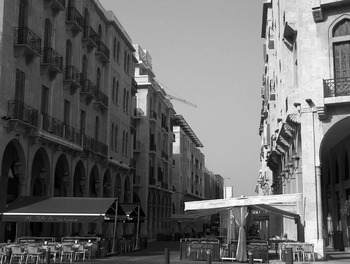
Figure 7.1. Solidère project, Beirut.
Operating on the basis of a new faith in economic liberalism and a laissez-faire approach to city building, Solidère reconstructed the devastated downtown core into a hypermodern and socioeconomically isolated district that is intended to serve as a new playground for a global, and especially rich Arab elite.Footnote 59 Indeed, this new sanitized and purified Beirut has become an exportable model for urban redevelopment in other cities of the Arab world, like Amman (Jordan), Riyadh and Jeddah (Saudi Arabia), and Hazmieh (Lebanon). Large-scale construction and real-estate companies from the Arab Gulf, like Sama Dubai, have begun to build cities in its image elsewhere in the region.Footnote 60
This remaking and reimagining of war-torn Beirut through an elaborate assemblage of downtown mega-projects took place in tandem with the emergence of Hezbollah (the “party of God”) as the de facto state administration in the impoverished suburban neighborhoods south of the central city.Footnote 61 In Beirut, the designation “southern suburbs” has a negative connotation, often used interchangeably with anarchy, unauthorized squatting, illegality, and poverty. The southern suburbs–created at first by a permanent flow of rural migrants and later by both urban and rural refugees from the 1975–1991 civil war and the Israeli occupation (1978–2000) – are homogenous and impoverished quarters of Beirut, consisting mostly of Shi'a Muslim residents and by the second decade of the twenty-first century comprised one third of the population of the greater Beirut metropolitan region. As such, this vast catchment area has been stigmatized as an uninviting belt of misery, a vast zone of rural migrants, displaced peoples, and Palestinian refugees – all squeezed into temporary encampments without proper services or infrastructure.Footnote 62 The southern outskirts of Beirut became spatially fragmented into militia-controlled “mini-states,” home to all sorts of newcomers to the city.Footnote 63 Over time, these newcomers became permanent inhabitants, and these “camp-cities” became an integral part of the southern precincts of Beirut.Footnote 64
Despite the uncertainly produced by the long civil war, Beirut was far from an insular “closed city”: its urban landscape was subjected to an odd globalization all of its own, consisting of transnational flows of capital organized under the watchful eye of warlords, informal economies of social and infrastructural services provided by militias, and real-estate development in spite of the ongoing violence. For celebrants of the neoliberal global order, the micro managed “militia economy” operated in “the realm of pathology, infected by politics and cultural traditionalism, by predatory gangsterism and transnational criminality.” Its backwardness “prevented Beirut from taking its rightful place as the primary regional driver of the Arab world toward integration with global markets.” Yet as Najb Hourani has argued, the “militia economy” was never fully outside larger processes of financial globalization, but instead was integrated into a global field consisting not of formal financial enterprises operating according to a universal capitalist rationality, but rather one of similarly constituted networks of entrepreneurs, private companies, and other institutional actors working within and alongside a variety of global networks in pursuit of politico-economic power.Footnote 65
Just as elaborate urban mega-projects such as Solidère and Elyssar have remade Beirut in the radiant image of a world-class cosmopolitan city, Hezbollah (the political party best known for its role as the “Islamic Resistance” against Israel) has emerged as the main mediator of social rights for the Shi’a poor.Footnote 66 Its rise to power can only be understood in the context of civil-war Beirut where the city was divided into various zones, each governed by well-armed religious militias. What is striking is the maturation and subsequent transformation of Hezbollah from a popular paramilitary “war machine” into a competent apparatus of service provision and urban development. Its development programs in the southern suburbs of Beirut include the provision of housing, education, medical services, water, sewage systems, and electricity.Footnote 67
What is critical to understanding post–civil war Beirut are the ways in which a complex and hybrid mix of non state actors have actively engaged in the production of mundane spaces (including such installations as roads, industrial zones, housing, and social service centers), which have resulted in the reconfiguration of existing geographies of power and control. Along with other religious-political organizations, Hezbollah provided infrastructure services to informal settlements in the almost total absence of state services, thereby transforming the southern peripheries of Beirut into frontiers of sectarian conflict through territorial battles over land, housing, and available resources.Footnote 68 In the wake of the summer 2006 Israeli invasion and bombardment, Hezbollah took charge as the main planning actor in the reconstruction of the southern suburban neighborhoods of Beirut. Hezbollah became a full partner for all relief agencies and reconstruction donors, and played a dominant role in the rehabilitation of damaged road networks and bridges as well as the development of design schemes for the reconstruction of a number of ravaged villages and neighborhoods.Footnote 69
Depending on one's particular perspective, Hezbollah can be considered at one and the same time an NGO, a Lebanese political party, a resistance movement, and an armed militia.Footnote 70 Such social categories, however, selectively emphasize or blur Hezbollah's various activities in the arenas of politics, military organization, resistance to occupation, and service provision – all of which characterize its diverse functions. The hybrid character of the two main religious-political organizations in southern Beirut – the Shi’a-led Hezbollah and the Druze Progressive Socialist Party (PSP) – makes their spatial interventions difficult to categorize in any unambiguous way. Each organization is a complex mixture of public and private activities, combining local militias with transnational networks. They cannot be confined to the simplifying categories of “non state actors” or NGOs, since they function simultaneously inside the state administration and outside it. Neither can they be considered political parties in the conventional sense, since they are involved in a wide range of diverse “state-like” activities.Footnote 71 Put concretely, these organizations maintain armed militias, serve as philanthropic charities, function as NGOs that manage transnational donations, administer social services, and deliver public works.Footnote 72
The spatial practices of Hezbollah have transformed what used to be a depressed peripheral area into a religiously contested frontier zone, where spatial contestation has become less about war maneuvering and more about the social production of a spatial order of political difference through property markets, building and infrastructure construction, and urban regulations and land-use zoning.Footnote 73 Rather than introducing an innovative model of land-use planning that decisively breaks with the reigning neoliberal approaches, Hezbollah has adopted a language of proprietary rights that corresponds closely with the conception of property rights advocated by neoliberal planning, that is, one that enshrines private, individual ownership as sacrosanct and desirable. According to Mona Fawaz, the “neoliberal planning regime” that Hezbollah has adopted is not the accidental outcome of unreflective policy choices; rather, it is necessary step that has enabled the party to consolidate control over its territory in the city and to fix the future of land-use planning in accordance with its own political calculations.Footnote 74
Over time, Hezbollah mutated from a political organization providing social welfare services in the low-income neighborhoods and informal settlements in the southern peripheries of Beirut during the civil war into a proto-state agency (a virtual “shadow state”) providing shelter for internally displaced families. After the July 2006 war between Israel and Lebanon, this religious-political organization underwent a further transformation, becoming an aggressive top-down property development agency with a vision for a future world-class city. Hezbollah has used a variety of different tools – such as intervention into housing and real-estate markets, contestation over infrastructure and property rights, war compensation policies, urban planning and design practices, and land-use zoning policies and building laws – to carve out a distinctive “fiefdom,”Footnote 75 or a space-in-the-making that Hiba Bou Akar has termed “Hezbollah City.”Footnote 76‖
Spatial landscapes in deeply divided cities like Beirut (or Belfast, Nicosia, and Jerusalem) often become oversaturated with conflicting meanings. In the words of journalist Monika Borgman, “Beirut is a city of camps, full of blocked thoroughfares. The visible city is not the city. The city is invisible. Everything is a screen.”Footnote 77 The spatial reconstruction strategies of Solidère and Hezbollah can be seen as two sides of the same coin: in going about embedding their competing visions of the urban future, they have both set themselves on a collision course against the city.Footnote 78 In other words, they both act with limited public affirmation, and independently of public oversight or municipal control. Whether commercial or sectarian, they both represent interests that are partially sectarian, private, and narrowly focused on particular goals. These crystallized interests are a telling symptom of the hybrid sovereignties that operate in parallel universes in Beirut. Solidère and Hezbollah each have a different vision of the city and its future. Proponents of each vision marshal support from within their own constituencies, thereby setting in motion platforms involving coercive urban politics. Both visions draw on different historical narratives: on the one side, Hezbollah has tapped into a history of resistance to external oppression; on the other side, Solidère has identified with a long history of commercial integration at the heart of the Arab Mediterranean.Footnote 79 In fashioning an image of itself as pious and incorruptible, Hezbollah seeks to stand above the corrupt city.Footnote 80 In contrast, Solidère presents a sanitized, elitist version of Beirut as a cosmopolitan world-class city: a clean, orderly, and regulated enclave as opposed to the chaotic, run-down parts of the city, with their crumbling infrastructure and overcrowded streetscapes.Footnote 81
To be sure, Hezbollah is not the only organizational entity – religious, political, or otherwise – involved in informal planning practices outside formal juridical administration of state authorities. Always and everywhere, urban landscapes are “marked, crisscrossed, and fragmented by demarcation lines which are simultaneously real and virtual.” At any moment, these virtual demarcation lines can become real, brought to life by agencies and organizations without formal authorization to make these sorts of deliberate decisions.Footnote 82
Fragmented Regimes of Territorial Governance
Informal settlements and slums, on the one side, and exclusive urban enclaves like gated residential communities and other deliberately sequestered landscapes, on the other, occupy the polar extremes in cities divided by deep sociocultural cleavages. They are both governed by the logic of exception, which acts to suspend the conventional rule of law. Both operate under extralegal rules and regulations beyond the capacity of municipal authorities to effectively manage or even officially intervene. Gated residential communities and other sequestered landscapes embody a “distinctive territorialisation of citizenship”Footnote 83 – or what Setha Low and Steven Robins have termed a new “spatial governmentality.”Footnote 84 The key characteristic of these spatial regimes is the formation of cocooned compounds that are governed by private bodies that largely escape public scrutiny. Such collective entities as common interest communities (CICs), common interest developments (CIDs), and “community/neighborhood associations” typically operate as the private governance bodies for gated residential communities. These self-governing enclaves rely on covenants, conditions, and restrictions to privately govern and control land use, design decisions, services, and even social conduct. As incorporated collective entities, they own, operate, and manage the common properties within their boundaries, including open space, parking, recreational facilities, and open-access streets. These private governing bodies have the legal authority to enforce “reciprocal rights and obligations.” They are “contractual associations” that deliver some type of neighborhood-level governance in the form of rules and regulations and the provision of local services (e.g., safety and security, road maintenance, landscaping) on the basis of assessments (fees) collected from members.Footnote 85
Codified as specialized covenants, legally binding contracts, and deed restrictions, this governance structure creates new types of private governance in the form of “home-owner” or neighborhood associations.Footnote 86 As Evan McKenzie has argued (following Robert Reich), these “privatopias” signal the “secession of the successful.”Footnote 87 In this sense, gated residential estates, with their own internal regulations and codes, represent a new kind of privatized governance where contract law in defense of restrictive covenants functions as the supreme authority, where property values are the foundational pillars of community life, and where exclusion is the driving force behind social organization.Footnote 88 Although the individual rights associated with private property have historically been the legal domain that has protected affluent residents from spatial encroachment, collective agreements with formal legal standing have increasingly become the prototype for urban residential development. Taking the form of condominiums, cooperatives and single- and multi family homes, private residential communities (gated and non gated) are spreading worldwide across diverse socioeconomic classes.Footnote 89
As such, these self-governing enclaves are more than just the resultant outcome of neoliberal urban governance policies. They are also active agents that produce new technologies of spatial governance, generate new kinds of sovereignty largely independent of public authority, and manufacture subjectivities and identities.Footnote 90 Gated residential communities epitomize supply-driven residential segregation, that is, they are the embodiment of security gates in search of a residential community to inhabit them. As Jeremy Seabrook has put it in a particularly sardonic rhetoric, the super-wealthy elite of the “globalizing” cities at the margins of modernity occupy a liminal place of “gilded captivity”: they “cease to be citizens of their own countries and become nomads belonging to, and owing allegiance to, a super terrestrial topography of money; they become patriots of wealth, nationalists of an elusive and golden nowhere.”Footnote 91
The political logic of the exception creates “a pattern of noncontiguous, differently administered spaces of “graduated” or “variegated sovereignty.’”Footnote 92 Some of these zones have well-defined and heavily policed borders, while others have porous and fluid boundaries. Some zones grant formal benefits and exact formal obligations, while others operate in accordance with informal rules and moral persuasion. Because they both exist in a liminal space outside existing regulatory frameworks, gated residential communities and slums are the opposite extremes of a singular process that carves the city into different orders of mottled citizenship where the mechanisms of patronage become the principles of rule. Seen from this angle of vision, neither slums nor gated residential communities fall wholly under the exclusive domain of state regulation and public authority. They both straddle a liminal border-zone of extraterritorial sovereignty.Footnote 93
Autonomous zones operate as complex and dynamic systems of exception. As exemplary expression of autonomous zones, Free Trade Zones (FTZs) have a juridical status, as a matter of legal exemption, that considers them as not part of the sovereign territory of nation-states, such that goods moving through them enjoy exemptions from tariffs and duties (along with various other state and local tax obligations). FTZs function as storage and trans-shipment areas, but also host all sorts of production activities – such as assembling, repackaging, and the like – which take place in a legal limbo outside of jurisdiction of the sovereign territories within which they are embedded. Furthermore, users of FTZs are exempt from regulatory oversight that enables them to bypass inspection and avoid civil law and even international law. FTZ authorities are not only able to override government ministries, local courts, revenue offices, central banks, and planning authorities, but replace them with their own administrative and logical systems of rule. As a matter of course, FTZs have acquired the power to grant exemptions from laws regulating unfair labor practices, environment standards, sanitation codes, and even human rights abuses.Footnote 94 As “parastatal proxies,” FTZ authorities are able to employ wide legal-juridical discretion to claim exceptions. For users of these zones, these exceptions translate into enhanced entitlements, rights, and privileges. The activities of FTZs constitute not merely a matter of rolling back the power of public administration, but involves “the thickening of the regulatory functions of quasi-state authorities which set the legal and social forms of control.”Footnote 95
Postliberal Urbanism
In the postliberal city, new modes of governance – a vast array of pseudo-public authorities, public–private partnerships, redevelopment agencies, special-purpose commissions, and unelected organizations and entities operating outside of public oversight – have become the primary mechanisms for administering fragmented metropolitan landscapes.Footnote 96 These quasi-private entities, and the spaces they control, have become detached (in varying degrees) from the governing principles and the regulatory reach of public authorities. In ever-expanding ways, cities increasingly consist of a kaleidoscopic mélange of distinct sociopolitical spaces that have divided urban landscapes into hybrid assemblages of distinct enclaves and autonomous zones – each defined by a distinct package of rights, entitlements, and protections.Footnote 97 These modes of flexible sovereignty enable these proto-state agencies and organizations to both fragment and extend the space of rule/authority.Footnote 98
The logic of exception has evolved into corrosive force vis-à-vis the rule of law. The rich and powerful claimants to private property are able to use exceptionality as a way of creating flexible, splintered, and rescaled legal regimes. The deployment of regimes of exception in a geographically targeted fashion enables quasi-private entities to suspend the conventional rule of law.Footnote 99 The powers of exception, that is, the capacity to rescind the normal palate of rules, provides powerful social actors with wide discretion to shape the form and functions of the splintered city. These private actors and agencies enjoy (to varying degrees) the capacity to unbundle and rebundle regulatory regimes in particular configurations in ways that allow them both to do what they please and to conceal their actions from public scrutiny. This unbundling of public regulatory regimes with their single-purpose mandate has produced a layered tableau of proliferating exceptions and polymorphous forms of governance.Footnote 100
The logic of the exception fragments unified and singular conceptions of territorial sovereignty. Suspended sovereignty provides for creation of extraterritorial jurisdictions. Sketched in bold strokes, sovereignty can no longer be usefully thought of as emanating from a coherent “political singularity.” Rather, “sovereignty is manifest in multiple, often contradictory strategies that encounter diverse claims and contestations, and produce diverse and contingent outcomes.”Footnote 101

