


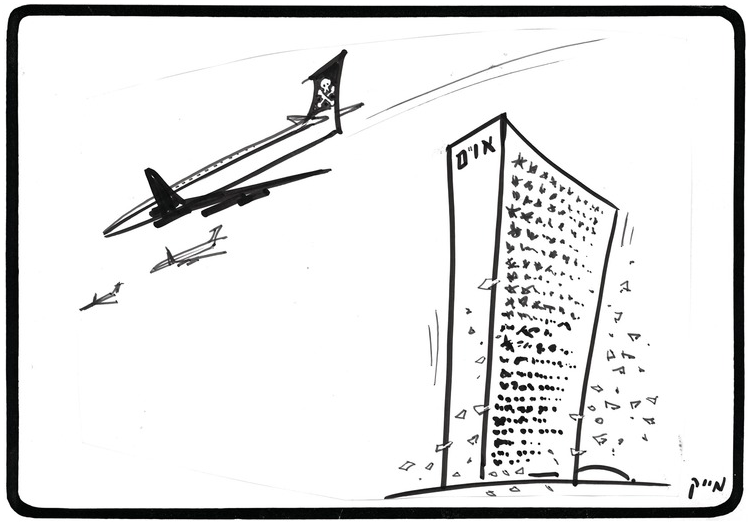
Five passenger aircraft were hijacked by the PFLP to Dawson’s Field, a remote airstrip near Zarqa in Jordan, where they were eventually blown up. The Jewish passengers were separated from the non-Jewish ones who were released. This incident was a central factor in King Hussein’s decision to militarily confront the Palestinians during ‘Black September’.
The inaction of the United Nations is depicted by the crumbling UN building in New York since four of the aircraft were bound for New York. The skull and crossbones, the insignia of piracy, is emblazoned on the tail fin of one aircraft.
- 1 Jan
Shmuel Rosenwasser kidnapped from Metula while on guard duty
- 7 Jan
Israeli aircraft bomb military installations 30 km from Cairo in Operation Priha
- 10 Jan
Two Sukhoi SU-7 fighters shot down by Hawk ground-to-air missiles over Suez
- 15 Jan
Leah Goldberg, Hebrew poet, writer and translator, dies aged 58
- 23 Jan
Supreme Court decides the nationality of Shalit’s children
- 24 Jan
Huge ammunitions explosion in Eilat kills 21
- 27 Jan
Letter from 25 Moscow Jews asking to go to Israel submitted to UN
- 6 Feb
Naval auxiliary vessel in Eilat sunk by Egyptian frogmen
- 6 Feb
Soviet-built 700-ton Egyptian minelayer sunk by Israeli forces in Gulf of Suez
- 8 Feb
Egyptians cross Suez Canal and penetrate into Sinai as far as the Mitla Pass
- 9 Feb
New sales tax increases price of imported cars as much as fourfold
- 10 Feb
DFLP attack passenger bus at Munich airport
- 17 Feb
Nobel Prize winner and Hebrew writer Shmuel Yosef Agnon dies aged 82
- 21 Feb
PFLP-GC bomb on board Tel Aviv Swissair flight kills all crew and passengers
- 4 Mar
Pro-Kremlin Soviet Jews appear at press conference to condemn Israel
- 9 Mar
Yigal Allon reveals plans to build a Jewish suburb of Hebron
- 10 Mar
Knesset agrees Jewish status is based on Halakha after Shalit case
- 23 Mar
US Secretary of State Rogers rejects request for more Skyhawk and Phantom jets
- 28 Mar
Poet Natan Alterman dies in Tel Aviv aged 59
- 8 Apr
Knesset rejects possibility of Nahum Goldmann meeting Nasser in Cairo
- 29 Apr
Government confirms Soviet pilots are flying defence missions over Egypt.
- 4 May
Dayan announces that Israel has halted deep penetration raids into Egypt
- 18 May
David Ben-Gurion resigns from the Knesset
- 22 May
Eight children on Avivim bus killed in a PFLP attack near the Lebanese border
- 10 June
PFLP kill Robert Perry, assistant military attaché at US Embassy in Amman
- 12 June
King Hussein dismisses army head following clashes with Palestinian forces
- 15 June
Foiled attempt by refuseniks to take aircraft at Smolny airport, Leningrad
- 25 June
Rogers proposes revamped peace plan including 90-day ceasefire
- 16 July
Haim Moshe Shapira, NRP leader and government minister, dies aged 68
- 4 Aug
Gahal votes 117–112 to leave government over acceptance of Rogers plan
- 7 Aug
Israel and Egypt agree to 90-day ceasefire
- 7 Sept
Yitzhak Gruenbaum, Polish Zionist leader and government minister, dies aged 90
- 12 Sept
PFLP blow up five hijacked passenger aircraft in Dawson’s Field in Jordan
- 16 Sept
Armed conflict breaks out between Palestinian forces and Jordanian army
- 28 Sept
President Nasser dies of a heart attack in Cairo aged 52
- 5 Oct
Anwar Sadat nominated to serve full five-year term as Nasser’s successor
- 24 Dec
Kuznetsov and Dymshits sentenced to death in Leningrad aircraft affair trial
Nahum Goldmann, president of the World Jewish Congress, wrote an article in Foreign Affairs Quarterly which bemoaned the admiration of and support for Israel by ‘reactionary, nationalistic groups’ as a result of ‘this permanent state of war’. It was then disclosed that Goldmann might be invited to visit Egypt to meet Nasser, but only if there was official Israeli authorisation and that any such visit should be made public. The initiative had come about following Goldmann’s contact with Marshall Tito of Yugoslavia.
This brought criticism from Abba Eban, Moshe Dayan, Golda Meir and most vociferously, Herut’s Menahem Begin. Goldmann’s initiative was condemned in a Knesset vote on the grounds that he was unelected. This brusque rejection led to student demonstrations and a meeting between Golda Meir and high school seniors. Only President Shazar defended Goldmann, arguing that he should not be turned into a second Uriel Da Costa, the seventeenth-century philosopher who challenged orthodoxy and was excommunicated by the Jewish community of Amsterdam.
King Hussein’s attempt to assist Palestinian militants from his side of the border while simultaneously trying to make them desist became more difficult. While Palestinians came to Jordan from Lebanon and Syria to participate in the armed struggle, others felt committed to the state of Jordan. In addition Arafat was unable to control the more revolutionary elements of the Palestinian national movement. The Popular Front for the Liberation of Palestine (PFLP) and the Democratic Front for the Liberation of Palestine (DFLP) began to advocate the overthrow of the Jordanian regime, which undermined Arafat’s relationship with King Hussein. In early June, gunmen fired on Hussein’s motorcade which ignited a shelling of Palestinian refugee camps by the Jordanian military. The PFLP responded by taking more than fifty hostages from two Amman hotels.
In early September, the PFLP hijacked two passenger planes from Frankfurt and Zurich to Dawson’s Field at Zarqa in Jordan, while an attempted hijack of an El Al flight from Amsterdam was foiled. Leila Khaled was arrested by British police after an emergency stop-off in London. The other hijacker, Patrick Argüello, a member of the Nicaraguan Sandinistas, was killed in a gunfight on board the aircraft. He had been trained by the DFLP. A Pan Am flight was hijacked to Cairo and a couple of days later, a BOAC flight from Bahrain was taken to Dawson’s Field in the hope of freeing Khaled. All the aircraft were blown up.
Several of the flights had originated in Tel Aviv and a majority of their passengers were Israeli. The Jewish passengers were separated from the non-Jewish ones. Many were detained in a hotel in Amman before release.
While Arafat meandered between approval and disapproval, Hussein took military action as parts of his kingdom had been taken over by Palestinian militants. The Jordanian air force stopped a Syrian incursion in support of the Palestinians. As a result of Hussein’s assault against Palestinian militants in Jordan during ‘Black September’, Arafat was eventually forced to recognise the authority of the king, while the leaders of the PFLP and the DFLP fled to Damascus. This marked the genesis of the Black September group, based on Fatah members.
Gahal, while part of the government coalition, suffered internal dissension between its Herut and Liberal components. Following the Supreme Court’s decision to rule that the nationality of Binyamin Shalit’s wife and children should be considered to be ‘Jewish’, Herut aligned itself with the religious parties in a vote in the Knesset in March on the question of definition of Jewishness. It also took exception to the government’s interpretation of UN Resolution 242 which could be understood as withdrawal from the West Bank. Gahal became supportive of the Rafi wing of the Labour party and Dayan’s statements on the territories. Golda Meir was concerned that ideological differences between Rafi and other wings of the party would result in a defection to Gahal.
The Rogers peace plan exacerbated the factional division within Gahal, with Herut vociferously opposed to any withdrawal from conquered territory. While the Liberals disagreed and rejected any departure from government, they were also not prepared to break up their alliance with Herut. In August, the Knesset voted 66–28, with 9 abstentions, to accept the Rogers plan. All six Gahal ministers then resigned from Golda Meir’s government. In a subsequent debate, Begin termed the initiative ‘a Munich diktat’. Dayan, however, did not resign. Yet within a few weeks of the vote, construction work began on Kiriat Arba, a settlement abutting Hebron. Begin further argued that the Israeli presence in the Suez Canal region was a service to the free world, delaying the delivery of Soviet arms to North Vietnam by another sixteen days. In December, Gahal opposed the resumption of peace talks under the auspices of the UN’s Special Representative for the Middle East, Gunnar Jarring, calling instead for direct talks with the Arabs.
In June, several refuseniks, mainly from Riga, were arrested on the tarmac of Smolny airport, Leningrad. Their plan was to seize a twelve-seater small aircraft, fly it to Priozersk near the Finnish border, pick up another four passengers and hop over the border to Sweden. The KGB knew of their plans all along and intended to utilise this futile attempt to entrap the mainstream refuseniks and thereby extinguish the growing emigration movement in the USSR.
Their trial opened in mid-December in Leningrad. Two defendants, Mark Dymshits and Eduard Kuznetsov, were sentenced to death on Christmas Eve on a charge of treason. This led to international protests, especially among figures on the Left including Salvador Allende and many leading Eurocommunists. A private appeal by the Israelis to General Franco in Spain had led to the commuting of the death sentences on several Basque prisoners. The Kremlin felt that it could not fall below the standards of Francisco Franco and the sentences on Dymshits and Kuznetsov were commuted to fifteen years’ imprisonment.
