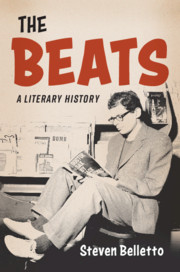


This book is a literary history of the Beat movement, which had its roots in New York City in the mid-1940s, its zenith in the late 1950s, and its legacy secured in the 1990s and after. The story I want to tell isn’t predominantly focused on the biographical exploits that have become legendary in certain circles – the details of such exploits are easily found in popular histories, encyclopedias, and on the internet. Instead, this book explores something like a Beat republic of letters, an informal association of writers and artists that germinated aesthetic innovations and encouraged considerations of once-taboo subjects. This network, which existed always in tension with the underground and what dominant culture thought about the underground, was responsible for producing some of the most recognizable literary works in postwar America. My basic assumption is that the richest way to appreciate individual Beat texts is in relation to one another, so that their achievement may be seen as at once singular and of a piece with more widespread preoccupations; as the great Beat scholar Oliver Harris has put it in the context of William S. Burroughs’s “early texts,” one would be ill-advised to imagine that discrete texts are best “read outside the Beat context, taken out like a picture from an old frame.”1 What follows is a book-length examination of texts and contexts during which the concept of “Beat” emerges as a character in its own right, an elusive and ever-shifting idea that floats through these pages naming constellations of aesthetics, attitudes, formal techniques, and styles that mutated across time and space.
Readers of this book are probably already familiar with the more celebrated Beat writers: Jack Kerouac (1922–1969), Allen Ginsberg (1926–1997), and William S. Burroughs (1914–1997). Originally from Massachusetts, New Jersey, and Missouri, respectively, in the early 1940s, these three converged in and around Columbia University in New York City, forming a circle of friends that would be the roots of the so-called Beat Generation. They were first brought together by Columbia undergraduate Lucien Carr, and as I explain in the first chapter, his shocking murder of a mutual friend gave the aspiring writers their first collective subject matter. Another irresistible subject would arrive from Denver in 1946: Neal Cassady, a manic raconteur and womanizer whose boundless energy inspired the character of Dean Moriarty in Kerouac’s On the Road, and who would be anointed the “secret hero” of Ginsberg’s “Howl.” John Clellon Holmes, a fourth early chronicler of the Beat ethos in both fiction and nonfiction, entered the frame in 1948. Rounding out the group was Gregory Corso, a younger poet Ginsberg met in 1950; a decade later Corso would be routinely grouped with Kerouac, Ginsberg, and Burroughs as the four most important Beat figures. As the original generation, we can look to these writers to understand the most consequential features of Beat literary achievement – at least according to the common story.
In fact, this group was only the front line of a much more diffuse avant-garde literary and cultural movement. Peruse this book’s Table of Contents and you’ll get a quick sense of how from small beginnings in the New York underground, the Beat sensibility shifted and adapted as widening circles chased their own artistic visions while associating with others doing the same. To more fully appreciate the depths of the Beat movement, then, it is necessary to look at familiar writers as well as those lesser known, and to read their work in the context of one another, as pieces of a gathering postwar sensibility some called the “new consciousness.” While I do offer readings of stalwarts like On the Road, “Howl,” and Naked Lunch, these readings aren’t intended to be flashily ingenious, but rather to show how they contributed to the rise of the Beat novel or Beat poetry. In terms of word count, much attention is given to the Big Three writers – and, to a lesser extent, Holmes and Corso – and the book tries to reckon with the decades-long critical conversations that scholars have had about these writers. But the balance of the book concerns a broader diversity of writers and texts, some of whom have received comparatively little scholarly attention, with the hope of bringing wider and more complex Beat networks into better focus. Of course, even a good-faith effort to take a wide-angle approach cannot be totally comprehensive, for as became dauntingly clear when writing this book, there are always negotiations between telling sweeping stories and drilling down into the specifics of particular texts, of acknowledging and exploring the nuances of major writers while filling in details about those who might be more obscure but still of interest (no, said my editor, it’s long enough). Thus for all my visions of inclusion, there are inevitable omissions or short shrifts that are products of my own biases, tastes, and scope of knowledge. But what follows is, I hope, a capacious, not-too-shameless journey through a significant literary movement as told by its writing, a movement that is in my view among the more far-reaching of the latter twentieth century.
