
Skip to main content Accessibility help
×
  • Cited by 8
    • Show more authors
    • You may already have access via personal or institutional login
    • Select format
    • Publisher:
      Cambridge University Press
      Publication date:
      09 March 2018
      22 March 2018
      ISBN:
      9781316848371
      9781107180918
      Dimensions:
      (228 x 152 mm)
      Weight & Pages:
      0.37kg, 170 Pages
      Dimensions:
      Weight & Pages:
    You may already have access via personal or institutional login
  • Selected: Digital
    Add to cart View cart Buy from Cambridge.org

    Book description

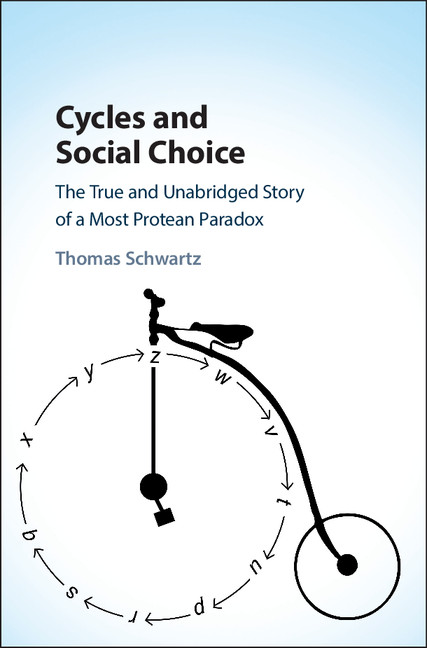
    The centuries-old paradox of voting is that majorities sometimes prefer x to y, y to z, and z to x - a cycle. The discovery of the sources and consequences of such cycles, under majority rule and countless other regimes, constitutes much of the mathematical theory of voting and social choice. This book explores the big questions posed by the paradox of voting: positive questions about how to predict outcomes and explain observed stability, and normative questions about how to hold elections, how to take account of preference intensities, the relevance of social welfare to social choice, and challenges to formal 'rationality', individual and social. The overall lesson is that cycles are facts, ubiquitous, and consequential in non-obvious ways, not puzzles to be solved, much less maladies or misfortunes to be avoided or regretted.

    Reviews

    ‘Thomas Schwartz reveals the mysteries of voting cycles, including their connections to famous results in social choice theory and game theory. Instead of bewailing cycles as incoherent, he casts them in a penetrating, positive light. Additionally, Cycles and Social Choice illuminates the philosophical implications of cycles for democratic rule, and their empirical ramifications for such political institutions as legislatures and political parties.'

    Steven J. Brams - New York University

    ‘Thomas Schwartz has been one of the handful of most important political science scholars in the formal study of properties of voting and social choice. He has made seminal contributions on topics such as logrolling, agenda manipulation, dimensionality of voting, and cycle sets. This book provides an integrated treatment of Schwartz's contributions over many decades. The ideas in it are relevant to anyone seriously interested in the study of democracy, regardless of whether their interests are primarily theoretical or primarily empirical.'

    Bernard Grofman - Jack W. Peltason Endowed Chair of Democracy Studies, University of California, Irvine

    Refine List

    Actions for selected content:

    Select all | Deselect all
    • View selected items
    • Export citations
    • Download PDF (zip)
    • Save to Kindle
    • Save to Dropbox
    • Save to Google Drive

    Save Search

    You can save your searches here and later view and run them again in "My saved searches".

    Please provide a title, maximum of 40 characters.
    ×

    Contents

    References

    Aldrich, John H. 1995. Why Parties? Chicago: University of Chicago Press.10.7208/chicago/9780226012773.001.0001
    Aleman, Eduardo, and Schwartz, Thomas. 2006. “Presidential Vetoes in Latin American Constitutions.” Journal of Theoretical Politics 18: 98120.10.1177/0951629806059598
    Arrow, Kenneth J. 1950. “A Difficulty in the Concept of Social Welfare.” Journal of Political Economy 58: 32834610.1086/256963
    Arrow, Kenneth J. 1952. Social Choice and Individual Values. 1st edn. New York: Wiley
    Arrow, Kenneth J. 1959. “Rational Choice Functions and Orderings.” Economica [N.S.] 26: 121127.10.2307/2550390
    Arrow, Kenneth J. 1963. Social Choice and Individual Values. 2nd edn. New Haven, CT: Yale University Press. First edition published by Wiley, , 1951.
    Arrow, Kenneth J. and Reynaud, Hervé. 1986. Social Choice and Multicriterion Decision-Making. Cambridge, MA: MIT Press.
    Balinski, Michel, and Laraki, Rida. 2010. Majority Judgment. Cambridge, MA: MIT Press.
    Banks, Jeffrey S. 1985. “Sophisticated Voting Outcomes and Agenda Control.” Social Choice and Welfare 2: 295306.10.1007/BF00649265
    Bernholz, Peter. 1973. “Logrolling, Arrow Paradox and Cyclical Majorities.” Public Choice 15: 8795.10.1007/BF01718844
    Bernholz, Peter. 1974. “Logrolling, Arrow Paradox and Decision Rules – A Generalization.” Kyklos 27: 4961.
    Black, Duncan. 1948. “On the Rationale of Group Decision-Making.” Journal of Political Economy 56: 2324.10.1086/256633
    Black, Duncan. 1958. Theory of Committees and Elections. Cambridge: Cambridge University Press.
    Black, Duncan and Newing, R. A.. 1951. Committee Decisions with Complementary Valuation. London: William Hodge.
    Blau, Julian H. 1957. “The Existence of Social Welfare Functions.” Econometrica 25: 302313.10.2307/1910256
    Borda, Jean-Charles. 1781. “Memoires sur les Électroniques au Scrutin.” Histoires de l’Academie Royale des Sciences. English translation by de Grazia, A.. “Mathematical Derivation of an Election System.” Iris 44 (1953).
    Brams, Steven and Fishburn, Peter. 1983. “Paradoxes of Preferential Voting.” Mathematical Magazine 56: 207214.
    Brandt, F., Fischer, F., and Harrenstein, P.. 2009. “A Computational Analysis of the Tournament Equilibrium Set.” Social Choice and Welfare 34: 597609.10.1007/s00355-009-0419-z
    Brandt, F., Fischer, F., and Harrenstein, P.. 2009. “The Computational Complexity of Choice Sets.” Mathematical Logic Quarterly 55: 444459.10.1002/malq.200810027
    Brandt, F., Brill, M., Fischer, F., and Harrenstein, P.. 2014. “Minimal Retentive Sets in Tournaments.” Social Choice and Welfare 42: 551574.
    Brandt, F., Chudnovsky, M., Kim, I., Norin, S., Scott, A., Seymour, P., Thomassé, S., and Montpelier, F.. 2011. “A Counterexample to a Conjecture of Schwartz.” Social Choice and Welfare 40: 739743.10.1007/s00355-011-0638-y
    Brown, Donald J. 1975. “Aggregation of Preferences.” Quarterly Journal of Economics 89: 456469.10.2307/1885263
    Buchanan, James M. and Tullock, Gordon. 1962. The Calculus of Consent. Ann Arbor, MI: University of Michigan Press.
    Chernoff, Herman. 1954. “Rational Selection of Decision Functions.” Econometrica 22: 422443.
    Condorcet, the Marquis de. 1785. Essai sur l’application de l’analyse à la probabilité des decisions rendues à la pluralité des voix. Paris. Trans. as “Essay on the Application of Mathematics to the theory of Decision Making.” In Baker, K., ed., Condorcet, Selected Writings. Indianapolis: Bobbs-Merrill, 1976.
    Cox, Gary. 1987. “The Uncovered Set and the Core.” American Journal of Political Science 31: 408422.10.2307/2111082
    Davis, Otto A. and Hinich, Melvin J.. 1966. “A Mathematical Model of Policy Formation in a Democratic Society.” In Joseph, Bernd, ed., Mathematical Applications in Political Science, Vol. II. Dallas, TX: Southern Methodist University Press, pp. 175208.
    Deb, Rajat. 1977. “On Schwartz’s Rule.” Journal of Economic Theory 16: 103110.10.1016/0022-0531(77)90125-9
    Downs, Anthony. 1957. An Economic Theory of Democracy. New York: Harper & Row.
    Duggan, John and Schwartz, Thomas. 2000. “Strategic Manipulation without Resoluteness or Shared Beliefs: Gibbard-Satterthwaite Generalized.” Social Choice and Welfare 17: 8593.10.1007/PL00007177
    Dutta, Baskar. 1988. “Covering Sets and a New Condorcet Choice Correspondence.” Journal of Economic Theory 44: 6368.
    Dutta, Baskar. 1990. “On the Tournament Equilibrium Set.” Social Choice and Welfare 7: 381383.
    Duverger, Maurice. 1959. “Political Parties.Political Science 31: 408422.
    Enelow, James M. and Hinich, Melvin. 1984. An Introduction to the Spatial Theory of Voting. Cambridge: Cambridge University Press.
    Farquharson, Robin. 1969. Theory of Voting. New Haven, CT: Yale University Press.
    Ferejohn, John. 1985. “Logrolling in an Institutional Context: A Case Study of Food Stamps Legislation.” Unpublished MS. Stanford University, California.
    Ferejohn, John A. and Grether, David. 1974. “On a Class of Rational Social Decision Procedures.” Journal of Economic Theory 8: 471482.10.1016/0022-0531(74)90022-2
    Ferejohn, John A. and Fishburn, Peter C.. 1979. “Representation of Binary Decision Rules by Generalized Decision Structures.” Journal of Economic Theory 21: 2845.
    Fishburn, Peter C. 1973. The Theory of Social Choice. Princeton, NJ: Princeton University Press.
    Fishburn, Peter C. 1977. “Condorcet Social Choice Functions.” Siam Journal of Applied Mathematics 33: 469489.10.1137/0133030
    Fishburn, Peter C. and Brams, Steven J.. 1978. “Approval Voting.” American Political Science Review 72: 831847.
    Gehrlein, William V. 1983. “Condorcet’s Paradox.” Theory and Decision 15: 161197.10.1007/BF00143070
    Gibbard, Allan. 1973. “Manipulation of Voting Schemes: A General Result.” Econometrica 41: 587601.
    Hammond, Thomas. 1986. “Agenda Control, Organizational Structure, and Bureaucratic Politics.” American Journal of Political Science 30: 379420.
    Hammond, Thomas, and Miller, Gary. 1987. “The Core of the Constitution.” American Political Science Review 81: 11551175.10.2307/1962583
    Hoag, Clarence, G. and Hallet, George H. Jr. 1926. Proportional Representation. New York: Macmillan.
    Hotelling, Harold. 1929. “Stability in Competition.” The Economic Journal 39: 4157. Reprinted in Stigler, George J. and Boulding, Kenneth E., eds., Readings in Price Theory, Chicago, IL: Irwin, 1952, pp. 467485.
    Houy, N. 2009. “Still More on the Tournament Equilibrium Set.” Social Choice and Welfare 32: 9399.
    Inada, K.-I. 1969. “On the Simple Majority Decision Rule.” Econometrica 37: 490506.10.2307/1912796
    International Conference on Autonomous Agents and Multiagent Systems (AAMAS 2010). Toronto.
    Kadane, J. B. 1972. “On Division of the Question.” Public Choice 13: 4754.10.1007/BF01718851
    Koford, Kenneth. 1989. “Dimensions in Congressional Voting.” American Political Science Review 83: 949962.10.2307/1962068
    Krehbiel, Keith. 1998. Pivotal Politics: A Theory of U.S. Lawmaking: Chicago, IL: University of Chicago Press.10.7208/chicago/9780226452739.001.0001
    Lafford, G., Laslier, J-F., and Le Breton, M.. 1993. “More on the Tournament Equilibrium Set.” Mathématiques et Science Humaines 31: 3744.
    Lasslier, J.-F. 1997. Soultions and Majority Voting. Berlin: Springer.10.1007/978-3-642-60805-6
    Mas-Colell, Andreu and Sonnenschein, Hugo F.. 1972. “General Possibility Theorems for Group Decisions.” Review of Economic Studies 39: 185192.10.2307/2296870
    Maskin, Eric. 1999. “Nash Equilibrium and Welfare Optimality.” Review of Economic Studies 66: 2338.10.1111/1467-937X.00076
    May, K. O. 1954. “Intransitivity, Utility and the Aggregation of Preference Patterns.” Econometrica 22: 113.10.2307/1909827
    McGarvey, D. C. 1953. “A Theorem on the Construction of Voting Paradoxes.” Econometrica 21: 608610.10.2307/1907926
    McKelvey, Richard D. 1976. “Intransitivities in Multidimensional Voting Models, and Some Implications for Agenda Control.” Journal of Economic Theory 2: 472482.
    McKelvey, Richard D. and Schofield, Norman. 1987. “Generalized Symmetry Conditions at a Core Point.” Econometrica 55: 923933.10.2307/1911036
    McKelvey, Richard D. and Niemi, Richard. 1978. “A Multi-Stage Game Representation of Sophisticated Voting for Binary Procedures.” Journal of Economic Theory 18: 122.10.1016/0022-0531(78)90039-X
    McLean, Iain and Urken, Arnold B.. 1995. Classics of Social Choice. Ann Arbor, MI: University of Michigan Press.10.3998/mpub.12736
    Miller, Nicholas. 1980. “A New Solution Set for Tournaments and Majority Voting: Further Graph Theoretical Approaches to the Theory of Voting.” American Journal of Political Science 24: 6896.10.2307/2110925
    Moser, Scott. 2012. “A Note on Contestation-Based Tournament Solutions.” Social Choice and Welfare 41: 133143.10.1007/s00355-012-0672-4
    Moser, Scott and Allock, Daniel. 2013. “Binary Relations from Tournament Solutions, and Back Again.” Unpublished MS, University of Texas+.10.2139/ssrn.2261959
    Moulin, Hervé. 1979. “Dominance-Solvable Voting Schemes.” Econometrica 47: 11341151.10.2307/1914004
    Moulin, Hervé. 1986. “Choosing from a Tournament.” Social Choice and Welfare 3: 271291.10.1007/BF00292732
    Nakamura, K. 1979. “The Vetoers in a Simple Game with Ordinal Preferences.” International Journal of Game Theory 8: 5561.
    Nash, John F. 1950. “The Bargaining Problem.” Econometrica 18: 155162.10.2307/1907266
    Oppenheimer, Joe A. 1975. “Some Political Implications of ‘Vote Trading and the Voting Paradox: A Proof of Logical Equivalence.’” American Political Science Review 69: 963966.10.2307/1958412
    Ordeshook, Peter C. and Schwartz, Thomas. 1987. “Agendas and the Control of Political Outcomes.” American Political Science Review 81: 179199.10.2307/1960784
    Packard, Dennis J. 1975a. “A Note on Wiitgenstein and Cyclical Comparatives.” Analysis 36: 3740.10.1093/analys/36.1.37
    Packard, Dennis J. 1975b. “On the Impossibility of Measurement.” Utah Academy Proceedings 52 (2): 3643.
    Packard, Dennis J. 1975c. “Social Choice Theory and Citizens’ Intransitive Weak Preference.” Public Choice 22: 107111.
    Packard, Dennis J. 1982. “Cyclical Preference Logic.” Theory and Decision 14: 415426.10.1007/BF00126177
    Pattanaik, Prasanta K. 1971. Voting and Collective Choice. London and New York: Cambridge University Press.
    Plott, Charles. 1967. “A Notion of Equilibrium and Its Possibility under Majority Rule.” American Economic Review 57: 788806.
    Plott, Charles. 1976. “Axiomatic Social Choice Theory: An Overview and Interpretation.” American Journal of Political Science 20: 511596.10.2307/2110686
    Poole, Keith and Rosenthal, Howard. 1985. “A Spatial Model for Legislative Roll Call Analysis.” American Journal of Political Science 29: 357384.10.2307/2111172
    Poole, Keith and Rosenthal, Howard. 1997. Congress. Oxford: Oxford University Press.
    Romer, Thomas and Rosenthal, Howard. 1978. “Political Resource Allocation, Controlled Agendas and the Status Quo.” Public Choice 33: 2743.10.1007/BF03187594
    Saari, Donald. 2006. “Which is Better: The Condorcet or Borda Winner?Social Choice and Welfare 26: 107130.10.1007/s00355-005-0046-2
    Satterthwaite, Mark A. 1975. “Strategy-Proofness and Arrow’s Conditions: Existence and Correspondence Theorems for Voting Procedures and Social Welfare Functions.Journal of Economic Theory 10: 187217.10.1016/0022-0531(75)90050-2
    Schofield, Norman. 1978. “Instability of Simple Dynamic Games.” Review of Economic Studies 45: 575594.10.2307/2297259
    Schwartz, Thomas. 1970. “On the Possibility of Rational Policy Evaluation.” Theory and Decision 1: 89106.
    Schwartz, Thomas. 1972. “Rationality and the Myth of the Maximum.” Nous 6: 97117.10.2307/2216143
    Schwartz, Thomas. 1977. “Collective Choice, Separation of Issues, and Vote Trading.” American Political Science Review 71: 9991010.10.2307/1960103
    Schwartz, Thomas. 1981. “The Universal Instability Theorem.” Public Choice 37: 487501.10.1007/BF00133747
    Schwartz, Thomas. 1982a. “Human Welfare: What It Is Not.” In Miller, Harlan and Williams, William, eds., The Limits of Utilitarianism, pp. 195206. Minneapolis, MN: University of Minnesota Press.
    Schwartz, Thomas. 1982b. “A Really General Impossibility Theorem.” Quality and Quantity 16: 493505.
    Schwartz, Thomas. 1986. The Logic of Collective Choice. New York: Columbia University Press10.7312/schw93758
    Schwartz, Thomas. 1990. “Cyclic Tournaments and Cooperative Majority Voting: A Solution.” Social Choice and Welfare 7: 19292.10.1007/BF01832917
    Schwartz, Thomas. 1994. “The Paradox of Representation.” The Journal of Politics 57: 309323.10.2307/2960308
    Schwartz, Thomas. 1999. “The Executive Veto: Purpose, Procedure, and Paradox.” Constitutional Political Economy 10: 89105.10.1023/A:1009002632048
    Schwartz, Thomas. 2001. “From Arrow to Cycles, Instability, and Chaos by Untying Alternatives.” Social Choice and Welfare 18: 122.10.1007/PL00007179
    Schwartz, Thomas. 2004. “Vetoes Overridable by Simple Majorities.” Constitutional Political Economy 15: 383389.10.1007/s10602-004-7770-y
    Schwartz, Thomas. 2007. “A Procedural Condition Necessary and Sufficient for Cyclic Social Preference.” Journal of Economic Theory 37: 688695.10.1016/j.jet.2006.06.002
    Schwartz, Thomas. 2008. “Parliamentary Procedure: Principal Forms and Political Effects.” Public Choice 36: 353377.10.1007/s11127-008-9300-3
    Schwartz, Thomas. 2011. “One-Dimensionality and Stability in Legislative Voting.” Public Choice 48: 197214.10.1007/s11127-010-9652-3
    Schwartz, Thomas. 2011. “Social Choice and Individual Values in the Electronic Republic.” Social Choice and Welfare 37: 621632.10.1007/s00355-011-0580-z
    Schwartz, Thomas. 2015. “Rational Interplay: A Philosophical Critique and Revision of Nash Equilibrium.Journal of Business and Economics 20: 680684.
    Sen, Amartya K. 1970a. Collective Choice and Social Welfare. San Francisco: Holden-Day.
    Sen, Amartya. 1970b. “The Impossibility of a Paretian Liberal.” Journal of Political Economy 78: 152157.10.1086/259614
    Sen, Amartya K. and Pattanaik, Prasanta. 1969. “Necessary and Sufficient Conditions for Rational Choice Under Majority Decision.” Journal of Economic Theory 1: 178202.10.1016/0022-0531(69)90020-9
    Shepsle, Kenneth A. 1979. “Institutional Arrangements and Equilibrium in Multidimensional Voting Models.” American Journal of Political Science 23: 2759.10.2307/2110770
    Shepsle, Kenneth A. and Weingast, Barry. 1981. “Structure-Induced Equilibrium and Legislative Choice.” Public Choice 37: 503519.10.1007/BF00133748
    Smith, W. D. 2000. “Range Voting.” wds/homepage/rangevote.pdf.
    Taylor, Alan D. 2002. “The Manipulability of Voting Systems.” The American Mathematics Monthly 109: 321337.10.1080/00029890.2002.11920895
    Taylor, Alan D. 2005. Social Choice and the Mathematics of Manipulation. Cambridge: Cambridge University Press.10.1017/CBO9780511614316
    Taylor, Alan D. and Pacelli, Allison M.. 2008. Mathematics and Politics. New York: Springer.
    Tsebelis, George. 2002. Veto Players: How Political Institutions Work. Princeton, NJ: Princeton University Press.10.1515/9781400831456
    Tullock, Gordon. 1981. “Why So Much Stability?Public Choice 37: 189204.10.1007/BF00138239
    Tversky, Amos. 1969. “Intransitivity of Preferences.” Psychological Review 76: 3148.10.1037/h0026750
    Ward, Benjamin. 1960. “Majority Rule and Allocation.” Journal of Conflict Resolution 5: 380389.
    Wilson, Robert. 1972a. “The Game-Theoretic Structure of Arrow’s General Possibility Theorem.” Journal of Economic Theory 5: 1420.10.1016/0022-0531(72)90115-9
    Young, H. P. 1974. “An Axiomatization of Borda’s Rule.” Journal of Economic Theory 9: 4352.10.1016/0022-0531(74)90073-8

    Metrics

    Full text views

    Total number of HTML views: 0
    Total number of PDF views: 0 *
    Loading metrics...

    Book summary page views

    Total views: 0 *
    Loading metrics...

    * Views captured on Cambridge Core between #date#. This data will be updated every 24 hours.

    Usage data cannot currently be displayed.

    Accessibility standard: Unknown

    Why this information is here

    This section outlines the accessibility features of this content - including support for screen readers, full keyboard navigation and high-contrast display options. This may not be relevant for you.

    Accessibility Information

    Accessibility compliance for the HTML of this book is currently unknown and may be updated in the future.
