
Skip to main content Accessibility help
×
  • Cited by 28
    • Show more authors
    • You may already have access via personal or institutional login
    • Select format
    • Publisher:
      Cambridge University Press
      Publication date:
      04 July 2017
      27 April 2017
      ISBN:
      9781316946312
      9781107188020
      9781316638392
      Dimensions:
      (228 x 152 mm)
      Weight & Pages:
      0.77kg, 402 Pages
      Dimensions:
      (229 x 152 mm)
      Weight & Pages:
      0.59kg, 406 Pages
    You may already have access via personal or institutional login
  • Selected: Digital
    Add to cart View cart Buy from Cambridge.org

    Book description

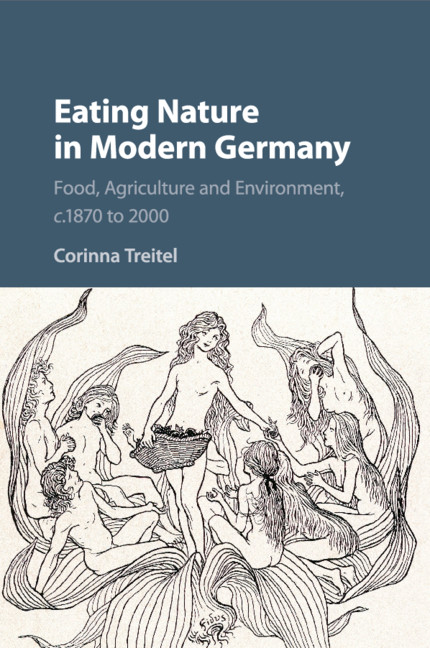
    Adolf Hitler was a vegetarian and the Dachau concentration camp had an organic herb garden. Vegetarianism, organic farming, and other such practices have enticed a wide variety of Germans, from socialists, liberals, and radical anti-Semites in the nineteenth century to fascists, communists, and Greens in the twentieth century. Corinna Treitel offers a fascinating new account of how Germans became world leaders in developing more 'natural' ways to eat and farm. Used to conserve nutritional resources with extreme efficiency at times of hunger and to optimize the nation's health at times of nutritional abundance, natural foods and farming belong to the biopolitics of German modernity. Eating Nature in Modern Germany brings together histories of science, medicine, agriculture, the environment, and popular culture to offer the most thorough and historically comprehensive treatment yet of this remarkable story.

    Reviews

    'Corinna Treitel has written a highly readable and informative book … She shows how important life reform was for the development of modern alternative diets and at the same time makes clear that a decades-long dynamic of criticism and co-optation between vastly different actors propelled the consolidation and wide dissemination of the 'natural diet'.'

    Laura-Elena Keck Source: translated from H-Soz-Kult (www.hsozkult.de)

    '… well written and carefully researched … Treitel’s examination of the discourse on eating naturally challenges our understanding of biopolitics by arguing that biopolitics is the result of both popular impulse to self-rule as well as authoritarian attempts to coerce and as such is coproduced by laypeople and experts.'

    Gesine Gerhard Source: The Journal of Modern History

    'Corinna Treitel’s impressive study roundly dispels any notion that nutrition expertise is becoming irrelevant … provides an empirically rich account of the many ways in which more natural eating became acceptable, co-opted, and mainstreamed - if one wishes to use the word in a country whose love of meat endures in the twenty-first century.'

    Frank Uekoetter Source: H-Net

    ‘The book does not only offer a convincing account of eating naturally in modern German history, but also succeeds in making important points: The call for living more naturally is not antimodern, as early historians of life reform have argued, but deeply connected with the modern world of science and consumption, lifestyle and individuality.’

    Thomas Rohkrämer Source: Journal of Religion in Europe

    Refine List

    Actions for selected content:

    Select all | Deselect all
    • View selected items
    • Export citations
    • Download PDF (zip)
    • Save to Kindle
    • Save to Dropbox
    • Save to Google Drive

    Save Search

    You can save your searches here and later view and run them again in "My saved searches".

    Please provide a title, maximum of 40 characters.
    ×

    Contents

    Metrics

    Altmetric attention score

    Full text views

    Total number of HTML views: 0
    Total number of PDF views: 0 *
    Loading metrics...

    Book summary page views

    Total views: 0 *
    Loading metrics...

    * Views captured on Cambridge Core between #date#. This data will be updated every 24 hours.

    Usage data cannot currently be displayed.

    Accessibility standard: Unknown

    Why this information is here

    This section outlines the accessibility features of this content - including support for screen readers, full keyboard navigation and high-contrast display options. This may not be relevant for you.

    Accessibility Information

    Accessibility compliance for the HTML of this book is currently unknown and may be updated in the future.
